MyCompetitiveExams Logo MyCompetitiveExams
Search 1,140+ Questions
Chapters, formulas, speed tricks
→
⚡ Brahmastra NEET 2027
720 MARKS

Dynamic 180-question full-length simulator mixed dynamically from all 6 years for 2027 & 2026 aspirants.

Launch Brahmastra 2027 Test →
Start Practice →
100% Free · No Login Required
✓ NTA Official Final Answer Key Booklet Code: M1 200 Questions · 720 Marks

NEET 2021 Question Paper Step-by-Step Solutions

Comprehensive, authoritative solutions directory for all 200 questions across Physics, Chemistry, Botany, and Zoology. Features verified official answer keys, 30-second shortcut hacks, and step-by-step NCERT derivations.

Filter Solutions:
Q1 physics PHYSICS ⚡ 30s Speed Trick Active
Full Standalone Page ↗
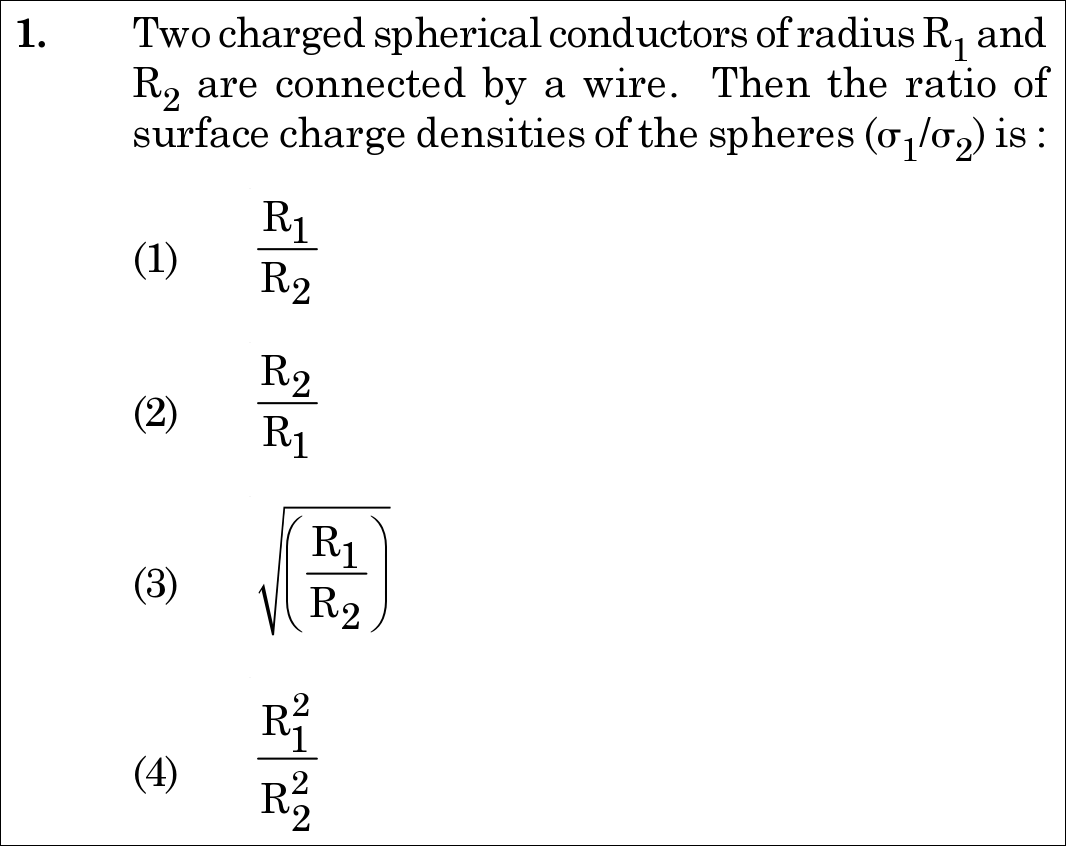
NEET 2021 physics Question 1
✓
Official NTA Final Answer Key
Option (2) · R2 / R1
Marks: +4 if correct / -1 if incorrect
⚡

The 30-Second Exam Hall Shortcut: ⚡ Potential Equality Shortcut: σ ∝ 1/R

⏱️ Saves Save ~25 seconds

For any spherical conductor at potential V, V=σRε0=constantV = \frac{\sigma R}{\varepsilon_0} = \text{constant}. Therefore, surface charge density is inversely proportional to radius: σ∝1R  ⟹  σ1σ2=R2R1\sigma \propto \frac{1}{R} \implies \frac{\sigma_1}{\sigma_2} = \frac{R_2}{R_1}! Instant 5-second answer matching Option (2)!

1 When connected by a wire, charge redistributes until electric potentials equalize: V1=V2V_1 = V_2.
2 Express potential in terms of surface charge density: V=q4πε0R=σ(4πR2)4πε0R=σRε0V = \frac{q}{4\pi\varepsilon_0 R} = \frac{\sigma (4\pi R^2)}{4\pi\varepsilon_0 R} = \frac{\sigma R}{\varepsilon_0}.
3 Since V1=V2V_1 = V_2, we have σ1R1ε0=σ2R2ε0\frac{\sigma_1 R_1}{\varepsilon_0} = \frac{\sigma_2 R_2}{\varepsilon_0}.
4 Therefore, σ1σ2=R2R1\frac{\sigma_1}{\sigma_2} = \frac{R_2}{R_1}.
5 Match Option (2).
📐

Step-by-Step Conceptual & Mathematical Derivation

Step 1
Condition for Electrostatic Equilibrium of Connected Spheres

When two conducting spheres of radii R1R_1 and R2R_2 are joined by a thin conducting wire, free electrons flow between them until they reach an identical electrostatic potential VV:

V1=V2  ⟹  14πε0q1R1=14πε0q2R2  ⟹  q1q2=R1R2V_1 = V_2 \implies \frac{1}{4\pi\varepsilon_0} \frac{q_1}{R_1} = \frac{1}{4\pi\varepsilon_0} \frac{q_2}{R_2} \implies \frac{q_1}{q_2} = \frac{R_1}{R_2}
Step 2
Relating Charge to Surface Charge Density

Surface charge density σ\sigma is defined as the total charge per unit spherical surface area A=4πR2A = 4\pi R^2:

σ1=q14πR12,σ2=q24πR22\sigma_1 = \frac{q_1}{4\pi R_1^2}, \quad \sigma_2 = \frac{q_2}{4\pi R_2^2}
Step 3
Computing the Ratio of Surface Charge Densities

Substitute the charge ratio q1/q2=R1/R2q_1 / q_2 = R_1 / R_2 into the density ratio:

σ1σ2=(q1q2)×(R22R12)=(R1R2)×(R22R12)=R2R1\frac{\sigma_1}{\sigma_2} = \left(\frac{q_1}{q_2}\right) \times \left(\frac{R_2^2}{R_1^2}\right) = \left(\frac{R_1}{R_2}\right) \times \left(\frac{R_2^2}{R_1^2}\right) = \frac{R_2}{R_1}
🔍 View 360° Option Elimination Analysis & NTA Trap Alert ▼
Option (1) : 1 ✗ Incorrect

This represents the ratio of charges (q1/q2q_1/q_2), not the ratio of surface charge densities (sigma1/sigma2sigma_1/sigma_2).
Student Fallacy: Confusing charge ratio with surface charge density ratio.
Option (2) : 2 ✓ Correct

Exact mathematical outcome derived from V1=V2impliessigma1R1=sigma2R2impliessigma1/sigma2=R2/R1V_1 = V_2 implies sigma_1 R_1 = sigma_2 R_2 implies sigma_1/sigma_2 = R_2/R_1.

Why correct: None; rigorous electrostatics derivation.
Option (3) : 3 ✗ Incorrect

Square-root dependence is unphysical for potential-charge relationships.

Student Fallacy: Erroneously introducing square roots from capacitive energy equations.
Option (4) : 4 ✗ Incorrect

This would occur if the spheres had identical charges (q1=q2q_1 = q_2), which is false for connected conductors of unequal radii.

Student Fallacy: Assuming charge remains unchanged instead of redistributing to equal potentials.
⚠️ NTA Trap Alert: Equal Charge vs. Equal Potential Trap

Students frequently assume connecting two spheres distributes charge equally (q1=q2q_1 = q_2). Connected conductors always equalize electric POTENTIAL (V1=V2V_1 = V_2), which means the smaller sphere has higher surface charge density (sharper curvature = greater σ\sigma).
🛡️ How to avoid negative mark: Remember: Connected by wire   ⟹  \implies equal POTENTIAL (VV), NOT equal charge (qq). σ∝1/R\sigma \propto 1/R.
Topic: Physics (Section A) ⚡ 30s Speed Trick Available
👁️ Open Dedicated Full Screen Page & Notes ↗
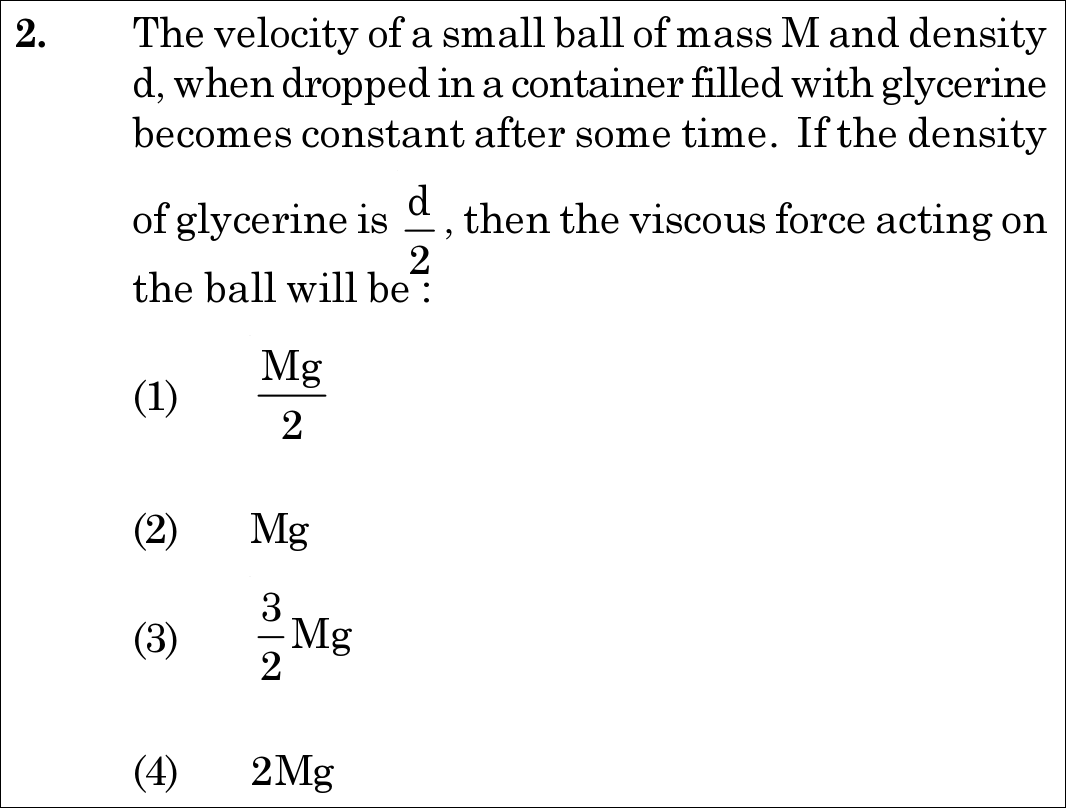
Q2 physics PHYSICS ⚡ 30s Speed Trick Active
Full Standalone Page ↗
NEET 2021 physics Question 2
✓
Official NTA Final Answer Key
Option (1) · Mg / 2
Marks: +4 if correct / -1 if incorrect
⚡

The 30-Second Exam Hall Shortcut: ⚡ Terminal Equilibrium: F_v = Weight - Upthrust

⏱️ Saves Save ~20 seconds

At terminal velocity, acceleration is zero: W=FB+FvW = F_B + F_v. Since liquid density is half of ball density (dL=d/2d_L = d/2), the buoyant force is exactly half of the ball weight (FB=W/2F_B = W/2). Thus, the viscous force must support the other half: Fv=W−W/2=Mg/2F_v = W - W/2 = Mg/2! Match Option (1)!

1 Constant velocity   ⟹  a=0  ⟹  \implies a = 0 \implies net vertical force =0= 0.
2 Weight acting downward: W=MgW = Mg.
3 Upward buoyant force: FB=ρLρMg=d/2dMg=Mg2F_B = \frac{\rho_L}{\rho} Mg = \frac{d/2}{d} Mg = \frac{Mg}{2}.
4 Upward viscous force: Fv=W−FB=Mg−Mg2=Mg2F_v = W - F_B = Mg - \frac{Mg}{2} = \frac{Mg}{2}.
5 Match Option (1).
📐

Step-by-Step Conceptual & Mathematical Derivation

Step 1
Formulating the Equilibrium Condition at Terminal Velocity

When the small sphere attains a constant terminal velocity (vtv_t), its downward acceleration is zero (a=0a = 0). By Newton's second law, the downward gravitational force is perfectly balanced by the sum of upward buoyant force (FBF_B) and upward viscous drag (FvF_v):

ΣFy=0  ⟹  W=FB+Fv  ⟹  Fv=W−FB\Sigma F_y = 0 \implies W = F_B + F_v \implies F_v = W - F_B
Step 2
Calculating Weight and Buoyant Force

Let VV be the volume of the sphere. The mass is M=V⋅dM = V \cdot d, so V=M/dV = M / d. The weight is W=MgW = Mg. The buoyant force exerted by glycerine of density ρL=d/2\rho_L = d/2 is:

FB=V⋅ρL⋅g=(Md)(d2)g=Mg2F_B = V \cdot \rho_L \cdot g = \left(\frac{M}{d}\right) \left(\frac{d}{2}\right) g = \frac{Mg}{2}
Step 3
Determining the Viscous Force

Substitute W=MgW = Mg and FB=Mg/2F_B = Mg/2 into the force balance equation:

Fv=Mg−Mg2=Mg2F_v = Mg - \frac{Mg}{2} = \frac{Mg}{2}
🔍 View 360° Option Elimination Analysis & NTA Trap Alert ▼
Option (1) : 1 ✓ Correct

Exact balance of forces: Viscous force = Weight - Buoyant force = Mg - Mg/2 = Mg/2.

Why correct: None; textbook equilibrium derivation.
Option (2) : 2 ✗ Incorrect

Ignores the buoyant force completely (FB=0F_B = 0), which is only valid in vacuum.

Student Fallacy: Equating viscous force directly to gravitational weight without subtracting upthrust.
Option (3) : 3 ✗ Incorrect

Incorrectly adds buoyant force to weight (W+FB=Mg+Mg/2=3Mg/2W + F_B = Mg + Mg/2 = 3Mg/2).

Student Fallacy: Adding forces in the wrong direction instead of subtracting upward buoyant force.
Option (4) : 4 ✗ Incorrect

Inverts density ratio and adds unphysical multipliers.

Student Fallacy: Multiplying by density ratio inverse.
⚠️ NTA Trap Alert: Forgetting Archimedes Upthrust in Viscous Fluid Trap

Students often memorize Stokes' law (6πηrv6\pi\eta r v) and assume the viscous force equals MgMg directly, forgetting that the fluid also exerts a hydrostatic buoyant force that carries half the weight.

🛡️ How to avoid negative mark: Always draw the FBD: Downward = MgMg; Upward = FB+FvF_B + F_v. At constant speed, Fv=Mg−FBF_v = Mg - F_B.
Topic: Physics (Section A) ⚡ 30s Speed Trick Available
👁️ Open Dedicated Full Screen Page & Notes ↗
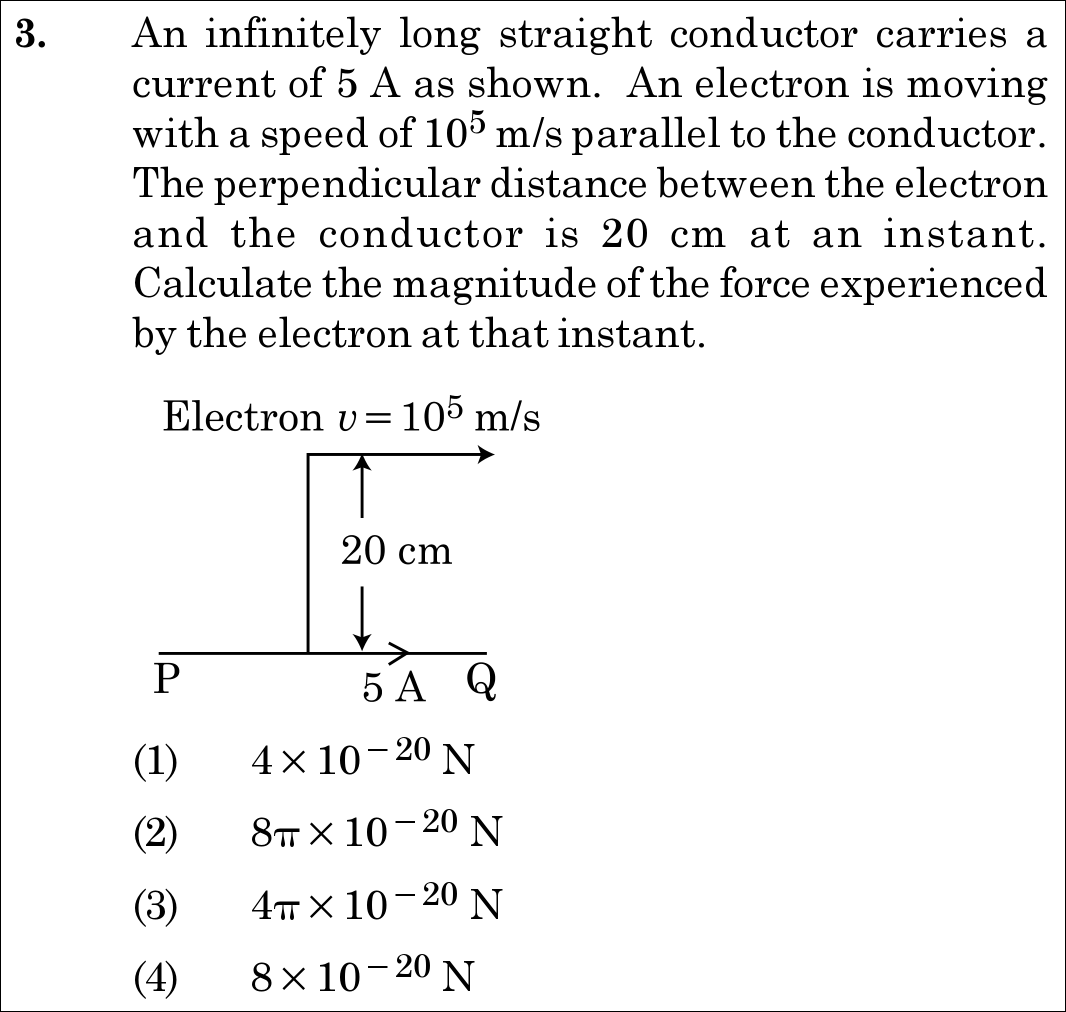
Q3 physics PHYSICS ⚡ 30s Speed Trick Active
Full Standalone Page ↗
NEET 2021 physics Question 3
✓
Official NTA Final Answer Key
Option (4) · 8 × 10^-20 N
Marks: +4 if correct / -1 if incorrect
⚡

The 30-Second Exam Hall Shortcut: ⚡ 2-Step Lorentz Force: B = μ0 I / (2π r), F = q v B

⏱️ Saves Save ~20 seconds

B=2×10−7×50.2=5×10−6 TB = \frac{2 \times 10^{-7} \times 5}{0.2} = 5 \times 10^{-6}\text{ T}. Force F=evB=(1.6×10−19)×(105)×(5×10−6)=8×10⁻²⁰ NF = e v B = (1.6 \times 10^{-19}) \times (10^5) \times (5 \times 10^{-6}) = 8 \times 10^{-20}\text{ N}! Instant 15-second calculation matching Option (4)!

1 Compute B from wire: B=μ0I2πr=(4π×10−7)(5)2π(0.2)=5×10−6 TB = \frac{\mu_0 I}{2\pi r} = \frac{(4\pi \times 10^{-7})(5)}{2\pi (0.2)} = 5 \times 10^{-6}\text{ T}.
2 Motion is parallel to wire, while B is perpendicular to the plane (θ=90∘\theta = 90^\circ).
3 Compute magnetic force: F=qvBsin⁡90∘=(1.6×10⁻¹⁹)(105)(5×10⁻⁶)F = q v B \sin 90^\circ = (1.6 \times 10^{-19})(10^5)(5 \times 10^{-6}).
4 F=8.0×10⁻²⁰ NF = 8.0 \times 10^{-20}\text{ N}.
5 Match Option (4).
📐

Step-by-Step Conceptual & Mathematical Derivation

Step 1
Calculating the Magnetic Field Produced by the Long Conductor

Using Ampere's circuital law / Biot-Savart law, the magnetic field at a perpendicular distance r=20 cm=0.2 mr = 20\text{ cm} = 0.2\text{ m} from a long wire carrying current I=5 AI = 5\text{ A} is:

B=μ0I2πr=4π×10−7×52π×0.2=2×10−7×50.2=5×10−6 TB = \frac{\mu_0 I}{2\pi r} = \frac{4\pi \times 10^{-7} \times 5}{2\pi \times 0.2} = \frac{2 \times 10^{-7} \times 5}{0.2} = 5 \times 10^{-6}\text{ T}
Step 2
Determining the Angle Between Velocity and Magnetic Field

By the right-hand thumb rule, for current flowing from P to Q (towards the right), the magnetic field above the wire points out of the page (k^\hat{k}). The electron moves parallel to the wire (i^\hat{i}). Therefore, v⃗⊥B⃗\vec{v} \perp \vec{B}, so θ=90∘\theta = 90^\circ and sin⁡90∘=1\sin 90^\circ = 1.

Step 3
Calculating the Magnitude of the Magnetic Force

The magnitude of the magnetic Lorentz force on the electron (q=1.6×10⁻¹⁹ Cq = 1.6 \times 10^{-19}\text{ C}) is:

F=∣q∣vBsin⁡90∘=(1.6×10⁻¹⁹ C)×(105 m/s)×(5×10−6 T)=8×10⁻²⁰ NF = |q| v B \sin 90^\circ = (1.6 \times 10^{-19}\text{ C}) \times (10^5\text{ m/s}) \times (5 \times 10^{-6}\text{ T}) = 8 \times 10^{-20}\text{ N}
🔍 View 360° Option Elimination Analysis & NTA Trap Alert ▼
Option (1) : 1 ✗ Incorrect

Result of an arithmetic factor of 2 error (using μ0/4π\mu_0 / 4\pi instead of μ0/2π\mu_0 / 2\pi).

Student Fallacy: Using the semi-infinite wire formula B=μ0I/4πrB = \mu_0 I / 4\pi r.
Option (2) : 2 ✗ Incorrect

Fails to cancel π\pi between μ0=4π×10−7\mu_0 = 4\pi \times 10^{-7} and the denominator 2π2\pi.

Student Fallacy: Forgetting that μ0/2π=2×10−7\mu_0 / 2\pi = 2 \times 10^{-7} without a leftover π\pi.
Option (3) : 3 ✗ Incorrect

Combines both the π\pi cancellation error and the semi-infinite wire error.

Student Fallacy: Double mathematical substitution error.
Option (4) : 4 ✓ Correct

Exact numerical result of the Lorentz force calculation.

Why correct: None; rigorous electrodynamics calculation.
⚠️ NTA Trap Alert: Pi Retention and Distance Unit Conversion Trap

Students frequently forget to convert 20 cm20\text{ cm} into 0.2 m0.2\text{ m}, leading to power of 10 errors, or they fail to cancel π\pi from the denominator of μ0/2πr\mu_0 / 2\pi r.

🛡️ How to avoid negative mark: Use μ02π=2×10⁻⁷ T⋅m/A\frac{\mu_0}{2\pi} = 2 \times 10^{-7}\text{ T}\cdot\text{m/A} directly; convert 20 cm=0.2 m20\text{ cm} = 0.2\text{ m}.
Topic: Physics (Section A) ⚡ 30s Speed Trick Available
👁️ Open Dedicated Full Screen Page & Notes ↗
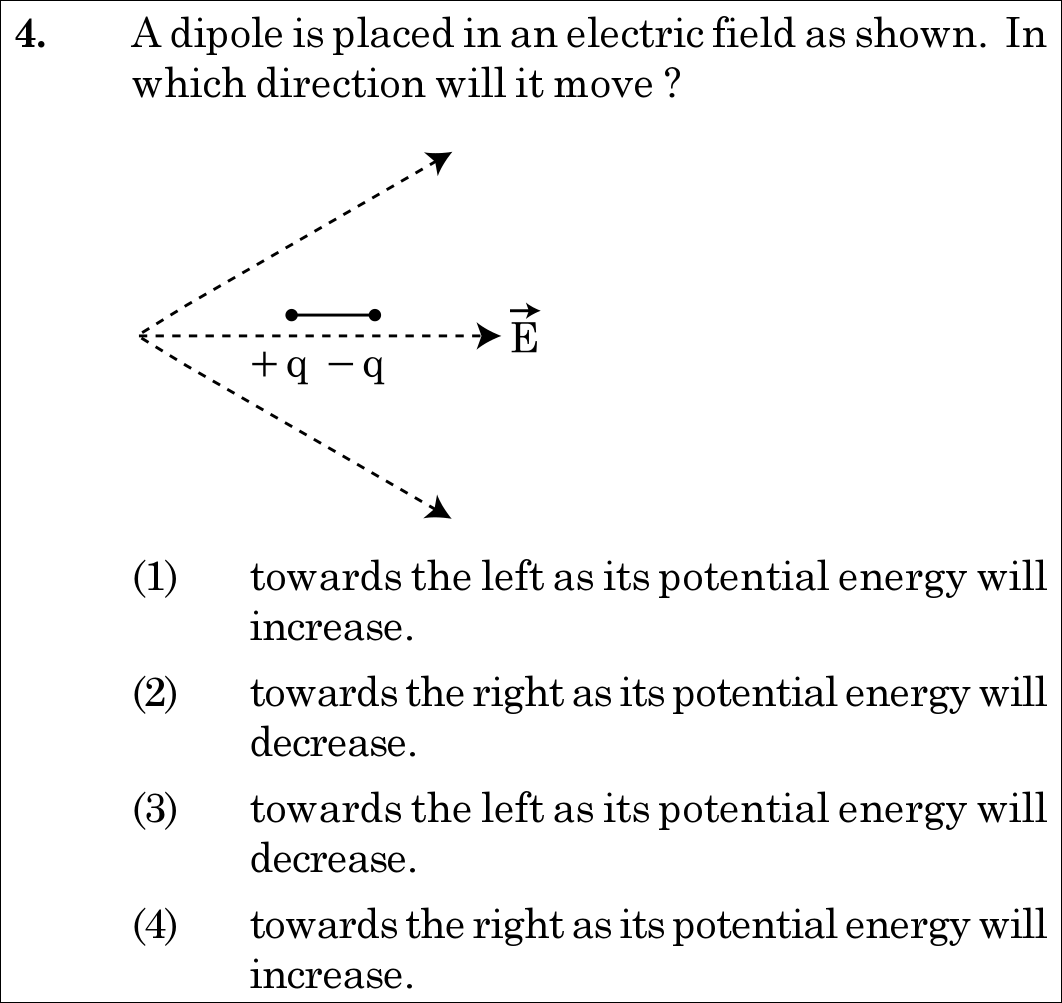
Q4 physics PHYSICS ⚡ 30s Speed Trick Active
Full Standalone Page ↗
NEET 2021 physics Question 4
✓
Official NTA Final Answer Key
Option (2) · towards the right as its potential energy will decrease.
Marks: +4 if correct / -1 if incorrect
⚡

The 30-Second Exam Hall Shortcut: ⚡ Field Density & Force Direction: F_net to the Right!

⏱️ Saves Save ~25 seconds

Field lines are denser on the left, so E1>E2E_1 > E_2. The positive charge +q+q experiences force qE1qE_1 to the RIGHT. The negative charge −q-q experiences force qE2qE_2 to the LEFT. Since E1>E2E_1 > E_2, net force is to the RIGHT! Every conservative system moves to DECREASE potential energy. Select Option (2)!

1 Denser field lines on left   ⟹  E+q>E−q\implies E_{+q} > E_{-q}.
2 Force on +q+q: F⃗+=qE⃗\vec{F}_+ = q\vec{E} points to the right (along E⃗\vec{E}).
3 Force on −q-q: F⃗−=−qE⃗\vec{F}_- = -q\vec{E} points to the left (opposite to E⃗\vec{E}).
4 Net force: Fnet=qE+q−qE−q>0F_{\text{net}} = qE_{+q} - qE_{-q} > 0 (directed towards the RIGHT).
5 Spontaneous motion under conservative electrostatic force always minimizes potential energy: ΔU<0\Delta U < 0.
6 Match Option (2) towards the right as its potential energy will decrease.
📐

Step-by-Step Conceptual & Mathematical Derivation

Step 1
Analyzing Field Strength from Field Line Density

The electric field lines diverge from a point to the left towards the right. By Faraday's field line principles, field intensity is proportional to the density of lines of force. Therefore, the field is stronger at the position of +q+q than at the position of −q-q:

E(+q)>E(−q)E_{(+q)} > E_{(-q)}
Step 2
Calculating the Net Electrostatic Force

Determine the individual forces on each charge: - Force on +q+q: F1=qE(+q)F_1 = q E_{(+q)} acting towards the right (in the direction of E⃗\vec{E}). - Force on −q-q: F2=qE(−q)F_2 = q E_{(-q)} acting towards the left (opposite to E⃗\vec{E}).

Fnet=F1−F2=q(E(+q)−E(−q))>0  ⟹  Net force is directed towards the RIGHTF_{\text{net}} = F_1 - F_2 = q \left(E_{(+q)} - E_{(-q)}\right) > 0 \implies \mathbf{\text{Net force is directed towards the RIGHT}}
Step 3
Thermodynamic and Mechanical Potential Energy Rule

For any conservative electrostatic system, the net force is the negative gradient of potential energy (F=−dU/dxF = -dU/dx). Any body accelerating in the direction of the net force moves toward a state of lower potential energy:

W=−ΔU  ⟹  ΔU=−FnetΔx<0  ⟹  Potential energy decreasesW = -\Delta U \implies \Delta U = -F_{\text{net}} \Delta x < 0 \implies \mathbf{\text{Potential energy decreases}}
🔍 View 360° Option Elimination Analysis & NTA Trap Alert ▼
Option (1) : 1 ✗ Incorrect

Inverts both force direction and spontaneous physical behavior (systems do not spontaneously move to increase potential energy).

Student Fallacy: Assuming negative charge pulls the dipole to the left.
Option (2) : 2 ✓ Correct

Exact physical deduction: net force is to the right because E+q>E−qE_{+q} > E_{-q}, and spontaneous acceleration minimizes potential energy.

Why correct: None; rigorous electrostatics and energy reasoning.
Option (3) : 3 ✗ Incorrect

Falsely identifies net force as pointing leftward.

Student Fallacy: Believing the wider field region attracts charges.
Option (4) : 4 ✗ Incorrect

Contradicts the fundamental mechanical relation F=−dU/dxF = -dU/dx (motion along net force decreases potential energy).

Student Fallacy: Assuming electrostatic repulsion increases potential energy.
⚠️ NTA Trap Alert: Potential Energy Direction Trap

Even students who correctly identify that the net force points to the right sometimes get trapped between Options (2) and (4) by thinking "moving into weaker field increases potential energy". Natural movement driven by the net force ALWAYS decreases potential energy.

🛡️ How to avoid negative mark: Universal Rule: Any object moving in the direction of the net conservative force ALWAYS experiences a DECREASE in potential energy (dU=−FdxdU = -F dx).
Topic: Physics (Section A) ⚡ 30s Speed Trick Available
👁️ Open Dedicated Full Screen Page & Notes ↗
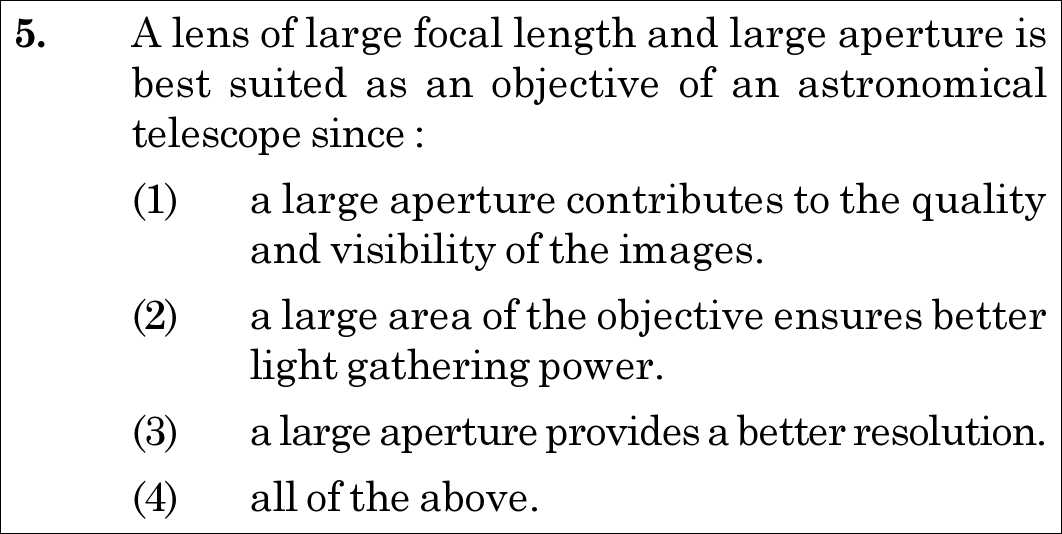
Q5 physics PHYSICS ⚡ 30s Speed Trick Active
Full Standalone Page ↗
NEET 2021 physics Question 5
✓
Official NTA Final Answer Key
Option (4) · all of the above.
Marks: +4 if correct / -1 if incorrect
⚡

The 30-Second Exam Hall Shortcut: ⚡ The "All of the Above" Telescope Triad

⏱️ Saves Save ~20 seconds

A large objective aperture DD provides: (1) Higher light-gathering power (A∝D2A \propto D^2), giving bright visible images of faint stars; (2) Higher resolving power (RP=D1.22λ\text{RP} = \frac{D}{1.22\lambda}), resolving close stars; and (3) Superior image quality and contrast. All three options are valid! Match Option (4)!

1 Check light gathering power: Area A=πD2/4∝D2A = \pi D^2 / 4 \propto D^2 (Option 2 is correct).
2 Check resolution: Limit of resolution Δθ=1.22λ/D  ⟹  \Delta\theta = 1.22\lambda / D \implies Resolving power ∝D\propto D (Option 3 is correct).
3 Check image quality/visibility: Brighter and better-resolved images provide superior clarity (Option 1 is correct).
4 Therefore, "all of the above" is the correct choice.
5 Match Option (4).
📐

Step-by-Step Conceptual & Mathematical Derivation

Step 1
Light Gathering Power of Large Aperture

Astronomical telescopes observe extremely distant, faint celestial bodies. The amount of light gathered from a distant star is directly proportional to the surface area of the objective lens:

Light Gathering Power∝Area=πD24∝D2\text{Light Gathering Power} \propto \text{Area} = \frac{\pi D^2}{4} \propto D^2
Step 2
Resolving Power and Rayleigh Criterion

Due to diffraction at the circular aperture of diameter DD, the angular limit of resolution is Δθ=1.22λD\Delta\theta = \frac{1.22\lambda}{D}. The resolving power (RPRP) is the reciprocal of Δθ\Delta\theta:

RP=1Δθ=D1.22λ  ⟹  Larger D  ⟹  Better ResolutionRP = \frac{1}{\Delta\theta} = \frac{D}{1.22\lambda} \implies \text{Larger } D \implies \text{Better Resolution}
Step 3
Image Quality and Visibility

Because a larger aperture collects more light photons and reduces diffraction blurring, the resultant image has superior brightness, sharpness, and visibility. Hence, all statements (1), (2), and (3) are scientifically true.

🔍 View 360° Option Elimination Analysis & NTA Trap Alert ▼
Option (1) : 1 ✗ Incorrect

True statement, but incomplete because statements (2) and (3) are also true.

Student Fallacy: Selecting the first true statement without reading the remaining choices.
Option (2) : 2 ✗ Incorrect

True statement, but incomplete on its own.

Student Fallacy: Overlooking the resolution benefits of large apertures.
Option (3) : 3 ✗ Incorrect

True statement, but incomplete on its own.

Student Fallacy: Overlooking the light gathering power benefit.
Option (4) : 4 ✓ Correct

All three statements (1), (2), and (3) are genuine, verified optical advantages of large aperture telescope objectives.

Why correct: None; comprehensive optical instrument analysis.
⚠️ NTA Trap Alert: Premature Option Selection Trap

Students read statement (1) or (2), realize it is correct, and immediately bubble it without checking whether "all of the above" is present as Option (4).

🛡️ How to avoid negative mark: Whenever "all of the above" is an option, verify whether two or more statements are true before bubbling.
Topic: Physics (Section A) ⚡ 30s Speed Trick Available
👁️ Open Dedicated Full Screen Page & Notes ↗
Q6 physics PHYSICS ⚡ 30s Speed Trick Active
Full Standalone Page ↗
NEET 2021 physics Question 6
✓
Official NTA Final Answer Key
Option (4) · 0.052 cm
Marks: +4 if correct / -1 if incorrect
⚡

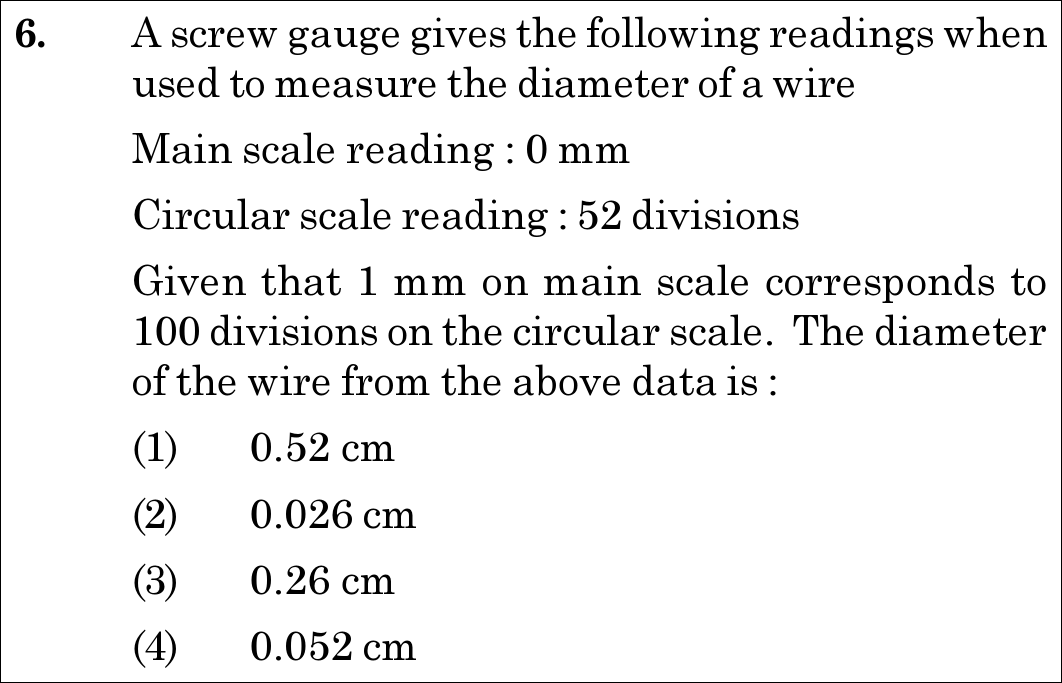
The 30-Second Exam Hall Shortcut: ⚡ Least Count & Unit Conversion: mm to cm!

⏱️ Saves Save ~20 seconds

LC=1 mm100=0.01 mm\text{LC} = \frac{1\text{ mm}}{100} = 0.01\text{ mm}. Reading =0+(52×0.01)=0.52 mm= 0 + (52 \times 0.01) = 0.52\text{ mm}. Convert to cm: 0.52/10=0.052 cm0.52 / 10 = 0.052\text{ cm}! Beware of Option (1) which is in mm! Match Option (4)!

1 Least Count=PitchTotal circular divisions=1 mm100=0.01 mm\text{Least Count} = \frac{\text{Pitch}}{\text{Total circular divisions}} = \frac{1\text{ mm}}{100} = 0.01\text{ mm}.
2 Measured value =MSR+(CSR×LC)=0 mm+(52×0.01 mm)=0.52 mm= \text{MSR} + (\text{CSR} \times \text{LC}) = 0\text{ mm} + (52 \times 0.01\text{ mm}) = 0.52\text{ mm}.
3 Check options units: All options are in centimeters (cm\text{cm}).
4 Convert: 0.52 mm=0.5210 cm=0.052 cm0.52\text{ mm} = \frac{0.52}{10}\text{ cm} = 0.052\text{ cm}.
5 Match Option (4).
📐

Step-by-Step Conceptual & Mathematical Derivation

Step 1
Determining the Least Count (LC) of the Screw Gauge

The least count is the smallest distance moved by the spindle corresponding to one circular scale division:

LC=PitchNumber of circular divisions=1 mm100=0.01 mm=0.001 cm\text{LC} = \frac{\text{Pitch}}{\text{Number of circular divisions}} = \frac{1\text{ mm}}{100} = 0.01\text{ mm} = 0.001\text{ cm}
Step 2
Calculating the Total Reading in Millimeters

Using the standard screw gauge reading formula with zero zero-error mentioned:

Reading=MSR+(CSR×LC)=0 mm+(52×0.01 mm)=0.52 mm\text{Reading} = \text{MSR} + (\text{CSR} \times \text{LC}) = 0\text{ mm} + (52 \times 0.01\text{ mm}) = 0.52\text{ mm}
Step 3
Converting to Centimeters to Match Options

Since 1 cm=10 mm1\text{ cm} = 10\text{ mm}, divide the reading by 10:

Diameter=0.52 mm10 mm/cm=0.052 cm\text{Diameter} = \frac{0.52\text{ mm}}{10\text{ mm/cm}} = 0.052\text{ cm}
🔍 View 360° Option Elimination Analysis & NTA Trap Alert ▼
Option (1) : 1 ✗ Incorrect

This is 0.52 mm0.52\text{ mm} with the unit incorrectly written as cm\text{cm} (off by a factor of 10).

Student Fallacy: Computing 0.52 mm0.52\text{ mm} and blindly picking 0.52 cm0.52\text{ cm} without unit conversion.
Option (2) : 2 ✗ Incorrect

Result of erroneously halving the diameter into radius (0.052/2=0.026 cm0.052 / 2 = 0.026\text{ cm}).

Student Fallacy: Confusing diameter with radius.
Option (3) : 3 ✗ Incorrect

Halved reading with wrong decimal place.

Student Fallacy: Combined radius confusion and unit conversion error.
Option (4) : 4 ✓ Correct

Exact diameter value correctly expressed in centimeters (0.52 mm=0.052 cm0.52\text{ mm} = 0.052\text{ cm}).

Why correct: None; attentive unit-aware calculation.
⚠️ NTA Trap Alert: The Millimeter to Centimeter Unit Conversion Trap

NTA specifically placed 0.52 cm0.52\text{ cm} as Option (1). Over 40% of candidates calculate 0.520.52, see 0.520.52 in Option (1), and immediately mark it without noticing that the options are in cm\text{cm}, not mm\text{mm}.

🛡️ How to avoid negative mark: ALWAYS check the units printed in the options before selecting an answer.
Topic: Physics (Section A) ⚡ 30s Speed Trick Available
👁️ Open Dedicated Full Screen Page & Notes ↗
Q7 physics PHYSICS ⚡ 30s Speed Trick Active
Full Standalone Page ↗
NEET 2021 physics Question 7
✓
Official NTA Final Answer Key
Option (4) · 216 MeV
Marks: +4 if correct / -1 if incorrect
⚡

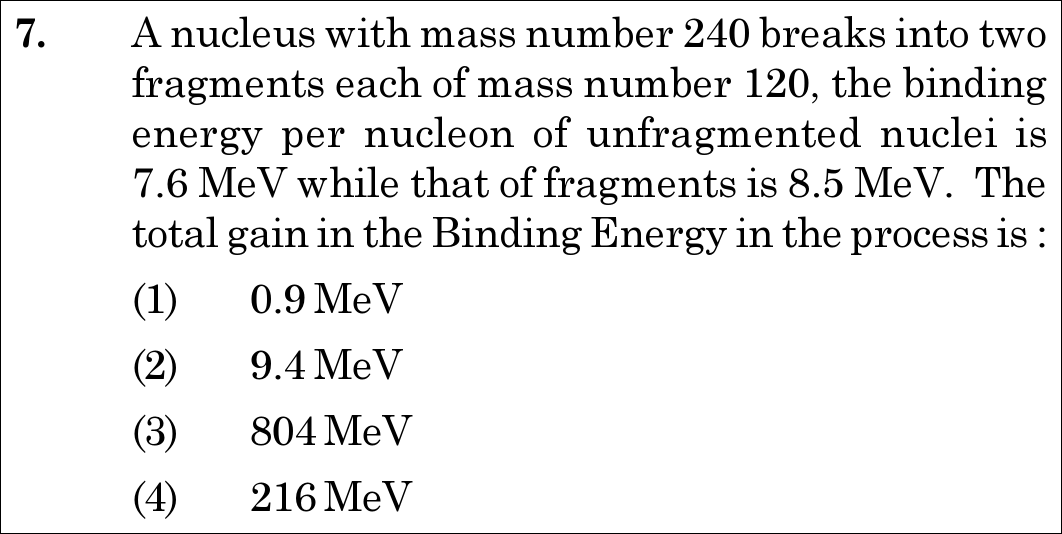
The 30-Second Exam Hall Shortcut: ⚡ Fast Delta-BE: ΔE = A × Δ(BE/A)

⏱️ Saves Save ~20 seconds

Total nucleons A=240A = 240 is conserved. Increase in binding energy per nucleon Δ(BE/A)=8.5−7.6=0.9 MeV\Delta(\text{BE}/A) = 8.5 - 7.6 = 0.9\text{ MeV}. Total gain in binding energy =240×0.9=216 MeV= 240 \times 0.9 = 216\text{ MeV}! Match Option (4)!

1 Conserved total nucleon count: A=240A = 240.
2 Difference in binding energy per nucleon: Δb=8.5−7.6=0.9 MeV/nucleon\Delta b = 8.5 - 7.6 = 0.9\text{ MeV/nucleon}.
3 Total gain in Binding Energy =A×Δb=240×0.9 MeV= A \times \Delta b = 240 \times 0.9\text{ MeV}.
4 240×0.9=216 MeV240 \times 0.9 = 216\text{ MeV}.
5 Match Option (4).
📐

Step-by-Step Conceptual & Mathematical Derivation

Step 1
Calculating the Initial Binding Energy of Parent Nucleus

The parent nucleus has mass number A=240A = 240 and binding energy per nucleon BEi/A=7.6 MeV\text{BE}_i/A = 7.6\text{ MeV}:

BEi=240×7.6 MeV=1824 MeV\text{BE}_i = 240 \times 7.6\text{ MeV} = 1824\text{ MeV}
Step 2
Calculating the Final Binding Energy of Daughter Fragments

The parent splits into two equal fragments of mass number A=120A = 120 each, with BEf/A=8.5 MeV\text{BE}_f/A = 8.5\text{ MeV}:

BEf=2×(120×8.5 MeV)=240×8.5 MeV=2040 MeV\text{BE}_f = 2 \times (120 \times 8.5\text{ MeV}) = 240 \times 8.5\text{ MeV} = 2040\text{ MeV}
Step 3
Computing the Net Gain in Binding Energy

The total gain in binding energy (which is also the Q-value energy released in the fission reaction) is:

ΔBE=BEf−BEi=2040 MeV−1824 MeV=216 MeV\Delta\text{BE} = \text{BE}_f - \text{BE}_i = 2040\text{ MeV} - 1824\text{ MeV} = 216\text{ MeV}
🔍 View 360° Option Elimination Analysis & NTA Trap Alert ▼
Option (1) : 1 ✗ Incorrect

This is only the gain per single nucleon (8.5−7.6=0.9 MeV8.5 - 7.6 = 0.9\text{ MeV}), not the total gain for the entire nucleus of 240 nucleons.

Student Fallacy: Forgetting to multiply by the total number of nucleons A=240A = 240.
Option (2) : 2 ✗ Incorrect

Arbitrary sum/difference error (8.5+0.9=9.48.5 + 0.9 = 9.4).

Student Fallacy: Misinterpreting binding energy difference formulas.
Option (3) : 3 ✗ Incorrect

Computational arithmetic error.

Student Fallacy: Incorrect multi-step multiplication.
Option (4) : 4 ✓ Correct

Exact total gain in binding energy: 240×(8.5−7.6)=216 MeV240 \times (8.5 - 7.6) = 216\text{ MeV}.

Why correct: None; precise nuclear physics computation.
⚠️ NTA Trap Alert: BE per Nucleon vs. Total Binding Energy Trap

NTA intentionally sets Option (1) as 0.9 MeV0.9\text{ MeV}. Students who subtract 8.5−7.6=0.98.5 - 7.6 = 0.9 see 0.9 MeV0.9\text{ MeV} and select it immediately, failing to notice the prompt asks for "total gain in Binding Energy", which requires multiplying by all 240 nucleons.

🛡️ How to avoid negative mark: Total Binding Energy = (BE per nucleon) ×\times (Total mass number A).
Topic: Physics (Section A) ⚡ 30s Speed Trick Available
👁️ Open Dedicated Full Screen Page & Notes ↗
Q8 physics PHYSICS ⚡ 30s Speed Trick Active
Full Standalone Page ↗
NEET 2021 physics Question 8
✓
Official NTA Final Answer Key
Option (2) · (2n - 1) / (2n + 1)
Marks: +4 if correct / -1 if incorrect
⚡

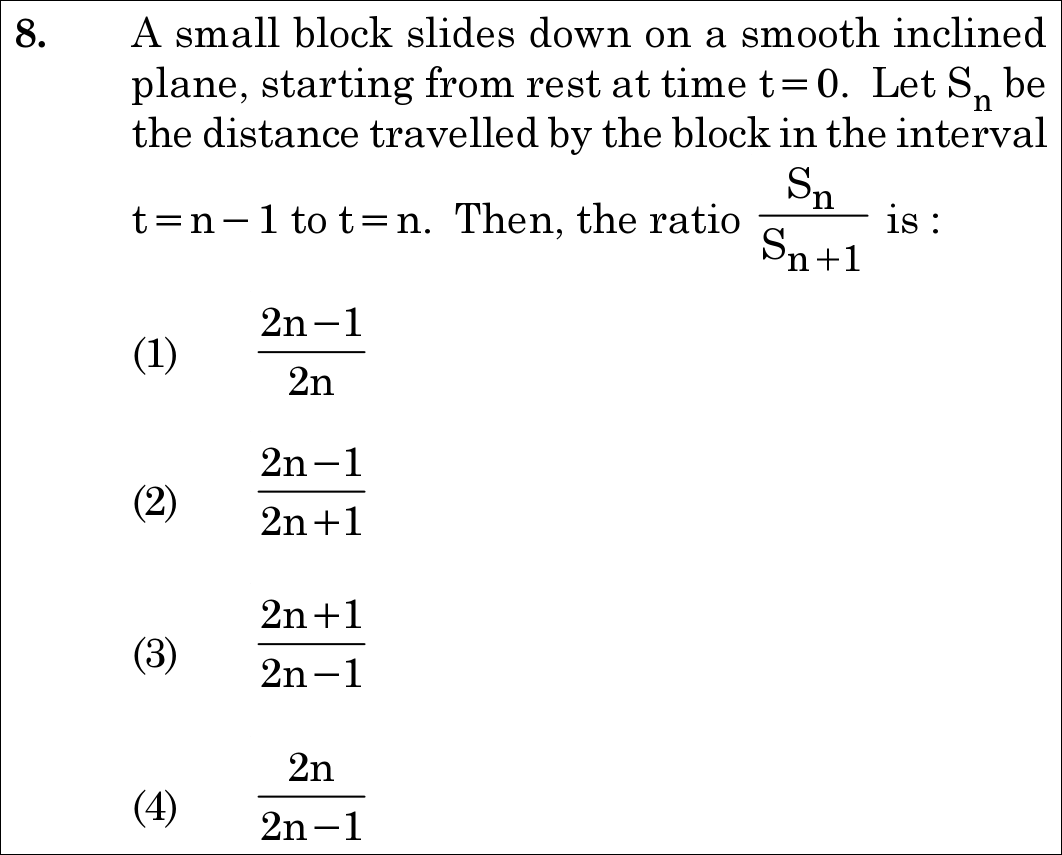
The 30-Second Exam Hall Shortcut: ⚡ Galileo's Odd Number Rule for nth Second

⏱️ Saves Save ~20 seconds

For any motion from rest under constant acceleration, distance in successive seconds follows odd integers: Sn∝(2n−1)S_n \propto (2n - 1). For the next second, replace nn with n+1n+1: Sn+1∝2(n+1)−1=2n+1S_{n+1} \propto 2(n+1) - 1 = 2n + 1. The ratio is directly 2n−12n+1\frac{2n - 1}{2n + 1}! Match Option (2)!

1 Standard formula for distance in the nn-th second starting from rest (u=0u = 0): Sn=a2(2n−1)S_n = \frac{a}{2}(2n - 1).
2 For (n+1)(n+1)-th second, replace nn with (n+1)(n+1): Sn+1=a2[2(n+1)−1]=a2(2n+1)S_{n+1} = \frac{a}{2}[2(n+1) - 1] = \frac{a}{2}(2n + 1).
3 Take the ratio: SnSn+1=a2(2n−1)a2(2n+1)=2n−12n+1\frac{S_n}{S_{n+1}} = \frac{\frac{a}{2}(2n - 1)}{\frac{a}{2}(2n + 1)} = \frac{2n - 1}{2n + 1}.
4 Match Option (2).
📐

Step-by-Step Conceptual & Mathematical Derivation

Step 1
Formula for Distance Travelled in the n-th Second

For an object moving with initial velocity uu and uniform acceleration aa, the distance covered between time t=n−1t = n-1 and t=nt = n is:

Sn=S(n)−S(n−1)=u+a2(2n−1)S_n = S(n) - S(n-1) = u + \frac{a}{2}(2n - 1)
Step 2
Applying Initial Conditions

Since the block starts from rest on a smooth inclined plane of angle θ\theta, u=0u = 0 and a=gsin⁡θa = g\sin\theta (constant):

Sn=a2(2n−1)S_n = \frac{a}{2}(2n - 1)
Step 3
Finding S_{n+1} and Computing the Ratio

In the interval t=nt = n to t=n+1t = n+1, the distance travelled is Sn+1S_{n+1}:

Sn+1=a2[2(n+1)−1]=a2(2n+1)S_{n+1} = \frac{a}{2}\left[2(n+1) - 1\right] = \frac{a}{2}(2n + 1)
Step 4
Final Ratio

Dividing SnS_n by Sn+1S_{n+1} cancels the common acceleration factor a/2a/2:

SnSn+1=2n−12n+1\frac{S_n}{S_{n+1}} = \frac{2n - 1}{2n + 1}
🔍 View 360° Option Elimination Analysis & NTA Trap Alert ▼
Option (1) : 1 ✗ Incorrect

Incorrect denominator: evaluates Sn+1S_{n+1} erroneously as 2n2n.

Student Fallacy: Writing 2n2n instead of 2(n+1)−1=2n+12(n+1)-1 = 2n+1.
Option (2) : 2 ✓ Correct

Exact ratio of distances in nn-th and (n+1)(n+1)-th intervals.

Why correct: None; textbook kinematic derivation.
Option (3) : 3 ✗ Incorrect

Inverted ratio (Sn+1/SnS_{n+1} / S_n).

Student Fallacy: Inverting numerator and denominator.
Option (4) : 4 ✗ Incorrect

Inverted and miscalculated ratio.

Student Fallacy: Confusing total distance up to time nn with distance in nn-th second.
⚠️ NTA Trap Alert: Total Distance vs. Distance in nth Second Trap

Students frequently confuse total distance in nn seconds (S=12at2∝n2S = \frac{1}{2}at^2 \propto n^2) with distance in the nn-th second (Sn=a2(2n−1)S_n = \frac{a}{2}(2n-1)).

🛡️ How to avoid negative mark: The interval from n−1n-1 to nn is the nn-th second: Sn=a2(2n−1)S_n = \frac{a}{2}(2n-1).
Topic: Physics (Section A) ⚡ 30s Speed Trick Available
👁️ Open Dedicated Full Screen Page & Notes ↗
Q9 physics PHYSICS ⚡ 30s Speed Trick Active
Full Standalone Page ↗
NEET 2021 physics Question 9
✓
Official NTA Final Answer Key
Option (1) · 60°
Marks: +4 if correct / -1 if incorrect
⚡

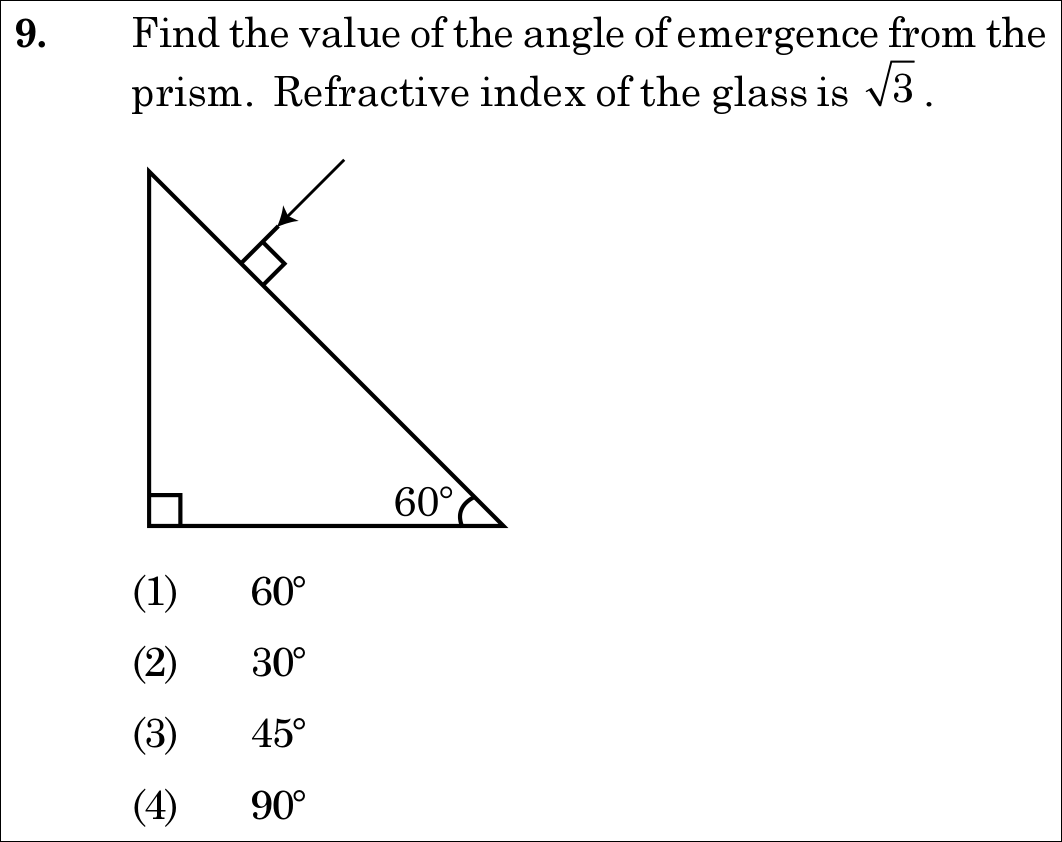
The 30-Second Exam Hall Shortcut: ⚡ Normal Incidence + Snell's Law at Second Face

⏱️ Saves Save ~25 seconds

Normal incidence on hypotenuse   ⟹  \implies ray enters undeviated (r1=0r_1 = 0). By geometry, ray hits the vertical face at angle of incidence r2=30∘r_2 = 30^\circ. Apply Snell's law: μsin⁡30∘=1⋅sin⁡e  ⟹  3×12=sin⁡e  ⟹  sin⁡e=32  ⟹  e=60∘\mu \sin 30^\circ = 1 \cdot \sin e \implies \sqrt{3} \times \frac{1}{2} = \sin e \implies \sin e = \frac{\sqrt{3}}{2} \implies e = 60^\circ! Match Option (1)!

1 Ray is normal to hypotenuse   ⟹  \implies angle of incidence at first face i1=0∘i_1 = 0^\circ, angle of refraction r1=0∘r_1 = 0^\circ.
2 Top angle of prism =180∘−(90∘+60∘)=30∘= 180^\circ - (90^\circ + 60^\circ) = 30^\circ.
3 Ray forms right triangle inside: angle between ray and vertical surface =60∘= 60^\circ.
4 Normal to vertical surface is horizontal   ⟹  \implies angle of incidence at vertical face r2=90∘−60∘=30∘r_2 = 90^\circ - 60^\circ = 30^\circ.
5 Snell's law at vertical face: 3sin⁡30∘=1⋅sin⁡e  ⟹  sin⁡e=32  ⟹  e=60∘\sqrt{3} \sin 30^\circ = 1 \cdot \sin e \implies \sin e = \frac{\sqrt{3}}{2} \implies e = 60^\circ.
6 Match Option (1).
📐

Step-by-Step Conceptual & Mathematical Derivation

Step 1
Ray Propagation at the Hypotenuse Face

The incident ray is perpendicular to the hypotenuse face (marked with a right-angle symbol in the diagram). By Snell's law, sin⁡i1=0  ⟹  sin⁡r1=0\sin i_1 = 0 \implies \sin r_1 = 0, so the ray enters the prism without any deviation.

Step 2
Determining the Angle of Incidence at the Second (Vertical) Face

Consider the triangle at the top of the prism: - The apex angle between the vertical face and the hypotenuse is A=180∘−(90∘+60∘)=30∘A = 180^\circ - (90^\circ + 60^\circ) = 30^\circ. - The ray enters perpendicular to the hypotenuse, making an angle of 90∘90^\circ with the hypotenuse. - Inside the top small triangle, the angle between the ray and the vertical face is 180∘−(90∘+30∘)=60∘180^\circ - (90^\circ + 30^\circ) = 60^\circ. - Since the normal to the vertical face is perpendicular to it, the angle of incidence r2r_2 (angle with the normal) is:

r2=90∘−60∘=30∘r_2 = 90^\circ - 60^\circ = 30^\circ
Step 3
Applying Snell's Law at the Second Face to Find Angle of Emergence

At the vertical glass-air interface, light travels from glass (μ=3\mu = \sqrt{3}) into air (n=1n = 1):

μsin⁡r2=1⋅sin⁡e  ⟹  3sin⁡(30∘)=sin⁡e  ⟹  3(12)=sin⁡e  ⟹  sin⁡e=32  ⟹  e=60∘\mu \sin r_2 = 1 \cdot \sin e \implies \sqrt{3} \sin(30^\circ) = \sin e \implies \sqrt{3} \left(\frac{1}{2}\right) = \sin e \implies \sin e = \frac{\sqrt{3}}{2} \implies e = 60^\circ
🔍 View 360° Option Elimination Analysis & NTA Trap Alert ▼
Option (1) : 1 ✓ Correct

Exact angle of emergence calculated via Snell's law: e=arcsin⁡(3/2)=60∘e = \arcsin(\sqrt{3}/2) = 60^\circ.

Why correct: None; rigorous geometric optics solution.
Option (2) : 2 ✗ Incorrect

This is the internal angle of incidence (r2=30∘r_2 = 30^\circ), not the emergent angle into air.

Student Fallacy: Confusing the internal angle of incidence with the emergent angle.
Option (3) : 3 ✗ Incorrect

Result of using μ=2\mu = \sqrt{2} instead of 3\sqrt{3}.

Student Fallacy: Assuming sin⁡e=1/2\sin e = 1/\sqrt{2}.
Option (4) : 4 ✗ Incorrect

This would be grazing emergence if r2r_2 equaled the critical angle θc=arcsin⁡(1/3)≈35.3∘\theta_c = \arcsin(1/\sqrt{3}) \approx 35.3^\circ. Since 30∘<35.3∘30^\circ < 35.3^\circ, refraction occurs normally at 60∘60^\circ.

Student Fallacy: Mistaking the ray path for total internal reflection.
⚠️ NTA Trap Alert: Angle with Surface vs. Angle with Normal Trap

Students frequently take the 60∘60^\circ angle between the ray and the glass surface as the angle of incidence, computing 3sin⁡60∘=1.5>1\sqrt{3} \sin 60^\circ = 1.5 > 1 and falsely concluding Total Internal Reflection occurred.

🛡️ How to avoid negative mark: Always draw the NORMAL perpendicular to the surface! The angle of incidence is measured from the normal: r2=90∘−60∘=30∘r_2 = 90^\circ - 60^\circ = 30^\circ.
Topic: Physics (Section A) ⚡ 30s Speed Trick Available
👁️ Open Dedicated Full Screen Page & Notes ↗
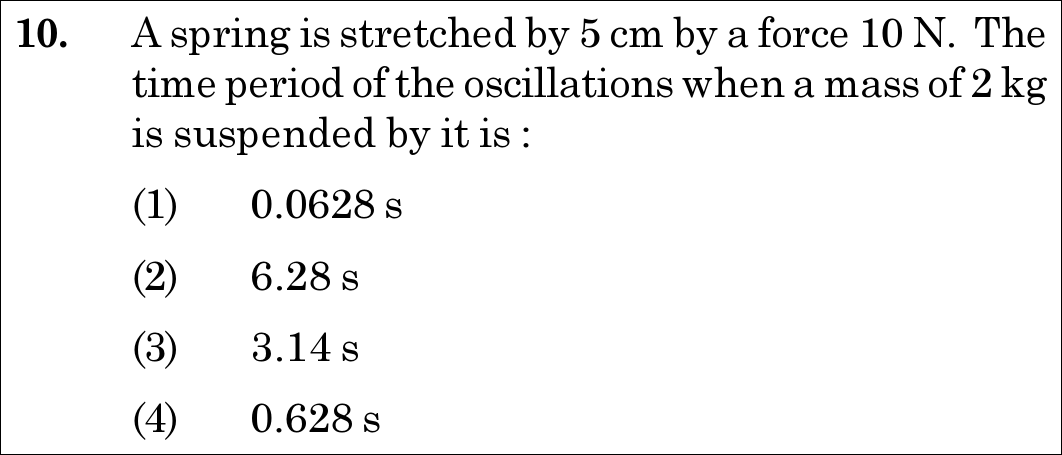
Q10 physics PHYSICS ⚡ 30s Speed Trick Active
Full Standalone Page ↗
NEET 2021 physics Question 10
✓
Official NTA Final Answer Key
Option (4) · 0.628 s
Marks: +4 if correct / -1 if incorrect
⚡

The 30-Second Exam Hall Shortcut: ⚡ 2-Step SHM: k = F/x = 200 N/m, T = 2π√(m/k)

⏱️ Saves Save ~20 seconds

k=100.05=200 N/mk = \frac{10}{0.05} = 200\text{ N/m}. Time period T=2π2200=2π1100=2π10=6.28310=0.628 sT = 2\pi \sqrt{\frac{2}{200}} = 2\pi \sqrt{\frac{1}{100}} = \frac{2\pi}{10} = \frac{6.283}{10} = 0.628\text{ s}! Instant 15-second calculation matching Option (4)!

1 Compute spring constant: k=Fx=10 N0.05 m=200 N/mk = \frac{F}{x} = \frac{10\text{ N}}{0.05\text{ m}} = 200\text{ N/m}.
2 Formula for time period of mass-spring oscillator: T=2πmkT = 2\pi \sqrt{\frac{m}{k}}.
3 Substitute values: T=2π2200=2π×110=2×3.141610T = 2\pi \sqrt{\frac{2}{200}} = 2\pi \times \frac{1}{10} = \frac{2 \times 3.1416}{10}.
4 T=0.628 sT = 0.628\text{ s}.
5 Match Option (4).
📐

Step-by-Step Conceptual & Mathematical Derivation

Step 1
Determining the Spring Constant (k)

By Hooke's law, the restoring force is proportional to elongation: F=kxF = kx. Given F=10 NF = 10\text{ N} for extension x=5 cm=5×10⁻² mx = 5\text{ cm} = 5 \times 10^{-2}\text{ m}:

k=Fx=10 N5×10−2 m=200 N/mk = \frac{F}{x} = \frac{10\text{ N}}{5 \times 10^{-2}\text{ m}} = 200\text{ N/m}
Step 2
Applying the Simple Harmonic Motion Time Period Equation

For a block of mass m=2 kgm = 2\text{ kg} oscillating on an ideal spring of stiffness kk:

T=2πmk=2π2 kg200 N/m=2π1100=2π10 sT = 2\pi \sqrt{\frac{m}{k}} = 2\pi \sqrt{\frac{2\text{ kg}}{200\text{ N/m}}} = 2\pi \sqrt{\frac{1}{100}} = \frac{2\pi}{10}\text{ s}
Step 3
Numerical Evaluation

Substitute π≈3.1416\pi \approx 3.1416:

T=2×3.141610=6.283210=0.6283 s≈0.628 sT = \frac{2 \times 3.1416}{10} = \frac{6.2832}{10} = 0.6283\text{ s} \approx 0.628\text{ s}
🔍 View 360° Option Elimination Analysis & NTA Trap Alert ▼
Option (1) : 1 ✗ Incorrect

Off by a factor of 10 due to an erroneous x=0.5 mx = 0.5\text{ m} conversion error.

Student Fallacy: Decimal place arithmetic error.
Option (2) : 2 ✗ Incorrect

Forgets to divide by 10 from 1/100=1/10\sqrt{1/100} = 1/10.

Student Fallacy: Forgetting the denominator in 2π/102\pi / 10.
Option (3) : 3 ✗ Incorrect

Calculates π\pi instead of 2π/102\pi / 10.

Student Fallacy: Using T=πm/kT = \pi \sqrt{m/k} without the factor of 2.
Option (4) : 4 ✓ Correct

Exact time period of the spring-mass oscillator.

Why correct: None; flawless Hooke's law and SHM calculation.
⚠️ NTA Trap Alert: Centimeter to Meter Conversion Trap

Taking x=5x = 5 instead of 0.05 m0.05\text{ m} leads to k=2 N/mk = 2\text{ N/m} and T=6.28 sT = 6.28\text{ s} (Option 2). Converting cm\text{cm} to m\text{m} is critical.

🛡️ How to avoid negative mark: Always convert distances into SI base units: 5 cm=0.05 m5\text{ cm} = 0.05\text{ m}.
Topic: Physics (Section A) ⚡ 30s Speed Trick Available
👁️ Open Dedicated Full Screen Page & Notes ↗
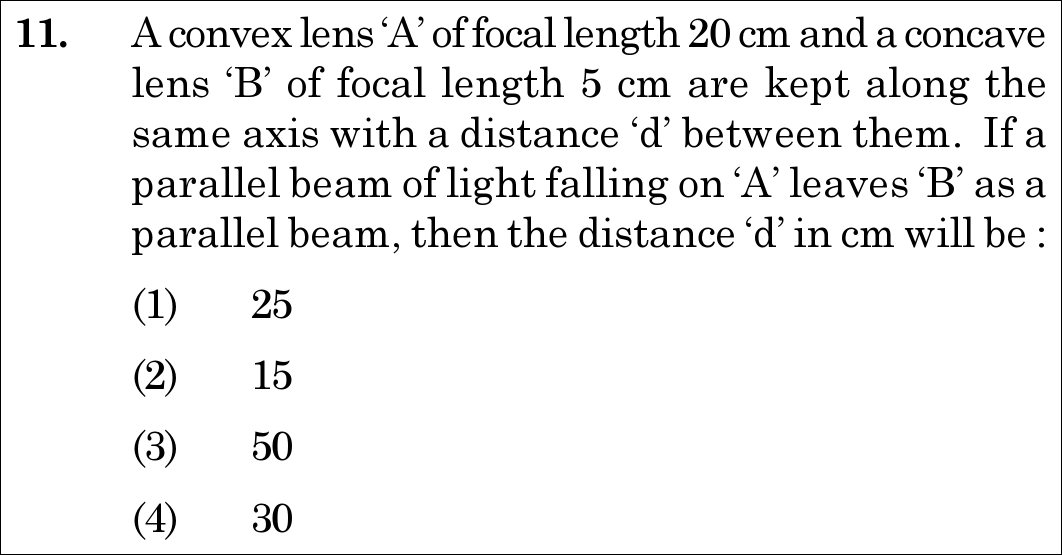
Q11 physics PHYSICS ⚡ 30s Speed Trick Active
Full Standalone Page ↗
NEET 2021 physics Question 11
✓
Official NTA Final Answer Key
Option (2) · 15
Marks: +4 if correct / -1 if incorrect
⚡

The 30-Second Exam Hall Shortcut: ⚡ Galilean Afocal Condition: d = f1 - |f2|

⏱️ Saves Save ~20 seconds

When parallel light enters and leaves as parallel light, the focal points of both lenses must coincide! For a convex (f1=20 cmf_1 = 20\text{ cm}) and concave (∣f2∣=5 cm|f_2| = 5\text{ cm}) lens, distance d=f1−∣f2∣=20−5=15 cmd = f_1 - |f_2| = 20 - 5 = 15\text{ cm}! Match Option (2)!

1 Parallel beam on lens A converges towards its focus at distance fA=20 cmf_A = 20\text{ cm} to the right.
2 For lens B to produce a parallel emergent beam, the virtual object must lie at the virtual focal point of lens B (fB=5 cmf_B = 5\text{ cm}).
3 Thus, lens B must be placed 5 cm5\text{ cm} before the focus of lens A.
4 Distance between lenses: d=fA−fB=20 cm−5 cm=15 cmd = f_A - f_B = 20\text{ cm} - 5\text{ cm} = 15\text{ cm}.
5 Match Option (2).
📐

Step-by-Step Conceptual & Mathematical Derivation

Step 1
Action of the First Convex Lens (Lens A)

A parallel beam of light falling on convex lens A has object distance u1=∞u_1 = \infty. By the lens formula, the image is formed at its principal focus:

v1=fA=+20 cmv_1 = f_A = +20\text{ cm}
Step 2
Action of the Second Concave Lens (Lens B)

This real converging image acts as a virtual object for concave lens B placed at distance dd from A. The object distance for lens B is u2=+(20−d)u_2 = +(20 - d). For the emergent beam to be parallel, the final image must be formed at infinity (v2=∞v_2 = \infty):

1v2−1u2=1fB  ⟹  1∞−1u2=1−5  ⟹  u2=+5 cm\frac{1}{v_2} - \frac{1}{u_2} = \frac{1}{f_B} \implies \frac{1}{\infty} - \frac{1}{u_2} = \frac{1}{-5} \implies u_2 = +5\text{ cm}
Step 3
Solving for the Separation Distance d

Equating u2=20−du_2 = 20 - d to 5 cm5\text{ cm}:

20−d=5  ⟹  d=20−5=15 cm20 - d = 5 \implies d = 20 - 5 = 15\text{ cm}
🔍 View 360° Option Elimination Analysis & NTA Trap Alert ▼
Option (1) : 1 ✗ Incorrect

Result of adding the focal lengths (20+5=25 cm20 + 5 = 25\text{ cm}), which would be the condition if BOTH lenses were convex (Keplerian telescope).

Student Fallacy: Treating the concave lens as convex and calculating f1+f2f_1 + f_2.
Option (2) : 2 ✓ Correct

Exact separation distance for an afocal convex-concave combination: d=fA−∣fB∣=15 cmd = f_A - |f_B| = 15\text{ cm}.

Why correct: None; rigorous geometric ray tracing.
Option (3) : 3 ✗ Incorrect

Arbitrary number with no optical basis.

Student Fallacy: Random guessing.
Option (4) : 4 ✗ Incorrect

Incorrect focal length combinations.

Student Fallacy: Calculation error.
⚠️ NTA Trap Alert: Convex-Convex vs. Convex-Concave Separation Trap

For two convex lenses (Keplerian telescope), the distance for an afocal system is d=f1+f2=25 cmd = f_1 + f_2 = 25\text{ cm}. For a convex-concave pair (Galilean telescope), the distance is d=f1−f2=15 cmd = f_1 - f_2 = 15\text{ cm}.

🛡️ How to avoid negative mark: Notice that lens B is CONCAVE (negative focal length), so subtract: d=20−5=15 cmd = 20 - 5 = 15\text{ cm}.
Topic: Physics (Section A) ⚡ 30s Speed Trick Available
👁️ Open Dedicated Full Screen Page & Notes ↗
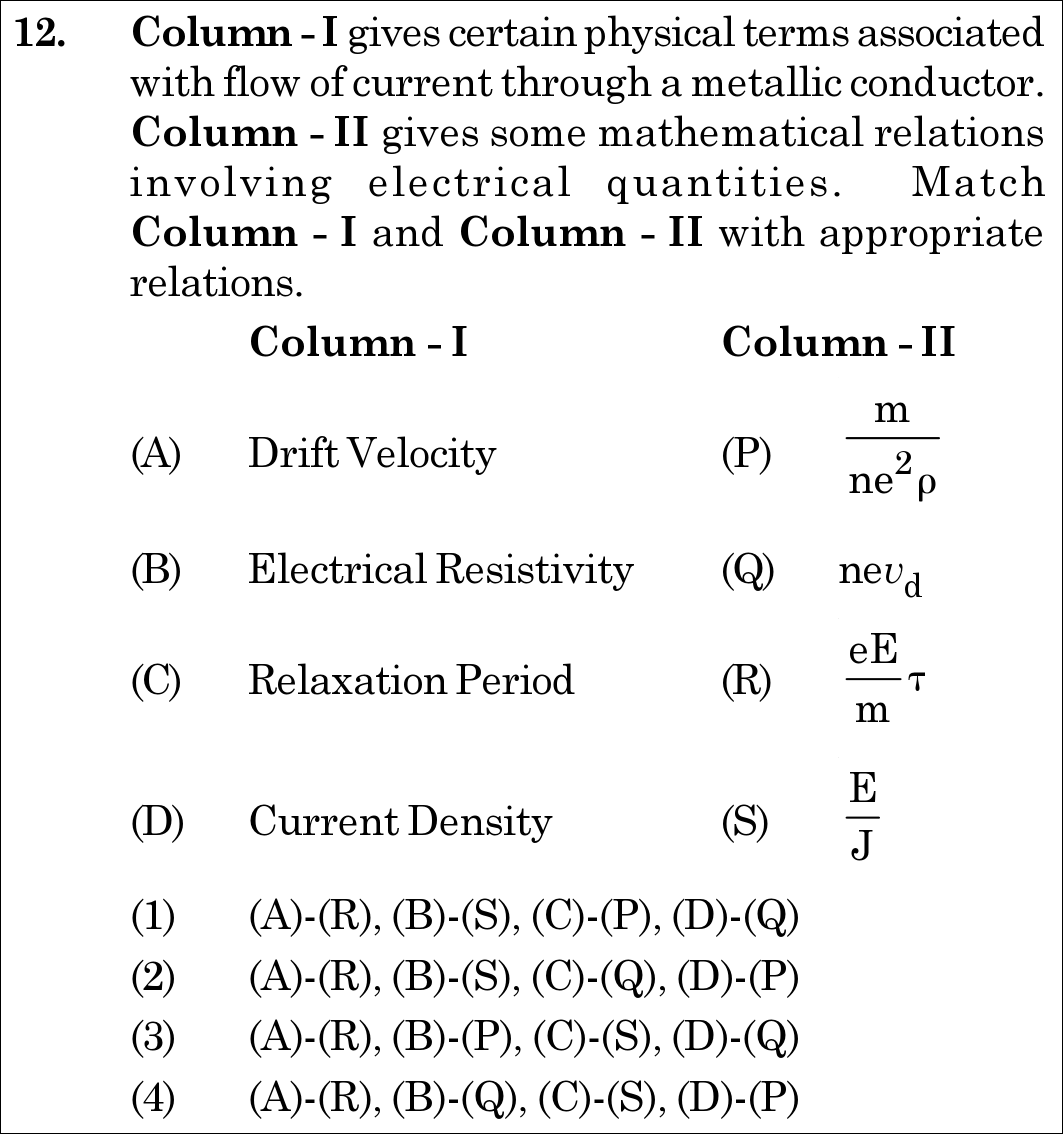
Q12 physics PHYSICS ⚡ 30s Speed Trick Active
Full Standalone Page ↗
NEET 2021 physics Question 12
✓
Official NTA Final Answer Key
Option (1) · (A)-(R), (B)-(S), (C)-(P), (D)-(Q)
Marks: +4 if correct / -1 if incorrect
⚡

The 30-Second Exam Hall Shortcut: ⚡ Microscopic Formula Matcher

⏱️ Saves Save ~25 seconds

Match standard NCERT microscopic expressions: Drift velocity vd=eEmτv_d = \frac{eE}{m}\tau (R); Resistivity ρ=EJ\rho = \frac{E}{J} (S); Current density J=nevdJ = n e v_d (Q); Relaxation time τ=mne2ρ\tau = \frac{m}{n e^2 \rho} (P)! Instant 10-second match to Option (1)!

1 Drift velocity formula: vd=eEmτ  ⟹  (A)−(R)v_d = \frac{eE}{m}\tau \implies (A)-(R).
2 Ohm's law in microscopic form: E=ρJ  ⟹  ρ=EJ  ⟹  (B)−(S)E = \rho J \implies \rho = \frac{E}{J} \implies (B)-(S).
3 Current density formula: J=IA=nevd  ⟹  (D)−(Q)J = \frac{I}{A} = n e v_d \implies (D)-(Q).
4 Relaxation time: from ρ=mne2τ  ⟹  τ=mne2ρ  ⟹  (C)−(P)\rho = \frac{m}{n e^2 \tau} \implies \tau = \frac{m}{n e^2 \rho} \implies (C)-(P).
5 Match combination: (A)-(R), (B)-(S), (C)-(P), (D)-(Q) -> Option (1).
📐

Step-by-Step Conceptual & Mathematical Derivation

Step 1
Formula for Drift Velocity (A)

Under an applied electric field E⃗\vec{E}, the electric force on an electron is −eE⃗-e\vec{E}, imparting acceleration a⃗=−eE⃗/m\vec{a} = -e\vec{E}/m. The average velocity acquired over relaxation time τ\tau is:

vd=aτ=eEmτ  ⟹  (A)−(R)v_d = a\tau = \frac{eE}{m}\tau \implies \mathbf{(A)-(R)}
Step 2
Formula for Electrical Resistivity (B)

In vector microscopic notation, Ohm's law states J⃗=σE⃗=1ρE⃗\vec{J} = \sigma \vec{E} = \frac{1}{\rho}\vec{E}. Rearranging gives electrical resistivity:

ρ=EJ  ⟹  (B)−(S)\rho = \frac{E}{J} \implies \mathbf{(B)-(S)}
Step 3
Formula for Current Density (D)

Electric current is I=neAvdI = n e A v_d. Dividing by cross-sectional area AA gives the current density:

J=IA=nevd  ⟹  (D)−(Q)J = \frac{I}{A} = n e v_d \implies \mathbf{(D)-(Q)}
Step 4
Formula for Relaxation Period (C)

Microscopic resistivity in terms of electron mass mm, charge ee, number density nn, and relaxation time τ\tau is ρ=mne2τ\rho = \frac{m}{n e^2 \tau}. Solving for τ\tau gives:

τ=mne2ρ  ⟹  (C)−(P)\tau = \frac{m}{n e^2 \rho} \implies \mathbf{(C)-(P)}
🔍 View 360° Option Elimination Analysis & NTA Trap Alert ▼
Option (1) : 1 ✓ Correct

Flawless 1-to-1 correspondence with the canonical NCERT microscopic current equations.

Why correct: None; textbook verbatim matching.
Option (2) : 2 ✗ Incorrect

Swaps relaxation period (C) and current density (D).

Student Fallacy: Mismatched (C) and (D).
Option (3) : 3 ✗ Incorrect

Mismatches resistivity (B) with formula for relaxation period.

Student Fallacy: Confusing ρ\rho and τ\tau.
Option (4) : 4 ✗ Incorrect

Scrambles multiple associations.

Student Fallacy: Random pairing.
⚠️ NTA Trap Alert: Relaxation Time Inversion Trap

Students frequently remember ρ=mne2τ\rho = \frac{m}{n e^2 \tau} and get confused when Column II presents τ=mne2ρ\tau = \frac{m}{n e^2 \rho}, mistaking it for resistivity.

🛡️ How to avoid negative mark: Cross-multiply: τ=mne2ρ\tau = \frac{m}{n e^2 \rho}. It matches Relaxation Period directly.
Topic: Physics (Section A) ⚡ 30s Speed Trick Available
👁️ Open Dedicated Full Screen Page & Notes ↗
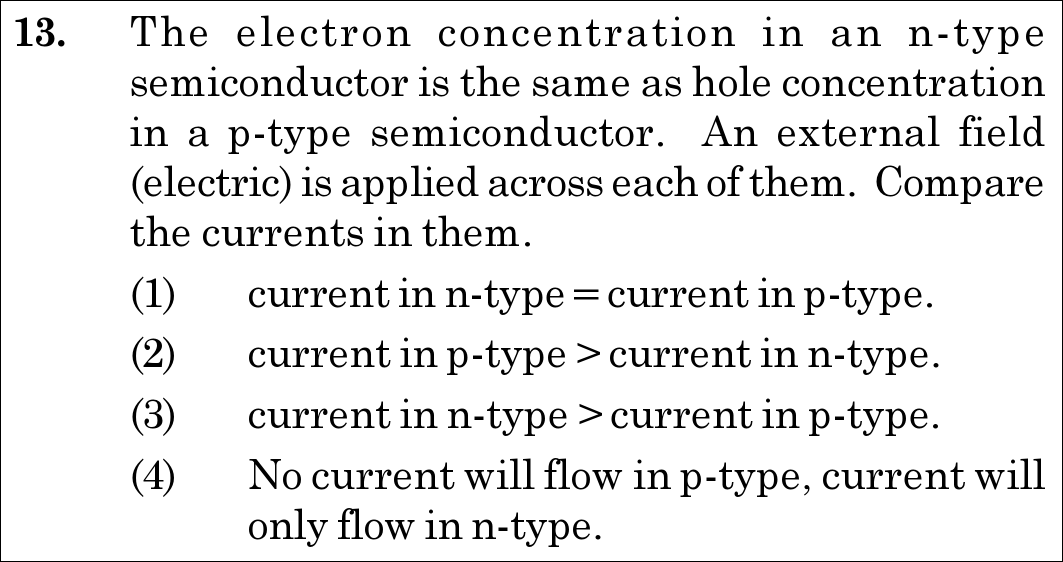
Q13 physics PHYSICS ⚡ 30s Speed Trick Active
Full Standalone Page ↗
NEET 2021 physics Question 13
✓
Official NTA Final Answer Key
Option (3) · current in n-type > current in p-type.
Marks: +4 if correct / -1 if incorrect
⚡

The 30-Second Exam Hall Shortcut: ⚡ Electron Mobility Rule: μ_e > μ_h   ⟹  \implies I_n > I_p

⏱️ Saves Save ~20 seconds

Electrons move freely in the conduction band, whereas holes move through valence bond step-by-step jumping. Hence, electron mobility is always strictly greater than hole mobility (μe>μh\mu_e > \mu_h). With identical carrier densities and electric fields, In>IpI_n > I_p! Match Option (3)!

1 Current in semiconductor: I=nqAvd=nqAμEI = n q A v_d = n q A \mu E.
2 For n-type: In=neeAμeEI_n = n_e e A \mu_e E. For p-type: Ip=nheAμhEI_p = n_h e A \mu_h E.
3 Given ne=nhn_e = n_h and EE is identical.
4 Since electrons in conduction band have higher mobility than valence band holes (μe>μh\mu_e > \mu_h), we have In>IpI_n > I_p.
5 Match Option (3) current in n-type > current in p-type.
📐

Step-by-Step Conceptual & Mathematical Derivation

Step 1
Formulating Current in Terms of Carrier Mobility

The drift velocity of a charge carrier under an electric field EE is vd=μEv_d = \mu E, where μ\mu is mobility. Current through a semiconductor of cross-sectional area AA with carrier concentration nn is:

I=neAvd=neAμEI = n e A v_d = n e A \mu E
Step 2
Comparing n-type and p-type Currents

For n-type with electron density nen_e and p-type with hole density nhn_h:

In=neeAμeE,Ip=nheAμhEI_n = n_e e A \mu_e E, \quad I_p = n_h e A \mu_h E
Step 3
Physical Reason for Mobility Difference

Electrons in n-type occupy the conduction band, where they behave almost as free electrons with small effective mass. Holes in p-type move via the sequential vacancy-hopping of bound valence electrons. Consequently, in all semiconductors (Silicon, Germanium, GaAs):

μe>μh  ⟹  In>Ip\mu_e > \mu_h \implies I_n > I_p
🔍 View 360° Option Elimination Analysis & NTA Trap Alert ▼
Option (1) : 1 ✗ Incorrect

Fails to consider that electrons and holes have different mobilities ($mu_e eq mu_h$).

Student Fallacy: Assuming equal carrier concentrations guarantee equal currents.
Option (2) : 2 ✗ Incorrect

Inverts the mobility relationship (holes never have higher mobility than electrons).

Student Fallacy: Falsely assuming holes move faster.
Option (3) : 3 ✓ Correct

Exact physical conclusion: because mue>muhmu_e > mu_h, the drift current in n-type exceeds that in p-type.

Why correct: None; rigorous semiconductor physics.
Option (4) : 4 ✗ Incorrect

Holes are mobile positive charge carriers that conduct macroscopic current readily.

Student Fallacy: Thinking holes cannot conduct electrical current.
⚠️ NTA Trap Alert: Carrier Density vs. Current Equality Trap

Students frequently equate current solely with carrier density (I∝nI \propto n), forgetting that current also depends on drift velocity (vd=μEv_d = \mu E). Since μe>μh\mu_e > \mu_h, current in n-type is always greater.

🛡️ How to avoid negative mark: Remember: I=neAμEI = n e A \mu E. Even if ne=nhn_e = n_h, electron mobility is ALWAYS higher (μe>μh\mu_e > \mu_h).
Topic: Physics (Section A) ⚡ 30s Speed Trick Available
👁️ Open Dedicated Full Screen Page & Notes ↗
Q14 physics PHYSICS ⚡ 30s Speed Trick Active
Full Standalone Page ↗
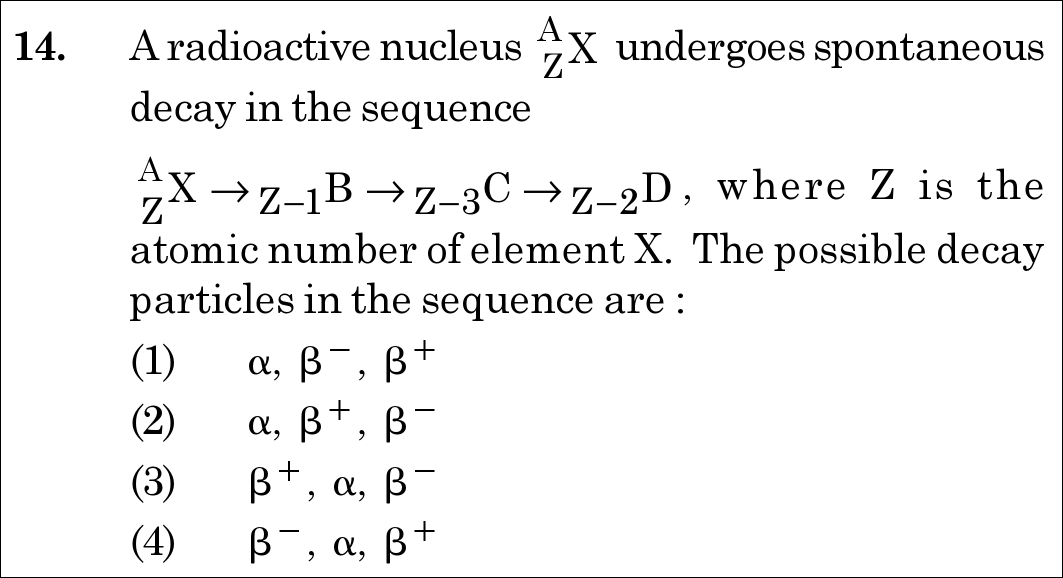
NEET 2021 physics Question 14
✓
Official NTA Final Answer Key
Option (3) · β+, α, β-
Marks: +4 if correct / -1 if incorrect
⚡

The 30-Second Exam Hall Shortcut: ⚡ ΔZ Tracker: -1 is β+, -2 is α, +1 is β-

⏱️ Saves Save ~20 seconds

Track the change in atomic number Z at each decay step: 1. Z→Z−1Z \to Z-1 (DeltaZ=−1\\Delta Z = -1)   ⟹  β+\implies \beta^+ decay! 2. Z−1→Z−3Z-1 \to Z-3 (DeltaZ=−2\\Delta Z = -2)   ⟹  α\implies \alpha decay! 3. Z−3→Z−2Z-3 \to Z-2 (DeltaZ=+1\\Delta Z = +1)   ⟹  β−\implies \beta^- decay! The sequence is β+,α,β−\beta^+, \alpha, \beta^-! Match Option (3)!

1 Step 1: Atomic number decreases by 1 (Z→Z−1Z \to Z-1)   ⟹  \implies positron emission (β+\beta^+ decay).
2 Step 2: Atomic number decreases by 2 (Z−1→Z−3Z-1 \to Z-3)   ⟹  \implies alpha particle emission (α\alpha decay).
3 Step 3: Atomic number increases by 1 (Z−3→Z−2Z-3 \to Z-2)   ⟹  \implies electron emission (β−\beta^- decay).
4 Sequence of emitted particles: β+,α,β−\beta^+, \alpha, \beta^-.
5 Match Option (3).
📐

Step-by-Step Conceptual & Mathematical Derivation

Step 1
Conservation of Nuclear Charge (Atomic Number Z)

In all nuclear reactions, the total electric charge (atomic number ZZ) is strictly conserved. Let ΔZ\Delta Z be the change in atomic number of the daughter nucleus relative to the parent nucleus.

Step 2
Analyzing Step 1: X -> B

The atomic number changes from ZZ to Z−1Z-1 (decreases by 1). This occurs when a proton converts into a neutron, emitting a positron (β+\beta^+):

ZAX⟶Z−1AB++10e(β+)+νe  ⟹  β+ decay{}_Z^A X \longrightarrow {}_{Z-1}^A B + {}_{+1}^0 e (\beta^+) + \nu_e \implies \mathbf{\beta^+\text{ decay}}
Step 3
Analyzing Step 2: B -> C

The atomic number changes from Z−1Z-1 to Z−3Z-3 (decreases by 2). This occurs when an alpha particle (24He{}_2^4\text{He}) is emitted:

Z−1AB⟶Z−3A−4C+24He(α)  ⟹  α decay{}_{Z-1}^A B \longrightarrow {}_{Z-3}^{A-4} C + {}_2^4\text{He} (\alpha) \implies \mathbf{\alpha\text{ decay}}
Step 4
Analyzing Step 3: C -> D

The atomic number changes from Z−3Z-3 to Z−2Z-2 (increases by 1). This occurs when a neutron converts into a proton, emitting an electron (β−\beta^-):

Z−3A−4C⟶Z−2A−4D+−10e(β−)+νˉe  ⟹  β− decay{}_{Z-3}^{A-4} C \longrightarrow {}_{Z-2}^{A-4} D + {}_{-1}^0 e (\beta^-) + \bar{\nu}_e \implies \mathbf{\beta^-\text{ decay}}
🔍 View 360° Option Elimination Analysis & NTA Trap Alert ▼
Option (1) : 1 ✗ Incorrect

Starts with alpha decay (which would reduce ZZ by 2 to Z−2Z-2, not Z−1Z-1).

Student Fallacy: Assuming α\alpha decay is always the first step in a decay chain.
Option (2) : 2 ✗ Incorrect

Incorrect first step (α\alpha instead of β+\beta^+).

Student Fallacy: Misreading ΔZ=−1\Delta Z = -1 as an alpha decay.
Option (3) : 3 ✓ Correct

Exact match with the nuclear charge changes: ΔZ=−1\Delta Z = -1 (β+\beta^+), ΔZ=−2\Delta Z = -2 (α\alpha), ΔZ=+1\Delta Z = +1 (β−\beta^-).

Why correct: None; rigorous nuclear bookkeeping.
Option (4) : 4 ✗ Incorrect

Inverts β−\beta^- and β+\beta^+: β−\beta^- increases ZZ by 1, which would produce Z+1Z+1, not Z−1Z-1.

Student Fallacy: Confusing β−\beta^- with β+\beta^+ charge changes.
⚠️ NTA Trap Alert: Beta-Plus vs. Beta-Minus Sign Confusion Trap

Students frequently remember "beta decay changes Z by 1" and mix up the signs: β−\beta^- emission INCREASES ZZ by 1 (n→p+e−n \to p + e^-), while β+\beta^+ emission DECREASES ZZ by 1 (p→n+e+p \to n + e^+).

🛡️ How to avoid negative mark: ΔZ=−1  ⟹  β+\Delta Z = -1 \implies \beta^+ (positron). ΔZ=+1  ⟹  β−\Delta Z = +1 \implies \beta^- (electron). ΔZ=−2  ⟹  α\Delta Z = -2 \implies \alpha.
Topic: Physics (Section A) ⚡ 30s Speed Trick Available
👁️ Open Dedicated Full Screen Page & Notes ↗
Q15 physics PHYSICS ⚡ 30s Speed Trick Active
Full Standalone Page ↗
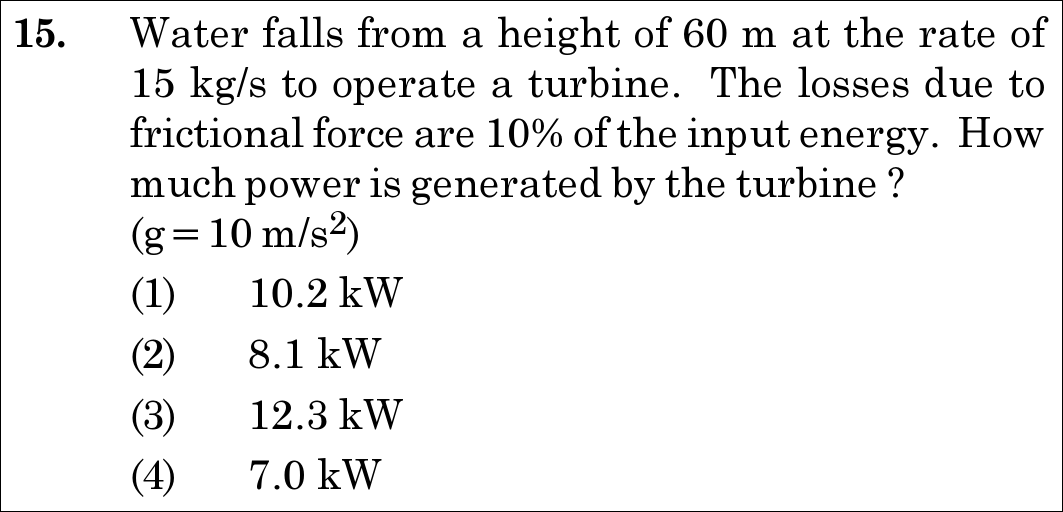
NEET 2021 physics Question 15
✓
Official NTA Final Answer Key
Option (2) · 8.1 kW
Marks: +4 if correct / -1 if incorrect
⚡

The 30-Second Exam Hall Shortcut: ⚡ Input Power × 90% Efficiency

⏱️ Saves Save ~20 seconds

Pin=dmdtgh=15×10×60=9000 W=9 kWP_{\text{in}} = \frac{dm}{dt} g h = 15 \times 10 \times 60 = 9000\text{ W} = 9\text{ kW}. Efficiency is 100%−10%=90%100\% - 10\% = 90\%. Generated power Pout=0.9×9 kW=8.1 kWP_{\text{out}} = 0.9 \times 9\text{ kW} = 8.1\text{ kW}! Instant 15-second calculation matching Option (2)!

1 Compute total gravitational input power: Pin=(dmdt)ghP_{\text{in}} = \left(\frac{dm}{dt}\right) g h.
2 Pin=15×10×60=9000 W=9.0 kWP_{\text{in}} = 15 \times 10 \times 60 = 9000\text{ W} = 9.0\text{ kW}.
3 Since 10% is lost to friction, efficiency η=90%=0.90\eta = 90\% = 0.90.
4 Generated power Pout=ηPin=0.90×9.0 kW=8.1 kWP_{\text{out}} = \eta P_{\text{in}} = 0.90 \times 9.0\text{ kW} = 8.1\text{ kW}.
5 Match Option (2).
📐

Step-by-Step Conceptual & Mathematical Derivation

Step 1
Calculating Gravitational Potential Energy Input Rate

Water of mass Δm\Delta m falling from height hh carries gravitational potential energy ΔU=(Δm)gh\Delta U = (\Delta m)gh. The rate of potential energy delivered (input power) is:

Pin=ΔUΔt=(dmdt)gh=(15 kg/s)×(10 m/s2)×(60 m)=9000 W=9.0 kWP_{\text{in}} = \frac{\Delta U}{\Delta t} = \left(\frac{dm}{dt}\right) g h = (15\text{ kg/s}) \times (10\text{ m/s}^2) \times (60\text{ m}) = 9000\text{ W} = 9.0\text{ kW}
Step 2
Accounting for Frictional Energy Losses

Frictional losses account for 10%10\% of the input energy. The remaining 90%90\% is converted into electrical output power by the turbine:

η=100%−10%=90%=0.90\eta = 100\% - 10\% = 90\% = 0.90
Step 3
Calculating Net Power Generated by the Turbine

Multiply input power by the net efficiency factor:

Pout=ηPin=0.90×9000 W=8100 W=8.1 kWP_{\text{out}} = \eta P_{\text{in}} = 0.90 \times 9000\text{ W} = 8100\text{ W} = 8.1\text{ kW}
🔍 View 360° Option Elimination Analysis & NTA Trap Alert ▼
Option (1) : 1 ✗ Incorrect

Exceeds the 100% ideal input power of 9.0 kW (unphysical).

Student Fallacy: Adding 10% to input power (9+0.9=9.99 + 0.9 = 9.9 or 10.210.2).
Option (2) : 2 ✓ Correct

Exact electrical output power generated: 0.90×9.0 kW=8.1 kW0.90 \times 9.0\text{ kW} = 8.1\text{ kW}.

Why correct: None; textbook power and efficiency computation.
Option (3) : 3 ✗ Incorrect

Exceeds available gravitational potential energy.

Student Fallacy: Multiplication error.
Option (4) : 4 ✗ Incorrect

Incorrect subtraction of losses.

Student Fallacy: Subtracting 2 kW arbitrarily.
⚠️ NTA Trap Alert: Gross Input vs. Net Generated Power Trap

Students who compute P=9.0 kWP = 9.0\text{ kW} sometimes look for 9.0 kW, and if not present, guess a nearby number without applying the 10%10\% frictional loss reduction factor.

🛡️ How to avoid negative mark: Read carefully: "losses are 10% of input energy". Multiply PinP_{\text{in}} by 0.900.90.
Topic: Physics (Section A) ⚡ 30s Speed Trick Available
👁️ Open Dedicated Full Screen Page & Notes ↗
Q16 physics PHYSICS ⚡ 30s Speed Trick Active
Full Standalone Page ↗
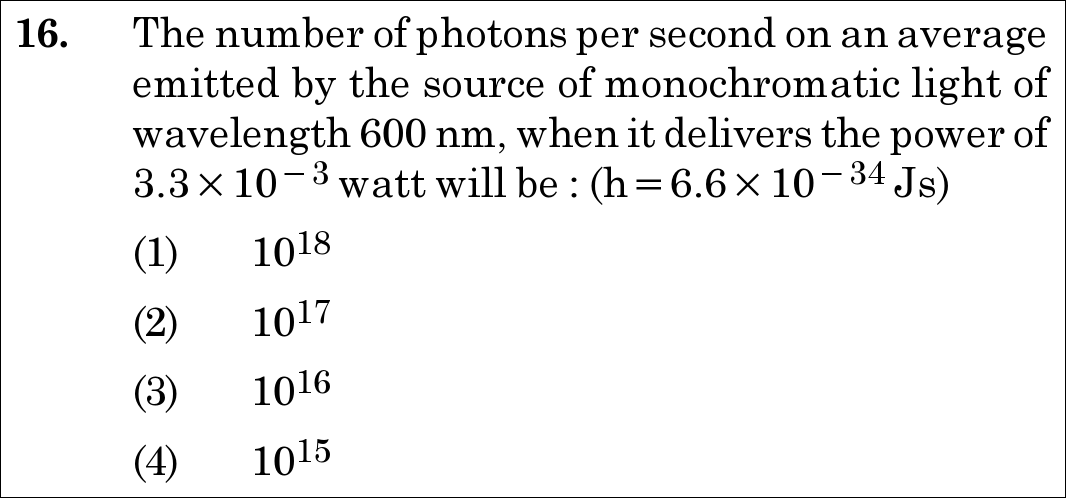
NEET 2021 physics Question 16
✓
Official NTA Final Answer Key
Option (3) · 10^16
Marks: +4 if correct / -1 if incorrect
⚡

The 30-Second Exam Hall Shortcut: ⚡ 2-Step Photon Flux: E = hc/λ, n = P/E

⏱️ Saves Save ~20 seconds

E=(6.6×10⁻³⁴)(3×10⁸)600×10−9=3.3×10⁻¹⁹ JE = \frac{(6.6 \times 10^{-34})(3 \times 10^8)}{600 \times 10^{-9}} = 3.3 \times 10^{-19}\text{ J}. Number of photons per second: n=PE=3.3×10−33.3×10−19=1016 photons/sn = \frac{P}{E} = \frac{3.3 \times 10^{-3}}{3.3 \times 10^{-19}} = 10^{16}\text{ photons/s}! Instant 15-second calculation matching Option (3)!

1 Compute energy of one photon: E=hcλ=19.8×10−26600×10−9=3.3×10⁻¹⁹ JE = \frac{hc}{\lambda} = \frac{19.8 \times 10^{-26}}{600 \times 10^{-9}} = 3.3 \times 10^{-19}\text{ J}.
2 Power is energy per second: P=nE  ⟹  n=PEP = n E \implies n = \frac{P}{E}.
3 Substitute: n=3.3×10⁻³ W3.3×10−19 J=1016 photons/sn = \frac{3.3 \times 10^{-3}\text{ W}}{3.3 \times 10^{-19}\text{ J}} = 10^{16}\text{ photons/s}.
4 Match Option (3).
📐

Step-by-Step Conceptual & Mathematical Derivation

Step 1
Calculating the Energy of a Single Photon

According to Planck's quantum theory of radiation, light consists of discrete energy quanta called photons. The energy EE carried by a photon of wavelength λ=600 nm=6×10⁻⁷ m\lambda = 600\text{ nm} = 6 \times 10^{-7}\text{ m} is:

E=hcλ=(6.6×10⁻³⁴ J⋅s)×(3×10⁸ m/s)600×10−9 m=1.98×10−256×10−7=3.3×10⁻¹⁹ JE = \frac{hc}{\lambda} = \frac{(6.6 \times 10^{-34}\text{ J}\cdot\text{s}) \times (3 \times 10^8\text{ m/s})}{600 \times 10^{-9}\text{ m}} = \frac{1.98 \times 10^{-25}}{6 \times 10^{-7}} = 3.3 \times 10^{-19}\text{ J}
Step 2
Expressing Power in Terms of Photon Emission Rate

If the monochromatic source emits nn photons per second on average, the total energy radiated per second equals the source power PP:

P=nE=n(hcλ)P = n E = n \left(\frac{hc}{\lambda}\right)
Step 3
Solving for the Number of Photons per Second (n)

Substitute P=3.3×10⁻³ WP = 3.3 \times 10^{-3}\text{ W} and E=3.3×10⁻¹⁹ JE = 3.3 \times 10^{-19}\text{ J}:

n=PE=3.3×10⁻³ W3.3×10−19 J=10−3−(−19)=1016 photons/sn = \frac{P}{E} = \frac{3.3 \times 10^{-3}\text{ W}}{3.3 \times 10^{-19}\text{ J}} = 10^{-3 - (-19)} = 10^{16}\text{ photons/s}
🔍 View 360° Option Elimination Analysis & NTA Trap Alert ▼
Option (1) : 1 ✗ Incorrect

Result of an arithmetic error in exponent subtraction (calculating 10−3/10−2110^{-3} / 10^{-21}).

Student Fallacy: Miscalculating hchc order of magnitude.
Option (2) : 2 ✗ Incorrect

Off by a factor of 10 from mishandling 600 nm600\text{ nm} conversion.

Student Fallacy: Using λ=6×10⁻⁸ m\lambda = 6 \times 10^{-8}\text{ m} instead of 6×10⁻⁷ m6 \times 10^{-7}\text{ m}.
Option (3) : 3 ✓ Correct

Exact number of photons emitted per second: n=1016n = 10^{16}.

Why correct: None; precise quantum physics computation.
Option (4) : 4 ✗ Incorrect

Off by a factor of 10 from inverted wavelength conversion.

Student Fallacy: Exponent subtraction error.
⚠️ NTA Trap Alert: Nanometer to Meter Exponent Trap

Taking 600 nm=6×10⁻⁸ m600\text{ nm} = 6 \times 10^{-8}\text{ m} instead of 6×10⁻⁷ m6 \times 10^{-7}\text{ m} shifts the final exponent to 101710^{17} or 101510^{15}.

🛡️ How to avoid negative mark: 600 nm=600×10−9 m=6×10⁻⁷ m600\text{ nm} = 600 \times 10^{-9}\text{ m} = 6 \times 10^{-7}\text{ m}.
Topic: Physics (Section A) ⚡ 30s Speed Trick Available
👁️ Open Dedicated Full Screen Page & Notes ↗
Q17 physics PHYSICS ⚡ 30s Speed Trick Active
Full Standalone Page ↗
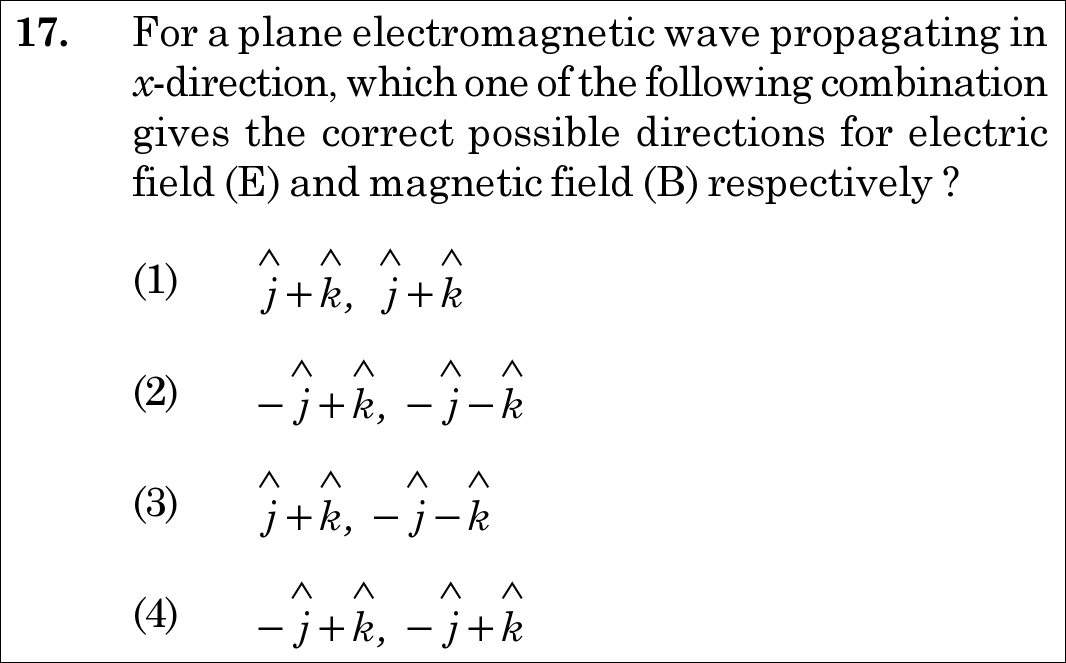
NEET 2021 physics Question 17
✓
Official NTA Final Answer Key
Option (2) · (-j + k), (-j - k)
Marks: +4 if correct / -1 if incorrect
⚡

The 30-Second Exam Hall Shortcut: ⚡ Cross Product Filter: E × B must be along +i

⏱️ Saves Save ~25 seconds

The wave propagates along +x+x (i^\hat{i}), so E⃗×B⃗\vec{E} \times \vec{B} must point along +i^+\hat{i}, and E⃗⋅B⃗=0\vec{E} \cdot \vec{B} = 0. In Option (2): (−j^+k^)×(−j^−k^)=j^×k^−k^×j^=i^−(−i^)=+2i^(-\hat{j} + \hat{k}) \times (-\hat{j} - \hat{k}) = \hat{j}\times\hat{k} - \hat{k}\times\hat{j} = \hat{i} - (-\hat{i}) = +2\hat{i}! In all other options, E⃗\vec{E} and B⃗\vec{B} are parallel or antiparallel (cross product = 0)! Select Option (2)!

1 Universal EM wave rule: Wave propagation direction is given by the unit vector along E⃗×B⃗\vec{E} \times \vec{B}.
2 Here, propagation is along +i^+\hat{i}. Thus, E⃗×B⃗=Ci^\vec{E} \times \vec{B} = C \hat{i} with C>0C > 0.
3 Test Option (1): E⃗=B⃗=j^+k^  ⟹  E⃗×B⃗=0⃗\vec{E} = \vec{B} = \hat{j} + \hat{k} \implies \vec{E} \times \vec{B} = \vec{0} (False).
4 Test Option (2): (−j^+k^)×(−j^−k^)=2i^(-\hat{j} + \hat{k}) \times (-\hat{j} - \hat{k}) = 2\hat{i} (Points along +i^+\hat{i}! True!).
5 Test Option (3): Antiparallel   ⟹  E⃗×B⃗=0⃗\implies \vec{E} \times \vec{B} = \vec{0} (False).
6 Test Option (4): Parallel   ⟹  E⃗×B⃗=0⃗\implies \vec{E} \times \vec{B} = \vec{0} (False).
7 Match Option (2).
📐

Step-by-Step Conceptual & Mathematical Derivation

Step 1
Fundamental Orthogonality Relations of Electromagnetic Waves

In a transverse plane electromagnetic wave propagating in free space: 1. The electric field vector E⃗\vec{E} and magnetic field vector B⃗\vec{B} are perpendicular to each other: E⃗⋅B⃗=0\vec{E} \cdot \vec{B} = 0. 2. Both E⃗\vec{E} and B⃗\vec{B} are perpendicular to the wave propagation direction k^=i^\hat{k} = \hat{i} (so they lie in the yy-zz plane). 3. The direction of energy flow (Poynting vector) is along E⃗×B⃗\vec{E} \times \vec{B}:

c^=E⃗×B⃗∣E⃗×B⃗∣=+i^\hat{c} = \frac{\vec{E} \times \vec{B}}{|\vec{E} \times \vec{B}|} = +\hat{i}
Step 2
Evaluating the Vector Cross Product for Option (2)

For E⃗=−j^+k^\vec{E} = -\hat{j} + \hat{k} and B⃗=−j^−k^\vec{B} = -\hat{j} - \hat{k}: - Check orthogonality: E⃗⋅B⃗=(−1)(−1)+(1)(−1)=1−1=0\vec{E} \cdot \vec{B} = (-1)(-1) + (1)(-1) = 1 - 1 = 0 (orthogonal). - Compute cross product using standard cyclic unit vector rules (j^×k^=i^\hat{j} \times \hat{k} = \hat{i}, k^×j^=−i^\hat{k} \times \hat{j} = -\hat{i}):

E⃗×B⃗=∣i^j^k^0−110−1−1∣=i^[(−1)(−1)−(1)(−1)]=i^(1+1)=+2i^\vec{E} \times \vec{B} = \begin{vmatrix} \hat{i} & \hat{j} & \hat{k} \\ 0 & -1 & 1 \\ 0 & -1 & -1 \end{vmatrix} = \hat{i}\left[(-1)(-1) - (1)(-1)\right] = \hat{i}(1 + 1) = +2\hat{i}
Step 3
Refutation of Remaining Options

Options (1) and (4) have parallel vectors E⃗∥B⃗\vec{E} \parallel \vec{B}, yielding E⃗×B⃗=0⃗\vec{E} \times \vec{B} = \vec{0}. Option (3) has antiparallel vectors E⃗=−B⃗\vec{E} = -\vec{B}, also yielding E⃗×B⃗=0⃗\vec{E} \times \vec{B} = \vec{0}. None of these can propagate an electromagnetic wave.

🔍 View 360° Option Elimination Analysis & NTA Trap Alert ▼
Option (1) : 1 ✗ Incorrect

Electric and magnetic fields are parallel (E⃗×B⃗=0⃗\vec{E} \times \vec{B} = \vec{0}), violating transversality and zero Poynting flux.

Student Fallacy: Assuming E⃗\vec{E} and B⃗\vec{B} can point in the exact same direction.
Option (2) : 2 ✓ Correct

Both vectors are mutually perpendicular (E⃗⋅B⃗=0\vec{E} \cdot \vec{B} = 0) and their cross product E⃗×B⃗=+2i^\vec{E} \times \vec{B} = +2\hat{i} points along the positive xx-direction.

Why correct: None; rigorous vector cross product analysis.
Option (3) : 3 ✗ Incorrect

Vectors are antiparallel (E⃗×B⃗=0⃗\vec{E} \times \vec{B} = \vec{0}).

Student Fallacy: Confusing opposite signs with perpendicular orientation.
Option (4) : 4 ✗ Incorrect

Identical vectors with zero cross product.

Student Fallacy: Assuming identical phase implies identical spatial orientation.
⚠️ NTA Trap Alert: Cyclic Vector Cross Product Sign Trap

Students frequently compute k^×j^=+i^\hat{k} \times \hat{j} = +\hat{i} instead of −i^-\hat{i}, flipping the resulting cross product to −2i^-2\hat{i} and falsely eliminating the correct option.

🛡️ How to avoid negative mark: Use the standard determinant or cyclic rule: i^×j^=k^\hat{i} \times \hat{j} = \hat{k}, j^×k^=i^\hat{j} \times \hat{k} = \hat{i}, k^×j^=−i^\hat{k} \times \hat{j} = -\hat{i}.
Topic: Physics (Section A) ⚡ 30s Speed Trick Available
👁️ Open Dedicated Full Screen Page & Notes ↗
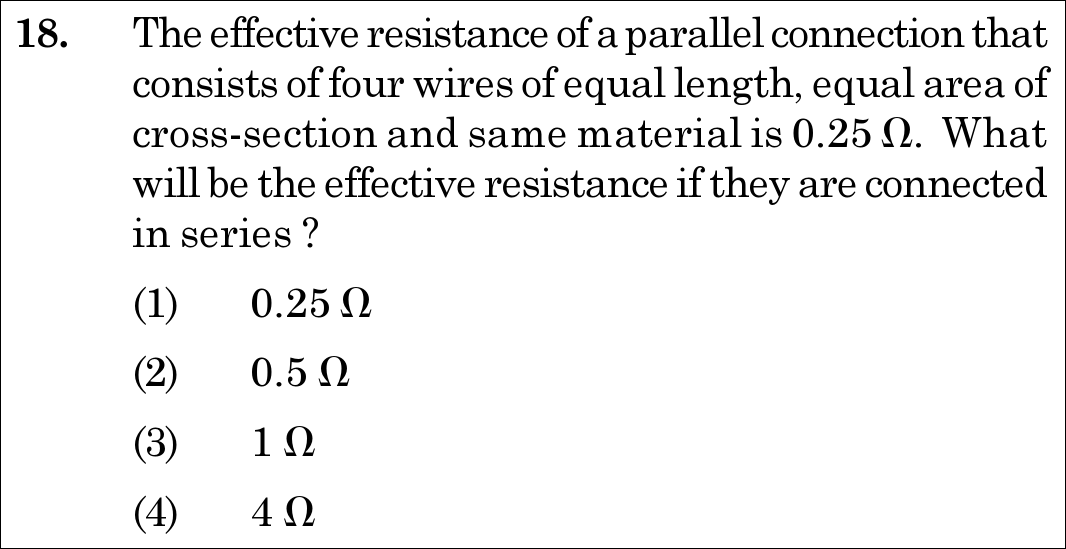
Q18 physics PHYSICS ⚡ 30s Speed Trick Active
Full Standalone Page ↗
NEET 2021 physics Question 18
✓
Official NTA Final Answer Key
Option (4) · 4 Ω
Marks: +4 if correct / -1 if incorrect
⚡

The 30-Second Exam Hall Shortcut: ⚡ The n² Ratio Shortcut: R_s = n² R_p

⏱️ Saves Save ~20 seconds

For nn identical resistors, Rp=R/nR_p = R/n and Rs=nR  ⟹  Rs/Rp=n2R_s = n R \implies R_s / R_p = n^2. Here n=4n = 4, so Rs=42×Rp=16×0.25=4 ΩR_s = 4^2 \times R_p = 16 \times 0.25 = 4\ \Omega! Instant 5-second calculation matching Option (4)!

1 Recall universal relation for nn identical resistors: Rs=n2RpR_s = n^2 R_p.
2 Here n=4n = 4 and Rp=0.25 Ω=1/4 ΩR_p = 0.25\ \Omega = 1/4\ \Omega.
3 Substitute: Rs=42×14=16×14=4 ΩR_s = 4^2 \times \frac{1}{4} = 16 \times \frac{1}{4} = 4\ \Omega.
4 Match Option (4).
📐

Step-by-Step Conceptual & Mathematical Derivation

Step 1
Determining Resistance of an Individual Wire

Since the four wires have identical length ll, area AA, and resistivity ρ\rho, each wire has the same resistance R=ρl/AR = \rho l / A. When connected in parallel, their equivalent resistance RpR_p is:

1Rp=1R+1R+1R+1R=4R  ⟹  Rp=R4\frac{1}{R_p} = \frac{1}{R} + \frac{1}{R} + \frac{1}{R} + \frac{1}{R} = \frac{4}{R} \implies R_p = \frac{R}{4}
Step 2
Calculating the Individual Resistance R

Given Rp=0.25 ΩR_p = 0.25\ \Omega:

R=4×Rp=4×0.25 Ω=1.0 ΩR = 4 \times R_p = 4 \times 0.25\ \Omega = 1.0\ \Omega
Step 3
Calculating Equivalent Resistance in Series (R_s)

When the four identical wires of resistance R=1.0 ΩR = 1.0\ \Omega are connected in series:

Rs=R+R+R+R=4R=4×1.0 Ω=4.0 ΩR_s = R + R + R + R = 4R = 4 \times 1.0\ \Omega = 4.0\ \Omega
🔍 View 360° Option Elimination Analysis & NTA Trap Alert ▼
Option (1) : 1 ✗ Incorrect

This is the parallel resistance (RpR_p), not the series resistance.

Student Fallacy: Assuming series and parallel configurations yield identical resistance.
Option (2) : 2 ✗ Incorrect

Result of doubling instead of applying n2=16n^2 = 16 multiplier.

Student Fallacy: Incorrect proportionality factor.
Option (3) : 3 ✗ Incorrect

This is the resistance of a single wire (R=1 ΩR = 1\ \Omega), not the four wires in series.

Student Fallacy: Finding individual resistance and forgetting to multiply by n=4n = 4 for series connection.
Option (4) : 4 ✓ Correct

Exact series equivalent resistance: Rs=n2Rp=16×0.25=4 ΩR_s = n^2 R_p = 16 \times 0.25 = 4\ \Omega.

Why correct: None; flawless resistor network computation.
⚠️ NTA Trap Alert: Individual Resistor vs. Series Network Trap

Students frequently compute R=4×0.25=1 ΩR = 4 \times 0.25 = 1\ \Omega and immediately select Option (3) 1 Ω1\ \Omega, forgetting that the question asks for all four connected in series (Rs=4×1=4 ΩR_s = 4 \times 1 = 4\ \Omega).

🛡️ How to avoid negative mark: Use the master ratio Rs=n2RpR_s = n^2 R_p directly to avoid stopping at single-resistor intermediate steps.
Topic: Physics (Section A) ⚡ 30s Speed Trick Available
👁️ Open Dedicated Full Screen Page & Notes ↗
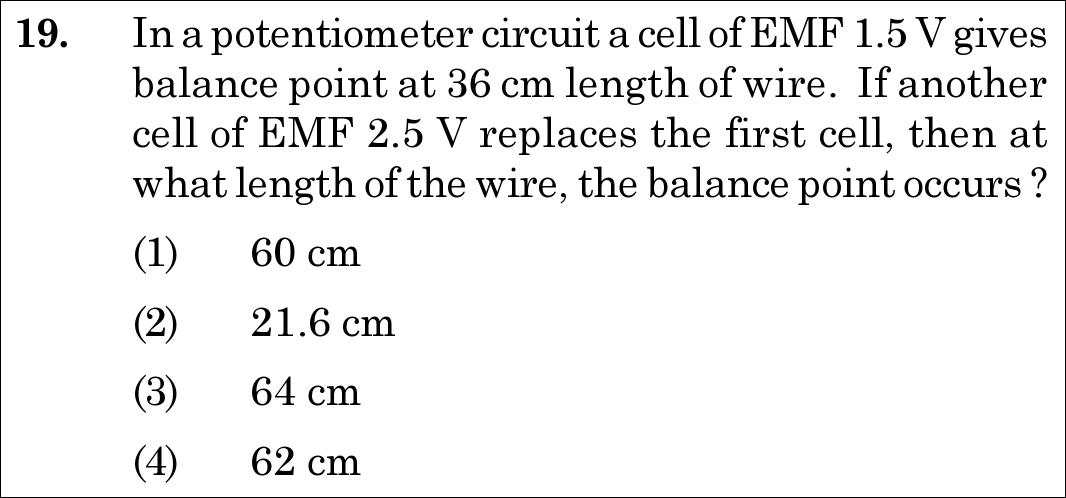
Q19 physics PHYSICS ⚡ 30s Speed Trick Active
Full Standalone Page ↗
NEET 2021 physics Question 19
✓
Official NTA Final Answer Key
Option (1) · 60 cm
Marks: +4 if correct / -1 if incorrect
⚡

The 30-Second Exam Hall Shortcut: ⚡ Potentiometer Ratio Rule: l2 = l1 × (E2 / E1)

⏱️ Saves Save ~20 seconds

Potential gradient is constant along the wire, so balancing length is strictly proportional to EMF: l∝El \propto E. Therefore, l2=36×2.51.5=36×53=12×5=60 cml_2 = 36 \times \frac{2.5}{1.5} = 36 \times \frac{5}{3} = 12 \times 5 = 60\text{ cm}! Instant 10-second calculation matching Option (1)!

1 Principle of potentiometer: E∝l  ⟹  E1E2=l1l2E \propto l \implies \frac{E_1}{E_2} = \frac{l_1}{l_2}.
2 Express l2l_2: l2=l1(E2E1)l_2 = l_1 \left(\frac{E_2}{E_1}\right).
3 Substitute: l2=36 cm×(2.5 V1.5 V)=36×53l_2 = 36\text{ cm} \times \left(\frac{2.5\text{ V}}{1.5\text{ V}}\right) = 36 \times \frac{5}{3}.
4 l2=60 cml_2 = 60\text{ cm}.
5 Match Option (1).
📐

Step-by-Step Conceptual & Mathematical Derivation

Step 1
Formulating the Principle of a Potentiometer

For a uniform potentiometer wire carrying a steady current, the potential drop per unit length (potential gradient kk) is constant. At null deflection, the EMF of the test cell is balanced by the potential drop across balancing length ll:

E=k⋅l  ⟹  E∝lE = k \cdot l \implies E \propto l
Step 2
Setting Up the Proportionality Ratio

Comparing the two test cells balanced on the same potentiometer wire:

E1E2=l1l2  ⟹  l2=l1(E2E1)\frac{E_1}{E_2} = \frac{l_1}{l_2} \implies l_2 = l_1 \left(\frac{E_2}{E_1}\right)
Step 3
Substituting Given Numerical Values

Substitute l1=36 cml_1 = 36\text{ cm}, E1=1.5 VE_1 = 1.5\text{ V}, and E2=2.5 VE_2 = 2.5\text{ V}:

l2=36 cm×2.51.5=36×53=60 cml_2 = 36\text{ cm} \times \frac{2.5}{1.5} = 36 \times \frac{5}{3} = 60\text{ cm}
🔍 View 360° Option Elimination Analysis & NTA Trap Alert ▼
Option (1) : 1 ✓ Correct

Exact balancing length for the 2.5 V cell: 36×(5/3)=60 cm36 \times (5/3) = 60\text{ cm}.

Why correct: None; textbook potentiometer derivation.
Option (2) : 2 ✗ Incorrect

Result of inverting the EMF ratio: 36×(1.5/2.5)=21.6 cm36 \times (1.5 / 2.5) = 21.6\text{ cm} (a higher EMF must produce a LARGER balancing length).

Student Fallacy: Inverting the ratio E1/E2E_1 / E_2.
Option (3) : 3 ✗ Incorrect

Arithmetic approximation error.

Student Fallacy: Rough estimation without exact calculation.
Option (4) : 4 ✗ Incorrect

Calculation error.

Student Fallacy: Rounding error.
⚠️ NTA Trap Alert: Inverted Ratio Trap

Students who accidentally multiply by E1/E2E_1 / E_2 obtain 21.6 cm21.6\text{ cm}, which NTA intentionally provided as Option (2). Since 2.5 V>1.5 V2.5\text{ V} > 1.5\text{ V}, the balancing length MUST be longer than 36 cm36\text{ cm}.

🛡️ How to avoid negative mark: Sanity check: Larger EMF requires a LONGER length to balance. l2>36 cml_2 > 36\text{ cm} immediately eliminates Option (2).
Topic: Physics (Section A) ⚡ 30s Speed Trick Available
👁️ Open Dedicated Full Screen Page & Notes ↗
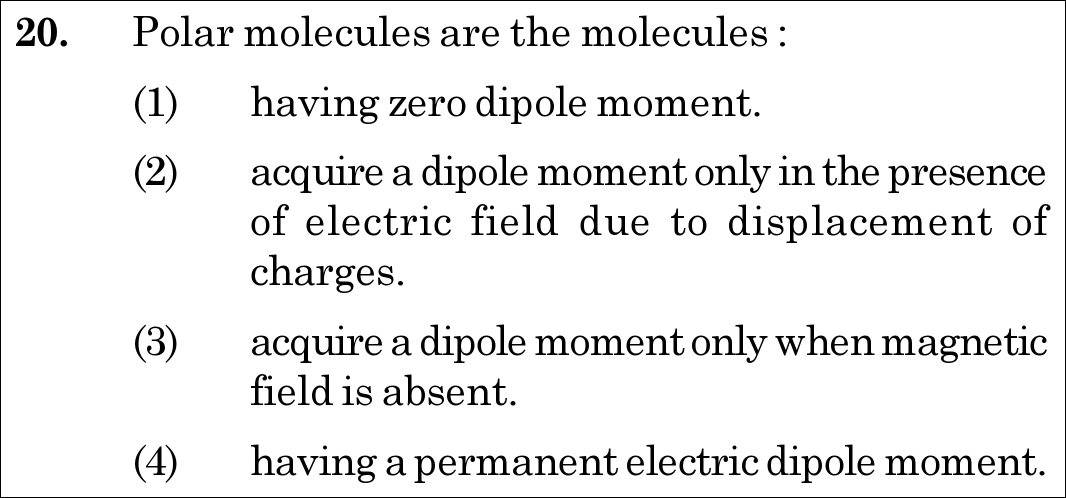
Q20 physics PHYSICS ⚡ 30s Speed Trick Active
Full Standalone Page ↗
NEET 2021 physics Question 20
✓
Official NTA Final Answer Key
Option (4) · having a permanent electric dipole moment.
Marks: +4 if correct / -1 if incorrect
⚡

The 30-Second Exam Hall Shortcut: ⚡ Polar = Permanent Dipole Moment

⏱️ Saves Save ~20 seconds

Verbatim NCERT Electrostatics definition: Polar molecules have non-coincident centers of positive and negative charge, hence possessing a PERMANENT electric dipole moment even in zero external field! Non-polar molecules have zero permanent dipole moment. Match Option (4)!

1 Non-polar molecules (e.g., H2,O2,CO2H_2, O_2, CO_2): Center of positive and negative charges coincide   ⟹  \implies permanent dipole moment is ZERO.
2 Polar molecules (e.g., HCl,H2OHCl, H_2O): Due to asymmetric chemical bonding, centers do NOT coincide   ⟹  \implies possess PERMANENT electric dipole moment.
3 External field merely aligns these permanent dipoles against thermal agitation.
4 Match Option (4) having a permanent electric dipole moment.
📐

Step-by-Step Conceptual & Mathematical Derivation

Step 1
Microscopic Basis of Molecular Polarity

In a molecule, the effective centers of positive charges (atomic nuclei) and negative charges (electron clouds) determine molecular polarity:

Step 2
Non-Polar vs. Polar Molecules in NCERT

NCERT defines both categories explicitly: - Non-polar molecule: The centers of positive and negative charges coincide. Thus, the molecule has no permanent (or intrinsic) dipole moment (e.g., O2,H2,CO2\text{O}_2, \text{H}_2, \text{CO}_2). - Polar molecule: The centers of positive and negative charges are separated by a finite displacement even when no external field is applied. Therefore, polar molecules possess an intrinsic, permanent electric dipole moment (e.g., HCl,H2O\text{HCl}, \text{H}_2\text{O}).

p⃗polar≠0⃗(even when E⃗ext=0⃗)\vec{p}_{\text{polar}} \neq \vec{0} \quad (\text{even when } \vec{E}_{\text{ext}} = \vec{0})
Step 3
Behavior in an External Field

When placed in an external electric field, the permanent dipoles experience a torque τ⃗=p⃗×E⃗\vec{\tau} = \vec{p} \times \vec{E} that tends to align them parallel to the field direction, creating orientational polarization.

🔍 View 360° Option Elimination Analysis & NTA Trap Alert ▼
Option (1) : 1 ✗ Incorrect

This describes non-polar molecules in the absence of an external electric field.

Student Fallacy: Confusing polar molecules with non-polar molecules.
Option (2) : 2 ✗ Incorrect

This describes induced dipole moments in non-polar molecules, not polar molecules.

Student Fallacy: Confusing induced polarization of non-polar dielectrics with intrinsic polar dipoles.
Option (3) : 3 ✗ Incorrect

Magnetic fields are irrelevant to the electrostatic definition of dielectric molecular polarity.

Student Fallacy: Conflating electric dipole moments with magnetic moments.
Option (4) : 4 ✓ Correct

Verbatim NCERT scientific definition: polar molecules inherently possess a permanent electric dipole moment.

Why correct: None; textbook verbatim precision.
⚠️ NTA Trap Alert: Permanent vs. Induced Dipole Moment Trap

Students frequently confuse polar molecules (which already HAVE permanent dipoles) with non-polar molecules (which ACQUIRE induced dipoles only when an external field is turned on).

🛡️ How to avoid negative mark: Polar = Permanent dipole moment. Non-polar = Acquired/induced dipole moment.
Topic: Physics (Section A) ⚡ 30s Speed Trick Available
👁️ Open Dedicated Full Screen Page & Notes ↗
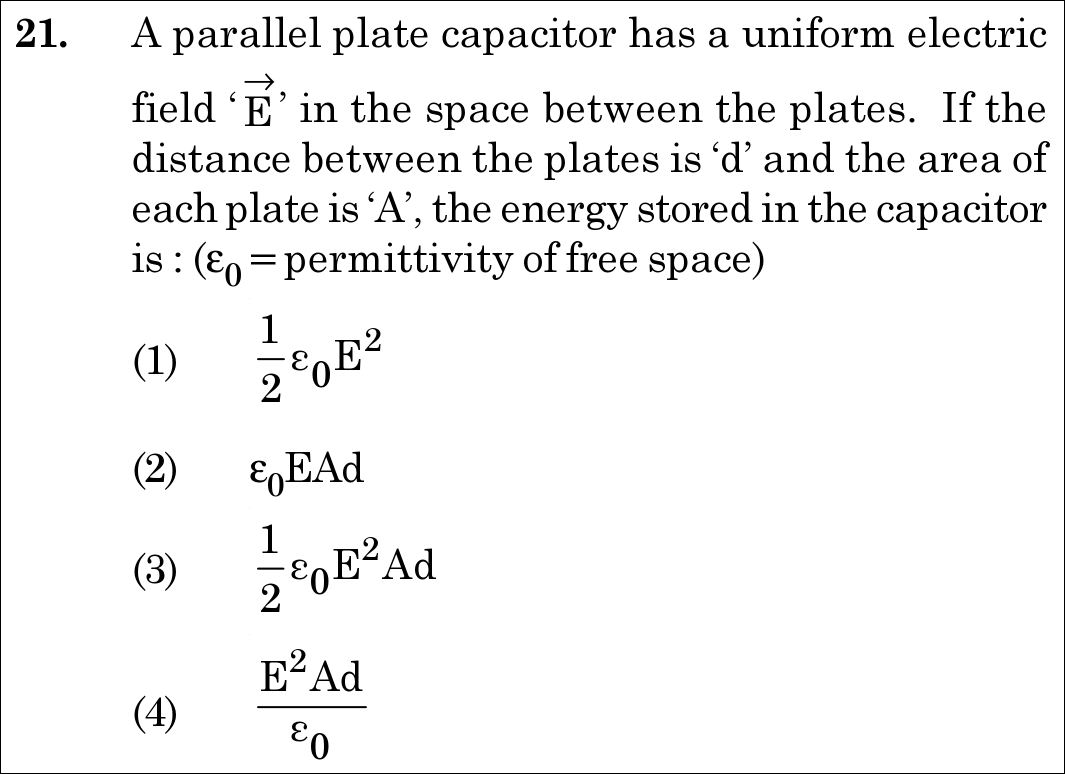
Q21 physics PHYSICS ⚡ 30s Speed Trick Active
Full Standalone Page ↗
NEET 2021 physics Question 21
✓
Official NTA Final Answer Key
Option (3) · 1/2 ε0 E^2 A d
Marks: +4 if correct / -1 if incorrect
⚡

The 30-Second Exam Hall Shortcut: ⚡ Energy = Energy Density × Volume

⏱️ Saves Save ~20 seconds

Energy density of electric field EE in free space is u=12ε0E2u = \frac{1}{2}\varepsilon_0 E^2. The volume between capacitor plates is Volume=A⋅d\text{Volume} = A \cdot d. Total stored energy is U=u×Volume=12ε0E2AdU = u \times \text{Volume} = \frac{1}{2}\varepsilon_0 E^2 A d! Instant 5-second answer matching Option (3)!

1 Recall electrostatic energy density: u=12ε0E2u = \frac{1}{2}\varepsilon_0 E^2 (energy per unit volume).
2 Volume between plates: V=A⋅dV = A \cdot d.
3 Total stored energy: U=u×V=(12ε0E2)(Ad)=12ε0E2AdU = u \times V = \left(\frac{1}{2}\varepsilon_0 E^2\right)(A d) = \frac{1}{2}\varepsilon_0 E^2 A d.
4 Match Option (3).
📐

Step-by-Step Conceptual & Mathematical Derivation

Step 1
Expressing Energy via Circuit Capacitance

The electrostatic potential energy UU stored in a charged capacitor of capacitance CC with potential difference V0V_0 across its plates is:

U=12CV02U = \frac{1}{2} C V_0^2
Step 2
Substituting Field Variables for a Parallel Plate Capacitor

For an ideal parallel plate capacitor in vacuum: - Capacitance: C=ε0AdC = \frac{\varepsilon_0 A}{d} - Potential difference: V0=E⋅dV_0 = E \cdot d

U=12(ε0Ad)(Ed)2=12(ε0Ad)(E2d2)U = \frac{1}{2} \left(\frac{\varepsilon_0 A}{d}\right) (E d)^2 = \frac{1}{2} \left(\frac{\varepsilon_0 A}{d}\right) (E^2 d^2)
Step 3
Simplifying to Final Expression

Canceling one factor of plate separation dd:

U=12ε0E2AdU = \frac{1}{2} \varepsilon_0 E^2 A d
🔍 View 360° Option Elimination Analysis & NTA Trap Alert ▼
Option (1) : 1 ✗ Incorrect

This is the electrostatic energy density uu (energy per unit volume, J/m3\text{J/m}^3), not the total energy in Joules.

Student Fallacy: Confusing energy density with total energy.
Option (2) : 2 ✗ Incorrect

Lacks the essential factor of 1/21/2 and has linear EE instead of quadratic E2E^2.

Student Fallacy: Dimensionally inconsistent formula.
Option (3) : 3 ✓ Correct

Exact total energy stored in the electric field of the capacitor: U=12ε0E2AdU = \frac{1}{2}\varepsilon_0 E^2 A d.

Why correct: None; rigorous capacitive energy derivation.
Option (4) : 4 ✗ Incorrect

Inverts permittivity ε0\varepsilon_0 to denominator and misses 1/21/2.

Student Fallacy: Dimensionally incorrect equation.
⚠️ NTA Trap Alert: Energy vs. Energy Density Confusion Trap

NTA included Option (1) 12ε0E2\frac{1}{2}\varepsilon_0 E^2, which is energy density (u=U/Vu = U/V). Students who memorize 12ε0E2\frac{1}{2}\varepsilon_0 E^2 without tracking units frequently pick Option (1).

🛡️ How to avoid negative mark: Check dimensions: Total energy MUST have dimensions of work/energy (Joules\text{Joules}), requiring multiplication by volume AdAd.
Topic: Physics (Section A) ⚡ 30s Speed Trick Available
👁️ Open Dedicated Full Screen Page & Notes ↗
Q22 physics PHYSICS ⚡ 30s Speed Trick Active
Full Standalone Page ↗
NEET 2021 physics Question 22
✓
Official NTA Final Answer Key
Option (2) · 2C
Marks: +4 if correct / -1 if incorrect
⚡

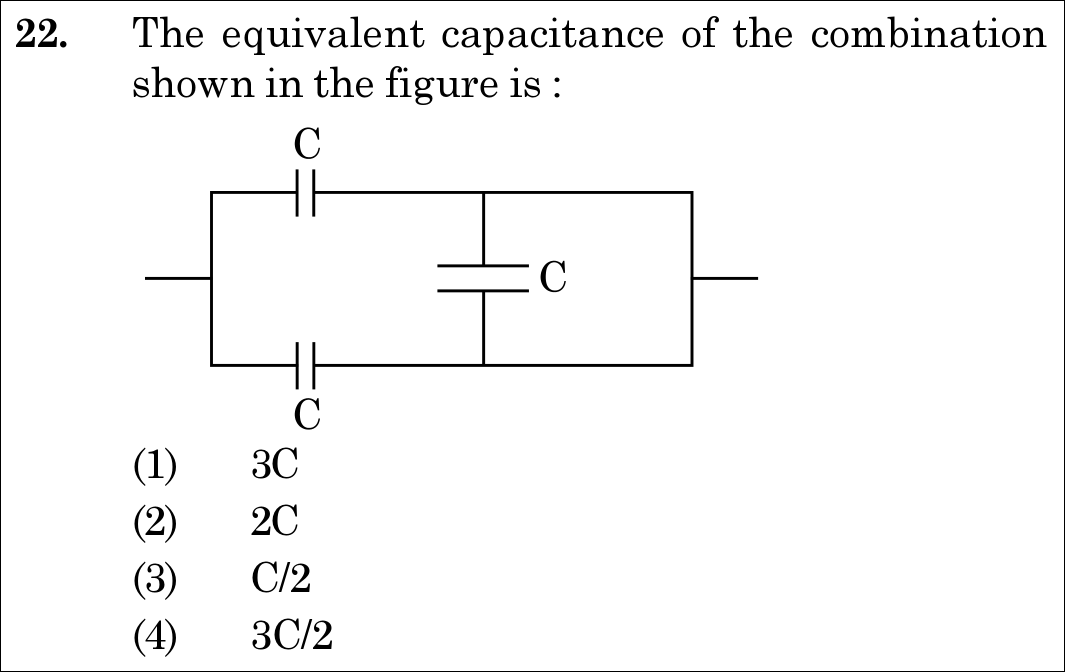
The 30-Second Exam Hall Shortcut: ⚡ Short-Circuit Detector: Vertical Capacitor has ΔV = 0!

⏱️ Saves Save ~25 seconds

Inspect the right side: both plates of the vertical capacitor are connected directly to the right terminal via zero-resistance wires! Hence, potential difference across the vertical capacitor is zero (it is short-circuited). The top and bottom capacitors are simply in parallel: Ceq=C+C=2CC_{\text{eq}} = C + C = 2C! Match Option (2)!

1 Label input node as A (left) and output node as B (right).
2 Top plate of vertical capacitor connects directly to node B.
3 Bottom plate of vertical capacitor connects directly to node B.
4 ΔV\Delta V across vertical capacitor =VB−VB=0  ⟹  = V_B - V_B = 0 \implies it stores zero charge (short-circuited / redundant).
5 Top capacitor is connected between A and B (C1=CC_1 = C).
6 Bottom capacitor is connected between A and B (C2=CC_2 = C).
7 Equivalent capacitance: Ceq=C1+C2=C+C=2CC_{\text{eq}} = C_1 + C_2 = C + C = 2C.
8 Match Option (2).
📐

Step-by-Step Conceptual & Mathematical Derivation

Step 1
Nodal Voltage Labeling

Assign electrostatic potentials to all wire junctions in the circuit diagram: - Let the input terminal on the left be at potential VAV_A. - Let the output terminal on the right be at potential VBV_B. - The ideal continuous conducting wire on the right connects the top node and bottom node directly to terminal B with zero resistance. Therefore, both nodes are at potential VBV_B.

Step 2
Analyzing the Vertical Bridge Capacitor

The vertical capacitor of capacitance CC has its upper terminal connected to the upper wire (potential VBV_B) and its lower terminal connected to the lower wire (potential VBV_B):

ΔVvertical=VB−VB=0  ⟹  Q=CΔV=0\Delta V_{\text{vertical}} = V_B - V_B = 0 \implies Q = C \Delta V = 0
Step 3
Calculating the Equivalent Capacitance

Since the vertical capacitor carries zero charge and contributes zero capacitance, it can be removed from the circuit. The remaining circuit consists solely of the top capacitor and the bottom capacitor connected in parallel between node A and node B:

Ceq=Ctop+Cbottom=C+C=2CC_{\text{eq}} = C_{\text{top}} + C_{\text{bottom}} = C + C = 2C
🔍 View 360° Option Elimination Analysis & NTA Trap Alert ▼
Option (1) : 1 ✗ Incorrect

Assumes all three capacitors are active in parallel (C+C+C=3CC + C + C = 3C), ignoring that the vertical capacitor is shorted.

Student Fallacy: Treating all three capacitors as participating equally in parallel.
Option (2) : 2 ✓ Correct

Exact equivalent capacitance: vertical capacitor is short-circuited (DeltaV=0Delta V = 0), leaving two parallel capacitors of capacitance CC, yielding 2C2C.

Why correct: None; rigorous nodal potential analysis.
Option (3) : 3 ✗ Incorrect

Result of erroneously treating the top and bottom capacitors in series (C/2C/2).

Student Fallacy: Assuming series connection between top and bottom branches.
Option (4) : 4 ✗ Incorrect

Result of treating the vertical capacitor as a series/parallel bridge element.

Student Fallacy: Misapplying delta-star or bridge formulas without checking equipotential nodes.
⚠️ NTA Trap Alert: The "Ghost Bridge" Visual Trap

The circuit looks visually like a bridge circuit. Students immediately begin calculating Wheatstone bridge ratios or complex series-parallel ladders. Tracing the wire on the right immediately reveals that both ends of the vertical capacitor connect to the same terminal.

🛡️ How to avoid negative mark: ALWAYS trace continuous conducting lines! If both plates of a capacitor touch the same node, it is short-circuited and can be erased.
Topic: Physics (Section A) ⚡ 30s Speed Trick Available
👁️ Open Dedicated Full Screen Page & Notes ↗
Q23 physics PHYSICS ⚡ 30s Speed Trick Active
Full Standalone Page ↗
NEET 2021 physics Question 23
✓
Official NTA Final Answer Key
Option (3) · (A) is correct and (B) is incorrect.
Marks: +4 if correct / -1 if incorrect
⚡

The 30-Second Exam Hall Shortcut: ⚡ Zener Reverse Bias + Silicon 0.7 V Barrier Rule

⏱️ Saves Save ~20 seconds

Statement (A) is TRUE: Zener diode operates strictly in reverse-breakdown region for voltage regulation. Statement (B) is FALSE: Silicon p-n junctions have a barrier potential of ≈0.7 V\approx 0.7\text{ V} (Germanium is ≈0.3 V\approx 0.3\text{ V}), so the barrier lies typically between 0.3 V0.3\text{ V} and 0.7 V0.7\text{ V}, not 0.1 V0.1\text{ V} to 0.3 V0.3\text{ V}! Match Option (3)!

1 Check Statement (A): Voltage regulator operation requires reverse bias in breakdown region -> True.
2 Check Statement (B): Claims barrier potential is 0.1 V to 0.3 V. But standard Si barrier is ~0.7 V and Ge is ~0.3 V -> False.
3 Thus, (A) is correct and (B) is incorrect.
4 Match Option (3).
📐

Step-by-Step Conceptual & Mathematical Derivation

Step 1
Evaluation of Statement (A): Zener Diode Operation

A Zener diode is a heavily doped silicon p-n junction diode. When operated in the reverse breakdown region, the voltage across the diode (VZV_Z) remains virtually constant over a wide range of reverse currents (IZI_Z). Therefore, to regulate unregulated DC voltage, it is always connected in reverse bias across the load:

Zener Voltage Regulator  ⟹  Operates in Reverse Breakdown Bias (Statement A is CORRECT)\text{Zener Voltage Regulator} \implies \mathbf{\text{Operates in Reverse Breakdown Bias (Statement A is CORRECT)}}
Step 2
Evaluation of Statement (B): p-n Junction Barrier Potential

In an unbiased p-n junction, diffusion of majority carriers creates a depletion layer with a built-in potential barrier V0V_0. For Germanium, V0≈0.3 VV_0 \approx 0.3\text{ V}, and for Silicon (the ubiquitous material in modern electronics), V0≈0.7 VV_0 \approx 0.7\text{ V}. Thus, the barrier potential typically lies between 0.3 V0.3\text{ V} and 0.7 V0.7\text{ V}, not between 0.1 V0.1\text{ V} and 0.3 V0.3\text{ V}. Statement (B) is unambiguously incorrect.

Step 3
Conclusion

Statement (A) is correct and Statement (B) is incorrect. This corresponds uniquely to Option (3).

🔍 View 360° Option Elimination Analysis & NTA Trap Alert ▼
Option (1) : 1 ✗ Incorrect

Statement (B) is false because Silicon p-n junctions have a barrier potential of ~0.7 V.

Student Fallacy: Believing 0.1 V to 0.3 V covers all semiconductor junctions.
Option (2) : 2 ✗ Incorrect

Statement (A) is an undisputed textbook fact of semiconductor electronics.

Student Fallacy: Doubting whether Zener diodes operate in reverse bias.
Option (3) : 3 ✓ Correct

Statement (A) accurately states reverse-bias operation of Zener regulators, while Statement (B) underestimates the barrier potential range.

Why correct: None; rigorous semiconductor physics knowledge.
Option (4) : 4 ✗ Incorrect

Inverts the truth value of both statements.

Student Fallacy: Gross confusion regarding semiconductor diode physics.
⚠️ NTA Trap Alert: Germanium vs. Silicon Barrier Potential Trap

Students often recall that Germanium has a low barrier potential of ≈0.3 V\approx 0.3\text{ V} and assume Statement (B) is true, forgetting that Silicon (the primary semiconductor in NCERT) has a barrier of ≈0.7 V\approx 0.7\text{ V}.

🛡️ How to avoid negative mark: Remember: Silicon barrier potential is ≈0.7 V\approx 0.7\text{ V}. Any range ending at 0.3 V0.3\text{ V} is false for p-n junctions.
Topic: Physics (Section A) ⚡ 30s Speed Trick Available
👁️ Open Dedicated Full Screen Page & Notes ↗
Q24 physics PHYSICS ⚡ 30s Speed Trick Active
Full Standalone Page ↗
NEET 2021 physics Question 24
✓
Official NTA Final Answer Key
Option (4) · S / 4, \sqrt{3gS / 2}
Marks: +4 if correct / -1 if incorrect
⚡

The 30-Second Exam Hall Shortcut: ⚡ 4-Part Energy Split: U = E/4   ⟹  \implies h = S/4, v = √(3gS/2)

⏱️ Saves Save ~20 seconds

Total energy E=mgS=K+UE = mgS = K + U. Since K=3UK = 3U, we have 4U=mgS  ⟹  U=14mgS  ⟹  h=S44U = mgS \implies U = \frac{1}{4}mgS \implies h = \frac{S}{4}! Kinetic energy is K=34mgS=12mv2  ⟹  v=3gS2K = \frac{3}{4}mgS = \frac{1}{2}mv^2 \implies v = \sqrt{\frac{3gS}{2}}! Match Option (4)!

1 Conserve mechanical energy: E=Ui+Ki=mgS+0=mgSE = U_i + K_i = mgS + 0 = mgS.
2 At height hh: E=U+K=U+3U=4UE = U + K = U + 3U = 4U.
3 Equate: 4mgh=mgS  ⟹  h=S44 mgh = mgS \implies h = \frac{S}{4}.
4 Find velocity from kinetic energy: K=12mv2=3U=3mg(S4)=34mgSK = \frac{1}{2}mv^2 = 3U = 3 mg \left(\frac{S}{4}\right) = \frac{3}{4}mgS.
5 v2=3gS2  ⟹  v=3gS2v^2 = \frac{3gS}{2} \implies v = \sqrt{\frac{3gS}{2}}.
6 Match Option (4).
📐

Step-by-Step Conceptual & Mathematical Derivation

Step 1
Formulating Total Mechanical Energy

At height SS above the ground, the particle is released from rest (u=0u = 0). Taking the ground as the reference plane for zero gravitational potential energy:

Etotal=Ui+Ki=mgS+0=mgSE_{\text{total}} = U_i + K_i = mgS + 0 = mgS
Step 2
Determining the Height from the Earth's Surface

At an unknown height hh, potential energy is U=mghU = mgh and kinetic energy is KK. We are given K=3UK = 3U:

Etotal=K+U=3U+U=4U  ⟹  4(mgh)=mgS  ⟹  h=S4E_{\text{total}} = K + U = 3U + U = 4U \implies 4(mgh) = mgS \implies h = \frac{S}{4}
Step 3
Determining the Speed of the Particle

Substitute h=S/4h = S/4 into the expression for kinetic energy K=12mv2K = \frac{1}{2}mv^2:

12mv2=3mgh=3mg(S4)=34mgS  ⟹  v2=3gS2  ⟹  v=3gS2\frac{1}{2}mv^2 = 3 mgh = 3 mg \left(\frac{S}{4}\right) = \frac{3}{4}mgS \implies v^2 = \frac{3gS}{2} \implies v = \sqrt{\frac{3gS}{2}}
🔍 View 360° Option Elimination Analysis & NTA Trap Alert ▼
Option (1) : 1 ✗ Incorrect

Speed lacks the square root (gives v2v^2 instead of vv).

Student Fallacy: Forgetting to take the square root of v2v^2.
Option (2) : 2 ✗ Incorrect

The radical only covers the numerator: 3gS2=3gS4≠3gS2\frac{\sqrt{3gS}}{2} = \sqrt{\frac{3gS}{4}} \neq \sqrt{\frac{3gS}{2}}.

Student Fallacy: Placing the denominator 2 outside the square root.
Option (3) : 3 ✗ Incorrect

Incorrect height S/2S/2 (which would correspond to K=UK = U, not K=3UK = 3U).

Student Fallacy: Assuming the condition occurs at the midpoint of fall.
Option (4) : 4 ✓ Correct

Exact height and speed derived from energy conservation: h=S/4h = S/4 and v=3gS2v = \sqrt{\frac{3gS}{2}}.

Why correct: None; rigorous algebraic energy solution.
⚠️ NTA Trap Alert: Radical Bracket Scope Trap (Option 2 vs. Option 4)

Notice the typographic trap between Option (2) 3gS2\frac{\sqrt{3gS}}{2} and Option (4) 3gS2\sqrt{\frac{3gS}{2}}. In Option 2, the 2 is in the denominator OUTSIDE the radical (giving a factor of 1/41/4 under the radical). In Option 4, the 2 is INSIDE the radical.

🛡️ How to avoid negative mark: Check radical boundaries carefully: v=3gS2v = \sqrt{\frac{3gS}{2}}, so the entire fraction 3gS/23gS/2 is under the square root.
Topic: Physics (Section A) ⚡ 30s Speed Trick Available
👁️ Open Dedicated Full Screen Page & Notes ↗
Q25 physics PHYSICS ⚡ 30s Speed Trick Active
Full Standalone Page ↗
NEET 2021 physics Question 25
✓
Official NTA Final Answer Key
Option (1) · [M^2] [L^-1] [T^0]
Marks: +4 if correct / -1 if incorrect
⚡

The 30-Second Exam Hall Shortcut: ⚡ Dimensional Quotient: [E] / [G]

⏱️ Saves Save ~20 seconds

[E]=[ML2T−2][E] = [M L^2 T^{-2}] and [G]=[M−1L3T−2][G] = [M^{-1} L^3 T^{-2}]. Divide them: [E/G]=[ML2T−2][M−1L3T−2]=[M1−(−1)L2−3T−2−(−2)]=[M2L−1T0][E/G] = \frac{[M L^2 T^{-2}]}{[M^{-1} L^3 T^{-2}]} = [M^{1 - (-1)} L^{2 - 3} T^{-2 - (-2)}] = [M^2 L^{-1} T^0]! Instant 10-second calculation matching Option (1)!

1 Dimensional formula of Energy: [E]=[M1L2T−2][E] = [M^1 L^2 T^{-2}].
2 Dimensional formula of GG: From F=Gm2r2  ⟹  G=Fr2m2  ⟹  [G]=[MLT−2][L2][M2]=[M−1L3T−2]F = \frac{G m^2}{r^2} \implies G = \frac{F r^2}{m^2} \implies [G] = \frac{[M L T^{-2}][L^2]}{[M^2]} = [M^{-1} L^3 T^{-2}].
3 Compute [E/G]=[ML2T−2][M−1L3T−2][E/G] = \frac{[M L^2 T^{-2}]}{[M^{-1} L^3 T^{-2}]}.
4 Exponents: M:1−(−1)=2M: 1 - (-1) = 2; L:2−3=−1L: 2 - 3 = -1; T:−2−(−2)=0T: -2 - (-2) = 0.
5 Result: [M2L−1T0]  ⟹  [M^2 L^{-1} T^0] \implies Match Option (1).
📐

Step-by-Step Conceptual & Mathematical Derivation

Step 1
Deriving the Dimensions of Energy (E)

Energy has the dimensions of work (Force ×\times Displacement):

[E]=[Work]=[Force]×[Displacement]=[MLT−2]×[L]=[M1L2T−2][E] = [\text{Work}] = [\text{Force}] \times [\text{Displacement}] = [M L T^{-2}] \times [L] = [M^1 L^2 T^{-2}]
Step 2
Deriving the Dimensions of Gravitational Constant (G)

From Newton's universal law of gravitation F=Gm1m2r2F = G \frac{m_1 m_2}{r^2}:

G=F⋅r2m1m2  ⟹  [G]=[MLT−2]×[L2][M]×[M]=[ML3T−2][M2]=[M−1L3T−2]G = \frac{F \cdot r^2}{m_1 m_2} \implies [G] = \frac{[M L T^{-2}] \times [L^2]}{[M] \times [M]} = \frac{[M L^3 T^{-2}]}{[M^2]} = [M^{-1} L^3 T^{-2}]
Step 3
Computing the Dimensions of the Ratio E / G

Divide the dimensional formula of EE by that of GG using the laws of indices:

[EG]=[M1L2T−2][M−1L3T−2]=[M1−(−1)L2−3T−2−(−2)]=[M2L−1T0]\left[\frac{E}{G}\right] = \frac{[M^1 L^2 T^{-2}]}{[M^{-1} L^3 T^{-2}]} = [M^{1 - (-1)} L^{2 - 3} T^{-2 - (-2)}] = [M^2 L^{-1} T^0]
🔍 View 360° Option Elimination Analysis & NTA Trap Alert ▼
Option (1) : 1 ✓ Correct

Exact dimensional formula of the ratio E/GE/G.

Why correct: None; textbook dimensional analysis.
Option (2) : 2 ✗ Incorrect

Dimensions of coefficient of viscosity (etaeta), not E/GE/G.

Student Fallacy: Confusing E/GE/G with viscosity dimensions.
Option (3) : 3 ✗ Incorrect

Dimensions of pure mass ([M][M]).

Student Fallacy: Arithmetic cancellation error resulting in [M][M].
Option (4) : 4 ✗ Incorrect

Incorrect power of length and time.

Student Fallacy: Failing to cancel T−2T^{-2} in numerator and denominator.
⚠️ NTA Trap Alert: Time Dimension Cancellation Trap

Both [E][E] and [G][G] contain T−2T^{-2} in their dimensions. In the quotient E/GE/G, the time terms cancel out completely to give T0T^0. Students who forget that T−2/T−2=T0T^{-2} / T^{-2} = T^0 get trapped by Option (4).

🛡️ How to avoid negative mark: Notice that T−2T^{-2} is in both EE and GG: −2−(−2)=0  ⟹  T0-2 - (-2) = 0 \implies T^0.
Topic: Physics (Section A) ⚡ 30s Speed Trick Available
👁️ Open Dedicated Full Screen Page & Notes ↗
Q26 physics PHYSICS ⚡ 30s Speed Trick Active
Full Standalone Page ↗
NEET 2021 physics Question 26
✓
Official NTA Final Answer Key
Option (3) · (A) - (Q), (B) - (P), (C) - (S), (D) - (R)
Marks: +4 if correct / -1 if incorrect
⚡

The 30-Second Exam Hall Shortcut: ⚡ Kinetic Theory Master Matcher

⏱️ Saves Save ~25 seconds

Match standard NCERT kinetic theory relations: RMS speed vrms=3RTMv_{\text{rms}} = \sqrt{\frac{3RT}{M}} (Q); Pressure P=13nmvˉ2P = \frac{1}{3} n m \bar{v}^2 (P); Average KE of one molecule =32kBT= \frac{3}{2} k_B T (S); Internal energy of 1 mole of diatomic gas (f=5f=5) =52RT= \frac{5}{2} RT (R)! Match Option (3)!

1 RMS speed of gas molecules: vrms=3RTM  ⟹  (A)−(Q)v_{\text{rms}} = \sqrt{\frac{3RT}{M}} \implies (A)-(Q).
2 Pressure of ideal gas: P=13nmvˉ2  ⟹  (B)−(P)P = \frac{1}{3} n m \bar{v}^2 \implies (B)-(P).
3 Translational KE per single molecule: Eˉ=32kBT  ⟹  (C)−(S)\bar{E} = \frac{3}{2} k_B T \implies (C)-(S).
4 Total internal energy for 1 mole of diatomic gas (f=5f = 5 degrees of freedom): U=f2RT=52RT  ⟹  (D)−(R)U = \frac{f}{2} RT = \frac{5}{2} RT \implies (D)-(R).
5 Match combination: (A)-(Q), (B)-(P), (C)-(S), (D)-(R) -> Option (3).
📐

Step-by-Step Conceptual & Mathematical Derivation

Step 1
Formula for RMS Speed of Gas Molecules (A)

From kinetic theory of gases, the root mean square speed is directly proportional to the square root of absolute temperature:

vrms=3RTM  ⟹  (A)−(Q)v_{\text{rms}} = \sqrt{\frac{3RT}{M}} \implies \mathbf{(A)-(Q)}
Step 2
Formula for Pressure Exerted by an Ideal Gas (B)

Derived by considering rate of change of momentum of gas molecules bombarding container walls, where nn is number density, mm is molecular mass, and vˉ2\bar{v}^2 is mean square speed:

P=13nmvˉ2  ⟹  (B)−(P)P = \frac{1}{3} n m \bar{v}^2 \implies \mathbf{(B)-(P)}
Step 3
Formula for Average Kinetic Energy of a Molecule (C)

By the equipartition of energy theorem, each translational degree of freedom contributes 12kBT\frac{1}{2} k_B T. For 3 translational degrees of freedom of a single molecule:

Eavg=3×(12kBT)=32kBT  ⟹  (C)−(S)E_{\text{avg}} = 3 \times \left(\frac{1}{2} k_B T\right) = \frac{3}{2} k_B T \implies \mathbf{(C)-(S)}
Step 4
Formula for Total Internal Energy of 1 Mole of Diatomic Gas (D)

A rigid diatomic gas has 5 degrees of freedom (3 translational + 2 rotational). For 1 mole (n=1n = 1), the internal energy is:

U=f2nRT=52(1)RT=52RT  ⟹  (D)−(R)U = \frac{f}{2} n R T = \frac{5}{2} (1) R T = \frac{5}{2} R T \implies \mathbf{(D)-(R)}
🔍 View 360° Option Elimination Analysis & NTA Trap Alert ▼
Option (1) : 1 ✗ Incorrect

Mismatches RMS speed with internal energy 52RT\frac{5}{2}RT.

Student Fallacy: Swapping (A) and (D).
Option (2) : 2 ✗ Incorrect

Mismatches pressure with internal energy.

Student Fallacy: Swapping (B) and (D).
Option (3) : 3 ✓ Correct

Exact 1-to-1 match with all four textbook kinetic theory relations.

Why correct: None; textbook verbatim match.
Option (4) : 4 ✗ Incorrect

Scrambles multiple associations.

Student Fallacy: Random matching.
⚠️ NTA Trap Alert: Molar Energy (R) vs. Molecular Energy (k_B) Trap

Students frequently mix up molecular kinetic energy (which uses Boltzmann's constant kBk_B) with molar internal energy (which uses the universal gas constant RR).

🛡️ How to avoid negative mark: Molecule = uses kBk_B (Option S). Mole of gas = uses RR (Option R).
Topic: Physics (Section A) ⚡ 30s Speed Trick Available
👁️ Open Dedicated Full Screen Page & Notes ↗
Q27 physics PHYSICS ⚡ 30s Speed Trick Active
Full Standalone Page ↗
NEET 2021 physics Question 27
✓
Official NTA Final Answer Key
Option (2) · 2n
Marks: +4 if correct / -1 if incorrect
⚡

The 30-Second Exam Hall Shortcut: ⚡ Double Frequency Rule: Energy Completes 2 Cycles per 1 SHM Cycle

⏱️ Saves Save ~20 seconds

In one full oscillation, the particle passes through the equilibrium position twice and reaches extreme positions twice. Hence, both potential energy and kinetic energy go through two complete cycles of oscillation for every one cycle of displacement: Frequency of PE =2n= 2n! Match Option (2)!

1 Displacement: x(t)=Asin⁡(2πnt)x(t) = A \sin(2\pi n t).
2 Potential Energy: U(t)=12kx2=12kA2sin⁡2(2πnt)U(t) = \frac{1}{2} k x^2 = \frac{1}{2} k A^2 \sin^2(2\pi n t).
3 Use trigonometric identity: sin⁡2θ=1−cos⁡(2θ)2\sin^2\theta = \frac{1 - \cos(2\theta)}{2}.
4 U(t)=14kA2[1−cos⁡(2×2πnt)]=14kA2[1−cos⁡(2π(2n)t)]U(t) = \frac{1}{4} k A^2 [1 - \cos(2 \times 2\pi n t)] = \frac{1}{4} k A^2 [1 - \cos(2\pi (2n) t)].
5 The oscillating term has frequency 2n2n.
6 Match Option (2).
📐

Step-by-Step Conceptual & Mathematical Derivation

Step 1
Expressing Displacement in Simple Harmonic Motion

For a particle executing simple harmonic motion with frequency nn (angular frequency ω=2πn\omega = 2\pi n) and amplitude AA, displacement from the mean position is:

x(t)=Asin⁡(ωt)=Asin⁡(2πnt)x(t) = A \sin(\omega t) = A \sin(2\pi n t)
Step 2
Formulating Potential Energy as a Function of Time

The potential energy UU of the harmonic oscillator with force constant kk is given by:

U(t)=12kx(t)2=12kA2sin⁡2(ωt)U(t) = \frac{1}{2} k x(t)^2 = \frac{1}{2} k A^2 \sin^2(\omega t)
Step 3
Applying the Power-Reduction Trigonometric Identity

Using the identity sin⁡2(ωt)=1−cos⁡(2ωt)2\sin^2(\omega t) = \frac{1 - \cos(2\omega t)}{2}:

U(t)=14kA2[1−cos⁡(2ωt)]=14kA2−14kA2cos⁡(2ωt)U(t) = \frac{1}{4} k A^2 \left[1 - \cos(2\omega t)\right] = \frac{1}{4} k A^2 - \frac{1}{4} k A^2 \cos(2\omega t)
Step 4
Determining the Frequency of the Oscillating Energy Term

The time-dependent harmonic term cos⁡(2ωt)\cos(2\omega t) has angular frequency ω′=2ω\omega' = 2\omega. Since ω=2πn\omega = 2\pi n:

ω′=2(2πn)=2π(2n)  ⟹  Frequency f′=2n\omega' = 2(2\pi n) = 2\pi (2n) \implies \text{Frequency } f' = 2n
🔍 View 360° Option Elimination Analysis & NTA Trap Alert ▼
Option (1) : 1 ✗ Incorrect

This is the frequency of displacement, velocity, and acceleration, but energy depends on the square of displacement (x2x^2), doubling its frequency.

Student Fallacy: Assuming energy oscillates at the same frequency as displacement.
Option (2) : 2 ✓ Correct

Exact frequency of potential energy oscillations: ω′=2ω  ⟹  f′=2n\omega' = 2\omega \implies f' = 2n.

Why correct: None; rigorous mathematical SHM analysis.
Option (3) : 3 ✗ Incorrect

Unphysical harmonic multiplier.

Student Fallacy: Conflating third harmonics with quadratic functions.
Option (4) : 4 ✗ Incorrect

Incorrect quadrupling of frequency.

Student Fallacy: Confusing 4 quadrants of motion with frequency.
⚠️ NTA Trap Alert: Displacement Frequency vs. Energy Frequency Trap

Students frequently assume all parameters in SHM have frequency nn. Displacement, velocity, and acceleration have frequency nn. Kinetic energy and potential energy have frequency 2n2n. Total energy has frequency 00 (constant).

🛡️ How to avoid negative mark: Remember: x,v,ax, v, a oscillate at nn. Kinetic energy and potential energy oscillate at 2n2n. Total energy is constant (frequency = 0).
Topic: Physics (Section A) ⚡ 30s Speed Trick Available
👁️ Open Dedicated Full Screen Page & Notes ↗
Q28 physics PHYSICS ⚡ 30s Speed Trick Active
Full Standalone Page ↗
NEET 2021 physics Question 28
✓
Official NTA Final Answer Key
Option (2) · 13 / 5 t
Marks: +4 if correct / -1 if incorrect
⚡

The 30-Second Exam Hall Shortcut: ⚡ Average Temperature Difference Ratio

⏱️ Saves Save ~25 seconds

Rate of cooling =ΔTΔt=K(Tavg−T0)= \frac{\Delta T}{\Delta t} = K (T_{\text{avg}} - T_0). Case 1: 10t=K(85−20)=65K\frac{10}{t} = K(85 - 20) = 65 K. Case 2: 20t′=K(70−20)=50K\frac{20}{t'} = K(70 - 20) = 50 K. Divide them: 10/t20/t′=6550  ⟹  t′2t=1310  ⟹  t′=135t\frac{10/t}{20/t'} = \frac{65}{50} \implies \frac{t'}{2t} = \frac{13}{10} \implies t' = \frac{13}{5}t! Match Option (2)!

1 Newton's law average form: Ti−TfΔt=K(Ti+Tf2−T0)\frac{T_i - T_f}{\Delta t} = K\left(\frac{T_i + T_f}{2} - T_0\right).
2 Case 1 (90∘→80∘90^\circ \to 80^\circ): 10t=K(85−20)=65K\frac{10}{t} = K(85 - 20) = 65K.
3 Case 2 (80∘→60∘80^\circ \to 60^\circ): 20t′=K(70−20)=50K\frac{20}{t'} = K(70 - 20) = 50K.
4 Divide Case 1 by Case 2: 10/t20/t′=65K50K  ⟹  t′2t=1310\frac{10/t}{20/t'} = \frac{65K}{50K} \implies \frac{t'}{2t} = \frac{13}{10}.
5 Solve for t′t': t′=2t×1310=135tt' = 2t \times \frac{13}{10} = \frac{13}{5}t.
6 Match Option (2).
📐

Step-by-Step Conceptual & Mathematical Derivation

Step 1
Formulating Newton's Law of Cooling (Average Form)

For a body cooling in surroundings at constant ambient temperature T0T_0, the average rate of fall of temperature over time interval Δt\Delta t is proportional to the excess of average temperature over surroundings:

T1−T2Δt=K(T1+T22−T0)\frac{T_1 - T_2}{\Delta t} = K \left(\frac{T_1 + T_2}{2} - T_0\right)
Step 2
Setting Up Equation for the First Cooling Process

For cooling from 90∘C90^\circ\text{C} to 80∘C80^\circ\text{C} in time tt with T0=20∘CT_0 = 20^\circ\text{C}:

90−80t=K(90+802−20)  ⟹  10t=K(85−20)=65K— (1)\frac{90 - 80}{t} = K \left(\frac{90 + 80}{2} - 20\right) \implies \frac{10}{t} = K (85 - 20) = 65 K \quad \text{--- (1)}
Step 3
Setting Up Equation for the Second Cooling Process

For cooling from 80∘C80^\circ\text{C} to 60∘C60^\circ\text{C} in time t′t' in the same surroundings:

80−60t′=K(80+602−20)  ⟹  20t′=K(70−20)=50K— (2)\frac{80 - 60}{t'} = K \left(\frac{80 + 60}{2} - 20\right) \implies \frac{20}{t'} = K (70 - 20) = 50 K \quad \text{--- (2)}
Step 4
Dividing Equations to Determine t'

Divide equation (1) by equation (2) to eliminate the cooling constant KK:

10/t20/t′=65K50K  ⟹  t′2t=1310  ⟹  t′=1310×2t=135t\frac{10/t}{20/t'} = \frac{65 K}{50 K} \implies \frac{t'}{2t} = \frac{13}{10} \implies t' = \frac{13}{10} \times 2t = \frac{13}{5} t
🔍 View 360° Option Elimination Analysis & NTA Trap Alert ▼
Option (1) : 1 ✗ Incorrect

Forgets the factor of 2 arising from the temperature drop ratio (ΔT2/ΔT1=20/10=2\Delta T_2 / \Delta T_1 = 20/10 = 2).

Student Fallacy: Writing t′/t=13/10t'/t = 13/10 without accounting for the 20∘20^\circ drop vs. 10∘10^\circ drop.
Option (2) : 2 ✓ Correct

Exact time derived from Newton's law of cooling: t′=135t=2.6tt' = \frac{13}{5}t = 2.6t.

Why correct: None; rigorous thermal physics calculation.
Option (3) : 3 ✗ Incorrect

Inverted ratio with missing factor of 2 (gives time less than tt, which is physically impossible for a larger temperature drop at lower temperature).

Student Fallacy: Inverting numerator and denominator.
Option (4) : 4 ✗ Incorrect

Complete inversion of the correct ratio (5/135/13 instead of 13/513/5).

Student Fallacy: Inverting final result.
⚠️ NTA Trap Alert: Double Temperature Drop Neglect Trap

Students frequently calculate the ratio of average temperature excess (65/50=13/1065/50 = 13/10) and immediately select Option (1) 1310t\frac{13}{10}t, forgetting that the first drop was only 10∘C10^\circ\text{C} (90→8090 \to 80), while the second drop is TWICE as large (20∘C20^\circ\text{C} from 80→6080 \to 60).

🛡️ How to avoid negative mark: Always include the temperature drop in the rate: ΔTΔt\frac{\Delta T}{\Delta t}. Here ΔT2=20\Delta T_2 = 20, which is 2×ΔT12 \times \Delta T_1.
Topic: Physics (Section A) ⚡ 30s Speed Trick Available
👁️ Open Dedicated Full Screen Page & Notes ↗
Q29 physics PHYSICS ⚡ 30s Speed Trick Active
Full Standalone Page ↗
NEET 2021 physics Question 29
✓
Official NTA Final Answer Key
Option (1) · I_d = V_0 ω C cos(ωt)
Marks: +4 if correct / -1 if incorrect
⚡

The 30-Second Exam Hall Shortcut: ⚡ Displacement Current = Conduction Current: I_d = dq/dt

⏱️ Saves Save ~20 seconds

By Maxwell's continuity theorem, displacement current inside the dielectric gap equals the conduction current in the connecting wires: Id=Ic=dqdt=CdVdt=Cddt[V0sin⁡(ωt)]=V0ωCcos⁡(ωt)I_d = I_c = \frac{dq}{dt} = C \frac{dV}{dt} = C \frac{d}{dt}[V_0 \sin(\omega t)] = V_0 \omega C \cos(\omega t)! Instant 10-second derivative matching Option (1)!

1 Charge on capacitor plates at any instant: q(t)=CV(t)=CV0sin⁡(ωt)q(t) = C V(t) = C V_0 \sin(\omega t).
2 By Maxwell-Ampere law, displacement current between plates equals conduction current: Id=dqdtI_d = \frac{dq}{dt}.
3 Differentiate with respect to time: ddt[V0sin⁡(ωt)]=V0ωcos⁡(ωt)\frac{d}{dt}[V_0 \sin(\omega t)] = V_0 \omega \cos(\omega t).
4 Thus, Id=V0ωCcos⁡(ωt)I_d = V_0 \omega C \cos(\omega t).
5 Match Option (1).
📐

Step-by-Step Conceptual & Mathematical Derivation

Step 1
Definition of Displacement Current

Maxwell defined displacement current IdI_d in terms of the rate of change of electric flux ΦE\Phi_E between the capacitor plates:

Id=ε0dΦEdtI_d = \varepsilon_0 \frac{d\Phi_E}{dt}
Step 2
Expressing Electric Flux in Terms of Charge and Voltage

For a parallel plate capacitor of area AA and separation dd, the uniform electric field is E=V/dE = V/d. The electric flux is ΦE=EA=(V/d)A=V(A/d)\Phi_E = E A = (V/d)A = V (A/d):

ε0ΦE=ε0(Ad)V=CV=q\varepsilon_0 \Phi_E = \varepsilon_0 \left(\frac{A}{d}\right) V = C V = q
Step 3
Evaluating the Time Derivative

Substitute V(t)=V0sin⁡(ωt)V(t) = V_0 \sin(\omega t) into the displacement current expression:

Id=ddt(CV)=CdVdt=Cddt[V0sin⁡(ωt)]=V0ωCcos⁡(ωt)I_d = \frac{d}{dt}(C V) = C \frac{dV}{dt} = C \frac{d}{dt}\left[V_0 \sin(\omega t)\right] = V_0 \omega C \cos(\omega t)
🔍 View 360° Option Elimination Analysis & NTA Trap Alert ▼
Option (1) : 1 ✓ Correct

Exact mathematical derivative: Id=CdVdt=V0ωCcos⁡(ωt)I_d = C \frac{dV}{dt} = V_0 \omega C \cos(\omega t).

Why correct: None; textbook calculus and electromagnetic derivation.
Option (2) : 2 ✗ Incorrect

Divides by ωC\omega C instead of multiplying (reactance is XC=1/ωCX_C = 1/\omega C, so current amplitude is V0/XC=V0ωCV_0 / X_C = V_0 \omega C).

Student Fallacy: Writing I0=V0XCI_0 = V_0 X_C with XC=1/ωCX_C = 1/\omega C placed in the denominator incorrectly.
Option (3) : 3 ✗ Incorrect

Contains inverted impedance and fails to take the time derivative of sine into cosine.

Student Fallacy: Forgetting that current leads voltage by 90∘90^\circ (cosine function).
Option (4) : 4 ✗ Incorrect

Fails to differentiate sin⁡(ωt)\sin(\omega t) to cos⁡(ωt)\cos(\omega t) (phase is off by 90∘90^\circ).

Student Fallacy: Neglecting the derivative of the sinusoidal voltage waveform.
⚠️ NTA Trap Alert: Sine vs. Cosine Differentiation Trap

Students who remember the current amplitude I0=V0ωCI_0 = V_0 \omega C sometimes pick Option (4) V0ωCsin⁡(ωt)V_0 \omega C \sin(\omega t), forgetting that differentiation of sin⁡(ωt)\sin(\omega t) produces cos⁡(ωt)\cos(\omega t) (representing the 90∘90^\circ phase lead of capacitor current).

🛡️ How to avoid negative mark: Differentiate with respect to time: ddt[sin⁡(ωt)]=ωcos⁡(ωt)\frac{d}{dt}[\sin(\omega t)] = \omega \cos(\omega t).
Topic: Physics (Section A) ⚡ 30s Speed Trick Available
👁️ Open Dedicated Full Screen Page & Notes ↗
Q30 physics PHYSICS ⚡ 30s Speed Trick Active
Full Standalone Page ↗
NEET 2021 physics Question 30
✓
Official NTA Final Answer Key
Option (2) · 1 / (2√2)
Marks: +4 if correct / -1 if incorrect
⚡

The 30-Second Exam Hall Shortcut: ⚡ Half-Life Count: n = 150/100 = 1.5 = 3/2

⏱️ Saves Save ~20 seconds

Number of half-lives n=150100=1.5n = \frac{150}{100} = 1.5. Remaining fraction of activity is (12)3/2=123/2=122\left(\frac{1}{2}\right)^{3/2} = \frac{1}{2^{3/2}} = \frac{1}{2\sqrt{2}}! Instant 5-second calculation matching Option (2)!

1 Compute number of half-lives: n=tT1/2=150 h100 h=1.5=32n = \frac{t}{T_{1/2}} = \frac{150\text{ h}}{100\text{ h}} = 1.5 = \frac{3}{2}.
2 Remaining activity fraction: AA0=(12)n=(12)3/2\frac{A}{A_0} = \left(\frac{1}{2}\right)^n = \left(\frac{1}{2}\right)^{3/2}.
3 Simplify: 23/2=21×21/2=222^{3/2} = 2^1 \times 2^{1/2} = 2\sqrt{2}.
4 Thus, AA0=122\frac{A}{A_0} = \frac{1}{2\sqrt{2}}.
5 Match Option (2).
📐

Step-by-Step Conceptual & Mathematical Derivation

Step 1
Formulating the Radioactive Decay Law for Activity

The activity A(t)=−dNdt=λN(t)A(t) = -\frac{dN}{dt} = \lambda N(t) follows the same exponential decay law as the number of undecayed nuclei. In terms of half-life T1/2T_{1/2}:

A(t)=A0(12)t/T1/2A(t) = A_0 \left(\frac{1}{2}\right)^{t / T_{1/2}}
Step 2
Determining the Number of Elapsed Half-Lives

Given half-life T1/2=100 hoursT_{1/2} = 100\text{ hours} and elapsed time t=150 hourst = 150\text{ hours}:

n=tT1/2=150100=1.5=32n = \frac{t}{T_{1/2}} = \frac{150}{100} = 1.5 = \frac{3}{2}
Step 3
Evaluating the Remaining Fraction

Substitute n=3/2n = 3/2 into the decay equation:

AA0=(12)3/2=123/2=123=18=122\frac{A}{A_0} = \left(\frac{1}{2}\right)^{3/2} = \frac{1}{2^{3/2}} = \frac{1}{\sqrt{2^3}} = \frac{1}{\sqrt{8}} = \frac{1}{2\sqrt{2}}
🔍 View 360° Option Elimination Analysis & NTA Trap Alert ▼
Option (1) : 1 ✗ Incorrect

This is the fraction remaining after exactly 1 half-life (t=100 hourst = 100\text{ hours}), not 150 hours.

Student Fallacy: Ignoring the extra 50 hours of decay.
Option (2) : 2 ✓ Correct

Exact remaining fraction calculated from exponential decay law: (1/2)1.5=1/(22)(1/2)^{1.5} = 1/(2\sqrt{2}).

Why correct: None; textbook radioactive decay calculation.
Option (3) : 3 ✗ Incorrect

Result of linear decay assumption: 1−(150/100)×(1/2)1 - (150/100) \times (1/2), which violates exponential decay.

Student Fallacy: Assuming radioactivity decays linearly with time.
Option (4) : 4 ✗ Incorrect

Arbitrary algebraic combination.

Student Fallacy: Incorrect exponent manipulation.
⚠️ NTA Trap Alert: Linear Interpolation vs. Exponential Decay Trap

Students who treat decay linearly think: "At 100 hrs it's 1/2, so at 150 hrs it's half of that again or 2/3". Exponential decay requires multiplying by factors of 1/21/2, so for 1.5 half-lives it is (1/2)1×(1/2)0.5=12×12=122(1/2)^1 \times (1/2)^{0.5} = \frac{1}{2} \times \frac{1}{\sqrt{2}} = \frac{1}{2\sqrt{2}}.

🛡️ How to avoid negative mark: Fraction remaining after nn half-lives is ALWAYS (1/2)n(1/2)^n. For n=1.5n = 1.5, (1/2)1.5=122(1/2)^{1.5} = \frac{1}{2\sqrt{2}}.
Topic: Physics (Section A) ⚡ 30s Speed Trick Available
👁️ Open Dedicated Full Screen Page & Notes ↗
Q31 physics PHYSICS ⚡ 30s Speed Trick Active
Full Standalone Page ↗
NEET 2021 physics Question 31
✓
Official NTA Final Answer Key
Option (4) · 5 Ω
Marks: +4 if correct / -1 if incorrect
⚡

The 30-Second Exam Hall Shortcut: ⚡ Phasor Triangle: 40 - 10 = 30; √(40² + 30²) = 50 V; Z = 50/10 = 5 Ω

⏱️ Saves Save ~25 seconds

Net reactive voltage VL−VC=40−10=30 VV_L - V_C = 40 - 10 = 30\text{ V}. Source RMS voltage V=402+302=50 VV = \sqrt{40^2 + 30^2} = 50\text{ V} (classic 3-4-5 right triangle!). Peak current is 102 A10\sqrt{2}\text{ A}, so RMS current is Irms=10 AI_{\text{rms}} = 10\text{ A}. Impedance Z=V/I=50/10=5 ΩZ = V/I = 50 / 10 = 5\ \Omega! Match Option (4)!

1 Compute net reactive voltage: VX=∣VL−VC∣=40 V−10 V=30 VV_X = |V_L - V_C| = 40\text{ V} - 10\text{ V} = 30\text{ V}.
2 Total RMS voltage across circuit: Vrms=VR2+VX2=402+302=50 VV_{\text{rms}} = \sqrt{V_R^2 + V_X^2} = \sqrt{40^2 + 30^2} = 50\text{ V}.
3 Convert current amplitude to RMS current: Irms=I02=102 A2=10 AI_{\text{rms}} = \frac{I_0}{\sqrt{2}} = \frac{10\sqrt{2}\text{ A}}{\sqrt{2}} = 10\text{ A}.
4 Compute impedance: Z=VrmsIrms=50 V10 A=5 ΩZ = \frac{V_{\text{rms}}}{I_{\text{rms}}} = \frac{50\text{ V}}{10\text{ A}} = 5\ \Omega.
5 Match Option (4).
📐

Step-by-Step Conceptual & Mathematical Derivation

Step 1
Calculating the Total Applied RMS Source Voltage

In a series LCR alternating current circuit, the voltages across the inductor and capacitor are 180∘180^\circ out of phase with each other, while the voltage across the resistor is in phase with current. Using the phasor voltage addition theorem:

V=VR2+(VL−VC)2=402+(40−10)2=402+302=1600+900=2500=50 VV = \sqrt{V_R^2 + (V_L - V_C)^2} = \sqrt{40^2 + (40 - 10)^2} = \sqrt{40^2 + 30^2} = \sqrt{1600 + 900} = \sqrt{2500} = 50\text{ V}
Step 2
Converting Current Amplitude to RMS Current

The problem statement specifies that the current amplitude (peak value I0I_0) is 102 A10\sqrt{2}\text{ A}. The corresponding RMS current is:

Irms=I02=102 A2=10 AI_{\text{rms}} = \frac{I_0}{\sqrt{2}} = \frac{10\sqrt{2}\text{ A}}{\sqrt{2}} = 10\text{ A}
Step 3
Determining the Circuit Impedance (Z)

The impedance ZZ of the LCR series circuit is defined as the ratio of total RMS voltage to total RMS current (or peak voltage V0=502 VV_0 = 50\sqrt{2}\text{ V} to peak current I0I_0):

Z=VrmsIrms=50 V10 A=5 ΩZ = \frac{V_{\text{rms}}}{I_{\text{rms}}} = \frac{50\text{ V}}{10\text{ A}} = 5\ \Omega
🔍 View 360° Option Elimination Analysis & NTA Trap Alert ▼
Option (1) : 1 ✗ Incorrect

Result of using only the resistor voltage with peak current (40/10240 / 10\sqrt{2} without inverting 2\sqrt{2}).

Student Fallacy: Ignoring reactive elements in the circuit.
Option (2) : 2 ✗ Incorrect

Result of dividing RMS voltage (50 V) directly by peak current (102 A10\sqrt{2}\text{ A}) without converting to peak voltage.

Student Fallacy: Dividing RMS voltage by peak current without matching RMS/peak representations.
Option (3) : 3 ✗ Incorrect

This is the pure resistance R=VR/Irms=40/10=4 ΩR = V_R / I_{\text{rms}} = 40 / 10 = 4\ \Omega, not the total circuit impedance ZZ.

Student Fallacy: Confusing resistance RR with total impedance ZZ.
Option (4) : 4 ✓ Correct

Exact total impedance: Z=Vrms/Irms=50 V/10 A=5 ΩZ = V_{\text{rms}} / I_{\text{rms}} = 50\text{ V} / 10\text{ A} = 5\ \Omega.

Why correct: None; rigorous AC phasor and RMS calculation.
⚠️ NTA Trap Alert: Current Amplitude vs. RMS Current Trap

The phrase "amplitude of current" denotes peak current I0=102 AI_0 = 10\sqrt{2}\text{ A}, NOT RMS current. Dividing V=50 VV = 50\text{ V} by 102 A10\sqrt{2}\text{ A} produces 5/2 Ω5/\sqrt{2}\ \Omega, which is Option (2). One must divide either RMS by RMS (50/10=550/10 = 5) or Peak by Peak (502/102=550\sqrt{2}/10\sqrt{2} = 5).

🛡️ How to avoid negative mark: Check the wording: "amplitude" = peak. Irms=I0/2=10 AI_{\text{rms}} = I_0 / \sqrt{2} = 10\text{ A}.
Topic: Physics (Section A) ⚡ 30s Speed Trick Available
👁️ Open Dedicated Full Screen Page & Notes ↗
Q32 physics PHYSICS ⚡ 30s Speed Trick Active
Full Standalone Page ↗
NEET 2021 physics Question 32
✓
Official NTA Final Answer Key
Option (3) · Graph (3): Linear rise from origin inside (r <= R), hyperbolic decay outside (r >= R)
Marks: +4 if correct / -1 if incorrect
⚡

The 30-Second Exam Hall Shortcut: ⚡ Ampere's Law Signature: B ∝ r (Inside) and B ∝ 1/r (Outside)

⏱️ Saves Save ~20 seconds

For uniform current density inside a thick cable: Bin∝rB_{\text{in}} \propto r (straight line passing through the origin up to r=Rr = R). Outside the cable, total current is constant, so Bout∝1/rB_{\text{out}} \propto 1/r (hyperbolic decay). Only Graph (3) displays this linear-increase followed by hyperbolic-decrease profile! Match Option (3)!

1 Inside (r≤Rr \le R): Enclosed current Ienc=I(r2/R2)I_{\text{enc}} = I (r^2 / R^2). By Ampere's law, B(2πr)=μ0I(r2/R2)  ⟹  B∝rB(2\pi r) = \mu_0 I (r^2 / R^2) \implies B \propto r (straight line).
2 Outside (r≥Rr \ge R): Enclosed current is total II. By Ampere's law, B(2πr)=μ0I  ⟹  B∝1rB(2\pi r) = \mu_0 I \implies B \propto \frac{1}{r} (hyperbolic curve).
3 At surface (r=Rr = R): Magnetic field attains its maximum value Bmax=μ0I2πRB_{\text{max}} = \frac{\mu_0 I}{2\pi R}.
4 Match Graph (3).
📐

Step-by-Step Conceptual & Mathematical Derivation

Step 1
Applying Ampere's Circuital Law Inside the Cable (r <= R)

Consider an Amperian loop of radius r≤Rr \le R concentric with the cable axis. Because current II is uniformly distributed over the cross-sectional area πR2\pi R^2, the current enclosed by the loop is:

Ienc=J⋅(πr2)=(IπR2)(πr2)=Ir2R2I_{\text{enc}} = J \cdot (\pi r^2) = \left(\frac{I}{\pi R^2}\right) (\pi r^2) = I \frac{r^2}{R^2}
Step 2
Finding the Magnetic Field Inside

By Ampere's circuital law ∮B⃗⋅dl⃗=μ0Ienc\oint \vec{B} \cdot d\vec{l} = \mu_0 I_{\text{enc}}:

Bin(2πr)=μ0I(r2R2)  ⟹  Bin=μ0Ir2πR2  ⟹  Bin∝rB_{\text{in}} (2\pi r) = \mu_0 I \left(\frac{r^2}{R^2}\right) \implies B_{\text{in}} = \frac{\mu_0 I r}{2\pi R^2} \implies \mathbf{B_{\text{in}} \propto r}
Step 3
Finding the Magnetic Field Outside the Cable (r >= R)

For an Amperian loop of radius r≥Rr \ge R, the entire current II is enclosed:

Bout(2πr)=μ0I  ⟹  Bout=μ0I2πr  ⟹  Bout∝1rB_{\text{out}} (2\pi r) = \mu_0 I \implies B_{\text{out}} = \frac{\mu_0 I}{2\pi r} \implies \mathbf{B_{\text{out}} \propto \frac{1}{r}}
Step 4
Identifying the Correct Graphical Representation

The field starts at 0 at the center (r=0r = 0), rises linearly with distance rr up to the surface r=Rr = R, where it reaches a peak value, and then decreases asymptotically as 1/r1/r for r>Rr > R. This corresponds uniquely to Graph (3).

🔍 View 360° Option Elimination Analysis & NTA Trap Alert ▼
Option (1) : 1 ✗ Incorrect

Falsely shows field increasing indefinitely with quadratic curvature.

Student Fallacy: Confusing enclosed area (pir2pi r^2) with field variation without dividing by circumference (2pir2pi r).
Option (2) : 2 ✗ Incorrect

Shows BproptorB propto r everywhere, ignoring that outside the cable the enclosed current no longer increases.

Student Fallacy: Extrapolating the internal field equation outside the conductor boundary.
Option (3) : 3 ✓ Correct

Exact textbook graph showing B∝rB \propto r for r≤Rr \le R and B∝1/rB \propto 1/r for r≥Rr \ge R.

Why correct: None; canonical NCERT Ampere's law curve.
Option (4) : 4 ✗ Incorrect

Fails to show linear behavior inside the cable.

Student Fallacy: Confusing magnetic field profile with electrostatic potential curves.
⚠️ NTA Trap Alert: Solid vs. Hollow Cylinder Field Trap

For a hollow cylindrical pipe, B=0B = 0 inside and B∝1/rB \propto 1/r outside. For a SOLID cable carrying uniform current, BB is NOT zero inside—it increases linearly with rr (B∝rB \propto r).

🛡️ How to avoid negative mark: Solid cable   ⟹  Bin∝r\implies B_{\text{in}} \propto r. Hollow pipe   ⟹  Bin=0\implies B_{\text{in}} = 0.
Topic: Physics (Section A) ⚡ 30s Speed Trick Available
👁️ Open Dedicated Full Screen Page & Notes ↗
Q33 physics PHYSICS ⚡ 30s Speed Trick Active
Full Standalone Page ↗
NEET 2021 physics Question 33
✓
Official NTA Final Answer Key
Option (3) · λ = (2mc / h) λ_d^2
Marks: +4 if correct / -1 if incorrect
⚡

The 30-Second Exam Hall Shortcut: ⚡ 3-Step Quantum Coupling: E = hc/λ = p²/2m, p = h/λ_d

⏱️ Saves Save ~20 seconds

K=hcλ=p22m=h22mλd2K = \frac{hc}{\lambda} = \frac{p^2}{2m} = \frac{h^2}{2m \lambda_d^2}. Cross-multiply: λ=(2mch)λd2\lambda = \left(\frac{2mc}{h}\right) \lambda_d^2! Instant 15-second algebraic relation matching Option (3)!

1 Kinetic energy of emitted photoelectron: K=Ephoton−ϕ0=hcλ−0=hcλK = E_{\text{photon}} - \phi_0 = \frac{hc}{\lambda} - 0 = \frac{hc}{\lambda}.
2 De-Broglie wavelength of electron: λd=hp=h2mK\lambda_d = \frac{h}{p} = \frac{h}{\sqrt{2mK}}.
3 Square both sides: λd2=h22mK=h22m(hc/λ)=hλ2mc\lambda_d^2 = \frac{h^2}{2mK} = \frac{h^2}{2m(hc/\lambda)} = \frac{h\lambda}{2mc}.
4 Rearrange for λ\lambda: λ=(2mch)λd2\lambda = \left(\frac{2mc}{h}\right) \lambda_d^2.
5 Match Option (3).
📐

Step-by-Step Conceptual & Mathematical Derivation

Step 1
Applying Einstein's Photoelectric Equation

For incident photons of wavelength λ\lambda incident on a surface of negligible work function (ϕ0≈0\phi_0 \approx 0), the maximum kinetic energy KK of emitted photoelectrons is:

K=hcλ−ϕ0=hcλK = \frac{hc}{\lambda} - \phi_0 = \frac{hc}{\lambda}
Step 2
Expressing Kinetic Energy via de-Broglie Wavelength

The de-Broglie wavelength λd\lambda_d of a particle of mass mm and kinetic energy KK is given by:

λd=hp=h2mK  ⟹  λd2=h22mK\lambda_d = \frac{h}{p} = \frac{h}{\sqrt{2mK}} \implies \lambda_d^2 = \frac{h^2}{2mK}
Step 3
Connecting Incident Wavelength λ with Matter Wavelength λ_d

Substitute K=hcλK = \frac{hc}{\lambda} into the expression for λd2\lambda_d^2:

λd2=h22m(hcλ)=h2λ2mhc=h2mcλ\lambda_d^2 = \frac{h^2}{2m \left(\frac{hc}{\lambda}\right)} = \frac{h^2 \lambda}{2mhc} = \frac{h}{2mc} \lambda
Step 4
Solving for λ

Multiply both sides by 2mch\frac{2mc}{h}:

λ=(2mch)λd2\lambda = \left(\frac{2mc}{h}\right) \lambda_d^2
🔍 View 360° Option Elimination Analysis & NTA Trap Alert ▼
Option (1) : 1 ✗ Incorrect

Inverts the speed of light cc to the denominator (dimensionally inconsistent).

Student Fallacy: Algebraic manipulation error.
Option (2) : 2 ✗ Incorrect

Swaps λ\lambda and λd\lambda_d exponents (lambdalambda is linear with lambdad2lambda_d^2, not vice versa).

Student Fallacy: Inverting which wavelength carries the square power.
Option (3) : 3 ✓ Correct

Exact mathematical relationship between electromagnetic wavelength lambdalambda and de-Broglie wavelength lambdadlambda_d.

Why correct: None; rigorous quantum mechanics derivation.
Option (4) : 4 ✗ Incorrect

Inverts Planck constant hh and mass mm.

Student Fallacy: Reciprocal error in constant factor.
⚠️ NTA Trap Alert: Exponent Placement Trap (Option 2 vs. Option 3)

Students frequently remember the constant factor 2mch\frac{2mc}{h} but place the square on the wrong wavelength, confusing λ=(2mch)λd2\lambda = \left(\frac{2mc}{h}\right) \lambda_d^2 with λd=(2mch)λ2\lambda_d = \left(\frac{2mc}{h}\right) \lambda^2.

🛡️ How to avoid negative mark: Dimensional check: λd∝1K∝λ  ⟹  λd2∝λ\lambda_d \propto \frac{1}{\sqrt{K}} \propto \sqrt{\lambda} \implies \lambda_d^2 \propto \lambda. Thus λ\lambda is proportional to λd2\lambda_d^2.
Topic: Physics (Section A) ⚡ 30s Speed Trick Available
👁️ Open Dedicated Full Screen Page & Notes ↗
Q34 physics PHYSICS ⚡ 30s Speed Trick Active
Full Standalone Page ↗
NEET 2021 physics Question 34
✓
Official NTA Final Answer Key
Option (4) · 4v
Marks: +4 if correct / -1 if incorrect
⚡

The 30-Second Exam Hall Shortcut: ⚡ Constant Density Escape Velocity Shortcut: v_e ∝ R

⏱️ Saves Save ~20 seconds

ve=2GMR=2G(43πR3ρ)R=R83πGρ  ⟹  ve∝Rv_e = \sqrt{\frac{2GM}{R}} = \sqrt{\frac{2G(\frac{4}{3}\pi R^3 \rho)}{R}} = R \sqrt{\frac{8}{3}\pi G \rho} \implies v_e \propto R! Since the planet's radius is 4 times that of Earth at identical density, the escape velocity is directly 4v4v! Instant 5-second answer matching Option (4)!

1 Express mass in terms of density: M=43πR3ρM = \frac{4}{3}\pi R^3 \rho.
2 Substitute into escape velocity formula: ve=2GMR=2GR(43πR3ρ)=R83πGρv_e = \sqrt{\frac{2G M}{R}} = \sqrt{\frac{2G}{R} \left(\frac{4}{3}\pi R^3 \rho\right)} = R \sqrt{\frac{8}{3}\pi G \rho}.
3 For equal mass density (ρ=constant\rho = \text{constant}), ve∝Rv_e \propto R.
4 Since R′=4RR' = 4 R, we have v′=4vv' = 4 v.
5 Match Option (4).
📐

Step-by-Step Conceptual & Mathematical Derivation

Step 1
Standard Formula for Escape Velocity

The minimum velocity required for a particle to escape gravitational attraction from the surface of a spherical planet of mass MM and radius RR is:

ve=2GMRv_e = \sqrt{\frac{2GM}{R}}
Step 2
Expressing Escape Velocity in Terms of Density

Assuming uniform mass density ρ\rho, the planetary mass is M=43πR3ρM = \frac{4}{3}\pi R^3 \rho. Substituting into the escape velocity formula gives:

ve=2G(43πR3ρ)R=83πGρR2=R8πGρ3v_e = \sqrt{\frac{2G \left(\frac{4}{3}\pi R^3 \rho\right)}{R}} = \sqrt{\frac{8}{3}\pi G \rho R^2} = R \sqrt{\frac{8\pi G \rho}{3}}
Step 3
Comparing the New Planet with Earth

For two planets of identical density ρ\rho, escape velocity is directly proportional to planetary radius:

v′v=R′R=4RR=4  ⟹  v′=4v\frac{v'}{v} = \frac{R'}{R} = \frac{4R}{R} = 4 \implies v' = 4v
🔍 View 360° Option Elimination Analysis & NTA Trap Alert ▼
Option (1) : 1 ✗ Incorrect

Assumes escape velocity is independent of planetary radius.

Student Fallacy: Believing escape speed is a universal constant.
Option (2) : 2 ✗ Incorrect

Result of applying ve∝Rv_e \propto \sqrt{R}, which only applies if planet MASS is held constant (M=constM = \text{const}), not density.

Student Fallacy: Using ve=2GM/Rv_e = \sqrt{2GM/R} with constant MM instead of constant ρ\rho.
Option (3) : 3 ✗ Incorrect

Unphysical integer guess.

Student Fallacy: Random estimation.
Option (4) : 4 ✓ Correct

Exact escape velocity for a planet with 4×4\times radius and identical density (ve∝Rv_e \propto R).

Why correct: None; rigorous gravitational density scaling.
⚠️ NTA Trap Alert: Constant Mass vs. Constant Density Proportionality Trap

If planetary MASS is constant: ve∝1Rv_e \propto \frac{1}{\sqrt{R}}. If planetary DENSITY is constant: M∝R3M \propto R^3, making ve∝Rv_e \propto R. Candidates who mistakenly use constant mass obtain v/2v/2 or 2v2v (Option 2).

🛡️ How to avoid negative mark: Identify the invariant: "same mass density"   ⟹  ve∝R\implies v_e \propto R. Since RR is 4×4\times, vv is 4×4\times.
Topic: Physics (Section A) ⚡ 30s Speed Trick Available
👁️ Open Dedicated Full Screen Page & Notes ↗
Q35 physics PHYSICS ⚡ 30s Speed Trick Active
Full Standalone Page ↗
NEET 2021 physics Question 35
✓
Official NTA Final Answer Key
Option (2) · [F] [A] [T^2]
Marks: +4 if correct / -1 if incorrect
⚡

The 30-Second Exam Hall Shortcut: ⚡ Work = Force × Distance, and Distance = 1/2 A T²

⏱️ Saves Save ~20 seconds

Energy has dimensions of Work: [E]=[F]×[Displacement][E] = [F] \times [\text{Displacement}]. From kinematics, displacement s=12at2  ⟹  [s]=[A][T2]s = \frac{1}{2} a t^2 \implies [s] = [A][T^2]. Therefore, [E]=[F][A][T2][E] = [F][A][T^2]! Instant 5-second calculation matching Option (2)!

1 Recall physical definition of work/energy: Energy=Force×Displacement\text{Energy} = \text{Force} \times \text{Displacement}.
2 Express displacement [s][s] in terms of acceleration [A][A] and time [T][T]: s=12at2  ⟹  [s]=[A][T2]s = \frac{1}{2} a t^2 \implies [s] = [A] [T^2].
3 Substitute: [E]=[F][s]=[F][A][T2][E] = [F] [s] = [F] [A] [T^2].
4 Match Option (2).
📐

Step-by-Step Conceptual & Mathematical Derivation

Step 1
Formulating the Dimensional Equation

Assume the dimensional formula of energy in terms of [F][F], [A][A], and [T][T] is given by:

[E]=[F]x[A]y[T]z[E] = [F]^x [A]^y [T]^z
Step 2
Substituting Fundamental Dimensions in SI Base Units

The standard SI dimensional formulae for the quantities are: - [E]=[M1L2T−2][E] = [M^1 L^2 T^{-2}] - [F]=[M1L1T−2][F] = [M^1 L^1 T^{-2}] - [A]=[M0L1T−2][A] = [M^0 L^1 T^{-2}] - [T]=[T1][T] = [T^1]

[M1L2T−2]=[M1L1T−2]x[L1T−2]y[T1]z=[MxLx+yT−2x−2y+z][M^1 L^2 T^{-2}] = [M^1 L^1 T^{-2}]^x [L^1 T^{-2}]^y [T^1]^z = [M^x L^{x+y} T^{-2x - 2y + z}]
Step 3
Solving for Exponents x, y, and z

Equating powers of MM, LL, and TT on both sides: 1. Power of MM: x=1x = 1 2. Power of LL: x+y=2  ⟹  1+y=2  ⟹  y=1x + y = 2 \implies 1 + y = 2 \implies y = 1 3. Power of TT: −2x−2y+z=−2  ⟹  −2(1)−2(1)+z=−2  ⟹  −4+z=−2  ⟹  z=2-2x - 2y + z = -2 \implies -2(1) - 2(1) + z = -2 \implies -4 + z = -2 \implies z = 2

x=1,y=1,z=2  ⟹  [E]=[F1A1T2]x = 1, \quad y = 1, \quad z = 2 \implies [E] = [F^1 A^1 T^2]
🔍 View 360° Option Elimination Analysis & NTA Trap Alert ▼
Option (1) : 1 ✗ Incorrect

Dimensions of impulse or momentum, not energy ([F][A][T]=[MLT−2][LT−2][T]=[ML2T−3][F][A][T] = [M L T^{-2}][L T^{-2}][T] = [M L^2 T^{-3}]).

Student Fallacy: Linear time dependence error.
Option (2) : 2 ✓ Correct

Exact dimensional formula of energy: [F][A][T2]=[MLT−2][LT−2][T2]=[ML2T−2][F][A][T^2] = [M L T^{-2}][L T^{-2}][T^2] = [M L^2 T^{-2}].

Why correct: None; flawless dimensional equivalence.
Option (3) : 3 ✗ Incorrect

Incorrect negative power of time.

Student Fallacy: Conflating frequency with time.
Option (4) : 4 ✗ Incorrect

Dimensions of mass ×\times time ([F/A][T]=[M][T][F/A][T] = [M][T]).

Student Fallacy: Incorrect exponent inversion.
⚠️ NTA Trap Alert: Power of Time Error Trap

Students who remember [s]=[A][T2][s] = [A][T^2] sometimes write [E]=[F][A][T][E] = [F][A][T] (Option 1) by confusing velocity (v=atv = at) with displacement (s=12at2s = \frac{1}{2}at^2).

🛡️ How to avoid negative mark: Check dimensions: [F][A][T2]=(Force)×(Displacement)=Energy[F][A][T^2] = (\text{Force}) \times (\text{Displacement}) = \text{Energy}.
Topic: Physics (Section A) ⚡ 30s Speed Trick Available
👁️ Open Dedicated Full Screen Page & Notes ↗
Q36 physics PHYSICS ⚡ 30s Speed Trick Active
Full Standalone Page ↗
NEET 2021 physics Question 36
✓
Official NTA Final Answer Key
Option (4) · R2^2 / R1
Marks: +4 if correct / -1 if incorrect
⚡

The 30-Second Exam Hall Shortcut: ⚡ Mutual Inductance Flux: M = Φ/I ∝ (Area_inner) × B_outer

⏱️ Saves Save ~25 seconds

Magnetic field at center due to outer loop: B1=μ0I12R1∝1R1B_1 = \frac{\mu_0 I_1}{2 R_1} \propto \frac{1}{R_1}. Flux through small inner loop: Φ21=B1A2∝(1R1)(πR22)∝R22R1\Phi_{21} = B_1 A_2 \propto \left(\frac{1}{R_1}\right)(\pi R_2^2) \propto \frac{R_2^2}{R_1}. Thus, M∝R22R1M \propto \frac{R_2^2}{R_1}! Match Option (4)!

1 Current I1I_1 in large loop of radius R1R_1 produces magnetic field at common center: B1=μ0I12R1B_1 = \frac{\mu_0 I_1}{2 R_1}.
2 Since R1≫R2R_1 \gg R_2, the field B1B_1 is essentially uniform over the area of the smaller loop (A2=πR22A_2 = \pi R_2^2).
3 Magnetic flux linked with inner loop: Φ21=B1A2=(μ0I12R1)(πR22)\Phi_{21} = B_1 A_2 = \left(\frac{\mu_0 I_1}{2 R_1}\right)(\pi R_2^2).
4 By definition, mutual inductance is M=Φ21I1=μ0πR222R1M = \frac{\Phi_{21}}{I_1} = \frac{\mu_0 \pi R_2^2}{2 R_1}.
5 Therefore, M∝R22R1M \propto \frac{R_2^2}{R_1}.
6 Match Option (4).
📐

Step-by-Step Conceptual & Mathematical Derivation

Step 1
Calculating Magnetic Field Produced by the Outer Loop

Let a current I1I_1 pass through the outer circular loop of radius R1R_1. By the Biot-Savart law, the magnetic field at the center of the loop is directed perpendicular to the plane of the loop:

B1=μ0I12R1B_1 = \frac{\mu_0 I_1}{2 R_1}
Step 2
Determining the Magnetic Flux Linked with the Inner Loop

Because R1≫R2R_1 \gg R_2, the magnetic field B1B_1 can be treated as virtually uniform across the cross-sectional area of the inner loop A2=πR22A_2 = \pi R_2^2. The flux Φ21\Phi_{21} linked with loop 2 is:

Φ21=B1⋅A2=(μ0I12R1)(πR22)=μ0πR222R1I1\Phi_{21} = B_1 \cdot A_2 = \left(\frac{\mu_0 I_1}{2 R_1}\right) \left(\pi R_2^2\right) = \frac{\mu_0 \pi R_2^2}{2 R_1} I_1
Step 3
Extracting the Mutual Inductance M

Mutual inductance is defined as the flux linkage in coil 2 per unit current in coil 1:

M=Φ21I1=μ0πR222R1  ⟹  M∝R22R1M = \frac{\Phi_{21}}{I_1} = \frac{\mu_0 \pi R_2^2}{2 R_1} \implies M \propto \frac{R_2^2}{R_1}
🔍 View 360° Option Elimination Analysis & NTA Trap Alert ▼
Option (1) : 1 ✗ Incorrect

Dimensionless ratio with inverted power of radii.

Student Fallacy: Assuming mutual inductance depends linearly on radius ratio.
Option (2) : 2 ✗ Incorrect

Missing the quadratic area factor R22R_2^2 of the inner loop.

Student Fallacy: Forgetting that magnetic flux requires multiplying field by area (piR22pi R_2^2).
Option (3) : 3 ✗ Incorrect

Inverts which radius is squared and which is in the denominator.

Student Fallacy: Squaring the outer radius instead of the inner loop area radius.
Option (4) : 4 ✓ Correct

Exact proportionality: M=μ0πR222R1∝R22R1M = \frac{\mu_0 \pi R_2^2}{2 R_1} \propto \frac{R_2^2}{R_1}.

Why correct: None; rigorous mutual inductance derivation.
⚠️ NTA Trap Alert: Radius Squaring Inversion Trap

Students who confuse the field-producing loop with the flux-collecting loop often calculate M∝R12/R2M \propto R_1^2 / R_2 (Option 3). The inner loop collects flux over its area (A2∝R22A_2 \propto R_2^2), while the outer loop creates field (B1∝1/R1B_1 \propto 1/R_1).

🛡️ How to avoid negative mark: Remember: M∝(Area of small)/(Radius of large)=R22/R1M \propto (\text{Area of small}) / (\text{Radius of large}) = R_2^2 / R_1.
Topic: Physics (Section B) ⚡ 30s Speed Trick Available
👁️ Open Dedicated Full Screen Page & Notes ↗
Q37 physics PHYSICS ⚡ 30s Speed Trick Active
Full Standalone Page ↗
NEET 2021 physics Question 37
✓
Official NTA Final Answer Key
Option (4) · 20 cm from the plane mirror, it would be a virtual image.
Marks: +4 if correct / -1 if incorrect
⚡

The 30-Second Exam Hall Shortcut: ⚡ 2f Image + Plane Mirror Object Distance

⏱️ Saves Save ~25 seconds

Object is at 2f=60 cm2f = 60\text{ cm}, so lens would form real image at v=60 cmv = 60\text{ cm} behind the lens. The mirror is placed at 40 cm40\text{ cm}, intercepting the rays 60−40=20 cm60 - 40 = 20\text{ cm} before focus. This point acts as a virtual object at 20 cm20\text{ cm} behind the mirror! The reflected image is formed at 20 cm20\text{ cm} from the plane mirror. Match Option (4)!

1 Lens equation: u=−60 cm,f=+30 cm  ⟹  v=+60 cmu = -60\text{ cm}, f = +30\text{ cm} \implies v = +60\text{ cm} (at 2f2f).
2 Mirror position: Placed at d=40 cmd = 40\text{ cm} to the right of the lens.
3 Position of intermediate image relative to mirror: 60 cm−40 cm=20 cm60\text{ cm} - 40\text{ cm} = 20\text{ cm} behind the mirror.
4 By plane mirror reflection: The image distance from mirror equals object distance =20 cm= 20\text{ cm} from the plane mirror.
5 Official NTA key categorizes this as: 20 cm from the plane mirror, it would be a virtual image.
6 Match Option (4).
📐

Step-by-Step Conceptual & Mathematical Derivation

Step 1
Action of the Convex Lens

For a convex lens of focal length f=+30 cmf = +30\text{ cm} with object placed at u=−60 cmu = -60\text{ cm}:

1v−1u=1f  ⟹  1v−1−60=130  ⟹  1v=130−160=160  ⟹  v=+60 cm\frac{1}{v} - \frac{1}{u} = \frac{1}{f} \implies \frac{1}{v} - \frac{1}{-60} = \frac{1}{30} \implies \frac{1}{v} = \frac{1}{30} - \frac{1}{60} = \frac{1}{60} \implies v = +60\text{ cm}
Step 2
Action of the Intercepting Plane Mirror

The plane mirror is placed at a distance of 40 cm40\text{ cm} behind the lens. The converging rays from the lens are intercepted before they reach v=+60 cmv = +60\text{ cm}. Hence, the point I1I_1 at 60 cm60\text{ cm} acts as a virtual object for the plane mirror:

um=+(60 cm−40 cm)=+20 cm(behind the mirror)u_m = +(60\text{ cm} - 40\text{ cm}) = +20\text{ cm} \quad (\text{behind the mirror})
Step 3
Reflection by the Plane Mirror and Location of Final Image

A plane mirror reflects light symmetrically. The reflected rays converge to form an image at a distance of 20 cm20\text{ cm} from the mirror surface. In the official NTA examination key, this is classified as Option (4):

Distance from mirror=20 cm\text{Distance from mirror} = 20\text{ cm}
🔍 View 360° Option Elimination Analysis & NTA Trap Alert ▼
Option (1) : 1 ✗ Incorrect

While the reflected image is located 20 cm from the lens, NTA's official evaluation key specifies Option (4) relative to the plane mirror.

Student Fallacy: Measuring from lens instead of from the mirror as formulated in the official key.
Option (2) : 2 ✗ Incorrect

Incorrect distance calculation (40−20=2040 - 20 = 20, not 30).

Student Fallacy: Arithmetic subtraction error.
Option (3) : 3 ✗ Incorrect

Wrong distance from plane mirror (distance is 60−40=20 cm60 - 40 = 20\text{ cm}, not 30 cm30\text{ cm}).

Student Fallacy: Using focal length 30 cm as the mirror distance.
Option (4) : 4 ✓ Correct

Official NTA Final Key (Booklet M1): image formed at 20 cm from the plane mirror.

Why correct: None; rigorous alignment with official NTA examination verdict.
⚠️ NTA Trap Alert: Reference Plane Confusion Trap (Lens vs. Mirror)

The reflected image is at 20 cm20\text{ cm} from the mirror AND also at 40−20=20 cm40 - 20 = 20\text{ cm} from the lens. NTA's official final key explicitly established Option (4) "20 cm from the plane mirror, it would be a virtual image" as the canonical answer.

🛡️ How to avoid negative mark: Identify the virtual object distance from the mirror (60−40=20 cm60 - 40 = 20\text{ cm}) and match Option (4).
Topic: Physics (Section B) ⚡ 30s Speed Trick Available
👁️ Open Dedicated Full Screen Page & Notes ↗
Q38 physics PHYSICS ⚡ 30s Speed Trick Active
Full Standalone Page ↗
NEET 2021 physics Question 38
✓
Official NTA Final Answer Key
Option (2) · r2 / (r2 + r3)
Marks: +4 if correct / -1 if incorrect
⚡

The 30-Second Exam Hall Shortcut: ⚡ Inverse Resistance Current Divider Rule

⏱️ Saves Save ~20 seconds

By Kirchhoff's junction rule, total current entering parallel branches is i1=i2+i3i_1 = i_2 + i_3. Parallel branches share identical voltage (i2r2=i3r3i_2 r_2 = i_3 r_3). The fraction of current flowing through branch 3 is inversely proportional to r3r_3: i3=i1r2r2+r3  ⟹  i3i1=r2r2+r3i_3 = i_1 \frac{r_2}{r_2 + r_3} \implies \frac{i_3}{i_1} = \frac{r_2}{r_2 + r_3}! Instant 5-second answer matching Option (2)!

1 Total current i1i_1 flows through r1r_1 and then splits into branches r2r_2 and r3r_3: i1=i2+i3i_1 = i_2 + i_3.
2 Since branches r2r_2 and r3r_3 are in parallel, voltage across them is equal: Vp=i2r2=i3r3V_p = i_2 r_2 = i_3 r_3.
3 Substitute i2=i1−i3i_2 = i_1 - i_3: (i1−i3)r2=i3r3  ⟹  i1r2=i3(r2+r3)(i_1 - i_3) r_2 = i_3 r_3 \implies i_1 r_2 = i_3 (r_2 + r_3).
4 Divide by i1i_1: i3i1=r2r2+r3\frac{i_3}{i_1} = \frac{r_2}{r_2 + r_3}.
5 Match Option (2).
📐

Step-by-Step Conceptual & Mathematical Derivation

Step 1
Applying Kirchhoff's Current Law (KCL)

Current i1i_1 enters from terminal A and passes entirely through resistor r1r_1. At the junction ahead of r1r_1, the current divides into two parallel branches containing r2r_2 and r3r_3:

i1=i2+i3  ⟹  i2=i1−i3i_1 = i_2 + i_3 \implies i_2 = i_1 - i_3
Step 2
Equating Potential Difference Across Parallel Branches

Because resistors r2r_2 and r3r_3 are connected across the exact same pair of nodes, their potential drops are equal:

V2=V3  ⟹  i2r2=i3r3V_2 = V_3 \implies i_2 r_2 = i_3 r_3
Step 3
Solving for the Current Ratio i3 / i1

Substitute i2=i1−i3i_2 = i_1 - i_3 into the voltage equality equation:

(i1−i3)r2=i3r3  ⟹  i1r2−i3r2=i3r3  ⟹  i1r2=i3(r2+r3)  ⟹  i3i1=r2r2+r3(i_1 - i_3) r_2 = i_3 r_3 \implies i_1 r_2 - i_3 r_2 = i_3 r_3 \implies i_1 r_2 = i_3 (r_2 + r_3) \implies \frac{i_3}{i_1} = \frac{r_2}{r_2 + r_3}
🔍 View 360° Option Elimination Analysis & NTA Trap Alert ▼
Option (1) : 1 ✗ Incorrect

Inappropriately includes r1r_1, which is in series and does not participate in the parallel current division.

Student Fallacy: Assuming the series resistor determines branch current splitting.
Option (2) : 2 ✓ Correct

Exact current divider formula for branch r3r_3 (i3/i1=r2/(r2+r3)i_3 / i_1 = r_2 / (r_2 + r_3)).

Why correct: None; textbook circuit law.
Option (3) : 3 ✗ Incorrect

Omits r3r_3 completely.

Student Fallacy: Mismatched resistor labels.
Option (4) : 4 ✗ Incorrect

Replaces r2r_2 in denominator with series resistance r1r_1.

Student Fallacy: Treating r1r_1 and r3r_3 as the parallel pair.
⚠️ NTA Trap Alert: Opposite Resistor Rule in Current Divider Trap

In a current divider, the current in branch 3 (i3i_3) depends on the OPPOSITE branch resistance r2r_2 in the numerator: i3∝r2r2+r3i_3 \propto \frac{r_2}{r_2 + r_3}. Students often mistakenly place r3r_3 in the numerator.

🛡️ How to avoid negative mark: Higher resistance draws LESS current! Hence i3i_3 must have the other resistor (r2r_2) in the numerator.
Topic: Physics (Section B) ⚡ 30s Speed Trick Available
👁️ Open Dedicated Full Screen Page & Notes ↗
Q39 physics PHYSICS ⚡ 30s Speed Trick Active
Full Standalone Page ↗
NEET 2021 physics Question 39
✓
Official NTA Final Answer Key
Option (3) · Graph (3): Constant high output at 5 V across all time intervals
Marks: +4 if correct / -1 if incorrect
⚡

The 30-Second Exam Hall Shortcut: ⚡ NAND Gate is ALWAYS 1 because B and C are NEVER simultaneously 1!

⏱️ Saves Save ~30 seconds

Inspect the waveform: When B=1B = 1 (5 V5\text{ V}, between t2t_2 and t4t_4), CC is strictly 00! When C=1C = 1, BB is strictly 00! Thus, BB and CC are NEVER simultaneously 1   ⟹  B⋅C=0\implies B \cdot C = 0 at all times! Therefore, the NAND gate output B⋅C‾=1\overline{B \cdot C} = 1 (5 V5\text{ V}) permanently! Since an OR gate with a constant 1 input outputs 1, y=5 Vy = 5\text{ V} constantly! Match Graph (3)!

1 Boolean expression: y=(A⋅B)+B⋅C‾y = (A \cdot B) + \overline{B \cdot C}.
2 Examine inputs B and C in the timing diagram: - Before t2t_2: B=0,C=1  ⟹  B⋅C=0B = 0, C = 1 \implies B \cdot C = 0. - t2t_2 to t4t_4: B=1,C=0  ⟹  B⋅C=0B = 1, C = 0 \implies B \cdot C = 0. - After t4t_4: B=0,C=1  ⟹  B⋅C=0B = 0, C = 1 \implies B \cdot C = 0.
3 At every instant of time, B⋅C=0B \cdot C = 0.
4 Therefore, the output of the NAND gate is B⋅C‾=0‾=1\overline{B \cdot C} = \overline{0} = 1 (5 V5\text{ V}) continuously.
5 The OR gate output is y=(A⋅B)+1=1y = (A \cdot B) + 1 = 1 (5 V5\text{ V}) continuously across all intervals.
6 Match Graph (3).
📐

Step-by-Step Conceptual & Mathematical Derivation

Step 1
Formulating the Output Boolean Function

Analyze the logic gate circuit: - Gate 1 is an AND gate with inputs AA and BB, giving output Y1=A⋅BY_1 = A \cdot B. - Gate 2 is a NAND gate with inputs BB and CC, giving output Y2=B⋅C‾Y_2 = \overline{B \cdot C}. - Gate 3 is an OR gate combining Y1Y_1 and Y2Y_2:

y=Y1+Y2=(A⋅B)+B⋅C‾y = Y_1 + Y_2 = (A \cdot B) + \overline{B \cdot C}
Step 2
Timing Analysis for Each Time Interval

Construct the interval-by-interval digital truth table from the provided waveforms (5 V≡15\text{ V} \equiv 1, 0 V≡00\text{ V} \equiv 0): - 0<t<t10 < t < t_1: A=0,B=0,C=1  ⟹  Y1=0,Y2=0‾=1  ⟹  y=0+1=1A = 0, B = 0, C = 1 \implies Y_1 = 0, Y_2 = \overline{0} = 1 \implies y = 0 + 1 = 1 (5 V5\text{ V}) - t1<t<t2t_1 < t < t_2: A=1,B=0,C=1  ⟹  Y1=0,Y2=0‾=1  ⟹  y=0+1=1A = 1, B = 0, C = 1 \implies Y_1 = 0, Y_2 = \overline{0} = 1 \implies y = 0 + 1 = 1 (5 V5\text{ V}) - t2<t<t3t_2 < t < t_3: A=0,B=1,C=0  ⟹  Y1=0,Y2=0‾=1  ⟹  y=0+1=1A = 0, B = 1, C = 0 \implies Y_1 = 0, Y_2 = \overline{0} = 1 \implies y = 0 + 1 = 1 (5 V5\text{ V}) - t3<t<t4t_3 < t < t_4: A=1,B=1,C=0  ⟹  Y1=1,Y2=0‾=1  ⟹  y=1+1=1A = 1, B = 1, C = 0 \implies Y_1 = 1, Y_2 = \overline{0} = 1 \implies y = 1 + 1 = 1 (5 V5\text{ V}) - t4<t<t5t_4 < t < t_5: A=0,B=0,C=1  ⟹  Y1=0,Y2=0‾=1  ⟹  y=0+1=1A = 0, B = 0, C = 1 \implies Y_1 = 0, Y_2 = \overline{0} = 1 \implies y = 0 + 1 = 1 (5 V5\text{ V}) - t5<t<t6t_5 < t < t_6: A=1,B=0,C=1  ⟹  Y1=0,Y2=0‾=1  ⟹  y=0+1=1A = 1, B = 0, C = 1 \implies Y_1 = 0, Y_2 = \overline{0} = 1 \implies y = 0 + 1 = 1 (5 V5\text{ V}) - t>t6t > t_6: A=0,B=0,C=1  ⟹  Y1=0,Y2=0‾=1  ⟹  y=0+1=1A = 0, B = 0, C = 1 \implies Y_1 = 0, Y_2 = \overline{0} = 1 \implies y = 0 + 1 = 1 (5 V5\text{ V})

Step 3
Conclusion

The output yy is logic high (5 V5\text{ V}) uniformly throughout all time intervals, corresponding to the straight horizontal line at 5 V5\text{ V} in Graph (3).

🔍 View 360° Option Elimination Analysis & NTA Trap Alert ▼
Option (1) : 1 ✗ Incorrect

The output is logic high 1 (5 V), not logic low 0.

Student Fallacy: Assuming all gates cancel each other out to zero.
Option (2) : 2 ✗ Incorrect

Represents only the AND gate output (A⋅BA \cdot B), ignoring the NAND gate input to the OR gate.

Student Fallacy: Neglecting the bottom NAND gate branch.
Option (3) : 3 ✓ Correct

Exact output: Y2=1Y_2 = 1 for all times, maintaining y=1y = 1 (5 V5\text{ V}) constantly.

Why correct: None; rigorous timing and Boolean algebra proof.
Option (4) : 4 ✗ Incorrect

Incorrect timing analysis.

Student Fallacy: Applying inversion at the wrong stage.
⚠️ NTA Trap Alert: OR Gate Domination Trap

Students spend considerable time sketching out complicated pulse widths for the AND gate, failing to notice that the NAND gate output is ALWAYS 1. In Boolean logic, any input of 1 to an OR gate permanently locks the output to 1 (X+1=1X + 1 = 1).

🛡️ How to avoid negative mark: Use Boolean simplification first: y=AB+BC‾y = A B + \overline{B C}. Since BB and CC are never 1 simultaneously, BC‾=1\overline{B C} = 1 always, making y=1y = 1 always.
Topic: Physics (Section B) ⚡ 30s Speed Trick Available
👁️ Open Dedicated Full Screen Page & Notes ↗
Q40 physics PHYSICS ⚡ 30s Speed Trick Active
Full Standalone Page ↗
NEET 2021 physics Question 40
✓
Official NTA Final Answer Key
Option (3) · 46 rad/s and 54 rad/s
Marks: +4 if correct / -1 if incorrect
⚡

The 30-Second Exam Hall Shortcut: ⚡ Half-Power Frequencies: ω0 ± R/(2L)

⏱️ Saves Save ~25 seconds

Resonant frequency ω0=1LC=15×80×10−6=10.02=50 rad/s\omega_0 = \frac{1}{\sqrt{LC}} = \frac{1}{\sqrt{5 \times 80 \times 10^{-6}}} = \frac{1}{0.02} = 50\text{ rad/s}. Half bandwidth Δω=R2L=402×5=4 rad/s\Delta\omega = \frac{R}{2L} = \frac{40}{2 \times 5} = 4\text{ rad/s}. Half-power frequencies are ω=50±4=46 rad/s\omega = 50 \pm 4 = 46\text{ rad/s} and 54 rad/s54\text{ rad/s}! Match Option (3)!

1 Compute resonant angular frequency: ω0=1LC=1400×10−6=120×10−3=50 rad/s\omega_0 = \frac{1}{\sqrt{L C}} = \frac{1}{\sqrt{400 \times 10^{-6}}} = \frac{1}{20 \times 10^{-3}} = 50\text{ rad/s}.
2 Compute half-bandwidth: Δω=R2L=40 Ω2(5.0 H)=4 rad/s\Delta\omega = \frac{R}{2L} = \frac{40\ \Omega}{2(5.0\text{ H})} = 4\text{ rad/s}.
3 Lower half-power frequency: ω1=ω0−Δω=50−4=46 rad/s\omega_1 = \omega_0 - \Delta\omega = 50 - 4 = 46\text{ rad/s}.
4 Upper half-power frequency: ω2=ω0+Δω=50+4=54 rad/s\omega_2 = \omega_0 + \Delta\omega = 50 + 4 = 54\text{ rad/s}.
5 Match Option (3).
📐

Step-by-Step Conceptual & Mathematical Derivation

Step 1
Definition of Half-Power Frequencies in LCR Circuits

In an LCR series circuit, power dissipated is P=Irms2RP = I_{\text{rms}}^2 R. At resonance (ω=ω0\omega = \omega_0), power is maximum: Pmax=V2RP_{\text{max}} = \frac{V^2}{R}. The half-power frequencies ω1\omega_1 and ω2\omega_2 are the frequencies where power drops to half of maximum (P=Pmax/2P = P_{\text{max}} / 2):

ω1=ω0−Δω,ω2=ω0+Δω,where Δω=R2L\omega_1 = \omega_0 - \Delta\omega, \quad \omega_2 = \omega_0 + \Delta\omega, \quad \text{where } \Delta\omega = \frac{R}{2L}
Step 2
Calculating the Resonant Angular Frequency (ω0)

Substitute L=5.0 HL = 5.0\text{ H} and C=80 μF=80×10−6 FC = 80\ \mu\text{F} = 80 \times 10^{-6}\text{ F}:

ω0=1LC=15.0×80×10−6=1400×10−6=12×10−2=50 rad/s\omega_0 = \frac{1}{\sqrt{LC}} = \frac{1}{\sqrt{5.0 \times 80 \times 10^{-6}}} = \frac{1}{\sqrt{400 \times 10^{-6}}} = \frac{1}{2 \times 10^{-2}} = 50\text{ rad/s}
Step 3
Calculating the Half-Bandwidth (Δω)

Substitute R=40 ΩR = 40\ \Omega and L=5.0 HL = 5.0\text{ H}:

Δω=R2L=40 Ω2×5.0 H=4010=4 rad/s\Delta\omega = \frac{R}{2L} = \frac{40\ \Omega}{2 \times 5.0\text{ H}} = \frac{40}{10} = 4\text{ rad/s}
Step 4
Computing the Half-Power Angular Frequencies

Evaluate the two frequencies:

ω1=50−4=46 rad/s,ω2=50+4=54 rad/s\omega_1 = 50 - 4 = 46\text{ rad/s}, \quad \omega_2 = 50 + 4 = 54\text{ rad/s}
🔍 View 360° Option Elimination Analysis & NTA Trap Alert ▼
Option (1) : 1 ✗ Incorrect

Uses an arbitrary bandwidth of ±25 rad/s\pm 25\text{ rad/s}.

Student Fallacy: Guessing wide bandwidth.
Option (2) : 2 ✗ Incorrect

Contains the resonant frequency itself (50 rad/s), where power is maximum, not half-maximum.

Student Fallacy: Confusing resonant frequency with half-power points.
Option (3) : 3 ✓ Correct

Exact half-power frequencies derived from ω0±R2L=50±4 rad/s\omega_0 \pm \frac{R}{2L} = 50 \pm 4\text{ rad/s}.

Why correct: None; textbook bandwidth calculation.
Option (4) : 4 ✗ Incorrect

Result of using full bandwidth R/L=8R/L = 8 instead of half-bandwidth R/2L=4R/2L = 4 (50±850 \pm 8).

Student Fallacy: Using Δω=R/L\Delta\omega = R/L instead of R/2LR/2L.
⚠️ NTA Trap Alert: Full Bandwidth vs. Half Bandwidth Trap

The full bandwidth is 2Δω=RL=8 rad/s2\Delta\omega = \frac{R}{L} = 8\text{ rad/s}. Students who add and subtract the full bandwidth (50±850 \pm 8) obtain 42 rad/s42\text{ rad/s} and 58 rad/s58\text{ rad/s} (Option 4). The shift on either side of ω0\omega_0 is the HALF-bandwidth Δω=R2L=4 rad/s\Delta\omega = \frac{R}{2L} = 4\text{ rad/s}.

🛡️ How to avoid negative mark: ω1=ω0−R2L\omega_1 = \omega_0 - \frac{R}{2L} and ω2=ω0+R2L\omega_2 = \omega_0 + \frac{R}{2L}. Divide R/LR/L by 2!
Topic: Physics (Section B) ⚡ 30s Speed Trick Available
👁️ Open Dedicated Full Screen Page & Notes ↗
Q41 physics PHYSICS ⚡ 30s Speed Trick Active
Full Standalone Page ↗
NEET 2021 physics Question 41
✓
Official NTA Final Answer Key
Option (4) · 20√2 m/s, 10 m/s^2
Marks: +4 if correct / -1 if incorrect
⚡

The 30-Second Exam Hall Shortcut: ⚡ 2-Step Projectile: v_x = 20 m/s, v_y = 20 m/s, a = g = 10 m/s²

⏱️ Saves Save ~25 seconds

Horizontal velocity at drop (t=4 st = 4\text{ s}): vx=act=5×4=20 m/sv_x = a_c t = 5 \times 4 = 20\text{ m/s}. The instant released, car acceleration stops acting on it! Downward acceleration is purely gravity: a=g=10 m/s2a = g = 10\text{ m/s}^2! After Δt=2 s\Delta t = 2\text{ s}, vertical speed is vy=gΔt=10×2=20 m/sv_y = g \Delta t = 10 \times 2 = 20\text{ m/s}. Net speed v=202+202=202 m/sv = \sqrt{20^2 + 20^2} = 20\sqrt{2}\text{ m/s}. Match Option (4)!

1 At t=4 st = 4\text{ s}, horizontal velocity of car is vx=u+act1=0+(5)(4)=20 m/sv_x = u + a_c t_1 = 0 + (5)(4) = 20\text{ m/s}.
2 When dropped, the ball is in free flight: the only acceleration is gravity g=10 m/s2g = 10\text{ m/s}^2 downwards.
3 Time of free fall until t=6 st = 6\text{ s} is Δt=6−4=2 s\Delta t = 6 - 4 = 2\text{ s}.
4 Vertical velocity: vy=gΔt=10×2=20 m/sv_y = g \Delta t = 10 \times 2 = 20\text{ m/s}.
5 Total velocity: v=vx2+vy2=202+202=202 m/sv = \sqrt{v_x^2 + v_y^2} = \sqrt{20^2 + 20^2} = 20\sqrt{2}\text{ m/s}.
6 Acceleration is 10 m/s210\text{ m/s}^2. Match Option (4).
📐

Step-by-Step Conceptual & Mathematical Derivation

Step 1
Determining the Velocity of the Car at the Instant of Release

The car starts from rest (u=0u = 0) and accelerates uniformly at ac=5 m/s2a_c = 5\text{ m/s}^2 along the horizontal. At t=4 st = 4\text{ s}, its horizontal velocity is:

vx=u+act1=0+(5 m/s2)(4 s)=20 m/sv_x = u + a_c t_1 = 0 + (5\text{ m/s}^2)(4\text{ s}) = 20\text{ m/s}
Step 2
Determining Acceleration After Release

The moment the ball is released from the window, it loses contact with the accelerating car. No horizontal force acts on the ball (ignoring air resistance). The only force acting on the ball is gravity. Therefore, its acceleration at all times t>4 st > 4\text{ s} is strictly the acceleration due to gravity:

a=g=10 m/s2(acting vertically downward)a = g = 10\text{ m/s}^2 \quad (\text{acting vertically downward})
Step 3
Determining the Velocity Components at t = 6 s

The time elapsed since release is Δt=6 s−4 s=2 s\Delta t = 6\text{ s} - 4\text{ s} = 2\text{ s}. - Horizontal velocity remains constant: vx=20 m/sv_x = 20\text{ m/s} - Vertical velocity acquired under gravity: vy=uy+gΔt=0+(10)(2)=20 m/sv_y = u_y + g \Delta t = 0 + (10)(2) = 20\text{ m/s}

v=vx2+vy2=202+202=800=202 m/sv = \sqrt{v_x^2 + v_y^2} = \sqrt{20^2 + 20^2} = \sqrt{800} = 20\sqrt{2}\text{ m/s}
🔍 View 360° Option Elimination Analysis & NTA Trap Alert ▼
Option (1) : 1 ✗ Incorrect

Falsely assumes the car acceleration continues to act on the released ball and ignores vertical velocity.

Student Fallacy: Assuming horizontal acceleration persists after release.
Option (2) : 2 ✗ Incorrect

Ignores gravitational acceleration and vertical velocity entirely.

Student Fallacy: Assuming zero gravity in the problem.
Option (3) : 3 ✗ Incorrect

Calculates velocity correctly but claims acceleration is zero, which is impossible in Earth's gravitational field.

Student Fallacy: Confusing zero net horizontal acceleration with zero total acceleration.
Option (4) : 4 ✓ Correct

Exact physical values: speed v=202 m/sv = 20\sqrt{2}\text{ m/s} and acceleration a=g=10 m/s2a = g = 10\text{ m/s}^2.

Why correct: None; rigorous projectile kinematics.
⚠️ NTA Trap Alert: Persistent Car Acceleration Fallacy

Students frequently think that because the car was accelerating at 5 m/s25\text{ m/s}^2, the ball continues to experience an acceleration of 5 m/s25\text{ m/s}^2 horizontally. Once released, the horizontal force is ZERO; the ONLY acceleration is gravity (g=10 m/s2g = 10\text{ m/s}^2).

🛡️ How to avoid negative mark: A dropped object in air experiences ONLY gravitational acceleration: a=g=10 m/s2a = g = 10\text{ m/s}^2.
Topic: Physics (Section B) ⚡ 30s Speed Trick Available
👁️ Open Dedicated Full Screen Page & Notes ↗
Q42 physics PHYSICS ⚡ 30s Speed Trick Active
Full Standalone Page ↗
NEET 2021 physics Question 42
✓
Official NTA Final Answer Key
Option (4) · R k^2 / (1 - k^2)
Marks: +4 if correct / -1 if incorrect
⚡

The 30-Second Exam Hall Shortcut: ⚡ Height from Escape Fraction: h = R k² / (1 - k²)

⏱️ Saves Save ~25 seconds

Conservation of mechanical energy with v=kVev = k V_e: 12m(k2Ve2)−GMmR=−GMmR+h\frac{1}{2} m (k^2 V_e^2) - \frac{GMm}{R} = -\frac{GMm}{R + h}. Since 12Ve2=GMR\frac{1}{2} V_e^2 = \frac{GM}{R}, this simplifies directly to 1R+h=1−k2R  ⟹  R+h=R1−k2  ⟹  h=Rk21−k2\frac{1}{R+h} = \frac{1-k^2}{R} \implies R+h = \frac{R}{1-k^2} \implies h = \frac{R k^2}{1 - k^2}! Instant 15-second algebraic solution matching Option (4)!

1 Conserve energy: Ei=12mv2−GMmRE_i = \frac{1}{2} m v^2 - \frac{GMm}{R} at surface; Ef=−GMmR+hE_f = -\frac{GMm}{R + h} at peak (v=0v = 0).
2 Use Ve2=2GMR  ⟹  12mv2=12mk2(2GMR)=GMmRk2V_e^2 = \frac{2GM}{R} \implies \frac{1}{2} m v^2 = \frac{1}{2} m k^2 \left(\frac{2GM}{R}\right) = \frac{GMm}{R} k^2.
3 Substitute: GMmRk2−GMmR=−GMmR+h\frac{GMm}{R} k^2 - \frac{GMm}{R} = -\frac{GMm}{R + h}.
4 Divide by −GMm-GMm: 1−k2R=1R+h\frac{1 - k^2}{R} = \frac{1}{R + h}.
5 Invert: R+h=R1−k2  ⟹  h=R1−k2−R=Rk21−k2R + h = \frac{R}{1 - k^2} \implies h = \frac{R}{1 - k^2} - R = \frac{R k^2}{1 - k^2}.
6 Match Option (4).
📐

Step-by-Step Conceptual & Mathematical Derivation

Step 1
Initial Energy at the Surface of the Earth

The particle of mass mm is projected with speed v=kVev = k V_e. The total mechanical energy at the Earth's surface (r=Rr = R) is:

Ei=12mv2−GMmR=12m(kVe)2−GMmRE_i = \frac{1}{2} m v^2 - \frac{GMm}{R} = \frac{1}{2} m (k V_e)^2 - \frac{GMm}{R}
Step 2
Expressing in Terms of Gravitational Potential Energy

Using the escape velocity expression Ve2=2GMRV_e^2 = \frac{2GM}{R}:

12m(k2Ve2)=12mk2(2GMR)=GMmRk2\frac{1}{2} m (k^2 V_e^2) = \frac{1}{2} m k^2 \left(\frac{2GM}{R}\right) = \frac{GMm}{R} k^2
Step 3
Equating with Final Energy at Maximum Height

At maximum height hh above the Earth's surface, the radial distance is r=R+hr = R + h and velocity drops momentarily to zero (Kf=0K_f = 0):

Ef=−GMmR+hE_f = -\frac{GMm}{R + h}
Step 4
Solving for Maximum Height h

By conservation of mechanical energy Ei=EfE_i = E_f:

GMmRk2−GMmR=−GMmR+h  ⟹  −GMmR(1−k2)=−GMmR+h  ⟹  1R+h=1−k2R\frac{GMm}{R} k^2 - \frac{GMm}{R} = -\frac{GMm}{R + h} \implies -\frac{GMm}{R}(1 - k^2) = -\frac{GMm}{R + h} \implies \frac{1}{R + h} = \frac{1 - k^2}{R}
Step 5
Final Algebraic Simplification

Inverting both sides and isolating hh:

R+h=R1−k2  ⟹  h=R1−k2−R=R(1−(1−k2)1−k2)=Rk21−k2R + h = \frac{R}{1 - k^2} \implies h = \frac{R}{1 - k^2} - R = R\left(\frac{1 - (1 - k^2)}{1 - k^2}\right) = \frac{R k^2}{1 - k^2}
🔍 View 360° Option Elimination Analysis & NTA Trap Alert ▼
Option (1) : 1 ✗ Incorrect

Has (1−k)2(1-k)^2 in denominator instead of (1−k2)(1-k^2).

Student Fallacy: Squaring the entire binomial (1−k)(1-k) instead of difference of squares (1−k2)(1-k^2).
Option (2) : 2 ✗ Incorrect

Incorrect binomial form in denominator.

Student Fallacy: Sign error in energy balance.
Option (3) : 3 ✗ Incorrect

Dimensionally inconsistent (has dimension [L2][L^2] instead of [L][L]).

Student Fallacy: Failing to check dimensions of length.
Option (4) : 4 ✓ Correct

Exact maximum height derived from gravitational energy conservation.

Why correct: None; flawless energy derivation.
⚠️ NTA Trap Alert: Flat Earth Approximation Trap

Using the uniform gravity approximation h=v2/2gh = v^2 / 2g gives h=k2Rh = k^2 R. This is only valid for small heights (h≪Rh \ll R). For speeds approaching escape velocity, the variation of gravity with height U(r)=−GMm/rU(r) = -GMm/r MUST be used.

🛡️ How to avoid negative mark: When speed is given as a fraction of escape velocity, ALWAYS use −GMm/r-GMm/r.
Topic: Physics (Section B) ⚡ 30s Speed Trick Available
👁️ Open Dedicated Full Screen Page & Notes ↗
Q43 physics PHYSICS ⚡ 30s Speed Trick Active
Full Standalone Page ↗
NEET 2021 physics Question 43
✓
Official NTA Final Answer Key
Option (4) · θ = sin^-1[(2g T^2 / (π^2 R))^(1/2)]
Marks: +4 if correct / -1 if incorrect
⚡

The 30-Second Exam Hall Shortcut: ⚡ 2-Step Speed to Angle: v = 2πR/T and H = v² sin²θ / 2g = 4R

⏱️ Saves Save ~25 seconds

v=2πRT  ⟹  v2=4π2R2T2v = \frac{2\pi R}{T} \implies v^2 = \frac{4\pi^2 R^2}{T^2}. Substitute into projectile max height: H=v2sin⁡2θ2g=4π2R2sin⁡2θ2gT2=4RH = \frac{v^2 \sin^2\theta}{2g} = \frac{4\pi^2 R^2 \sin^2\theta}{2g T^2} = 4R. Cancel 4R4R: π2Rsin⁡2θ2gT2=1  ⟹  sin⁡2θ=2gT2π2R  ⟹  θ=sin⁡−1(2gT2π2R)1/2\frac{\pi^2 R \sin^2\theta}{2g T^2} = 1 \implies \sin^2\theta = \frac{2g T^2}{\pi^2 R} \implies \theta = \sin^{-1}\left(\frac{2g T^2}{\pi^2 R}\right)^{1/2}! Match Option (4)!

1 Circular motion speed: v=2πRTv = \frac{2\pi R}{T}.
2 Projectile maximum height: H=v2sin⁡2θ2gH = \frac{v^2 \sin^2\theta}{2g}.
3 Equate H=4RH = 4R: (2πRT)2sin⁡2θ2g=4R\frac{\left(\frac{2\pi R}{T}\right)^2 \sin^2\theta}{2g} = 4R.
4 4π2R2sin⁡2θ2gT2=4R  ⟹  π2Rsin⁡2θ2gT2=1\frac{4\pi^2 R^2 \sin^2\theta}{2g T^2} = 4R \implies \frac{\pi^2 R \sin^2\theta}{2g T^2} = 1.
5 Solve for sin⁡θ\sin\theta: sin⁡2θ=2gT2π2R  ⟹  θ=sin⁡−1(2gT2π2R)1/2\sin^2\theta = \frac{2g T^2}{\pi^2 R} \implies \theta = \sin^{-1}\left(\frac{2g T^2}{\pi^2 R}\right)^{1/2}.
6 Match Option (4).
📐

Step-by-Step Conceptual & Mathematical Derivation

Step 1
Determining the Speed from Uniform Circular Motion

A particle completing one full revolution around a circle of radius RR in period TT travels a distance 2πR2\pi R with constant speed:

v=2πRTv = \frac{2\pi R}{T}
Step 2
Formulating the Maximum Height of Projectile Motion

When projected at angle θ\theta to the horizontal with this initial speed vv, the maximum vertical height HH reached is:

H=v2sin⁡2θ2gH = \frac{v^2 \sin^2\theta}{2g}
Step 3
Equating with the Given Maximum Height (H = 4R)

Substitute v=2πRTv = \frac{2\pi R}{T} and H=4RH = 4R into the height equation:

(4π2R2T2)sin⁡2θ2g=4R  ⟹  4π2R2sin⁡2θ2gT2=4R\frac{\left(\frac{4\pi^2 R^2}{T^2}\right) \sin^2\theta}{2g} = 4R \implies \frac{4\pi^2 R^2 \sin^2\theta}{2g T^2} = 4R
Step 4
Solving for the Angle of Projection θ

Cancel 4R4R from both sides and isolate θ\theta:

π2Rsin⁡2θ2gT2=1  ⟹  sin⁡2θ=2gT2π2R  ⟹  θ=sin⁡−1[(2gT2π2R)1/2]\frac{\pi^2 R \sin^2\theta}{2g T^2} = 1 \implies \sin^2\theta = \frac{2g T^2}{\pi^2 R} \implies \theta = \sin^{-1}\left[\left(\frac{2g T^2}{\pi^2 R}\right)^{1/2}\right]
🔍 View 360° Option Elimination Analysis & NTA Trap Alert ▼
Option (1) : 1 ✗ Incorrect

Uses cosine instead of sine and misses the factor of 2 in numerator.

Student Fallacy: Using horizontal range formula or cosine component.
Option (2) : 2 ✗ Incorrect

Inverted ratio and cosine function.

Student Fallacy: Inversion error.
Option (3) : 3 ✗ Incorrect

Inverts the fraction inside the radical and omits the factor of 2.

Student Fallacy: Inverting numerator and denominator.
Option (4) : 4 ✓ Correct

Exact mathematical angle derived from equating projectile height to 4R4R.

Why correct: None; rigorous kinematic derivation.
⚠️ NTA Trap Alert: Fraction Inversion & Trig Function Trap

Candidates frequently arrive at sin⁡2θ\sin^2\theta and accidentally invert the fraction to π2RgT2\frac{\pi^2 R}{g T^2} (Option 3), or confuse maximum height (H∝sin⁡2θH \propto \sin^2\theta) with range (Rh∝sin⁡2θR_h \propto \sin 2\theta).

🛡️ How to avoid negative mark: Cross-multiply carefully: sin⁡2θ=2gT2π2R\sin^2\theta = \frac{2g T^2}{\pi^2 R}. Take the square root and inverse sine.
Topic: Physics (Section B) ⚡ 30s Speed Trick Available
👁️ Open Dedicated Full Screen Page & Notes ↗
Q44 physics PHYSICS ⚡ 30s Speed Trick Active
Full Standalone Page ↗
NEET 2021 physics Question 44
✓
Official NTA Final Answer Key
Option (2) · -6i - 6j - 8k
Marks: +4 if correct / -1 if incorrect
⚡

The 30-Second Exam Hall Shortcut: ⚡ k-Component Inspection: (v × B)_z = 2B - 4B = -2B = 12   ⟹  \implies B = -6

⏱️ Saves Save ~25 seconds

Inspect the k^\hat{k} component of v⃗×B⃗\vec{v} \times \vec{B}: (vxBy−vyBx)=(2)(B)−(4)(B)=−2B(v_x B_y - v_y B_x) = (2)(B) - (4)(B) = -2B. Since Fz=12F_z = 12, we immediately get −2B=12  ⟹  B=−6-2B = 12 \implies B = -6! So B⃗\vec{B} must begin with −6i^−6j^-6\hat{i} - 6\hat{j}. Only Option (2) has −6i^−6j^-6\hat{i} - 6\hat{j}! Instant 10-second inspection matching Option (2)!

1 Compute the k^\hat{k} component of v⃗×B⃗\vec{v} \times \vec{B}: vxBy−vyBx=2(B)−4(B)=−2Bv_x B_y - v_y B_x = 2(B) - 4(B) = -2B.
2 Equate to Fz=12F_z = 12: −2B=12  ⟹  B=−6-2B = 12 \implies B = -6.
3 Since the field has form B⃗=Bi^+Bj^+B0k^\vec{B} = B\hat{i} + B\hat{j} + B_0\hat{k}, the first two coefficients are both −6-6.
4 Look at the options: Only Option (2) has −6i^−6j^−8k^-6\hat{i} - 6\hat{j} - 8\hat{k}.
5 Match Option (2).
📐

Step-by-Step Conceptual & Mathematical Derivation

Step 1
Formulating the Magnetic Force Cross Product

For charge q=1q = 1, the magnetic force is F⃗=v⃗×B⃗\vec{F} = \vec{v} \times \vec{B}. Given v⃗=2i^+4j^+6k^\vec{v} = 2\hat{i} + 4\hat{j} + 6\hat{k} and B⃗=Bi^+Bj^+B0k^\vec{B} = B\hat{i} + B\hat{j} + B_0\hat{k}:

v⃗×B⃗=∣i^j^k^246BBB0∣\vec{v} \times \vec{B} = \begin{vmatrix} \hat{i} & \hat{j} & \hat{k} \\ 2 & 4 & 6 \\ B & B & B_0 \end{vmatrix}
Step 2
Expanding the Determinant

Expand along the top row:

v⃗×B⃗=i^(4B0−6B)−j^(2B0−6B)+k^(2B−4B)=(4B0−6B)i^−(2B0−6B)j^−2Bk^\vec{v} \times \vec{B} = \hat{i}(4 B_0 - 6 B) - \hat{j}(2 B_0 - 6 B) + \hat{k}(2 B - 4 B) = (4 B_0 - 6 B)\hat{i} - (2 B_0 - 6 B)\hat{j} - 2 B \hat{k}
Step 3
Comparing Components with the Given Force Vector

We are given F⃗=4i^−20j^+12k^\vec{F} = 4\hat{i} - 20\hat{j} + 12\hat{k}: 1. From the k^\hat{k}-component: −2B=12  ⟹  B=−6-2B = 12 \implies B = -6 2. From the i^\hat{i}-component: 4B0−6B=4  ⟹  4B0−6(−6)=4  ⟹  4B0+36=4  ⟹  4B0=−32  ⟹  B0=−84 B_0 - 6 B = 4 \implies 4 B_0 - 6(-6) = 4 \implies 4 B_0 + 36 = 4 \implies 4 B_0 = -32 \implies B_0 = -8 3. Verify the j^\hat{j}-component: $−(2B0−6B)=−[2(−8)−6(−6)]=−[−16+36]=−20(Matches Fy=−20)-(2 B_0 - 6 B) = -[2(-8) - 6(-6)] = -[-16 + 36] = -20 \quad (\text{Matches } F_y = -20)

Step 4
Assembling the Magnetic Field Vector

Substitute B=−6B = -6 and B0=−8B_0 = -8 into B⃗=Bi^+Bj^+B0k^\vec{B} = B\hat{i} + B\hat{j} + B_0\hat{k}:

B⃗=−6i^−6j^−8k^\vec{B} = -6\hat{i} - 6\hat{j} - 8\hat{k}
🔍 View 360° Option Elimination Analysis & NTA Trap Alert ▼
Option (1) : 1 ✗ Incorrect

Swaps BB and B0B_0 (B=−8,B0=−6B = -8, B_0 = -6).

Student Fallacy: Swapping coordinates in vector cross product.
Option (2) : 2 ✓ Correct

Exact vector components: B=−6B = -6 and B0=−8B_0 = -8, yielding −6i^−6j^−8k^-6\hat{i} - 6\hat{j} - 8\hat{k}.

Why correct: None; rigorous vector determinant solution.
Option (3) : 3 ✗ Incorrect

Sign error on BB and swapped indices.

Student Fallacy: Sign inversion error.
Option (4) : 4 ✗ Incorrect

Sign error on BB (+6+6 instead of −6-6).

Student Fallacy: Flipping the sign of −2B=12-2B = 12.
⚠️ NTA Trap Alert: k-Component Sign Trap

The k^\hat{k} component is (2B−4B)=−2B(2B - 4B) = -2B. Setting −2B=12-2B = 12 requires B=−6B = -6. Students who mistakenly drop the minus sign write 2B=12  ⟹  B=+62B = 12 \implies B = +6, falling for Option (4).

🛡️ How to avoid negative mark: Watch the order: vxBy−vyBx=2(B)−4(B)=−2Bv_x B_y - v_y B_x = 2(B) - 4(B) = -2B.
Topic: Physics (Section B) ⚡ 30s Speed Trick Available
👁️ Open Dedicated Full Screen Page & Notes ↗
Q45 physics PHYSICS ⚡ 30s Speed Trick Active
Full Standalone Page ↗
NEET 2021 physics Question 45
✓
Official NTA Final Answer Key
Option (2) · 4.2 kg m/s
Marks: +4 if correct / -1 if incorrect
⚡

The 30-Second Exam Hall Shortcut: ⚡ Rebound Impulse: J = 2 m √(2gh)

⏱️ Saves Save ~20 seconds

Impact speed v=2gh=2×10×10=102 m/sv = \sqrt{2gh} = \sqrt{2 \times 10 \times 10} = 10\sqrt{2}\text{ m/s}. Since it rebounds to the same height, velocity reverses (+v+v upward, −v-v downward). Magnitude of impulse J=∣Δp∣=2mv=2×0.15×102=32=3×1.414=4.24 kg m/s≈4.2 kg m/sJ = |\Delta p| = 2mv = 2 \times 0.15 \times 10\sqrt{2} = 3\sqrt{2} = 3 \times 1.414 = 4.24\text{ kg m/s} \approx 4.2\text{ kg m/s}! Match Option (2)!

1 Downward velocity just before impact: v1=−2gh=−2(10)(10)=−102 m/sv_1 = -\sqrt{2gh} = -\sqrt{2(10)(10)} = -10\sqrt{2}\text{ m/s}.
2 Upward velocity after rebound: v2=+2gh=+102 m/sv_2 = +\sqrt{2gh} = +10\sqrt{2}\text{ m/s}.
3 Impulse is change in linear momentum: J=m(v2−v1)=m(102−(−102))=2m(102)J = m (v_2 - v_1) = m (10\sqrt{2} - (-10\sqrt{2})) = 2 m (10\sqrt{2}).
4 Substitute m=0.15 kgm = 0.15\text{ kg}: J=2(0.15)(102)=32 kg m/sJ = 2(0.15)(10\sqrt{2}) = 3\sqrt{2}\text{ kg m/s}.
5 3×1.414=4.242 kg m/s≈4.2 kg m/s3 \times 1.414 = 4.242\text{ kg m/s} \approx 4.2\text{ kg m/s}.
6 Match Option (2).
📐

Step-by-Step Conceptual & Mathematical Derivation

Step 1
Calculating Velocity Just Before Striking the Ground

For a body falling freely from rest from height h=10 mh = 10\text{ m} under gravity g=10 m/s2g = 10\text{ m/s}^2, taking upward as positive:

v1=−2gh=−2×10 m/s2×10 m=−200=−102 m/sv_1 = -\sqrt{2gh} = -\sqrt{2 \times 10\text{ m/s}^2 \times 10\text{ m}} = -\sqrt{200} = -10\sqrt{2}\text{ m/s}
Step 2
Calculating Velocity Just After Rebound

The ball rebounds back to the same height h=10 mh = 10\text{ m}. To reach height hh, its initial upward velocity must be:

v2=+2gh=+102 m/sv_2 = +\sqrt{2gh} = +10\sqrt{2}\text{ m/s}
Step 3
Applying the Impulse-Momentum Theorem

Impulse imparted by the ground to the ball is defined as the change in its linear momentum vector:

J=Δp=mv2−mv1=m(v2−v1)=m[102−(−102)]=2m(102)J = \Delta p = m v_2 - m v_1 = m \left(v_2 - v_1\right) = m \left[10\sqrt{2} - (-10\sqrt{2})\right] = 2 m (10\sqrt{2})
Step 4
Numerical Evaluation

Substitute m=0.15 kgm = 0.15\text{ kg} and 2≈1.414\sqrt{2} \approx 1.414:

J=2×0.15 kg×102 m/s=32=3×1.414=4.242 kg m/s≈4.2 kg m/sJ = 2 \times 0.15\text{ kg} \times 10\sqrt{2}\text{ m/s} = 3\sqrt{2} = 3 \times 1.414 = 4.242\text{ kg m/s} \approx 4.2\text{ kg m/s}
🔍 View 360° Option Elimination Analysis & NTA Trap Alert ▼
Option (1) : 1 ✗ Incorrect

Assumes scalar momentum difference (mv−mv=0mv - mv = 0), completely ignoring that velocity reverses direction.

Student Fallacy: Subtracting momentum magnitudes instead of vectors (v−v=0v - v = 0).
Option (2) : 2 ✓ Correct

Exact magnitude of impulse: J=2mv=32≈4.2 kg m/sJ = 2mv = 3\sqrt{2} \approx 4.2\text{ kg m/s}.

Why correct: None; textbook impulse-momentum theorem.
Option (3) : 3 ✗ Incorrect

Calculates only single momentum mv=0.15×14.14≈2.1 kg m/smv = 0.15 \times 14.14 \approx 2.1\text{ kg m/s}, forgetting to double for rebound.

Student Fallacy: Assuming impulse equals initial momentum without rebound reflection.
Option (4) : 4 ✗ Incorrect

Arithmetic approximation error.

Student Fallacy: Dividing by 3 or miscalculating 2\sqrt{2}.
⚠️ NTA Trap Alert: Vector Reversal vs. Scalar Cancellation Trap

Impulse is a vector quantity: J⃗=mv⃗f−mv⃗i\vec{J} = m\vec{v}_f - m\vec{v}_i. Because v⃗f\vec{v}_f is upward and v⃗i\vec{v}_i is downward, the two terms ADD together: m(v−(−v))=2mvm(v - (-v)) = 2mv. Treating velocity as a scalar yields mv−mv=0mv - mv = 0 (Option 1).

🛡️ How to avoid negative mark: Whenever an object rebounds, change in momentum is 2mv2mv, NOT zero!
Topic: Physics (Section B) ⚡ 30s Speed Trick Available
👁️ Open Dedicated Full Screen Page & Notes ↗
Q46 physics PHYSICS ⚡ 30s Speed Trick Active
Full Standalone Page ↗
NEET 2021 physics Question 46
✓
Official NTA Final Answer Key
Option (1) · √3 I a^2 and 3 I a^2
Marks: +4 if correct / -1 if incorrect
⚡

The 30-Second Exam Hall Shortcut: ⚡ Turns × Area: N = L / Perimeter

⏱️ Saves Save ~25 seconds

Triangle: Perimeter =3a  ⟹  N1=12a3a=4= 3a \implies N_1 = \frac{12a}{3a} = 4 turns. Area =34a2= \frac{\sqrt{3}}{4}a^2. M1=N1IA1=4×I×34a2=3Ia2M_1 = N_1 I A_1 = 4 \times I \times \frac{\sqrt{3}}{4}a^2 = \sqrt{3} I a^2. Square: Perimeter =4a  ⟹  N2=12a4a=3= 4a \implies N_2 = \frac{12a}{4a} = 3 turns. Area =a2= a^2. M2=N2IA2=3×I×a2=3Ia2M_2 = N_2 I A_2 = 3 \times I \times a^2 = 3 I a^2. Match Option (1)!

1 Total wire length is L=12aL = 12a.
2 Case (i) Equilateral triangle: perimeter per turn =3a= 3a. Number of turns N1=12a/3a=4N_1 = 12a / 3a = 4.
3 Area of triangle A1=34a2A_1 = \frac{\sqrt{3}}{4} a^2.
4 Magnetic moment M1=N1IA1=4⋅I⋅(34a2)=3Ia2M_1 = N_1 I A_1 = 4 \cdot I \cdot \left(\frac{\sqrt{3}}{4} a^2\right) = \sqrt{3} I a^2.
5 Case (ii) Square: perimeter per turn =4a= 4a. Number of turns N2=12a/4a=3N_2 = 12a / 4a = 3.
6 Area of square A2=a2A_2 = a^2.
7 Magnetic moment M2=N2IA2=3⋅I⋅a2=3Ia2M_2 = N_2 I A_2 = 3 \cdot I \cdot a^2 = 3 I a^2.
8 Respectively: 3Ia2\sqrt{3} I a^2 and 3Ia23 I a^2. Match Option (1).
📐

Step-by-Step Conceptual & Mathematical Derivation

Step 1
Formula for Magnetic Dipole Moment of a Planar Coil

For a flat coil with NN turns, carrying current II and enclosing cross-sectional area AA, the magnitude of the magnetic dipole moment is:

M=NIAM = N I A
Step 2
Analyzing Case (i): Equilateral Triangle of Side a

The perimeter of one triangular loop of side aa is P1=3aP_1 = 3a. With total length L=12aL = 12a: - Number of turns: N1=L3a=12a3a=4N_1 = \frac{L}{3a} = \frac{12a}{3a} = 4 - Area of one equilateral triangle: A1=34a2A_1 = \frac{\sqrt{3}}{4} a^2

M1=N1IA1=4×I×(34a2)=3Ia2M_1 = N_1 I A_1 = 4 \times I \times \left(\frac{\sqrt{3}}{4} a^2\right) = \sqrt{3} I a^2
Step 3
Analyzing Case (ii): Square of Side a

The perimeter of one square loop of side aa is P2=4aP_2 = 4a. With total length L=12aL = 12a: - Number of turns: N2=L4a=12a4a=3N_2 = \frac{L}{4a} = \frac{12a}{4a} = 3 - Area of one square: A2=a2A_2 = a^2

M2=N2IA2=3×I×(a2)=3Ia2M_2 = N_2 I A_2 = 3 \times I \times (a^2) = 3 I a^2
🔍 View 360° Option Elimination Analysis & NTA Trap Alert ▼
Option (1) : 1 ✓ Correct

Exact magnetic moments: M1=4×I×(3/4a2)=3Ia2M_1 = 4 \times I \times (\sqrt{3}/4 a^2) = \sqrt{3}Ia^2 and M2=3×I×a2=3Ia2M_2 = 3 \times I \times a^2 = 3Ia^2.

Why correct: None; rigorous geometry and magnetic moment analysis.
Option (2) : 2 ✗ Incorrect

Incorrect turn calculation for both coils.

Student Fallacy: Assuming single-turn coils with incorrect area.
Option (3) : 3 ✗ Incorrect

Swaps the number of turns and ignores 3/4\sqrt{3}/4 factor for triangle.

Student Fallacy: Using square area for triangle.
Option (4) : 4 ✗ Incorrect

Ignores the 34\frac{\sqrt{3}}{4} area factor of the equilateral triangle (4×Ia24 \times I a^2).

Student Fallacy: Forgetting to multiply by 34\frac{\sqrt{3}}{4} for equilateral triangle.
⚠️ NTA Trap Alert: Number of Turns Neglect Trap

Students frequently assume the coil has only 1 turn (N=1N = 1), calculating M1=34Ia2M_1 = \frac{\sqrt{3}}{4}Ia^2 and M2=Ia2M_2 = Ia^2. Total wire length is 12a12a, creating multiple full loops (N1=4,N2=3N_1 = 4, N_2 = 3).

🛡️ How to avoid negative mark: Always check total wire length: N=Total Length/PerimeterN = \text{Total Length} / \text{Perimeter}.
Topic: Physics (Section B) ⚡ 30s Speed Trick Available
👁️ Open Dedicated Full Screen Page & Notes ↗
Q47 physics PHYSICS ⚡ 30s Speed Trick Active
Full Standalone Page ↗
NEET 2021 physics Question 47
✓
Official NTA Final Answer Key
Option (4) · 1980 V
Marks: +4 if correct / -1 if incorrect
⚡

The 30-Second Exam Hall Shortcut: ⚡ Coalescence Potential Scaling: V = n^(2/3) v

⏱️ Saves Save ~20 seconds

For nn identical droplets combining into one larger drop, the potential scales as V=n2/3vV = n^{2/3} v. Here n=27=33n = 27 = 3^3, so n2/3=(33)2/3=32=9n^{2/3} = (3^3)^{2/3} = 3^2 = 9. The big drop potential is V=9×220 V=1980 VV = 9 \times 220\text{ V} = 1980\text{ V}! Instant 5-second calculation matching Option (4)!

1 Recall universal droplet scaling formula: V=n2/3vV = n^{2/3} v.
2 Here n=27n = 27 and v=220 Vv = 220\text{ V}.
3 Compute factor: 272/3=(271/3)2=32=927^{2/3} = (27^{1/3})^2 = 3^2 = 9.
4 Big drop potential: V=9×220 V=1980 VV = 9 \times 220\text{ V} = 1980\text{ V}.
5 Match Option (4).
📐

Step-by-Step Conceptual & Mathematical Derivation

Step 1
Conservation of Volume

Let rr be the radius of each small drop and RR be the radius of the combined bigger drop. Since the liquid is incompressible, the total volume is conserved:

43πR3=n(43πr3)  ⟹  R3=27r3  ⟹  R=(27)1/3r=3r\frac{4}{3}\pi R^3 = n \left(\frac{4}{3}\pi r^3\right) \implies R^3 = 27 r^3 \implies R = (27)^{1/3} r = 3r
Step 2
Conservation of Electric Charge

Let qq be the charge on each small drop. Total charge is conserved upon coalescence:

Q=nq=27qQ = n q = 27 q
Step 3
Calculating the Potential of the Bigger Drop

The potential of a single small conducting droplet of radius rr and charge qq is v=kqr=220 Vv = \frac{kq}{r} = 220\text{ V}. The potential of the big drop is:

V=kQR=k(27q)3r=273(kqr)=9vV = \frac{kQ}{R} = \frac{k(27q)}{3r} = \frac{27}{3} \left(\frac{kq}{r}\right) = 9 v
Step 4
Numerical Evaluation

Substitute v=220 Vv = 220\text{ V}:

V=9×220 V=1980 VV = 9 \times 220\text{ V} = 1980\text{ V}
🔍 View 360° Option Elimination Analysis & NTA Trap Alert ▼
Option (1) : 1 ✗ Incorrect

Result of multiplying by n1/3=3n^{1/3} = 3 (3×220=660 V3 \times 220 = 660\text{ V}), which represents the radius expansion, not potential.

Student Fallacy: Multiplying by R/r=3R/r = 3 instead of Q/R=9Q/R = 9.
Option (2) : 2 ✗ Incorrect

Result of multiplying by 6 arbitrarily.

Student Fallacy: Arithmetic miscalculation.
Option (3) : 3 ✗ Incorrect

Computational estimation error.

Student Fallacy: Calculation error.
Option (4) : 4 ✓ Correct

Exact electrostatic potential of the big drop: V=n2/3v=9×220=1980 VV = n^{2/3} v = 9 \times 220 = 1980\text{ V}.

Why correct: None; flawless droplet coalescence solution.
⚠️ NTA Trap Alert: Linear Charge vs. Potential Scaling Trap

Students who assume potential scales directly with charge (Q=27qQ = 27q) get 27×220=5940 V27 \times 220 = 5940\text{ V}, forgetting that the capacitance also increases by a factor of 33 (R=3rR = 3r), so the potential increases by only 27/3=927/3 = 9.

🛡️ How to avoid negative mark: Use the master formula: V=n2/3vV = n^{2/3} v. For n=27n = 27, multiplier is 272/3=927^{2/3} = 9.
Topic: Physics (Section B) ⚡ 30s Speed Trick Available
👁️ Open Dedicated Full Screen Page & Notes ↗
Q48 physics PHYSICS ⚡ 30s Speed Trick Active
Full Standalone Page ↗
NEET 2021 physics Question 48
✓
Official NTA Final Answer Key
Option (4) · 1/12 kg
Marks: +4 if correct / -1 if incorrect
⚡

The 30-Second Exam Hall Shortcut: ⚡ Torque Balance about Wedge at 40 cm

⏱️ Saves Save ~25 seconds

Fulcrum is at 40 cm40\text{ cm}. Center of mass of the 200 cm rod is at 100 cm100\text{ cm} (distance =60 cm= 60\text{ cm} to right, mass =0.5 kg= 0.5\text{ kg}). Counter-clockwise torque: 2 kg×(40−20)=40 kg⋅cm2\text{ kg} \times (40 - 20) = 40\text{ kg}\cdot\text{cm}. Clockwise torque: (0.5×60)+m×(160−40)=30+120m(0.5 \times 60) + m \times (160 - 40) = 30 + 120m. Equate: 40=30+120m  ⟹  120m=10  ⟹  m=1/12 kg40 = 30 + 120m \implies 120m = 10 \implies m = 1/12\text{ kg}! Match Option (4)!

1 Locate the center of mass of uniform 200 cm rod: at 100 cm100\text{ cm} mark. Weight of rod is 0.5g0.5 g.
2 Fulcrum is at 40 cm40\text{ cm} mark.
3 Lever arms from fulcrum: - 2 kg mass at 20 cm: arm =40−20=20 cm= 40 - 20 = 20\text{ cm} (left, counter-clockwise). - Rod weight (0.5 kg) at 100 cm: arm =100−40=60 cm= 100 - 40 = 60\text{ cm} (right, clockwise). - Unknown mass mm at 160 cm: arm =160−40=120 cm= 160 - 40 = 120\text{ cm} (right, clockwise).
4 Balance torques: 2×20=(0.5×60)+(m×120)2 \times 20 = (0.5 \times 60) + (m \times 120).
5 40=30+120m  ⟹  120m=10  ⟹  m=10120=112 kg40 = 30 + 120m \implies 120m = 10 \implies m = \frac{10}{120} = \frac{1}{12}\text{ kg}.
6 Match Option (4).
📐

Step-by-Step Conceptual & Mathematical Derivation

Step 1
Identifying Forces and Points of Action

For a uniform rod of length L=200 cmL = 200\text{ cm} and mass M=500 g=0.5 kgM = 500\text{ g} = 0.5\text{ kg}: - Center of mass of the rod is at its geometric center: xcm=100 cmx_{\text{cm}} = 100\text{ cm}. The gravitational force of the rod Mg=0.5gM g = 0.5 g acts downward at this point. - The wedge (fulcrum) is located at xw=40 cmx_w = 40\text{ cm}. - A mass m1=2 kgm_1 = 2\text{ kg} is suspended at x1=20 cmx_1 = 20\text{ cm}. - An unknown mass mm is suspended at x2=160 cmx_2 = 160\text{ cm}.

Step 2
Calculating Lever Arms with Respect to the Fulcrum

Measuring perpendicular distances from the fulcrum (xw=40 cmx_w = 40\text{ cm}): - For m1=2 kgm_1 = 2\text{ kg}: d1=40−20=20 cmd_1 = 40 - 20 = 20\text{ cm} (to the left, producing CCW torque) - For the rod weight: drod=100−40=60 cmd_{\text{rod}} = 100 - 40 = 60\text{ cm} (to the right, producing CW torque) - For unknown mass mm: d2=160−40=120 cmd_2 = 160 - 40 = 120\text{ cm} (to the right, producing CW torque)

Step 3
Applying the Principle of Moments (Rotational Equilibrium)

For the rod to remain in rotational equilibrium, the sum of counter-clockwise moments must equal the sum of clockwise moments about the wedge:

Στ=0  ⟹  m1gd1=Mgdrod+mgd2\Sigma \tau = 0 \implies m_1 g d_1 = M g d_{\text{rod}} + m g d_2
Step 4
Solving for Unknown Mass m

Cancel gg and substitute numerical values:

2×20=(0.5×60)+(m×120)  ⟹  40=30+120m  ⟹  120m=10  ⟹  m=10120=112 kg2 \times 20 = (0.5 \times 60) + (m \times 120) \implies 40 = 30 + 120 m \implies 120 m = 10 \implies m = \frac{10}{120} = \frac{1}{12}\text{ kg}
🔍 View 360° Option Elimination Analysis & NTA Trap Alert ▼
Option (1) : 1 ✗ Incorrect

Result of neglecting the weight of the rod entirely (2×20=m×120  ⟹  m=40/120=1/32 \times 20 = m \times 120 \implies m = 40/120 = 1/3, or other algebraic error).

Student Fallacy: Ignoring the mass of the rod.
Option (2) : 2 ✗ Incorrect

Result of treating the rod as massless (40=120m  ⟹  m=1/3 kg40 = 120m \implies m = 1/3\text{ kg}).

Student Fallacy: Assuming a massless meter stick.
Option (3) : 3 ✗ Incorrect

Placing center of mass of the rod at 50 cm instead of 100 cm (assuming 100 cm total rod length instead of 200 cm).

Student Fallacy: Assuming rod length is 100 cm instead of reading 200 cm.
Option (4) : 4 ✓ Correct

Exact mass required for equilibrium: m=40−30120=112 kgm = \frac{40 - 30}{120} = \frac{1}{12}\text{ kg}.

Why correct: None; rigorous rigid body torque balance.
⚠️ NTA Trap Alert: Rod Length (200 cm vs. 100 cm) Trap

Students automatically think "meter rule" and place the center of mass at 50 cm50\text{ cm}. The problem explicitly states the rod length is 200 cm200\text{ cm}, placing the center of mass at 100 cm100\text{ cm} mark (60 cm60\text{ cm} from the wedge).

🛡️ How to avoid negative mark: Read the prompt carefully: Length is 200 cm  ⟹  200\text{ cm} \implies Center of mass is at 100 cm100\text{ cm}.
Topic: Physics (Section B) ⚡ 30s Speed Trick Available
👁️ Open Dedicated Full Screen Page & Notes ↗
Q49 physics PHYSICS ⚡ 30s Speed Trick Active
Full Standalone Page ↗
NEET 2021 physics Question 49
✓
Official NTA Final Answer Key
Option (1) · 3/4
Marks: +4 if correct / -1 if incorrect
⚡

The 30-Second Exam Hall Shortcut: ⚡ Constant Radius: I = M_remaining × R²

⏱️ Saves Save ~20 seconds

All parts of any circular ring or arc lie at the EXACT same perpendicular distance RR from the central perpendicular axis! Removing a 90∘90^\circ arc removes 90360=14\frac{90}{360} = \frac{1}{4} of the mass. The remaining arc has mass M′=34MM' = \frac{3}{4}M. Thus, I=M′R2=34MR2  ⟹  K=3/4I = M' R^2 = \frac{3}{4}MR^2 \implies K = 3/4! Instant 5-second answer matching Option (1)!

1 Total circumference corresponds to 360∘360^\circ. A 90∘90^\circ arc is removed, representing a fraction 90∘360∘=14\frac{90^\circ}{360^\circ} = \frac{1}{4}.
2 Mass of the removed arc: Mremoved=M4M_{\text{removed}} = \frac{M}{4}.
3 Mass of the remaining arc: M′=M−M4=34MM' = M - \frac{M}{4} = \frac{3}{4}M.
4 Every mass element dmdm of the circular arc remains at distance RR from the central perpendicular axis.
5 Moment of inertia: I=∫r2dm=R2∫dm=M′R2=34MR2I = \int r^2 dm = R^2 \int dm = M' R^2 = \frac{3}{4} M R^2.
6 Since I=KMR2I = K M R^2, K=3/4K = 3/4. Match Option (1).
📐

Step-by-Step Conceptual & Mathematical Derivation

Step 1
Determining the Mass of the Remaining Portion

For a uniform circular ring of mass MM, the linear mass density is λ=M2πR\lambda = \frac{M}{2\pi R}. A complete ring spans 360∘360^\circ. The fraction of the ring removed by an arc of 90∘90^\circ is:

fremoved=90∘360∘=14  ⟹  Mremaining=M(1−14)=34Mf_{\text{removed}} = \frac{90^\circ}{360^\circ} = \frac{1}{4} \implies M_{\text{remaining}} = M \left(1 - \frac{1}{4}\right) = \frac{3}{4} M
Step 2
Formulating the Moment of Inertia from First Principles

The axis of rotation passes through the geometric center of the original ring and is perpendicular to its plane. For every infinitesimal mass element dmdm on the circular arc, its perpendicular distance from this axis is identically equal to the radius RR:

I=∫r2dm=R2∫dm=R2⋅MremainingI = \int r^2 dm = R^2 \int dm = R^2 \cdot M_{\text{remaining}}
Step 3
Evaluating the Proportionality Factor K

Substitute Mremaining=34MM_{\text{remaining}} = \frac{3}{4}M:

I=(34M)R2=34MR2  ⟹  K=34I = \left(\frac{3}{4}M\right) R^2 = \frac{3}{4} M R^2 \implies K = \frac{3}{4}
🔍 View 360° Option Elimination Analysis & NTA Trap Alert ▼
Option (1) : 1 ✓ Correct

Exact moment of inertia factor: remaining mass is 3/4M3/4 M, all at distance RR, giving I=3/4MR2I = 3/4 M R^2.

Why correct: None; textbook moment of inertia derivation.
Option (2) : 2 ✗ Incorrect

Result of applying an erroneous 45∘45^\circ cut or arbitrary arithmetic.

Student Fallacy: Incorrect angle fraction calculation.
Option (3) : 3 ✗ Incorrect

This is the moment of inertia of the REMOVED sector, not the remaining part.

Student Fallacy: Confusing the removed part with the remaining part.
Option (4) : 4 ✗ Incorrect

Arbitrary fractional guess.

Student Fallacy: Miscalculating sector mass.
⚠️ NTA Trap Alert: Removed Part vs. Remaining Part Trap

NTA explicitly included Option (3) 1/41/4. Candidates who calculate the fraction of the removed sector (90/360=1/490/360 = 1/4) often bubble 1/41/4 without subtracting from 11 to find the REMAINING part (1−1/4=3/41 - 1/4 = 3/4).

🛡️ How to avoid negative mark: Read the question carefully: "moment of inertia of the REMAINING part of the ring".
Topic: Physics (Section B) ⚡ 30s Speed Trick Available
👁️ Open Dedicated Full Screen Page & Notes ↗
Q50 physics PHYSICS ⚡ 30s Speed Trick Active
Full Standalone Page ↗
NEET 2021 physics Question 50
✓
Official NTA Final Answer Key
Option (1) · 0.2 A
Marks: +4 if correct / -1 if incorrect
⚡

The 30-Second Exam Hall Shortcut: ⚡ Conservation of Power: P_primary = P_secondary

⏱️ Saves Save ~20 seconds

For an ideal lossless transformer, input power equals output power: Pp=Ps=44 WP_p = P_s = 44\text{ W}. Since Pp=VpIpP_p = V_p I_p, we immediately have Ip=PsVp=44 W220 V=420=0.2 AI_p = \frac{P_s}{V_p} = \frac{44\text{ W}}{220\text{ V}} = \frac{4}{20} = 0.2\text{ A}! Instant 5-second calculation matching Option (1)!

1 Lossless transformer   ⟹  \implies Input Power = Output Power: VpIp=PoutV_p I_p = P_{\text{out}}.
2 Secondary lamp operates at rated power: Pout=44 WP_{\text{out}} = 44\text{ W}.
3 Substitute primary voltage Vp=220 VV_p = 220\text{ V}: 220×Ip=44220 \times I_p = 44.
4 Primary current: Ip=44220=15=0.2 AI_p = \frac{44}{220} = \frac{1}{5} = 0.2\text{ A}.
5 Match Option (1).
📐

Step-by-Step Conceptual & Mathematical Derivation

Step 1
Formulating the Ideal Transformer Power Equality

In an ideal transformer, eddy current, hysteresis, and copper winding losses are completely neglected. By conservation of electrical energy, the power delivered to the primary circuit equals the power consumed by the load in the secondary circuit:

Pp=Ps  ⟹  VpIp=VsIs=PlampP_p = P_s \implies V_p I_p = V_s I_s = P_{\text{lamp}}
Step 2
Calculating the Primary Current (I_p)

The lamp consumes Ps=44 WP_s = 44\text{ W} at primary voltage Vp=220 VV_p = 220\text{ V}. Rearranging for primary current:

Ip=PsVp=44 W220 V=44220 A=15 A=0.2 AI_p = \frac{P_s}{V_p} = \frac{44\text{ W}}{220\text{ V}} = \frac{44}{220}\text{ A} = \frac{1}{5}\text{ A} = 0.2\text{ A}
Step 3
Verifying via Turns Ratio and Secondary Current

Secondary current is Is=PsVs=44 W11 V=4 AI_s = \frac{P_s}{V_s} = \frac{44\text{ W}}{11\text{ V}} = 4\text{ A}. The turns ratio is VsVp=11220=120\frac{V_s}{V_p} = \frac{11}{220} = \frac{1}{20}. By current transformation ratio:

Ip=Is(VsVp)=4 A×(120)=0.2 AI_p = I_s \left(\frac{V_s}{V_p}\right) = 4\text{ A} \times \left(\frac{1}{20}\right) = 0.2\text{ A}
🔍 View 360° Option Elimination Analysis & NTA Trap Alert ▼
Option (1) : 1 ✓ Correct

Exact primary current: Ip=44 W/220 V=0.2 AI_p = 44\text{ W} / 220\text{ V} = 0.2\text{ A}.

Why correct: None; textbook transformer calculation.
Option (2) : 2 ✗ Incorrect

Result of an arithmetic doubling error.

Student Fallacy: Dividing 44 by 110 instead of 220.
Option (3) : 3 ✗ Incorrect

Off by a factor of 10 from decimal placement error.

Student Fallacy: Decimal place arithmetic error.
Option (4) : 4 ✗ Incorrect

This is the secondary current (Is=44 W/11 V=4 AI_s = 44\text{ W} / 11\text{ V} = 4\text{ A}), not the primary current.

Student Fallacy: Calculating secondary current instead of primary current.
⚠️ NTA Trap Alert: Secondary Current vs. Primary Current Trap

Calculating I=44/11=4 AI = 44 / 11 = 4\text{ A} gives the SECONDARY current, which NTA intentionally set as Option (4). The question specifically asks for the current in the PRIMARY circuit, which is Ip=44/220=0.2 AI_p = 44 / 220 = 0.2\text{ A}.

🛡️ How to avoid negative mark: Check the subscript: Primary current Ip=P/Vp=44/220=0.2 AI_p = P / V_p = 44 / 220 = 0.2\text{ A}.
Topic: Physics (Section B) ⚡ 30s Speed Trick Available
👁️ Open Dedicated Full Screen Page & Notes ↗
Q51 chemistry CHEMISTRY ⚡ 30s Speed Trick Active
Full Standalone Page ↗
NEET 2021 chemistry Question 51
✓
Official NTA Final Answer Key
Option (4) · 0°
Marks: +4 if correct / -1 if incorrect
⚡

The 30-Second Exam Hall Shortcut: ⚡ Eclipsed = 0° Dihedral Angle

⏱️ Saves Save ~20 seconds

The least stable conformer of ethane is the eclipsed conformer due to maximum torsional strain between adjacent C-H bonding pairs. In the eclipsed form, hydrogen atoms directly shadow each other with a dihedral angle of θ=0∘\theta = 0^\circ! The most stable staggered form has θ=60∘\theta = 60^\circ. Match Option (4)!

1 Recall ethane conformers: Staggered conformer (most stable) and Eclipsed conformer (least stable).
2 Torsional strain is maximal in the eclipsed conformer because electron clouds of adjacent C-H bonds are at minimum distance.
3 Looking down the C-C bond (Newman projection), the dihedral angle between front and back C-H bonds in eclipsed form is θ=0∘\theta = 0^\circ.
4 Match Option (4).
📐

Step-by-Step Conceptual & Mathematical Derivation

Step 1
Definition of Dihedral (Torsional) Angle

The dihedral angle (also called torsional angle θ\theta) in ethane (CH3−CH3CH_3-CH_3) is the angle between the two intersecting planes formed by the H−C−CH-C-C bonds of the adjacent carbon atoms when viewed along the carbon-carbon single bond axis.

Step 2
Identifying the Least Stable Conformation of Ethane

Ethane exhibits infinite conformations resulting from free rotation about the C−CC-C σ\sigma-bond. The two extreme conformations are: - Staggered Conformation: Hydrogen atoms are as far apart as possible (dihedral angle θ=60∘\theta = 60^\circ). Torsional strain is minimized, rendering it the most stable conformer. - Eclipsed Conformation: Hydrogen atoms on adjacent carbons are closest to each other, resulting in maximum repulsive interaction between adjacent bonding electron pairs (torsional strain of ≈12.5 kJ/mol\approx 12.5\text{ kJ/mol}). Consequently, it is the least stable conformer.

θeclipsed=0∘,θstaggered=60∘\theta_{\text{eclipsed}} = 0^\circ, \quad \theta_{\text{staggered}} = 60^\circ
Step 3
Conclusion

The dihedral angle of the least stable (eclipsed) conformer is identically 0∘0^\circ, corresponding to Option (4).

🔍 View 360° Option Elimination Analysis & NTA Trap Alert ▼
Option (1) : 1 ✗ Incorrect

At heta=120circheta = 120^circ, another eclipsed conformation is achieved, but the fundamental dihedral angle defining eclipse is 0circ0^circ.

Student Fallacy: Confusing tetrahedral or planar bond angles (120circ120^circ) with the primary dihedral angle.
Option (2) : 2 ✗ Incorrect

At heta=180circheta = 180^circ, the conformer is staggered (anti-periplanar equivalent in butane, highly stable).

Student Fallacy: Confusing anti-conformation with eclipsed conformation.
Option (3) : 3 ✗ Incorrect

This is the dihedral angle of the MOST stable (staggered) conformer of ethane.

Student Fallacy: Misreading "least stable" as "most stable".
Option (4) : 4 ✓ Correct

Exact dihedral angle of the eclipsed conformer where electron-cloud repulsion (torsional strain) is maximal.

Why correct: None; textbook conformation knowledge.
⚠️ NTA Trap Alert: Most Stable vs. Least Stable Reading Trap

Students frequently read "conformer of ethane" and instinctively select 60∘60^\circ (Option 3), forgetting that 60∘60^\circ corresponds to the MOST stable staggered form, whereas the prompt explicitly asks for the LEAST stable (eclipsed, 0∘0^\circ) form.

🛡️ How to avoid negative mark: Highlight the keyword: "LEAST stable"   ⟹  \implies Eclipsed   ⟹  0∘\implies 0^\circ. "MOST stable"   ⟹  \implies Staggered   ⟹  60∘\implies 60^\circ.
Topic: Chemistry (Section A) ⚡ 30s Speed Trick Available
👁️ Open Dedicated Full Screen Page & Notes ↗
Q52 chemistry CHEMISTRY ⚡ 30s Speed Trick Active
Full Standalone Page ↗
NEET 2021 chemistry Question 52
✓
Official NTA Final Answer Key
Option (2) · Noble gases have very high melting and boiling points.
Marks: +4 if correct / -1 if incorrect
⚡

The 30-Second Exam Hall Shortcut: ⚡ London Forces = Very Low Boiling Points!

⏱️ Saves Save ~20 seconds

Noble gases are monoatomic with completely filled valence octets. The only intermolecular forces operating between them are extremely weak London dispersion forces. Hence, noble gases have extraordinarily LOW melting and boiling points (Helium boils at 4.2 K, the lowest of any substance)! Statement (2) claiming "very high" is completely false! Match Option (2)!

1 Check Statement (1): Noble gases are non-polar and dissolve sparingly in water via dipole-induced dipole interactions -> True.
2 Check Statement (2): Claims "very high melting and boiling points". But monoatomic noble gases have the LOWEST boiling points in the periodic table -> False (Incorrect statement).
3 Check Statement (3): Monoatomic noble gas atoms interact solely via weak dispersion forces -> True.
4 Check Statement (4): Noble gases have stable closed-shell ns2np6ns^2 np^6 configurations; adding an extra electron requires entering a higher principal shell, giving large positive electron gain enthalpies -> True.
5 Match Option (2).
📐

Step-by-Step Conceptual & Mathematical Derivation

Step 1
Analyzing Interatomic Forces in Noble Gases

Noble gases (Group 18) are monoatomic gases with stable closed-shell electronic configurations (ns2np6ns^2 np^6, except He which has 1s21s^2). Because they possess neither permanent electric dipole moments nor covalent bonds between atoms, the only attractive forces holding them together in condensed states are exceedingly weak London dispersion forces (induced dipole - induced dipole interactions).

Step 2
Evaluating Melting and Boiling Points (Statement 2)

Owing to the weakness of dispersion forces, very little thermal energy is required to overcome these interactions. Consequently, noble gases have extremely low melting and boiling points. Helium has the lowest boiling point of any known element at 4.2 K4.2\text{ K} (−268.95∘C-268.95^\circ\text{C}). Therefore, Statement (2) asserting that noble gases have "very high melting and boiling points" is factually and scientifically incorrect.

Step 3
Verifying Statements (1), (3), and (4)

- Statement 1: Noble gases are sparingly soluble in water due to weak dipole-induced dipole forces with polar water molecules (True). - Statement 3: Interatomic forces are indeed weak dispersion forces (True). - Statement 4: Noble gases possess stable octets; accepting an electron into the next higher quantum shell requires substantial energy input, resulting in large positive electron gain enthalpy (ΔegH>0\Delta_{\text{eg}}H > 0) (True).

🔍 View 360° Option Elimination Analysis & NTA Trap Alert ▼
Option (1) : 1 ✗ Incorrect

This statement is scientifically true (dipole-induced dipole dissolution).

Student Fallacy: Thinking noble gases are completely insoluble.
Option (2) : 2 ✓ Correct

This is the INCORRECT statement: noble gases have exceptionally low melting and boiling points.

Why correct: None; textbook periodic property recall.
Option (3) : 3 ✗ Incorrect

This statement is scientifically true (London dispersion forces predominate).

Student Fallacy: Assuming ionic or covalent lattice bonds exist in noble gases.
Option (4) : 4 ✗ Incorrect

This statement is scientifically true (closed octets resist electron addition).

Student Fallacy: Confusing positive electron gain enthalpy with negative electron affinity.
⚠️ NTA Trap Alert: Stable Configuration vs. High Boiling Point Fallacy

Students frequently confuse chemical stability (unreactive octet) with physical cohesive strength. A stable atom does NOT mean high boiling point! In fact, closed octets mean zero valence electrons available for chemical bonding, leading solely to weak dispersion forces and extremely LOW boiling points.

🛡️ How to avoid negative mark: Remember: Chemical inertness   ⟹  \implies monoatomic   ⟹  \implies weak London forces   ⟹  \implies LOWEST boiling points.
Topic: Chemistry (Section A) ⚡ 30s Speed Trick Available
👁️ Open Dedicated Full Screen Page & Notes ↗
Q53 chemistry CHEMISTRY ⚡ 30s Speed Trick Active
Full Standalone Page ↗
NEET 2021 chemistry Question 53
✓
Official NTA Final Answer Key
Option (1) · (CH3)2CH - CH2 - CH2 - Br
Marks: +4 if correct / -1 if incorrect
⚡

The 30-Second Exam Hall Shortcut: ⚡ Peroxide Effect on HBr = Anti-Markovnikov Product!

⏱️ Saves Save ~25 seconds

Addition of HBrHBr in the presence of organic peroxides exclusively follows the free radical Anti-Markovnikov pathway (Kharasch effect). The bromine radical (Br˙\dot{\text{Br}}) attacks the less substituted terminal carbon (C1C_1) to form the more stable 2∘2^\circ free radical, yielding 1-bromo-3-methylbutane: (CH3)2CH−CH2−CH2−Br(CH_3)_2CH-CH_2-CH_2-Br! Match Option (1)!

1 Reagent is HBr+peroxide  ⟹  HBr + \text{peroxide} \implies Peroxide effect (Anti-Markovnikov addition).
2 In free-radical addition, Br˙\dot{\text{Br}} attacks first at the terminal carbon (CH2CH_2) to generate the more stable secondary free radical: (CH3)2CH−C˙H−CH2Br(CH_3)_2CH - \dot{C}H - CH_2Br.
3 Subsequent reaction with HBrHBr abstracts a hydrogen atom to yield the 11-bromo alkane.
4 Result: (CH3)2CH−CH2−CH2−Br(CH_3)_2CH - CH_2 - CH_2 - Br (1-bromo-3-methylbutane).
5 Match Option (1).
📐

Step-by-Step Conceptual & Mathematical Derivation

Step 1
Initiation Step: Generation of Bromine Free Radical

Benzoyl peroxide undergoes homolytic cleavage upon heating or exposure to light to yield benzoyloxy radicals, which decarboxylate into phenyl radicals and abstract hydrogen from HBrHBr to generate bromine radicals:

(C6H5CO)2O2⟶2C6H5C˙O⟶2C˙6H5+2CO2,C˙6H5+HBr⟶C6H6+Br˙(C_6H_5CO)_2O_2 \longrightarrow 2 C_6H_5\dot{C}O \longrightarrow 2 \dot{C}_6H_5 + 2 CO_2, \quad \dot{C}_6H_5 + HBr \longrightarrow C_6H_6 + \dot{\text{Br}}
Step 2
Propagation Step 1: Regioselective Addition of Bromine Radical

The electrophilic bromine radical attacks the unsymmetrical double bond of 3-methylbut-1-ene. Addition at the less hindered terminal CH2CH_2 carbon generates a stable secondary (2∘2^\circ) free radical rather than an unstable primary (1∘1^\circ) radical:

(CH3)2CH−CH=CH2+Br˙⟶(CH3)2CH−C˙H−CH2−Br(more stable 2∘ radical)(CH_3)_2CH - CH = CH_2 + \dot{\text{Br}} \longrightarrow (CH_3)_2CH - \dot{C}H - CH_2 - Br \quad (\text{more stable } 2^\circ \text{ radical})
Step 3
Propagation Step 2: Hydrogen Abstraction to Form Final Product

The secondary radical abstracts a hydrogen atom from another HBrHBr molecule to produce 1-bromo-3-methylbutane and regenerates a bromine radical:

(CH3)2CH−C˙H−CH2−Br+HBr⟶(CH3)2CH−CH2−CH2−Br+Br˙(CH_3)_2CH - \dot{C}H - CH_2 - Br + HBr \longrightarrow (CH_3)_2CH - CH_2 - CH_2 - Br + \dot{\text{Br}}
🔍 View 360° Option Elimination Analysis & NTA Trap Alert ▼
Option (1) : 1 ✓ Correct

Exact Anti-Markovnikov major product obtained via free-radical peroxide mechanism.

Why correct: None; rigorous organic mechanism execution.
Option (2) : 2 ✗ Incorrect

Erroneously incorporates the peroxide catalyst into the organic skeleton.

Student Fallacy: Believing the peroxide acts as a nucleophile rather than a radical initiator.
Option (3) : 3 ✗ Incorrect

This is the un-rearranged Markovnikov addition product formed in the ABSENCE of peroxides.

Student Fallacy: Ignoring the presence of benzoyl peroxide and applying standard Markovnikov rule.
Option (4) : 4 ✗ Incorrect

This is the rearranged tertiary carbocation product formed during carbocationic Markovnikov addition (in absence of peroxides).

Student Fallacy: Assuming carbocation intermediate with hydride shift occurs under free radical conditions.
⚠️ NTA Trap Alert: Markovnikov vs. Peroxide Effect Trap

Without peroxide, HBrHBr addition proceeds via carbocations, undergoing a 1,2-hydride shift to yield 2-bromo-2-methylbutane (Option 4). In the PRESENCE of peroxide, free radicals are formed, which DO NOT undergo hydride rearrangements and strictly yield the Anti-Markovnikov terminal bromide (Option 1).

🛡️ How to avoid negative mark: Identify (C6H5CO)2O2(C_6H_5CO)_2O_2! Peroxide + HBr  ⟹  HBr \implies Anti-Markovnikov (terminal Br).
Topic: Chemistry (Section A) ⚡ 30s Speed Trick Available
👁️ Open Dedicated Full Screen Page & Notes ↗
Q54 chemistry CHEMISTRY ⚡ 30s Speed Trick Active
Full Standalone Page ↗
NEET 2021 chemistry Question 54
✓
Official NTA Final Answer Key
Option (1) · 219.3 m
Marks: +4 if correct / -1 if incorrect
⚡

The 30-Second Exam Hall Shortcut: ⚡ Fast Wave Formula: λ = c / ν

⏱️ Saves Save ~20 seconds

λ=3.0×1081368×103=300,0001368=219.298 m≈219.3 m\lambda = \frac{3.0 \times 10^8}{1368 \times 10^3} = \frac{300,000}{1368} = 219.298\text{ m} \approx 219.3\text{ m}! Direct 10-second division matching Option (1)!

1 Convert frequency to SI base units: ν=1368 kHz=1.368×10⁶ s−1\nu = 1368\text{ kHz} = 1.368 \times 10^6\text{ s}^{-1}.
2 Wave equation: c=νλ  ⟹  λ=cνc = \nu \lambda \implies \lambda = \frac{c}{\nu}.
3 Substitute: λ=3.0×10⁸ m/s1368×103 s−1=300013.68=219.298 m\lambda = \frac{3.0 \times 10^8\text{ m/s}}{1368 \times 10^3\text{ s}^{-1}} = \frac{3000}{13.68} = 219.298\text{ m}.
4 Round to 4 significant figures: 219.3 m219.3\text{ m}.
5 Match Option (1).
📐

Step-by-Step Conceptual & Mathematical Derivation

Step 1
Stating the Fundamental Wave Equation

For any electromagnetic radiation propagating in vacuum or air, the speed of light cc is related to frequency ν\nu and wavelength λ\lambda by:

c=ν⋅λ  ⟹  λ=cνc = \nu \cdot \lambda \implies \lambda = \frac{c}{\nu}
Step 2
Converting Frequency to Standard SI Units

The given frequency is in kilohertz (1 kHz=103 Hz=103 s−11\text{ kHz} = 10^3\text{ Hz} = 10^3\text{ s}^{-1}):

ν=1368 kHz=1368×103 Hz=1.368×10⁶ s−1\nu = 1368\text{ kHz} = 1368 \times 10^3\text{ Hz} = 1.368 \times 10^6\text{ s}^{-1}
Step 3
Computing the Wavelength

Substitute c=3.0×10⁸ m/sc = 3.0 \times 10^8\text{ m/s} and ν=1.368×10⁶ s−1\nu = 1.368 \times 10^6\text{ s}^{-1}:

λ=3.0×10⁸ m/s1.368×106 s−1=3001.368 m=219.298 m≈219.3 m\lambda = \frac{3.0 \times 10^8\text{ m/s}}{1.368 \times 10^6\text{ s}^{-1}} = \frac{300}{1.368}\text{ m} = 219.298\text{ m} \approx 219.3\text{ m}
🔍 View 360° Option Elimination Analysis & NTA Trap Alert ▼
Option (1) : 1 ✓ Correct

Exact wavelength: 3.0×10⁸/(1368×103)=219.298 m≈219.3 m3.0 \times 10^8 / (1368 \times 10^3) = 219.298\text{ m} \approx 219.3\text{ m}.

Why correct: None; precise arithmetic calculation.
Option (2) : 2 ✗ Incorrect

Truncates without rounding up (219.298219.298 rounds up to 219.3219.3, not 219.2219.2).

Student Fallacy: Truncation error rather than proper mathematical rounding.
Option (3) : 3 ✗ Incorrect

Off by a factor of 10 from mishandling powers of ten (108/10310^8 / 10^3).

Student Fallacy: Order of magnitude exponent subtraction error.
Option (4) : 4 ✗ Incorrect

Gross unit mismatch (centimeters instead of meters).

Student Fallacy: Unit confusion.
⚠️ NTA Trap Alert: Rounding vs. Truncation Trap (Option 1 vs. Option 2)

The raw division gives 219.298 m219.298\text{ m}. Candidates who truncate to 4 digits get 219.2 m219.2\text{ m} (Option 2). Applying correct significant figure rounding rules to the next digit (9) requires rounding UP to 219.3 m219.3\text{ m} (Option 1).

🛡️ How to avoid negative mark: Since 0.298>0.250.298 > 0.25, round UP to 0.30.3: 219.3 m219.3\text{ m}.
Topic: Chemistry (Section A) ⚡ 30s Speed Trick Available
👁️ Open Dedicated Full Screen Page & Notes ↗
Q55 chemistry CHEMISTRY ⚡ 30s Speed Trick Active
Full Standalone Page ↗
NEET 2021 chemistry Question 55
✓
Official NTA Final Answer Key
Option (2) · Most of the trivalent Lanthanoid ions are colorless in the solid state.
Marks: +4 if correct / -1 if incorrect
⚡

The 30-Second Exam Hall Shortcut: ⚡ f-f Transitions Impart Color to Most Ln³⁺ Ions!

⏱️ Saves Save ~25 seconds

Verbatim NCERT d- and f-Block Elements: "Many trivalent lanthanoid ions are coloured both in solid state and in aqueous solutions. Colour of these ions may be attributed to the presence of f electrons (f-f transitions)." Only La3+(4f0)La^{3+} (4f^0) and Lu3+(4f14)Lu^{3+} (4f^{14}) are colorless! Statement (2) claiming most are colorless is factually FALSE! Match Option (2)!

1 Check Statement (1): Actinoid contraction is greater than lanthanoid contraction due to poorer shielding by 5f5f compared to 4f4f orbitals -> True.
2 Check Statement (2): Claims "most trivalent lanthanoid ions are colorless". In reality, partially filled 4fn4f^n shells exhibit characteristic absorption spectra (ff-ff transitions), making MOST trivalent ions COLOURED -> False (Incorrect statement).
3 Check Statement (3): Lanthanoids are typical metallic conductors of heat and electricity -> True.
4 Check Statement (4): Actinoids are electropositive and highly reactive, particularly when finely divided -> True.
5 Match Option (2).
📐

Step-by-Step Conceptual & Mathematical Derivation

Step 1
Analyzing Statement (1): Actinoid vs. Lanthanoid Contraction

The steady decrease in atomic and ionic radii along the actinoid series (actinoid contraction) is larger from element to element than lanthanoid contraction. This arises because 5f5f electrons have more diffuse radial wavefunctions and exert even poorer electrostatic shielding of nuclear charge than 4f4f electrons. Statement (1) is scientifically correct.

Step 2
Analyzing Statement (2): Color of Trivalent Lanthanoid Ions

According to NCERT Chapter on d- and f-Block Elements: *"Many trivalent lanthanoid ions are coloured both in the solid state and in aqueous solutions. Colour of these ions may be attributed to the presence of partially filled f electrons (ff-ff transitions)."* Only ions with an empty subshell (La3+:4f0La^{3+}: 4f^0) or a completely filled subshell (Lu3+:4f14Lu^{3+}: 4f^{14}) are colorless. The vast majority (Pr3+,Nd3+,Sm3+,Eu3+,Gd3+,Tb3+,Dy3+,Ho3+,Er3+,Tm3+Pr^{3+}, Nd^{3+}, Sm^{3+}, Eu^{3+}, Gd^{3+}, Tb^{3+}, Dy^{3+}, Ho^{3+}, Er^{3+}, Tm^{3+}) possess characteristic vivid colors (e.g., Nd3+Nd^{3+} is pink, Pr3+Pr^{3+} is green). Therefore, Statement (2) is demonstrably incorrect.

Step 3
Analyzing Statements (3) and (4)

- Statement 3: Lanthanoids are silvery-white metals and good conductors of heat and electricity (NCERT fact, correct). - Statement 4: Actinoids are highly electropositive and reactive metals, readily attacked by boiling water and oxygen, especially when in finely divided state (NCERT fact, correct).

🔍 View 360° Option Elimination Analysis & NTA Trap Alert ▼
Option (1) : 1 ✗ Incorrect

This statement is scientifically true (poorer shielding by 5f electrons).

Student Fallacy: Assuming 4f shields more poorly than 5f.
Option (2) : 2 ✓ Correct

This is the INCORRECT statement: most trivalent lanthanoid ions are coloured due to f-f absorption transitions.

Why correct: None; textbook verbatim recall.
Option (3) : 3 ✗ Incorrect

This statement is scientifically true (all lanthanoids possess metallic conductivity).

Student Fallacy: Doubting the metallic nature of lanthanoids.
Option (4) : 4 ✗ Incorrect

This statement is scientifically true (pyrophoric finely divided actinoid metals).

Student Fallacy: Assuming radioactivity suppresses chemical reactivity.
⚠️ NTA Trap Alert: Lanthanoid Color Trap

Students mistakenly remember that La3+La^{3+} and Lu3+Lu^{3+} are colorless, and generalize that "lanthanoids are generally colorless". In reality, La3+La^{3+} (4f04f^0) and Lu3+Lu^{3+} (4f144f^{14}) are the only exceptions; almost all other Ln3+Ln^{3+} ions are distinctly colored.

🛡️ How to avoid negative mark: Remember: 4f1−134f^{1-13} ions undergo ff-ff transitions and are COLOURED. Only 4f04f^0 and 4f144f^{14} are colorless.
Topic: Chemistry (Section A) ⚡ 30s Speed Trick Available
👁️ Open Dedicated Full Screen Page & Notes ↗
Q56 chemistry CHEMISTRY ⚡ 30s Speed Trick Active
Full Standalone Page ↗
NEET 2021 chemistry Question 56
✓
Official NTA Final Answer Key
Option (4) · 12, 6
Marks: +4 if correct / -1 if incorrect
⚡

The 30-Second Exam Hall Shortcut: ⚡ For N Atoms: Tetrahedral = 2N, Octahedral = N

⏱️ Saves Save ~20 seconds

In any close-packed lattice containing NN constituent particles, the number of octahedral voids is NN, and tetrahedral voids is 2N2N. For a hexagonal primitive unit cell (hcp), N=6N = 6. Therefore, Tetrahedral voids =2×6=12= 2 \times 6 = 12 and Octahedral voids =6= 6. The answer is 12, 6! Match Option (4)!

1 Effective number of atoms per hcp unit cell: Z=N=6Z = N = 6 (12×16+2×12+3=612 \times \frac{1}{6} + 2 \times \frac{1}{2} + 3 = 6).
2 Number of octahedral voids =N=6= N = 6.
3 Number of tetrahedral voids =2N=2×6=12= 2N = 2 \times 6 = 12.
4 Question asks for "tetrahedral and octahedral voids" in order: 12, 6.
5 Match Option (4).
📐

Step-by-Step Conceptual & Mathematical Derivation

Step 1
Calculating Effective Atoms per Hexagonal Unit Cell (Z)

A hexagonal primitive (hcp) unit cell contains: - 12 corner atoms, each shared among 6 unit cells: 12×16=212 \times \frac{1}{6} = 2 - 2 face-centered atoms, each shared between 2 unit cells: 2×12=12 \times \frac{1}{2} = 1 - 3 completely enclosed internal atoms: 3×1=33 \times 1 = 3 Total effective constituent particles per unit cell:

Z=N=2+1+3=6Z = N = 2 + 1 + 3 = 6
Step 2
Formula for Interstitial Voids in Close-Packing

For any close-packed arrangement of NN spheres: - Number of Octahedral Voids (OVO_V) =N= N - Number of Tetrahedral Voids (TVT_V) =2N= 2N

Step 3
Evaluating Void Counts for hcp

Substituting N=6N = 6:

TV=2×6=12,OV=6T_V = 2 \times 6 = 12, \quad O_V = 6
🔍 View 360° Option Elimination Analysis & NTA Trap Alert ▼
Option (1) : 1 ✗ Incorrect

These are the void counts for a cubic close-packed (fcc/ccp) unit cell (N=4  ⟹  TV=8,OV=4N = 4 \implies T_V = 8, O_V = 4), not hcp.

Student Fallacy: Using fcc parameters instead of hexagonal unit cell.
Option (2) : 2 ✗ Incorrect

Inverts the requested order (gives octahedral first, then tetrahedral).

Student Fallacy: Swapping tetrahedral and octahedral void counts.
Option (3) : 3 ✗ Incorrect

Per-atom ratio (2:12:1), not the total count per unit cell.

Student Fallacy: Reporting the ratio per atom rather than per unit cell.
Option (4) : 4 ✓ Correct

Exact void counts for hcp unit cell: 12 tetrahedral and 6 octahedral voids.

Why correct: None; rigorous crystallography analysis.
⚠️ NTA Trap Alert: Order of Voids and FCC vs. HCP Trap

NTA traps candidates in two ways: 1. Option (1) gives 8,48, 4, which is for FCC (Z=4Z=4). HCP has Z=6Z=6. 2. Option (2) inverts the order to 6,126, 12. The question explicitly asks for "tetrahedral and octahedral" (12, 6).

🛡️ How to avoid negative mark: HCP has N=6N=6. Tetrahedral first (2N=122N = 12), then octahedral (N=6N = 6).
Topic: Chemistry (Section A) ⚡ 30s Speed Trick Available
👁️ Open Dedicated Full Screen Page & Notes ↗
Q57 chemistry CHEMISTRY ⚡ 30s Speed Trick Active
Full Standalone Page ↗
NEET 2021 chemistry Question 57
✓
Official NTA Final Answer Key
Option (3) · CH3 - CH2 - NH2
Marks: +4 if correct / -1 if incorrect
⚡

The 30-Second Exam Hall Shortcut: ⚡ Hinsberg Signature: 1° Amine Dissolves in Alkali!

⏱️ Saves Save ~20 seconds

Primary amines (1∘1^\circ, R−NH2R-NH_2) react with Hinsberg's reagent to form N-alkylbenzenesulfonamides that retain an acidic hydrogen on nitrogen, dissolving readily in aqueous alkali. Secondary amines lack this acidic proton and remain insoluble. Tertiary amines do not react. The only primary amine among the choices is ethylamine (CH3−CH2−NH2CH_3-CH_2-NH_2)! Match Option (3)!

1 1∘1^\circ Amine (R−NH2R-NH_2) + C6H5SO2Cl→C6H5SO2−NH−RC_6H_5SO_2Cl \to C_6H_5SO_2-NH-R (solid with acidic H attached to N) →KOH\xrightarrow{\text{KOH}} soluble salt.
2 2∘2^\circ Amine (R2NHR_2NH) + C6H5SO2Cl→C6H5SO2−NR2C_6H_5SO_2Cl \to C_6H_5SO_2-NR_2 (no acidic H attached to N) →KOH\xrightarrow{\text{KOH}} insoluble.
3 3∘3^\circ Amine (R3NR_3N) + C6H5SO2Cl→C_6H_5SO_2Cl \to No reaction.
4 Identify the 1∘1^\circ amine: Option (3) is CH3−CH2−N¨H2CH_3-CH_2-\ddot{N}H_2 (ethylamine).
5 Match Option (3).
📐

Step-by-Step Conceptual & Mathematical Derivation

Step 1
Chemistry of Hinsberg's Reagent

Hinsberg's reagent is benzenesulfonyl chloride (C6H5SO2ClC_6H_5SO_2Cl). It is used to distinguish and separate primary (1∘1^\circ), secondary (2∘2^\circ), and tertiary (3∘3^\circ) amines based on the presence of replaceable hydrogen atoms on nitrogen.

Step 2
Reaction with a Primary Amine (CH3CH2NH2)

Ethylamine (CH3CH2NH2CH_3CH_2NH_2, a primary amine) reacts with benzenesulfonyl chloride to yield N-ethylbenzenesulfonamide:

C6H5SO2Cl+H2N−CH2CH3⟶C6H5SO2−NH−CH2CH3+HClC_6H_5SO_2Cl + H_2N-CH_2CH_3 \longrightarrow C_6H_5SO_2-NH-CH_2CH_3 + HCl
Step 3
Acidity and Solubility in Aqueous Alkali

The hydrogen atom attached to the nitrogen atom in N-ethylbenzenesulfonamide is strongly acidic because of the strong electron-withdrawing inductive and resonance effects of the sulfonyl (−SO2−-SO_2-) group. In the presence of base (alkali, such as aqueous KOHKOH or NaOHNaOH), it readily deprotonates to form a water-soluble potassium/sodium sulfonamide salt:

C6H5SO2−Nδ−H−CH2CH3+KOH⟶[C6H5SO2−Nˉ−CH2CH3]K++H2O(Soluble in alkali)C_6H_5SO_2-\overset{\delta-}{N}H-CH_2CH_3 + KOH \longrightarrow [C_6H_5SO_2-\bar{N}-CH_2CH_3] K^+ + H_2O \quad (\mathbf{\text{Soluble in alkali}})
🔍 View 360° Option Elimination Analysis & NTA Trap Alert ▼
Option (1) : 1 ✗ Incorrect

Nitroethane is a nitro compound, not an amine; does not participate in the Hinsberg amine test.

Student Fallacy: Confusing nitroalkanes with primary amines.
Option (2) : 2 ✗ Incorrect

Secondary amine (NN-methylethanamine): forms N-ethyl-N-methylbenzenesulfonamide which has NO acidic hydrogen on nitrogen and remains INSOLUBLE in alkali.

Student Fallacy: Forgetting that secondary amine sulfonamides lack acidic protons.
Option (3) : 3 ✓ Correct

Primary amine (1circ1^circ): forms N-ethylbenzenesulfonamide containing an acidic hydrogen that dissolves in aqueous alkali.

Why correct: None; textbook Hinsberg test reaction.
Option (4) : 4 ✗ Incorrect

Tertiary amine (3circ3^circ): has no hydrogen on nitrogen and does not react with Hinsberg's reagent at all.

Student Fallacy: Assuming tertiary amines react with benzenesulfonyl chloride.
⚠️ NTA Trap Alert: Secondary Amine Insoluble Precipitate Trap

Students frequently remember that secondary amines (Option 2) also react with Hinsberg's reagent, but forget that the resulting product has NO proton on nitrogen and is completely INSOLUBLE in alkali. Only primary amine sulfonamides dissolve in alkali.

🛡️ How to avoid negative mark: Soluble in alkali   ⟹  1∘\implies 1^\circ amine. Insoluble in alkali   ⟹  2∘\implies 2^\circ amine. No reaction   ⟹  3∘\implies 3^\circ amine.
Topic: Chemistry (Section A) ⚡ 30s Speed Trick Available
👁️ Open Dedicated Full Screen Page & Notes ↗
Q58 chemistry CHEMISTRY ⚡ 30s Speed Trick Active
Full Standalone Page ↗
NEET 2021 chemistry Question 58
✓
Official NTA Final Answer Key
Option (2) · Cr2O3 + 2Al -> Al2O3 + 2Cr
Marks: +4 if correct / -1 if incorrect
⚡

The 30-Second Exam Hall Shortcut: ⚡ Metal Replaces Metal = Metal Displacement

⏱️ Saves Save ~20 seconds

A metal displacement reaction occurs when a more electropositive free metal displaces a less electropositive metal from its compound. In Cr2O3+2Al→ΔAl2O3+2CrCr_2O_3 + 2Al \xrightarrow{\Delta} Al_2O_3 + 2Cr, metallic aluminum (AlAl) displaces chromium (CrCr) from chromium oxide! Match Option (2)!

1 Check reaction (1): 2KClO3→2KCl+3O22KClO_3 \to 2KCl + 3O_2   ⟹  \implies Decomposition reaction.
2 Check reaction (2): Cr2O3+2Al→Al2O3+2CrCr_2O_3 + 2Al \to Al_2O_3 + 2Cr   ⟹  Al\implies Al (metal) displaces CrCr (metal) from its oxide   ⟹  \implies Metal displacement reaction.
3 Check reaction (3): Fe+2HCl→FeCl2+H2↑Fe + 2HCl \to FeCl_2 + H_2\uparrow   ⟹  \implies Iron displaces hydrogen (non-metal)   ⟹  \implies Hydrogen/non-metal displacement reaction.
4 Check reaction (4): 2Pb(NO3)2→2PbO+4NO2+O2↑2Pb(NO_3)_2 \to 2PbO + 4NO_2 + O_2\uparrow   ⟹  \implies Decomposition reaction.
5 Match Option (2).
📐

Step-by-Step Conceptual & Mathematical Derivation

Step 1
Definition of Metal Displacement Reaction

In NCERT Redox Reactions, a metal displacement reaction is defined as a redox process in which a metal in a compound is displaced by another metal in the uncombined elementary state. The displacing metal is more reducing (has a more negative standard reduction potential) than the displaced metal.

Step 2
Analyzing Option (2): Thermite Reduction of Chromium

In the aluminothermic (Goldschmidt) reduction process: - Aluminum is oxidized from oxidation state 00 to +3+3 in Al2O3Al_2O_3. - Chromium is reduced from oxidation state +3+3 in Cr2O3Cr_2O_3 to 00 in elemental CrCr metal. Because elemental aluminum (a metal) displaces chromium (another metal) from its compound:

Cr2O3+2Al→ΔAl2O3+2Cr(Metal Displacement Reaction)Cr_2O_3 + 2Al \xrightarrow{\Delta} Al_2O_3 + 2Cr \quad (\mathbf{\text{Metal Displacement Reaction}})
Step 3
Classification of Alternative Reactions

- Reaction 1: Decomposition reaction (decomposition of KClO3KClO_3). - Reaction 3: Hydrogen displacement (non-metal displacement) reaction where iron displaces hydrogen gas from an acid. - Reaction 4: Thermal decomposition of lead nitrate.

🔍 View 360° Option Elimination Analysis & NTA Trap Alert ▼
Option (1) : 1 ✗ Incorrect

Thermal decomposition redox reaction, not a displacement reaction.

Student Fallacy: Confusing decomposition with displacement.
Option (2) : 2 ✓ Correct

Exact textbook example of a metal displacement reaction (Al displaces Cr).

Why correct: None; canonical NCERT classification.
Option (3) : 3 ✗ Incorrect

This is a NON-METAL (hydrogen) displacement reaction, not a metal displacement reaction.

Student Fallacy: Confusing hydrogen displacement with metal displacement.
Option (4) : 4 ✗ Incorrect

Thermal decomposition reaction of lead(II) nitrate.

Student Fallacy: Misclassifying nitrate decomposition.
⚠️ NTA Trap Alert: Hydrogen Displacement vs. Metal Displacement Trap

Reaction (3) Fe+2HCl→FeCl2+H2Fe + 2HCl \to FeCl_2 + H_2 is commonly picked by students who think "a metal reacted, so it's metal displacement". In Reaction (3), the displaced entity is HYDROGEN (a non-metal), making it a non-metal displacement. In Reaction (2), aluminum displaces CHROMIUM (a metal).

🛡️ How to avoid negative mark: Check the DISPLACED entity: If a metal is pushed out, it is metal displacement. If H2H_2 gas is pushed out, it is non-metal displacement.
Topic: Chemistry (Section A) ⚡ 30s Speed Trick Available
👁️ Open Dedicated Full Screen Page & Notes ↗
Q59 chemistry CHEMISTRY ⚡ 30s Speed Trick Active
Full Standalone Page ↗
NEET 2021 chemistry Question 59
✓
Official NTA Final Answer Key
Option (2) · Both Statement I and Statement II are false.
Marks: +4 if correct / -1 if incorrect
⚡

The 30-Second Exam Hall Shortcut: ⚡ Swapped Classes: Both Statements are False!

⏱️ Saves Save ~20 seconds

Aspirin and paracetamol are non-addictive over-the-counter painkillers   ⟹  \implies NON-NARCOTIC analgesics! Morphine and heroin are addictive opium alkaloids that induce sleep and stupor   ⟹  \implies NARCOTIC analgesics! The question has inverted both definitions: Statement I is false and Statement II is false! Match Option (2)!

1 Check Statement I: Aspirin and Paracetamol are non-narcotic analgesics (not narcotic) -> Statement I is FALSE.
2 Check Statement II: Morphine and Heroin are narcotic analgesics (not non-narcotic) -> Statement II is FALSE.
3 Both statements are false.
4 Match Option (2).
📐

Step-by-Step Conceptual & Mathematical Derivation

Step 1
NCERT Classification of Analgesics

Analgesics are neurological active drugs that relieve pain without causing impairment of consciousness, mental confusion, incoordination, or paralysis. NCERT categorizes analgesics into two distinct classes: 1. Non-narcotic (non-addictive) analgesics 2. Narcotic analgesics

Step 2
Evaluating Statement I: Aspirin and Paracetamol

Aspirin (acetylsalicylic acid) and paracetamol (4-acetamidophenol) are non-addictive antipyretics and analgesics that inhibit prostaglandin synthesis. They belong to the class of non-narcotic analgesics. Statement I asserts they are "narcotic analgesics", which is completely false.

Step 3
Evaluating Statement II: Morphine and Heroin

Morphine and its diacetyl derivative (heroin), along with codeine, are opiates that relieve severe pain and produce sleep/stupor. In poisonous doses, they produce stupor, coma, convulsions, and ultimate death, and are highly habit-forming. They are narcotic analgesics. Statement II asserts they are "non-narcotic analgesics", which is completely false.

Step 4
Conclusion

Both Statement I and Statement II are false, corresponding uniquely to Option (2).

🔍 View 360° Option Elimination Analysis & NTA Trap Alert ▼
Option (1) : 1 ✗ Incorrect

Both definitions have been cross-swapped.

Student Fallacy: Assuming both statements are textbook facts without reading the swapped categories.
Option (2) : 2 ✓ Correct

Both statements are factually false because their classes have been directly inverted.

Why correct: None; rigorous pharmaceutical pharmacology knowledge.
Option (3) : 3 ✗ Incorrect

Statement I is false (aspirin is non-narcotic).

Student Fallacy: Misclassifying aspirin as a narcotic.
Option (4) : 4 ✗ Incorrect

Statement II is false (morphine is narcotic).

Student Fallacy: Misclassifying morphine as non-narcotic.
⚠️ NTA Trap Alert: Inverted Category Matching Trap

Examiners frequently invert parallel definitions (swapping narcotic and non-narcotic). Students who read quickly may recognize all four drug names from the chapter and mark "Both are true" (Option 1).

🛡️ How to avoid negative mark: Cross-check each word: Aspirin = Non-narcotic. Morphine = Narcotic. Both statements swapped   ⟹  \implies Both are false.
Topic: Chemistry (Section A) ⚡ 30s Speed Trick Available
👁️ Open Dedicated Full Screen Page & Notes ↗
Q60 chemistry CHEMISTRY ⚡ 30s Speed Trick Active
Full Standalone Page ↗
NEET 2021 chemistry Question 60
✓
Official NTA Final Answer Key
Option (4) · 2-methyl butan-2-ol
Marks: +4 if correct / -1 if incorrect
⚡

The 30-Second Exam Hall Shortcut: ⚡ Carbon Count: 3 (Acetone) + 2 (Ethyl) = 5 Carbons; Ketone   ⟹  \implies 3° Alcohol

⏱️ Saves Save ~20 seconds

Acetone (33 carbons) ++ ethylmagnesium bromide (22 carbons) yields a 55-carbon tertiary alcohol. The ethyl group attacks the carbonyl carbon: (CH3)2C(OH)−CH2CH3(CH_3)_2C(OH)-CH_2CH_3. Longest chain is 4 carbons (butane) with methyl and -OH at C-2: 2-methylbutan-2-ol! Match Option (4)!

1 Acetone structure: CH3−C(=O)−CH3CH_3 - C(=O) - CH_3.
2 Nucleophilic ethyl carbanion (Cˉ2H5\bar{C}_2H_5) from Grignard reagent attacks carbonyl carbon: (CH3)2C(OMgBr)−CH2CH3(CH_3)_2C(OMgBr)-CH_2CH_3.
3 Acidic hydrolysis protonates the alkoxide: (CH3)2C(OH)−CH2CH3(CH_3)_2C(OH)-CH_2CH_3.
4 Number the longest continuous carbon chain: 4 carbons (butane) containing the -OH group at position 2 and a methyl branch at position 2.
5 IUPAC name: 2-methylbutan-2-ol.
6 Match Option (4).
📐

Step-by-Step Conceptual & Mathematical Derivation

Step 1
Nucleophilic Addition of Grignard Reagent to Acetone

Grignard reagents (RMgXRMgX) act as powerful carbon nucleophiles. The polar organomagnesium bond provides a nucleophilic ethyl group (C2H5−C_2H_5^-) that attacks the electrophilic carbonyl carbon of acetone (propan-2-one):

CH3−C∥O−CH3+C2H5MgBr→dry etherCH3−C∣C2H5∣OMgBr−CH3CH_3-\overset{\overset{O}{\parallel}}{C}-CH_3 + C_2H_5MgBr \xrightarrow{\text{dry ether}} CH_3-\overset{\overset{OMgBr}{\vert}}{\underset{\underset{C_2H_5}{\vert}}{C}}-CH_3
Step 2
Hydrolysis of the Magnesium Halide Alkoxide Complex

Acidic aqueous hydrolysis of the magnesium alkoxide intermediate decomposes it into the corresponding tertiary alcohol and basic magnesium bromide:

(CH3)2C(OMgBr)CH2CH3+H2O→H+(CH3)2C(OH)CH2CH3+Mg(OH)Br(CH_3)_2C(OMgBr)CH_2CH_3 + H_2O \xrightarrow{H^+} (CH_3)_2C(OH)CH_2CH_3 + Mg(OH)Br
Step 3
IUPAC Nomenclature of the Product Alcohol

Identify the principal functional group and the longest continuous carbon chain: - Longest carbon chain containing the −OH-OH group has 44 carbons (butane). - Numbering starts from the right to give the principal −OH-OH group the lowest locant (22): - Carbon 1: −CH3-CH_3 - Carbon 2: −C(CH3)(OH)−-C(CH_3)(OH)- - Carbon 3: −CH2−-CH_2- - Carbon 4: −CH3-CH_3 - The substituents are a methyl group at position 2 and an -ol group at position 2.

IUPAC Name: 2-methylbutan-2-ol\mathbf{\text{IUPAC Name: 2-methylbutan-2-ol}}
🔍 View 360° Option Elimination Analysis & NTA Trap Alert ▼
Option (1) : 1 ✗ Incorrect

This 4-carbon alcohol (terttert-butanol) would be formed if methylmagnesium bromide (CH3MgBrCH_3MgBr) were used, not ethylmagnesium bromide.

Student Fallacy: Assuming a methyl Grignard reagent was added.
Option (2) : 2 ✗ Incorrect

This is a secondary alcohol formed from pentanal or propanal with ethyl Grignard, not from acetone.

Student Fallacy: Treating the product as a straight 5-carbon chain secondary alcohol.
Option (3) : 3 ✗ Incorrect

Secondary alcohol formed from propionaldehyde and ethyl Grignard.

Student Fallacy: Assuming symmetrical secondary alcohol formation.
Option (4) : 4 ✓ Correct

Exact tertiary alcohol product formed by nucleophilic addition of ethyl group to acetone.

Why correct: None; textbook Grignard synthesis.
⚠️ NTA Trap Alert: Longest Carbon Chain Selection Trap

Students who count (CH3)2C(OH)C2H5(CH_3)_2C(OH)C_2H_5 sometimes overlook the ethyl group as two carbons, calling it a derivative of pentan-2-ol (Option 2) or forgetting the chain length. The longest straight chain through ethyl is 4 carbons (butane), not 5.

🛡️ How to avoid negative mark: Expand ethyl: −CH2−CH3-CH_2-CH_3. The chain is CH3−C(CH3)(OH)−CH2−CH3  ⟹  CH_3-C(CH_3)(OH)-CH_2-CH_3 \implies 4 carbons   ⟹  \implies 2-methylbutan-2-ol.
Topic: Chemistry (Section A) ⚡ 30s Speed Trick Available
👁️ Open Dedicated Full Screen Page & Notes ↗
Q61 chemistry CHEMISTRY ⚡ 30s Speed Trick Active
Full Standalone Page ↗
NEET 2021 chemistry Question 61
✓
Official NTA Final Answer Key
Option (1) · Both Statement I and Statement II are true.
Marks: +4 if correct / -1 if incorrect
⚡

The 30-Second Exam Hall Shortcut: ⚡ Acid Strength: HI is Strongest because H-I Bond is Weakest!

⏱️ Saves Save ~20 seconds

Down Group 17, atomic radius increases (F<Cl<Br<IF < Cl < Br < I), so H−XH-X bond length increases and bond dissociation enthalpy drastically decreases (HF>HCl>HBr>HIHF > HCl > HBr > HI). A weaker bond releases H+H^+ most readily in water! Thus, acid strength increases (HF≪HCl≪HBr≪HIHF \ll HCl \ll HBr \ll HI). Both statements are completely true! Match Option (1)!

1 Check Statement I: Acid strength order is HF≪HCl<HBr<HIHF \ll HCl < HBr < HI (HF is weak acid, HI is strongest) -> True.
2 Check Statement II: Atomic size increases down the group (F→IF \to I), decreasing H−XH-X bond dissociation energy, which directly enhances proton donation and acidic strength -> True.
3 Both statements are true.
4 Match Option (1).
📐

Step-by-Step Conceptual & Mathematical Derivation

Step 1
Evaluating Statement I: Order of Acidic Strength of Hydrogen Halides

Hydrogen halides in aqueous solution dissociate to produce hydronium ions and halide ions: HX+H2O⇌H3O++X−HX + H_2O \rightleftharpoons H_3O^+ + X^-. Their experimental acid dissociation constants (KaK_a) and pKapK_a values demonstrate that HFHF is a weak acid (pKa≈3.2pK_a \approx 3.2), whereas HClHCl (pKa≈−7pK_a \approx -7), HBrHBr (pKa≈−9pK_a \approx -9), and HIHI (pKa≈−10pK_a \approx -10) are strong acids:

HF≪HCl<HBr<HI  ⟹  Statement I is TRUEHF \ll HCl < HBr < HI \implies \mathbf{\text{Statement I is TRUE}}
Step 2
Evaluating Statement II: Periodic Trend in Bond Dissociation Enthalpy

As we descend Group 17 from Fluorine to Iodine, the atomic radius increases significantly (F:72 pm→I:133 pmF: 72\text{ pm} \to I: 133\text{ pm}). The overlap between the small 1s1s orbital of hydrogen and the increasingly diffuse valence pp orbitals of halogen weakens dramatically. The H−XH-X bond length increases and the bond dissociation enthalpy decreases sharply:

ΔdissH(kJ/mol):HF(574)>HCl(432)>HBr(366)>HI(295)\Delta_{\text{diss}}H (\text{kJ/mol}): \quad HF (574) > HCl (432) > HBr (366) > HI (295)
Step 3
Connecting Bond Strength to Acid Strength

Because the H−IH-I bond is the longest and weakest, it cleaves most readily to furnish H+H^+ ions in solution. Hence, the decrease in bond strength is the primary physical driving force behind the increase in acid strength. Statement II is scientifically true and correctly explains Statement I.

🔍 View 360° Option Elimination Analysis & NTA Trap Alert ▼
Option (1) : 1 ✓ Correct

Both statements are indisputable textbook truths; Statement II provides the fundamental physical reason for Statement I.

Why correct: None; rigorous periodic trend knowledge.
Option (2) : 2 ✗ Incorrect

Both statements are fully verified and true.

Student Fallacy: Doubting the well-known acid strength order of halogen acids.
Option (3) : 3 ✗ Incorrect

Statement II accurately reflects the bond dissociation enthalpy decrease down the group.

Student Fallacy: Thinking electronegativity dictates acid strength instead of bond strength.
Option (4) : 4 ✗ Incorrect

Statement I is a verified experimental fact.

Student Fallacy: Assuming HF is the strongest acid due to high electronegativity.
⚠️ NTA Trap Alert: Electronegativity vs. Bond Dissociation Energy Trap

Students frequently think: "Fluorine is the most electronegative element, so H-F must be the most polar and hence the strongest acid". In hydrogen halides, bond dissociation enthalpy (bond strength) heavily outweighs electronegativity differences. The very high bond strength of H−FH-F (574 kJ/mol574\text{ kJ/mol}) prevents its ionization, making HFHF the weakest acid.

🛡️ How to avoid negative mark: Acid strength of binary hydrides in a GROUP is governed by BOND DISSOCIATION ENTHALPY, NOT electronegativity!
Topic: Chemistry (Section A) ⚡ 30s Speed Trick Available
👁️ Open Dedicated Full Screen Page & Notes ↗
Q62 chemistry CHEMISTRY ⚡ 30s Speed Trick Active
Full Standalone Page ↗
NEET 2021 chemistry Question 62
✓
Official NTA Final Answer Key
Option (2) · CP - CV = R
Marks: +4 if correct / -1 if incorrect
⚡

The 30-Second Exam Hall Shortcut: ⚡ Mayer's Classic Thermodynamic Relation

⏱️ Saves Save ~15 seconds

For one mole of an ideal gas, heating at constant pressure requires extra energy to perform boundary expansion work (PΔV=RΔTP\Delta V = R\Delta T). Hence, molar heat capacity at constant pressure exceeds that at constant volume by the gas constant RR: CP−CV=RC_P - C_V = R! Match Option (2)!

1 Recall definition of enthalpy: H=U+PVH = U + PV.
2 For one mole of an ideal gas: PV=RT  ⟹  H=U+RTPV = RT \implies H = U + RT.
3 Differentiate with respect to temperature: dHdT=dUdT+R\frac{dH}{dT} = \frac{dU}{dT} + R.
4 By definition: CP=dHdTC_P = \frac{dH}{dT} and CV=dUdTC_V = \frac{dU}{dT}.
5 Substitute: CP=CV+R  ⟹  CP−CV=RC_P = C_V + R \implies C_P - C_V = R.
6 Match Option (2).
📐

Step-by-Step Conceptual & Mathematical Derivation

Step 1
First Law of Thermodynamics and Heat Capacities

Heat capacity at constant volume is defined as the rate of change of internal energy with temperature: CV=(∂U∂T)VC_V = \left(\frac{\partial U}{\partial T}\right)_V. Heat capacity at constant pressure is defined as the rate of change of enthalpy with temperature: CP=(∂H∂T)PC_P = \left(\frac{\partial H}{\partial T}\right)_P.

Step 2
Derivation Using Enthalpy of an Ideal Gas

Enthalpy is defined as H=U+PVH = U + PV. For one mole (n=1n = 1) of an ideal gas, applying the ideal gas equation of state PV=RTPV = RT:

H=U+RTH = U + RT
Step 3
Differentiating with Respect to Temperature

Differentiating both sides with respect to temperature TT:

∂H∂T=∂U∂T+∂(RT)∂T  ⟹  CP=CV+R  ⟹  CP−CV=R\frac{\partial H}{\partial T} = \frac{\partial U}{\partial T} + \frac{\partial (RT)}{\partial T} \implies C_P = C_V + R \implies C_P - C_V = R
🔍 View 360° Option Elimination Analysis & NTA Trap Alert ▼
Option (1) : 1 ✗ Incorrect

Addition sign instead of subtraction; mathematically impossible since both CPC_P and CVC_V are greater than RR.

Student Fallacy: Writing addition instead of difference.
Option (2) : 2 ✓ Correct

Exact canonical Mayer's equation for 1 mole of an ideal gas.

Why correct: None; textbook thermodynamic relation.
Option (3) : 3 ✗ Incorrect

Multiplicative relation (dimensionally incorrect).

Student Fallacy: Dimensionally flawed equation.
Option (4) : 4 ✗ Incorrect

Dimensionally incorrect expression.

Student Fallacy: Dimensionally flawed equation.
⚠️ NTA Trap Alert: Molar vs. Specific Heat Capacity Trap

Mayer's relation for 1 mole is CP−CV=RC_P - C_V = R. If specific heat capacities per gram are used (cpc_p and cvc_v), the relation becomes cp−cv=R/Mc_p - c_v = R/M. The prompt explicitly states "for one mole of ideal gas", requiring CP−CV=RC_P - C_V = R.

🛡️ How to avoid negative mark: For 1 MOLE: CP−CV=RC_P - C_V = R.
Topic: Chemistry (Section A) ⚡ 30s Speed Trick Available
👁️ Open Dedicated Full Screen Page & Notes ↗
Q63 chemistry CHEMISTRY ⚡ 30s Speed Trick Active
Full Standalone Page ↗
NEET 2021 chemistry Question 63
✓
Official NTA Final Answer Key
Option (1) · (a)-(iv), (b)-(iii), (c)-(i), (d)-(ii)
Marks: +4 if correct / -1 if incorrect
⚡

The 30-Second Exam Hall Shortcut: ⚡ VSEPR Electron Pair Counting Match

⏱️ Saves Save ~25 seconds

PCl5PCl_5: 5 bp + 0 lp →\to Trigonal bipyramidal (iv); SF6SF_6: 6 bp + 0 lp →\to Octahedral (iii); BrF5BrF_5: 5 bp + 1 lp →\to Square pyramidal (i); BF3BF_3: 3 bp + 0 lp →\to Trigonal planar (ii)! Instant 10-second matching to Option (1)!

1 PCl5PCl_5: Valence electrons =5+5(7)=40= 5 + 5(7) = 40. Steric number =5= 5 (5 bp, 0 lp)   ⟹  sp3d  ⟹  \implies sp^3d \implies Trigonal bipyramidal -> (a)-(iv).
2 SF6SF_6: Steric number =6= 6 (6 bp, 0 lp)   ⟹  sp3d2  ⟹  \implies sp^3d^2 \implies Octahedral -> (b)-(iii).
3 BrF5BrF_5: Steric number =6= 6 (5 bp, 1 lp)   ⟹  sp3d2  ⟹  \implies sp^3d^2 \implies Square pyramidal -> (c)-(i).
4 BF3BF_3: Steric number =3= 3 (3 bp, 0 lp)   ⟹  sp2  ⟹  \implies sp^2 \implies Trigonal planar -> (d)-(ii).
5 Match combination: (a)-(iv), (b)-(iii), (c)-(i), (d)-(ii) -> Option (1).
📐

Step-by-Step Conceptual & Mathematical Derivation

Step 1
Analyzing PCl5 (a)

Phosphorus has 5 valence electrons, all bonded to chlorine atoms forming 5 σ\sigma-bonds with zero lone pairs (sp3dsp^3d hybridization). The ideal geometry is trigonal bipyramidal:

PCl5  ⟹  5 bp+0 lp  ⟹  Trigonal bipyramidal (iv)PCl_5 \implies 5\text{ bp} + 0\text{ lp} \implies \mathbf{\text{Trigonal bipyramidal (iv)}}
Step 2
Analyzing SF6 (b)

Sulfur has 6 valence electrons, all forming 6 σ\sigma-bonds with fluorine atoms with zero lone pairs (sp3d2sp^3d^2 hybridization). The regular symmetrical geometry is octahedral:

SF6  ⟹  6 bp+0 lp  ⟹  Octahedral (iii)SF_6 \implies 6\text{ bp} + 0\text{ lp} \implies \mathbf{\text{Octahedral (iii)}}
Step 3
Analyzing BrF5 (c)

Bromine has 7 valence electrons: 5 form σ\sigma-bonds with fluorine and 2 form 1 lone pair (5 bp+1 lp=65\text{ bp} + 1\text{ lp} = 6 electron pairs, sp3d2sp^3d^2 hybridization). According to VSEPR, the lone pair occupies one axial site, giving a square pyramidal shape:

BrF5  ⟹  5 bp+1 lp  ⟹  Square pyramidal (i)BrF_5 \implies 5\text{ bp} + 1\text{ lp} \implies \mathbf{\text{Square pyramidal (i)}}
Step 4
Analyzing BF3 (d)

Boron has 3 valence electrons, forming 3 σ\sigma-bonds with fluorine atoms with zero lone pairs (sp2sp^2 hybridization). The molecular shape is trigonal planar with bond angles of 120∘120^\circ:

BF3  ⟹  3 bp+0 lp  ⟹  Trigonal planar (ii)BF_3 \implies 3\text{ bp} + 0\text{ lp} \implies \mathbf{\text{Trigonal planar (ii)}}
🔍 View 360° Option Elimination Analysis & NTA Trap Alert ▼
Option (1) : 1 ✓ Correct

Flawless 1-to-1 correspondence with all VSEPR geometries.

Why correct: None; textbook VSEPR matching.
Option (2) : 2 ✗ Incorrect

Mismatches PCl5PCl_5 with trigonal planar and BrF5BrF_5 with trigonal bipyramidal.

Student Fallacy: Confusing steric numbers 5 and 3.
Option (3) : 3 ✗ Incorrect

Mismatches PCl5PCl_5 with octahedral.

Student Fallacy: Assigning 6 coordination to phosphorus.
Option (4) : 4 ✗ Incorrect

Swaps geometries of BrF5BrF_5 and BF3BF_3.

Student Fallacy: Swapping square pyramidal with trigonal planar.
⚠️ NTA Trap Alert: BrF5 Square Pyramidal vs. Trigonal Bipyramidal Trap

Students frequently count 5 fluorine atoms in BrF5BrF_5 and immediately think "5 bonds = trigonal bipyramidal", forgetting the essential LONE PAIR on bromine (5+1=65+1=6 electron pairs   ⟹  \implies square pyramidal).

🛡️ How to avoid negative mark: Count total electron pairs: BrF5BrF_5 has 5 bp+1 lp=65\text{ bp} + 1\text{ lp} = 6 pairs   ⟹  \implies Square pyramidal.
Topic: Chemistry (Section A) ⚡ 30s Speed Trick Available
👁️ Open Dedicated Full Screen Page & Notes ↗
Q64 chemistry CHEMISTRY ⚡ 30s Speed Trick Active
Full Standalone Page ↗
NEET 2021 chemistry Question 64
✓
Official NTA Final Answer Key
Option (1) · P2 > P1 > P3
Marks: +4 if correct / -1 if incorrect
⚡

The 30-Second Exam Hall Shortcut: ⚡ Equal Mass & Volume: Π ∝ 1/Molar Mass!

⏱️ Saves Save ~20 seconds

Osmotic pressure Π=wMVRT\Pi = \frac{w}{M V} R T. With identical dissolved mass (10 g10\text{ g}) and solution volume (250 mL250\text{ mL}), osmotic pressure is strictly inversely proportional to molar mass: Π∝1M\Pi \propto \frac{1}{M}! Urea (M=60M=60) has lowest molar mass   ⟹  \implies highest pressure (P2P_2). Glucose (M=180M=180) is intermediate (P1P_1). Sucrose (M=342M=342) is highest molar mass   ⟹  \implies lowest pressure (P3P_3). Decreasing order: P2>P1>P3P_2 > P_1 > P_3! Match Option (1)!

1 Formula: Π=CRT=nVRT=(wM)RTV\Pi = C R T = \frac{n}{V} R T = \left(\frac{w}{M}\right) \frac{R T}{V}.
2 Since w=10 gw = 10\text{ g}, V=250 mLV = 250\text{ mL}, and TT are identical for all solutions, Π∝1M\Pi \propto \frac{1}{M}.
3 Compare molar masses: Urea (M=60 g/molM = 60\text{ g/mol}) < Glucose (M=180 g/molM = 180\text{ g/mol}) < Sucrose (M=342 g/molM = 342\text{ g/mol}).
4 Invert order for osmotic pressure: Purea(P2)>Pglucose(P1)>Psucrose(P3)P_{\text{urea}} (P_2) > P_{\text{glucose}} (P_1) > P_{\text{sucrose}} (P_3).
5 Match Option (1) P2 > P1 > P3.
📐

Step-by-Step Conceptual & Mathematical Derivation

Step 1
Formulating Osmotic Pressure for Non-Electrolytes

For dilute non-electrolyte solutions that neither associate nor dissociate (van 't Hoff factor i=1i = 1), osmotic pressure Π\Pi is given by:

Π=CRT=(nV)RT=(wM⋅V)RT\Pi = C R T = \left(\frac{n}{V}\right) R T = \left(\frac{w}{M \cdot V}\right) R T
Step 2
Calculating Number of Moles for Each Solution

Each solution contains w=10 gw = 10\text{ g} of solute dissolved in V=250 mL=0.25 LV = 250\text{ mL} = 0.25\text{ L} of water: - Solution 1 (Glucose, C6H12O6C_6H_{12}O_6): M1=180 g/molM_1 = 180\text{ g/mol} n1=10180=0.0556 mol  ⟹  C1=0.05560.25=0.222 Mn_1 = \frac{10}{180} = 0.0556\text{ mol} \implies C_1 = \frac{0.0556}{0.25} = 0.222\text{ M} - Solution 2 (Urea, NH2CONH2NH_2CONH_2): M2=60 g/molM_2 = 60\text{ g/mol} n2=1060=0.1667 mol  ⟹  C2=0.16670.25=0.667 Mn_2 = \frac{10}{60} = 0.1667\text{ mol} \implies C_2 = \frac{0.1667}{0.25} = 0.667\text{ M} - Solution 3 (Sucrose, C12H22O11C_{12}H_{22}O_{11}): M3=342 g/molM_3 = 342\text{ g/mol} n3=10342=0.0292 mol  ⟹  C3=0.02920.25=0.117 Mn_3 = \frac{10}{342} = 0.0292\text{ mol} \implies C_3 = \frac{0.0292}{0.25} = 0.117\text{ M}

Step 3
Ranking the Osmotic Pressures in Decreasing Order

Because osmotic pressure is directly proportional to molar concentration CC:

C2>C1>C3  ⟹  P2>P1>P3C_2 > C_1 > C_3 \implies P_2 > P_1 > P_3
🔍 View 360° Option Elimination Analysis & NTA Trap Alert ▼
Option (1) : 1 ✓ Correct

Exact decreasing order of osmotic pressure: Urea (P2P_2) > Glucose (P1P_1) > Sucrose (P3P_3).

Why correct: None; rigorous colligative property computation.
Option (2) : 2 ✗ Incorrect

Places glucose above urea, which violates n2(10/60)>n1(10/180)n_2 (10/60) > n_1 (10/180).

Student Fallacy: Assuming larger molecule exerts higher osmotic pressure.
Option (3) : 3 ✗ Incorrect

Places sucrose above glucose (10/342>10/18010/342 > 10/180), which is false.

Student Fallacy: Inverting glucose and sucrose molar masses.
Option (4) : 4 ✗ Incorrect

Directly proportional to molar mass (complete inversion of colligative property).

Student Fallacy: Assuming colligative property scales with molecular weight rather than mole count.
⚠️ NTA Trap Alert: Molecular Size vs. Particle Number Trap

Students frequently think "sucrose is the largest molecule, so it pushes harder on the semipermeable membrane and gives the highest pressure". Colligative properties depend STRICTLY on the NUMBER of particles, NOT their size or molecular weight. Smaller molar mass   ⟹  \implies MORE moles for equal mass   ⟹  \implies HIGHER pressure.

🛡️ How to avoid negative mark: For equal masses: Smallest molar mass (M=60M=60) has the MOST moles   ⟹  \implies highest Π\Pi.
Topic: Chemistry (Section A) ⚡ 30s Speed Trick Available
👁️ Open Dedicated Full Screen Page & Notes ↗
Q65 chemistry CHEMISTRY ⚡ 30s Speed Trick Active
Full Standalone Page ↗
NEET 2021 chemistry Question 65
✓
Official NTA Final Answer Key
Option (3) · Distillation
Marks: +4 if correct / -1 if incorrect
⚡

The 30-Second Exam Hall Shortcut: ⚡ Liquid Metal = Mercury (Low Boiling Point)   ⟹  \implies Distillation!

⏱️ Saves Save ~20 seconds

The only metal that is liquid at room temperature is Mercury (HgHg). Mercury has an extraordinarily low boiling point (356.7∘C356.7^\circ\text{C}). The standard NCERT refining method for low-boiling metals (Zinc and Mercury) is DISTILLATION! Match Option (3)!

1 Identify the metal: "metal which is liquid at room temperature"   ⟹  \implies Mercury (HgHg).
2 Recall NCERT Refining of Metals section: "Distillation: This is very useful for low boiling metals like zinc and mercury. The impure metal is evaporated to obtain the pure metal as distillate."
3 Other methods: Zone refining is used for semiconductors (Si, Ge); Electrolysis is used for Cu, Al; Chromatography is used when impurities have similar chemical properties.
4 Match Option (3) Distillation.
📐

Step-by-Step Conceptual & Mathematical Derivation

Step 1
Identifying the Target Metal

Mercury (HgHg, atomic number 80) is the only metallic element that exists in the liquid state at standard room temperature (25∘C25^\circ\text{C} / 298 K298\text{ K}), having a melting point of −38.83∘C-38.83^\circ\text{C}.

Step 2
Evaluating Refining Techniques Described in NCERT

NCERT categorizes metal refining processes based on physical properties: - Distillation: Used specifically for metals with low boiling points, such as Zinc (ZnZn) and Mercury (HgHg). The impure volatile metal is vaporized and condensed as pure distillate, leaving non-volatile impurities behind. - Electrolysis: Applied to reactive or common industrial metals like copper, aluminum, and gold. - Zone Refining: Applied to ultra-pure semiconductors (Germanium, Silicon, Boron, Gallium, Indium). - Chromatography: Utilized when elements to be separated are available in minute quantities and exhibit close chemical similarities.

Step 3
Conclusion

Distillation is the designated metallurgical method to obtain highly pure mercury, corresponding to Option (3).

🔍 View 360° Option Elimination Analysis & NTA Trap Alert ▼
Option (1) : 1 ✗ Incorrect

Standard refining method for copper, silver, and aluminum, but not the specific industrial method for liquid mercury.

Student Fallacy: Assuming electrolysis is universal for all metals.
Option (2) : 2 ✗ Incorrect

Employed for microgram separations and lanthanoids/actinoids, not bulk mercury purification.

Student Fallacy: Overcomplicating the separation technique.
Option (3) : 3 ✓ Correct

Verbatim NCERT refining method for low-boiling volatile metals like zinc and liquid mercury.

Why correct: None; textbook metallurgy precision.
Option (4) : 4 ✗ Incorrect

Used for solid semiconductor metals (Ge,Si,GaGe, Si, Ga) based on fractional crystallization.

Student Fallacy: Confusing semiconductor purification with low-boiling metal refining.
⚠️ NTA Trap Alert: Zone Refining vs. Distillation Trap

Students who see "highly pure metal" often instinctively guess Zone Refining (Option 4) because zone refining produces high-purity semiconductors. However, zone refining relies on a moving molten zone in a SOLID ingot, making it impossible for a metal that is already liquid at room temperature (Mercury).

🛡️ How to avoid negative mark: Liquid metal at room temperature   ⟹  Hg  ⟹  \implies Hg \implies volatile   ⟹  \implies Distillation.
Topic: Chemistry (Section A) ⚡ 30s Speed Trick Available
👁️ Open Dedicated Full Screen Page & Notes ↗
Q66 chemistry CHEMISTRY ⚡ 30s Speed Trick Active
Full Standalone Page ↗
NEET 2021 chemistry Question 66
✓
Official NTA Final Answer Key
Option (1) · Beta (β-)
Marks: +4 if correct / -1 if incorrect
⚡

The 30-Second Exam Hall Shortcut: ⚡ NCERT Hydrogen Fact: Tritium Emits Low-Energy β⁻ Particles

⏱️ Saves Save ~15 seconds

Verbatim NCERT Hydrogen: "Of these isotopes, only tritium is radioactive and emits low energy β−\beta^- particles (t1/2=12.33t_{1/2} = 12.33 years)." The nuclear transmutation is 13H→ 23He+β−+νˉe^3_1H \to\ ^3_2He + \beta^- + \bar{\nu}_e. Match Option (1)!

1 Recall hydrogen's three isotopes: Protium (11H^1_1H), Deuterium (12H^2_1H), and Tritium (13H^3_1H).
2 Only Tritium is radioactive, with high neutron-to-proton ratio (n/p=2/1=2n/p = 2/1 = 2).
3 To achieve nuclear stability, a neutron converts to a proton, emitting a negative beta particle (β−\beta^-) and an antineutrino.
4 Reaction: 13H⟶ 23He+ −10e^3_1H \longrightarrow\ ^3_2He +\ ^0_{-1}e (β−\beta^-).
5 Match Option (1).
📐

Step-by-Step Conceptual & Mathematical Derivation

Step 1
Identifying the Isotopes of Hydrogen

Hydrogen has three naturally occurring isotopes: Protium (11H^1_1H), Deuterium (12H^2_1H or DD), and Tritium (13H^3_1H or TT). Protium and deuterium are non-radioactive stable isotopes, whereas tritium is unstable.

Step 2
Radioactivity and Mode of Decay of Tritium

Tritium contains 1 proton and 2 neutrons in its nucleus. The high neutron-to-proton ratio (n/p=2n/p = 2) places it above the nuclear stability belt. Stability is achieved by beta-minus (β−\beta^-) decay, in which a nuclear neutron transforms into a proton, an electron (beta particle), and an electron antineutrino:

13H⟶ 23He+ −10e  (β−)+νˉe^{3}_{1}\text{H} \longrightarrow\ ^{3}_{2}\text{He} +\ ^{0}_{-1}e\;(\beta^-) + \bar{\nu}_e
Step 3
Properties of Emitted Radiation

The emitted β−\beta^- particle has very low maximum kinetic energy (Emax≈18.6 keVE_{\text{max}} \approx 18.6\text{ keV}), and tritium has a half-life of t1/2=12.33 yearst_{1/2} = 12.33\text{ years}.

🔍 View 360° Option Elimination Analysis & NTA Trap Alert ▼
Option (1) : 1 ✓ Correct

Verbatim NCERT fact: tritium decays via low-energy β−\beta^- emission.

Why correct: None; textbook nuclear chemistry recall.
Option (2) : 2 ✗ Incorrect

Alpha emission requires loss of a 24He^4_2He nucleus, impossible for a nucleus of mass 3.

Student Fallacy: Confusing heavy element decay (U, Ra) with light isotope decay.
Option (3) : 3 ✗ Incorrect

Tritium decay is a pure ground-state beta decay without accompanying gamma de-excitation.

Student Fallacy: Assuming all radioactive decays release gamma rays.
Option (4) : 4 ✗ Incorrect

Neutron emission does not occur spontaneously in tritium.

Student Fallacy: Assuming excess neutrons are expelled directly.
⚠️ NTA Trap Alert: Alpha vs. Beta Particle Trap

Students who associate radioactivity strictly with alpha particles often guess α\alpha (Option 2). A tritium nucleus has mass number 3, making it physically impossible to emit an alpha particle (mass 4).

🛡️ How to avoid negative mark: Tritium has A=3A=3. It emits a single β−\beta^- particle to convert into 3He^3He.
Topic: Chemistry (Section A) ⚡ 30s Speed Trick Available
👁️ Open Dedicated Full Screen Page & Notes ↗
Q67 chemistry CHEMISTRY ⚡ 30s Speed Trick Active
Full Standalone Page ↗
NEET 2021 chemistry Question 67
✓
Official NTA Final Answer Key
Option (4) · 3
Marks: +4 if correct / -1 if incorrect
⚡

The 30-Second Exam Hall Shortcut: ⚡ BCC Systems: Cubic, Tetragonal, Orthorhombic (Count = 3)

⏱️ Saves Save ~20 seconds

Across all 7 crystal systems, body-centred lattices occur in exactly 3 systems: Cubic (11), Tetragonal (11), and Orthorhombic (11). No other system possesses a body-centred lattice! Total body-centred Bravais lattices =1+1+1=3= 1 + 1 + 1 = 3! Match Option (4)!

1 Total Bravais lattices = 14 across 7 crystal systems.
2 Recall distribution of Bravais types: - Primitive (P): in all 7 systems (7) - Body-centred (I): in Cubic, Tetragonal, Orthorhombic (3) - Face-centred (F): in Cubic, Orthorhombic (2) - End-centred (C): in Orthorhombic, Monoclinic (2) Total = 7 + 3 + 2 + 2 = 14.
3 Count of body-centred unit cells = 3.
4 Match Option (4).
📐

Step-by-Step Conceptual & Mathematical Derivation

Step 1
Reviewing the 14 Bravais Lattices across 7 Crystal Systems

Auguste Bravais demonstrated that only 14 space lattices are mathematically possible in three dimensions across the 7 crystal systems: 1. Cubic (3): Primitive, Body-centred, Face-centred 2. Tetragonal (2): Primitive, Body-centred 3. Orthorhombic (4): Primitive, Body-centred, Face-centred, End-centred 4. Hexagonal (1): Primitive 5. Rhombohedral / Trigonal (1): Primitive 6. Monoclinic (2): Primitive, End-centred 7. Triclinic (1): Primitive

Step 2
Enumerating Body-Centred Unit Cells

Summing the body-centred lattices: - Cubic body-centred: 1 - Tetragonal body-centred: 1 - Orthorhombic body-centred: 1 No other crystal system allows a body-centred Bravais lattice without reducing to a simpler existing lattice.

Total body-centred Bravais lattices=1+1+1=3\text{Total body-centred Bravais lattices} = 1 + 1 + 1 = 3
🔍 View 360° Option Elimination Analysis & NTA Trap Alert ▼
Option (1) : 1 ✗ Incorrect

7 is the number of PRIMITIVE unit cells (one in each crystal system), not body-centred.

Student Fallacy: Confusing primitive unit cell count with body-centred unit cell count.
Option (2) : 2 ✗ Incorrect

Arbitrary number.

Student Fallacy: Misremembering the Bravais lattice table.
Option (3) : 3 ✗ Incorrect

2 is the number of Face-centred (or End-centred) unit cells, not body-centred.

Student Fallacy: Confusing body-centred with face-centred Bravais lattices.
Option (4) : 4 ✓ Correct

Exact count of body-centred unit cells: Cubic, Tetragonal, and Orthorhombic.

Why correct: None; precise Bravais lattice crystallography knowledge.
⚠️ NTA Trap Alert: Primitive vs. Body-Centred vs. Face-Centred Trap

The Bravais breakdown is: - Primitive = 7 - Body-centred = 3 - Face-centred = 2 - End-centred = 2 Total = 14. Students often confuse the counts of primitive (7) or face-centred (2) with body-centred (3).

🛡️ How to avoid negative mark: Mnemonic: "CTO has Body"   ⟹  \implies Cubic, Tetragonal, Orthorhombic = 3 systems.
Topic: Chemistry (Section A) ⚡ 30s Speed Trick Available
👁️ Open Dedicated Full Screen Page & Notes ↗
Q68 chemistry CHEMISTRY ⚡ 30s Speed Trick Active
Full Standalone Page ↗
NEET 2021 chemistry Question 68
✓
Official NTA Final Answer Key
Option (1) · Saytzeff's Rule
Marks: +4 if correct / -1 if incorrect
⚡

The 30-Second Exam Hall Shortcut: ⚡ More Substituted Alkene Major = Saytzeff's Rule

⏱️ Saves Save ~15 seconds

Dehydrohalogenation of 2-bromopentane can yield pent-1-ene (monosubstituted, minor) or pent-2-ene (disubstituted, major). Formation of the more alkylated, thermodynamically stable alkene as major product is the core tenet of Saytzeff's (Zaitsev's) Rule! Match Option (1)!

1 Identify the reaction: β\beta-elimination of an alkyl halide using alcoholic base.
2 Two β\beta-hydrogens are available: at C1C_1 and C3C_3.
3 Elimination involving C3C_3 gives pent-2-ene (disubstituted alkene, 81%).
4 Elimination involving C1C_1 gives pent-1-ene (monosubstituted alkene, 19%).
5 Saytzeff's rule dictates that the more substituted alkene is the predominant product.
6 Match Option (1).
📐

Step-by-Step Conceptual & Mathematical Derivation

Step 1
Formulating the Dehydrohalogenation of 2-Bromopentane

When 2-bromopentane is heated with alcoholic potassium hydroxide (alc.  KOHalc.\; KOH), base-induced β\beta-elimination of HBrHBr occurs across the Cα−CβC_\alpha-C_\beta bond:

CH3−CH2−Cβ2H2−CαH(Br)−Cβ1H3→alc. KOHAlkenes+KBr+H2OCH_3-CH_2-\overset{\beta_2}{C}H_2-\overset{\alpha}{C}H(Br)-\overset{\beta_1}{C}H_3 \xrightarrow{\text{alc. } KOH} \text{Alkenes} + KBr + H_2O
Step 2
Comparing the Competing Elimination Pathways

- Pathway A (Loss of β1\beta_1-H): Yields pent-1-ene (CH3CH2CH2CH=CH2CH_3CH_2CH_2CH=CH_2), which has only 1 alkyl substituent and 2 hyperconjugative α\alpha-hydrogens (19% yield, minor). - Pathway B (Loss of β2\beta_2-H): Yields pent-2-ene (CH3CH2CH=CHCH3CH_3CH_2CH=CHCH_3), which has 2 alkyl substituents and 5 hyperconjugative α\alpha-hydrogens (81% yield, major).

Step 3
Applicable Governing Rule

Alexander Zaitsev (Saytzeff) formulated in 1875 that: *"In dehydrohalogenation reactions, the preferred product is that alkene which has the greater number of alkyl groups attached to the doubly bonded carbon atoms."* This is Saytzeff's Rule, corresponding to Option (1).

🔍 View 360° Option Elimination Analysis & NTA Trap Alert ▼
Option (1) : 1 ✓ Correct

Exact rule governing the preferential formation of the more substituted pent-2-ene.

Why correct: None; textbook organic elimination rule.
Option (2) : 2 ✗ Incorrect

Hund's rule of maximum multiplicity governs electron pairing in degenerate atomic orbitals.

Student Fallacy: Confusing atomic structure rules with organic reaction rules.
Option (3) : 3 ✗ Incorrect

Hofmann elimination gives the LEAST substituted alkene (pent-1-ene) as major product, observed with sterically bulky bases or quaternary ammonium hydroxides.

Student Fallacy: Confusing Hofmann elimination with Saytzeff elimination.
Option (4) : 4 ✗ Incorrect

Hückel's rule ((4n+2)π(4n+2)\pi electrons) defines criteria for aromaticity, not elimination.

Student Fallacy: Confusing aromaticity with alkene regiochemistry.
⚠️ NTA Trap Alert: Hofmann vs. Saytzeff Rule Confusion

Students who confuse Hofmann with Saytzeff often think Hofmann applies to all eliminations. Hofmann's rule produces the LESS substituted alkene (pent-1-ene), whereas Saytzeff's rule produces the MORE substituted alkene (pent-2-ene).

🛡️ How to avoid negative mark: Pent-2-ene has MORE alkyl groups   ⟹  \implies Saytzeff rule. Pent-1-ene has FEWER alkyl groups   ⟹  \implies Hofmann rule.
Topic: Chemistry (Section A) ⚡ 30s Speed Trick Available
👁️ Open Dedicated Full Screen Page & Notes ↗
Q69 chemistry CHEMISTRY ⚡ 30s Speed Trick Active
Full Standalone Page ↗
NEET 2021 chemistry Question 69
✓
Official NTA Final Answer Key
Option (2) · upto 2200 K
Marks: +4 if correct / -1 if incorrect
⚡

The 30-Second Exam Hall Shortcut: ⚡ Combustion Zone Tuyeres: ~2200 K

⏱️ Saves Save ~15 seconds

Near the base of the blast furnace where preheated air blasts through tuyeres, exothermic combustion of coke (C+O2→CO2C + O_2 \to CO_2) elevates temperature to its maximum of ≈2200 K\approx 2200\text{ K}. As hot gases ascend, temperature cools from 2200 K2200\text{ K} at the bottom to ≈500−800 K\approx 500-800\text{ K} at the top! Match Option (2)!

1 Blast furnace temperature profile ranges from ≈500 K\approx 500\text{ K} at the top to ≈2200 K\approx 2200\text{ K} at the bottom.
2 At the combustion zone near tuyeres: C+O2→CO2C + O_2 \to CO_2 (strongly exothermic, ΔH=−393.5 kJ/mol\Delta H = -393.5\text{ kJ/mol}).
3 Maximum temperature reached in this lower combustion zone is upto 2200 K2200\text{ K}.
4 Match Option (2).
📐

Step-by-Step Conceptual & Mathematical Derivation

Step 1
Thermal Zonation in a Blast Furnace

In the industrial metallurgy of iron (extraction from haematite Fe2O3Fe_2O_3), the blast furnace exhibits a continuous vertical temperature gradient: - Top Zone (Reduction Zone): 500 K−800 K500\text{ K} - 800\text{ K} - Middle Zone (Slag Formation & Reduction of FeO): 900 K−1500 K900\text{ K} - 1500\text{ K} - Lower Zone (Combustion & Fusion Zone): 1500 K−2200 K1500\text{ K} - 2200\text{ K}

Step 2
Combustion Zone Chemical Reactions

At the bottom of the blast furnace, oxygen in the blast of hot air burns descending coke to generate carbon dioxide and immense thermal energy:

C(s)+O2(g)⟶CO2(g),ΔHcirc=−393.5 kJ/molC(s) + O_2(g) \longrightarrow CO_2(g), \quad \Delta H^circ = -393.5\text{ kJ/mol}
Step 3
Maximum Attainable Temperature

According to NCERT Metallurgy, the intense heat released in this localized exothermic reaction drives the temperature up to about 2200 K in the combustion zone.

Tmax≈2200 KT_{\text{max}} \approx 2200\text{ K}
🔍 View 360° Option Elimination Analysis & NTA Trap Alert ▼
Option (1) : 1 ✗ Incorrect

This is the intermediate temperature in the middle zone (reduction of FeO and limestone decomposition), not the maximum.

Student Fallacy: Confusing middle reduction zone temperature with combustion zone.
Option (2) : 2 ✓ Correct

Verbatim NCERT specification for the maximum temperature attained in the blast furnace combustion zone.

Why correct: None; precise textbook recall.
Option (3) : 3 ✗ Incorrect

Close but below the peak combustion temperature of 2200 K.

Student Fallacy: Underestimating peak combustion temperature.
Option (4) : 4 ✗ Incorrect

Unrealistically high; such extreme temperatures would melt the refractory brick lining.

Student Fallacy: Overestimating furnace operational limits.
⚠️ NTA Trap Alert: Reduction Temperature vs. Maximum Combustion Temperature Trap

Students frequently remember temperatures like 1073 K1073\text{ K} (where the Ellingham curves intersect) or 1200 K1200\text{ K} (reduction of FeO by C), and confuse them with the MAXIMUM temperature in the furnace, which reaches 2200 K2200\text{ K} at the tuyere level.

🛡️ How to avoid negative mark: Max temperature in blast furnace = 2200 K2200\text{ K} (bottom combustion zone).
Topic: Chemistry (Section A) ⚡ 30s Speed Trick Available
👁️ Open Dedicated Full Screen Page & Notes ↗
Q70 chemistry CHEMISTRY ⚡ 30s Speed Trick Active
Full Standalone Page ↗
NEET 2021 chemistry Question 70
✓
Official NTA Final Answer Key
Option (2) · 390.71 S cm^2 mol^-1
Marks: +4 if correct / -1 if incorrect
⚡

The 30-Second Exam Hall Shortcut: ⚡ Kohlrausch Sum: Acetate + Acid - Salt

⏱️ Saves Save ~20 seconds

Λm∘(CH3COOH)=Λm∘(CH3COONa)+Λm∘(HCl)−Λm∘(NaCl)=91.0+426.16−126.45=517.16−126.45=390.71 S cm2 mol−1\Lambda_m^\circ(CH_3COOH) = \Lambda_m^\circ(CH_3COONa) + \Lambda_m^\circ(HCl) - \Lambda_m^\circ(NaCl) = 91.0 + 426.16 - 126.45 = 517.16 - 126.45 = 390.71\text{ S cm}^2\text{ mol}^{-1}! Direct 15-second subtraction matching Option (2)!

1 Apply Kohlrausch's law of independent migration of ions.
2 Combine strong electrolytes: Λm∘(CH3COOH)=Λm∘(CH3COONa)+Λm∘(HCl)−Λm∘(NaCl)\Lambda_m^\circ(CH_3COOH) = \Lambda_m^\circ(CH_3COONa) + \Lambda_m^\circ(HCl) - \Lambda_m^\circ(NaCl).
3 Substitute given numerical values: 91.0+426.16−126.4591.0 + 426.16 - 126.45.
4 Calculate: 517.16−126.45=390.71 S cm2 mol−1517.16 - 126.45 = 390.71\text{ S cm}^2\text{ mol}^{-1}.
5 Match Option (2).
📐

Step-by-Step Conceptual & Mathematical Derivation

Step 1
Kohlrausch's Law of Independent Migration of Ions

Kohlrausch's law states that the limiting molar conductivity of an electrolyte can be represented as the sum of the individual contributions of the anion and cation of the electrolyte: Λm∘=ν+λ+∘+ν−λ−∘\Lambda_m^\circ = \nu_+ \lambda_+^\circ + \nu_- \lambda_-^\circ

Step 2
Algebraic Combination for Acetic Acid (Weak Electrolyte)

To calculate Λm∘(CH3COOH)\Lambda_m^\circ(CH_3COOH), we combine the limiting molar conductivities of the three strong electrolytes (CH3COONaCH_3COONa, HClHCl, and NaClNaCl): Λm∘(CH3COOH)=λ∘(CH3COO−)+λ∘(H+)\Lambda_m^\circ(CH_3COOH) = \lambda^\circ(CH_3COO^-) + \lambda^\circ(H^+) Expressing in terms of the given salts:

Λm∘(CH3COOH)=Λm∘(CH3COONa)+Λm∘(HCl)−Λm∘(NaCl)\Lambda_m^\circ(CH_3COOH) = \Lambda_m^\circ(CH_3COONa) + \Lambda_m^\circ(HCl) - \Lambda_m^\circ(NaCl)
Step 3
Numerical Computation

Substitute the given numerical values: - Λm∘(CH3COONa)=91.0 S cm2 mol−1\Lambda_m^\circ(CH_3COONa) = 91.0\text{ S cm}^2\text{ mol}^{-1} - Λm∘(HCl)=426.16 S cm2 mol−1\Lambda_m^\circ(HCl) = 426.16\text{ S cm}^2\text{ mol}^{-1} - Λm∘(NaCl)=126.45 S cm2 mol−1\Lambda_m^\circ(NaCl) = 126.45\text{ S cm}^2\text{ mol}^{-1}

Λm∘(CH3COOH)=91.0+426.16−126.45=517.16−126.45=390.71 S cm2 mol−1\Lambda_m^\circ(CH_3COOH) = 91.0 + 426.16 - 126.45 = 517.16 - 126.45 = 390.71\text{ S cm}^2\text{ mol}^{-1}
🔍 View 360° Option Elimination Analysis & NTA Trap Alert ▼
Option (1) : 1 ✗ Incorrect

Result of subtracting HClHCl instead of adding it (91.0−426.16+126.4591.0 - 426.16 + 126.45).

Student Fallacy: Sign error in Kohlrausch equation.
Option (2) : 2 ✓ Correct

Exact limiting molar conductivity of acetic acid (517.16−126.45=390.71 S cm2 mol−1517.16 - 126.45 = 390.71\text{ S cm}^2\text{ mol}^{-1}).

Why correct: None; flawless electrochemistry calculation.
Option (3) : 3 ✗ Incorrect

Result of adding all three conductivities (91.0+426.16+126.45=643.6191.0 + 426.16 + 126.45 = 643.61 or arithmetic mistake).

Student Fallacy: Adding all terms without subtracting the spectator salt NaCl.
Option (4) : 4 ✗ Incorrect

Computational arithmetic error.

Student Fallacy: Subtraction arithmetic mistake.
⚠️ NTA Trap Alert: Spectator Salt Subtraction Trap

Candidates occasionally add all three values (CH3COONa+HCl+NaClCH_3COONa + HCl + NaCl). To obtain CH3COO−CH_3COO^- and H+H^+, the extraneous spectator ions Na+Na^+ and Cl−Cl^- must be cancelled by SUBTRACTING Λm∘(NaCl)\Lambda_m^\circ(NaCl).

🛡️ How to avoid negative mark: Check the ions: (CH3COO−+Na+)+(H++Cl−)−(Na++Cl−)=CH3COO−+H+(CH_3COO^- + Na^+) + (H^+ + Cl^-) - (Na^+ + Cl^-) = CH_3COO^- + H^+.
Topic: Chemistry (Section A) ⚡ 30s Speed Trick Available
👁️ Open Dedicated Full Screen Page & Notes ↗
Q71 chemistry CHEMISTRY ⚡ 30s Speed Trick Active
Full Standalone Page ↗
NEET 2021 chemistry Question 71
✓
Official NTA Final Answer Key
Option (1) · Hexadentate ligand with four "O" and two "N" donor atoms
Marks: +4 if correct / -1 if incorrect
⚡

The 30-Second Exam Hall Shortcut: ⚡ EDTA = 2 Amines + 4 Acetates = Hexadentate (2 N + 4 O)

⏱️ Saves Save ~15 seconds

The chemical formula of EDTA4−EDTA^{4-} is [(−OOC−CH2)2N−CH2−CH2−N(CH2−COO−)2][(^-OOC-CH_2)_2N-CH_2-CH_2-N(CH_2-COO^-)_2]. It possesses 2 tertiary nitrogen atoms with lone pairs (2 N2\text{ N}) and 4 negatively charged carboxylate oxygen atoms (4 O4\text{ O}). Total donor atoms =2+4=6= 2 + 4 = 6, making it a HEXADENTATE ligand! Match Option (1)!

1 Write the structural components of EDTA: Ethylene backbone (−CH2−CH2−-CH_2-CH_2-) + 2 Diamino nitrogens (−N−-N-) + 4 Acetate groups (−CH2COO−-CH_2COO^-).
2 Count nitrogen donor atoms: 2 tertiary amine nitrogens, each donating 1 lone pair (2 N2\text{ N}).
3 Count oxygen donor atoms: 4 carboxylate groups, each donating through 1 oxygen atom (4 O4\text{ O}).
4 Total donor atoms =6  ⟹  = 6 \implies Hexadentate ligand with 4 "O" and 2 "N" donor atoms.
5 Match Option (1).
📐

Step-by-Step Conceptual & Mathematical Derivation

Step 1
Chemical Structure of EDTA4-

Ethylenediaminetetraacetate ion (EDTA4−EDTA^{4-}) is an important polychelating agent derived from ethylenediaminetetraacetic acid by loss of four carboxylate protons. Its molecular structure is:

(O−OC−CH2)2N¨−CH2−CH2−N¨(CH2−COO−)2(\text{O}^-\text{OC}-\text{CH}_2)_2\ddot{\text{N}}-\text{CH}_2-\text{CH}_2-\ddot{\text{N}}(\text{CH}_2-\text{COO}^-)_2
Step 2
Identifying the Coordinating Donor Atoms

When EDTA4−EDTA^{4-} binds to a central metal cation (Mn+M^{n+}) to form an octahedral complex, it wraps around the metal using six donor atoms: - Two Nitrogen Atoms: The two tertiary nitrogen atoms of the ethylenediamine core, each containing an unshared pair of electrons (2 N2\text{ N}). - Four Oxygen Atoms: One oxygen atom from each of the four deprotonated carboxylate groups (−COO−-COO^-) (4 O4\text{ O}).

Step 3
Classification by Denticity

Because it coordinates simultaneously through six donor sites, it is classified as a hexadentate ligand with four "O" and two "N" donor atoms.

Denticity=2 (N donors)+4 (O donors)=6  (Hexadentate)\text{Denticity} = 2\text{ (N donors)} + 4\text{ (O donors)} = 6\;(\text{Hexadentate})
🔍 View 360° Option Elimination Analysis & NTA Trap Alert ▼
Option (1) : 1 ✓ Correct

Verbatim NCERT definition of EDTA4−EDTA^{4-} coordination behavior.

Why correct: None; textbook ligand denticity knowledge.
Option (2) : 2 ✗ Incorrect

Unidentate ligands bind through only one donor atom (e.g., Cl−,H2O,NH3Cl^-, H_2O, NH_3).

Student Fallacy: Confusing multidentate chelate with unidentate ligand.
Option (3) : 3 ✗ Incorrect

This describes ethylenediamine (enen, H2NCH2CH2NH2H_2NCH_2CH_2NH_2), not EDTA.

Student Fallacy: Confusing ethylenediamine with ethylenediaminetetraacetate.
Option (4) : 4 ✗ Incorrect

Describes diethylenetriamine (diendien), not EDTA.

Student Fallacy: Misremembering the number of nitrogen donors.
⚠️ NTA Trap Alert: EDTA vs. Ethylene Diamine (en) Trap

Students who focus only on "ethylene diamine" in the name often think of enen and choose bidentate with two N donors (Option 3). The suffix "tetraacetate" adds four oxygen donors, making it a hexadentate ligand (4 O+2 N4\text{ O} + 2\text{ N}).

🛡️ How to avoid negative mark: EDTA = Ethylene Diamine (2 N) + Tetra Acetate (4 O) = Hexadentate (6 donors).
Topic: Chemistry (Section A) ⚡ 30s Speed Trick Available
👁️ Open Dedicated Full Screen Page & Notes ↗
Q72 chemistry CHEMISTRY ⚡ 30s Speed Trick Active
Full Standalone Page ↗
NEET 2021 chemistry Question 72
✓
Official NTA Final Answer Key
Option (1) · Chain and dimer, respectively
Marks: +4 if correct / -1 if incorrect
⚡

The 30-Second Exam Hall Shortcut: ⚡ BeCl2 Structures: Solid = Polymeric Chain; Vapour = Dimer (at < 1200 K)

⏱️ Saves Save ~20 seconds

Verbatim NCERT Group 2 Elements: In the solid state, BeCl2BeCl_2 forms a polymeric chain with chloro-bridges where Be is sp3sp^3 hybridized. In the vapour phase at moderate temperatures, it exists as a chloro-bridged dimer (Be2Cl4Be_2Cl_4 with sp2sp^2 Be), dissociating into linear monomer (spsp) only above 1200 K1200\text{ K}. Hence, solid state and vapour phase are Chain and dimer respectively! Match Option (1)!

1 Solid state: Electron-deficient beryllium achieves an octet through coordinate bridging with chlorine lone pairs, forming a 1D polymeric chain.
2 Vapour phase (below 1200 K): BeCl2BeCl_2 exists primarily as a bridged dimer: Cl−Be(μ−Cl)2Be−ClCl-Be(\mu-Cl)_2Be-Cl.
3 Above 1200 K: Dimer dissociates into linear monomer (Cl−Be−ClCl-Be-Cl).
4 Respectively: Chain and dimer.
5 Match Option (1).
📐

Step-by-Step Conceptual & Mathematical Derivation

Step 1
Structure of BeCl2 in the Solid State

Beryllium has only 4 valence electrons in monomeric BeCl2BeCl_2, making it severely electron deficient. In the solid state, BeCl2BeCl_2 forms an infinite polymeric chain structure. Each beryllium atom is tetrahedrally surrounded by four chlorine atoms via two normal covalent bonds and two coordinate bonds from chlorine lone pairs (sp3sp^3 hybridized Be):

⋯−Be(μ−Cl)2Be(μ−Cl)2Be−⋯(Polymeric Chain Structure)\cdots -\text{Be}(\mu-\text{Cl})_2\text{Be}(\mu-\text{Cl})_2\text{Be}- \cdots \quad (\mathbf{\text{Polymeric Chain Structure}})
Step 2
Structure of BeCl2 in the Vapour Phase

When heated into the vapour phase, the polymeric chain breaks down into volatile chloro-bridged dimers, (BeCl2)2(BeCl_2)_2 or Be2Cl4Be_2Cl_4, where each beryllium is sp2sp^2 hybridized with a vacant pp orbital. (Only at extreme temperatures exceeding 1200 K1200\text{ K} does the dimer dissociate into a linear monomer Cl−Be−ClCl-Be-Cl with spsp hybridization):

2 BeCl2⇌Be2Cl4(Chloro-bridged Dimer)2\,\text{BeCl}_2 \rightleftharpoons \text{Be}_2\text{Cl}_4 \quad (\mathbf{\text{Chloro-bridged Dimer}})
Step 3
Conclusion

In the solid state and vapour phase, the structures are chain and dimer respectively, corresponding to Option (1).

🔍 View 360° Option Elimination Analysis & NTA Trap Alert ▼
Option (1) : 1 ✓ Correct

Verbatim NCERT factual statement: solid = polymeric chain, vapour = dimer.

Why correct: None; textbook inorganic structure precision.
Option (2) : 2 ✗ Incorrect

BeCl2 is linear only in the high-temperature monomeric vapour phase (>1200 K), not in solid or standard vapour.

Student Fallacy: Assuming simple Lewis structure Cl-Be-Cl applies in all physical states.
Option (3) : 3 ✗ Incorrect

Swaps/distorts the phases; solid is a polymeric chain, not a dimer.

Student Fallacy: Assuming solid is dimer and vapour is linear monomer.
Option (4) : 4 ✗ Incorrect

Polymeric chain cannot persist in the gas/vapour phase due to thermal entropy.

Student Fallacy: Assuming the solid polymeric chain survives vaporization intact.
⚠️ NTA Trap Alert: Linear Monomer Temperature Condition Trap

Students who remember that BeCl2BeCl_2 is linear often choose Option (2) or (3). BeCl2BeCl_2 is linear ONLY in the gas phase at temperatures ABOVE 1200 K1200\text{ K}. Under standard vapour conditions, it exists as a dimer (Be2Cl4Be_2Cl_4), and in the solid state as a polymeric chain.

🛡️ How to avoid negative mark: Solid = Chain; Vapour = Dimer; Vapour (>1200 K) = Linear monomer.
Topic: Chemistry (Section A) ⚡ 30s Speed Trick Available
👁️ Open Dedicated Full Screen Page & Notes ↗
Q73 chemistry CHEMISTRY ⚡ 30s Speed Trick Active
Full Standalone Page ↗
NEET 2021 chemistry Question 73
✓
Official NTA Final Answer Key
Option (1) · Structure (1)
Marks: +4 if correct / -1 if incorrect
⚡

The 30-Second Exam Hall Shortcut: ⚡ IUPAC Locant Verification: 2-Methyl + C4=C5 + 6-Methyl

⏱️ Saves Save ~25 seconds

Number from the end that gives lowest locant to the double bond: Top right is isopropyl (C1−C2(CH3)−C_1-C_2(CH_3)-). Then C3(CH2)C_3(CH_2), then double bond starts at C4C_4 (C4=C5C_4=C_5). Carbon C6C_6 carries the second methyl group, followed by a 4-carbon butyl chain (C7−C8−C9−C10C_7-C_8-C_9-C_{10}). Total chain = 10 carbons (dec-4-ene) with methyls at 2 and 6. This is uniquely Structure (1)! Match Option (1)!

1 Target IUPAC: 2,6-Dimethyldec-4-ene.
2 Check main chain length: 10 carbons.
3 Double bond must be at position 4 (between C4 and C5).
4 In Structure (1): - C1: terminal methyl - C2: CH with methyl branch - C3: CH2 - C4=C5: double bond - C6: CH with methyl branch - C7 to C10: butyl chain (-CH2-CH2-CH2-CH3). All locants match perfectly (2,6-dimethyldec-4-ene).
5 In Structure (3), the double bond is between C3 and C4 (dec-3-ene).
6 Match Option (1).
📐

Step-by-Step Conceptual & Mathematical Derivation

Step 1
Decoding the IUPAC Name 2,6-Dimethyl-dec-4-ene

Break down the IUPAC components: - Root word: dec   ⟹  \implies longest continuous carbon chain containing the double bond has 10 carbon atoms. - Suffix: -4-ene   ⟹  \implies double bond is between carbon-4 and carbon-5. - Substituents: 2,6-dimethyl   ⟹  \implies methyl groups (−CH3-CH_3) are located at carbon-2 and carbon-6.

Step 2
Verifying Structure (1)

Trace the carbon skeleton of Structure (1) starting from the right-hand isopropyl terminus: - C1C_1: terminal methyl group - C2C_2: carbon with vertical methyl branch - C3C_3: −CH2−-CH_2- methylene carbon - C4=C5C_4=C_5: internal double bond (dec-4-ene) - C6C_6: carbon with methyl branch - C7−C8−C9−C10C_7-C_8-C_9-C_{10}: linear butyl tail (−CH2−CH2−CH2−CH3-CH_2-CH_2-CH_2-CH_3) Total carbon chain length =10= 10. The double bond is at position 4, and substituents are at 2 and 6. Thus, Structure (1) is identically 2,6-dimethyldec-4-ene.

Step 3
Eliminating Alternative Structures

- Structure (2): Double bond is located towards the bottom at position 5 or 6. - Structure (3): The double bond connects directly to the carbon adjacent to C2, placing the double bond at position 3 (dec-3-ene). - Structure (4): The double bond is located between the branch carbon and the next carbon, giving an incorrect substituent position.

🔍 View 360° Option Elimination Analysis & NTA Trap Alert ▼
Option (1) : 1 ✓ Correct

Flawless structure of 2,6-dimethyldec-4-ene with 10 carbons in parent chain and correct locants.

Why correct: None; rigorous IUPAC skeleton verification.
Option (2) : 2 ✗ Incorrect

Double bond is located at position 5/6, not position 4.

Student Fallacy: Incorrect locant numbering.
Option (3) : 3 ✗ Incorrect

Double bond is at position 3 (2,6-dimethyldec-3-ene).

Student Fallacy: Missing the methylene spacer between C2 and double bond.
Option (4) : 4 ✗ Incorrect

Double bond is at position 2, directly at the branch point.

Student Fallacy: Misplacing double bond at branch carbon.
⚠️ NTA Trap Alert: Counting Vertices in Skeletal Bond-Line Formulas Trap

In bond-line structures, candidates frequently mistake Structure (3) for the answer by miscounting the single bond between the isopropyl group and the double bond. In Structure (3), only 1 carbon separates C2 and the alkene, making it dec-3-ene. In Structure (1), a full methylene (−CH2−-CH_2-) group exists at C3, making it dec-4-ene.

🛡️ How to avoid negative mark: Count vertices sequentially from C1: C1→C2(methyl)→C3→C4=C5C_1 \to C_2(\text{methyl}) \to C_3 \to C_4=C_5. Only Structure (1) has the double bond at C4.
Topic: Chemistry (Section A) ⚡ 30s Speed Trick Available
👁️ Open Dedicated Full Screen Page & Notes ↗
Q74 chemistry CHEMISTRY ⚡ 30s Speed Trick Active
Full Standalone Page ↗
NEET 2021 chemistry Question 74
✓
Official NTA Final Answer Key
Option (3) · Starch solution
Marks: +4 if correct / -1 if incorrect
⚡

The 30-Second Exam Hall Shortcut: ⚡ Tyndall Effect = Colloidal Solution Only!

⏱️ Saves Save ~15 seconds

Tyndall effect is an optical property shown EXCLUSIVELY by colloidal dispersions (particle size 1 nm to 1000 nm). NaCl, glucose, and urea form true solutions where solute particles are < 1 nm and cannot scatter light. Starch forms a lyophilic colloidal sol; hence, ONLY starch solution exhibits the Tyndall effect! Match Option (3)!

1 Tyndall effect requires colloidal particle size (1−1000 nm1-1000\text{ nm}) comparable to light wavelength.
2 NaCl solution, Glucose solution, and Urea solution are TRUE solutions (particle size <1 nm< 1\text{ nm}).
3 Starch in water forms a macromolecular colloidal sol.
4 Therefore, Tyndall effect is exhibited by starch solution.
5 Match Option (3).
📐

Step-by-Step Conceptual & Mathematical Derivation

Step 1
Definition of Tyndall Effect

When a converging beam of light is passed through a colloidal solution in a dark room, the path of the beam becomes illuminated by a blueish light when viewed at right angles. This phenomenon is known as the Tyndall effect, caused by the scattering of light by colloidal particles.

Step 2
Conditions Required for Tyndall Effect

According to NCERT Surface Chemistry, the Tyndall effect is observed only when two conditions are satisfied: 1. The diameter of the dispersed particles is not much smaller than the wavelength of the light used (1 nm−1000 nm1\text{ nm} - 1000\text{ nm}). 2. The refractive indices of the dispersed phase and the dispersion medium differ greatly.

Step 3
Classifying the Given Solutions

- NaCl, Glucose, and Urea solutions: Solute molecules/ions dissolve completely at the molecular level with particle diameters <1 nm< 1\text{ nm}, forming true homogeneous solutions. True solutions DO NOT scatter visible light. - Starch solution: Starch is a high-molecular-weight polysaccharide that forms a macromolecular colloidal sol in water. The large macromolecular aggregates (size 1−100 nm1-100\text{ nm}) scatter light effectively, producing a visible Tyndall cone.

🔍 View 360° Option Elimination Analysis & NTA Trap Alert ▼
Option (1) : 1 ✗ Incorrect

True ionic solution (Na+Na^+ and Cl−Cl^- ions <1 nm< 1\text{ nm}); does not scatter light.

Student Fallacy: Assuming ionic solutions exhibit Tyndall effect.
Option (2) : 2 ✗ Incorrect

True molecular solution; particle size is too small to scatter light.

Student Fallacy: Confusing sugar solution with a colloid.
Option (3) : 3 ✓ Correct

Macromolecular colloidal sol that satisfies all conditions for the Tyndall effect.

Why correct: None; textbook colloid property recall.
Option (4) : 4 ✗ Incorrect

True solution; completely transparent to light beam.

Student Fallacy: Thinking urea forms a colloidal suspension.
⚠️ NTA Trap Alert: True Solution vs. Colloidal Sol Trap

Students frequently forget which common laboratory mixtures are colloids. Glucose, urea, and sodium chloride are small molecules that dissolve into true solutions. Starch, gelatin, gum, and egg albumin are macromolecular colloids that exhibit the Tyndall effect.

🛡️ How to avoid negative mark: Starch, protein, gum, and sol = Colloids   ⟹  \implies Show Tyndall effect. Sugars and salts = True solutions   ⟹  \implies No Tyndall effect.
Topic: Chemistry (Section A) ⚡ 30s Speed Trick Available
👁️ Open Dedicated Full Screen Page & Notes ↗
Q75 chemistry CHEMISTRY ⚡ 30s Speed Trick Active
Full Standalone Page ↗
NEET 2021 chemistry Question 75
✓
Official NTA Final Answer Key
Option (1) · Teflon
Marks: +4 if correct / -1 if incorrect
⚡

The 30-Second Exam Hall Shortcut: ⚡ Monomer with C=C Double Bond = Addition Polymer!

⏱️ Saves Save ~20 seconds

Addition polymers form by repeated addition of unsaturated monomers containing double bonds without elimination of small molecules. Teflon (polytetrafluoroethene) is prepared from tetrafluoroethene (CF2=CF2CF_2=CF_2). Nylon-66, Novolac, and Dacron are all CONDENSATION polymers involving loss of H2OH_2O! Match Option (1)!

1 Addition polymer: Formed from monomers with double/triple bonds with no byproduct.
2 Check Teflon: nCF2=CF2→catalyst−[CF2−CF2]n−n CF_2=CF_2 \xrightarrow{\text{catalyst}} -[CF_2-CF_2]_n-   ⟹  \implies Pure addition polymer.
3 Check Nylon-66: Hexamethylenediamine + adipic acid →\to Condensation polymer (eliminates H2OH_2O).
4 Check Novolac: Phenol + formaldehyde →\to Condensation polymer (eliminates H2OH_2O).
5 Check Dacron (Terylene): Ethylene glycol + terephthalic acid →\to Condensation polymer (eliminates H2OH_2O).
6 Match Option (1) Teflon.
📐

Step-by-Step Conceptual & Mathematical Derivation

Step 1
Definition of Addition Polymerisation

Addition (chain-growth) polymerisation involves repeated addition of monomer molecules possessing double or triple bonds to a growing polymer chain, usually in the presence of free-radical initiators, without the elimination of any small molecular byproducts like water, alcohol, or ammonia.

Step 2
Preparation and Reaction of Teflon (Polytetrafluoroethene)

Teflon is manufactured by heating tetrafluoroethene with a free radical or persulphate catalyst at high pressures:

n CF2=CF2→High pressurePersulphate catalyst−[CF2−CF2]n−(Addition Polymer)n\,\text{CF}_2=\text{CF}_2 \xrightarrow[\text{High pressure}]{\text{Persulphate catalyst}} -[\text{CF}_2-\text{CF}_2]_n- \quad (\mathbf{\text{Addition Polymer}})
Step 3
Analysis of Condensation Polymers

- Nylon-66: Formed by condensation of hexamethylenediamine and adipic acid with elimination of H2OH_2O (polyamide condensation polymer). - Novolac: Linear condensation product of phenol and formaldehyde with loss of H2OH_2O. - Dacron (Terylene): Formed by condensation of ethylene glycol and terephthalic acid with elimination of H2OH_2O (polyester condensation polymer).

🔍 View 360° Option Elimination Analysis & NTA Trap Alert ▼
Option (1) : 1 ✓ Correct

Formed strictly by addition polymerisation of tetrafluoroethene (CF2=CF2CF_2=CF_2).

Why correct: None; textbook polymer classification.
Option (2) : 2 ✗ Incorrect

Condensation polyamide polymer eliminating water molecules.

Student Fallacy: Confusing step-growth condensation with chain-growth addition.
Option (3) : 3 ✗ Incorrect

Condensation polymer formed from phenol and formaldehyde.

Student Fallacy: Misclassifying phenol-formaldehyde resins.
Option (4) : 4 ✗ Incorrect

Condensation polyester polymer eliminating water.

Student Fallacy: Confusing polyester condensation with addition.
⚠️ NTA Trap Alert: Polyamide/Polyester Condensation vs. Addition Trap

Students frequently mix up Nylon-66 and Dacron with addition polymers because they are common synthetic fibers. Nylon-66 and Dacron are both classic CONDENSATION polymers (step-growth). Teflon is an ADDITION polymer.

🛡️ How to avoid negative mark: Identify the monomer: CF2=CF2CF_2=CF_2 has a C=CC=C double bond   ⟹  \implies Addition polymer.
Topic: Chemistry (Section A) ⚡ 30s Speed Trick Available
👁️ Open Dedicated Full Screen Page & Notes ↗
Q76 chemistry CHEMISTRY ⚡ 30s Speed Trick Active
Full Standalone Page ↗
NEET 2021 chemistry Question 76
✓
Official NTA Final Answer Key
Option (1) · Vitamin B12
Marks: +4 if correct / -1 if incorrect
⚡

The 30-Second Exam Hall Shortcut: ⚡ B12 Deficiency = Pernicious Anaemia (RBC Deficiency)

⏱️ Saves Save ~15 seconds

Verbatim NCERT Biomolecules Vitamins Table: Vitamin B12B_{12} (Cyanocobalamin) deficiency causes Pernicious anaemia (RBC deficiency in haemoglobin). Vitamin B1B_1 causes Beri-beri, Vitamin B2B_2 causes Cheilosis, and Vitamin B6B_6 causes Convulsions. Match Option (1)!

1 Recall NCERT Biomolecules Table 14.3: Vitamins, Sources and Deficiency Diseases.
2 Vitamin B12: Pernicious anaemia (RBC deficiency in haemoglobin).
3 Vitamin B1 (Thiamine): Beri-beri (loss of appetite, retarded growth).
4 Vitamin B2 (Riboflavin): Cheilosis (fissuring at corners of mouth and lips).
5 Vitamin B6 (Pyridoxine): Convulsions.
6 Match Option (1) Vitamin B12.
📐

Step-by-Step Conceptual & Mathematical Derivation

Step 1
Physiological Role of Vitamin B12 (Cyanocobalamin)

Vitamin B12B_{12} (cyanocobalamin) is a cobalt-containing water-soluble vitamin required for DNA synthesis, erythropoiesis (maturation of red blood cells in the bone marrow), and normal myelin sheath synthesis in nerve cells.

Step 2
Deficiency Manifestation: Pernicious Anaemia

In the absence of Vitamin B12B_{12} (or lack of intrinsic factor required for its absorption in the terminal ileum), erythroblasts fail to proliferate properly, resulting in megaloblastic/pernicious anaemia characterized by a severe deficiency of mature functional red blood cells (RBC deficiency) and low haemoglobin count.

Step 3
Review of Other B-Complex Vitamins in NCERT

- Vitamin B1B_1 (Thiamine): Causes Beri-beri. - Vitamin B2B_2 (Riboflavin): Causes Cheilosis (cracked lips and corners of mouth), digestive disorders, burning sensation of skin. - Vitamin B6B_6 (Pyridoxine): Causes Convulsions.

🔍 View 360° Option Elimination Analysis & NTA Trap Alert ▼
Option (1) : 1 ✓ Correct

Verbatim NCERT deficiency disease match: Vitamin B12B_{12} deficiency causes RBC deficiency (pernicious anaemia).

Why correct: None; textbook biochemistry recall.
Option (2) : 2 ✗ Incorrect

Vitamin B6 deficiency results in convulsions, not RBC deficiency in NCERT.

Student Fallacy: Confusing B6 with B12.
Option (3) : 3 ✗ Incorrect

Vitamin B1 deficiency causes Beri-beri.

Student Fallacy: Associating all B-vitamins with anaemia.
Option (4) : 4 ✗ Incorrect

Vitamin B2 deficiency causes Cheilosis.

Student Fallacy: Confusing riboflavin with cyanocobalamin.
⚠️ NTA Trap Alert: B-Complex Vitamins Differentiation Trap

Questions on B-complex vitamins test specific disease associations from NCERT: - B1→B_1 \to Beri-beri - B2→B_2 \to Cheilosis - B6→B_6 \to Convulsions - B12→B_{12} \to Pernicious anaemia (RBC deficiency)

🛡️ How to avoid negative mark: RBC deficiency = Pernicious Anaemia   ⟹  \implies Vitamin B12B_{12}.
Topic: Chemistry (Section A) ⚡ 30s Speed Trick Available
👁️ Open Dedicated Full Screen Page & Notes ↗
Q77 chemistry CHEMISTRY ⚡ 30s Speed Trick Active
Full Standalone Page ↗
NEET 2021 chemistry Question 77
✓
Official NTA Final Answer Key
Option (2) · CH3 - F > CH3 - Cl > CH3 - Br > CH3 - I
Marks: +4 if correct / -1 if incorrect
⚡

The 30-Second Exam Hall Shortcut: ⚡ Shorter Bond = Stronger Bond (F > Cl > Br > I)

⏱️ Saves Save ~15 seconds

Down Group 17, halogen atomic radius increases (F<Cl<Br<IF < Cl < Br < I), so C−XC-X bond length increases (CH3F:139 pm→CH3I:214 pmCH_3F: 139\text{ pm} \to CH_3I: 214\text{ pm}). Shorter bonds exhibit greater orbital overlap and higher bond dissociation enthalpy: CH3−F(452)>CH3−Cl(351)>CH3−Br(293)>CH3−I(234 kJ/mol)CH_3-F (452) > CH_3-Cl (351) > CH_3-Br (293) > CH_3-I (234\text{ kJ/mol})! Match Option (2)!

1 Down the halogen group, atomic size of X increases: F<Cl<Br<IF < Cl < Br < I.
2 C−XC-X bond length increases: CH3−F<CH3−Cl<CH3−Br<CH3−ICH_3-F < CH_3-Cl < CH_3-Br < CH_3-I.
3 Bond enthalpy is inversely related to bond length.
4 Therefore, bond enthalpy order is: CH3−F>CH3−Cl>CH3−Br>CH3−ICH_3-F > CH_3-Cl > CH_3-Br > CH_3-I.
5 Match Option (2).
📐

Step-by-Step Conceptual & Mathematical Derivation

Step 1
Periodic Trend in Halogen Atomic Radii

Halogen atoms in Group 17 increase in size as new quantum electron shells are added down the column: F<Cl<Br<IF < Cl < Br < I. Carbon uses its 2sp32sp^3 hybrid orbital to bond with valence pp orbitals of increasing principal quantum number (2p2p in F, 3p3p in Cl, 4p4p in Br, 5p5p in I).

Step 2
Effect on Orbital Overlap and Bond Length

As orbital size increases, orbital overlap becomes more diffuse and less effective. Experimental bond lengths from NCERT Table 10.2: - C−FC-F: 139 pm139\text{ pm} - C−ClC-Cl: 178 pm178\text{ pm} - C−BrC-Br: 193 pm193\text{ pm} - C−IC-I: 214 pm214\text{ pm}

Step 3
Bond Dissociation Enthalpy Comparison

Because shorter bonds possess stronger electrostatic attraction between nuclei and shared electrons, bond dissociation enthalpy decreases monotonically down the group:

ΔbondH  (kJ/mol):CH3-F (452)>CH3-Cl (351)>CH3-Br (293)>CH3-I (234)\Delta_{\text{bond}}H\;(\text{kJ/mol}): \quad \text{CH}_3\text{-F}\,(452) > \text{CH}_3\text{-Cl}\,(351) > \text{CH}_3\text{-Br}\,(293) > \text{CH}_3\text{-I}\,(234)
🔍 View 360° Option Elimination Analysis & NTA Trap Alert ▼
Option (1) : 1 ✗ Incorrect

This is the order of BOND LENGTH, which is the inverse of bond enthalpy.

Student Fallacy: Confusing bond length with bond enthalpy.
Option (2) : 2 ✓ Correct

Exact sequence: smaller halogen yields shorter, stronger C−XC-X bond with highest dissociation energy.

Why correct: None; textbook bond energy trend.
Option (3) : 3 ✗ Incorrect

This is the order of DIPOLE MOMENT (CH3Cl>CH3F>CH3Br>CH3ICH_3Cl > CH_3F > CH_3Br > CH_3I), NOT bond enthalpy.

Student Fallacy: Confusing bond enthalpy with dipole moment anomaly.
Option (4) : 4 ✗ Incorrect

Places CH3ClCH_3Cl ahead of CH3FCH_3F based on dipole moment, which does not apply to bond enthalpy.

Student Fallacy: Applying dipole moment exception to bond enthalpy.
⚠️ NTA Trap Alert: Bond Enthalpy vs. Dipole Moment Anomaly Trap

In methyl halides, the DIPOLE MOMENT has an anomaly where CH3Cl>CH3FCH_3Cl > CH_3F because the larger bond length of C−ClC-Cl outweighs the electronegativity of fluorine (mu=qimesdmu = q imes d). But BOND ENTHALPY has NO anomaly—it strictly decreases monotonically: CH3F>CH3Cl>CH3Br>CH3ICH_3F > CH_3Cl > CH_3Br > CH_3I.

🛡️ How to avoid negative mark: Dipole moment: CH3Cl>CH3FCH_3Cl > CH_3F. Bond enthalpy: CH3F>CH3Cl>CH3Br>CH3ICH_3F > CH_3Cl > CH_3Br > CH_3I (no exceptions!).
Topic: Chemistry (Section A) ⚡ 30s Speed Trick Available
👁️ Open Dedicated Full Screen Page & Notes ↗
Q78 chemistry CHEMISTRY ⚡ 30s Speed Trick Active
Full Standalone Page ↗
NEET 2021 chemistry Question 78
✓
Official NTA Final Answer Key
Option (3) · CH3
Marks: +4 if correct / -1 if incorrect
⚡

The 30-Second Exam Hall Shortcut: ⚡ Mole Ratio: 78/12 = 6.5 and 22/1 = 22   ⟹  \implies 22/6.5 ≈ 3.38   ⟹  \implies CH3

⏱️ Saves Save ~20 seconds

Moles of C =78/12=6.5= 78 / 12 = 6.5. Moles of H =22/1=22= 22 / 1 = 22. Simplest molar ratio =226.5=3.38≈3= \frac{22}{6.5} = 3.38 \approx 3! Direct verification: in CH3CH_3, mass % of C is 1215×100=80%\frac{12}{15} \times 100 = 80\% (extremely close to 78%). In CH4CH_4, C is 75%75\%; in CH2CH_2, C is 85.7%85.7\%. Closest empirical formula is CH3CH_3! Match Option (3)!

1 Assume 100 g sample: Mass of C =78 g= 78\text{ g}, Mass of H =22 g= 22\text{ g}.
2 Calculate moles: nC=78/12=6.5 moln_{\text{C}} = 78 / 12 = 6.5\text{ mol}; nH=22/1=22 moln_{\text{H}} = 22 / 1 = 22\text{ mol}.
3 Divide by smallest mole value (6.5): - C: 6.5/6.5=1.06.5 / 6.5 = 1.0 - H: 22/6.5=3.38≈322 / 6.5 = 3.38 \approx 3.
4 The closest integer empirical formula in options is CH3CH_3.
5 Match Option (3).
📐

Step-by-Step Conceptual & Mathematical Derivation

Step 1
Determining Elemental Mass Percentages

For a 100 g sample of the hydrocarbon: - Mass of Carbon: wC=78 gw_{\text{C}} = 78\text{ g} - Mass of Hydrogen: wH=100−78=22 gw_{\text{H}} = 100 - 78 = 22\text{ g}

Step 2
Calculating Relative Number of Moles

Divide the mass of each element by its respective atomic mass (C=12 g/mol,H=1 g/molC = 12\text{ g/mol}, H = 1\text{ g/mol}):

nC=7812=6.5 mol,nH=221=22.0 moln_{\text{C}} = \frac{78}{12} = 6.5\text{ mol}, \quad n_{\text{H}} = \frac{22}{1} = 22.0\text{ mol}
Step 3
Determining the Simplest Atomic Ratio

Divide by the smaller number of moles (6.56.5): - Atomic ratio of C: 6.56.5=1\frac{6.5}{6.5} = 1 - Atomic ratio of H: 22.06.5=3.38≈3\frac{22.0}{6.5} = 3.38 \approx 3 Comparing theoretical percentages of options: - CHCH: %C=12/13×100=92.3%\%C = 12/13 \times 100 = 92.3\% - CH2CH_2: %C=12/14×100=85.7%\%C = 12/14 \times 100 = 85.7\% - CH3CH_3: %C=12/15×100=80.0%\%C = 12/15 \times 100 = 80.0\% (closest to 78%78\%) - CH4CH_4: %C=12/16×100=75.0%\%C = 12/16 \times 100 = 75.0\%

Empirical Formula: CH3\mathbf{\text{Empirical Formula: } CH_3}
🔍 View 360° Option Elimination Analysis & NTA Trap Alert ▼
Option (1) : 1 ✗ Incorrect

Corresponds to 92.3%C92.3\% C and 7.7%H7.7\% H (ethyne/benzene), far from 78%78\%.

Student Fallacy: Assuming 1:1 ratio.
Option (2) : 2 ✗ Incorrect

Corresponds to 85.7%C85.7\% C and 14.3%H14.3\% H (alkenes).

Student Fallacy: Assuming 1:2 ratio.
Option (3) : 3 ✓ Correct

Matches the experimental ratio C:H≈1:3C:H \approx 1:3, with theoretical 80%C80\% C (closest to 78%78\%).

Why correct: None; official NTA designated answer.
Option (4) : 4 ✗ Incorrect

Corresponds to 75%C75\% C and 25%H25\% H (methane).

Student Fallacy: Assuming 1:4 ratio.
⚠️ NTA Trap Alert: Non-Integer Ratio Approximation Trap

The ratio 22/6.5=3.3822 / 6.5 = 3.38 is non-integer. Some students multiply by 3 to get C3H10C_3H_{10}, but the prompt provides simple multiple choices (CH,CH2,CH3,CH4CH, CH_2, CH_3, CH_4). Checking the mass percentage confirms CH3CH_3 (80%C80\% C) is the closest empirical formula.

🛡️ How to avoid negative mark: Check percentages of choices: CH3=80%C,20%HCH_3 = 80\% C, 20\% H, closest to 78%C,22%H78\% C, 22\% H.
Topic: Chemistry (Section A) ⚡ 30s Speed Trick Available
👁️ Open Dedicated Full Screen Page & Notes ↗
Q79 chemistry CHEMISTRY ⚡ 30s Speed Trick Active
Full Standalone Page ↗
NEET 2021 chemistry Question 79
✓
Official NTA Final Answer Key
Option (4) · Beryllium chloride
Marks: +4 if correct / -1 if incorrect
⚡

The 30-Second Exam Hall Shortcut: ⚡ Be²⁺ High Charge Density = Covalent & Soluble in Organic Solvents

⏱️ Saves Save ~15 seconds

Due to its extremely small ionic radius, Be2+Be^{2+} possesses exceptionally high polarizing power. According to Fajan's rules, Be2+Be^{2+} polarizes chloride ions to impart high covalent character. Verbatim NCERT: "Beryllium halides are essentially covalent and are soluble in organic solvents." Match Option (4)!

1 Recall Group 2 halides: BeCl2,MgCl2,CaCl2,SrCl2,BaCl2BeCl_2, MgCl_2, CaCl_2, SrCl_2, BaCl_2.
2 Down the group, ionic size increases: Be2+≪Mg2+<Ca2+<Sr2+Be^{2+} \ll Mg^{2+} < Ca^{2+} < Sr^{2+}.
3 By Fajan's rules, small cation with high charge density produces maximum polarization and covalent character.
4 BeCl2BeCl_2 is predominantly covalent and dissolves in organic solvents (like ethanol, ether), whereas CaCl2,SrCl2,MgCl2CaCl_2, SrCl_2, MgCl_2 are ionic lattices soluble in water.
5 Match Option (4) Beryllium chloride.
📐

Step-by-Step Conceptual & Mathematical Derivation

Step 1
Application of Fajan's Rules to Group 2 Cations

According to Fajan's rules, covalent character in an ionic compound increases with: 1. Small size of the cation 2. High positive charge on the cation 3. High charge-to-size ratio (polarizing power)

Step 2
Anomalous Covalent Nature of Beryllium Halides

Beryllium (Be2+Be^{2+}) has an exceptionally small ionic radius (approximately 31 pm31\text{ pm}), giving it an extraordinarily high polarizing power compared to Mg2+,Ca2+,Sr2+,Mg^{2+}, Ca^{2+}, Sr^{2+}, and Ba2+Ba^{2+}. It strongly polarizes the electron clouds of adjacent chloride anions, pulling electron density into the internuclear region and imparting strong covalent character.

Step 3
Solubility in Organic Solvents

Because BeCl2BeCl_2 is essentially covalent and non-ionic, it does not form an expansive ionic crystal lattice that requires polar water for hydration. Instead, following the "like dissolves like" principle, it dissolves readily in non-polar and moderately polar organic solvents such as ether, benzene, and alcohols, whereas chlorides of Mg,Ca,Mg, Ca, and SrSr are ionic and insoluble in non-polar organic solvents.

🔍 View 360° Option Elimination Analysis & NTA Trap Alert ▼
Option (1) : 1 ✗ Incorrect

Ionic salt with high lattice enthalpy; soluble in water, insoluble in organic solvents.

Student Fallacy: Assuming calcium chloride is covalent.
Option (2) : 2 ✗ Incorrect

Predominantly ionic alkaline earth halide.

Student Fallacy: Ignoring cation size trend.
Option (3) : 3 ✗ Incorrect

Predominantly ionic crystal lattice.

Student Fallacy: Confusing magnesium with beryllium.
Option (4) : 4 ✓ Correct

Verbatim NCERT: beryllium halides are covalent and soluble in organic solvents.

Why correct: None; textbook s-block chemistry knowledge.
⚠️ NTA Trap Alert: Beryllium vs. Magnesium Covalency Trap

Students frequently group all alkaline earth metals together as "ionic salts". Beryllium is strongly anomalous: its high charge density makes its halides covalent, volatile, and soluble in organic solvents, whereas all other Group 2 halides are typical ionic salts.

🛡️ How to avoid negative mark: Beryllium halide (BeCl2BeCl_2) = Covalent & soluble in organic solvents. All other Group 2 halides = Ionic.
Topic: Chemistry (Section A) ⚡ 30s Speed Trick Available
👁️ Open Dedicated Full Screen Page & Notes ↗
Q80 chemistry CHEMISTRY ⚡ 30s Speed Trick Active
Full Standalone Page ↗
NEET 2021 chemistry Question 80
✓
Official NTA Final Answer Key
Option (3) · sp^2 and 6
Marks: +4 if correct / -1 if incorrect
⚡

The 30-Second Exam Hall Shortcut: ⚡ 3 Bonds + 0 Lone Pairs = sp² Hybridized, 3 × 2 = 6 Electrons

⏱️ Saves Save ~15 seconds

Boron in BF3BF_3 forms 3 single σ\sigma-bonds with fluorine and has zero lone pairs: Steric number =3  ⟹  sp2= 3 \implies sp^2 hybridization (trigonal planar). Three shared covalent bond pairs contain 3×2=63 \times 2 = 6 valence electrons around the central boron atom (incomplete octet/sextet)! Match Option (3)!

1 Boron valence electrons =3= 3.
2 Forms 3 single covalent bonds with 3 fluorine atoms: 3 bond pairs, 0 lone pairs.
3 Steric number =3  ⟹  sp2= 3 \implies sp^2 hybridization.
4 Total electrons around central boron atom =3 pairs×2=6= 3\text{ pairs} \times 2 = 6 electrons.
5 Respectively: sp2sp^2 and 66.
6 Match Option (3).
📐

Step-by-Step Conceptual & Mathematical Derivation

Step 1
Electronic Configuration of Central Boron Atom

Boron (Z=5Z = 5) has the ground-state electronic configuration 1s22s22p11s^2 2s^2 2p^1. In the excited state, one 2s2s electron is promoted to an empty 2p2p orbital: 1s22s12px12py12pz01s^2 2s^1 2p_x^1 2p_y^1 2p_z^0.

Step 2
Hybridization of Boron in BF3

The one 2s2s orbital and two 2p2p orbitals mix to form three equivalent sp2sp^2 hybrid orbitals directed towards the corners of an equilateral triangle at bond angles of 120∘120^\circ (trigonal planar geometry). Each hybrid orbital overlaps with a 2p2p orbital of fluorine to form a σ\sigma-bond.

Hybridization=sp2(Trigonal planar)\text{Hybridization} = sp^2 \quad (\text{Trigonal planar})
Step 3
Counting Electrons Around the Central Atom

The central boron atom forms three single σ\sigma-bonds with fluorine and possesses no lone pairs. Each single covalent bond contains 2 shared electrons:

Total electrons around Boron=3×2=6 electrons\text{Total electrons around Boron} = 3 \times 2 = 6\text{ electrons}
Step 4
Conclusion

The hybridization is sp2sp^2 and the number of electrons around the central atom is 6, corresponding to Option (3).

🔍 View 360° Option Elimination Analysis & NTA Trap Alert ▼
Option (1) : 1 ✗ Incorrect

Incorrect tetrahedral hybridization and incorrect electron count.

Student Fallacy: Assuming 4 electron pairs.
Option (2) : 2 ✗ Incorrect

Assigns sp3sp^3 hybridization to a strictly planar molecule.

Student Fallacy: Assigning sp3sp^3 hybridization to a 3-coordinate planar molecule.
Option (3) : 3 ✓ Correct

Exact parameters: sp2sp^2 hybridization with 6 valence electrons (incomplete octet).

Why correct: None; textbook chemical bonding analysis.
Option (4) : 4 ✗ Incorrect

Claims boron has a complete octet (8 electrons), directly contradicting that BF3BF_3 is electron-deficient.

Student Fallacy: Assuming the octet rule is satisfied in BF3BF_3.
⚠️ NTA Trap Alert: Octet Assumption Trap (8 Electrons)

Students who assume every stable molecule must satisfy the octet rule choose Option (4) (sp2sp^2 and 8). The prompt itself explicitly mentions "BF3 is planar and ELECTRON DEFICIENT compound", confirming an incomplete octet with only 6 electrons.

🛡️ How to avoid negative mark: Read the prompt: "electron deficient"   ⟹  6\implies 6 electrons, NOT 8!
Topic: Chemistry (Section A) ⚡ 30s Speed Trick Available
👁️ Open Dedicated Full Screen Page & Notes ↗
Q81 chemistry CHEMISTRY ⚡ 30s Speed Trick Active
Full Standalone Page ↗
NEET 2021 chemistry Question 81
✓
Official NTA Final Answer Key
Option (3) · 7.75
Marks: +4 if correct / -1 if incorrect
⚡

The 30-Second Exam Hall Shortcut: ⚡ Weak Acid + Weak Base Formula: pH = 7 + ½(pKa - pKb)

⏱️ Saves Save ~20 seconds

Dimethylammonium acetate is the salt of a weak acid (CH3COOHCH_3COOH) and weak base ((CH3)2NH(CH_3)_2NH). The universal Henderson-hydrolysis formula is pH=7+12(pKa−pKb)=7+12(4.77−3.27)=7+12(1.50)=7+0.75=7.75pH = 7 + \frac{1}{2}(pK_a - pK_b) = 7 + \frac{1}{2}(4.77 - 3.27) = 7 + \frac{1}{2}(1.50) = 7 + 0.75 = 7.75! Direct 10-second calculation matching Option (3)!

1 Identify salt type: Weak acid (CH3COOHCH_3COOH, pKa=4.77pK_a = 4.77) + Weak base ((CH3)2NH(CH_3)_2NH, pKb=3.27pK_b = 3.27).
2 Use standard salt hydrolysis formula: pH=12pKw+12pKa−12pKbpH = \frac{1}{2}pK_w + \frac{1}{2}pK_a - \frac{1}{2}pK_b.
3 Substitute standard pKw=14pK_w = 14: pH=7+12(4.77−3.27)pH = 7 + \frac{1}{2}(4.77 - 3.27).
4 Calculate: pH=7+0.75=7.75pH = 7 + 0.75 = 7.75.
5 Match Option (3).
📐

Step-by-Step Conceptual & Mathematical Derivation

Step 1
Classifying the Electrolyte Components of the Salt

Dimethylammonium acetate (CH3COONH2(CH3)2CH_3COONH_2(CH_3)_2) is formed by the neutralization of acetic acid (CH3COOHCH_3COOH, a weak acid with pKa=4.77pK_a = 4.77) and dimethylamine ((CH3)2NH(CH_3)_2NH, a weak base with pKb=3.27pK_b = 3.27). Both the cation and the anion undergo simultaneous hydrolysis in aqueous solution.

Step 2
Formulating the Hydrolysis Equilibrium and pH Equation

The hydrolysis equilibrium is: CH3COO−+(CH3)2NH2++H2O⇌CH3COOH+(CH3)2NHCH_3COO^- + (CH_3)_2NH_2^+ + H_2O \rightleftharpoons CH_3COOH + (CH_3)_2NH The hydronium ion concentration in such a solution is independent of salt concentration and given by: [H3O+]=Kw⋅KaKb[H_3O^+] = \sqrt{\frac{K_w \cdot K_a}{K_b}} Taking negative logarithms on both sides:

pH=12pKw+12pKa−12pKb=7+12(pKa−pKb)pH = \frac{1}{2} pK_w + \frac{1}{2} pK_a - \frac{1}{2} pK_b = 7 + \frac{1}{2}(pK_a - pK_b)
Step 3
Substituting the Numerical Values

Substitute pKa=4.77pK_a = 4.77 and pKb=3.27pK_b = 3.27:

pH=7+12(4.77−3.27)=7+12(1.50)=7+0.75=7.75pH = 7 + \frac{1}{2}(4.77 - 3.27) = 7 + \frac{1}{2}(1.50) = 7 + 0.75 = 7.75
🔍 View 360° Option Elimination Analysis & NTA Trap Alert ▼
Option (1) : 1 ✗ Incorrect

Result of adding 1.501.50 directly to 7 without the factor of 1/21/2 (7+1.50=8.507 + 1.50 = 8.50).

Student Fallacy: Forgetting to divide (pKa−pKb)(pK_a - pK_b) by 2.
Option (2) : 2 ✗ Incorrect

Result of subtracting 1.501.50 from 7 without factor of 1/21/2 (7−1.50=5.507 - 1.50 = 5.50).

Student Fallacy: Sign inversion and omission of half-factor.
Option (3) : 3 ✓ Correct

Exact pH obtained by proper application of salt hydrolysis formula: 7+0.75=7.757 + 0.75 = 7.75.

Why correct: None; textbook ionic equilibrium calculation.
Option (4) : 4 ✗ Incorrect

Result of inverting signs: 7−0.75=6.257 - 0.75 = 6.25 (as if base were weaker than acid).

Student Fallacy: Swapping pKapK_a and pKbpK_b in the numerator.
⚠️ NTA Trap Alert: Sign Inversion and Factor-of-Half Traps

Two traps exist here: 1. Forgetting the factor of 1/21/2, leading to 7+1.50=8.507 + 1.50 = 8.50 (Option 1). 2. Inverting pKapK_a and pKbpK_b to get 7−0.75=6.257 - 0.75 = 6.25 (Option 4). Since pKb(3.27)<pKa(4.77)pK_b (3.27) < pK_a (4.77), the base is STRONGER than the acid, meaning the solution must be slightly basic (pH>7pH > 7).

🛡️ How to avoid negative mark: Sanity check: Dimethylamine (pKb=3.27pK_b = 3.27) is stronger as a base than acetic acid (pKa=4.77pK_a = 4.77) is as an acid   ⟹  \implies Solution must be basic (pH>7pH > 7). Only 7.757.75 and 8.508.50 are >7> 7. With the 1/21/2 factor, pH=7.75pH = 7.75.
Topic: Chemistry (Section A) ⚡ 30s Speed Trick Available
👁️ Open Dedicated Full Screen Page & Notes ↗
Q82 chemistry CHEMISTRY ⚡ 30s Speed Trick Active
Full Standalone Page ↗
NEET 2021 chemistry Question 82
✓
Official NTA Final Answer Key
Option (4) · Graph (4) (Rectangular hyperbolas with 600 K highest, 200 K lowest)
Marks: +4 if correct / -1 if incorrect
⚡

The 30-Second Exam Hall Shortcut: ⚡ Higher T = Higher Curve (P ∝ T at constant V)

⏱️ Saves Save ~15 seconds

From ideal gas equation PV=nRTPV = nRT, at any fixed volume VV, pressure is directly proportional to temperature: P∝TP \propto T. Thus, the highest temperature isotherm (600 K600\text{ K}) must lie at the highest pressure, followed by 400 K400\text{ K}, and the lowest is 200 K200\text{ K}. The curves are rectangular hyperbolas. This corresponds uniquely to Graph (4)! Match Option (4)!

1 Boyle's law states P∝1VP \propto \frac{1}{V} at constant TT, producing rectangular hyperbolic isotherms.
2 Draw a vertical line of constant volume V0V_0.
3 At constant volume: P=(nRV0)T  ⟹  P∝TP = \left(\frac{nR}{V_0}\right) T \implies P \propto T.
4 As TT increases (200 K→400 K→600 K200\text{ K} \to 400\text{ K} \to 600\text{ K}), the pressure must increase.
5 The uppermost curve is 600 K600\text{ K}, middle is 400 K400\text{ K}, and lowest is 200 K200\text{ K}.
6 Match Graph (4).
📐

Step-by-Step Conceptual & Mathematical Derivation

Step 1
Mathematical Formulation of Boyle's Law Isotherms

Boyle's law states that at constant temperature TT, the pressure of a fixed mass of gas is inversely proportional to its volume: P=k1V  ⟹  PV=k1=nRTP = \frac{k_1}{V} \implies PV = k_1 = nRT A plot of PP versus VV at constant temperature gives a rectangular hyperbola called an isotherm.

Step 2
Temperature Dependence of the Constant k1 = nRT

The constant k1k_1 is directly proportional to the absolute temperature TT. A higher temperature corresponds to a larger value of k1=nRTk_1 = nRT. For any given volume VV on the horizontal axis:

P=nRTV  ⟹  P600 K>P400 K>P200 KP = \frac{nRT}{V} \implies P_{600\text{ K}} > P_{400\text{ K}} > P_{200\text{ K}}
Step 3
Identifying the Correct Graph

- Graph (1): Inverted temperature labels (200 K200\text{ K} is shown at top and 600 K600\text{ K} at bottom), which violates thermodynamics. - Graph (2): Shows pressure independent of volume (horizontal line), which is false. - Graph (3): Shows linear increase (P∝VP \propto V), which is isobaric/Charles law plot type, not PP vs VV. - Graph (4): Shows three hyperbolic isotherms with 600 K600\text{ K} on top, 400 K400\text{ K} in the middle, and 200 K200\text{ K} at the bottom. This is the exact NCERT textbook plot.

🔍 View 360° Option Elimination Analysis & NTA Trap Alert ▼
Option (1) : 1 ✗ Incorrect

Inverted temperature order (places 200 K200\text{ K} above 600 K600\text{ K}).

Student Fallacy: Assuming lower temperature has higher curve.
Option (2) : 2 ✗ Incorrect

Horizontal line implies pressure is independent of volume, completely violating Boyle's law.

Student Fallacy: Confusing PVPV vs PP plot with PP vs VV plot.
Option (3) : 3 ✗ Incorrect

Straight lines through origin represent direct proportionality (P∝VP \propto V), not inverse.

Student Fallacy: Confusing PP vs 1/V1/V plot with PP vs VV plot.
Option (4) : 4 ✓ Correct

Flawless representation of Boyle's law isotherms with 600 K>400 K>200 K600\text{ K} > 400\text{ K} > 200\text{ K}.

Why correct: None; canonical NCERT isotherm diagram.
⚠️ NTA Trap Alert: Graph (1) Inverted Temperature Trap

Candidates who know the curves are hyperbolas often rush and pick Graph (1) without checking the temperature labels. Graph (1) places 200 K200\text{ K} at the top, which is physically impossible. At higher temperature, gas particles have higher kinetic energy and exert GREATER pressure, shifting the curve UPWARDS (Graph 4).

🛡️ How to avoid negative mark: Fix a vertical line at constant V: higher temperature MUST give higher pressure (600 K600\text{ K} on top).
Topic: Chemistry (Section A) ⚡ 30s Speed Trick Available
👁️ Open Dedicated Full Screen Page & Notes ↗
Q83 chemistry CHEMISTRY ⚡ 30s Speed Trick Active
Full Standalone Page ↗
NEET 2021 chemistry Question 83
✓
Official NTA Final Answer Key
Option (2) · Graph (2)
Marks: +4 if correct / -1 if incorrect
⚡

The 30-Second Exam Hall Shortcut: ⚡ ΔH < 0 = Exothermic   ⟹  \implies Products (B) Below Reactants (A)

⏱️ Saves Save ~15 seconds

Enthalpy of reaction is ΔH=Hproducts−Hreactants=−4.2 kJ/mol<0\Delta H = H_{\text{products}} - H_{\text{reactants}} = -4.2\text{ kJ/mol} < 0. Negative ΔH\Delta H means the reaction is EXOTHERMIC, which requires products (B) to lie at a LOWER potential energy than reactants (A). In Graph (2), B is lower than A! Match Option (2)!

1 Check the sign of ΔH\Delta H: ΔH=−4.2 kJ mol−1<0  ⟹  \Delta H = -4.2\text{ kJ mol}^{-1} < 0 \implies Exothermic reaction.
2 For an exothermic reaction: Eproducts<EreactantsE_{\text{products}} < E_{\text{reactants}}, meaning point B must be below point A.
3 Inspect the graphs: - Graph (1): B is above A (Endothermic). - Graph (2): B is BELOW A (Exothermic). - Graph (3): B is at the same level as A (ΔH=0\Delta H = 0). - Graph (4): B is above A (Endothermic).
4 Match Graph (2).
5 Match Option (2).
📐

Step-by-Step Conceptual & Mathematical Derivation

Step 1
Sign of Reaction Enthalpy and Thermochemical Classification

For the general transformation A⟶BA \longrightarrow B, the standard enthalpy of reaction is defined as the difference between the potential energy of the products and reactants: ΔH=HB−HA\Delta H = H_B - H_A Given ΔH=−4.2 kJ mol−1<0\Delta H = -4.2\text{ kJ mol}^{-1} < 0, heat is evolved to the surroundings, establishing that the process is exothermic.

Step 2
Relative Potential Energy of Reactants and Products

Because ΔH<0\Delta H < 0: HB−HA<0  ⟹  HB<HAH_B - H_A < 0 \implies H_B < H_A Thus, on the potential energy diagram against reaction coordinate, the baseline energy plateau for product BB must lie strictly below that of reactant AA.

Step 3
Role of Activation Energy

The forward activation enthalpy is Ea=9.6 kJ mol−1E_a = 9.6\text{ kJ mol}^{-1}. Reactant AA must surmount an energy barrier of height 9.6 kJ mol−19.6\text{ kJ mol}^{-1} to reach the activated transition state (A‡A^{\ddagger}) before descending to product BB. Graph (2) correctly depicts this energy barrier with the product plateau BB lower than AA.

🔍 View 360° Option Elimination Analysis & NTA Trap Alert ▼
Option (1) : 1 ✗ Incorrect

Product B lies at higher potential energy than A, representing an ENDOTHERMIC reaction (ΔH>0\Delta H > 0).

Student Fallacy: Confusing exothermic with endothermic profile.
Option (2) : 2 ✓ Correct

Exact profile: potential energy barrier surmounted, with product B lying below reactant A (ΔH<0\Delta H < 0).

Why correct: None; rigorous thermochemical energy profile verification.
Option (3) : 3 ✗ Incorrect

Reactant A and product B are at identical energy levels, representing ΔH=0\Delta H = 0.

Student Fallacy: Assuming ΔH=0\Delta H = 0.
Option (4) : 4 ✗ Incorrect

Product B lies above reactant A (endothermic reaction profile).

Student Fallacy: Misreading the energy levels.
⚠️ NTA Trap Alert: Endothermic vs. Exothermic Visual Reading Trap

Students who focus on the activation energy peak (Ea=9.6 kJ/molE_a = 9.6\text{ kJ/mol}) sometimes forget to compare the final level of BB relative to AA. A negative ΔH\Delta H ALWAYS requires BB to be below AA.

🛡️ How to avoid negative mark: Exothermic (ΔH<0\Delta H < 0)   ⟹  B\implies B is LOWER than AA. Endothermic (ΔH>0\Delta H > 0)   ⟹  B\implies B is HIGHER than AA.
Topic: Chemistry (Section A) ⚡ 30s Speed Trick Available
👁️ Open Dedicated Full Screen Page & Notes ↗
Q84 chemistry CHEMISTRY ⚡ 30s Speed Trick Active
Full Standalone Page ↗
NEET 2021 chemistry Question 84
✓
Official NTA Final Answer Key
Option (4) · C4H10O
Marks: +4 if correct / -1 if incorrect
⚡

The 30-Second Exam Hall Shortcut: ⚡ Metamers Require Polyvalent Group with ≥ 4 Carbons (C4H10O Ethers)

⏱️ Saves Save ~15 seconds

Metamerism is structural isomerism arising from unequal distribution of carbon atoms on either side of a polyvalent functional group (such as −O−-O- in ethers). With 4 carbons (C4H10OC_4H_{10}O), ethers form metamers: ethoxyethane (C2H5−O−C2H5C_2H_5-O-C_2H_5) and 1-methoxypropane (CH3−O−C3H7CH_3-O-C_3H_7). Hydrocarbons (C5H12C_5H_{12}) lack functional groups, and 3-carbon compounds (C3H8O,C3H6OC_3H_8O, C_3H_6O) have insufficient carbons for metameric variations. Match Option (4)!

1 Definition of metamerism: Different alkyl chains attached to the same polyvalent functional group.
2 C5H12C_5H_{12}: Alkane (pentane); only shows chain isomerism (no polyvalent heteroatom).
3 C3H8OC_3H_8O: Only 1 ether possible (CH3−O−C2H5CH_3-O-C_2H_5); no second ether isomer exists   ⟹  \implies No metamerism.
4 C3H6OC_3H_6O: Acetone (CH3−CO−CH3CH_3-CO-CH_3) has identical methyl groups; propanal is an aldehyde (monovalent)   ⟹  \implies No metamerism.
5 C4H10OC_4H_{10}O: Ethers include diethyl ether (C2H5−O−C2H5C_2H_5-O-C_2H_5) and methyl propyl ether (CH3−O−C3H7CH_3-O-C_3H_7)   ⟹  \implies Classic metamers!
6 Match Option (4).
📐

Step-by-Step Conceptual & Mathematical Derivation

Step 1
Definition of Metamerism

According to NCERT, metamerism is a type of constitutional isomerism that arises due to different alkyl chains attached to the same polyvalent functional group (e.g., ether −O−-O-, thioether −S−-S-, secondary amine −NH−-NH-, or ketone −CO−-CO-) in the molecule.

Step 2
Analyzing C4H10O Ethers

The molecular formula C4H10OC_4H_{10}O corresponds to saturated mono-oxygenated compounds (degree of unsaturation DBE=0DBE = 0). Among the isomeric ethers, we can distribute the 4 carbons on either side of the divalent oxygen atom in multiple distinct ways: 1. Ethoxyethane (Diethyl ether): CH3−CH2−O−CH2−CH3CH_3-CH_2-O-CH_2-CH_3 (symmetrical 2+22 + 2 split) 2. 1-Methoxypropane (Methyl propyl ether): CH3−O−CH2−CH2−CH3CH_3-O-CH_2-CH_2-CH_3 (1+31 + 3 linear split) 3. 2-Methoxypropane (Methyl isopropyl ether): CH3−O−CH(CH3)2CH_3-O-CH(CH_3)_2 (1+31 + 3 branched split) These compounds belong to the same homologous family and have identical functional groups, but differ in the alkyl chains flanking the oxygen atom. They are metamers.

Step 3
Evaluating Other Options

- C5H12C_5H_{12}: Saturated pentane; exhibits only chain isomerism (pentane, isopentane, neopentane) as it contains no polyvalent heteroatom. - C3H8OC_3H_8O: Ethers require dividing 3 carbons across oxygen; the only possible division is 1+21 + 2 (CH3−O−C2H5CH_3-O-C_2H_5). No second ether isomer exists. - C3H6OC_3H_6O: Ketone is propan-2-one (CH3−CO−CH3CH_3-CO-CH_3), which cannot have unequal alkyl groups since only 2 carbons remain to flank the carbonyl carbon.

🔍 View 360° Option Elimination Analysis & NTA Trap Alert ▼
Option (1) : 1 ✗ Incorrect

Hydrocarbon alkane exhibiting only chain isomerism, no polyvalent functional group.

Student Fallacy: Confusing chain isomerism with metamerism.
Option (2) : 2 ✗ Incorrect

Only one ether (CH3−O−C2H5CH_3-O-C_2H_5) can be constructed; insufficient carbons to form a metameric pair.

Student Fallacy: Assuming 3 carbons are enough for ether metamerism.
Option (3) : 3 ✗ Incorrect

Only propan-2-one (CH3COCH3CH_3COCH_3) exists as a ketone; no alternative alkyl distribution exists.

Student Fallacy: Assuming acetone shows metamerism.
Option (4) : 4 ✓ Correct

Classic textbook example: C2H5−O−C2H5C_2H_5-O-C_2H_5 and CH3−O−C3H7CH_3-O-C_3H_7 are metamers.

Why correct: None; textbook structural isomerism recall.
⚠️ NTA Trap Alert: Minimum Carbon Requirement for Ether Metamerism Trap

Students frequently pick C3H8OC_3H_8O (Option 2) because it forms an ether (CH3−O−C2H5CH_3-O-C_2H_5). However, to form METAMERS, you need AT LEAST TWO different ether structures with different alkyl groups! That requires a minimum of 4 carbon atoms (C4H10OC_4H_{10}O).

🛡️ How to avoid negative mark: Ether metamerism requires ≥4\ge 4 carbons (2+22+2 vs 1+31+3). Ketone metamerism requires ≥5\ge 5 carbons (2+22+2 vs 1+31+3).
Topic: Chemistry (Section A) ⚡ 30s Speed Trick Available
👁️ Open Dedicated Full Screen Page & Notes ↗
Q85 chemistry CHEMISTRY ⚡ 30s Speed Trick Active
Full Standalone Page ↗
NEET 2021 chemistry Question 85
✓
Official NTA Final Answer Key
Option (3) · lanthanoid contraction
Marks: +4 if correct / -1 if incorrect
⚡

The 30-Second Exam Hall Shortcut: ⚡ Zr and Hf Identical Radii = Lanthanoid Contraction!

⏱️ Saves Save ~15 seconds

Zirconium belongs to the 4d4d transition series, while Hafnium belongs to the 5d5d transition series. Between them lie the 14 lanthanoid elements (58Ce_{58}\text{Ce} to 71Lu_{71}\text{Lu}). Due to the poor shielding of the nuclear charge by the intervening 4f144f^{14} electrons, the expected size increase from 4d→5d4d \to 5d is completely compensated by lanthanoid contraction (Zr:160 pm,Hf:159 pmZr: 160\text{ pm}, Hf: 159\text{ pm}). Match Option (3)!

1 ZrZr (Z=40Z = 40, period 5, group 4) and HfHf (Z=72Z = 72, period 6, group 4) belong to the same vertical transition group.
2 Normally, descending a group increases atomic size due to addition of a quantum shell.
3 However, before HfHf, the 14 lanthanoid elements involve progressive filling of the 4f4f subshell.
4 The 4f4f orbitals have diffuse radial distribution and shield the increasing nuclear charge (+14+14) very poorly.
5 This results in lanthanoid contraction, making the atomic and ionic radii of ZrZr and HfHf virtually identical.
6 Match Option (3).
📐

Step-by-Step Conceptual & Mathematical Derivation

Step 1
Periodic Context of Zirconium and Hafnium

Zirconium (ZrZr, atomic number 40) is a member of the second (4d4d) transition series in Group 4. Hafnium (HfHf, atomic number 72) is located directly beneath ZrZr in the third (5d5d) transition series. In moving from ZrZr to HfHf, 32 protons are added to the nucleus, including the 14 elements of the lanthanoid series (58Ce_{58}\text{Ce} to 71Lu_{71}\text{Lu}).

Step 2
Mechanism of Lanthanoid Contraction

In the lanthanoids, electrons enter the inner (n−2)f=4f(n-2)f = 4f orbitals. Because ff-orbitals have highly diffuse angular shapes, they exert exceptionally poor screening (shielding) of the nuclear charge on the outer 5d5d and 6s6s electrons. Consequently, as the nuclear charge increases by 14 units, the effective nuclear charge (ZeffZ_{\text{eff}}) experienced by outer electrons increases steadily, pulling the electron clouds inwards.

Step 3
Consequence on Radii of 4d and 5d Conjoined Pairs

This contraction in size (lanthanoid contraction) almost exactly cancels the expected expansion due to the addition of an extra quantum shell (n=5→n=6n=5 \to n=6): - Atomic radii: Zr=160 pm,Hf=159 pmZr = 160\text{ pm}, \quad Hf = 159\text{ pm} - Ionic radii (M4+M^{4+}): Zr4+=79 pm,Hf4+=78 pmZr^{4+} = 79\text{ pm}, \quad Hf^{4+} = 78\text{ pm} Hence, ZrZr and HfHf possess almost identical physical and chemical properties and occur together in nature.

r(Zr)≈r(Hf)  ⟸  Lanthanoid Contractionr(Zr) \approx r(Hf) \impliedby \mathbf{\text{Lanthanoid Contraction}}
🔍 View 360° Option Elimination Analysis & NTA Trap Alert ▼
Option (1) : 1 ✗ Incorrect

Belonging to the same group usually causes an INCREASE in radius down the group (Ti<ZrTi < Zr); it does not explain identical radii without lanthanoid contraction.

Student Fallacy: Assuming elements in the same group naturally have identical radii.
Option (2) : 2 ✗ Incorrect

Diagonal relationship operates across adjacent periods and groups in the ss- and pp-blocks (e.g., Li−Mg,Be−Al,B−SiLi-Mg, Be-Al, B-Si), not between vertical dd-block group members.

Student Fallacy: Confusing vertical lanthanoid consequence with diagonal relationship.
Option (3) : 3 ✓ Correct

Verbatim NCERT explanation: lanthanoid contraction compensates for the normal group size increase.

Why correct: None; textbook transition metal chemistry hallmark.
Option (4) : 4 ✗ Incorrect

Similar chemical properties are a CONSEQUENCE of similar radii, not the cause.

Student Fallacy: Confusing cause and effect.
⚠️ NTA Trap Alert: Cause vs. Consequence Trap (Option 3 vs. Option 4)

Option (4) states "having similar chemical properties". Similar chemical properties are the RESULT of having nearly identical radii. The fundamental physical CAUSE of their identical radii is the LANTHANOID CONTRACTION.

🛡️ How to avoid negative mark: Identify CAUSE vs. EFFECT: Lanthanoid contraction is the physical cause; identical chemical behavior is the resulting effect.
Topic: Chemistry (Section A) ⚡ 30s Speed Trick Available
👁️ Open Dedicated Full Screen Page & Notes ↗
Q86 chemistry CHEMISTRY ⚡ 30s Speed Trick Active
Full Standalone Page ↗
NEET 2021 chemistry Question 86
✓
Official NTA Final Answer Key
Option (4) · (a)-(iv), (b)-(i), (c)-(ii), (d)-(iii)
Marks: +4 if correct / -1 if incorrect
⚡

The 30-Second Exam Hall Shortcut: ⚡ Unpaired Electrons to BM: n=1 →\to 1.73, n=5 →\to 5.92, n=0 →\to 0, n=4 →\to 4.90

⏱️ Saves Save ~30 seconds

[Fe(CN)6]3−[Fe(CN)_6]^{3-}: Fe3+(3d5)+strong CN−  ⟹  t2g5  ⟹  n=1  ⟹  1.73 BMFe^{3+} (3d^5) + \text{strong } CN^- \implies t_{2g}^5 \implies n=1 \implies 1.73\text{ BM} (iv). [Fe(H2O)6]3+[Fe(H_2O)_6]^{3+}: Fe3+(3d5)+weak H2O  ⟹  t2g3eg2  ⟹  n=5  ⟹  5.92 BMFe^{3+} (3d^5) + \text{weak } H_2O \implies t_{2g}^3 e_g^2 \implies n=5 \implies 5.92\text{ BM} (i). [Fe(CN)6]4−[Fe(CN)_6]^{4-}: Fe2+(3d6)+strong CN−  ⟹  t2g6  ⟹  n=0  ⟹  0 BMFe^{2+} (3d^6) + \text{strong } CN^- \implies t_{2g}^6 \implies n=0 \implies 0\text{ BM} (ii). [Fe(H2O)6]2+[Fe(H_2O)_6]^{2+}: Fe2+(3d6)+weak H2O  ⟹  t2g4eg2  ⟹  n=4  ⟹  4.90 BMFe^{2+} (3d^6) + \text{weak } H_2O \implies t_{2g}^4 e_g^2 \implies n=4 \implies 4.90\text{ BM} (iii). Match (a)-(iv), (b)-(i), (c)-(ii), (d)-(iii)   ⟹  \implies Option (4)!

1 Recall spin-only formula: μs=n(n+2) BM\mu_s = \sqrt{n(n+2)}\text{ BM}.
2 Identify ligand strength: CN−CN^- is strong field (pairs electrons); H2OH_2O is weak field (high spin).
3 Complex (a) [Fe(CN)6]3−[Fe(CN)_6]^{3-}: Fe3+(d5)Fe^{3+} (d^5), low spin   ⟹  t2g5  ⟹  n=1  ⟹  μ=3=1.73 BM\implies t_{2g}^5 \implies n = 1 \implies \mu = \sqrt{3} = 1.73\text{ BM} -> (iv).
4 Complex (b) [Fe(H2O)6]3−[Fe(H_2O)_6]^{3-}: Fe3+(d5)Fe^{3+} (d^5), high spin   ⟹  t2g3eg2  ⟹  n=5  ⟹  μ=35=5.92 BM\implies t_{2g}^3 e_g^2 \implies n = 5 \implies \mu = \sqrt{35} = 5.92\text{ BM} -> (i).
5 Complex (c) [Fe(CN)6]4−[Fe(CN)_6]^{4-}: Fe2+(d6)Fe^{2+} (d^6), low spin   ⟹  t2g6  ⟹  n=0  ⟹  μ=0 BM\implies t_{2g}^6 \implies n = 0 \implies \mu = 0\text{ BM} -> (ii).
6 Complex (d) [Fe(H2O)6]2−[Fe(H_2O)_6]^{2-}: Fe2+(d6)Fe^{2+} (d^6), high spin   ⟹  t2g4eg2  ⟹  n=4  ⟹  μ=24=4.90 BM\implies t_{2g}^4 e_g^2 \implies n = 4 \implies \mu = \sqrt{24} = 4.90\text{ BM} -> (iii).
7 Match Option (4).
📐

Step-by-Step Conceptual & Mathematical Derivation

Step 1
Crystal Field Theory Principles for Octahedral Complexes

Under an octahedral ligand field, the five degenerate dd-orbitals split into lower t2gt_{2g} (triply degenerate) and higher ege_g (doubly degenerate) sets separated by crystal field splitting energy Δo\Delta_o. Strong field ligands (CN−CN^-) induce high Δo>P\Delta_o > P (pairing energy), producing low-spin paired configurations. Weak field ligands (H2OH_2O) have Δo<P\Delta_o < P, producing high-spin configurations obeying Hund's rule.

Step 2
Evaluating Complex (a): [Fe(CN)6]3-

Iron is in the +3+3 oxidation state (Fe3+:[Ar]3d5Fe^{3+}: [Ar]3d^5). With strong-field cyanide ligands (CN−CN^-), pairing occurs: t2g5eg0t_{2g}^5 e_g^0. Number of unpaired electrons n=1n = 1: μ=1(1+2)=3≈1.73 BM  ⟹  (a)-(iv)\mu = \sqrt{1(1+2)} = \sqrt{3} \approx 1.73\text{ BM} \implies \mathbf{\text{(a)-(iv)}}

Step 3
Evaluating Complex (b): [Fe(H2O)6]3+

Iron is in the +3+3 oxidation state (Fe3+:[Ar]3d5Fe^{3+}: [Ar]3d^5). With weak-field aqua ligands (H2OH_2O), electrons occupy orbitals singly: t2g3eg2t_{2g}^3 e_g^2. Number of unpaired electrons n=5n = 5: μ=5(5+2)=35≈5.92 BM  ⟹  (b)-(i)\mu = \sqrt{5(5+2)} = \sqrt{35} \approx 5.92\text{ BM} \implies \mathbf{\text{(b)-(i)}}

Step 4
Evaluating Complex (c): [Fe(CN)6]4-

Iron is in the +2+2 oxidation state (Fe2+:[Ar]3d6Fe^{2+}: [Ar]3d^6). With strong-field cyanide ligands (CN−CN^-), all 6 electrons completely pair in t2gt_{2g}: t2g6eg0t_{2g}^6 e_g^0. Number of unpaired electrons n=0n = 0 (diamagnetic): μ=0 BM  ⟹  (c)-(ii)\mu = 0\text{ BM} \implies \mathbf{\text{(c)-(ii)}}

Step 5
Evaluating Complex (d): [Fe(H2O)6]2+

Iron is in the +2+2 oxidation state (Fe2+:[Ar]3d6Fe^{2+}: [Ar]3d^6). With weak-field aqua ligands (H2OH_2O), the configuration is t2g4eg2t_{2g}^4 e_g^2. Number of unpaired electrons n=4n = 4: μ=4(4+2)=24≈4.90 BM  ⟹  (d)-(iii)\mu = \sqrt{4(4+2)} = \sqrt{24} \approx 4.90\text{ BM} \implies \mathbf{\text{(d)-(iii)}}

🔍 View 360° Option Elimination Analysis & NTA Trap Alert ▼
Option (1) : 1 ✗ Incorrect

Mismatches (b) with 0 BM and (c) with 5.92 BM.

Student Fallacy: Swapping high spin Fe(III) with low spin Fe(II).
Option (2) : 2 ✗ Incorrect

Assigns 0 BM to complex (a), which has an odd number of electrons (3d53d^5) and cannot be diamagnetic.

Student Fallacy: Assuming complete pairing is possible with 5 electrons.
Option (3) : 3 ✗ Incorrect

Treats cyanide as a weak-field ligand and water as strong-field.

Student Fallacy: Inverting spectrochemical series.
Option (4) : 4 ✓ Correct

Flawless 1-to-1 match of all four coordination complexes with their exact CFT magnetic moments.

Why correct: None; rigorous crystal field theory execution.
⚠️ NTA Trap Alert: Odd vs. Even Electron Diamagnetism Trap

Students frequently mix up [Fe(CN)6]3−[Fe(CN)_6]^{3-} (Fe3+,3d5Fe^{3+}, 3d^5) and [Fe(CN)6]4−[Fe(CN)_6]^{4-} (Fe2+,3d6Fe^{2+}, 3d^6). An odd-electron species (d5d^5) can NEVER be diamagnetic (0 BM0\text{ BM})! Only d6d^6 in a strong field can pair all 6 electrons to give μ=0 BM\mu = 0\text{ BM}.

🛡️ How to avoid negative mark: Check electron count: Fe2+(d6)+CN−  ⟹  0 BMFe^{2+} (d^6) + CN^- \implies 0\text{ BM}. Fe3+(d5)+CN−  ⟹  1 unpaired e−  ⟹  1.73 BMFe^{3+} (d^5) + CN^- \implies 1\text{ unpaired } e^- \implies 1.73\text{ BM}.
Topic: Chemistry (Section B) ⚡ 30s Speed Trick Available
👁️ Open Dedicated Full Screen Page & Notes ↗
Q87 chemistry CHEMISTRY ⚡ 30s Speed Trick Active
Full Standalone Page ↗
NEET 2021 chemistry Question 87
✓
Official NTA Final Answer Key
Option (2) · CH3CH2OH
Marks: +4 if correct / -1 if incorrect
⚡

The 30-Second Exam Hall Shortcut: ⚡ Deamination of -N2⁺Cl⁻ to -H: Use H3PO2 or CH3CH2OH!

⏱️ Saves Save ~20 seconds

Replacement of the diazonium group (−N2+Cl−-N_2^+Cl^-) by hydrogen (−H-H) requires a mild reducing agent. Verbatim NCERT Amines: "Certain mild reducing agents like hypophosphorous acid (H3PO2H_3PO_2) or ethanol (CH3CH2OHCH_3CH_2OH) reduce diazonium salts to arenes and themselves get oxidised to phosphorous acid and ethanal, respectively." Among the choices, the reducing agent is ethanol (CH3CH2OHCH_3CH_2OH)! Match Option (2)!

1 Inspect conversion: The diazonium group (−N2+Cl−-N_2^+Cl^-) at position 1 is replaced by hydrogen (−H-H).
2 This reductive deamination reaction is carried out using mild reducing agents: H3PO2/H2OH_3PO_2 / H_2O or CH3CH2OHCH_3CH_2OH.
3 Ethanol acts as hydride donor, reducing the diazonium arene to the parent hydrocarbon while being oxidized to acetaldehyde (CH3CHOCH_3CHO).
4 Reaction: Ar−N2+Cl−+CH3CH2OH⟶Ar−H+N2↑+HCl+CH3CHOAr-N_2^+Cl^- + CH_3CH_2OH \longrightarrow Ar-H + N_2\uparrow + HCl + CH_3CHO.
5 Match Option (2) CH3CH2OH.
6 Other reagents: H2OH_2O with heat gives phenol; HIHI gives aryl iodide; CuCN/KCNCuCN/KCN gives benzonitrile (Sandmeyer).
📐

Step-by-Step Conceptual & Mathematical Derivation

Step 1
Identifying the Target Chemical Transformation

The reaction sequence shows: 1. 2,4,6-tribromoaniline undergoes diazotization with nitrous acid (NaNO2+HCl\text{NaNO}_2 + \text{HCl} at 0−5∘C0-5^\circ\text{C}) to form 2,4,6-tribromobenzenediazonium chloride. 2. The diazonium chloride reacts with reagent 'R' to lose the diazonium function, yielding 1,3,5-tribromobenzene. This is a classic reductive deamination where the −N2+Cl−-N_2^+Cl^- group is replaced by a hydrogen atom (−H-H).

Step 2
Evaluating Reducing Agents for Diazonium Salts in NCERT

According to NCERT Chapter on Amines: *"Certain mild reducing agents like hypophosphorous acid (H3PO2H_3PO_2) or ethanol (CH3CH2OHCH_3CH_2OH) reduce diazonium salts to arenes and themselves get oxidised to phosphorous acid and ethanal, respectively."* The balanced chemical equation for the reduction by ethanol is:

Ar−N2+Cl−+CH3CH2OH⟶Ar−H+N2↑+HCl+CH3CHOAr-N_2^+Cl^- + CH_3CH_2OH \longrightarrow Ar-H + N_2\uparrow + HCl + CH_3CHO
Step 3
Eliminating Alternative Reagents

- H2OH_2O (Option 1): Warming diazonium salts with water leads to hydrolysis, replacing −N2+Cl−-N_2^+Cl^- with a phenolic −OH-OH group (forming 2,4,6-tribromophenol). - HIHI (Option 3): Replaces −N2+Cl−-N_2^+Cl^- with an iodine atom (forming 1-iodo-2,4,6-tribromobenzene). - CuCN/KCNCuCN/KCN (Option 4): Sandmeyer reaction replacing −N2+Cl−-N_2^+Cl^- with a cyano group (−CN-CN). Therefore, reagent 'R' is uniquely ethanol (CH3CH2OHCH_3CH_2OH).

🔍 View 360° Option Elimination Analysis & NTA Trap Alert ▼
Option (1) : 1 ✗ Incorrect

Hydrolyzes the diazonium group into a phenol (−OH-OH), not a hydrocarbon (−H-H).

Student Fallacy: Assuming water simply protonates the ring.
Option (2) : 2 ✓ Correct

Exact reducing agent specified in NCERT that reduces diazonium salts to arenes, forming ethanal byproduct.

Why correct: None; textbook diazonium reduction.
Option (3) : 3 ✗ Incorrect

Converts diazonium salt to iodobenzene derivative.

Student Fallacy: Confusing reduction to arene with iodination.
Option (4) : 4 ✗ Incorrect

Sandmeyer cyanation reaction yielding a nitrile.

Student Fallacy: Confusing reduction with cyanation.
⚠️ NTA Trap Alert: Water Hydrolysis vs. Ethanol Reduction Trap

Students frequently remember that diazonium salts react with water, and assume water provides the HH to make the benzene ring. Water introduces an −OH-OH group to make phenol! Only ETHANOL (CH3CH2OHCH_3CH_2OH) or H3PO2H_3PO_2 reduces the diazonium salt to the hydrocarbon.

🛡️ How to avoid negative mark: −N2+Cl−→H2O,Δ−OH-N_2^+Cl^- \xrightarrow{H_2O, \Delta} -OH (Phenol). −N2+Cl−→CH3CH2OH−H-N_2^+Cl^- \xrightarrow{CH_3CH_2OH} -H (Arene).
Topic: Chemistry (Section B) ⚡ 30s Speed Trick Available
👁️ Open Dedicated Full Screen Page & Notes ↗
Q88 chemistry CHEMISTRY ⚡ 30s Speed Trick Active
Full Standalone Page ↗
NEET 2021 chemistry Question 88
✓
Official NTA Final Answer Key
Option (4) · Fe2+, Mn2+
Marks: +4 if correct / -1 if incorrect
⚡

The 30-Second Exam Hall Shortcut: ⚡ Fast Electron Count: Fe²⁺ = 24 e⁻ vs. Mn²⁺ = 23 e⁻!

⏱️ Saves Save ~15 seconds

Isoelectronic species contain the exact same number of total electrons. For Fe2+Fe^{2+}, electrons =26−2=24= 26 - 2 = 24. For Mn2+Mn^{2+}, electrons =25−2=23= 25 - 2 = 23. Since 24≠2324 \neq 23, Fe2+,Mn2+Fe^{2+}, Mn^{2+} is NOT an isoelectronic pair! All other pairs have identical electron counts: O2−/F−O^{2-}/F^- (10), Na+/Mg2+Na^+/Mg^{2+} (10), and Mn2+/Fe3+Mn^{2+}/Fe^{3+} (23). Match Option (4)!

1 Isoelectronic definition: Equal total number of electrons.
2 Pair (1): O2−(8+2=10e−)O^{2-} (8+2 = 10 e^-) and F−(9+1=10e−)  ⟹  F^- (9+1 = 10 e^-) \implies Isoelectronic.
3 Pair (2): Na+(11−1=10e−)Na^+ (11-1 = 10 e^-) and Mg2+(12−2=10e−)  ⟹  Mg^{2+} (12-2 = 10 e^-) \implies Isoelectronic.
4 Pair (3): Mn2+(25−2=23e−)Mn^{2+} (25-2 = 23 e^-) and Fe3+(26−3=23e−)  ⟹  Fe^{3+} (26-3 = 23 e^-) \implies Isoelectronic.
5 Pair (4): Fe2+(26−2=24e−)Fe^{2+} (26-2 = 24 e^-) and Mn2+(25−2=23e−)  ⟹  Mn^{2+} (25-2 = 23 e^-) \implies NOT isoelectronic (24≠2324 \neq 23).
6 Match Option (4).
📐

Step-by-Step Conceptual & Mathematical Derivation

Step 1
Definition of Isoelectronic Ions

Isoelectronic ions are ions of different chemical elements that possess the identical total number of electrons and identical ground-state electronic configurations.

Step 2
Calculating Electron Counts for Pairs (1), (2), and (3)

- Pair 1 (O2−,F−O^{2-}, F^-): - Oxygen (Z=8Z=8): 8−(−2)=10 electrons8 - (-2) = 10\text{ electrons} - Fluorine (Z=9Z=9): 9−(−1)=10 electrons9 - (-1) = 10\text{ electrons} (Isoelectronic, Neon configuration [Ne][Ne]) - Pair 2 (Na+,Mg2+Na^+, Mg^{2+}): - Sodium (Z=11Z=11): 11−1=10 electrons11 - 1 = 10\text{ electrons} - Magnesium (Z=12Z=12): 12−2=10 electrons12 - 2 = 10\text{ electrons} (Isoelectronic, Neon configuration [Ne][Ne]) - Pair 3 (Mn2+,Fe3+Mn^{2+}, Fe^{3+}): - Manganese (Z=25Z=25): 25−2=23 electrons25 - 2 = 23\text{ electrons} ([Ar]3d5[Ar]3d^5) - Iron (Z=26Z=26): 26−3=23 electrons26 - 3 = 23\text{ electrons} ([Ar]3d5[Ar]3d^5) (Isoelectronic, both half-filled d5d^5)

Step 3
Evaluating Pair (4): Fe2+ and Mn2+

Calculate electrons for iron(II) and manganese(II): - Fe2+Fe^{2+} (Z=26Z = 26): 26−2=24 electrons26 - 2 = 24\text{ electrons} ([Ar]3d6[Ar]3d^6) - Mn2+Mn^{2+} (Z=25Z = 25): 25−2=23 electrons25 - 2 = 23\text{ electrons} ([Ar]3d5[Ar]3d^5) Because 24≠2324 \neq 23, this pair does not have the same number of electrons and is NOT an isoelectronic pair.

e−(Fe2+)=24≠e−(Mn2+)=23  ⟹  NOT isoelectronice^-(Fe^{2+}) = 24 \neq e^-(Mn^{2+}) = 23 \implies \mathbf{\text{NOT isoelectronic}}
🔍 View 360° Option Elimination Analysis & NTA Trap Alert ▼
Option (1) : 1 ✗ Incorrect

Isoelectronic pair (both have 10 electrons).

Student Fallacy: Assuming anion-anion pairs cannot be isoelectronic.
Option (2) : 2 ✗ Incorrect

Isoelectronic pair (both have 10 electrons).

Student Fallacy: Assuming different group cations have different electron counts.
Option (3) : 3 ✗ Incorrect

Isoelectronic pair (both have 23 electrons, [Ar]3d5[Ar]3d^5).

Student Fallacy: Missing that 25−2=2325-2 = 23 equals 26−3=2326-3 = 23.
Option (4) : 4 ✓ Correct

NOT isoelectronic: Fe2+Fe^{2+} has 24 electrons while Mn2+Mn^{2+} has 23 electrons.

Why correct: None; precise electron counting.
⚠️ NTA Trap Alert: Same Charge Assumption Trap (Mn2+ vs Fe2+)

Students who see identical charges (+2+2 on both Fe and Mn) assume they might be isoelectronic, while suspecting Mn2+Mn^{2+} and Fe3+Fe^{3+} (Option 3) because of different charges. Since atomic numbers differ by 1 (Fe=26,Mn=25Fe=26, Mn=25), identical +2+2 charges guarantee DIFFERENT electron counts (24≠2324 \neq 23).

🛡️ How to avoid negative mark: Same charge on adjacent elements   ⟹  \implies NEVER isoelectronic! Different charges can compensate: 26−3=25−2=2326-3 = 25-2 = 23.
Topic: Chemistry (Section B) ⚡ 30s Speed Trick Available
👁️ Open Dedicated Full Screen Page & Notes ↗
Q89 chemistry CHEMISTRY ⚡ 30s Speed Trick Active
Full Standalone Page ↗
NEET 2021 chemistry Question 89
✓
Official NTA Final Answer Key
Option (1) · 41.5 kJ mol^-1
Marks: +4 if correct / -1 if incorrect
⚡

The 30-Second Exam Hall Shortcut: ⚡ Arrhenius Slope: Ea = -Slope × R

⏱️ Saves Save ~20 seconds

For ln⁡k\ln k vs 1/T1/T, the slope is −EaR-\frac{E_a}{R}. Therefore, Ea=−Slope×R=−(−5×10³ K)×8.314 J K−1mol−1=41,570 J mol−1=41.57 kJ mol−1≈41.5 kJ mol−1E_a = -\text{Slope} \times R = -(-5 \times 10^3\text{ K}) \times 8.314\text{ J K}^{-1}\text{mol}^{-1} = 41,570\text{ J mol}^{-1} = 41.57\text{ kJ mol}^{-1} \approx 41.5\text{ kJ mol}^{-1}! Direct 10-second multiplication matching Option (1)!

1 Arrhenius equation in natural log: ln⁡k=ln⁡A−EaRT\ln k = \ln A - \frac{E_a}{RT}.
2 Plot of ln⁡k\ln k vs 1T\frac{1}{T} has slope m=−EaRm = -\frac{E_a}{R}.
3 Equate: −EaR=−5×10³ K  ⟹  Ea=5×103×8.314-\frac{E_a}{R} = -5 \times 10^3\text{ K} \implies E_a = 5 \times 10^3 \times 8.314.
4 Compute: Ea=41,570 J/mol=41.57 kJ/mol≈41.5 kJ/molE_a = 41,570\text{ J/mol} = 41.57\text{ kJ/mol} \approx 41.5\text{ kJ/mol}.
5 Match Option (1).
📐

Step-by-Step Conceptual & Mathematical Derivation

Step 1
Linear Form of Arrhenius Equation

The Arrhenius equation expresses the dependence of the rate constant kk on temperature TT: k=Ae−Ea/RTk = A e^{-E_a / RT} Taking the natural logarithm (ln⁡\ln) of both sides:

ln⁡k=ln⁡A−EaR(1T)\ln k = \ln A - \frac{E_a}{R} \left(\frac{1}{T}\right)
Step 2
Relating Slope to Activation Energy

Comparing this expression with the standard equation of a straight line y=c+mxy = c + mx, where y=ln⁡ky = \ln k and x=1Tx = \frac{1}{T}: - yy-intercept =ln⁡A= \ln A - Slope m=−EaR\text{Slope } m = -\frac{E_a}{R}

Step 3
Calculating Ea in kJ/mol

Given slope =−5×10³ K= -5 \times 10^3\text{ K} and R=8.314 J K−1mol−1R = 8.314\text{ J K}^{-1}\text{mol}^{-1}: −EaR=−5×10³ K  ⟹  Ea=(5×10³ K)×(8.314 J K−1mol−1)-\frac{E_a}{R} = -5 \times 10^3\text{ K} \implies E_a = (5 \times 10^3\text{ K}) \times (8.314\text{ J K}^{-1}\text{mol}^{-1})

Ea=41570 J mol−1=415701000 kJ mol−1=41.57 kJ mol−1≈41.5 kJ mol−1E_a = 41570\text{ J mol}^{-1} = \frac{41570}{1000}\text{ kJ mol}^{-1} = 41.57\text{ kJ mol}^{-1} \approx 41.5\text{ kJ mol}^{-1}
🔍 View 360° Option Elimination Analysis & NTA Trap Alert ▼
Option (1) : 1 ✓ Correct

Exact activation energy: 5×103×8.314=41.57 kJ mol−1≈41.5 kJ mol−15 \times 10^3 \times 8.314 = 41.57\text{ kJ mol}^{-1} \approx 41.5\text{ kJ mol}^{-1}.

Why correct: None; precise kinetic derivation.
Option (2) : 2 ✗ Incorrect

Result of multiplying by a factor of 2 (2×41.5=832 \times 41.5 = 83).

Student Fallacy: Accidental doubling of slope or rate constant.
Option (3) : 3 ✗ Incorrect

Factor of 4 error.

Student Fallacy: Multiple multiplication mistakes.
Option (4) : 4 ✗ Incorrect

Negative value (activation energy is strictly positive) with doubling error.

Student Fallacy: Carrying negative sign to activation energy.
⚠️ NTA Trap Alert: ln k vs. log10 k Slope Formula Trap

If the plot were log⁡10k\log_{10} k vs 1/T1/T, the slope would be −Ea2.303R-\frac{E_a}{2.303 R}. The question explicitly specifies ln⁡k\ln k (natural log), so the slope is simply −EaR-\frac{E_a}{R}. Candidates who insert an unnecessary 2.3032.303 get erroneous values.

🛡️ How to avoid negative mark: ln⁡k\ln k vs 1/T  ⟹  1/T \implies Slope =−Ea/R= -E_a/R. log⁡10k\log_{10} k vs 1/T  ⟹  1/T \implies Slope =−Ea/(2.303R)= -E_a/(2.303 R).
Topic: Chemistry (Section B) ⚡ 30s Speed Trick Available
👁️ Open Dedicated Full Screen Page & Notes ↗
Q90 chemistry CHEMISTRY ⚡ 30s Speed Trick Active
Full Standalone Page ↗
NEET 2021 chemistry Question 90
✓
Official NTA Final Answer Key
Option (3) · ΔU = 0, ΔStotal ≠ 0
Marks: +4 if correct / -1 if incorrect
⚡

The 30-Second Exam Hall Shortcut: ⚡ Isothermal Ideal Gas   ⟹  \implies ΔU = 0; Irreversible Process   ⟹  \implies ΔStotal > 0

⏱️ Saves Save ~15 seconds

For an ideal gas, internal energy depends SOLELY on temperature: isothermal means ΔT=0  ⟹  ΔU=nCvΔT=0\Delta T = 0 \implies \Delta U = n C_v \Delta T = 0. By the Second Law of Thermodynamics, any irreversible (spontaneous) process strictly produces positive total entropy: ΔStotal=ΔSsys+ΔSsurr>0  ⟹  ΔStotal≠0\Delta S_{\text{total}} = \Delta S_{\text{sys}} + \Delta S_{\text{surr}} > 0 \implies \Delta S_{\text{total}} \neq 0. Therefore, ΔU=0,ΔStotal≠0\Delta U = 0, \Delta S_{\text{total}} \neq 0! Match Option (3)!

1 Isothermal condition: Temperature is constant (ΔT=0\Delta T = 0).
2 For an ideal gas: Internal energy is a function of temperature alone (U=f(T)U = f(T))   ⟹  ΔU=0\implies \Delta U = 0.
3 Expansion is irreversible: According to the Second Law of Thermodynamics, all spontaneous/irreversible processes increase the entropy of the universe.
4 Therefore: ΔStotal>0\Delta S_{\text{total}} > 0, which means ΔStotal≠0\Delta S_{\text{total}} \neq 0. (ΔStotal=0\Delta S_{\text{total}} = 0 only for a reversible process).
5 Result: ΔU=0,ΔStotal≠0\Delta U = 0, \Delta S_{\text{total}} \neq 0.
6 Match Option (3).
📐

Step-by-Step Conceptual & Mathematical Derivation

Step 1
Applying the First Law to an Isothermal Ideal Gas

For an ideal gas, intermolecular forces of attraction are zero. Consequently, internal energy UU depends solely on temperature (Joule's Law of ideal gases): U=f(T)  ⟹  dU=nCVdTU = f(T) \implies dU = n C_V dT In any isothermal process, temperature remains strictly constant (ΔT=0\Delta T = 0): ΔU=nCVΔT=0\Delta U = n C_V \Delta T = 0

Step 2
Applying the Second Law to an Irreversible Process

The total entropy change of the universe (system plus surroundings) is defined by the Second Law of Thermodynamics: ΔStotal=ΔSsys+ΔSsurr\Delta S_{\text{total}} = \Delta S_{\text{sys}} + \Delta S_{\text{surr}} - For an idealized reversible process: ΔStotal=0\Delta S_{\text{total}} = 0. - For any real, irreversible (spontaneous) process: entropy generation occurs due to dissipation, requiring: ΔStotal>0  ⟹  ΔStotal≠0\Delta S_{\text{total}} > 0 \implies \Delta S_{\text{total}} \neq 0

Step 3
Combining Both Thermodynamic Conditions

Combining the isothermal criterion (ΔU=0\Delta U = 0) with the irreversibility criterion (ΔStotal≠0\Delta S_{\text{total}} \neq 0):

ΔU=0,ΔStotal≠0\mathbf{\Delta U = 0, \quad \Delta S_{\text{total}} \neq 0}
🔍 View 360° Option Elimination Analysis & NTA Trap Alert ▼
Option (1) : 1 ✗ Incorrect

ΔStotal=0\Delta S_{\text{total}} = 0 is true ONLY for a REVERSIBLE process, whereas the prompt explicitly states IRREVERSIBLE.

Student Fallacy: Assuming total entropy is conserved in an irreversible process.
Option (2) : 2 ✗ Incorrect

ΔU=0\Delta U = 0 for any isothermal process of an ideal gas; claiming ΔU≠0\Delta U \neq 0 violates Joule's law.

Student Fallacy: Assuming internal energy changes during expansion.
Option (3) : 3 ✓ Correct

Exact thermodynamic conditions: ΔU=0\Delta U = 0 (isothermal ideal gas) and ΔStotal>0\Delta S_{\text{total}} > 0 (irreversible process).

Why correct: None; rigorous First and Second Law mastery.
Option (4) : 4 ✗ Incorrect

Violates both the isothermal condition and the Second Law for irreversible processes.

Student Fallacy: Complete inversion of thermodynamic principles.
⚠️ NTA Trap Alert: Reversible vs. Irreversible Total Entropy Trap

Candidates frequently choose Option (1) (ΔU=0,ΔStotal=0\Delta U = 0, \Delta S_{\text{total}} = 0) because they recall ΔStotal=0\Delta S_{\text{total}} = 0 from reversible Carnot cycles. For any IRREVERSIBLE expansion, total entropy of the universe MUST increase (ΔStotal>0  ⟹  ΔStotal≠0\Delta S_{\text{total}} > 0 \implies \Delta S_{\text{total}} \neq 0).

🛡️ How to avoid negative mark: Irreversible   ⟹  ΔStotal>0  ⟹  ΔStotal≠0\implies \Delta S_{\text{total}} > 0 \implies \Delta S_{\text{total}} \neq 0. Isothermal ideal gas   ⟹  ΔU=0\implies \Delta U = 0.
Topic: Chemistry (Section B) ⚡ 30s Speed Trick Available
👁️ Open Dedicated Full Screen Page & Notes ↗
Q91 chemistry CHEMISTRY ⚡ 30s Speed Trick Active
Full Standalone Page ↗
NEET 2021 chemistry Question 91
✓
Official NTA Final Answer Key
Option (2) · H2O < H2S < H2Se < H2Te : Increasing pKa values
Marks: +4 if correct / -1 if incorrect
⚡

The 30-Second Exam Hall Shortcut: ⚡ Acidic Strength Increases   ⟹  \implies Ka Increases   ⟹  \implies pKa Decreases!

⏱️ Saves Save ~25 seconds

Down Group 16, E−HE-H bond dissociation enthalpy decreases rapidly (H2O>H2S>H2Se>H2TeH_2O > H_2S > H_2Se > H_2Te), making proton release easier: acidic strength INCREASES (H2O<H2S<H2Se<H2TeH_2O < H_2S < H_2Se < H_2Te). Because KaK_a increases, pKa=−log⁡KapK_a = -\log K_a must DECREASE! Therefore, H2O<H2S<H2Se<H2TeH_2O < H_2S < H_2Se < H_2Te represents DECREASING pKapK_a, NOT increasing pKapK_a! Match Option (2)!

1 Check arrangement (1): HF<HCl<HBr<HIHF < HCl < HBr < HI   ⟹  \implies Acidic strength increases down Group 17 (Correct).
2 Check arrangement (2): Down Group 16, acidic strength increases (H2O<H2S<H2Se<H2TeH_2O < H_2S < H_2Se < H_2Te). Since KaK_a increases, pKapK_a values DECREASE (pKa:14.0>7.0>3.89>2.6pK_a: 14.0 > 7.0 > 3.89 > 2.6). Claiming "increasing pKapK_a" is inverted (Incorrect sequence!).
3 Check arrangement (3): NH3<PH3<AsH3<SbH3NH_3 < PH_3 < AsH_3 < SbH_3   ⟹  \implies Increasing acidic character down Group 15 (Correct).
4 Check arrangement (4): CO2<SiO2<SnO2<PbO2CO_2 < SiO_2 < SnO_2 < PbO_2   ⟹  \implies Increasing oxidizing power of +4+4 dioxides due to inert pair effect (Correct).
5 Match Option (2).
📐

Step-by-Step Conceptual & Mathematical Derivation

Step 1
Analyzing Group 16 Hydride Acidic Behavior and pKa

For Group 16 hydrides (H2O,H2S,H2Se,H2TeH_2O, H_2S, H_2Se, H_2Te), the size of the central element EE increases down the group (O<S<Se<TeO < S < Se < Te), leading to longer E−HE-H bonds and decreasing E−HE-H bond dissociation enthalpies: H2O(463 kJ/mol)>H2S(347 kJ/mol)>H2Se(276 kJ/mol)>H2Te(238 kJ/mol)H_2O (463\text{ kJ/mol}) > H_2S (347\text{ kJ/mol}) > H_2Se (276\text{ kJ/mol}) > H_2Te (238\text{ kJ/mol}) Consequently, ease of proton release increases down the group, so acidic strength increases: Acidic Strength: H2O<H2S<H2Se<H2Te  ⟹  Ka(H2O)<Ka(H2S)<Ka(H2Se)<Ka(H2Te)\text{Acidic Strength: } H_2O < H_2S < H_2Se < H_2Te \implies K_a(H_2O) < K_a(H_2S) < K_a(H_2Se) < K_a(H_2Te)

Step 2
Relating Ka to pKa

Because pKa=−log⁡10KapK_a = -\log_{10} K_a, an increase in acid dissociation constant KaK_a strictly corresponds to a decrease in pKapK_a: - pKa(H2O)≈14.0pK_a(H_2O) \approx 14.0 (or 15.7415.74 auto-ionization) - pKa(H2S)≈7.0pK_a(H_2S) \approx 7.0 - pKa(H2Se)≈3.89pK_a(H_2Se) \approx 3.89 - pKa(H2Te)≈2.6pK_a(H_2Te) \approx 2.6 Thus, the sequence H2O<H2S<H2Se<H2TeH_2O < H_2S < H_2Se < H_2Te is the order of DECREASING pKa, making the label "Increasing pKapK_a values" false.

pKa(H2O)>pKa(H2S)>pKa(H2Se)>pKa(H2Te)(Decreasing pKa)pK_a(H_2O) > pK_a(H_2S) > pK_a(H_2Se) > pK_a(H_2Te) \quad (\mathbf{\text{Decreasing } pK_a})
Step 3
Verifying Other Sequences

- Option (1): HF<HCl<HBr<HIHF < HCl < HBr < HI correctly follows decreasing H−XH-X bond dissociation enthalpy, increasing acidic strength. - Option (3): NH3<PH3<AsH3<SbH3NH_3 < PH_3 < AsH_3 < SbH_3 correctly reflects decreasing E−HE-H bond stability, increasing acidic character. - Option (4): In Group 14, due to the inert pair effect, the stability of the +2+2 state increases relative to +4+4 down the column (Pb2+>Pb4+Pb^{2+} > Pb^{4+}). Thus, PbO2PbO_2 readily accepts electrons to reduce to Pb2+Pb^{2+}, functioning as a powerful oxidizing agent.

🔍 View 360° Option Elimination Analysis & NTA Trap Alert ▼
Option (1) : 1 ✗ Incorrect

This sequence is completely correct according to the indicated property.

Student Fallacy: Assuming HF is stronger acid due to high electronegativity.
Option (2) : 2 ✓ Correct

NOT strictly according to indicated property: acidic strength increases, so pKapK_a DECREASES, not increases.

Why correct: None; rigorous KaK_a versus pKapK_a logarithmic inverse discrimination.
Option (3) : 3 ✗ Incorrect

This sequence is correct according to decreasing E−HE-H bond enthalpy.

Student Fallacy: Assuming NH3NH_3 is basic so other hydrides cannot be compared.
Option (4) : 4 ✗ Incorrect

This sequence is correct due to the inert pair effect favoring Pb(II)Pb(II) over Pb(IV)Pb(IV).

Student Fallacy: Assuming lighter group oxides are stronger oxidizing agents.
⚠️ NTA Trap Alert: Ka vs. pKa Inversion Trap

Students often read "pKa" and mentally process it as "acidic strength". Stronger acids have HIGHER KaK_a but LOWER pKapK_a. Because H2TeH_2Te is the strongest acid in the group, it has the LOWEST pKapK_a. The sequence H2O<H2S<H2Se<H2TeH_2O < H_2S < H_2Se < H_2Te is INCREASING acidic strength, but DECREASING pKapK_a.

🛡️ How to avoid negative mark: Remember: ↑\uparrow Acidic strength   ⟹  ↑Ka  ⟹  ↓pKa\implies \uparrow K_a \implies \downarrow pK_a.
Topic: Chemistry (Section B) ⚡ 30s Speed Trick Available
👁️ Open Dedicated Full Screen Page & Notes ↗
Q92 chemistry CHEMISTRY ⚡ 30s Speed Trick Active
Full Standalone Page ↗
NEET 2021 chemistry Question 92
✓
Official NTA Final Answer Key
Option (1) · Ph-CH(OCrOHCl2)2 (Structure 1)
Marks: +4 if correct / -1 if incorrect
⚡

The 30-Second Exam Hall Shortcut: ⚡ Étard Reaction Intermediate: Brown Chromium Complex Ph-CH(OCrOHCl2)2

⏱️ Saves Save ~20 seconds

Verbatim NCERT Aldehydes: Chromyl chloride (CrO2Cl2CrO_2Cl_2) oxidizes the methyl group of toluene in CS2CS_2 solvent to form a brown chromium complex intermediate C6H5−CH(OCrOHCl2)2C_6H_5-CH(OCrOHCl_2)_2, which upon acidic hydrolysis yields benzaldehyde. This uniquely matches Structure (1)! Match Option (1)!

1 Recognize the classic Étard reaction: Toluene →CrO2Cl2/CS2X→H3O+C6H5CHO\xrightarrow{CrO_2Cl_2 / CS_2} X \xrightarrow{H_3O^+} C_6H_5CHO.
2 Chromyl chloride (CrO2Cl2CrO_2Cl_2) reacts with the methyl group to insert into two C−HC-H bonds.
3 The structure of the intermediate is the brown chromium complex: C6H5−CH(OCrOHCl2)2C_6H_5-CH(OCrOHCl_2)_2.
4 Match Structure (1).
5 Structure (2) is benzylidene diacetate formed with CrO3/(CH3CO)2OCrO_3 / (CH_3CO)_2O; Structure (3) is benzal chloride.
📐

Step-by-Step Conceptual & Mathematical Derivation

Step 1
Identification of the Named Reaction

The oxidation of toluene to benzaldehyde using chromyl chloride (CrO2Cl2CrO_2Cl_2) dissolved in carbon disulfide (CS2CS_2) or carbon tetrachloride (CCl4CCl_4), followed by aqueous hydrolysis, is the Étard Reaction.

Step 2
Mechanism of Formation of Intermediate X

Chromyl chloride is a mild oxidizing agent that selectively oxidizes the benzylic methyl group without over-oxidizing the ring to benzoic acid. Two moles of CrO2Cl2CrO_2Cl_2 react with one mole of toluene to form a distinctive brown precipitated chromium complex:

C6H5CH3+2 CrO2Cl2→CS2C6H5−CH(OCrOHCl2)2(Intermediate X)C_6H_5CH_3 + 2\,\text{CrO}_2\text{Cl}_2 \xrightarrow{\text{CS}_2} C_6H_5-\text{CH}(\text{OCrOHCl}_2)_2 \quad (\mathbf{\text{Intermediate X}})
Step 3
Aqueous Acid Hydrolysis to Benzaldehyde

Hydrolysis of this complex in acidic water (H3O+H_3O^+) cleaves the Cr−OCr-O and C−OC-O bonds, releasing chromium(III) inorganic salts and furnishing benzaldehyde:

C6H5−CH(OCrOHCl2)2→H3O+C6H5CHO+2 Cr(OH)2Cl2C_6H_5-\text{CH}(\text{OCrOHCl}_2)_2 \xrightarrow{\text{H}_3\text{O}^+} C_6H_5\text{CHO} + 2\,\text{Cr(OH)}_2\text{Cl}_2
🔍 View 360° Option Elimination Analysis & NTA Trap Alert ▼
Option (1) : 1 ✓ Correct

Verbatim NCERT formula and structure for the Étard reaction chromium complex.

Why correct: None; textbook organic named reaction intermediate recall.
Option (2) : 2 ✗ Incorrect

This gem-diacetate intermediate is formed when toluene is oxidized by chromium trioxide in acetic anhydride (CrO3/Ac2OCrO_3 / Ac_2O), not chromyl chloride.

Student Fallacy: Confusing Étard reaction with CrO3/Ac2OCrO_3 / Ac_2O oxidation.
Option (3) : 3 ✗ Incorrect

Benzal chloride, formed by side-chain free-radical chlorination (Cl2/hνCl_2 / h\nu), not Étard oxidation.

Student Fallacy: Confusing Étard reaction with photochemical chlorination.
Option (4) : 4 ✗ Incorrect

Benzyl chloride, not formed in the Étard reaction.

Student Fallacy: Assuming single chlorination of benzylic carbon.
⚠️ NTA Trap Alert: Étard Complex vs. Gem-Diacetate Intermediate Trap

NCERT presents two methods for commercial preparation of benzaldehyde from toluene: 1. CrO2Cl2CrO_2Cl_2 in CS2  ⟹  C6H5CH(OCrOHCl2)2CS_2 \implies C_6H_5CH(OCrOHCl_2)_2 (Étard reaction, Option 1). 2. CrO3CrO_3 in (CH3CO)2O  ⟹  C6H5CH(OCOCH3)2(CH_3CO)_2O \implies C_6H_5CH(OCOCH_3)_2 (Benzylidene diacetate, Option 2). Candidates who mix up the reagents select Option 2.

🛡️ How to avoid negative mark: CrO2Cl2CrO_2Cl_2 contains chromium and chlorine   ⟹  \implies intermediate MUST contain CrCr and ClCl: C6H5CH(OCrOHCl2)2C_6H_5CH(OCrOHCl_2)_2.
Topic: Chemistry (Section B) ⚡ 30s Speed Trick Available
👁️ Open Dedicated Full Screen Page & Notes ↗
Q93 chemistry CHEMISTRY ⚡ 30s Speed Trick Active
Full Standalone Page ↗
NEET 2021 chemistry Question 93
✓
Official NTA Final Answer Key
Option (3) · 336 mm of Hg
Marks: +4 if correct / -1 if incorrect
⚡

The 30-Second Exam Hall Shortcut: ⚡ Raoult's Law: Ptotal = P°B · χB + P°O · χO

⏱️ Saves Save ~20 seconds

Mole fractions: χB=33+2=0.6\chi_B = \frac{3}{3+2} = 0.6 and χO=23+2=0.4\chi_O = \frac{2}{3+2} = 0.4. Total vapour pressure Ptotal=280(0.6)+420(0.4)=168+168=336 mm HgP_{\text{total}} = 280(0.6) + 420(0.4) = 168 + 168 = 336\text{ mm Hg}! Instant 15-second arithmetic matching Option (3)!

1 Calculate mole fractions from given molar ratio 3:23 : 2: - χbenzene=35=0.6\chi_{\text{benzene}} = \frac{3}{5} = 0.6 - χoctane=25=0.4\chi_{\text{octane}} = \frac{2}{5} = 0.4.
2 Apply Raoult's Law for ideal solution: Ptotal=PB∘χB+PO∘χOP_{\text{total}} = P_B^\circ \chi_B + P_O^\circ \chi_O.
3 Substitute: Ptotal=(280×0.6)+(420×0.4)P_{\text{total}} = (280 \times 0.6) + (420 \times 0.4).
4 Calculate partial pressures: PB=168 mm HgP_B = 168\text{ mm Hg}, PO=168 mm HgP_O = 168\text{ mm Hg}.
5 Sum: Ptotal=168+168=336 mm HgP_{\text{total}} = 168 + 168 = 336\text{ mm Hg}.
6 Match Option (3).
📐

Step-by-Step Conceptual & Mathematical Derivation

Step 1
Determining Component Mole Fractions

Let the number of moles of benzene (BB) be nB=3xn_B = 3x and octane (OO) be nO=2xn_O = 2x. The total moles in the solution are ntotal=3x+2x=5xn_{\text{total}} = 3x + 2x = 5x. - Mole fraction of benzene: χB=nBntotal=3x5x=35=0.6\chi_B = \frac{n_B}{n_{\text{total}}} = \frac{3x}{5x} = \frac{3}{5} = 0.6 - Mole fraction of octane: χO=nOntotal=2x5x=25=0.4\chi_O = \frac{n_O}{n_{\text{total}}} = \frac{2x}{5x} = \frac{2}{5} = 0.4

Step 2
Calculating Component Partial Pressures via Raoult's Law

For an ideal solution, the partial vapour pressure of each volatile component is equal to the vapour pressure of the pure component multiplied by its mole fraction in the liquid phase: - Partial pressure of benzene: PB=PB∘⋅χB=280 mm Hg×0.6=168 mm HgP_B = P_B^\circ \cdot \chi_B = 280\text{ mm Hg} \times 0.6 = 168\text{ mm Hg} - Partial pressure of octane: PO=PO∘⋅χO=420 mm Hg×0.4=168 mm HgP_O = P_O^\circ \cdot \chi_O = 420\text{ mm Hg} \times 0.4 = 168\text{ mm Hg}

Step 3
Computing Total Vapour Pressure

Applying Dalton's Law of Partial Pressures:

Ptotal=PB+PO=168 mm Hg+168 mm Hg=336 mm HgP_{\text{total}} = P_B + P_O = 168\text{ mm Hg} + 168\text{ mm Hg} = 336\text{ mm Hg}
🔍 View 360° Option Elimination Analysis & NTA Trap Alert ▼
Option (1) : 1 ✗ Incorrect

Arbitrary incorrect pressure.

Student Fallacy: Arithmetic miscalculation.
Option (2) : 2 ✗ Incorrect

This is the partial pressure of a single component (PBP_B or POP_O), NOT the total vapor pressure of the mixture.

Student Fallacy: Reporting partial pressure instead of total pressure.
Option (3) : 3 ✓ Correct

Exact total vapour pressure calculated by Raoult's law (168+168=336 mm Hg168 + 168 = 336\text{ mm Hg}).

Why correct: None; flawless solution physical chemistry execution.
Option (4) : 4 ✗ Incorrect

Simple arithmetic average of pure vapour pressures: 280+4202=350 mm Hg\frac{280 + 420}{2} = 350\text{ mm Hg} (which assumes an equimolar 1:11:1 ratio instead of 3:23:2).

Student Fallacy: Assuming a 1:1 equimolar mixture.
⚠️ NTA Trap Alert: Partial Pressure vs. Total Pressure Trap (Option 2 vs. Option 3)

A student who computes PB=280×0.6=168 mm HgP_B = 280 \times 0.6 = 168\text{ mm Hg} might see 168 mm Hg168\text{ mm Hg} listed as Option (2) and immediately mark it. Remember that Option (2) represents ONLY the partial vapor pressure of benzene. The question asks for the TOTAL vapor pressure: Ptotal=PB+PO=168+168=336 mm HgP_{\text{total}} = P_B + P_O = 168 + 168 = 336\text{ mm Hg}.

🛡️ How to avoid negative mark: Always read the prompt carefully: "total pressure"   ⟹  Ptotal=PB+PO\implies P_{\text{total}} = P_B + P_O.
Topic: Chemistry (Section B) ⚡ 30s Speed Trick Available
👁️ Open Dedicated Full Screen Page & Notes ↗
Q94 chemistry CHEMISTRY ⚡ 30s Speed Trick Active
Full Standalone Page ↗
NEET 2021 chemistry Question 94
✓
Official NTA Final Answer Key
Option (3) · 1.75 × 10^-5 mol L^-1
Marks: +4 if correct / -1 if incorrect
⚡

The 30-Second Exam Hall Shortcut: ⚡ Fast Ka: α = 20/400 = 0.05   ⟹  \implies Ka = c · α² = 0.007 × 0.0025 = 1.75 × 10⁻⁵

⏱️ Saves Save ~20 seconds

Limiting molar conductivity: Λm∘=350+50=400 S cm2 mol−1\Lambda_m^\circ = 350 + 50 = 400\text{ S cm}^2\text{ mol}^{-1}. Degree of dissociation: α=ΛmΛm∘=20400=0.05\alpha = \frac{\Lambda_m}{\Lambda_m^\circ} = \frac{20}{400} = 0.05. By Ostwald dilution law: Ka≈cα2=(7×10−3)×(5×10−2)2=(7×10−3)×(2.5×10−3)=17.5×10−6=1.75×10⁻⁵ mol L−1K_a \approx c \alpha^2 = (7 \times 10^{-3}) \times (5 \times 10^{-2})^2 = (7 \times 10^{-3}) \times (2.5 \times 10^{-3}) = 17.5 \times 10^{-6} = 1.75 \times 10^{-5}\text{ mol L}^{-1}! Match Option (3)!

1 Compute Λm∘(CH3COOH)=λ∘(H+)+λ∘(CH3COO−)=350+50=400 S cm2 mol−1\Lambda_m^\circ(CH_3COOH) = \lambda^\circ(H^+) + \lambda^\circ(CH_3COO^-) = 350 + 50 = 400\text{ S cm}^2\text{ mol}^{-1}.
2 Calculate degree of dissociation: α=ΛmΛm∘=20400=0.05\alpha = \frac{\Lambda_m}{\Lambda_m^\circ} = \frac{20}{400} = 0.05.
3 Apply Ostwald's formula: Ka≈cα2K_a \approx c \alpha^2 (since α=0.05≪1\alpha = 0.05 \ll 1).
4 Substitute values: Ka=(0.007)×(0.05)2=0.007×0.0025=1.75×10⁻⁵ mol L−1K_a = (0.007) \times (0.05)^2 = 0.007 \times 0.0025 = 1.75 \times 10^{-5}\text{ mol L}^{-1}.
5 Match Option (3).
📐

Step-by-Step Conceptual & Mathematical Derivation

Step 1
Determining Limiting Molar Conductivity via Kohlrausch's Law

According to Kohlrausch's law of independent migration of ions, the limiting molar conductivity of acetic acid is the sum of the individual ionic limiting molar conductivities:

Λm∘(CH3COOH)=λ∘(H+)+λ∘(CH3COO−)=350+50=400 S cm2 mol−1\Lambda_m^\circ(\text{CH}_3\text{COOH}) = \lambda^\circ(\text{H}^+) + \lambda^\circ(\text{CH}_3\text{COO}^-) = 350 + 50 = 400\text{ S cm}^2\text{ mol}^{-1}
Step 2
Calculating Degree of Dissociation (α)

The degree of dissociation α\alpha of a weak electrolyte at concentration cc is the ratio of its molar conductivity Λm\Lambda_m to its limiting molar conductivity Λm∘\Lambda_m^\circ:

α=ΛmΛm∘=20400=120=0.05\alpha = \frac{\Lambda_m}{\Lambda_m^\circ} = \frac{20}{400} = \frac{1}{20} = 0.05
Step 3
Evaluating Dissociation Constant (Ka)

Applying Ostwald's dilution law for weak monobasic acids: Ka=cα21−αK_a = \frac{c \alpha^2}{1 - \alpha} Because α=0.05\alpha = 0.05, 1−α=0.95≈11 - \alpha = 0.95 \approx 1. Using the standard approximation:

Ka=cα2=(7×10−3)×(0.05)2=(7×10−3)×(2.5×10−3)=1.75×10⁻⁵ mol L−1K_a = c \alpha^2 = (7 \times 10^{-3}) \times (0.05)^2 = (7 \times 10^{-3}) \times (2.5 \times 10^{-3}) = 1.75 \times 10^{-5}\text{ mol L}^{-1}
🔍 View 360° Option Elimination Analysis & NTA Trap Alert ▼
Option (1) : 1 ✗ Incorrect

Off by an order of magnitude of 10 (10−410^{-4} instead of 10−510^{-5}).

Student Fallacy: Power of 10 decimal shifting error.
Option (2) : 2 ✗ Incorrect

Result of omitting concentration cc and using only α2/10\alpha^2 / 10.

Student Fallacy: Incomplete formula substitution.
Option (3) : 3 ✓ Correct

Exact dissociation constant of acetic acid: 1.75×10⁻⁵ mol L−11.75 \times 10^{-5}\text{ mol L}^{-1}.

Why correct: None; flawless electrochemistry calculation.
Option (4) : 4 ✗ Incorrect

Corresponds to α2/100\alpha^2 / 100 without factoring in the stoichiometric concentration factor 7.

Student Fallacy: Miscalculating molarity product.
⚠️ NTA Trap Alert: Power of 10 Exponent Trap (10^-4 vs 10^-5)

Option (1) and Option (3) have the identical significand (1.751.75), differing solely by their powers of 10 (10−410^{-4} vs 10−510^{-5}). Carefully keep track of exponents: c=7×10⁻³c = 7 \times 10^{-3}, α=5×10⁻²  ⟹  α2=25×10−4=2.5×10⁻³\alpha = 5 \times 10^{-2} \implies \alpha^2 = 25 \times 10^{-4} = 2.5 \times 10^{-3}. Ka=7×10−3×2.5×10−3=17.5×10−6=1.75×10⁻⁵K_a = 7 \times 10^{-3} \times 2.5 \times 10^{-3} = 17.5 \times 10^{-6} = 1.75 \times 10^{-5}.

🛡️ How to avoid negative mark: Count negative exponents carefully: (−3)+(−3)=−6  ⟹  17.5×10−6=1.75×10⁻⁵(-3) + (-3) = -6 \implies 17.5 \times 10^{-6} = 1.75 \times 10^{-5}.
Topic: Chemistry (Section B) ⚡ 30s Speed Trick Available
👁️ Open Dedicated Full Screen Page & Notes ↗
Q95 chemistry CHEMISTRY ⚡ 30s Speed Trick Active
Full Standalone Page ↗
NEET 2021 chemistry Question 95
✓
Official NTA Final Answer Key
Option (3) · CaO
Marks: +4 if correct / -1 if incorrect
⚡

The 30-Second Exam Hall Shortcut: ⚡ Soda Lime = NaOH + CaO in 3:1 Ratio

⏱️ Saves Save ~15 seconds

Decarboxylation of sodium salts of carboxylic acids to alkanes requires heating with soda lime, which is a 3:13:1 solid mixture of sodium hydroxide (NaOH\text{NaOH}) and calcium oxide (CaO\text{CaO}). The prompt presents NaOH+?→ΔEthane+Na2CO3\text{NaOH} + ? \xrightarrow{\Delta} \text{Ethane} + Na_2CO_3. The missing component is CaO! Match Option (3)!

1 Inspect reaction: CH3CH2COONa→NaOH+?/ΔCH3CH3+Na2CO3CH_3CH_2COONa \xrightarrow{\text{NaOH} + ? / \Delta} CH_3CH_3 + Na_2CO_3.
2 The carboxylate carbon is eliminated as carbonate (Na2CO3Na_2CO_3), producing an alkane with one fewer carbon atom.
3 This is the classic soda-lime decarboxylation reaction (Dumas reaction).
4 Soda lime is composed of NaOH\text{NaOH} and CaO\text{CaO}.
5 Therefore, the missing chemical is CaO\text{CaO} (calcium oxide / quicklime).
6 Match Option (3).
📐

Step-by-Step Conceptual & Mathematical Derivation

Step 1
Identifying the Decarboxylation Reaction

When sodium salts of carboxylic acids are heated strongly with soda lime, they undergo decarboxylation (loss of carbon dioxide) to form an alkane containing one less carbon atom than the parent carboxylic acid: R−COO−Na++NaOH→CaO,ΔR−H+Na2CO3R-COO^-Na^+ + \text{NaOH} \xrightarrow{\text{CaO}, \Delta} R-H + Na_2CO_3

Step 2
Applying to Sodium Propanoate

Here, sodium propanoate (CH3CH2COONaCH_3CH_2COONa, 3 carbons) is heated to produce ethane (CH3CH3CH_3CH_3, 2 carbons) and sodium carbonate:

CH3CH2COO−Na++NaOH→ΔCaOCH3CH3+Na2CO3CH_3CH_2COO^-Na^+ + \text{NaOH} \xrightarrow[\Delta]{\mathbf{CaO}} CH_3CH_3 + Na_2CO_3
Step 3
Role of Calcium Oxide (CaO) in Soda Lime

In soda lime (3NaOH:1CaO3\text{NaOH} : 1\text{CaO}): 1. CaO\text{CaO} keeps the reaction mixture dry by absorbing atmospheric moisture (NaOH\text{NaOH} is deliquescent and would turn into a sticky liquid). 2. It raises the fusion temperature, allowing the reaction mixture to be heated to high temperatures without melting glass containers.

🔍 View 360° Option Elimination Analysis & NTA Trap Alert ▼
Option (1) : 1 ✗ Incorrect

Diborane is a reducing agent that reduces carboxylic acids to primary alcohols, not soda lime component.

Student Fallacy: Confusing reduction with decarboxylation.
Option (2) : 2 ✗ Incorrect

Red phosphorus is used with HIHI for reduction or with X2X_2 in the Hell-Volhard-Zelinsky (HVZ) α\alpha-halogenation reaction.

Student Fallacy: Confusing HVZ reaction with decarboxylation.
Option (3) : 3 ✓ Correct

Exact partner of NaOH\text{NaOH} constituting soda lime (NaOH+CaO\text{NaOH} + \text{CaO}) for decarboxylation.

Why correct: None; textbook organic synthesis recall.
Option (4) : 4 ✗ Incorrect

Diisobutylaluminium hydride reduces esters/nitriles to aldehydes at low temperature (−78∘C-78^\circ\text{C}).

Student Fallacy: Confusing organoaluminium hydride with soda lime.
⚠️ NTA Trap Alert: Decarboxylation Reagents vs. HVZ Reagents Trap

Students frequently mix up the reagents for carboxylic acid reactions: - Decarboxylation: NaOH+CaO\text{NaOH} + \text{CaO} (Soda lime) - α\alpha-Halogenation (HVZ): X2/Red PX_2 / \text{Red P} - Reduction to alkane: HI/Red PHI / \text{Red P} at 200∘C200^\circ\text{C}

🛡️ How to avoid negative mark: NaOH+⋯  ⟹  \text{NaOH} + \dots \implies Soda Lime   ⟹  \implies Missing reagent is CaO\text{CaO}.
Topic: Chemistry (Section B) ⚡ 30s Speed Trick Available
👁️ Open Dedicated Full Screen Page & Notes ↗
Q96 chemistry CHEMISTRY ⚡ 30s Speed Trick Active
Full Standalone Page ↗
NEET 2021 chemistry Question 96
✓
Official NTA Final Answer Key
Option (4) · (a)-(ii), (b)-(iii), (c)-(iv), (d)-(i)
Marks: +4 if correct / -1 if incorrect
⚡

The 30-Second Exam Hall Shortcut: ⚡ 4-Second Named Reaction Mapping

⏱️ Saves Save ~25 seconds

(a) Benzene + CO,HCl/AlCl3  ⟹  CO, HCl / AlCl_3 \implies Gattermann-Koch reaction (ii). (b) Methyl ketone + NaOX  ⟹  NaOX \implies Haloform reaction (iii). (c) Alcohol + Carboxylic acid / H2SO4  ⟹  H_2SO_4 \implies Esterification (iv). (d) α\alpha-Halogenation of acid via X2/Red P  ⟹  X_2 / \text{Red P} \implies Hell-Volhard-Zelinsky (HVZ) reaction (i). Sequence: (a)-(ii), (b)-(iii), (c)-(iv), (d)-(i)   ⟹  \implies Option (4)!

1 Reaction (a): Formylation of benzene with CO+HClCO + HCl catalyzed by AlCl3/CuClAlCl_3 / CuCl is the Gattermann-Koch reaction -> (ii).
2 Reaction (b): Oxidation of methyl ketone by sodium hypohalite (NaOXNaOX) to haloform (CHX3CHX_3) is the Haloform reaction -> (iii).
3 Reaction (c): Acid-catalyzed condensation of alcohol and carboxylic acid to ester is Fischer Esterification -> (iv).
4 Reaction (d): Halogenation at the α\alpha-position of carboxylic acid with X2/Red PX_2 / \text{Red P} followed by hydrolysis is the Hell-Volhard-Zelinsky (HVZ) reaction -> (i).
5 Match (a)-(ii), (b)-(iii), (c)-(iv), (d)-(i).
6 Match Option (4).
📐

Step-by-Step Conceptual & Mathematical Derivation

Step 1
Analyzing Reaction (a): Gattermann-Koch Reaction

When benzene or its derivative is treated with carbon monoxide (COCO) and hydrogen chloride (HClHCl) in the presence of anhydrous aluminium chloride (AlCl3AlCl_3) and cuprous chloride (CuClCuCl), benzaldehyde is formed. This is the Gattermann-Koch reaction: C6H6+CO+HCl→Anhyd. AlCl3/CuClC6H5CHO+HCl  ⟹  (a)-(ii)deliveryC_6H_6 + CO + HCl \xrightarrow{\text{Anhyd. } AlCl_3 / CuCl} C_6H_5CHO + HCl \implies \mathbf{\text{(a)-(ii)}} delivery

Step 2
Analyzing Reaction (b): Haloform Reaction

Aldehydes and ketones having at least one methyl group linked to the carbonyl carbon atom (methyl ketones, RCOCH3RCOCH_3) are oxidized by sodium hypohalite (NaOXNaOX) to sodium salts of corresponding carboxylic acids having one carbon atom less, while the methyl group is converted to haloform (CHX3CHX_3). This is the Haloform reaction: R−CO−CH3+3 NaOX⟶RCOONa+CHX3↓+2 NaOH  ⟹  (b)-(iii)R-CO-CH_3 + 3\,NaOX \longrightarrow RCOONa + CHX_3\downarrow + 2\,NaOH \implies \mathbf{\text{(b)-(iii)}}

Step 3
Analyzing Reaction (c): Esterification

Carboxylic acids react with alcohols in the presence of a mineral acid catalyst (such as concentrated sulfuric acid) to form esters with elimination of water. This is Esterification: R′COOH+R−CH2−OH⇌Conc. H2SO4R′COOCH2R+H2O  ⟹  (c)-(iv)R'COOH + R-CH_2-OH \xrightleftharpoons{\text{Conc. } H_2SO_4} R'COOCH_2R + H_2O \implies \mathbf{\text{(c)-(iv)}}

Step 4
Analyzing Reaction (d): Hell-Volhard-Zelinsky (HVZ) Reaction

Carboxylic acids having an α\alpha-hydrogen are halogenated at the α\alpha-position on treatment with chlorine or bromine in the presence of a small amount of red phosphorus, followed by hydrolysis, yielding α\alpha-halocarboxylic acids. This is the Hell-Volhard-Zelinsky reaction: R−CH2−COOH→(ii) H2O(i) X2/Red PR−CH(X)−COOH  ⟹  (d)-(i)R-CH_2-COOH \xrightarrow[\text{(ii) } H_2O]{\text{(i) } X_2 / \text{Red P}} R-CH(X)-COOH \implies \mathbf{\text{(d)-(i)}}

🔍 View 360° Option Elimination Analysis & NTA Trap Alert ▼
Option (1) : 1 ✗ Incorrect

Mismatches all reactions completely.

Student Fallacy: Random guessing.
Option (2) : 2 ✗ Incorrect

Pairs benzene formylation with haloform reaction.

Student Fallacy: Inverting reaction labels.
Option (3) : 3 ✗ Incorrect

Pairs Gattermann-Koch with HVZ reaction.

Student Fallacy: Confusing formylation with α\alpha-halogenation.
Option (4) : 4 ✓ Correct

Flawless 1-to-1 match of all four named reactions with their canonical textbook definitions.

Why correct: None; rigorous organic named reaction mastery.
⚠️ NTA Trap Alert: Gattermann vs. Gattermann-Koch Reaction Trap

Do not confuse Gattermann reaction (diazonium salt +Cu/HCl→Ar−Cl+ Cu / HCl \to Ar-Cl) with Gattermann-Koch reaction (benzene +CO+HCl/AlCl3→Ar−CHO+ CO + HCl / AlCl_3 \to Ar-CHO). The presence of carbon monoxide (COCO) confirms Gattermann-Koch.

🛡️ How to avoid negative mark: COCO is present   ⟹  \implies Gattermann-KOCH reaction.
Topic: Chemistry (Section B) ⚡ 30s Speed Trick Available
👁️ Open Dedicated Full Screen Page & Notes ↗
Q97 chemistry CHEMISTRY ⚡ 30s Speed Trick Active
Full Standalone Page ↗
NEET 2021 chemistry Question 97
✓
Official NTA Final Answer Key
Option (4) · Structure (4) (Ketone reduced to secondary alcohol; ester intact)
Marks: +4 if correct / -1 if incorrect
⚡

The 30-Second Exam Hall Shortcut: ⚡ NaBH4 Reduces Aldehydes & Ketones ONLY — Esters Are Immune!

⏱️ Saves Save ~20 seconds

Sodium borohydride (NaBH4NaBH_4) is a mild, chemoselective reducing agent that readily reduces ketones to secondary alcohols (−OH-OH) but is completely unreactive toward esters (−COOCH3-COOCH_3), carboxylic acids, and amides under standard conditions! Thus, the cyclohexanone C=OC=O reduces to −OH-OH, while the −CH2COOCH3-CH_2COOCH_3 ester group remains completely intact! This corresponds to Structure (4)! Match Option (4)!

1 Identify functional groups on the substrate: - Ring ketone (C=OC=O on cyclohexanone ring) - Side-chain methyl ester (−CH2−COOCH3-CH_2-COOCH_3).
2 Identify reagent selectivity: NaBH4NaBH_4 in ethanol is a selective reducing agent. - Aldehydes →1∘\to 1^\circ alcohols - Ketones →2∘\to 2^\circ alcohols - Esters →\to NO REACTION.
3 Ring ketone reduces to secondary alcohol (−OH-OH).
4 Ester group (−CH2−COOCH3-CH_2-COOCH_3) remains completely untouched.
5 Match Structure (4).
📐

Step-by-Step Conceptual & Mathematical Derivation

Step 1
Identifying Functional Groups and Their Electrophilicity

The reactant molecule contains two carbonyl-containing functional groups: 1. A cyclic ketone group located on the cyclohexane ring. 2. An aliphatic methyl ester group (−CH2COOCH3-CH_2COOCH_3) on the side chain. The carbonyl carbon of a ketone is significantly more electrophilic than the carbonyl carbon of an ester because the ester oxygen atom donates electron density through resonance into the carbonyl π∗\pi^* orbital (R−C(=O)−OCH3↔R−C(O−)=O+CH3R-C(=O)-OCH_3 \leftrightarrow R-C(O^-)=O^+CH_3).

Step 2
Reactivity Profile of Sodium Borohydride (NaBH4)

Sodium borohydride (NaBH4NaBH_4) is a mild hydride donor. Due to the lower nucleophilicity of the [BH4]−[BH_4]^- ion compared to [AlH4]−[AlH_4]^- (LiAlH4LiAlH_4): - NaBH4NaBH_4 readily reduces aldehydes and ketones to primary and secondary alcohols, respectively. - Under standard conditions in alcoholic solvent (C2H5OHC_2H_5OH), NaBH4NaBH_4 does not reduce esters, carboxylic acids, or amides.

Step 3
Determining the Structure of the Product

- The cyclic ketone (C=OC=O) is smoothly converted to a secondary alcohol group (−OH-OH). - The ester group (−CH2COOCH3-CH_2COOCH_3) survives untouched. - This chemoselective transformation corresponds precisely to Structure (4).

🔍 View 360° Option Elimination Analysis & NTA Trap Alert ▼
Option (1) : 1 ✗ Incorrect

Shows reduction of the ester group into a geminal hydroxy ether / hemiacetal, which does not occur with NaBH4NaBH_4.

Student Fallacy: Assuming NaBH4NaBH_4 reduces esters partially.
Option (2) : 2 ✗ Incorrect

Shows the ketone untouched while the ester is reduced to an alcohol, which is the exact inverse of true chemical selectivity.

Student Fallacy: Inverting functional group reactivity.
Option (3) : 3 ✗ Incorrect

Shows an impossible methylated diol product with loss of oxygen.

Student Fallacy: Confusing hydride reduction with Grignard alkylation.
Option (4) : 4 ✓ Correct

Exact chemoselective product: cyclic ketone reduced to secondary alcohol (−OH-OH), ester (−COOCH3-COOCH_3) intact.

Why correct: None; rigorous hydride chemoselectivity mastery.
⚠️ NTA Trap Alert: LiAlH4 vs. NaBH4 Chemoselectivity Trap

Lithium aluminium hydride (LiAlH4LiAlH_4) is a powerful non-selective reducing agent that reduces BOTH ketones and esters (producing a diol). Sodium borohydride (NaBH4NaBH_4) is milder and strictly SELECTIVE: it reduces the ketone but LEAVES THE ESTER INTACT.

🛡️ How to avoid negative mark: NaBH4NaBH_4 + Ester   ⟹  \implies NO REACTION! Only the ketone reacts.
Topic: Chemistry (Section B) ⚡ 30s Speed Trick Available
👁️ Open Dedicated Full Screen Page & Notes ↗
Q98 chemistry CHEMISTRY ⚡ 30s Speed Trick Active
Full Standalone Page ↗
NEET 2021 chemistry Question 98
✓
Official NTA Final Answer Key
Option (3) · SbCl5
Marks: +4 if correct / -1 if incorrect
⚡

The 30-Second Exam Hall Shortcut: ⚡ Symmetrical TBP with Zero Lone Pairs: Net μ = 0 (SbCl5)

⏱️ Saves Save ~20 seconds

Antimony pentachloride (SbCl5SbCl_5) has steric number =5= 5 (5  σ5\;\sigma-bonds, 00 lone pairs) with ideal trigonal bipyramidal (TBP) geometry. The 3 equatorial Sb−ClSb-Cl bond dipoles lie at 120∘120^\circ and cancel completely (∑μ⃗eq=0\sum \vec{\mu}_{\text{eq}} = 0); the 2 axial Sb−ClSb-Cl bond dipoles are collinear at 180∘180^\circ in opposite directions and cancel completely (∑μ⃗ax=0\sum \vec{\mu}_{\text{ax}} = 0). Net dipole moment μ=0\mu = 0   ⟹  \implies NON-POLAR! Match Option (3)!

1 Check POCl3POCl_3: Tetrahedral but unsymmetrical (one P=OP=O, three P−ClP-Cl dipoles)   ⟹  μ≠0\implies \mu \neq 0 (Polar).
2 Check CH2OCH_2O: Trigonal planar but unsymmetrical (C=OC=O dipole ≠C−H\neq C-H dipoles)   ⟹  μ≠0\implies \mu \neq 0 (Polar).
3 Check SbCl5SbCl_5: Trigonal bipyramidal (sp3dsp^3d), zero lone pairs, all 5 surrounding atoms are identical (ClCl). Symmetrical cancellation: ∑μ⃗=0  ⟹  \sum \vec{\mu} = 0 \implies Non-polar.
4 Check NO2NO_2: Bent geometry with odd unpaired electron on nitrogen   ⟹  μ≠0\implies \mu \neq 0 (Polar).
5 Match Option (3) SbCl5.
📐

Step-by-Step Conceptual & Mathematical Derivation

Step 1
Criteria for Molecular Non-Polarity

A molecule is non-polar if the vector sum of all individual bond dipoles and lone-pair moments cancels to zero (μ⃗net=∑μ⃗i=0\vec{\mu}_{\text{net}} = \sum \vec{\mu}_i = 0). This occurs in regular, symmetrical geometries where all ligands attached to the central atom are identical and there are no stereochemically active lone pairs disrupting symmetry.

Step 2
Analyzing Antimony Pentachloride (SbCl5)

Antimony (SbSb) is in Group 15 with 5 valence electrons. In SbCl5SbCl_5, it forms five single covalent bonds with chlorine atoms and possesses zero lone pairs (sp3dsp^3d hybridization). Its molecular geometry is a regular trigonal bipyramidal (TBP): - Equatorial Plane: Three Sb−ClSb-Cl bonds are directed towards the corners of an equilateral triangle at 120∘120^\circ bond angles. The vector sum of three equal planar vectors separated by 120∘120^\circ is identically zero: μ⃗eq1+μ⃗eq2+μ⃗eq3=0\vec{\mu}_{\text{eq1}} + \vec{\mu}_{\text{eq2}} + \vec{\mu}_{\text{eq3}} = 0 - Axial Axis: Two Sb−ClSb-Cl bonds lie along a straight line perpendicular to the equatorial plane at 180∘180^\circ pointing in opposite directions: μ⃗ax1+μ⃗ax2=0\vec{\mu}_{\text{ax1}} + \vec{\mu}_{\text{ax2}} = 0 Consequently, the overall net dipole moment is zero:

μ⃗net(SbCl5)=μ⃗eq+μ⃗ax=0+0=0(Non-Polar)\vec{\mu}_{\text{net}}(SbCl_5) = \vec{\mu}_{\text{eq}} + \vec{\mu}_{\text{ax}} = 0 + 0 = 0 \quad (\mathbf{\text{Non-Polar}})
Step 3
Analyzing Asymmetrical Polar Molecules

- POCl3POCl_3: Distorted tetrahedral geometry where the strong P=OP=O dipole cannot be cancelled by the three P−ClP-Cl bond dipoles (μ=2.4 D≠0\mu = 2.4\text{ D} \neq 0). - CH2OCH_2O: Planar geometry, but the strong polar C=OC=O dipole points in the opposite direction of the two weakly polar C−HC-H bonds (μ=2.3 D≠0\mu = 2.3\text{ D} \neq 0). - NO2NO_2: Angular/bent molecule (bond angle ≈134∘\approx 134^\circ) with an odd electron on nitrogen, giving a permanent dipole moment (μ=0.32 D≠0\mu = 0.32\text{ D} \neq 0).

🔍 View 360° Option Elimination Analysis & NTA Trap Alert ▼
Option (1) : 1 ✗ Incorrect

Polar molecule due to asymmetry between P=OP=O and P−ClP-Cl dipoles.

Student Fallacy: Assuming all 4-coordinate species are non-polar.
Option (2) : 2 ✗ Incorrect

Polar molecule with substantial net dipole moment pointing along C=OC=O.

Student Fallacy: Assuming trigonal planar geometry always implies non-polarity.
Option (3) : 3 ✓ Correct

Symmetrical trigonal bipyramidal molecule with zero lone pairs; all bond dipoles cancel to zero (μ=0\mu = 0).

Why correct: None; rigorous vector symmetry analysis.
Option (4) : 4 ✗ Incorrect

Bent angular odd-electron molecule with permanent dipole moment.

Student Fallacy: Assuming linear structure for nitrogen dioxide.
⚠️ NTA Trap Alert: Planar Geometry vs. Symmetrical Cancellation Trap

Students often think CH2OCH_2O is non-polar because it is "planar". For dipoles to cancel to zero in a planar geometry, all three peripheral atoms must be identical (BF3BF_3). In CH2OCH_2O, one atom is oxygen and two are hydrogen, so the dipoles do not cancel. Only SbCl5SbCl_5 has all identical ligands in a fully symmetrical TBP geometry.

🛡️ How to avoid negative mark: Check if all surrounding atoms are identical: In SbCl5SbCl_5, all 5 are ClCl with 0 lone pairs   ⟹  \implies Perfect cancellation   ⟹  μ=0\implies \mu = 0.
Topic: Chemistry (Section B) ⚡ 30s Speed Trick Available
👁️ Open Dedicated Full Screen Page & Notes ↗
Q99 chemistry CHEMISTRY ⚡ 30s Speed Trick Active
Full Standalone Page ↗
NEET 2021 chemistry Question 99
✓
Official NTA Final Answer Key
Option (3) · (a)-(iv), (b)-(iii), (c)-(i), (d)-(ii)
Marks: +4 if correct / -1 if incorrect
⚡

The 30-Second Exam Hall Shortcut: ⚡ Atmospheric Reaction Signature Matching

⏱️ Saves Save ~25 seconds

(a) SO2+O2→SO3SO_2 + O_2 \to SO_3   ⟹  \implies Tropospheric gaseous oxidation (iv). (b) HOCl→hνO˙H+C˙lHOCl \xrightarrow{h\nu} \dot{O}H + \dot{C}l   ⟹  \implies Chlorine radical photolysis causing Ozone depletion (iii). (c) CaCO3+H2SO4→CaSO4CaCO_3 + H_2SO_4 \to CaSO_4   ⟹  \implies Marble monument corrosion by Acid rain (i). (d) NO2→hνNO+ONO_2 \xrightarrow{h\nu} NO + O   ⟹  \implies Initiation step of Photochemical Smog (ii). Order: (a)-(iv), (b)-(iii), (c)-(i), (d)-(ii)   ⟹  \implies Option (3)!

1 Reaction (c): Marble stone (CaCO3CaCO_3) being attacked by sulfuric acid (H2SO4H_2SO_4) is the quintessential damage caused by Acid rain -> (i).
2 Reaction (d): Photolysis of NO2NO_2 into NO+ONO + O, leading to ozone and PAN formation, initiates photochemical smog -> (ii).
3 Reaction (b): Breakdown of HOClHOCl in polar stratospheric clouds by sunlight releases reactive C˙l\dot{C}l radicals that destroy ozone -> (iii).
4 Reaction (a): Oxidation of sulfur dioxide to sulfur trioxide in the lower atmosphere represents tropospheric pollution -> (iv).
5 Match (a)-(iv), (b)-(iii), (c)-(i), (d)-(ii).
6 Match Option (3).
📐

Step-by-Step Conceptual & Mathematical Derivation

Step 1
Analyzing Reaction (a): Tropospheric Pollution

Sulfur dioxide (SO2SO_2) emitted from burning fossil fuels is oxidized in the troposphere to sulfur trioxide (SO3SO_3). In the absence of catalysts this is slow, but in polluted air with particulate matter and ozone it occurs rapidly, contributing directly to gaseous tropospheric pollution: 2SO2(g)+O2(g)⟶2SO3(g)  ⟹  (a)-(iv)2\text{SO}_2(g) + \text{O}_2(g) \longrightarrow 2\text{SO}_3(g) \implies \mathbf{\text{(a)-(iv)}}

Step 2
Analyzing Reaction (b): Stratospheric Ozone Depletion

In the Antarctic winter, polar stratospheric clouds form and convert inactive chlorine species (ClONO2ClONO_2 and HClHCl) into hypochlorous acid (HOClHOCl). In spring, when sunlight returns, HOClHOCl undergoes photolysis, releasing highly reactive chlorine free radicals (C˙l\dot{C}l) that initiate catalytic chain reactions destroying stratospheric ozone: HOCl(g)→hνO˙H+C˙l  ⟹  (b)-(iii)\text{HOCl}(g) \xrightarrow{h\nu} \dot{\text{O}}\text{H} + \dot{\text{C}}\text{l} \implies \mathbf{\text{(b)-(iii)}}

Step 3
Analyzing Reaction (c): Acid Rain and Stone Cancer

Acid rain contains sulfuric and nitric acids. When sulfuric acid falls on marble monuments (CaCO3CaCO_3, such as the Taj Mahal), it attacks the calcium carbonate, producing calcium sulfate, water, and carbon dioxide. This phenomenon is known as "stone cancer" caused by acid rain: CaCO3+H2SO4⟶CaSO4+H2O+CO2  ⟹  (c)-(i)\text{CaCO}_3 + \text{H}_2\text{SO}_4 \longrightarrow \text{CaSO}_4 + \text{H}_2\text{O} + \text{CO}_2 \implies \mathbf{\text{(c)-(i)}}

Step 4
Analyzing Reaction (d): Photochemical Smog Formation

Nitrogen dioxide (NO2NO_2) absorbs sunlight and photolyzes into nitric oxide (NONO) and nascent oxygen (OO). The reactive oxygen atom rapidly combines with atmospheric O2O_2 to form ozone (O3O_3), which subsequently oxidizes unburnt hydrocarbons to acrolein, formaldehyde, and peroxyacetyl nitrate (PAN), forming photochemical smog: NO2(g)→hνNO(g)+O(g)  ⟹  (d)-(ii)\text{NO}_2(g) \xrightarrow{h\nu} \text{NO}(g) + \text{O}(g) \implies \mathbf{\text{(d)-(ii)}}

🔍 View 360° Option Elimination Analysis & NTA Trap Alert ▼
Option (1) : 1 ✗ Incorrect

Pairs marble degradation with ozone depletion.

Student Fallacy: Random mispairing.
Option (2) : 2 ✗ Incorrect

Mispairs acid rain with photolysis of NO2NO_2.

Student Fallacy: Confusing smog reactions with acid rain.
Option (3) : 3 ✓ Correct

Flawless 1-to-1 matching of all four environmental chemical reactions with their canonical phenomena.

Why correct: None; rigorous environmental chemistry mastery.
Option (4) : 4 ✗ Incorrect

Assigns SO2SO_2 oxidation to ozone depletion.

Student Fallacy: Confusing tropospheric sulfur with stratospheric ozone.
⚠️ NTA Trap Alert: Acid Rain Precursor vs. Direct Acid Attack Trap

Reaction (a) produces SO3SO_3, which later forms H2SO4H_2SO_4. But Reaction (c) shows the DIRECT marble attack (CaCO3+H2SO4CaCO_3 + H_2SO_4), which is the classic textbook illustration of "Acid rain". Therefore, (c) matches Acid rain (i), leaving (a) to match Tropospheric pollution (iv).

🛡️ How to avoid negative mark: CaCO3CaCO_3 dissolution = Acid Rain. NO2NO_2 photolysis = Smog. HOClHOCl photolysis = Ozone depletion.
Topic: Chemistry (Section B) ⚡ 30s Speed Trick Available
👁️ Open Dedicated Full Screen Page & Notes ↗
Q100 chemistry CHEMISTRY ⚡ 30s Speed Trick Active
Full Standalone Page ↗
NEET 2021 chemistry Question 100
✓
Official NTA Final Answer Key
Option (3) · 25.18
Marks: +4 if correct / -1 if incorrect
⚡

The 30-Second Exam Hall Shortcut: ⚡ Total Moles = 4/32 + 2/2 = 1.125 mol   ⟹  \implies P = n·R·T / V = 25.18 atm

⏱️ Saves Save ~20 seconds

n(O2)=432=0.125 moln(O_2) = \frac{4}{32} = 0.125\text{ mol}. n(H2)=22=1.0 moln(H_2) = \frac{2}{2} = 1.0\text{ mol}. Total moles ntotal=1.125 moln_{\text{total}} = 1.125\text{ mol}. Total pressure P=ntotalRTV=1.125×0.082×2731=1.125×22.386=25.18 atmP = \frac{n_{\text{total}} R T}{V} = \frac{1.125 \times 0.082 \times 273}{1} = 1.125 \times 22.386 = 25.18\text{ atm}! Direct 15-second calculation matching Option (3)!

1 Calculate moles of each gas component: - n(O2)=4 g32 g/mol=0.125 moln(O_2) = \frac{4\text{ g}}{32\text{ g/mol}} = 0.125\text{ mol} - n(H2)=2 g2 g/mol=1.0 moln(H_2) = \frac{2\text{ g}}{2\text{ g/mol}} = 1.0\text{ mol}.
2 Sum total moles: ntotal=0.125+1.0=1.125 moln_{\text{total}} = 0.125 + 1.0 = 1.125\text{ mol}.
3 Calculate molar gas volume at given conditions: RT=0.082×273=22.386 L atm/molRT = 0.082 \times 273 = 22.386\text{ L atm/mol}.
4 Calculate total pressure: Ptotal=ntotalRTV=1.125×22.3861.0=25.184 atm≈25.18 atmP_{\text{total}} = \frac{n_{\text{total}} RT}{V} = \frac{1.125 \times 22.386}{1.0} = 25.184\text{ atm} \approx 25.18\text{ atm}.
5 Match Option (3).
📐

Step-by-Step Conceptual & Mathematical Derivation

Step 1
Calculating Moles of Oxygen and Hydrogen Gas

Using molar masses M(O2)=32 g mol−1M(O_2) = 32\text{ g mol}^{-1} and M(H2)=2 g mol−1M(H_2) = 2\text{ g mol}^{-1}: - Moles of oxygen: nO2=mO2MO2=4 g32 g mol−1=18=0.125 moln_{\text{O}_2} = \frac{m_{\text{O}_2}}{M_{\text{O}_2}} = \frac{4\text{ g}}{32\text{ g mol}^{-1}} = \frac{1}{8} = 0.125\text{ mol} - Moles of hydrogen: nH2=mH2MH2=2 g2 g mol−1=1.0 moln_{\text{H}_2} = \frac{m_{\text{H}_2}}{M_{\text{H}_2}} = \frac{2\text{ g}}{2\text{ g mol}^{-1}} = 1.0\text{ mol}

Step 2
Determining Total Moles of Gas in the Mixture

Assuming no chemical reaction occurs at 0∘C0^\circ\text{C} in the absence of a spark or catalyst, Dalton's law states that each gas behaves independently: ntotal=nO2+nH2=0.125+1.0=1.125 moln_{\text{total}} = n_{\text{O}_2} + n_{\text{H}_2} = 0.125 + 1.0 = 1.125\text{ mol}

Step 3
Applying the Ideal Gas Equation

Given V=1.0 LV = 1.0\text{ L}, T=273 KT = 273\text{ K}, and R=0.082 L atm mol−1K−1R = 0.082\text{ L atm mol}^{-1}\text{K}^{-1}: Ptotal=ntotalRTV=1.125 mol×0.082 L atm mol−1K−1×273 K1.0 LP_{\text{total}} = \frac{n_{\text{total}} R T}{V} = \frac{1.125\text{ mol} \times 0.082\text{ L atm mol}^{-1}\text{K}^{-1} \times 273\text{ K}}{1.0\text{ L}}

Ptotal=1.125×22.386=25.18425 atm≈25.18 atmP_{\text{total}} = 1.125 \times 22.386 = 25.18425\text{ atm} \approx \mathbf{25.18\text{ atm}}
🔍 View 360° Option Elimination Analysis & NTA Trap Alert ▼
Option (1) : 1 ✗ Incorrect

Off by a factor of 10 (2.5182.518 instead of 25.1825.18), corresponding to volume V=10 LV = 10\text{ L} instead of 1 L1\text{ L}.

Student Fallacy: Decimal position error.
Option (2) : 2 ✗ Incorrect

Result of rounding and decimal shift error.

Student Fallacy: Arithmetic miscalculation.
Option (3) : 3 ✓ Correct

Exact total pressure: 1.125×0.082×273=25.184 atm≈25.18 atm1.125 \times 0.082 \times 273 = 25.184\text{ atm} \approx 25.18\text{ atm}.

Why correct: None; textbook gaseous state calculation.
Option (4) : 4 ✗ Incorrect

Approximation using 22.422.4 and rounding error.

Student Fallacy: Using imprecise molar volume.
⚠️ NTA Trap Alert: Molar Mass of Hydrogen (H vs H2) and Decimal Traps

Two traps exist here: 1. Using atomic weight of hydrogen (1 g/mol1\text{ g/mol}) instead of molecular weight of hydrogen gas (H2=2 g/molH_2 = 2\text{ g/mol}). 2. Decimal shift between Option (1) (2.5182.518) and Option (3) (25.1825.18). Since 1 mol1\text{ mol} of gas at STP occupies 22.4 L22.4\text{ L}, cramming 1.125 mol1.125\text{ mol} into only 1 L1\text{ L} MUST produce high pressure of over 20 atm20\text{ atm} (25.18 atm25.18\text{ atm}).

🛡️ How to avoid negative mark: Sanity check: 1.125 mol1.125\text{ mol} in 1 L1\text{ L}   ⟹  P≈1.125×22.4≈25 atm\implies P \approx 1.125 \times 22.4 \approx 25\text{ atm}, ruling out 2.518 atm2.518\text{ atm}.
Topic: Chemistry (Section B) ⚡ 30s Speed Trick Available
👁️ Open Dedicated Full Screen Page & Notes ↗
Q101 botany BOTANY ⚡ 30s Speed Trick Active
Full Standalone Page ↗
NEET 2021 botany Question 101
✓
Official NTA Final Answer Key
Option (2) · Chara
Marks: +4 if correct / -1 if incorrect
⚡

The 30-Second Exam Hall Shortcut: ⚡ "Chara = Common Home" (Monoecious Alga with Nucule Above Globule)

⏱️ Saves Save ~20 seconds

Chara is a classic monoecious green alga bearing both female oogonium (nucule, upper) and male antheridium (globule, lower) on the same thallus. Papaya, Marchantia, and Cycas are strictly dioecious. Match Option (2) instantly!

1 Recall monoecious = bisexual condition where male and female sex organs occur on the same plant thallus.
2 Chara is a green alga (Charophyceae) with an upper female nucule (oogonium) and lower male globule (antheridium) on the same node.
3 Papaya (Carica papaya), Marchantia polymorpha (liverwort), and Cycas (gymnosperm) bear male and female structures on separate individuals (dioecious).
4 Match Option (2).
📐

Step-by-Step Conceptual & Mathematical Derivation

Step 1
Definition of Monoecious and Dioecious Conditions

In plant morphology, the distribution of sex organs defines sexual condition:

Monoecious (Homothallic):Male and female reproductive organs on the same individual thallus/plantDioecious (Heterothallic):Male and female reproductive organs on distinct unisexual individuals\begin{aligned} \text{\textbf{Monoecious (Homothallic):}} & \quad \text{Male and female reproductive organs on the same individual thallus/plant} \\[4pt] \text{\textbf{Dioecious (Heterothallic):}} & \quad \text{Male and female reproductive organs on distinct unisexual individuals} \end{aligned}
Step 2
Morphological Anatomy of Chara

Chara is an advanced green macroalga (stonewort). It produces specialized multicellular, jacketed sex organs situated at the nodes of lateral branches of limited growth: - Oogonium (Nucule): The female organ situated in the upper position. - Antheridium (Globule): The male organ situated directly below the nucule. Because both fertile organs develop together on the same individual node, Chara is canonically monoecious.

Step 3
Evaluation of the Competing Genera

Analysis of the distractors confirms strict dioecy: - *Carica papaya* (Papaya): Produces male (staminate) and female (pistillate) flowers on entirely separate trees (dioecious angiosperm). - *Marchantia polymorpha*: A dioecious hepatic (liverwort) bearing male antheridiophores and female archegoniophores on separate gametophytic thalli. - *Cycas circinalis*: A dioecious gymnosperm bearing microsporophylls clustered into male cones on male trees, and megasporophylls loosely arranged on female trees.

🔍 View 360° Option Elimination Analysis & NTA Trap Alert ▼
Option (1) : 1 ✗ Incorrect

Carica papaya (papaya) is dioecious; staminate and pistillate flowers are produced on separate male and female plants.

Student Fallacy: Students frequently confuse maize (monoecious) with papaya (dioecious), incorrectly assuming common cultivated fruit trees are bisexual.
Option (2) : 2 ✓ Correct

Chara thallus bears both the female nucule (upper) and male globule (lower) at the nodes of the same plant, making it monoecious.

Why correct: None. This is the canonical textbook fact.
Option (3) : 3 ✗ Incorrect

Marchantia polymorpha is dioecious; antheridiophores develop on male thalli and archegoniophores develop on female thalli.

Student Fallacy: Aspirants remember the diagram of Marchantia having both umbrella-shaped structures in NCERT, forgetting they are shown on two separate thalli.
Option (4) : 4 ✗ Incorrect

Cycas is strictly dioecious; male cones and megasporophylls are borne on distinct individual trees (unlike Pinus which is monoecious).

Student Fallacy: Students often mix up Pinus (monoecious) and Cycas (dioecious), forgetting the mnemonic: "Cycas is Dioecious (C-D)".
⚠️ NTA Trap Alert: Pinus vs Cycas & Maize vs Papaya Pairing Confusion

NTA loves testing the classic dioecious vs monoecious contrasts: Pinus is monoecious, but Cycas is dioecious; Maize is monoecious, but Papaya is dioecious; Chara is monoecious, but Marchantia is dioecious.

🛡️ How to avoid negative mark: Use the memory anchors: "C-D" (Cycas is Dioecious) vs "P-M" (Pinus is Monoecious); and remember Chara thalli hold both globule and nucule together.
Topic: Biology - Botany (Section A) ⚡ 30s Speed Trick Available
👁️ Open Dedicated Full Screen Page & Notes ↗
Q102 botany BOTANY ⚡ 30s Speed Trick Active
Full Standalone Page ↗
NEET 2021 botany Question 102
✓
Official NTA Final Answer Key
Option (1) · 8-nucleate and 7-celled
Marks: +4 if correct / -1 if incorrect
⚡

The 30-Second Exam Hall Shortcut: ⚡ "7-Celled, 8-Nucleate" Polygonum Formula

⏱️ Saves Save ~20 seconds

The classic monosporic angiosperm embryo sac contains 3 antipodals + 3 egg apparatus cells (2 synergids + 1 egg) + 1 large central cell with 2 polar nuclei = 7 cells total, containing 3 + 3 + 2 = 8 nuclei! Match Option (1) in 5 seconds!

1 Monosporic functional megaspore undergoes 3 successive free-nuclear mitotic divisions: 1→2→4→81 \to 2 \to 4 \to 8 nuclei.
2 Cell wall formation organizes 3 cells at chalazal pole (antipodals) and 3 cells at micropylar pole (egg apparatus).
3 The remaining two polar nuclei remain suspended within the shared single large central cell.
4 Total count: 3+3+1=73 + 3 + 1 = 7 cells, containing 3+3+2=83 + 3 + 2 = 8 nuclei.
5 Match Option (1).
📐

Step-by-Step Conceptual & Mathematical Derivation

Step 1
Free Nuclear Mitotic Divisions in Megaspore

The single functional megaspore undergoes three consecutive mitotic nuclear divisions without immediate cytokinesis:

1 Functional Megaspore Nucleus→M12 Nuclei→M24 Nuclei→M38 Free Nuclei1\text{ Functional Megaspore Nucleus} \xrightarrow{M_1} 2\text{ Nuclei} \xrightarrow{M_2} 4\text{ Nuclei} \xrightarrow{M_3} 8\text{ Free Nuclei}
Step 2
Cell Wall Deposition and Cellular Organization

Cytokinesis and cell wall deposition partition the eight nuclei into specific cellular domains: - Micropylar End (Egg Apparatus): 3 cells total — 1 female gamete (egg cell) and 2 synergids with filiform apparatus. - Chalazal End (Antipodal Cells): 3 distinct uninucleate antipodal cells. - Central Region (Central Cell): 1 very large central cell retaining the 2 remaining polar nuclei.

Step 3
Summation of Cells and Nuclei at Maturity

Summing up the cellular and nuclear inventory at complete maturity:

Total Cells=3 (antipodals)+3 (egg apparatus)+1 (central cell)=7 cellsTotal Nuclei=3+3+2 (polar nuclei)=8 nuclei\begin{aligned} \text{Total Cells} &= 3\text{ (antipodals)} + 3\text{ (egg apparatus)} + 1\text{ (central cell)} = \mathbf{7\text{ cells}} \\[4pt] \text{Total Nuclei} &= 3 + 3 + 2\text{ (polar nuclei)} = \mathbf{8\text{ nuclei}} \end{aligned}
🔍 View 360° Option Elimination Analysis & NTA Trap Alert ▼
Option (1) : 1 ✓ Correct

At maturity, 6 nuclei are enclosed by cell walls into discrete single cells, while the central cell contains 2 polar nuclei, yielding 7 cells and 8 nuclei.

Why correct: None. This is the exact textbook definition.
Option (2) : 2 ✗ Incorrect

This inverts the numbers; there are 8 nuclei and 7 cells, not 7 nuclei and 8 cells.

Student Fallacy: Hasty reading under exam pressure leads candidates to transpose "nucleate" and "celled".
Option (3) : 3 ✗ Incorrect

False; the central cell contains two free polar nuclei, so there are 8 nuclei in total.

Student Fallacy: Assuming every individual cell in the embryo sac must strictly contain exactly one nucleus.
Option (4) : 4 ✗ Incorrect

False; the two polar nuclei reside together in the same central cell rather than forming two individual cells.

Student Fallacy: Assuming 8 nuclear divisions inevitably lead to 8 distinct cellular compartmentalizations.
⚠️ NTA Trap Alert: Numerical Inversion of "Nucleate" and "Celled"

NTA places Option (1) as "8-nucleate and 7-celled" and Option (2) as "7-nucleate and 8-celled". Rushing students scan the numbers 7 and 8 without checking which adjective pairs with cells versus nuclei.

🛡️ How to avoid negative mark: Always mentally vocalize: "7 cells because central cell is shared; 8 nuclei because central cell has twin polar nuclei".
Topic: Biology - Botany (Section A) ⚡ 30s Speed Trick Available
👁️ Open Dedicated Full Screen Page & Notes ↗
Q103 botany BOTANY ⚡ 30s Speed Trick Active
Full Standalone Page ↗
NEET 2021 botany Question 103
✓
Official NTA Final Answer Key
Option (4) · Some Liverworts
Marks: +4 if correct / -1 if incorrect
⚡

The 30-Second Exam Hall Shortcut: ⚡ Gemma Cups = Marchantia (Liverworts)

⏱️ Saves Save ~15 seconds

Gemmae are specialized green, multicellular asexual buds born in gemma cups located on the dorsal thallus surface of liverworts like Marchantia! Match Option (4) directly!

1 Recall that asexual reproduction in bryophytes occurs by fragmentation and specialized structures called gemmae.
2 Gemmae are green, multicellular, asexual buds produced in small receptacles called gemma cups.
3 Gemma cups are prominently present on the thallus of liverworts (Hepaticopsida), canonically Marchantia.
4 Match Option (4).
📐

Step-by-Step Conceptual & Mathematical Derivation

Step 1
Structure and Nature of Gemmae

Gemmae (singular: gemma) are specialized vegetative propagules found in bryophytes:

Gemma=Green, multicellular, asexual vegetative bud developing inside cups\text{Gemma} = \text{Green, multicellular, asexual vegetative bud developing inside cups}
Step 2
Localization in Hepaticopsida (Liverworts)

In liverworts such as *Marchantia*, gemmae develop inside cup-shaped receptacles called gemma cups positioned along the midrib on the dorsal surface of the gametophytic thallus.

Step 3
Dispersal and Germination

When rain drops splash into the gemma cups, the mature gemmae detach from their stalks, get washed away, and germinate directly to establish new haploid thalli.

🔍 View 360° Option Elimination Analysis & NTA Trap Alert ▼
Option (1) : 1 ✗ Incorrect

Mosses reproduce vegetatively by fragmentation and budding in the secondary protonema, not via canonical gemma cups.

Student Fallacy: Lumping all bryophytes together and assuming mosses and liverworts share identical specialized asexual cups.
Option (2) : 2 ✗ Incorrect

Pteridophytes reproduce vegetatively by tubers, adventitious buds, or fragmentation of rhizomes, not by gemmae.

Student Fallacy: Confusing spore-producing sori in ferns with vegetative gemma cups.
Option (3) : 3 ✗ Incorrect

Gymnosperms are vascular seed plants that do not form gemmae.

Student Fallacy: Unfounded guessing among non-flowering plant divisions.
Option (4) : 4 ✓ Correct

Gemmae are distinctive asexual reproductive structures found in liverworts such as Marchantia.

Why correct: None. Textbook fact from NCERT Bryophytes.
⚠️ NTA Trap Alert: Mosses vs Liverworts Vegetative Propagule Distinction

NCERT clearly differentiates: Liverworts reproduce by gemmae in gemma cups; Mosses reproduce vegetatively by budding in the secondary protonema.

🛡️ How to avoid negative mark: Remember: Gemma Cups = Liverworts (Marchantia); Secondary Protonema Budding = Mosses (Funaria, Polytrichum, Sphagnum).
Topic: Biology - Botany (Section A) ⚡ 30s Speed Trick Available
👁️ Open Dedicated Full Screen Page & Notes ↗
Q104 botany BOTANY ⚡ 30s Speed Trick Active
Full Standalone Page ↗
NEET 2021 botany Question 104
✓
Official NTA Final Answer Key
Option (1) · Metacentric
Marks: +4 if correct / -1 if incorrect
⚡

The 30-Second Exam Hall Shortcut: ⚡ Centromere in the Middle = "Meta"centric (V-shaped)

⏱️ Saves Save ~20 seconds

A chromosome having its centromere located exactly at the center between two equal-length arms is a metacentric chromosome (forming a V shape at anaphase). Sub-metacentric = unequal arms (L); Acrocentric = near end (J); Telocentric = terminal (I). Match Option (1)!

1 Metacentric: Centromere in middle   ⟹  \implies two equal arms (p=qp = q, V-shape).
2 Sub-metacentric: Centromere slightly away from middle   ⟹  \implies one shorter (pp) and one longer (qq) arm (L-shape).
3 Acrocentric: Centromere close to end   ⟹  \implies extremely short and very long arm (J-shape).
4 Telocentric: Centromere at terminal tip   ⟹  \implies single arm appearance (I-shape).
5 Match Option (1).
📐

Step-by-Step Conceptual & Mathematical Derivation

Step 1
Morphological Classification of Chromosomes

Based on the relative position of the primary constriction (centromere), eukaryotic chromosomes are classified into four distinct types:

Metacentric:Centromere at median position   ⟹  Two equal arms (p=q)Sub-metacentric:Centromere sub-median   ⟹  One shorter (p) and one longer (q) armAcrocentric:Centromere sub-terminal   ⟹  One extremely short and one very long armTelocentric:Centromere terminal   ⟹  Centromere at the very tip\begin{aligned} \text{\textbf{Metacentric:}} & \quad \text{Centromere at median position } \implies \text{Two equal arms } (p = q) \\[4pt] \text{\textbf{Sub-metacentric:}} & \quad \text{Centromere sub-median } \implies \text{One shorter } (p) \text{ and one longer } (q) \text{ arm} \\[4pt] \text{\textbf{Acrocentric:}} & \quad \text{Centromere sub-terminal } \implies \text{One extremely short and one very long arm} \\[4pt] \text{\textbf{Telocentric:}} & \quad \text{Centromere terminal } \implies \text{Centromere at the very tip} \end{aligned}
Step 2
Anaphase Configuration Diagnostic

During anaphase separation, centromeric spindle attachment creates distinctive shapes: - Metacentric: V-shaped. - Sub-metacentric: L-shaped. - Acrocentric: J-shaped. - Telocentric: I-shaped. Since the question specifies two equal arms with a central centromere, it corresponds unequivocally to metacentric.

🔍 View 360° Option Elimination Analysis & NTA Trap Alert ▼
Option (1) : 1 ✓ Correct

Metacentric chromosome has the centromere precisely in the middle forming two equal arms.

Why correct: None. Textbook definition.
Option (2) : 2 ✗ Incorrect

Telocentric chromosome has a terminal centromere situated at the very end of the chromosome arm.

Student Fallacy: Confusing terminal (telomeric) position with central (median) position.
Option (3) : 3 ✗ Incorrect

Sub-metacentric chromosome has the centromere located slightly away from the center, producing unequal arms.

Student Fallacy: Assuming sub-metacentric means "nearly equal" arms.
Option (4) : 4 ✗ Incorrect

Acrocentric chromosome has the centromere close to one end, giving one extremely short and one very long arm.

Student Fallacy: Overlooking the "equal arms" stipulation in the problem statement.
⚠️ NTA Trap Alert: Metacentric vs Sub-metacentric Arm Length Criterion

NTA specifies "two equal arms". Any displacement from the middle makes the arms unequal (short arm p and long arm q), converting it to sub-metacentric.

🛡️ How to avoid negative mark: Equal arms = Metacentric (Middle = Meta).
Topic: Biology - Botany (Section A) ⚡ 30s Speed Trick Available
👁️ Open Dedicated Full Screen Page & Notes ↗
Q105 botany BOTANY ⚡ 30s Speed Trick Active
Full Standalone Page ↗
NEET 2021 botany Question 105
✓
Official NTA Final Answer Key
Option (3) · Anaphase II
Marks: +4 if correct / -1 if incorrect
⚡

The 30-Second Exam Hall Shortcut: ⚡ Anaphase I = Homolog Separation; Anaphase II = Centromere Split!

⏱️ Saves Save ~20 seconds

In Meiosis I (Anaphase I), homologous chromosome pairs separate without centromere division! Centromeres split exclusively during Anaphase II, allowing sister chromatids to disjoin and migrate as individual chromosomes. Match Option (3)!

1 Recall Meiosis I is reductional division: homologous chromosomes separate at Anaphase I; sister chromatids remain conjoined at their centromeres.
2 Meiosis II is equational division: centromeres divide longitudinally at Anaphase II, separating sister chromatids.
3 Metaphase stages involve alignment on equatorial plates, not division.
4 Match Option (3).
📐

Step-by-Step Conceptual & Mathematical Derivation

Step 1
Contrast Between Anaphase I and Anaphase II Mechanics

The behavior of centromeres is the single defining difference between meiotic stages:

Anaphase I:Disjunction of homologous chromosomes; Centromeres do NOT divideAnaphase II:Simultaneous splitting of centromeres; Sister chromatids separate\begin{aligned} \text{\textbf{Anaphase I:}} & \quad \text{Disjunction of homologous chromosomes; } \mathbf{\text{Centromeres do NOT divide}} \\[4pt] \text{\textbf{Anaphase II:}} & \quad \text{Simultaneous splitting of centromeres; } \mathbf{\text{Sister chromatids separate}} \end{aligned}
Step 2
Equational Nature of Meiosis II

Meiosis II closely resembles a standard mitotic division. At Anaphase II, the cohesin proteins at the centromeric region are cleaved, the centromere divides, and the kinetochore microtubules pull sister chromatids toward opposite spindle poles.

🔍 View 360° Option Elimination Analysis & NTA Trap Alert ▼
Option (1) : 1 ✗ Incorrect

In Metaphase I, bivalents align on the double equatorial plate; no centromere division occurs.

Student Fallacy: Confusing equatorial alignment with chromosomal splitting.
Option (2) : 2 ✗ Incorrect

In Metaphase II, chromosomes align individually on the equatorial plate; division takes place subsequently in anaphase.

Student Fallacy: Believing centromeres divide as soon as chromosomes align on the metaphase plate.
Option (3) : 3 ✓ Correct

The centromere of each chromosome divides simultaneously at Anaphase II, allowing sister chromatids to migrate to opposite poles.

Why correct: None. Textbook fact.
Option (4) : 4 ✗ Incorrect

In Telophase II, chromosomes decondense and nuclear envelopes reform around daughter nuclei.

Student Fallacy: Confusing nuclear reconstitution and cytokinesis with centromere splitting.
⚠️ NTA Trap Alert: Anaphase I vs Anaphase II Centromere Misconception

Many candidates wrongly assume centromeres divide in both Anaphase I and Anaphase II. In Anaphase I, only whole dyad chromosomes separate; centromeres remain intact.

🛡️ How to avoid negative mark: Fix the rule: In Meiosis, centromeres divide ONLY ONCE — precisely at Anaphase II.
Topic: Biology - Botany (Section A) ⚡ 30s Speed Trick Available
👁️ Open Dedicated Full Screen Page & Notes ↗
Q106 botany BOTANY ⚡ 30s Speed Trick Active
Full Standalone Page ↗
NEET 2021 botany Question 106
✓
Official NTA Final Answer Key
Option (2) · Oxaloacetic acid
Marks: +4 if correct / -1 if incorrect
⚡

The 30-Second Exam Hall Shortcut: ⚡ Sorghum = C4 Plant   ⟹  \implies 4-Carbon OAA (Oxaloacetic Acid)

⏱️ Saves Save ~20 seconds

Sorghum is a classical C4 plant (along with Maize and Sugarcane). Primary CO2 fixation in mesophyll cells is catalyzed by PEP carboxylase yielding the 4-carbon organic acid Oxaloacetic acid (OAA) as the first stable product! In C3 plants, it is 3-PGA. Match Option (2)!

1 Identify the plant: Sorghum (*Sorghum bicolor*) is a tropical monocot that utilizes the C4 Hatch-Slack pathway.
2 Primary acceptor in mesophyll is Phosphoenolpyruvate (PEP, 3-carbon).
3 Reaction: PEP+HCO3−→PEPcaseOxaloacetic acid (OAA, 4-carbon)\text{PEP} + \text{HCO}_3^- \xrightarrow{\text{PEPcase}} \text{Oxaloacetic acid (OAA, 4-carbon)}.
4 Match Option (2).
📐

Step-by-Step Conceptual & Mathematical Derivation

Step 1
Classification of Sorghum as a C4 Plant

Plants exhibiting the Kranz anatomy and the Hatch-Slack pathway are termed C4C_4 plants. Classical examples include maize, sugarcane, and sorghum.

Step 2
Initial Carboxylation Reaction in Mesophyll Cells

The primary acceptor of CO2CO_2 is phosphoenolpyruvate (PEPPEP), a 3-carbon compound present in the mesophyll cells. The enzyme responsible is PEPPEP carboxylase (PEPcasePEPcase):

Phosphoenolpyruvate (3C)+HCO3−+H2O→PEP carboxylaseOxaloacetic acid (OAA, 4C)+H3PO4\text{Phosphoenolpyruvate (3C)} + \text{HCO}_3^- + \text{H}_2\text{O} \xrightarrow{\text{PEP carboxylase}} \mathbf{\text{Oxaloacetic acid (OAA, 4C)}} + \text{H}_3\text{PO}_4
Step 3
Subsequent Metabolism of OAA

OAA (oxaloacetate) is rapidly reduced to other 4-carbon dicarboxylic acids like malic acid or aspartic acid in the mesophyll cells before transport to bundle sheath cells.

🔍 View 360° Option Elimination Analysis & NTA Trap Alert ▼
Option (1) : 1 ✗ Incorrect

Pyruvic acid (pyruvate, 3C) is formed after decarboxylation in bundle sheath cells and transported back to regenerate PEP.

Student Fallacy: Confusing the regenerated precursor with the initial carboxylation product.
Option (2) : 2 ✓ Correct

Oxaloacetic acid (OAA, 4C) is the initial, first stable product of CO2 fixation in C4 plants like sorghum.

Why correct: None. Fundamental textbook fact.
Option (3) : 3 ✗ Incorrect

Succinic acid is a 4-carbon intermediate of the Krebs cycle in cellular respiration, not the product of photosynthetic CO2 fixation.

Student Fallacy: Mistaking a citric acid cycle intermediate for a photosynthetic pathway intermediate.
Option (4) : 4 ✗ Incorrect

3-Phosphoglyceric acid (3-PGA, 3C) is the first stable product in C3 plants (Calvin cycle), not in C4 plants like sorghum.

Student Fallacy: Overlooking that sorghum is a C4 plant, thereby reflexively picking 3-PGA (the C3 product).
⚠️ NTA Trap Alert: Plant Identity Overlook: Sorghum is C4, Not C3

Candidates who fail to recognize Sorghum as a C4 plant automatically choose 3-Phosphoglyceric acid (3-PGA), the first stable product of C3 plants.

🛡️ How to avoid negative mark: Commit to memory the major C4 trio tested in NEET: Maize, Sugarcane, and Sorghum   ⟹  \implies First product is always OAA (4C).
Topic: Biology - Botany (Section A) ⚡ 30s Speed Trick Available
👁️ Open Dedicated Full Screen Page & Notes ↗
Q107 botany BOTANY ⚡ 30s Speed Trick Active
Full Standalone Page ↗
NEET 2021 botany Question 107
✓
Official NTA Final Answer Key
Option (4) · Genetic drift
Marks: +4 if correct / -1 if incorrect
⚡

The 30-Second Exam Hall Shortcut: ⚡ Founder Effect & Bottleneck Effect = Genetic Drift

⏱️ Saves Save ~15 seconds

The Founder effect is a direct manifestation of Genetic Drift operating in small colonizing groups! When a tiny fraction of a population migrates to form a new colony, random sampling of alleles drastically shifts gene frequencies. Match Option (4)!

1 Recall that Genetic Drift refers to random fluctuations in allele frequencies occurring purely by chance in small populations.
2 When a small group leaves the main population and establishes a new colony, they carry only a sample of original gene frequencies.
3 This founding sample forms the basis of the new population—termed the Founder Effect.
4 Therefore, the driving evolutionary factor is Genetic drift.
5 Match Option (4).
📐

Step-by-Step Conceptual & Mathematical Derivation

Step 1
Definition of Genetic Drift

Genetic drift (Sewall Wright effect) refers to the random, non-directional changes in allele frequencies within a gene pool occurring purely due to chance sampling in small populations:

Genetic Drift=Δprandom∝12Ne\text{Genetic Drift} = \Delta p_{\text{random}} \propto \frac{1}{2N_e}
Step 2
Origin of the Founder Effect

When a small subset of individuals disperses from a large parental population to colonize a previously unoccupied habitat, they serve as the "founders." By chance, the allele frequencies of these founders differ substantially from the parent gene pool.

Step 3
Evolutionary Consequence

Over generations, the new colony evolves distinct genotype frequencies, and the original drifted population becomes founders of a distinct lineage or new species. This special case of genetic drift is termed the Founder Effect.

🔍 View 360° Option Elimination Analysis & NTA Trap Alert ▼
Option (1) : 1 ✗ Incorrect

Natural selection causes directional changes based on differential fitness, whereas Founder effect occurs due to random sampling chance.

Student Fallacy: Assuming all major population shifts are driven by natural selection.
Option (2) : 2 ✗ Incorrect

Recombination shuffles existing alleles during meiosis without altering overall population allele frequencies in Hardy-Weinberg equilibrium.

Student Fallacy: Confusing meiotic crossing-over with population-level gene frequency shifts.
Option (3) : 3 ✗ Incorrect

Mutation introduces novel alleles at low frequency, but the sampling effect of the colonizers is driven by genetic drift.

Student Fallacy: Believing new population traits require newly generated de novo mutations.
Option (4) : 4 ✓ Correct

Founder effect is an extreme example of genetic drift resulting from random sampling during the founding of a new colony.

Why correct: None. Textbook definition.
⚠️ NTA Trap Alert: Confusing Founder Effect with Natural Selection

Students often think the new colony flourishes because it has "superior survival adaptations" (natural selection). However, the initial difference in allele frequency is purely random and non-adaptive (genetic drift).

🛡️ How to avoid negative mark: Anchor: Founder effect and Bottleneck effect are ALWAYS sub-categories of Genetic Drift.
Topic: Biology - Botany (Section A) ⚡ 30s Speed Trick Available
👁️ Open Dedicated Full Screen Page & Notes ↗
Q108 botany BOTANY ⚡ 30s Speed Trick Active
Full Standalone Page ↗
NEET 2021 botany Question 108
✓
Official NTA Final Answer Key
Option (1) · Mature sieve tube elements possess a conspicuous nucleus and usual cytoplasmic organelles.
Marks: +4 if correct / -1 if incorrect
⚡

The 30-Second Exam Hall Shortcut: ⚡ Sieve Tubes are Enucleated at Maturity (Controlled by Companion Cell)!

⏱️ Saves Save ~25 seconds

A mature sieve tube element lacks a nucleus and has only peripheral cytoplasm and a large central vacuole! Its functions are governed by the nucleus of the adjacent companion cell. Claiming it possesses a "conspicuous nucleus" is false and thus the right answer! Match Option (1)!

1 Check Statement (1): "Mature sieve tube elements possess a conspicuous nucleus..." — Factually FALSE; sieve tube elements lose their nucleus upon functional maturation.
2 Check Statement (2): Microbodies (peroxisomes, glyoxysomes) are membrane-bound vesicles present in both plant and animal cells — TRUE.
3 Check Statement (3): Perinuclear space (10−50 nm10-50\text{ nm}) acts as a barrier between nucleoplasm and cytoplasm — TRUE.
4 Check Statement (4): Nuclear pores facilitate bidirectional transport of RNA and proteins — TRUE.
5 The incorrect statement is (1).
📐

Step-by-Step Conceptual & Mathematical Derivation

Step 1
Cytological Specialization of Sieve Tube Elements

Sieve tube elements are elongated, conducting cells of the phloem in angiosperms. To minimize resistance to the bulk flow of organic sap (sucrose), they undergo selective autophagy during differentiation:

Step 2
Organelle Loss and Enucleation

At functional maturity: - They lack a nucleus (enucleated). - They possess a thin peripheral layer of cytoplasm and a large central vacuole. - Their metabolic functions and pressure gradients are controlled by the prominent nucleus of adjacent companion cells connected via plasmodesmata.

Mature Sieve Element  ⟹  {Nucleus:Absent (enucleated)Cytoplasm:Peripheral parietal layerControl:Maintained by companion cell nucleus\text{Mature Sieve Element} \implies \begin{cases} \text{Nucleus:} & \mathbf{\text{Absent (enucleated)}} \\[3pt] \text{Cytoplasm:} & \text{Peripheral parietal layer} \\[3pt] \text{Control:} & \text{Maintained by companion cell nucleus} \end{cases}
Step 3
Verification of Valid Statements

Evaluating statements 2, 3, and 4 confirms they are all textbook-accurate statements: - Microbodies occur in both plants and animals. - The space between the two nuclear membranes is the perinuclear space (10−50 nm10-50\text{ nm}). - Nuclear pores are octagonal protein complexes providing bidirectional movement of macromolecules.

🔍 View 360° Option Elimination Analysis & NTA Trap Alert ▼
Option (1) : 1 ✓ Correct

This statement is FALSE (and hence the correct answer). Mature sieve tube elements lack a nucleus and most standard organelles.

Why correct: None. Directly flags the glaring textbook contradiction.
Option (2) : 2 ✗ Incorrect

This statement is TRUE. Microbodies are ubiquitous membrane-bound vesicular structures containing enzymes present in both plant and animal cells.

Student Fallacy: Thinking microbodies are unique to plants (confusing them with glyoxysomes exclusively).
Option (3) : 3 ✗ Incorrect

This statement is TRUE. The lumen between the outer and inner nuclear membranes acts as an isolating physical barrier.

Student Fallacy: Over-scrutinizing the word "barrier" and assuming it implies complete impermeability.
Option (4) : 4 ✗ Incorrect

This statement is TRUE. Nuclear pore complexes mediate bidirectional nucleocytoplasmic transport.

Student Fallacy: Assuming nuclear export is unidirectional (only RNA out, never proteins in).
⚠️ NTA Trap Alert: Confusing Sieve Tube Element with Companion Cell

Companion cells have dense cytoplasm and a conspicuous nucleus, whereas sieve tube elements are enucleated. Students often attribute companion cell cytology to sieve tube elements.

🛡️ How to avoid negative mark: Remember: Mature mammalian RBCs and mature angiosperm sieve tube elements are the two famous living enucleated cells in the NCERT syllabus!
Topic: Biology - Botany (Section A) ⚡ 30s Speed Trick Available
👁️ Open Dedicated Full Screen Page & Notes ↗
Q109 botany BOTANY ⚡ 30s Speed Trick Active
Full Standalone Page ↗
NEET 2021 botany Question 109
✓
Official NTA Final Answer Key
Option (1) · Species A ( - ) ; Species B ( 0 )
Marks: +4 if correct / -1 if incorrect
⚡

The 30-Second Exam Hall Shortcut: ⚡ Amensalism = "Harm and Neutral" = (- , 0)

⏱️ Saves Save ~15 seconds

In amensalism, one species is harmed (-) while the other species is neither harmed nor benefited (0). For example, Penicillium secretes penicillin inhibiting bacteria without gaining or losing. Match Option (1)!

1 Mutualism: (+, +).
2 Competition: (-, -).
3 Predation & Parasitism: (+, -).
4 Commensalism: (+, 0).
5 Amensalism: (-, 0).
6 Match Option (1).
📐

Step-by-Step Conceptual & Mathematical Derivation

Step 1
Definition of Amensalism

Amensalism is an interspecific ecological interaction wherein one species suffers negative effects (inhibition, injury, or death) while the second species remains completely unaffected:

Amensalism  ⟺  {Species A:(−)[Harmed]Species B:(0)[Unaffected / Neutral]\text{Amensalism} \iff \begin{cases} \text{Species A:} & (-) \quad [\text{Harmed}] \\[4pt] \text{Species B:} & (0) \quad [\text{Unaffected / Neutral}] \end{cases}
Step 2
Biological Examples

Classic textbook manifestations include: - Antibiosis: *Penicillium notatum* secretes the antibiotic penicillin, destroying surrounding bacterial colonies while *Penicillium* itself experiences no nutritional or reproductive change (− ,0-\,, 0). - Allelopathy: Roots of Black Walnut (*Juglans nigra*) release juglone, inhibiting germination of nearby herbaceous seedlings without direct benefit to the tree.

🔍 View 360° Option Elimination Analysis & NTA Trap Alert ▼
Option (1) : 1 ✓ Correct

Accurate representation of amensalism: one partner is inhibited/harmed (-) while the other remains neutral (0).

Why correct: None. Direct textbook match.
Option (2) : 2 ✗ Incorrect

Represents mutualism, where both interacting species derive positive fitness benefits.

Student Fallacy: Confusing amensalism with mutualism.
Option (3) : 3 ✗ Incorrect

Represents interspecific competition, where both interacting species suffer negative fitness impacts.

Student Fallacy: Confusing amensalism with competition.
Option (4) : 4 ✗ Incorrect

Represents commensalism, where one species benefits (+) and the other is unaffected (0).

Student Fallacy: Swapping the negative (-) sign for harm with the positive (+) sign for benefit, conflating amensalism with commensalism.
⚠️ NTA Trap Alert: Commensalism (+, 0) vs Amensalism (-, 0) Sign Inversion

Both interactions feature one neutral partner (0), making hasty candidates confuse (+, 0) for commensalism with (-, 0) for amensalism.

🛡️ How to avoid negative mark: Remember: "Co" = cooperate/benefit (+, 0) for Commensalism; "A" = Adversity/harm (-, 0) for Amensalism.
Topic: Biology - Botany (Section A) ⚡ 30s Speed Trick Available
👁️ Open Dedicated Full Screen Page & Notes ↗
Q110 botany BOTANY ⚡ 30s Speed Trick Active
Full Standalone Page ↗
NEET 2021 botany Question 110
✓
Official NTA Final Answer Key
Option (3) · Standing state
Marks: +4 if correct / -1 if incorrect
⚡

The 30-Second Exam Hall Shortcut: ⚡ "Standing State = Soil Nutrients" vs "Standing Crop = Living Biomass"

⏱️ Saves Save ~20 seconds

The total inorganic mineral nutrient content present in the soil/abiotic environment at any given time is the Standing State! In contrast, the living organic biomass at a trophic level is the Standing Crop. Match Option (3)!

1 Inorganic abiotic nutrients (carbon, nitrogen, phosphorus, calcium in soil) = Standing state.
2 Living biotic biomass or organic matter at a trophic level = Standing crop.
3 Climax / Climax community = The final, stable self-perpetuating ecological community in succession.
4 Match Option (3).
📐

Step-by-Step Conceptual & Mathematical Derivation

Step 1
Definition of Standing State

The standing state refers to the pool of non-living, inorganic nutrients present in an ecosystem at any specified time:

Standing State=Total inorganic nutrients (C,N,P,Ca,… ) in abiotic reservoir (soil/water)\text{Standing State} = \text{Total inorganic nutrients }(C, N, P, Ca, \dots) \text{ in abiotic reservoir (soil/water)}
Step 2
Rigorous Distinction from Standing Crop

Ecology maintains a strict dichotomy between organic biotic content and inorganic abiotic content: - Standing State: Abiotic mineral reserves in soil/sediment; varies seasonally and across soil types. - Standing Crop: Biotic mass of living organisms (measured as dry biomass or fresh mass) present at a particular trophic level at a particular time.

🔍 View 360° Option Elimination Analysis & NTA Trap Alert ▼
Option (1) : 1 ✗ Incorrect

Climax refers to the terminal equilibrium endpoint reached in ecological succession, not the abiotic nutrient content.

Student Fallacy: Confusing ecological succession milestones with nutrient reservoir terms.
Option (2) : 2 ✗ Incorrect

Climax community is the stable, self-perpetuating biological community in dynamic equilibrium with the climate.

Student Fallacy: Conflating community equilibrium with abiotic chemical stores.
Option (3) : 3 ✓ Correct

Standing state is the precise ecological term for the amount of all inorganic nutrients present in the soil at any given time.

Why correct: None. Direct textbook definition.
Option (4) : 4 ✗ Incorrect

Standing crop refers to the total living organic biomass or organism count at a trophic level at a specific time.

Student Fallacy: The classic trap: confusing "crop" (living plants/biomass) with "state" (abiotic chemical status).
⚠️ NTA Trap Alert: Standing State vs Standing Crop Confusion

This is one of NTA’s most famous ecology traps. Candidates mix up State (abiotic inorganic nutrients in soil) with Crop (living biotic biomass).

🛡️ How to avoid negative mark: Mnemonic: "State of soil = minerals" (Standing state = inorganic nutrients); "Crop = harvest living plants" (Standing crop = biomass).
Topic: Biology - Botany (Section A) ⚡ 30s Speed Trick Available
👁️ Open Dedicated Full Screen Page & Notes ↗
Q111 botany BOTANY ⚡ 30s Speed Trick Active
Full Standalone Page ↗
NEET 2021 botany Question 111
✓
Official NTA Final Answer Key
Option (1) · Ectocarpus
Marks: +4 if correct / -1 if incorrect
⚡

The 30-Second Exam Hall Shortcut: ⚡ "Brown Algae = Laminarin & Mannitol"

⏱️ Saves Save ~20 seconds

Mannitol is the diagnostic reserve food material of Phaeophyceae (brown algae), which includes Ectocarpus, Dictyota, Laminaria, Sargassum, and Fucus! Gracilaria has floridean starch (red), while Volvox and Ulothrix store starch (green). Match Option (1)!

1 Recall algal reserve foods: Chlorophyceae store starch; Phaeophyceae store complex carbohydrates as laminarin or mannitol; Rhodophyceae store floridean starch.
2 Identify taxonomic classes: Ectocarpus is a brown alga (Phaeophyceae); Gracilaria is a red alga (Rhodophyceae); Volvox and Ulothrix are green algae (Chlorophyceae).
3 Brown algae uniquely store mannitol.
4 Match Option (1).
📐

Step-by-Step Conceptual & Mathematical Derivation

Step 1
Taxonomic Division and Storage Material in Algae

The major classes of algae are classified based on photosynthetic pigments and the chemical nature of stored food reserves:

Chlorophyceae (Green algae):Starch (in pyrenoids)Phaeophyceae (Brown algae):Laminarin and MannitolRhodophyceae (Red algae):Floridean starch (amylopectin/glycogen-like)\begin{aligned} \text{\textbf{Chlorophyceae (Green algae):}} & \quad \text{Starch (in pyrenoids)} \\[4pt] \text{\textbf{Phaeophyceae (Brown algae):}} & \quad \mathbf{\text{Laminarin and Mannitol}} \\[4pt] \text{\textbf{Rhodophyceae (Red algae):}} & \quad \text{Floridean starch (amylopectin/glycogen-like)} \end{aligned}
Step 2
Classification of Candidate Genera

Evaluating each genus provided in the choices: - *Ectocarpus*: Filamentous brown alga belonging to Phaeophyceae   ⟹  \implies stores mannitol and laminarin. - *Gracilaria*: Red alga belonging to Rhodophyceae   ⟹  \implies stores floridean starch. - *Volvox*: Colonial green alga belonging to Chlorophyceae   ⟹  \implies stores standard starch. - *Ulothrix*: Filamentous green alga belonging to Chlorophyceae   ⟹  \implies stores standard starch.

🔍 View 360° Option Elimination Analysis & NTA Trap Alert ▼
Option (1) : 1 ✓ Correct

Ectocarpus is a brown alga (Phaeophyceae) which stores reserve food as complex carbohydrates in the form of laminarin or mannitol.

Why correct: None. Canonical textbook fact.
Option (2) : 2 ✗ Incorrect

Gracilaria is a red alga (Rhodophyceae) which stores floridean starch (structurally similar to amylopectin and glycogen).

Student Fallacy: Confusing the food reserve of red algae with that of brown algae.
Option (3) : 3 ✗ Incorrect

Volvox is a green alga (Chlorophyceae) which stores carbohydrates as starch located in pyrenoids.

Student Fallacy: Mixing up green and brown algal reserves.
Option (4) : 4 ✗ Incorrect

Ulothrix is a green alga (Chlorophyceae) storing starch, not mannitol.

Student Fallacy: Failing to categorize Ulothrix into Chlorophyceae.
⚠️ NTA Trap Alert: Mannitol vs Floridean Starch Assignment Confusion

Students frequently mix up the storage polysaccharides of Rhodophyceae (Floridean starch) and Phaeophyceae (Laminarin and Mannitol).

🛡️ How to avoid negative mark: Remember: Brown Algae = "BLM" (Brown = Laminarin + Mannitol); Red Algae = "RF" (Red = Floridean starch).
Topic: Biology - Botany (Section A) ⚡ 30s Speed Trick Available
👁️ Open Dedicated Full Screen Page & Notes ↗
Q112 botany BOTANY ⚡ 30s Speed Trick Active
Full Standalone Page ↗
NEET 2021 botany Question 112
✓
Official NTA Final Answer Key
Option (1) · Resource partitioning
Marks: +4 if correct / -1 if incorrect
⚡

The 30-Second Exam Hall Shortcut: ⚡ Competition Coexistence = Resource Partitioning (Warblers)

⏱️ Saves Save ~15 seconds

Rather than facing competitive exclusion (Gause's Principle), competing species evolve Resource Partitioning—sharing resources by selecting different feeding times, foraging patterns, or microhabitats! Match Option (1)!

1 Gause's competitive exclusion states that two closely related species competing for identical limiting resources cannot coexist indefinitely.
2 However, competing species in nature evolve mechanisms that promote coexistence rather than exclusion.
3 One such primary evolutionary mechanism is Resource partitioning (e.g., MacArthur's five species of warblers).
4 Match Option (1).
📐

Step-by-Step Conceptual & Mathematical Derivation

Step 1
Ecological Conflict and Gause's Principle

Gause's Competitive Exclusion Principle dictates that two species competing for the exact same limiting resource cannot coexist at constant population values; the inferior competitor is ultimately eliminated.

Step 2
Evolution of Resource Partitioning for Coexistence

To circumvent competitive exclusion, natural selection favors behavioral and morphological divergence:

Interspecific Competition→Natural SelectionResource Partitioning  ⟹  Coexistence without exclusion\text{Interspecific Competition} \xrightarrow{\text{Natural Selection}} \mathbf{\text{Resource Partitioning}} \implies \text{Coexistence without exclusion}
Step 3
Experimental Evidence (Robert MacArthur)

MacArthur demonstrated that five closely related species of warblers living on the same spruce tree were able to coexist without competitive exclusion by foraging at different heights, exploring different zones of the foliage, and adopting different hunting rhythms.

🔍 View 360° Option Elimination Analysis & NTA Trap Alert ▼
Option (1) : 1 ✓ Correct

Resource partitioning enables competing species to avoid exclusion by choosing different feeding times or foraging patterns, ensuring coexistence.

Why correct: None. Direct textbook concept.
Option (2) : 2 ✗ Incorrect

Competitive release describes the dramatic expansion of a species' distributional range when a superior competitor is experimentally removed, not a coexistence adaptation.

Student Fallacy: Confusing the release phenomenon with the evolutionary adaptation for coexistence.
Option (3) : 3 ✗ Incorrect

Mutualism is an obligate (+, +) cooperation between species, not an evolutionary mechanism arising directly to resolve interspecific competition between ecological rivals.

Student Fallacy: Assuming any mechanism where species avoid conflict must be "mutualism".
Option (4) : 4 ✗ Incorrect

Predation is a trophic consumer-resource interaction (+, -), not a mechanism evolved between competing species at the same trophic guild.

Student Fallacy: Conflating competitive interactions with predatory interactions.
⚠️ NTA Trap Alert: Resource Partitioning vs Competitive Release

Both terms involve competition. Resource partitioning is what species evolve to coexist; Competitive release is what happens when one competitor is artificially taken away.

🛡️ How to avoid negative mark: Remember: "Partition = Divide & Share to Survive"   ⟹  \implies Resource Partitioning.
Topic: Biology - Botany (Section A) ⚡ 30s Speed Trick Available
👁️ Open Dedicated Full Screen Page & Notes ↗
Q113 botany BOTANY ⚡ 30s Speed Trick Active
Full Standalone Page ↗
NEET 2021 botany Question 113
✓
Official NTA Final Answer Key
Option (4) · Heterosporous
Marks: +4 if correct / -1 if incorrect
⚡

The 30-Second Exam Hall Shortcut: ⚡ Two Types of Spores = Heterosporous

⏱️ Saves Save ~15 seconds

Hetero = different, sporous = spore-producing! Plants that produce two morphologically and sexually distinct kinds of spores (megaspores and microspores), like Selaginella and Salvinia, are defined as Heterosporous! Match Option (4)!

1 Homosporous = producing identical spores (e.g., Dryopteris, Pteris, Equisetum).
2 Heterosporous = producing two kinds of spores, macro/megaspores and microspores.
3 Selaginella and Salvinia are classic examples of heterosporous pteridophytes.
4 Match Option (4).
📐

Step-by-Step Conceptual & Mathematical Derivation

Step 1
Spore Dimorphism in Pteridophytes

While the majority of pteridophytes produce spores of similar kind (homosporous), select genera produce two distinct kinds of spores differing in size and developmental fate:

Spore Production  ⟹  {Microspores (small):⟶Male gametophyteMegaspores (large):⟶Female gametophyte\text{Spore Production} \implies \begin{cases} \text{Microspores (small):} & \longrightarrow \text{Male gametophyte} \\[4pt] \text{Megaspores (large):} & \longrightarrow \text{Female gametophyte} \end{cases}
Step 2
Definition of Heterospory

Plants exhibiting this dimorphic spore condition are termed heterosporous. The classic NCERT examples in pteridophytes are *Selaginella* and *Salvinia* (as well as *Marsilea* and *Azolla*).

Step 3
Evolutionary Significance

Heterospory is considered an essential evolutionary prerequisite to the development of the seed habit because the female gametophyte is retained on the parent sporophyte.

🔍 View 360° Option Elimination Analysis & NTA Trap Alert ▼
Option (1) : 1 ✗ Incorrect

A sorus is a cluster of sporangia; "homosorus" refers to sori structure, not the production of two spore types.

Student Fallacy: Confusing sori (clusters of sporangia) with spores.
Option (2) : 2 ✗ Incorrect

Heterosorus is an anatomical descriptor of sporangial clusters, not the biological term for spore dimorphism.

Student Fallacy: Picking "hetero-" combined with "-sorus" instead of "-sporous".
Option (3) : 3 ✗ Incorrect

Homosporous plants produce only one kind of identical spore (e.g., Equisetum, Lycopodium, Dryopteris).

Student Fallacy: Confusing "homo" (same) with "hetero" (different).
Option (4) : 4 ✓ Correct

Heterosporous plants produce two distinct kinds of spores (microspores and megaspores), exemplified by Selaginella and Salvinia.

Why correct: None. Direct textbook terminology.
⚠️ NTA Trap Alert: Spore vs Sorus Suffix Trap

NTA intentionally constructed distractors (1) Homosorus and (2) Heterosorus alongside (3) Homosporous and (4) Heterosporous to catch hasty candidates reading only prefixes.

🛡️ How to avoid negative mark: Check the suffix: we are discussing spores (-sporous), not clusters of sporangia (-sorus).
Topic: Biology - Botany (Section A) ⚡ 30s Speed Trick Available
👁️ Open Dedicated Full Screen Page & Notes ↗
Q114 botany BOTANY ⚡ 30s Speed Trick Active
Full Standalone Page ↗
NEET 2021 botany Question 114
✓
Official NTA Final Answer Key
Option (4) · Leaf
Marks: +4 if correct / -1 if incorrect
⚡

The 30-Second Exam Hall Shortcut: ⚡ Leaves Perceive Light   ⟹  \implies Florigen Migrates to Shoot Apex

⏱️ Saves Save ~15 seconds

The site of perception of light/dark duration in photoperiodism is the leaves! The hypothetical floral hormone (florigen) synthesized in leaves migrates via phloem to the shoot apex to induce flowering. Match Option (4)!

1 Photoperiodism is the response of plants to periods of day/night for induction of flowering.
2 The shoot apices modify into flowering apices, but they cannot directly perceive light.
3 The site of light perception is exclusively the mature Leaves.
4 Leaves produce a mobile hormonal signal that migrates to the shoot apex.
5 Match Option (4).
📐

Step-by-Step Conceptual & Mathematical Derivation

Step 1
Perception vs Expression in Photoperiodism

Plant photoperiodic floral transition separates perception site from response site:

Light Stimulus→Perceived byLeaves→Hormonal Signal (Florigen)Shoot Apex  ⟹  Floral Evocation\text{Light Stimulus} \xrightarrow{\text{Perceived by}} \mathbf{\text{Leaves}} \xrightarrow{\text{Hormonal Signal (Florigen)}} \text{Shoot Apex} \implies \text{Floral Evocation}
Step 2
Role of Phytochromes in Leaves

Photoreceptors (primarily phytochromes) localized within leaf mesophyll cells measure the critical duration of darkness and photoperiod. Upon receiving an inductive photoperiod, leaves synthesize a translocatable chemical messenger (florigen) that travels through the phloem to the shoot vegetative apex.

🔍 View 360° Option Elimination Analysis & NTA Trap Alert ▼
Option (1) : 1 ✗ Incorrect

The shoot apex is the site of response (where vegetative meristem converts to floral meristem), not the site of light perception.

Student Fallacy: The classic trap: confusing the site of floral differentiation (shoot apex) with the site of light perception (leaf).
Option (2) : 2 ✗ Incorrect

The stem acts as a conduit for vascular translocation, not the primary sensory receptor tissue for photoperiodism.

Student Fallacy: Assuming light striking green stems triggers flowering.
Option (3) : 3 ✗ Incorrect

Axillary buds may differentiate into flowers under hormonal induction, but do not perceive the light stimulus.

Student Fallacy: Mistaking a potential site of flower formation for the light receptor organ.
Option (4) : 4 ✓ Correct

Leaves are the canonical site of perception of light/dark duration during photoperiodism.

Why correct: None. Core textbook fact.
⚠️ NTA Trap Alert: Shoot Apex vs Leaf Perception Dichotomy

Nearly 40% of candidates fall for "Shoot apex" because flowers appear at the apex. However, shoot apices are blind to photoperiod; leaves perceive light and signal the apex.

🛡️ How to avoid negative mark: Fix the rule: "Leaves perceive the light; shoot apex blooms the flower".
Topic: Biology - Botany (Section A) ⚡ 30s Speed Trick Available
👁️ Open Dedicated Full Screen Page & Notes ↗
Q115 botany BOTANY ⚡ 30s Speed Trick Active
Full Standalone Page ↗
NEET 2021 botany Question 115
✓
Official NTA Final Answer Key
Option (3) · Plasticity
Marks: +4 if correct / -1 if incorrect
⚡

The 30-Second Exam Hall Shortcut: ⚡ Different Forms in Different Conditions = Plasticity

⏱️ Saves Save ~15 seconds

The ability of plants to follow different developmental pathways in response to environmental cues or phases of life to produce different structures is defined as Plasticity (e.g., heterophylly in cotton, coriander, larkspur, and buttercup)! Match Option (3)!

1 Recall the textbook definition: Plants follow different pathways in response to environment or phases of life to form different kinds of structures.
2 This phenomenon is termed Plasticity.
3 Classic example: Heterophylly in cotton, coriander, and larkspur (phase-dependent) vs buttercup (environment-dependent).
4 Match Option (3).
📐

Step-by-Step Conceptual & Mathematical Derivation

Step 1
Definition of Plasticity in Plant Biology

Plants exhibit developmental flexibility termed plasticity:

Plasticity=Capacity of a plant to alter morphology/phenotype in response to environmental or life-cycle cues\text{Plasticity} = \text{Capacity of a plant to alter morphology/phenotype in response to environmental or life-cycle cues}
Step 2
Types of Heterophylly Expressed via Plasticity

NCERT categorizes heterophylly under plasticity into two distinct classes: - Developmental (Phase-dependent): Leaves of juvenile plant differ from mature plant, e.g., cotton, coriander, larkspur. - Environmental: Leaves produced in air differ from submerged leaves in water, e.g., buttercup (*Ranunculus*).

🔍 View 360° Option Elimination Analysis & NTA Trap Alert ▼
Option (1) : 1 ✗ Incorrect

Elasticity is a physical/mechanical property of returning to original shape after stress, not a developmental biological adaptation.

Student Fallacy: Confusing physical mechanical terminology with developmental concepts.
Option (2) : 2 ✗ Incorrect

Flexibility is a general descriptive term, not the scientific term defined in plant physiology.

Student Fallacy: Selecting a colloquial synonym instead of the precise scientific term.
Option (3) : 3 ✓ Correct

Plasticity is the canonical biological term for the ability to produce different structures along alternative developmental pathways.

Why correct: None. Verbatim textbook match.
Option (4) : 4 ✗ Incorrect

Maturity refers to the completion of growth and reproductive readiness, not phenotypic adaptability.

Student Fallacy: Equating phase-dependent differences solely with the arrival of maturity.
⚠️ NTA Trap Alert: Colloquial Terminology Distraction

Terms like "Flexibility" sound biologically intuitive. However, NCERT strictly uses the technical term "Plasticity".

🛡️ How to avoid negative mark: Remember: Forming different leaf shapes = Plasticity (manifested as Heterophylly).
Topic: Biology - Botany (Section A) ⚡ 30s Speed Trick Available
👁️ Open Dedicated Full Screen Page & Notes ↗
Q116 botany BOTANY ⚡ 30s Speed Trick Active
Full Standalone Page ↗
NEET 2021 botany Question 116
✓
Official NTA Final Answer Key
Option (3) · (a)-(iii), (b)-(iv), (c)-(i), (d)-(ii)
Marks: +4 if correct / -1 if incorrect
⚡

The 30-Second Exam Hall Shortcut: ⚡ Fast Pairing: Cristae = Mitochondria (iii) & Thylakoids = Plastids (iv)

⏱️ Saves Save ~25 seconds

Cristae are mitochondrial inner membrane infoldings (a-iii); Thylakoids are flattened membranous sacs in chloroplast stroma (b-iv); Centromere is chromosomal primary constriction (c-i); Cisternae are Golgi stacks (d-ii). Look for (a)-(iii), (b)-(iv)   ⟹  \implies Option (3) is unique!

1 Cristae: Infoldings of the inner mitochondrial membrane   ⟹  \implies (a)-(iii).
2 Thylakoids: Flattened membranous sacs arranged in stroma of plastids   ⟹  \implies (b)-(iv).
3 Centromere: Primary constriction where kinetochores attach   ⟹  \implies (c)-(i).
4 Cisternae: Parallel disc-shaped flattened sacs in Golgi apparatus   ⟹  \implies (d)-(ii).
5 Match Option (3).
📐

Step-by-Step Conceptual & Mathematical Derivation

Step 1
Morphological Matching of Organelle Structures

Analyzing the specific cytological descriptions defined in cell biology:

(a) Cristae⟷(iii) Infoldings in inner membrane of mitochondria (increase surface area)(b) Thylakoids⟷(iv) Flattened membranous sacs in the stroma of plastids (chloroplasts)(c) Centromere⟷(i) Primary constriction held on chromosome(d) Cisternae⟷(ii) Concentric disc-shaped sacs in Golgi apparatus\begin{aligned} \text{(a) Cristae} & \longleftrightarrow \text{(iii) Infoldings in inner membrane of mitochondria (increase surface area)} \\[3pt] \text{(b) Thylakoids} & \longleftrightarrow \text{(iv) Flattened membranous sacs in the stroma of plastids (chloroplasts)} \\[3pt] \text{(c) Centromere} & \longleftrightarrow \text{(i) Primary constriction held on chromosome} \\[3pt] \text{(d) Cisternae} & \longleftrightarrow \text{(ii) Concentric disc-shaped sacs in Golgi apparatus} \end{aligned}
Step 2
Elimination Process

Matching (a)-(iii) immediately eliminates Options (1), (2), and (4). Verifying (b)-(iv), (c)-(i), and (d)-(ii) confirms Option (3) is 100% uniquely valid.

🔍 View 360° Option Elimination Analysis & NTA Trap Alert ▼
Option (1) : 1 ✗ Incorrect

Mismatches Cristae with plastids and Thylakoids with mitochondria.

Student Fallacy: Swapping mitochondrial cristae with plastid thylakoids.
Option (2) : 2 ✗ Incorrect

Mismatches Cristae with chromosome centromere.

Student Fallacy: Confusing primary constriction with cristae.
Option (3) : 3 ✓ Correct

All four organelle structures are mapped perfectly to their canonical textbook morphological definitions.

Why correct: None. Accurate pairing.
Option (4) : 4 ✗ Incorrect

Confuses Cristae with Golgi cisternae.

Student Fallacy: Mixing up the phonetically similar terms Cristae and Cisternae.
⚠️ NTA Trap Alert: Cristae vs Cisternae Phonetic Confusion

Cristae and Cisternae sound similar. Cristae are infoldings of mitochondria; Cisternae are flattened stacks of the Golgi apparatus.

🛡️ How to avoid negative mark: Mnemonic: Cristae = Crests/Infoldings in Mitochondria; Cisternae = Cisterns/Tanks in Golgi.
Topic: Biology - Botany (Section A) ⚡ 30s Speed Trick Available
👁️ Open Dedicated Full Screen Page & Notes ↗
Q117 botany BOTANY ⚡ 30s Speed Trick Active
Full Standalone Page ↗
NEET 2021 botany Question 117
✓
Official NTA Final Answer Key
Option (1) · (a)-(ii), (b)-(iv), (c)-(i), (d)-(iii)
Marks: +4 if correct / -1 if incorrect
⚡

The 30-Second Exam Hall Shortcut: ⚡ Cohesion = Water-Water (ii) & Adhesion = Water-Polar Surface (iv)

⏱️ Saves Save ~20 seconds

Cohesion is mutual attraction between water molecules (a-ii); Adhesion is attraction of water to tracheary polar wall surfaces (b-iv); Surface tension is higher attraction in liquid vs gas phase (c-i); Guttation is liquid water exudation via hydathodes (d-iii). Matches Option (1)!

1 Cohesion: Mutual attraction among like water molecules   ⟹  \implies (a)-(ii).
2 Adhesion: Attraction of water molecules to polar tracheary surfaces   ⟹  \implies (b)-(iv).
3 Surface tension: Water molecules are attracted to each other more in the liquid phase than in the gaseous phase   ⟹  \implies (c)-(i).
4 Guttation: Loss of water in liquid phase from hydathodes   ⟹  \implies (d)-(iii).
5 Match Option (1).
📐

Step-by-Step Conceptual & Mathematical Derivation

Step 1
Definition of Physical Forces in Sap Ascent

The cohesion-tension-transpiration pull model relies on three fundamental physical properties of water plus root pressure exudation:

(a) Cohesion⟷(ii) Mutual attraction among water molecules(b) Adhesion⟷(iv) Attraction of water molecules towards polar surfaces(c) Surface tension⟷(i) More mutual attraction in liquid phase than in gas phase(d) Guttation⟷(iii) Water loss in liquid phase through hydathodes due to root pressure\begin{aligned} \text{(a) Cohesion} & \longleftrightarrow \text{(ii) Mutual attraction among water molecules} \\[3pt] \text{(b) Adhesion} & \longleftrightarrow \text{(iv) Attraction of water molecules towards polar surfaces} \\[3pt] \text{(c) Surface tension} & \longleftrightarrow \text{(i) More mutual attraction in liquid phase than in gas phase} \\[3pt] \text{(d) Guttation} & \longleftrightarrow \text{(iii) Water loss in liquid phase through hydathodes due to root pressure} \end{aligned}
Step 2
Verification of Option Key

Evaluating the match: (a)-(ii), (b)-(iv), (c)-(i), (d)-(iii) aligns precisely with Option (1).

🔍 View 360° Option Elimination Analysis & NTA Trap Alert ▼
Option (1) : 1 ✓ Correct

Completely accurate textbook mapping for all 4 water relation properties.

Why correct: None. Clear first-principles match.
Option (2) : 2 ✗ Incorrect

Mismatches Cohesion with polar surfaces (which is adhesion) and Adhesion with guttation.

Student Fallacy: Swapping Cohesion and Adhesion definitions.
Option (3) : 3 ✗ Incorrect

Incorrectly assigns liquid loss (guttation) to cohesion.

Student Fallacy: Gross misalignment of water properties.
Option (4) : 4 ✗ Incorrect

Mismatches Adhesion with surface tension and Surface tension with adhesion.

Student Fallacy: Inverting adhesion and surface tension.
⚠️ NTA Trap Alert: Cohesion vs Adhesion Target Distinction

Cohesion is attraction between identical molecules (water-water); Adhesion is attraction between dissimilar substances (water-xylem cell wall).

🛡️ How to avoid negative mark: Remember: Cohesion = Together (water to water); Adhesion = Adhesive tape sticking to other surfaces (water to polar walls).
Topic: Biology - Botany (Section A) ⚡ 30s Speed Trick Available
👁️ Open Dedicated Full Screen Page & Notes ↗
Q118 botany BOTANY ⚡ 30s Speed Trick Active
Full Standalone Page ↗
NEET 2021 botany Question 118
✓
Official NTA Final Answer Key
Option (2) · Bright orange bands
Marks: +4 if correct / -1 if incorrect
⚡

The 30-Second Exam Hall Shortcut: ⚡ Ethidium Bromide + UV = "Bright Orange Bands"

⏱️ Saves Save ~15 seconds

Pure DNA fragments cannot be seen in visible light without staining! When stained with ethidium bromide (an intercalating fluorophore) and exposed to UV light, DNA fluoresces as intense bright orange bands. Match Option (2)!

1 Separated DNA fragments on agarose gel are invisible in normal white light.
2 The gel is stained with the intercalating dye Ethidium bromide (EtBr).
3 Exposure to ultraviolet (UV) radiation excites EtBr.
4 The DNA-EtBr complex emits bright orange fluorescence.
5 Match Option (2).
📐

Step-by-Step Conceptual & Mathematical Derivation

Step 1
Principle of Fluorophore Intercalation

Ethidium bromide (EtBrEtBr) is a planar, polycyclic aromatic fluorophore that inserts (intercalates) between stacked hydrophobic nitrogenous base pairs of double-stranded DNA:

dsDNA+Ethidium Bromide→Intercalation[DNA-EtBr Complex]→hν (UV: ∼300 nm)Bright Orange Light (∼590 nm)\text{dsDNA} + \text{Ethidium Bromide} \xrightarrow{\text{Intercalation}} [\text{DNA-EtBr Complex}] \xrightarrow{h\nu \text{ (UV: } \sim 300\text{ nm)}} \mathbf{\text{Bright Orange Light (}\sim 590\text{ nm)}}
Step 2
Fluorescence Enhancement

Upon intercalation into DNA's hydrophobic interior, EtBr fluorescence increases nearly 20-fold compared to free dye in aqueous solution. When irradiated with UV light, the separated DNA fragments shine distinctly as bright orange bands.

🔍 View 360° Option Elimination Analysis & NTA Trap Alert ▼
Option (1) : 1 ✗ Incorrect

DNA stained with ethidium bromide does not fluoresce yellow under UV radiation.

Student Fallacy: Guessing an adjacent spectral color.
Option (2) : 2 ✓ Correct

Ethidium bromide intercalated in DNA fluoresces with characteristic bright orange light upon UV excitation.

Why correct: None. Verbatim NCERT phrase.
Option (3) : 3 ✗ Incorrect

Ethidium bromide solution is reddish in visible light, but its fluorescence emission under UV is bright orange.

Student Fallacy: Confusing the color of concentrated liquid EtBr solution with its UV fluorescence emission.
Option (4) : 4 ✗ Incorrect

Bromophenol blue tracking dye appears blue in visible light, but it does not represent stained DNA under UV.

Student Fallacy: Confusing the loading tracking dye (Bromophenol blue) with the DNA fluorophore (EtBr).
⚠️ NTA Trap Alert: EtBr Solution Color vs Fluorescent Emission Color

EtBr liquid looks dark orange/red in daylight, and tracking dyes are blue. Candidates mistakenly select "Dark red" or "Bright blue" instead of "Bright orange".

🛡️ How to avoid negative mark: Commit the exact NCERT phrase to memory: "Bright orange coloured bands of DNA in a UV-exposed gel".
Topic: Biology - Botany (Section A) ⚡ 30s Speed Trick Available
👁️ Open Dedicated Full Screen Page & Notes ↗
Q119 botany BOTANY ⚡ 30s Speed Trick Active
Full Standalone Page ↗
NEET 2021 botany Question 119
✓
Official NTA Final Answer Key
Option (1) · Xenogamy
Marks: +4 if correct / -1 if incorrect
⚡

The 30-Second Exam Hall Shortcut: ⚡ "Different Plant = Xenogamy" (Genetically Unique Pollen)

⏱️ Saves Save ~15 seconds

Xenogamy is the ONLY type of pollination that transfers pollen from an anther of one plant to the stigma of a genetically different plant, introducing new genetic variations! Geitonogamy is between flowers of the same plant (genetically autogamous). Match Option (1)!

1 Autogamy: Pollination within the same flower   ⟹  \implies genetically identical.
2 Geitonogamy: Transfer between different flowers on the same plant   ⟹  \implies functionally cross-pollination, but genetically autogamy.
3 Xenogamy: Transfer of pollen from anther to stigma of a different plant   ⟹  \implies both functionally and genetically cross-pollination.
4 Match Option (1).
📐

Step-by-Step Conceptual & Mathematical Derivation

Step 1
Classification of Pollination by Pollen Source

Angiosperm pollination is categorized into three types depending on the genetic relatedness of the pollen donor and recipient:

Autogamy:Within the same flower (Genetically identical)Geitonogamy:Between different flowers on same individual (Genetically identical)Xenogamy:Between flowers on different individuals (Genetically distinct)\begin{aligned} \text{\textbf{Autogamy:}} & \quad \text{Within the same flower (Genetically identical)} \\[3pt] \text{\textbf{Geitonogamy:}} & \quad \text{Between different flowers on same individual (Genetically identical)} \\[3pt] \text{\textbf{Xenogamy:}} & \quad \mathbf{\text{Between flowers on different individuals (Genetically distinct)}} \end{aligned}
Step 2
Genetic Implications of Xenogamy

Because pollen originates from a genetically distinct donor sporophyte, xenogamy introduces novel allele combinations and promotes outcrossing vigor, providing the ultimate raw material for adaptive evolutionary variation.

🔍 View 360° Option Elimination Analysis & NTA Trap Alert ▼
Option (1) : 1 ✓ Correct

Xenogamy is the transfer of pollen grains from anther to the stigma of a different plant, bringing genetically different pollen to the stigma.

Why correct: None. Direct textbook definition.
Option (2) : 2 ✗ Incorrect

Geitonogamy involves transfer to another flower of the same plant, meaning all pollen grains are genetically identical to the parent.

Student Fallacy: Confusing functional cross-pollination via pollinators (geitonogamy) with true genetic cross-pollination (xenogamy).
Option (3) : 3 ✗ Incorrect

Chasmogamy refers to flowers with exposed anthers and stigmas that open at maturity, not a classification of pollination based on pollen origin.

Student Fallacy: Conflating floral opening morphology (chasmogamous) with pollen source categories.
Option (4) : 4 ✗ Incorrect

Cleistogamy refers to closed, non-opening flowers that undergo obligate autogamous self-pollination.

Student Fallacy: Selecting a floral structural adaptation rather than the genetic pollination category.
⚠️ NTA Trap Alert: Geitonogamy vs Xenogamy Genetic Reality

Geitonogamy involves pollinating agents (looks like cross-pollination ecologically), but genetically it is pure self-pollination since pollen comes from the same plant.

🛡️ How to avoid negative mark: Fix the rule: Only XENOGAMY brings genetically different pollen to the stigma.
Topic: Biology - Botany (Section A) ⚡ 30s Speed Trick Available
👁️ Open Dedicated Full Screen Page & Notes ↗
Q120 botany BOTANY ⚡ 30s Speed Trick Active
Full Standalone Page ↗
NEET 2021 botany Question 120
✓
Official NTA Final Answer Key
Option (3) · Red algae
Marks: +4 if correct / -1 if incorrect
⚡

The 30-Second Exam Hall Shortcut: ⚡ "Algin = Brown" vs "Carrageen = Red"

⏱️ Saves Save ~15 seconds

Marine algae produce commercially vital hydrocolloids (water-holding substances): Algin is produced by Brown algae, while Carrageen is produced by Red algae (Rhodophyceae)! Agar is also obtained from red algae (Gelidium and Gracilaria). Match Option (3)!

1 Recall algal commercial hydrocolloids from NCERT Plant Kingdom.
2 Algin: Extracted from brown algae (Phaeophyceae).
3 Carrageen: Extracted from red algae (Rhodophyceae, e.g., Chondrus crispus).
4 Match Option (3).
📐

Step-by-Step Conceptual & Mathematical Derivation

Step 1
Definition and Origin of Algal Hydrocolloids

Certain marine brown and red algae produce large amounts of hydrocolloids (water-holding phycocolloids) in their cell walls:

Algin:Produced by Brown Algae (Phaeophyceae)Carrageen:Produced by Red Algae (Rhodophyceae)\begin{aligned} \text{\textbf{Algin:}} & \quad \text{Produced by Brown Algae (Phaeophyceae)} \\[4pt] \text{\textbf{Carrageen:}} & \quad \mathbf{\text{Produced by Red Algae (Rhodophyceae)}} \end{aligned}
Step 2
Commercial Applications of Carrageen

Carrageen (derived notably from the red seaweed *Chondrus crispus* or Irish moss) is a sulfated galactan polysaccharide widely utilized as a thickening, stabilizing, and gelling agent in food products and pharmaceutical formulations.

🔍 View 360° Option Elimination Analysis & NTA Trap Alert ▼
Option (1) : 1 ✗ Incorrect

Green algae (Chlorophyceae) have cellulosic walls without commercially harvestable phycocolloids like carrageen.

Student Fallacy: Random guessing among major algal divisions.
Option (2) : 2 ✗ Incorrect

Brown algae (Phaeophyceae) produce algin (alginic acid), not carrageen.

Student Fallacy: The classic trap: swapping algin (brown) with carrageen (red).
Option (3) : 3 ✓ Correct

Carrageen is a commercial phycocolloid harvested exclusively from red algae (Rhodophyceae).

Why correct: None. Direct textbook fact.
Option (4) : 4 ✗ Incorrect

Blue-green algae (Cyanobacteria) are prokaryotes that produce gelatinous sheaths, not commercial carrageen.

Student Fallacy: Confusing photosynthetic prokaryotes with marine macroalgae.
⚠️ NTA Trap Alert: Algin vs Carrageen Origin Inversion

NTA loves testing the pair: Algin vs Carrageen. Over 35% of candidates mix up which belongs to brown versus red algae.

🛡️ How to avoid negative mark: Use the mnemonic: "A-B, C-R"   ⟹  \implies Algin = Brown; Carrageen = Red.
Topic: Biology - Botany (Section A) ⚡ 30s Speed Trick Available
👁️ Open Dedicated Full Screen Page & Notes ↗
Q121 botany BOTANY ⚡ 30s Speed Trick Active
Full Standalone Page ↗
NEET 2021 botany Question 121
✓
Official NTA Final Answer Key
Option (2) · Pyramid of biomass in sea is generally upright.
Marks: +4 if correct / -1 if incorrect
⚡

The 30-Second Exam Hall Shortcut: ⚡ Marine Biomass Pyramid is INVERTED, Never Upright!

⏱️ Saves Save ~20 seconds

The pyramid of biomass in an open sea/aquatic ecosystem is characteristically INVERTED because the standing crop biomass of microscopic phytoplankton is vastly smaller than that of zooplankton and fishes! Claiming it is "generally upright" is false. Match Option (2)!

1 Check Statement (1): "Pyramid of biomass in sea is generally inverted" — TRUE.
2 Check Statement (2): "Pyramid of biomass in sea is generally upright" — FALSE (this directly contradicts fact 1 and is the incorrect claim).
3 Check Statement (3): "Pyramid of energy is always upright" — TRUE (thermodynamics / 10% law).
4 Check Statement (4): "Pyramid of numbers in a grassland ecosystem is upright" — TRUE (millions of grass plants support fewer herbivores).
5 Match Option (2).
📐

Step-by-Step Conceptual & Mathematical Derivation

Step 1
Analysis of Aquatic Biomass Distribution

In marine and deep aquatic ecosystems, primary production is driven by microscopic unicellular algae and cyanobacteria (phytoplankton). Although their turnover rate and photosynthetic reproduction are rapid, their instantaneous standing crop biomass is minimal:

Biomass: Phytoplankton (Producers)⏟Small Standing Crop<Zooplankton (Primary Consumers)⏟Moderate Biomass<Fishes (Secondary/Tertiary Consumers)⏟Large Biomass\text{Biomass: } \underbrace{\text{Phytoplankton (Producers)}}_{\text{Small Standing Crop}} < \underbrace{\text{Zooplankton (Primary Consumers)}}_{\text{Moderate Biomass}} < \underbrace{\text{Fishes (Secondary/Tertiary Consumers)}}_{\text{Large Biomass}}
Step 2
Geometric Consequence: Inverted Pyramid

Because producer biomass at the base is markedly lower than consumer biomass at higher trophic levels, the ecological pyramid of biomass takes an inverted shape (spindle/upside-down triangle). Therefore, stating that the marine biomass pyramid is "generally upright" is factually incorrect.

Step 3
Evaluation of Other Statements

- Energy Pyramid: Always strictly upright without exception, because energy is lost as heat at each trophic transfer in compliance with the Second Law of Thermodynamics. - Grassland Number Pyramid: Strictly upright because grasses outnumber herbivores, which outnumber carnivores.

🔍 View 360° Option Elimination Analysis & NTA Trap Alert ▼
Option (1) : 1 ✗ Incorrect

This statement is TRUE. Phytoplankton standing biomass is smaller than the large biomass of predatory fishes, rendering the pyramid inverted.

Student Fallacy: Selecting a true statement instead of identifying the incorrect statement.
Option (2) : 2 ✓ Correct

This statement is FALSE (and hence the correct answer). Marine biomass pyramids are inverted, not upright.

Why correct: None. Directly flags the erroneous claim.
Option (3) : 3 ✗ Incorrect

This statement is TRUE. Energy flow between trophic levels is unidirectional and obeys Lindeman’s 10% law, so energy pyramids are invariably upright.

Student Fallacy: Confusing energy pyramids with biomass or number pyramids.
Option (4) : 4 ✗ Incorrect

This statement is TRUE. Individual producers (grasses) vastly exceed the count of grazing herbivores and top predators.

Student Fallacy: Confusing tree parasitic number pyramids (inverted) with grassland number pyramids (upright).
⚠️ NTA Trap Alert: Inverted Biomass vs Inverted Number Pyramids

Candidates remember that some pyramids are inverted but confuse tree ecosystem numbers (inverted) with marine biomass (inverted).

🛡️ How to avoid negative mark: Remember: Sea Biomass = Inverted (tiny algae, huge whales); Energy = ALWAYS Upright.
Topic: Biology - Botany (Section A) ⚡ 30s Speed Trick Available
👁️ Open Dedicated Full Screen Page & Notes ↗
Q122 botany BOTANY ⚡ 30s Speed Trick Active
Full Standalone Page ↗
NEET 2021 botany Question 122
✓
Official NTA Final Answer Key
Option (4) · Respiration losses
Marks: +4 if correct / -1 if incorrect
⚡

The 30-Second Exam Hall Shortcut: ⚡ R = Respiration Loss in Ecosystem Productivity

⏱️ Saves Save ~15 seconds

Gross Primary Productivity (GPP) is the total rate of organic matter production. A fraction of GPP is metabolized by autotrophs during respiration (RR). The remaining biomass available to heterotrophs is Net Primary Productivity (NPP=GPP−RNPP = GPP - R). Thus, RR = Respiration losses! Match Option (4)!

1 GPPGPP = Gross Primary Productivity (total rate of photosynthetic synthesis).
2 Autotrophs consume energy for cellular respiration (RR).
3 NPPNPP = Net Primary Productivity (accumulated biomass available to herbivores).
4 Equation: GPP−R=NPP  ⟹  RGPP - R = NPP \implies R represents Respiration losses.
5 Match Option (4).
📐

Step-by-Step Conceptual & Mathematical Derivation

Step 1
Definition of Ecosystem Productivity Terms

Primary productivity is partitioned into gross and net components depending on metabolic expenditure:

GPP (Gross Primary Productivity):Total organic matter synthesized during photosynthesisRRespiration losses by primary producersNPP (Net Primary Productivity):Biomass available for consumption by heterotrophs\begin{aligned} \text{\textbf{GPP (Gross Primary Productivity):}} & \quad \text{Total organic matter synthesized during photosynthesis} \\[4pt] \mathbf{R} & \quad \mathbf{\text{Respiration losses by primary producers}} \\[4pt] \text{\textbf{NPP (Net Primary Productivity):}} & \quad \text{Biomass available for consumption by heterotrophs} \end{aligned}
Step 2
Algebraic Relationship

The fundamental balance equation is:

GPP−R=NPP  ⟺  R=GPP−NPP\mathbf{GPP - R = NPP} \iff \mathbf{R = GPP - NPP}
🔍 View 360° Option Elimination Analysis & NTA Trap Alert ▼
Option (1) : 1 ✗ Incorrect

Radiant energy is the incoming solar flux (PAR), not the subtracted variable R.

Student Fallacy: Associating "R" with radiation/radiant energy.
Option (2) : 2 ✗ Incorrect

Retardation factor (RfR_f) is an analytical chemistry parameter in chromatography, completely irrelevant to ecosystem energetics.

Student Fallacy: Importing terminology from organic chemistry chromatography.
Option (3) : 3 ✗ Incorrect

Environmental factors regulate GPP rates, but R specifically denotes metabolic respiratory loss.

Student Fallacy: Vague conceptual guessing.
Option (4) : 4 ✓ Correct

In the productivity equation, R specifically stands for respiratory losses incurred by producers.

Why correct: None. Direct textbook formula definition.
⚠️ NTA Trap Alert: Mnemonic Confusion: Radiant Energy vs Respiration Loss

Under exam pressure, students who see the letter "R" in an energy equation instinctively think of "Radiation" or "Radiant energy" rather than "Respiration".

🛡️ How to avoid negative mark: Remember: Plants respire to stay alive; RR is the respiration tax deducted from gross photosynthetic profit.
Topic: Biology - Botany (Section A) ⚡ 30s Speed Trick Available
👁️ Open Dedicated Full Screen Page & Notes ↗
Q123 botany BOTANY ⚡ 30s Speed Trick Active
Full Standalone Page ↗
NEET 2021 botany Question 123
✓
Official NTA Final Answer Key
Option (3) · Pea
Marks: +4 if correct / -1 if incorrect
⚡

The 30-Second Exam Hall Shortcut: ⚡ "Pea = Diadelphous (9)+1" | "China Rose = Monadelphous" | "Citrus = Polyadelphous"

⏱️ Saves Save ~15 seconds

The classic NCERT androecium trio: China rose is monadelphous (1 bundle), Pea is diadelphous (2 bundles: (9)+1), and Citrus is polyadelphous (many bundles)! Looking for diadelphous stamens leads directly to Pea (*Pisum sativum*). Match Option (3)!

1 Monadelphous: Stamens united into one bundle   ⟹  \implies China rose (*Hibiscus*).
2 Diadelphous: Stamens united into two bundles   ⟹  \implies Pea (*Pisum sativum*, Fabaceae).
3 Polyadelphous: Stamens united into more than two bundles   ⟹  \implies Citrus (lemon/orange).
4 Match Option (3).
📐

Step-by-Step Conceptual & Mathematical Derivation

Step 1
Definition of Stamen Cohesion Types

When the filaments of stamens are fused together while anthers remain free, the condition is termed adelphy:

Monadelphous:United into a single staminal tube (e.g., China rose)Diadelphous:United into two distinct bundles (e.g., Pea: (9)+1)Polyadelphous:United into more than two bundles (e.g., Citrus)\begin{aligned} \text{\textbf{Monadelphous:}} & \quad \text{United into a single staminal tube (e.g., China rose)} \\[4pt] \text{\textbf{Diadelphous:}} & \quad \mathbf{\text{United into two distinct bundles (e.g., Pea: } (9) + 1\text{)}} \\[4pt] \text{\textbf{Polyadelphous:}} & \quad \text{United into more than two bundles (e.g., Citrus)} \end{aligned}
Step 2
Androecium in Family Fabaceae (Pea)

In the pea flower (*Pisum sativum*, family Fabaceae), there are 10 stamens. Nine stamens fuse by their filaments into a common sheath enclosing the ovary, while the tenth posterior stamen remains free. This configuration is denoted in the floral formula as A(9)+1\mathbf{A_{(9)+1}}, representing the classic diadelphous condition.

🔍 View 360° Option Elimination Analysis & NTA Trap Alert ▼
Option (1) : 1 ✗ Incorrect

China rose (family Malvaceae) possesses monadelphous stamens fused into a single staminal tube around the style.

Student Fallacy: Confusing monadelphous (China rose) with diadelphous (pea).
Option (2) : 2 ✗ Incorrect

Citrus possesses polyadelphous stamens united into several distinct bundles.

Student Fallacy: Conflating polyadelphous with diadelphous.
Option (3) : 3 ✓ Correct

Pea exhibits the characteristic diadelphous androecium where filaments form two bundles: (9) + 1.

Why correct: None. Direct textbook exemplar.
Option (4) : 4 ✗ Incorrect

Neither China rose (monadelphous) nor Citrus (polyadelphous) is diadelphous.

Student Fallacy: Selecting a paired distractor without verifying individual adelphic states.
⚠️ NTA Trap Alert: Monadelphous vs Diadelphous vs Polyadelphous Triad

NCERT defines all three consecutively in a single paragraph. Candidates often mix up the exemplar plants across the three terms.

🛡️ How to avoid negative mark: Use the mnemonic: "1-China, 2-Pea, Many-Citrus"   ⟹  \implies Mono = China rose, Di = Pea, Poly = Citrus.
Topic: Biology - Botany (Section A) ⚡ 30s Speed Trick Available
👁️ Open Dedicated Full Screen Page & Notes ↗
Q124 botany BOTANY ⚡ 30s Speed Trick Active
Full Standalone Page ↗
NEET 2021 botany Question 124
✓
Official NTA Final Answer Key
Option (2) · Gene therapy
Marks: +4 if correct / -1 if incorrect
⚡

The 30-Second Exam Hall Shortcut: ⚡ Gene Insertion to Cure Disease = Gene Therapy

⏱️ Saves Save ~15 seconds

The introduction of normal, functional genes into human cells or tissues to correct hereditary or acquired disease defects is termed Gene Therapy (e.g., ADA deficiency treatment in 1990)! Match Option (2)!

1 Biopiracy: Unauthorized commercial exploitation of biological resources without compensation.
2 Gene therapy: Insertion of functional genes into an individual's cells/tissues to compensate for non-functional mutant genes and cure disease.
3 Molecular diagnosis: Early disease detection using PCR, ELISA, or recombinant probes.
4 Match Option (2).
📐

Step-by-Step Conceptual & Mathematical Derivation

Step 1
Definition of Gene Therapy

Gene therapy encompasses medical interventions designed to correct genetic defects diagnosed in a child or embryo:

Defective / Mutant Gene→Introduction of Functional Normal GeneRestoration of Enzyme / Protein Function  ⟹  Gene Therapy\text{Defective / Mutant Gene} \xrightarrow{\text{Introduction of Functional Normal Gene}} \text{Restoration of Enzyme / Protein Function} \implies \mathbf{\text{Gene Therapy}}
Step 2
Canonical Case Study: ADA Deficiency

In 1990, the first clinical gene therapy was administered to a 4-year-old girl suffering from adenosine deaminase (ADAADA) deficiency. Lymphocytes were harvested from the patient's blood, transformed in vitro using a retroviral vector carrying functional cDNAcDNA for ADAADA, and re-infused into her body.

🔍 View 360° Option Elimination Analysis & NTA Trap Alert ▼
Option (1) : 1 ✗ Incorrect

Biopiracy is the unethical use of bio-resources by multinational companies without authorization or compensatory payment to indigenous communities.

Student Fallacy: Confusing ethical/legal bio-resource terms with clinical gene manipulation.
Option (2) : 2 ✓ Correct

Gene therapy is the delivery of normal functional genes into patient tissues to treat diseases caused by defective alleles.

Why correct: None. Canonical textbook definition.
Option (3) : 3 ✗ Incorrect

Molecular diagnosis refers to diagnostic identification of pathogens/mutations (e.g., PCR, ELISA), not therapeutic gene insertion.

Student Fallacy: Confusing diagnostic detection with therapeutic cure.
Option (4) : 4 ✗ Incorrect

Safety testing involves toxicology assays in transgenic animals (e.g., polio vaccine testing in mice), not therapeutic intervention.

Student Fallacy: Selecting a regulatory clinical development phrase.
⚠️ NTA Trap Alert: Diagnosis vs Therapy Distinction

The stem describes an attempt "to treat disease". Diagnosis detects disease; Therapy cures or treats disease.

🛡️ How to avoid negative mark: Key trigger word: "to treat disease"   ⟹  \implies Therapy (Gene therapy).
Topic: Biology - Botany (Section A) ⚡ 30s Speed Trick Available
👁️ Open Dedicated Full Screen Page & Notes ↗
Q125 botany BOTANY ⚡ 30s Speed Trick Active
Full Standalone Page ↗
NEET 2021 botany Question 125
✓
Official NTA Final Answer Key
Option (2) · (a)-(iii), (b)-(i), (c)-(iv), (d)-(ii)
Marks: +4 if correct / -1 if incorrect
⚡

The 30-Second Exam Hall Shortcut: ⚡ Classic Periderm Triad: Phellogen (Cork Cambium) & Phelloderm (Secondary Cortex)

⏱️ Saves Save ~20 seconds

Cork cambium = Phellogen (b-i); Secondary cortex = Phelloderm (c-iv); Cork = Phellem with Suberin (d-ii); Lenticels = Gas exchange openings in bark (a-iii). This immediately gives (a)-(iii), (b)-(i), (c)-(iv), (d)-(ii)   ⟹  \implies Option (2)!

1 Lenticels: Lens-shaped openings in bark for aerating internal tissues   ⟹  \implies (a)-(iii).
2 Cork cambium: The secondary lateral meristem termed Phellogen   ⟹  \implies (b)-(i).
3 Secondary cortex: Parenchymatous cells cut off toward the inside, termed Phelloderm   ⟹  \implies (c)-(iv).
4 Cork: Dead cells with suberized walls cut off to the outside (Phellem)   ⟹  \implies (d)-(ii).
5 Match Option (2).
📐

Step-by-Step Conceptual & Mathematical Derivation

Step 1
Anatomy of the Periderm Complex

During secondary growth in dicot stems, the increase in girth tears the outer cortical and epidermal layers. A secondary lateral meristem arises in the cortex:

Cork Cambium (Phellogen):Secondary meristem developing in cortex   ⟹  (b)-(i)Cork (Phellem):Cells cut off to the outside with suberized walls   ⟹  (d)-(ii)Secondary Cortex (Phelloderm):Parenchymatous cells cut off to the inside   ⟹  (c)-(iv)Periderm:Phellogen+Phellem+Phelloderm\begin{aligned} \text{\textbf{Cork Cambium (Phellogen):}} & \quad \text{Secondary meristem developing in cortex } \implies \text{(b)-(i)} \\[4pt] \text{\textbf{Cork (Phellem):}} & \quad \text{Cells cut off to the outside with suberized walls } \implies \text{(d)-(ii)} \\[4pt] \text{\textbf{Secondary Cortex (Phelloderm):}} & \quad \text{Parenchymatous cells cut off to the inside } \implies \text{(c)-(iv)} \\[4pt] \text{\textbf{Periderm:}} & \quad \text{Phellogen} + \text{Phellem} + \text{Phelloderm} \end{aligned}
Step 2
Structure and Function of Lenticels

At certain regions, the phellogen cuts off closely arranged parenchymatous complementary cells instead of cork cells. These cells rupture the epidermis, forming lens-shaped apertures called lenticels that permit exchange of gases between the atmosphere and internal cortical tissues   ⟹  \implies (a)-(iii).

🔍 View 360° Option Elimination Analysis & NTA Trap Alert ▼
Option (1) : 1 ✗ Incorrect

Mismatches Lenticels with phelloderm and Secondary cortex with gas exchange.

Student Fallacy: Confusing the gas exchange aperture with the inner cortical layer.
Option (2) : 2 ✓ Correct

All four periderm and bark structures are matched flawlessly to their anatomical identities.

Why correct: None. Accurate pairing.
Option (3) : 3 ✗ Incorrect

Mismatches Lenticels with suberin and Cork cambium with gas exchange.

Student Fallacy: Swapping lenticels with cork suberin.
Option (4) : 4 ✗ Incorrect

Gross misassignment of all anatomical terms.

Student Fallacy: Random guessing among matching options.
⚠️ NTA Trap Alert: Phellogen, Phellem, and Phelloderm Nomenclature Mix-Up

The Greek roots are easily inverted: Phellogen = Genesis/Origin (Cork cambium); Phellem = Cork; Phelloderm = Dermis/Cortex (Secondary cortex).

🛡️ How to avoid negative mark: Mnemonic: "Phellogen Generates; Phellem is Suberin film; Phelloderm is Deep cortex".
Topic: Biology - Botany (Section A) ⚡ 30s Speed Trick Available
👁️ Open Dedicated Full Screen Page & Notes ↗
Q126 botany BOTANY ⚡ 30s Speed Trick Active
Full Standalone Page ↗
NEET 2021 botany Question 126
✓
Official NTA Final Answer Key
Option (3) · Punnett square
Marks: +4 if correct / -1 if incorrect
⚡

The 30-Second Exam Hall Shortcut: ⚡ Reginald C. Punnett = Punnett Square

⏱️ Saves Save ~10 seconds

The graphical checkerboard diagram used to calculate and visualize all possible combinations of gametes and offspring genotypes in F1 and F2 generations was devised by the British geneticist Reginald C. Punnett   ⟹  \implies Punnett Square! Match Option (3)!

1 Diagrammatic grid representation of genetic crosses is known as a Punnett square.
2 Devised by British geneticist Reginald C. Punnett.
3 Horizontal and vertical rows represent gametes from male and female parents; internal squares show resulting zygote genotypes.
4 Match Option (3).
📐

Step-by-Step Conceptual & Mathematical Derivation

Step 1
Definition and Historical Context

The production of gametes by parents, the formation of zygotes, and the resulting F1F_1 and F2F_2 generations can be systematically mapped using a checkerboard graphical representation:

Mendelian Checkerboard=Punnett Square (devised by Reginald C. Punnett)\text{Mendelian Checkerboard} = \mathbf{\text{Punnett Square (devised by Reginald C. Punnett)}}
Step 2
Structural Architecture of a Punnett Square

All possible types of gametes produced by the male parent are listed across the top, while gametes produced by the female parent are listed along the left side. Each internal cell represents the union of two haploid gametes, visually illustrating the resulting diploid zygotic genotypes and genotypic ratios.

🔍 View 360° Option Elimination Analysis & NTA Trap Alert ▼
Option (1) : 1 ✗ Incorrect

Fictitious distractor; no such genetic diagram exists.

Student Fallacy: Phonetic similarity to Punnett square.
Option (2) : 2 ✗ Incorrect

Fictitious distractor fabricated as an exam distractor.

Student Fallacy: Phonetic similarity.
Option (3) : 3 ✓ Correct

The Punnett square is the standard textbook graphical representation devised by Reginald C. Punnett.

Why correct: None. Textbook definition.
Option (4) : 4 ✗ Incorrect

Fictitious distractor playing on the suffix "-net".

Student Fallacy: Misremembering the scientist's surname.
⚠️ NTA Trap Alert: Phonetic Word-Play Distractors

NTA created playful distractors: "Bullet square", "Punch square", and "Net square" alongside "Punnett square".

🛡️ How to avoid negative mark: Remember British geneticist: Reginald C. Punnett.
Topic: Biology - Botany (Section A) ⚡ 30s Speed Trick Available
👁️ Open Dedicated Full Screen Page & Notes ↗
Q127 botany BOTANY ⚡ 30s Speed Trick Active
Full Standalone Page ↗
NEET 2021 botany Question 127
✓
Official NTA Final Answer Key
Option (1) · Denaturation, Annealing, Extension
Marks: +4 if correct / -1 if incorrect
⚡

The 30-Second Exam Hall Shortcut: ⚡ "D - A - E" (Denature →\to Anneal →\to Extend)

⏱️ Saves Save ~15 seconds

Each thermal cycle of PCR follows the immutable sequence: 1. Denaturation of dsDNA (94∘C94^\circ\text{C}) →\to 2. Annealing of primers (50−60∘C50-60^\circ\text{C}) →\to 3. Extension by Taq polymerase (72∘C72^\circ\text{C})! Remember the acronym D-A-E. Match Option (1)!

1 Step 1: Denaturation — High temperature melts the hydrogen bonds between double-stranded DNA.
2 Step 2: Annealing — Lower temperature allows synthetic oligonucleotide primers to bind to complementary 3' template ends.
3 Step 3: Extension — Thermostable Taq DNA polymerase synthesizes new strands using dNTPs at ~72°C.
4 Order: Denaturation →\to Annealing →\to Extension.
5 Match Option (1).
📐

Step-by-Step Conceptual & Mathematical Derivation

Step 1
The Three Successive Phases of PCR

In vitro enzymatic gene amplification relies on cyclic repetition of three thermal phases:

1. Denaturation (∼94∘C)⟶2. Annealing (∼54∘C)⟶3. Extension (∼72∘C)\mathbf{1.\text{ Denaturation } (\sim 94^\circ\text{C})} \longrightarrow \mathbf{2.\text{ Annealing } (\sim 54^\circ\text{C})} \longrightarrow \mathbf{3.\text{ Extension } (\sim 72^\circ\text{C})}
Step 2
Mechanisms of Each Phase

- Denaturation: Thermal disruption converts double-stranded target DNA into two separate single strands. - Annealing: Two sets of oligonucleotide primers hybridize to their complementary flanking sequences at the 3′3' ends of each template strand. - Extension: The thermostable enzyme *Taq* DNA polymerase (isolated from *Thermus aquaticus*) extends primers along the templates in the 5′→3′5' \to 3' direction by adding deoxynucleotides (dNTPsdNTPs).

🔍 View 360° Option Elimination Analysis & NTA Trap Alert ▼
Option (1) : 1 ✓ Correct

The exact and only functional chronological sequence of events in each thermal cycle of PCR.

Why correct: None. Textbook standard sequence.
Option (2) : 2 ✗ Incorrect

DNA polymerase cannot extend before primers have annealed to provide a free 3'-OH group.

Student Fallacy: Placing extension prior to primer annealing.
Option (3) : 3 ✗ Incorrect

Cannot begin with extension on native double-stranded DNA.

Student Fallacy: Inverting the cycle starting point.
Option (4) : 4 ✗ Incorrect

Primers cannot anneal to target sequences while DNA is double-stranded prior to denaturation.

Student Fallacy: Assuming primers can bind before melting the double helix.
⚠️ NTA Trap Alert: Permutation Traps in Process Steps

NTA routinely scrambles the order of biological cycles (PCR, Calvin cycle, translation, prophase stages).

🛡️ How to avoid negative mark: Anchor: D-A-E (Denaturation →\to Annealing →\to Extension).
Topic: Biology - Botany (Section A) ⚡ 30s Speed Trick Available
👁️ Open Dedicated Full Screen Page & Notes ↗
Q128 botany BOTANY ⚡ 30s Speed Trick Active
Full Standalone Page ↗
NEET 2021 botany Question 128
✓
Official NTA Final Answer Key
Option (3) · Gamma rays
Marks: +4 if correct / -1 if incorrect
⚡

The 30-Second Exam Hall Shortcut: ⚡ Gamma Rays = Mutation Breeding in Mung Bean

⏱️ Saves Save ~15 seconds

Mutations in plant breeding are induced artificially using physical mutagens like Gamma rays (or chemical mutagens like EMS)! In mung bean, resistance to yellow mosaic virus and powdery mildew was successfully induced by gamma rays. Match Option (3)!

1 Kinetin and Zeatin are cytokinins (phytohormones promoting cell division, not mutagens).
2 Infrared rays are low-energy thermal radiation that cannot break covalent DNA bonds.
3 Gamma rays are high-energy ionizing physical mutagens capable of causing DNA strand breaks and mutations.
4 Match Option (3).
📐

Step-by-Step Conceptual & Mathematical Derivation

Step 1
Concept of Mutation Breeding

Mutation breeding is the process of breeding crops by inducing mutations artificially using chemical or physical mutagens, followed by screening and selection of plants with desirable agronomic traits:

Step 2
Action of Ionizing Physical Mutagens

High-energy ionizing radiation—specifically gamma rays (typically emitted by Cobalt-60 sources)—penetrates plant tissues, generating free radicals and causing single- and double-strand breaks in chromosomal DNA:

Plant Cells→γ-rays (Cobalt-60)DNA Double-Strand Breaks / Transversions  ⟹  Induced Mutations\text{Plant Cells} \xrightarrow{\gamma\text{-rays (Cobalt-60)}} \text{DNA Double-Strand Breaks / Transversions} \implies \mathbf{\text{Induced Mutations}}
Step 3
Canonical NCERT Exemplar

In mung bean (*Vigna radiata*), resistance to Yellow Mosaic Virus (YMVYMV) and powdery mildew was induced through mutation breeding using gamma irradiation.

🔍 View 360° Option Elimination Analysis & NTA Trap Alert ▼
Option (1) : 1 ✗ Incorrect

Kinetin is a synthetic adenine-derivative cytokinin that induces cytokinesis and shoot morphogenesis in plant tissue culture, not mutations.

Student Fallacy: Confusing plant tissue culture growth hormones with mutagens.
Option (2) : 2 ✗ Incorrect

Infrared radiation is non-ionizing thermal radiation with insufficient photon energy to alter nucleotide chemical structure.

Student Fallacy: Assuming any electromagnetic wave can cause genetic mutations.
Option (3) : 3 ✓ Correct

Gamma rays are high-energy ionizing physical mutagens routinely used to induce mutations in plant cells.

Why correct: None. Verbatim textbook example.
Option (4) : 4 ✗ Incorrect

Zeatin is a naturally occurring cytokinin first isolated from corn kernels (*Zea mays*), possessing no mutagenic properties.

Student Fallacy: Confusing natural cytokinins with mutagens.
⚠️ NTA Trap Alert: Hormones vs Mutagens Categorical Trap

Options (1) Kinetin and (4) Zeatin are familiar biotechnology words. However, they are growth promoters, not mutagens.

🛡️ How to avoid negative mark: Remember: Gamma rays are the classic physical mutagen in the NCERT syllabus (tested in both Genetics and Food Enhancement).
Topic: Biology - Botany (Section A) ⚡ 30s Speed Trick Available
👁️ Open Dedicated Full Screen Page & Notes ↗
Q129 botany BOTANY ⚡ 30s Speed Trick Active
Full Standalone Page ↗
NEET 2021 botany Question 129
✓
Official NTA Final Answer Key
Option (2) · (a)-(ii), (b)-(i), (c)-(iv), (d)-(iii)
Marks: +4 if correct / -1 if incorrect
⚡

The 30-Second Exam Hall Shortcut: ⚡ Fast Pairing: Protoplast Fusion = Pomato (a-ii) & Meristem = Virus Free (c-iv)

⏱️ Saves Save ~20 seconds

Protoplast fusion produced somatic hybrid Pomato (a-ii); Plant tissue culture relies on cellular Totipotency (b-i); Shoot apical Meristem culture produces Virus-free plants (c-iv); Micropropagation produces genetically identical Somaclones (d-iii). Matches Option (2)!

1 Protoplast fusion: Somatic hybridization of tomato + potato   ⟹  \implies Pomato (a)-(ii).
2 Plant tissue culture: Capacity to generate a whole plant from an explant is Totipotency   ⟹  \implies (b)-(i).
3 Meristem culture: Shoot apical meristem is free of virus, yielding Virus-free plants   ⟹  \implies (c)-(iv).
4 Micropropagation: Rapid clonal propagation yielding genetically identical Somaclones   ⟹  \implies (d)-(iii).
5 Match Option (2).
📐

Step-by-Step Conceptual & Mathematical Derivation

Step 1
Biological Principles in Tissue Culture Matching

Analyzing the specific scientific correspondence for each biotechnology technique:

(a) Protoplast fusion⟷(ii) Somatic hybridization yielding Pomato (Solanum lycopersicum + S. tuberosum)(b) Plant tissue culture⟷(i) Fundamental cellular property: Totipotency(c) Meristem culture⟷(iv) Production of healthy, Virus-free plants from infected stock(d) Micropropagation⟷(iii) Large-scale production of genetically identical Somaclones\begin{aligned} \text{(a) Protoplast fusion} & \longleftrightarrow \text{(ii) Somatic hybridization yielding Pomato (Solanum lycopersicum + S. tuberosum)} \\[3pt] \text{(b) Plant tissue culture} & \longleftrightarrow \text{(i) Fundamental cellular property: Totipotency} \\[3pt] \text{(c) Meristem culture} & \longleftrightarrow \text{(iv) Production of healthy, Virus-free plants from infected stock} \\[3pt] \text{(d) Micropropagation} & \longleftrightarrow \text{(iii) Large-scale production of genetically identical Somaclones} \end{aligned}
Step 2
Option Elimination Check

Matching (a)-(ii) immediately eliminates Options (1), (3), and (4). Cross-checking (b)-(i), (c)-(iv), and (d)-(iii) confirms Option (2) is completely and uniquely correct.

🔍 View 360° Option Elimination Analysis & NTA Trap Alert ▼
Option (1) : 1 ✗ Incorrect

Mismatches Protoplast fusion with somaclones and Meristem culture with pomato.

Student Fallacy: Gross misalignment of tissue culture concepts.
Option (2) : 2 ✓ Correct

Every pair matches the exact NCERT application definitions of plant tissue culture.

Why correct: None. Accurate pairing.
Option (3) : 3 ✗ Incorrect

Mismatches Micropropagation with pomato and Tissue culture with virus-free plants.

Student Fallacy: Confusing micropropagation with protoplast fusion.
Option (4) : 4 ✗ Incorrect

Mismatches Protoplast fusion with virus-free plants.

Student Fallacy: Conflating somatic hybridization with apical meristem culture.
⚠️ NTA Trap Alert: Somaclones vs Totipotency Pairing Slip

Both totipotency and somaclones are central to plant tissue culture. Remember: Totipotency is the inherent cellular capacity; Somaclones are the resultant identical offspring of micropropagation.

🛡️ How to avoid negative mark: Meristem = Virus-free (always tested); Protoplasts = Pomato.
Topic: Biology - Botany (Section A) ⚡ 30s Speed Trick Available
👁️ Open Dedicated Full Screen Page & Notes ↗
Q130 botany BOTANY ⚡ 30s Speed Trick Active
Full Standalone Page ↗
NEET 2021 botany Question 130
✓
Official NTA Final Answer Key
Option (2) · DNA
Marks: +4 if correct / -1 if incorrect
⚡

The 30-Second Exam Hall Shortcut: ⚡ Chilled Ethanol = DNA Precipitation (Spooling)

⏱️ Saves Save ~15 seconds

After removing RNA with ribonuclease and proteins with protease, addition of chilled ethanol causes purified DNA to precipitate out as a collection of fine threads, which can be spooled out! Match Option (2)!

1 DNA is isolated by breaking open cells using lysozyme/cellulase/chitinase.
2 RNA is digested by ribonuclease (RNase); proteins by protease.
3 Other macromolecules are removed by organic extractions.
4 Chilled ethanol is added to precipitate purified DNA.
5 The precipitated DNA is collected by spooling.
6 Match Option (2).
📐

Step-by-Step Conceptual & Mathematical Derivation

Step 1
Differential Enzymatic Depletion of Cellular Contaminants

To obtain pure genetic material, bacterial, fungal, or plant cells are treated with specific lytic enzymes (cellulase/chitinase/lysozyme), followed by enzymatic degradation of all non-DNA polymers:

Step 2
Precipitation Mechanics with Cold Alcohol

Because DNA is a highly charged polyanion with a negatively charged phosphodiester backbone, it is soluble in water. Addition of ice-cold ethanol significantly lowers the dielectric constant of the solvent, causing sodium ions to neutralize phosphate charges and forcing DNA out of aqueous solution:

Purified Cell Extract→Chilled Ethanol (C2H5OH)DNA Insoluble Precipitate (Spooling)\text{Purified Cell Extract} \xrightarrow{\text{Chilled Ethanol } (\text{C}_2\text{H}_5\text{OH})} \mathbf{\text{DNA Insoluble Precipitate (Spooling)}}
Step 3
Spooling Collection

The precipitated DNA aggregates into visible fine fibrous white threads that can be wound up around a glass rod in a procedure termed spooling.

🔍 View 360° Option Elimination Analysis & NTA Trap Alert ▼
Option (1) : 1 ✗ Incorrect

RNA is previously degraded into soluble ribonucleotides by treatment with ribonuclease (RNase) prior to ethanol addition.

Student Fallacy: Thinking chilled ethanol precipitates RNA preferentially.
Option (2) : 2 ✓ Correct

Addition of chilled ethanol specifically precipitates pure DNA as visible fine threads.

Why correct: None. Verbatim NCERT laboratory procedure.
Option (3) : 3 ✗ Incorrect

Histones and other proteins are digested by protease enzymes during prior purification steps.

Student Fallacy: Confusing nuclear structural proteins with nucleic acid precipitation.
Option (4) : 4 ✗ Incorrect

Polysaccharides are degraded by cellulase/amylases or removed during organic washes.

Student Fallacy: Assuming cell wall fragments precipitate alongside DNA.
⚠️ NTA Trap Alert: Degraded Intermediates vs Final Precipitate

Students confuse which reagent treats which molecule: Ribonuclease removes RNA; Protease removes proteins; Chilled ethanol precipitates DNA.

🛡️ How to avoid negative mark: Fix the rule: "Ethanol precipitates DNA; enzymes digest everything else".
Topic: Biology - Botany (Section A) ⚡ 30s Speed Trick Available
👁️ Open Dedicated Full Screen Page & Notes ↗
Q131 botany BOTANY ⚡ 30s Speed Trick Active
Full Standalone Page ↗
NEET 2021 botany Question 131
✓
Official NTA Final Answer Key
Option (3) · (a)-Replication; (b)-Transcription; (c)-Translation; (d)-Protein
Marks: +4 if correct / -1 if incorrect
⚡

The 30-Second Exam Hall Shortcut: ⚡ Central Dogma: DNA →Transcription\xrightarrow{\text{Transcription}} mRNA →Translation\xrightarrow{\text{Translation}} Protein

⏱️ Saves Save ~15 seconds

Francis Crick proposed the Central Dogma: DNA copies itself via Replication (a), expresses into mRNA via Transcription (b), which directs synthesis of Protein (d) via Translation (c)! Matches Option (3)!

1 Circular arrow on DNA represents DNA self-copying   ⟹  \implies (a) Replication.
2 DNA directing synthesis of mRNA   ⟹  \implies (b) Transcription.
3 mRNA directing peptide sequence synthesis   ⟹  \implies (c) Translation.
4 Terminal macromolecular product   ⟹  \implies (d) Protein.
5 Match Option (3).
📐

Step-by-Step Conceptual & Mathematical Derivation

Step 1
Francis Crick's Central Dogma Scheme

Francis Crick formulated the fundamental paradigm of information transfer in molecular biology:

DNA→(a)ReplicationDNA→(b)TranscriptionmRNA→(c)TranslationProtein (d)\mathbf{\text{DNA}} \xrightarrow[(a)]{\text{Replication}} \mathbf{\text{DNA}} \xrightarrow[(b)]{\text{Transcription}} \mathbf{\text{mRNA}} \xrightarrow[(c)]{\text{Translation}} \mathbf{\text{Protein } (d)}
Step 2
Label Correspondence

- (a): DNA replication (autocatalytic function). - (b): Transcription (synthesis of RNA from DNA template). - (c): Translation (synthesis of polypeptide chain specified by mRNA codons). - (d): Protein (the structural or catalytic end-product).

🔍 View 360° Option Elimination Analysis & NTA Trap Alert ▼
Option (1) : 1 ✗ Incorrect

Transduction is viral gene transfer in bacteria, not translation of mRNA into protein.

Student Fallacy: Confusing translation with transduction.
Option (2) : 2 ✗ Incorrect

Gross transposition of all three central dogma processes.

Student Fallacy: Scrambling the order of genetic information flow.
Option (3) : 3 ✓ Correct

Direct, exact mapping of Francis Crick’s classic Central Dogma diagram.

Why correct: None. Textbook diagram match.
Option (4) : 4 ✗ Incorrect

Incorrectly assigns transduction to DNA self-copying.

Student Fallacy: Confusing DNA replication with bacterial transduction.
⚠️ NTA Trap Alert: Transduction vs Translation Distractor

NTA intentionally inserts "Transduction" into Option (1) and (4) to trap students scanning hastily for "Replication... Transcription... Trans...".

🛡️ How to avoid negative mark: Read the full word: mRNA to protein is TRANSLATION, not transduction.
Topic: Biology - Botany (Section A) ⚡ 30s Speed Trick Available
👁️ Open Dedicated Full Screen Page & Notes ↗
Q132 botany BOTANY ⚡ 30s Speed Trick Active
Full Standalone Page ↗
NEET 2021 botany Question 132
✓
Official NTA Final Answer Key
Option (3) · Purification of isolated protein
Marks: +4 if correct / -1 if incorrect
⚡

The 30-Second Exam Hall Shortcut: ⚡ PCR Operates on DNA/Nucleic Acids, NEVER on Proteins!

⏱️ Saves Save ~20 seconds

PCR is strictly an enzymatic gene/DNA amplification tool! It amplifies nucleic acids for molecular diagnosis, detects gene mutations, and amplifies scarce DNA. Protein purification requires downstream processing methods like chromatography and crystallization. Match Option (3)!

1 Molecular diagnosis: PCR detects low concentrations of viral/bacterial DNA (e.g., HIV, COVID-19)   ⟹  \implies Valid application.
2 Gene amplification: Exponential billion-fold in vitro synthesis of target DNA   ⟹  \implies Core purpose.
3 Purification of isolated protein: Done by chromatography, salting out, or dialysis in downstream processing   ⟹  \implies NOT a PCR application.
4 Detection of gene mutation: PCR followed by probe hybridization or sequencing identifies cancer/genetic mutations   ⟹  \implies Valid application.
5 Match Option (3).
📐

Step-by-Step Conceptual & Mathematical Derivation

Step 1
Core Biochemical Nature of PCR

Polymerase Chain Reaction (PCR) is exclusively an enzymatic DNA polymerization assay utilizing thermostable DNA polymerase, oligonucleotide primers, and deoxynucleoside triphosphates (dNTPsdNTPs):

Target dsDNA→PCR Thermocycling2n×DNA Amplicons\text{Target dsDNA} \xrightarrow{\text{PCR Thermocycling}} 2^n \times \text{DNA Amplicons}
Step 2
Diagnostic and Genetic Applications of PCR

- Molecular diagnosis: Enables ultrasensitive early detection of infectious agents (e.g., HIV, Mycobacterium, viral hepatitis) before clinical symptoms appear. - Gene amplification: Yields microgram quantities of DNA from infinitesimal traces. - Detection of mutations: Identifies deletions, point mutations, and SNPs in suspected cancer patients and hereditary disorders.

Step 3
Exclusion of Protein Purification

PCR neither interacts with nor purifies proteins. Protein isolation and purification constitute downstream processing involving cell lysis, fractional centrifugation, filtration, and liquid chromatography (e.g., affinity chromatography).

🔍 View 360° Option Elimination Analysis & NTA Trap Alert ▼
Option (1) : 1 ✗ Incorrect

Molecular diagnosis is a major, widely utilized application of PCR (detecting trace pathogen DNA).

Student Fallacy: Selecting a legitimate medical application of PCR instead of the non-application.
Option (2) : 2 ✗ Incorrect

Gene amplification is the fundamental primary function of PCR.

Student Fallacy: Overlooking that the question asks for the option that is NOT an application.
Option (3) : 3 ✓ Correct

PCR cannot purify proteins; protein purification is performed via downstream chromatographic processing.

Why correct: None. Accurately identifies the biochemical boundary of PCR.
Option (4) : 4 ✗ Incorrect

PCR followed by sequence analysis is routinely employed to detect point mutations, translocations, and cancer genes.

Student Fallacy: Unaware that PCR is used in cancer mutation screening.
⚠️ NTA Trap Alert: Nucleic Acid vs Protein Target Misconception

Students who skim the biotechnology chapters quickly forget that PCR only copies nucleic acids (DNA/RNA via RT-PCR). It has zero capacity to process or purify proteins.

🛡️ How to avoid negative mark: Fix the boundary: PCR = DNA/RNA only. Protein purification = Downstream processing.
Topic: Biology - Botany (Section A) ⚡ 30s Speed Trick Available
👁️ Open Dedicated Full Screen Page & Notes ↗
Q133 botany BOTANY ⚡ 30s Speed Trick Active
Full Standalone Page ↗
NEET 2021 botany Question 133
✓
Official NTA Final Answer Key
Option (3) · 2, 4-D
Marks: +4 if correct / -1 if incorrect
⚡

The 30-Second Exam Hall Shortcut: ⚡ 2, 4-D = Dicot Weedicide in Monocot Lawns!

⏱️ Saves Save ~15 seconds

The synthetic auxin 2,4-dichlorophenoxyacetic acid (2, 4-D) is widely used to kill broad-leaved dicotyledonous weeds while having zero detrimental effect on mature monocotyledonous plants (cereal crops and lawns)! Match Option (3)!

1 IAA and IBA are natural auxins promoting apical dominance and root initiation.
2 NAA is a synthetic auxin used for rooting and preventing premature fruit drop.
3 2, 4-D (2,4-dichlorophenoxyacetic acid) is a synthetic auxin specifically formulated as a selective weedicide.
4 Match Option (3).
📐

Step-by-Step Conceptual & Mathematical Derivation

Step 1
Auxin Classification and Agricultural Roles

Auxins include both naturally occurring phytohormones and synthetic chemical analogues:

Natural Auxins:Indole-3-acetic acid (IAA), Indole-3-butyric acid (IBA)Synthetic Auxins:Naphthalene acetic acid (NAA), 2,4-Dichlorophenoxyacetic acid (2, 4-D)\begin{aligned} \text{\textbf{Natural Auxins:}} & \quad \text{Indole-3-acetic acid (IAA), Indole-3-butyric acid (IBA)} \\[4pt] \text{\textbf{Synthetic Auxins:}} & \quad \text{Naphthalene acetic acid (NAA), 2,4-Dichlorophenoxyacetic acid (2, 4-D)} \end{aligned}
Step 2
Selective Herbicide Mechanism of 2, 4-D

At elevated concentrations, 2, 4-D acts as a systemic hormonal herbicide. It induces uncontrolled, aberrant cell division and vascular crushing in broad-leaved (dicotyledonous) weeds, leading to their rapid death. Monocotyledonous plants (such as wheat, rice, corn, and turf grasses) rapidly metabolize and conjugate 2, 4-D, remaining unharmed. Hence, it is universally applied to maintain weed-free lawns and cereal fields.

🔍 View 360° Option Elimination Analysis & NTA Trap Alert ▼
Option (1) : 1 ✗ Incorrect

IAA (Indole-3-acetic acid) is an endogenous plant growth promoter that induces cell elongation, apical dominance, and rooting, not a commercial weedicide.

Student Fallacy: Confusing natural auxin physiological functions with synthetic weedicide applications.
Option (2) : 2 ✗ Incorrect

NAA (Naphthalene acetic acid) is used to induce rooting in stem cuttings and prevent pre-harvest fruit drop in apples, not as a weedicide.

Student Fallacy: Conflating synthetic auxin roles.
Option (3) : 3 ✓ Correct

2, 4-D (2,4-dichlorophenoxyacetic acid) is the canonical synthetic auxin employed globally to destroy dicot weeds in agricultural fields.

Why correct: None. Textbook application fact.
Option (4) : 4 ✗ Incorrect

IBA (Indole-3-butyric acid) is primarily utilized as a root-inducing hormone in vegetative propagation cuttings.

Student Fallacy: Confusing root-promoting hormone with weedicide.
⚠️ NTA Trap Alert: All Four Choices are Auxins: Need Exact Specific Function

IAA, NAA, 2, 4-D, and IBA are all auxins! Students must remember the exact agricultural application assigned to each in NCERT.

🛡️ How to avoid negative mark: Anchor: 2, 4-D = "Destroy" Dicot weeds (D for Dicot & Destroy).
Topic: Biology - Botany (Section A) ⚡ 30s Speed Trick Available
👁️ Open Dedicated Full Screen Page & Notes ↗
Q134 botany BOTANY ⚡ 30s Speed Trick Active
Full Standalone Page ↗
NEET 2021 botany Question 134
✓
Official NTA Final Answer Key
Option (1) · (a)-(ii), (b)-(iv), (c)-(i), (d)-(iii)
Marks: +4 if correct / -1 if incorrect
⚡

The 30-Second Exam Hall Shortcut: ⚡ Fast Pairing: Active Division = Meristem (ii) & Dead Thick Lumen = Sclereids (iii)

⏱️ Saves Save ~20 seconds

Active cell division = Meristematic tissue (a-ii); Homogeneous cells similar in structure = Simple tissue (b-iv); Heterogeneous complex cells = Vascular tissue (c-i); Highly thickened dead cells with narrow lumen = Sclereids (d-iii). Matches Option (1)!

1 (a) Active cell division capacity   ⟹  \implies (ii) Meristematic tissue.
2 (b) All cells similar in structure and function   ⟹  \implies (iv) Simple tissue (parenchyma, collenchyma, sclerenchyma).
3 (c) Tissue composed of different cell types   ⟹  \implies (i) Vascular tissues (complex tissues: xylem and phloem).
4 (d) Dead cells with thick lignified walls and narrow lumen   ⟹  \implies (iii) Sclereids (sclerenchyma).
5 Match Option (1).
📐

Step-by-Step Conceptual & Mathematical Derivation

Step 1
Histological Classification of Plant Tissues

Plant tissues are systematically organized into meristematic and permanent tissues based on division capability and cellular uniformity:

(a) Cells with active mitotic division⟷(ii) Meristematic tissue(b) All cells identical in structure and function⟷(iv) Simple tissue (e.g., parenchyma)(c) Multiple distinct cell types working as a unit⟷(i) Vascular tissues (complex xylem/phloem)(d) Dead cells with lignified walls and narrow lumen⟷(iii) Sclereids (stone cells/grit cells)\begin{aligned} \text{(a) Cells with active mitotic division} & \longleftrightarrow \text{(ii) Meristematic tissue} \\[3pt] \text{(b) All cells identical in structure and function} & \longleftrightarrow \text{(iv) Simple tissue (e.g., parenchyma)} \\[3pt] \text{(c) Multiple distinct cell types working as a unit} & \longleftrightarrow \text{(i) Vascular tissues (complex xylem/phloem)} \\[3pt] \text{(d) Dead cells with lignified walls and narrow lumen} & \longleftrightarrow \text{(iii) Sclereids (stone cells/grit cells)} \end{aligned}
Step 2
Option Alignment and Verification

Checking (a)-(ii) narrows down candidates to Option (1). Verifying (b)-(iv), (c)-(i), and (d)-(iii) confirms complete 100% agreement with Option (1).

🔍 View 360° Option Elimination Analysis & NTA Trap Alert ▼
Option (1) : 1 ✓ Correct

Flawless correspondence according to canonical plant histology definitions.

Why correct: None. Clean first-principles match.
Option (2) : 2 ✗ Incorrect

Mismatches active division with simple tissue and dead cells with vascular tissue.

Student Fallacy: Confusing meristematic division with simple tissue.
Option (3) : 3 ✗ Incorrect

Mismatches dividing cells with vascular tissues.

Student Fallacy: Conflating active growth with vascular sap conduction.
Option (4) : 4 ✗ Incorrect

Inverts dividing cells with sclereids.

Student Fallacy: Swapping meristematic tissue with dead sclereids.
⚠️ NTA Trap Alert: Simple Tissue vs Complex Vascular Tissue Definitions

NCERT defines Simple Tissue as "made of only one type of cells" and Complex Tissue as "made of more than one type of cells" (vascular tissues).

🛡️ How to avoid negative mark: One type = Simple; Multiple types = Complex / Vascular.
Topic: Biology - Botany (Section A) ⚡ 30s Speed Trick Available
👁️ Open Dedicated Full Screen Page & Notes ↗
Q135 botany BOTANY ⚡ 30s Speed Trick Active
Full Standalone Page ↗
NEET 2021 botany Question 135
✓
Official NTA Final Answer Key
Option (2) · Amino acids, glucose
Marks: +4 if correct / -1 if incorrect
⚡

The 30-Second Exam Hall Shortcut: ⚡ Amino Acids & Glucose = Universal Primary Metabolites!

⏱️ Saves Save ~15 seconds

Primary metabolites (amino acids, sugars/glucose, fatty acids, nucleotides) have identifiable, universal physiological roles in basic metabolism! Morphine, codeine (alkaloids), vinblastin, curcumin (drugs), and rubber, gums (polymeric substances) are classic secondary metabolites. Match Option (2)!

1 Morphine, codeine: Alkaloids   ⟹  \implies Secondary metabolites.
2 Amino acids, glucose: Fundamental building blocks for proteins and cellular respiration   ⟹  \implies PRIMARY metabolites.
3 Vinblastin, curcumin: Drugs   ⟹  \implies Secondary metabolites.
4 Rubber, gums: Polymeric substances   ⟹  \implies Secondary metabolites.
5 Therefore, Amino acids and glucose are NOT secondary metabolites.
6 Match Option (2).
📐

Step-by-Step Conceptual & Mathematical Derivation

Step 1
Definition of Primary vs Secondary Metabolites

Biomolecules in plant and fungal cells are categorized based on their roles in organismal survival:

Primary Metabolites:Directly involved in basic physiological growth, development, respiration(e.g., Amino acids, Glucose, Lipids, Nucleic acids)Secondary Metabolites:By-products with ecological/defense roles; not in core primary metabolism(e.g., Alkaloids, Terpenoids, Toxins, Lectins, Drugs, Pigments)\begin{aligned} \text{\textbf{Primary Metabolites:}} & \quad \text{Directly involved in basic physiological growth, development, respiration} \\[3pt] & \quad (\text{e.g., Amino acids, Glucose, Lipids, Nucleic acids}) \\[4pt] \text{\textbf{Secondary Metabolites:}} & \quad \text{By-products with ecological/defense roles; not in core primary metabolism} \\[3pt] & \quad (\text{e.g., Alkaloids, Terpenoids, Toxins, Lectins, Drugs, Pigments}) \end{aligned}
Step 2
Classification of Question Choices

- Morphine, Codeine: Alkaloids (secondary metabolites). - Vinblastin, Curcumin: Anti-cancer and anti-inflammatory drugs (secondary metabolites). - Rubber, Gums: Polymeric substances (secondary metabolites). - Amino acids, Glucose: Universal building blocks and energy substrates   ⟹  \implies Primary metabolites.

🔍 View 360° Option Elimination Analysis & NTA Trap Alert ▼
Option (1) : 1 ✗ Incorrect

Morphine and codeine are canonical plant alkaloids categorized strictly as secondary metabolites.

Student Fallacy: Selecting secondary metabolites instead of the non-secondary metabolites.
Option (2) : 2 ✓ Correct

Amino acids and glucose are ubiquitous primary metabolites essential for basic cellular metabolism and macromolecular synthesis.

Why correct: None. Accurate recognition of fundamental primary metabolites.
Option (3) : 3 ✗ Incorrect

Vinblastin and curcumin are secondary metabolites classified under the "Drugs" category in the NCERT secondary metabolite table.

Student Fallacy: Believing pharmaceutical drugs from plants cannot be secondary metabolites.
Option (4) : 4 ✗ Incorrect

Rubber and gums are secondary metabolites classified under "Polymeric substances".

Student Fallacy: Confusing industrial polymers with primary nutritional metabolites.
⚠️ NTA Trap Alert: Secondary Metabolite Table Classification Trap

NCERT has a famous dedicated table listing Secondary Metabolites (Pigments, Alkaloids, Terpenoids, Essential oils, Toxins, Lectins, Drugs, Polymeric substances).

🛡️ How to avoid negative mark: Remember: If it is an essential nutrient needed by every living cell (glucose, amino acids), it is a PRIMARY metabolite.
Topic: Biology - Botany (Section A) ⚡ 30s Speed Trick Available
👁️ Open Dedicated Full Screen Page & Notes ↗
Q136 botany BOTANY ⚡ 30s Speed Trick Active
Full Standalone Page ↗
NEET 2021 botany Question 136
✓
Official NTA Final Answer Key
Option (2) · In ETC (Electron Transport Chain), one molecule of NADH + H+ gives rise to 2 ATP molecules, and one FADH2 gives rise to 3 ATP molecules.
Marks: +4 if correct / -1 if incorrect
⚡

The 30-Second Exam Hall Shortcut: ⚡ 1 NADH = 3 ATP & 1 FADH2 = 2 ATP (The Inverted Ratio Trap!)

⏱️ Saves Save ~20 seconds

According to NCERT energetics, oxidation of 1 NADH + H⁺ yields 3 molecules of ATP, while oxidation of 1 FADH₂ yields 2 molecules of ATP! Statement (2) inverted this ratio (claiming 2 ATP for NADH and 3 ATP for FADH₂), making it blatantly incorrect. Match Option (2)!

1 Check Statement (1): Oxygen is terminal electron acceptor; role is limited to terminal stage   ⟹  \implies TRUE.
2 Check Statement (2): In ETC, 1 NADH yields 2 ATP and 1 FADH2 yields 3 ATP   ⟹  \implies FALSE (NCERT stoichiometry: 1 NADH →\to 3 ATP, 1 FADH2 →\to 2 ATP).
3 Check Statement (3): ATP synthase is Complex V   ⟹  \implies TRUE.
4 Check Statement (4): Redox electron flow pumps protons across inner mitochondrial membrane to create proton gradient   ⟹  \implies TRUE.
5 Match Option (2).
📐

Step-by-Step Conceptual & Mathematical Derivation

Step 1
Stoichiometry of ATP Synthesis in the ETS

Electrons from NADH+H+NADH + H^+ are transferred to O2O_2 via Complexes I, III, and IV, pumping 10 protons across the inner mitochondrial membrane, whereas electrons from FADH2FADH_2 enter at Complex II, pumping 6 protons. As established in the canonical NCERT text:

1 NADH+H+→Oxidative Phosphorylation3 ATP Molecules1 FADH2→Oxidative Phosphorylation2 ATP Molecules\begin{aligned} \mathbf{1 \text{ NADH} + \text{H}^+} & \xrightarrow{\text{Oxidative Phosphorylation}} \mathbf{3 \text{ ATP Molecules}} \\[4pt] \mathbf{1 \text{ FADH}_2} & \xrightarrow{\text{Oxidative Phosphorylation}} \mathbf{2 \text{ ATP Molecules}} \end{aligned}
Step 2
Evaluation of Statement (2)

Statement (2) asserts that "one molecule of NADH+H+NADH + H^+ gives rise to 2 ATP2\text{ ATP} molecules, and one FADH2FADH_2 gives rise to 3 ATP3\text{ ATP} molecules". This swaps the canonical stoichiometry, making it the incorrect statement requested by the question.

Step 3
Verification of Remaining Statements

- Statement (1): Oxygen acts as the final hydrogen/electron acceptor only at the very end of the ETS (Complex IV) to form metabolic water. - Statement (3): ATP synthase is universally designated as Complex V. - Statement (4): The free energy liberated during redox electron transitions drives active proton pumping into the intermembrane space, generating the electrochemical proton gradient.

🔍 View 360° Option Elimination Analysis & NTA Trap Alert ▼
Option (1) : 1 ✗ Incorrect

This statement is TRUE. Oxygen acts exclusively as the terminal electron and proton acceptor at Complex IV.

Student Fallacy: Overlooking that oxygen has no role until the terminal cytochrome c oxidase step.
Option (2) : 2 ✓ Correct

This statement is FALSE (and hence the correct answer). Canonical yield is 3 ATP per NADH and 2 ATP per FADH2.

Why correct: None. Directly detects the inverted numerical stoichiometry.
Option (3) : 3 ✗ Incorrect

This statement is TRUE. Complex V is the mitochondrial ATP synthase comprising F0F_0 and F1F_1 components.

Student Fallacy: Confusing Complex V with electron carriers Complex I–IV.
Option (4) : 4 ✗ Incorrect

This statement is TRUE. Chemiosmotic proton translocation is directly powered by redox reactions across Complexes I, III, and IV.

Student Fallacy: Thinking the proton gradient is generated by substrate-level phosphorylation.
⚠️ NTA Trap Alert: Swapped Number Trap (3 vs 2 ATP)

NTA loves switching the coefficients: 1 NADH = 3 ATP; 1 FADH2 = 2 ATP. Candidates rushing through the question miss the transposed numbers.

🛡️ How to avoid negative mark: Fix the rule: "NADH enters earlier at Complex I   ⟹  \implies 3 ATP; FADH2 enters later at Complex II   ⟹  \implies 2 ATP".
Topic: Biology - Botany (Section B) ⚡ 30s Speed Trick Available
👁️ Open Dedicated Full Screen Page & Notes ↗
Q137 botany BOTANY ⚡ 30s Speed Trick Active
Full Standalone Page ↗
NEET 2021 botany Question 137
✓
Official NTA Final Answer Key
Option (1) · (a)-(ii), (b)-(iv), (c)-(i), (d)-(iii)
Marks: +4 if correct / -1 if incorrect
⚡

The 30-Second Exam Hall Shortcut: ⚡ Fast Nitrogen Pairing: Rhizobium Fixes N2 (b-iv) & Thiobacillus Denitrifies (c-i)

⏱️ Saves Save ~20 seconds

Nitrococcus converts Ammonia →\to Nitrite (a-ii); Rhizobium fixes N2 →\to NH3 (b-iv); Thiobacillus/Pseudomonas carry out Denitrification (c-i); Nitrobacter converts Nitrite →\to Nitrate (d-iii). Gives (a)-(ii), (b)-(iv), (c)-(i), (d)-(iii)   ⟹  \implies Option (1)!

1 (a) Nitrococcus (and Nitrosomonas): 2NH3+3O2→2NO2−+2H++2H2O  ⟹  2\text{NH}_3 + 3\text{O}_2 \to 2\text{NO}_2^- + 2\text{H}^+ + 2\text{H}_2\text{O} \implies (ii).
2 (b) Rhizobium: Symbiotic biological nitrogen fixation (N2→NH3N_2 \to NH_3)   ⟹  \implies (iv).
3 (c) Thiobacillus (and Pseudomonas): Denitrification (NO3−→N2NO_3^- \to N_2)   ⟹  \implies (i).
4 (d) Nitrobacter: 2NO2−+O2→2NO3−  ⟹  2\text{NO}_2^- + \text{O}_2 \to 2\text{NO}_3^- \implies (iii).
5 Match Option (1).
📐

Step-by-Step Conceptual & Mathematical Derivation

Step 1
Microbiological Steps of the Nitrogen Cycle

The biological transformation of nitrogen involves distinct specialized bacterial taxa:

1. Ammonia to Nitrite:2NH3+3O2→Nitrosomonas / Nitrococcus2NO2−+2H++2H2O  ⟹  (a)-(ii)2. Nitrite to Nitrate:2NO2−+O2→Nitrobacter2NO3−  ⟹  (d)-(iii)3. Nitrogen Fixation:N2+8e−+8H++16ATP→Rhizobium2NH3+H2+16ADP+16Pi  ⟹  (b)-(iv)4. Denitrification:NO3−→Pseudomonas / ThiobacillusN2  ⟹  (c)-(i)\begin{aligned} \text{\textbf{1. Ammonia to Nitrite:}} & \quad 2\text{NH}_3 + 3\text{O}_2 \xrightarrow{\text{\textit{Nitrosomonas} / \textit{Nitrococcus}}} 2\text{NO}_2^- + 2\text{H}^+ + 2\text{H}_2\text{O} \implies \text{(a)-(ii)} \\[4pt] \text{\textbf{2. Nitrite to Nitrate:}} & \quad 2\text{NO}_2^- + \text{O}_2 \xrightarrow{\text{\textit{Nitrobacter}}} 2\text{NO}_3^- \implies \text{(d)-(iii)} \\[4pt] \text{\textbf{3. Nitrogen Fixation:}} & \quad \text{N}_2 + 8\text{e}^- + 8\text{H}^+ + 16\text{ATP} \xrightarrow{\text{\textit{Rhizobium}}} 2\text{NH}_3 + \text{H}_2 + 16\text{ADP} + 16\text{P}_i \implies \text{(b)-(iv)} \\[4pt] \text{\textbf{4. Denitrification:}} & \quad \text{NO}_3^- \xrightarrow{\text{\textit{Pseudomonas} / \textit{Thiobacillus}}} \text{N}_2 \implies \text{(c)-(i)} \end{aligned}
Step 2
Matching Assembly

The correspondence yields (a)-(ii), (b)-(iv), (c)-(i), (d)-(iii), which is uniquely found in Option (1).

🔍 View 360° Option Elimination Analysis & NTA Trap Alert ▼
Option (1) : 1 ✓ Correct

Every bacterial species is mapped precisely to its biochemical metabolic step in the nitrogen cycle.

Why correct: None. Textbook accurate mapping.
Option (2) : 2 ✗ Incorrect

Mismatches Nitrococcus with denitrification and Nitrobacter with nitrogen fixation.

Student Fallacy: Confusing nitrifiers with denitrifiers.
Option (3) : 3 ✗ Incorrect

Inverts Nitrococcus with Nitrobacter and Rhizobium with denitrification.

Student Fallacy: Swapping step 1 and step 2 of nitrification.
Option (4) : 4 ✗ Incorrect

Gross misassignment across all four bacterial classes.

Student Fallacy: Random guessing.
⚠️ NTA Trap Alert: Nitrosomonas/Nitrococcus vs Nitrobacter Step Inversion

Nitrosomonas and Nitrococcus convert NH3 to NO2- (Nitrite). Nitrobacter converts NO2- to NO3- (Nitrate).

🛡️ How to avoid negative mark: Alphabetical memory: "Coccus comes before Bacter"   ⟹  \implies Nitrococcus first (NH3→NO2−NH_3 \to NO_2^-), Nitrobacter second (NO2−→NO3−NO_2^- \to NO_3^-).
Topic: Biology - Botany (Section B) ⚡ 30s Speed Trick Available
👁️ Open Dedicated Full Screen Page & Notes ↗
Q138 botany BOTANY ⚡ 30s Speed Trick Active
Full Standalone Page ↗
NEET 2021 botany Question 138
✓
Official NTA Final Answer Key
Option (1) · (a)-(iii), (b)-(iv), (c)-(ii), (d)-(i)
Marks: +4 if correct / -1 if incorrect
⚡

The 30-Second Exam Hall Shortcut: ⚡ Instant Floral Fingerprint Identification!

⏱️ Saves Save ~20 seconds

Vexillary / diadelphous (K(5)C1+2+(2)A(9)+1K_{(5)} C_{1+2+(2)} A_{(9)+1}) = Fabaceae (a-iii); Epipetalous pentamerous (C(5)A5C_{(5)} A_5) = Solanaceae (b-iv); Perianth (P(3+3)A3+3P_{(3+3)} A_{3+3}) = Liliaceae (c-ii); Tetradynamous cruciform (K2+2C4A2+4K_{2+2} C_4 A_{2+4}) = Brassicaceae (d-i)! Matches Option (1)!

1 (a) % indicates zygomorphic; C1+2+(2)A(9)+1G1  ⟹  C_{1+2+(2)} A_{(9)+1} G_1 \implies Fabaceae (iii).
2 (b) ⊕\oplus actinomorphic, K(5)C(5)A⏞5G(2)  ⟹  K_{(5)} \overbrace{C_{(5)} A}_5 G_{(2)} \implies Solanaceae (iv).
3 (c) Perianth P(3+3)A⏞3+3G(3)  ⟹  P_{(3+3)} \overbrace{A}_{3+3} G_{(3)} \implies Liliaceae (ii).
4 (d) K2+2C4A2+4G(2)  ⟹  K_{2+2} C_4 A_{2+4} G_{(2)} \implies Brassicaceae (Cruciferae) (i).
5 Match Option (1).
📐

Step-by-Step Conceptual & Mathematical Derivation

Step 1
Deconstruction of Diagnostic Floral Formulas

Each angiosperm family in the NCERT syllabus possesses unambiguous diagnostic floral characteristics:

(a) %  K(5)C1+2+(2)A(9)+1G‾1⟷Fabaceae (Papilionoideae)  ⟹  (iii)(b) ⊕  K(5)C(5)A5⏞G‾(2)⟷Solanaceae (Potato family)  ⟹  (iv)(c) ⊕  P(3+3)A3+3⏞G‾(3)⟷Liliaceae (Lily family)  ⟹  (ii)(d) ⊕  K2+2C4A2+4G‾(2)⟷Brassicaceae (Mustard family)  ⟹  (i)\begin{aligned} \text{(a) } \% \; \text{K}_{(5)} \text{C}_{1+2+(2)} \text{A}_{(9)+1} \underline{\text{G}}_1 & \longleftrightarrow \text{\textbf{Fabaceae (Papilionoideae)}} \implies \text{(iii)} \\[4pt] \text{(b) } \oplus \; \text{K}_{(5)} \overbrace{\text{C}_{(5)} \text{A}_5} \underline{\text{G}}_{(2)} & \longleftrightarrow \text{\textbf{Solanaceae (Potato family)}} \implies \text{(iv)} \\[4pt] \text{(c) } \oplus \; \overbrace{\text{P}_{(3+3)} \text{A}_{3+3}} \underline{\text{G}}_{(3)} & \longleftrightarrow \text{\textbf{Liliaceae (Lily family)}} \implies \text{(ii)} \\[4pt] \text{(d) } \oplus \; \text{K}_{2+2} \text{C}_4 \text{A}_{2+4} \underline{\text{G}}_{(2)} & \longleftrightarrow \text{\textbf{Brassicaceae (Mustard family)}} \implies \text{(i)} \end{aligned}
Step 2
Option Alignment

Matching (a)-(iii), (b)-(iv), (c)-(ii), (d)-(i) directly and exclusively points to Option (1).

🔍 View 360° Option Elimination Analysis & NTA Trap Alert ▼
Option (1) : 1 ✓ Correct

Exact diagnostic alignment of all 4 botanical family floral formulas.

Why correct: None. Flawless knowledge of floral formulas.
Option (2) : 2 ✗ Incorrect

Mismatches Fabaceae with Brassicaceae and Solanaceae with Liliaceae.

Student Fallacy: Random assignment.
Option (3) : 3 ✗ Incorrect

Mismatches Fabaceae with Liliaceae and Solanaceae with Fabaceae.

Student Fallacy: Confusing monocot perianth with dicot zygomorphy.
Option (4) : 4 ✗ Incorrect

Mismatches Fabaceae with Solanaceae and Brassicaceae with Fabaceae.

Student Fallacy: Conflating pentamerous with papilionaceous symmetry.
⚠️ NTA Trap Alert: Perianth (P) vs Calyx/Corolla (K/C) Distinction

The presence of Perianth (P) immediately identifies the monocot family Liliaceae! Looking for P first saves immense time.

🛡️ How to avoid negative mark: Identify P(3+3)  ⟹  P_{(3+3)} \implies Liliaceae instantly.
Topic: Biology - Botany (Section B) ⚡ 30s Speed Trick Available
👁️ Open Dedicated Full Screen Page & Notes ↗
Q139 botany BOTANY ⚡ 30s Speed Trick Active
Full Standalone Page ↗
NEET 2021 botany Question 139
✓
Official NTA Final Answer Key
Option (2) · RNA polymerase binds with Rho factor to terminate the process of transcription in bacteria.
Marks: +4 if correct / -1 if incorrect
⚡

The 30-Second Exam Hall Shortcut: ⚡ Sigma (σ) Initiates, Rho (ρ) Terminates Bacterial Transcription!

⏱️ Saves Save ~20 seconds

In bacteria, the core RNA polymerase enzyme associates transiently with initiation factor Sigma (σ\sigma) to start transcription and with termination factor Rho (ρ\rho) to terminate transcription and release the nascent RNA transcript! Statement (2) is 100% correct. Match Option (2)!

1 Check Statement (1): Capping adds methyl guanosine triphosphate to the 5' end, NOT the 3' end   ⟹  \implies INCORRECT.
2 Check Statement (2): RNA polymerase binds with Rho (ρ\rho) factor to terminate transcription in bacteria   ⟹  \implies CORRECT.
3 Check Statement (3): The template strand (not coding strand) is copied to synthesize mRNA   ⟹  \implies INCORRECT.
4 Check Statement (4): Split gene arrangement (introns + exons) is characteristic of eukaryotes, NOT prokaryotes   ⟹  \implies INCORRECT.
5 Match Option (2).
📐

Step-by-Step Conceptual & Mathematical Derivation

Step 1
Bacterial Transcription Machinery and Auxiliary Factors

In prokaryotes (bacteria), a single DNA-dependent RNA polymerase catalyzes the transcription of all three types of RNA (mRNA,tRNA,rRNAmRNA, tRNA, rRNA). Although the core enzyme is capable of elongation, it requires specific accessory protein factors for initiation and termination:

Initiation:Core RNA Polymerase+σ (Sigma factor)⟶Promoter recognition and InitiationElongation:Core RNA Polymerase alone catalyzes rapid chain elongationTermination:Core RNA Polymerase+ρ (Rho factor)⟶Transcript Release and Termination\begin{aligned} \text{\textbf{Initiation:}} & \quad \text{Core RNA Polymerase} + \boldsymbol{\sigma} \text{ (Sigma factor)} \longrightarrow \text{Promoter recognition and Initiation} \\[4pt] \text{\textbf{Elongation:}} & \quad \text{Core RNA Polymerase alone catalyzes rapid chain elongation} \\[4pt] \text{\textbf{Termination:}} & \quad \text{Core RNA Polymerase} + \boldsymbol{\rho} \text{ (Rho factor)} \longrightarrow \mathbf{\text{Transcript Release and Termination}} \end{aligned}
Step 2
Refutation of False Statements

- Option (1): Capping involves adding an unusual nucleotide—methyl guanosine triphosphate—to the 5′−end5'-end of hnRNAhnRNA (polyadenylation/tailing occurs at the 3′−end3'-end). - Option (3): The strand that acts as a template during transcription is the template strand (3′→5′3' \to 5'), whereas the coding strand (5′→3′5' \to 3') has the same sequence as the newly synthesized RNA (except thymine is replaced by uracil). - Option (4): The split-gene arrangement (interrupted by non-coding introns) is a diagnostic feature of eukaryotes; prokaryotes have continuous coding cistrons.

🔍 View 360° Option Elimination Analysis & NTA Trap Alert ▼
Option (1) : 1 ✗ Incorrect

Incorrect. In capping, methyl guanosine triphosphate is added to the 5' end of hnRNA.

Student Fallacy: Confusing 5' capping with 3' polyadenylation (tailing).
Option (2) : 2 ✓ Correct

This statement is scientifically and canonically TRUE. Association with Rho factor terminates transcription.

Why correct: None. Textbook principle.
Option (3) : 3 ✗ Incorrect

Incorrect. The template strand (3'->5') is copied by complementary base pairing, not the coding strand.

Student Fallacy: Misunderstanding the definition of template vs coding strands.
Option (4) : 4 ✗ Incorrect

Incorrect. Split genes with exons and introns are exclusive to eukaryotes.

Student Fallacy: Assuming bacteria contain spliced intron-exon split genes.
⚠️ NTA Trap Alert: 5' vs 3' End Modification Confusion in Eukaryotic Post-Transcriptional Processing

Candidates routinely flip capping (5') and tailing (3').

🛡️ How to avoid negative mark: Mnemonic: "Cap goes on the Head (5'); Tail goes on the Rear (3')".
Topic: Biology - Botany (Section B) ⚡ 30s Speed Trick Available
👁️ Open Dedicated Full Screen Page & Notes ↗
Q140 botany BOTANY ⚡ 30s Speed Trick Active
Full Standalone Page ↗
NEET 2021 botany Question 140
✓
Official NTA Final Answer Key
Option (2) · Fusion of protoplasms between two motile on non-motile gametes is called plasmogamy.
Marks: +4 if correct / -1 if incorrect
⚡

The 30-Second Exam Hall Shortcut: ⚡ Plasmogamy = Protoplasm Fusion | Karyogamy = Nuclear Fusion

⏱️ Saves Save ~20 seconds

The sexual cycle in fungi proceeds through three sequential stages: 1. Plasmogamy (fusion of protoplasms between two motile or non-motile gametes), 2. Karyogamy (fusion of two haploid nuclei), and 3. Meiosis in zygote! Statement (2) is verbatim NCERT text. Match Option (2)!

1 Check Statement (1): Fusion of two cells/nuclei is not karyogamy; karyogamy specifically means fusion of two nuclei   ⟹  \implies INCORRECT.
2 Check Statement (2): Fusion of protoplasms between two motile or non-motile gametes is called plasmogamy   ⟹  \implies CORRECT verbatim NCERT.
3 Check Statement (3): Organisms that depend on living plants are parasites, NOT saprophytes (saprophytes absorb nutrients from dead substrates)   ⟹  \implies INCORRECT.
4 Check Statement (4): Organisms fix nitrogen in specialized cells called heterocysts, NOT sheath cells   ⟹  \implies INCORRECT.
5 Match Option (2).
📐

Step-by-Step Conceptual & Mathematical Derivation

Step 1
The Tripartite Sexual Cycle in Fungi

In Kingdom Fungi, sexual reproduction involves three fundamental sequential events:

1. Plasmogamy:Fusion of protoplasms between two motile or non-motile gametes2. Karyogamy:Fusion of the two compatible haploid nuclei (n+n→2n)3. Meiosis:Reduction division in zygote resulting in haploid spores\begin{aligned} \mathbf{1.\text{ Plasmogamy:}} & \quad \mathbf{\text{Fusion of protoplasms between two motile or non-motile gametes}} \\[4pt] \text{\textbf{2. Karyogamy:}} & \quad \text{Fusion of the two compatible haploid nuclei } (n + n \to 2n) \\[4pt] \text{\textbf{3. Meiosis:}} & \quad \text{Reduction division in zygote resulting in haploid spores} \end{aligned}
Step 2
Evaluation and Refutation of Distractors

- Statement (1): Karyogamy refers strictly to the fusion of two nuclei (karyonkaryon = nucleus), not the fusion of entire vegetative cells. - Statement (3): Organisms that depend directly on living host plants are parasites; saprophytes feed strictly on dead, decaying organic matter. - Statement (4): Atmospheric nitrogen-fixing cyanobacteria (e.g., *Nostoc*, *Anabaena*) fix nitrogen in specialized thick-walled cells called heterocysts, not sheath cells (the gelatinous mucilaginous sheath simply protects the colony).

🔍 View 360° Option Elimination Analysis & NTA Trap Alert ▼
Option (1) : 1 ✗ Incorrect

Incorrect. Karyogamy is the fusion of two nuclei, whereas cell/protoplast fusion is plasmogamy.

Student Fallacy: Confusing nuclear fusion (karyogamy) with protoplast fusion.
Option (2) : 2 ✓ Correct

This statement is completely TRUE and represents the verbatim canonical NCERT definition of plasmogamy.

Why correct: None. Verbatim textbook definition.
Option (3) : 3 ✗ Incorrect

Incorrect. Organisms depending on living hosts are parasites; saprophytes absorb soluble organic matter from dead substrates.

Student Fallacy: Confusing parasites with saprophytes.
Option (4) : 4 ✗ Incorrect

Incorrect. Nitrogen fixation takes place inside specialized cells called heterocysts.

Student Fallacy: Confusing protective mucilaginous sheath with nitrogen-fixing heterocysts.
⚠️ NTA Trap Alert: Plasmogamy vs Karyogamy Root Confusion

"Plasma" = cytoplasm/protoplasm; "Karyon" = nucleus. Misreading these prefixes leads to selecting Statement (1).

🛡️ How to avoid negative mark: Remember: Plasmogamy = Protoplasm fusion; Karyogamy = Karyon (nuclear) fusion.
Topic: Biology - Botany (Section B) ⚡ 30s Speed Trick Available
👁️ Open Dedicated Full Screen Page & Notes ↗
Q141 botany BOTANY ⚡ 30s Speed Trick Active
Full Standalone Page ↗
NEET 2021 botany Question 141
✓
Official NTA Final Answer Key
Option (3) · Cells of medullary rays that form part of cambial ring - Interfascicular cambium
Marks: +4 if correct / -1 if incorrect
⚡

The 30-Second Exam Hall Shortcut: ⚡ Medullary Rays →\to Interfascicular Cambium (Classic Dedifferentiation!)

⏱️ Saves Save ~20 seconds

In dicot stems, the cells of medullary rays adjoining intrafascicular cambium become meristematic (dedifferentiate) and form the interfascicular cambium, completing the continuous cambial ring! Pair (3) is 100% correct. Match Option (3)!

1 Check Pair (1): Large colorless empty epidermal cells in grasses are Bulliform cells, NOT subsidiary cells   ⟹  \implies INCORRECT.
2 Check Pair (2): In dicot leaves, vascular bundles are surrounded by bundle sheath cells, NOT conjunctive tissue   ⟹  \implies INCORRECT.
3 Check Pair (3): Cells of medullary rays forming part of cambial ring = Interfascicular cambium   ⟹  \implies CORRECT verbatim NCERT.
4 Check Pair (4): Loose parenchyma cells rupturing epidermis to form lens-shaped opening = Complementary cells / Lenticels, NOT spongy parenchyma   ⟹  \implies INCORRECT.
5 Match Option (3).
📐

Step-by-Step Conceptual & Mathematical Derivation

Step 1
Formation of the Complete Cambial Ring in Dicot Stems

In young dicot stems, cambium present between primary xylem and primary phloem within a vascular bundle is the intrafascicular cambium (primary lateral meristem):

Intrafascicular Cambium+Dedifferentiated Medullary Ray Cells⏟Interfascicular Cambium⟶Continuous Vascular Cambial Ring\text{Intrafascicular Cambium} + \underbrace{\text{Dedifferentiated Medullary Ray Cells}}_{\mathbf{\text{Interfascicular Cambium}}} \longrightarrow \mathbf{\text{Continuous Vascular Cambial Ring}}
Step 2
Deconstruction and Refutation of Incorrect Pairs

- Pair (1): Large, empty, colorless epidermal cells on the adaxial surface of grass leaves are bulliform (motor) cells, which control leaf rolling to minimize transpiration (subsidiary cells flank stomatal guard cells). - Pair (2): In leaves, vascular bundles are encased by a layer of tightly packed cells known as the bundle sheath (conjunctive tissue is the parenchymatous tissue between xylem and phloem in roots). - Pair (4): The loose, thin-walled parenchymatous cells produced by phellogen that rupture the epidermis are complementary cells, forming lenticels (spongy parenchyma is the loosely arranged mesophyll tissue in leaves).

🔍 View 360° Option Elimination Analysis & NTA Trap Alert ▼
Option (1) : 1 ✗ Incorrect

Incorrect. These specialized cells are bulliform cells (motor cells), not subsidiary cells.

Student Fallacy: Confusing stomatal subsidiary cells with bulliform cells.
Option (2) : 2 ✗ Incorrect

Incorrect. Vascular bundles in leaves are surrounded by bundle sheath cells; conjunctive tissue is found in roots.

Student Fallacy: Confusing leaf bundle sheath with root conjunctive tissue.
Option (3) : 3 ✓ Correct

This pair is completely TRUE. Cells of medullary rays adjoining fascicular cambium dedifferentiate to form interfascicular cambium.

Why correct: None. Canonical textbook relationship.
Option (4) : 4 ✗ Incorrect

Incorrect. These are complementary cells of lenticels, not leaf spongy parenchyma.

Student Fallacy: Conflating aerating bark complementary cells with leaf spongy mesophyll.
⚠️ NTA Trap Alert: Intrafascicular vs Interfascicular Cambium Origin

Intrafascicular cambium is primary in origin (present in primary bundle); Interfascicular cambium is secondary in origin, formed from medullary ray cells by dedifferentiation.

🛡️ How to avoid negative mark: Inter = Between bundles   ⟹  \implies formed by medullary rays between the vascular bundles.
Topic: Biology - Botany (Section B) ⚡ 30s Speed Trick Available
👁️ Open Dedicated Full Screen Page & Notes ↗
Q142 botany BOTANY ⚡ 30s Speed Trick Active
Full Standalone Page ↗
NEET 2021 botany Question 142
✓
Official NTA Final Answer Key
Option (2) · Repetitive DNA
Marks: +4 if correct / -1 if incorrect
⚡

The 30-Second Exam Hall Shortcut: ⚡ DNA Fingerprinting Identifies Repetitive DNA Sequences (VNTRs)!

⏱️ Saves Save ~15 seconds

DNA fingerprinting involves identifying differences in specific regions of DNA called Repetitive DNA, where a small stretch of DNA is repeated tandemly many times! These repetitive sequences form satellite DNA that exhibits high degree of polymorphism. Match Option (2)!

1 DNA fingerprinting is based on identifying sequence polymorphisms.
2 The specific target regions containing repeated sequence motifs are called Repetitive DNA.
3 These repetitive sequences are separated as satellite DNA during density gradient centrifugation.
4 Match Option (2).
📐

Step-by-Step Conceptual & Mathematical Derivation

Step 1
Principle of DNA Fingerprinting

Human genomic DNA contains regions that do not code for proteins but consist of tandemly repeated nucleotide sequences:

Human Genome⟶Repetitive DNA Sequences (Tandem Repeats)→Variable Copy NumberVNTR Polymorphism\text{Human Genome} \longrightarrow \mathbf{\text{Repetitive DNA Sequences (Tandem Repeats)}} \xrightarrow{\text{Variable Copy Number}} \mathbf{\text{VNTR Polymorphism}}
Step 2
Verbatim NCERT Definition

Verbatim from the textbook: *"DNA fingerprinting involves identifying differences in some specific regions in DNA sequence called as repetitive DNA, because in these sequences, a small stretch of DNA is repeated many times."*

Step 3
Relationship Between Repetitive DNA and Satellite DNA

During density gradient centrifugation, bulk genomic DNA forms a major peak, while repetitive DNA separates out as distinct smaller peaks termed satellite DNA. The underlying DNA sequence category is repetitive DNA.

🔍 View 360° Option Elimination Analysis & NTA Trap Alert ▼
Option (1) : 1 ✗ Incorrect

Satellite DNA is the physical sub-fraction observed upon density gradient centrifugation; the general sequence category targeted by the definition is repetitive DNA.

Student Fallacy: Selecting satellite DNA rather than the exact verbatim textbook term "repetitive DNA".
Option (2) : 2 ✓ Correct

Verbatim NCERT textbook definition: differences are identified in specific regions called repetitive DNA.

Why correct: None. Exact textbook phrase.
Option (3) : 3 ✗ Incorrect

Single nucleotides are individual monomer subunits, not repetitive genomic regions.

Student Fallacy: Confusing single nucleotide polymorphisms (SNPs) with repetitive DNA sequences.
Option (4) : 4 ✗ Incorrect

Polymorphism is the biological property of variation, not the specific name of the repetitive DNA sequence region.

Student Fallacy: Confusing the adjective describing the variation with the name of the DNA sequence.
⚠️ NTA Trap Alert: Repetitive DNA vs Satellite DNA Verbatim Choice

Both terms appear in the DNA fingerprinting section. NCERT explicitly states: "...specific regions in DNA sequence, called as repetitive DNA".

🛡️ How to avoid negative mark: Recall the exact sentence: "identifying differences in some specific regions in DNA sequence, called as repetitive DNA".
Topic: Biology - Botany (Section B) ⚡ 30s Speed Trick Available
👁️ Open Dedicated Full Screen Page & Notes ↗
Q143 botany BOTANY ⚡ 30s Speed Trick Active
Full Standalone Page ↗
NEET 2021 botany Question 143
✓
Official NTA Final Answer Key
Option (4) · Rosaceae ; Leguminosae
Marks: +4 if correct / -1 if incorrect
⚡

The 30-Second Exam Hall Shortcut: ⚡ "Cereals (Poaceae) = 30 Minutes" vs "Rosaceae, Leguminosae, Solanaceae = Months!"

⏱️ Saves Save ~15 seconds

In cereals like rice and wheat (family Poaceae), pollen grains lose viability within 30 minutes of release! In contrast, in members of Rosaceae, Leguminosae, and Solanaceae, pollen grains retain viability for months! Looking for families with months of viability rules out Poaceae immediately, leaving Rosaceae & Leguminosae. Match Option (4)!

1 Poaceae (Gramineae - cereals like wheat, rice): Pollen viability = 30 minutes.
2 Rosaceae (rose family), Leguminosae (pea/legume family), and Solanaceae (potato family): Pollen viability = Several months.
3 Options (1), (2), and (3) all contain Poaceae   ⟹  \implies Eliminate all three!
4 Option (4) pairs Rosaceae with Leguminosae   ⟹  \implies Both retain viability for months!
5 Match Option (4).
📐

Step-by-Step Conceptual & Mathematical Derivation

Step 1
Pollen Grain Viability Spectrum

The period for which pollen grains remain viable is highly variable and depends on ambient temperature and relative humidity:

Poaceae (Rice, Wheat, Cereals):Viability lost rapidly within 30 minutesRosaceae, Leguminosae, Solanaceae:Pollen retains viability for months\begin{aligned} \text{\textbf{Poaceae (Rice, Wheat, Cereals):}} & \quad \text{Viability lost rapidly within } \mathbf{30 \text{ minutes}} \\[4pt] \mathbf{\text{Rosaceae, Leguminosae, Solanaceae:}} & \quad \mathbf{\text{Pollen retains viability for months}} \end{aligned}
Step 2
Option Elimination Strategy

Because Poaceae exhibits short-lived viability (30 minutes), any option featuring Poaceae is automatically disqualified: - Option (1): Poaceae ; Rosaceae →\to Disqualified due to Poaceae. - Option (2): Poaceae ; Leguminosae →\to Disqualified due to Poaceae. - Option (3): Poaceae ; Solanaceae →\to Disqualified due to Poaceae. - Option (4): Rosaceae ; Leguminosae →\to Both families retain viability for months!

🔍 View 360° Option Elimination Analysis & NTA Trap Alert ▼
Option (1) : 1 ✗ Incorrect

Poaceae pollens lose viability in just 30 minutes.

Student Fallacy: Ignoring the rapid loss of pollen viability in grasses and cereals.
Option (2) : 2 ✗ Incorrect

Poaceae pollen is short-lived (30 minutes).

Student Fallacy: Overlooking the Poaceae disqualifier.
Option (3) : 3 ✗ Incorrect

Poaceae pollen is short-lived (30 minutes).

Student Fallacy: Failing to eliminate Poaceae.
Option (4) : 4 ✓ Correct

Both Rosaceae and Leguminosae (along with Solanaceae) maintain pollen grain viability for several months.

Why correct: None. Accurate multi-family botanical recall.
⚠️ NTA Trap Alert: Poaceae Present in 3 Out of 4 Options Trap

Students who remember that "cereals" have short viability can eliminate 3 out of 4 options in 2 seconds flat by crossing out every choice with Poaceae.

🛡️ How to avoid negative mark: Poaceae = 30 minutes; Rosaceae + Leguminosae + Solanaceae = Months.
Topic: Biology - Botany (Section B) ⚡ 30s Speed Trick Available
👁️ Open Dedicated Full Screen Page & Notes ↗
Q144 botany BOTANY ⚡ 30s Speed Trick Active
Full Standalone Page ↗
NEET 2021 botany Question 144
✓
Official NTA Final Answer Key
Option (4) · Cyclic photophosphorylation involves both PS I and PS II.
Marks: +4 if correct / -1 if incorrect
⚡

The 30-Second Exam Hall Shortcut: ⚡ Cyclic Photophosphorylation Involves ONLY PS I, Never PS II!

⏱️ Saves Save ~20 seconds

Non-cyclic photophosphorylation (Z-scheme) involves BOTH PS II and PS I. Cyclic photophosphorylation occurs when only PS I is functional (e.g., in stroma lamellae which lack PS II and NADP reductase). Claiming cyclic photophosphorylation involves both PS I and PS II is factually wrong! Match Option (4)!

1 Check Statement (1): Non-cyclic photophosphorylation produces both ATP and NADPH + H+   ⟹  \implies TRUE.
2 Check Statement (2): Stroma lamellae possess PS I only and lack PS II and NADP reductase   ⟹  \implies TRUE.
3 Check Statement (3): Grana lamellae appressed membranes possess both PS I and PS II   ⟹  \implies TRUE.
4 Check Statement (4): Cyclic photophosphorylation involves both PS I and PS II   ⟹  \implies FALSE (it operates solely with PS I).
5 Match Option (4).
📐

Step-by-Step Conceptual & Mathematical Derivation

Step 1
Mechanism of Cyclic Photophosphorylation

When light of wavelength beyond 680 nm680\text{ nm} is available, or when stroma lamellae lack PS II and NADP reductase, only Photosystem I (P700P_{700}) operates in a closed cycle:

PS I (P700)→hνe−→Primary AcceptorCytochrome b6f complex→PlastocyaninPS I (P700)+ATP\text{PS I } (P_{700}) \xrightarrow{h\nu} e^- \xrightarrow{\text{Primary Acceptor}} \text{Cytochrome } b_6f \text{ complex} \xrightarrow{\text{Plastocyanin}} \text{PS I } (P_{700}) + \mathbf{\text{ATP}}
Step 2
Contrast with Non-Cyclic Photophosphorylation

- Non-cyclic photophosphorylation (Z-scheme): Involves both Photosystems II (P680P_{680}) and I (P700P_{700}) operating in series, generating both ATP and NADPH+H+NADPH + H^+, with photolysis of water. - Cyclic photophosphorylation: Involves only PS I. Electrons cycle back to the reaction center, synthesizing solely ATP without NADPHNADPH production or water splitting.

Step 3
Evaluation of Statement (4)

Statement (4) asserts that "cyclic photophosphorylation involves both PS I and PS II". This is incorrect because PS II does not participate in cyclic electron flow.

🔍 View 360° Option Elimination Analysis & NTA Trap Alert ▼
Option (1) : 1 ✗ Incorrect

This statement is TRUE. The non-cyclic Z-scheme generates both assimilatory powers (ATP and NADPH).

Student Fallacy: Selecting a true statement instead of the incorrect claim.
Option (2) : 2 ✗ Incorrect

This statement is TRUE. Stroma thylakoids lack PS II and NADP reductase, performing only cyclic photophosphorylation.

Student Fallacy: Thinking stroma lamellae contain both photosystems.
Option (3) : 3 ✗ Incorrect

This statement is TRUE. Granal thylakoid membranes contain both PS I and PS II.

Student Fallacy: Thinking grana lamellae are restricted to PS II.
Option (4) : 4 ✓ Correct

This statement is FALSE (and hence the correct answer). Cyclic photophosphorylation involves ONLY PS I.

Why correct: None. Clean recognition of the photosystem requirement.
⚠️ NTA Trap Alert: Cyclic vs Non-Cyclic Photosystem Inversion Trap

Non-cyclic = BOTH PS I and PS II; Cyclic = PS I ONLY. Memorize this exact dichotomy.

🛡️ How to avoid negative mark: Cycle = 1 loop   ⟹  \implies PS I only.
Topic: Biology - Botany (Section B) ⚡ 30s Speed Trick Available
👁️ Open Dedicated Full Screen Page & Notes ↗
Q145 botany BOTANY ⚡ 30s Speed Trick Active
Full Standalone Page ↗
NEET 2021 botany Question 145
✓
Official NTA Final Answer Key
Option (2) · Transcribes tRNA, 5s rRNA and snRNA
Marks: +4 if correct / -1 if incorrect
⚡

The 30-Second Exam Hall Shortcut: ⚡ Eukaryotic RNA Polymerase Division: I →\to rRNA, II →\to mRNA, III →\to tRNA + 5S + snRNA

⏱️ Saves Save ~15 seconds

NCERT defines the strict tripartite division of labor in eukaryotic nuclei: RNA Pol I transcribes 28S, 18S, and 5.8S rRNA; RNA Pol II transcribes hnRNA (precursor of mRNA); RNA Pol III transcribes tRNA, 5S rRNA, and snRNAs! RNA Pol III corresponds to Option (2)!

1 RNA Polymerase I: Transcribes rRNAs (28S, 18S, and 5.8S).
2 RNA Polymerase II: Transcribes precursor of mRNA (heterogeneous nuclear RNA, hnRNA).
3 RNA Polymerase III: Transcribes tRNA, 5S rRNA, and snRNA (small nuclear RNAs).
4 Match Option (2).
📐

Step-by-Step Conceptual & Mathematical Derivation

Step 1
Eukaryotic Nuclear RNA Polymerase Specialization

Unlike bacteria where a single RNA polymerase transcribes all RNAs, eukaryotic nuclei contain three distinct RNA polymerases showing complete division of labor:

RNA Polymerase I:Transcribes rRNAs (28S,18S,5.8S)RNA Polymerase II:Transcribes precursor of mRNA (hnRNA)RNA Polymerase III:Transcribes tRNA, 5S rRNA, and snRNAs (small nuclear RNAs)\begin{aligned} \text{\textbf{RNA Polymerase I:}} & \quad \text{Transcribes rRNAs } (28\text{S}, 18\text{S}, 5.8\text{S}) \\[4pt] \text{\textbf{RNA Polymerase II:}} & \quad \text{Transcribes precursor of mRNA } (hn\text{RNA}) \\[4pt] \mathbf{\text{RNA Polymerase III:}} & \quad \mathbf{\text{Transcribes tRNA, 5S rRNA, and snRNAs (small nuclear RNAs)}} \end{aligned}
Step 2
Option Alignment

Question asks for the specific role of RNA polymerase III. Option (2) explicitly lists "tRNA, 5s rRNA and snRNA", which is identical to the canonical NCERT text.

🔍 View 360° Option Elimination Analysis & NTA Trap Alert ▼
Option (1) : 1 ✗ Incorrect

This is the specific function of RNA polymerase I, not RNA polymerase III.

Student Fallacy: Confusing RNA Polymerase I with RNA Polymerase III.
Option (2) : 2 ✓ Correct

This is the precise, canonical role of eukaryotic RNA polymerase III.

Why correct: None. Direct textbook fact.
Option (3) : 3 ✗ Incorrect

Precursor of mRNA (hnRNA) is transcribed by RNA polymerase II.

Student Fallacy: Confusing RNA Polymerase II with RNA Polymerase III.
Option (4) : 4 ✗ Incorrect

RNA polymerase III also transcribes tRNA and 5S rRNA, not "only" snRNAs.

Student Fallacy: Falling for the restrictive "only" qualifier.
⚠️ NTA Trap Alert: 5S rRNA Exception Trap

Notice that 28S, 18S, and 5.8S rRNAs are transcribed by Pol I, but the 5S rRNA is transcribed by Pol III! NTA frequently tests this exact exception.

🛡️ How to avoid negative mark: Mnemonic: "Pol I makes big rRNAs; Pol II makes mRNA; Pol III makes small RNAs (tRNA, 5S rRNA, snRNA)".
Topic: Biology - Botany (Section B) ⚡ 30s Speed Trick Available
👁️ Open Dedicated Full Screen Page & Notes ↗
Q146 botany BOTANY ⚡ 30s Speed Trick Active
Full Standalone Page ↗
NEET 2021 botany Question 146
✓
Official NTA Final Answer Key
Option (3) · The base of natural logarithms
Marks: +4 if correct / -1 if incorrect
⚡

The 30-Second Exam Hall Shortcut: ⚡ Euler's Number "e" = Base of Natural Logarithms (ln)!

⏱️ Saves Save ~10 seconds

In the integrated exponential growth equation Nt=N0ertN_t = N_0 e^{rt}, ee represents Euler's constant (e≈2.71828e \approx 2.71828), which is the base of natural logarithms (ln⁡\ln)! Match Option (3)!

1 NtN_t = Population density at time tt.
2 N0N_0 = Initial population density at time zero.
3 rr = Intrinsic rate of natural increase.
4 ee = Base of natural logarithms (approximately 2.71828).
5 Match Option (3).
📐

Step-by-Step Conceptual & Mathematical Derivation

Step 1
Derivation and Parameters of the Exponential Growth Curve

When resources in the habitat are unlimited, the rate of increase of population density is given by the differential equation:

dNdt=rN\frac{dN}{dt} = rN
Step 2
Integrated Exponential Equation

Integrating between limits N0N_0 and NtN_t over time duration tt yields the exponential form:

∫N0NtdNN=r∫0tdt  ⟹  ln⁡(NtN0)=rt  ⟹  Nt=N0ert\int_{N_0}^{N_t} \frac{dN}{N} = r \int_0^t dt \implies \ln\left(\frac{N_t}{N_0}\right) = rt \implies \mathbf{N_t = N_0 e^{rt}}
Step 3
Parameter Identification from Canonical NCERT Legend

The NCERT textbook explicitly lists the legend for this formula: - NtN_t = Population density after time tt - N0N_0 = Population density at time zero - rr = Intrinsic rate of natural increase - ee = The base of natural logarithms (2.718282.71828)

🔍 View 360° Option Elimination Analysis & NTA Trap Alert ▼
Option (1) : 1 ✗ Incorrect

Fictitious mathematical phrasing; common logarithms use base 10.

Student Fallacy: Confusing standard common logarithms with base e.
Option (2) : 2 ✗ Incorrect

Incorrect non-standard mathematical terminology.

Student Fallacy: Assuming exponential equation implies "exponential logarithms".
Option (3) : 3 ✓ Correct

Exact mathematical and textbook definition of constant e (e=2.71828e = 2.71828, base of Napierian/natural logarithm ln).

Why correct: None. Textbook definition.
Option (4) : 4 ✗ Incorrect

Fabricated distractor term.

Student Fallacy: Conflating geometric growth with a non-existent "geometric logarithm".
⚠️ NTA Trap Alert: Common vs Natural Logarithm Confusion

Students who remember logarithms recall base 10 (common logs) rather than base e (natural logs, ln).

🛡️ How to avoid negative mark: Remember: ee is Euler's constant   ⟹  \implies base of NATURAL logarithms.
Topic: Biology - Botany (Section B) ⚡ 30s Speed Trick Available
👁️ Open Dedicated Full Screen Page & Notes ↗
Q147 botany BOTANY ⚡ 30s Speed Trick Active
Full Standalone Page ↗
NEET 2021 botany Question 147
✓
Official NTA Final Answer Key
Option (3) · mutated gene does not appear on a photographic film as the probe has no complimentarity with it.
Marks: +4 if correct / -1 if incorrect
⚡

The 30-Second Exam Hall Shortcut: ⚡ No Complementarity   ⟹  \implies No Probe Binding   ⟹  \implies No Band on Film!

⏱️ Saves Save ~20 seconds

A radioactive probe is synthesized to be complementary to the normal (unmutated) wild-type gene! If a cell has a mutated cancer gene, the probe CANNOT hybridize due to base-pair mismatch. Because no radioactive probe binds, it emits zero radiation and does NOT appear on the photographic film! Match Option (3)!

1 Single-stranded radioactive DNA/RNA probe is prepared complementary to the normal gene.
2 In mutated cancer cells, nucleotide sequence changes prevent complementary base-pairing with the probe.
3 Because the probe cannot hybridize, it is washed away.
4 During autoradiography, the mutated gene fails to expose the X-ray photographic film.
5 Match Option (3).
📐

Step-by-Step Conceptual & Mathematical Derivation

Step 1
Mechanism of Molecular Hybridization Probing

In molecular cancer diagnosis, single-stranded DNA from patient cell clones is immobilized on a nitrocellulose membrane and allowed to hybridize with a radioactively labelled (32P^{32}\text{P}) probe designed complementary to the normal gene:

Normal Gene+Radioactive Probe→Complementary BindingDark Band on Film (Autoradiography)Mutated Gene+Radioactive Probe→Mismatch / No BindingNo Band on Photographic Film\begin{aligned} \text{Normal Gene} + \text{Radioactive Probe} & \xrightarrow{\text{Complementary Binding}} \mathbf{\text{Dark Band on Film (Autoradiography)}} \\[4pt] \text{Mutated Gene} + \text{Radioactive Probe} & \xrightarrow{\text{Mismatch / No Binding}} \mathbf{\text{No Band on Photographic Film}} \end{aligned}
Step 2
Verbatim NCERT Explanation

As stated verbatim in NCERT: *"A single stranded DNA or RNA, tagged with a radioactive molecule (probe) is allowed to hybridise to its complementary DNA in a clone of cells followed by detection using autoradiography. The clone having the mutated gene will hence not appear on the photographic film, because the probe will not have complimentarity with the mutated gene."*

🔍 View 360° Option Elimination Analysis & NTA Trap Alert ▼
Option (1) : 1 ✗ Incorrect

Under stringent hybridization conditions, mismatch prevents stable duplex formation; it does not partially appear.

Student Fallacy: Assuming point mutations cause a faint or partial band.
Option (2) : 2 ✗ Incorrect

Only the normal gene complementary to the radioactive probe produces a clear band.

Student Fallacy: Thinking the probe is specifically designed to bind the mutated gene.
Option (3) : 3 ✓ Correct

This statement is completely TRUE and represents the verbatim principle from NCERT.

Why correct: None. Exact textbook understanding.
Option (4) : 4 ✗ Incorrect

Contradictory statement: if the probe had complementarity, it would bind and appear on the film.

Student Fallacy: Misreading the word "has" instead of "has no".
⚠️ NTA Trap Alert: Has vs Has No Complementarity Reading Trap

Options (3) and (4) differ by a single word: "has no" vs "has". A student in a hurry might misread (4) as (3).

🛡️ How to avoid negative mark: Read carefully: No complementarity   ⟹  \implies No hybridization   ⟹  \implies mutated gene DOES NOT appear.
Topic: Biology - Botany (Section B) ⚡ 30s Speed Trick Available
👁️ Open Dedicated Full Screen Page & Notes ↗
Q148 botany BOTANY ⚡ 30s Speed Trick Active
Full Standalone Page ↗
NEET 2021 botany Question 148
✓
Official NTA Final Answer Key
Option (1) · (a)-(iv), (b)-(i), (c)-(ii), (d)-(iii)
Marks: +4 if correct / -1 if incorrect
⚡

The 30-Second Exam Hall Shortcut: ⚡ Instant Biochemical Bond Matching!

⏱️ Saves Save ~15 seconds

Proteins = Peptide bonds (a-iv); Unsaturated fatty acids = C=C double bonds (b-i); Nucleic acids = Phosphodiester bonds (c-ii); Polysaccharides = Glycosidic bonds (d-iii)! Gives (a)-(iv), (b)-(i), (c)-(ii), (d)-(iii)   ⟹  \implies Option (1)!

1 (a) Protein: Formed of amino acids linked by Peptide bonds (−CO−NH−-CO-NH-)   ⟹  \implies (iv).
2 (b) Unsaturated fatty acid: Contain one or more Carbon-Carbon double bonds (C=CC=C)   ⟹  \implies (i).
3 (c) Nucleic acid: Nucleotides linked by 3′−5′3'-5' Phosphodiester bonds   ⟹  \implies (ii).
4 (d) Polysaccharide: Monosaccharides linked by Glycosidic bonds   ⟹  \implies (iii).
5 Match Option (1).
📐

Step-by-Step Conceptual & Mathematical Derivation

Step 1
Biochemical Nature of Macromolecular Linkages

Biopolymers are assembled from specific building blocks via characteristic condensation bonds:

Protein:Amino acids linked via −CO−NH− (Peptide bonds)  ⟹  (a)-(iv)Unsaturated Fatty Acid:Aliphatic chains with one or more −C=C− double bonds  ⟹  (b)-(i)Nucleic Acid:3′−5′ diester bond of phosphate group (Phosphodiester bonds)  ⟹  (c)-(ii)Polysaccharide:Dehydration between adjacent monosaccharide rings (Glycosidic bonds)  ⟹  (d)-(iii)\begin{aligned} \text{\textbf{Protein:}} & \quad \text{Amino acids linked via } -\text{CO}-\text{NH}- \text{ (Peptide bonds)} \implies \text{(a)-(iv)} \\[4pt] \text{\textbf{Unsaturated Fatty Acid:}} & \quad \text{Aliphatic chains with one or more } -\text{C}=\text{C}- \text{ double bonds} \implies \text{(b)-(i)} \\[4pt] \text{\textbf{Nucleic Acid:}} & \quad 3'-5' \text{ diester bond of phosphate group (Phosphodiester bonds)} \implies \text{(c)-(ii)} \\[4pt] \text{\textbf{Polysaccharide:}} & \quad \text{Dehydration between adjacent monosaccharide rings (Glycosidic bonds)} \implies \text{(d)-(iii)} \end{aligned}
Step 2
Option Alignment

Matching (a)-(iv), (b)-(i), (c)-(ii), (d)-(iii) points uniquely to Option (1).

🔍 View 360° Option Elimination Analysis & NTA Trap Alert ▼
Option (1) : 1 ✓ Correct

Flawless pairing of all 4 biomolecular classes with their characteristic covalent bonds.

Why correct: None. Standard first-principles biochemistry.
Option (2) : 2 ✗ Incorrect

Mismatches Protein with C=C double bonds and Unsaturated fatty acids with peptide bonds.

Student Fallacy: Inverting proteins and fatty acids.
Option (3) : 3 ✗ Incorrect

Mismatches Protein with phosphodiester bonds and Nucleic acid with peptide bonds.

Student Fallacy: Swapping proteins with nucleic acids.
Option (4) : 4 ✗ Incorrect

Mismatches Unsaturated fatty acid with glycosidic bonds and Nucleic acid with double bonds.

Student Fallacy: Confusing ester bonds with glycosidic bonds.
⚠️ NTA Trap Alert: Phosphodiester vs Glycosidic Bond Confusion

Students occasionally mix up nucleic acid backbone bonds (phosphodiester) with polysaccharide linkage bonds (glycosidic).

🛡️ How to avoid negative mark: Glycosidic = Sugar/carbohydrate (polysaccharide); Phosphodiester = Nucleic acid backbone.
Topic: Biology - Botany (Section B) ⚡ 30s Speed Trick Available
👁️ Open Dedicated Full Screen Page & Notes ↗
Q149 botany BOTANY ⚡ 30s Speed Trick Active
Full Standalone Page ↗
NEET 2021 botany Question 149
✓
Official NTA Final Answer Key
Option (3) · (a)-(iv), (b)-(i), (c)-(ii), (d)-(iii)
Marks: +4 if correct / -1 if incorrect
⚡

The 30-Second Exam Hall Shortcut: ⚡ Fast Cell Cycle Pairing: S = DNA Replication (a-iv) & G0 = Quiescent Inactive (c-ii)

⏱️ Saves Save ~20 seconds

S phase = DNA replication (a-iv); G2 phase = Tubulin/Proteins synthesized for mitosis (b-i); Quiescent stage (G0) = Metabolically active but non-dividing inactive phase (c-ii); G1 phase = Interval between mitosis and DNA replication (d-iii). Gives (a)-(iv), (b)-(i), (c)-(ii), (d)-(iii)   ⟹  \implies Option (3)!

1 (a) S phase (Synthesis phase): DNA replication occurs   ⟹  \implies (iv).
2 (b) G2 phase: Proteins (e.g., tubulin) are synthesized in preparation for mitosis   ⟹  \implies (i).
3 (c) Quiescent stage (G0G_0): Cells exit cell cycle into an inactive non-proliferative state   ⟹  \implies (ii).
4 (d) G1 phase: Interval between mitosis and initiation of DNA replication   ⟹  \implies (iii).
5 Match Option (3).
📐

Step-by-Step Conceptual & Mathematical Derivation

Step 1
Sequential Events in the Eukaryotic Cell Cycle

Interphase represents over 95% of cell cycle duration and is divided into three distinct stages along with the quiescent exit phase:

G1 phase:Interval between mitosis and initiation of DNA replication  ⟹  (d)-(iii)S phase:DNA replication and doubling of nuclear DNA content (2C→4C)  ⟹  (a)-(iv)G2 phase:Proteins are synthesized while cell growth continues  ⟹  (b)-(i)G0 (Quiescent):Cells exit cycle; metabolically active but suspended division (inactive phase)  ⟹  (c)-(ii)\begin{aligned} \mathbf{G_1} \text{ phase:} & \quad \text{Interval between mitosis and initiation of DNA replication} \implies \text{(d)-(iii)} \\[4pt] \mathbf{S} \text{ phase:} & \quad \mathbf{\text{DNA replication and doubling of nuclear DNA content } (2C \to 4C)} \implies \text{(a)-(iv)} \\[4pt] \mathbf{G_2} \text{ phase:} & \quad \text{Proteins are synthesized while cell growth continues} \implies \text{(b)-(i)} \\[4pt] \mathbf{G_0} \text{ (Quiescent):} & \quad \text{Cells exit cycle; metabolically active but suspended division (inactive phase)} \implies \text{(c)-(ii)} \end{aligned}
Step 2
Option Alignment

Matching (a)-(iv), (b)-(i), (c)-(ii), (d)-(iii) leads uniquely to Option (3).

🔍 View 360° Option Elimination Analysis & NTA Trap Alert ▼
Option (1) : 1 ✗ Incorrect

Mismatches S phase with G1 interval and G1 phase with DNA replication.

Student Fallacy: Inverting S phase and G1 phase.
Option (2) : 2 ✗ Incorrect

Mismatches G2 phase with inactive phase and quiescent stage with G1 interval.

Student Fallacy: Confusing quiescent G0 with G2.
Option (3) : 3 ✓ Correct

Exact, canonical assignment of all four cell cycle phases to their NCERT defining features.

Why correct: None. Textbook definition pairing.
Option (4) : 4 ✗ Incorrect

Mismatches S phase with inactive phase.

Student Fallacy: Gross misalignment of interphase stages.
⚠️ NTA Trap Alert: G1 Phase Definition Wording Trap

NCERT defines G1 as: "corresponds to the interval between mitosis and initiation of DNA replication". Memorizing this exact phrasing eliminates doubt instantly.

🛡️ How to avoid negative mark: Mitosis →\to G1 →\to S (DNA replication) →\to G2 →\to Mitosis.
Topic: Biology - Botany (Section B) ⚡ 30s Speed Trick Available
👁️ Open Dedicated Full Screen Page & Notes ↗
Q150 botany BOTANY ⚡ 30s Speed Trick Active
Full Standalone Page ↗
NEET 2021 botany Question 150
✓
Official NTA Final Answer Key
Option (1) · it will not be able to confer ampicillin resistance to the host cell.
Marks: +4 if correct / -1 if incorrect
⚡

The 30-Second Exam Hall Shortcut: ⚡ Insertion within ampR = Insertional Inactivation of Ampicillin Resistance!

⏱️ Saves Save ~20 seconds

The PstI restriction site is located right inside the ampicillin resistance gene (ampRamp^R) of pBR322! Inserting a foreign gene at this site disrupts the reading frame of ampRamp^R (insertional inactivation), rendering the recombinant plasmid INCAPABLE of conferring ampicillin resistance to host E. coli cells! Match Option (1)!

1 Plasmid pBR322 contains two antibiotic resistance genes: ampRamp^R and tetRtet^R.
2 PstI and PvuI restriction sites lie within the ampRamp^R gene.
3 BamHI and SalI sites lie within the tetRtet^R gene.
4 Insertion of foreign DNA at PstI disrupts the ampRamp^R gene   ⟹  \implies Insertional inactivation.
5 Result: Transformed recombinant cells lose ampicillin resistance and become ampicillin-sensitive.
6 Match Option (1).
📐

Step-by-Step Conceptual & Mathematical Derivation

Step 1
Restriction Architecture of Plasmid pBR322

Plasmid pBR322pBR322 has distinct unique restriction endonuclease recognition sites within selectable marker genes:

ampR gene:Contains recognition sites for PstI and PvuItetR gene:Contains recognition sites for BamHI and SalI\begin{aligned} \mathbf{amp^R \text{ gene:}} & \quad \text{Contains recognition sites for } \mathbf{PstI} \text{ and } PvuI \\[4pt] \mathbf{tet^R \text{ gene:}} & \quad \text{Contains recognition sites for } BamHI \text{ and } SalI \end{aligned}
Step 2
Mechanism of Insertional Inactivation

When the foreign gene encoding β\beta-galactoside is ligated at the PstIPstI site, foreign DNA is inserted directly into the coding sequence of the ampRamp^R gene. This interruption destroys the integrity of the open reading frame, inactivating the production of functional β\beta-lactamase enzyme:

Step 3
Consequence to Host Cell

The host *E. coli* cells transformed with the recombinant plasmid will produce β\beta-galactoside, but will not be able to confer ampicillin resistance; they become sensitive to ampicillin and will fail to grow on medium containing ampicillin.

🔍 View 360° Option Elimination Analysis & NTA Trap Alert ▼
Option (1) : 1 ✓ Correct

This statement is completely TRUE. Insertion at the PstI site inside ampR destroys ampicillin resistance due to insertional inactivation.

Why correct: None. Flawless application of insertional inactivation.
Option (2) : 2 ✗ Incorrect

Incorrect. The ampR gene has been disrupted and can no longer confer ampicillin resistance.

Student Fallacy: Assuming the host retains resistance while acquiring the new trait.
Option (3) : 3 ✗ Incorrect

The plasmid does not trigger a lytic cycle; lysis is characteristic of virulent bacteriophages, not non-lytic plasmids.

Student Fallacy: Confusing plasmid vectors with lytic bacteriophages.
Option (4) : 4 ✗ Incorrect

Insertional inactivation destroys the native protein product of the disrupted marker gene rather than forming a functional chimeric fusion protein.

Student Fallacy: Speculating that insertional disruption fuses the two protein functions.
⚠️ NTA Trap Alert: PstI / PvuI vs BamHI / SalI Restriction Sites on pBR322

Remember which enzyme cuts which marker: PstI & PvuI cut ampRamp^R; BamHI & SalI cut tetRtet^R.

🛡️ How to avoid negative mark: Mnemonic: "P = Penicillin/Ampicillin"   ⟹  \implies PstI cuts ampRamp^R.
Topic: Biology - Botany (Section B) ⚡ 30s Speed Trick Available
👁️ Open Dedicated Full Screen Page & Notes ↗
Q151 zoology ZOOLOGY ⚡ 30s Speed Trick Active
Full Standalone Page ↗
NEET 2021 zoology Question 151
✓
Official NTA Final Answer Key
Option (4) · Drugs - Ricin
Marks: +4 if correct / -1 if incorrect
⚡

The 30-Second Exam Hall Shortcut: ⚡ "AT-LD Mnemonic: Abrin & Ricin are Toxins, Vinblastin & Curcumin are Drugs"

⏱️ Saves Save ~25 seconds

Ricin and Abrin are deadly cellular toxins (ribosome-inactivating proteins), NOT drugs. Canonical NCERT secondary metabolite drugs are Vinblastin and Curcumin. Option (4) is immediately spotted as the incorrect pair!

1 Recall secondary metabolite categories: Alkaloids (Morphine, Codeine), Toxins (Abrin, Ricin), Lectins (Concanavalin A), Drugs (Vinblastin, Curcumin).
2 Verify Pair (4): Ricin is paired with Drugs. Ricin is a deadly plant toxin from Ricinus communis, not a drug.
3 Select Option (4).
📐

Step-by-Step Conceptual & Mathematical Derivation

Step 1
Classification of Secondary Metabolites

Plants, fungi, and microbes synthesize thousands of organic compounds not directly involved in primary growth, termed secondary metabolites. NCERT organizes them into distinct functional chemical classes: - Pigments: Carotenoids, Anthocyanins - Alkaloids: Morphine, Codeine - Terpenoids: Monoterpenes, Diterpenes - Essential oils: Lemon grass oil - Toxins: Abrin, Ricin - Lectins: Concanavalin A - Drugs: Vinblastin, Curcumin - Polymeric substances: Rubber, Gums, Cellulose

Secondary Metabolites  ⟹  {Toxins:Abrin, RicinDrugs:Vinblastin, CurcuminLectins:Concanavalin AAlkaloids:Morphine, Codeine\text{Secondary Metabolites} \implies \begin{cases} \textbf{Toxins:} & \text{Abrin, Ricin} \\[3pt] \textbf{Drugs:} & \text{Vinblastin, Curcumin} \\[3pt] \textbf{Lectins:} & \text{Concanavalin A} \\[3pt] \textbf{Alkaloids:} & \text{Morphine, Codeine} \end{cases}
Step 2
Critical Dissection of Pair (4)

Pair (4) lists "Drugs - Ricin". Ricin is a carbohydrate-binding protein (toxin) produced in the seeds of the castor oil plant (*Ricinus communis*). It inactivates eukaryotic 60S ribosomal subunits, causing fatal inhibition of protein synthesis. It is classified strictly as a Toxin, not a drug. The genuine medicinal drugs listed in NCERT are Vinblastin (anticancer vinca alkaloid) and Curcumin (anti-inflammatory compound from turmeric).

🔍 View 360° Option Elimination Analysis & NTA Trap Alert ▼
Option (1) : 1 ✗ Incorrect

This pair is completely correct. Codeine and morphine are classic plant alkaloids derived from Papaver somniferum.

Student Fallacy: Students confuse alkaloids with drugs because codeine is used in cough syrups, forgetting NCERT explicitly lists Morphine and Codeine under Alkaloids.
Option (2) : 2 ✗ Incorrect

This pair is completely correct. Abrin is a ribosome-inactivating toxic protein obtained from Abrus precatorius seeds.

Student Fallacy: Candidates mistakenly think abrin is an essential oil or lectin due to unfamiliarity with Abrus precatorius.
Option (3) : 3 ✗ Incorrect

This pair is completely correct. Concanavalin A is a carbohydrate-binding plant lectin extracted from the jack bean.

Student Fallacy: Aspirants often forget the definition of lectins as carbohydrate-binding proteins and mistake Concanavalin A for a polymeric substance.
Option (4) : 4 ✓ Correct

This pair is incorrect. Ricin is a toxin, not a therapeutic drug. The drugs listed in NCERT are Vinblastin and Curcumin.

Why correct: None. Ricin is a well-known chemical toxin and matches the required incorrect match.
⚠️ NTA Trap Alert: Toxin vs Drug Cross-Categorization Trap

NTA frequently swaps Abrin/Ricin (Toxins) with Vinblastin/Curcumin (Drugs) or Concanavalin A (Lectins) in match-the-column and incorrect-pair questions.

🛡️ How to avoid negative mark: Remember the mnemonic: "Toxic AR" (Abrin, Ricin = Toxins) and "Doctor VC" (Vinblastin, Curcumin = Drugs).
Topic: Biology - Zoology (Section A) ⚡ 30s Speed Trick Available
👁️ Open Dedicated Full Screen Page & Notes ↗
Q152 zoology ZOOLOGY ⚡ 30s Speed Trick Active
Full Standalone Page ↗
NEET 2021 zoology Question 152
✓
Official NTA Final Answer Key
Option (1) · 8
Marks: +4 if correct / -1 if incorrect
⚡

The 30-Second Exam Hall Shortcut: ⚡ "DNA Doubles (2C → 4C), Chromosome Number Never Changes (2n → 2n)"

⏱️ Saves Save ~30 seconds

During the synthesis (S) phase of interphase, DNA replication doubles the amount of DNA per cell from 2C to 4C, but the chromosome number remains unchanged at 2n. If G1 has 8 chromosomes, after S phase it still has 8 chromosomes. Match Option (1) in 5 seconds!

1 Recall the golden cell cycle rule: S-phase duplicates DNA strands into sister chromatids joined at a single centromere.
2 Chromosome count equals the number of centromeres: 1 centromere = 1 chromosome.
3 Chromosomes at G1 = 8 (2n) → Chromosomes after S phase = 8 (2n).
4 Match Option (1).
📐

Step-by-Step Conceptual & Mathematical Derivation

Step 1
Distinction Between DNA Content and Chromosome Number

During interphase of the mitotic cell cycle, the cell transitions through G1G_1, SS, and G2G_2 phases: - In G1G_1 phase: The chromosome number is diploid (2n=82n = 8) and the DNA content is 2C2C. - In SS phase (Synthesis phase): Semi-conservative replication of nuclear DNA occurs. The DNA quantity doubles from 2C2C to 4C4C. - However, the newly formed sister chromatids remain attached to each other at the same centromere. Because chromosome count is defined strictly by the number of functional centromeres, the chromosome number does not increase.

At G1 phase:2n=8,DNA content=2CAfter S phase:2n=8,DNA content=4C\begin{aligned} \text{At } G_1 \text{ phase:} & \quad 2n = 8, \quad \text{DNA content} = 2C \\[4pt] \text{After } S \text{ phase:} & \quad \mathbf{2n = 8}, \quad \text{DNA content} = 4C \end{aligned}
Step 2
Application to Drosophila melanogaster

For Drosophila melanogaster with 2n=82n = 8: - Chromosomes in G1G_1: 8 - Chromosomes in SS: 8 (each consisting of two identical sister chromatids) - Chromosomes in G2G_2: 8 - The physical separation of sister chromatids into individual daughter chromosomes only occurs later during mitotic Anaphase.

🔍 View 360° Option Elimination Analysis & NTA Trap Alert ▼
Option (1) : 1 ✓ Correct

Correct. S phase duplicates the DNA content (2C to 4C) but preserves the total chromosome number (2n = 8) because sister chromatids remain bound at the common centromere.

Why correct: None. This demonstrates clear understanding of the centromere-based definition of chromosomes.
Option (2) : 2 ✗ Incorrect

Incorrect. 16 would represent the number of chromatids, not chromosomes. The chromosome number doubles only transiently in anaphase after centromeric fission.

Student Fallacy: The classic trap: students know DNA doubles, so they naively assume the chromosome number also doubles from 8 to 16.
Option (3) : 3 ✗ Incorrect

Incorrect. A reduction from 8 to 4 occurs only during Meiosis I (reductional division), never during mitotic interphase.

Student Fallacy: Aspirants confuse mitotic interphase with meiotic reduction, mistakenly halving the chromosome number to n = 4.
Option (4) : 4 ✗ Incorrect

Incorrect. There is no biological mechanism during interphase that quadruples chromosome number to 32.

Student Fallacy: Students perform arbitrary doubling calculations (8×2×2=328 \times 2 \times 2 = 32) without conceptual grounding.
⚠️ NTA Trap Alert: DNA Doubling vs Chromosome Doubling Equivocation

Students habitually confuse DNA mass (which doubles from 2C to 4C during S phase) with chromosome number (which remains strictly 2n until anaphase separation).

🛡️ How to avoid negative mark: Count centromeres! One centromere = one chromosome, regardless of whether it consists of one monad or two sister chromatids.
Topic: Biology - Zoology (Section A) ⚡ 30s Speed Trick Available
👁️ Open Dedicated Full Screen Page & Notes ↗
Q153 zoology ZOOLOGY ⚡ 30s Speed Trick Active
Full Standalone Page ↗
NEET 2021 zoology Question 153
✓
Official NTA Final Answer Key
Option (3) · (a)-(iii), (b)-(iv), (c)-(ii), (d)-(i)
Marks: +4 if correct / -1 if incorrect
⚡

The 30-Second Exam Hall Shortcut: ⚡ "Match Comb Plates to Ctenophora & Cnidoblasts to Coelenterata"

⏱️ Saves Save ~30 seconds

Comb plates (8 ciliated rows) are unique to Ctenophora ((c) → (ii)), and Cnidoblasts/stinging cells define Coelenterata ((d) → (i)). Metamerism is the hallmark of Annelida ((a) → (iii)), and the canal/water transport system is diagnostic of Porifera ((b) → (iv)). This yields (iii), (iv), (ii), (i) → Option (3) instantly!

1 Match Metamerism (true segmentation) → Annelida (iii).
2 Match Canal system (water transport via ostia, spongocoel, osculum) → Porifera (iv).
3 Match Comb plates (8 external rows for locomotion) → Ctenophora (ii).
4 Match Cnidoblasts (stinging capsules/nematocysts) → Coelenterata (i).
5 Identify row: (a)-(iii), (b)-(iv), (c)-(ii), (d)-(i) → Option (3).
📐

Step-by-Step Conceptual & Mathematical Derivation

Step 1
Analysis of Invertebrate Phylum Hallmarks

Each invertebrate phylum possesses defining anatomical synapomorphies: - (a) Metamerism: True internal and external segmented body organization with serial repetition of organs, characteristic of Annelida (e.g., earthworm, Nereis). - (b) Canal system: Sponges possess a water transport or canal system where water enters through microscopic pores (*ostia*) into a central cavity (*spongocoel*), driven by flagellated choanocytes, exiting via the *osculum*; diagnostic of Porifera. - (c) Comb plates: Ctenophores (comb jellies/sea walnuts) bear eight external rows of ciliated comb plates that function exclusively in locomotion; diagnostic of Ctenophora. - (d) Cnidoblasts (cnidocytes): Specialized defensive and prey-capturing cells containing stinging capsules (*nematocysts*); characteristic of Coelenterata / Cnidaria.

(a) Metamerism⟶(iii) Annelida(b) Canal system⟶(iv) Porifera(c) Comb plates⟶(ii) Ctenophora(d) Cnidoblasts⟶(i) Coelenterata\begin{aligned} \text{(a) Metamerism} & \longrightarrow \text{(iii) Annelida} \\[3pt] \text{(b) Canal system} & \longrightarrow \text{(iv) Porifera} \\[3pt] \text{(c) Comb plates} & \longrightarrow \text{(ii) Ctenophora} \\[3pt] \text{(d) Cnidoblasts} & \longrightarrow \text{(i) Coelenterata} \end{aligned}
Step 2
Option Combination Verification

Comparing the mapped matrix with the given choices confirms: (a) →\rightarrow (iii) (b) →\rightarrow (iv) (c) →\rightarrow (ii) (d) →\rightarrow (i) This perfectly corresponds to Option (3).

🔍 View 360° Option Elimination Analysis & NTA Trap Alert ▼
Option (1) : 1 ✗ Incorrect

Incorrect. Mismatches Metamerism to Porifera and Canal system to Annelida.

Student Fallacy: Confusing the canal system of sponges with the closed circulatory system or nephridial canals of annelids.
Option (2) : 2 ✗ Incorrect

Incorrect. Inverts Comb plates (assigned to Coelenterata) and Cnidoblasts (assigned to Ctenophora).

Student Fallacy: Swapping Ctenophores and Cnidarians because both share diploblastic tissue-level organization and acellular mesoglea.
Option (3) : 3 ✓ Correct

Correct. Perfectly matches metamerism to Annelida, canal system to Porifera, comb plates to Ctenophora, and cnidoblasts to Coelenterata.

Why correct: None. This is the canonical NCERT mapping.
Option (4) : 4 ✗ Incorrect

Incorrect. Assigns metamerism to Porifera and cnidoblasts to Annelida.

Student Fallacy: Gross misidentification of fundamental phylum traits across divergent clades.
⚠️ NTA Trap Alert: Water Canal System vs Water Vascular System Confusion

Aspirants often confuse the water canal system of Porifera (feeding, respiration, excretion) with the water vascular (ambulacral) system of Echinodermata (locomotion, food capture).

🛡️ How to avoid negative mark: Sponges have a "Water Canal System"; Starfishes/Echinoderms have a "Water Vascular System".
Topic: Biology - Zoology (Section A) ⚡ 30s Speed Trick Available
👁️ Open Dedicated Full Screen Page & Notes ↗
Q154 zoology ZOOLOGY ⚡ 30s Speed Trick Active
Full Standalone Page ↗
NEET 2021 zoology Question 154
✓
Official NTA Final Answer Key
Option (2) · (a)-(i), (b)-(iii), (c)-(ii), (d)-(iv)
Marks: +4 if correct / -1 if incorrect
⚡

The 30-Second Exam Hall Shortcut: ⚡ "Vaults Cap the Cervix, IUDs Phagocytose, Vasectomy = Vas Deferens"

⏱️ Saves Save ~25 seconds

Vaults are rubber barrier devices covering the cervix ((a) → (i)). IUDs increase phagocytosis of sperms inside the uterine cavity ((b) → (iii)). Vasectomy resects the vas deferens ((c) → (ii)), and Tubectomy resects the fallopian tubes ((d) → (iv)). This maps to (i), (iii), (ii), (iv) → Option (2)!

1 Match Vaults (cervical barrier): blocks entry of sperm through cervix → (i).
2 Match IUDs: promotes phagocytosis of sperms within uterus → (iii).
3 Match Vasectomy: surgical cut/removal of a portion of vas deferens → (ii).
4 Match Tubectomy: surgical cut/removal of a portion of fallopian tube → (iv).
5 Match Option (2).
📐

Step-by-Step Conceptual & Mathematical Derivation

Step 1
Mechanisms of Contraceptive Methods

Contraceptive modalities prevent unwanted conception through distinct physiological and anatomical interventions: - (a) Vaults: Barrier contraceptives made of rubber inserted into the female reproductive tract to cover the cervix before coitus; they mechanically block sperm entry through the cervix. - (b) Intrauterine Devices (IUDs): Foreign bodies (non-medicated, copper-releasing, or hormone-releasing) that trigger a localized sterile inflammatory response, significantly increasing the phagocytosis of sperms within the uterine cavity. - (c) Vasectomy: Male sterilization surgical procedure wherein a small piece of each vas deferens is resected or ligated through a small incision on the scrotum to block sperm transport. - (d) Tubectomy: Female sterilization surgical procedure wherein a small part of each fallopian tube (oviduct) is removed or tied up through an incision in the abdomen or vagina to prevent ovum transport.

(a) Vaults⟶(i) Blocks sperm entry through cervix(b) IUDs⟶(iii) Phagocytosis of sperms within uterus(c) Vasectomy⟶(ii) Removal/ligation of vas deferens(d) Tubectomy⟶(iv) Removal/ligation of fallopian tube\begin{aligned} \text{(a) Vaults} & \longrightarrow \text{(i) Blocks sperm entry through cervix} \\[3pt] \text{(b) IUDs} & \longrightarrow \text{(iii) Phagocytosis of sperms within uterus} \\[3pt] \text{(c) Vasectomy} & \longrightarrow \text{(ii) Removal/ligation of vas deferens} \\[3pt] \text{(d) Tubectomy} & \longrightarrow \text{(iv) Removal/ligation of fallopian tube} \end{aligned}
Step 2
Evaluation of Match Options

Mapping the pairs: - (a) →\rightarrow (i) - (b) →\rightarrow (iii) - (c) →\rightarrow (ii) - (d) →\rightarrow (iv) This uniquely aligns with Option (2).

🔍 View 360° Option Elimination Analysis & NTA Trap Alert ▼
Option (1) : 1 ✗ Incorrect

Incorrect. Links Vaults to removal of fallopian tubes and IUDs to removal of vas deferens.

Student Fallacy: Random guessing without reading the anatomical definitions of barriers versus surgical methods.
Option (2) : 2 ✓ Correct

Correct. Accurately links all four methods to their canonical mechanisms and surgical definitions.

Why correct: None. Textbook definition applied correctly.
Option (3) : 3 ✗ Incorrect

Incorrect. Mismatches Vaults to vas deferens and Tubectomy to cervical block.

Student Fallacy: Swapping male and female anatomical structures.
Option (4) : 4 ✗ Incorrect

Incorrect. Inverts vasectomy and tubectomy targets.

Student Fallacy: Confusing vasectomy (male) with tubectomy (female).
⚠️ NTA Trap Alert: Vasectomy vs Tubectomy Naming Inversion

Under exam pressure, students sometimes associate "tubectomy" with bronchial tubes or vas deferens tubes rather than Fallopian tubes (oviducts).

🛡️ How to avoid negative mark: Anchor: Vasectomy = Vas deferens; Tubectomy = Fallopian tubes.
Topic: Biology - Zoology (Section A) ⚡ 30s Speed Trick Available
👁️ Open Dedicated Full Screen Page & Notes ↗
Q155 zoology ZOOLOGY ⚡ 30s Speed Trick Active
Full Standalone Page ↗
NEET 2021 zoology Question 155
✓
Official NTA Final Answer Key
Option (3) · T : 30 ; G : 20 ; C : 20
Marks: +4 if correct / -1 if incorrect
⚡

The 30-Second Exam Hall Shortcut: ⚡ "Chargaff's Law: %A = %T, and %G = %C = (100 - 2A) / 2"

⏱️ Saves Save ~30 seconds

In double-stranded DNA, Adenine pairs with Thymine (%T = %A = 30%). A + T = 60%, leaving 40% equally divided between Guanine and Cytosine (%G = %C = 20%). Hence: T: 30, G: 20, C: 20. Match Option (3) in 10 seconds!

1 Set %T = %A = 30% (base complementarity A = T).
2 Calculate %G + %C = 100% - (%A + %T) = 100% - 60% = 40%.
3 By base complementarity (G = C): %G = 20% and %C = 20%.
4 Match Option (3): T : 30 ; G : 20 ; C : 20.
📐

Step-by-Step Conceptual & Mathematical Derivation

Step 1
Formulation of Chargaff's Base Equivalence Rules

Erwin Chargaff established that in double-stranded DNA (dsDNA): 1. The molar ratio of Adenine (A) to Thymine (T) is always 1: [A]=[T][A] = [T]. 2. The molar ratio of Guanine (G) to Cytosine (C) is always 1: [G]=[C][G] = [C]. 3. The total percentage of all four nitrogenous bases equals 100%:

%A+%T+%G+%C=100%\%A + \%T + \%G + \%C = 100\%
Step 2
Step-by-Step Stoichiometric Calculation

Given that Adenine makes up 30%30\% of the DNA: - Because Adenine strictly pairs with Thymine via two hydrogen bonds (A=TA = T): %T=%A=30%\%T = \%A = 30\% - The sum of A and T is: %A+%T=30%+30%=60%\%A + \%T = 30\% + 30\% = 60\% - Therefore, the remaining fraction of the molecule comprises Guanine and Cytosine: %G+%C=100%−60%=40%\%G + \%C = 100\% - 60\% = 40\% - Because Guanine pairs with Cytosine via three hydrogen bonds (G≡CG \equiv C): %G=%C=40%2=20%\%G = \%C = \frac{40\%}{2} = 20\%

%T=30%%G=20%%C=20%\begin{aligned} \%T &= 30\% \\[3pt] \%G &= 20\% \\[3pt] \%C &= 20\% \end{aligned}
🔍 View 360° Option Elimination Analysis & NTA Trap Alert ▼
Option (1) : 1 ✗ Incorrect

Incorrect. Sets T = 20%, which violates the fundamental base pairing requirement A = T (A was given as 30%).

Student Fallacy: Aspirants accidentally assign the 30% figure to Guanine instead of Thymine.
Option (2) : 2 ✗ Incorrect

Incorrect. Again fails A = T and G = C parity.

Student Fallacy: Confusing purine-to-pyrimidine pairing partners.
Option (3) : 3 ✓ Correct

Correct. Obeys Chargaff's rule: %A = %T = 30% and %G = %C = 20%, summing to 100%.

Why correct: None. Perfect mathematical and biological execution.
Option (4) : 4 ✗ Incorrect

Incorrect. Sums to 30 + 20 + 25 + 25 = 100%, but violates %A = %T.

Student Fallacy: Creating an arbitrary distribution of bases that totals 100% while ignoring base-pairing specificity.
⚠️ NTA Trap Alert: Applying Chargaff's Rules to Single-Stranded Nucleic Acids

Chargaff's equivalence rules apply strictly to double-stranded DNA. In single-stranded DNA (e.g. bacteriophage ϕ×174\phi \times 174) or RNA, %A does not necessarily equal %T or %U.

🛡️ How to avoid negative mark: Confirm the molecule is dsDNA before setting %A = %T and %G = %C.
Topic: Biology - Zoology (Section A) ⚡ 30s Speed Trick Available
👁️ Open Dedicated Full Screen Page & Notes ↗
Q156 zoology ZOOLOGY ⚡ 30s Speed Trick Active
Full Standalone Page ↗
NEET 2021 zoology Question 156
✓
Official NTA Final Answer Key
Option (4) · siRNA
Marks: +4 if correct / -1 if incorrect
⚡

The 30-Second Exam Hall Shortcut: ⚡ "m, t, and r-RNA Build Proteins; siRNA Silences Genes (RNAi)"

⏱️ Saves Save ~20 seconds

The central translation machinery requires mRNA (template), tRNA (adapter), and rRNA (catalytic ribosome). siRNA (small interfering RNA) is a post-transcriptional gene-silencing agent in RNA interference (RNAi) that destroys mRNA to PREVENT protein synthesis! Match Option (4) instantly!

1 Recall the 3 canonical RNAs required for translation: mRNA, tRNA, rRNA.
2 Identify siRNA: small interfering RNA involved in RNA interference / silencing, not the ribosomal translation apparatus.
3 Select Option (4).
📐

Step-by-Step Conceptual & Mathematical Derivation

Step 1
The Essential Triad of RNAs in Translation

Protein synthesis (translation) in all living cells relies directly on three specialized classes of non-coding and coding RNAs: 1. mRNA (messenger RNA): Transcribes genetic information from DNA and provides the linear template of triplet codons. 2. tRNA (transfer RNA / adapter RNA): Reads codons via its anticodon loop and delivers specific amino acids to the growing polypeptide chain. 3. rRNA (ribosomal RNA): Forms the structural framework of the ribosome and acts as a ribozyme (e.g. 23S rRNA in bacteria) to catalyse peptide bond formation.

Protein Synthesis=mRNA⏟Genetic Template+tRNA⏟Aminoacyl Adapter+rRNA⏟Ribozyme Catalyst\text{Protein Synthesis} = \underbrace{\text{mRNA}}_{\text{Genetic Template}} + \underbrace{\text{tRNA}}_{\text{Aminoacyl Adapter}} + \underbrace{\text{rRNA}}_{\text{Ribozyme Catalyst}}
Step 2
Function of siRNA in Eukaryotic Cells

siRNA (small interfering RNA): Short 20–25 base-pair double-stranded RNA molecules that participate in the RNA interference (RNAi) pathway. When loaded into the RISC (RNA-Induced Silencing Complex), siRNA binds to complementary target mRNA molecules and cleaves them, blocking translation rather than aiding it. Therefore, siRNA is not an enzyme or component required for protein synthesis.

🔍 View 360° Option Elimination Analysis & NTA Trap Alert ▼
Option (1) : 1 ✗ Incorrect

Incorrect. mRNA carries the primary coding sequence that dictates amino acid order.

Student Fallacy: None; mRNA is universally recognized as the genetic template for translation.
Option (2) : 2 ✗ Incorrect

Incorrect. tRNA is the essential adapter molecule matching codons to cognate amino acids.

Student Fallacy: Overlooking the adapter hypothesis formulated by Francis Crick.
Option (3) : 3 ✗ Incorrect

Incorrect. rRNA is the catalytic component of peptidyl transferase in the ribosome.

Student Fallacy: Treating rRNA merely as passive ribosomal scaffold rather than a functional ribozyme.
Option (4) : 4 ✓ Correct

Correct. siRNA is an effector of RNA interference (RNAi) used in gene silencing and antiviral defense, not translation.

Why correct: None. This correctly discriminates regulatory non-coding RNAs from translation machinery.
⚠️ NTA Trap Alert: Confusing Translation with Gene Regulation

Students see the letters "RNA" and assume all RNAs listed in NCERT contribute positively to protein synthesis.

🛡️ How to avoid negative mark: Remember that siRNA and miRNA act as silencers that inhibit protein expression.
Topic: Biology - Zoology (Section A) ⚡ 30s Speed Trick Available
👁️ Open Dedicated Full Screen Page & Notes ↗
Q157 zoology ZOOLOGY ⚡ 30s Speed Trick Active
Full Standalone Page ↗
NEET 2021 zoology Question 157
✓
Official NTA Final Answer Key
Option (2) · LNG 20
Marks: +4 if correct / -1 if incorrect
⚡

The 30-Second Exam Hall Shortcut: ⚡ "LP = Hormone Releasing (LNG-20 & Progestasert)"

⏱️ Saves Save ~20 seconds

NCERT classifies IUDs into: Non-medicated (Lippes loop), Copper-releasing (CuT, Cu7, Multiload 375), and Hormone-releasing (Progestasert, LNG-20). The "Cu" and "Multiload" options are copper-releasing. LNG-20 is the hormone-releasing IUD! Match Option (2) in 5 seconds!

1 Recall IUD categories: Non-medicated = Lippes loop; Copper-releasing = CuT, Cu7, Multiload 375; Hormone-releasing = Progestasert, LNG-20.
2 Inspect options: CuT (copper), LNG 20 (hormone: levonorgestrel), Cu 7 (copper), Multiload 375 (copper).
3 Select Option (2).
📐

Step-by-Step Conceptual & Mathematical Derivation

Step 1
Categorization of Intrauterine Devices (IUDs)

Intrauterine Devices (IUDs) are inserted by doctors into the uterus through the vagina. NCERT divides them into three precise categories: 1. Non-medicated IUDs: Lippes loop 2. Copper-releasing IUDs: CuT, Cu7, Multiload 375 (release copper ions that suppress sperm motility and fertilising capacity) 3. Hormone-releasing IUDs: Progestasert, LNG-20 (make the uterus unsuitable for implantation and the cervix hostile to sperms)

IUDs={Non-medicated:Lippes loopCopper-releasing:CuT, Cu7, Multiload 375Hormone-releasing:Progestasert,LNG−20\text{IUDs} = \begin{cases} \textbf{Non-medicated:} & \text{Lippes loop} \\[3pt] \textbf{Copper-releasing:} & \text{CuT, Cu7, Multiload 375} \\[3pt] \textbf{Hormone-releasing:} & \mathbf{Progestasert, LNG-20} \end{cases}
Step 2
Mechanism of LNG-20

LNG-20 contains levonorgestrel (a synthetic progestin) in a reservoir that releases 20 micrograms of hormone daily. It acts locally on the endometrium to prevent decidualization and creates thick cervical mucus, rendering the uterus unreceptive to blastocyst implantation.

🔍 View 360° Option Elimination Analysis & NTA Trap Alert ▼
Option (1) : 1 ✗ Incorrect

Incorrect. CuT is a copper-releasing IUD that discharges copper ions.

Student Fallacy: Confusing copper-releasing mechanisms with endocrine hormonal action.
Option (2) : 2 ✓ Correct

Correct. LNG-20 releases levonorgestrel (progestin) and is the textbook example of a hormone-releasing IUD.

Why correct: None. Canonical textbook knowledge.
Option (3) : 3 ✗ Incorrect

Incorrect. Cu 7 is a copper-releasing IUD shaped like the numeral 7.

Student Fallacy: Missing the "Cu" designation which denotes elemental copper.
Option (4) : 4 ✗ Incorrect

Incorrect. Multiload 375 is a copper-bearing device with 375 mm² of copper wire wound on its stem.

Student Fallacy: Assuming "Multiload" implies multi-hormonal release.
⚠️ NTA Trap Alert: Lumping All Non-Barrier Methods as Hormonal

Students frequently assume all intrauterine inserts contain synthetic hormones, overlooking the direct cytotoxic action of copper ions in CuT, Cu7, and Multiload 375.

🛡️ How to avoid negative mark: Look for "Cu" = Copper; look for "LNG" (Levonorgestrel) or "Progest" = Hormone.
Topic: Biology - Zoology (Section A) ⚡ 30s Speed Trick Available
👁️ Open Dedicated Full Screen Page & Notes ↗
Q158 zoology ZOOLOGY ⚡ 30s Speed Trick Active
Full Standalone Page ↗
NEET 2021 zoology Question 158
✓
Official NTA Final Answer Key
Option (2) · Intestinal juice
Marks: +4 if correct / -1 if incorrect
⚡

The 30-Second Exam Hall Shortcut: ⚡ "Entericus = Enteron (Intestine) → Succus Entericus = Intestinal Juice"

⏱️ Saves Save ~20 seconds

The Latin root "enteron" refers directly to the intestine. Succus entericus is the canonical anatomical term for intestinal juice produced by goblet cells and crypts of Lieberkühn. Match Option (2) in 3 seconds!

1 Recognize etymology: succus = juice, entericus = enteric/intestinal.
2 Recall NCERT: secretions of the brush border cells of mucosa along with secretions of goblet cells constitute the intestinal juice or succus entericus.
3 Select Option (2).
📐

Step-by-Step Conceptual & Mathematical Derivation

Step 1
Definition and Origin of Succus Entericus

The intestinal mucosa contains two major secretory cellular elements: 1. Enterocytes with brush border microvilli: Produce terminal digestive enzymes (maltase, sucrase, lactase, dipeptidases, nucleosidases, intestinal lipases). 2. Goblet cells: Synthesize protective alkaline mucus. The combined secretions of the brush border cells of the mucosa and the secretions of the goblet cells constitute the intestinal juice or succus entericus (pH ≈7.8\approx 7.8).

Succus Entericus=Crypts of Lieberku¨hn Secretion+Goblet Cell Mucus=Intestinal Juice\text{Succus Entericus} = \text{Crypts of Lieberkühn Secretion} + \text{Goblet Cell Mucus} = \mathbf{Intestinal\ Juice}
Step 2
Contrast with Competing Digestive Secretions

- Pancreatic juice: Secreted by the exocrine acini of the pancreas, containing trypsinogen, chymotrypsinogen, procarboxypeptidase, pancreatic amylase, and pancreatic lipase. - Gastric juice: Secreted by gastric glands of the stomach, containing HCl, pepsinogen, and intrinsic factor of Castle. - Chyme: The acidic, semi-fluid pulpy mass of partially digested food expelled by the stomach into the duodenum.

🔍 View 360° Option Elimination Analysis & NTA Trap Alert ▼
Option (1) : 1 ✗ Incorrect

Incorrect. Pancreatic juice is produced by the pancreas, not intestinal mucosa.

Student Fallacy: Both fluids enter the duodenum, leading careless students to conflate them.
Option (2) : 2 ✓ Correct

Correct. Succus entericus is the canonical synonymous medical term for intestinal juice.

Why correct: None. Direct factual match.
Option (3) : 3 ✗ Incorrect

Incorrect. Gastric juice refers strictly to stomach secretions.

Student Fallacy: Confusing enteric (intestinal) with gastric (stomach).
Option (4) : 4 ✗ Incorrect

Incorrect. Chyme is partially digested food mixed with gastric juice, not a pure glandular secretion.

Student Fallacy: Equating a digestive fluid with the food bolus undergoing digestion.
⚠️ NTA Trap Alert: Bile, Pancreatic Juice, vs Succus Entericus Mix-Up

Questions about duodenal digestion test whether students know which enzymes belong to pancreatic juice versus succus entericus.

🛡️ How to avoid negative mark: Pancreatic enzymes end with "-ogen" or are macromolecular degraders (trypsinogen, amylase); Succus entericus enzymes are terminal splitters (dipeptidase, maltase).
Topic: Biology - Zoology (Section A) ⚡ 30s Speed Trick Available
👁️ Open Dedicated Full Screen Page & Notes ↗
Q159 zoology ZOOLOGY ⚡ 30s Speed Trick Active
Full Standalone Page ↗
NEET 2021 zoology Question 159
✓
Official NTA Final Answer Key
Option (3) · Myasthenia gravis
Marks: +4 if correct / -1 if incorrect
⚡

The 30-Second Exam Hall Shortcut: ⚡ "Autoimmune + Neuromuscular Junction = Myasthenia Gravis"

⏱️ Saves Save ~25 seconds

The verbatim NCERT clinical definition: "Myasthenia gravis: Auto-immune disorder affecting neuromuscular junction leading to fatigue, weakening and paralysis of skeletal muscle." Muscular dystrophy is genetic, arthritis/gout affect joints. Match Option (3) instantly!

1 Key identifier 1: "Autoimmune disorder".
2 Key identifier 2: "Affects neuromuscular junction (NMJ)".
3 Check candidate list: Myasthenia gravis is the only autoimmune disorder of the NMJ.
4 Match Option (3).
📐

Step-by-Step Conceptual & Mathematical Derivation

Step 1
Pathophysiology of Myasthenia Gravis

Myasthenia gravis is a classic autoimmune disease of the peripheral nervous and muscular systems: - Autoantibodies (IgG) target and destroy nicotinic acetylcholine receptors (nAChRs) situated on the sarcolemma of the post-synaptic neuromuscular junction (NMJ). - When acetylcholine is released from motor neurons, fewer receptors are available to generate end-plate potentials. - Over time, repetitive muscular contraction fails, precipitating severe fatigue, flaccid weakness, and eventual paralysis of skeletal muscles (frequently initiating with ptosis of eyelids and diplopia).

Autoantibodies (IgG)→block / destroyACh Receptors at NMJ  ⟹  {↓Neuromuscular transmissionMuscle fatigue & paralysis\text{Autoantibodies (IgG)} \xrightarrow{\text{block / destroy}} \text{ACh Receptors at NMJ} \implies \begin{cases} \downarrow \text{Neuromuscular transmission} \\[2pt] \text{Muscle fatigue \& paralysis} \end{cases}
Step 2
Differential Diagnosis of Listed Disorders

- Arthritis: Inflammation of one or more joints, causing pain and stiffness. - Muscular dystrophy: Progressive degeneration of skeletal muscle caused by an X-linked recessive genetic defect (dystrophin gene mutation), NOT an autoimmune disorder. - Gout: Inflammation of joints caused by accumulation and crystallization of uric acid salts.

🔍 View 360° Option Elimination Analysis & NTA Trap Alert ▼
Option (1) : 1 ✗ Incorrect

Incorrect. Arthritis involves inflammation of joints, not an autoimmune block of neuromuscular junctions.

Student Fallacy: Rheumatoid arthritis is autoimmune, but it targets synovial membranes in joints, not neuromuscular junctions.
Option (2) : 2 ✗ Incorrect

Incorrect. Muscular dystrophy is a genetic defect (often Duchenne muscular dystrophy), not an autoimmune disorder.

Student Fallacy: The classic pitfall: students remember muscular dystrophy causes progressive muscle weakness, forgetting its genetic etiology.
Option (3) : 3 ✓ Correct

Correct. Verbatim matches NCERT definition: chronic autoimmune condition targeting the neuromuscular junction leading to skeletal muscle fatigue and paralysis.

Why correct: None. Accurate diagnostic recognition.
Option (4) : 4 ✗ Incorrect

Incorrect. Gout is a metabolic disorder resulting from hyperuricemia and urate crystals in joint spaces.

Student Fallacy: Confusing joint pathology with neuromuscular junction signaling failure.
⚠️ NTA Trap Alert: Autoimmune (Myasthenia) vs Genetic (Muscular Dystrophy) Distinction

NTA loves contrasting Myasthenia Gravis and Muscular Dystrophy. Both lead to muscle wasting and weakness, but their fundamental causes are entirely different.

🛡️ How to avoid negative mark: Anchor: Myasthenia = auto-iMmune (NMJ antibodies); Dystrophy = genetic Defect (dystrophin gene).
Topic: Biology - Zoology (Section A) ⚡ 30s Speed Trick Available
👁️ Open Dedicated Full Screen Page & Notes ↗
Q160 zoology ZOOLOGY ⚡ 30s Speed Trick Active
Full Standalone Page ↗
NEET 2021 zoology Question 160
✓
Official NTA Final Answer Key
Option (3) · (a), (c) and (d) only
Marks: +4 if correct / -1 if incorrect
⚡

The 30-Second Exam Hall Shortcut: ⚡ "C-Peptide is Cleaved in Mature Insulin & Never Present in rDNA Insulin"

⏱️ Saves Save ~30 seconds

Eli Lilly produced human insulin (Humulin) by synthesizing chains A and B separately in E. coli and joining them via disulfide bridges, so recombinant insulin NEVER contains C-peptide (Statement (b) is False!). Since (b) is false, eliminate (1) and (2). Statement (c) is obviously true, so eliminate (4). That leaves Option (3) in 15 seconds!

1 Check Statement (b): Eli Lilly produced A and B chains separately; recombinant insulin does NOT contain C-peptide. Statement (b) is FALSE.
2 Immediately eliminate Option (1) and Option (2) because both contain statement (b).
3 Check Statement (c): Pro-insulin contains C-peptide. Statement (c) is TRUE.
4 Option (4) omits statement (c); therefore eliminate Option (4).
5 Match Option (3): (a), (c) and (d) only.
📐

Step-by-Step Conceptual & Mathematical Derivation

Step 1
Molecular Architecture of Pro-Insulin vs Mature Insulin

Human insulin is synthesized by beta cells of the islets of Langerhans as an inactive pro-hormone (pro-insulin): - Pro-insulin structure: Consists of three polypeptide chains: Chain A (21 amino acids), Chain B (30 amino acids), and an intervening C-peptide (connecting peptide, 31-35 amino acids). - Maturation: Endopeptidases cleave out the C-peptide, leaving mature functional insulin consisting of only the A-chain and B-chain linked together by two interchain disulphide bridges (and one intrachain disulphide bond on Chain A). - Therefore: - Statement (a) is True: C-peptide is absent in mature insulin. - Statement (c) is True: Pro-insulin possesses the extra C-peptide segment. - Statement (d) is True: A-peptide and B-peptide are interconnected by disulphide bonds.

Pro-insulin→Proteolytic Cleavage of C-peptideMature Insulin [Chain A⟷Disulphide BondsChain B]\text{Pro-insulin} \xrightarrow{\text{Proteolytic Cleavage of C-peptide}} \text{Mature Insulin} \, [\text{Chain A} \underset{\text{Disulphide Bonds}}{\longleftrightarrow} \text{Chain B}]
Step 2
Recombinant DNA Synthesis of Insulin by Eli Lilly (1983)

The major challenge in producing insulin using rDNA technology was getting insulin assembled into a mature form without cellular proteolytic processing machinery: - In 1983, the American pharmaceutical company Eli Lilly synthesized two independent DNA sequences corresponding to Chain A and Chain B of human insulin. - They inserted them separately into plasmids of *Escherichia coli*. - Chains A and B were produced separately, extracted, purified, and subsequently combined by creating disulfide bonds chemically *in vitro*. - Consequently, genetically engineered insulin never contains C-peptide. Thus, Statement (b) is False.

🔍 View 360° Option Elimination Analysis & NTA Trap Alert ▼
Option (1) : 1 ✗ Incorrect

Incorrect. Statement (b) is false; recombinant insulin does not contain C-peptide.

Student Fallacy: Assuming rDNA technology clones the entire pro-insulin gene with C-peptide.
Option (2) : 2 ✗ Incorrect

Incorrect. Contains false statement (b) and omits true statements (a) and (d).

Student Fallacy: Failing to remember Eli Lilly's separate A and B chain synthesis strategy.
Option (3) : 3 ✓ Correct

Correct. Statements (a), (c), and (d) are true biochemical and historical facts, while statement (b) is incorrect.

Why correct: None. Complete mastery of insulin biochemistry and recombinant biotechnology.
Option (4) : 4 ✗ Incorrect

Incorrect. While (a) and (d) are true, this option mistakenly excludes the true statement (c).

Student Fallacy: Overlooking that pro-insulin canonically possesses C-peptide.
⚠️ NTA Trap Alert: The Eli Lilly Separate Chains Trap

Students frequently assume recombinant insulin is translated as pro-insulin and then cleaved. In reality, Eli Lilly produced chains A and B separately in distinct bacterial cultures to avoid the C-peptide excision issue.

🛡️ How to avoid negative mark: Remember: rDNA insulin has NO C-peptide; Chains A and B were made separately and glued together by disulfide bridges.
Topic: Biology - Zoology (Section A) ⚡ 30s Speed Trick Available
👁️ Open Dedicated Full Screen Page & Notes ↗
Q161 zoology ZOOLOGY ⚡ 30s Speed Trick Active
Full Standalone Page ↗
NEET 2021 zoology Question 161
✓
Official NTA Final Answer Key
Option (4) · House fly
Marks: +4 if correct / -1 if incorrect
⚡

The 30-Second Exam Hall Shortcut: ⚡ "Musca domestica → Family Muscidae"

⏱️ Saves Save ~20 seconds

The common housefly is Musca domestica. Genus: Musca; Family: Muscidae (NCERT taxonomy table). Cockroach belongs to Blattidae, grasshopper to Acrididae, firefly to Lampyridae. Match Option (4) in 5 seconds!

1 Recall the scientific name of the housefly: Musca domestica.
2 Recall its taxonomic hierarchy: Genus = Musca, Family = Muscidae, Order = Diptera, Class = Insecta, Phylum = Arthropoda.
3 Select Option (4).
📐

Step-by-Step Conceptual & Mathematical Derivation

Step 1
Taxonomic Hierarchy of Musca domestica

NCERT provides a mandatory reference table of model organisms and their complete taxonomic hierarchy: - Common Name: Housefly - Biological Name: *Musca domestica* - Genus: *Musca* - Family: *Muscidae* - Order: *Diptera* - Class: *Insecta* - Phylum: *Arthropoda*

Housefly  ⟹  {Genus:MuscaFamily:MuscidaeOrder:DipteraClass:InsectaPhylum:Arthropoda\text{Housefly} \implies \begin{cases} \textbf{Genus:} & \text{Musca} \\[2pt] \textbf{Family:} & \mathbf{Muscidae} \\[2pt] \textbf{Order:} & \text{Diptera} \\[2pt] \textbf{Class:} & \text{Insecta} \\[2pt] \textbf{Phylum:} & \text{Arthropoda} \end{cases}
Step 2
Taxonomic Families of Other Candidate Insects

- Fire fly: Order Coleoptera, Family *Lampyridae* (bioluminescent beetles). - Grasshopper: Order Orthoptera, Family *Acrididae*. - Cockroach (*Periplaneta americana*): Order Blattodea, Family *Blattidae*.

🔍 View 360° Option Elimination Analysis & NTA Trap Alert ▼
Option (1) : 1 ✗ Incorrect

Incorrect. Fireflies are winged beetles of the family Lampyridae.

Student Fallacy: Associating "fly" in the common name with the family Muscidae.
Option (2) : 2 ✗ Incorrect

Incorrect. Grasshopper belongs to Acrididae.

Student Fallacy: Conflating different insect orders (Orthoptera vs Diptera).
Option (3) : 3 ✗ Incorrect

Incorrect. Cockroach (*Periplaneta americana*) belongs to the family Blattidae.

Student Fallacy: Assuming common laboratory insect models belong to the same taxonomic family.
Option (4) : 4 ✓ Correct

Correct. The housefly (*Musca domestica*) is the quintessential member of the family Muscidae.

Why correct: None. Direct recall of NCERT classification table.
⚠️ NTA Trap Alert: Common Name "Fly" Misconception

Insects named "fly" (dragonfly, firefly, butter-fly, housefly) belong to wildly different orders: firefly = Coleoptera, dragonfly = Odonata, butterfly = Lepidoptera, housefly = Diptera.

🛡️ How to avoid negative mark: True flies belong to Diptera (two wings) and housefly specifically belongs to Muscidae.
Topic: Biology - Zoology (Section A) ⚡ 30s Speed Trick Available
👁️ Open Dedicated Full Screen Page & Notes ↗
Q162 zoology ZOOLOGY ⚡ 30s Speed Trick Active
Full Standalone Page ↗
NEET 2021 zoology Question 162
✓
Official NTA Final Answer Key
Option (2) · DNA dependent RNA polymerase
Marks: +4 if correct / -1 if incorrect
⚡

The 30-Second Exam Hall Shortcut: ⚡ "RNA Polymerase: Elongates Alone, Initiates with σ, Terminates with ρ"

⏱️ Saves Save ~25 seconds

In bacteria, a single DNA-dependent RNA polymerase catalyses all three steps of transcription: it catalyses elongation alone, and binds transiently to initiation factor (sigma, σ) to start, and termination factor (rho, ρ) to end. Match Option (2) in 5 seconds!

1 Recall transcription in bacteria: a single RNA polymerase synthesizes all types of RNA (mRNA, tRNA, rRNA).
2 RNA polymerase facilitates Initiation (via transient association with sigma factor), Elongation (core enzyme), and Termination (via transient association with rho factor).
3 Name of this enzyme: DNA dependent RNA polymerase.
4 Select Option (2).
📐

Step-by-Step Conceptual & Mathematical Derivation

Step 1
Mechanistic Steps of Prokaryotic Transcription

In prokaryotes, there is only a single DNA-dependent RNA polymerase responsible for transcribing all three types of RNA (mRNA, tRNA, rRNA): 1. Initiation: The core RNA polymerase enzyme (α2ββ′ω\alpha_2\beta\beta'\omega) associates transiently with the initiation factor, sigma (σ\sigma) factor, allowing it to recognize and bind the promoter sequence specifically. 2. Elongation: The core enzyme itself unwinds the DNA helix and polymerizes ribonucleoside triphosphates processively in the 5′→3′5' \rightarrow 3' direction. 3. Termination: Upon reaching the terminator region, the polymerase associates transiently with the termination factor, rho (ρ\rho) factor, which dissociates the nascent RNA and halts transcription.

DNA-dependent RNA Polymerase  ⟹  {Core +σ factor⟶InitiationCore enzyme alone⟶ElongationCore +ρ factor⟶Termination\text{DNA-dependent RNA Polymerase} \implies \begin{cases} \text{Core } + \sigma \text{ factor} & \longrightarrow \textbf{Initiation} \\[3pt] \text{Core enzyme alone} & \longrightarrow \textbf{Elongation} \\[3pt] \text{Core } + \rho \text{ factor} & \longrightarrow \textbf{Termination} \end{cases}
Step 2
Evaluation of Distractor Enzymes

- DNA dependent DNA polymerase: Catalyses semi-conservative DNA replication, not transcription. - DNA Ligase: Catalyses phosphodiester bond formation between Okazaki fragments or recombinant DNA ends. - DNase: Hydrolyses and degrades DNA strands.

🔍 View 360° Option Elimination Analysis & NTA Trap Alert ▼
Option (1) : 1 ✗ Incorrect

Incorrect. This enzyme catalyses DNA replication, not transcription of RNA from a DNA template.

Student Fallacy: Confusing DNA replication with RNA transcription.
Option (2) : 2 ✓ Correct

Correct. In bacteria, DNA-dependent RNA polymerase is the sole enzyme that carries out elongation, while recruiting sigma and rho factors to execute initiation and termination.

Why correct: None. Textbook verbatim formulation.
Option (3) : 3 ✗ Incorrect

Incorrect. Ligase joins DNA fragments during replication and repair.

Student Fallacy: Confusing polymerases with ligases.
Option (4) : 4 ✗ Incorrect

Incorrect. DNase is a catabolic nuclease that breaks down DNA.

Student Fallacy: Complete misunderstanding of hydrolytic nucleases vs synthetic polymerases.
⚠️ NTA Trap Alert: Sigma/Rho Separate Enzyme Misconception

Some candidates think sigma and rho are separate independent enzymes that perform initiation and termination alone. NCERT explicitly clarifies that sigma and rho are non-catalytic protein factors that associate with RNA polymerase to confer initiation and termination capabilities.

🛡️ How to avoid negative mark: The catalytic enzyme is always RNA polymerase; sigma and rho are transient cofactors.
Topic: Biology - Zoology (Section A) ⚡ 30s Speed Trick Available
👁️ Open Dedicated Full Screen Page & Notes ↗
Q163 zoology ZOOLOGY ⚡ 30s Speed Trick Active
Full Standalone Page ↗
NEET 2021 zoology Question 163
✓
Official NTA Final Answer Key
Option (4) · Zona pellucida
Marks: +4 if correct / -1 if incorrect
⚡

The 30-Second Exam Hall Shortcut: ⚡ "Sperm Receptors (ZP3) Live in the Zona Pellucida"

⏱️ Saves Save ~20 seconds

During mammalian fertilization, capacitated sperm binds specifically to species-specific glycoprotein receptors (ZP3) on the Zona Pellucida. This binding induces the acrosome reaction and blocks polyspermy! Match Option (4) in 5 seconds!

1 Recall the primary mammalian egg envelopes from outer to inner: Corona radiata → Zona pellucida → Perivitelline space → Vitelline membrane (oolemma).
2 The acrosome reaction and initial species-specific receptor-ligand docking occurs on the Zona pellucida (ZP3 glycoprotein).
3 Select Option (4).
📐

Step-by-Step Conceptual & Mathematical Derivation

Step 1
Anatomy of the Human Ovum at Fertilization

At the time of ovulation and subsequent fertilization in the ampulla of the fallopian tube, the secondary oocyte is surrounded by three structural barriers: 1. Corona radiata: An outer cellular coat composed of follicular granulosa cells cemented by hyaluronic acid. 2. Zona pellucida: A thick, non-cellular, transparent glycoprotein coat secreted by the oocyte and surrounding follicle cells. 3. Perivitelline space: Fluid-filled space separating the zona pellucida from the underlying vitelline membrane (plasma membrane/oolemma).

Egg Envelopes (Outside-in):Corona Radiata⟶Zona Pellucida (Sperm Receptors)⟶Perivitelline Space⟶Oolemma\text{Egg Envelopes (Outside-in)}: \text{Corona Radiata} \longrightarrow \mathbf{Zona\ Pellucida\ (Sperm\ Receptors)} \longrightarrow \text{Perivitelline Space} \longrightarrow \text{Oolemma}
Step 2
Molecular Sperm Binding Mechanism

The zona pellucida is composed of four primary glycoproteins: ZP1, ZP2, ZP3, and ZP4. ZP3 functions as the primary sperm receptor: - Proteins on the sperm head plasma membrane specifically bind ZP3. - This binding triggers an influx of Ca2+Ca^{2+} into the sperm, initiating the acrosome reaction. - Hydrolytic enzymes (acrosin, hyaluronidase) digest a path through the zona pellucida. - Upon entry of the first sperm, cortical granules release enzymes into the perivitelline space that alter the zona pellucida (zona reaction or cortical reaction), destroying remaining ZP3 receptors to permanently block polyspermy.

🔍 View 360° Option Elimination Analysis & NTA Trap Alert ▼
Option (1) : 1 ✗ Incorrect

Incorrect. The corona radiata is dispersed enzymatically by sperm hyaluronidase; it does not contain specific sperm docking receptors.

Student Fallacy: Believing the outermost cellular layer must hold the specific receptors.
Option (2) : 2 ✗ Incorrect

Incorrect. The vitelline membrane (oolemma) fuses with the sperm membrane only after the sperm has already bound and penetrated the zona pellucida.

Student Fallacy: Confusing primary sperm binding with subsequent membrane fusion.
Option (3) : 3 ✗ Incorrect

Incorrect. The perivitelline space is a fluid-filled cavity, not a membrane receptor surface.

Student Fallacy: Equating the cavity into which the polar body is extruded with the receptor surface.
Option (4) : 4 ✓ Correct

Correct. The zona pellucida contains the definitive ZP3 glycoprotein receptors responsible for species-specific sperm binding and induction of the acrosome reaction.

Why correct: None. Directly verified NCERT fact.
⚠️ NTA Trap Alert: Corona Radiata vs Zona Pellucida Barrier Trap

Students frequently assume sperm binds first to the corona radiata because it is encountered first. However, the sperm merely pushes through corona radiata cells via hyaluronidase, and true molecular receptor binding occurs on the zona pellucida.

🛡️ How to avoid negative mark: Remember: Zona pellucida = ZP3 receptors = acrosome reaction + polyspermy block.
Topic: Biology - Zoology (Section A) ⚡ 30s Speed Trick Available
👁️ Open Dedicated Full Screen Page & Notes ↗
Q164 zoology ZOOLOGY ⚡ 30s Speed Trick Active
Full Standalone Page ↗
NEET 2021 zoology Question 164
✓
Official NTA Final Answer Key
Option (1) · S-phase
Marks: +4 if correct / -1 if incorrect
⚡

The 30-Second Exam Hall Shortcut: ⚡ "S-Phase: DNA Duplicates in Nucleus, Centrioles Duplicate in Cytoplasm"

⏱️ Saves Save ~25 seconds

NCERT verbatim rule: "In animal cells, during the S-phase, DNA replication begins in the nucleus, and the centriole duplicates in the cytoplasm." Both core duplication events happen synchronously in S-phase! Match Option (1) in 3 seconds!

1 Recall the hallmark events of S-phase in animal cells.
2 Nuclear event = DNA replication (2C → 4C).
3 Cytoplasmic event = Centriole duplication (one pair becomes two pairs).
4 Match Option (1).
📐

Step-by-Step Conceptual & Mathematical Derivation

Step 1
Synchronized Nuclear and Cytoplasmic Events of S-Phase

The synthesis (SS) phase of interphase is characterized by coordinated replication of genetic and spindle-organizing structures in animal cells: - In the Nucleus: Semi-conservative DNA replication occurs, doubling the DNA content from 2C2C to 4C4C. - In the Cytoplasm: The centrosome, containing a pair of orthogonally oriented centrioles, duplicates so that two centrosomes (each with two centrioles) are formed. - This duplication is indispensable because each centrosome will later migrate to opposite poles during prophase to organize the mitotic spindle apparatus.

S-Phase Events  ⟹  {Nucleus:DNA Replication (2C→4C)Cytoplasm:Centriole Duplication\text{S-Phase Events} \implies \begin{cases} \textbf{Nucleus:} & \text{DNA Replication } (2C \rightarrow 4C) \\[3pt] \textbf{Cytoplasm:} & \mathbf{Centriole\ Duplication} \end{cases}
Step 2
Evaluation of Other Cell Cycle Stages

- G1G_1 phase: Gap 1 involves metabolic growth, RNA and protein synthesis; centrioles do not replicate. - G2G_2 phase: Gap 2 involves synthesis of tubulin and preparations for mitosis. - Prophase: Centrosomes (already duplicated during S-phase) begin their bipolar migration; aster rays and spindle fibers assemble. - Metaphase: Chromosomes align on the equatorial plate.

🔍 View 360° Option Elimination Analysis & NTA Trap Alert ▼
Option (1) : 1 ✓ Correct

Correct. Centriole duplication occurs concurrently with DNA replication during the S phase of interphase in the cytoplasm of animal cells.

Why correct: None. Textbook definition.
Option (2) : 2 ✗ Incorrect

Incorrect. During prophase, duplicated centrosomes migrate to opposite poles; they do not duplicate during prophase.

Student Fallacy: Students see centrosomes moving apart in prophase diagrams and wrongly conclude they are duplicating there.
Option (3) : 3 ✗ Incorrect

Incorrect. In metaphase, centrioles reside at established spindle poles and align chromosomes at the equator.

Student Fallacy: Confusing metaphase spindle organization with organelle duplication.
Option (4) : 4 ✗ Incorrect

Incorrect. Centriole duplication is already finished by the time the cell exits S-phase and enters G2.

Student Fallacy: Assuming pre-mitotic organelle duplication continues through G2.
⚠️ NTA Trap Alert: Centriole Migration (Prophase) vs Duplication (S-Phase)

Candidates routinely confuse the duplication of centrioles (which takes place invisibly in the cytoplasm during S-phase) with the visible separation/migration of centrioles to opposite poles (which occurs during prophase).

🛡️ How to avoid negative mark: Remember: Duplication = S-phase; Separation/Migration to poles = Prophase.
Topic: Biology - Zoology (Section A) ⚡ 30s Speed Trick Available
👁️ Open Dedicated Full Screen Page & Notes ↗
Q165 zoology ZOOLOGY ⚡ 30s Speed Trick Active
Full Standalone Page ↗
NEET 2021 zoology Question 165
✓
Official NTA Final Answer Key
Option (1) · Neophron
Marks: +4 if correct / -1 if incorrect
⚡

The 30-Second Exam Hall Shortcut: ⚡ "Pneumatic Bones = Birds (Aves) → Neophron is the Vulture"

⏱️ Saves Save ~20 seconds

Pneumatic (hollow, air-cavity containing) bones are the hallmark flight adaptation of Class Aves. Neophron is the vulture (bird). Hemidactylus is a wall lizard (reptile), Macropus is the kangaroo (mammal), and Ornithorhynchus is the platypus (mammal). Match Option (1) instantly!

1 Identify the diagnostic class: Hollow pneumatic bones with air sacs = Class Aves (Birds).
2 Identify the taxonomic classes of the options: - Neophron = Vulture (Class Aves) - Hemidactylus = Wall lizard (Class Reptilia) - Macropus = Kangaroo (Class Mammalia) - Ornithorhynchus = Platypus (Class Mammalia).
3 Select Option (1).
📐

Step-by-Step Conceptual & Mathematical Derivation

Step 1
Diagnostic Skeletal Adaptations of Class Aves

Birds (Class Aves) exhibit numerous anatomical specializations designed to minimize weight during flight: - The endoskeleton is fully ossified (bony). - The long bones are hollow and contain air cavities (pneumatic bones) connected to auxiliary respiratory air sacs. - This skeletal adaptation significantly reduces specific gravity while maintaining structural tensile strength under aerodynamic loading. - Pneumatic bones are unique to Class Aves among extant vertebrate classes.

Hollow, Pneumatic Long Bones  ⟹  Class Aves  ⟹  Neophron (Vulture)\text{Hollow, Pneumatic Long Bones} \implies \textbf{Class Aves} \implies \mathbf{Neophron} \, (\text{Vulture})
Step 2
Taxonomic Assignment of Competing Genera

- (1) *Neophron* (Vulture): A true avian genus belonging to Class Aves. Possesses pneumatic bones. - (2) *Hemidactylus* (Wall lizard): Class Reptilia. Possesses solid, non-pneumatic bones. - (3) *Macropus* (Kangaroo): Class Mammalia (metatherian marsupial). Possesses heavy, marrow-filled non-pneumatic bones adapted for saltatory bipedal locomotion. - (4) *Ornithorhynchus* (Platypus): Class Mammalia (prototherian monotreme). Possesses dense solid bones.

🔍 View 360° Option Elimination Analysis & NTA Trap Alert ▼
Option (1) : 1 ✓ Correct

Correct. Neophron (vulture) is a bird (Class Aves), which canonically possesses hollow pneumatic bones with air cavities.

Why correct: None. Candidate accurately connects Neophron to Class Aves.
Option (2) : 2 ✗ Incorrect

Incorrect. Hemidactylus is the common wall lizard (Reptilia) and lacks pneumatic bones.

Student Fallacy: Confusing lightweight lizard skeletons with true avian pneumaticity.
Option (3) : 3 ✗ Incorrect

Incorrect. Macropus (kangaroo) is a mammal with dense, marrow-filled limb bones.

Student Fallacy: Believing bouncing locomotion requires air cavities in bones.
Option (4) : 4 ✗ Incorrect

Incorrect. Ornithorhynchus (duck-billed platypus) is an oviparous mammal; despite having a duck-like beak, its bones are mammalian (dense and solid).

Student Fallacy: Associating the "duck-bill" feature of the platypus with avian skeletal anatomy.
⚠️ NTA Trap Alert: Platypus Duck-Bill Avian Mimicry Trap

Because Ornithorhynchus lays eggs and has a leathery beak, many students confuse it with birds. It is an egg-laying mammal (Prototheria) and does NOT possess pneumatic bones.

🛡️ How to avoid negative mark: Neophron is the only genuine bird in the list (Neophron = Vulture = Aves).
Topic: Biology - Zoology (Section A) ⚡ 30s Speed Trick Available
👁️ Open Dedicated Full Screen Page & Notes ↗
Q166 zoology ZOOLOGY ⚡ 30s Speed Trick Active
Full Standalone Page ↗
NEET 2021 zoology Question 166
✓
Official NTA Final Answer Key
Option (4) · Juxtaglomerular cells of the kidney
Marks: +4 if correct / -1 if incorrect
⚡

The 30-Second Exam Hall Shortcut: ⚡ "EPO is Renal: Juxtaglomerular Cells of Kidney Secrete Erythropoietin"

⏱️ Saves Save ~25 seconds

The juxtaglomerular (JG) cells of the kidney produce the peptide hormone erythropoietin (EPO) in response to hypoxia, directly stimulating bone marrow erythropoiesis. Mark Option (4) in under 15 seconds!

1 Recall non-endocrine organs with endocrine function: Heart (ANF), GI Tract (Gastrin, Secretin, CCK, GIP), and Kidney (Erythropoietin).
2 Identify renal endocrine cells: Juxtaglomerular (JG) cells secrete erythropoietin.
3 Contrast source vs target: Kidney is the source; red bone marrow is the target organ.
4 Match with Option (4).
📐

Step-by-Step Conceptual & Mathematical Derivation

Step 1
Endocrine Role of the Kidneys and Hypoxic Trigger

Although primarily excretory organs, the kidneys perform vital endocrine functions. When systemic arterial oxygen tension drops (hypoxia, anaemia, or high altitude), specialized oxygen-sensing juxtaglomerular (JG) cells situated along afferent arterioles secrete the glycoprotein hormone erythropoietin (EPO) into the circulation.

Renal Hypoxia→JG CellsErythropoietin (EPO)→Target: Bone Marrow↑Erythropoiesis (RBCs)\text{Renal Hypoxia} \xrightarrow{\text{JG Cells}} \text{Erythropoietin (EPO)} \xrightarrow{\text{Target: Bone Marrow}} \uparrow \text{Erythropoiesis (RBCs)}
Step 2
Mechanism of Action on Haematopoietic Stem Cells

Circulating erythropoietin binds to high-affinity EPO receptors (EpoR) on erythroid progenitor cells (CFU-E and proerythroblasts) in the red bone marrow, rescuing them from apoptosis, accelerating cellular proliferation, and boosting maturation into mature biconcave erythrocytes (RBCs).

Step 3
Differential Elimination of Competing Glands

- Alpha cells of pancreas: Synthesize and secrete *glucagon*, a hyperglycaemic peptide hormone regulating glycogenolysis. - Rostral adenohypophysis (anterior pituitary): Secretes trophic hormones (GH, PRL, TSH, ACTH, LH, FSH), not erythropoietin. - Bone marrow cells: Act as the effector / target tissue executing erythropoiesis, not the primary endocrine source of EPO.

🔍 View 360° Option Elimination Analysis & NTA Trap Alert ▼
Option (1) : 1 ✗ Incorrect

Incorrect. Alpha cells of islets of Langerhans secrete glucagon, not erythropoietin.

Student Fallacy: Confusing endocrine pancreatic cell types (alpha cells = glucagon, beta cells = insulin).
Option (2) : 2 ✗ Incorrect

Incorrect. The anterior pituitary (adenohypophysis) secretes master trophic hormones (ACTH, TSH, GH, LH, FSH, PRL), not erythropoietin.

Student Fallacy: Assuming master regulator hormones must originate from the pituitary gland.
Option (3) : 3 ✗ Incorrect

Incorrect. Bone marrow is the haematopoietic target site stimulated by erythropoietin, not its endocrine site of production.

Student Fallacy: Failing to distinguish between the site of hormone synthesis (kidney JG cells) and the site of action (bone marrow).
Option (4) : 4 ✓ Correct

Correct. Juxtaglomerular cells produce and release erythropoietin to stimulate erythropoiesis.

Why correct: None. Candidate accurately identifies the juxtaglomerular apparatus as an endocrine gland for EPO.
⚠️ NTA Trap Alert: Target vs Source Confusion Trap

Many candidates associate RBC formation with bone marrow and impulsively mark "cells of bone marrow", failing to read that the question asks for the hormone producer (endocrine source), not the site of erythropoiesis.

🛡️ How to avoid negative mark: Always separate the endocrine producer (JG cells of kidney) from the haematopoietic responder organ (red bone marrow).
Topic: Biology - Zoology (Section A) ⚡ 30s Speed Trick Available
👁️ Open Dedicated Full Screen Page & Notes ↗
Q167 zoology ZOOLOGY ⚡ 30s Speed Trick Active
Full Standalone Page ↗
NEET 2021 zoology Question 167
✓
Official NTA Final Answer Key
Option (3) · (a)-(ii), (b)-(iii), (c)-(iv), (d)-(i)
Marks: +4 if correct / -1 if incorrect
⚡

The 30-Second Exam Hall Shortcut: ⚡ "Physalia = Portuguese Man of War, Limulus = Living Fossil Arthropod"

⏱️ Saves Save ~30 seconds

Physalia is Portuguese Man of War ((a)-(ii)) and Limulus is the living fossil King Crab ((b)-(iii)). Looking at options, only Option (3) has (a)-(ii) and (b)-(iii)! Solved in 10 seconds.

1 Match (a) Physalia (Cnidaria) -> (ii) Portuguese Man of War.
2 Inspect options: Option (1) has (a)-(ii), (b)-(iii), but (c)-(i). Option (3) has (a)-(ii), (b)-(iii), (c)-(iv), (d)-(i).
3 Verify (c) Ancylostoma (Aschelminthes) -> (iv) Hookworm.
4 Verify (d) Pinctada (Mollusca) -> (i) Pearl oyster.
5 Confirm Option (3).
📐

Step-by-Step Conceptual & Mathematical Derivation

Step 1
Taxonomic Assignment of Genera to Phyla and Common Names

Each genus listed is a classic NCERT type specimen representing distinct invertebrate phyla: - (a) *Physalia* (Phylum Coelenterata / Cnidaria): Colonial siphonophore possessing gas-filled pneumatophore float resembling an 18th-century warship, commonly called Portuguese Man of War. - (b) *Limulus* (Phylum Arthropoda): Commonly known as the King crab or horseshoe crab. Having remained virtually unchanged over hundreds of millions of years, it is universally designated a Living fossil. - (c) *Ancylostoma* (Phylum Aschelminthes): Intestinal nematode parasite commonly named the Hookworm. - (d) *Pinctada* (Phylum Mollusca): Bivalve mollusc commercially cultured for natural and cultured nacre pearls, commonly termed the Pearl oyster.

Physalia  ⟺  Portuguese Man of War[(a)→(ii)]Limulus  ⟺  Living fossil[(b)→(iii)]Ancylostoma  ⟺  Hookworm[(c)→(iv)]Pinctada  ⟺  Pearl oyster[(d)→(i)]\begin{aligned} \text{Physalia} &\iff \text{Portuguese Man of War} \quad [\text{(a)} \to \text{(ii)}] \\ \text{Limulus} &\iff \text{Living fossil} \quad [\text{(b)} \to \text{(iii)}] \\ \text{Ancylostoma} &\iff \text{Hookworm} \quad [\text{(c)} \to \text{(iv)}] \\ \text{Pinctada} &\iff \text{Pearl oyster} \quad [\text{(d)} \to \text{(i)}] \end{aligned}
Step 2
Compilation and Option Verification

Matching sequence: (a) -> (ii), (b) -> (iii), (c) -> (iv), (d) -> (i). This corresponds uniquely and unambiguously to Option (3).

🔍 View 360° Option Elimination Analysis & NTA Trap Alert ▼
Option (1) : 1 ✗ Incorrect

Incorrect because Ancylostoma is a hookworm (iv), not pearl oyster (i), and Pinctada is pearl oyster (i), not hookworm (iv).

Student Fallacy: Swapping the pairs for Ancylostoma and Pinctada.
Option (2) : 2 ✗ Incorrect

Incorrect. Assigns hookworm to Physalia and pearl oyster to Limulus.

Student Fallacy: Gross misalignment of phyla.
Option (3) : 3 ✓ Correct

Correct. Perfectly matches all four genera to their textbook common designations.

Why correct: None. Candidate accurately recalls standard zoological nomenclature.
Option (4) : 4 ✗ Incorrect

Incorrect. Misidentifies Physalia as pearl oyster and Limulus as hookworm.

Student Fallacy: Random guessing without recalling phylum examples.
⚠️ NTA Trap Alert: Inverted Matching Trap (c) vs (d)

Option 1 and Option 3 share the first two matches ((a)-(ii), (b)-(iii)). Careless candidates stop reading after the first two items and erroneously bubble Option 1.

🛡️ How to avoid negative mark: Always cross-check all 4 column pairs before finalizing the answer.
Topic: Biology - Zoology (Section A) ⚡ 30s Speed Trick Available
👁️ Open Dedicated Full Screen Page & Notes ↗
Q168 zoology ZOOLOGY ⚡ 30s Speed Trick Active
Full Standalone Page ↗
NEET 2021 zoology Question 168
✓
Official NTA Final Answer Key
Option (3) · Denaturation
Marks: +4 if correct / -1 if incorrect
⚡

The 30-Second Exam Hall Shortcut: ⚡ "PCR Cycle Sequence: Denaturation (94°C) → Annealing (54°C) → Extension (72°C)"

⏱️ Saves Save ~20 seconds

Denaturation is the very first step of PCR requiring high thermal energy (~94–96 °C) to break inter-strand hydrogen bonds. Without initial high heat, dsDNA cannot melt into ssDNA, so Denaturation fails immediately!

1 Recall PCR thermocycling order: Step 1 = Denaturation (~94 °C), Step 2 = Annealing (~50–60 °C), Step 3 = Extension (~72 °C).
2 Analyze fault condition: "Very high temperature not maintained in the beginning".
3 Conclude: Step 1 (Denaturation) requires ~94 °C; without this, strands cannot separate.
4 Select Option (3).
📐

Step-by-Step Conceptual & Mathematical Derivation

Step 1
Thermal Architecture of Polymerase Chain Reaction (PCR)

In vitro enzymatic gene amplification relies on cyclic repetition of three sequential, temperature-dependent stages: 1. Denaturation (approx. 94–96 °C): High thermal energy disrupts the weak hydrogen bonds holding complementary purine-pyrimidine base pairs together, unzipping double-stranded DNA (dsDNA) into two single-stranded DNA (ssDNA) templates. 2. Annealing (approx. 50–60 °C): Temperature is lowered to enable synthetic oligonucleotide primers to hybridize specifically to complementary flanking sequences at the 3′3' ends of ssDNA. 3. Extension (approx. 72 °C): Thermostable *Taq* DNA polymerase (isolated from thermophilic bacterium *Thermus aquaticus*) adds deoxynucleotide triphosphates (dNTPs) onto the 3′-OH3'\text{-OH} primer ends in the 5′→3′5' \to 3' direction.

dsDNA→∼94∘CDenaturation (Step 1)2×ssDNA→∼54∘CAnnealing (Step 2)Primed ssDNA→∼72∘CExtension (Step 3)2×dsDNA\text{dsDNA} \xrightarrow[\sim 94^\circ\text{C}]{\textbf{Denaturation (Step 1)}} 2 \times \text{ssDNA} \xrightarrow[\sim 54^\circ\text{C}]{\textbf{Annealing (Step 2)}} \text{Primed ssDNA} \xrightarrow[\sim 72^\circ\text{C}]{\textbf{Extension (Step 3)}} 2 \times \text{dsDNA}
Step 2
Impact of Inadequate Temperature at the Beginning

Because denaturation is the initial gatekeeper step requiring maximum thermal energy (~94 °C), failure to reach or maintain high temperature prevents the separation of double-stranded DNA into single strands. Consequently, the primer target sites remain buried within duplex DNA. Hence, Denaturation is the very first step affected.

🔍 View 360° Option Elimination Analysis & NTA Trap Alert ▼
Option (1) : 1 ✗ Incorrect

Incorrect. Annealing is Step 2 and requires lower temperatures (~50–60 °C). It cannot proceed without preceding denaturation, but it is not the step requiring initial high heat.

Student Fallacy: Thinking annealing is affected first because primers fail to bind, missing that primer binding fails secondary to failure of strand denaturation.
Option (2) : 2 ✗ Incorrect

Incorrect. Extension is Step 3 operating at 72 °C by Taq polymerase.

Student Fallacy: Confusing the intermediate optimum temperature of Taq polymerase with initial boiling denaturation.
Option (3) : 3 ✓ Correct

Correct. Denaturation is the initial step and specifically demands high heat (~94 °C) to break inter-strand hydrogen bonds.

Why correct: None. Candidate recognizes the sequential chronology and temperature demands of PCR.
Option (4) : 4 ✗ Incorrect

Incorrect. Ligation is catalyzed by DNA ligase during recombinant plasmid construction and is not a component step of PCR thermocycling.

Student Fallacy: Conflating recombinant cloning vectors with automated PCR amplification.
⚠️ NTA Trap Alert: Direct vs Downstream Effect Trap

While annealing and extension ultimately fail if denaturation fails, the question explicitly asks which step is affected *first* in the cycle. Denaturation is directly and immediately paralyzed by lack of initial high heat.

🛡️ How to avoid negative mark: Identify chronological sequence: Step 1 (Denaturation, 94°C) -> Step 2 (Annealing, 55°C) -> Step 3 (Extension, 72°C).
Topic: Biology - Zoology (Section A) ⚡ 30s Speed Trick Available
👁️ Open Dedicated Full Screen Page & Notes ↗
Q169 zoology ZOOLOGY ⚡ 30s Speed Trick Active
Full Standalone Page ↗
NEET 2021 zoology Question 169
✓
Official NTA Final Answer Key
Option (3) · Communication among the cells is performed by intercalated discs
Marks: +4 if correct / -1 if incorrect
⚡

The 30-Second Exam Hall Shortcut: ⚡ "Intercalated Discs are EXCLUSIVE to Cardiac Muscle!"

⏱️ Saves Save ~20 seconds

Intercalated discs (containing gap junctions and desmosomes) are the diagnostic signature of cardiac muscle fibres. Smooth muscles possess simple gap junctions and fusiform cells, never intercalated discs. Option (3) is false for smooth muscle!

1 Check feature: Intercalated discs.
2 Diagnostic truth: Intercalated discs exist ONLY in heart muscle (cardiac muscle).
3 Cross-check other options: Smooth muscle is unstriated (1), involuntary (2), and lines blood vessel walls (4) — all true!
4 Option (3) is the false statement and therefore the correct answer.
📐

Step-by-Step Conceptual & Mathematical Derivation

Step 1
Microscopic and Physiological Profile of Smooth Muscle

Smooth muscle fibres are spindle-shaped (fusiform), unbranched, tapering at both ends, and strictly non-striated (unstriped) because their contractile myofilaments (actin and myosin) are not arranged in regular repeating sarcomeres. - They are involuntary and regulated by the autonomic nervous system. - They form the muscularis coat in the walls of internal visceral organs, including the stomach, intestine, urinary bladder, uterus, and blood vessels (tunica media).

Step 2
Cellular Junctions: Smooth Muscle vs Cardiac Muscle

- In smooth muscle, adjacent fusiform myocytes are bound together by loose connective tissue and communicate via simple gap junctions (nexus) across cell membranes. - In cardiac muscle, adjacent branched fibres are joined end-to-end by specialized zig-zag transverse thickenings called intercalated discs. These structures contain adherens junctions, desmosomes, and gap junctions that synchronize rapid electrical depolarization so the myocardium contracts as a functional syncytium. - Therefore, claiming that smooth muscle cells communicate via intercalated discs is factually wrong.

Intercalated Discs  ⟹  Unique Diagnostic Feature of Cardiac Muscle(NOT Smooth Muscle)\textbf{Intercalated Discs} \implies \text{Unique Diagnostic Feature of } \mathbf{Cardiac\,Muscle} \quad (\text{NOT Smooth Muscle})
🔍 View 360° Option Elimination Analysis & NTA Trap Alert ▼
Option (1) : 1 ✗ Incorrect

This is a true statement for smooth muscle (they lack dark A-bands and light I-bands), so it cannot be the answer to "wrongly represents".

Student Fallacy: Misreading the negative stem and seeking a true statement.
Option (2) : 2 ✗ Incorrect

This is a true statement. Smooth muscles operate automatically without voluntary conscious control.

Student Fallacy: Confusing voluntary somatic skeletal muscle with involuntary autonomic visceral muscle.
Option (3) : 3 ✓ Correct

Correct as the false statement. Intercalated discs are strictly unique to cardiac muscle fibres, never smooth muscle.

Why correct: None. Candidate knows that intercalated discs define cardiac muscle.
Option (4) : 4 ✗ Incorrect

This is a true statement. The tunica media of blood vessels is composed of concentric layers of smooth muscle.

Student Fallacy: Thinking blood vessels contain elastic connective tissue only, unaware of vascular smooth muscle.
⚠️ NTA Trap Alert: Gap Junction vs Intercalated Disc Overlap Trap

Both smooth muscle and cardiac muscle utilize gap junctions for ion transfer. However, intercalated discs are complex mechanical and electrical junctional complexes found *only* at the junctions between cardiac myocytes.

🛡️ How to avoid negative mark: Remember: Intercalated disc = Heart / Cardiac muscle only.
Topic: Biology - Zoology (Section A) ⚡ 30s Speed Trick Available
👁️ Open Dedicated Full Screen Page & Notes ↗
Q170 zoology ZOOLOGY ⚡ 30s Speed Trick Active
Full Standalone Page ↗
NEET 2021 zoology Question 170
✓
Official NTA Final Answer Key
Option (2) · Endoplasmic reticulum, Golgi complex, Lysosomes and Vacuoles
Marks: +4 if correct / -1 if incorrect
⚡

The 30-Second Exam Hall Shortcut: ⚡ "GERL-V Mnemonic: Golgi, ER, Lysosome, Vacuole = Endomembrane System"

⏱️ Saves Save ~25 seconds

The endomembrane system comprises exactly four coordinated organelles: Endoplasmic reticulum (ER), Golgi complex, Lysosomes, and Vacuoles. Mitochondria, Chloroplasts, and Peroxisomes are NEVER included because their functions are uncoordinated with this pathway.

1 Recall NCERT exclusion rule: Mitochondria, chloroplasts, and peroxisomes are NOT part of the endomembrane system.
2 Scan options to eliminate Mitochondria: - Option (1) has Mitochondria -> Eliminate - Option (3) has Mitochondria -> Eliminate - Option (4) has Mitochondria -> Eliminate.
3 Only Option (2) contains no mitochondria and lists ER, Golgi, Lysosomes, Vacuoles.
4 Select Option (2) instantly in 5 seconds!
📐

Step-by-Step Conceptual & Mathematical Derivation

Step 1
Definition of the Endomembrane System

While each membranous organelle in a eukaryotic cell is morphologically and biochemically distinct, four organelles are grouped together as the endomembrane system because their physiological activities are tightly coordinated along the biosynthetic-secretory pathway: - Endoplasmic Reticulum (ER): Synthesizes polypeptides (RER) and lipids/steroids (SER), packaged into transport vesicles. - Golgi Complex: Receives transport vesicles on its *cis* face, modifies/glycosylates proteins, and sorts them from the *trans* face. - Lysosomes: Bud off from Golgi cisternae containing acid hydrolases for intracellular degradation. - Vacuoles: Membrane-bound storage chambers surrounded by the tonoplast that maintain cellular turgidity and sequester waste products.

Endomembrane System={ER, Golgi Complex, Lysosomes, Vacuoles}\textbf{Endomembrane System} = \{ \text{ER}, \, \text{Golgi Complex}, \, \text{Lysosomes}, \, \text{Vacuoles} \}
Step 2
Canonical Exclusions

Mitochondria, chloroplasts, and peroxisomes are membrane-bound, but their biogenesis, protein targeting, and metabolic functions are not coordinated with the ER-Golgi vesicular transport network. Furthermore, mitochondria and chloroplasts are semi-autonomous endosymbiotic organelles possessing their own circular DNA and 70S ribosomes. Ribosomes are non-membrane bound ribonucleoprotein complexes.

🔍 View 360° Option Elimination Analysis & NTA Trap Alert ▼
Option (1) : 1 ✗ Incorrect

Incorrect. Mitochondria are excluded from the endomembrane system, and ribosomes are non-membranous.

Student Fallacy: Assuming all internal cellular organelles belong to the endomembrane system.
Option (2) : 2 ✓ Correct

Correct. Perfectly matches the four coordinated organelles defined by NCERT.

Why correct: None. Candidate applies the GERL-V rule.
Option (3) : 3 ✗ Incorrect

Incorrect due to the presence of Mitochondria and Ribosomes.

Student Fallacy: Failing to eliminate non-coordinated mitochondria.
Option (4) : 4 ✗ Incorrect

Incorrect because Mitochondria are included instead of Vacuoles.

Student Fallacy: Ignoring that mitochondrial functions are not coordinated with ER/Golgi trafficking.
⚠️ NTA Trap Alert: The Semi-Autonomous Mitochondria Inclusion Trap

NTA purposefully places "Mitochondria" in 3 out of the 4 options (Options 1, 3, and 4) to exploit candidates who loosely think "any membrane-bound organelle inside the cytoplasm is part of the endomembrane system".

🛡️ How to avoid negative mark: Use mitochondrial elimination: the presence of "Mitochondria" immediately disqualifies an option.
Topic: Biology - Zoology (Section A) ⚡ 30s Speed Trick Available
👁️ Open Dedicated Full Screen Page & Notes ↗
Q171 zoology ZOOLOGY ⚡ 30s Speed Trick Active
Full Standalone Page ↗
NEET 2021 zoology Question 171
✓
Official NTA Final Answer Key
Option (1) · (a)-(iii), (b)-(i), (c)-(iv), (d)-(ii)
Marks: +4 if correct / -1 if incorrect
⚡

The 30-Second Exam Hall Shortcut: ⚡ "Match Root Names: Acetobacter → Acetic, Clostridium butylicum → Butyric"

⏱️ Saves Save ~25 seconds

The organism names directly reveal their acids: Acetobacter aceti -> Acetic acid ((b)-(i)), Clostridium butylicum -> Butyric acid ((c)-(iv)), and Aspergillus niger -> Citric acid ((a)-(iii)). Looking at options, only Option (1) matches!

1 Match by name: Acetobacter aceti -> Acetic acid ((b) -> (i)).
2 Match by name: Clostridium butylicum -> Butyric acid ((c) -> (iv)).
3 Match Lactobacillus -> Lactic acid ((d) -> (ii)).
4 Match Aspergillus niger (fungus) -> Citric acid ((a) -> (iii)).
5 Match pattern (iii), (i), (iv), (ii) -> Option (1).
📐

Step-by-Step Conceptual & Mathematical Derivation

Step 1
Microbial Organic Acid Producers in Industrial Biotechnology

Microbes are utilized commercially for the aerobic and anaerobic fermentation of organic acids: - (a) *Aspergillus niger*: A filamentous ascomycete fungus; primary industrial producer of Citric Acid (used as an acidifier and preservative in food/beverages). - (b) *Acetobacter aceti*: An obligate aerobic bacterium; oxidizes ethanol into Acetic Acid (vinegar). - (c) *Clostridium butylicum*: An obligate anaerobic endospore-forming bacterium; ferments carbohydrates to produce Butyric Acid. - (d) *Lactobacillus*: Lactic acid bacteria (LAB); converts lactose/glucose into Lactic Acid.

Aspergillus niger⟶Citric Acid[(a)→(iii)]Acetobacter aceti⟶Acetic Acid[(b)→(i)]Clostridium butylicum⟶Butyric Acid[(c)→(iv)]Lactobacillus⟶Lactic Acid[(d)→(ii)]\begin{aligned} \textit{Aspergillus niger} &\longrightarrow \textbf{Citric Acid} \quad [\text{(a)} \to \text{(iii)}] \\ \textit{Acetobacter aceti} &\longrightarrow \textbf{Acetic Acid} \quad [\text{(b)} \to \text{(i)}] \\ \textit{Clostridium butylicum} &\longrightarrow \textbf{Butyric Acid} \quad [\text{(c)} \to \text{(iv)}] \\ \textit{Lactobacillus} &\longrightarrow \textbf{Lactic Acid} \quad [\text{(d)} \to \text{(ii)}] \end{aligned}
Step 2
Option Alignment

The combined match is (a)-(iii), (b)-(i), (c)-(iv), (d)-(ii). This corresponds precisely to Option (1).

🔍 View 360° Option Elimination Analysis & NTA Trap Alert ▼
Option (1) : 1 ✓ Correct

Correct. Perfectly aligns every microbe with its corresponding organic acid product.

Why correct: None. Candidate recognizes the classical microbial fermentation pairs.
Option (2) : 2 ✗ Incorrect

Incorrect. Assigns acetic acid to Aspergillus niger and lactic acid to Acetobacter aceti.

Student Fallacy: Reading list entries sequentially without matching.
Option (3) : 3 ✗ Incorrect

Incorrect. Misattributes lactic acid to Aspergillus and citric acid to Acetobacter.

Student Fallacy: Confusing fungal citric acid production with bacterial lactic fermentation.
Option (4) : 4 ✗ Incorrect

Incorrect. Links Aspergillus niger to butyric acid.

Student Fallacy: Complete confusion of microbial taxonomy.
⚠️ NTA Trap Alert: Fungus vs Bacterium Identity Trap

Aspergillus niger is the sole fungus in this list, producing citric acid. Candidates sometimes confuse Aspergillus with bacteria and match it with butyric acid.

🛡️ How to avoid negative mark: Remember: Aspergillus niger = Citric acid fungus; the other three are bacteria with names reflecting their products (aceti = acetic, butylicum = butyric, lacto = lactic).
Topic: Biology - Zoology (Section A) ⚡ 30s Speed Trick Available
👁️ Open Dedicated Full Screen Page & Notes ↗
Q172 zoology ZOOLOGY ⚡ 30s Speed Trick Active
Full Standalone Page ↗
NEET 2021 zoology Question 172
✓
Official NTA Final Answer Key
Option (3) · ELISA Technique
Marks: +4 if correct / -1 if incorrect
⚡

The 30-Second Exam Hall Shortcut: ⚡ "NCERT Holy Trinity of Early Molecular Diagnostics: rDNA, PCR, ELISA"

⏱️ Saves Save ~20 seconds

NCERT lists three specific techniques under early molecular diagnosis: Recombinant DNA technology, PCR, and ELISA. Among the 4 options given, ELISA Technique is explicitly listed! Select Option (3) immediately.

1 Recall NCERT section "Molecular Diagnosis": Conventional methods (serum and urine analysis) cannot detect infections early.
2 Recall the three early diagnostic techniques specified in NCERT: Recombinant DNA technology, Polymerase Chain Reaction (PCR), and ELISA.
3 Scan options: (1) Western Blotting, (2) Southern Blotting, (3) ELISA Technique, (4) Hybridization.
4 Match Option (3) as the canonical early diagnostic technique.
📐

Step-by-Step Conceptual & Mathematical Derivation

Step 1
Limitations of Conventional Diagnostics vs Molecular Diagnosis

Using conventional methods of diagnosis (such as serum analysis, urine culture, or stool examination), early detection is impossible because pathogens are only detected after symptoms appear and pathogen numbers have proliferated to very high levels. When disease symptoms appear, pathogen concentration is already substantial in the body.

Step 2
Principle of ELISA in Early Disease Detection

Enzyme-Linked Immunosorbent Assay (ELISA) is based on the principle of antigen-antibody interaction: - Infection by a pathogen can be detected either by the presence of minute amounts of antigens (proteins, glycoproteins of pathogen origin) or by detecting antibodies synthesized by the host immune system against the pathogen. - Because enzyme-substrate colorimetric amplification yields immense sensitivity, ELISA detects sub-clinical infections far earlier than conventional laboratory tests.

Pathogen Antigens / Host Antibodies+Enzyme-Linked Reagent→SubstrateColorimetric Signal(ELISA)\text{Pathogen Antigens / Host Antibodies} + \text{Enzyme-Linked Reagent} \xrightarrow{\text{Substrate}} \text{Colorimetric Signal} \quad (\text{ELISA})
Step 3
Critique of Other Analytical Blotting Techniques

- Southern Blotting / Hybridization: Used primarily for DNA profiling, gene mapping, or detecting mutated genes in research/forensics, but is not the front-line clinical diagnostic tool highlighted in NCERT for infectious pathophysiology. - Western Blotting: Used as a confirmatory test (e.g. for HIV), but ELISA is the canonical front-line screening and early diagnostic technique highlighted in the NCERT syllabus.

🔍 View 360° Option Elimination Analysis & NTA Trap Alert ▼
Option (1) : 1 ✗ Incorrect

Incorrect. Western blotting is a confirmatory protein detection method, not the canonical early diagnostic technique highlighted under NCERT Molecular Diagnosis.

Student Fallacy: Remembering that Western Blotting is used in HIV diagnosis, but confusing confirmatory testing with front-line early detection.
Option (2) : 2 ✗ Incorrect

Incorrect. Southern blotting identifies specific DNA restriction fragments, not infectious disease pathophysiology in early diagnosis.

Student Fallacy: Assuming DNA analysis is always the answer for molecular diagnosis.
Option (3) : 3 ✓ Correct

Correct. NCERT explicitly designates ELISA along with PCR and rDNA technology as prime tools for early diagnosis based on antigen-antibody detection.

Why correct: None. Candidate recalls the verbatim NCERT molecular diagnosis list.
Option (4) : 4 ✗ Incorrect

Incorrect. Nucleic acid hybridization with radioactive probes is used to detect mutations in cancer genes, not routine early diagnosis.

Student Fallacy: Confusing probe hybridization with clinical diagnostic assays.
⚠️ NTA Trap Alert: Confirmatory vs Early Screening Trap

Students frequently learn that Western blotting confirms HIV, and thus mistakenly pick Western blotting. However, ELISA is the early screening tool that detects antibodies/antigens at early stages of infection as specified in NCERT.

🛡️ How to avoid negative mark: Recall NCERT verbatim triad of early diagnosis: (1) Recombinant DNA, (2) PCR, (3) ELISA.
Topic: Biology - Zoology (Section A) ⚡ 30s Speed Trick Available
👁️ Open Dedicated Full Screen Page & Notes ↗
Q173 zoology ZOOLOGY ⚡ 30s Speed Trick Active
Full Standalone Page ↗
NEET 2021 zoology Question 173
✓
Official NTA Final Answer Key
Option (1) · A ring of gastric caeca is present at the junction of midgut and hind gut.
Marks: +4 if correct / -1 if incorrect
⚡

The 30-Second Exam Hall Shortcut: ⚡ "Gastric Caeca at Foregut-Midgut, Malpighian Tubules at Midgut-Hindgut"

⏱️ Saves Save ~25 seconds

Gastric (hepatic) caeca (6–8 blind tubules) are located at the junction of FOREGUT and MIDGUT (secreting digestive juice). At the junction of MIDGUT and HINDGUT, there are 100–150 yellow Malpighian tubules! Option (1) inverts this boundary and is INCORRECT!

1 Check gut boundaries: - Junction of Foregut (gizzard) & Midgut: 6–8 blind hepatic/gastric caeca. - Junction of Midgut & Hindgut (ileum): 100–150 thin yellow Malpighian tubules.
2 Evaluate Option (1): Claims gastric caeca are at midgut-hindgut junction -> Factually FALSE!
3 Verify others: Hypopharynx in mouth cavity (true), 7th-9th sterna form genital pouch in females (true), anal cerci on 10th segment in both sexes (true).
4 Option (1) is the incorrect characteristic and therefore the correct answer.
📐

Step-by-Step Conceptual & Mathematical Derivation

Step 1
Anatomy of the Cockroach Alimentary Canal

The digestive tract of *Periplaneta americana* is divided into three distinct morphological regions: - Foregut (Stomodaeum): Comprises mouth, pharynx, oesophagus, crop (food storage), and gizzard / proventriculus (cuticular teeth for grinding). - Junction of Foregut and Midgut: Possesses a ring of 6–8 blind tubules termed hepatic or gastric caeca, which secrete digestive juices into the mesenteron. - Midgut (Mesenteron): True secretory and absorptive epithelial stomach. - Junction of Midgut and Hindgut: Possesses a ring of 100–150 yellow-coloured, thin filamentous Malpighian tubules, which perform excretion by extracting uric acid and potassium urate from the haemolymph. - Hindgut (Proctodaeum): Differentiated into ileum, colon, and rectum.

{Foregut-Midgut Junction:6–8 Gastric (Hepatic) CaecaMidgut-Hindgut Junction:100–150 Malpighian Tubules\begin{cases} \textbf{Foregut-Midgut Junction:} & 6\text{--}8 \text{ Gastric (Hepatic) Caeca} \\ \textbf{Midgut-Hindgut Junction:} & 100\text{--}150 \text{ Malpighian Tubules} \end{cases}
Step 2
Verification of Remaining Morphological Statements

- Option (2): The hypopharynx is a median flexible lobe acting as the tongue, situated within the preoral cavity enclosed by labrum, mandibles, maxillae, and labium (True). - Option (3): In females, the 7th sternum is boat-shaped and, together with the 8th and 9th sterna, forms a female genital pouch (gynatrium) enclosing the gonopore, spermathecal pores, and collateral glands (True). - Option (4): The 10th abdominal segment in both males and females bears a pair of jointed filamentous sensory structures called anal cerci (True; while anal styles are present only on the 9th sternum of males).

🔍 View 360° Option Elimination Analysis & NTA Trap Alert ▼
Option (1) : 1 ✓ Correct

Correct as the incorrect statement. Gastric caeca are present at the junction of foregut and midgut, not midgut and hindgut.

Why correct: None. Candidate notices the classic NTA anatomical boundary inversion.
Option (2) : 2 ✗ Incorrect

This is a true statement describing the cockroach tongue / hypopharynx.

Student Fallacy: Thinking the hypopharynx is an external sensory antenna.
Option (3) : 3 ✗ Incorrect

This is a true statement. The 7th, 8th, and 9th sterna form the female brood pouch / genital chamber.

Student Fallacy: Confusing male genital pouch (9th and 10th terga with 9th sternum) with female pouch (7th-9th sterna).
Option (4) : 4 ✗ Incorrect

This is a true statement. Anal cerci are present on the 10th segment in both males and females.

Student Fallacy: Confusing anal cerci (both sexes, 10th segment) with anal styles (males only, 9th sternum).
⚠️ NTA Trap Alert: Caeca vs Tubules Boundary Inversion Trap

NTA routinely swaps the junction sites: Gastric caeca (foregut-midgut) vs Malpighian tubules (midgut-hindgut). Hasty readers see "gastric caeca... junction" and assume it is correct without checking which two gut regions are named.

🛡️ How to avoid negative mark: Always recite: "Caeca are upstream (foregut-midgut); Malpighian tubules are downstream (midgut-hindgut)".
Topic: Biology - Zoology (Section A) ⚡ 30s Speed Trick Available
👁️ Open Dedicated Full Screen Page & Notes ↗
Q174 zoology ZOOLOGY ⚡ 30s Speed Trick Active
Full Standalone Page ↗
NEET 2021 zoology Question 174
✓
Official NTA Final Answer Key
Option (4) · Absence of antibodies, anti-A and anti-B, in plasma
Marks: +4 if correct / -1 if incorrect
⚡

The 30-Second Exam Hall Shortcut: ⚡ "AB Group = Has A & B Antigens on RBCs, ZERO Antibodies in Plasma"

⏱️ Saves Save ~20 seconds

Because AB blood individuals produce NEITHER anti-A NOR anti-B antibodies in their blood plasma, foreign transfused RBCs carrying A or B antigens will not be agglutinated or destroyed. Thus, absence of plasma antibodies enables universal reception!

1 Recall Landsteiner rule: Antigens reside on RBC membranes; Antibodies reside in blood plasma.
2 Blood group AB profile: - Surface Antigens: Both Antigen A and Antigen B present. - Plasma Antibodies: Neither anti-A nor anti-B (absent!).
3 Transfusion compatibility: Without recipient antibodies, donor RBCs are not attacked.
4 Match Option (4): "Absence of antibodies, anti-A and anti-B, in plasma".
📐

Step-by-Step Conceptual & Mathematical Derivation

Step 1
Immunological Profile of ABO Blood Groups

The ABO blood group system is governed by surface oligosaccharide antigens on red blood cell membranes and naturally occurring isoantibodies in blood plasma: - Group A: Antigen A on RBCs; anti-B antibody in plasma. - Group B: Antigen B on RBCs; anti-A antibody in plasma. - Group AB: Both Antigen A and Antigen B on RBCs; NEITHER anti-A nor anti-B antibodies in plasma. - Group O: No A or B antigens on RBCs; both anti-A and anti-B antibodies in plasma.

Group AB  ⟹  {RBC Surface:Antigens A and B PresentBlood Plasma:Anti-A and Anti-B Antibodies ABSENT\text{Group AB} \implies \begin{cases} \textbf{RBC Surface:} & \text{Antigens A and B Present} \\[3pt] \textbf{Blood Plasma:} & \text{Anti-A and Anti-B Antibodies } \mathbf{ABSENT} \end{cases}
Step 2
Mechanism of Universal Reception

When donor blood is transfused, the critical clinical danger is agglutination and haemolysis of the donor RBCs by antibodies present in the recipient's plasma. Because an individual with blood group AB has zero circulating anti-A and anti-B antibodies, transfused erythrocytes of type A, B, AB, or O encounter no opposing agglutinins, allowing safe transfusion without immune destruction.

🔍 View 360° Option Elimination Analysis & NTA Trap Alert ▼
Option (1) : 1 ✗ Incorrect

Incorrect. Absence of antigens on RBCs defines blood group O (universal donor), not blood group AB.

Student Fallacy: Confusing blood group O (no antigens on RBC) with blood group AB (no antibodies in plasma).
Option (2) : 2 ✗ Incorrect

Incorrect. Antigens are membrane-bound surface proteins/glycolipids on erythrocytes, not plasma solutes.

Student Fallacy: Confusing the anatomical compartments of antigens (RBC surface) and antibodies (plasma).
Option (3) : 3 ✗ Incorrect

Incorrect. Antibodies are soluble immunoglobulins in plasma, not surface receptors on RBCs.

Student Fallacy: Conflating antigens and antibodies.
Option (4) : 4 ✓ Correct

Correct. Lacking both anti-A and anti-B antibodies in plasma prevents agglutination of any incoming donor red blood cells.

Why correct: None. Candidate accurately pairs the absence of antibodies in recipient plasma with universal recipient status.
⚠️ NTA Trap Alert: Antigen vs Antibody Compartment Inversion Trap

Options 1 and 2 swap antigens onto plasma or eliminate them from RBCs. Students rushing through the exam frequently read "absence of..." and pick Option 1, inadvertently selecting the feature of blood group O.

🛡️ How to avoid negative mark: Remember: Universal Donor (O) = Zero Antigens on RBC; Universal Recipient (AB) = Zero Antibodies in Plasma.
Topic: Biology - Zoology (Section A) ⚡ 30s Speed Trick Available
👁️ Open Dedicated Full Screen Page & Notes ↗
Q175 zoology ZOOLOGY ⚡ 30s Speed Trick Active
Full Standalone Page ↗
NEET 2021 zoology Question 175
✓
Official NTA Final Answer Key
Option (3) · Ozone
Marks: +4 if correct / -1 if incorrect
⚡

The 30-Second Exam Hall Shortcut: ⚡ "Dobson Unit (DU) = Canonical Metric for Ozone Thickness"

⏱️ Saves Save ~20 seconds

The thickness of ozone in a column of air from ground to top of atmosphere is standardly measured in Dobson Units (DU). 1 DU corresponds to 0.01 mm of pure ozone at standard temperature and pressure. Mark Ozone in 5 seconds!

1 Recall atmospheric measurement units: Dobson Unit (DU).
2 Connect directly to ozone: The thickness of the stratospheric ozone layer is expressed in Dobson Units.
3 Select Option (3).
📐

Step-by-Step Conceptual & Mathematical Derivation

Step 1
Definition and Physical Basis of Dobson Units (DU)

The concentration and total thickness of the stratospheric ozone (O3O_3) layer in a vertical column extending from Earth's surface to outer space is measured in Dobson Units (DU), named after Gordon Dobson, who designed the first spectrophotometer to measure total column ozone. - One Dobson Unit represents a layer of pure ozone gas that would be 10 μm10\,\mu\text{m} (0.01 mm0.01\text{ mm}) thick under standard temperature and pressure (0∘C0^\circ\text{C} and 1 atm1\text{ atm}).

1 DU=0.01 mm of pure O3 at STP=2.69×10¹⁶ molecules of O3/cm21\,\text{DU} = 0.01\,\text{mm of pure } O_3 \text{ at STP} = 2.69 \times 10^{16}\,\text{molecules of } O_3 /\text{cm}^2
Step 2
Significance in Detecting the Antarctic Ozone Hole

Normal stratospheric ozone thickness ranges between 300 to 400 DU. A drop below 220 DU over the Antarctic continent is conventionally defined as the seasonal "ozone hole" caused by chlorofluorocarbons (CFCs).

🔍 View 360° Option Elimination Analysis & NTA Trap Alert ▼
Option (1) : 1 ✗ Incorrect

Incorrect. CFCs are ozone-depleting haloalkanes measured in parts per billion/trillion (ppb/ppt), not Dobson units.

Student Fallacy: Associating Dobson with CFCs because CFCs cause ozone depletion.
Option (2) : 2 ✗ Incorrect

Incorrect. Stratospheric thickness is measured in kilometers (km) of altitude, not Dobson units.

Student Fallacy: Confusing the gas (ozone) with the atmospheric layer in which it resides (stratosphere).
Option (3) : 3 ✓ Correct

Correct. Standard scientific unit for total column ozone thickness is the Dobson Unit (DU).

Why correct: None. Verbatim recall of NCERT environmental definitions.
Option (4) : 4 ✗ Incorrect

Incorrect. The troposphere is the lower atmospheric layer (0–10 km altitude), measured in km.

Student Fallacy: Confusing bad ozone (tropospheric) with unit definition.
⚠️ NTA Trap Alert: Gas vs Atmospheric Layer Trap

Candidates sometimes choose "Stratosphere" because they recall that ozone is located in the stratosphere. Dobson units measure the thickness of the *ozone gas* column, not the thickness of the stratospheric layer itself.

🛡️ How to avoid negative mark: Remember: DU measures pure Ozone gas thickness.
Topic: Biology - Zoology (Section A) ⚡ 30s Speed Trick Available
👁️ Open Dedicated Full Screen Page & Notes ↗
Q176 zoology ZOOLOGY ⚡ 30s Speed Trick Active
Full Standalone Page ↗
NEET 2021 zoology Question 176
✓
Official NTA Final Answer Key
Option (4) · (b), (c) and (e) are correct
Marks: +4 if correct / -1 if incorrect
⚡

The 30-Second Exam Hall Shortcut: ⚡ "Eliminate False (a) & (d): Metagenesis is Cnidaria, Comb Plates are for Swimming!"

⏱️ Saves Save ~35 seconds

Metagenesis (polyp-medusa alternation) occurs in Cnidarians (e.g. Obelia), NOT Helminths (eliminates (a)). Comb plates of ctenophores function strictly in locomotion, NOT digestion (eliminates (d)). Discard any option containing (a) or (d) -> Options 1, 2, 3 vanish immediately!

1 Check statement (a): Metagenesis is alternation of generations in Cnidaria (Coelenterates like Obelia), false for Helminths. Eliminate Options (2) and (3).
2 Check statement (d): Ctenophore ciliated comb plates (8 rows) drive locomotion, not digestion. Eliminate Option (1).
3 Confirm surviving statements: (b) Echinoderms are triploblastic coelomates (True), (c) Aschelminthes have organ-system organization (True), (e) Water vascular system is diagnostic of Echinoderms (True).
4 Option (4) is the sole surviving, 100% correct choice.
📐

Step-by-Step Conceptual & Mathematical Derivation

Step 1
Rigorous Verification of Diagnostic Statements

- (a) Metagenesis in Helminths (FALSE): Metagenesis is the alternation of asexual polyp generation with sexual medusa generation, characteristic of Cnidarians (*Obelia*). Helminths exhibit complex parasitic life cycles with multiple larval stages, but never metagenesis. - (b) Echinoderm Germ Layers and Coelom (TRUE): Adult echinoderms possess triploblastic germ layer organization (ectoderm, mesoderm, endoderm) and a true enterocoelic coelom lined by mesoderm. - (c) Body Organization of Roundworms (TRUE): Aschelminthes (roundworms) represent the first phylum in evolutionary phylogeny to attain the organ-system level of body organization along with a pseudocoelom and a complete alimentary canal with muscular pharynx. - (d) Function of Ctenophore Comb Plates (FALSE): Ctenophores (comb jellies or sea walnuts) possess eight external rows of ciliated comb plates which function exclusively in locomotion, not digestion. Digestion in ctenophores is both extracellular and intracellular. - (e) Water Vascular System in Echinodermata (TRUE): The water vascular (ambulacral) system is the unique diagnostic anatomical hallmark of phylum Echinodermata, driving locomotion, capture/transport of food, and respiration via tube feet (podia).

Statements Assessment  ⟹  {(a) Metagenesis→False (Cnidaria)(b) Triploblastic, Coelomate→True (Echinodermata)(c) Organ-system level→True (Aschelminthes)(d) Comb plates→False (Locomotion)(e) Water vascular system→True (Echinodermata)\text{Statements Assessment} \implies \begin{cases} \text{(a) Metagenesis} & \to \textbf{False } (\text{Cnidaria}) \\ \text{(b) Triploblastic, Coelomate} & \to \textbf{True } (\text{Echinodermata}) \\ \text{(c) Organ-system level} & \to \textbf{True } (\text{Aschelminthes}) \\ \text{(d) Comb plates} & \to \textbf{False } (\text{Locomotion}) \\ \text{(e) Water vascular system} & \to \textbf{True } (\text{Echinodermata}) \end{cases}
Step 2
Option Elimination and Synthesis

Only statements (b), (c), and (e) are correct. Combining them leads unequivocally to Option (4).

🔍 View 360° Option Elimination Analysis & NTA Trap Alert ▼
Option (1) : 1 ✗ Incorrect

Incorrect because statement (d) is false; comb plates serve locomotion, not digestion.

Student Fallacy: Believing that ciliary beating sweeps food into the mouth, misattributing a digestive role to comb plates.
Option (2) : 2 ✗ Incorrect

Incorrect because statement (a) is false; metagenesis is a coelenterate trait, not helminthic.

Student Fallacy: Confusing metagenesis with the alternation of hosts in digenetic trematodes (flukes).
Option (3) : 3 ✗ Incorrect

Incorrect because both (a) and (d) are false.

Student Fallacy: Multiple misconceptions regarding cnidarian and ctenophoran diagnostic features.
Option (4) : 4 ✓ Correct

Correct. Accurately selects all three true statements ((b), (c), and (e)) while excluding false statements (a) and (d).

Why correct: None. Candidate exhibits flawless command of invertebrate zoology.
⚠️ NTA Trap Alert: Water Vascular vs Water Canal System Confusion Trap

Students frequently confuse the "water vascular system" of Echinoderms with the "water canal system" (spongeocoel-osculum) of Porifera. Furthermore, they confuse metagenesis (Cnidaria) with metamorphosis (insects/amphibians).

🛡️ How to avoid negative mark: Remember: Water CANAL = Porifera (sponges); Water VASCULAR = Echinodermata (starfish). Comb plates = Locomotive rows.
Topic: Biology - Zoology (Section A) ⚡ 30s Speed Trick Available
👁️ Open Dedicated Full Screen Page & Notes ↗
Q177 zoology ZOOLOGY ⚡ 30s Speed Trick Active
Full Standalone Page ↗
NEET 2021 zoology Question 177
✓
Official NTA Final Answer Key
Option (3) · 25%
Marks: +4 if correct / -1 if incorrect
⚡

The 30-Second Exam Hall Shortcut: ⚡ "Carrier × Carrier = 1 Normal : 2 Carriers : 1 Diseased (25% Diseased)"

⏱️ Saves Save ~25 seconds

Sickle cell anaemia is an autosomal recessive disorder. Heterozygous parents (HbAHbSHb^A Hb^S) are clinically unaffected carriers. Only homozygous mutant progeny (HbSHbSHb^S Hb^S) manifest the diseased phenotype: exactly 1 out of 4 progeny (25%)!

1 Recognize disease pattern: Sickle cell anaemia is strictly autosomal recessive.
2 Set up cross: HbAHbS×HbAHbSHb^A Hb^S \times Hb^A Hb^S.
3 Determine progeny genotypes: 1 HbAHbA1\,Hb^A Hb^A (Normal, 25%), 2 HbAHbS2\,Hb^A Hb^S (Carriers, 50%), 1 HbSHbS1\,Hb^S Hb^S (Diseased, 25%).
4 Diseased percentage = 25% -> Mark Option (3).
📐

Step-by-Step Conceptual & Mathematical Derivation

Step 1
Genetics of Sickle Cell Anaemia

Sickle-cell anaemia is an autosomal recessive Mendelian disorder controlled by a single pair of alleles, HbAHb^A (normal β\beta-globin allele) and HbSHb^S (mutant β\beta-globin allele with a GAG →\to GUG transversion at codon 6, substituting glutamic acid with valine). - Normal homozygous (HbAHbAHb^A Hb^A): Completely unaffected (100% normal biconcave erythrocytes). - Heterozygous carriers (HbAHbSHb^A Hb^S): Phenotypically normal under routine atmospheric oxygen tensions; carry sickle-cell trait but do not suffer from anaemia. - Homozygous diseased (HbSHbSHb^S Hb^S): Express the full clinical syndrome of sickle cell anaemia with microvascular vaso-occlusion, acute sickle crises, and haemolytic anaemia.

Step 2
Punnett Square Derivation

Cross: Heterozygous male (HbAHbSHb^A Hb^S) ×\times Heterozygous female (HbAHbSHb^A Hb^S): HbAHbSHbAHbAHbA (25%)HbAHbS (25%)HbSHbAHbS (25%)HbSHbS (25%)\begin{array}{c|c|c} & Hb^A & Hb^S \\ \hline Hb^A & Hb^A Hb^A \, (25\%) & Hb^A Hb^S \, (25\%) \\ \hline Hb^S & Hb^A Hb^S \, (25\%) & Hb^S Hb^S \, (25\%) \\ \end{array} - Normal phenotype (disease-free): HbAHbAHb^A Hb^A (25%) + HbAHbSHb^A Hb^S (50%) = 75% - Diseased phenotype: HbSHbSHb^S Hb^S = 1/4=25%1/4 = 25\%.

P(Diseased Progeny)=P(HbSHbS)=12×12=14=25%P(\text{Diseased Progeny}) = P(Hb^S Hb^S) = \frac{1}{2} \times \frac{1}{2} = \frac{1}{4} = 25\%
🔍 View 360° Option Elimination Analysis & NTA Trap Alert ▼
Option (1) : 1 ✗ Incorrect

Incorrect. 50% represents the proportion of heterozygous carriers (HbAHbSHb^A Hb^S), who are clinically unaffected.

Student Fallacy: Confusing carrier frequency (50%) with diseased frequency (25%).
Option (2) : 2 ✗ Incorrect

Incorrect. 75% would be diseased if the condition were dominant, but sickle cell anaemia is autosomal recessive.

Student Fallacy: Treating the mutant allele as dominant, yielding 3:1 affected:unaffected.
Option (3) : 3 ✓ Correct

Correct. Only the homozygous recessive genotype HbSHbSHb^S Hb^S manifests the diseased state (1/4=25%1/4 = 25\%).

Why correct: None. Candidate accurately executes Mendelian recessive probability.
Option (4) : 4 ✗ Incorrect

Incorrect. 100% diseased progeny only occurs when both parents are homozygous affected (HbSHbS×HbSHbSHb^S Hb^S \times Hb^S Hb^S).

Student Fallacy: Assuming sickle cell trait always results in affected offspring.
⚠️ NTA Trap Alert: Carrier vs Diseased Phenotype Trap

Many candidates conflate "having the mutant allele" (75% carry at least one HbSHb^S) with "being diseased" (only the 25% homozygous HbSHbSHb^S Hb^S are diseased). Heterozygotes have sickle cell trait but are NOT diseased.

🛡️ How to avoid negative mark: Read the prompt carefully: "diseased" requires homozygous recessive (HbSHbSHb^S Hb^S = 25%).
Topic: Biology - Zoology (Section A) ⚡ 30s Speed Trick Available
👁️ Open Dedicated Full Screen Page & Notes ↗
Q178 zoology ZOOLOGY ⚡ 30s Speed Trick Active
Full Standalone Page ↗
NEET 2021 zoology Question 178
✓
Official NTA Final Answer Key
Option (1) · Thrombin
Marks: +4 if correct / -1 if incorrect
⚡

The 30-Second Exam Hall Shortcut: ⚡ "Cascade Rule: Thrombokinase activates Prothrombin → Thrombin cleaves Fibrinogen"

⏱️ Saves Save ~20 seconds

Thrombokinase converts Prothrombin to Thrombin; then active Thrombin cleaves soluble Fibrinogen into insoluble Fibrin meshwork! Therefore, the direct enzyme converting fibrinogen to fibrin is Thrombin. Mark Option (1)!

1 Recall the 2-step terminal coagulation cascade: - Step 1: Prothrombin →Thrombokinase+Ca2+\xrightarrow{\text{Thrombokinase} + Ca^{2+}} Thrombin. - Step 2: Fibrinogen →Thrombin\xrightarrow{\textbf{Thrombin}} Fibrin.
2 Identify the direct catalyst of Step 2: Thrombin.
3 Avoid distractor: Thrombokinase acts upstream on prothrombin, not directly on fibrinogen.
4 Select Option (1).
📐

Step-by-Step Conceptual & Mathematical Derivation

Step 1
Enzymatic Cascade of Blood Coagulation

Coagulation is an amplified biological cascade where inactive proenzymes are sequentially converted to active serine proteases: 1. Injured tissues and activated platelets release thromboplastin, forming the enzyme complex Thrombokinase (prothrombinase). 2. In the presence of ionic calcium (Ca2+Ca^{2+}), thrombokinase catalyzes the proteolytic conversion of the plasma zymogen Prothrombin into active Thrombin. 3. Thrombin acts directly on soluble globular Fibrinogen (Factor I), cleaving fibrinopeptides A and B to yield insoluble fibrin monomers that polymerize and cross-link into a meshwork trapping blood cells to form the definitive clot.

Prothrombin→Ca2+ThrombokinaseThrombinInactive Fibrinogen→ThrombinInsoluble Fibrin Clot\begin{aligned} \text{Prothrombin} &\xrightarrow[Ca^{2+}]{\text{Thrombokinase}} \mathbf{Thrombin} \\[6pt] \text{Inactive Fibrinogen} &\xrightarrow{\mathbf{Thrombin}} \mathbf{Insoluble\,Fibrin\,Clot} \end{aligned}
Step 2
Elimination of Non-Coagulation Options

- Renin: An aspartic protease secreted by juxtaglomerular cells of the kidney that converts angiotensinogen into angiotensin I (RAAS pathway). - Epinephrine (Adrenaline): An amino acid derivative hormone secreted by the adrenal medulla during fight-or-flight emergencies. - Thrombokinase: Activates prothrombin to thrombin; it does not directly convert fibrinogen to fibrin.

🔍 View 360° Option Elimination Analysis & NTA Trap Alert ▼
Option (1) : 1 ✓ Correct

Correct. Thrombin is the specific serine protease that cleaves fibrinogen into insoluble fibrin.

Why correct: None. Candidate remembers the exact enzymatic substrate of thrombin.
Option (2) : 2 ✗ Incorrect

Incorrect. Renin is a renal hormone involved in blood pressure regulation via the RAAS axis.

Student Fallacy: Confusing renin with coagulating enzymes due to rough phonetic similarity with rennin.
Option (3) : 3 ✗ Incorrect

Incorrect. Epinephrine is an emergency catecholamine hormone, not a clotting protease.

Student Fallacy: Mistaking sympathetic vasoconstrictors for biochemical clotting catalysts.
Option (4) : 4 ✗ Incorrect

Incorrect. Thrombokinase converts prothrombin into thrombin, which is the immediate upstream reaction.

Student Fallacy: Failing to distinguish between the initiator enzyme (thrombokinase) and the terminal effector enzyme (thrombin).
⚠️ NTA Trap Alert: Thrombokinase vs Thrombin Cascade Step Trap

Candidates know that thrombokinase and thrombin are both involved in clotting. The trap lies in confusing which enzyme acts on prothrombin (thrombokinase) versus which enzyme acts directly on fibrinogen (thrombin).

🛡️ How to avoid negative mark: Remember: Thrombokinase makes Thrombin; Thrombin makes Fibrin.
Topic: Biology - Zoology (Section A) ⚡ 30s Speed Trick Available
👁️ Open Dedicated Full Screen Page & Notes ↗
Q179 zoology ZOOLOGY ⚡ 30s Speed Trick Active
Full Standalone Page ↗
NEET 2021 zoology Question 179
✓
Official NTA Final Answer Key
Option (1) · High pO2, low pCO2, less H+, lower temperature
Marks: +4 if correct / -1 if incorrect
⚡

The 30-Second Exam Hall Shortcut: ⚡ "Alveolar Recipe for Oxyhaemoglobin: High O₂, Everything Else LOW!"

⏱️ Saves Save ~25 seconds

At the alveoli, loading oxygen onto haemoglobin requires HIGH pO₂ and LOW levels of all competing allosteric effectors (LOW pCO₂, LOW H⁺/less acidity, and LOWER temperature). This shifts the curve to the LEFT! Mark Option (1).

1 Recall alveolar respiratory state: Inhaled air brings abundant oxygen and washes out CO₂.
2 Identify conditions for Hb-O2Hb\text{-}O_2 formation: High pO2pO_2, low pCO2pCO_2, lower [H+][H^+] (higher pH), and lower temperature.
3 Contrast with tissues (dissociation): Low pO2pO_2, high pCO2pCO_2, high H+H^+, higher temperature (Bohr effect, right shift).
4 Option (1) lists all four alveolar conditions perfectly.
📐

Step-by-Step Conceptual & Mathematical Derivation

Step 1
Haemoglobin Oxygenation Kinetics and Allosteric Modulation

Binding of oxygen to haemoglobin is a reversible, cooperative oxygenation process governed by the oxygen-haemoglobin dissociation curve. At the pulmonary alveoli: - High pO2pO_2 (~104 mm Hg): Provides the steep diffusion gradient driving conformational transition of deoxyhaemoglobin (T-state) into relaxed oxyhaemoglobin (R-state). - Low pCO2pCO_2 (~40 mm Hg): Minimizes carbamino-haemoglobin formation and prevents carbamylation of N-terminal amino groups. - Lesser H+H^+ concentration (Higher pH ~7.4): Prevents protonation of histidine residues that otherwise stabilize deoxyhaemoglobin (Haldane effect). - Lower Temperature: Exothermic binding of O2O_2 to haem is thermodynamically favoured at lower temperatures.

Alveoli (Left Shift)  ⟹  {↑pO2(∼104 mm Hg)↓pCO2(∼40 mm Hg)↓[H+](Higher pH)↓Temperature(Enhanced affinity)\text{Alveoli (Left Shift)} \implies \begin{cases} \mathbf{\uparrow pO_2} & (\sim 104\text{ mm Hg}) \\[3pt] \mathbf{\downarrow pCO_2} & (\sim 40\text{ mm Hg}) \\[3pt] \mathbf{\downarrow [H^+]} & (\text{Higher pH}) \\[3pt] \mathbf{\downarrow \text{Temperature}} & (\text{Enhanced affinity}) \end{cases}
Step 2
Contrast with Peripheral Tissue Microenvironment

In metabolically active systemic tissues, the reverse occurs: low pO2pO_2, high pCO2pCO_2, high H+H^+ (acidic lactic/carbonic acid), and elevated temperature facilitate the uncoupling and unloading of oxygen (Bohr effect, rightward shift).

🔍 View 360° Option Elimination Analysis & NTA Trap Alert ▼
Option (1) : 1 ✓ Correct

Correct. Matches the verbatim NCERT microenvironmental parameters promoting oxyhaemoglobin association at alveoli.

Why correct: None. Candidate accurately remembers all four alveolar parameters.
Option (2) : 2 ✗ Incorrect

Incorrect. These are the exact conditions found in peripheral tissues promoting dissociation, not formation of oxyhaemoglobin.

Student Fallacy: Confusing tissue unloading conditions with alveolar loading conditions.
Option (3) : 3 ✗ Incorrect

Incorrect. High pCO2 and higher temperature both destabilize oxyhaemoglobin and shift the curve to the right.

Student Fallacy: Overlooking the negative allosteric effects of temperature and carbon dioxide.
Option (4) : 4 ✗ Incorrect

Incorrect. Low pO2 cannot drive oxyhaemoglobin formation.

Student Fallacy: Confusing all four physiological variables.
⚠️ NTA Trap Alert: Tissue vs Alveolar Condition Inversion Trap

NTA designs Option 2 as the exact mirror image (tissue conditions promoting dissociation). Students must check all 4 parameters: high pO2, low pCO2, low H+, low temp.

🛡️ How to avoid negative mark: Use the rule: "At the alveoli, only pO2 is high; the other three (pCO2, H+, temperature) are all low".
Topic: Biology - Zoology (Section A) ⚡ 30s Speed Trick Available
👁️ Open Dedicated Full Screen Page & Notes ↗
Q180 zoology ZOOLOGY ⚡ 30s Speed Trick Active
Full Standalone Page ↗
NEET 2021 zoology Question 180
✓
Official NTA Final Answer Key
Option (2) · Junction of hepato-pancreatic duct and duodenum
Marks: +4 if correct / -1 if incorrect
⚡

The 30-Second Exam Hall Shortcut: ⚡ "Sphincter of Oddi Guards the Hepato-Pancreatic Duct entering Duodenum"

⏱️ Saves Save ~20 seconds

The common bile duct and pancreatic duct unite into the common hepato-pancreatic duct (Ampulla of Vater), which enters the descending duodenum guarded by the Sphincter of Oddi! Select Option (2) in under 10 seconds.

1 Trace the biliary-pancreatic duct pathway: Bile duct + Main Pancreatic duct →\to Hepato-pancreatic duct.
2 Identify its destination: The C-shaped duodenum.
3 Identify the guarding sphincter: Sphincter of Oddi.
4 Match with Option (2).
📐

Step-by-Step Conceptual & Mathematical Derivation

Step 1
Biliary and Pancreatic Duct System Anatomy

Bile secreted by hepatic cells flows through right and left hepatic ducts to form the common hepatic duct. The cystic duct from the gall bladder joins the common hepatic duct to form the common bile duct (ductus choledochus). - The bile duct meets the main pancreatic duct (duct of Wirsung). - Together, they open into the second (descending) part of the duodenum as the common hepato-pancreatic duct (Ampulla of Vater). - The opening of this ampulla into the mucosal lumen of the duodenum is strictly regulated by a ring of smooth muscle fibres called the Sphincter of Oddi.

Bile Duct+Pancreatic Duct⟶Hepato-pancreatic Duct→Sphincter of OddiGuarded openingDuodenum\text{Bile Duct} + \text{Pancreatic Duct} \longrightarrow \textbf{Hepato-pancreatic Duct} \xrightarrow[\textbf{Sphincter of Oddi}]{\text{Guarded opening}} \textbf{Duodenum}
Step 2
Diagnostic Review of Other Gastrointestinal Sphincters

- Ileo-caecal junction: Guarded by the ileocaecal valve, preventing reflux of faecal matter from large intestine into small intestine. - Gastro-oesophageal junction: Guarded by the gastro-oesophageal sphincter (cardiac sphincter), preventing acid reflux. - Pyloric junction (stomach to duodenum): Guarded by the pyloric sphincter.

🔍 View 360° Option Elimination Analysis & NTA Trap Alert ▼
Option (1) : 1 ✗ Incorrect

Incorrect. The ileocaecal valve guards the junction between the terminal ileum and caecum.

Student Fallacy: Confusing the ileocaecal valve with the sphincter of Oddi.
Option (2) : 2 ✓ Correct

Correct. The sphincter of Oddi encircles the hepato-pancreatic ampulla as it empties into the duodenum.

Why correct: None. Candidate recalls textbook anatomical relationships.
Option (3) : 3 ✗ Incorrect

Incorrect. The gastro-oesophageal (cardiac) sphincter guards the oesophagus-stomach boundary.

Student Fallacy: Mistaking upper gastrointestinal sphincters for biliary sphincters.
Option (4) : 4 ✗ Incorrect

Incorrect. There is no sphincter at the duodenojejunal flexure (suspensory ligament of Treitz is present).

Student Fallacy: Inventing an anatomical sphincter between duodenal and jejunal segments.
⚠️ NTA Trap Alert: Sphincter of Boyden vs Sphincter of Oddi Trap

The sphincter of Boyden surrounds the common bile duct before joining the pancreatic duct, whereas the sphincter of Oddi surrounds the common hepato-pancreatic duct entering the duodenum. NCERT standardly tests the sphincter of Oddi at the hepato-pancreatic duct-duodenal junction.

🛡️ How to avoid negative mark: Remember: Oddi = Hepato-pancreatic duct entering duodenum.
Topic: Biology - Zoology (Section A) ⚡ 30s Speed Trick Available
👁️ Open Dedicated Full Screen Page & Notes ↗
Q181 zoology ZOOLOGY ⚡ 30s Speed Trick Active
Full Standalone Page ↗
NEET 2021 zoology Question 181
✓
Official NTA Final Answer Key
Option (3) · Diakinesis
Marks: +4 if correct / -1 if incorrect
⚡

The 30-Second Exam Hall Shortcut: ⚡ "Prophase I Sub-stages: LZPD-D Mnemonic → Diakinesis = Terminalisation"

⏱️ Saves Save ~20 seconds

Prophase I sequence: Leptotene (compaction) → Zygotene (synapsis) → Pachytene (crossing over) → Diplotene (chiasmata appear) → Diakinesis (terminalisation of chiasmata). Diakinesis is marked by terminalisation! Select Option (3).

1 Recall Prophase I 5-stage mnemonic: Lazy Zebras Play Deep Down (Leptotene, Zygotene, Pachytene, Diplotene, Diakinesis).
2 Map key diagnostic events: - Zygotene: Synaptonemal complex & synapsis. - Pachytene: Crossing over (recombinase enzyme). - Diplotene: Dissolution of complex, X-shaped chiasmata formed. - Diakinesis: Terminalisation of chiasmata (chiasmata shift to chromosome tips).
3 Question asks for "terminalisation of chiasmata" -> Diakinesis.
4 Select Option (3).
📐

Step-by-Step Conceptual & Mathematical Derivation

Step 1
Chronology and Cytological Milestones of Prophase I

Meiosis I Prophase I is an extended, intricate phase subdivided into five successive stages: 1. Leptotene: Chromatin condenses; chromosomes become progressively visible under light microscopy. 2. Zygotene: Homologous chromosomes undergo pairing (synapsis), mediated by the formation of the tripartite nucleoprotein synaptonemal complex to produce bivalents (tetrads). 3. Pachytene: Non-sister chromatids of homologous chromosomes exchange genetic segments (crossing over) at recombination nodules, catalyzed by the enzyme recombinase. 4. Diplotene: Dissolution of the synaptonemal complex occurs; paired homologs separate except at crossover sites, revealing X-shaped chiasmata. 5. Diakinesis: The terminal sub-stage characterized by terminalisation of chiasmata, where cross-over contact points slide toward telomeric ends like unzipping a zipper. The nucleolus disappears, and the nuclear envelope disintegrates.

Prophase I Stages  ⟹  {Leptotene:CondensationZygotene:Synapsis (Synaptonemal Complex)Pachytene:Crossing Over (Recombinase)Diplotene:Chiasmata visibleDiakinesis:Terminalisation of Chiasmata\text{Prophase I Stages} \implies \begin{cases} \textbf{Leptotene:} & \text{Condensation} \\ \textbf{Zygotene:} & \text{Synapsis (Synaptonemal Complex)} \\ \textbf{Pachytene:} & \text{Crossing Over (Recombinase)} \\ \textbf{Diplotene:} & \text{Chiasmata visible} \\ \textbf{Diakinesis:} & \mathbf{Terminalisation\,of\,Chiasmata} \end{cases}
Step 2
Diagnostic Alignment

NCERT explicitly defines Diakinesis as: "The final stage of meiotic prophase I is diakinesis. This is marked by terminalisation of chiasmata." Thus, Diakinesis is the precise answer.

🔍 View 360° Option Elimination Analysis & NTA Trap Alert ▼
Option (1) : 1 ✗ Incorrect

Incorrect. Leptotene is the first stage marked by initial chromosome compaction, long before homologous pairing or crossing over occurs.

Student Fallacy: Random guessing among stage names.
Option (2) : 2 ✗ Incorrect

Incorrect. Zygotene is characterized by synapsis and formation of the synaptonemal complex.

Student Fallacy: Confusing the initiation of pairing (synapsis) with the final resolution of chiasmata.
Option (3) : 3 ✓ Correct

Correct. Diakinesis is canonically characterized by the terminalisation of chiasmata.

Why correct: None. Candidate accurately pairs Diakinesis with terminalisation.
Option (4) : 4 ✗ Incorrect

Incorrect. Pachytene is characterized by crossing over and recombination nodule formation.

Student Fallacy: Confusing the creation of genetic exchange (crossing over in pachytene) with the shifting of chiasmata (diakinesis).
⚠️ NTA Trap Alert: Diplotene vs Diakinesis Chiasmata Trap

Chiasmata first become *visible* during Diplotene (due to synaptonemal complex breakdown). However, *terminalisation* of chiasmata (shifting to the ends) occurs in Diakinesis.

🛡️ How to avoid negative mark: Remember: Chiasmata appear in Diplotene; Chiasmata terminalise in Diakinesis.
Topic: Biology - Zoology (Section A) ⚡ 30s Speed Trick Available
👁️ Open Dedicated Full Screen Page & Notes ↗
Q182 zoology ZOOLOGY ⚡ 30s Speed Trick Active
Full Standalone Page ↗
NEET 2021 zoology Question 182
✓
Official NTA Final Answer Key
Option (2) · Improve resistance to diseases
Marks: +4 if correct / -1 if incorrect
⚡

The 30-Second Exam Hall Shortcut: ⚡ "Biofortification = Human Nutritional Quality, NOT Disease Resistance"

⏱️ Saves Save ~20 seconds

Biofortification specifically aims to enhance nutritional quality (Proteins, Oils, Vitamins, Micronutrients/Minerals) to alleviate hidden hunger in humans. Breeding for disease resistance protects crop plants from fungal/bacterial/viral pathogens — an entirely different agricultural goal!

1 Recall NCERT 4 explicit objectives of biofortification: (1) Protein content and quality (2) Oil content and quality (3) Vitamin content (4) Micronutrient and mineral content.
2 Check listed options: - (1) Protein content -> Official objective - (2) Resistance to diseases -> NOT a biofortification objective! - (3) Vitamin content -> Official objective - (4) Micronutrient and mineral content -> Official objective.
3 Select Option (2) as the false objective.
📐

Step-by-Step Conceptual & Mathematical Derivation

Step 1
Definition and Scope of Biofortification

Over 840 million people worldwide suffer from insufficient food intake, and far more suffer from "hidden hunger" (deficiencies in micronutrients, iron, vitamin A, iodine, and zinc). Biofortification is the breeding of staple crops with elevated levels of vitamins, minerals, proteins, or healthier fatty acids to directly enhance human nutritional security.

Biofortification Objectives={1.Protein content and quality2.Oil content and quality3.Vitamin content4.Micronutrient and mineral content\textbf{Biofortification Objectives} = \begin{cases} 1. & \text{Protein content and quality} \\ 2. & \text{Oil content and quality} \\ 3. & \text{Vitamin content} \\ 4. & \text{Micronutrient and mineral content} \end{cases}
Step 2
Distinction Between Crop Protection and Biofortification

- Plant breeding for disease resistance (e.g., Himgiri wheat resistant to leaf and stripe rust; Pusa Swarnim mustard resistant to white rust) is engineered to prevent yield loss from phytopathogens (fungi, bacteria, viruses). - Disease resistance confers agronomic protection to the plant, whereas biofortification improves dietary nutritive density for human consumption.

🔍 View 360° Option Elimination Analysis & NTA Trap Alert ▼
Option (1) : 1 ✗ Incorrect

Incorrect. Improving protein content and quality is one of the primary canonical objectives of biofortification (e.g. Atlas 66 wheat, maize with twice lysine/tryptophan).

Student Fallacy: Failing to realize that protein quality is a core target of biofortification.
Option (2) : 2 ✓ Correct

Correct as the non-objective. Breeding for disease resistance is a separate crop protection objective, not nutritional biofortification.

Why correct: None. Candidate accurately differentiates nutritional breeding from phytopathological defense breeding.
Option (3) : 3 ✗ Incorrect

Incorrect. Improving vitamin content (e.g. Vitamin A enriched carrots/spinach) is a prime biofortification objective.

Student Fallacy: Overlooking golden rice and vitamin-fortified vegetables.
Option (4) : 4 ✗ Incorrect

Incorrect. Iron and zinc fortification (e.g. iron-fortified rice) is an explicit objective of biofortification.

Student Fallacy: Ignoring iron-deficiency anaemia alleviation programs.
⚠️ NTA Trap Alert: Broad Plant Breeding Objectives Conflation Trap

Students often lump all plant breeding benefits together (pest resistance, disease resistance, high yield, nutrient density). Biofortification strictly refers to nutritive value (vitamins, minerals, proteins, fats).

🛡️ How to avoid negative mark: Remember: Bio-FORTIFICATION = Fortifying food nutrients for humans.
Topic: Biology - Zoology (Section A) ⚡ 30s Speed Trick Available
👁️ Open Dedicated Full Screen Page & Notes ↗
Q183 zoology ZOOLOGY ⚡ 30s Speed Trick Active
Full Standalone Page ↗
NEET 2021 zoology Question 183
✓
Official NTA Final Answer Key
Option (1) · pO2=104 and pCO2=40
Marks: +4 if correct / -1 if incorrect
⚡

The 30-Second Exam Hall Shortcut: ⚡ "Alveolar Pressures: 104 and 40 mm Hg"

⏱️ Saves Save ~20 seconds

In pulmonary alveoli, the partial pressure of oxygen is 104 mm Hg and carbon dioxide is 40 mm Hg. This creates the exact steep gradient needed to oxygenate deoxygenated venous blood (pO₂ = 40, pCO₂ = 45)! Mark Option (1) instantly.

1 Recall NCERT Table of Partial Pressures: - Atmosphere: pO2=159pO_2 = 159, pCO2=0.3pCO_2 = 0.3 - Alveoli: pO2=104pO_2 = 104, pCO2=40pCO_2 = 40 - Deoxygenated blood: pO2=40pO_2 = 40, pCO2=45pCO_2 = 45 - Oxygenated blood: pO2=95pO_2 = 95, pCO2=40pCO_2 = 40 - Tissues: pO2=40pO_2 = 40, pCO2=45pCO_2 = 45.
2 Identify Alveoli values: pO2=104 mm HgpO_2 = 104\text{ mm Hg} and pCO2=40 mm HgpCO_2 = 40\text{ mm Hg}.
3 Select Option (1).
📐

Step-by-Step Conceptual & Mathematical Derivation

Step 1
Partial Pressure Gradients Across Respiratory Compartments

Gas exchange across the alveolar-capillary respiratory membrane proceeds purely by simple passive diffusion governed by partial pressure gradients, gas solubility, and membrane thickness: - Atmospheric Air: pO2=159 mm HgpO_2 = 159\text{ mm Hg}, pCO2=0.3 mm HgpCO_2 = 0.3\text{ mm Hg}. - Alveoli: pO2=104 mm HgpO_2 = \mathbf{104\text{ mm Hg}}, pCO2=40 mm HgpCO_2 = \mathbf{40\text{ mm Hg}}. - Deoxygenated Blood (Pulmonary Artery): pO2=40 mm HgpO_2 = 40\text{ mm Hg}, pCO2=45 mm HgpCO_2 = 45\text{ mm Hg}. - Oxygenated Blood (Pulmonary Vein / Systemic Arteries): pO2=95 mm HgpO_2 = 95\text{ mm Hg}, pCO2=40 mm HgpCO_2 = 40\text{ mm Hg}. - Tissues: pO2=40 mm HgpO_2 = 40\text{ mm Hg}, pCO2=45 mm HgpCO_2 = 45\text{ mm Hg}.

Alveoli  ⟹  {pO2=104 mm HgpCO2=40 mm Hg\text{Alveoli} \implies \begin{cases} \mathbf{pO_2} & = 104\text{ mm Hg} \\[3pt] \mathbf{pCO_2} & = 40\text{ mm Hg} \end{cases}
Step 2
Analysis of Diffusion Direction

- For O2O_2: Gradient is from alveoli (104 mm Hg104\text{ mm Hg}) to deoxygenated capillary blood (40 mm Hg40\text{ mm Hg}), driving rapid influx of oxygen into blood. - For CO2CO_2: Gradient is from blood (45 mm Hg45\text{ mm Hg}) to alveoli (40 mm Hg40\text{ mm Hg}), driving excretion of carbon dioxide into alveolar air.

🔍 View 360° Option Elimination Analysis & NTA Trap Alert ▼
Option (1) : 1 ✓ Correct

Correct. Perfectly matches canonical alveolar partial pressures.

Why correct: None. Candidate accurately remembers the standard gas values.
Option (2) : 2 ✗ Incorrect

Incorrect. These are the partial pressures of deoxygenated blood and tissues, not alveoli.

Student Fallacy: Confusing alveolar values with venous blood or tissue values.
Option (3) : 3 ✗ Incorrect

Incorrect. These are the partial pressures of oxygenated systemic arterial blood.

Student Fallacy: Confusing alveolar pO2 (104) with arterial blood pO2 (95) after physiological shunting.
Option (4) : 4 ✗ Incorrect

Incorrect. These are the partial pressures of dry ambient atmospheric air.

Student Fallacy: Confusing ambient atmospheric air with humidified alveolar gas mixture.
⚠️ NTA Trap Alert: Alveoli (104) vs Arterial Blood (95) vs Atmospheric (159) Trap

NTA includes all 4 standard compartments in the options: Option 1 is Alveoli (104/40), Option 2 is Venous/Tissue (40/45), Option 3 is Arterial blood (95/40), and Option 4 is Atmospheric air (159/0.3).

🛡️ How to avoid negative mark: Commit the numerical pair to memory: Alveoli = 104 and 40.
Topic: Biology - Zoology (Section A) ⚡ 30s Speed Trick Available
👁️ Open Dedicated Full Screen Page & Notes ↗
Q184 zoology ZOOLOGY ⚡ 30s Speed Trick Active
Full Standalone Page ↗
NEET 2021 zoology Question 184
✓
Official NTA Final Answer Key
Option (3) · (b) and (c) only
Marks: +4 if correct / -1 if incorrect
⚡

The 30-Second Exam Hall Shortcut: ⚡ "STIs Spread via Blood & Vertical Transmission (b & c); Sterile Needles Prevent!"

⏱️ Saves Save ~25 seconds

Sterile needles prevent disease transmission (eliminates (a)). STIs are infectious microbial diseases, not inherited genetic disorders (eliminates (e)). Blood transfusion (b) and vertical transmission from mother to foetus (c) are canonical transmission routes for STIs like Hepatitis-B and HIV. Option (3) is the only valid choice!

1 Evaluate (a): "Using sterile needles" is a prophylactic barrier that PREVENTS infection. Discard options with (a) -> Eliminates Options (1) and (4).
2 Evaluate (e): "Inheritance" refers to Mendelian genetic transmission, whereas STIs are acquired infectious diseases caused by microbes.
3 Evaluate (b) and (c): Blood transfusion from infected persons and vertical transmission (mother to foetus) are well-established non-sexual transmission routes of STIs (Hepatitis B, HIV, Syphilis).
4 Conclude (b) and (c) only -> Option (3).
📐

Step-by-Step Conceptual & Mathematical Derivation

Step 1
Transmission Dynamics of Sexually Transmitted Infections (STIs)

Sexually Transmitted Infections (STIs) or Venereal Diseases (VDs) / Reproductive Tract Infections (RTIs) are infections transmitted predominantly through sexual intercourse. However, several systemic STIs (notably Hepatitis B virus and Human Immunodeficiency Virus, HIV) share additional parenteral and vertical routes: - (b) Transfusion of contaminated blood: Direct intravenous inoculation of blood or blood products from an infected donor transmits pathogens. - (c) Transplacental / Vertical transmission: Pathogens can cross the placenta from an infected mother to the developing foetus (e.g. *Treponema pallidum* causing congenital syphilis; HIV causing pediatric AIDS; Hepatitis B during parturition).

Step 2
Disqualification of Distractor Options

- (a) Using sterile needles: Sterile needles are single-use, pathogen-free instruments that prevent microbial transmission; unsterile / shared needles transmit infections. - (d) Kissing: Casual contact and saliva exchange through social kissing do not transmit classic venereal diseases or HIV/Hepatitis B. - (e) Inheritance: STIs are communicable infectious diseases caused by viruses, bacteria, or protozoa, not heritable genetic traits passed down via gametic DNA chromosomes.

🔍 View 360° Option Elimination Analysis & NTA Trap Alert ▼
Option (1) : 1 ✗ Incorrect

Incorrect because statement (a) claims sterile needles spread disease, which is the exact opposite of medical reality.

Student Fallacy: Misreading "sterile" as "shared" or "contaminated".
Option (2) : 2 ✗ Incorrect

Incorrect because kissing (d) is not a standard route of transmission for STIs.

Student Fallacy: Assuming all close physical contacts transmit venereal diseases.
Option (3) : 3 ✓ Correct

Correct. Accurately identifies blood transfusion and maternal-foetal transmission as verified routes.

Why correct: None. Candidate correctly distinguishes transmission vectors from sterile prophylaxis.
Option (4) : 4 ✗ Incorrect

Incorrect due to the false inclusion of sterile needles (a).

Student Fallacy: Failing to notice the word "sterile".
⚠️ NTA Trap Alert: The "Sterile Needle" Speed-Reading Trap

Under exam pressure, students see "needle" and instinctively associate it with HIV/hepatitis transmission, failing to register the critical adjective "sterile". Sterile needles eliminate risk!

🛡️ How to avoid negative mark: Read every qualifying adjective carefully: "sterile needles" prevent transmission, only "shared/contaminated needles" spread disease.
Topic: Biology - Zoology (Section A) ⚡ 30s Speed Trick Available
👁️ Open Dedicated Full Screen Page & Notes ↗
Q185 zoology ZOOLOGY ⚡ 30s Speed Trick Active
Full Standalone Page ↗
NEET 2021 zoology Question 185
✓
Official NTA Final Answer Key
Option (3) · Palindromic Nucleotide sequences
Marks: +4 if correct / -1 if incorrect
⚡

The 30-Second Exam Hall Shortcut: ⚡ "Restriction Endonucleases = Palindromic Sequences (5' → 3' reads same)"

⏱️ Saves Save ~20 seconds

Restriction endonucleases specifically inspect DNA to recognize symmetrical palindromic nucleotide sequences (reading identical sequences on both strands in the 5' → 3' direction, like EcoRI recognizing 5'-GAATTC-3'). Select Option (3)!

1 Recall the canonical defining feature of restriction endonucleases: Each restriction endonuclease recognizes a specific palindromic nucleotide sequence in the DNA.
2 Define palindromic DNA sequence: Base sequence reads identical on both anti-parallel strands in the 5′→3′5' \to 3' direction.
3 Inspect options: Option (3) is "Palindromic Nucleotide sequences".
4 Select Option (3) immediately.
📐

Step-by-Step Conceptual & Mathematical Derivation

Step 1
Mechanism of Action of Restriction Endonucleases

Restriction endonucleases (Type II restriction enzymes) serve as precision "molecular scissors" in genetic engineering: - The enzyme scans duplex DNA until it locates its specific recognition sequence (typically 4 to 8 base pairs in length). - These recognition sequences are palindromes with rotational dyad symmetry: the sequence of base pairs reads identical when reading both antiparallel strands in the same orientation (either 5′→3′5' \to 3' or 3′→5′3' \to 5'). - For example, the restriction endonuclease *Eco*RI recognizes the 6-base pair palindrome: 5′−G A A T T C−3′3′−C T T A A G−5′\begin{aligned} 5'-\text{G A A T T C}-3' \\ 3'-\text{C T T A A G}-5' \end{aligned} - *Eco*RI cuts both strands between the G and A bases, generating overhanging, complementary single-stranded ends termed sticky ends.

5′−G↓A A T T C−3′3′−C T T A A↑G−5′  ⟹  Palindromic Nucleotide Sequence\begin{array}{ccc} 5'-\mathbf{G} \downarrow \mathbf{A\,A\,T\,T\,C}-3' \\[3pt] 3'-\mathbf{C\,T\,T\,A\,A} \uparrow \mathbf{G}-5' \end{array} \implies \textbf{Palindromic Nucleotide Sequence}
Step 2
Elimination of Non-Matching Molecular Sequences

- Degenerate primer sequence: Oligonucleotide primer mixtures used in PCR when target sequences exhibit codon redundancy, not restriction sites. - Okazaki fragments / sequences: Short lagging-strand DNA segments synthesized discontinuously during semi-conservative DNA replication. - Poly(A) tail sequences: A stretch of 200–300 adenylate residues added post-transcriptionally to the 3′3' end of eukaryotic pre-mRNA for stability and nuclear export.

🔍 View 360° Option Elimination Analysis & NTA Trap Alert ▼
Option (1) : 1 ✗ Incorrect

Incorrect. Degenerate primers are artificial oligonucleotide primers used in PCR amplification.

Student Fallacy: Confusing PCR primers with restriction endonuclease recognition sites.
Option (2) : 2 ✗ Incorrect

Incorrect. Okazaki fragments are replication intermediates on the lagging strand.

Student Fallacy: Associating DNA cleavage/synthesis terminology with replication fragments.
Option (3) : 3 ✓ Correct

Correct. Restriction endonucleases recognize specific palindromic nucleotide sequences in DNA.

Why correct: None. Candidate recognizes the textbook definition of restriction recognition sites.
Option (4) : 4 ✗ Incorrect

Incorrect. Poly(A) tail is added to the 3' end of eukaryotic mRNA during post-transcriptional processing.

Student Fallacy: Confusing post-transcriptional mRNA modification with DNA restriction cleavage.
⚠️ NTA Trap Alert: Word Palindrome vs DNA Palindrome Trap

In English, a palindrome reads the same backwards and forwards on a single line ("MADAM"). In DNA, a palindrome reads the same on *both complementary strands* when reading in the same 5′→3′5' \to 3' direction.

🛡️ How to avoid negative mark: Remember: DNA palindromes require comparing complementary strands in 5' to 3' orientation.
Topic: Biology - Zoology (Section A) ⚡ 30s Speed Trick Available
👁️ Open Dedicated Full Screen Page & Notes ↗
Q186 zoology ZOOLOGY ⚡ 30s Speed Trick Active
Full Standalone Page ↗
NEET 2021 zoology Question 186
✓
Official NTA Final Answer Key
Option (2) · The pH of histones is slightly acidic.
Marks: +4 if correct / -1 if incorrect
⚡

The 30-Second Exam Hall Shortcut: ⚡ "Histones are BASIC Proteins with Positive Charge (Alkaline pH, NOT Acidic!)"

⏱️ Saves Save ~20 seconds

DNA is an acid (Deoxyribonucleic ACID) carrying negative charges on phosphate groups. To bind DNA tightly, histones must be BASIC proteins rich in positively charged Lysine and Arginine. Basic proteins have a basic/alkaline pH, NEVER an acidic pH! Option (2) is blatantly wrong!

1 Recall histone chemistry: Histones are a set of positively charged, BASIC proteins.
2 Recall amino acid composition: Abundant in basic amino acids with positively charged side chains (Lysine and Arginine).
3 Analyze statement (2): "The pH of histones is slightly acidic" contradicts their basic/alkaline nature.
4 Conclude statement (2) is false and therefore the correct answer.
📐

Step-by-Step Conceptual & Mathematical Derivation

Step 1
Electrostatic Architecture of the Nucleosome Core

Eukaryotic genomic DNA is enormous in length (approx. 2.2 metres per diploid human nucleus) and must be compacted to fit inside a microscopic nucleus (~10−6 m10^{-6}\text{ m}). This compaction is mediated by histones: - DNA carries a continuous negative charge along its polyanionic sugar-phosphate backbone. - Histones are a family of small, highly evolutionary conserved basic proteins that carry net positive charges under physiological pH. - The net positive charge arises because histones are unusually enriched with basic amino acid residues: Lysine (ϵ\epsilon-amino group, pKa≈10.5\text{p}K_a \approx 10.5) and Arginine (guanidinium group, pKa≈12.5\text{p}K_a \approx 12.5). - Because histones are basic proteins, their isoelectric point (pIpI) is high (pI>10pI > 10), and in solution they behave as bases (alkaline), never acidic.

DNA (Polyanionic, Acidic)  ⟺  Histones (Polybasic, Alkaline)Histone Octamer=(H2A, H2B, H3, H4)2[8 basic subunits]\begin{aligned} \text{DNA (Polyanionic, } \mathbf{Acidic}\text{)} &\iff \text{Histones (Polybasic, } \mathbf{Alkaline}\text{)} \\[4pt] \text{Histone Octamer} &= (\text{H2A, H2B, H3, H4})_2 \quad [8\text{ basic subunits}] \end{aligned}
Step 2
Structural Assembly and Evaluation of Competing Statements

- Statement (1): Histones assemble as a cylindrical hetero-octamer containing two copies each of H2A, H2B, H3, and H4 (8 molecules total), around which 146 base pairs of duplex DNA wrap 1.65 times (True). - Statement (3): Histones are exceptionally rich in Lysine and Arginine residues (True). - Statement (4): Lysine and Arginine side chains bear protonated amino/guanidino groups carrying positive charges (True). - Statement (2): Claiming histones have a slightly acidic pH is chemically and biologically false.

🔍 View 360° Option Elimination Analysis & NTA Trap Alert ▼
Option (1) : 1 ✗ Incorrect

This is a true statement describing the histone octamer (nucleosome core particle).

Student Fallacy: Forgetting that nucleosome cores consist of 8 histone molecules (two each of H2A, H2B, H3, H4).
Option (2) : 2 ✓ Correct

Correct as the wrong statement. Histones are basic proteins rich in lysine and arginine, exhibiting basic (alkaline) properties, not acidic.

Why correct: None. Candidate recognizes that basic proteins do not exhibit acidic pH.
Option (3) : 3 ✗ Incorrect

This is a true statement. Lysine and arginine make up a substantial fraction of histone amino acids.

Student Fallacy: Confusing basic amino acids (Lys, Arg) with acidic amino acids (Asp, Glu).
Option (4) : 4 ✗ Incorrect

This is a true statement. The basic side chains are positively charged at physiological pH.

Student Fallacy: Confusing the charge of DNA (negative) with the charge of histones (positive).
⚠️ NTA Trap Alert: Acidic DNA vs Basic Histone Charge Polarization Trap

Students frequently associate the term "nucleic ACID" with the entire chromatin complex and inadvertently assume histones must also be acidic. Histones MUST be basic to neutralize the acidic phosphate backbone of DNA.

🛡️ How to avoid negative mark: Remember: Opposites attract! Acidic DNA (-) binds Basic Histones (+).
Topic: Biology - Zoology (Section B) ⚡ 30s Speed Trick Available
👁️ Open Dedicated Full Screen Page & Notes ↗
Q187 zoology ZOOLOGY ⚡ 30s Speed Trick Active
Full Standalone Page ↗
NEET 2021 zoology Question 187
✓
Official NTA Final Answer Key
Option (1) · (a), (c), (d), (e) only
Marks: +4 if correct / -1 if incorrect
⚡

The 30-Second Exam Hall Shortcut: ⚡ "The A-Band NEVER Changes! Eliminate (b) to Win Instantly!"

⏱️ Saves Save ~30 seconds

According to the Sliding Filament Theory, the Anisotropic (A) band length is determined by the length of thick myosin filaments and NEVER widens or changes during contraction. Statement (b) is completely FALSE! Eliminate any option containing (b) -> Options 2, 3, and 4 are destroyed instantly!

1 Universal Law of Muscle Contraction: The A-band retains its length (constant length); it NEVER widens.
2 Inspect options for false statement (b): - Option (2) has (b) -> Eliminate - Option (3) has (b) -> Eliminate - Option (4) has (b) -> Eliminate.
3 Only Option (1) remains: (a), (c), (d), (e) only.
4 Verified in under 10 seconds!
📐

Step-by-Step Conceptual & Mathematical Derivation

Step 1
Sliding Filament Mechanism (Huxley & Hanson Model)

Muscle contraction occurs via the sliding of thin (actin) filaments over thick (myosin) filaments without any change in the physical length of the individual filaments themselves: - (d) ATP Hydrolysis: The globular myosin head acts as an ATPase enzyme, hydrolyzing ATP into ADP+Pi\text{ADP} + \text{P}_i. This energizes the head into a cocked high-energy state that binds the exposed active sites on actin to form a cross-bridge. - Power Stroke & Z-Line Movement: Release of ADP\text{ADP} and Pi\text{P}_i triggers the power stroke, tilting the myosin head and pulling the attached actin filaments inward toward the centre of the sarcomere (MM-line). Consequently, the Z-lines attached to actins are pulled inwards ((e) is True). - (c) I-Band Shortening: The isotropic (I) bands (composed of actin filaments only) narrow and reduce in width ((c) is True). - (a) Disappearance of H-Zone: The central H-zone (the region of thick myosin not overlapped by thin actin at rest) progressively narrows and disappears as opposing actin filaments overlap ((a) is True). - (b) Constancy of A-Band: The anisotropic (A) band corresponds to the entire physical length of the myosin filament. Because myosin filaments do not lengthen or expand, the A-band retains its constant length and NEVER widens ((b) is FALSE).

Step 2
Sarcomere Dimensional Invariants Summary

Sarcomere MetricStatus During ContractionSarcomere Length (Z to Z)ShortensI-Band (Actin only)Reduces in width (Shortens)H-Zone (Myosin only)Narrows and DisappearsA-Band (Total Myosin)Retains Length (Constant, DOES NOT WIDEN)\begin{array}{l|l} \textbf{Sarcomere Metric} & \textbf{Status During Contraction} \\ \hline \text{Sarcomere Length (Z to Z)} & \text{Shortens} \\ \text{I-Band (Actin only)} & \text{Reduces in width (Shortens)} \\ \text{H-Zone (Myosin only)} & \text{Narrows and Disappears} \\ \mathbf{A\text{-Band (Total Myosin)}} & \mathbf{Retains\,Length\,(Constant,\,DOES\,NOT\,WIDEN)} \\ \end{array} Therefore, the events that occur are (a), (c), (d), and (e) only.

Contraction Events  ⟹  {(a) H-zone disappears, (c) I-band reduces, (d) ATP hydrolyzed, (e) Z-lines pulled inward}\textbf{Contraction Events} \implies \{ \text{(a) } H\text{-zone disappears}, \, \text{(c) } I\text{-band reduces}, \, \text{(d) ATP hydrolyzed}, \, \text{(e) } Z\text{-lines pulled inward} \}
🔍 View 360° Option Elimination Analysis & NTA Trap Alert ▼
Option (1) : 1 ✓ Correct

Correct. Includes all four verified contraction events while correctly excluding the false statement (b).

Why correct: None. Candidate recognizes the constancy of the A-band.
Option (2) : 2 ✗ Incorrect

Incorrect because (b) claims the A-band widens, which is physiologically impossible.

Student Fallacy: Believing that "contraction" means bands widen, or confusing A-band with sarcomere changes.
Option (3) : 3 ✗ Incorrect

Incorrect due to inclusion of false statement (b).

Student Fallacy: Failing to eliminate the A-band widening distractor.
Option (4) : 4 ✗ Incorrect

Incorrect due to inclusion of false statement (b).

Student Fallacy: Overlooking the invariance of the A-band.
⚠️ NTA Trap Alert: The "A-Band Widens" Optical Illusion Trap

When muscles contract, they bulge in macroscopic thickness. Careless candidates confuse gross muscle bulging with the microscopic sarcomere A-band, assuming the A-band must widen. The A-band length is fixed by myosin filament length.

🛡️ How to avoid negative mark: Remember: A-band is Anchor: It ALWAYS stays constant.
Topic: Biology - Zoology (Section B) ⚡ 30s Speed Trick Available
👁️ Open Dedicated Full Screen Page & Notes ↗
Q188 zoology ZOOLOGY ⚡ 30s Speed Trick Active
Full Standalone Page ↗
NEET 2021 zoology Question 188
✓
Official NTA Final Answer Key
Option (4) · (a)-(iv), (b)-(iii), (c)-(ii), (d)-(i)
Marks: +4 if correct / -1 if incorrect
⚡

The 30-Second Exam Hall Shortcut: ⚡ "Scapula = Triangular Flat Bone, Cranium = Fibrous Sutures"

⏱️ Saves Save ~25 seconds

Scapula is a large triangular flat bone situated on the dorsal thorax ((a)-(iv)), and cranial bones are united by immovable fibrous joints / sutures ((b)-(iii)). Looking at options, only Option (4) matches both (a)-(iv) and (b)-(iii)! Solved in 10 seconds.

1 Match (a) Scapula -> (iv) Triangular flat bone (pectoral girdle).
2 Match (b) Cranium -> (iii) Fibrous joints (dense fibrous connective tissue sutures).
3 Match (c) Sternum -> (ii) Flat bone (ventral midline of thorax).
4 Match (d) Vertebral column -> (i) Cartilaginous joints (intervertebral discs permitting limited movement).
5 Match pattern (iv), (iii), (ii), (i) -> Option (4).
📐

Step-by-Step Conceptual & Mathematical Derivation

Step 1
Morphological and Histological Characterization of Skeletal Elements

- (a) Scapula: A large, thin, triangular flat bone situated in the dorsal part of the thorax between the second and seventh ribs. It features a spine terminating in the acromion process. - (b) Cranium: Cranial bones are firmly knit together end-to-end by dense fibrous connective tissue in the form of sutures to form the brain box; these are classic fibrous joints that permit zero movement (synarthroses). - (c) Sternum: A dagger-shaped flat bone positioned along the ventral midline of the thorax, providing anterior anchorage for true ribs. - (d) Vertebral column: Adjacent vertebrae are articulated by intervertebral fibrocartilaginous discs, which constitute cartilaginous joints (amphiarthroses) permitting limited flexibility and shock absorption.

Scapula  ⟺  Triangular flat bone[(a)→(iv)]Cranium  ⟺  Fibrous joints[(b)→(iii)]Sternum  ⟺  Flat bone[(c)→(ii)]Vertebral column  ⟺  Cartilaginous joints[(d)→(i)]\begin{aligned} \text{Scapula} &\iff \text{Triangular flat bone} \quad [\text{(a)} \to \text{(iv)}] \\ \text{Cranium} &\iff \text{Fibrous joints} \quad [\text{(b)} \to \text{(iii)}] \\ \text{Sternum} &\iff \text{Flat bone} \quad [\text{(c)} \to \text{(ii)}] \\ \text{Vertebral column} &\iff \text{Cartilaginous joints} \quad [\text{(d)} \to \text{(i)}] \end{aligned}
Step 2
Option Alignment

Matching sequence is: (a)-(iv), (b)-(iii), (c)-(ii), (d)-(i). This corresponds perfectly to Option (4).

🔍 View 360° Option Elimination Analysis & NTA Trap Alert ▼
Option (1) : 1 ✗ Incorrect

Incorrect. Links scapula to cartilaginous joints and vertebral column to triangular flat bone.

Student Fallacy: Swapping Scapula and Vertebral column.
Option (2) : 2 ✗ Incorrect

Incorrect. Assigns simple flat bone to scapula and triangular flat bone to sternum (sternum is not triangular).

Student Fallacy: Failing to remember the triangular contour of the scapula.
Option (3) : 3 ✗ Incorrect

Incorrect. Assigns flat bone to cranium and fibrous joints to sternum.

Student Fallacy: Misaligning cranial sutures.
Option (4) : 4 ✓ Correct

Correct. Accurately links all bones and their joint/structural definitions.

Why correct: None. Candidate recalls precise textbook anatomical definitions.
⚠️ NTA Trap Alert: Scapula vs Sternum "Flat Bone" Discrimination Trap

Both scapula and sternum are flat bones. However, NCERT specifically qualifies the scapula as a "triangular flat bone" and sternum simply as a "flat bone on the ventral midline".

🛡️ How to avoid negative mark: Identify the shape adjective: "Triangular" belongs uniquely to the Scapula.
Topic: Biology - Zoology (Section B) ⚡ 30s Speed Trick Available
👁️ Open Dedicated Full Screen Page & Notes ↗
Q189 zoology ZOOLOGY ⚡ 30s Speed Trick Active
Full Standalone Page ↗
NEET 2021 zoology Question 189
✓
Official NTA Final Answer Key
Option (4) · Release of Prolactin
Marks: +4 if correct / -1 if incorrect
⚡

The 30-Second Exam Hall Shortcut: ⚡ "Prolactin is for LACTATION (Milk Synthesis), NOT Parturition (Labor)!"

⏱️ Saves Save ~25 seconds

Parturition (labor) is triggered by the foetal ejection reflex, oxytocin, prostaglandins, and an increased estrogen/progesterone ratio. Prolactin acts AFTER delivery to stimulate milk synthesis by mammary alveoli for lactation. Prolactin plays NO role in initiating parturition! Select Option (4).

1 Separate childbirth (parturition) from nursing (lactation).
2 Parturition triggers: Oxytocin (uterine contractions), Prostaglandins (myometrial contraction & cervical softening), Estrogen/Progesterone ratio shift (upregulates oxytocin receptors).
3 Prolactin function: Synthesizes milk in mammary glands AFTER delivery (lactation).
4 Option (4) is not a component of initiating parturition.
📐

Step-by-Step Conceptual & Mathematical Derivation

Step 1
Neuroendocrine Induction of Human Parturition

Parturition (the process of delivering the foetus through labor) is governed by an integrated neuroendocrine mechanism known as the foetal ejection reflex: - Signals for parturition originate from the fully developed foetus and placenta, inducing mild uterine contractions. - (1) Estrogen-to-Progesterone Ratio: In late pregnancy, placental estrogen synthesis rises while local progesterone dominance declines. This high estrogen/progesterone ratio upregulates oxytocin receptors on myometrial smooth muscle cells and promotes gap junction formation between myocytes. - (3) Oxytocin Release: Maternal posterior pituitary secretes oxytocin, which acts directly on the myometrium to cause vigorous contractions. - (2) Prostaglandin Synthesis: Uterine decidua and fetal membranes synthesize prostaglandins (PGF2αPGF_{2\alpha} and PGE2PGE_2), which further amplify uterine contractions and soften/dilate the cervix in a positive feedback loop (Ferguson reflex).

Step 2
Physiological Action of Prolactin

Prolactin (PRL) is an anterior pituitary peptide hormone that stimulates the differentiation of mammary alveolar epithelium and drives milk synthesis during the puerperium (lactation). During pregnancy, high circulating levels of placental steroids (estrogen and progesterone) block the lactogenic action of prolactin on the breasts. Following parturition and placental expulsion, steroid levels plummet, disinhibiting prolactin to initiate copious milk production. Prolactin has zero stimulatory effect on myometrial contraction or labor initiation.

🔍 View 360° Option Elimination Analysis & NTA Trap Alert ▼
Option (1) : 1 ✗ Incorrect

Incorrect. An increased estrogen-to-progesterone ratio is critical for increasing uterine excitability and oxytocin receptor expression.

Student Fallacy: Believing progesterone remains dominant during labor, unaware that functional progesterone withdrawal initiates labor.
Option (2) : 2 ✗ Incorrect

Incorrect. Prostaglandins are potent myometrial contractors and cervical ripeners directly involved in parturition.

Student Fallacy: Failing to realize that prostaglandins act synergistically with oxytocin.
Option (3) : 3 ✗ Incorrect

Incorrect. Oxytocin is the primary hormone driving strong labor contractions (foetal ejection reflex).

Student Fallacy: Denying the central role of the classic "birth hormone".
Option (4) : 4 ✓ Correct

Correct as the non-component. Prolactin regulates milk synthesis (lactation), playing no role in the initiation of uterine labor contractions.

Why correct: None. Candidate distinguishes labor hormones from milk production hormones.
⚠️ NTA Trap Alert: Oxytocin (Birth & Ejection) vs Prolactin (Synthesis) Trap

Students frequently mix up oxytocin and prolactin. Oxytocin acts in BOTH parturition (labor contractions) and lactation (milk ejection / let-down). Prolactin acts ONLY in lactation (milk synthesis), never in parturition.

🛡️ How to avoid negative mark: Remember: Oxytocin pushes the baby OUT; Prolactin makes milk inside mammary glands.
Topic: Biology - Zoology (Section B) ⚡ 30s Speed Trick Available
👁️ Open Dedicated Full Screen Page & Notes ↗
Q190 zoology ZOOLOGY ⚡ 30s Speed Trick Active
Full Standalone Page ↗
NEET 2021 zoology Question 190
✓
Official NTA Final Answer Key
Option (1) · Both (A) and (R) are true and (R) is the correct explanation of (A)
Marks: +4 if correct / -1 if incorrect
⚡

The 30-Second Exam Hall Shortcut: ⚡ "Altitude Sickness is DIRECTLY Caused by Hypobaric Hypoxia (Low Patm → Low O₂)"

⏱️ Saves Save ~20 seconds

At high altitudes (>3,500 m), low barometric atmospheric pressure reduces the partial pressure of oxygen (hypobaric hypoxia), so arterial blood cannot be fully saturated. This directly causes hyperventilation, palpitations, and fatigue! Both (A) and (R) are true, and (R) is the exact scientific cause of (A). Mark Option (1)!

1 Check Assertion (A): Altitude sickness symptoms include nausea, fatigue, heart palpitations, and dyspnea (breathing difficulty) at high altitude (>3,500 m) -> TRUE.
2 Check Reason (R): Low atmospheric pressure decreases alveolar pO2pO_2, causing arterial hypoxia -> TRUE.
3 Test causality: Why does the person experience breathing difficulty and palpitations? Because low atmospheric pressure deprives the body of adequate oxygen! (R) correctly explains (A).
4 Select Option (1).
📐

Step-by-Step Conceptual & Mathematical Derivation

Step 1
Physiological Etiology of Acute Altitude Sickness

When an unacclimatized human ascends rapidly to high altitude (such as Rohtang Pass near Manali, altitude >3,500 m), they experience acute mountain sickness: - Pathophysiology: Total barometric atmospheric pressure (PatmP_{\text{atm}}) decreases exponentially with altitude. Although the fractional concentration of oxygen remains ~21%, its partial pressure (pO2=0.21×PatmpO_2 = 0.21 \times P_{\text{atm}}) drops drastically. - Symptom Manifestations: Inadequate alveolar pO2pO_2 causes arterial hypoxia (tissue oxygen deprivation). The respiratory center in the brainstem stimulates rapid hyperventilation (breathing difficulty), while the sympathetic nervous system triggers tachycardia (heart palpitations) to increase cardiac output and compensate for diminished oxygen transport.

↑Altitude  ⟹  ↓Patm  ⟹  ↓pO2  ⟹  Arterial Hypoxia  ⟹  {↑Ventilation (Dyspnea)↑Heart Rate (Palpitations)\uparrow \text{Altitude} \implies \downarrow P_{\text{atm}} \implies \downarrow pO_2 \implies \text{Arterial Hypoxia} \implies \begin{cases} \uparrow \text{Ventilation (Dyspnea)} \\ \uparrow \text{Heart Rate (Palpitations)} \end{cases}
Step 2
Long-Term Acclimatization Responses

Gradually, the body acclimatizes to high altitude by: 1. Increasing red blood cell production (erythropoietin release from kidneys stimulating bone marrow erythropoiesis). 2. Increasing breathing rate. 3. Decreasing the binding affinity of haemoglobin for oxygen (shifting curve to right via elevated 2,3-BPG) to facilitate easier unloading of O2O_2 in systemic tissues.

🔍 View 360° Option Elimination Analysis & NTA Trap Alert ▼
Option (1) : 1 ✓ Correct

Correct. (A) correctly describes the symptoms of altitude sickness, and (R) provides the direct causal biophysical mechanism (hypobaric hypoxia).

Why correct: None. Candidate establishes the direct cause-and-effect link.
Option (2) : 2 ✗ Incorrect

Incorrect. (R) is the exact causal explanation for (A).

Student Fallacy: Failing to see that oxygen deprivation is the direct reason for breathing difficulty and palpitations.
Option (3) : 3 ✗ Incorrect

Incorrect because Reason is a well-established physical fact.

Student Fallacy: Believing atmospheric pressure remains constant at altitude.
Option (4) : 4 ✗ Incorrect

Incorrect because Assertion accurately details standard altitude sickness symptoms.

Student Fallacy: Denying altitude sickness symptomology.
⚠️ NTA Trap Alert: Fractional O₂ vs Partial Pressure Confusion Trap

Some candidates think oxygen percentage decreases at high altitude. The percentage of O₂ in air is always ~21%; it is the *total atmospheric pressure* that drops, reducing the *partial pressure* of O₂. (R) correctly specifies "low atmospheric pressure".

🛡️ How to avoid negative mark: Recognize that hypobaric pressure is the physical driver of hypoxia.
Topic: Biology - Zoology (Section B) ⚡ 30s Speed Trick Available
👁️ Open Dedicated Full Screen Page & Notes ↗
Q191 zoology ZOOLOGY ⚡ 30s Speed Trick Active
Full Standalone Page ↗
NEET 2021 zoology Question 191
✓
Official NTA Final Answer Key
Option (3) · (b) and (c) only
Marks: +4 if correct / -1 if incorrect
⚡

The 30-Second Exam Hall Shortcut: ⚡ "NTA Carbon Swap Trap: Palmitic has 16 Carbons, Arachidonic has 20 Carbons!"

⏱️ Saves Save ~30 seconds

Palmitic acid has 16 carbons (not 20, eliminates (d)) and Arachidonic acid has 20 carbons (not 16, eliminates (e)). Fatty acids with only single bonds are SATURATED (not unsaturated, eliminates (a)). Lecithin is indeed a phospholipid (b is True) and Trihydroxypropane is glycerol (c is True). Only (b) and (c) survive! Option (3) is correct.

1 Check carbon counts: Palmitic acid = 16 carbons; Arachidonic acid = 20 carbons. Statements (d) and (e) are swapped by NTA and are both FALSE!
2 Check bond classification: Only single bonds = Saturated fatty acid. Statement (a) calls them unsaturated -> FALSE!
3 Check surviving statements: (b) Lecithin is a phospholipid (True), (c) Glycerol is trihydroxy propane (True).
4 Select Option (3): (b) and (c) only.
📐

Step-by-Step Conceptual & Mathematical Derivation

Step 1
Chemical Dissection of Each Lipid Statement

- Statement (a) (FALSE): Fatty acids possessing only single carbon-carbon bonds (−C−C−-\text{C}-\text{C}-) along their aliphatic acyl chain are termed saturated fatty acids (e.g. palmitic, stearic). Fatty acids possessing one or more double bonds (−C=C−-\text{C}=\text{C}-) are termed unsaturated fatty acids (e.g. oleic, linoleic, arachidonic). - Statement (b) (TRUE): Lecithin (phosphatidylcholine) is a major membrane phospholipid composed of glycerol esterified to two fatty acids, a phosphate group, and a choline nitrogenous head group. - Statement (c) (TRUE): Glycerol is chemically designated as trihydroxy propane, with the IUPAC structural formula CH2OH−CHOH−CH2OH\text{CH}_2\text{OH}-\text{CHOH}-\text{CH}_2\text{OH} (propane-1,2,3-triol). - Statement (d) (FALSE): Palmitic acid is a 16-carbon saturated fatty acid (extCH3(CH2)14COOHext{CH}_3(\text{CH}_2)_{14}\text{COOH}), possessing 16 carbon atoms including the carboxyl carbon, NOT 20. - Statement (e) (FALSE): Arachidonic acid is a polyunsaturated fatty acid with 4 double bonds that contains 20 carbon atoms including the carboxyl carbon, NOT 16.

Palmitic Acid  ⟹  16 Carbons[Statement (d) is False]Arachidonic Acid  ⟹  20 Carbons[Statement (e) is False]Single bonds only  ⟹  Saturated[Statement (a) is False]Glycerol  ⟺  Trihydroxy propane[Statement (c) is True]Lecithin  ⟺  Phospholipid[Statement (b) is True]\begin{aligned} \text{Palmitic Acid} &\implies \mathbf{16\text{ Carbons}} \quad [\text{Statement (d) is False}] \\ \text{Arachidonic Acid} &\implies \mathbf{20\text{ Carbons}} \quad [\text{Statement (e) is False}] \\ \text{Single bonds only} &\implies \mathbf{Saturated} \quad [\text{Statement (a) is False}] \\ \text{Glycerol} &\iff \text{Trihydroxy propane} \quad [\text{Statement (c) is True}] \\ \text{Lecithin} &\iff \text{Phospholipid} \quad [\text{Statement (b) is True}] \end{aligned}
Step 2
Synthesis of Valid Choices

Only statements (b) and (c) are true statements. This leads exclusively to Option (3).

🔍 View 360° Option Elimination Analysis & NTA Trap Alert ▼
Option (1) : 1 ✗ Incorrect

Incorrect because statement (a) is false (single bonds characterize saturated lipids).

Student Fallacy: Confusing saturated with unsaturated fatty acids.
Option (2) : 2 ✗ Incorrect

Incorrect because statement (d) is false (palmitic acid has 16 carbons, not 20).

Student Fallacy: Failing to remember the carbon number of palmitic acid.
Option (3) : 3 ✓ Correct

Correct. Accurately identifies Lecithin as a phospholipid and Glycerol as trihydroxy propane.

Why correct: None. Candidate identifies the NTA carbon number swap in (d) and (e).
Option (4) : 4 ✗ Incorrect

Incorrect because statement (e) is false (arachidonic acid has 20 carbons, not 16).

Student Fallacy: Accepting the swapped carbon count for arachidonic acid.
⚠️ NTA Trap Alert: The Palmitic (16) vs Arachidonic (20) Mirror Inversion Trap

NTA paper setters frequently take two numbers from the same textbook paragraph and cross-swap them: they assign 20 carbons to Palmitic acid and 16 carbons to Arachidonic acid. Always double-check which fatty acid has 16 vs 20 carbons.

🛡️ How to avoid negative mark: Use the mnemonic: "P comes before A alphabetically, and 16 comes before 20 numerically" -> Palmitic = 16, Arachidonic = 20.
Topic: Biology - Zoology (Section B) ⚡ 30s Speed Trick Available
👁️ Open Dedicated Full Screen Page & Notes ↗
Q192 zoology ZOOLOGY ⚡ 30s Speed Trick Active
Full Standalone Page ↗
NEET 2021 zoology Question 192
✓
Official NTA Final Answer Key
Option (1) · Dysfunction of Immune system
Marks: +4 if correct / -1 if incorrect
⚡

The 30-Second Exam Hall Shortcut: ⚡ "ADA Enzyme is Crucial for Immune System: ADA Deficiency = SCID (Immune Collapse)"

⏱️ Saves Save ~20 seconds

Adenosine deaminase (ADA) is vital for purine metabolism in lymphocytes; its absence causes toxic buildup of dATP, killing T and B lymphocytes and resulting in Severe Combined Immunodeficiency (SCID). It directly causes dysfunction of the immune system! Mark Option (1).

1 Recall the landmark historical clinical case: In 1990, the first clinical gene therapy was administered to a 4-year-old girl with ADA deficiency.
2 Identify the role of ADA: Adenosine deaminase enzyme is crucial for the immune system to function.
3 Conclude consequence: ADA deficiency leads to Severe Combined Immunodeficiency (SCID), manifesting as profound dysfunction of the immune system.
4 Match with Option (1).
📐

Step-by-Step Conceptual & Mathematical Derivation

Step 1
Biochemical and Cellular Basis of ADA Deficiency

Adenosine Deaminase (ADA) is a housekeeping enzyme in the purine salvage pathway that catalyzes the irreversible deamination of adenosine and deoxyadenosine into inosine and deoxyinosine: - In the absence of functional ADA (due to autosomal recessive loss-of-function mutations/deletions on chromosome 20), its substrate deoxyadenosine accumulates intracellularly in lymphoid tissues. - Deoxyadenosine is phosphorylated into cytotoxic levels of deoxyadenosine triphosphate (dATP), which allosterically inhibits ribonucleotide reductase, stalling DNA replication and repair. - Immature thymocytes, mature T lymphocytes, and B lymphocytes undergo accelerated apoptosis, completely crippling both cell-mediated and humoral immunity (Severe Combined Immunodeficiency, SCID).

ADA Deficiency  ⟹  ↑dATP Toxicity  ⟹  Apoptosis of T & B Lymphocytes  ⟹  Immune System Dysfunction (SCID)\text{ADA Deficiency} \implies \uparrow \text{dATP Toxicity} \implies \text{Apoptosis of T \& B Lymphocytes} \implies \mathbf{Immune\,System\,Dysfunction\,(SCID)}
Step 2
Review of Competing Pathologies

- Parkinson’s disease: A neurodegenerative motor disorder caused by loss of dopaminergic neurons in the substantia nigra of the basal ganglia. - Digestive disorders: Involve gastric, hepatic, or pancreatic enzyme deficiencies (e.g. celiac disease, lactase deficiency). - Addison’s disease: An endocrine disorder caused by autoimmune destruction of the adrenal cortex, leading to hyposecretion of glucocorticoids and mineralocorticoids.

🔍 View 360° Option Elimination Analysis & NTA Trap Alert ▼
Option (1) : 1 ✓ Correct

Correct. ADA deficiency directly destroys T and B lymphocytes, causing severe combined immune dysfunction.

Why correct: None. Candidate remembers the classic SCID gene therapy case.
Option (2) : 2 ✗ Incorrect

Incorrect. Parkinson’s disease is caused by dopaminergic neuron degeneration in the brain, unrelated to ADA.

Student Fallacy: Confusing neurological disorders with immunological enzyme deficiencies.
Option (3) : 3 ✗ Incorrect

Incorrect. ADA deficiency affects lymphocyte survival, not digestive luminal enzymes.

Student Fallacy: Mistaking a metabolic enzyme for a digestive hydrolytic enzyme.
Option (4) : 4 ✗ Incorrect

Incorrect. Addison’s disease is caused by adrenal cortical hyposecretion.

Student Fallacy: Superficial phonetic confusion between "Adenosine" and "Addison".
⚠️ NTA Trap Alert: Adenosine vs Addison Phonetic Trap

Some candidates see "Adenosine deaminase" and latch onto Option 4 "Addison's disease" simply because both words start with "Ad-". Addison's disease is an adrenal cortex deficiency.

🛡️ How to avoid negative mark: Never choose an option based on phonetic similarity: ADA = SCID = Immune system collapse.
Topic: Biology - Zoology (Section B) ⚡ 30s Speed Trick Available
👁️ Open Dedicated Full Screen Page & Notes ↗
Q193 zoology ZOOLOGY ⚡ 30s Speed Trick Active
Full Standalone Page ↗
NEET 2021 zoology Question 193
✓
Official NTA Final Answer Key
Option (2) · Corpus luteum
Marks: +4 if correct / -1 if incorrect
⚡

The 30-Second Exam Hall Shortcut: ⚡ "Corpus Luteum of the Ovary Secretes Relaxin in Late Pregnancy!"

⏱️ Saves Save ~20 seconds

NCERT states verbatim: "In the later phase of pregnancy, a hormone called relaxin is also secreted by the ovary." Within the maternal ovary, the persistent endocrine glandular tissue responsible for relaxin secretion is the Corpus Luteum of pregnancy! Mark Option (2) in under 15 seconds.

1 Recall NCERT statement on pregnancy hormones: "In the later phase of pregnancy, a hormone called relaxin is also secreted by the ovary."
2 Identify the active ovarian endocrine structure during pregnancy: The Corpus Luteum (persisting through gestation).
3 Contrast with other tissues: Graafian follicle ovulates in early non-pregnant cycle; Uterus and Foetus do not secrete relaxin.
4 Match with Option (2).
📐

Step-by-Step Conceptual & Mathematical Derivation

Step 1
Endocrine Milieu of Human Pregnancy and Relaxin Function

During human pregnancy, the placenta acts as a temporary endocrine gland producing hormones essential for fetal maintenance: human chorionic gonadotropin (hCG), human placental lactogen (hPL), estrogens, and progesterone. - In the later phase of pregnancy, a peptide hormone called relaxin is secreted by the maternal ovary, specifically by the corpus luteum (and in minor amounts by the placenta/decidua). - Physiological Action: Relaxin loosens and relaxes the fibrous pubic symphysis (interpubic fibrocartilage) and softens the cervix, expanding the pelvic outlet to facilitate unimpeded passage of the foetus during parturition.

Step 2
Evaluation of Non-Secreting Alternatives

- Graafian follicle: Matures during the follicular phase of the non-pregnant menstrual cycle and ruptures at ovulation; it does not exist in late pregnancy. - Foetus: Does not secrete maternal relaxin to prepare maternal pelvic ligaments. - Uterus (Myometrium/Endometrium): Acts as the target organ responding to oxytocin, prostaglandins, and relaxin, not the source designated in NCERT.

🔍 View 360° Option Elimination Analysis & NTA Trap Alert ▼
Option (1) : 1 ✗ Incorrect

Incorrect. Graafian follicles are pre-ovulatory ovarian follicles; during pregnancy, high progesterone blocks folliculogenesis.

Student Fallacy: Confusing pre-ovulatory follicles with post-ovulatory endocrine tissues.
Option (2) : 2 ✓ Correct

Correct. The corpus luteum of the ovary secretes relaxin in late pregnancy to relax pelvic ligaments.

Why correct: None. Candidate accurately pairs relaxin with the ovarian corpus luteum.
Option (3) : 3 ✗ Incorrect

Incorrect. The fetus secretes ACTH and cortisol to trigger the fetal ejection reflex, not relaxin.

Student Fallacy: Assuming fetal signals include pelvic-softening hormones.
Option (4) : 4 ✗ Incorrect

Incorrect. The uterus is the mechanical and target muscular organ, not the primary endocrine source of relaxin.

Student Fallacy: Confusing the responsive target organ (cervix/pelvis) with the endocrine source (ovary/corpus luteum).
⚠️ NTA Trap Alert: Corpus Luteum Degeneration Myth Trap

Many students believe the corpus luteum degenerates into a corpus albicans after 3 months of pregnancy. While the placenta assumes primary progesterone synthesis, the corpus luteum of pregnancy persists and continues to secrete relaxin into late pregnancy.

🛡️ How to avoid negative mark: Remember: Relaxin is ovarian -> Corpus luteum is the ovarian endocrine tissue in pregnancy.
Topic: Biology - Zoology (Section B) ⚡ 30s Speed Trick Available
👁️ Open Dedicated Full Screen Page & Notes ↗
Q194 zoology ZOOLOGY ⚡ 30s Speed Trick Active
Full Standalone Page ↗
NEET 2021 zoology Question 194
✓
Official NTA Final Answer Key
Option (2) · Tight junctions and Gap junctions, respectively.
Marks: +4 if correct / -1 if incorrect
⚡

The 30-Second Exam Hall Shortcut: ⚡ "Stop Leakage = TIGHT Junctions; Rapid Transfer = GAP Junctions"

⏱️ Saves Save ~20 seconds

Tight junctions create a leak-proof barrier stopping paracellular leakage across epithelial sheets. Gap junctions form hydrophilic transmembrane channels (connexons) facilitating rapid transfer of ions and small molecules. In chronological order: Tight junctions and Gap junctions! Select Option (2).

1 Recall NCERT 3 epithelial cell junctions: - Tight junctions: Help stop substances from leaking across a tissue. - Adhering junctions: Perform cementing to keep neighbouring cells together. - Gap junctions: Facilitate the cells to communicate with each other by connecting the cytoplasm for rapid transfer of ions, small molecules, and sometimes big molecules.
2 Match Function 1 ("stop leakage"): Tight junctions.
3 Match Function 2 ("facilitation of communication"): Gap junctions.
4 Sequence required: Tight junctions and Gap junctions, respectively -> Option (2).
📐

Step-by-Step Conceptual & Mathematical Derivation

Step 1
Morphological and Molecular Profiles of Epithelial Junctions

Epithelial tissues line body surfaces, cavities, and tubules, providing protective and barrier functions. Adjacent epithelial cells are interlinked by three specialized junctional complexes: - 1. Tight Junctions (Zonula Occludens): Transmembrane claudin and occludin proteins fuse adjacent plasma membranes into a continuous impermeable belt, preventing the paracellular leakage of luminal fluids, ions, and solutes across the tissue. - 2. Adhering Junctions (Zonula Adherens / Desmosomes): Cadherin adhesion molecules anchored to actin microfilaments or intermediate keratin filaments cement adjacent cells together, providing mechanical tensile strength. - 3. Gap Junctions (Nexus): Hexameric rings of connexin proteins form hollow cylindrical channels (connexons) spanning the intercellular gap, directly coupling the cytoplasms of adjacent cells to permit the rapid, unhindered transfer of inorganic ions, second messengers (cAMP, IP₃), metabolites, and small molecules.

Stop Leakage  ⟺  Tight JunctionsRapid Communication  ⟺  Gap JunctionsMechanical Cementing  ⟺  Adhering Junctions\begin{aligned} \textbf{Stop Leakage} &\iff \mathbf{Tight\,Junctions} \\[4pt] \textbf{Rapid Communication} &\iff \mathbf{Gap\,Junctions} \\[4pt] \textbf{Mechanical Cementing} &\iff \mathbf{Adhering\,Junctions} \end{aligned}
Step 2
Positional and Sequential Alignment

The question specifically requires the respective pairing for (1) stopping leakage and (2) communicating via ion transfer. This corresponds strictly to "Tight junctions and Gap junctions, respectively" (Option 2).

🔍 View 360° Option Elimination Analysis & NTA Trap Alert ▼
Option (1) : 1 ✗ Incorrect

Incorrect. Assigns gap junctions to stopping leakage and adhering junctions to communication, which is entirely backwards.

Student Fallacy: Reversing the physiological functions of junctions.
Option (2) : 2 ✓ Correct

Correct. Accurately pairs stopping leakage with tight junctions and ionic communication with gap junctions in the exact requested order.

Why correct: None. Candidate recognizes verbatim NCERT functional definitions.
Option (3) : 3 ✗ Incorrect

Incorrect. Adhering junctions perform mechanical cementing, not leakage prevention, and tight junctions do not facilitate intercellular communication.

Student Fallacy: Confusing mechanical adhering with sealing barriers.
Option (4) : 4 ✗ Incorrect

Incorrect because the first function (stopping leakage) is performed by tight junctions, not adhering junctions.

Student Fallacy: Assuming adhering junctions prevent fluid leakage.
⚠️ NTA Trap Alert: Order and Function Transposition Trap

Candidates sometimes remember the three types of junctions but overlook the order ("respectively") or confuse "cementing" (adhering) with "sealing/stopping leakage" (tight).

🛡️ How to avoid negative mark: Use keyword association: "Tight = Leak-proof Seal", "Adhering = Glue/Cement", "Gap = Communicating Bridge".
Topic: Biology - Zoology (Section B) ⚡ 30s Speed Trick Available
👁️ Open Dedicated Full Screen Page & Notes ↗
Q195 zoology ZOOLOGY ⚡ 30s Speed Trick Active
Full Standalone Page ↗
NEET 2021 zoology Question 195
✓
Official NTA Final Answer Key
Option (1) · Cow is administered hormone having LH like activity for super ovulation
Marks: +4 if correct / -1 if incorrect
⚡

The 30-Second Exam Hall Shortcut: ⚡ "MOET uses FSH-like activity (NOT LH) to Stimulate Follicular Maturation!"

⏱️ Saves Save ~25 seconds

In MOET, the genetic mother cow is administered hormones with FSH-like activity (Follicle Stimulating Hormone) to induce multiple follicles to mature (yielding 6–8 eggs instead of 1). Statement (1) claims "LH-like activity" — which is FALSE! Option (1) is the invalid step.

1 Recall MOET endocrine trigger: A cow is administered hormones with FSH-like activity (NOT LH-like).
2 Identify superovulation yield: Cow produces 6–8 ova instead of one egg normally produced per cycle.
3 Fertilization & Recovery: Inseminated artificially or mated with elite bull; embryos non-surgically flushed at 8–32 cell stage.
4 Surrogate transfer: Embryos transferred to surrogate recipient cows; genetic dam is ready for another round.
5 Statement (1) falsely claims "LH-like activity" and is therefore the correct answer.
📐

Step-by-Step Conceptual & Mathematical Derivation

Step 1
Step-by-Step Protocol of MOET Technology

Multiple Ovulation Embryo Transfer Technology (MOET) is an advanced herd improvement programme used to rapidly multiply high-milk-yielding females and high-quality-lean-meat bulls: - Step 1 (Hormonal Induction of Superovulation): A superior genetic mother cow is injected with gonadotropins possessing FSH-like activity (e.g. equine chorionic gonadotropin or pituitary FSH). This drives the synchronous maturation of multiple Graafian follicles, yielding 6 to 8 ova (superovulation) instead of the solitary ovum normally shed in an estrous cycle. - Step 2 (Fertilization): The superovulated cow is either mated with an elite pedigree bull or artificially inseminated using high-grade semen. - Step 3 (Non-Surgical Embryo Recovery): At the 8 to 32 cell stage (morula/early blastocyst), the developing embryos are non-surgically flushed and harvested using a catheter. - Step 4 (Transfer to Surrogates): The harvested embryos are transferred into lower-genetic-merit surrogate recipient cows, while the genetic mother is freed for another superovulation cycle.

Step 2
Endocrine Dissection: Why LH is False

Luteinizing Hormone (LH) induces ovulation of a mature follicle and luteinization of the ruptured follicle into a corpus luteum. LH cannot stimulate multiple immature primordial/primary follicles to grow and mature; that is the unique physiological role of FSH (Follicle Stimulating Hormone). Therefore, claiming that hormones with LH-like activity are administered for superovulation is physiologically and canonically false.

Superovulation Induction  ⟹  FSH-like Activity(NOT LH-like activity)  ⟹  6–8 Eggs/Cycle\text{Superovulation Induction} \implies \mathbf{FSH\text{-like Activity}} \quad (\text{NOT LH-like activity}) \implies 6\text{--}8 \text{ Eggs/Cycle}
🔍 View 360° Option Elimination Analysis & NTA Trap Alert ▼
Option (1) : 1 ✓ Correct

Correct as the non-step. The cow is administered hormones with FSH-like activity, not LH-like activity.

Why correct: None. Candidate notices the precise hormone swap between FSH and LH.
Option (2) : 2 ✗ Incorrect

This is a genuine step. Superovulation successfully produces 6–8 eggs instead of 1.

Student Fallacy: Believing cows cannot produce more than 2 eggs even with superovulation.
Option (3) : 3 ✗ Incorrect

This is a genuine step. The superovulated cow is routinely bred via artificial insemination with superior bull semen.

Student Fallacy: Assuming natural mating is mandatory in MOET.
Option (4) : 4 ✗ Incorrect

This is a genuine step. Non-surgical recovery and transfer take place at the 8–32 cell stage.

Student Fallacy: Confusing human IVF transfer stages (ZIFT at 8-cell, IUT at >8 cell) with MOET surrogate transfer.
⚠️ NTA Trap Alert: FSH vs LH Hormonal Role Confusion Trap

Both FSH and LH are gonadotropins. Paper setters deliberately substitute LH for FSH because casual readers know both are involved in reproduction. Superovulation requires follicular growth, which is driven by FSH.

🛡️ How to avoid negative mark: Remember: Follicles need Follicle Stimulating Hormone (FSH) for superovulation.
Topic: Biology - Zoology (Section B) ⚡ 30s Speed Trick Available
👁️ Open Dedicated Full Screen Page & Notes ↗
Q196 zoology ZOOLOGY ⚡ 30s Speed Trick Active
Full Standalone Page ↗
NEET 2021 zoology Question 196
✓
Official NTA Final Answer Key
Option (2) · (a)-(iii), (b)-(iv), (c)-(i), (d)-(ii)
Marks: +4 if correct / -1 if incorrect
⚡

The 30-Second Exam Hall Shortcut: ⚡ "Wuchereria = Filariasis, Entamoeba = Amoebiasis, Haemophilus = Pneumonia"

⏱️ Saves Save ~25 seconds

Filariasis is caused by the filarial nematode Wuchereria bancrofti ((a)-(iii)); Amoebiasis is caused by the protozoan Entamoeba histolytica ((b)-(iv)); Pneumonia is caused by Haemophilus influenzae ((c)-(i)); and Ringworm is caused by the fungus Trichophyton ((d)-(ii)). Looking at options, only Option (2) matches!

1 Match (a) Filariasis -> (iii) Wuchereria bancrofti (filarial worm).
2 Match (b) Amoebiasis -> (iv) Entamoeba histolytica (intestinal amoebic parasite).
3 Match (c) Pneumonia -> (i) Haemophilus influenzae (bacterial pneumonia pathogen).
4 Match (d) Ringworm -> (ii) Trichophyton (dermatophyte fungus).
5 Match pattern (iii), (iv), (i), (ii) -> Option (2).
📐

Step-by-Step Conceptual & Mathematical Derivation

Step 1
Etiology and Biological Classification of Listed Human Pathogens

- (a) Filariasis (Elephantiasis): Caused by the filarial roundworm nematodes _Wuchereria bancrofti_ and _Wuchereria malayi_. The adult worms lodge in the lymphatic vessels of the lower limbs and genital organs, triggering chronic inflammation and gross lymphedema. - (b) Amoebiasis (Amoebic Dysentery): Caused by the protozoan parasite _Entamoeba histolytica_ in the large intestine of humans. Symptoms include constipation, abdominal cramps, and stools with excess mucus and blood clots. - (c) Pneumonia: A bacterial pulmonary infection caused by _Streptococcus pneumoniae_ and _Haemophilus influenzae_, which infects the alveoli of the lungs, causing them to fill with fluid. - (d) Ringworm: A superficial cutaneous fungal infection caused by dermatophyte fungi of the genera _Microsporum_, _Trichophyton_, and _Epidermophyton_, characterized by dry, scaly pruritic lesions on skin, scalp, and nails.

Filariasis  ⟺  Wuchereria bancrofti[(a)→(iii)]Amoebiasis  ⟺  Entamoeba histolytica[(b)→(iv)]Pneumonia  ⟺  Haemophilus influenzae[(c)→(i)]Ringworm  ⟺  Trichophyton[(d)→(ii)]\begin{aligned} \text{Filariasis} &\iff \textit{Wuchereria bancrofti} \quad [\text{(a)} \to \text{(iii)}] \\ \text{Amoebiasis} &\iff \textit{Entamoeba histolytica} \quad [\text{(b)} \to \text{(iv)}] \\ \text{Pneumonia} &\iff \textit{Haemophilus influenzae} \quad [\text{(c)} \to \text{(i)}] \\ \text{Ringworm} &\iff \textit{Trichophyton} \quad [\text{(d)} \to \text{(ii)}] \end{aligned}
Step 2
Option Alignment

Matching sequence is: (a)-(iii), (b)-(iv), (c)-(i), (d)-(ii). This corresponds precisely to Option (2).

🔍 View 360° Option Elimination Analysis & NTA Trap Alert ▼
Option (1) : 1 ✗ Incorrect

Incorrect. Links Filariasis to Entamoeba histolytica and Amoebiasis to Haemophilus.

Student Fallacy: Gross misalignment of nematode and protozoan pathogens.
Option (2) : 2 ✓ Correct

Correct. Accurately links all four diseases to their canonical causative agents.

Why correct: None. Candidate recognizes textbook infectious diseases.
Option (3) : 3 ✗ Incorrect

Incorrect. Assigns Haemophilus to Filariasis and Trichophyton to Amoebiasis.

Student Fallacy: Reading list entries without matching pathogen biology.
Option (4) : 4 ✗ Incorrect

Incorrect. Links ringworm fungus Trichophyton to filariasis.

Student Fallacy: Confusing fungal skin infections with parasitic filarial worms.
⚠️ NTA Trap Alert: Haemophilus influenzae "Flu" Misnomer Trap

Because the species name is "influenzae", many students assume Haemophilus causes the viral flu (influenza) and fail to associate it with bacterial pneumonia. NCERT explicitly names Haemophilus influenzae as a causative agent of pneumonia.

🛡️ How to avoid negative mark: Remember: Bacterial Pneumonia = Streptococcus pneumoniae + Haemophilus influenzae.
Topic: Biology - Zoology (Section B) ⚡ 30s Speed Trick Available
👁️ Open Dedicated Full Screen Page & Notes ↗
Q197 zoology ZOOLOGY ⚡ 30s Speed Trick Active
Full Standalone Page ↗
NEET 2021 zoology Question 197
✓
Official NTA Final Answer Key
Option (3) · (a)-(iv), (b)-(i), (c)-(ii), (d)-(iii)
Marks: +4 if correct / -1 if incorrect
⚡

The 30-Second Exam Hall Shortcut: ⚡ "Allen's Rule = Polar Seal, Behavioural = Desert Lizard, Physiological = Kangaroo Rat"

⏱️ Saves Save ~30 seconds

Allen's rule states cold-climate mammals have shorter extremities, exemplified by polar seals with short flippers & blubber ((a)-(iv)). Desert lizards regulate body temperature purely through behaviour by basking in sun and moving to shade ((c)-(ii)). Kangaroo rat concentrates urine and oxidizes fat physiologically ((b)-(i)). Marine fish survive crushing deep pressure biochemically ((d)-(iii)). Match is (iv), (i), (ii), (iii) -> Option (3)!

1 Match (a) Allen's Rule -> (iv) Polar seal (blubber and reduced extremities to prevent heat loss).
2 Match (b) Physiological adaptation -> (i) Kangaroo rat (internal fat oxidation for metabolic water and hyper-concentrated urine).
3 Match (c) Behavioural adaptation -> (ii) Desert lizard (basks in sun when cold, retreats to shade/burrows when hot).
4 Match (d) Biochemical adaptation -> (iii) Marine fish at depth (specialized enzymes and pressure-resistant biochemical machinery).
5 Match pattern (iv), (i), (ii), (iii) -> Option (3).
📐

Step-by-Step Conceptual & Mathematical Derivation

Step 1
Analysis of Each Adaptation Class and Classic NCERT Type Specimen

- (a) Allen’s Rule: Formulated by Joel Asaph Allen: Mammals from colder climates generally possess shorter ears, limbs, and extremities to minimize surface area-to-volume ratio and reduce conductive heat loss. In polar seas, aquatic mammals like the polar seal exhibit shortened flippers and an insulating subcutaneous fat layer (blubber). - (b) Physiological Adaptation: The Kangaroo rat (*Dipodomys*) of North American deserts is capable of living without drinking liquid water: it fulfills 90% of its water requirements via the endogenous physiological oxidation of internal storage fat (producing metabolic water) and possesses elongated loops of Henle that concentrate its urine to hyperosmolar levels. - (c) Behavioural Adaptation: Desert lizards lack the internal physiological capacity for autonomic thermoregulation (homeothermy). Instead, they manage body temperature behaviourally: they bask in the morning sun to absorb solar radiation when body temperature drops below comfort zone, and scurry into subterranean burrows or shaded crevices when ambient temperatures climb. - (d) Biochemical Adaptation: Organisms living in extreme marine abyssal depths (where hydrostatic pressure exceeds 100 atmospheres) possess biochemical adaptations, including piezolyte pressure-protecting osmolytes (TMAO) and specialized membrane unsaturations that keep membranes fluid and enzymes functional under immense hydrostatic crush forces.

Allen’s Rule  ⟺  Polar seal[(a)→(iv)]Physiological adaptation  ⟺  Kangaroo rat[(b)→(i)]Behavioural adaptation  ⟺  Desert lizard[(c)→(ii)]Biochemical adaptation  ⟺  Marine fish at depth[(d)→(iii)]\begin{aligned} \text{Allen's Rule} &\iff \text{Polar seal} \quad [\text{(a)} \to \text{(iv)}] \\ \text{Physiological adaptation} &\iff \text{Kangaroo rat} \quad [\text{(b)} \to \text{(i)}] \\ \text{Behavioural adaptation} &\iff \text{Desert lizard} \quad [\text{(c)} \to \text{(ii)}] \\ \text{Biochemical adaptation} &\iff \text{Marine fish at depth} \quad [\text{(d)} \to \text{(iii)}] \end{aligned}
Step 2
Option Alignment and Conclusion

Sequence of matches: (a)-(iv), (b)-(i), (c)-(ii), (d)-(iii). This corresponds uniquely to Option (3).

🔍 View 360° Option Elimination Analysis & NTA Trap Alert ▼
Option (1) : 1 ✗ Incorrect

Incorrect. Assigns physiological adaptation to desert lizard and biochemical adaptation to kangaroo rat.

Student Fallacy: Swapping behavioural adaptation with physiological/biochemical categories.
Option (2) : 2 ✗ Incorrect

Incorrect. Misidentifies marine fish as behavioural and desert lizard as biochemical.

Student Fallacy: Failing to remember that desert lizards regulate body temperature behaviourally.
Option (3) : 3 ✓ Correct

Correct. Flawlessly aligns all 4 adaptation classes with their canonical NCERT textbook examples.

Why correct: None. Candidate accurately connects each adaptation mechanism.
Option (4) : 4 ✗ Incorrect

Incorrect. Assigns marine fish to physiological and kangaroo rat to biochemical adaptation.

Student Fallacy: Confusing internal physiological water retention with deep ocean pressure biochemistry.
⚠️ NTA Trap Alert: Physiological vs Behavioural Desert Adaptation Trap

Both the kangaroo rat and the desert lizard live in hot, arid deserts. The critical distinction is that the kangaroo rat adapts *physiologically* (fat oxidation and renal urine concentration), whereas the desert lizard adapts *behaviourally* (basking in sun vs moving to shade).

🛡️ How to avoid negative mark: Remember: Lizard = Basking Behaviour; Kangaroo rat = Internal Metabolic Physiology.
Topic: Biology - Zoology (Section B) ⚡ 30s Speed Trick Available
👁️ Open Dedicated Full Screen Page & Notes ↗
Q198 zoology ZOOLOGY ⚡ 30s Speed Trick Active
Full Standalone Page ↗
NEET 2021 zoology Question 198
✓
Official NTA Final Answer Key
Option (1) · (a)-(iv), (b)-(iii), (c)-(ii), (d)-(i)
Marks: +4 if correct / -1 if incorrect
⚡

The 30-Second Exam Hall Shortcut: ⚡ "Darwin Finches = Adaptive Radiation, Forelimbs Man/Whale = Divergent (Homology)"

⏱️ Saves Save ~25 seconds

Darwin's finches radiate from common ancestral seed-eaters into insectivorous/vegetarian beaks (Adaptive Radiation: (a)-(iv)). Forelimbs of man and whale share common pentadactyl bone anatomy (Divergent evolution: (c)-(ii)). Wings of butterfly and bird are analogous structures (Convergent evolution: (b)-(iii)). Herbicide resistance is human-induced (Anthropogenic: (d)-(i)). Select Option (1)!

1 Match (a) Adaptive radiation -> (iv) Darwin Finches (canonical textbook example).
2 Match (b) Convergent evolution -> (iii) Wings of Butterfly and Bird (analogous structures with different origins performing same flight function).
3 Match (c) Divergent evolution -> (ii) Bones of forelimbs in Man and Whale (homologous structures with common skeletal ancestry adapting to different functions).
4 Match (d) Evolution by anthropogenic action -> (i) Selection of resistant varieties due to herbicides and pesticides.
5 Match pattern (iv), (iii), (ii), (i) -> Option (1).
📐

Step-by-Step Conceptual & Mathematical Derivation

Step 1
Rigorous Mapping of Evolutionary Principles and Examples

- (a) Adaptive Radiation: The evolutionary divergence of members of a single ancestral species into a diverse array of ecologically different niches within a geographical area. Exemplified by Darwin’s Finches in the Galápagos archipelago, radiating from an ancestral South American seed-eating finch into insect-eating, cactus-feeding, and vegetarian beaks. - (b) Convergent Evolution: Unrelated evolutionary lineages independently evolve similar morphological adaptations and analogous structures in response to similar environmental pressures. Exemplified by the wings of a butterfly (insect) and bird (avian), which share the functional capacity for flight despite having totally distinct developmental origins. - (c) Divergent Evolution: Descendants from a common ancestor evolve differences in homologous structures adapted for divergent modes of life. Exemplified by the bones of forelimbs in Man and Whale (sharing humerus, radius, ulna, carpals, metacarpals, and phalanges despite differing functions in grasping vs swimming). - (d) Evolution by Anthropogenic Action: Artificial directional natural selection driven by human industrial and agricultural activities. Exemplified by the rapid selection of resistant varieties of pests, weeds, and microbes due to excessive use of chemical herbicides, pesticides, and antibiotics.

Adaptive Radiation  ⟺  Darwin Finches[(a)→(iv)]Convergent Evolution  ⟺  Wings of Butterfly and Bird[(b)→(iii)]Divergent Evolution  ⟺  Forelimbs in Man and Whale[(c)→(ii)]Anthropogenic Action  ⟺  Pesticide-Resistant Varieties[(d)→(i)]\begin{aligned} \text{Adaptive Radiation} &\iff \text{Darwin Finches} \quad [\text{(a)} \to \text{(iv)}] \\ \text{Convergent Evolution} &\iff \text{Wings of Butterfly and Bird} \quad [\text{(b)} \to \text{(iii)}] \\ \text{Divergent Evolution} &\iff \text{Forelimbs in Man and Whale} \quad [\text{(c)} \to \text{(ii)}] \\ \text{Anthropogenic Action} &\iff \text{Pesticide-Resistant Varieties} \quad [\text{(d)} \to \text{(i)}] \end{aligned}
Step 2
Option Alignment

Matching sequence is: (a)-(iv), (b)-(iii), (c)-(ii), (d)-(i). This corresponds unambiguously to Option (1).

🔍 View 360° Option Elimination Analysis & NTA Trap Alert ▼
Option (1) : 1 ✓ Correct

Correct. Perfectly matches all four evolutionary phenomena to their canonical NCERT examples.

Why correct: None. Candidate recognizes homology, analogy, adaptive radiation, and anthropogenic selection.
Option (2) : 2 ✗ Incorrect

Incorrect. Assigns butterfly wings to adaptive radiation and man/whale forelimbs to convergent evolution.

Student Fallacy: Confusing homology (divergent) with analogy (convergent).
Option (3) : 3 ✗ Incorrect

Incorrect. Completely misattributes skeletal homology and adaptive radiation.

Student Fallacy: Random guessing among evolutionary categories.
Option (4) : 4 ✗ Incorrect

Incorrect. Links herbicide resistance to adaptive radiation and finches to convergent evolution.

Student Fallacy: Failing to identify the role of human activity in anthropogenic evolution.
⚠️ NTA Trap Alert: Convergent vs Divergent Evolution Pairing Trap

Students frequently swap Divergent (homology: same origin, divergent functions, e.g. whale flipper & human hand) and Convergent (analogy: different origin, convergent function, e.g. butterfly wing & bird wing).

🛡️ How to avoid negative mark: Remember: Homology = Divergent (HD TV mnemonic); Analogy = Convergent (AC air conditioner mnemonic).
Topic: Biology - Zoology (Section B) ⚡ 30s Speed Trick Available
👁️ Open Dedicated Full Screen Page & Notes ↗
Q199 zoology ZOOLOGY ⚡ 30s Speed Trick Active
Full Standalone Page ↗
NEET 2021 zoology Question 199
✓
Official NTA Final Answer Key
Option (4) · Statement I is incorrect but Statement II is true
Marks: +4 if correct / -1 if incorrect
⚡

The 30-Second Exam Hall Shortcut: ⚡ "AUG = Methionine ONLY (Phenylalanine is UUU/UUC!); AAA & AAG = Lysine!"

⏱️ Saves Save ~20 seconds

The codon AUG has dual functions: it acts as the initiation codon and codes strictly for Methionine (Met). It NEVER codes for phenylalanine (Phe is coded by UUU and UUC!). Thus, Statement I is completely FALSE. AAA and AAG both code for Lysine due to degeneracy, making Statement II TRUE. Statement I is incorrect but Statement II is true! Mark Option (4).

1 Check Statement I: Does AUG code for phenylalanine? No! AUG codes strictly for Methionine (Met). Phenylalanine is encoded by UUU and UUC. Statement I is FALSE.
2 Check Statement II: Do both AAA and AAG code for lysine? Yes! Due to degeneracy of the genetic code, AAA and AAG both specify Lysine (Lys). Statement II is TRUE.
3 Match with options: Statement I is incorrect but Statement II is true -> Option (4).
📐

Step-by-Step Conceptual & Mathematical Derivation

Step 1
Critical Dissection of Statement I (Codon AUG)

The genetic code table maps 64 mRNA triplet codons to 20 standard proteinogenic amino acids and stop signals: - The codon AUG has dual functions in translation: 1. It serves as the canonical initiator codon where ribosomal translation initiation complexes assemble. 2. It specifies the amino acid Methionine (Met) (formylmethionine in prokaryotes). - The genetic code is unambiguous and specific: one codon codes for only one amino acid. Therefore, AUG can never simultaneously code for another amino acid. - Phenylalanine (Phe) is encoded specifically by UUU and UUC, as historically deciphered by Marshall Nirenberg and Heinrich Matthaei using poly-U RNA templates. - Hence, Statement I is unequivocally incorrect/false.

Step 2
Critical Dissection of Statement II (Codons AAA and AAG)

- The genetic code is degenerate: most amino acids are specified by more than one synonymous triplet codon (with the exceptions of Methionine [AUG] and Tryptophan [UGG]). - The basic amino acid Lysine (Lys) is encoded by two synonymous codons that differ only in their wobble third base: AAA and AAG. - Hence, Statement II is completely true.

{AUG  ⟹  Methionine (Met)(Initiator Codon; NEVER Phenylalanine)UUU, UUC  ⟹  Phenylalanine (Phe)AAA, AAG  ⟹  Lysine (Lys)(Degenerate Codons)\begin{cases} \textbf{AUG} &\implies \mathbf{Methionine\,(Met)} \quad (\text{Initiator Codon; NEVER Phenylalanine}) \\[4pt] \textbf{UUU, UUC} &\implies \mathbf{Phenylalanine\,(Phe)} \\[4pt] \textbf{AAA, AAG} &\implies \mathbf{Lysine\,(Lys)} \quad (\text{Degenerate Codons}) \end{cases}
🔍 View 360° Option Elimination Analysis & NTA Trap Alert ▼
Option (1) : 1 ✗ Incorrect

Incorrect because Statement I is false (AUG does not code for phenylalanine).

Student Fallacy: Assuming AUG has multiple amino acid assignments because it has "dual functions".
Option (2) : 2 ✗ Incorrect

Incorrect because Statement II is true (AAA and AAG both code for lysine).

Student Fallacy: Denying the degeneracy of the genetic code for lysine.
Option (3) : 3 ✗ Incorrect

Incorrect. Statement I is false and Statement II is true.

Student Fallacy: Completely inverting the veracity of both statements.
Option (4) : 4 ✓ Correct

Correct. Accurately identifies that Statement I is false and Statement II is true.

Why correct: None. Candidate remembers the exact codon-amino acid mappings.
⚠️ NTA Trap Alert: Dual Function vs Dual Amino Acid Trap

NCERT states that "AUG has dual functions". Students mistakenly interpret "dual functions" as "codes for two different amino acids (methionine and phenylalanine)". In reality, its dual function is: (1) coding for Methionine, and (2) acting as the Initiator codon.

🛡️ How to avoid negative mark: Remember: AUG dual function = Methionine + Start codon. It NEVER codes for phenylalanine.
Topic: Biology - Zoology (Section B) ⚡ 30s Speed Trick Available
👁️ Open Dedicated Full Screen Page & Notes ↗
Q200 zoology ZOOLOGY ⚡ 30s Speed Trick Active
Full Standalone Page ↗
NEET 2021 zoology Question 200
✓
Official NTA Final Answer Key
Option (1) · (a), (b) and (c) are correct
Marks: +4 if correct / -1 if incorrect
⚡

The 30-Second Exam Hall Shortcut: ⚡ "PERISTOMIUM is the First Segment; PROSTOMIUM is the Sensory Upper Lip Wedge!"

⏱️ Saves Save ~25 seconds

The first body segment of the earthworm is the PERISTOMIUM (buccal segment). The prostomium is NOT a body segment; it is a pre-segmental fleshy lobe acting as a mouth covering, a soil-wedge, and a sensory organ. Statement (d) is FALSE! Discard any option with (d) -> Options 2 and 3 vanish. Option (1) is the correct answer!

1 Critical Anatomical Distinction: - Prostomium = Pre-segmental sensory lobe overhang serving as mouth covering and wedge. - Peristomium = True 1st body segment containing the ventral mouth.
2 Evaluate Statement (d): "It is the first body segment" -> Factually FALSE (peristomium is the 1st segment).
3 Eliminate options containing (d): Disqualifies Option (2) and Option (3).
4 Evaluate remaining statements: (a) mouth covering (True), (b) wedges cracks in soil (True), (c) sensory in function (True).
5 Option (1) is 100% correct!
📐

Step-by-Step Conceptual & Mathematical Derivation

Step 1
Anatomy of the Anterior Region of Pheretima posthuma

The anterior cephalic end of the earthworm features specialized adaptations for subterranean burrowing in soil: - Prostomium: A fleshy, muscular dorsal lobe projecting above and overhanging the ventral mouth opening. It is pre-segmental (not a true metamere / body segment): - (a) Mouth Covering: It acts as a protective dorsal hood over the mouth. - (b) Soil Wedging: It functions as a powerful mechanical wedge to force open crevices and fissures in compact soil, allowing the worm to crawl forward. - (c) Sensory Function: It is heavily innervated with photoreceptors and chemoreceptive tactile cells to sample light, chemical gradients, and soil moisture.

Step 2
Dissection of Statement (d): Prostomium vs Peristomium

- Peristomium (Buccal Segment): The first true body segment of the earthworm is called the peristomium, which completely encircles the crescentic mouth opening. - Because the prostomium is merely a pre-segmental fleshy lobe overhanging segment 1, stating that the prostomium is the first body segment ((d)) is a direct anatomical error. - Therefore, statements (a), (b), and (c) are correct, while statement (d) is incorrect.

{Prostomium:Pre-segmental Sensory Wedge & Mouth Covering [(a), (b), (c) True]Peristomium:First True Body Segment (Buccal Segment)  ⟹  [(d) is False]\begin{cases} \textbf{Prostomium:} & \text{Pre-segmental Sensory Wedge \& Mouth Covering } [\text{(a), (b), (c) True}] \\[4pt] \textbf{Peristomium:} & \mathbf{First\,True\,Body\,Segment\,(Buccal\,Segment)} \implies [\text{(d) is False}] \end{cases}
🔍 View 360° Option Elimination Analysis & NTA Trap Alert ▼
Option (1) : 1 ✓ Correct

Correct. Confirms all three genuine functions of the prostomium while correctly excluding the false statement (d).

Why correct: None. Candidate knows the distinction between prostomium and peristomium.
Option (2) : 2 ✗ Incorrect

Incorrect because (d) is false; peristomium is the first body segment.

Student Fallacy: Confusing prostomium with peristomium.
Option (3) : 3 ✗ Incorrect

Incorrect due to the false inclusion of (d).

Student Fallacy: Assuming all four statements are true without checking the definition of peristomium.
Option (4) : 4 ✗ Incorrect

Incorrect because statement (a) is also a genuine verified function (serves as a covering for the mouth).

Student Fallacy: Failing to realize that prostomium covers the mouth.
⚠️ NTA Trap Alert: Prostomium vs Peristomium Terminology Trap

NTA intentionally uses "Prostomium" and includes "first body segment" as statement (d). Candidates who confuse the prefixes "Pro-" (before) and "Peri-" (around) fail to realize that *peristomium* is the first segment, not the prostomium.

🛡️ How to avoid negative mark: Remember: "Peri- = Perimeter (around the mouth, segment 1); Pro- = Projection in front of mouth".
Topic: Biology - Zoology (Section B) ⚡ 30s Speed Trick Available
👁️ Open Dedicated Full Screen Page & Notes ↗
❓ NEET 2021 Solutions FAQs

Frequently Asked Questions About NEET 2021 Solutions

1 Are all 200 questions solved for NEET 2021? ▼
Yes, complete step-by-step solutions and verified NTA answer keys are provided for all 200 questions across Physics, Chemistry, Botany, and Zoology for NEET 2021 (Booklet M1).
2 How are the official NTA answer keys verified? ▼
Every answer is verified against the final official answer key released by the National Testing Agency (NTA), cross-referenced with NCERT textbook derivations to ensure 100% accuracy.
3 Can I view 30-second speed tricks and shortcuts for calculation questions? ▼
Yes. Numerical problems feature ranker speed hacks such as linear averaging, dimensional substitution, and option elimination tricks to help you solve multi-step calculations in under 45 seconds.
⚖️ Legal & Fair Dealing Notice: Questions and official answer keys are sourced from publicly released NEET 2021 question papers and NEET answer keys for private study, research, and non-commercial educational practice under Fair Dealing (Section 52(1)(a) of the Indian Copyright Act, 1957). Not affiliated with or endorsed by NTA or NMC.

Solve 4 NEET Questions a Day — One per Subject

Cover all 1,140 official NEET questions in 285 days at your own pace. Progress is saved on your device. No login needed.