MyCompetitiveExams Logo MyCompetitiveExams
Search 1,140+ Questions
Chapters, formulas, speed tricks
→
⚡ Brahmastra NEET 2027
720 MARKS

Dynamic 180-question full-length simulator mixed dynamically from all 6 years for 2027 & 2026 aspirants.

Launch Brahmastra 2027 Test →
Start Practice →
100% Free · No Login Required
Q.5 Physics ⭐ 360° Option Elimination Active
Vault ↗

NEET 2021 Physics Question 5 Solution

Topic: Ray Optics and Optical Instruments · Official NTA Booklet Code M1
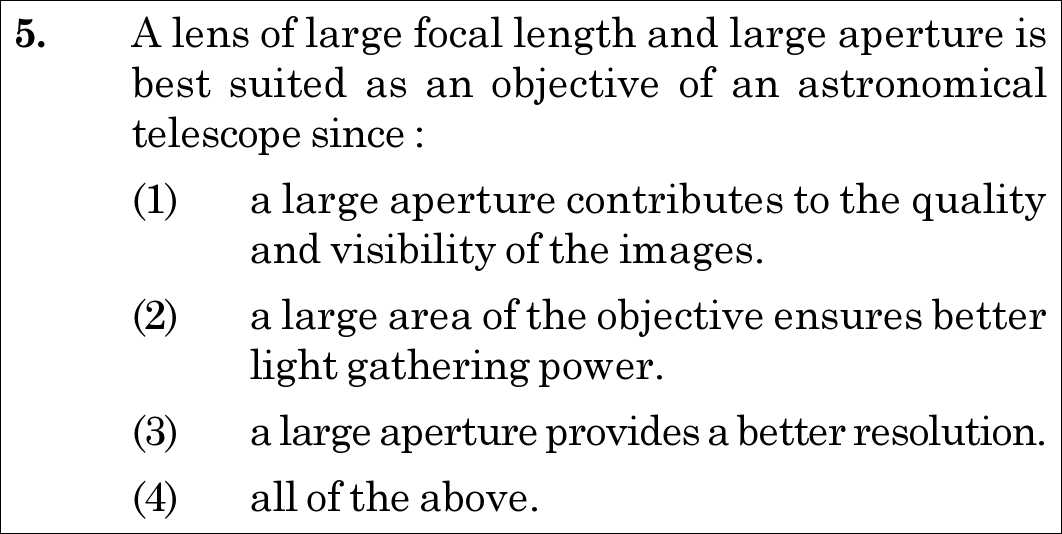
NEET 2021 Physics Question 5: Astronomical Telescope: Objective Lens Aperture and Focal Length Advantages

Question

A lens of large focal length and large aperture is best suited as an objective of an astronomical telescope since:

  1. (1)a large aperture contributes to the quality and visibility of the images.
  2. (2)a large area of the objective ensures better light gathering power.
  3. (3)a large aperture provides a better resolution.
  4. (4)all of the above.
✓
Verified Against NTA Final Answer Key
Option (4) : all of the above.
📚 Ray Optics and Optical Instruments Easy
📋 Given Parameters & Problem Setup
Optical Instrument Astronomical Refracting Telescope
Objective Lens Properties Large focal length and large aperture (diameter D)
⚡

The 30-Second Exam Hall Shortcut: ⚡ The "All of the Above" Telescope Triad

⏱️ Save ~20 seconds

A large objective aperture DD provides: (1) Higher light-gathering power (A∝D2A \propto D^2), giving bright visible images of faint stars; (2) Higher resolving power (RP=D1.22λ\text{RP} = \frac{D}{1.22\lambda}), resolving close stars; and (3) Superior image quality and contrast. All three options are valid! Match Option (4)!

1 Check light gathering power: Area A=πD2/4∝D2A = \pi D^2 / 4 \propto D^2 (Option 2 is correct).
2 Check resolution: Limit of resolution Δθ=1.22λ/D  ⟹  \Delta\theta = 1.22\lambda / D \implies Resolving power ∝D\propto D (Option 3 is correct).
3 Check image quality/visibility: Brighter and better-resolved images provide superior clarity (Option 1 is correct).
4 Therefore, "all of the above" is the correct choice.
5 Match Option (4).
🛡️
Why You Can 100% Trust This Shortcut: Canonical wave optics diffraction limit (Rayleigh criterion) and geometric light collection physics.
📐

Step-by-Step Rigorous Workflow & Mathematical Proof

Step 1

Light Gathering Power of Large Aperture

Astronomical telescopes observe extremely distant, faint celestial bodies. The amount of light gathered from a distant star is directly proportional to the surface area of the objective lens:

Light Gathering Power∝Area=πD24∝D2\text{Light Gathering Power} \propto \text{Area} = \frac{\pi D^2}{4} \propto D^2
Step 2

Resolving Power and Rayleigh Criterion

Due to diffraction at the circular aperture of diameter DD, the angular limit of resolution is Δθ=1.22λD\Delta\theta = \frac{1.22\lambda}{D}. The resolving power (RPRP) is the reciprocal of Δθ\Delta\theta:

RP=1Δθ=D1.22λ  ⟹  Larger D  ⟹  Better ResolutionRP = \frac{1}{\Delta\theta} = \frac{D}{1.22\lambda} \implies \text{Larger } D \implies \text{Better Resolution}
Step 3

Image Quality and Visibility

Because a larger aperture collects more light photons and reduces diffraction blurring, the resultant image has superior brightness, sharpness, and visibility. Hence, all statements (1), (2), and (3) are scientifically true.

⭐

360° Option Elimination Engine Key Feature

Diagnose every choice: Know exactly why the right option works and why distractors fail.

4-Option Deep Scan
1 1
✗ Incorrect
Verdict & Scientific Reason:

True statement, but incomplete because statements (2) and (3) are also true.

⚠️
Student Fallacy (Why candidates pick this trap): Selecting the first true statement without reading the remaining choices.
2 2
✗ Incorrect
Verdict & Scientific Reason:

True statement, but incomplete on its own.

⚠️
Student Fallacy (Why candidates pick this trap): Overlooking the resolution benefits of large apertures.
3 3
✗ Incorrect
Verdict & Scientific Reason:

True statement, but incomplete on its own.

⚠️
Student Fallacy (Why candidates pick this trap): Overlooking the light gathering power benefit.
4 4
✓ 100% Correct
Verdict & Scientific Reason:

All three statements (1), (2), and (3) are genuine, verified optical advantages of large aperture telescope objectives.

💡
Why this is airtight: None; comprehensive optical instrument analysis.
⚠️

NTA Trap Alert: Premature Option Selection Trap

Students read statement (1) or (2), realize it is correct, and immediately bubble it without checking whether "all of the above" is present as Option (4).

🛡️ How to avoid the -1 mark: Whenever "all of the above" is an option, verify whether two or more statements are true before bubbling.
📖

Core NEET Syllabus Standard

NCERT Physics · Ray Optics and Optical Instruments Standard Benchmark
Core Scientific Principle Tested:

"The objective of an astronomical telescope has a large focal length and large aperture to collect more light from faint stars and provide high resolving power (D/1.22λD/1.22\lambda)."

Syllabus Focus: Telescope
✓ Core NEET UG Syllabus Anchor Syllabus & Academic Standards ↗

Ready to attempt under real exam pressure?

Test your speed and accuracy in the authentic 200-minute timed NTA simulator.

Launch NEET 2021 CBT Test →

Spotted a mistake in this solution? Report an error ([email protected])

⚖️ Legal & Fair Dealing Notice: Sourced from publicly released NEET 2021 question papers and NEET answer keys for private study, research, and non-commercial educational practice under Fair Dealing (Section 52(1)(a) of the Indian Copyright Act, 1957). Not affiliated with or endorsed by NTA or NMC.

Solve 4 NEET Questions a Day — One per Subject

Cover all 1,140 official NEET questions in 285 days at your own pace. Progress is saved on your device. No login needed.