MyCompetitiveExams Logo MyCompetitiveExams
Search 1,140+ Questions
Chapters, formulas, speed tricks
→
⚡ Brahmastra NEET 2027
720 MARKS

Dynamic 180-question full-length simulator mixed dynamically from all 6 years for 2027 & 2026 aspirants.

Launch Brahmastra 2027 Test →
Start Practice →
100% Free · No Login Required
Q.4 Physics ⭐ 360° Option Elimination Active
Vault ↗

NEET 2021 Physics Question 4 Solution

Topic: Electric Charges and Fields · Official NTA Booklet Code M1
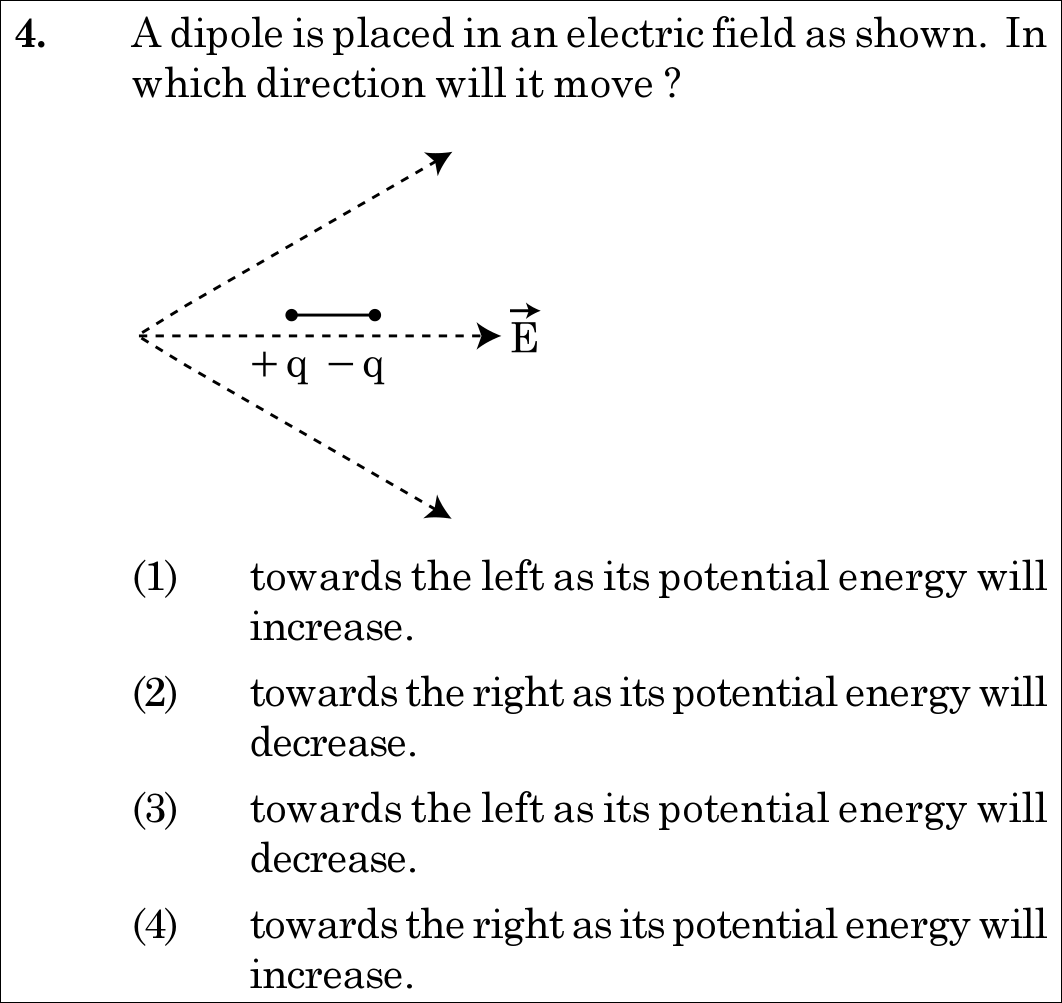
NEET 2021 Physics Question 4: Electric Dipole in Non-Uniform Electric Field and Potential Energy

Question

A dipole is placed in an electric field as shown. In which direction will it move?

  1. (1)towards the left as its potential energy will increase.
  2. (2)towards the right as its potential energy will decrease.
  3. (3)towards the left as its potential energy will decrease.
  4. (4)towards the right as its potential energy will increase.
✓
Verified Against NTA Final Answer Key
Option (2) : towards the right as its potential energy will decrease.
📚 Electric Charges and Fields Medium
📋 Given Parameters & Problem Setup
System Electric dipole (+q and -q) on horizontal axis
Field Pattern Electric field lines diverge from left towards right (E_left > E_right)
Orientation +q is on the left, -q is on the right
⚡

The 30-Second Exam Hall Shortcut: ⚡ Field Density & Force Direction: F_net to the Right!

⏱️ Save ~25 seconds

Field lines are denser on the left, so E1>E2E_1 > E_2. The positive charge +q+q experiences force qE1qE_1 to the RIGHT. The negative charge −q-q experiences force qE2qE_2 to the LEFT. Since E1>E2E_1 > E_2, net force is to the RIGHT! Every conservative system moves to DECREASE potential energy. Select Option (2)!

1 Denser field lines on left   ⟹  E+q>E−q\implies E_{+q} > E_{-q}.
2 Force on +q+q: F⃗+=qE⃗\vec{F}_+ = q\vec{E} points to the right (along E⃗\vec{E}).
3 Force on −q-q: F⃗−=−qE⃗\vec{F}_- = -q\vec{E} points to the left (opposite to E⃗\vec{E}).
4 Net force: Fnet=qE+q−qE−q>0F_{\text{net}} = qE_{+q} - qE_{-q} > 0 (directed towards the RIGHT).
5 Spontaneous motion under conservative electrostatic force always minimizes potential energy: ΔU<0\Delta U < 0.
6 Match Option (2) towards the right as its potential energy will decrease.
🛡️
Why You Can 100% Trust This Shortcut: Canonical field-density relation for non-uniform electric fields and conservative force potential gradient F⃗=−∇U\vec{F} = -\nabla U.
📐

Step-by-Step Rigorous Workflow & Mathematical Proof

Step 1

Analyzing Field Strength from Field Line Density

The electric field lines diverge from a point to the left towards the right. By Faraday's field line principles, field intensity is proportional to the density of lines of force. Therefore, the field is stronger at the position of +q+q than at the position of −q-q:

E(+q)>E(−q)E_{(+q)} > E_{(-q)}
Step 2

Calculating the Net Electrostatic Force

Determine the individual forces on each charge: - Force on +q+q: F1=qE(+q)F_1 = q E_{(+q)} acting towards the right (in the direction of E⃗\vec{E}). - Force on −q-q: F2=qE(−q)F_2 = q E_{(-q)} acting towards the left (opposite to E⃗\vec{E}).

Fnet=F1−F2=q(E(+q)−E(−q))>0  ⟹  Net force is directed towards the RIGHTF_{\text{net}} = F_1 - F_2 = q \left(E_{(+q)} - E_{(-q)}\right) > 0 \implies \mathbf{\text{Net force is directed towards the RIGHT}}
Step 3

Thermodynamic and Mechanical Potential Energy Rule

For any conservative electrostatic system, the net force is the negative gradient of potential energy (F=−dU/dxF = -dU/dx). Any body accelerating in the direction of the net force moves toward a state of lower potential energy:

W=−ΔU  ⟹  ΔU=−FnetΔx<0  ⟹  Potential energy decreasesW = -\Delta U \implies \Delta U = -F_{\text{net}} \Delta x < 0 \implies \mathbf{\text{Potential energy decreases}}
⭐

360° Option Elimination Engine Key Feature

Diagnose every choice: Know exactly why the right option works and why distractors fail.

4-Option Deep Scan
1 1
✗ Incorrect
Verdict & Scientific Reason:

Inverts both force direction and spontaneous physical behavior (systems do not spontaneously move to increase potential energy).

⚠️
Student Fallacy (Why candidates pick this trap): Assuming negative charge pulls the dipole to the left.
2 2
✓ 100% Correct
Verdict & Scientific Reason:

Exact physical deduction: net force is to the right because E+q>E−qE_{+q} > E_{-q}, and spontaneous acceleration minimizes potential energy.

💡
Why this is airtight: None; rigorous electrostatics and energy reasoning.
3 3
✗ Incorrect
Verdict & Scientific Reason:

Falsely identifies net force as pointing leftward.

⚠️
Student Fallacy (Why candidates pick this trap): Believing the wider field region attracts charges.
4 4
✗ Incorrect
Verdict & Scientific Reason:

Contradicts the fundamental mechanical relation F=−dU/dxF = -dU/dx (motion along net force decreases potential energy).

⚠️
Student Fallacy (Why candidates pick this trap): Assuming electrostatic repulsion increases potential energy.
⚠️

NTA Trap Alert: Potential Energy Direction Trap

Even students who correctly identify that the net force points to the right sometimes get trapped between Options (2) and (4) by thinking "moving into weaker field increases potential energy". Natural movement driven by the net force ALWAYS decreases potential energy.

🛡️ How to avoid the -1 mark: Universal Rule: Any object moving in the direction of the net conservative force ALWAYS experiences a DECREASE in potential energy (dU=−FdxdU = -F dx).
📖

Core NEET Syllabus Standard

NCERT Physics · Electric Charges and Fields Standard Benchmark
Core Scientific Principle Tested:

"In a non-uniform field, an electric dipole experiences a net translational force in addition to torque, moving in the direction of net force towards lower potential energy."

Syllabus Focus: Dipole in a Non-Uniform Electric Field
✓ Core NEET UG Syllabus Anchor Syllabus & Academic Standards ↗

Ready to attempt under real exam pressure?

Test your speed and accuracy in the authentic 200-minute timed NTA simulator.

Launch NEET 2021 CBT Test →

Spotted a mistake in this solution? Report an error ([email protected])

⚖️ Legal & Fair Dealing Notice: Sourced from publicly released NEET 2021 question papers and NEET answer keys for private study, research, and non-commercial educational practice under Fair Dealing (Section 52(1)(a) of the Indian Copyright Act, 1957). Not affiliated with or endorsed by NTA or NMC.

Solve 4 NEET Questions a Day — One per Subject

Cover all 1,140 official NEET questions in 285 days at your own pace. Progress is saved on your device. No login needed.