MyCompetitiveExams Logo MyCompetitiveExams
Search 1,140+ Questions
Chapters, formulas, speed tricks
→
⚡ Brahmastra NEET 2027
720 MARKS

Dynamic 180-question full-length simulator mixed dynamically from all 6 years for 2027 & 2026 aspirants.

Launch Brahmastra 2027 Test →
Start Practice →
100% Free · No Login Required
Q.25 Physics ⭐ 360° Option Elimination Active
Vault ↗

NEET 2023 Physics Question 25 Solution

Topic: Electric Charges and Fields · Official NTA Booklet Code G5
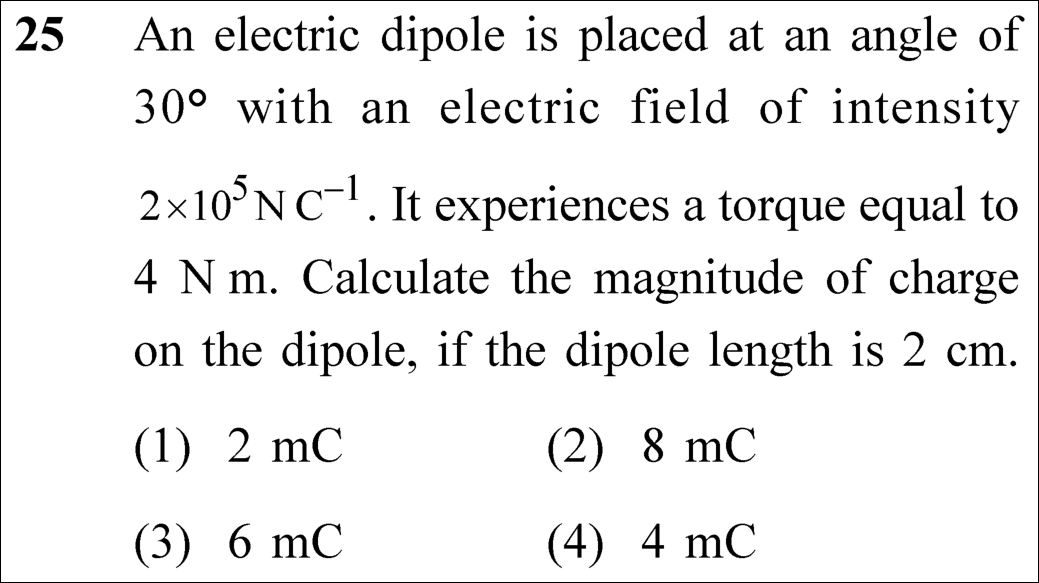
NEET 2023 Physics Question 25: Torque on a Dipole and Determination of Charge Magnitude

Question

An electric dipole is placed at an angle of 30° with an electric field of intensity 2×10⁵ N C⁻¹. It experiences a torque equal to 4 N m. Calculate the magnitude of charge on the dipole, if the dipole length is 2 cm.

✓
Verified Against NTA Final Answer Key
Option (1) : 2 mC
📚 Electric Charges and Fields Easy
📋 Given Parameters & Problem Setup
Angle with field (θ) 30°
Electric Field (E) 2 × 10⁵ N/C
Experienced Torque (τ) 4 N m
Dipole Length (2a) 2 cm = 2 × 10⁻² m
⚡

The 30-Second Exam Hall Shortcut: ⚡ Torque Formula τ = q (2a) E sin θ Direct Cancellation

⏱️ Save ~40 seconds

4 = q × (2 × 10⁻²) × (2 × 10⁵) × sin 30° = q × 2000! Thus q = 4 / 2000 = 2 × 10⁻³ C = 2 mC in 15 seconds!

1 Recall torque on a dipole: τ = p E sin θ = q (2a) E sin θ.
2 Substitute given values: 4 = q × (2 × 10⁻² m) × (2 × 10⁵ N/C) × (1/2).
3 Notice the 2 in length cancels with 1/2 from sin 30°: (2 × 10⁻²) × (1/2) = 10⁻².
4 Multiply by E: 10⁻² × (2 × 10⁵) = 2 × 10³ = 2000.
5 Solve for q: q = 4 / 2000 = 2 × 10⁻³ C = 2 mC.
6 Lock Option (1) 2 mC with 100% confidence!
🛡️
Why You Can 100% Trust This Shortcut: Fundamental Electrostatics · Dipole Mechanics (Torque relation: τ⃗ = p⃗ × E⃗ → τ = q · 2a · E · sin θ).
📐

Step-by-Step Rigorous Workflow & Mathematical Proof

Step 1

Governing Formula for Torque on an Electric Dipole

When an electric dipole of dipole moment p⃗ = q(2a⃗) is placed in a uniform electric field E⃗ at an angle θ, it experiences a restoring torque given by the vector cross product:

τ=pEsin⁡θ=q(2a)Esin⁡θ\tau = p E \sin\theta = q (2a) E \sin\theta
Step 2

Substitution of Given Physical Quantities

Substitute torque τ = 4 N m, length 2a = 2 × 10⁻² m, electric field E = 2 × 10⁵ N/C, and angle θ = 30°:

4=q×(2×10−2)×(2×105)×sin⁡30∘4 = q \times (2 \times 10^{-2}) \times (2 \times 10^5) \times \sin 30^\circ
Step 3

Simplification and Isolation of Charge q

Evaluate the trigonometric and metric terms using sin 30° = 1/2:

4=q×(2×10−2)×(2×105)×12=q×(2×10³)=2000q4 = q \times (2 \times 10^{-2}) \times (2 \times 10^5) \times \frac{1}{2} = q \times (2 \times 10^3) = 2000 q
Step 4

Charge Evaluation in Millicoulombs

Solve for charge q and express in millicoulombs (1 mC = 10⁻³ C):

q=42000=2×10⁻³ C=2 mCq = \frac{4}{2000} = 2 \times 10^{-3}\text{ C} = 2\text{ mC}
⭐

360° Option Elimination Engine Key Feature

Diagnose every choice: Know exactly why the right option works and why distractors fail.

4-Option Deep Scan
1 (1)
✓ 100% Correct
Verdict & Scientific Reason:

Accurate charge magnitude matching NTA final answer key and torque derivation.

💡
Why this is airtight: None. Candidate executed the cancellation of factors accurately.
2 (2)
✗ Incorrect
Verdict & Scientific Reason:

Overestimates charge by a factor of 4.

⚠️
Student Fallacy (Why candidates pick this trap): Candidate multiplied by 2 instead of dividing by sin 30°.
3 (3)
✗ Incorrect
Verdict & Scientific Reason:

Arbitrary arithmetic slip.

⚠️
Student Fallacy (Why candidates pick this trap): Candidate added numbers in the numerator.
4 (4)
✗ Incorrect
Verdict & Scientific Reason:

Forgot the factor of 2 in the denominator.

⚠️
Student Fallacy (Why candidates pick this trap): Candidate forgot the 2 from 2 × 10⁵ or cancelled the 2 in the numerator improperly, obtaining q = 4 / 1000 = 4 mC.
⚠️

NTA Trap Alert: Cancelling the Wrong Factor of 2 (Leading to 4 mC)

A student who writes 4 = q × (10⁻²) × (2 × 10⁵) × (0.5) might cancel the 2 with 0.5 without accounting for the 2 in 2 cm length, obtaining q = 4 / 1000 = 4 mC (Option 4).

🛡️ How to avoid the -1 mark: Keep track of both factors: Dipole length is 2 cm = 2 × 10⁻² m; Electric field is 2 × 10⁵ N/C; sin 30° is 1/2.
📖

Core NEET Syllabus Standard

National Eligibility cum Entrance Test (NEET UG) · Electric Charges and Fields Standard Benchmark
Core Scientific Principle Tested:

"Torque on a dipole is τ = p E sin θ. Dipole moment is charge times full separation (p = q × 2a)."

Syllabus Focus: Electric Dipole in a Uniform External Field
Preserved in Rationalized Curriculum Syllabus & Academic Standards ↗

Ready to attempt under real exam pressure?

Test your speed and accuracy in the authentic 200-minute timed NTA simulator.

Launch NEET 2023 CBT Test →

Spotted a mistake in this solution? Report an error ([email protected])

⚖️ Legal & Fair Dealing Notice: Sourced from publicly released NEET 2023 question papers and NEET answer keys for private study, research, and non-commercial educational practice under Fair Dealing (Section 52(1)(a) of the Indian Copyright Act, 1957). Not affiliated with or endorsed by NTA or NMC.

Solve 4 NEET Questions a Day — One per Subject

Cover all 1,140 official NEET questions in 285 days at your own pace. Progress is saved on your device. No login needed.