Q.26 Physics ⭐ 360° Option Elimination Active
NEET 2023 Physics Question 26 Solution
Topic: Electric Charges and Fields · Official NTA Booklet Code G5
Question
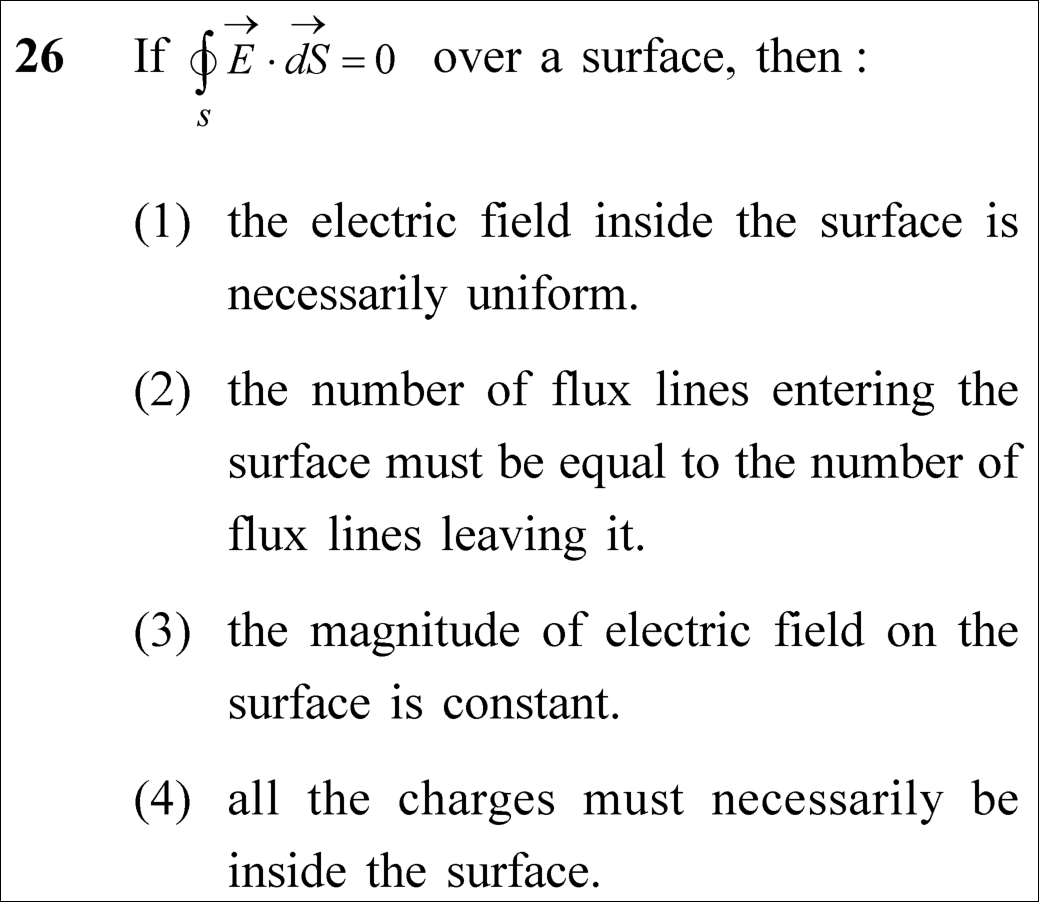
If ∮ E · dS = 0 over a surface, then:
 MyCompetitiveExams
Dynamic 180-question full-length simulator mixed dynamically from all 6 years for 2027 & 2026 aspirants.
If ∮ E · dS = 0 over a surface, then:
Number of lines entering = Number of lines leaving ⟹ Net flux Φ_net = 0 ⟹ Net enclosed charge q_enc = 0 in 5 seconds!
The electric flux Φ through a closed Gaussian surface S is geometrically defined as the net count of electric field lines penetrating the surface. Inward-directed lines contribute negative flux, while outward-directed lines contribute positive flux:
The problem states that the number of field lines entering the closed surface equals the number of field lines leaving it. Therefore:
According to Gauss’s Law of electrostatics, the net electric flux through any closed Gaussian surface in vacuum is directly proportional to the total net charge q_enc enclosed within the surface:
Equating the net flux to zero yields:
Diagnose every choice: Know exactly why the right option works and why distractors fail.
Uniform electric field is neither necessary nor implied; non-uniform external fields also produce zero net flux.
Accurate deduction from Gauss’s Law: zero net flux guarantees zero net enclosed charge.
External charges can exist freely; all field lines from external charges that enter the surface must also exit.
Completely unphysical and baseless claim.
Zero net flux (Φ = 0) means the algebraic SUM of enclosed charges is zero (e.g., an electric dipole inside has q_net = 0). It does NOT mean the electric field E is zero everywhere on the surface, nor does it mean no field lines exist.
"The total electric flux through a closed surface is equal to 1/ε₀ times the total charge enclosed within the surface."
Test your speed and accuracy in the authentic 200-minute timed NTA simulator.
Spotted a mistake in this solution? Report an error ([email protected])
Cover all 1,140 official NEET questions in 285 days at your own pace. Progress is saved on your device. No login needed.