MyCompetitiveExams Logo MyCompetitiveExams
Search 1,140+ Questions
Chapters, formulas, speed tricks
→
⚡ Brahmastra NEET 2027
720 MARKS

Dynamic 180-question full-length simulator mixed dynamically from all 6 years for 2027 & 2026 aspirants.

Launch Brahmastra 2027 Test →
Start Practice →
100% Free · No Login Required
Q.27 Physics ⭐ 360° Option Elimination Active
Vault ↗

NEET 2023 Physics Question 27 Solution

Topic: Wave Optics · Official NTA Booklet Code G5
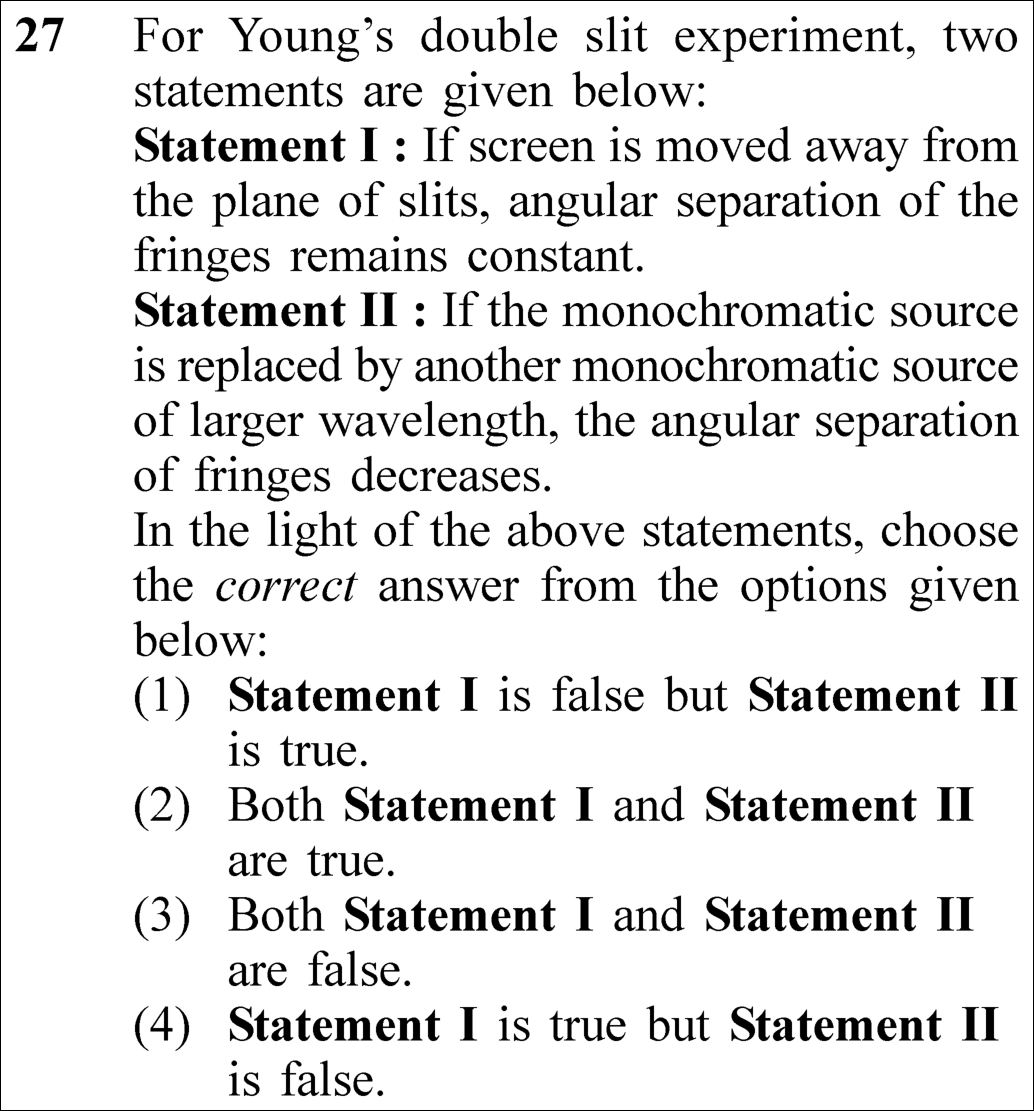
NEET 2023 Physics Question 27: Dependence of Angular Width on Wavelength and Screen Distance

Question

For Young's double slit experiment, two statements are given below: Statement I: If screen is moved away from the plane of slits, angular separation of the fringes remains constant. Statement II: If the monochromatic source is replaced by another monochromatic source of larger wavelength, the angular separation of fringes decreases. In the light of the above statements, choose the correct answer from the options given below:

✓
Verified Against NTA Final Answer Key
Option (4) : Statement I is true but Statement II is false
📚 Wave Optics Easy
📋 Given Parameters & Problem Setup
Diffraction type Fraunhofer single-slit diffraction
Statement I Screen moved away from slit ⟹ angular separation does not change
Statement II Wavelength increased ⟹ angular separation decreases
⚡

The 30-Second Exam Hall Shortcut: ⚡ Formula Inspection: θ = λ / a (Independent of D)

⏱️ Save ~40 seconds

Angular width θ = λ / a contains NO screen distance D (Statement I TRUE). If λ increases, θ MUST increase, not decrease (Statement II FALSE). Option (4) in 10 seconds!

1 Recall the angular separation/width of diffraction fringes: θ = λ / a (where a is slit width).
2 Notice screen distance D does not appear anywhere in the expression for angular width θ.
3 Thus moving the screen changes linear fringe width (β = λD/a), but angular width θ remains constant. Statement I is TRUE.
4 Next, examine Statement II: θ = λ / a is directly proportional to wavelength (θ ∝ λ).
5 Increasing wavelength λ must INCREASE θ, not decrease it. Thus Statement II is FALSE.
6 Lock Option (4): Statement I is true but Statement II is false!
🛡️
Why You Can 100% Trust This Shortcut: Wave Optics · Diffraction Formulae (Angular spread θ = λ / a depends strictly on wavelength and aperture width, independent of screen distance D).
📐

Step-by-Step Rigorous Workflow & Mathematical Proof

Step 1

Expression for Angular Width / Separation

In Fraunhofer single-slit diffraction produced by a slit of width a, the condition for the first diffraction minimum is given by a sin θ = λ. For small diffraction angles (sin θ ≈ θ in radians), the angular width of the central maximum is 2θ = 2λ/a, and the angular separation of adjacent fringes is:

θ=λa\theta = \frac{\lambda}{a}
Step 2

Evaluation of Statement I (Effect of Screen Distance D)

Linear fringe separation on the screen is y = D θ = λ D / a, which is directly proportional to D. However, the ANGULAR separation θ depends strictly on the ratio λ/a and is completely independent of the distance D between the slit plane and the screen:

∂θ∂D=0  ⟹  θ remains unchanged when D changes.\frac{\partial \theta}{\partial D} = 0 \implies \theta \text{ remains unchanged when } D \text{ changes.}
Step 3

Evaluation of Statement II (Effect of Wavelength λ)

From the governing formula θ = λ / a, the angular separation is directly proportional to the wavelength of light used:

θ∝λ  ⟹  When λ increases, θ MUST increase.\theta \propto \lambda \implies \text{When } \lambda \text{ increases, } \theta \text{ MUST increase.}
Step 4

Final Synthesis

Statement I correctly asserts that angular separation does not change when the screen is moved away. Statement II incorrectly claims that angular separation decreases with increasing wavelength (it actually increases). Therefore, Statement I is true and Statement II is false.

Statement I: True,Statement II: False\text{Statement I: True}, \quad \text{Statement II: False}
⭐

360° Option Elimination Engine Key Feature

Diagnose every choice: Know exactly why the right option works and why distractors fail.

4-Option Deep Scan
1 (1)
✗ Incorrect
Verdict & Scientific Reason:

Incorrect because Statement II is false (θ increases with λ, not decreases).

⚠️
Student Fallacy (Why candidates pick this trap): Candidate failed to check the direct proportionality θ ∝ λ.
2 (2)
✗ Incorrect
Verdict & Scientific Reason:

Incorrect because Statement I is demonstrably true (angular width is independent of D).

⚠️
Student Fallacy (Why candidates pick this trap): Candidate confused angular width (θ) with linear width (y = θD).
3 (3)
✗ Incorrect
Verdict & Scientific Reason:

Both verdicts are inverted.

⚠️
Student Fallacy (Why candidates pick this trap): Candidate inverted the definitions of both quantities.
4 (4)
✓ 100% Correct
Verdict & Scientific Reason:

Precisely matches physical principles and official NTA final answer key.

💡
Why this is airtight: None. Candidate clearly distinguished angular width from linear width.
⚠️

NTA Trap Alert: Confusing Angular Separation (θ) with Linear Separation (β or y)

Linear fringe separation β = λ D / a changes when D changes. But ANGULAR separation θ = β / D = λ / a is purely angular and DOES NOT depend on D!

🛡️ How to avoid the -1 mark: Always check the word "ANGULAR": Angular width = λ/a (no D). Linear width = λD/a (contains D).
📖

Core NEET Syllabus Standard

National Eligibility cum Entrance Test (NEET UG) · Wave Optics Standard Benchmark
Core Scientific Principle Tested:

"Angular fringe separation is given by θ = λ/a, which depends purely on wavelength λ and slit width a, not on screen distance D."

Syllabus Focus: Single Slit Diffraction and Angular Spread
Preserved in Rationalized Curriculum Syllabus & Academic Standards ↗

Ready to attempt under real exam pressure?

Test your speed and accuracy in the authentic 200-minute timed NTA simulator.

Launch NEET 2023 CBT Test →

Spotted a mistake in this solution? Report an error ([email protected])

⚖️ Legal & Fair Dealing Notice: Sourced from publicly released NEET 2023 question papers and NEET answer keys for private study, research, and non-commercial educational practice under Fair Dealing (Section 52(1)(a) of the Indian Copyright Act, 1957). Not affiliated with or endorsed by NTA or NMC.

Solve 4 NEET Questions a Day — One per Subject

Cover all 1,140 official NEET questions in 285 days at your own pace. Progress is saved on your device. No login needed.