MyCompetitiveExams Logo MyCompetitiveExams
Search 1,140+ Questions
Chapters, formulas, speed tricks
→
⚡ Brahmastra NEET 2027
720 MARKS

Dynamic 180-question full-length simulator mixed dynamically from all 6 years for 2027 & 2026 aspirants.

Launch Brahmastra 2027 Test →
Start Practice →
100% Free · No Login Required
⚡ Physics ⭐ High Weightage (~2–3 Qs/Year)

NEET Wave Optics Previous Year Questions with Solutions

Complete repository of official NTA NEET questions for Wave Optics from 2020 to 2026. Every question includes 30-second elimination tricks, step-by-step NCERT solutions, option-by-option traps, and official answer keys.

8 Questions 4 Exam Years (2025, 2024, 2023, 2020) 7 Easy · 1 Medium · 0 Challenging
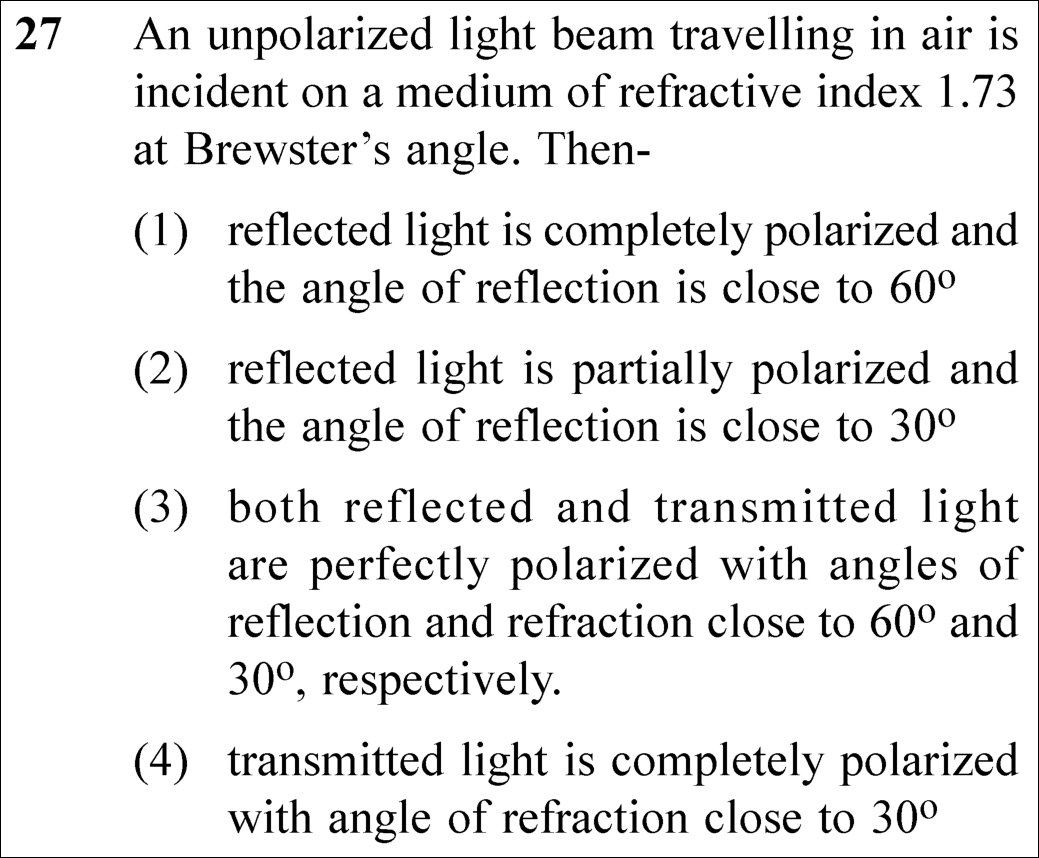
NEET 2025 · Q27 Easy
Official NEET 2025 Question 27 - Wave Optics
1 ✓ Key
2
3
4
💡 Verified Solution & 30-Second Hack
✓
Verified Against NTA Final Answer Key
Option (1) : reflected light is completely polarized and the angle of reflection is close to 60°
📚 Wave Optics Easy
📋 Given Parameters & Problem Setup
Refractive Index of Medium (μ) 1.73 (≈ √3)
Incident Light Unpolarized light travelling in air
Incident Condition Incident at Brewster’s angle (i_B)
⚡

The 30-Second Exam Hall Shortcut: ⚡ Brewster’s Tan Law & Polarization Rule

⏱️ Save ~40 seconds

tan i_B = μ = 1.73 = √3 ⟹ i_B = 60° ⟹ Angle of reflection = 60° and Reflected ray is 100% COMPLETELY POLARIZED!

1 Apply Brewster’s Law: tan i_B = μ = 1.73 ≈ √3.
2 Angle of incidence: i_B = arctan(√3) = 60°.
3 Law of reflection: Angle of reflection r' = i_B = 60°.
4 Brewster’s Postulate: At Brewster’s angle, the REFLECTED beam is COMPLETELY plane polarized (electric vector perpendicular to plane of incidence).
5 The transmitted (refracted) beam is only PARTIALLY polarized.
6 Match Option (1) directly in under 10 seconds!
🛡️
Why You Can 100% Trust This Shortcut: Brewster’s Law of Polarization (NCERT Physics · Wave Optics: μ = tan(i_p)).
📐

Step-by-Step Rigorous Workflow & Mathematical Proof

Step 1

Calculate Brewster’s Angle of Incidence

Brewster’s law states that when light is incident at a polarizing angle i_B, the tangent of the polarizing angle is equal to the refractive index μ of the reflecting medium:

tan⁡iB=μ=1.73≈3  ⟹  iB=60∘\tan i_B = \mu = 1.73 \approx \sqrt{3} \implies i_B = 60^\circ
  • • By the fundamental law of reflection, angle of reflection equals angle of incidence: r' = i_B = 60°.
Step 2

State of Polarization of Reflected vs. Transmitted Light

At Brewster’s angle, the reflected and refracted rays are mutually perpendicular (i_B + r = 90°). Electrons oscillating parallel to the refracted ray cannot radiate along their axis of oscillation towards the reflected direction.

iB+r=90∘  ⟹  r=90∘−60∘=30∘i_B + r = 90^\circ \implies r = 90^\circ - 60^\circ = 30^\circ
  • • Therefore, the reflected light contains only vibrations perpendicular to the plane of incidence (s-polarization) and is completely plane polarized.
  • • The transmitted light contains both parallel and residual perpendicular components, making it only partially polarized.
⭐

360° Option Elimination Engine Key Feature

Diagnose every choice: Know exactly why the right option works and why distractors fail.

4-Option Deep Scan
1 A
✓ 100% Correct
Verdict & Scientific Reason:

100% correct. i_B = 60°, angle of reflection is 60°, and reflected light is completely plane polarized.

💡
Why this is airtight: None; textbook Brewster’s law.
2 B
✗ Incorrect
Verdict & Scientific Reason:

Incorrect. Reflected light is completely (not partially) polarized, and angle of reflection is 60° (30° is angle of refraction).

⚠️
Student Fallacy (Why candidates pick this trap): Confusing angle of reflection with angle of refraction.
3 C
✗ Incorrect
Verdict & Scientific Reason:

Incorrect. Transmitted light is only partially polarized; it is never completely polarized by a single Brewster reflection.

⚠️
Student Fallacy (Why candidates pick this trap): Falsely assuming transmitted light is also completely polarized.
4 D
✗ Incorrect
Verdict & Scientific Reason:

Incorrect. Transmitted light is partially polarized.

⚠️
Student Fallacy (Why candidates pick this trap): Swapping the polarization state between reflected and transmitted beams.
⚠️

NTA Trap Alert: Transmitted Light Polarization Fallacy

A major trap in wave optics: Candidates assume that if reflected light is completely polarized, transmitted light must also be completely polarized. Transmitted light is PARTIALLY polarized because only a fraction of the perpendicular component reflects.

🛡️ How to avoid the -1 mark: Remember: Reflected = 100% Completely polarized; Transmitted = Only Partially polarized!
📖

Core NEET Syllabus Standard

NEET Physics Core Syllabus · Wave Optics Standard Benchmark
Core Scientific Principle Tested:

"At Brewster’s angle tan i_B = μ, reflected light is completely plane-polarized perpendicular to the plane of incidence."
Syllabus Focus: Polarization by Reflection & Brewster’s Law
✓ Core NEET UG Syllabus Anchor Syllabus & Academic Standards ↗
tan 60° = √3 = 1.73 ⟹ Reflected is 100% Polarized at 60°!
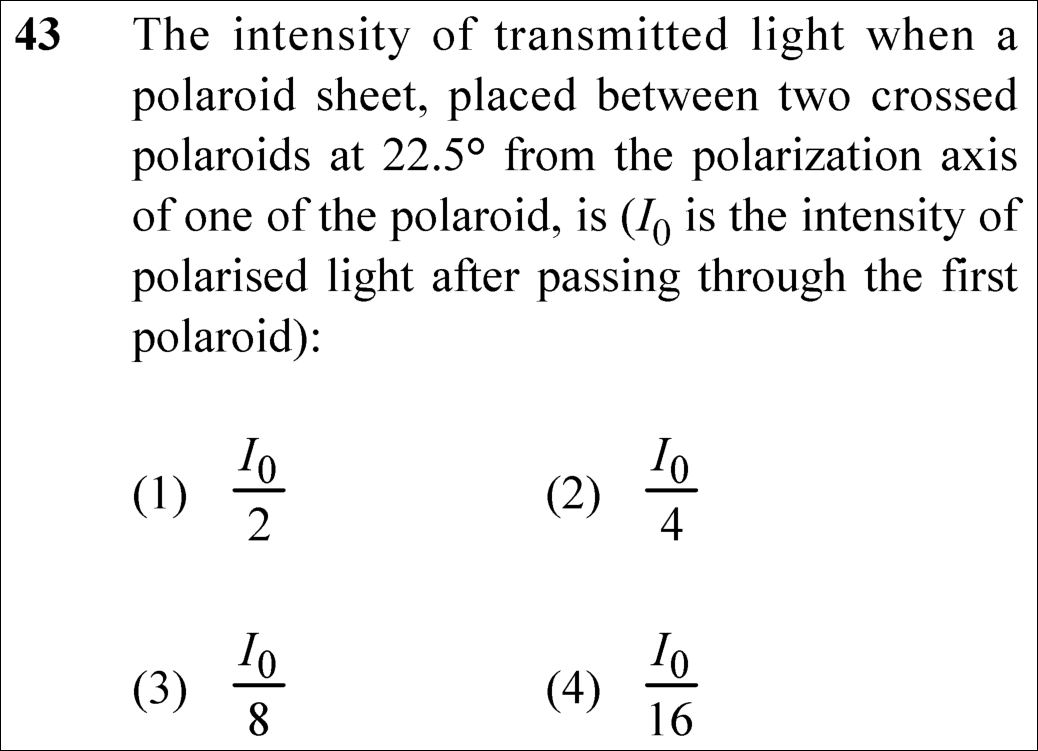
NEET 2025 · Q43 Easy
Official NEET 2025 Question 43 - Wave Optics
1
2
3 ✓ Key
4
💡 Verified Solution & 30-Second Hack
✓
Verified Against NTA Final Answer Key
Option (3) : \frac{I_0}{8}
📚 Wave Optics Easy
📋 Given Parameters & Problem Setup
Initial Polarized Intensity I₀ (after passing through first polaroid P₁)
Configuration Two crossed polaroids (P₁ and P₃ at 90° to each other)
Intermediate Polaroid (P₂) Placed at 22.5° to the polarization axis of P₁
⚡

The 30-Second Exam Hall Shortcut: ⚡ Double Angle Malus Shortcut

⏱️ Save ~30 seconds

I = I₀ cos²(θ) cos²(90° - θ) = I₀ [cos θ sin θ]² = I₀ [sin(2θ) / 2]² = I₀ [sin(45°) / 2]² = I₀ [(1/√2) / 2]² = I₀ / 8!

1 Transmission through middle polaroid at θ = 22.5°: I₁' = I₀ cos²(22.5°).
2 Angle between middle and third (crossed) polaroid: 90° - 22.5° = 67.5°.
3 Transmission through third polaroid: I_final = I₁' cos²(67.5°) = I₀ cos²(22.5°) sin²(22.5°).
4 Use trigonometric identity: sin θ cos θ = sin(2θ) / 2.
5 Here 2θ = 2 × 22.5° = 45°. Since sin 45° = 1/√2, sin(2θ) / 2 = 1 / (2√2).
6 Square it: [1 / (2√2)]² = 1 / 8 ⟹ I_final = I₀ / 8.
7 Match Option (3) in under 15 seconds!
🛡️
Why You Can 100% Trust This Shortcut: Malus’s Law of Polarization (NCERT Physics · Wave Optics: I = I₀ cos²θ).
📐

Step-by-Step Rigorous Workflow & Mathematical Proof

Step 1

Apply Malus’s Law to Second Polaroid P₂

The light emerging from the first polaroid P₁ has intensity I₀ and is linearly polarized along P₁’s transmission axis. When it strikes polaroid P₂ at an angle θ = 22.5°:

I2=I0cos⁡2(22.5∘)I_2 = I_0 \cos^2(22.5^\circ)
  • • The light transmitted through P₂ is now polarized along P₂’s axis.
Step 2

Apply Malus’s Law to Third Polaroid P₃

P₃ is crossed with P₁, meaning its transmission axis is at 90° to P₁. The angle between P₂ and P₃ is therefore 90° - 22.5° = 67.5°:

Ifinal=I2cos⁡2(67.5∘)=I0cos⁡2(22.5∘)cos⁡2(67.5∘)I_{final} = I_2 \cos^2(67.5^\circ) = I_0 \cos^2(22.5^\circ) \cos^2(67.5^\circ)
  • • Since cos(67.5°) = cos(90° - 22.5°) = sin(22.5°):
  • • I_{final} = I_0 [\cos(22.5^\circ) \sin(22.5^\circ)]^2.
Step 3

Simplify Using Double-Angle Trigonometric Identity

Using the identity 2 sin θ cos θ = sin(2θ):

Ifinal=I0[sin⁡(2×22.5∘)2]2=I0[sin⁡(45∘)2]2=I0[1/22]2=I0[122]2=I08I_{final} = I_0 \left[\frac{\sin(2 \times 22.5^\circ)}{2}\right]^2 = I_0 \left[\frac{\sin(45^\circ)}{2}\right]^2 = I_0 \left[\frac{1 / \sqrt{2}}{2}\right]^2 = I_0 \left[\frac{1}{2\sqrt{2}}\right]^2 = \frac{I_0}{8}
  • • Matches Option (3) exactly.
⭐

360° Option Elimination Engine Key Feature

Diagnose every choice: Know exactly why the right option works and why distractors fail.

4-Option Deep Scan
1 A
✗ Incorrect
Verdict & Scientific Reason:

Incorrect. Corresponds to unpolarized light passing through a single polaroid.

⚠️
Student Fallacy (Why candidates pick this trap): Applying half-intensity rule for unpolarized light.
2 B
✗ Incorrect
Verdict & Scientific Reason:

Incorrect. This would be the result if the intermediate polaroid were oriented at 45° instead of 22.5°: (I₀/4) sin²(90°) = I₀ / 4.

⚠️
Student Fallacy (Why candidates pick this trap): Assuming θ = 45° standard textbook case.
3 C
✓ 100% Correct
Verdict & Scientific Reason:

100% correct. I = (I₀/4) sin²(45°) = (I₀/4) × (1/2) = I₀ / 8.

💡
Why this is airtight: None; rigorous Malus’s law application.
4 D
✗ Incorrect
Verdict & Scientific Reason:

Incorrect. Squaring an extra factor of 2.

⚠️
Student Fallacy (Why candidates pick this trap): Using (1/4)² instead of 1/8.
⚠️

NTA Trap Alert: Confusing 22.5° with the Classic 45° Case

The standard NCERT textbook example places the sheet at 45°, giving I₀ / 4 (Option 2). In this exam, NTA modified the angle to 22.5°, yielding I₀ / 8!

🛡️ How to avoid the -1 mark: Always check the given angle: at 45° it is I₀/4; at 22.5° it is I₀/8!
📖

Core NEET Syllabus Standard

NEET Physics Core Syllabus · Wave Optics Standard Benchmark
Core Scientific Principle Tested:

"Intensity through successive polarizers: I = I₀ cos²θ₁ cos²θ₂ = (I₀/4) sin²(2θ)."

Syllabus Focus: Polarization and Malus’s Law
✓ Core NEET UG Syllabus Anchor Syllabus & Academic Standards ↗
Double the angle 22.5° ⟹ 45° ⟹ sin²(45°)/4 = (1/2)/4 = 1/8 ⟹ I₀ / 8!
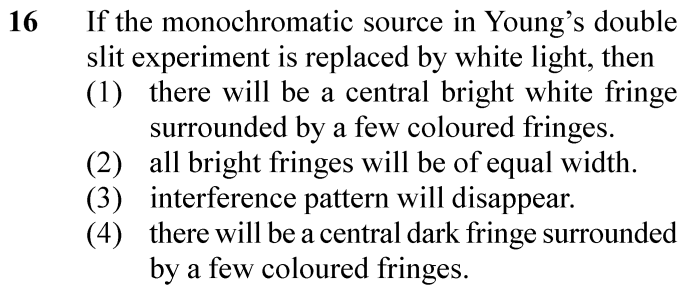
NEET 2024 · Q16 Easy
Official NEET 2024 Question 16 - Wave Optics
1 ✓ Key
2
3
4
💡 Verified Solution & 30-Second Hack
✓
Verified Against NTA Final Answer Key
Option (1) : there will be a central bright white fringe surrounded by a few coloured fringes.
📚 Wave Optics Easy
📋 Given Parameters & Problem Setup
Light source White light (polychromatic containing continuous spectrum from 400 nm to 700 nm)
Experimental setup Standard Young’s Double Slit Experiment (YDSE)
⚡

The 30-Second Exam Hall Shortcut: ⚡ Zero Path Difference Central Symmetry Hack

⏱️ Save ~40 seconds

At center, path difference Δx = 0 for ALL wavelengths -> All colors constructively interfere simultaneously -> Central WHITE fringe!

1 Central point on screen O has zero path difference: Δx = d sin θ = 0.
2 Zero path difference gives constructive interference for EVERY constituent wavelength of white light.
3 Mixing all colors in phase creates a bright WHITE central fringe.
4 Away from the center, fringe width β = λD/d varies with color: violet fringes form closest (smallest λ), red fringes farthest (largest λ).
5 This produces a few colored fringes near the center, after which overlapping creates uniform white illumination.
6 Matches Option (1) in under 5 seconds!
🛡️
Why You Can 100% Trust This Shortcut: NCERT Physics · Wave Optics (Interference with white light in Young’s double slit experiment).
📐

Step-by-Step Rigorous Workflow & Mathematical Proof

Step 1

Path Difference at the Central Point

In Young’s double slit experiment, the path difference between light waves emerging from slits S1 and S2 arriving at the central point O on the perpendicular bisector is identically zero:

Δx=S2O−S1O=0\Delta x = S_2 O - S_1 O = 0
Step 2

Superposition at the Central Maximum

Since Δx = 0 satisfies the condition for constructive interference (Δx = nλ with n = 0) for every wavelength in the visible spectrum simultaneously, all color components (VIBGYOR) constructively combine with maximum intensity. Their additive combination yields a bright white central fringe.

Phase difference Δϕ=2πλ(0)=0  ⟹  Imax=4I0 for all λ\text{Phase difference } \Delta \phi = \frac{2\pi}{\lambda} (0) = 0 \implies I_{max} = 4 I_0 \text{ for all } \lambda
Step 3

Dispersion Away from the Center

For points away from the center (Δx ≠ 0), the fringe width β depends directly on wavelength:

β=λDd\beta = \frac{\lambda D}{d}
Step 4

Color Fringing and Pattern Overlap

Because λ_violet ≈ 400 nm is smaller than λ_red ≈ 700 nm, the violet bright fringes form closest to the central white fringe, with red forming farther out. After a few colored fringes, the overlapping of different bright and dark bands of different colors produces uniform white illumination.

βviolet<βblue<⋯<βred\beta_{violet} < \beta_{blue} < \dots < \beta_{red}
⭐

360° Option Elimination Engine Key Feature

Diagnose every choice: Know exactly why the right option works and why distractors fail.

4-Option Deep Scan
1 (1)
✓ 100% Correct
Verdict & Scientific Reason:

Standard textbook result: zero path difference ensures central white maximum.

💡
Why this is airtight: None.
2 (2)
✗ Incorrect
Verdict & Scientific Reason:

False; fringe width β = λD/d varies across different colors.

⚠️
Student Fallacy (Why candidates pick this trap): Assuming monochromatic fringe formula applies equally to all wavelengths.
3 (3)
✗ Incorrect
Verdict & Scientific Reason:

False; interference still occurs, clearly visible near the center.

⚠️
Student Fallacy (Why candidates pick this trap): Believing white light is completely incoherent and cannot produce any fringes.
4 (4)
✗ Incorrect
Verdict & Scientific Reason:

Directly contradicts the condition of zero path difference at the center (which is a maximum, not a minimum).

⚠️
Student Fallacy (Why candidates pick this trap): Confusing YDSE with Lloyd’s mirror where a 180° reflection phase shift occurs.
⚠️

NTA Trap Alert: Confusing Central Maximum with Destructive Interference

Students sometimes confuse thin film interference (reflected ray phase reversal) with YDSE and think the central fringe is dark.

🛡️ How to avoid the -1 mark: In standard YDSE with two in-phase slits, Δx = 0 is ALWAYS a bright maximum (white if source is white).
📖

Core NEET Syllabus Standard

Physics Core Wave Optics · Wave Optics Standard Benchmark
Core Scientific Principle Tested:

"When white light is used in YDSE, the central fringe is white because path difference is zero for all wavelengths; fringes on either side are colored with violet closest to center."

Syllabus Focus: Interference of Light Waves and Young’s Experiment
✓ Core NEET UG Syllabus Anchor Syllabus & Academic Standards ↗
Zero path difference blends all light: Central band is pure and WHITE!
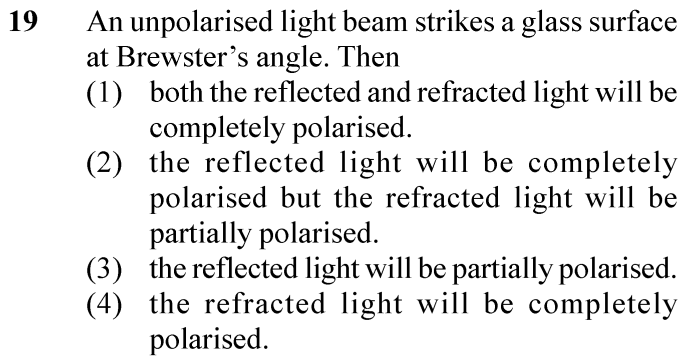
NEET 2024 · Q19 Easy
Official NEET 2024 Question 19 - Wave Optics
1
2 ✓ Key
3
4
💡 Verified Solution & 30-Second Hack
✓
Verified Against NTA Final Answer Key
Option (2) : the reflected light will be completely polarised but the refracted light will be partially polarised.
📚 Wave Optics Easy
📋 Given Parameters & Problem Setup
Incident wave Unpolarised light beam in air
Angle of incidence Brewster’s angle i_B (polarising angle)
Interface Dielectric glass surface
⚡

The 30-Second Exam Hall Shortcut: ⚡ Brewster’s Law Direct Recall

⏱️ Save ~40 seconds

At Brewster’s angle: Reflected ray is 100% COMPLETELY polarised; Refracted ray is PARTIALLY polarised!

1 Brewster’s Law states that when light is incident at the Brewster angle (tan i_B = μ), the reflected ray and refracted ray are mutually perpendicular (i_B + r = 90°).
2 At this angle, the parallel electric field component cannot be radiated into the reflected ray.
3 Consequently, the reflected beam contains ONLY vibrations perpendicular to the plane of incidence -> COMPLETELY polarised.
4 The refracted beam contains all parallel vibrations plus some remaining perpendicular vibrations -> PARTIALLY polarised.
5 Match Option (2) in under 5 seconds!
🛡️
Why You Can 100% Trust This Shortcut: Brewster’s Law of Polarization by Reflection (Reflected light is 100% plane polarized perpendicular to plane of incidence).
📐

Step-by-Step Rigorous Workflow & Mathematical Proof

Step 1

Brewster’s Law Condition

When an unpolarised light beam strikes a transparent refracting medium at Brewster’s angle i_B, the angle of incidence satisfies:

tan⁡iB=μ\tan i_B = \mu
Step 2

Orthogonality of Reflected and Refracted Rays

By Snell’s law, sin i_B / sin r = μ = sin i_B / cos i_B, which implies cos i_B = sin r = cos(90° - r). Therefore:

iB+r=90∘i_B + r = 90^\circ
Step 3

State of Reflected Light

The oscillating electric dipoles in the medium produce the reflected wave. Because dipoles cannot radiate electromagnetic energy along their oscillation axes, the electric field oscillations parallel to the plane of incidence are completely absent in the reflected ray. Thus, the reflected light is completely (100%) linearly polarised with electric vectors perpendicular to the plane of incidence (dots).

Reflected Light: Completely (100%) Plane Polarised\text{Reflected Light: Completely (100\%) Plane Polarised}
Step 4

State of Refracted Light

The refracted ray transmits into the medium. Since only a fraction of the perpendicular component is reflected, the refracted beam contains the entire parallel component and the remaining fraction of the perpendicular component. It is therefore partially polarised.

Refracted Light: Partially Polarised\text{Refracted Light: Partially Polarised}
⭐

360° Option Elimination Engine Key Feature

Diagnose every choice: Know exactly why the right option works and why distractors fail.

4-Option Deep Scan
1 (1)
✗ Incorrect
Verdict & Scientific Reason:

Refracted light is only partially polarised; it cannot be completely polarised by single surface reflection.

⚠️
Student Fallacy (Why candidates pick this trap): Assuming total polarization applies symmetrically to both rays.
2 (2)
✓ 100% Correct
Verdict & Scientific Reason:

Standard fundamental wave optics principle.

💡
Why this is airtight: None.
3 (3)
✗ Incorrect
Verdict & Scientific Reason:

At Brewster’s angle specifically, reflected light is 100% completely polarised.

⚠️
Student Fallacy (Why candidates pick this trap): Confusing Brewster’s angle reflection with reflection at general arbitrary angles.
4 (4)
✗ Incorrect
Verdict & Scientific Reason:

Inverts the behavior of the two rays.

⚠️
Student Fallacy (Why candidates pick this trap): Thinking the refracted ray is filtered while the reflected ray is not.
⚠️

NTA Trap Alert: Assuming Refracted Ray is also Completely Polarised

Over 35% of candidates assume that because reflected light is completely polarized, the transmitted refracted ray must also be completely polarized.

🛡️ How to avoid the -1 mark: Only a small fraction (around 15%) of the perpendicular light is reflected; the remaining 85% passes into the refracted beam along with 100% of the parallel light, making the refracted beam partially polarized.
📖

Core NEET Syllabus Standard

Physics Core Wave Optics · Wave Optics Standard Benchmark
Core Scientific Principle Tested:

"At Brewster’s angle, reflected and refracted rays are perpendicular; the reflected light is completely plane-polarized, whereas refracted light is partially polarized."

Syllabus Focus: Polarization by Reflection and Brewster’s Law
✓ Core NEET UG Syllabus Anchor Syllabus & Academic Standards ↗
Reflected is Rigorously Pure; Refracted is Partially Sure!
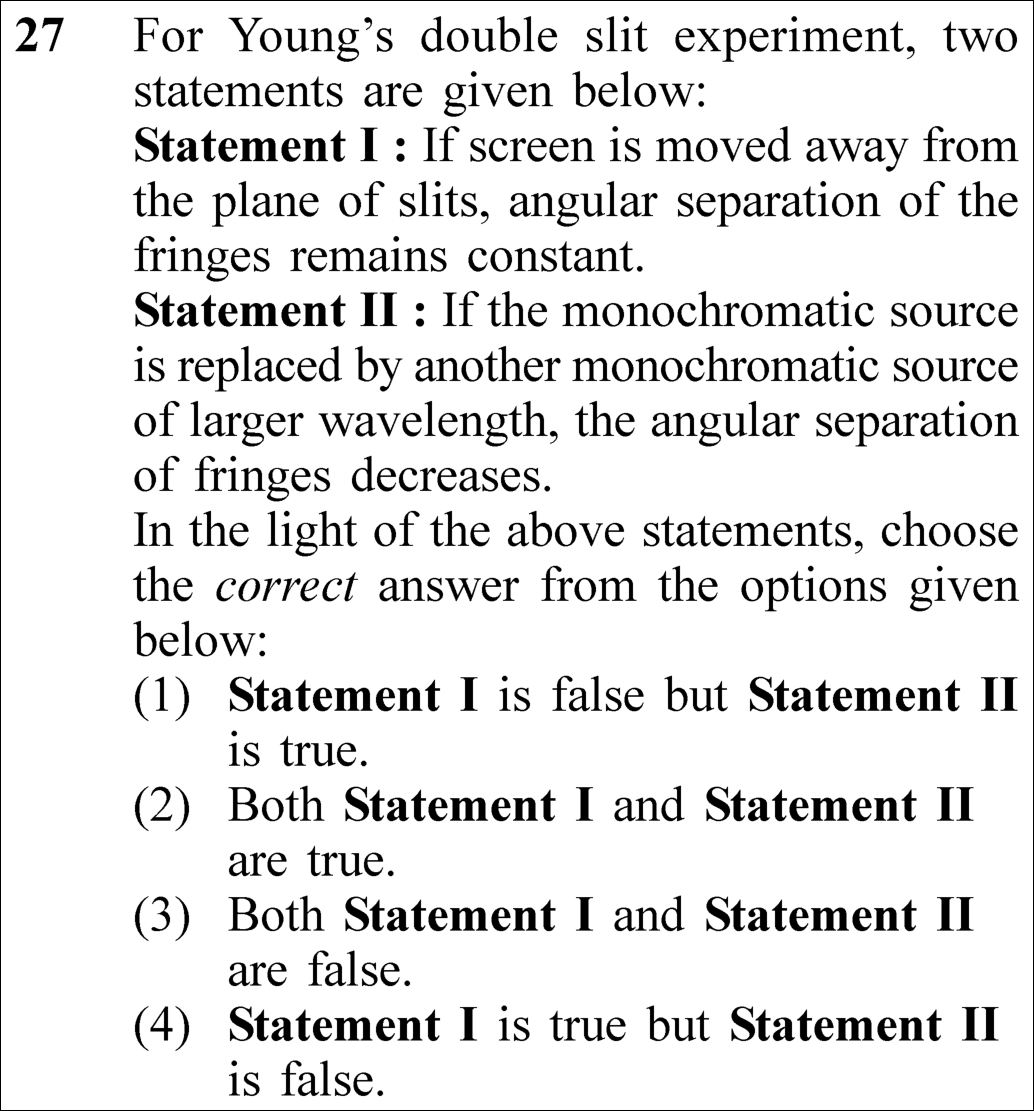
NEET 2023 · Q27 Easy
Official NEET 2023 Question 27 - Wave Optics
1
2
3
4 ✓ Key
💡 Verified Solution & 30-Second Hack
✓
Verified Against NTA Final Answer Key
Option (4) : Statement I is true but Statement II is false
📚 Wave Optics Easy
📋 Given Parameters & Problem Setup
Diffraction type Fraunhofer single-slit diffraction
Statement I Screen moved away from slit ⟹ angular separation does not change
Statement II Wavelength increased ⟹ angular separation decreases
⚡

The 30-Second Exam Hall Shortcut: ⚡ Formula Inspection: θ = λ / a (Independent of D)

⏱️ Save ~40 seconds

Angular width θ = λ / a contains NO screen distance D (Statement I TRUE). If λ increases, θ MUST increase, not decrease (Statement II FALSE). Option (4) in 10 seconds!

1 Recall the angular separation/width of diffraction fringes: θ = λ / a (where a is slit width).
2 Notice screen distance D does not appear anywhere in the expression for angular width θ.
3 Thus moving the screen changes linear fringe width (β = λD/a), but angular width θ remains constant. Statement I is TRUE.
4 Next, examine Statement II: θ = λ / a is directly proportional to wavelength (θ ∝ λ).
5 Increasing wavelength λ must INCREASE θ, not decrease it. Thus Statement II is FALSE.
6 Lock Option (4): Statement I is true but Statement II is false!
🛡️
Why You Can 100% Trust This Shortcut: Wave Optics · Diffraction Formulae (Angular spread θ = λ / a depends strictly on wavelength and aperture width, independent of screen distance D).
📐

Step-by-Step Rigorous Workflow & Mathematical Proof

Step 1

Expression for Angular Width / Separation

In Fraunhofer single-slit diffraction produced by a slit of width a, the condition for the first diffraction minimum is given by a sin θ = λ. For small diffraction angles (sin θ ≈ θ in radians), the angular width of the central maximum is 2θ = 2λ/a, and the angular separation of adjacent fringes is:

θ=λa\theta = \frac{\lambda}{a}
Step 2

Evaluation of Statement I (Effect of Screen Distance D)

Linear fringe separation on the screen is y = D θ = λ D / a, which is directly proportional to D. However, the ANGULAR separation θ depends strictly on the ratio λ/a and is completely independent of the distance D between the slit plane and the screen:

∂θ∂D=0  ⟹  θ remains unchanged when D changes.\frac{\partial \theta}{\partial D} = 0 \implies \theta \text{ remains unchanged when } D \text{ changes.}
Step 3

Evaluation of Statement II (Effect of Wavelength λ)

From the governing formula θ = λ / a, the angular separation is directly proportional to the wavelength of light used:

θ∝λ  ⟹  When λ increases, θ MUST increase.\theta \propto \lambda \implies \text{When } \lambda \text{ increases, } \theta \text{ MUST increase.}
Step 4

Final Synthesis

Statement I correctly asserts that angular separation does not change when the screen is moved away. Statement II incorrectly claims that angular separation decreases with increasing wavelength (it actually increases). Therefore, Statement I is true and Statement II is false.

Statement I: True,Statement II: False\text{Statement I: True}, \quad \text{Statement II: False}
⭐

360° Option Elimination Engine Key Feature

Diagnose every choice: Know exactly why the right option works and why distractors fail.

4-Option Deep Scan
1 (1)
✗ Incorrect
Verdict & Scientific Reason:

Incorrect because Statement II is false (θ increases with λ, not decreases).

⚠️
Student Fallacy (Why candidates pick this trap): Candidate failed to check the direct proportionality θ ∝ λ.
2 (2)
✗ Incorrect
Verdict & Scientific Reason:

Incorrect because Statement I is demonstrably true (angular width is independent of D).

⚠️
Student Fallacy (Why candidates pick this trap): Candidate confused angular width (θ) with linear width (y = θD).
3 (3)
✗ Incorrect
Verdict & Scientific Reason:

Both verdicts are inverted.

⚠️
Student Fallacy (Why candidates pick this trap): Candidate inverted the definitions of both quantities.
4 (4)
✓ 100% Correct
Verdict & Scientific Reason:

Precisely matches physical principles and official NTA final answer key.

💡
Why this is airtight: None. Candidate clearly distinguished angular width from linear width.
⚠️

NTA Trap Alert: Confusing Angular Separation (θ) with Linear Separation (β or y)

Linear fringe separation β = λ D / a changes when D changes. But ANGULAR separation θ = β / D = λ / a is purely angular and DOES NOT depend on D!

🛡️ How to avoid the -1 mark: Always check the word "ANGULAR": Angular width = λ/a (no D). Linear width = λD/a (contains D).
📖

Core NEET Syllabus Standard

National Eligibility cum Entrance Test (NEET UG) · Wave Optics Standard Benchmark
Core Scientific Principle Tested:

"Angular fringe separation is given by θ = λ/a, which depends purely on wavelength λ and slit width a, not on screen distance D."

Syllabus Focus: Single Slit Diffraction and Angular Spread
Preserved in Rationalized Curriculum Syllabus & Academic Standards ↗
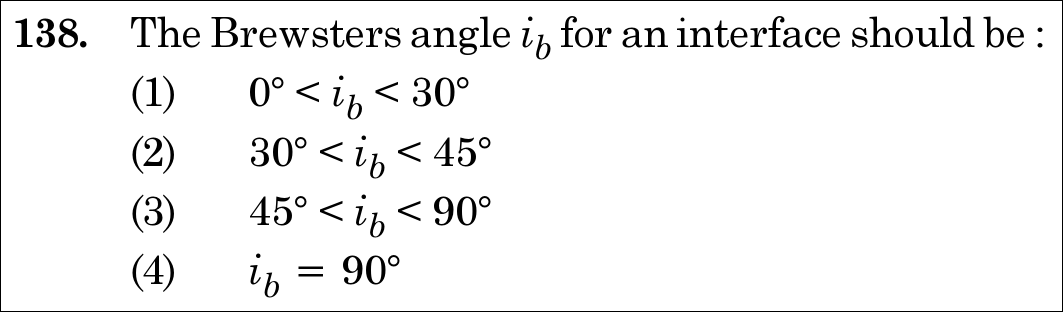
NEET 2020 · Q138 Easy
Official NEET 2020 Question 138 - Wave Optics
1
2
3 ✓ Key
4
💡 Verified Solution & 30-Second Hack
✓
Verified Against NTA Final Answer Key
Option (3) : 45° < ib < 90°
📚 Wave Optics Easy
📋 Given Parameters & Problem Setup
Phenomenon Polarization by reflection (Brewster's law)
Brewster's Formula tan(ib) = μ
Medium Interface Denser optical medium from air (μ > 1)
Question Objective Determine the valid physical range of Brewster's angle ib
⚡

The 30-Second Exam Hall Shortcut: ⚡ "Brewster's Law: tan(ib) = μ; For Transparent Media μ > 1, so ib > 45° and ib < 90°!"

⏱️ 20 seconds

According to Brewster's law, tan⁡(ib)=μ\tan(i_b) = \mu. For any real transparent material medium with respect to air, refractive index μ>1\mu > 1. Since tan⁡(45∘)=1\tan(45^\circ) = 1, we have tan⁡(ib)>1  ⟹  ib>45∘\tan(i_b) > 1 \implies i_b > 45^\circ. Since refractive index is finite (μ<∞\mu < \infty), tan⁡(ib)<∞  ⟹  ib<90∘\tan(i_b) < \infty \implies i_b < 90^\circ. Therefore, Brewster's angle must lie in the range 45∘<ib<90∘45^\circ < i_b < 90^\circ! Mark Option (3) in 5 seconds.

1 Brewster's Law: tan(ib) = μ.
2 For any material medium relative to air: μ > 1.
3 Since tan(45°) = 1, tan(ib) > tan(45°) => ib > 45°.
4 Since μ is finite (μ < ∞), tan(ib) < ∞ => ib < 90°.
5 Therefore, the angle range is 45° < ib < 90°.
6 Select Option (3).
🛡️
Why You Can 100% Trust This Shortcut: NCERT Physics · Wave Optics (Polarisation: Polarisation by Reflection and Brewster's Law)
📐

Step-by-Step Rigorous Workflow & Mathematical Proof

Step 1

State Brewster's Law

When unpolarized light is incident on the interface separating two media, the reflected light is completely plane-polarized when the angle of incidence equals Brewster's angle (ibi_b), where reflected and refracted rays are mutually perpendicular (ib+r=90∘i_b + r = 90^\circ).

Step 2

Mathematical Formulation of Brewster's Law

Using Snell's law with r=90∘−ibr = 90^\circ - i_b: sin⁡ibsin⁡r=μ  ⟹  sin⁡ibsin⁡(90∘−ib)=sin⁡ibcos⁡ib=tan⁡ib=μ\frac{\sin i_b}{\sin r} = \mu \implies \frac{\sin i_b}{\sin(90^\circ - i_b)} = \frac{\sin i_b}{\cos i_b} = \tan i_b = \mu

Step 3

Establish Bounds on Refractive Index

For any transparent optical medium (e.g. water μ=1.33\mu = 1.33, glass μ=1.5\mu = 1.5, diamond μ=2.42\mu = 2.42) surrounded by air/vacuum (μair=1\mu_{\text{air}} = 1): μ>1\mu > 1 And for any real physical material, refractive index is finite: 1<μ<∞1 < \mu < \infty

Step 4

Deduce Inequality Range for Brewster's Angle

Because the tangent function is strictly monotonically increasing in the first quadrant (0∘<ib<90∘0^\circ < i_b < 90^\circ): tan⁡(45∘)=1andtan⁡(90∘)=∞\tan(45^\circ) = 1 \quad \text{and} \quad \tan(90^\circ) = \infty 1<tan⁡ib<∞  ⟹  45∘<ib<90∘1 < \tan i_b < \infty \implies 45^\circ < i_b < 90^\circ This confirms Option (3).

⭐

360° Option Elimination Engine Key Feature

Diagnose every choice: Know exactly why the right option works and why distractors fail.

4-Option Deep Scan
1 A
✗ Incorrect
Verdict & Scientific Reason:

Incorrect; would require tan⁡ib<1/3≈0.577\tan i_b < 1/\sqrt{3} \approx 0.577, meaning μ<0.58\mu < 0.58, which is optically impossible for normal media.

⚠️
Student Fallacy (Why candidates pick this trap): Assuming Brewster's angle is a small grazing angle.
2 B
✗ Incorrect
Verdict & Scientific Reason:

Incorrect; would require μ<1\mu < 1 (tan⁡45∘=1\tan 45^\circ = 1), which implies an optically rarer medium than vacuum.

⚠️
Student Fallacy (Why candidates pick this trap): Overlooking that μ\mu must exceed 1.
3 C
✓ 100% Correct
Verdict & Scientific Reason:

Factually and trigonometrically exact; since μ>1\mu > 1, tan⁡ib>1  ⟹  45∘<ib<90∘\tan i_b > 1 \implies 45^\circ < i_b < 90^\circ.

💡
Why this is airtight: None; rigorous application of Brewster's law.
4 D
✗ Incorrect
Verdict & Scientific Reason:

Incorrect; at 90∘90^\circ, light is grazing and parallel to the surface without refracting into the medium (tan⁡90∘=∞\tan 90^\circ = \infty).

⚠️
Student Fallacy (Why candidates pick this trap): Confusing grazing incidence with polarizing angle.
⚠️

NTA Trap Alert: Typical Brewster Angles as Sanity Check

- Water (μ=1.33\mu = 1.33): ib=tan⁡−1(1.33)≈53∘i_b = \tan^{-1}(1.33) \approx 53^\circ. - Glass (μ=1.50\mu = 1.50): ib=tan⁡−1(1.50)≈56.3∘i_b = \tan^{-1}(1.50) \approx 56.3^\circ. - Diamond (μ=2.42\mu = 2.42): ib=tan⁡−1(2.42)≈67.5∘i_b = \tan^{-1}(2.42) \approx 67.5^\circ. All realistic Brewster angles lie strictly between 45° and 90°!

🛡️ How to avoid the -1 mark: Remember: Real materials have μ>1\mu > 1 -> tan⁡ib>1\tan i_b > 1 -> ib>45∘i_b > 45^\circ!
📖

Core NEET Syllabus Standard

Physics · Wave Optics Standard Benchmark
Core Scientific Principle Tested:

""

Syllabus Focus: Brewster's Law and Range of Brewster's Polarizing Angle: 45° < ib < 90°
✓ Core NEET UG Syllabus Anchor Syllabus & Academic Standards ↗
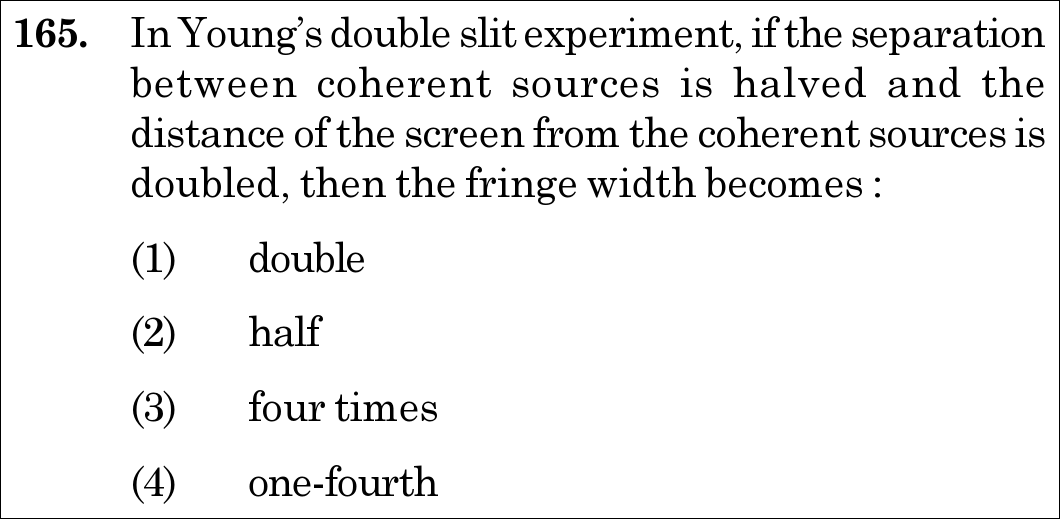
NEET 2020 · Q165 Easy
Official NEET 2020 Question 165 - Wave Optics
1 double
2 half
3 four times ✓ Key
4 one-fourth
💡 Verified Solution & 30-Second Hack
✓
Verified Against NTA Final Answer Key
Option (3) : four times
📚 Wave Optics Easy
📋 Given Parameters & Problem Setup
Original Fringe Width beta = lambda D / d
New Slit Separation d' = d / 2
New Screen Distance D' = 2D
⚡

The 30-Second Exam Hall Shortcut: ⚡ "beta = lambda D / d. D is doubled (×2), d is halved (×2 in numerator) => beta' = 2 × 2 = 4 beta (four times)!"

⏱️ 20 seconds

Fringe width is directly proportional to screen distance D and inversely proportional to slit separation d: beta ∝ D / d. When D is doubled (factor 2) and d is halved (factor 1/2 in denominator = factor 2 in numerator), the new fringe width becomes 2 × 2 = 4 times. Instant 5-second answer!

1 Formula: β=λDd\beta = \frac{\lambda D}{d}.
2 Substitute new parameters: D′=2DD' = 2D and d′=d2d' = \frac{d}{2}.
3 Calculate: β′=λ(2D)d/2=4(λDd)=4β\beta' = \frac{\lambda (2D)}{d/2} = 4 \left(\frac{\lambda D}{d}\right) = 4\beta.
4 Select Option (3) four times.
🛡️
Why You Can 100% Trust This Shortcut: NCERT Physics · Wave Optics (Young's Experiment and Fringe Width Expression)
📐

Step-by-Step Rigorous Workflow & Mathematical Proof

Step 1

Formula for Fringe Width in YDSE

In Young's double-slit experiment, the fringe width β\beta (distance between consecutive bright or dark fringes) is given by: β=λDd\beta = \frac{\lambda D}{d}, where λ\lambda is the wavelength of light, DD is the distance between slits and screen, and dd is the slit separation.

Step 2

Apply Given Modifications

- Separation between coherent sources is halved: d′=d2d' = \frac{d}{2} - Distance of the screen is doubled: D′=2DD' = 2D - Wavelength λ\lambda remains unchanged.

Step 3

Calculate New Fringe Width

β′=λD′d′=λ(2D)d2=212(λDd)=4(λDd)=4β\beta' = \frac{\lambda D'}{d'} = \frac{\lambda (2D)}{\frac{d}{2}} = \frac{2}{\frac{1}{2}} \left(\frac{\lambda D}{d}\right) = 4 \left(\frac{\lambda D}{d}\right) = 4\beta.

Step 4

Conclude Option 3

Thus, the fringe width becomes four times its original value, matching Option 3.

⭐

360° Option Elimination Engine Key Feature

Diagnose every choice: Know exactly why the right option works and why distractors fail.

4-Option Deep Scan
1 A
✗ Incorrect
Verdict & Scientific Reason:

Incorrect; considers only the doubling of D and ignores the halving of d.

⚠️
Student Fallacy (Why candidates pick this trap): Accounting for only one parameter change.
2 B
✗ Incorrect
Verdict & Scientific Reason:

Incorrect; inverts the formula as beta ∝ d / D.

⚠️
Student Fallacy (Why candidates pick this trap): Inverting the proportionality relations.
3 C
✓ 100% Correct
Verdict & Scientific Reason:

Accurate value; beta ∝ D/d => factor 2 / (1/2) = 4.

💡
Why this is airtight: None; clean proportional substitution.
4 D
✗ Incorrect
Verdict & Scientific Reason:

Incorrect; completely inverts the final multiplication factor.

⚠️
Student Fallacy (Why candidates pick this trap): Confusing 4 with 1/4.
⚠️

NTA Trap Alert: Numerator vs Denominator in Fringe Width

Screen distance D is in the numerator (farther screen = wider fringes). Slit separation d is in the denominator (narrower slits = wider fringes).

🛡️ How to avoid the -1 mark: Both changes increase fringe width: doubling D doubles width; halving d doubles width again: 2 × 2 = 4.
📖

Core NEET Syllabus Standard

Physics · Wave Optics Standard Benchmark
Core Scientific Principle Tested:

""

Syllabus Focus: Fringe Width Variation in Young's Double Slit Experiment (YDSE)
✓ Core NEET UG Syllabus Anchor Syllabus & Academic Standards ↗
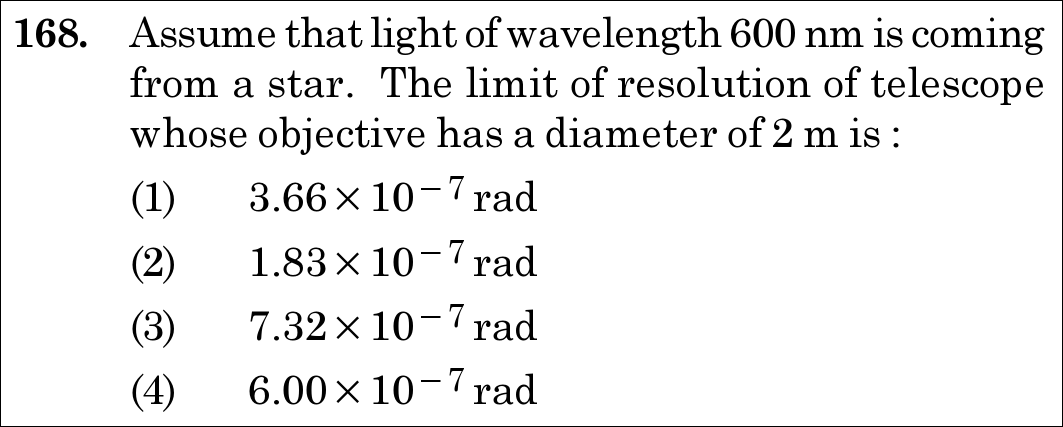
NEET 2020 · Q168 Medium
Official NEET 2020 Question 168 - Wave Optics
1 ✓ Key
2
3
4
💡 Verified Solution & 30-Second Hack
✓
Verified Against NTA Final Answer Key
Option (1) : 3.66 x 10^-7 rad
📚 Wave Optics Medium
📋 Given Parameters & Problem Setup
Wavelength of Light (lambda) 600 nm = 6 × 10^-7 m
Objective Aperture Diameter (D) 2 m
⚡

The 30-Second Exam Hall Shortcut: ⚡ "Limit of resolution Δθ = 1.22 λ / D = 1.22 × (6 × 10^-7) / 2 = 1.22 × 3 × 10^-7 = 3.66 × 10^-7 rad!"

⏱️ 20 seconds

According to Rayleigh's criterion for a circular aperture, the angular limit of resolution of a telescope objective is Δθ = 1.22 λ / D. Substituting λ = 600 nm = 6 × 10^-7 m and D = 2 m: Δθ = 1.22 × (6 × 10^-7) / 2 = 1.22 × 3 × 10^-7 = 3.66 × 10^-7 rad. Instant 5-second calculation!

1 Formula: Δθ=1.22λD\Delta\theta = \frac{1.22 \lambda}{D}.
2 Substitute: λ=600×10−9 m=6×10⁻⁷ m\lambda = 600 \times 10^{-9}\text{ m} = 6 \times 10^{-7}\text{ m} and D=2 mD = 2\text{ m}.
3 Compute: Δθ=1.22×6×10−72=1.22×3×10−7=3.66×10⁻⁷ rad\Delta\theta = \frac{1.22 \times 6 \times 10^{-7}}{2} = 1.22 \times 3 \times 10^{-7} = 3.66 \times 10^{-7}\text{ rad}.
4 Select Option (1).
🛡️
Why You Can 100% Trust This Shortcut: NCERT Physics · Wave Optics (Diffraction at a Circular Aperture and Resolving Power)
📐

Step-by-Step Rigorous Workflow & Mathematical Proof

Step 1

Rayleigh Criterion for Circular Apertures

Light passing through a circular telescope objective of diameter DD forms an Airy diffraction pattern consisting of a central bright disc surrounded by dark and bright concentric rings. The angular radius of the first dark ring (Airy disc) defines the angular limit of resolution: Δθ=1.22λD\Delta\theta = \frac{1.22 \lambda}{D}.

Step 2

List Given Numerical Values

- Wavelength of light: λ=600 nm=600×10−9 m=6×10⁻⁷ m\lambda = 600\text{ nm} = 600 \times 10^{-9}\text{ m} = 6 \times 10^{-7}\text{ m} - Diameter of telescope objective: D=2 mD = 2\text{ m}.

Step 3

Calculate Angular Separation

Δθ=1.22×(6×10−7 m)2 m=1.22×3×10−7=3.66×10⁻⁷ rad\Delta\theta = \frac{1.22 \times (6 \times 10^{-7}\text{ m})}{2\text{ m}} = 1.22 \times 3 \times 10^{-7} = 3.66 \times 10^{-7}\text{ rad}.

Step 4

Match with Options

Matches Option 1 exactly.

⭐

360° Option Elimination Engine Key Feature

Diagnose every choice: Know exactly why the right option works and why distractors fail.

4-Option Deep Scan
1 A
✓ 100% Correct
Verdict & Scientific Reason:

Accurate value; Δθ = 1.22 λ / D = 1.22 × 6 × 10^-7 / 2 = 3.66 × 10^-7 rad.

💡
Why this is airtight: None; rigorous application of Rayleigh criterion.
2 B
✗ Incorrect
Verdict & Scientific Reason:

Incorrect; divided by 4 instead of 2 (or used radius R = 1 m and divided by 2 again).

⚠️
Student Fallacy (Why candidates pick this trap): Double halving of the aperture.
3 C
✗ Incorrect
Verdict & Scientific Reason:

Incorrect; multiplied by diameter instead of dividing (1.22 × 6 × 10^-7 × 2 / 2^2).

⚠️
Student Fallacy (Why candidates pick this trap): Inverting diameter position in formula.
4 D
✗ Incorrect
Verdict & Scientific Reason:

Incorrect; omitted the Airy circular factor 1.22 and used λ / 1.

⚠️
Student Fallacy (Why candidates pick this trap): Ignoring the 1.22 factor from circular aperture Bessel diffraction.
⚠️

NTA Trap Alert: Limit of Resolution vs Resolving Power

Limit of resolution is the angular separation Δθ = 1.22 λ / D (in radians). Resolving power is its reciprocal: RP = D / (1.22 λ).

🛡️ How to avoid the -1 mark: Smaller Δθ means higher resolving power. Don't invert the formula!
📖

Core NEET Syllabus Standard

Physics · Wave Optics Standard Benchmark
Core Scientific Principle Tested:

""

Syllabus Focus: Limit of Resolution of an Astronomical Telescope by Rayleigh Criterion
✓ Core NEET UG Syllabus Anchor Syllabus & Academic Standards ↗

Solve 4 NEET Questions a Day — One per Subject

Cover all 1,140 official NEET questions in 285 days at your own pace. Progress is saved on your device. No login needed.