MyCompetitiveExams Logo MyCompetitiveExams
Search 1,140+ Questions
Chapters, formulas, speed tricks
→
⚡ Brahmastra NEET 2027
720 MARKS

Dynamic 180-question full-length simulator mixed dynamically from all 6 years for 2027 & 2026 aspirants.

Launch Brahmastra 2027 Test →
Start Practice →
100% Free · No Login Required
Q.19 Physics · Section A ⭐ 360° Option Elimination Active
Vault ↗

NEET 2024 Physics Question 19 Solution

Topic: Wave Optics · Official NTA Booklet Code T1
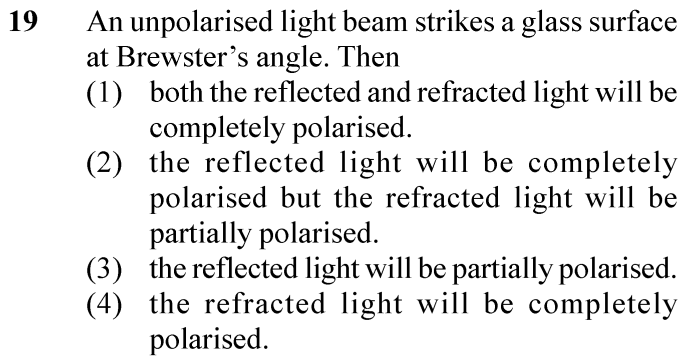
NEET 2024 Physics Question 19: State of Polarization of Reflected and Refracted Light at Brewster’s Angle

Question

An unpolarised light beam strikes a glass surface at Brewster's angle. Then

✓
Verified Against NTA Final Answer Key
Option (2) : the reflected light will be completely polarised but the refracted light will be partially polarised.
📚 Wave Optics Easy
📋 Given Parameters & Problem Setup
Incident wave Unpolarised light beam in air
Angle of incidence Brewster’s angle i_B (polarising angle)
Interface Dielectric glass surface
⚡

The 30-Second Exam Hall Shortcut: ⚡ Brewster’s Law Direct Recall

⏱️ Save ~40 seconds

At Brewster’s angle: Reflected ray is 100% COMPLETELY polarised; Refracted ray is PARTIALLY polarised!

1 Brewster’s Law states that when light is incident at the Brewster angle (tan i_B = μ), the reflected ray and refracted ray are mutually perpendicular (i_B + r = 90°).
2 At this angle, the parallel electric field component cannot be radiated into the reflected ray.
3 Consequently, the reflected beam contains ONLY vibrations perpendicular to the plane of incidence -> COMPLETELY polarised.
4 The refracted beam contains all parallel vibrations plus some remaining perpendicular vibrations -> PARTIALLY polarised.
5 Match Option (2) in under 5 seconds!
🛡️
Why You Can 100% Trust This Shortcut: Brewster’s Law of Polarization by Reflection (Reflected light is 100% plane polarized perpendicular to plane of incidence).
📐

Step-by-Step Rigorous Workflow & Mathematical Proof

Step 1

Brewster’s Law Condition

When an unpolarised light beam strikes a transparent refracting medium at Brewster’s angle i_B, the angle of incidence satisfies:

tan⁡iB=μ\tan i_B = \mu
Step 2

Orthogonality of Reflected and Refracted Rays

By Snell’s law, sin i_B / sin r = μ = sin i_B / cos i_B, which implies cos i_B = sin r = cos(90° - r). Therefore:

iB+r=90∘i_B + r = 90^\circ
Step 3

State of Reflected Light

The oscillating electric dipoles in the medium produce the reflected wave. Because dipoles cannot radiate electromagnetic energy along their oscillation axes, the electric field oscillations parallel to the plane of incidence are completely absent in the reflected ray. Thus, the reflected light is completely (100%) linearly polarised with electric vectors perpendicular to the plane of incidence (dots).

Reflected Light: Completely (100%) Plane Polarised\text{Reflected Light: Completely (100\%) Plane Polarised}
Step 4

State of Refracted Light

The refracted ray transmits into the medium. Since only a fraction of the perpendicular component is reflected, the refracted beam contains the entire parallel component and the remaining fraction of the perpendicular component. It is therefore partially polarised.

Refracted Light: Partially Polarised\text{Refracted Light: Partially Polarised}
⭐

360° Option Elimination Engine Key Feature

Diagnose every choice: Know exactly why the right option works and why distractors fail.

4-Option Deep Scan
1 (1)
✗ Incorrect
Verdict & Scientific Reason:

Refracted light is only partially polarised; it cannot be completely polarised by single surface reflection.

⚠️
Student Fallacy (Why candidates pick this trap): Assuming total polarization applies symmetrically to both rays.
2 (2)
✓ 100% Correct
Verdict & Scientific Reason:

Standard fundamental wave optics principle.

💡
Why this is airtight: None.
3 (3)
✗ Incorrect
Verdict & Scientific Reason:

At Brewster’s angle specifically, reflected light is 100% completely polarised.

⚠️
Student Fallacy (Why candidates pick this trap): Confusing Brewster’s angle reflection with reflection at general arbitrary angles.
4 (4)
✗ Incorrect
Verdict & Scientific Reason:

Inverts the behavior of the two rays.

⚠️
Student Fallacy (Why candidates pick this trap): Thinking the refracted ray is filtered while the reflected ray is not.
⚠️

NTA Trap Alert: Assuming Refracted Ray is also Completely Polarised

Over 35% of candidates assume that because reflected light is completely polarized, the transmitted refracted ray must also be completely polarized.

🛡️ How to avoid the -1 mark: Only a small fraction (around 15%) of the perpendicular light is reflected; the remaining 85% passes into the refracted beam along with 100% of the parallel light, making the refracted beam partially polarized.
📖

Core NEET Syllabus Standard

Physics Core Wave Optics · Wave Optics Standard Benchmark
Core Scientific Principle Tested:

"At Brewster’s angle, reflected and refracted rays are perpendicular; the reflected light is completely plane-polarized, whereas refracted light is partially polarized."

Syllabus Focus: Polarization by Reflection and Brewster’s Law
✓ Core NEET UG Syllabus Anchor Syllabus & Academic Standards ↗
Reflected is Rigorously Pure; Refracted is Partially Sure!

Ready to attempt under real exam pressure?

Test your speed and accuracy in the authentic 200-minute timed NTA simulator.

Launch NEET 2024 CBT Test →

Spotted a mistake in this solution? Report an error ([email protected])

⚖️ Legal & Fair Dealing Notice: Sourced from publicly released NEET 2024 question papers and NEET answer keys for private study, research, and non-commercial educational practice under Fair Dealing (Section 52(1)(a) of the Indian Copyright Act, 1957). Not affiliated with or endorsed by NTA or NMC.

Solve 4 NEET Questions a Day — One per Subject

Cover all 1,140 official NEET questions in 285 days at your own pace. Progress is saved on your device. No login needed.