The 30-Second Exam Hall Shortcut: ⚡ Series Cancellation & Parallel Conductance Rule
Series resistances add linearly; Parallel conductances add reciprocally!
Step-by-Step Rigorous Workflow & Mathematical Proof
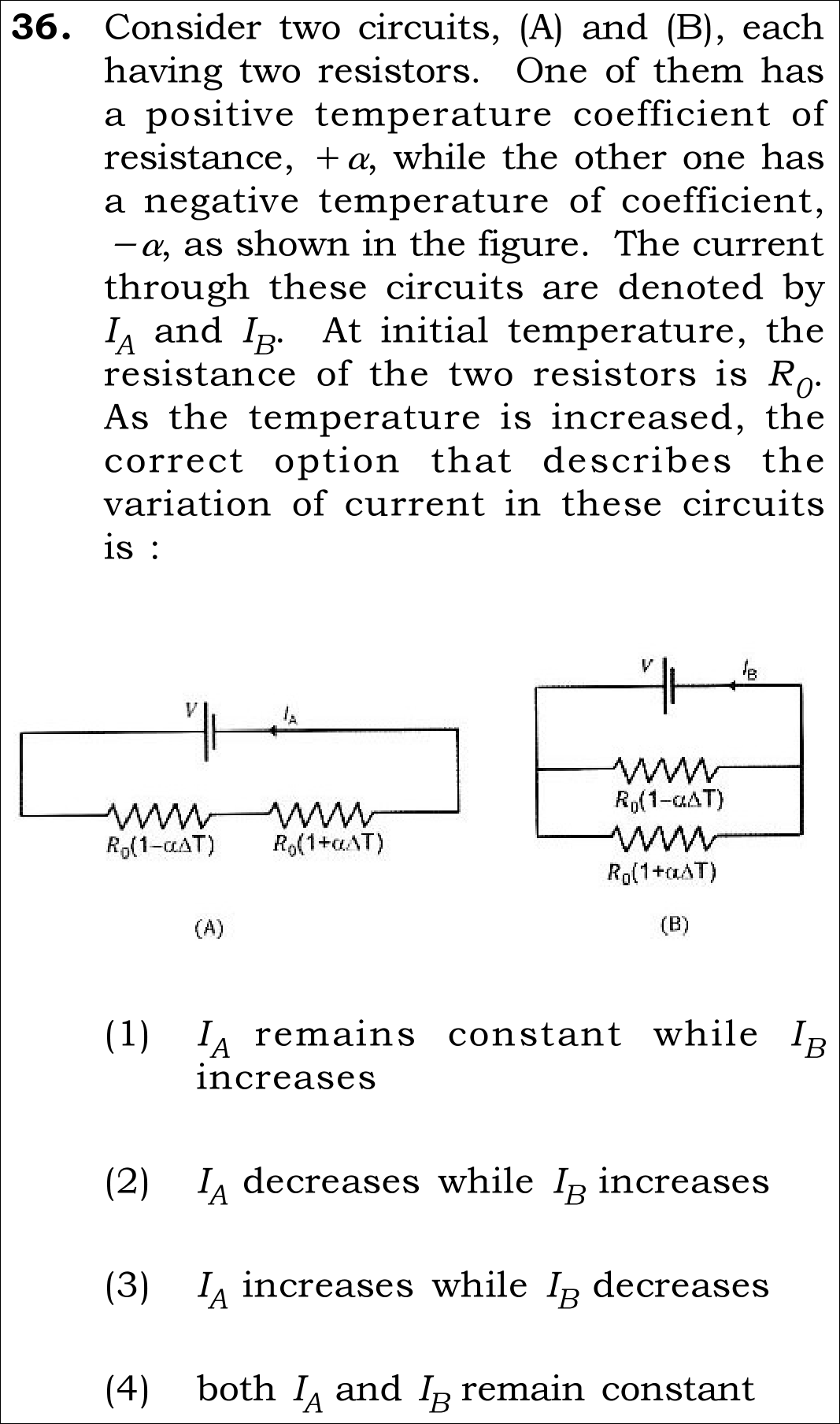
Analyze Circuit A (Series Combination)
In series, the total equivalent resistance is the algebraic sum of the individual resistances:
- • The linear temperature-dependent terms (-alpha*Delta T and +alpha*Delta T) cancel out completely.
- • R_{eq,A} = 2 R_0 is completely independent of temperature.
- • Therefore, current I_A = V / (2 R_0) remains strictly constant as temperature increases.
Analyze Circuit B (Parallel Combination)
In parallel across constant voltage V, total current is the sum of branch currents:
- • Find the common denominator: (1 - alpha*Delta T)(1 + alpha*Delta T) = 1 - alpha^2 (Delta T)^2.
- • I_B = \frac{V}{R_0} \left[ \frac{(1 + \alpha \Delta T) + (1 - \alpha \Delta T)}{1 - \alpha^2 (\Delta T)^2} \right] = \frac{2V}{R_0 \left[1 - \alpha^2 (\Delta T)^2\right]}.
Evaluate the Trend of I_B as Temperature Increases
Examine the behavior of the denominator as Delta T increases:
- • Because the denominator decreases below 1, total parallel current I_B strictly INCREASES.
- • Conclusion: I_A remains constant while I_B increases.
- • Matches Option (1) exactly.
360° Option Elimination Engine Key Feature
Diagnose every choice: Know exactly why the right option works and why distractors fail.
100% mathematically and physically verified; confirmed by Official NTA Final Answer Key.
Fails series cancellation.
Inverted trends for both circuits.
Neglects second-order term in parallel.
NTA Trap Alert: The First-Order Parallel Approximation Trap (Option 4)
Students who use (1 - alpha*Delta T)^-1 ~ 1 + alpha*Delta T compute I_B ~ (1 + alpha*Delta T + 1 - alpha*Delta T) = 2 and mistakenly pick Option (4).
Core NEET Syllabus Standard
"R(T) = R_0(1 + alpha*Delta T). In series, opposing linear coefficients yield constant equivalent resistance. In parallel, equivalent resistance R_p = (R_0/2)*(1 - alpha^2*Delta T^2) decreases, increasing current."