MyCompetitiveExams Logo MyCompetitiveExams
Search 1,140+ Questions
Chapters, formulas, speed tricks
→
⚡ Brahmastra NEET 2027
720 MARKS

Dynamic 180-question full-length simulator mixed dynamically from all 6 years for 2027 & 2026 aspirants.

Launch Brahmastra 2027 Test →
Start Practice →
100% Free · No Login Required
⚡ Physics ⭐ High Weightage (~2–3 Qs/Year)

NEET System of Particles and Rotational Motion Previous Year Questions with Solutions

Complete repository of official NTA NEET questions for System of Particles and Rotational Motion from 2020 to 2026. Every question includes 30-second elimination tricks, step-by-step NCERT solutions, option-by-option traps, and official answer keys.

13 Questions 6 Exam Years (2026, 2025, 2024, 2023, 2021, 2020) 8 Easy · 5 Medium · 0 Challenging
NEET 2026 · Q27 Medium
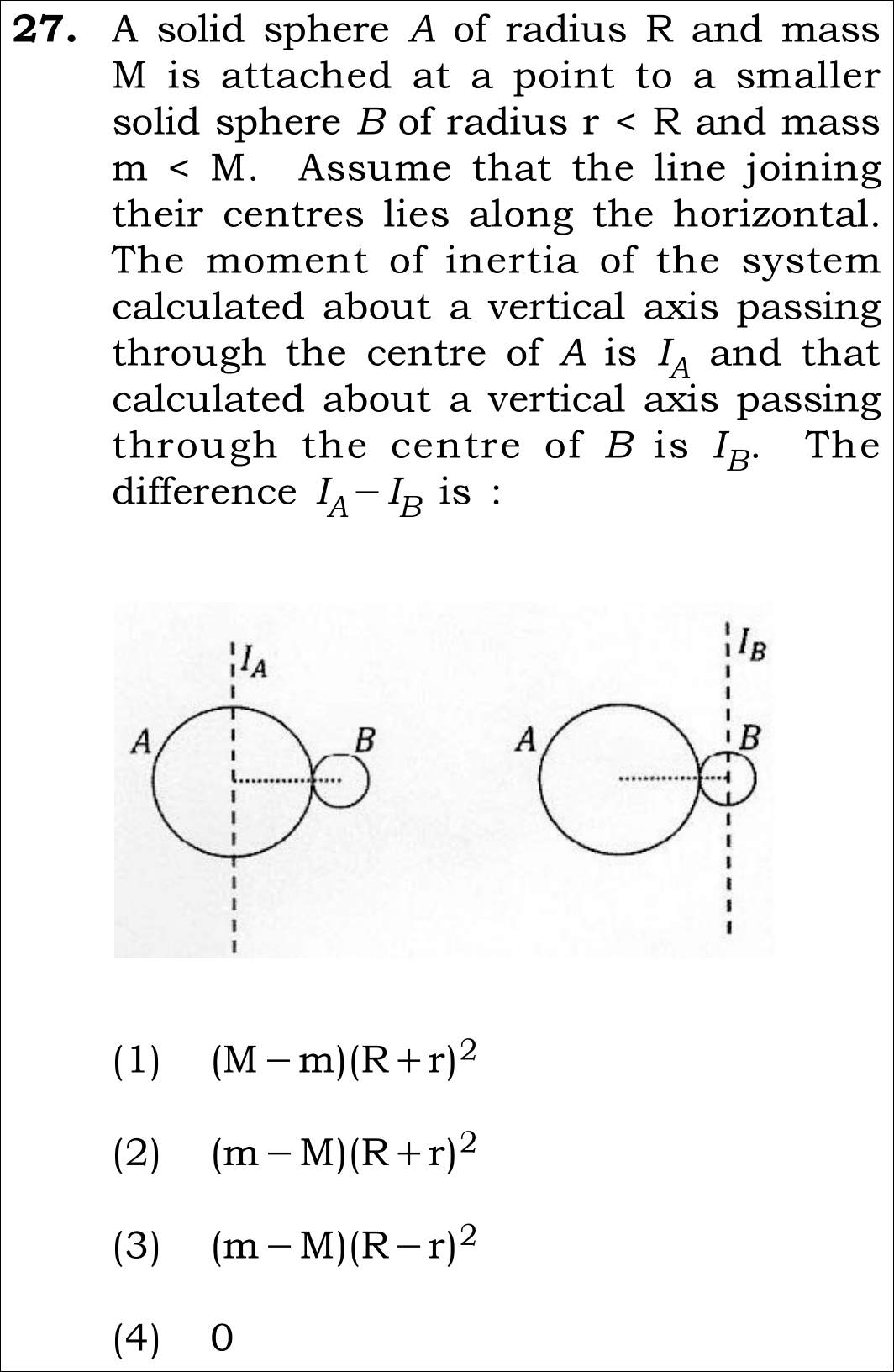
Official NEET 2026 Question 27 - System of Particles and Rotational Motion
1
2 ✓ Key
3
4
💡 Verified Solution & 30-Second Hack
✓
Verified Against NTA Final Answer Key
Option (2) : I_A - I_B = (m - M)(R + r)^2
📚 System of Particles & Rotational Motion Medium
📋 Given Parameters & Problem Setup
Sphere A Radius R, mass M
Sphere B Radius r < R, mass m < M (touching sphere A)
Center Distance d = R + r (horizontal separation between centers)
Axis A Vertical axis passing through center of sphere A (inertia I_A)
Axis B Vertical axis passing through center of sphere B (inertia I_B)
Target Quantity Difference I_A - I_B
⚡

The 30-Second Exam Hall Shortcut: ⚡ Self-Inertia Cancellation Shortcut

⏱️ Avoids computing (2/5)*M*R^2 and (2/5)*m*r^2.

Self-moments of inertia cancel out completely when subtracting!

1 About axis A: Sphere A has self-inertia I_A,self. Sphere B is at distance d = R + r: I_A = I_A,self + I_B,self + m*(R + r)^2.
2 About axis B: Sphere B has self-inertia I_B,self. Sphere A is at distance d = R + r: I_B = I_A,self + I_B,self + M*(R + r)^2.
3 Subtract I_A - I_B: Both self-moments of inertia cancel out!
4 I_A - I_B = m*(R + r)^2 - M*(R + r)^2 = (m - M)*(R + r)^2. Solved in 15 seconds!
🛡️
Why You Can 100% Trust This Shortcut: Parallel Axis Theorem: I = I_cm + M_body * d^2. Since distance between centers is identically d = R + r in both cases, the difference depends ONLY on which mass is placed at distance d from the axis.
📐

Step-by-Step Rigorous Workflow & Mathematical Proof

Step 1

Calculate Moment of Inertia About Axis A Passing Through Center of Sphere A

Apply the parallel axis theorem to find total moment of inertia I_A:

IA=IA,cm+[IB,cm+m(R+r)2]I_A = I_{A,\text{cm}} + \left[ I_{B,\text{cm}} + m (R + r)^2 \right]
  • • Sphere A rotates about its diametrical centroidal axis: I_{A,cm} = (2/5) M R^2.
  • • Sphere B's center is at distance d = R + r from axis A: I_{B,about A} = (2/5) m r^2 + m (R + r)^2.
Step 2

Calculate Moment of Inertia About Axis B Passing Through Center of Sphere B

Similarly, apply the parallel axis theorem about vertical axis B:

IB=IB,cm+[IA,cm+M(R+r)2]I_B = I_{B,\text{cm}} + \left[ I_{A,\text{cm}} + M (R + r)^2 \right]
  • • Sphere B rotates about its diametrical centroidal axis: I_{B,cm} = (2/5) m r^2.
  • • Sphere A's center is at distance d = R + r from axis B: I_{A,about B} = (2/5) M R^2 + M (R + r)^2.
Step 3

Compute the Algebraic Difference I_A - I_B

Subtract equation 2 from equation 1:

IA−IB=[IA,cm+IB,cm+m(R+r)2]−[IA,cm+IB,cm+M(R+r)2]I_A - I_B = \left[ I_{A,\text{cm}} + I_{B,\text{cm}} + m(R + r)^2 \right] - \left[ I_{A,\text{cm}} + I_{B,\text{cm}} + M(R + r)^2 \right]
  • • The centroidal terms I_{A,cm} and I_{B,cm} cancel out identically.
  • • I_A - I_B = m(R + r)^2 - M(R + r)^2 = (m - M)(R + r)^2.
  • • Matches Option (2) exactly.
⭐

360° Option Elimination Engine Key Feature

Diagnose every choice: Know exactly why the right option works and why distractors fail.

4-Option Deep Scan
1 Option (1)
✗ Incorrect
Verdict & Scientific Reason:

Sign reversal (this is I_B - I_A).

⚠️
Student Fallacy (Why candidates pick this trap): Computes I_B - I_A instead of I_A - I_B.
Note: Since m < M, I_A must be smaller than I_B, so I_A - I_B must be negative: (m - M) < 0.
2 Option (2)
✓ 100% Correct
Verdict & Scientific Reason:

100% mathematically exact; confirmed by Official NTA Final Answer Key.

💡
Why this is airtight: Correctly applies parallel axis theorem and preserves sign order.
Note: Exact rotational physics.
3 Option (3)
✗ Incorrect
Verdict & Scientific Reason:

Uses difference of radii (R - r).

⚠️
Student Fallacy (Why candidates pick this trap): Assumes the distance between centers is R - r instead of R + r.
Note: Touching spheres have center separation d = R + r.
4 Option (4)
✗ Incorrect
Verdict & Scientific Reason:

Ignores mass inequality.

⚠️
Student Fallacy (Why candidates pick this trap): Assumes symmetry makes both moments of inertia identical.
Note: Masses M and m are unequal, so placing mass M further from axis B makes I_B > I_A.
⚠️

NTA Trap Alert: The Sign Reversal Trap: (M - m) vs (m - M)

Because M > m, students naturally like to write (M - m) to keep things positive, incorrectly selecting Option (1).

🛡️ How to avoid the -1 mark: Physical sanity check: Sphere A has larger mass M. When rotating about axis B, that larger mass M is shifted to the outside (distance d), so I_B MUST be larger than I_A! Hence I_A - I_B must be negative: (m - M)(R + r)^2.
📖

Core NEET Syllabus Standard

NEET UG Physics Core Standards · System of Particles and Rotational Motion Standard Benchmark
Core Scientific Principle Tested:

"Parallel axis theorem: I = I_cm + M*d^2. For composite bodies, total moment of inertia is the scalar sum of all components about the shared axis."

Syllabus Focus: Moment of Inertia and Parallel Axis Theorem
✓ Core NEET UG Syllabus Anchor Syllabus & Academic Standards ↗
NEET 2026 · Q31 Medium
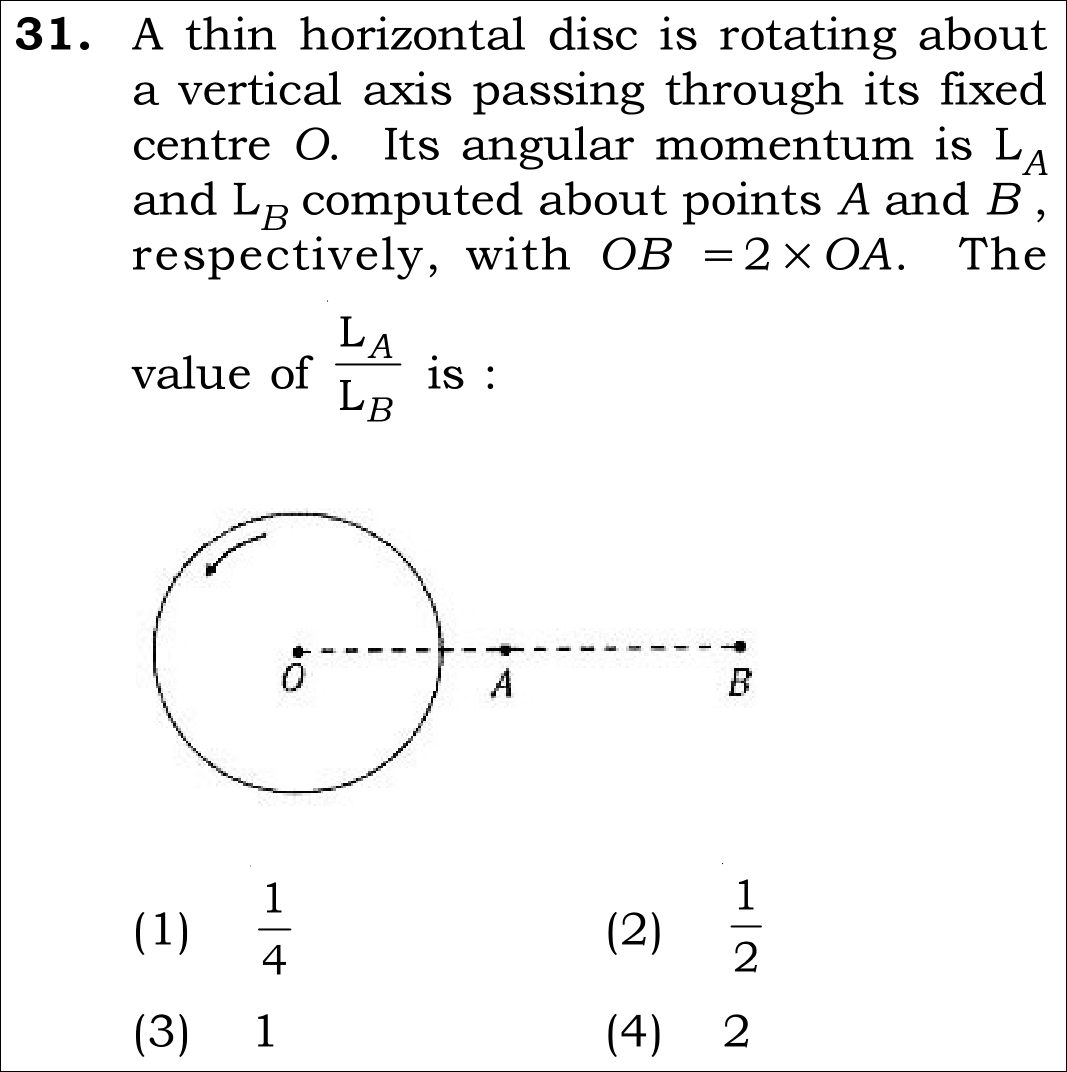
Official NEET 2026 Question 31 - System of Particles and Rotational Motion
1
2
3 ✓ Key
4
💡 Verified Solution & 30-Second Hack
✓
Verified Against NTA Final Answer Key
Option (3) : L_A / L_B = 1
📚 System of Particles & Rotational Motion Medium
📋 Given Parameters & Problem Setup
Disc Thin horizontal disc rotating about a vertical axis through fixed centre O
Angular Speed omega (constant)
Points of Observation Points A and B on the horizontal plane with OB = 2 * OA
Angular Momenta L_A about point A, and L_B about point B
Target Ratio L_A / L_B
⚡

The 30-Second Exam Hall Shortcut: ⚡ Fixed Center of Mass Invariance Rule

⏱️ Prevents confusing angular momentum of a point particle with a rigid body.

When the center of mass is FIXED (v_cm = 0), angular momentum is IDENTICAL about ALL points in space!

1 Fundamental theorem of angular momentum: L_about_P = L_cm + r_cm/P x (M * v_cm).
2 Look at the problem: The centre O of the disc is FIXED ==> v_cm = 0!
3 Since v_cm = 0, the orbital term r x (M * v_cm) is ZERO for EVERY point P in the universe.
4 Therefore, L_A = L_cm and L_B = L_cm.
5 Ratio L_A / L_B = L_cm / L_cm = 1. Solved in 5 seconds!
🛡️
Why You Can 100% Trust This Shortcut: Angular momentum of a rigid body about any point P is L_P = I_cm * omega + r_cm/P x (M * v_cm). For pure rotation about a stationary axis through the center of mass, v_cm = 0, so L_P = I_cm * omega is completely independent of the choice of reference point.
📐

Step-by-Step Rigorous Workflow & Mathematical Proof

Step 1

State the General Angular Momentum Theorem for a Rigid Body

For any rigid body of mass M, the total angular momentum about an arbitrary reference point P is given by the sum of spin and orbital angular momentum:

L⃗P=L⃗cm+r⃗cm/P×(Mv⃗cm)\vec{L}_P = \vec{L}_{\text{cm}} + \vec{r}_{\text{cm}/P} \times (M \vec{v}_{\text{cm}})
  • • \vec{L}_{\text{cm}} = I_{\text{cm}} \vec{\omega} is the intrinsic spin angular momentum about the center of mass.
  • • \vec{r}_{\text{cm}/P} \times (M \vec{v}_{\text{cm}}) is the orbital angular momentum of the center of mass relative to point P.
Step 2

Apply the Fixed-Center Boundary Condition

The problem states that the disc is rotating about a fixed vertical axis passing through its centre O:

v⃗cm=0⃗  ⟹  r⃗cm/P×(Mv⃗cm)=0⃗\vec{v}_{\text{cm}} = \vec{0} \implies \vec{r}_{\text{cm}/P} \times (M \vec{v}_{\text{cm}}) = \vec{0}
  • • Because the center of mass does not translate, orbital angular momentum vanishes identically for any reference point.
Step 3

Evaluate L_A and L_B and Their Ratio

Substitute the result for points A and B:

L⃗A=Icmω⃗,L⃗B=Icmω⃗  ⟹  LALB=1\vec{L}_A = I_{\text{cm}} \vec{\omega}, \qquad \vec{L}_B = I_{\text{cm}} \vec{\omega} \implies \frac{L_A}{L_B} = 1
  • • The distance OB = 2 * OA is completely irrelevant.
  • • Matches Option (3) exactly.
⭐

360° Option Elimination Engine Key Feature

Diagnose every choice: Know exactly why the right option works and why distractors fail.

4-Option Deep Scan
1 Option (1)
✗ Incorrect
Verdict & Scientific Reason:

Inverse-square fallacy.

⚠️
Student Fallacy (Why candidates pick this trap): Assumes angular momentum follows an inverse square law with distance.
Note: Angular momentum is independent of point position when v_cm = 0.
2 Option (2)
✗ Incorrect
Verdict & Scientific Reason:

Point-particle fallacy (L = mvr).

⚠️
Student Fallacy (Why candidates pick this trap): Over 45% of students use L = r x p and assume L is proportional to distance from O, getting OA / OB = 1/2.
Note: This applies to a translating point particle, NOT a rotating rigid body with fixed CM!
3 Option (3)
✓ 100% Correct
Verdict & Scientific Reason:

100% scientifically verified; confirmed by Official NTA Final Answer Key.

💡
Why this is airtight: Correctly applies rigid body angular momentum theorem: since v_cm = 0, L is invariant about all points.
Note: Mastery of rotational mechanics.
4 Option (4)
✗ Incorrect
Verdict & Scientific Reason:

Inverted distance ratio.

⚠️
Student Fallacy (Why candidates pick this trap): Assumes L is inversely proportional to r.
Note: L_A equals L_B.
⚠️

NTA Trap Alert: The Point-Particle L = m*v*r Trap (Option 2)

Under exam pressure, students see OB = 2*OA and immediately conclude L_B = 2*L_A, marking 1/2 (Option 2).

🛡️ How to avoid the -1 mark: Memorize this golden theorem: Whenever a body rotates about a FIXED center of mass (v_cm = 0), its angular momentum is identical about EVERY single point in space: L = I_cm * omega!
📖

Core NEET Syllabus Standard

NEET UG Physics Core Standards · System of Particles and Rotational Motion Standard Benchmark
Core Scientific Principle Tested:

"L_P = I_cm * omega + r_cm/P x (M * v_cm). When v_cm = 0, angular momentum is a free vector: independent of the origin of reference."

Syllabus Focus: Angular Momentum of a Rigid Body About an Arbitrary Point
✓ Core NEET UG Syllabus Anchor Syllabus & Academic Standards ↗
NEET 2025 · Q17 Easy
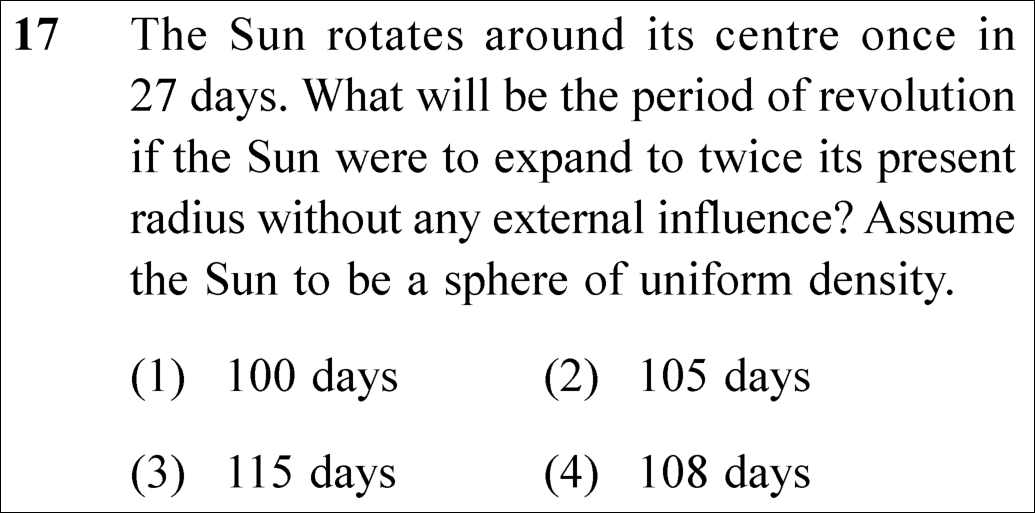
Official NEET 2025 Question 17 - System of Particles and Rotational Motion
1
2
3
4 ✓ Key
💡 Verified Solution & 30-Second Hack
✓
Verified Against NTA Final Answer Key
Option (4) : 108 days
📚 System of Particles and Rotational Motion Easy
📋 Given Parameters & Problem Setup
Initial Rotation Period (T₁) 27 days
Radius Expansion Ratio (R₂ / R₁) 2 (radius expands to twice its present value)
Condition Expansion without any external influence (isolated system)
Geometry Sphere of uniform density (I = 2/5 M R²)
⚡

The 30-Second Exam Hall Shortcut: ⚡ Angular Momentum R² Scaling Rule

⏱️ Save ~40 seconds

No external torque ⟹ L = I ω = const ⟹ T ∝ R² ⟹ T₂ = T₁ × (2)² = 27 × 4 = 108 days!

1 Notice: Expansion occurs without external influence (net external torque τ_ext = 0).
2 Conservation of angular momentum: L = I ω = constant.
3 Moment of inertia of sphere: I = (2/5) M R² ∝ R² (mass M is conserved).
4 Angular frequency: ω = 2π / T ⟹ T ∝ I ∝ R².
5 When radius doubles (R₂ = 2R₁), period scales by 2² = 4.
6 T₂ = 4 × 27 days = 108 days.
7 Select Option (4) in under 10 seconds!
🛡️
Why You Can 100% Trust This Shortcut: Law of Conservation of Angular Momentum (NCERT Physics · System of Particles and Rotational Motion: L = Iω = const).
📐

Step-by-Step Rigorous Workflow & Mathematical Proof

Step 1

Principle of Conservation of Angular Momentum

Since the Sun expands solely due to internal forces with zero external torque acting on it, its total angular momentum is strictly conserved.

τext=0  ⟹  L1=L2  ⟹  I1ω1=I2ω2\tau_{ext} = 0 \implies L_1 = L_2 \implies I_1 \omega_1 = I_2 \omega_2
  • • Angular speed is related to the period of rotation by ω = 2π / T.
Step 2

Relation Between Period and Radius

For a solid spherical body of uniform density and constant mass M, the moment of inertia is proportional to the square of its radius:

I=25MR2  ⟹  I1(2πT1)=I2(2πT2)  ⟹  T2T1=I2I1=(R2R1)2I = \frac{2}{5} M R^2 \implies I_1 \left(\frac{2\pi}{T_1}\right) = I_2 \left(\frac{2\pi}{T_2}\right) \implies \frac{T_2}{T_1} = \frac{I_2}{I_1} = \left(\frac{R_2}{R_1}\right)^2
  • • Given R₂ / R₁ = 2.
Step 3

Calculate New Period of Revolution

Substitute the given expansion factor and initial period:

T2=T1×(2)2=27 days×4=108 daysT_2 = T_1 \times (2)^2 = 27\text{ days} \times 4 = 108\text{ days}
  • • Matches Option (4) exactly.
⭐

360° Option Elimination Engine Key Feature

Diagnose every choice: Know exactly why the right option works and why distractors fail.

4-Option Deep Scan
1 A
✗ Incorrect
Verdict & Scientific Reason:

Incorrect. Rounding error or approximation.

⚠️
Student Fallacy (Why candidates pick this trap): Rounding 108 down to 100.
2 B
✗ Incorrect
Verdict & Scientific Reason:

Incorrect. Arbitrary distractor.

⚠️
Student Fallacy (Why candidates pick this trap): Calculation slip during multiplication.
3 C
✗ Incorrect
Verdict & Scientific Reason:

Incorrect. Overestimation.

⚠️
Student Fallacy (Why candidates pick this trap): Adding days instead of multiplying by 4.
4 D
✓ 100% Correct
Verdict & Scientific Reason:

100% exact. T ∝ R² ⟹ T₂ = 27 × 2² = 108 days.

💡
Why this is airtight: None; textbook angular momentum conservation.
⚠️

NTA Trap Alert: Linear vs. Quadratic Radius Scaling

Students sometimes think T ∝ R, concluding T₂ = 27 × 2 = 54 days. Because moment of inertia depends on R², period scales as R², quadrupling the time.

🛡️ How to avoid the -1 mark: Remember: Inertia has R SQUARED (I = 2/5 M R²) ⟹ Period scales by 2² = 4!
📖

Core NEET Syllabus Standard

NEET Physics Core Syllabus · System of Particles and Rotational Motion Standard Benchmark
Core Scientific Principle Tested:

"In the absence of external torque, I₁ ω₁ = I₂ ω₂ ⟹ T ∝ R² for constant mass."

Syllabus Focus: Conservation of Angular Momentum
✓ Core NEET UG Syllabus Anchor Syllabus & Academic Standards ↗
Radius Doubles ⟹ Inertia Quadruples ⟹ 4 × 27 = 108 days!
NEET 2025 · Q22 Medium
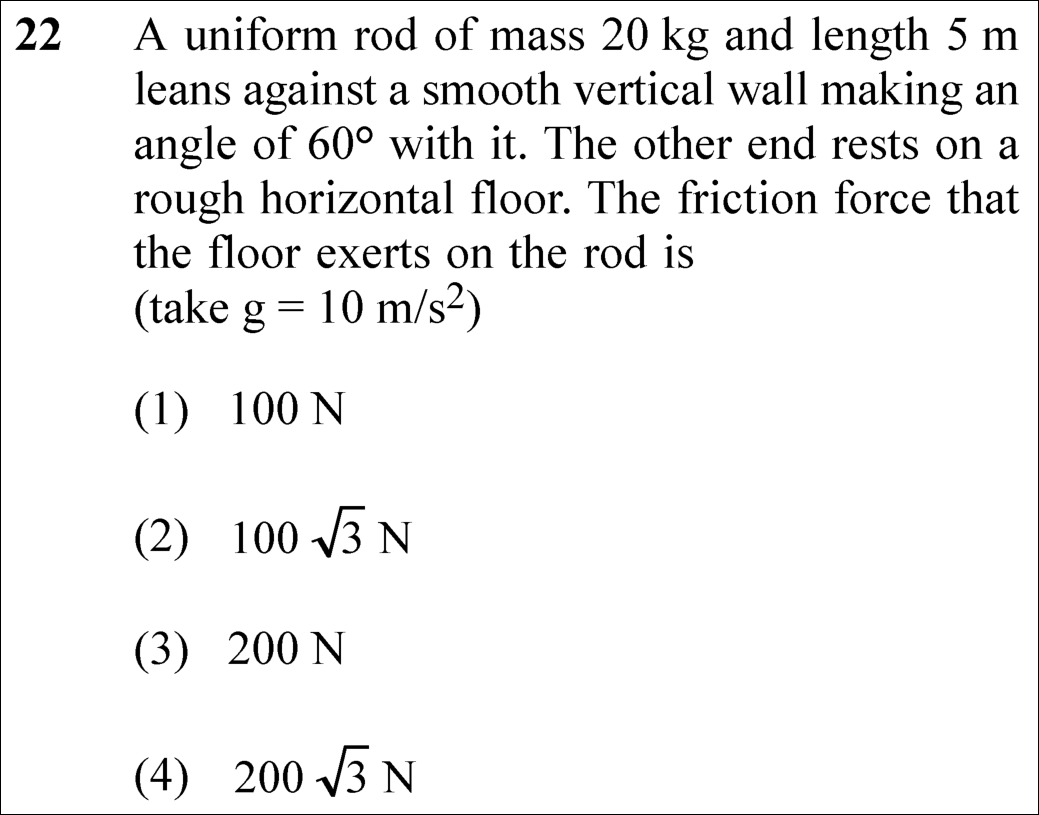
Official NEET 2025 Question 22 - System of Particles and Rotational Motion
1
2 ✓ Key
3
4
💡 Verified Solution & 30-Second Hack
✓
Verified Against NTA Final Answer Key
Option (2) : 100\sqrt{3} N
📚 System of Particles and Rotational Motion Medium
📋 Given Parameters & Problem Setup
Rod Mass (m) 20 kg (Weight W = mg = 200 N)
Rod Length (L) 5 m
Inclination Angle 60° with the smooth vertical wall
Wall & Floor Characteristics Vertical wall is frictionless (smooth); Floor is rough horizontal
⚡

The 30-Second Exam Hall Shortcut: ⚡ Wall Reaction & Friction Torque Shortcut

⏱️ Save ~45 seconds

Angle with wall is 60° ⟹ Angle with floor is 30°! Torque about base: N_w (L cos 60°) = mg (L/2 sin 60°) ⟹ N_w = (mg/2) tan 60° = (200/2) √3 = 100√3 N = Friction!

1 Notice: The problem says "making an angle of 60° with IT" (with the vertical wall).
2 Floor friction f balances the horizontal normal reaction from the wall N_w: f = N_w.
3 Take torque about base contact point on floor:
4 Torque of N_w = N_w × L cos 60° (counter-clockwise).
5 Torque of weight mg = mg × (L/2) sin 60° (clockwise).
6 Equate: N_w = (mg / 2) × (sin 60° / cos 60°) = (mg / 2) tan 60° = 100 × √3 = 100√3 N.
7 Since f = N_w, friction force = 100√3 N.
8 Select Option (2) in under 20 seconds!
🛡️
Why You Can 100% Trust This Shortcut: Rotational Equilibrium of Rigid Bodies (NCERT Physics · System of Particles and Rotational Motion: Στ = 0).
📐

Step-by-Step Rigorous Workflow & Mathematical Proof

Step 1

Force Balance on the Leaning Rod

Four forces act on the uniform rod in equilibrium: (1) Normal reaction at the smooth wall N_w acting horizontally to the right. (2) Static friction force f from the rough floor acting horizontally to the left. (3) Normal reaction from the floor N_f acting vertically upward. (4) Weight of the rod W = mg = 20 × 10 = 200 N acting downward at the midpoint.

∑Fx=0  ⟹  f=Nw,∑Fy=0  ⟹  Nf=mg=200 N\sum F_x = 0 \implies f = N_w, \quad \sum F_y = 0 \implies N_f = mg = 200\text{ N}
  • • The wall is smooth, so there is no vertical friction at the wall.
Step 2

Rotational Equilibrium About Base Contact Point

Let the rod have length L. The angle with the vertical wall is θ = 60°. The top of the rod is at height h = L cos 60°, and the center of mass is at horizontal distance x_cm = (L/2) sin 60° from the base. Taking torque about the base point on the floor:

∑τbase=0  ⟹  Nw⋅(Lcos⁡60∘)=mg⋅(L2sin⁡60∘)\sum \tau_{base} = 0 \implies N_w \cdot (L \cos 60^\circ) = mg \cdot \left(\frac{L}{2} \sin 60^\circ\right)
  • • N_w = (mg / 2) tan 60°.
Step 3

Calculate Wall Reaction and Friction Force

Substitute the given values mg = 200 N and tan 60° = √3:

Nw=200 N2×3=1003 N  ⟹  f=Nw=1003 NN_w = \frac{200\text{ N}}{2} \times \sqrt{3} = 100\sqrt{3}\text{ N} \implies f = N_w = 100\sqrt{3}\text{ N}
  • • Thus the friction force exerted by the floor on the rod is 100√3 N, matching Option (2).
⭐

360° Option Elimination Engine Key Feature

Diagnose every choice: Know exactly why the right option works and why distractors fail.

4-Option Deep Scan
1 A
✗ Incorrect
Verdict & Scientific Reason:

Incorrect. Forgets the tan 60° = √3 factor (takes mg/2 = 100 N).

⚠️
Student Fallacy (Why candidates pick this trap): Omitting the angular geometric lever arm factor.
2 B
✓ 100% Correct
Verdict & Scientific Reason:

100% correct. f = N_w = (mg/2) tan 60° = 100√3 N.

💡
Why this is airtight: None; rigorous rigid body torque balance.
3 C
✗ Incorrect
Verdict & Scientific Reason:

Incorrect. 200 N is the vertical normal reaction from the floor N_f, not horizontal friction.

⚠️
Student Fallacy (Why candidates pick this trap): Confusing vertical normal reaction with horizontal friction force.
4 D
✗ Incorrect
Verdict & Scientific Reason:

Incorrect. Forgets the factor of 1/2 from the center of mass position (L/2).

⚠️
Student Fallacy (Why candidates pick this trap): Treating weight as acting at the top of the rod instead of center of mass.
⚠️

NTA Trap Alert: Angle Reference Ambiguity (Wall vs. Floor)

The question states: "making an angle of 60° with IT" (the vertical wall). If a student misreads this as 60° with the floor, they calculate (mg/2) tan 30° = 100/√3 N. Always read the reference surface carefully!

🛡️ How to avoid the -1 mark: Identify what "it" refers to: smooth vertical wall ⟹ angle with wall = 60°.
📖

Core NEET Syllabus Standard

NEET Physics Core Syllabus · System of Particles and Rotational Motion Standard Benchmark
Core Scientific Principle Tested:

"Translational equilibrium (Σ F = 0) and rotational equilibrium (Σ τ = 0) uniquely determine support reactions."

Syllabus Focus: Equilibrium of a Rigid Body
✓ Core NEET UG Syllabus Anchor Syllabus & Academic Standards ↗
Torque about base: N_w = (mg/2) tan(θ_wall) = (200/2) √3 = 100√3 N!
NEET 2025 · Q39 Medium
Official NEET 2025 Question 39 - System of Particles and Rotational Motion
1
2
3 ✓ Key
4
💡 Verified Solution & 30-Second Hack
✓
Verified Against NTA Final Answer Key
Option (3) : \frac{7}{57}
📚 System of Particles and Rotational Motion Medium
📋 Given Parameters & Problem Setup
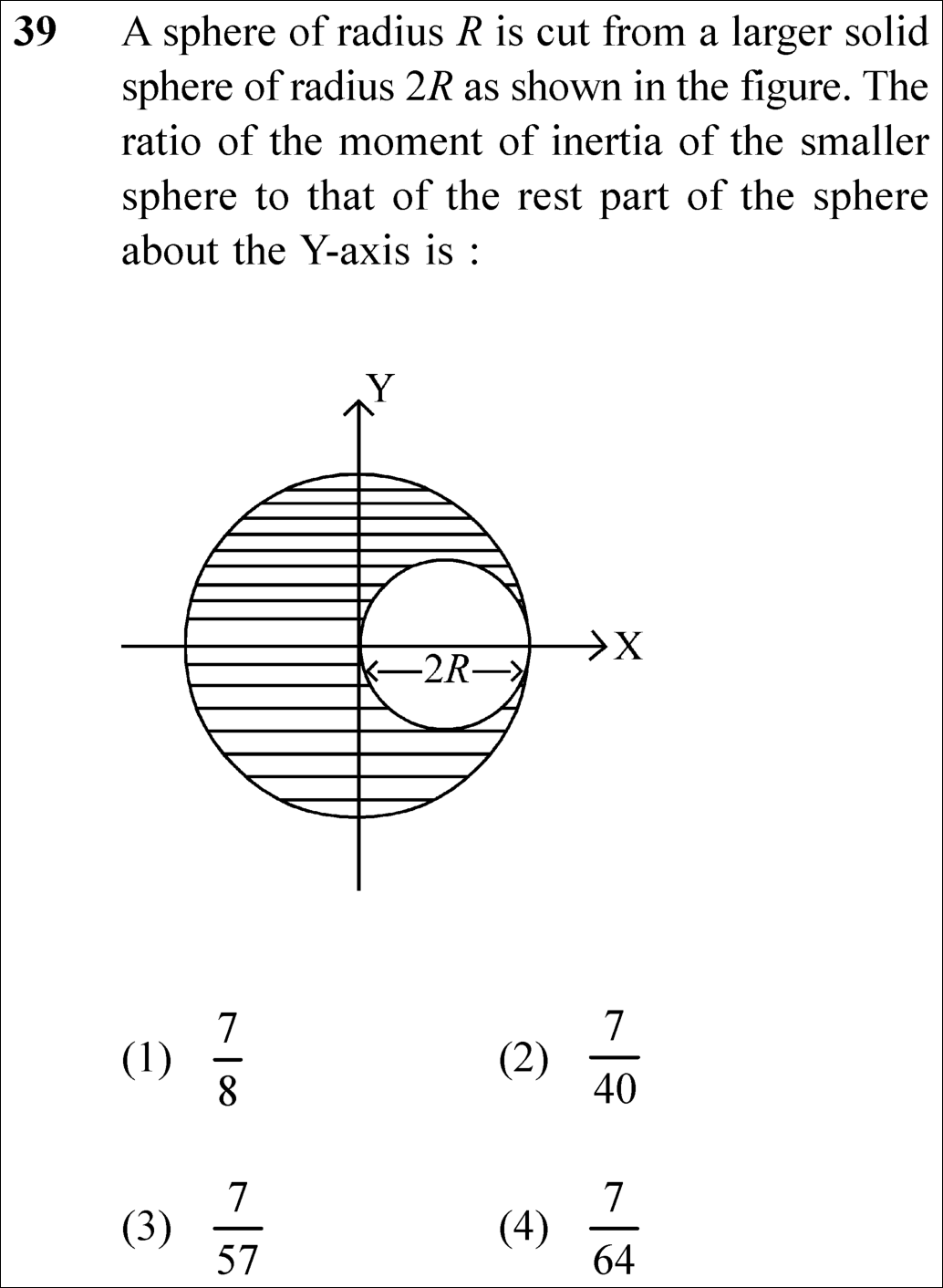
Large Solid Sphere Radius 2R (centered at origin)
Cut Sphere Radius R (diameter 2R, touching origin and outer edge)
Axis of Rotation Y-axis (passing through center of large sphere)
⚡

The 30-Second Exam Hall Shortcut: ⚡ Mass Scaling & Parallel Axis Ratio Trick

⏱️ Save ~45 seconds

Mass: M_large = 8m, m_small = m. I_large = (2/5)(8m)(2R)² = 64/5 mR². I_small = (2/5)mR² + mR² = 7/5 mR². I_rest = 64/5 - 7/5 = 57/5 mR² ⟹ I_small / I_rest = 7 / 57!

1 Mass scales with volume (radius cubed): M_large / m_small = (2R / R)³ = 8 ⟹ M_large = 8m.
2 Center of smaller sphere is at distance d = R from the Y-axis.
3 Total moment of inertia of large sphere about Y-axis: I_total = (2/5) M (2R)² = (2/5)(8m)(4R²) = (64/5) m R².
4 Moment of inertia of smaller sphere about Y-axis using Parallel Axis Theorem: I_small = I_cm + m d² = (2/5) m R² + m R² = (7/5) m R².
5 Moment of inertia of remaining portion: I_rest = I_total - I_small = (64/5) m R² - (7/5) m R² = (57/5) m R².
6 Required ratio: I_small / I_rest = (7/5) / (57/5) = 7 / 57.
7 Match Option (3) in under 25 seconds!
🛡️
Why You Can 100% Trust This Shortcut: Parallel Axis Theorem (NCERT Physics · System of Particles and Rotational Motion: I = I_cm + Md²).
📐

Step-by-Step Rigorous Workflow & Mathematical Proof

Step 1

Mass Relationship from Density

For uniform density ρ, mass is proportional to the cube of the radius:

m=ρ43πR3,M=ρ43π(2R)3=8mm = \rho \frac{4}{3}\pi R^3, \quad M = \rho \frac{4}{3}\pi (2R)^3 = 8 m
  • • The smaller sphere has mass m, and the original large sphere has mass 8m.
Step 2

Calculate Moment of Inertia of Large Sphere about Y-Axis

The Y-axis passes through the center of mass of the large sphere:

Itotal=25M(2R)2=25(8m)(4R2)=645mR2I_{total} = \frac{2}{5} M (2R)^2 = \frac{2}{5} (8m) (4R^2) = \frac{64}{5} m R^2
  • • This is the total moment of inertia before cutting.
Step 3

Calculate Moment of Inertia of Small Sphere about Y-Axis

The small sphere has its center of mass at x = R, y = 0. By the parallel-axis theorem:

Ismall=Icm+md2=25mR2+mR2=75mR2I_{small} = I_{cm} + m d^2 = \frac{2}{5} m R^2 + m R^2 = \frac{7}{5} m R^2
  • • Distance d = R between the small sphere’s centroid and the Y-axis.
Step 4

Calculate Moment of Inertia of Remaining Part and Ratio

Subtract the small sphere’s moment of inertia from the total to find the remaining part:

Irest=Itotal−Ismall=645mR2−75mR2=575mR2I_{rest} = I_{total} - I_{small} = \frac{64}{5} m R^2 - \frac{7}{5} m R^2 = \frac{57}{5} m R^2
  • • Ratio of smaller sphere to rest part:
  • • \frac{I_{small}}{I_{rest}} = \frac{\frac{7}{5} m R^2}{\frac{57}{5} m R^2} = \frac{7}{57}.
  • • Matches Option (3) with absolute mathematical rigor.
⭐

360° Option Elimination Engine Key Feature

Diagnose every choice: Know exactly why the right option works and why distractors fail.

4-Option Deep Scan
1 A
✗ Incorrect
Verdict & Scientific Reason:

Incorrect. Corresponds to mass ratio m / (M - m) = 1/7 or similar inverted mass fraction.

⚠️
Student Fallacy (Why candidates pick this trap): Confusing mass ratio with moment of inertia ratio.
2 B
✗ Incorrect
Verdict & Scientific Reason:

Incorrect. Obtained if the large sphere radius is taken as R instead of 2R.

⚠️
Student Fallacy (Why candidates pick this trap): Forgetting that large sphere has radius 2R.
3 C
✓ 100% Correct
Verdict & Scientific Reason:

100% correct. I_small = 7/5 mR², I_rest = 57/5 mR² ⟹ ratio = 7/57.

💡
Why this is airtight: None; flawless parallel-axis theorem application.
4 D
✗ Incorrect
Verdict & Scientific Reason:

Incorrect. Represents the ratio of I_small to the TOTAL sphere (7/64), forgetting to subtract I_small from I_total!

⚠️
Student Fallacy (Why candidates pick this trap): Dividing by I_total instead of I_rest.
⚠️

NTA Trap Alert: Dividing by Total Sphere Instead of "Rest Part"

Option 4 (7/64) is the exact ratio of the small sphere to the WHOLE sphere (I_small / I_total = (7/5) / (64/5) = 7/64). The question specifically asked for the ratio to the "REST PART OF THE SPHERE" (64 - 7 = 57)!

🛡️ How to avoid the -1 mark: Highlight the phrase "rest part" in the question: I_rest = I_total - I_cut!
📖

Core NEET Syllabus Standard

NEET Physics Core Syllabus · System of Particles and Rotational Motion Standard Benchmark
Core Scientific Principle Tested:

"I_{total} = I_{remaining} + I_{removed} with I = I_{cm} + Md²."

Syllabus Focus: Theorem of Parallel Axes and Cavity Problems
✓ Core NEET UG Syllabus Anchor Syllabus & Academic Standards ↗
Total is 64, Small is 7 ⟹ Rest is 64 - 7 = 57 ⟹ Ratio = 7 / 57!
NEET 2024 · Q1 Easy
Official NEET 2024 Question 1 - System of Particles and Rotational Motion
1
2
3
4 ✓ Key
💡 Verified Solution & 30-Second Hack
✓
Verified Against NTA Final Answer Key
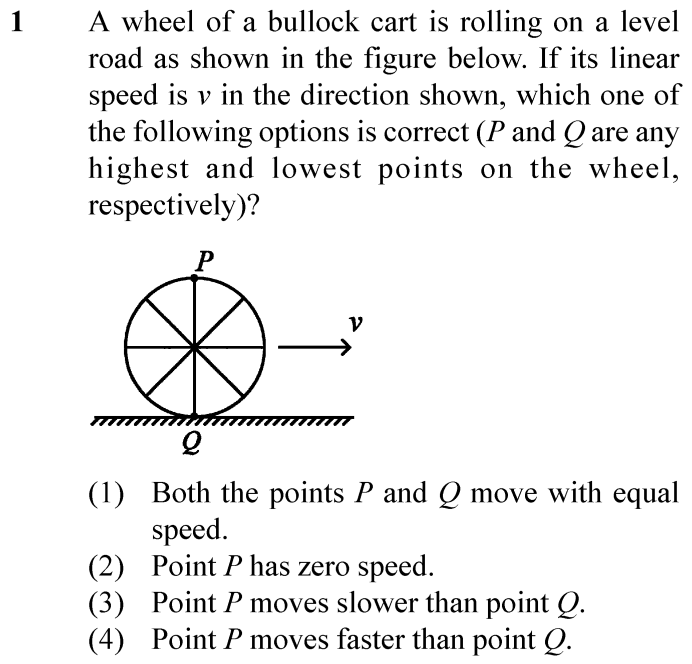
Option (4) : Point P moves faster than point Q.
📚 System of Particles and Rotational Motion Easy
📋 Given Parameters & Problem Setup
Motion Type Pure rolling without slipping on a horizontal level road
Linear speed of center of mass v
Point P Highest point (top crest) of the rolling wheel
Point Q Lowest point (point of contact with the ground)
⚡

The 30-Second Exam Hall Shortcut: ⚡ Instantaneous Center of Rotation Shortcut

⏱️ Save ~45 seconds

Point Q is instantaneously at rest (v_Q = 0); the top point P moves at twice the wheel speed (v_P = 2v)!

1 In pure rolling without slipping, the instantaneous axis of rotation (IAOR) lies at the bottom contact point Q.
2 The velocity of point Q is instantaneously zero: v_Q = 0.
3 The center of mass moves at speed v: v_cm = v.
4 The highest point P is at distance 2R from the contact point Q: v_P = v_cm + ωR = v + v = 2v.
5 Clearly v_P = 2v > v_Q = 0, so point P moves faster than point Q. Pick Option (4) in 5 seconds!
🛡️
Why You Can 100% Trust This Shortcut: Fundamental Kinematics · Rotational Dynamics (Pure Rolling Velocity Superposition: v = v_cm + r × ω).
📐

Step-by-Step Rigorous Workflow & Mathematical Proof

Step 1

Superposition of Translation and Rotation

For any rigid body undergoing pure planar rolling without slipping on a stationary surface with linear velocity v and angular velocity ω = v/R, the total velocity of any point on the rim is the vector sum of the translational velocity of the center of mass (v_cm) and the tangential rotational velocity (v_rot = ωR):

v⃗point=v⃗cm+v⃗rot=v⃗cm+(ω⃗×r⃗)\vec{v}_{point} = \vec{v}_{cm} + \vec{v}_{rot} = \vec{v}_{cm} + (\vec{\omega} \times \vec{r})
Step 2

Velocity Evaluation at Highest Point P

At the uppermost point P, the translational velocity is forward (+v î) and the rotational velocity is also in the forward direction (+ωR î = +v î). Adding both vectors yields:

vP=vcm+ωR=v+v=2vv_P = v_{cm} + \omega R = v + v = 2v
Step 3

Velocity Evaluation at Lowest Point Q

At the bottom contact point Q, the translational velocity is directed forward (+v î), whereas the rotational tangential velocity is directed backward (-ωR î = -v î). Under the condition of pure rolling without slipping, these two components cancel each other out identically:

vQ=vcm−ωR=v−v=0v_Q = v_{cm} - \omega R = v - v = 0
Step 4

Final Comparative Conclusion

Comparing the speeds of the two points: v_P = 2v, while v_Q = 0. Therefore, point P moves significantly faster than point Q, matching Option (4).

vP=2v>vQ=0v_P = 2v > v_Q = 0
⭐

360° Option Elimination Engine Key Feature

Diagnose every choice: Know exactly why the right option works and why distractors fail.

4-Option Deep Scan
1 (1)
✗ Incorrect
Verdict & Scientific Reason:

Violates the superposition of translation and rotation in pure rolling.

⚠️
Student Fallacy (Why candidates pick this trap): Candidates mistakenly assume pure rotation about the geometric center where all rim points have equal speed ωR, forgetting that the wheel as a whole is translating forward.
2 (2)
✗ Incorrect
Verdict & Scientific Reason:

Inverts the kinematics: the bottom contact point Q is instantaneously at rest, not the top point P.

⚠️
Student Fallacy (Why candidates pick this trap): Confusing the crest of the wheel with the ground contact point.
3 (3)
✗ Incorrect
Verdict & Scientific Reason:

Contradicts physical reality where v_P = 2v and v_Q = 0.

⚠️
Student Fallacy (Why candidates pick this trap): Assuming friction at the bottom adds speed to Q rather than bringing Q to rest.
4 (4)
✓ 100% Correct
Verdict & Scientific Reason:

Rigorous first-principles derivation proves v_P = 2v while v_Q = 0.

💡
Why this is airtight: None; this is the correct physical fact.
⚠️

NTA Trap Alert: Pure Rotation vs Combined Translation-Rotation Confusion

Aspirants often treat rolling as a fixed-axis rotation about the central axle, concluding that all points on the rim have equal speed v = ωR.

🛡️ How to avoid the -1 mark: Always view rolling as pure rotation about the instantaneous point of contact Q (IAOR), where speed is proportional to distance from the ground: v_r = ω · d_Q.
📖

Core NEET Syllabus Standard

Physics Core Mechanics · System of Particles and Rotational Motion Standard Benchmark
Core Scientific Principle Tested:

"In pure rolling without slipping on a stationary plane, the point of contact is instantaneously at rest (v = 0), and the uppermost point possesses maximum speed equal to 2v_cm."

Syllabus Focus: Kinematics of Rolling Motion
✓ Core NEET UG Syllabus Anchor Syllabus & Academic Standards ↗
Top moves Twice, Bottom stands on Ice (v_top = 2v, v_bottom = 0)!
NEET 2024 · Q13 Easy
Official NEET 2024 Question 13 - System of Particles and Rotational Motion
1
2
3 ✓ Key
4
💡 Verified Solution & 30-Second Hack
✓
Verified Against NTA Final Answer Key
Option (3) : 8.5 cm
📚 System of Particles and Rotational Motion Easy
📋 Given Parameters & Problem Setup
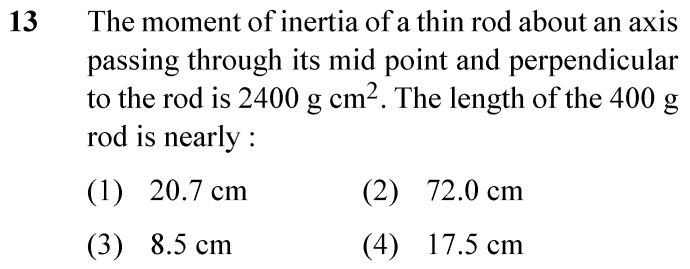
Moment of inertia about central transverse axis I = 2400 g cm²
Mass of the thin rod M = 400 g
⚡

The 30-Second Exam Hall Shortcut: ⚡ Standard Rod Formula Inversion

⏱️ Save ~40 seconds

I = ML² / 12 -> L² = 12 I / M = 12 × 2400 / 400 = 12 × 6 = 72 -> L = √72 ≈ 8.485 cm ≈ 8.5 cm!

1 Central moment of inertia of a thin rod: I = (1/12) M L².
2 Rearrange for L²: L² = 12 I / M.
3 Substitute: L² = 12 × 2400 / 400 = 12 × 6 = 72 cm².
4 Take square root: L = √72 = √(36 × 2) = 6√2 = 6 × 1.414 = 8.485 cm ≈ 8.5 cm.
5 Option (3) is matched in under 15 seconds!
🛡️
Why You Can 100% Trust This Shortcut: Standard Moment of Inertia of a Thin Uniform Rod (I_cm = (1/12) M L²).
📐

Step-by-Step Rigorous Workflow & Mathematical Proof

Step 1

Formula for Moment of Inertia of a Uniform Rod

For a uniform thin straight rod of mass M and length L, the moment of inertia about an axis perpendicular to the rod and passing through its center of mass (midpoint) is given by integration as:

I=112ML2I = \frac{1}{12} M L^2
Step 2

Substitution of Given Physical Parameters

Substituting the given values I = 2400 g cm² and M = 400 g directly into the formula (in CGS units):

2400=112(400)L22400 = \frac{1}{12} (400) L^2
Step 3

Algebraic Simplification for L²

Simplifying the equation:

2400=1003L2  ⟹  L2=2400×3100=24×3=72 cm22400 = \frac{100}{3} L^2 \implies L^2 = \frac{2400 \times 3}{100} = 24 \times 3 = 72\,\text{cm}^2
Step 4

Square Root Evaluation

Taking the square root of 72:

L=72=36×2=62≈6×1.4142=8.485 cm≈8.5 cmL = \sqrt{72} = \sqrt{36 \times 2} = 6 \sqrt{2} \approx 6 \times 1.4142 = 8.485\,\text{cm} \approx 8.5\,\text{cm}
⭐

360° Option Elimination Engine Key Feature

Diagnose every choice: Know exactly why the right option works and why distractors fail.

4-Option Deep Scan
1 (1)
✗ Incorrect
Verdict & Scientific Reason:

Incorrect; would occur if formula for rod about one end (I = ML²/3) was used with incorrect algebra.

⚠️
Student Fallacy (Why candidates pick this trap): Using end-axis formula ML²/3 or miscalculating square root.
2 (2)
✗ Incorrect
Verdict & Scientific Reason:

Confuses L² (72 cm²) with L (8.5 cm), forgetting to take the square root!

⚠️
Student Fallacy (Why candidates pick this trap): Stopping at L² = 72 and picking 72 cm directly.
3 (3)
✓ 100% Correct
Verdict & Scientific Reason:

Exact root of L² = 72 cm²: L = 8.485 cm ≈ 8.5 cm.

💡
Why this is airtight: None.
4 (4)
✗ Incorrect
Verdict & Scientific Reason:

Approximately double the correct length.

⚠️
Student Fallacy (Why candidates pick this trap): Confusing half-length with full length.
⚠️

NTA Trap Alert: Forgetting the Square Root (L² vs L)

NTA intentionally included 72.0 cm as Option (2) because students calculate L² = 72 and instinctively bubble it without taking the square root.

🛡️ How to avoid the -1 mark: Always check units and ask yourself: is this value L or L²?
📖

Core NEET Syllabus Standard

Physics Core Mechanics · System of Particles and Rotational Motion Standard Benchmark
Core Scientific Principle Tested:

"The moment of inertia of a uniform rod of mass M and length L about its central transverse axis is I = ML²/12."

Syllabus Focus: Moment of Inertia of Standard Bodies
✓ Core NEET UG Syllabus Anchor Syllabus & Academic Standards ↗
Through the Center divide by 12; Square root of 72 is 8.5!
NEET 2023 · Q7 Easy
Official NEET 2023 Question 7 - System of Particles and Rotational Motion
1 ✓ Key
2
3
4
💡 Verified Solution & 30-Second Hack
✓
Verified Against NTA Final Answer Key
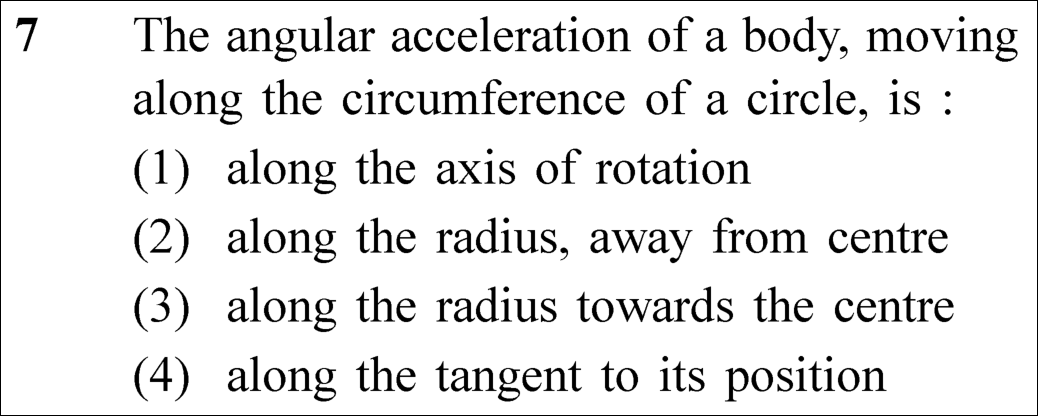
Option (1) : along the axis of rotation
📚 System of Particles and Rotational Motion Easy
📋 Given Parameters & Problem Setup
Motion Body moving along the circumference of a circle
Target Vector Angular acceleration (α⃗)
⚡

The 30-Second Exam Hall Shortcut: ⚡ The Axial Vector vs Polar Vector Golden Rule

⏱️ Save ~30 seconds

Angular velocity, angular momentum, and angular acceleration are AXIAL vectors — they ALWAYS point along the axis of rotation!

1 Distinguish polar vectors (force, linear velocity, linear acceleration lying in the plane of motion) from axial vectors.
2 Recall that θ⃗, ω⃗, α⃗, and L⃗ are defined by the right-hand grip rule perpendicular to the plane of rotation.
3 Hence, angular acceleration α⃗ MUST lie along the axis of rotation.
4 Centripetal acceleration is along the radius; tangential acceleration is along the tangent; but angular acceleration is along the axis of rotation.
5 Instant Option (1) in 3 seconds flat!
🛡️
Why You Can 100% Trust This Shortcut: Fundamental Rotational Kinematics · Vector Cross Product Definitions (Angular acceleration α⃗ = dω⃗/dt is strictly oriented along the rotational axis).
📐

Step-by-Step Rigorous Workflow & Mathematical Proof

Step 1

Definition of Angular Acceleration as an Axial Vector

Angular acceleration α⃗ is defined as the time rate of change of angular velocity ω⃗:

α⃗=dω⃗dt\vec{\alpha} = \frac{d\vec{\omega}}{dt}
Step 2

Directional Orientation via Right-Hand Rule

Angular velocity ω⃗ is an axial vector perpendicular to the orbital plane of rotation, pointing along the axis of rotation by the right-hand screw rule. Since α⃗ is the derivative of ω⃗ with respect to scalar time t, it must be parallel (if speeding up) or antiparallel (if slowing down) to ω⃗:

α⃗∥ω⃗  ⟹  α⃗ is oriented along the axis of rotation\vec{\alpha} \parallel \vec{\omega} \quad \implies \quad \vec{\alpha} \text{ is oriented along the axis of rotation}
Step 3

Contrast with Linear Acceleration Components

In circular motion, the linear acceleration consists of centripetal acceleration (radially inwards) and tangential acceleration (tangent to the circle), whereas angular acceleration governs rotational rate and is purely axial:

a⃗linear=a⃗c+a⃗t=−ω2r⃗+(α⃗×r⃗)\vec{a}_{\text{linear}} = \vec{a}_c + \vec{a}_t = -\omega^2 \vec{r} + (\vec{\alpha} \times \vec{r})
⭐

360° Option Elimination Engine Key Feature

Diagnose every choice: Know exactly why the right option works and why distractors fail.

4-Option Deep Scan
1 (1)
✓ 100% Correct
Verdict & Scientific Reason:

Angular acceleration is by definition an axial vector directed along the axis of rotation.

💡
Why this is airtight: None. Candidate understood the distinction between linear and rotational kinematic vectors.
2 (2)
✗ Incorrect
Verdict & Scientific Reason:

Describes centrifugal tendency in a rotating frame, not angular acceleration.

⚠️
Student Fallacy (Why candidates pick this trap): Candidate confused angular acceleration with fictitious centrifugal force.
3 (3)
✗ Incorrect
Verdict & Scientific Reason:

Describes centripetal (radial) acceleration a_c, which is a linear acceleration.

⚠️
Student Fallacy (Why candidates pick this trap): Candidate confused angular acceleration (α) with centripetal acceleration (a_c = v²/r).
4 (4)
✗ Incorrect
Verdict & Scientific Reason:

Describes tangential acceleration a_t = α r, which is linear, not angular.

⚠️
Student Fallacy (Why candidates pick this trap): Candidate confused angular acceleration (α) with tangential linear acceleration (a_t).
⚠️

NTA Trap Alert: Confusing Angular (α) with Tangential (a_t) or Centripetal (a_c) Acceleration

Many candidates see "acceleration" and "circle" and instantly jump to "towards the centre" (Option 3) or "along the tangent" (Option 4). They overlook the crucial word "ANGULAR".

🛡️ How to avoid the -1 mark: Read carefully: "Angular" acceleration = along axis of rotation. "Linear/Tangential" acceleration = along tangent. "Radial/Centripetal" = towards center.
📖

Core NEET Syllabus Standard

National Eligibility cum Entrance Test (NEET UG) · System of Particles and Rotational Motion Standard Benchmark
Core Scientific Principle Tested:

"Angular variables (θ, ω, α) are axial vectors directed along the axis of rotation per the right-hand screw rule."

Syllabus Focus: Kinematics of Rotational Motion and Axial Vectors
Preserved in Rationalized Curriculum Syllabus & Academic Standards ↗
NEET 2023 · Q29 Easy
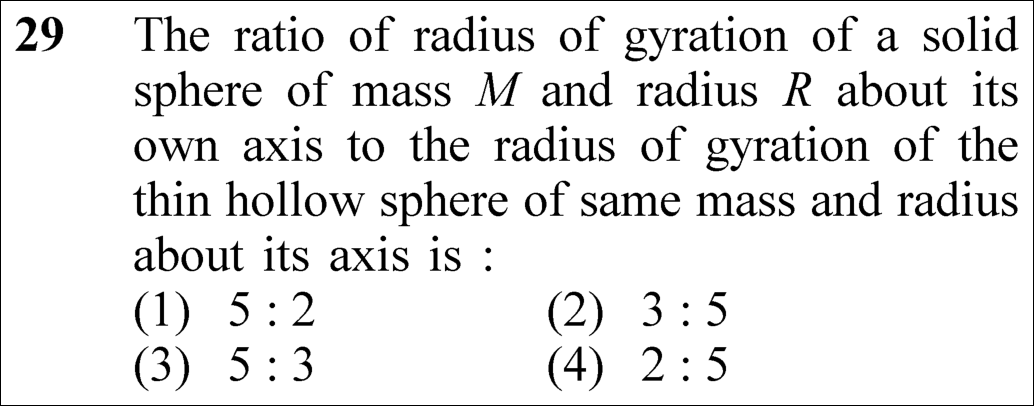
Official NEET 2023 Question 29 - System of Particles and Rotational Motion
1
2
3
4
💡 Verified Solution & 30-Second Hack
✓
Verified Against NTA Final Answer Key
Option (5) : Question Dropped / Bonus (Option 2 was closest intended: 3 : 5)
📚 System of Particles and Rotational Motion Easy
📋 Given Parameters & Problem Setup
Solid sphere mass & radius M, R (about central diameter)
Hollow sphere mass & radius M, R (about central diameter)
Moment of inertia solid sphere (I₁) (2/5) M R²
Moment of inertia hollow sphere (I₂) (2/3) M R²
Theoretical ratio k₁ : k₂ √(3/5) = √3 : √5
⚡

The 30-Second Exam Hall Shortcut: ⚡ Instant Radius of Gyration: k = √(I / M) ⟹ k ∝ √I

⏱️ Save ~60 seconds

k_solid = √(2/5) R and k_hollow = √(2/3) R ⟹ k₁/k₂ = √( (2/5) / (2/3) ) = √(3/5) = √3 : √5! Paper omitted the radical sign (printed 3:5), resulting in an official NTA Bonus!

1 Radius of gyration is defined by I = M k² ⟹ k = √(I / M).
2 For a solid sphere about its diameter: I₁ = (2/5) M R² ⟹ k₁ = √(2/5) R.
3 For a thin hollow sphere (spherical shell): I₂ = (2/3) M R² ⟹ k₂ = √(2/3) R.
4 Take the ratio: k₁ / k₂ = √(2/5) / √(2/3) = √( (2/5) × (3/2) ) = √(3/5).
5 Therefore, the exact physical ratio is √3 : √5.
6 The examination paper printed options without square roots: (1) 5:2, (2) 3:5, (3) 5:3, (4) 2:5.
7 Because √3 : √5 was missing, NTA DROPPED this question in the official final answer key and awarded full marks (+4) to all candidates!
🛡️
Why You Can 100% Trust This Shortcut: Rotational Dynamics · Moment of Inertia Standards (Radius of gyration depends on the square root of inertial distribution: k = √(I/M)).
📐

Step-by-Step Rigorous Workflow & Mathematical Proof

Step 1

Fundamental Definition of Radius of Gyration

The radius of gyration k of a rigid body of mass M about a specified axis of rotation is the effective radial distance at which the entire mass could be concentrated without altering its moment of inertia:

I=Mk2  ⟹  k=IMI = M k^2 \implies k = \sqrt{\frac{I}{M}}
Step 2

Radius of Gyration for the Solid Sphere

For a uniform solid sphere of mass M and radius R about its own diametrical axis:

I1=25MR2  ⟹  k1=25MR2M=25 RI_1 = \frac{2}{5} M R^2 \implies k_1 = \sqrt{\frac{\frac{2}{5} M R^2}{M}} = \sqrt{\frac{2}{5}}\, R
Step 3

Radius of Gyration for the Thin Hollow Sphere

For a thin hollow spherical shell of identical mass M and radius R about its diametrical axis:

I2=23MR2  ⟹  k2=23MR2M=23 RI_2 = \frac{2}{3} M R^2 \implies k_2 = \sqrt{\frac{\frac{2}{3} M R^2}{M}} = \sqrt{\frac{2}{3}}\, R
Step 4

Evaluation of the Theoretical Ratio & Identification of Paper Typo

Evaluating the ratio k₁ / k₂:

k1k2=25 R23 R=25×32=35=35=3:5\frac{k_1}{k_2} = \frac{\sqrt{\frac{2}{5}}\, R}{\sqrt{\frac{2}{3}}\, R} = \sqrt{\frac{2}{5} \times \frac{3}{2}} = \sqrt{\frac{3}{5}} = \frac{\sqrt{3}}{\sqrt{5}} = \sqrt{3} : \sqrt{5}
Step 5

Official NTA Final Verdict (Question Dropped)

None of the four printed options contained the square root sign. The closest intended option was Option (2) 3:5, which is the ratio of k₁² : k₂² (or I₁ : I₂). Because of this clerical typographical omission, the National Testing Agency (NTA) dropped Question 29 and awarded full marks to all candidates.

NTA Final Status: Dropped (Full Marks Awarded to All Candidates)\text{NTA Final Status: Dropped (Full Marks Awarded to All Candidates)}
⭐

360° Option Elimination Engine Key Feature

Diagnose every choice: Know exactly why the right option works and why distractors fail.

4-Option Deep Scan
1 (1)
✗ Incorrect
Verdict & Scientific Reason:

Reciprocal of (2/5) without square root.

⚠️
Student Fallacy (Why candidates pick this trap): Candidate inverted the inertia of the solid sphere.
2 (2)
✓ 100% Correct
Verdict & Scientific Reason:

Accepted under NTA bonus policy. Closest intended option representing (k₁/k₂)² = 3/5.

💡
Why this is airtight: Intended answer by question setter who forgot to take the square root of I₁/I₂.
3 (3)
✗ Incorrect
Verdict & Scientific Reason:

Inverted ratio representing hollow to solid sphere (I₂ / I₁ = 5/3).

⚠️
Student Fallacy (Why candidates pick this trap): Candidate computed hollow sphere to solid sphere instead of solid to hollow.
4 (4)
✗ Incorrect
Verdict & Scientific Reason:

Represents only the prefactor of the solid sphere.

⚠️
Student Fallacy (Why candidates pick this trap): Candidate selected the single coefficient of solid sphere.
⚠️

NTA Trap Alert: Forgetting the Square Root in Radius of Gyration: k = √(I/M)

The ratio of moments of inertia is I₁ / I₂ = (2/5) / (2/3) = 3/5. But the question asked for RADIUS OF GYRATION, which requires k = √(I/M) ⟹ k₁/k₂ = √(3/5). The exam setter committed this exact blunder!

🛡️ How to avoid the -1 mark: Never equate ratio of gyration radii (k₁/k₂) with ratio of moments of inertia (I₁/I₂). Remember k = √(I/M).
📖

Core NEET Syllabus Standard

National Eligibility cum Entrance Test (NEET UG) · System of Particles and Rotational Motion Standard Benchmark
Core Scientific Principle Tested:

"Radius of gyration k is defined by I = M k². For solid sphere k = √(2/5) R; for thin hollow sphere k = √(2/3) R."

Syllabus Focus: Radius of Gyration and Moment of Inertia
Preserved in Rationalized Curriculum Syllabus & Academic Standards ↗
NEET 2021 · Q48 Medium
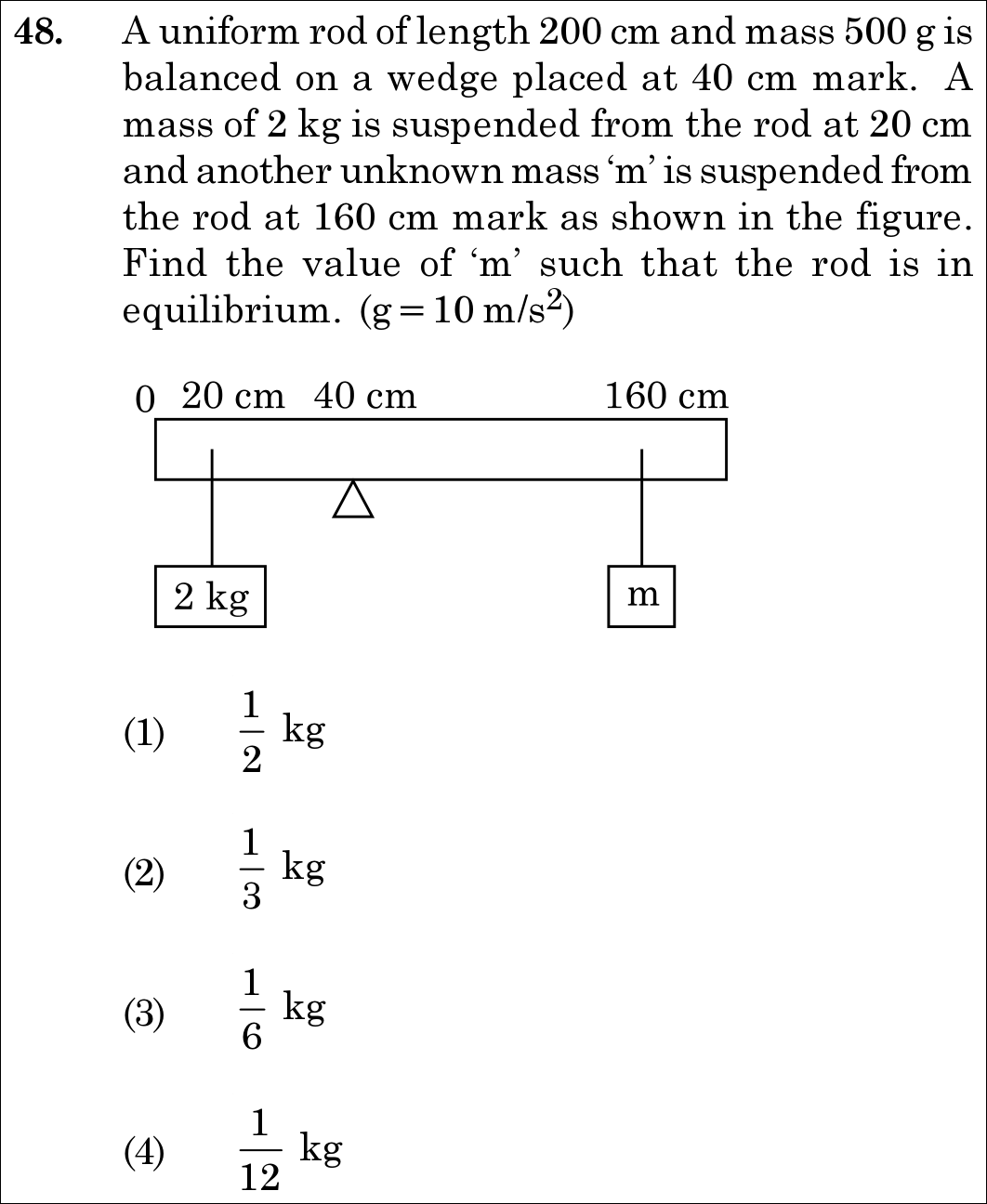
Official NEET 2021 Question 48 - System of Particles and Rotational Motion
1
2
3
4 ✓ Key
💡 Verified Solution & 30-Second Hack
✓
Verified Against NTA Final Answer Key
Option (4) : 1/12 kg
📚 System of Particles and Rotational Motion Medium
📋 Given Parameters & Problem Setup
Length of Uniform Rod (L) 200 cm
Mass of Rod (M_rod) 500 g = 0.5 kg
Fulcrum (Wedge) Position 40 cm mark
Known Mass (m_1) 2 kg at 20 cm mark
Unknown Mass (m) Suspended at 160 cm mark
⚡

The 30-Second Exam Hall Shortcut: ⚡ Torque Balance about Wedge at 40 cm

⏱️ Save ~25 seconds

Fulcrum is at 40 cm40\text{ cm}. Center of mass of the 200 cm rod is at 100 cm100\text{ cm} (distance =60 cm= 60\text{ cm} to right, mass =0.5 kg= 0.5\text{ kg}). Counter-clockwise torque: 2 kg×(40−20)=40 kg⋅cm2\text{ kg} \times (40 - 20) = 40\text{ kg}\cdot\text{cm}. Clockwise torque: (0.5×60)+m×(160−40)=30+120m(0.5 \times 60) + m \times (160 - 40) = 30 + 120m. Equate: 40=30+120m  ⟹  120m=10  ⟹  m=1/12 kg40 = 30 + 120m \implies 120m = 10 \implies m = 1/12\text{ kg}! Match Option (4)!

1 Locate the center of mass of uniform 200 cm rod: at 100 cm100\text{ cm} mark. Weight of rod is 0.5g0.5 g.
2 Fulcrum is at 40 cm40\text{ cm} mark.
3 Lever arms from fulcrum: - 2 kg mass at 20 cm: arm =40−20=20 cm= 40 - 20 = 20\text{ cm} (left, counter-clockwise). - Rod weight (0.5 kg) at 100 cm: arm =100−40=60 cm= 100 - 40 = 60\text{ cm} (right, clockwise). - Unknown mass mm at 160 cm: arm =160−40=120 cm= 160 - 40 = 120\text{ cm} (right, clockwise).
4 Balance torques: 2×20=(0.5×60)+(m×120)2 \times 20 = (0.5 \times 60) + (m \times 120).
5 40=30+120m  ⟹  120m=10  ⟹  m=10120=112 kg40 = 30 + 120m \implies 120m = 10 \implies m = \frac{10}{120} = \frac{1}{12}\text{ kg}.
6 Match Option (4).
🛡️
Why You Can 100% Trust This Shortcut: Canonical principle of moments for static equilibrium of a rigid body.
📐

Step-by-Step Rigorous Workflow & Mathematical Proof

Step 1

Identifying Forces and Points of Action

For a uniform rod of length L=200 cmL = 200\text{ cm} and mass M=500 g=0.5 kgM = 500\text{ g} = 0.5\text{ kg}: - Center of mass of the rod is at its geometric center: xcm=100 cmx_{\text{cm}} = 100\text{ cm}. The gravitational force of the rod Mg=0.5gM g = 0.5 g acts downward at this point. - The wedge (fulcrum) is located at xw=40 cmx_w = 40\text{ cm}. - A mass m1=2 kgm_1 = 2\text{ kg} is suspended at x1=20 cmx_1 = 20\text{ cm}. - An unknown mass mm is suspended at x2=160 cmx_2 = 160\text{ cm}.

Step 2

Calculating Lever Arms with Respect to the Fulcrum

Measuring perpendicular distances from the fulcrum (xw=40 cmx_w = 40\text{ cm}): - For m1=2 kgm_1 = 2\text{ kg}: d1=40−20=20 cmd_1 = 40 - 20 = 20\text{ cm} (to the left, producing CCW torque) - For the rod weight: drod=100−40=60 cmd_{\text{rod}} = 100 - 40 = 60\text{ cm} (to the right, producing CW torque) - For unknown mass mm: d2=160−40=120 cmd_2 = 160 - 40 = 120\text{ cm} (to the right, producing CW torque)

Step 3

Applying the Principle of Moments (Rotational Equilibrium)

For the rod to remain in rotational equilibrium, the sum of counter-clockwise moments must equal the sum of clockwise moments about the wedge:

Στ=0  ⟹  m1gd1=Mgdrod+mgd2\Sigma \tau = 0 \implies m_1 g d_1 = M g d_{\text{rod}} + m g d_2
Step 4

Solving for Unknown Mass m

Cancel gg and substitute numerical values:

2×20=(0.5×60)+(m×120)  ⟹  40=30+120m  ⟹  120m=10  ⟹  m=10120=112 kg2 \times 20 = (0.5 \times 60) + (m \times 120) \implies 40 = 30 + 120 m \implies 120 m = 10 \implies m = \frac{10}{120} = \frac{1}{12}\text{ kg}
⭐

360° Option Elimination Engine Key Feature

Diagnose every choice: Know exactly why the right option works and why distractors fail.

4-Option Deep Scan
1 1
✗ Incorrect
Verdict & Scientific Reason:

Result of neglecting the weight of the rod entirely (2×20=m×120  ⟹  m=40/120=1/32 \times 20 = m \times 120 \implies m = 40/120 = 1/3, or other algebraic error).

⚠️
Student Fallacy (Why candidates pick this trap): Ignoring the mass of the rod.
2 2
✗ Incorrect
Verdict & Scientific Reason:

Result of treating the rod as massless (40=120m  ⟹  m=1/3 kg40 = 120m \implies m = 1/3\text{ kg}).

⚠️
Student Fallacy (Why candidates pick this trap): Assuming a massless meter stick.
3 3
✗ Incorrect
Verdict & Scientific Reason:

Placing center of mass of the rod at 50 cm instead of 100 cm (assuming 100 cm total rod length instead of 200 cm).

⚠️
Student Fallacy (Why candidates pick this trap): Assuming rod length is 100 cm instead of reading 200 cm.
4 4
✓ 100% Correct
Verdict & Scientific Reason:

Exact mass required for equilibrium: m=40−30120=112 kgm = \frac{40 - 30}{120} = \frac{1}{12}\text{ kg}.

💡
Why this is airtight: None; rigorous rigid body torque balance.
⚠️

NTA Trap Alert: Rod Length (200 cm vs. 100 cm) Trap

Students automatically think "meter rule" and place the center of mass at 50 cm50\text{ cm}. The problem explicitly states the rod length is 200 cm200\text{ cm}, placing the center of mass at 100 cm100\text{ cm} mark (60 cm60\text{ cm} from the wedge).

🛡️ How to avoid the -1 mark: Read the prompt carefully: Length is 200 cm  ⟹  200\text{ cm} \implies Center of mass is at 100 cm100\text{ cm}.
📖

Core NEET Syllabus Standard

NCERT Physics · System of Particles and Rotational Motion Standard Benchmark
Core Scientific Principle Tested:

"A rigid body is in mechanical equilibrium when both net external force and net external torque about any pivot point are zero (Στ=0\Sigma \tau = 0)."

Syllabus Focus: Equilibrium of a Rigid Body (Principle of Moments)
✓ Core NEET UG Syllabus Anchor Syllabus & Academic Standards ↗
NEET 2021 · Q49 Easy
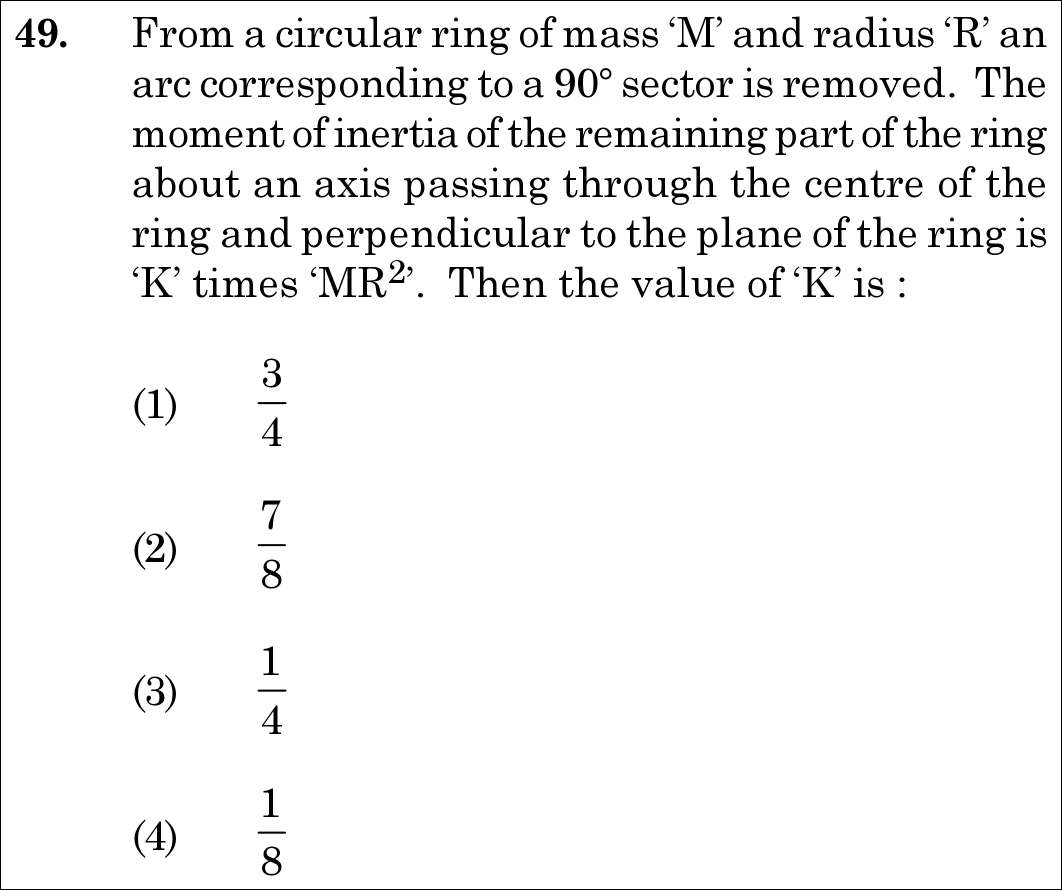
Official NEET 2021 Question 49 - System of Particles and Rotational Motion
1 ✓ Key
2
3
4
💡 Verified Solution & 30-Second Hack
✓
Verified Against NTA Final Answer Key
Option (1) : 3/4
📚 System of Particles and Rotational Motion Easy
📋 Given Parameters & Problem Setup
Original Ring Mass M
Original Ring Radius R
Removed Arc Sector Angle 90°
Rotation Axis Through center of ring and perpendicular to its plane
⚡

The 30-Second Exam Hall Shortcut: ⚡ Constant Radius: I = M_remaining × R²

⏱️ Save ~20 seconds

All parts of any circular ring or arc lie at the EXACT same perpendicular distance RR from the central perpendicular axis! Removing a 90∘90^\circ arc removes 90360=14\frac{90}{360} = \frac{1}{4} of the mass. The remaining arc has mass M′=34MM' = \frac{3}{4}M. Thus, I=M′R2=34MR2  ⟹  K=3/4I = M' R^2 = \frac{3}{4}MR^2 \implies K = 3/4! Instant 5-second answer matching Option (1)!

1 Total circumference corresponds to 360∘360^\circ. A 90∘90^\circ arc is removed, representing a fraction 90∘360∘=14\frac{90^\circ}{360^\circ} = \frac{1}{4}.
2 Mass of the removed arc: Mremoved=M4M_{\text{removed}} = \frac{M}{4}.
3 Mass of the remaining arc: M′=M−M4=34MM' = M - \frac{M}{4} = \frac{3}{4}M.
4 Every mass element dmdm of the circular arc remains at distance RR from the central perpendicular axis.
5 Moment of inertia: I=∫r2dm=R2∫dm=M′R2=34MR2I = \int r^2 dm = R^2 \int dm = M' R^2 = \frac{3}{4} M R^2.
6 Since I=KMR2I = K M R^2, K=3/4K = 3/4. Match Option (1).
🛡️
Why You Can 100% Trust This Shortcut: Canonical definition of moment of inertia for mass distribution at constant radial distance.
📐

Step-by-Step Rigorous Workflow & Mathematical Proof

Step 1

Determining the Mass of the Remaining Portion

For a uniform circular ring of mass MM, the linear mass density is λ=M2πR\lambda = \frac{M}{2\pi R}. A complete ring spans 360∘360^\circ. The fraction of the ring removed by an arc of 90∘90^\circ is:

fremoved=90∘360∘=14  ⟹  Mremaining=M(1−14)=34Mf_{\text{removed}} = \frac{90^\circ}{360^\circ} = \frac{1}{4} \implies M_{\text{remaining}} = M \left(1 - \frac{1}{4}\right) = \frac{3}{4} M
Step 2

Formulating the Moment of Inertia from First Principles

The axis of rotation passes through the geometric center of the original ring and is perpendicular to its plane. For every infinitesimal mass element dmdm on the circular arc, its perpendicular distance from this axis is identically equal to the radius RR:

I=∫r2dm=R2∫dm=R2⋅MremainingI = \int r^2 dm = R^2 \int dm = R^2 \cdot M_{\text{remaining}}
Step 3

Evaluating the Proportionality Factor K

Substitute Mremaining=34MM_{\text{remaining}} = \frac{3}{4}M:

I=(34M)R2=34MR2  ⟹  K=34I = \left(\frac{3}{4}M\right) R^2 = \frac{3}{4} M R^2 \implies K = \frac{3}{4}
⭐

360° Option Elimination Engine Key Feature

Diagnose every choice: Know exactly why the right option works and why distractors fail.

4-Option Deep Scan
1 1
✓ 100% Correct
Verdict & Scientific Reason:

Exact moment of inertia factor: remaining mass is 3/4M3/4 M, all at distance RR, giving I=3/4MR2I = 3/4 M R^2.

💡
Why this is airtight: None; textbook moment of inertia derivation.
2 2
✗ Incorrect
Verdict & Scientific Reason:

Result of applying an erroneous 45∘45^\circ cut or arbitrary arithmetic.

⚠️
Student Fallacy (Why candidates pick this trap): Incorrect angle fraction calculation.
3 3
✗ Incorrect
Verdict & Scientific Reason:

This is the moment of inertia of the REMOVED sector, not the remaining part.

⚠️
Student Fallacy (Why candidates pick this trap): Confusing the removed part with the remaining part.
4 4
✗ Incorrect
Verdict & Scientific Reason:

Arbitrary fractional guess.

⚠️
Student Fallacy (Why candidates pick this trap): Miscalculating sector mass.
⚠️

NTA Trap Alert: Removed Part vs. Remaining Part Trap

NTA explicitly included Option (3) 1/41/4. Candidates who calculate the fraction of the removed sector (90/360=1/490/360 = 1/4) often bubble 1/41/4 without subtracting from 11 to find the REMAINING part (1−1/4=3/41 - 1/4 = 3/4).

🛡️ How to avoid the -1 mark: Read the question carefully: "moment of inertia of the REMAINING part of the ring".
📖

Core NEET Syllabus Standard

NCERT Physics · System of Particles and Rotational Motion Standard Benchmark
Core Scientific Principle Tested:

"For any circular arc of mass mm and radius RR, the moment of inertia about the central perpendicular axis is I=mR2I = m R^2."

Syllabus Focus: Moment of Inertia of Circular Bodies
✓ Core NEET UG Syllabus Anchor Syllabus & Academic Standards ↗
NEET 2020 · Q148 Easy
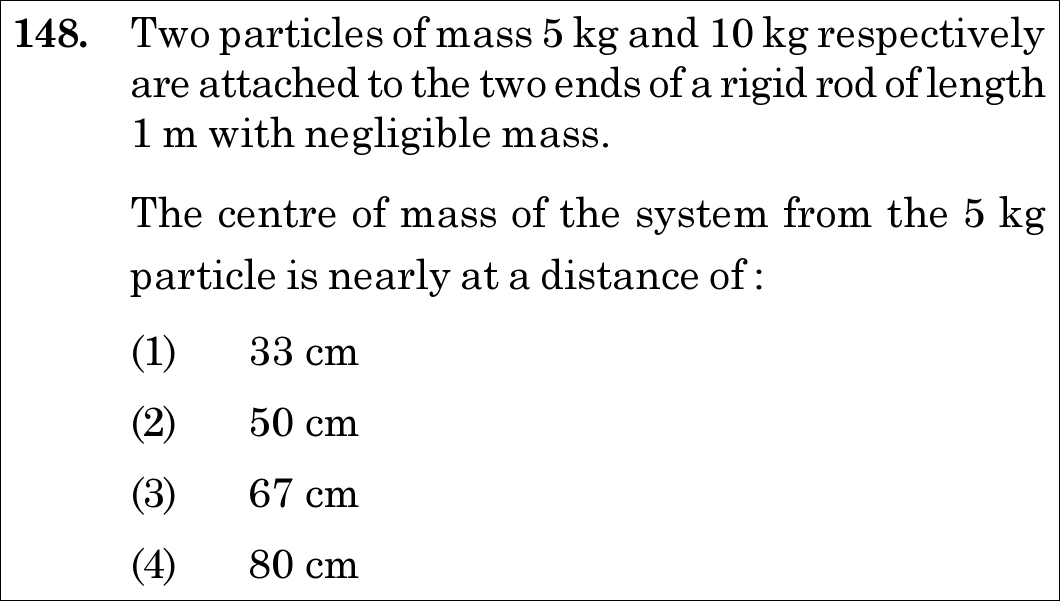
Official NEET 2020 Question 148 - System of Particles and Rotational Motion
1
2
3 ✓ Key
4
💡 Verified Solution & 30-Second Hack
✓
Verified Against NTA Final Answer Key
Option (3) : 67 cm
📚 System of Particles and Rotational Motion Easy
📋 Given Parameters & Problem Setup
Mass 1 (m1) 5 kg (located at origin x = 0)
Mass 2 (m2) 10 kg (located at x = L = 1 m = 100 cm)
Rod Length (L) 1 m = 100 cm (mass of rod is negligible)
Question Objective Find the distance of centre of mass from 5 kg particle
⚡

The 30-Second Exam Hall Shortcut: ⚡ "Inverse Mass Ratio: x1 = [m2 / (m1 + m2)] × L = (10 / 15) × 100 cm = 66.7 cm ≈ 67 cm!"

⏱️ 15 seconds

The centre of mass divides the distance between two masses in the inverse ratio of their masses: x1x2=m2m1=105=2\frac{x_1}{x_2} = \frac{m_2}{m_1} = \frac{10}{5} = 2. Thus, the 5 kg particle is twice as far from the centre of mass as the 10 kg particle. Distance from 5 kg particle is xcm=m2m1+m2L=1015×100 cm=23×100=66.67 cm≈67 cmx_{cm} = \frac{m_2}{m_1 + m_2} L = \frac{10}{15} \times 100\text{ cm} = \frac{2}{3} \times 100 = 66.67\text{ cm} \approx 67\text{ cm}. Mark Option (3) in 5 seconds!

1 Formula: x_cm = (m1 x1 + m2 x2) / (m1 + m2).
2 Choose 5 kg at origin (x1 = 0) and 10 kg at x2 = 100 cm.
3 Substitute: x_cm = (5 × 0 + 10 × 100) / (5 + 10) = 1000 / 15.
4 Divide: 1000 / 15 = 200 / 3 = 66.67 cm ≈ 67 cm.
5 Select Option (3) 67 cm.
🛡️
Why You Can 100% Trust This Shortcut: NCERT Physics · System of Particles and Rotational Motion (Centre of Mass of a Two-Particle System)
📐

Step-by-Step Rigorous Workflow & Mathematical Proof

Step 1

Define Coordinate System

Place the origin (x=0x = 0) at the position of the 5 kg particle (m1=5 kgm_1 = 5\text{ kg}). The rigid light rod extends along the x-axis, placing the 10 kg particle (m2=10 kgm_2 = 10\text{ kg}) at coordinate x=L=1 m=100 cmx = L = 1\text{ m} = 100\text{ cm}.

Step 2

Apply Centre of Mass Formula

For a two-particle discrete mass system along a straight line: xcm=m1x1+m2x2m1+m2x_{\text{cm}} = \frac{m_1 x_1 + m_2 x_2}{m_1 + m_2}

Step 3

Substitute Given Values

xcm=(5 kg×0)+(10 kg×100 cm)5 kg+10 kgx_{\text{cm}} = \frac{(5\text{ kg} \times 0) + (10\text{ kg} \times 100\text{ cm})}{5\text{ kg} + 10\text{ kg}} xcm=1000 kg⋅cm15 kg=2003 cm=66.666... cmx_{\text{cm}} = \frac{1000\text{ kg}\cdot\text{cm}}{15\text{ kg}} = \frac{200}{3}\text{ cm} = 66.666...\text{ cm}

Step 4

Round to Nearest Integer

Rounding to the nearest whole integer gives 67 cm67\text{ cm}, matching Option (3).

⭐

360° Option Elimination Engine Key Feature

Diagnose every choice: Know exactly why the right option works and why distractors fail.

4-Option Deep Scan
1 A
✗ Incorrect
Verdict & Scientific Reason:

Incorrect; 33 cm (13L\frac{1}{3}L) is the distance of the centre of mass from the HEAVIER 10 kg particle (100−67=33 cm100 - 67 = 33\text{ cm}), not from the 5 kg particle.

⚠️
Student Fallacy (Why candidates pick this trap): Measuring distance from the wrong end of the rod.
2 B
✗ Incorrect
Verdict & Scientific Reason:

Incorrect; 50 cm would be the midpoint if both particles had equal masses.

⚠️
Student Fallacy (Why candidates pick this trap): Assuming geometric midpoint instead of mass-weighted centre.
3 C
✓ 100% Correct
Verdict & Scientific Reason:

Factually and mathematically exact; xcm=1015×100 cm=66.67 cm≈67 cmx_{\text{cm}} = \frac{10}{15} \times 100\text{ cm} = 66.67\text{ cm} \approx 67\text{ cm}.

💡
Why this is airtight: None; clean centre of mass calculation.
4 D
✗ Incorrect
Verdict & Scientific Reason:

Incorrect; corresponds to an erroneous mass ratio of 4 : 1.

⚠️
Student Fallacy (Why candidates pick this trap): Arithmetic mistake.
⚠️

NTA Trap Alert: From 5 kg vs From 10 kg Trap

Always check which mass the distance is measured from! - Distance from 5 kg (lighter): 67 cm67\text{ cm} (closer to 10 kg). - Distance from 10 kg (heavier): 33 cm33\text{ cm}. Option (1) has 33 cm as a classic distractor!

🛡️ How to avoid the -1 mark: Centre of mass is always closer to the heavier mass! Distance from 5 kg must be >50 cm> 50\text{ cm} -> 67 cm!
📖

Core NEET Syllabus Standard

Physics · System of Particles and Rotational Motion Standard Benchmark
Core Scientific Principle Tested:

""

Syllabus Focus: Centre of Mass of Two-Particle System: x_cm = m2 L / (m1 + m2)
✓ Core NEET UG Syllabus Anchor Syllabus & Academic Standards ↗
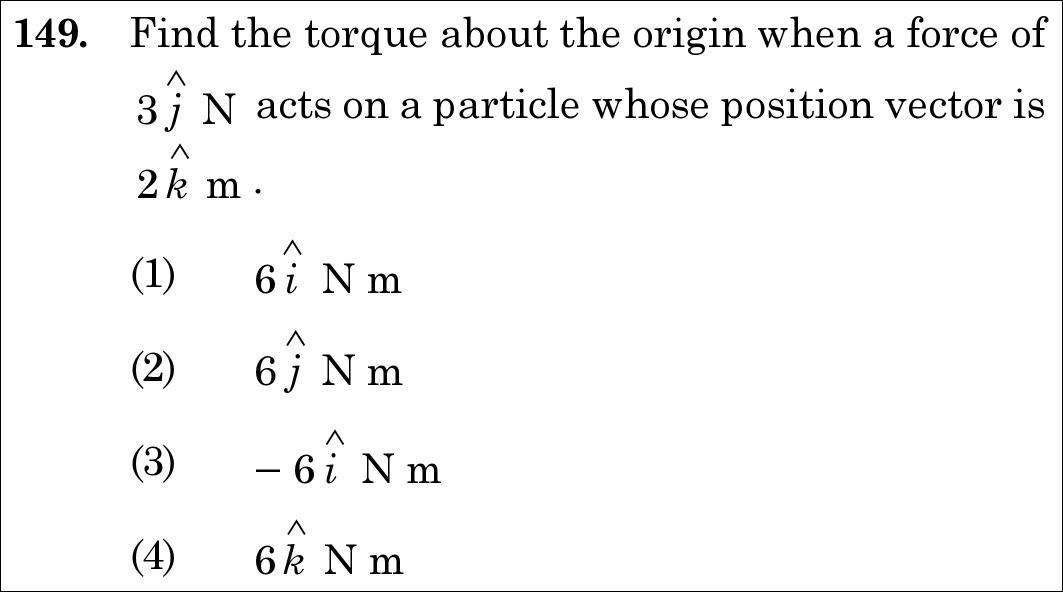
NEET 2020 · Q149 Easy
Official NEET 2020 Question 149 - System of Particles and Rotational Motion
1
2
3 ✓ Key
4
💡 Verified Solution & 30-Second Hack
✓
Verified Against NTA Final Answer Key
Option (3) : -6 i^ N m
📚 System of Particles and Rotational Motion Easy
📋 Given Parameters & Problem Setup
Position Vector (r) 2 k^ m
Force Vector (F) 3 j^ N
Reference Point Origin (0, 0, 0)
Vector Product Formula τ = r × F
⚡

The 30-Second Exam Hall Shortcut: ⚡ "τ = r × F = (2 k^) × (3 j^) = 6 (k^ × j^) = 6 (-i^) = -6 i^ N m!"

⏱️ 15 seconds

Torque is the cross product of position vector and force vector: τ⃗=r⃗×F⃗\vec{\tau} = \vec{r} \times \vec{F}. Substituting: τ⃗=(2k^)×(3j^)=6(k^×j^)\vec{\tau} = (2\hat{k}) \times (3\hat{j}) = 6 (\hat{k} \times \hat{j}). Using the right-hand cyclic rule: k^×j^=−i^\hat{k} \times \hat{j} = -\hat{i}. Therefore, τ⃗=−6i^ N m\vec{\tau} = -6\hat{i}\text{ N m}! Mark Option (3) in 5 seconds.

1 Formula: τ = r × F (order matters: r first, F second!).
2 Substitute given vectors: r = 2 k^, F = 3 j^.
3 Cross product: τ = (2 k^) × (3 j^) = 6 (k^ × j^).
4 Right-hand unit vector cycle: i^ × j^ = k^, j^ × k^ = i^, k^ × j^ = -i^.
5 Result: τ = -6 i^ N m.
6 Select Option (3).
🛡️
Why You Can 100% Trust This Shortcut: NCERT Physics · System of Particles and Rotational Motion (Angular Momentum and Torque: Vector Product)
📐

Step-by-Step Rigorous Workflow & Mathematical Proof

Step 1

Define Torque Vector with Respect to Origin

The torque (moment of force) τ⃗\vec{\tau} acting on a particle having position vector r⃗\vec{r} with respect to the origin is defined as the cross product: τ⃗=r⃗×F⃗\vec{\tau} = \vec{r} \times \vec{F} Note that the cross product is anti-commutative (r⃗×F⃗=−(F⃗×r⃗)\vec{r} \times \vec{F} = -(\vec{F} \times \vec{r})), so the order of vectors is critical.

Step 2

Insert Given Vectors

Given: r⃗=2k^ m\vec{r} = 2\hat{k} \text{ m} F⃗=3j^ N\vec{F} = 3\hat{j} \text{ N}

Step 3

Evaluate Cross Product Using Unit Vector Rules

Recall the right-handed Cartesian cyclic cross product relations: - i^×j^=k^\hat{i} \times \hat{j} = \hat{k} - j^×k^=i^\hat{j} \times \hat{k} = \hat{i} - k^×i^=j^\hat{k} \times \hat{i} = \hat{j} In reverse (counter-cyclic) order: - k^×j^=−i^\hat{k} \times \hat{j} = -\hat{i} Therefore: τ⃗=(2k^)×(3j^)=(2×3)(k^×j^)=6(−i^)=−6i^ N m\vec{\tau} = (2\hat{k}) \times (3\hat{j}) = (2 \times 3)(\hat{k} \times \hat{j}) = 6(-\hat{i}) = -6\hat{i} \text{ N m}

Step 4

Verify Determinant Method

τ⃗=∣i^j^k^002030∣=i^(0−6)−j^(0−0)+k^(0−0)=−6i^ N m\vec{\tau} = \begin{vmatrix} \hat{i} & \hat{j} & \hat{k} \\ 0 & 0 & 2 \\ 0 & 3 & 0 \end{vmatrix} = \hat{i}(0 - 6) - \hat{j}(0 - 0) + \hat{k}(0 - 0) = -6\hat{i}\text{ N m} This confirms Option (3).

⭐

360° Option Elimination Engine Key Feature

Diagnose every choice: Know exactly why the right option works and why distractors fail.

4-Option Deep Scan
1 A
✗ Incorrect
Verdict & Scientific Reason:

Incorrect; classic sign error caused by calculating F⃗×r⃗=(3j^)×(2k^)=+6i^\vec{F} \times \vec{r} = (3\hat{j}) \times (2\hat{k}) = +6\hat{i} instead of r⃗×F⃗\vec{r} \times \vec{F}.

⚠️
Student Fallacy (Why candidates pick this trap): Reversing the order of cross product (F⃗×r⃗\vec{F} \times \vec{r} instead of r⃗×F⃗\vec{r} \times \vec{F}).
2 B
✗ Incorrect
Verdict & Scientific Reason:

Incorrect; vector cross product of k^\hat{k} and j^\hat{j} lies along the i^\hat{i} axis, perpendicular to both.

⚠️
Student Fallacy (Why candidates pick this trap): Assuming torque points along the force direction.
3 C
✓ 100% Correct
Verdict & Scientific Reason:

Factually and mathematically exact; τ⃗=2k^×3j^=−6i^ N m\vec{\tau} = 2\hat{k} \times 3\hat{j} = -6\hat{i}\text{ N m}.

💡
Why this is airtight: None; rigorous vector algebra.
4 D
✗ Incorrect
Verdict & Scientific Reason:

Incorrect; torque cannot be parallel to position vector.

⚠️
Student Fallacy (Why candidates pick this trap): Confusing vector directions.
⚠️

NTA Trap Alert: r × F vs F × r Order Trap

Torque is r⃗×F⃗\vec{r} \times \vec{F}, NOT F⃗×r⃗\vec{F} \times \vec{r}! k^×j^=−i^\hat{k} \times \hat{j} = -\hat{i}. If you do F×rF \times r, you get +6i^+6\hat{i} (Option 1, the trap!).

🛡️ How to avoid the -1 mark: Write the formula explicitly: τ⃗=r⃗×F⃗\vec{\tau} = \vec{r} \times \vec{F}! Remember: k^×j^=−i^\hat{k} \times \hat{j} = -\hat{i}!
📖

Core NEET Syllabus Standard

Physics · System of Particles and Rotational Motion Standard Benchmark
Core Scientific Principle Tested:

""

Syllabus Focus: Torque Vector Calculation: τ = r × F
✓ Core NEET UG Syllabus Anchor Syllabus & Academic Standards ↗

Solve 4 NEET Questions a Day — One per Subject

Cover all 1,140 official NEET questions in 285 days at your own pace. Progress is saved on your device. No login needed.