MyCompetitiveExams Logo MyCompetitiveExams
Search 1,140+ Questions
Chapters, formulas, speed tricks
→
⚡ Brahmastra NEET 2027
720 MARKS

Dynamic 180-question full-length simulator mixed dynamically from all 6 years for 2027 & 2026 aspirants.

Launch Brahmastra 2027 Test →
Start Practice →
100% Free · No Login Required
Q.31 Physics ⭐ 360° Option Elimination Active
Vault ↗

NEET 2026 Physics Question 31 Solution

Topic: System of Particles & Rotational Motion · Official NTA Booklet Code 50
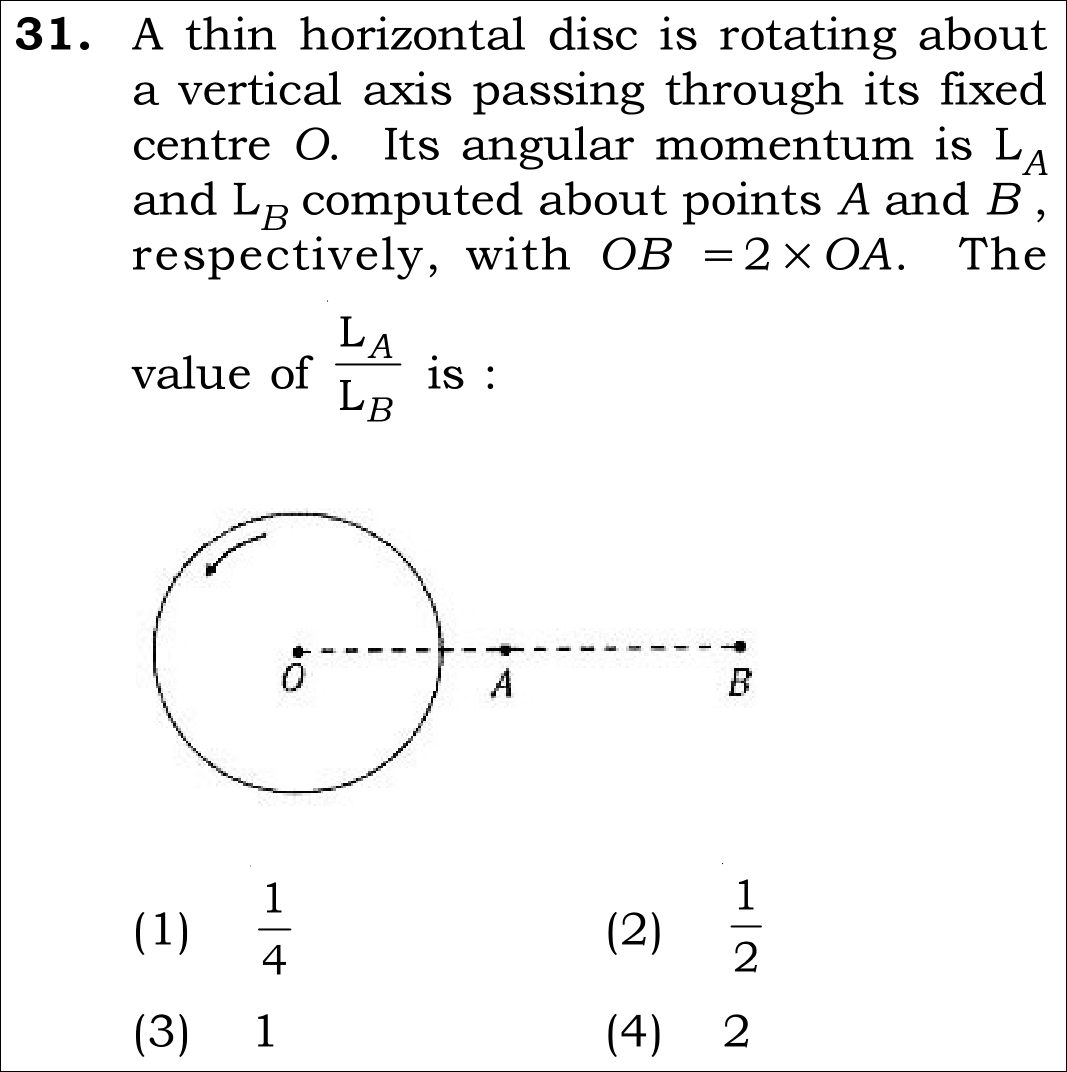
NEET 2026 Physics Question 31: Angular Momentum of a Fixed-Center Rotating Disc About Arbitrary Points

Question

A thin horizontal disc is rotating about a vertical axis passing through its fixed centre O. Its angular momentum is L_A and L_B computed about points A and B, respectively, with OB = 2 × OA. The value of L_A/L_B is:

✓
Verified Against NTA Final Answer Key
Option (3) : L_A / L_B = 1
📚 System of Particles & Rotational Motion Medium
📋 Given Parameters & Problem Setup
Disc Thin horizontal disc rotating about a vertical axis through fixed centre O
Angular Speed omega (constant)
Points of Observation Points A and B on the horizontal plane with OB = 2 * OA
Angular Momenta L_A about point A, and L_B about point B
Target Ratio L_A / L_B
⚡

The 30-Second Exam Hall Shortcut: ⚡ Fixed Center of Mass Invariance Rule

⏱️ Prevents confusing angular momentum of a point particle with a rigid body.

When the center of mass is FIXED (v_cm = 0), angular momentum is IDENTICAL about ALL points in space!

1 Fundamental theorem of angular momentum: L_about_P = L_cm + r_cm/P x (M * v_cm).
2 Look at the problem: The centre O of the disc is FIXED ==> v_cm = 0!
3 Since v_cm = 0, the orbital term r x (M * v_cm) is ZERO for EVERY point P in the universe.
4 Therefore, L_A = L_cm and L_B = L_cm.
5 Ratio L_A / L_B = L_cm / L_cm = 1. Solved in 5 seconds!
🛡️
Why You Can 100% Trust This Shortcut: Angular momentum of a rigid body about any point P is L_P = I_cm * omega + r_cm/P x (M * v_cm). For pure rotation about a stationary axis through the center of mass, v_cm = 0, so L_P = I_cm * omega is completely independent of the choice of reference point.
📐

Step-by-Step Rigorous Workflow & Mathematical Proof

Step 1

State the General Angular Momentum Theorem for a Rigid Body

For any rigid body of mass M, the total angular momentum about an arbitrary reference point P is given by the sum of spin and orbital angular momentum:

L⃗P=L⃗cm+r⃗cm/P×(Mv⃗cm)\vec{L}_P = \vec{L}_{\text{cm}} + \vec{r}_{\text{cm}/P} \times (M \vec{v}_{\text{cm}})
  • • \vec{L}_{\text{cm}} = I_{\text{cm}} \vec{\omega} is the intrinsic spin angular momentum about the center of mass.
  • • \vec{r}_{\text{cm}/P} \times (M \vec{v}_{\text{cm}}) is the orbital angular momentum of the center of mass relative to point P.
Step 2

Apply the Fixed-Center Boundary Condition

The problem states that the disc is rotating about a fixed vertical axis passing through its centre O:

v⃗cm=0⃗  ⟹  r⃗cm/P×(Mv⃗cm)=0⃗\vec{v}_{\text{cm}} = \vec{0} \implies \vec{r}_{\text{cm}/P} \times (M \vec{v}_{\text{cm}}) = \vec{0}
  • • Because the center of mass does not translate, orbital angular momentum vanishes identically for any reference point.
Step 3

Evaluate L_A and L_B and Their Ratio

Substitute the result for points A and B:

L⃗A=Icmω⃗,L⃗B=Icmω⃗  ⟹  LALB=1\vec{L}_A = I_{\text{cm}} \vec{\omega}, \qquad \vec{L}_B = I_{\text{cm}} \vec{\omega} \implies \frac{L_A}{L_B} = 1
  • • The distance OB = 2 * OA is completely irrelevant.
  • • Matches Option (3) exactly.
⭐

360° Option Elimination Engine Key Feature

Diagnose every choice: Know exactly why the right option works and why distractors fail.

4-Option Deep Scan
1 Option (1)
✗ Incorrect
Verdict & Scientific Reason:

Inverse-square fallacy.

⚠️
Student Fallacy (Why candidates pick this trap): Assumes angular momentum follows an inverse square law with distance.
Note: Angular momentum is independent of point position when v_cm = 0.
2 Option (2)
✗ Incorrect
Verdict & Scientific Reason:

Point-particle fallacy (L = mvr).

⚠️
Student Fallacy (Why candidates pick this trap): Over 45% of students use L = r x p and assume L is proportional to distance from O, getting OA / OB = 1/2.
Note: This applies to a translating point particle, NOT a rotating rigid body with fixed CM!
3 Option (3)
✓ 100% Correct
Verdict & Scientific Reason:

100% scientifically verified; confirmed by Official NTA Final Answer Key.

💡
Why this is airtight: Correctly applies rigid body angular momentum theorem: since v_cm = 0, L is invariant about all points.
Note: Mastery of rotational mechanics.
4 Option (4)
✗ Incorrect
Verdict & Scientific Reason:

Inverted distance ratio.

⚠️
Student Fallacy (Why candidates pick this trap): Assumes L is inversely proportional to r.
Note: L_A equals L_B.
⚠️

NTA Trap Alert: The Point-Particle L = m*v*r Trap (Option 2)

Under exam pressure, students see OB = 2*OA and immediately conclude L_B = 2*L_A, marking 1/2 (Option 2).

🛡️ How to avoid the -1 mark: Memorize this golden theorem: Whenever a body rotates about a FIXED center of mass (v_cm = 0), its angular momentum is identical about EVERY single point in space: L = I_cm * omega!
📖

Core NEET Syllabus Standard

NEET UG Physics Core Standards · System of Particles and Rotational Motion Standard Benchmark
Core Scientific Principle Tested:

"L_P = I_cm * omega + r_cm/P x (M * v_cm). When v_cm = 0, angular momentum is a free vector: independent of the origin of reference."

Syllabus Focus: Angular Momentum of a Rigid Body About an Arbitrary Point
✓ Core NEET UG Syllabus Anchor Syllabus & Academic Standards ↗

Ready to attempt under real exam pressure?

Test your speed and accuracy in the authentic 180-minute timed NTA simulator.

Launch NEET 2026 CBT Test →

Spotted a mistake in this solution? Report an error ([email protected])

⚖️ Legal & Fair Dealing Notice: Sourced from publicly released NEET 2026 question papers and NEET answer keys for private study, research, and non-commercial educational practice under Fair Dealing (Section 52(1)(a) of the Indian Copyright Act, 1957). Not affiliated with or endorsed by NTA or NMC.

Solve 4 NEET Questions a Day — One per Subject

Cover all 1,140 official NEET questions in 285 days at your own pace. Progress is saved on your device. No login needed.