MyCompetitiveExams Logo MyCompetitiveExams
Search 1,140+ Questions
Chapters, formulas, speed tricks
→
⚡ Brahmastra NEET 2027
720 MARKS

Dynamic 180-question full-length simulator mixed dynamically from all 6 years for 2027 & 2026 aspirants.

Launch Brahmastra 2027 Test →
Start Practice →
100% Free · No Login Required
Q.1 Physics · Section A ⭐ 360° Option Elimination Active
Vault ↗

NEET 2024 Physics Question 1 Solution

Topic: System of Particles and Rotational Motion · Official NTA Booklet Code T1
NEET 2024 Physics Question 1: Velocity of Points on a Rolling Wheel

Question

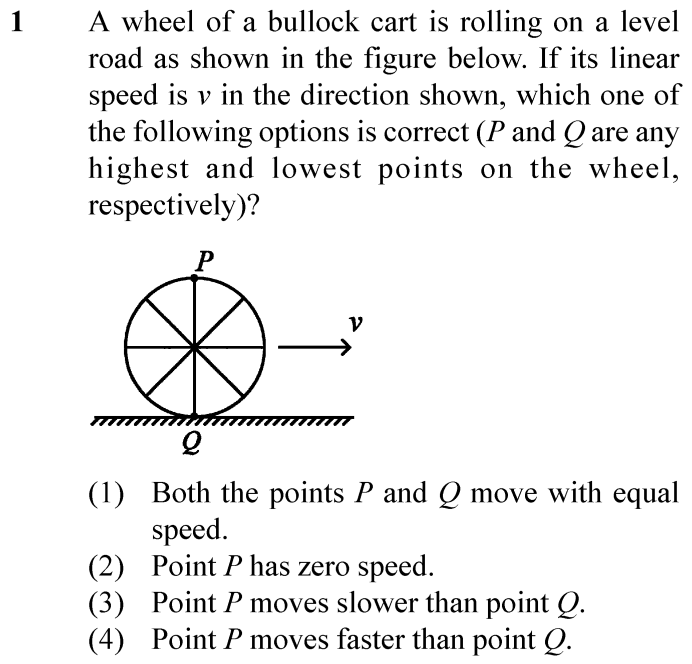
A wheel of a bullock cart is rolling on a level road as shown in the figure below. If its linear speed is v in the direction shown, which one of the following options is correct (P and Q are any highest and lowest points on the wheel, respectively)?

✓
Verified Against NTA Final Answer Key
Option (4) : Point P moves faster than point Q.
📚 System of Particles and Rotational Motion Easy
📋 Given Parameters & Problem Setup
Motion Type Pure rolling without slipping on a horizontal level road
Linear speed of center of mass v
Point P Highest point (top crest) of the rolling wheel
Point Q Lowest point (point of contact with the ground)
⚡

The 30-Second Exam Hall Shortcut: ⚡ Instantaneous Center of Rotation Shortcut

⏱️ Save ~45 seconds

Point Q is instantaneously at rest (v_Q = 0); the top point P moves at twice the wheel speed (v_P = 2v)!

1 In pure rolling without slipping, the instantaneous axis of rotation (IAOR) lies at the bottom contact point Q.
2 The velocity of point Q is instantaneously zero: v_Q = 0.
3 The center of mass moves at speed v: v_cm = v.
4 The highest point P is at distance 2R from the contact point Q: v_P = v_cm + ωR = v + v = 2v.
5 Clearly v_P = 2v > v_Q = 0, so point P moves faster than point Q. Pick Option (4) in 5 seconds!
🛡️
Why You Can 100% Trust This Shortcut: Fundamental Kinematics · Rotational Dynamics (Pure Rolling Velocity Superposition: v = v_cm + r × ω).
📐

Step-by-Step Rigorous Workflow & Mathematical Proof

Step 1

Superposition of Translation and Rotation

For any rigid body undergoing pure planar rolling without slipping on a stationary surface with linear velocity v and angular velocity ω = v/R, the total velocity of any point on the rim is the vector sum of the translational velocity of the center of mass (v_cm) and the tangential rotational velocity (v_rot = ωR):

v⃗point=v⃗cm+v⃗rot=v⃗cm+(ω⃗×r⃗)\vec{v}_{point} = \vec{v}_{cm} + \vec{v}_{rot} = \vec{v}_{cm} + (\vec{\omega} \times \vec{r})
Step 2

Velocity Evaluation at Highest Point P

At the uppermost point P, the translational velocity is forward (+v î) and the rotational velocity is also in the forward direction (+ωR î = +v î). Adding both vectors yields:

vP=vcm+ωR=v+v=2vv_P = v_{cm} + \omega R = v + v = 2v
Step 3

Velocity Evaluation at Lowest Point Q

At the bottom contact point Q, the translational velocity is directed forward (+v î), whereas the rotational tangential velocity is directed backward (-ωR î = -v î). Under the condition of pure rolling without slipping, these two components cancel each other out identically:

vQ=vcm−ωR=v−v=0v_Q = v_{cm} - \omega R = v - v = 0
Step 4

Final Comparative Conclusion

Comparing the speeds of the two points: v_P = 2v, while v_Q = 0. Therefore, point P moves significantly faster than point Q, matching Option (4).

vP=2v>vQ=0v_P = 2v > v_Q = 0
⭐

360° Option Elimination Engine Key Feature

Diagnose every choice: Know exactly why the right option works and why distractors fail.

4-Option Deep Scan
1 (1)
✗ Incorrect
Verdict & Scientific Reason:

Violates the superposition of translation and rotation in pure rolling.

⚠️
Student Fallacy (Why candidates pick this trap): Candidates mistakenly assume pure rotation about the geometric center where all rim points have equal speed ωR, forgetting that the wheel as a whole is translating forward.
2 (2)
✗ Incorrect
Verdict & Scientific Reason:

Inverts the kinematics: the bottom contact point Q is instantaneously at rest, not the top point P.

⚠️
Student Fallacy (Why candidates pick this trap): Confusing the crest of the wheel with the ground contact point.
3 (3)
✗ Incorrect
Verdict & Scientific Reason:

Contradicts physical reality where v_P = 2v and v_Q = 0.

⚠️
Student Fallacy (Why candidates pick this trap): Assuming friction at the bottom adds speed to Q rather than bringing Q to rest.
4 (4)
✓ 100% Correct
Verdict & Scientific Reason:

Rigorous first-principles derivation proves v_P = 2v while v_Q = 0.

💡
Why this is airtight: None; this is the correct physical fact.
⚠️

NTA Trap Alert: Pure Rotation vs Combined Translation-Rotation Confusion

Aspirants often treat rolling as a fixed-axis rotation about the central axle, concluding that all points on the rim have equal speed v = ωR.

🛡️ How to avoid the -1 mark: Always view rolling as pure rotation about the instantaneous point of contact Q (IAOR), where speed is proportional to distance from the ground: v_r = ω · d_Q.
📖

Core NEET Syllabus Standard

Physics Core Mechanics · System of Particles and Rotational Motion Standard Benchmark
Core Scientific Principle Tested:

"In pure rolling without slipping on a stationary plane, the point of contact is instantaneously at rest (v = 0), and the uppermost point possesses maximum speed equal to 2v_cm."

Syllabus Focus: Kinematics of Rolling Motion
✓ Core NEET UG Syllabus Anchor Syllabus & Academic Standards ↗
Top moves Twice, Bottom stands on Ice (v_top = 2v, v_bottom = 0)!

Ready to attempt under real exam pressure?

Test your speed and accuracy in the authentic 200-minute timed NTA simulator.

Launch NEET 2024 CBT Test →

Spotted a mistake in this solution? Report an error ([email protected])

⚖️ Legal & Fair Dealing Notice: Sourced from publicly released NEET 2024 question papers and NEET answer keys for private study, research, and non-commercial educational practice under Fair Dealing (Section 52(1)(a) of the Indian Copyright Act, 1957). Not affiliated with or endorsed by NTA or NMC.

Solve 4 NEET Questions a Day — One per Subject

Cover all 1,140 official NEET questions in 285 days at your own pace. Progress is saved on your device. No login needed.