MyCompetitiveExams Logo MyCompetitiveExams
Search 1,140+ Questions
Chapters, formulas, speed tricks
→
⚡ Brahmastra NEET 2027
720 MARKS

Dynamic 180-question full-length simulator mixed dynamically from all 6 years for 2027 & 2026 aspirants.

Launch Brahmastra 2027 Test →
Start Practice →
100% Free · No Login Required
Q.7 Physics ⭐ 360° Option Elimination Active
Vault ↗

NEET 2023 Physics Question 7 Solution

Topic: System of Particles and Rotational Motion · Official NTA Booklet Code G5
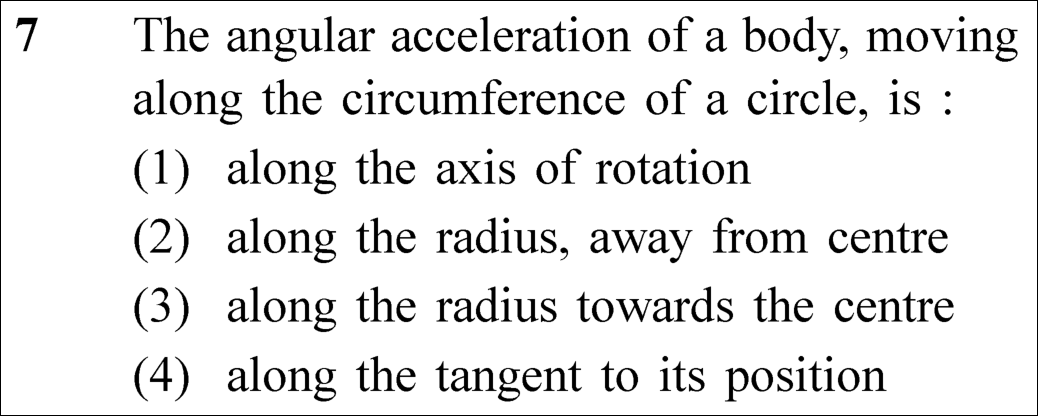
NEET 2023 Physics Question 7: Direction of Angular Acceleration Vector

Question

The angular acceleration of a body, moving along the circumference of a circle, is:

✓
Verified Against NTA Final Answer Key
Option (1) : along the axis of rotation
📚 System of Particles and Rotational Motion Easy
📋 Given Parameters & Problem Setup
Motion Body moving along the circumference of a circle
Target Vector Angular acceleration (α⃗)
⚡

The 30-Second Exam Hall Shortcut: ⚡ The Axial Vector vs Polar Vector Golden Rule

⏱️ Save ~30 seconds

Angular velocity, angular momentum, and angular acceleration are AXIAL vectors — they ALWAYS point along the axis of rotation!

1 Distinguish polar vectors (force, linear velocity, linear acceleration lying in the plane of motion) from axial vectors.
2 Recall that θ⃗, ω⃗, α⃗, and L⃗ are defined by the right-hand grip rule perpendicular to the plane of rotation.
3 Hence, angular acceleration α⃗ MUST lie along the axis of rotation.
4 Centripetal acceleration is along the radius; tangential acceleration is along the tangent; but angular acceleration is along the axis of rotation.
5 Instant Option (1) in 3 seconds flat!
🛡️
Why You Can 100% Trust This Shortcut: Fundamental Rotational Kinematics · Vector Cross Product Definitions (Angular acceleration α⃗ = dω⃗/dt is strictly oriented along the rotational axis).
📐

Step-by-Step Rigorous Workflow & Mathematical Proof

Step 1

Definition of Angular Acceleration as an Axial Vector

Angular acceleration α⃗ is defined as the time rate of change of angular velocity ω⃗:

α⃗=dω⃗dt\vec{\alpha} = \frac{d\vec{\omega}}{dt}
Step 2

Directional Orientation via Right-Hand Rule

Angular velocity ω⃗ is an axial vector perpendicular to the orbital plane of rotation, pointing along the axis of rotation by the right-hand screw rule. Since α⃗ is the derivative of ω⃗ with respect to scalar time t, it must be parallel (if speeding up) or antiparallel (if slowing down) to ω⃗:

α⃗∥ω⃗  ⟹  α⃗ is oriented along the axis of rotation\vec{\alpha} \parallel \vec{\omega} \quad \implies \quad \vec{\alpha} \text{ is oriented along the axis of rotation}
Step 3

Contrast with Linear Acceleration Components

In circular motion, the linear acceleration consists of centripetal acceleration (radially inwards) and tangential acceleration (tangent to the circle), whereas angular acceleration governs rotational rate and is purely axial:

a⃗linear=a⃗c+a⃗t=−ω2r⃗+(α⃗×r⃗)\vec{a}_{\text{linear}} = \vec{a}_c + \vec{a}_t = -\omega^2 \vec{r} + (\vec{\alpha} \times \vec{r})
⭐

360° Option Elimination Engine Key Feature

Diagnose every choice: Know exactly why the right option works and why distractors fail.

4-Option Deep Scan
1 (1)
✓ 100% Correct
Verdict & Scientific Reason:

Angular acceleration is by definition an axial vector directed along the axis of rotation.

💡
Why this is airtight: None. Candidate understood the distinction between linear and rotational kinematic vectors.
2 (2)
✗ Incorrect
Verdict & Scientific Reason:

Describes centrifugal tendency in a rotating frame, not angular acceleration.

⚠️
Student Fallacy (Why candidates pick this trap): Candidate confused angular acceleration with fictitious centrifugal force.
3 (3)
✗ Incorrect
Verdict & Scientific Reason:

Describes centripetal (radial) acceleration a_c, which is a linear acceleration.

⚠️
Student Fallacy (Why candidates pick this trap): Candidate confused angular acceleration (α) with centripetal acceleration (a_c = v²/r).
4 (4)
✗ Incorrect
Verdict & Scientific Reason:

Describes tangential acceleration a_t = α r, which is linear, not angular.

⚠️
Student Fallacy (Why candidates pick this trap): Candidate confused angular acceleration (α) with tangential linear acceleration (a_t).
⚠️

NTA Trap Alert: Confusing Angular (α) with Tangential (a_t) or Centripetal (a_c) Acceleration

Many candidates see "acceleration" and "circle" and instantly jump to "towards the centre" (Option 3) or "along the tangent" (Option 4). They overlook the crucial word "ANGULAR".

🛡️ How to avoid the -1 mark: Read carefully: "Angular" acceleration = along axis of rotation. "Linear/Tangential" acceleration = along tangent. "Radial/Centripetal" = towards center.
📖

Core NEET Syllabus Standard

National Eligibility cum Entrance Test (NEET UG) · System of Particles and Rotational Motion Standard Benchmark
Core Scientific Principle Tested:

"Angular variables (θ, ω, α) are axial vectors directed along the axis of rotation per the right-hand screw rule."

Syllabus Focus: Kinematics of Rotational Motion and Axial Vectors
Preserved in Rationalized Curriculum Syllabus & Academic Standards ↗

Ready to attempt under real exam pressure?

Test your speed and accuracy in the authentic 200-minute timed NTA simulator.

Launch NEET 2023 CBT Test →

Spotted a mistake in this solution? Report an error ([email protected])

⚖️ Legal & Fair Dealing Notice: Sourced from publicly released NEET 2023 question papers and NEET answer keys for private study, research, and non-commercial educational practice under Fair Dealing (Section 52(1)(a) of the Indian Copyright Act, 1957). Not affiliated with or endorsed by NTA or NMC.

Solve 4 NEET Questions a Day — One per Subject

Cover all 1,140 official NEET questions in 285 days at your own pace. Progress is saved on your device. No login needed.