MyCompetitiveExams Logo MyCompetitiveExams
Search 1,140+ Questions
Chapters, formulas, speed tricks
→
⚡ Brahmastra NEET 2027
720 MARKS

Dynamic 180-question full-length simulator mixed dynamically from all 6 years for 2027 & 2026 aspirants.

Launch Brahmastra 2027 Test →
Start Practice →
100% Free · No Login Required
Q.8 Physics ⭐ 360° Option Elimination Active
Vault ↗

NEET 2023 Physics Question 8 Solution

Topic: Alternating Current · Official NTA Booklet Code G5
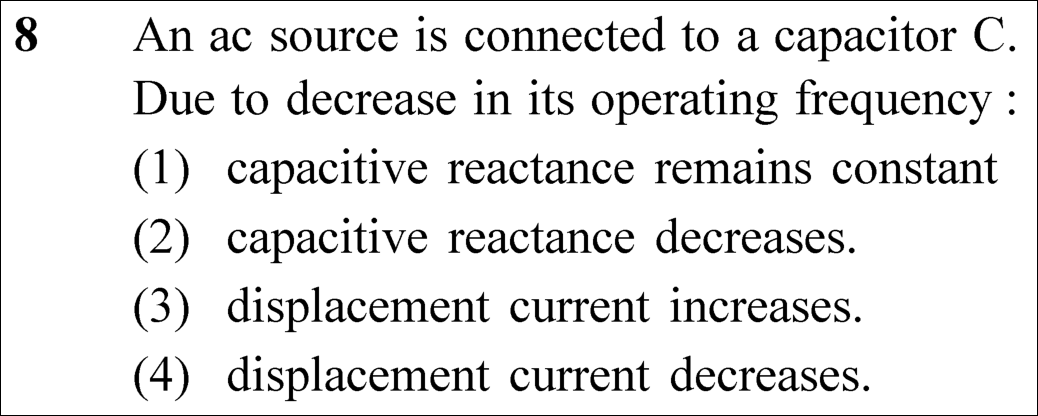
NEET 2023 Physics Question 8: Effect of Frequency on Capacitive Reactance and Displacement Current

Question

An ac source is connected to a capacitor C. Due to decrease in its operating frequency:

✓
Verified Against NTA Final Answer Key
Option (4) : displacement current decreases.
📚 Alternating Current Easy
📋 Given Parameters & Problem Setup
Circuit Element Capacitor C connected across AC source V
Condition Operating frequency f is decreased
⚡

The 30-Second Exam Hall Shortcut: ⚡ Capacitive Ohm's Law and Conduction-Displacement Equality

⏱️ Save ~40 seconds

Lower frequency means higher capacitive reactance (X_C = 1/ωC ↑), so current drops (I = V/X_C ↓); displacement current equals conduction current, so it decreases!

1 Capacitive reactance formula: X_C = 1 / (2π f C). When frequency f decreases, X_C INCREASES.
2 Thus, options (1) and (2) claiming X_C remains constant or decreases are immediately FALSE.
3 Current in the circuit is I = V / X_C = V × (2π f C).
4 As f decreases, current I decreases.
5 By Maxwell-Ampere law, displacement current inside the dielectric equals conduction current in the leads (i_d = i_c = I).
6 Therefore, displacement current decreases. Pick Option (4)!
🛡️
Why You Can 100% Trust This Shortcut: Fundamental Electrodynamics · Maxwell-Ampere Law (Continuity of total current: i_c = i_d = C dV/dt ∝ f).
📐

Step-by-Step Rigorous Workflow & Mathematical Proof

Step 1

Capacitive Reactance Relation to Frequency

The opposition offered by a capacitor to alternating current is capacitive reactance X_C:

XC=1ωC=12πfCX_C = \frac{1}{\omega C} = \frac{1}{2\pi f C}
Step 2

Effect of Frequency Reduction on Reactance and Current

When the operating frequency f decreases, the capacitive reactance X_C increases inversely:

f↓  ⟹  XC↑f \downarrow \implies X_C \uparrow
Step 3

Current and Displacement Current Relation

The alternating current in the circuit (conduction current i_c) is determined by Ohm's law in AC circuits:

ic=VXC=V(2πfC)  ⟹  ic∝fi_c = \frac{V}{X_C} = V(2\pi f C) \implies i_c \propto f
Step 4

Maxwell's Displacement Current Equivalence

Inside the capacitor plates, the changing electric flux generates displacement current i_d, which identically equals the conduction current i_c at every instant:

id=ε0dΦEdt=ic=V(2πfC)i_d = \varepsilon_0 \frac{d\Phi_E}{dt} = i_c = V(2\pi f C)
Step 5

Conclusion

Since f decreases, i_d decreases proportionally:

f↓  ⟹  id↓f \downarrow \implies i_d \downarrow
⭐

360° Option Elimination Engine Key Feature

Diagnose every choice: Know exactly why the right option works and why distractors fail.

4-Option Deep Scan
1 (1)
✗ Incorrect
Verdict & Scientific Reason:

False. X_C depends inversely on frequency (X_C = 1/(2πfC)).

⚠️
Student Fallacy (Why candidates pick this trap): Candidate confused capacitive reactance with ohmic resistance R (which is independent of frequency).
2 (2)
✗ Incorrect
Verdict & Scientific Reason:

False. As frequency decreases, X_C increases, not decreases.

⚠️
Student Fallacy (Why candidates pick this trap): Candidate confused capacitive reactance (1/ωC) with inductive reactance (X_L = ωL).
3 (3)
✗ Incorrect
Verdict & Scientific Reason:

False. Since impedance increases, current decreases.

⚠️
Student Fallacy (Why candidates pick this trap): Candidate incorrectly thought reactance decrease leads to current increase.
4 (4)
✓ 100% Correct
Verdict & Scientific Reason:

Accurate deduction: lower frequency causes higher reactance, lowering both conduction and displacement currents.

💡
Why this is airtight: None. Candidate correctly applied i_d = i_c = V(2πfC).
⚠️

NTA Trap Alert: Confusing Displacement Current with a Constant Static Parameter

Some students treat displacement current as an abstract quantity separate from circuit current. In reality, i_d is continuous with conduction current i_c.

🛡️ How to avoid the -1 mark: Remember: i_d = i_c in any AC circuit across a capacitor. If circuit current drops, displacement current drops.
📖

Core NEET Syllabus Standard

National Eligibility cum Entrance Test (NEET UG) · Alternating Current Standard Benchmark
Core Scientific Principle Tested:

"Capacitive current i = V/(X_C) = 2π f C V. Decreasing frequency reduces current directly."

Syllabus Focus: Capacitive AC Circuits and Displacement Current
Preserved in Rationalized Curriculum Syllabus & Academic Standards ↗

Ready to attempt under real exam pressure?

Test your speed and accuracy in the authentic 200-minute timed NTA simulator.

Launch NEET 2023 CBT Test →

Spotted a mistake in this solution? Report an error ([email protected])

⚖️ Legal & Fair Dealing Notice: Sourced from publicly released NEET 2023 question papers and NEET answer keys for private study, research, and non-commercial educational practice under Fair Dealing (Section 52(1)(a) of the Indian Copyright Act, 1957). Not affiliated with or endorsed by NTA or NMC.

Solve 4 NEET Questions a Day — One per Subject

Cover all 1,140 official NEET questions in 285 days at your own pace. Progress is saved on your device. No login needed.