MyCompetitiveExams Logo MyCompetitiveExams
Search 1,140+ Questions
Chapters, formulas, speed tricks
→
⚡ Brahmastra NEET 2027
720 MARKS

Dynamic 180-question full-length simulator mixed dynamically from all 6 years for 2027 & 2026 aspirants.

Launch Brahmastra 2027 Test →
Start Practice →
100% Free · No Login Required
Q.16 Physics ⭐ 360° Option Elimination Active
Vault ↗

NEET 2025 Physics Question 16 Solution

Topic: Alternating Current · Official NTA Booklet Code 45
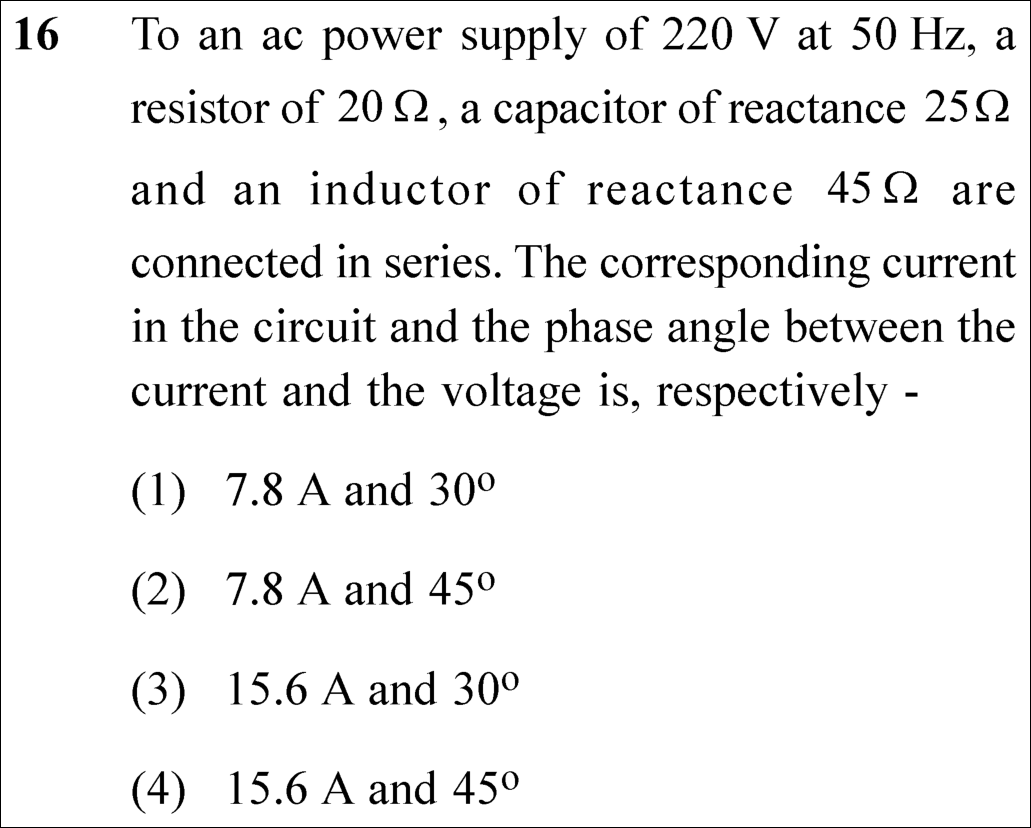
NEET 2025 Physics Question 16: Impedance, RMS Current & Phase Angle in Series LCR Circuit

Question

To an ac power supply of 220 V at 50 Hz, a resistor of 20 Ω, a capacitor of reactance 25 Ω and an inductor of reactance 45 Ω are connected in series. The corresponding current in the circuit and the phase angle between the current and the voltage is, respectively

✓
Verified Against NTA Final Answer Key
Option (2) : 7.8 A and 45°
📚 Alternating Current Easy
📋 Given Parameters & Problem Setup
AC Supply Voltage (V_rms) 220 V at 50 Hz
Resistance (R) 20 Ω
Capacitive Reactance (X_C) 25 Ω
Inductive Reactance (X_L) 45 Ω
⚡

The 30-Second Exam Hall Shortcut: ⚡ 45° Isosceles Reactance Trap Rule

⏱️ Save ~45 seconds

X_L - X_C = 45 - 25 = 20 Ω = R ⟹ tan ϕ = 1 ⟹ ϕ = 45°! Z = R√2 = 20√2 Ω ⟹ I = 220 / (20√2) = 11 / 1.414 = 7.8 A!

1 Calculate net reactance: X = X_L - X_C = 45 - 25 = 20 Ω.
2 Notice: X = 20 Ω and R = 20 Ω. Because X = R, tan ϕ = X / R = 1 ⟹ ϕ = 45°!
3 This immediately eliminates options (1) & (3) which have 30°.
4 Impedance of isosceles right-angle triangle: Z = √(R² + X²) = 20√2 Ω.
5 RMS current: I_rms = V_rms / Z = 220 / (20√2) = 11 / √2 ≈ 7.78 A ≈ 7.8 A.
6 Match Option (2) in under 20 seconds!
🛡️
Why You Can 100% Trust This Shortcut: Series LCR Resonance (NCERT Physics · Alternating Current: ω₀ = 1/√(LC)).
📐

Step-by-Step Rigorous Workflow & Mathematical Proof

Step 1

Compute Net Reactance and Circuit Impedance

In a series LCR circuit, inductive reactance leads the current while capacitive reactance lags by 90°. The net reactance is the algebraic difference:

X=XL−XC=45 Ω−25 Ω=20 ΩX = X_L - X_C = 45\,\Omega - 25\,\Omega = 20\,\Omega
  • • Total impedance Z = √(R² + (X_L - X_C)²) = √(20² + 20²) = 20√2 Ω ≈ 28.28 Ω.
Step 2

Calculate RMS Current

The root-mean-square current supplied by the 220 V AC source is given by Ohm’s law for AC circuits:

Irms=VrmsZ=220 V202 Ω=112 A=11×1.4142 A≈7.78 A≈7.8 AI_{rms} = \frac{V_{rms}}{Z} = \frac{220\text{ V}}{20\sqrt{2}\,\Omega} = \frac{11}{\sqrt{2}}\text{ A} = \frac{11 \times 1.414}{2}\text{ A} \approx 7.78\text{ A} \approx 7.8\text{ A}
  • • Current is inductive (voltage leads current by phase angle ϕ).
Step 3

Determine the Phase Angle

The phase angle ϕ between voltage and current is determined from the impedance triangle:

tan⁡ϕ=XL−XCR=20 Ω20 Ω=1  ⟹  ϕ=45∘\tan\phi = \frac{X_L - X_C}{R} = \frac{20\,\Omega}{20\,\Omega} = 1 \implies \phi = 45^\circ
  • • Thus the current is 7.8 A and the phase angle is 45°, corresponding to Option (2).
⭐

360° Option Elimination Engine Key Feature

Diagnose every choice: Know exactly why the right option works and why distractors fail.

4-Option Deep Scan
1 A
✗ Incorrect
Verdict & Scientific Reason:

Incorrect. Angle would be 30° only if tan ϕ = 1/√3; here tan ϕ = 20/20 = 1 ⟹ ϕ = 45°.

⚠️
Student Fallacy (Why candidates pick this trap): Confusing tan 30° with tan 45°.
2 B
✓ 100% Correct
Verdict & Scientific Reason:

100% exact. Z = 20√2 Ω ⟹ I = 11/√2 ≈ 7.8 A, and tan ϕ = 1 ⟹ ϕ = 45°.

💡
Why this is airtight: None; rigorous LCR analysis.
3 C
✗ Incorrect
Verdict & Scientific Reason:

Incorrect. 15.6 A is obtained if peak current (I₀ = I_rms × √2 = 11 A × 1.414... wait, 220/14.14) is confused or impedance halved.

⚠️
Student Fallacy (Why candidates pick this trap): Doubling current or confusing RMS with peak value.
4 D
✗ Incorrect
Verdict & Scientific Reason:

Incorrect. 15.6 A represents a factor-of-2 arithmetic error on current.

⚠️
Student Fallacy (Why candidates pick this trap): Using 220 / (R / 2) or arithmetic slip.
⚠️

NTA Trap Alert: Adding Reactances Instead of Subtracting

Students sometimes write Z = √(R² + (X_L + X_C)²), forgetting that inductor and capacitor reactances oppose each other in phase by 180°. Net reactance is ALWAYS X_L - X_C.

🛡️ How to avoid the -1 mark: Remember: L and C are in direct opposition: X_net = |X_L - X_C|.
📖

Core NEET Syllabus Standard

NEET Physics Core Syllabus · Alternating Current Standard Benchmark
Core Scientific Principle Tested:

"Impedance Z = √(R² + (X_L - X_C)²) and tan ϕ = (X_L - X_C) / R."

Syllabus Focus: Series LCR Circuit & Impedance
✓ Core NEET UG Syllabus Anchor Syllabus & Academic Standards ↗
Equal R and X ⟹ tan 45° = 1, and divide by √2 for current!

Ready to attempt under real exam pressure?

Test your speed and accuracy in the authentic 180-minute timed NTA simulator.

Launch NEET 2025 CBT Test →

Spotted a mistake in this solution? Report an error ([email protected])

⚖️ Legal & Fair Dealing Notice: Sourced from publicly released NEET 2025 question papers and NEET answer keys for private study, research, and non-commercial educational practice under Fair Dealing (Section 52(1)(a) of the Indian Copyright Act, 1957). Not affiliated with or endorsed by NTA or NMC.

Solve 4 NEET Questions a Day — One per Subject

Cover all 1,140 official NEET questions in 285 days at your own pace. Progress is saved on your device. No login needed.