NEET 2023 Physics Question 5 Solution
Question
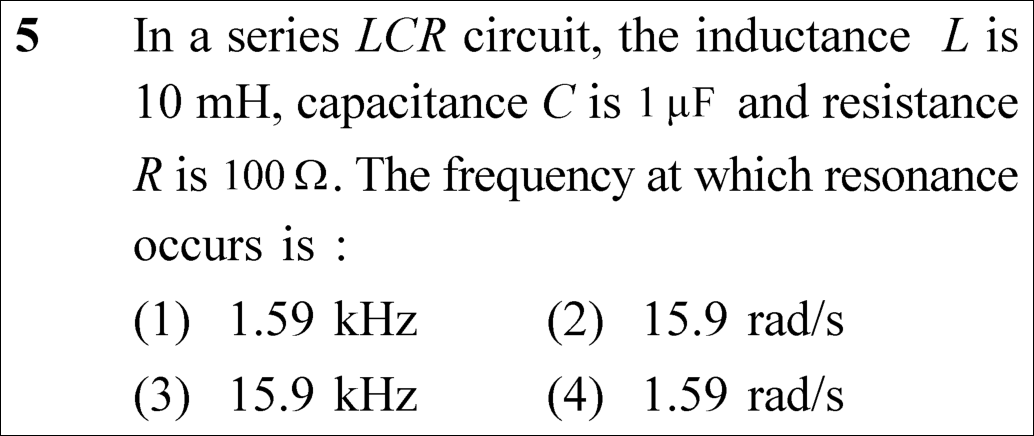
In a series LCR circuit, the inductance L is 10 mH, capacitance C is 1 μF and resistance R is 100 Ω. The frequency at which resonance occurs is:
Dynamic 180-question full-length simulator mixed dynamically from all 6 years for 2027 & 2026 aspirants.
In a series LCR circuit, the inductance L is 10 mH, capacitance C is 1 μF and resistance R is 100 Ω. The frequency at which resonance occurs is:
LC = 10⁻² × 10⁻⁶ = 10⁻⁸ → √LC = 10⁻⁴ → f₀ = 10⁴ / (2π) = 0.159 × 10⁴ Hz = 1.59 kHz in 15 seconds!
Resonance in a series LCR circuit occurs when inductive reactance equals capacitive reactance, causing impedance to become purely resistive (Z = R):
Substitute inductance L = 10 × 10⁻³ H and capacitance C = 10⁻⁶ F:
Convert angular frequency ω₀ (in rad/s) to cyclic frequency f₀ (in Hz):
Diagnose every choice: Know exactly why the right option works and why distractors fail.
Accurate value of linear frequency f₀ in kilohertz.
Wrong unit and wrong magnitude (angular frequency is 10,000 rad/s).
Off by a factor of 10.
Gross unit mismatch and incorrect numerical magnitude.
NTA includes both units (kHz and rad/s) among the choices. If a student forgets to divide ω by 2π, they will search for 10⁴ rad/s and get confused.
"Resonant frequency f₀ = 1 / (2π √LC) depends solely on L and C, completely independent of resistance R."
Test your speed and accuracy in the authentic 200-minute timed NTA simulator.
Spotted a mistake in this solution? Report an error ([email protected])
Cover all 1,140 official NEET questions in 285 days at your own pace. Progress is saved on your device. No login needed.