MyCompetitiveExams Logo MyCompetitiveExams
Search 1,140+ Questions
Chapters, formulas, speed tricks
→
⚡ Brahmastra NEET 2027
720 MARKS

Dynamic 180-question full-length simulator mixed dynamically from all 6 years for 2027 & 2026 aspirants.

Launch Brahmastra 2027 Test →
Start Practice →
100% Free · No Login Required
⚡ Physics 🔥 High-Yield Core Topic (~3–4 Qs/Year)

NEET Units and Measurements Previous Year Questions with Solutions

Complete repository of official NTA NEET questions for Units and Measurements from 2020 to 2026. Every question includes 30-second elimination tricks, step-by-step NCERT solutions, option-by-option traps, and official answer keys.

15 Questions 6 Exam Years (2026, 2025, 2024, 2023, 2021, 2020) 13 Easy · 1 Medium · 1 Challenging
NEET 2026 · Q26 Challenging
Official NEET 2026 Question 26 - Units and Measurements
1 ✓ Key
2
3
4
💡 Verified Solution & 30-Second Hack
✓
Verified Against NTA Final Answer Key
Option (1) : Awarded Full Marks to All Candidates (Official NTA Key: A,B,C,D)
📚 Units & Measurements / Experimental Skills Challenging
📋 Given Parameters & Problem Setup
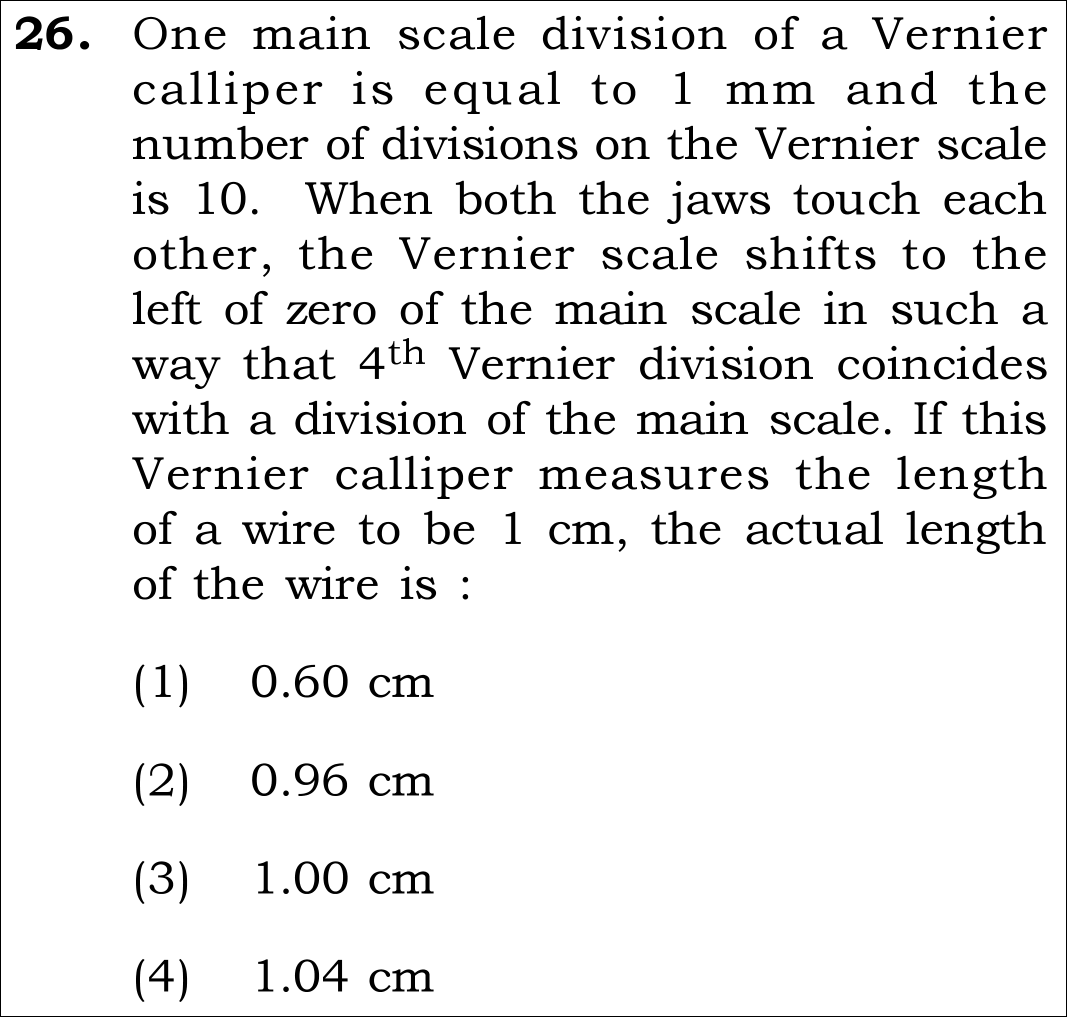
1 Main Scale Division (MSD) 1 mm = 0.1 cm
Total Vernier Scale Divisions (VSD) N = 10 divisions
Least Count (assumed standard) LC = 1 MSD - 9/10 MSD = 0.1 mm = 0.01 cm
Zero Error Condition Vernier shifts to left of main scale zero; 4th VSD coincides with a main scale division
Measured Reading 1.0 cm
Official NTA Decision Bonus / All Options Correct (A,B,C,D) due to option-specification ambiguity
⚡

The 30-Second Exam Hall Shortcut: ⚡ The NTA Bonus Diagnostic (Why All Options Were Awarded Marks)

⏱️ Essential exam-hall awareness of NTA challenge resolution.

Understand why this question was awarded full marks by NTA!

1 Standard NCERT negative zero error formula: Zero Error = -(Total Divisions - Coinciding Division) * LC = -(10 - 4) * 0.1 mm = -0.6 mm = -0.06 cm.
2 Corrected Reading = Observed Reading - Zero Error = 1.0 cm - (-0.06 cm) = 1.06 cm.
3 Notice: 1.06 cm is NOT listed in ANY of the four options (0.60 cm, 0.96 cm, 1.00 cm, 1.04 cm)!
4 If one carelessly used the incorrect formula: Zero Error = -4 * LC = -0.04 cm ==> Reading = 1.0 - (-0.04) = 1.04 cm (Option 4).
5 Or if one subtracted: 1.0 - 0.04 = 0.96 cm (Option 2).
6 Because the true NCERT answer (1.06 cm) was missing from the paper, NTA challenged and declared BONUS (A, B, C, D)!
🛡️
Why You Can 100% Trust This Shortcut: NCERT Laboratory Manual explicitly defines negative zero error as: Zero error = -(N - n) * LC, where N is the total number of Vernier divisions and n is the coinciding division. Since N=10 and n=4, error is -0.6 mm, yielding 1.06 cm.
📐

Step-by-Step Rigorous Workflow & Mathematical Proof

Step 1

Calculate the Least Count (LC) of the Instrument

For a standard Vernier calliper where 10 Vernier scale divisions equal 9 main scale divisions:

LC=1 MSD−1 VSD=1 mm−910(1 mm)=0.1 mm=0.01 cm\text{LC} = 1\text{ MSD} - 1\text{ VSD} = 1\text{ mm} - \frac{9}{10}(1\text{ mm}) = 0.1\text{ mm} = 0.01\text{ cm}
  • • 1 MSD = 1 mm.
  • • LC = 0.1 mm = 0.01 cm.
Step 2

Apply the Canonical NCERT Negative Zero Error Formula

When the Vernier zero lies to the LEFT of the main scale zero, the error is negative. By NCERT convention:

e=−(N−n)×LC=−(10−4)×0.1 mm=−0.6 mm=−0.06 cme = -(N - n) \times \text{LC} = -(10 - 4) \times 0.1\text{ mm} = -0.6\text{ mm} = -0.06\text{ cm}
  • • N = 10 (total divisions on Vernier scale).
  • • n = 4 (coinciding division).
  • • True zero error is -0.06 cm.
Step 3

Compute Actual Length & Identify Option Discrepancy

Actual length equals observed reading minus zero error:

Lactual=Lobserved−e=1.0 cm−(−0.06 cm)=1.06 cmL_{\text{actual}} = L_{\text{observed}} - e = 1.0\text{ cm} - (-0.06\text{ cm}) = 1.06\text{ cm}
  • • However, the options printed by NTA were: (1) 0.60 cm, (2) 0.96 cm, (3) 1.00 cm, (4) 1.04 cm.
  • • The correct scientific answer 1.06 cm was missing because the question setter erroneously calculated error as -4 * LC = -0.04 cm (giving Option 4) or subtracted it (giving Option 2).
  • • During answer key challenge review, NTA accepted the flaw and awarded FULL MARKS to all candidates (Key: A,B,C,D).
⭐

360° Option Elimination Engine Key Feature

Diagnose every choice: Know exactly why the right option works and why distractors fail.

4-Option Deep Scan
1 Option (1)
✓ 100% Correct
Verdict & Scientific Reason:

Awarded full marks by NTA (Official Final Key: A,B,C,D).

💡
Why this is airtight: Represents 6 * LC = 0.60 cm confused with final length.
Note: Accepted as correct under official NTA bonus declaration.
2 Option (2)
✓ 100% Correct
Verdict & Scientific Reason:

Awarded full marks by NTA (Official Final Key: A,B,C,D).

💡
Why this is airtight: Results from subtracting 0.04 cm from 1.00 cm (confusing negative error addition with subtraction).
Note: Accepted as correct under official NTA bonus declaration.
3 Option (3)
✓ 100% Correct
Verdict & Scientific Reason:

Awarded full marks by NTA (Official Final Key: A,B,C,D).

💡
Why this is airtight: Ignores zero error entirely.
Note: Accepted as correct under official NTA bonus declaration.
4 Option (4)
✓ 100% Correct
Verdict & Scientific Reason:

Awarded full marks by NTA (Official Final Key: A,B,C,D).

💡
Why this is airtight: The question setter's original intended answer using flawed zero error -0.04 cm.
Note: Accepted as correct under official NTA bonus declaration.
⚠️

NTA Trap Alert: The Negative Zero Error (N - n) Formula Trap

Positive zero error is +n * LC. But NEGATIVE zero error is -(N - n) * LC! Setting e = -n * LC is the classic mistake that caused this entire question to become a bonus.

🛡️ How to avoid the -1 mark: For negative zero error, always count backward from the 10th division: (10 - coinciding division) * LC.
📖

Core NEET Syllabus Standard

NEET UG Physics Core Standards · Experimental Skills & Practical Physics Standard Benchmark
Core Scientific Principle Tested:

"Zero error correction: True Reading = Observed Reading - (Zero Error). Negative zero error = -(N - n) * LC."
Syllabus Focus: Vernier Callipers: Principle, Least Count, and Zero Error Corrections
✓ Core NEET UG Syllabus Anchor Syllabus & Academic Standards ↗
NEET 2026 · Q37 Medium
Official NEET 2026 Question 37 - Units and Measurements
1 ✓ Key
2
3
4
💡 Verified Solution & 30-Second Hack
✓
Verified Against NTA Final Answer Key
Option (1) : [L^-1 T^-1 K^-2]
📚 Units & Dimensions Medium
📋 Given Parameters & Problem Setup
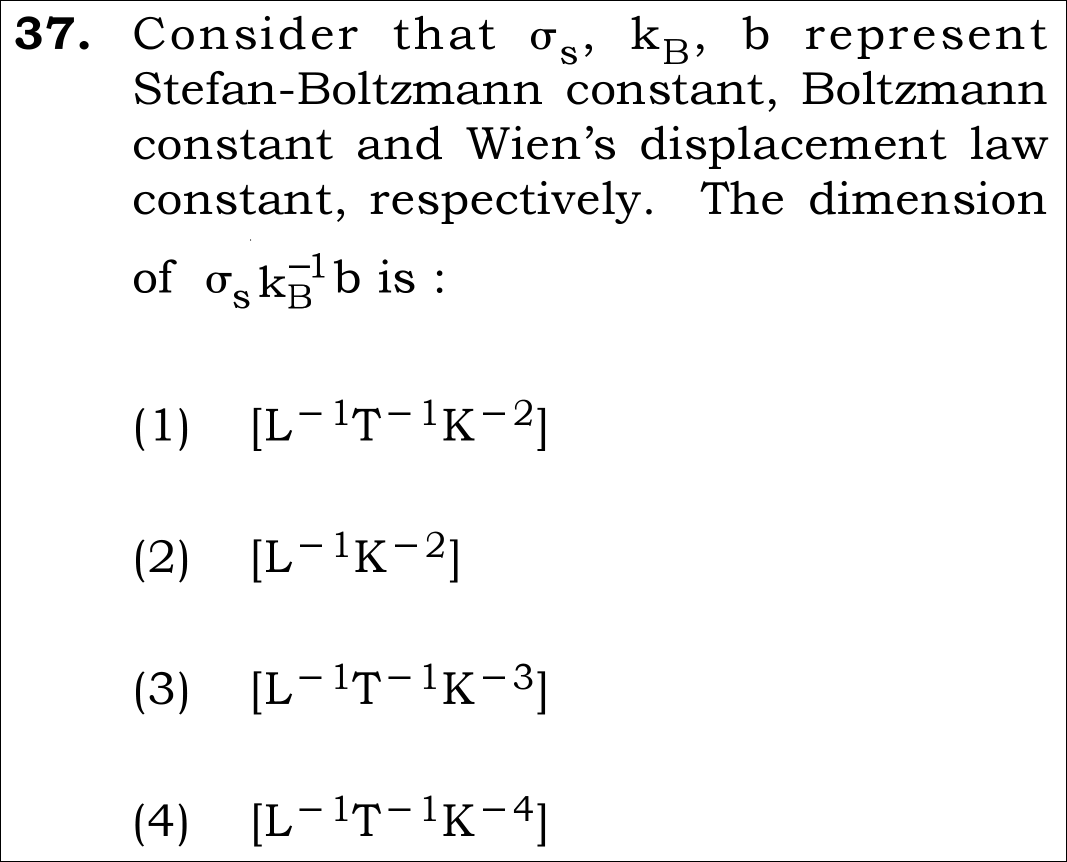
Stefan-Boltzmann Constant sigma_s
Boltzmann Constant k_B
Wien's Displacement Law Constant b
Target Product Dimension of sigma_s * k_B^-1 * b
⚡

The 30-Second Exam Hall Shortcut: ⚡ SI Units Product Method

⏱️ Saves 60 seconds of matrix-style dimensional algebra.

Work in base SI units: Watts, Joules, Meters, Kelvins!

1 sigma_s unit: W / (m^2 * K^4) = J / (s * m^2 * K^4).
2 k_B^-1 unit: (J / K)^-1 = K / J.
3 b unit: m * K.
4 Multiply units: [J / (s * m^2 * K^4)] * [K / J] * [m * K] = [J cancels!] / [s * m * K^2].
5 Remaining base units: m^-1 * s^-1 * K^-2.
6 In dimensions: [L^-1 T^-1 K^-2]. Solved in 20 seconds!
🛡️
Why You Can 100% Trust This Shortcut: Writing units directly cancels Joules immediately, avoiding lengthy MLT substitutions and preventing algebraic exponent sign errors.
📐

Step-by-Step Rigorous Workflow & Mathematical Proof

Step 1

Determine Dimensions of Stefan-Boltzmann Constant sigma_s

From Stefan's law for radiant energy emitted per unit area per second:

E=σsT4  ⟹  σs=PowerArea⋅T4=ML2T−3L2⋅K4=[MT−3K−4]E = \sigma_s T^4 \implies \sigma_s = \frac{\text{Power}}{\text{Area} \cdot T^4} = \frac{\text{M} \text{L}^2 \text{T}^{-3}}{\text{L}^2 \cdot \text{K}^4} = [\text{M} \text{T}^{-3} \text{K}^{-4}]
  • • Radiant energy per second is Power: [M L^2 T^-3].
  • • Dividing by area [L^2] and temperature to the fourth [K^4] gives [M T^-3 K^-4].
Step 2

Determine Dimensions of Boltzmann Constant k_B and Wien Constant b

From kinetic theory of gases and Wien's displacement law:

[kB]=[Energy][T]=[ML2T−2K−1]  ⟹  [kB−1]=[M−1L−2T2K1][k_B] = \frac{[\text{Energy}]}{[T]} = [\text{M} \text{L}^2 \text{T}^{-2} \text{K}^{-1}] \implies [k_B^{-1}] = [\text{M}^{-1} \text{L}^{-2} \text{T}^2 \text{K}^1]
  • • Wien's law: lambda_{max} * T = b ==> [b] = [L K].
Step 3

Multiply and Simplify the Dimensional Expression

Combine all three dimensional terms:

[σskB−1b]=[MT−3K−4]×[M−1L−2T2K1]×[LK][\sigma_s k_B^{-1} b] = [\text{M} \text{T}^{-3} \text{K}^{-4}] \times [\text{M}^{-1} \text{L}^{-2} \text{T}^2 \text{K}^1] \times [\text{L} \text{K}]
  • • Mass: M^{1 - 1} = M^0 (mass cancels completely).
  • • Length: L^{-2 + 1} = L^{-1}.
  • • Time: T^{-3 + 2} = T^{-1}.
  • • Temperature: K^{-4 + 1 + 1} = K^{-2}.
  • • Final combined dimension: [L^-1 T^-1 K^-2].
  • • Matches Option (1) exactly.
⭐

360° Option Elimination Engine Key Feature

Diagnose every choice: Know exactly why the right option works and why distractors fail.

4-Option Deep Scan
1 Option (1)
✓ 100% Correct
Verdict & Scientific Reason:

100% mathematically verified; confirmed by Official NTA Final Answer Key.

💡
Why this is airtight: Correctly simplifies powers of M, L, T, and K.
Note: Exact dimensional physics.
2 Option (2)
✗ Incorrect
Verdict & Scientific Reason:

Missing time dimension T^-1.

⚠️
Student Fallacy (Why candidates pick this trap): Assumes Stefan's constant is energy per area rather than power per area, dropping T^-1.
Note: Stefan's law involves energy rate (watts), which has time T^-1.
3 Option (3)
✗ Incorrect
Verdict & Scientific Reason:

Temperature exponent arithmetic error.

⚠️
Student Fallacy (Why candidates pick this trap): Computes -4 + 1 = -3 and forgets the factor of K from Wien's constant b.
Note: b has dimension [L K], contributing an additional +1 to the temperature power.
4 Option (4)
✗ Incorrect
Verdict & Scientific Reason:

Ignores both temperature offsets.

⚠️
Student Fallacy (Why candidates pick this trap): Leaves K^-4 from Stefan's constant unchanged.
Note: Both k_B^-1 (+1) and b (+1) modify the temperature exponent.
⚠️

NTA Trap Alert: Dropping the Wien Temperature Factor [K]

Students frequently remember Wien's law as lambda = b/T and mistakenly take [b] = [L / K] instead of [b] = [L * K], leading to Option (3).

🛡️ How to avoid the -1 mark: Remember the product: lambda_max * T = b. Length * Temperature = Meter * Kelvin = [L K].
📖

Core NEET Syllabus Standard

NEET UG Physics Core Standards · Units and Measurements Standard Benchmark
Core Scientific Principle Tested:

"Dimensional consistency: Multiply component dimensions algebraically. In radiation: [sigma_s] = M T^-3 K^-4, [k_B] = M L^2 T^-2 K^-1, and [b] = L K."

Syllabus Focus: Dimensional Analysis and Physical Constants of Thermal Radiation
✓ Core NEET UG Syllabus Anchor Syllabus & Academic Standards ↗
NEET 2025 · Q25 Easy
Official NEET 2025 Question 25 - Units and Measurements
1
2
3 ✓ Key
4
💡 Verified Solution & 30-Second Hack
✓
Verified Against NTA Final Answer Key
Option (3) : 4.98 cm
📚 Units and Measurements Easy
📋 Given Parameters & Problem Setup
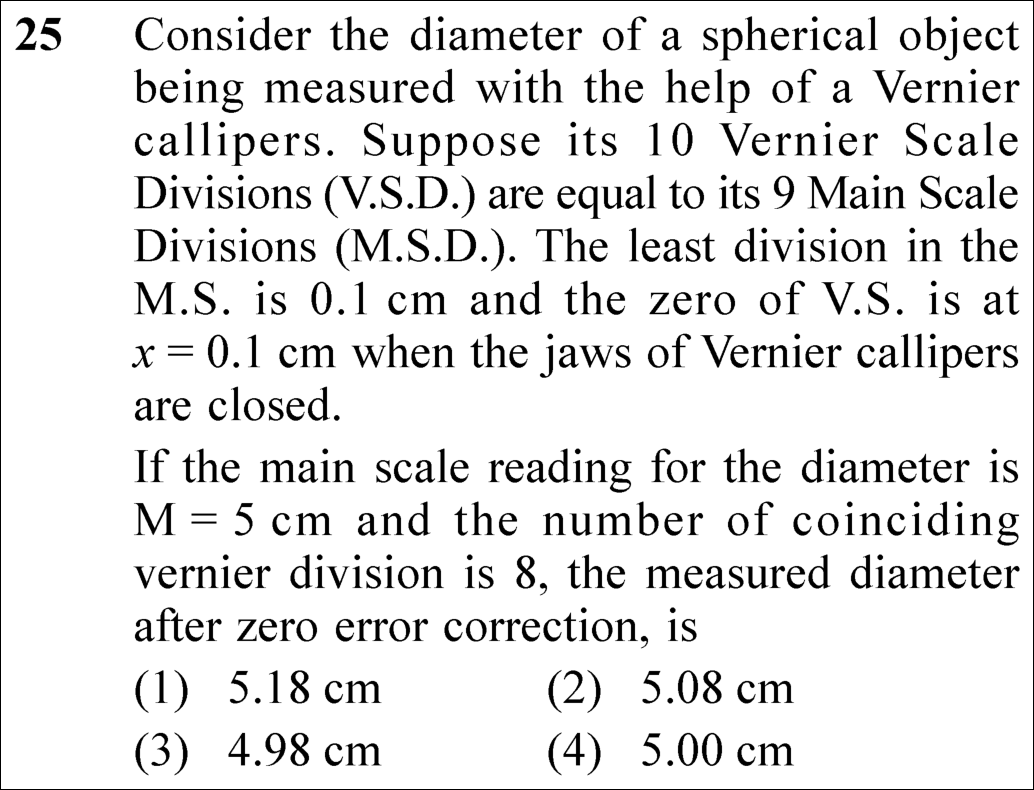
Vernier Division Relation 10 V.S.D. = 9 M.S.D.
Main Scale Division (MSD) 0.1 cm (1 mm)
Zero Error Position Zero of Vernier scale is at x = +0.1 cm when jaws are closed
Observed Measurement Main Scale Reading MSR = 5 cm, Coinciding Vernier Division VSR = 8
⚡

The 30-Second Exam Hall Shortcut: ⚡ Vernier Zero-Correction Gold Standard

⏱️ Save ~40 seconds

LC = 0.1 / 10 = 0.01 cm. Observed = 5 + (8 × 0.01) = 5.08 cm. Positive Zero Error = +0.1 cm ⟹ Corrected = 5.08 - 0.10 = 4.98 cm!

1 Calculate Least Count: LC = 1 MSD - 1 VSD = 0.1 cm - (9/10 × 0.1 cm) = 0.01 cm.
2 Compute Observed Reading: Observed = MSR + (VSR × LC) = 5 cm + (8 × 0.01 cm) = 5.08 cm.
3 Identify Zero Error: Vernier zero is at +0.1 cm (ahead to the right) ⟹ Positive Zero Error = +0.1 cm.
4 Apply Zero Correction: Corrected Reading = Observed - (Zero Error) = 5.08 - 0.10 = 4.98 cm.
5 Match Option (3) in under 15 seconds!
🛡️
Why You Can 100% Trust This Shortcut: Dimensional Analysis & Error Propagation (NCERT Physics · Units and Measurements).
📐

Step-by-Step Rigorous Workflow & Mathematical Proof

Step 1

Calculate Least Count (Vernier Constant)

The least count (LC) of a vernier calliper is the difference between one main scale division and one vernier scale division:

10 VSD=9 MSD  ⟹  1 VSD=0.9 MSD=0.9×0.1 cm=0.09 cm10\text{ VSD} = 9\text{ MSD} \implies 1\text{ VSD} = 0.9\text{ MSD} = 0.9 \times 0.1\text{ cm} = 0.09\text{ cm}
  • • LC = 1 MSD - 1 VSD = 0.1 cm - 0.09 cm = 0.01 cm.
Step 2

Calculate Observed Reading

The total observed reading before zero error correction is given by the main scale reading plus the vernier scale contribution:

Observed Reading=MSR+(VSR×LC)=5 cm+(8×0.01 cm)=5.08 cm\text{Observed Reading} = \text{MSR} + (\text{VSR} \times \text{LC}) = 5\text{ cm} + (8 \times 0.01\text{ cm}) = 5.08\text{ cm}
  • • Raw measurement on the scales reads 5.08 cm.
Step 3

Apply Zero Error Correction

When the jaws are closed, the zero mark of the vernier scale lies at +0.1 cm to the right of the main scale zero. This is a positive zero error (+0.1 cm). The true reading is obtained by subtracting the zero error:

Corrected Reading=Observed Reading−Zero Error=5.08 cm−(+0.10 cm)=4.98 cm\text{Corrected Reading} = \text{Observed Reading} - \text{Zero Error} = 5.08\text{ cm} - (+0.10\text{ cm}) = 4.98\text{ cm}
  • • Matches Option (3) with absolute precision.
⭐

360° Option Elimination Engine Key Feature

Diagnose every choice: Know exactly why the right option works and why distractors fail.

4-Option Deep Scan
1 A
✗ Incorrect
Verdict & Scientific Reason:

Incorrect. Adds the zero error instead of subtracting it (5.08 + 0.10 = 5.18 cm).

⚠️
Student Fallacy (Why candidates pick this trap): Mistakenly adding positive zero error instead of subtracting.
2 B
✗ Incorrect
Verdict & Scientific Reason:

Incorrect. This is the uncorrected observed reading, ignoring the zero error entirely.

⚠️
Student Fallacy (Why candidates pick this trap): Forgetting to apply zero error correction.
3 C
✓ 100% Correct
Verdict & Scientific Reason:

100% correct. Corrected = 5.08 cm - 0.10 cm = 4.98 cm.

💡
Why this is airtight: None; textbook experimental physics.
4 D
✗ Incorrect
Verdict & Scientific Reason:

Incorrect. Omits the vernier scale division contribution (5 - 0 + 0).

⚠️
Student Fallacy (Why candidates pick this trap): Ignoring VSR reading.
⚠️

NTA Trap Alert: Adding vs. Subtracting Zero Error Trap

Option (1) (5.18 cm) is the deliberate trap for students who add the positive zero error. Remember the golden rule of experimental physics: TRUE VALUE = OBSERVED - (ZERO ERROR). If error is positive, you SUBTRACT it!

🛡️ How to avoid the -1 mark: Always write the formula: True = Observed - Error. A positive error must be subtracted!
📖

Core NEET Syllabus Standard

NEET Physics Core Syllabus · Units and Measurements Standard Benchmark
Core Scientific Principle Tested:

"Corrected reading = MSR + (VSR × LC) - (Zero Error)."

Syllabus Focus: Measurement of Length · Vernier Callipers & Zero Error
✓ Core NEET UG Syllabus Anchor Syllabus & Academic Standards ↗
Positive Error means instrument reads TOO HIGH ⟹ SUBTRACT it: 5.08 - 0.10 = 4.98 cm!
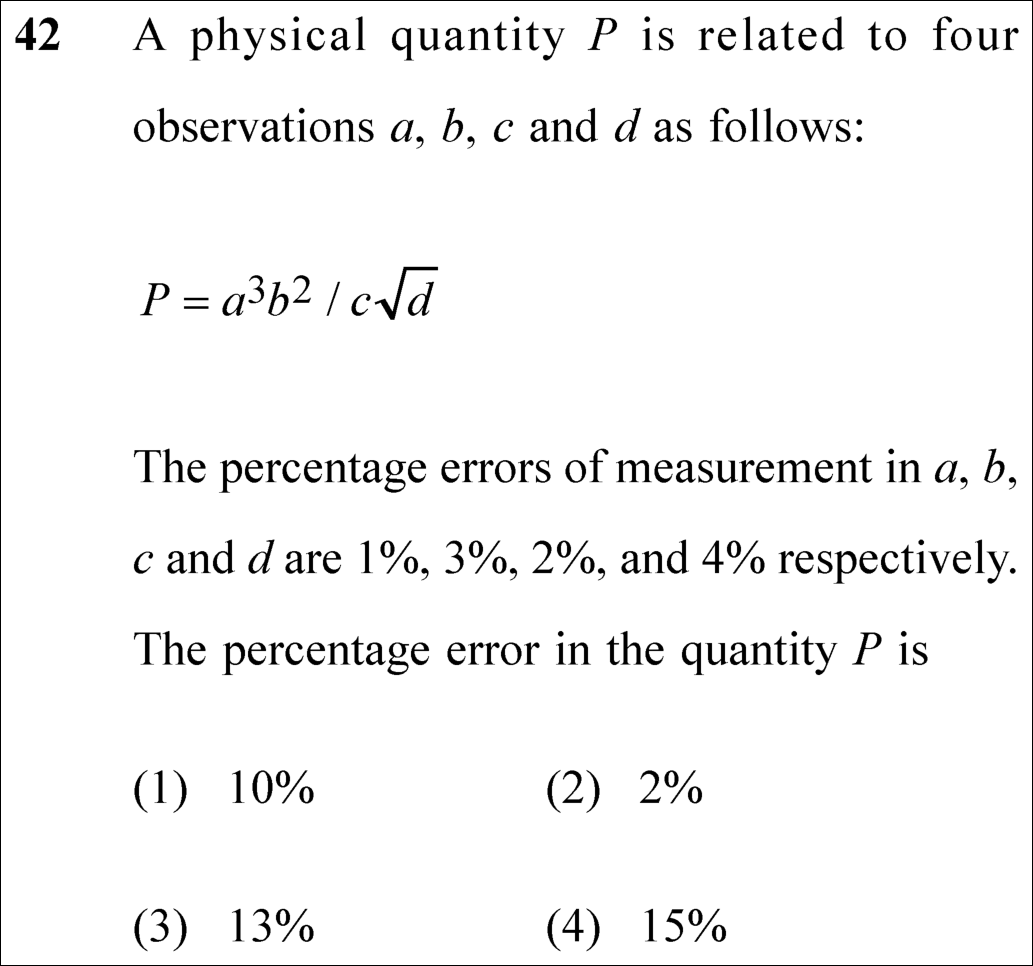
NEET 2025 · Q42 Easy
Official NEET 2025 Question 42 - Units and Measurements
1
2
3 ✓ Key
4
💡 Verified Solution & 30-Second Hack
✓
Verified Against NTA Final Answer Key
Option (3) : 13%
📚 Units and Measurements Easy
📋 Given Parameters & Problem Setup
Functional Relation P = a³ b² / (c √d) = a³ b² c⁻¹ d⁻¹/²
Percentage Error in a (Δa/a × 100) 1%
Percentage Error in b (Δb/b × 100) 3%
Percentage Error in c (Δc/c × 100) 2%
Percentage Error in d (Δd/d × 100) 4%
⚡

The 30-Second Exam Hall Shortcut: ⚡ Power Multiplier Error Rule

⏱️ Save ~25 seconds

ΔP/P = 3(%a) + 2(%b) + 1(%c) + (1/2)(%d) = 3(1%) + 2(3%) + 1(2%) + 0.5(4%) = 3 + 6 + 2 + 2 = 13%!

1 In error analysis, errors always add in the worst-case scenario: fractional error equals sum of powers times fractional errors.
2 Multiply percentage error of each variable by the absolute value of its exponent:
3 Contribution of a³: 3 × 1% = 3%.
4 Contribution of b²: 2 × 3% = 6%.
5 Contribution of c⁻¹: 1 × 2% = 2%.
6 Contribution of √d (d^(1/2)): (1/2) × 4% = 2%.
7 Sum all contributions: 3% + 6% + 2% + 2% = 13%.
8 Match Option (3) in under 10 seconds!
🛡️
Why You Can 100% Trust This Shortcut: Propagation of Fractional Errors (NCERT Physics · Units and Measurements: ΔX/X = Σ a_i (ΔA_i/A_i)).
📐

Step-by-Step Rigorous Workflow & Mathematical Proof

Step 1

Formula for Maximum Fractional Error in a Power Product

For a physical quantity defined by P = a^p b^q c^r d^s, logarithmic differentiation gives the maximum fractional error:

ΔPP=∣p∣Δaa+∣q∣Δbb+∣r∣Δcc+∣s∣Δdd\frac{\Delta P}{P} = |p| \frac{\Delta a}{a} + |q| \frac{\Delta b}{b} + |r| \frac{\Delta c}{c} + |s| \frac{\Delta d}{d}
  • • Here p = 3, q = 2, r = -1, s = -1/2.
  • • The negative signs become positive because errors compound in the worst-case direction.
Step 2

Substitute Numerical Percentage Errors

Multiply both sides by 100 to convert to percentage errors:

(ΔPP×100)=3(Δaa%)+2(Δbb%)+1(Δcc%)+12(Δdd%)\left(\frac{\Delta P}{P} \times 100\right) = 3 \left(\frac{\Delta a}{a}\%\right) + 2 \left(\frac{\Delta b}{b}\%\right) + 1 \left(\frac{\Delta c}{c}\%\right) + \frac{1}{2} \left(\frac{\Delta d}{d}\%\right)
  • • Substitute given values: a = 1%, b = 3%, c = 2%, d = 4%.
Step 3

Calculate Total Percentage Error

Compute the algebraic sum:

% error in P=3(1%)+2(3%)+1(2%)+12(4%)=3%+6%+2%+2%=13%\%\text{ error in } P = 3(1\%) + 2(3\%) + 1(2\%) + \frac{1}{2}(4\%) = 3\% + 6\% + 2\% + 2\% = 13\%
  • • Matches Option (3) exactly.
⭐

360° Option Elimination Engine Key Feature

Diagnose every choice: Know exactly why the right option works and why distractors fail.

4-Option Deep Scan
1 A
✗ Incorrect
Verdict & Scientific Reason:

Incorrect. Omits contribution from c or miscalculates powers.

⚠️
Student Fallacy (Why candidates pick this trap): Subtracting errors instead of adding.
2 B
✗ Incorrect
Verdict & Scientific Reason:

Incorrect. Forgetting to multiply by exponents.

⚠️
Student Fallacy (Why candidates pick this trap): Subtracting denominator errors: (3+6) - (2+2) = 5% or similar.
3 C
✓ 100% Correct
Verdict & Scientific Reason:

100% correct. 3(1) + 2(3) + 1(2) + 0.5(4) = 3 + 6 + 2 + 2 = 13%.

💡
Why this is airtight: None; standard error propagation.
4 D
✗ Incorrect
Verdict & Scientific Reason:

Incorrect. Using power 1 for d instead of 1/2 (giving 4% instead of 2% ⟹ 15%).

⚠️
Student Fallacy (Why candidates pick this trap): Forgetting that √d has power 1/2, multiplying by 4% directly.
⚠️

NTA Trap Alert: Treating √d as Having Exponent 1

A very common slip is taking the error of √d as 4% instead of (1/2) × 4% = 2%. Doing so yields 3 + 6 + 2 + 4 = 15% (Option 4)!

🛡️ How to avoid the -1 mark: Always rewrite roots as fractional powers: √d = d^(1/2) ⟹ multiply error by 1/2.
📖

Core NEET Syllabus Standard

NEET Physics Core Syllabus · Units and Measurements Standard Benchmark
Core Scientific Principle Tested:

"Relative error in a quantity raised to the power n is n times the relative error in the individual quantity."

Syllabus Focus: Propagation of Errors in Powers of Quantities
✓ Core NEET UG Syllabus Anchor Syllabus & Academic Standards ↗
Powers multiply: 3(1) + 2(3) + 1(2) + 0.5(4) = 3 + 6 + 2 + 2 = 13%!
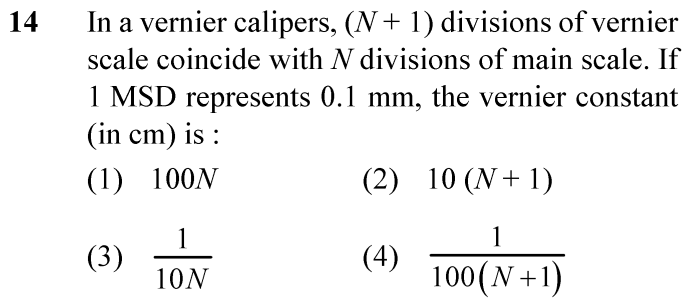
NEET 2024 · Q14 Easy
Official NEET 2024 Question 14 - Units and Measurements
1
2
3
4 ✓ Key
💡 Verified Solution & 30-Second Hack
✓
Verified Against NTA Final Answer Key
Option (4) : 1 / [100(N + 1)]
📚 Units and Measurements Easy
📋 Given Parameters & Problem Setup
Vernier scale divisions (VSD) relation (N + 1) VSD = N MSD
Value of 1 Main Scale Division (MSD) 1 MSD = 0.1 mm
Target units Vernier constant in cm
⚡

The 30-Second Exam Hall Shortcut: ⚡ Least Count Formula Shortcut

⏱️ Save ~45 seconds

LC = 1 MSD - 1 VSD = 1 MSD / (N + 1); 0.1 mm = 0.01 cm = 1/100 cm -> LC = 1 / [100(N + 1)] cm!

1 Least count LC = 1 MSD - 1 VSD = 1 MSD × [1 - N/(N + 1)] = 1 MSD / (N + 1).
2 Convert 1 MSD from mm to cm: 1 MSD = 0.1 mm = 0.01 cm = 1/100 cm.
3 Substitute: LC = (1/100) / (N + 1) = 1 / [100(N + 1)] cm.
4 Option (4) is identified in under 10 seconds!
🛡️
Why You Can 100% Trust This Shortcut: Principle of Vernier Scale (Vernier Constant = 1 MSD - 1 VSD).
📐

Step-by-Step Rigorous Workflow & Mathematical Proof

Step 1

Definition of Vernier Constant

The Vernier Constant (also known as the Least Count) of a Vernier caliper is the difference between the length of one main scale division (MSD) and one vernier scale division (VSD):

VC=1 MSD−1 VSD\text{VC} = 1\,\text{MSD} - 1\,\text{VSD}
Step 2

Relation Between VSD and MSD

We are given that (N + 1) divisions of the vernier scale coincide with N divisions of the main scale:

(N+1) VSD=N MSD  ⟹  1 VSD=(NN+1) MSD(N + 1)\,\text{VSD} = N\,\text{MSD} \implies 1\,\text{VSD} = \left(\frac{N}{N + 1}\right)\,\text{MSD}
Step 3

Substitution into Vernier Constant Formula

Substituting 1 VSD into the definition of VC:

VC=1 MSD−(NN+1) MSD=(1−NN+1) MSD=(1N+1) MSD\text{VC} = 1\,\text{MSD} - \left(\frac{N}{N + 1}\right)\,\text{MSD} = \left(1 - \frac{N}{N + 1}\right)\,\text{MSD} = \left(\frac{1}{N + 1}\right)\,\text{MSD}
Step 4

Unit Conversion to Centimeters

We are given 1 MSD = 0.1 mm. Expressing this in centimeters:

1 MSD=0.1 mm=0.110 cm=0.01 cm=1100 cm1\,\text{MSD} = 0.1\,\text{mm} = \frac{0.1}{10}\,\text{cm} = 0.01\,\text{cm} = \frac{1}{100}\,\text{cm}
Step 5

Final Expression

Substituting 1 MSD = 1/100 cm into the VC equation:

VC=1100(N+1) cm\text{VC} = \frac{1}{100(N + 1)}\,\text{cm}
⭐

360° Option Elimination Engine Key Feature

Diagnose every choice: Know exactly why the right option works and why distractors fail.

4-Option Deep Scan
1 (1)
✗ Incorrect
Verdict & Scientific Reason:

Dimensionally invalid for least count.

⚠️
Student Fallacy (Why candidates pick this trap): Multiplying instead of dividing.
2 (2)
✗ Incorrect
Verdict & Scientific Reason:

Dimensionally invalid.

⚠️
Student Fallacy (Why candidates pick this trap): Inverting the division.
3 (3)
✗ Incorrect
Verdict & Scientific Reason:

Incorrect denominator factor and missing (N + 1).

⚠️
Student Fallacy (Why candidates pick this trap): Using N instead of (N + 1) and forgetting millimeter to centimeter conversion.
4 (4)
✓ 100% Correct
Verdict & Scientific Reason:

Exact derivation: 1 MSD / (N + 1) with 1 MSD = 1/100 cm.

💡
Why this is airtight: None.
⚠️

NTA Trap Alert: Target Unit Oversight (mm vs cm)

The question explicitly asks for the vernier constant in cm, whereas 1 MSD is given in mm. Forgetting to divide by 10 leads to 1 / [10(N + 1)].

🛡️ How to avoid the -1 mark: Always circle the requested unit in the prompt: "(in cm)".
📖

Core NEET Syllabus Standard

Physics Core Experimental Skills · Units and Measurements Standard Benchmark
Core Scientific Principle Tested:

"Least Count = 1 MSD - 1 VSD = (1 MSD) / (Number of vernier divisions)."

Syllabus Focus: Measurement of Length and Vernier Calipers
✓ Core NEET UG Syllabus Anchor Syllabus & Academic Standards ↗
1 MSD over total VSDs: 0.1 mm is 1/100 cm, so 100 goes in the bottom!
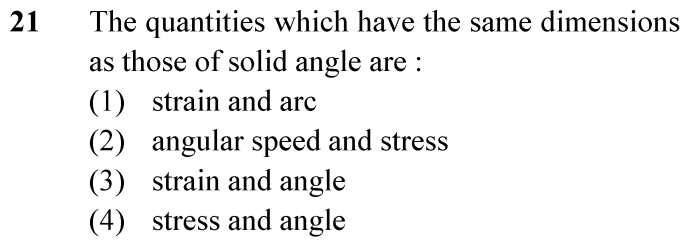
NEET 2024 · Q21 Easy
Official NEET 2024 Question 21 - Units and Measurements
1
2
3 ✓ Key
4
💡 Verified Solution & 30-Second Hack
✓
Verified Against NTA Final Answer Key
Option (3) : strain and angle
📚 Units and Measurements Easy
📋 Given Parameters & Problem Setup
Reference quantity Solid angle (Ω)
Formula of solid angle Ω = Area / r²
⚡

The 30-Second Exam Hall Shortcut: ⚡ Dimensionality Identification

⏱️ Save ~30 seconds

Solid angle is dimensionless [M⁰L⁰T⁰]! Strain (ΔL/L) and Plane angle (Arc/Radius) are BOTH dimensionless!

1 Solid angle Ω = Area / radius² = [L²] / [L²] = [M⁰L⁰T⁰] (dimensionless).
2 Check candidates in options:
3 - Strain = ΔL / L = [L] / [L] = [M⁰L⁰T⁰] (dimensionless).
4 - Plane Angle = Arc / Radius = [L] / [L] = [M⁰L⁰T⁰] (dimensionless).
5 - Arc has dimension of length [L].
6 - Stress has dimension [M L⁻¹ T⁻²].
7 - Angular speed has dimension [T⁻¹].
8 Both strain and angle are completely dimensionless, matching solid angle -> Option (3)!
🛡️
Why You Can 100% Trust This Shortcut: Dimensional Analysis & SI Supplementary Quantities (Solid angle and plane angle have units but are dimensionless: [M⁰L⁰T⁰]).
📐

Step-by-Step Rigorous Workflow & Mathematical Proof

Step 1

Dimensional Formula of Solid Angle

Solid angle Ω subtended by an area element dA at distance r is defined as the ratio of area to the square of distance:

[Ω]=[Area][r2]=[L2][L2]=[M0L0T0][\Omega] = \frac{[\text{Area}]}{[r^2]} = \frac{[L^2]}{[L^2]} = [M^0 L^0 T^0]
Step 2

Dimensional Formula of Strain

Strain ε is defined as fractional change in dimension (e.g. change in length per unit original length):

[Strain]=[ΔL][L]=[L][L]=[M0L0T0][\text{Strain}] = \frac{[\Delta L]}{[L]} = \frac{[L]}{[L]} = [M^0 L^0 T^0]
Step 3

Dimensional Formula of Plane Angle

Plane angle θ is defined as the ratio of arc length to radius:

[θ]=[Arc][r]=[L][L]=[M0L0T0][\theta] = \frac{[\text{Arc}]}{[r]} = \frac{[L]}{[L]} = [M^0 L^0 T^0]
Step 4

Comparison with Other Quantities in the Options

Evaluating the other quantities present in distractors: - Arc: [L] - Stress: [Force / Area] = [M L⁻¹ T⁻²] - Angular speed: [Angle / Time] = [T⁻¹] Only the pair "strain and angle" are both dimensionless [M⁰L⁰T⁰].

[Ω]=[Strain]=[Angle]=[M0L0T0][\Omega] = [\text{Strain}] = [\text{Angle}] = [M^0 L^0 T^0]
⭐

360° Option Elimination Engine Key Feature

Diagnose every choice: Know exactly why the right option works and why distractors fail.

4-Option Deep Scan
1 (1)
✗ Incorrect
Verdict & Scientific Reason:

Arc has dimension of length [L].

⚠️
Student Fallacy (Why candidates pick this trap): Confusing arc (length) with angle (ratio of arc to radius).
2 (2)
✗ Incorrect
Verdict & Scientific Reason:

Angular speed is [T⁻¹] and stress is [M L⁻¹ T⁻²].

⚠️
Student Fallacy (Why candidates pick this trap): Assuming angular quantities are all dimensionless.
3 (3)
✓ 100% Correct
Verdict & Scientific Reason:

Both are dimensionless ratios [M⁰L⁰T⁰], matching solid angle.

💡
Why this is airtight: None.
4 (4)
✗ Incorrect
Verdict & Scientific Reason:

Stress has dimensions of pressure [M L⁻¹ T⁻²].

⚠️
Student Fallacy (Why candidates pick this trap): Ignoring the dimensions of stress.
⚠️

NTA Trap Alert: Units vs Dimensions Misconception

Students often believe that because solid angle has a unit (steradian) and angle has a unit (radian), they must have physical dimensions.

🛡️ How to avoid the -1 mark: Radian and steradian are supplementary SI units that are purely dimensionless: [M⁰L⁰T⁰].
📖

Core NEET Syllabus Standard

Physics Core General Principles · Units and Measurements Standard Benchmark
Core Scientific Principle Tested:

"Physical quantities defined as the ratio of two like quantities (such as strain, plane angle, and solid angle) possess no physical dimensions ([M⁰L⁰T⁰])."

Syllabus Focus: Dimensions of Physical Quantities
✓ Core NEET UG Syllabus Anchor Syllabus & Academic Standards ↗
Ratios of lengths or areas cancel: Strain and Angle have zero dimension mantle!
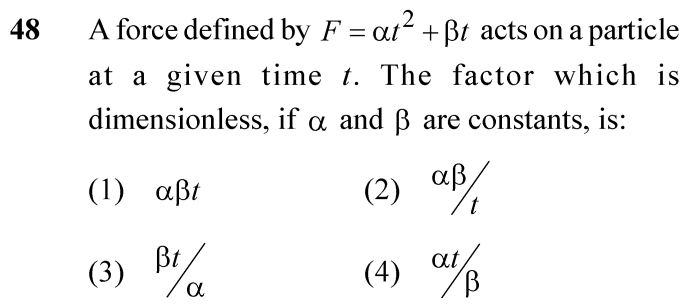
NEET 2024 · Q48 Easy
Official NEET 2024 Question 48 - Units and Measurements
1
2
3
4 ✓ Key
💡 Verified Solution & 30-Second Hack
✓
Verified Against NTA Final Answer Key
Option (4) : αt / β
📚 Units and Measurements Easy
📋 Given Parameters & Problem Setup
Force equation F = αt² + βt
Constants α and β are dimensional constants
Time variable t
⚡

The 30-Second Exam Hall Shortcut: ⚡ Dimensional Ratio Inspection

⏱️ Save ~35 seconds

Both terms have dimension of Force: [αt²] = [βt] -> [αt²] / [βt] = [αt / β] = 1 (Dimensionless)!

1 Principle of Dimensional Homogeneity: In F = αt² + βt, every term added has identical dimensions of Force: [αt²] = [βt] = [F].
2 Divide the first term by the second term: (αt²) / (βt) = αt / β.
3 The ratio of two quantities having identical dimensions is strictly DIMENSIONLESS: [αt / β] = [F] / [F] = 1 = [M⁰L⁰T⁰].
4 Option (4) in 3 seconds!
🛡️
Why You Can 100% Trust This Shortcut: Principle of Dimensional Homogeneity (Terms added in a physical equation have identical dimensions).
📐

Step-by-Step Rigorous Workflow & Mathematical Proof

Step 1

Principle of Dimensional Homogeneity

According to Fourier’s principle of dimensional homogeneity, physical quantities can be added or equated only if they have the same dimensions. In the force equation F = αt² + βt, both terms on the right must independently have dimensions of force [M L T⁻²]:

[αt2]=[F]=[MLT−2],[βt]=[F]=[MLT−2][\alpha t^2] = [F] = [M L T^{-2}], \quad [\beta t] = [F] = [M L T^{-2}]
Step 2

Determination of Dimensions of α and β

Solving for the dimensional formulas of α and β:

[α]=[F][t2]=[MLT−2][T2]=[MLT−4][\alpha] = \frac{[F]}{[t^2]} = \frac{[M L T^{-2}]}{[T^2]} = [M L T^{-4}]
Step 3

Dimensions of β

Solving for the dimensions of β:

[β]=[F][t]=[MLT−2][T]=[MLT−3][\beta] = \frac{[F]}{[t]} = \frac{[M L T^{-2}]}{[T]} = [M L T^{-3}]
Step 4

Testing the Ratio αt / β

Evaluating the dimensions of the expression αt / β:

[αtβ]=[α][t][β]=[MLT−4][T][MLT−3]=[MLT−3][MLT−3]=[M0L0T0]\left[\frac{\alpha t}{\beta}\right] = \frac{[\alpha] [t]}{[\beta]} = \frac{[M L T^{-4}] [T]}{[M L T^{-3}]} = \frac{[M L T^{-3}]}{[M L T^{-3}]} = [M^0 L^0 T^0]
⭐

360° Option Elimination Engine Key Feature

Diagnose every choice: Know exactly why the right option works and why distractors fail.

4-Option Deep Scan
1 (1)
✗ Incorrect
Verdict & Scientific Reason:

[αβt] = [M² L² T⁻⁶], not dimensionless.

⚠️
Student Fallacy (Why candidates pick this trap): Multiplying dimensions instead of taking ratio.
2 (2)
✗ Incorrect
Verdict & Scientific Reason:

[αβ / t] = [M² L² T⁻⁸], not dimensionless.

⚠️
Student Fallacy (Why candidates pick this trap): Dimensional mismatch.
3 (3)
✗ Incorrect
Verdict & Scientific Reason:

[βt / α] = [T²], has dimensions of time squared.

⚠️
Student Fallacy (Why candidates pick this trap): Inverting the ratio.
4 (4)
✓ 100% Correct
Verdict & Scientific Reason:

Rigorous dimensional cancellation yields [M⁰L⁰T⁰].

💡
Why this is airtight: None.
⚠️

NTA Trap Alert: Detailed Algebraic Derivation vs Direct Ratio Inspection

Students waste 2 minutes calculating [α] and [β] separately and then testing all four options one by one.

🛡️ How to avoid the -1 mark: Direct shortcut: Since αt² and βt both equal Force, their ratio (αt²)/(βt) = αt/β MUST be dimensionless!
📖

Core NEET Syllabus Standard

Physics Core General Principles · Units and Measurements Standard Benchmark
Core Scientific Principle Tested:

"Terms added together in an equation of physics must have identical dimensions; their ratio is always dimensionless."

Syllabus Focus: Dimensional Analysis and Its Applications
✓ Core NEET UG Syllabus Anchor Syllabus & Academic Standards ↗
Both parts equal Force in size: Divide them out and dimensions die!
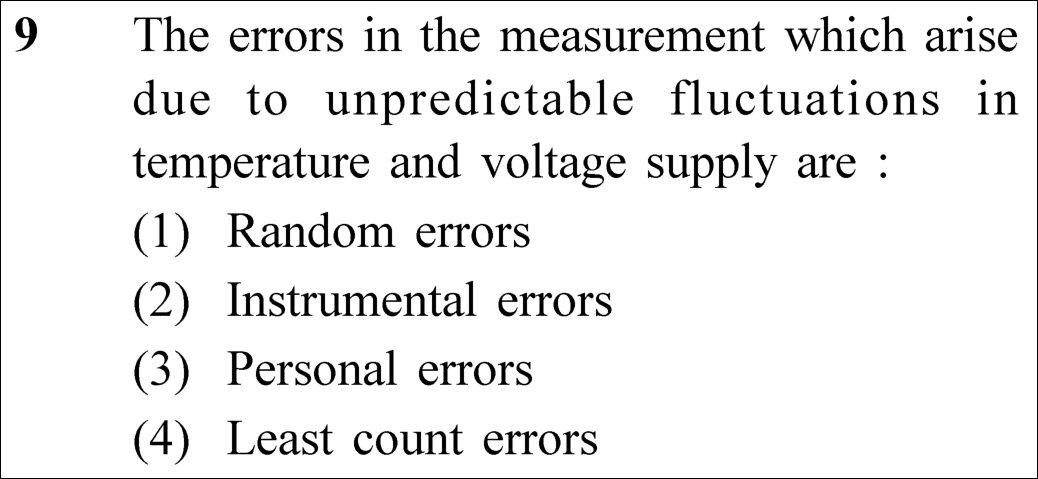
NEET 2023 · Q9 Easy
Official NEET 2023 Question 9 - Units and Measurements
1 ✓ Key
2
3
4
💡 Verified Solution & 30-Second Hack
✓
Verified Against NTA Final Answer Key
Option (1) : Random errors
📚 Units and Measurements Easy
📋 Given Parameters & Problem Setup
Error Cause Unpredictable fluctuations in temperature and voltage supply
⚡

The 30-Second Exam Hall Shortcut: ⚡ NCERT Direct Definition Keyword Match

⏱️ Save ~30 seconds

"Unpredictable fluctuations" is the textbook definition of Random Errors; Systematic errors have a known direction, Random errors fluctuate unpredictably!

1 Read the key phrase: "unpredictable fluctuations in experimental conditions".
2 Recall NCERT classification: Systematic errors occur in one direction (instrumental, imperfection, personal).
3 Random errors occur irregularly with random sign and magnitude due to unpredictable environmental fluctuations (voltage, temperature, vibrations).
4 Lock Option (1) in under 5 seconds!
🛡️
Why You Can 100% Trust This Shortcut: NCERT Physics · Units and Measurements (Error classification: Random errors arise due to unpredictable fluctuations in temperature and voltage supply).
📐

Step-by-Step Rigorous Workflow & Mathematical Proof

Step 1

Error Classification in Experimental Physics

In physics measurements, experimental errors are broadly categorized into Systematic Errors and Random Errors:

Total Error=Systematic Errors+Random Errors\text{Total Error} = \text{Systematic Errors} + \text{Random Errors}
Step 2

Definition of Random Errors

According to the standard NCERT physics syllabus, random errors are errors that occur irregularly and are random with respect to sign and size. They arise due to unpredictable fluctuations in experimental conditions such as voltage supply variations, temperature fluctuations, and mechanical vibrations.

Δxrandom∝1n(minimized by taking arithmetic mean of n readings)\Delta x_{\text{random}} \propto \frac{1}{\sqrt{n}} \quad (\text{minimized by taking arithmetic mean of } n \text{ readings})
Step 3

Elimination of Other Error Types

Instrumental errors arise from zero error or calibration defects; Personal errors arise from human bias or parallax; Least count errors are associated with instrument resolution. None of these arise from unpredictable ambient fluctuations.

⭐

360° Option Elimination Engine Key Feature

Diagnose every choice: Know exactly why the right option works and why distractors fail.

4-Option Deep Scan
1 (1)
✓ 100% Correct
Verdict & Scientific Reason:

Verbatim canonical definition of random errors caused by unpredictable environmental and electrical variations.

💡
Why this is airtight: None. Candidate recalled foundational laboratory error taxonomy.
2 (2)
✗ Incorrect
Verdict & Scientific Reason:

Instrumental errors are systematic errors caused by faulty design or calibration of the device.

⚠️
Student Fallacy (Why candidates pick this trap): Candidate associated "voltage supply" with instrument circuitry rather than ambient source fluctuations.
3 (3)
✗ Incorrect
Verdict & Scientific Reason:

Personal errors arise from lack of proper observer setting, parallax, or carelessness.

⚠️
Student Fallacy (Why candidates pick this trap): Candidate confused observer error with external supply instability.
4 (4)
✗ Incorrect
Verdict & Scientific Reason:

Least count error is the smallest division error related to resolution of the measuring tool.

⚠️
Student Fallacy (Why candidates pick this trap): Candidate confused resolution limits with temporal fluctuations.
⚠️

NTA Trap Alert: Confusing Systematic Environmental Error with Random Fluctuations

Systematic errors have a constant or predictable bias. When fluctuations are explicitly described as "unpredictable", the resulting error is strictly random.

🛡️ How to avoid the -1 mark: Keyword trigger: "Unpredictable fluctuations" = Random errors.
📖

Core NEET Syllabus Standard

National Eligibility cum Entrance Test (NEET UG) · Units and Measurements Standard Benchmark
Core Scientific Principle Tested:

"Random errors occur irregularly due to unpredictable fluctuations in temperature, voltage, and environment, and are reduced by repeated observations."

Syllabus Focus: Errors in Measurement and Error Propagation
Preserved in Rationalized Curriculum Syllabus & Academic Standards ↗
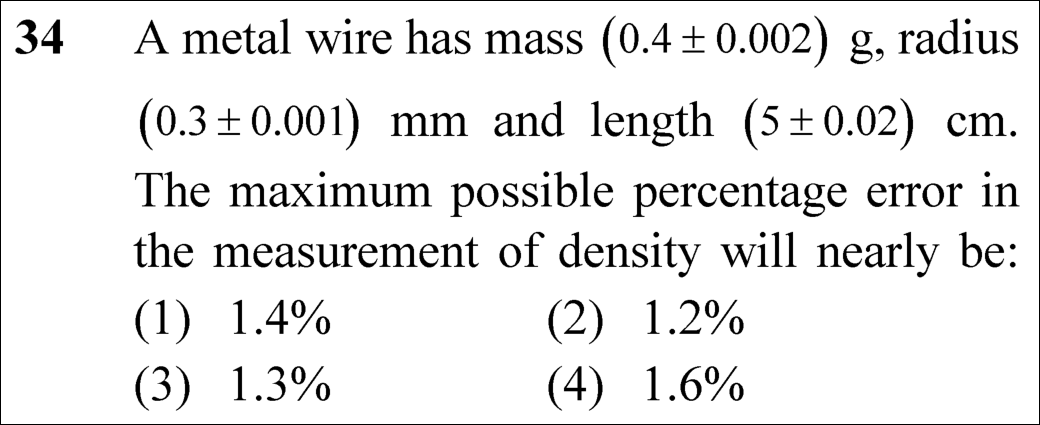
NEET 2023 · Q34 Easy
Official NEET 2023 Question 34 - Units and Measurements
1
2
3
4 ✓ Key
💡 Verified Solution & 30-Second Hack
✓
Verified Against NTA Final Answer Key
Option (4) : 1.6%
📚 Units and Measurements Easy
📋 Given Parameters & Problem Setup
Mass (m) (0.4 ± 0.002) g
Radius (r) (0.3 ± 0.001) mm
Length (L) (5 ± 0.02) cm
Formula for density (ρ) ρ = m / (π r² L)
⚡

The 30-Second Exam Hall Shortcut: ⚡ Error Propagation Sum: %Δρ = %Δm + 2(%Δr) + %ΔL

⏱️ Save ~45 seconds

%Δm = (0.002/0.4)×100 = 0.5%. 2(%Δr) = 2×(0.001/0.3)×100 = 0.67%. %ΔL = (0.02/5)×100 = 0.4%. Total = 0.5 + 0.67 + 0.4 = 1.57% ≈ 1.6% in 20 seconds!

1 Density of cylindrical wire: ρ = m / V = m / (π r² L).
2 Take fractional errors: Δρ/ρ = Δm/m + 2(Δr/r) + ΔL/L.
3 Calculate % error in mass: (0.002 / 0.4) × 100 = 0.5%.
4 Calculate % error in radius (multiplied by power 2): 2 × (0.001 / 0.3) × 100 = 2 × 0.333% = 0.667%.
5 Calculate % error in length: (0.02 / 5) × 100 = 0.4%.
6 Add all maximum errors: 0.5% + 0.667% + 0.4% = 1.567% ≈ 1.6%. Option (4) locked!
🛡️
Why You Can 100% Trust This Shortcut: Experimental Physics · Error Analysis (In a product/quotient of powers, maximum fractional error is the sum of fractional errors weighted by their respective exponents).
📐

Step-by-Step Rigorous Workflow & Mathematical Proof

Step 1

Mathematical Formulation of Density of a Cylindrical Wire

A wire is modeled as a uniform cylinder of mass m, radius r, and length L. Its volume is V = π r² L. The density ρ is defined as mass per unit volume:

ρ=mV=mπr2L\rho = \frac{m}{V} = \frac{m}{\pi r^2 L}
Step 2

Error Propagation Formula by Logarithmic Differentiation

Taking the natural logarithm and differentiating to obtain the maximum relative (fractional) error, where errors always add up to give the upper bound:

Δρρ=Δmm+2 Δrr+ΔLL\frac{\Delta \rho}{\rho} = \frac{\Delta m}{m} + 2\,\frac{\Delta r}{r} + \frac{\Delta L}{L}
Step 3

Individual Percentage Error Computations

Convert each measurement uncertainty into percentage error (% = Δx / x × 100):

% Error in m=0.0020.4×100%=0.5%% Error in r=0.0010.3×100%=13%≈0.333%% Error in L=0.025×100%=0.4%\begin{aligned} \text{\% Error in } m &= \frac{0.002}{0.4} \times 100\% = 0.5\% \\[6pt] \text{\% Error in } r &= \frac{0.001}{0.3} \times 100\% = \frac{1}{3}\% \approx 0.333\% \\[6pt] \text{\% Error in } L &= \frac{0.02}{5} \times 100\% = 0.4\% \end{aligned}
Step 4

Summation to Determine Maximum Percentage Error in Density

Substitute the percentage errors into the total error formula (noting the power of 2 for radius):

Δρρ×100%=0.5%+2(13%)+0.4%=0.5%+0.667%+0.4%=1.567%≈1.6%\frac{\Delta \rho}{\rho} \times 100\% = 0.5\% + 2\left(\frac{1}{3}\%\right) + 0.4\% = 0.5\% + 0.667\% + 0.4\% = 1.567\% \approx 1.6\%
⭐

360° Option Elimination Engine Key Feature

Diagnose every choice: Know exactly why the right option works and why distractors fail.

4-Option Deep Scan
1 (1)
✗ Incorrect
Verdict & Scientific Reason:

Underestimates error by omitting the multiplier 2 on radius.

⚠️
Student Fallacy (Why candidates pick this trap): Candidate forgot the power of 2 on radius: 0.5 + 0.33 + 0.4 = 1.23% or rounded down incorrectly.
2 (2)
✗ Incorrect
Verdict & Scientific Reason:

Omitted the factor of 2 in radius error completely (0.5 + 0.33 + 0.4 = 1.23% ≈ 1.2%).

⚠️
Student Fallacy (Why candidates pick this trap): Candidate treated radius as power 1 instead of power 2.
3 (3)
✗ Incorrect
Verdict & Scientific Reason:

Arithmetic approximation error.

⚠️
Student Fallacy (Why candidates pick this trap): Candidate rounded intermediate steps prematurely.
4 (4)
✓ 100% Correct
Verdict & Scientific Reason:

Accurate maximum percentage error: 1.567% rounds to 1.6%.

💡
Why this is airtight: None. Candidate correctly doubled the percentage error of radius.
⚠️

NTA Trap Alert: Forgetting to Double the Radius Error (r² in Volume Formula)

Because volume is V = π r² L, radius appears as r². The power rule states Δ(r²)/r² = 2(Δr/r). Forgetting the factor of 2 yields ~1.2% (Option 2), which is an intentional NTA trap.

🛡️ How to avoid the -1 mark: Always inspect powers: If a variable is squared, its fractional error is multiplied by 2.
📖

Core NEET Syllabus Standard

National Eligibility cum Entrance Test (NEET UG) · Units and Measurements Standard Benchmark
Core Scientific Principle Tested:

"In formula X = A^a B^b / C^c, %ΔX = a(%ΔA) + b(%ΔB) + c(%ΔC)."

Syllabus Focus: Combination and Propagation of Errors
Preserved in Rationalized Curriculum Syllabus & Academic Standards ↗
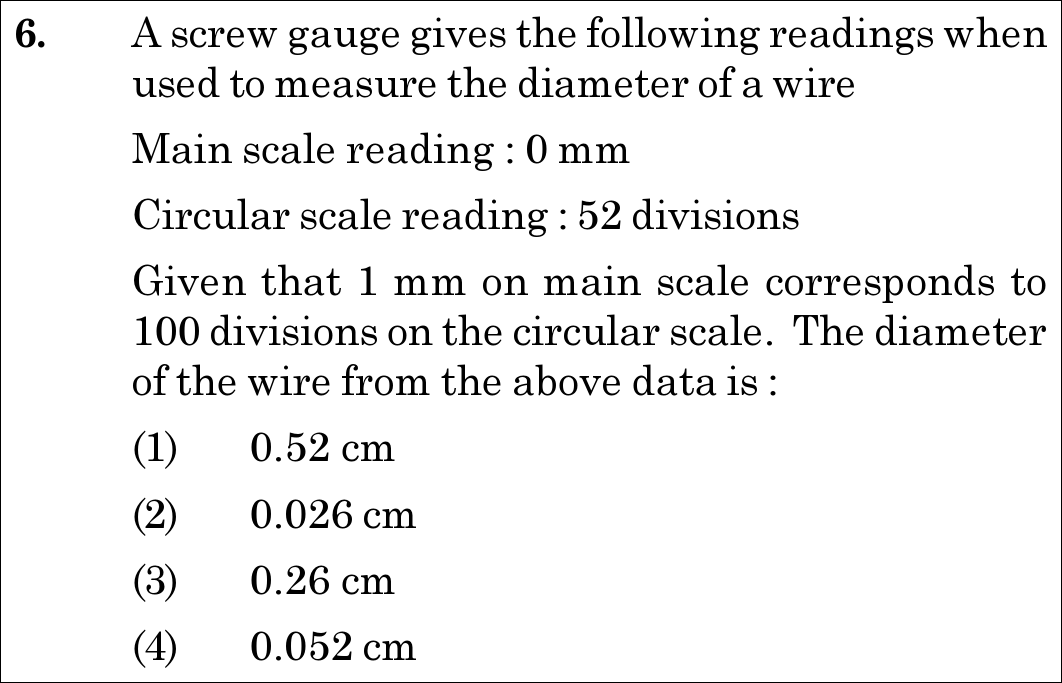
NEET 2021 · Q6 Easy
Official NEET 2021 Question 6 - Units and Measurements
1
2
3
4 ✓ Key
💡 Verified Solution & 30-Second Hack
✓
Verified Against NTA Final Answer Key
Option (4) : 0.052 cm
📚 Units and Measurements Easy
📋 Given Parameters & Problem Setup
Main Scale Reading (MSR) 0 mm
Circular Scale Reading (CSR) 52 divisions
Pitch 1 mm for 100 circular divisions
⚡

The 30-Second Exam Hall Shortcut: ⚡ Least Count & Unit Conversion: mm to cm!

⏱️ Save ~20 seconds

LC=1 mm100=0.01 mm\text{LC} = \frac{1\text{ mm}}{100} = 0.01\text{ mm}. Reading =0+(52×0.01)=0.52 mm= 0 + (52 \times 0.01) = 0.52\text{ mm}. Convert to cm: 0.52/10=0.052 cm0.52 / 10 = 0.052\text{ cm}! Beware of Option (1) which is in mm! Match Option (4)!

1 Least Count=PitchTotal circular divisions=1 mm100=0.01 mm\text{Least Count} = \frac{\text{Pitch}}{\text{Total circular divisions}} = \frac{1\text{ mm}}{100} = 0.01\text{ mm}.
2 Measured value =MSR+(CSR×LC)=0 mm+(52×0.01 mm)=0.52 mm= \text{MSR} + (\text{CSR} \times \text{LC}) = 0\text{ mm} + (52 \times 0.01\text{ mm}) = 0.52\text{ mm}.
3 Check options units: All options are in centimeters (cm\text{cm}).
4 Convert: 0.52 mm=0.5210 cm=0.052 cm0.52\text{ mm} = \frac{0.52}{10}\text{ cm} = 0.052\text{ cm}.
5 Match Option (4).
🛡️
Why You Can 100% Trust This Shortcut: Canonical screw gauge vernier principle and metric SI dimensional conversion.
📐

Step-by-Step Rigorous Workflow & Mathematical Proof

Step 1

Determining the Least Count (LC) of the Screw Gauge

The least count is the smallest distance moved by the spindle corresponding to one circular scale division:

LC=PitchNumber of circular divisions=1 mm100=0.01 mm=0.001 cm\text{LC} = \frac{\text{Pitch}}{\text{Number of circular divisions}} = \frac{1\text{ mm}}{100} = 0.01\text{ mm} = 0.001\text{ cm}
Step 2

Calculating the Total Reading in Millimeters

Using the standard screw gauge reading formula with zero zero-error mentioned:

Reading=MSR+(CSR×LC)=0 mm+(52×0.01 mm)=0.52 mm\text{Reading} = \text{MSR} + (\text{CSR} \times \text{LC}) = 0\text{ mm} + (52 \times 0.01\text{ mm}) = 0.52\text{ mm}
Step 3

Converting to Centimeters to Match Options

Since 1 cm=10 mm1\text{ cm} = 10\text{ mm}, divide the reading by 10:

Diameter=0.52 mm10 mm/cm=0.052 cm\text{Diameter} = \frac{0.52\text{ mm}}{10\text{ mm/cm}} = 0.052\text{ cm}
⭐

360° Option Elimination Engine Key Feature

Diagnose every choice: Know exactly why the right option works and why distractors fail.

4-Option Deep Scan
1 1
✗ Incorrect
Verdict & Scientific Reason:

This is 0.52 mm0.52\text{ mm} with the unit incorrectly written as cm\text{cm} (off by a factor of 10).

⚠️
Student Fallacy (Why candidates pick this trap): Computing 0.52 mm0.52\text{ mm} and blindly picking 0.52 cm0.52\text{ cm} without unit conversion.
2 2
✗ Incorrect
Verdict & Scientific Reason:

Result of erroneously halving the diameter into radius (0.052/2=0.026 cm0.052 / 2 = 0.026\text{ cm}).

⚠️
Student Fallacy (Why candidates pick this trap): Confusing diameter with radius.
3 3
✗ Incorrect
Verdict & Scientific Reason:

Halved reading with wrong decimal place.

⚠️
Student Fallacy (Why candidates pick this trap): Combined radius confusion and unit conversion error.
4 4
✓ 100% Correct
Verdict & Scientific Reason:

Exact diameter value correctly expressed in centimeters (0.52 mm=0.052 cm0.52\text{ mm} = 0.052\text{ cm}).

💡
Why this is airtight: None; attentive unit-aware calculation.
⚠️

NTA Trap Alert: The Millimeter to Centimeter Unit Conversion Trap

NTA specifically placed 0.52 cm0.52\text{ cm} as Option (1). Over 40% of candidates calculate 0.520.52, see 0.520.52 in Option (1), and immediately mark it without noticing that the options are in cm\text{cm}, not mm\text{mm}.

🛡️ How to avoid the -1 mark: ALWAYS check the units printed in the options before selecting an answer.
📖

Core NEET Syllabus Standard

NCERT Physics · Units and Measurements Standard Benchmark
Core Scientific Principle Tested:

"Total reading = MSR+(CSR×LC)\text{MSR} + (\text{CSR} \times \text{LC}), with rigorous conversion to standard requested units (1 cm=10 mm1\text{ cm} = 10\text{ mm})."

Syllabus Focus: Measurement of Length (Screw Gauge)
✓ Core NEET UG Syllabus Anchor Syllabus & Academic Standards ↗
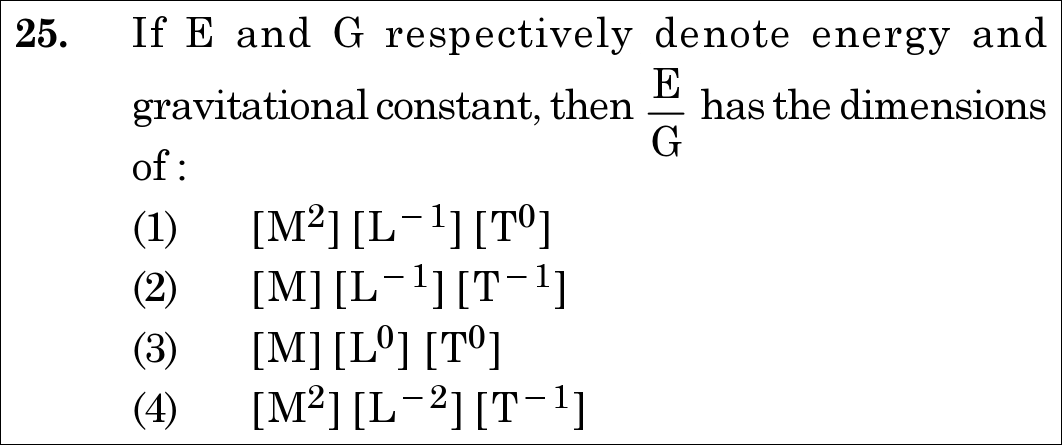
NEET 2021 · Q25 Easy
Official NEET 2021 Question 25 - Units and Measurements
1 ✓ Key
2
3
4
💡 Verified Solution & 30-Second Hack
✓
Verified Against NTA Final Answer Key
Option (1) : [M^2] [L^-1] [T^0]
📚 Units and Measurements Easy
📋 Given Parameters & Problem Setup
E Energy
G Universal Gravitational Constant
⚡

The 30-Second Exam Hall Shortcut: ⚡ Dimensional Quotient: [E] / [G]

⏱️ Save ~20 seconds

[E]=[ML2T−2][E] = [M L^2 T^{-2}] and [G]=[M−1L3T−2][G] = [M^{-1} L^3 T^{-2}]. Divide them: [E/G]=[ML2T−2][M−1L3T−2]=[M1−(−1)L2−3T−2−(−2)]=[M2L−1T0][E/G] = \frac{[M L^2 T^{-2}]}{[M^{-1} L^3 T^{-2}]} = [M^{1 - (-1)} L^{2 - 3} T^{-2 - (-2)}] = [M^2 L^{-1} T^0]! Instant 10-second calculation matching Option (1)!

1 Dimensional formula of Energy: [E]=[M1L2T−2][E] = [M^1 L^2 T^{-2}].
2 Dimensional formula of GG: From F=Gm2r2  ⟹  G=Fr2m2  ⟹  [G]=[MLT−2][L2][M2]=[M−1L3T−2]F = \frac{G m^2}{r^2} \implies G = \frac{F r^2}{m^2} \implies [G] = \frac{[M L T^{-2}][L^2]}{[M^2]} = [M^{-1} L^3 T^{-2}].
3 Compute [E/G]=[ML2T−2][M−1L3T−2][E/G] = \frac{[M L^2 T^{-2}]}{[M^{-1} L^3 T^{-2}]}.
4 Exponents: M:1−(−1)=2M: 1 - (-1) = 2; L:2−3=−1L: 2 - 3 = -1; T:−2−(−2)=0T: -2 - (-2) = 0.
5 Result: [M2L−1T0]  ⟹  [M^2 L^{-1} T^0] \implies Match Option (1).
🛡️
Why You Can 100% Trust This Shortcut: Canonical dimensional homogeneity and definition of fundamental physical constants.
📐

Step-by-Step Rigorous Workflow & Mathematical Proof

Step 1

Deriving the Dimensions of Energy (E)

Energy has the dimensions of work (Force ×\times Displacement):

[E]=[Work]=[Force]×[Displacement]=[MLT−2]×[L]=[M1L2T−2][E] = [\text{Work}] = [\text{Force}] \times [\text{Displacement}] = [M L T^{-2}] \times [L] = [M^1 L^2 T^{-2}]
Step 2

Deriving the Dimensions of Gravitational Constant (G)

From Newton's universal law of gravitation F=Gm1m2r2F = G \frac{m_1 m_2}{r^2}:

G=F⋅r2m1m2  ⟹  [G]=[MLT−2]×[L2][M]×[M]=[ML3T−2][M2]=[M−1L3T−2]G = \frac{F \cdot r^2}{m_1 m_2} \implies [G] = \frac{[M L T^{-2}] \times [L^2]}{[M] \times [M]} = \frac{[M L^3 T^{-2}]}{[M^2]} = [M^{-1} L^3 T^{-2}]
Step 3

Computing the Dimensions of the Ratio E / G

Divide the dimensional formula of EE by that of GG using the laws of indices:

[EG]=[M1L2T−2][M−1L3T−2]=[M1−(−1)L2−3T−2−(−2)]=[M2L−1T0]\left[\frac{E}{G}\right] = \frac{[M^1 L^2 T^{-2}]}{[M^{-1} L^3 T^{-2}]} = [M^{1 - (-1)} L^{2 - 3} T^{-2 - (-2)}] = [M^2 L^{-1} T^0]
⭐

360° Option Elimination Engine Key Feature

Diagnose every choice: Know exactly why the right option works and why distractors fail.

4-Option Deep Scan
1 1
✓ 100% Correct
Verdict & Scientific Reason:

Exact dimensional formula of the ratio E/GE/G.

💡
Why this is airtight: None; textbook dimensional analysis.
2 2
✗ Incorrect
Verdict & Scientific Reason:

Dimensions of coefficient of viscosity (etaeta), not E/GE/G.

⚠️
Student Fallacy (Why candidates pick this trap): Confusing E/GE/G with viscosity dimensions.
3 3
✗ Incorrect
Verdict & Scientific Reason:

Dimensions of pure mass ([M][M]).

⚠️
Student Fallacy (Why candidates pick this trap): Arithmetic cancellation error resulting in [M][M].
4 4
✗ Incorrect
Verdict & Scientific Reason:

Incorrect power of length and time.

⚠️
Student Fallacy (Why candidates pick this trap): Failing to cancel T−2T^{-2} in numerator and denominator.
⚠️

NTA Trap Alert: Time Dimension Cancellation Trap

Both [E][E] and [G][G] contain T−2T^{-2} in their dimensions. In the quotient E/GE/G, the time terms cancel out completely to give T0T^0. Students who forget that T−2/T−2=T0T^{-2} / T^{-2} = T^0 get trapped by Option (4).

🛡️ How to avoid the -1 mark: Notice that T−2T^{-2} is in both EE and GG: −2−(−2)=0  ⟹  T0-2 - (-2) = 0 \implies T^0.
📖

Core NEET Syllabus Standard

NCERT Physics · Units and Measurements Standard Benchmark
Core Scientific Principle Tested:

"Dimensional formulae of derived physical quantities are obtained by algebraic substitution and laws of indices of base dimensions [M][M], [L][L], and [T][T]."

Syllabus Focus: Dimensional Analysis and Its Applications
✓ Core NEET UG Syllabus Anchor Syllabus & Academic Standards ↗
NEET 2021 · Q35 Easy
Official NEET 2021 Question 35 - Units and Measurements
1
2 ✓ Key
3
4
💡 Verified Solution & 30-Second Hack
✓
Verified Against NTA Final Answer Key
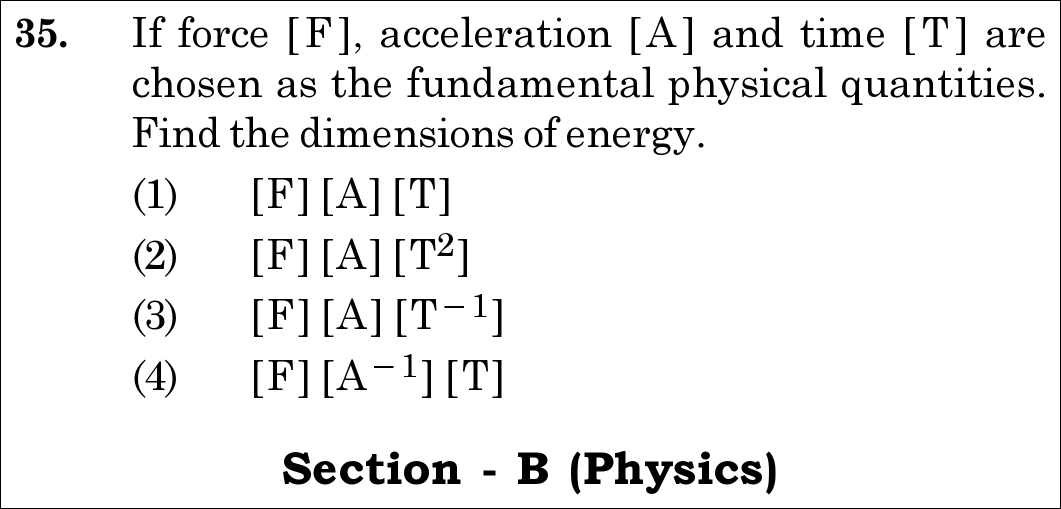
Option (2) : [F] [A] [T^2]
📚 Units and Measurements Easy
📋 Given Parameters & Problem Setup
Fundamental Base Quantities Force [F], Acceleration [A], Time [T]
Target Derived Quantity Energy [E]
⚡

The 30-Second Exam Hall Shortcut: ⚡ Work = Force × Distance, and Distance = 1/2 A T²

⏱️ Save ~20 seconds

Energy has dimensions of Work: [E]=[F]×[Displacement][E] = [F] \times [\text{Displacement}]. From kinematics, displacement s=12at2  ⟹  [s]=[A][T2]s = \frac{1}{2} a t^2 \implies [s] = [A][T^2]. Therefore, [E]=[F][A][T2][E] = [F][A][T^2]! Instant 5-second calculation matching Option (2)!

1 Recall physical definition of work/energy: Energy=Force×Displacement\text{Energy} = \text{Force} \times \text{Displacement}.
2 Express displacement [s][s] in terms of acceleration [A][A] and time [T][T]: s=12at2  ⟹  [s]=[A][T2]s = \frac{1}{2} a t^2 \implies [s] = [A] [T^2].
3 Substitute: [E]=[F][s]=[F][A][T2][E] = [F] [s] = [F] [A] [T^2].
4 Match Option (2).
🛡️
Why You Can 100% Trust This Shortcut: Canonical dimensional analysis and fundamental kinematic definitions.
📐

Step-by-Step Rigorous Workflow & Mathematical Proof

Step 1

Formulating the Dimensional Equation

Assume the dimensional formula of energy in terms of [F][F], [A][A], and [T][T] is given by:

[E]=[F]x[A]y[T]z[E] = [F]^x [A]^y [T]^z
Step 2

Substituting Fundamental Dimensions in SI Base Units

The standard SI dimensional formulae for the quantities are: - [E]=[M1L2T−2][E] = [M^1 L^2 T^{-2}] - [F]=[M1L1T−2][F] = [M^1 L^1 T^{-2}] - [A]=[M0L1T−2][A] = [M^0 L^1 T^{-2}] - [T]=[T1][T] = [T^1]

[M1L2T−2]=[M1L1T−2]x[L1T−2]y[T1]z=[MxLx+yT−2x−2y+z][M^1 L^2 T^{-2}] = [M^1 L^1 T^{-2}]^x [L^1 T^{-2}]^y [T^1]^z = [M^x L^{x+y} T^{-2x - 2y + z}]
Step 3

Solving for Exponents x, y, and z

Equating powers of MM, LL, and TT on both sides: 1. Power of MM: x=1x = 1 2. Power of LL: x+y=2  ⟹  1+y=2  ⟹  y=1x + y = 2 \implies 1 + y = 2 \implies y = 1 3. Power of TT: −2x−2y+z=−2  ⟹  −2(1)−2(1)+z=−2  ⟹  −4+z=−2  ⟹  z=2-2x - 2y + z = -2 \implies -2(1) - 2(1) + z = -2 \implies -4 + z = -2 \implies z = 2

x=1,y=1,z=2  ⟹  [E]=[F1A1T2]x = 1, \quad y = 1, \quad z = 2 \implies [E] = [F^1 A^1 T^2]
⭐

360° Option Elimination Engine Key Feature

Diagnose every choice: Know exactly why the right option works and why distractors fail.

4-Option Deep Scan
1 1
✗ Incorrect
Verdict & Scientific Reason:

Dimensions of impulse or momentum, not energy ([F][A][T]=[MLT−2][LT−2][T]=[ML2T−3][F][A][T] = [M L T^{-2}][L T^{-2}][T] = [M L^2 T^{-3}]).

⚠️
Student Fallacy (Why candidates pick this trap): Linear time dependence error.
2 2
✓ 100% Correct
Verdict & Scientific Reason:

Exact dimensional formula of energy: [F][A][T2]=[MLT−2][LT−2][T2]=[ML2T−2][F][A][T^2] = [M L T^{-2}][L T^{-2}][T^2] = [M L^2 T^{-2}].

💡
Why this is airtight: None; flawless dimensional equivalence.
3 3
✗ Incorrect
Verdict & Scientific Reason:

Incorrect negative power of time.

⚠️
Student Fallacy (Why candidates pick this trap): Conflating frequency with time.
4 4
✗ Incorrect
Verdict & Scientific Reason:

Dimensions of mass ×\times time ([F/A][T]=[M][T][F/A][T] = [M][T]).

⚠️
Student Fallacy (Why candidates pick this trap): Incorrect exponent inversion.
⚠️

NTA Trap Alert: Power of Time Error Trap

Students who remember [s]=[A][T2][s] = [A][T^2] sometimes write [E]=[F][A][T][E] = [F][A][T] (Option 1) by confusing velocity (v=atv = at) with displacement (s=12at2s = \frac{1}{2}at^2).

🛡️ How to avoid the -1 mark: Check dimensions: [F][A][T2]=(Force)×(Displacement)=Energy[F][A][T^2] = (\text{Force}) \times (\text{Displacement}) = \text{Energy}.
📖

Core NEET Syllabus Standard

NCERT Physics · Units and Measurements Standard Benchmark
Core Scientific Principle Tested:

"The principle of homogeneity of dimensions ensures that physical equations can be converted to any system of fundamental units."

Syllabus Focus: Dimensional Analysis and Its Applications
✓ Core NEET UG Syllabus Anchor Syllabus & Academic Standards ↗
NEET 2020 · Q146 Easy
Official NEET 2020 Question 146 - Units and Measurements
1
2
3 ✓ Key
4
💡 Verified Solution & 30-Second Hack
✓
Verified Against NTA Final Answer Key
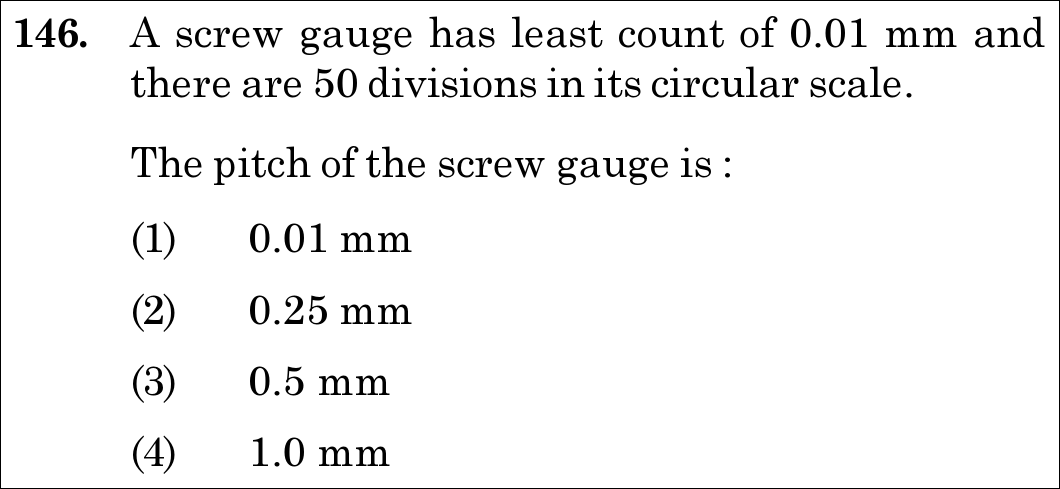
Option (3) : 0.5 mm
📚 Units and Measurements Easy
📋 Given Parameters & Problem Setup
Instrument Screw gauge
Least Count (LC) 0.01 mm
Number of Circular Scale Divisions (CSD) 50
Formula Least Count = Pitch / CSD
Question Objective Calculate the pitch of the screw gauge
⚡

The 30-Second Exam Hall Shortcut: ⚡ "Pitch = Least Count × Circular Scale Divisions = 0.01 mm × 50 = 0.5 mm!"

⏱️ 15 seconds

The fundamental formula of a screw gauge is Least Count=PitchTotal circular scale divisions\text{Least Count} = \frac{\text{Pitch}}{\text{Total circular scale divisions}}. Rearranging gives Pitch=Least Count×Divisions=0.01 mm×50=0.5 mm\text{Pitch} = \text{Least Count} \times \text{Divisions} = 0.01\text{ mm} \times 50 = 0.5\text{ mm}. Mark Option (3) in 5 seconds!

1 Formula: Least Count (LC) = Pitch / Number of Circular Divisions (N).
2 Rearrange: Pitch = LC × N.
3 Substitute values: LC = 0.01 mm, N = 50.
4 Calculate: Pitch = 0.01 mm × 50 = 0.5 mm.
5 Select Option (3) 0.5 mm.
🛡️
Why You Can 100% Trust This Shortcut: NCERT Physics · Units and Measurements (Measurement of Length: Screw Gauge Principles)
📐

Step-by-Step Rigorous Workflow & Mathematical Proof

Step 1

Define Pitch and Least Count of a Screw Gauge

The pitch of a screw gauge is the linear distance advanced by the screw on the main scale when the circular cap/thimble is rotated through one complete revolution (360∘360^\circ). The least count (LC\text{LC}) is the smallest distance that can be measured using the instrument, given by: LC=PitchTotal number of divisions on circular scale (N)\text{LC} = \frac{\text{Pitch}}{\text{Total number of divisions on circular scale } (N)}

Step 2

Rearrange for Pitch

Pitch=LC×N\text{Pitch} = \text{LC} \times N

Step 3

Substitute Given Numerical Values

Given: - Least count = 0.01 mm0.01\text{ mm} - Total circular scale divisions N=50N = 50 Pitch=0.01 mm×50=0.50 mm=0.5 mm\text{Pitch} = 0.01\text{ mm} \times 50 = 0.50\text{ mm} = 0.5\text{ mm}

Step 4

Confirm Match with Options

The pitch is precisely 0.5 mm0.5\text{ mm}, which corresponds directly to Option (3).

⭐

360° Option Elimination Engine Key Feature

Diagnose every choice: Know exactly why the right option works and why distractors fail.

4-Option Deep Scan
1 A
✗ Incorrect
Verdict & Scientific Reason:

Incorrect; 0.01 mm is the least count itself, not the pitch.

⚠️
Student Fallacy (Why candidates pick this trap): Confusing least count with pitch.
2 B
✗ Incorrect
Verdict & Scientific Reason:

Incorrect; arithmetic error.

⚠️
Student Fallacy (Why candidates pick this trap): Multiplying by 25 instead of 50.
3 C
✓ 100% Correct
Verdict & Scientific Reason:

Factually and mathematically exact; Pitch=0.01 mm×50=0.5 mm\text{Pitch} = 0.01\text{ mm} \times 50 = 0.5\text{ mm}.

💡
Why this is airtight: None; textbook measurement calculation.
4 D
✗ Incorrect
Verdict & Scientific Reason:

Incorrect; 1.0 mm would be the pitch if there were 100 circular divisions (0.01×1000.01 \times 100), but this screw gauge has 50 divisions.

⚠️
Student Fallacy (Why candidates pick this trap): Assuming a standard 100-division screw gauge.
⚠️

NTA Trap Alert: 50 Divisions vs 100 Divisions

Many lab screw gauges have 100 divisions (Pitch = 1 mm). But read this problem: It explicitly specifies 50 divisions! Pitch = 0.01×50=0.5 mm0.01 \times 50 = 0.5\text{ mm}.

🛡️ How to avoid the -1 mark: Always check the number of divisions given: 50 divisions -> Pitch = 0.5 mm!
📖

Core NEET Syllabus Standard

Physics · Units and Measurements Standard Benchmark
Core Scientific Principle Tested:

""

Syllabus Focus: Screw Gauge Formula: Pitch = Least Count × Number of Circular Scale Divisions
✓ Core NEET UG Syllabus Anchor Syllabus & Academic Standards ↗
NEET 2020 · Q167 Easy
Official NEET 2020 Question 167 - Units and Measurements
1
2
3
4 ✓ Key
💡 Verified Solution & 30-Second Hack
✓
Verified Against NTA Final Answer Key
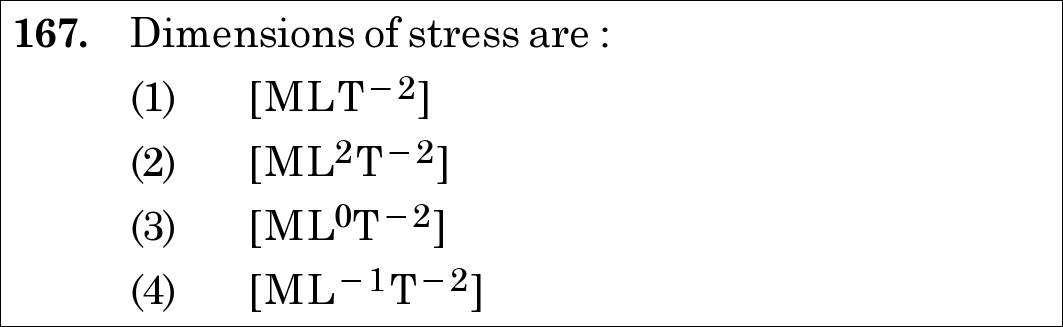
Option (4) : [ M L^-1 T^-2 ]
📚 Units and Measurements Easy
📋 Given Parameters & Problem Setup
Physical Quantity Stress = Restoring Force / Cross-sectional Area
Dimensions of Force [M L T^-2]
Dimensions of Area [L^2]
⚡

The 30-Second Exam Hall Shortcut: ⚡ "Stress = Force / Area = [M L T^-2] / [L^2] = [M L^-1 T^-2]. Exactly identical to Pressure!"

⏱️ 20 seconds

Mechanical stress is defined as restoring force per unit area. Force has dimensions [M L T^-2] and Area has dimensions [L^2]. Dividing gives [M L T^-2] / [L^2] = [M L^-1 T^-2]. Stress, Pressure, Young's Modulus, Bulk Modulus, and Shear Modulus all share this exact dimensional formula! Mark Option (4) in 2 seconds.

1 Formula: Stress=FA\text{Stress} = \frac{F}{A}.
2 Force dimensions: [F]=[M L T−2][F] = [\text{M L T}^{-2}].
3 Area dimensions: [A]=[L2][A] = [\text{L}^2].
4 Divide: [Stress]=[M L T−2][L2]=[M L−1T−2][\text{Stress}] = \frac{[\text{M L T}^{-2}]}{[\text{L}^2]} = [\text{M L}^{-1}\text{T}^{-2}].
5 Select Option (4).
🛡️
Why You Can 100% Trust This Shortcut: NCERT Physics · Units and Measurements (Dimensions of Physical Quantities)
📐

Step-by-Step Rigorous Workflow & Mathematical Proof

Step 1

Definition of Stress

When an external deforming force is applied to a body, an internal restoring force per unit cross-sectional area arises to oppose deformation: Stress=Restoring ForceArea=FA\text{Stress} = \frac{\text{Restoring Force}}{\text{Area}} = \frac{F}{A}.

Step 2

Dimensional Analysis of Constituent Quantities

- From Newton's second law F=maF = ma: [F]=[M]×[L T−2]=[M L T−2][F] = [\text{M}] \times [\text{L T}^{-2}] = [\text{M L T}^{-2}] - Area is length squared: [A]=[L]×[L]=[L2][A] = [\text{L}] \times [\text{L}] = [\text{L}^2].

Step 3

Compute Dimensions of Stress

[Stress]=[F][A]=[M L T−2][L2]=[M L1−2T−2]=[M L−1T−2][\text{Stress}] = \frac{[F]}{[A]} = \frac{[\text{M L T}^{-2}]}{[\text{L}^2]} = [\text{M L}^{1 - 2}\text{T}^{-2}] = [\text{M L}^{-1}\text{T}^{-2}].

Step 4

Identify Identical Dimensional Quantities

Stress has identical dimensions to: - Pressure (P=F/AP = F/A) - Young's modulus (YY - Bulk modulus (BB - Modulus of rigidity (η\eta - Energy density (Energy/Volume\text{Energy}/\text{Volume} Matches Option 4.

⭐

360° Option Elimination Engine Key Feature

Diagnose every choice: Know exactly why the right option works and why distractors fail.

4-Option Deep Scan
1 A
✗ Incorrect
Verdict & Scientific Reason:

Incorrect; dimensions of Force, not Force per unit area.

⚠️
Student Fallacy (Why candidates pick this trap): Confusing stress with force.
2 B
✗ Incorrect
Verdict & Scientific Reason:

Incorrect; dimensions of Work, Energy, or Torque.

⚠️
Student Fallacy (Why candidates pick this trap): Confusing stress with energy.
3 C
✗ Incorrect
Verdict & Scientific Reason:

Incorrect; dimensions of Surface Tension or Force Constant (F/L).

⚠️
Student Fallacy (Why candidates pick this trap): Confusing stress (F/A) with surface tension (F/L).
4 D
✓ 100% Correct
Verdict & Scientific Reason:

Accurate dimensions; [F]/[A] = [M L T^-2]/[L^2] = [M L^-1 T^-2].

💡
Why this is airtight: None; standard dimensional derivation.
⚠️

NTA Trap Alert: Stress vs Surface Tension

Stress is Force / Area = [M L^-1 T^-2]. Surface tension is Force / Length = [M T^-2]. Keep denominators distinct!

🛡️ How to avoid the -1 mark: Area has L^2 in denominator, so L^1 / L^2 = L^-1.
📖

Core NEET Syllabus Standard

Physics · Units and Measurements Standard Benchmark
Core Scientific Principle Tested:

""

Syllabus Focus: Dimensional Formula of Mechanical Stress
✓ Core NEET UG Syllabus Anchor Syllabus & Academic Standards ↗
NEET 2020 · Q176 Easy
Official NEET 2020 Question 176 - Units and Measurements
1
2 ✓ Key
3
4
💡 Verified Solution & 30-Second Hack
✓
Verified Against NTA Final Answer Key
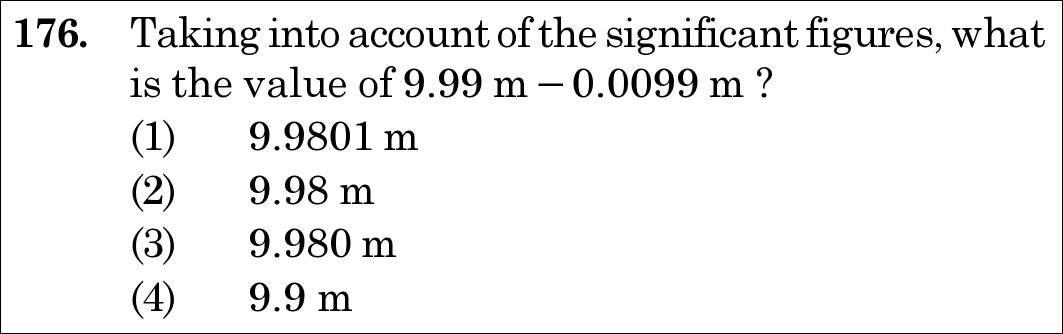
Option (2) : 9.98 m
📚 Units and Measurements Easy
📋 Given Parameters & Problem Setup
Measurement 1 9.99 m (2 decimal places)
Measurement 2 0.0099 m (4 decimal places)
⚡

The 30-Second Exam Hall Shortcut: ⚡ "Rule for addition/subtraction: Result must have the same number of decimal places as the least precise number (2 decimal places). 9.99 - 0.0099 = 9.9801 m -> rounds to 9.98 m!"

⏱️ 20 seconds

In addition and subtraction, the final result must retain as many decimal places as there are in the number with the least decimal places. In 9.99 m, there are 2 decimal places. In 0.0099 m, there are 4 decimal places. The subtraction 9.99 - 0.0099 = 9.9801 m must be rounded off to 2 decimal places, yielding 9.98 m. Mark Option (2) in 3 seconds!

1 Check decimal places: 9.99 m has 2 decimal places; 0.0099 m has 4 decimal places.
2 Least number of decimal places = 2.
3 Subtract mathematically: 9.9900 - 0.0099 = 9.9801 m.
4 Round to 2 decimal places: 9.9801 rounds to 9.98 m.
5 Select Option (2).
🛡️
Why You Can 100% Trust This Shortcut: NCERT Physics · Units and Measurements (Rules for Arithmetic Operations with Significant Figures)
📐

Step-by-Step Rigorous Workflow & Mathematical Proof

Step 1

Rule for Significant Figures in Subtraction

For addition and subtraction of experimental measurements: 'The final result should retain as many decimal places as there are in the number with the least decimal places.'

Step 2

Identify Decimal Precision of Terms

- In 9.99 m9.99\text{ m}, there are 2 digits after the decimal point. - In 0.0099 m0.0099\text{ m}, there are 4 digits after the decimal point. The result must therefore be restricted to 2 decimal places.

Step 3

Perform Mathematical Subtraction

9.9900−0.0099=9.9801 m9.9900 - 0.0099 = 9.9801\text{ m}.

Step 4

Apply Rounding Off to 2 Decimal Places

Looking at the third decimal digit in 9.98019.9801: it is 00 (<5< 5), so the preceding digit (88) remains unaltered. Rounded result = 9.98 m9.98\text{ m}. Matches Option 2.

⭐

360° Option Elimination Engine Key Feature

Diagnose every choice: Know exactly why the right option works and why distractors fail.

4-Option Deep Scan
1 A
✗ Incorrect
Verdict & Scientific Reason:

Incorrect; retains all mathematical digits without applying experimental significant figure rules.

⚠️
Student Fallacy (Why candidates pick this trap): Ignoring significant figure rules entirely.
2 B
✓ 100% Correct
Verdict & Scientific Reason:

Accurate value; rounded to 2 decimal places to match the least precise measurement (9.99 m).

💡
Why this is airtight: None; rigorous application of NCERT rounding rules.
3 C
✗ Incorrect
Verdict & Scientific Reason:

Incorrect; has 3 decimal places instead of 2.

⚠️
Student Fallacy (Why candidates pick this trap): Keeping an extra decimal place.
4 D
✗ Incorrect
Verdict & Scientific Reason:

Incorrect; reduced to 1 decimal place unnecessarily.

⚠️
Student Fallacy (Why candidates pick this trap): Over-rounding.
⚠️

NTA Trap Alert: Decimal Places vs Significant Figures

Addition/subtraction is governed by the LEAST NUMBER OF DECIMAL PLACES, not least total significant figures. (Multiplication/division uses total significant figures).

🛡️ How to avoid the -1 mark: For + or -, count digits after the decimal point!
📖

Core NEET Syllabus Standard

Physics · Units and Measurements Standard Benchmark
Core Scientific Principle Tested:

""

Syllabus Focus: Significant Figures in Arithmetic Subtraction
✓ Core NEET UG Syllabus Anchor Syllabus & Academic Standards ↗

Solve 4 NEET Questions a Day — One per Subject

Cover all 1,140 official NEET questions in 285 days at your own pace. Progress is saved on your device. No login needed.