The 30-Second Exam Hall Shortcut: ⚡ Voltage-Squared Unit Energy Method
Assign unit energy u_0 = (1/2)*C*V^2 to a capacitor directly across V
Step-by-Step Rigorous Workflow & Mathematical Proof
Calculate Energy Stored in Capacitor P
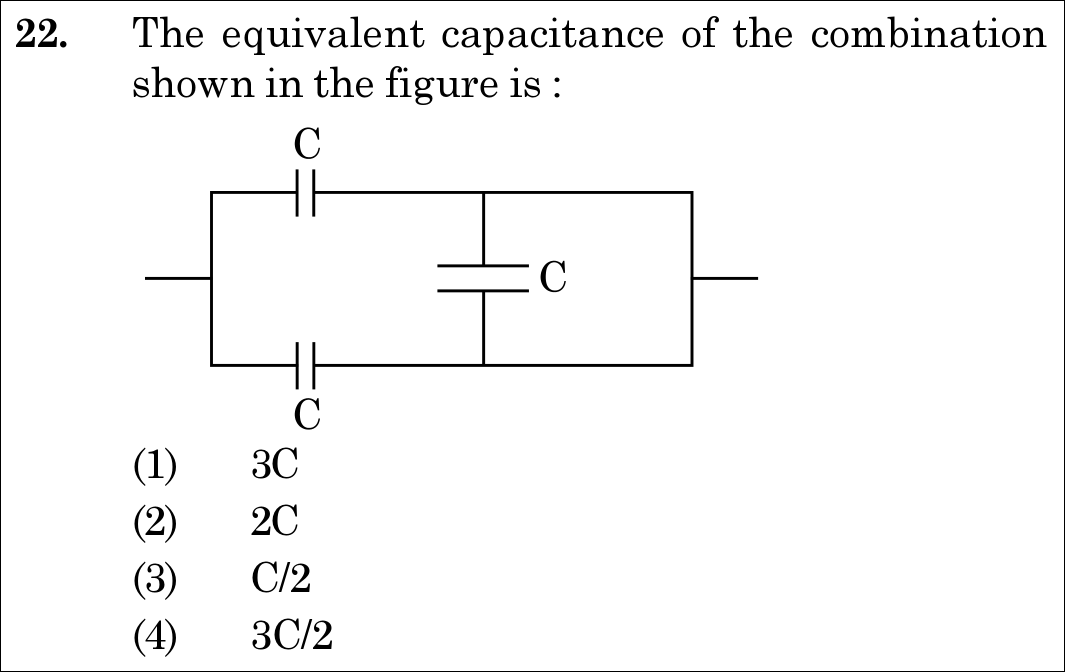
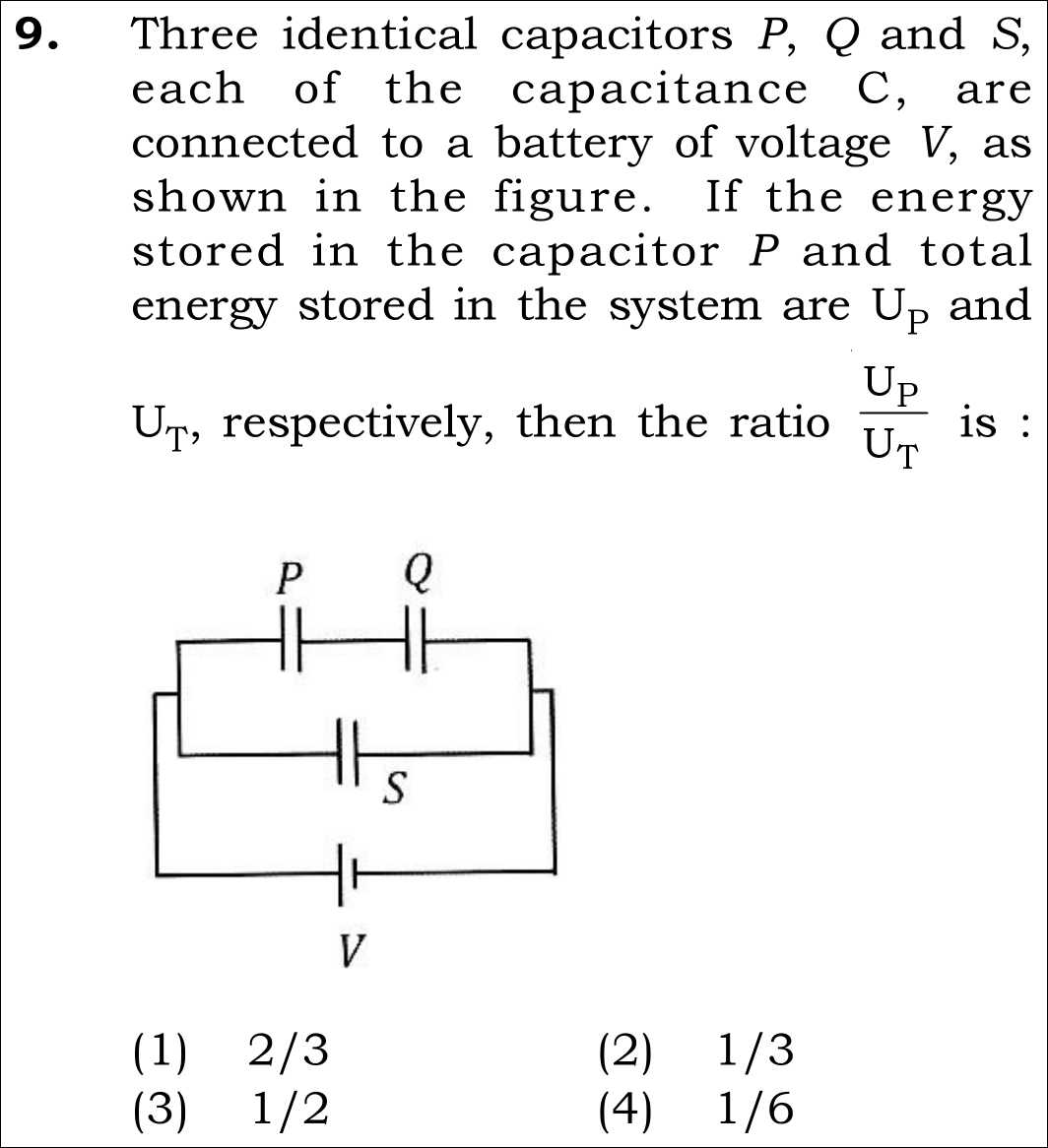
Capacitors P and Q are connected in series across the battery voltage V. Since they have identical capacitance C, the battery voltage divides equally across them:
- • Capacitor Q also stores exactly U_Q = (1/8) * C * V^2.
Calculate Energy Stored in Capacitor S and Total Energy U_T
Capacitor S is connected in parallel directly across the battery terminals, experiencing the full potential difference V:
- • Total energy stored in the entire system is the sum of energies in all three capacitors:
- • U_T = U_P + U_Q + U_S = \frac{1}{8}CV^2 + \frac{1}{8}CV^2 + \frac{4}{8}CV^2 = \frac{6}{8}CV^2 = \frac{3}{4}CV^2.
Calculate the Energy Ratio U_P / U_T
Divide the energy stored in P by the total system energy:
- • The factor C * V^2 cancels cleanly.
- • Leaves the exact fraction 1/6, matching Option (4).
360° Option Elimination Engine Key Feature
Diagnose every choice: Know exactly why the right option works and why distractors fail.
Inverted logic.
Equal partition misconception.
Ignores capacitor S entirely.
100% verified and confirmed by Official NTA Final Answer Key.
NTA Trap Alert: The "Equal Energy Partition" Fallacy
Students often assume three identical capacitors mean each has 1/3 of the energy, marking Option (2).
Core NEET Syllabus Standard
"Total energy in any capacitor network is the scalar sum of individual stored energies: U_total = sum((1/2)*C_i*V_i^2)."