MyCompetitiveExams Logo MyCompetitiveExams
Search 1,140+ Questions
Chapters, formulas, speed tricks
→
⚡ Brahmastra NEET 2027
720 MARKS

Dynamic 180-question full-length simulator mixed dynamically from all 6 years for 2027 & 2026 aspirants.

Launch Brahmastra 2027 Test →
Start Practice →
100% Free · No Login Required
Q.5 Physics · Section A ⭐ 360° Option Elimination Active
Vault ↗

NEET 2024 Physics Question 5 Solution

Topic: Electrostatic Potential and Capacitance · Official NTA Booklet Code T1
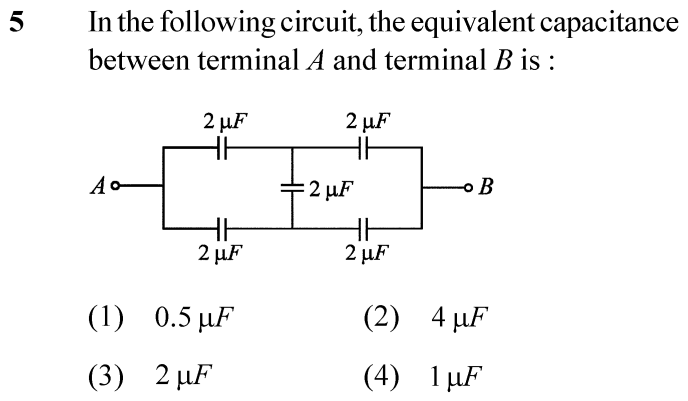
NEET 2024 Physics Question 5: Equivalent Capacitance of a Balanced Bridge Circuit

Question

In the following circuit, the equivalent capacitance between terminal A and terminal B is:

✓
Verified Against NTA Final Answer Key
Option (3) : 2 μF
📚 Electrostatic Potential and Capacitance Easy
📋 Given Parameters & Problem Setup
Individual capacitance of all 5 capacitors C = 2 μF each
Network topology Bridge arrangement between terminals A and B with central cross-capacitor
⚡

The 30-Second Exam Hall Shortcut: ⚡ Balanced Wheatstone Bridge Rule

⏱️ Save ~45 seconds

Bridge ratio is 2/2 = 2/2 = 1 -> Central 2 μF capacitor is inactive -> Two parallel branches of (2 in series) -> 1 + 1 = 2 μF!

1 Identify the 5-capacitor bridge topology with input A and output B.
2 Check bridge balance ratio: C1 / C2 = C3 / C4 = 2 / 2 = 1.
3 Since the bridge is balanced, the potential difference across the central capacitor is zero: remove it!
4 Top branch has two 2 μF capacitors in series: C_top = 2 / 2 = 1 μF.
5 Bottom branch has two 2 μF capacitors in series: C_bot = 2 / 2 = 1 μF.
6 Both branches are in parallel: C_eq = 1 + 1 = 2 μF. Solved in 5 seconds -> Option (3)!
🛡️
Why You Can 100% Trust This Shortcut: Balanced Wheatstone Bridge Condition (Potential across detector arm is identical: V_C = V_D).
📐

Step-by-Step Rigorous Workflow & Mathematical Proof

Step 1

Bridge Balance Verification

The given circuit consists of five capacitors each having capacitance C = 2 μF arranged in a Wheatstone bridge configuration. The condition for balance in a capacitance bridge is:

C1C2=C3C4  ⟹  2 μF2 μF=2 μF2 μF=1\frac{C_1}{C_2} = \frac{C_3}{C_4} \implies \frac{2\,\mu\text{F}}{2\,\mu\text{F}} = \frac{2\,\mu\text{F}}{2\,\mu\text{F}} = 1
Step 2

Removal of Central Bridge Capacitor

Because the ratio of adjacent arms is equal, the electric potential at the upper junction and lower junction is identical. No charge flows into or through the central 2 μF capacitor, so it can be completely removed from the circuit without affecting the equivalent capacitance.

Vupper=Vlower  ⟹  Qcentral=0V_{upper} = V_{lower} \implies Q_{central} = 0
Step 3

Calculation of Branch Capacitances

With the central capacitor removed, the circuit simplifies to two parallel branches, each containing two 2 μF capacitors in series:

Ctop=2×22+2=1 μF,Cbottom=2×22+2=1 μFC_{top} = \frac{2 \times 2}{2 + 2} = 1\,\mu\text{F}, \quad C_{bottom} = \frac{2 \times 2}{2 + 2} = 1\,\mu\text{F}
Step 4

Total Equivalent Capacitance

The top and bottom branches are connected in parallel across terminals A and B. Their capacitances add directly:

CAB=Ctop+Cbottom=1 μF+1 μF=2 μFC_{AB} = C_{top} + C_{bottom} = 1\,\mu\text{F} + 1\,\mu\text{F} = 2\,\mu\text{F}
⭐

360° Option Elimination Engine Key Feature

Diagnose every choice: Know exactly why the right option works and why distractors fail.

4-Option Deep Scan
1 (1)
✗ Incorrect
Verdict & Scientific Reason:

Incorrect; would occur if all 4 outer capacitors were assumed to be in series.

⚠️
Student Fallacy (Why candidates pick this trap): Treating the whole circuit as a single series loop of four capacitors (2/4 = 0.5 μF).
2 (2)
✗ Incorrect
Verdict & Scientific Reason:

Incorrect; would occur if branches were in parallel without series reduction.

⚠️
Student Fallacy (Why candidates pick this trap): Forgetting that capacitors in series reduce in value.
3 (3)
✓ 100% Correct
Verdict & Scientific Reason:

Standard balanced bridge result: C_eq equals the value of a single arm capacitor (2 μF).

💡
Why this is airtight: None.
4 (4)
✗ Incorrect
Verdict & Scientific Reason:

Represents only a single branch capacitance, forgetting the other parallel branch.

⚠️
Student Fallacy (Why candidates pick this trap): Calculating C_top = 1 μF and failing to add C_bottom.
⚠️

NTA Trap Alert: Including the Central Bridge Capacitor

Students unfamiliar with the Wheatstone bridge spend 2+ minutes attempting Kirchhoff loop equations or star-delta transformations on the central capacitor.

🛡️ How to avoid the -1 mark: Whenever you see 5 circuit elements in a diamond/H-bridge, immediately test C1/C2 = C3/C4. If equal, erase the middle element!
📖

Core NEET Syllabus Standard

Physics Core Electrostatics · Electrostatic Potential and Capacitance Standard Benchmark
Core Scientific Principle Tested:

"In a symmetrical balanced bridge with identical components C in all 4 arms, the equivalent capacitance is always identically equal to C."

Syllabus Focus: Capacitor Networks and Bridge Circuits
✓ Core NEET UG Syllabus Anchor Syllabus & Academic Standards ↗
Balanced Bridge of C is always C (Middle capacitor drops for free)!

Ready to attempt under real exam pressure?

Test your speed and accuracy in the authentic 200-minute timed NTA simulator.

Launch NEET 2024 CBT Test →

Spotted a mistake in this solution? Report an error ([email protected])

⚖️ Legal & Fair Dealing Notice: Sourced from publicly released NEET 2024 question papers and NEET answer keys for private study, research, and non-commercial educational practice under Fair Dealing (Section 52(1)(a) of the Indian Copyright Act, 1957). Not affiliated with or endorsed by NTA or NMC.

Solve 4 NEET Questions a Day — One per Subject

Cover all 1,140 official NEET questions in 285 days at your own pace. Progress is saved on your device. No login needed.