MyCompetitiveExams Logo MyCompetitiveExams
Search 1,140+ Questions
Chapters, formulas, speed tricks
→
⚡ Brahmastra NEET 2027
720 MARKS

Dynamic 180-question full-length simulator mixed dynamically from all 6 years for 2027 & 2026 aspirants.

Launch Brahmastra 2027 Test →
Start Practice →
100% Free · No Login Required
Q.9 Physics ⭐ 360° Option Elimination Active
Vault ↗

NEET 2026 Physics Question 9 Solution

Topic: Electrostatics & Capacitors · Official NTA Booklet Code 50
NEET 2026 Physics Question 9: Electrostatic Energy Ratio in a Series-Parallel Capacitor Network

Question

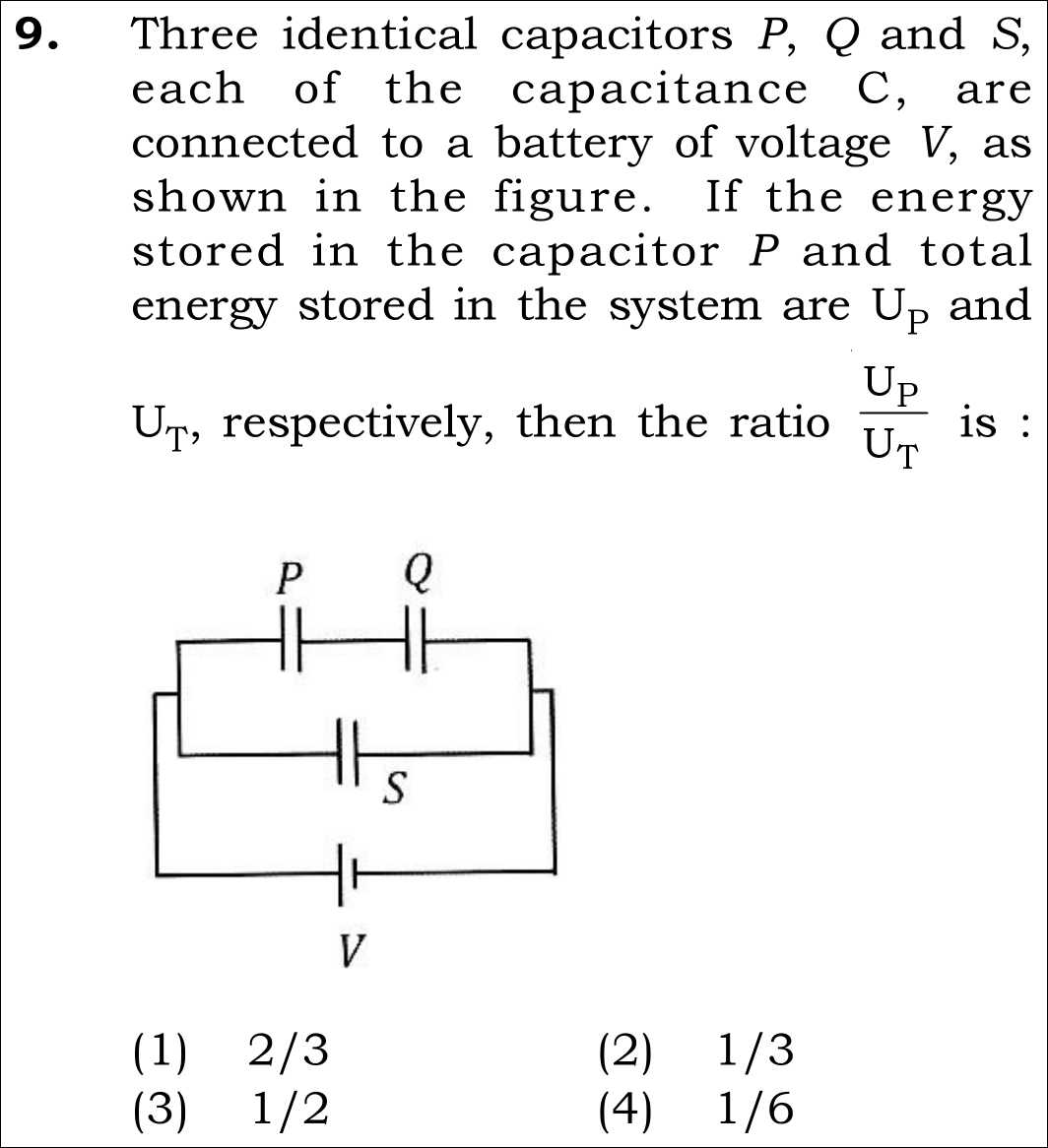
Three identical capacitors P, Q and S, each of the capacitance C, are connected to a battery of voltage V, as shown in the figure. If the energy stored in the capacitor P and total energy stored in the system are U_P and U_T, respectively, then the ratio U_P/U_T is:

✓
Verified Against NTA Final Answer Key
Option (4) : Ratio U_P / U_T = 1/6
📚 Electrostatics & Capacitors Medium
📋 Given Parameters & Problem Setup
Capacitors P, Q, S Three identical capacitors of capacitance C
Branch 1 Capacitors P and Q connected in series across battery V
Branch 2 Capacitor S connected in parallel across battery V
Target Ratio U_P / U_T (Energy in P / Total system energy)
⚡

The 30-Second Exam Hall Shortcut: ⚡ Voltage-Squared Unit Energy Method

⏱️ Bypasses lengthy equivalent capacitance derivations.

Assign unit energy u_0 = (1/2)*C*V^2 to a capacitor directly across V

1 Capacitor S is directly across voltage V: Stored energy U_S = (1/2)*C*V^2 = 1 unit.
2 Capacitors P and Q are identical in series across V, so voltage across each is V/2.
3 Energy in P: U_P = (1/2)*C*(V/2)^2 = (1/4) of a unit.
4 Energy in Q: U_Q = (1/4) of a unit.
5 Total system energy U_T = U_P + U_Q + U_S = 1/4 + 1/4 + 1 = 3/2 = 6/4 units.
6 Ratio U_P / U_T = (1/4) / (6/4) = 1/6. Solved in 20 seconds!
🛡️
Why You Can 100% Trust This Shortcut: Energy stored in any capacitor is U = (1/2)*C*V_cap^2. In a series string of N identical capacitors across V, each gets V/N and stores 1/N^2 the energy of a single parallel unit.
📐

Step-by-Step Rigorous Workflow & Mathematical Proof

Step 1

Calculate Energy Stored in Capacitor P

Capacitors P and Q are connected in series across the battery voltage V. Since they have identical capacitance C, the battery voltage divides equally across them:

VP=V2  ⟹  UP=12CVP2=12C(V2)2=18CV2V_P = \frac{V}{2} \implies U_P = \frac{1}{2} C V_P^2 = \frac{1}{2} C \left(\frac{V}{2}\right)^2 = \frac{1}{8} C V^2
  • • Capacitor Q also stores exactly U_Q = (1/8) * C * V^2.
Step 2

Calculate Energy Stored in Capacitor S and Total Energy U_T

Capacitor S is connected in parallel directly across the battery terminals, experiencing the full potential difference V:

US=12CV2=48CV2U_S = \frac{1}{2} C V^2 = \frac{4}{8} C V^2
  • • Total energy stored in the entire system is the sum of energies in all three capacitors:
  • • U_T = U_P + U_Q + U_S = \frac{1}{8}CV^2 + \frac{1}{8}CV^2 + \frac{4}{8}CV^2 = \frac{6}{8}CV^2 = \frac{3}{4}CV^2.
Step 3

Calculate the Energy Ratio U_P / U_T

Divide the energy stored in P by the total system energy:

UPUT=18CV268CV2=16\frac{U_P}{U_T} = \frac{\frac{1}{8} C V^2}{\frac{6}{8} C V^2} = \frac{1}{6}
  • • The factor C * V^2 cancels cleanly.
  • • Leaves the exact fraction 1/6, matching Option (4).
⭐

360° Option Elimination Engine Key Feature

Diagnose every choice: Know exactly why the right option works and why distractors fail.

4-Option Deep Scan
1 Option (1)
✗ Incorrect
Verdict & Scientific Reason:

Inverted logic.

⚠️
Student Fallacy (Why candidates pick this trap): Takes the ratio of equivalent capacitances without squaring the branch voltages.
Note: Energy scales with voltage squared, not linearly.
2 Option (2)
✗ Incorrect
Verdict & Scientific Reason:

Equal partition misconception.

⚠️
Student Fallacy (Why candidates pick this trap): Assumes the three capacitors share total energy equally (1/3 each), ignoring that S has twice the voltage of P.
Note: S is in parallel and holds four times the energy of P.
3 Option (3)
✗ Incorrect
Verdict & Scientific Reason:

Ignores capacitor S entirely.

⚠️
Student Fallacy (Why candidates pick this trap): Computes U_P / (U_P + U_Q) = (1/8) / (2/8) = 1/2, forgetting the parallel capacitor S.
Note: Total system energy U_T includes all three capacitors.
4 Option (4)
✓ 100% Correct
Verdict & Scientific Reason:

100% verified and confirmed by Official NTA Final Answer Key.

💡
Why this is airtight: Correctly squares the halved voltage on P and sums all three components: (1/8) / (6/8) = 1/6.
Note: Exact physics.
⚠️

NTA Trap Alert: The "Equal Energy Partition" Fallacy

Students often assume three identical capacitors mean each has 1/3 of the energy, marking Option (2).

🛡️ How to avoid the -1 mark: Always find the actual potential difference across each capacitor first: U = (1/2)*C*V_actual^2.
📖

Core NEET Syllabus Standard

NEET UG Physics Core Standards · Electrostatic Potential and Capacitance Standard Benchmark
Core Scientific Principle Tested:

"Total energy in any capacitor network is the scalar sum of individual stored energies: U_total = sum((1/2)*C_i*V_i^2)."

Syllabus Focus: Energy Stored in Capacitor Combinations
✓ Core NEET UG Syllabus Anchor Syllabus & Academic Standards ↗

Ready to attempt under real exam pressure?

Test your speed and accuracy in the authentic 180-minute timed NTA simulator.

Launch NEET 2026 CBT Test →

Spotted a mistake in this solution? Report an error ([email protected])

⚖️ Legal & Fair Dealing Notice: Sourced from publicly released NEET 2026 question papers and NEET answer keys for private study, research, and non-commercial educational practice under Fair Dealing (Section 52(1)(a) of the Indian Copyright Act, 1957). Not affiliated with or endorsed by NTA or NMC.

Solve 4 NEET Questions a Day — One per Subject

Cover all 1,140 official NEET questions in 285 days at your own pace. Progress is saved on your device. No login needed.