MyCompetitiveExams Logo MyCompetitiveExams
Search 1,140+ Questions
Chapters, formulas, speed tricks
→
⚡ Brahmastra NEET 2027
720 MARKS

Dynamic 180-question full-length simulator mixed dynamically from all 6 years for 2027 & 2026 aspirants.

Launch Brahmastra 2027 Test →
Start Practice →
100% Free · No Login Required
Q.30 Physics · Section A ⭐ 360° Option Elimination Active
Vault ↗

NEET 2024 Physics Question 30 Solution

Topic: Electrostatic Potential and Capacitance · Official NTA Booklet Code T1
NEET 2024 Physics Question 30: Potential Difference Between Center and Surface of a Charged Spherical Shell

Question

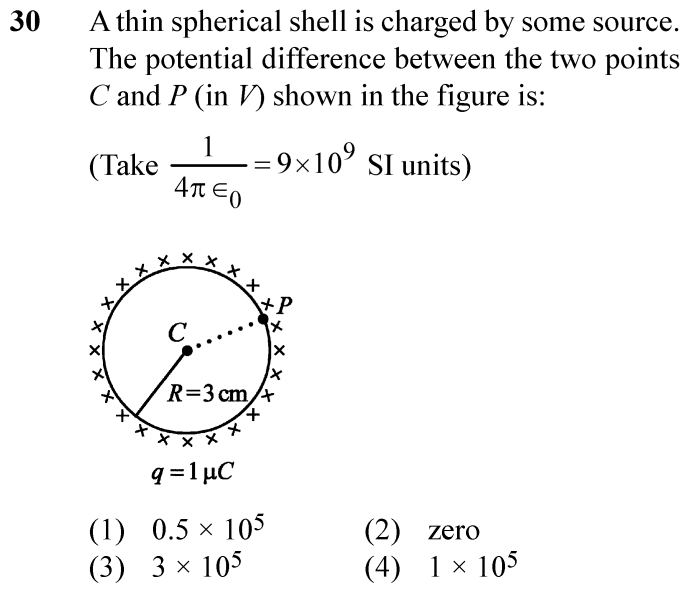
A thin spherical shell is charged by some source. The potential difference between the two points C and P (in V) shown in the figure is: (Take 1/(4πε₀) = 9×10⁹ SI units) [R = 3 cm, q = 1 μC]

✓
Verified Against NTA Final Answer Key
Option (2) : zero
📚 Electrostatic Potential and Capacitance Easy
📋 Given Parameters & Problem Setup
Spherical shell radius R = 3 cm
Charge on shell q = 1 μC
Point C Center of the thin spherical shell
Point P Point on the surface of the spherical shell
⚡

The 30-Second Exam Hall Shortcut: ⚡ Equipotential Interior Shell Theorem

⏱️ Save ~40 seconds

Inside a charged spherical shell, E = 0 everywhere -> Potential is strictly CONSTANT -> V_C - V_P = 0 V (ZERO)!

1 By Gauss’s law, electric field inside a hollow charged spherical shell is identically zero: E_in = 0.
2 Since E = -dV/dr = 0, the electric potential is constant throughout the entire interior and equals the surface potential.
3 Thus, potential at center C equals potential at surface P: V_C = V_P = q / (4πε₀ R).
4 Therefore, the potential difference is ΔV = V_C - V_P = 0 V.
5 Option (2) in 2 seconds!
🛡️
Why You Can 100% Trust This Shortcut: Gauss’s Law & Electrostatic Shielding (Electric potential is constant throughout the interior of a charged conductor/shell).
📐

Step-by-Step Rigorous Workflow & Mathematical Proof

Step 1

Electric Field Inside a Spherical Shell

Consider a Gaussian spherical surface of radius r < R concentric with the shell. Because all charge q resides on the outer surface of the thin shell, the charge enclosed within the Gaussian sphere is zero. By Gauss’s law:

∮E⃗⋅dA⃗=qenclosedε0=0  ⟹  Einside=0(for r≤R)\oint \vec{E} \cdot d\vec{A} = \frac{q_{enclosed}}{\varepsilon_0} = 0 \implies E_{inside} = 0 \quad (\text{for } r \le R)
Step 2

Relation Between Field and Potential

The electric field is the negative gradient of the electrostatic potential:

E=−dVdr=0  ⟹  V(r)=constant(for all r≤R)E = -\frac{dV}{dr} = 0 \implies V(r) = \text{constant} \quad (\text{for all } r \le R)
Step 3

Equivalence of Potentials

Because potential is constant everywhere from the center up to the surface, the potential at the center C is identically equal to the potential at point P on the surface:

VC=VP=14πε0qRV_C = V_P = \frac{1}{4\pi\varepsilon_0} \frac{q}{R}
Step 4

Evaluation of Potential Difference

The potential difference between points C and P is therefore identically zero:

ΔV=VC−VP=0 V\Delta V = V_C - V_P = 0\,\text{V}
⭐

360° Option Elimination Engine Key Feature

Diagnose every choice: Know exactly why the right option works and why distractors fail.

4-Option Deep Scan
1 (1)
✗ Incorrect
Verdict & Scientific Reason:

Arbitrary non-zero value.

⚠️
Student Fallacy (Why candidates pick this trap): Assuming potential drops linearly from surface to center.
2 (2)
✓ 100% Correct
Verdict & Scientific Reason:

Fundamental electrostatic property: hollow shell interior is an equipotential volume.

💡
Why this is airtight: None.
3 (3)
✗ Incorrect
Verdict & Scientific Reason:

This is the absolute potential V_P = 9×10⁹ × 10⁻⁶ / 0.03 = 3 × 10⁵ V, NOT the difference!

⚠️
Student Fallacy (Why candidates pick this trap): Confusing absolute potential at the surface with the potential difference between C and P.
4 (4)
✗ Incorrect
Verdict & Scientific Reason:

Incorrect non-zero value.

⚠️
Student Fallacy (Why candidates pick this trap): Miscalculating potential difference.
⚠️

NTA Trap Alert: Potential vs Potential Difference Confusion

Candidates calculate V = kq/R = 3 × 10⁵ V and choose Option (3), forgetting that the question specifically asks for the potential DIFFERENCE between C and P!

🛡️ How to avoid the -1 mark: Always note the keyword "difference": ΔV = V_C - V_P = 0 V.
📖

Core NEET Syllabus Standard

Physics Core Electrostatics · Electrostatic Potential and Capacitance Standard Benchmark
Core Scientific Principle Tested:

"The entire interior of a uniformly charged thin spherical shell is equipotential, with potential everywhere equal to that on its surface."

Syllabus Focus: Electrostatics of Conductors and Shells
✓ Core NEET UG Syllabus Anchor Syllabus & Academic Standards ↗
Inside a shell the field is dead: Potential is flat, Zero diff ahead!

Ready to attempt under real exam pressure?

Test your speed and accuracy in the authentic 200-minute timed NTA simulator.

Launch NEET 2024 CBT Test →

Spotted a mistake in this solution? Report an error ([email protected])

⚖️ Legal & Fair Dealing Notice: Sourced from publicly released NEET 2024 question papers and NEET answer keys for private study, research, and non-commercial educational practice under Fair Dealing (Section 52(1)(a) of the Indian Copyright Act, 1957). Not affiliated with or endorsed by NTA or NMC.

Solve 4 NEET Questions a Day — One per Subject

Cover all 1,140 official NEET questions in 285 days at your own pace. Progress is saved on your device. No login needed.