MyCompetitiveExams Logo MyCompetitiveExams
Search 1,140+ Questions
Chapters, formulas, speed tricks
→
⚡ Brahmastra NEET 2027
720 MARKS

Dynamic 180-question full-length simulator mixed dynamically from all 6 years for 2027 & 2026 aspirants.

Launch Brahmastra 2027 Test →
Start Practice →
100% Free · No Login Required
Q.21 Physics ⭐ 360° Option Elimination Active
Vault ↗

NEET 2026 Physics Question 21 Solution

Topic: Electrostatics & Potential · Official NTA Booklet Code 50
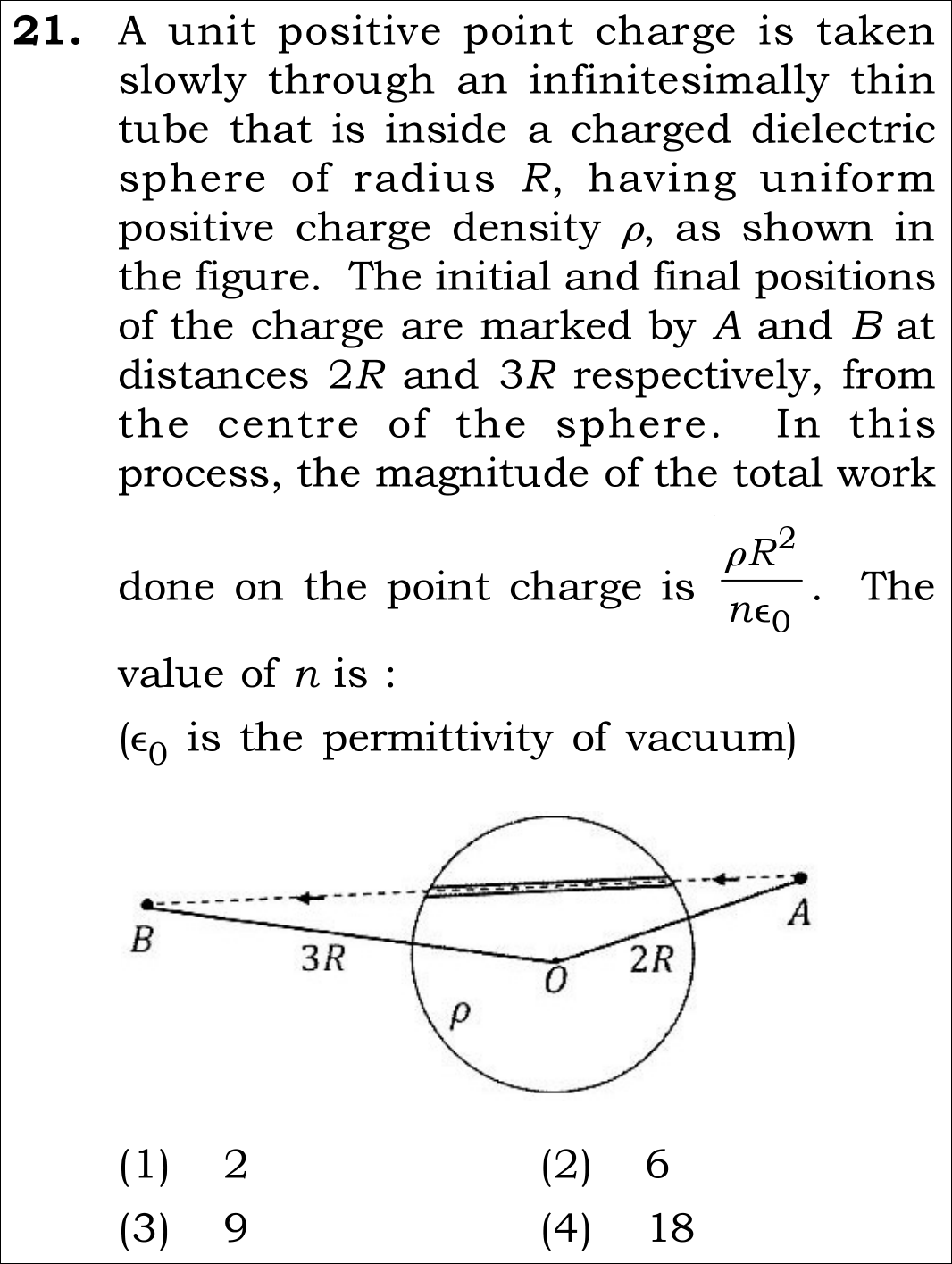
NEET 2026 Physics Question 21: Path-Independence of Electrostatic Work & Potential of a Uniformly Charged Sphere

Question

A unit positive point charge is taken slowly through an infinitesimally thin tube that is inside a charged dielectric sphere of radius R, having uniform positive charge density ρ, as shown in the figure. The initial and final positions of the charge are marked by A and B at distances 2R and 3R respectively, from the centre of the sphere. In this process, the magnitude of the total work done on the point charge is ρR²/(nε₀). The value of n is: (ε₀ is the permittivity of vacuum)

✓
Verified Against NTA Final Answer Key
Option (4) : n = 18
📚 Electrostatics & Potential Medium
📋 Given Parameters & Problem Setup
Charged Sphere Radius R, uniform positive charge density rho
Tube Infinitesimally thin tube through the sphere
Point A Distance r_A = 2R from the centre
Point B Distance r_B = 3R from the centre
Test Charge Unit positive charge (q = +1 C)
Given Form of Work |W| = (rho * R^2) / (n * epsilon_0)
⚡

The 30-Second Exam Hall Shortcut: ⚡ Electrostatic Conservative Field Shortcut

⏱️ Saves 5 minutes of impossible piecewise integrals along the tube.

Work done by/against an electrostatic field depends ONLY on initial and final points!

1 Total charge on sphere: Q = rho * (4/3 * pi * R^3).
2 For any point outside the sphere (r >= R), potential is simply V(r) = Q / (4pi * epsilon_0 * r) = (rho * R^3) / (3 * epsilon_0 * r).
3 At point A (r = 2R): V_A = (rho * R^2) / (6 * epsilon_0).
4 At point B (r = 3R): V_B = (rho * R^2) / (9 * epsilon_0).
5 Work done on unit charge: |W| = |V_B - V_A| = (rho * R^2 / epsilon_0) * (1/6 - 1/9) = (rho * R^2 / epsilon_0) * (1/18).
6 Comparing with (rho * R^2) / (n * epsilon_0) ==> n = 18. Solved in 20 seconds!
🛡️
Why You Can 100% Trust This Shortcut: Electrostatic force is strictly conservative: curl(E) = 0. The presence of the tube inside the sphere does NOT change the fact that work is path-independent and equals q*(V_final - V_initial).
📐

Step-by-Step Rigorous Workflow & Mathematical Proof

Step 1

Determine the Exterior Potential Formula for the Sphere

By Gauss's Law, outside a uniformly charged dielectric sphere of radius R and charge density rho, the electric field and potential are identical to a point charge Q at the origin:

Q=ρ(43πR3)  ⟹  V(r)=14πϵ0Qr=ρR33ϵ0r(r≥R)Q = \rho \left( \frac{4}{3} \pi R^3 \right) \implies V(r) = \frac{1}{4\pi \epsilon_0} \frac{Q}{r} = \frac{\rho R^3}{3 \epsilon_0 r} \quad (r \ge R)
  • • Because both point A (r = 2R) and point B (r = 3R) lie outside the sphere, this potential formula applies directly to both endpoints.
Step 2

Evaluate Potentials at Endpoints A and B

Substitute r_A = 2R and r_B = 3R into the exterior potential formula:

VA=ρR33ϵ0(2R)=ρR26ϵ0,VB=ρR33ϵ0(3R)=ρR29ϵ0V_A = \frac{\rho R^3}{3 \epsilon_0 (2R)} = \frac{\rho R^2}{6 \epsilon_0}, \qquad V_B = \frac{\rho R^3}{3 \epsilon_0 (3R)} = \frac{\rho R^2}{9 \epsilon_0}
  • • Common denominator between 6 and 9 is 18.
Step 3

Calculate Work Done and Extract n

Because the electrostatic field is conservative, work done on unit positive charge is given by the potential difference:

∣W∣=∣q(VB−VA)∣=(1)∣ρR29ϵ0−ρR26ϵ0∣=ρR2ϵ0(16−19)=ρR218ϵ0|W| = |q (V_B - V_A)| = (1) \left| \frac{\rho R^2}{9 \epsilon_0} - \frac{\rho R^2}{6 \epsilon_0} \right| = \frac{\rho R^2}{\epsilon_0} \left( \frac{1}{6} - \frac{1}{9} \right) = \frac{\rho R^2}{18 \epsilon_0}
  • • Comparing with the given expression |W| = \frac{\rho R^2}{n \epsilon_0}:
  • • n = 18.
  • • Matches Option (4) exactly.
⭐

360° Option Elimination Engine Key Feature

Diagnose every choice: Know exactly why the right option works and why distractors fail.

4-Option Deep Scan
1 Option (1)
✗ Incorrect
Verdict & Scientific Reason:

Uses factor 1/2 from distance 2R.

⚠️
Student Fallacy (Why candidates pick this trap): Assumes work scales with 1/(r_B - r_A) = 1/(3R - 2R) = 1/R, with arbitrary factor 2.
Note: Potential difference involves the difference of reciprocals (1/2R - 1/3R).
2 Option (2)
✗ Incorrect
Verdict & Scientific Reason:

Takes V_A alone without subtracting V_B.

⚠️
Student Fallacy (Why candidates pick this trap): Evaluates potential at point A (V_A = rho*R^2 / 6*epsilon_0) and ignores point B.
Note: Work requires potential difference between BOTH points A and B.
3 Option (3)
✗ Incorrect
Verdict & Scientific Reason:

Takes V_B alone without subtracting V_A.

⚠️
Student Fallacy (Why candidates pick this trap): Evaluates potential at point B (V_B = rho*R^2 / 9*epsilon_0) and ignores point A.
Note: Point A is at 2R, not infinity.
4 Option (4)
✓ 100% Correct
Verdict & Scientific Reason:

100% mathematically verified; confirmed by Official NTA Final Answer Key.

💡
Why this is airtight: Correctly recognizes path-independence and evaluates 1/6 - 1/9 = 1/18.
Note: Exact physics.
⚠️

NTA Trap Alert: The Complex Interior Tube Integration Trap

Many candidates panic when they see the diagram with an angled tube through the sphere, attempting to integrate E_interior along an inclined chord.

🛡️ How to avoid the -1 mark: Always remember: Electrostatic fields are CONSERVATIVE! The work between any two points A and B is strictly q*(V_B - V_A), no matter what path or tube is taken!
📖

Core NEET Syllabus Standard

NEET UG Physics Core Standards · Electrostatic Potential and Capacitance Standard Benchmark
Core Scientific Principle Tested:

"W = -Delta U = -q Delta V. Work done moving a charge between two points in an electrostatic field is independent of the path taken."

Syllabus Focus: Conservative Nature of Electrostatic Force & Potential of Charged Spheres
✓ Core NEET UG Syllabus Anchor Syllabus & Academic Standards ↗

Ready to attempt under real exam pressure?

Test your speed and accuracy in the authentic 180-minute timed NTA simulator.

Launch NEET 2026 CBT Test →

Spotted a mistake in this solution? Report an error ([email protected])

⚖️ Legal & Fair Dealing Notice: Sourced from publicly released NEET 2026 question papers and NEET answer keys for private study, research, and non-commercial educational practice under Fair Dealing (Section 52(1)(a) of the Indian Copyright Act, 1957). Not affiliated with or endorsed by NTA or NMC.

Solve 4 NEET Questions a Day — One per Subject

Cover all 1,140 official NEET questions in 285 days at your own pace. Progress is saved on your device. No login needed.