MyCompetitiveExams Logo MyCompetitiveExams
Search 1,140+ Questions
Chapters, formulas, speed tricks
→
⚡ Brahmastra NEET 2027
720 MARKS

Dynamic 180-question full-length simulator mixed dynamically from all 6 years for 2027 & 2026 aspirants.

Launch Brahmastra 2027 Test →
Start Practice →
100% Free · No Login Required
Q.33 Physics ⭐ 360° Option Elimination Active
Vault ↗

NEET 2026 Physics Question 33 Solution

Topic: Electrostatics & Conductors · Official NTA Booklet Code 50
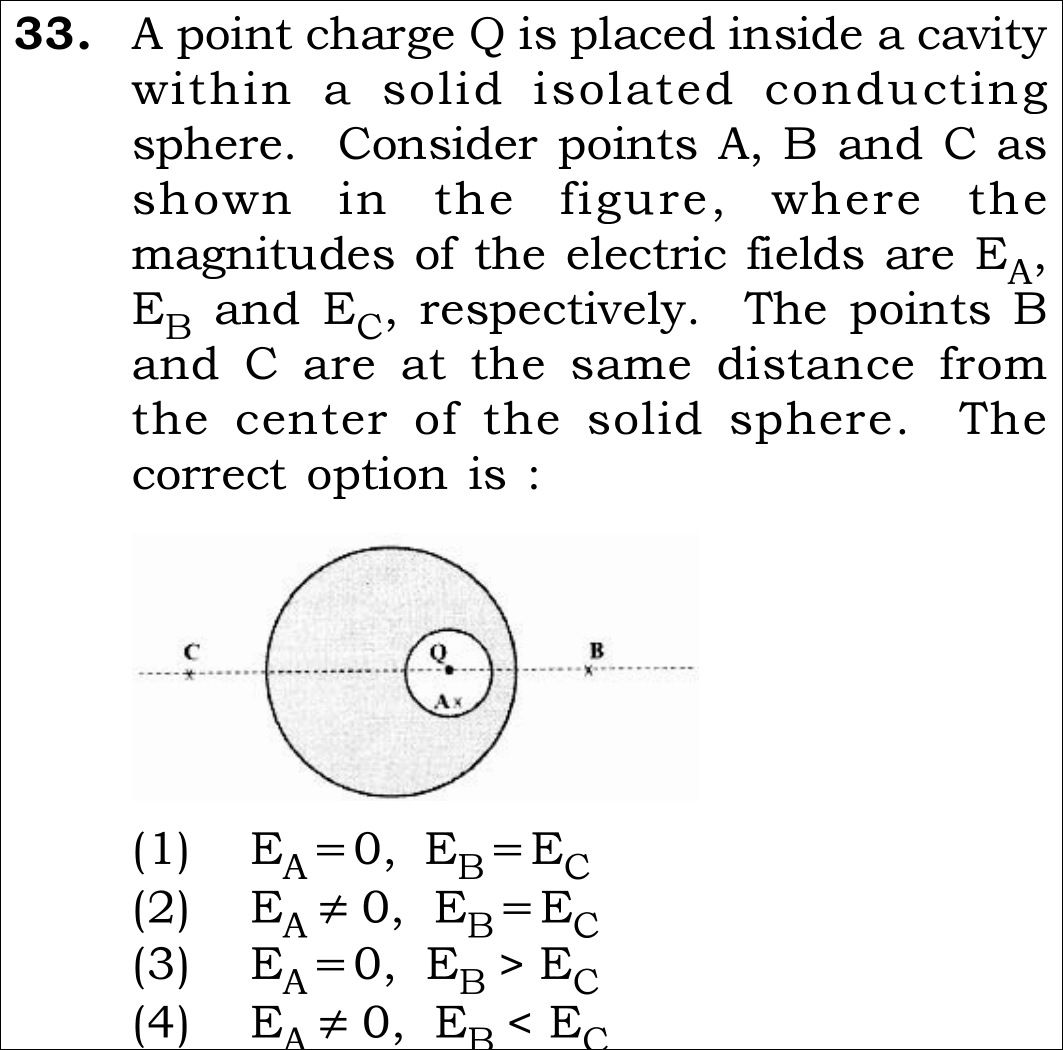
NEET 2026 Physics Question 33: Electrostatic Shielding and Cavity Field with Interior Point Charge

Question

A point charge Q is placed inside a cavity within a solid isolated conducting sphere. Consider points A, B and C as shown in the figure, where the magnitudes of the electric fields are E_A, E_B and E_C, respectively. The points B and C are at the same distance from the center of the solid sphere. The correct option is:

✓
Verified Against NTA Final Answer Key
Option (2) : E_A != 0, E_B = E_C
📚 Electrostatics & Conductors Medium
📋 Given Parameters & Problem Setup
Conductor Solid isolated spherical conductor with off-center cavity
Cavity Charge Point charge Q placed inside the cavity
Point A Located inside the cavity near charge Q
Points B and C Exterior points equidistant from the sphere center: r_B = r_C
Target Relations Electric fields E_A, E_B, E_C
⚡

The 30-Second Exam Hall Shortcut: ⚡ Cavity vs Outer Shell Decoupling Rule

⏱️ Prevents confusing internal conductor metal with cavity space.

A cavity with a charge has E != 0; A spherical outer surface makes external fields spherically symmetric!

1 Point A is inside the cavity where charge Q resides: The Coulomb field of charge Q + inner induced wall charge does NOT vanish inside the cavity ==> E_A != 0!
2 By Gauss's law, inner wall gets induced charge -Q, leaving net charge +Q on the exterior conductor surface.
3 Because the outer boundary of the conductor is a SPHERE, the +Q surface charge distributes UNIFORMLY with constant surface density sigma = +Q / (4pi * R^2), regardless of where the cavity is located inside!
4 Outside the sphere, the field is identical to a point charge +Q at the sphere's center: E(r) = Q / (4pi * epsilon_0 * r^2).
5 Since B and C are at identical distances from the center: E_B = E_C.
6 Result: E_A != 0, E_B = E_C. Solved in 15 seconds!
🛡️
Why You Can 100% Trust This Shortcut: Electrostatic shielding decouples the cavity geometry from the outer spherical boundary. The outer surface charge distribution is governed solely by the outer sphere's geometric symmetry, making external fields strictly central and isotropic.
📐

Step-by-Step Rigorous Workflow & Mathematical Proof

Step 1

Analyze Electric Field at Point A (Inside the Cavity)

Point A is located in the free space inside the cavity containing point charge Q:

EA≠0E_A \ne 0
  • • Electric field is zero inside the conducting METAL body, but NOT inside an empty cavity containing an enclosed charge.
  • • Point charge Q produces a strong radial field in its vicinity, so E_A is non-zero.
Step 2

Analyze Induced Charge Distribution on Outer Spherical Boundary

Apply Gauss's law to a Gaussian surface enclosing the cavity inside the conductor:

∮E⃗⋅dA⃗=0  ⟹  qenclosed=Q+qinner=0  ⟹  qinner=−Q\oint \vec{E} \cdot d\vec{A} = 0 \implies q_{\text{enclosed}} = Q + q_{\text{inner}} = 0 \implies q_{\text{inner}} = -Q
  • • By charge conservation on the isolated conductor: q_{outer} = +Q.
  • • Because the conductor's exterior surface is a sphere, electrostatic equilibrium forces +Q to distribute with uniform surface charge density sigma = Q / (4pi R_{ext}^2).
Step 3

Evaluate Exterior Fields at Equidistant Points B and C

By Gauss's theorem, outside a uniformly charged spherical surface, the field is purely radial from the center O:

E(r)=14πϵ0Qr2  ⟹  EB=EC(since rB=rC)E(r) = \frac{1}{4\pi \epsilon_0} \frac{Q}{r^2} \implies E_B = E_C \quad (\text{since } r_B = r_C)
  • • The off-center position of the cavity has zero effect on the external field symmetry.
  • • Therefore, E_A != 0 and E_B = E_C.
  • • Matches Option (2) exactly.
⭐

360° Option Elimination Engine Key Feature

Diagnose every choice: Know exactly why the right option works and why distractors fail.

4-Option Deep Scan
1 Option (1)
✗ Incorrect
Verdict & Scientific Reason:

Cavity field fallacy.

⚠️
Student Fallacy (Why candidates pick this trap): Believes electric field is zero everywhere inside the conductor perimeter, including cavities with charges.
Note: Electric field is only zero inside empty charge-free cavities or the metal itself.
2 Option (2)
✓ 100% Correct
Verdict & Scientific Reason:

100% scientifically sound; confirmed by Official NTA Final Answer Key.

💡
Why this is airtight: Correctly recognizes non-zero cavity field and external spherical symmetry.
Note: Exact electrostatic shielding physics.
3 Option (3)
✗ Incorrect
Verdict & Scientific Reason:

Double misconception.

⚠️
Student Fallacy (Why candidates pick this trap): Assumes cavity field is zero and that external field is asymmetric because the cavity is on the right.
Note: Conductor shielding guarantees the outer surface field is completely symmetric.
4 Option (4)
✗ Incorrect
Verdict & Scientific Reason:

External asymmetry fallacy.

⚠️
Student Fallacy (Why candidates pick this trap): Assumes external field is stronger on the side opposite the cavity.
Note: Spherical outer boundary ensures E_B = E_C.
⚠️

NTA Trap Alert: The "Field Inside a Conductor is Always Zero" Oversimplification

Many candidates blindly repeat "E = 0 inside conductors" and pick E_A = 0 (Option 1 or 3).

🛡️ How to avoid the -1 mark: Check the location of point A: It is in the VACUUM CAVITY next to point charge Q! A charge always creates a field around itself in vacuum.
📖

Core NEET Syllabus Standard

NEET UG Physics Core Standards · Electrostatic Potential and Capacitance Standard Benchmark
Core Scientific Principle Tested:

"In electrostatic equilibrium, E = 0 inside the metallic material. A charge Q inside a cavity induces -Q on inner wall and +Q on outer surface, which distributes according to outer surface curvature."

Syllabus Focus: Electrostatics of Conductors & Cavity Shielding
✓ Core NEET UG Syllabus Anchor Syllabus & Academic Standards ↗

Ready to attempt under real exam pressure?

Test your speed and accuracy in the authentic 180-minute timed NTA simulator.

Launch NEET 2026 CBT Test →

Spotted a mistake in this solution? Report an error ([email protected])

⚖️ Legal & Fair Dealing Notice: Sourced from publicly released NEET 2026 question papers and NEET answer keys for private study, research, and non-commercial educational practice under Fair Dealing (Section 52(1)(a) of the Indian Copyright Act, 1957). Not affiliated with or endorsed by NTA or NMC.

Solve 4 NEET Questions a Day — One per Subject

Cover all 1,140 official NEET questions in 285 days at your own pace. Progress is saved on your device. No login needed.