NEET 2021 Physics Question 1 Solution
Question
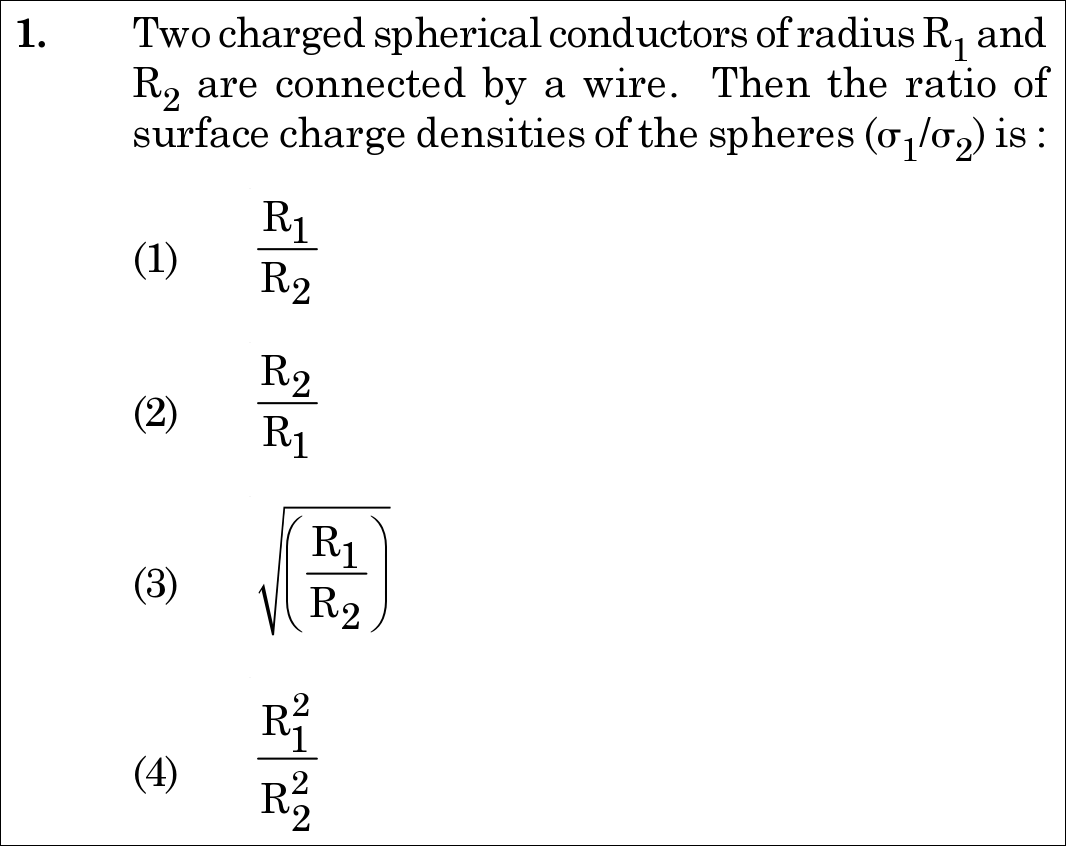
Two charged spherical conductors of radius R1 and R2 are connected by a wire. Then the ratio of surface charge densities of the spheres (σ1/σ2) is:
Dynamic 180-question full-length simulator mixed dynamically from all 6 years for 2027 & 2026 aspirants.
Two charged spherical conductors of radius R1 and R2 are connected by a wire. Then the ratio of surface charge densities of the spheres (σ1/σ2) is:
For any spherical conductor at potential V, . Therefore, surface charge density is inversely proportional to radius: ! Instant 5-second answer matching Option (2)!
When two conducting spheres of radii and are joined by a thin conducting wire, free electrons flow between them until they reach an identical electrostatic potential :
Surface charge density is defined as the total charge per unit spherical surface area :
Substitute the charge ratio into the density ratio:
Diagnose every choice: Know exactly why the right option works and why distractors fail.
This represents the ratio of charges (), not the ratio of surface charge densities ().
Exact mathematical outcome derived from .
Square-root dependence is unphysical for potential-charge relationships.
This would occur if the spheres had identical charges (), which is false for connected conductors of unequal radii.
Students frequently assume connecting two spheres distributes charge equally (). Connected conductors always equalize electric POTENTIAL (), which means the smaller sphere has higher surface charge density (sharper curvature = greater ).
"On a connected conducting surface in electrostatic equilibrium, electric potential is constant, and surface charge density is inversely proportional to the radius of curvature."
Test your speed and accuracy in the authentic 200-minute timed NTA simulator.
Spotted a mistake in this solution? Report an error ([email protected])
Cover all 1,140 official NEET questions in 285 days at your own pace. Progress is saved on your device. No login needed.