MyCompetitiveExams Logo MyCompetitiveExams
Search 1,140+ Questions
Chapters, formulas, speed tricks
→
⚡ Brahmastra NEET 2027
720 MARKS

Dynamic 180-question full-length simulator mixed dynamically from all 6 years for 2027 & 2026 aspirants.

Launch Brahmastra 2027 Test →
Start Practice →
100% Free · No Login Required
Q.24 Physics ⭐ 360° Option Elimination Active
Vault ↗

NEET 2023 Physics Question 24 Solution

Topic: Electrostatic Potential and Capacitance · Official NTA Booklet Code G5
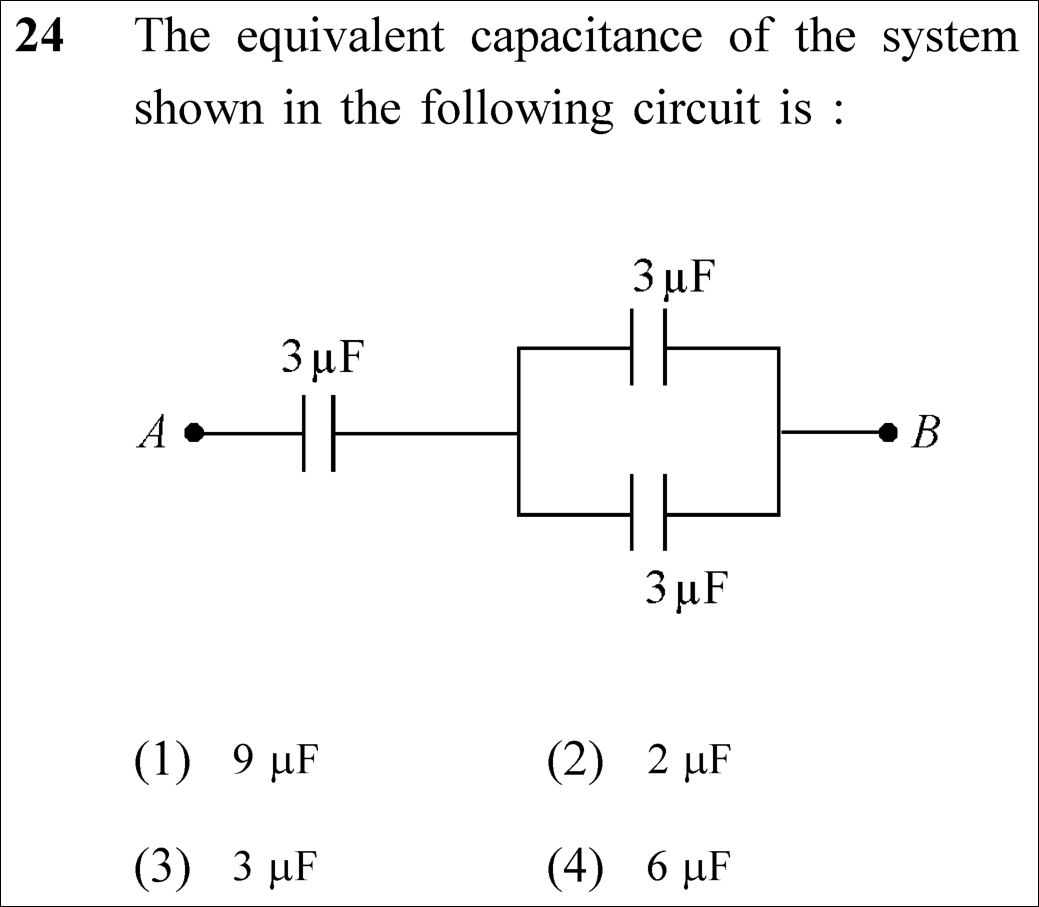
NEET 2023 Physics Question 24: Equivalent Capacitance of Series-Parallel Network

Question

The equivalent capacitance of the system shown in the following circuit is:

✓
Verified Against NTA Final Answer Key
Option (2) : 2 μF
📚 Electrostatic Potential and Capacitance Easy
📋 Given Parameters & Problem Setup
First Series Capacitor 3 μF
Parallel Branch Capacitors Two 3 μF capacitors in parallel
⚡

The 30-Second Exam Hall Shortcut: ⚡ Parallel Sum then Product-Over-Sum Series Trick

⏱️ Save ~30 seconds

Two 3 μF in parallel add up to 3 + 3 = 6 μF! Then 3 μF in series with 6 μF gives (3 × 6) / (3 + 6) = 18 / 9 = 2 μF in 5 seconds!

1 Identify the parallel branch first: two 3 μF capacitors in parallel.
2 In parallel, capacitances simply add: C_p = 3 + 3 = 6 μF.
3 Now this 6 μF combination is in series with the initial 3 μF capacitor.
4 In series, use product over sum: C_eq = (3 × 6) / (3 + 6) = 18 / 9 = 2 μF.
5 Instant Option (2) 2 μF!
🛡️
Why You Can 100% Trust This Shortcut: Fundamental Electrostatics · Capacitive Circuits (Parallel capacitance C_p = C₁ + C₂; Series capacitance 1/C_s = 1/C₁ + 1/C₂).
📐

Step-by-Step Rigorous Workflow & Mathematical Proof

Step 1

Evaluation of the Parallel Combination

Inspect the right branch of the circuit: two identical capacitors of capacitance 3 μF are connected in parallel across the same potential nodes. The equivalent capacitance of a parallel combination is the direct sum:

Cp=C2+C3=3 μF+3 μF=6 μFC_p = C_2 + C_3 = 3\ \mu\text{F} + 3\ \mu\text{F} = 6\ \mu\text{F}
Step 2

Series Reduction with the Input Capacitor

The parallel block C_p = 6 μF is connected in series with the first capacitor C_1 = 3 μF between terminals A and B. The equivalent series capacitance is given by the reciprocal formula:

1Ceq=1C1+1Cp=13+16=2+16=36=12 μF−1\frac{1}{C_{\text{eq}}} = \frac{1}{C_1} + \frac{1}{C_p} = \frac{1}{3} + \frac{1}{6} = \frac{2 + 1}{6} = \frac{3}{6} = \frac{1}{2}\ \mu\text{F}^{-1}
Step 3

Inversion to Obtain Equivalent Capacitance

Inverting yields the net equivalent capacitance:

Ceq=2 μFC_{\text{eq}} = 2\ \mu\text{F}
⭐

360° Option Elimination Engine Key Feature

Diagnose every choice: Know exactly why the right option works and why distractors fail.

4-Option Deep Scan
1 (1)
✗ Incorrect
Verdict & Scientific Reason:

Corresponds to all three capacitors in parallel (3 + 3 + 3 = 9 μF).

⚠️
Student Fallacy (Why candidates pick this trap): Candidate treated the entire circuit as parallel.
2 (2)
✓ 100% Correct
Verdict & Scientific Reason:

Accurate equivalent capacitance: 6 μF in series with 3 μF equals 2 μF.

💡
Why this is airtight: None. Candidate correctly combined parallel and series rules.
3 (3)
✗ Incorrect
Verdict & Scientific Reason:

Incorrect equivalent value.

⚠️
Student Fallacy (Why candidates pick this trap): Candidate assumed the circuit simplifies to a single capacitor value.
4 (4)
✗ Incorrect
Verdict & Scientific Reason:

Represents only the parallel stage, forgetting the series capacitor.

⚠️
Student Fallacy (Why candidates pick this trap): Candidate stopped calculation after finding C_p = 6 μF.
⚠️

NTA Trap Alert: Applying Resistor Combination Formulas in Reverse

Capacitors combine opposite to resistors: capacitors ADD in parallel (C = C₁ + C₂) and take reciprocals in series (1/C = 1/C₁ + 1/C₂). Applying resistor rules yields wrong answers.

🛡️ How to avoid the -1 mark: Check: Parallel capacitors ADD; Series capacitors REDUCE (always smaller than smallest individual capacitor).
📖

Core NEET Syllabus Standard

National Eligibility cum Entrance Test (NEET UG) · Electrostatic Potential and Capacitance Standard Benchmark
Core Scientific Principle Tested:

"Charge is identical in series (1/C_eq = Σ 1/C_i); voltage is identical in parallel (C_eq = Σ C_i)."

Syllabus Focus: Combination of Capacitors in Series and Parallel
Preserved in Rationalized Curriculum Syllabus & Academic Standards ↗

Ready to attempt under real exam pressure?

Test your speed and accuracy in the authentic 200-minute timed NTA simulator.

Launch NEET 2023 CBT Test →

Spotted a mistake in this solution? Report an error ([email protected])

⚖️ Legal & Fair Dealing Notice: Sourced from publicly released NEET 2023 question papers and NEET answer keys for private study, research, and non-commercial educational practice under Fair Dealing (Section 52(1)(a) of the Indian Copyright Act, 1957). Not affiliated with or endorsed by NTA or NMC.

Solve 4 NEET Questions a Day — One per Subject

Cover all 1,140 official NEET questions in 285 days at your own pace. Progress is saved on your device. No login needed.