MyCompetitiveExams Logo MyCompetitiveExams
Search 1,140+ Questions
Chapters, formulas, speed tricks
→
⚡ Brahmastra NEET 2027
720 MARKS

Dynamic 180-question full-length simulator mixed dynamically from all 6 years for 2027 & 2026 aspirants.

Launch Brahmastra 2027 Test →
Start Practice →
100% Free · No Login Required
Q.38 Physics ⭐ 360° Option Elimination Active
Vault ↗

NEET 2021 Physics Question 38 Solution

Topic: Current Electricity · Official NTA Booklet Code M1
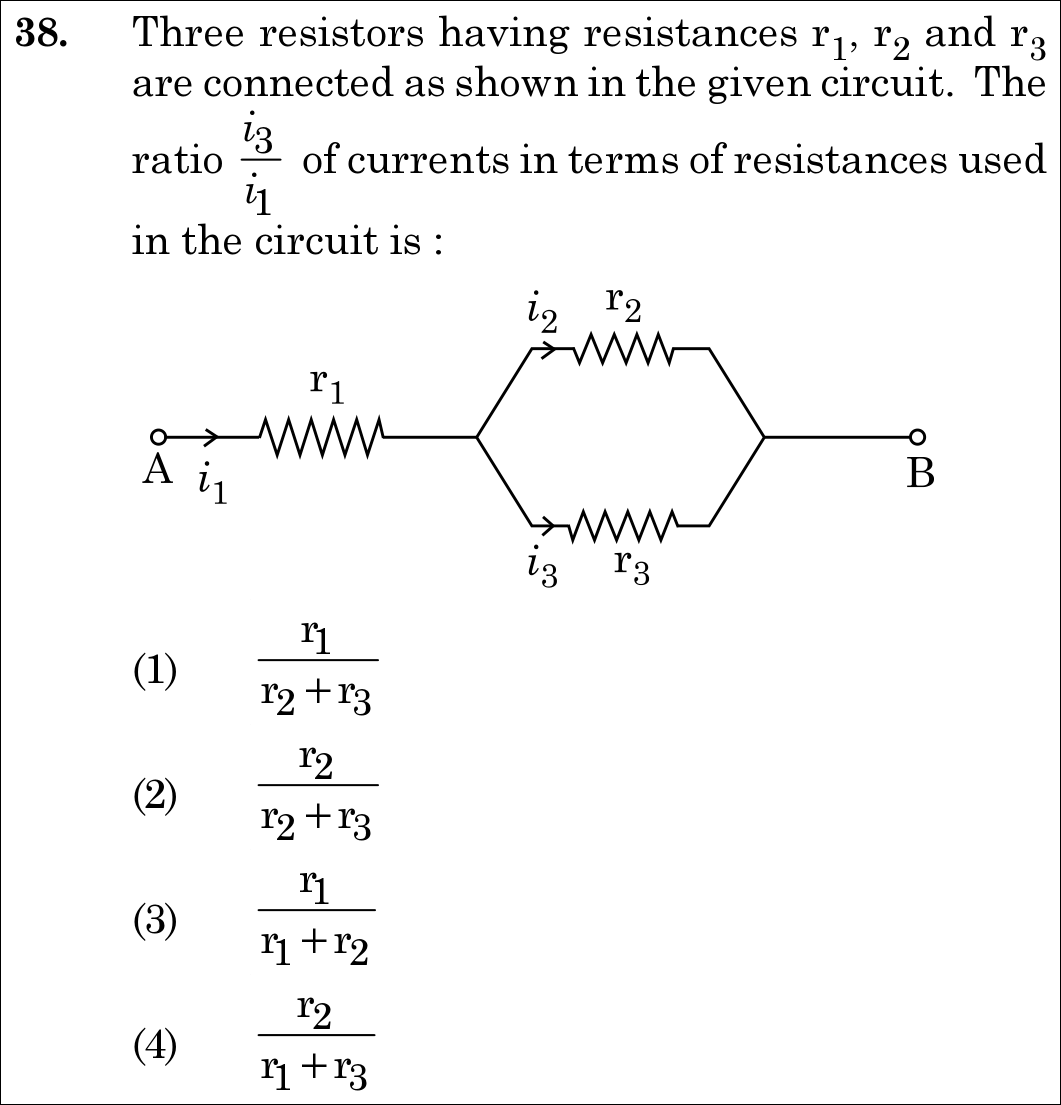
NEET 2021 Physics Question 38: Parallel Circuit Current Division Rule: Branch Current Ratio

Question

Three resistors having resistances r1, r2 and r3 are connected as shown in the given circuit. The ratio 3 i i of currents in terms of resistances used in the circuit is:

  1. (1)r r r +
  2. (2)r r r +
  3. (3)r r r +
  4. (4)r r r +
✓
Verified Against NTA Final Answer Key
Option (2) : r2 / (r2 + r3)
📚 Current Electricity Easy
📋 Given Parameters & Problem Setup
Total Current entering network i_1
Branch Resistor 2 r_2 (current i_2)
Branch Resistor 3 r_3 (current i_3)
Series Resistor r_1 (carries full current i_1)
⚡

The 30-Second Exam Hall Shortcut: ⚡ Inverse Resistance Current Divider Rule

⏱️ Save ~20 seconds

By Kirchhoff's junction rule, total current entering parallel branches is i1=i2+i3i_1 = i_2 + i_3. Parallel branches share identical voltage (i2r2=i3r3i_2 r_2 = i_3 r_3). The fraction of current flowing through branch 3 is inversely proportional to r3r_3: i3=i1r2r2+r3  ⟹  i3i1=r2r2+r3i_3 = i_1 \frac{r_2}{r_2 + r_3} \implies \frac{i_3}{i_1} = \frac{r_2}{r_2 + r_3}! Instant 5-second answer matching Option (2)!

1 Total current i1i_1 flows through r1r_1 and then splits into branches r2r_2 and r3r_3: i1=i2+i3i_1 = i_2 + i_3.
2 Since branches r2r_2 and r3r_3 are in parallel, voltage across them is equal: Vp=i2r2=i3r3V_p = i_2 r_2 = i_3 r_3.
3 Substitute i2=i1−i3i_2 = i_1 - i_3: (i1−i3)r2=i3r3  ⟹  i1r2=i3(r2+r3)(i_1 - i_3) r_2 = i_3 r_3 \implies i_1 r_2 = i_3 (r_2 + r_3).
4 Divide by i1i_1: i3i1=r2r2+r3\frac{i_3}{i_1} = \frac{r_2}{r_2 + r_3}.
5 Match Option (2).
🛡️
Why You Can 100% Trust This Shortcut: Canonical current division rule for two parallel resistors.
📐

Step-by-Step Rigorous Workflow & Mathematical Proof

Step 1

Applying Kirchhoff's Current Law (KCL)

Current i1i_1 enters from terminal A and passes entirely through resistor r1r_1. At the junction ahead of r1r_1, the current divides into two parallel branches containing r2r_2 and r3r_3:

i1=i2+i3  ⟹  i2=i1−i3i_1 = i_2 + i_3 \implies i_2 = i_1 - i_3
Step 2

Equating Potential Difference Across Parallel Branches

Because resistors r2r_2 and r3r_3 are connected across the exact same pair of nodes, their potential drops are equal:

V2=V3  ⟹  i2r2=i3r3V_2 = V_3 \implies i_2 r_2 = i_3 r_3
Step 3

Solving for the Current Ratio i3 / i1

Substitute i2=i1−i3i_2 = i_1 - i_3 into the voltage equality equation:

(i1−i3)r2=i3r3  ⟹  i1r2−i3r2=i3r3  ⟹  i1r2=i3(r2+r3)  ⟹  i3i1=r2r2+r3(i_1 - i_3) r_2 = i_3 r_3 \implies i_1 r_2 - i_3 r_2 = i_3 r_3 \implies i_1 r_2 = i_3 (r_2 + r_3) \implies \frac{i_3}{i_1} = \frac{r_2}{r_2 + r_3}
⭐

360° Option Elimination Engine Key Feature

Diagnose every choice: Know exactly why the right option works and why distractors fail.

4-Option Deep Scan
1 1
✗ Incorrect
Verdict & Scientific Reason:

Inappropriately includes r1r_1, which is in series and does not participate in the parallel current division.

⚠️
Student Fallacy (Why candidates pick this trap): Assuming the series resistor determines branch current splitting.
2 2
✓ 100% Correct
Verdict & Scientific Reason:

Exact current divider formula for branch r3r_3 (i3/i1=r2/(r2+r3)i_3 / i_1 = r_2 / (r_2 + r_3)).

💡
Why this is airtight: None; textbook circuit law.
3 3
✗ Incorrect
Verdict & Scientific Reason:

Omits r3r_3 completely.

⚠️
Student Fallacy (Why candidates pick this trap): Mismatched resistor labels.
4 4
✗ Incorrect
Verdict & Scientific Reason:

Replaces r2r_2 in denominator with series resistance r1r_1.

⚠️
Student Fallacy (Why candidates pick this trap): Treating r1r_1 and r3r_3 as the parallel pair.
⚠️

NTA Trap Alert: Opposite Resistor Rule in Current Divider Trap

In a current divider, the current in branch 3 (i3i_3) depends on the OPPOSITE branch resistance r2r_2 in the numerator: i3∝r2r2+r3i_3 \propto \frac{r_2}{r_2 + r_3}. Students often mistakenly place r3r_3 in the numerator.

🛡️ How to avoid the -1 mark: Higher resistance draws LESS current! Hence i3i_3 must have the other resistor (r2r_2) in the numerator.
📖

Core NEET Syllabus Standard

NCERT Physics · Current Electricity Standard Benchmark
Core Scientific Principle Tested:

"In parallel branches, current divides inversely proportional to resistance: i3=i1r2r2+r3i_3 = i_1 \frac{r_2}{r_2 + r_3}."

Syllabus Focus: Kirchhoff's Rules and Current Division
✓ Core NEET UG Syllabus Anchor Syllabus & Academic Standards ↗

Ready to attempt under real exam pressure?

Test your speed and accuracy in the authentic 200-minute timed NTA simulator.

Launch NEET 2021 CBT Test →

Spotted a mistake in this solution? Report an error ([email protected])

⚖️ Legal & Fair Dealing Notice: Sourced from publicly released NEET 2021 question papers and NEET answer keys for private study, research, and non-commercial educational practice under Fair Dealing (Section 52(1)(a) of the Indian Copyright Act, 1957). Not affiliated with or endorsed by NTA or NMC.

Solve 4 NEET Questions a Day — One per Subject

Cover all 1,140 official NEET questions in 285 days at your own pace. Progress is saved on your device. No login needed.