MyCompetitiveExams Logo MyCompetitiveExams
Search 1,140+ Questions
Chapters, formulas, speed tricks
→
⚡ Brahmastra NEET 2027
720 MARKS

Dynamic 180-question full-length simulator mixed dynamically from all 6 years for 2027 & 2026 aspirants.

Launch Brahmastra 2027 Test →
Start Practice →
100% Free · No Login Required
Q.36 Physics ⭐ 360° Option Elimination Active
Vault ↗

NEET 2025 Physics Question 36 Solution

Topic: Current Electricity · Official NTA Booklet Code 45
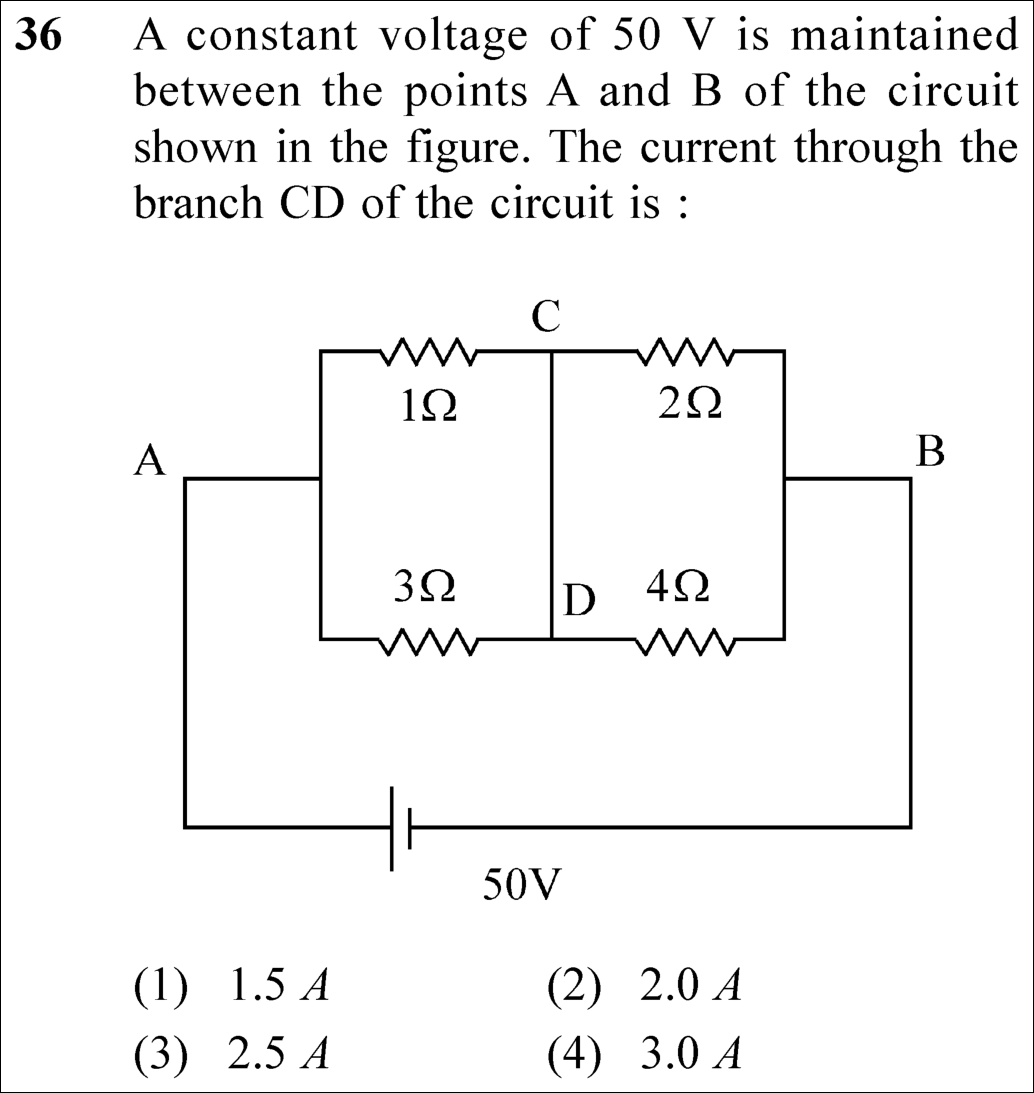
NEET 2025 Physics Question 36: Current Through Cross-Connecting Wire CD in Resistor Network

Question

A constant voltage of 50 V is maintained between the points A and B of the circuit shown in the figure. The current through the branch CD of the circuit is:

✓
Verified Against NTA Final Answer Key
Option (2) : 2.0 A
📚 Current Electricity Medium
📋 Given Parameters & Problem Setup
Applied Supply Voltage (V_AB) 50 V
Left Upper Resistor (R_AC) 1 Ω
Left Lower Resistor (R_AD) 3 Ω
Right Upper Resistor (R_CB) 2 Ω
Right Lower Resistor (R_DB) 4 Ω
Branch CD Zero-resistance connecting wire between C and D
⚡

The 30-Second Exam Hall Shortcut: ⚡ Node-Voltage Kirchhoff Shortcut

⏱️ Save ~45 seconds

CD is an equipotential wire (V_C = V_D). R_left = 1 || 3 = 0.75 Ω, R_right = 2 || 4 = 4/3 Ω ⟹ R_eq = 25/12 Ω ⟹ I = 24 A. V_AC = 18 V ⟹ I_1 = 18 A, I_2 = 16 A ⟹ I_CD = 18 - 16 = 2.0 A!

1 Recognize that branch CD is a shorting wire: Node C and Node D are at the same electric potential (V_C = V_D).
2 Left section has 1 Ω and 3 Ω in parallel: R_left = (1 × 3) / (1 + 3) = 3/4 Ω = 0.75 Ω.
3 Right section has 2 Ω and 4 Ω in parallel: R_right = (2 × 4) / (2 + 4) = 8/6 = 4/3 Ω.
4 Total equivalent resistance: R_eq = 3/4 + 4/3 = 25/12 Ω.
5 Total current from 50 V battery: I_total = 50 / (25/12) = 24 A.
6 Voltage across left parallel pair: V_left = 24 A × (3/4 Ω) = 18 V.
7 Current from A to C through 1 Ω resistor: I_AC = 18 V / 1 Ω = 18 A.
8 Voltage across right parallel pair: V_right = 50 V - 18 V = 32 V.
9 Current from C to B through 2 Ω resistor: I_CB = 32 V / 2 Ω = 16 A.
10 By Kirchhoff’s Current Law at node C: Current into CD is I_CD = I_AC - I_CB = 18 A - 16 A = 2.0 A!
11 Select Option (2) with 100% confidence!
🛡️
Why You Can 100% Trust This Shortcut: Kirchhoff’s Current and Voltage Laws (NCERT Physics · Current Electricity: ΣI = 0, ΣV = 0).
📐

Step-by-Step Rigorous Workflow & Mathematical Proof

Step 1

Identify Circuit Topology and Equipotential Nodes

Branch CD is an ideal wire with zero resistance connecting junction C and junction D. Therefore, junctions C and D form a single equipotential node:

VC=VD=VCDV_C = V_D = V_{CD}
  • • The 1 Ω and 3 Ω resistors are connected in parallel between node A and node CD.
  • • The 2 Ω and 4 Ω resistors are connected in parallel between node CD and node B.
Step 2

Calculate Equivalent Resistances and Total Current

Calculate the equivalent resistance of each section and the whole network:

Rleft=1×31+3=34 Ω,Rright=2×42+4=43 Ω  ⟹  Req=34+43=2512 ΩR_{left} = \frac{1 \times 3}{1 + 3} = \frac{3}{4}\,\Omega, \quad R_{right} = \frac{2 \times 4}{2 + 4} = \frac{4}{3}\,\Omega \implies R_{eq} = \frac{3}{4} + \frac{4}{3} = \frac{25}{12}\,\Omega
  • • Total current delivered by the 50 V battery:
  • • I_{total} = \frac{50}{25/12} = 50 \times \frac{12}{25} = 24\text{ A}.
Step 3

Calculate Currents and Apply KCL at Node C

Determine the potential at the central node and find currents entering and leaving node C:

VA−VC=ItotalRleft=24×34=18 V  ⟹  IAC=18 V1 Ω=18 AV_A - V_C = I_{total} R_{left} = 24 \times \frac{3}{4} = 18\text{ V} \implies I_{AC} = \frac{18\text{ V}}{1\,\Omega} = 18\text{ A}
  • • V_C - V_B = 50 - 18 = 32 V ⟹ I_{CB} = 32 V / 2 Ω = 16 A.
  • • KCL at node C: I_{AC} = I_{CB} + I_{CD} ⟹ I_{CD} = 18 A - 16 A = 2.0 A (flowing downward from C to D).
  • • Verification at node D: I_{AD} = 18 V / 3 Ω = 6 A; I_{DB} = 32 V / 4 Ω = 8 A; 6 A + 2 A = 8 A (verified!).
⭐

360° Option Elimination Engine Key Feature

Diagnose every choice: Know exactly why the right option works and why distractors fail.

4-Option Deep Scan
1 A
✗ Incorrect
Verdict & Scientific Reason:

Incorrect. Calculation error in node voltage.

⚠️
Student Fallacy (Why candidates pick this trap): Approximation error in current division.
2 B
✓ 100% Correct
Verdict & Scientific Reason:

100% correct. Rigorous nodal analysis yields exactly 2.0 A.

💡
Why this is airtight: None; perfect execution of KCL.
3 C
✗ Incorrect
Verdict & Scientific Reason:

Incorrect. Arithmetic slip.

⚠️
Student Fallacy (Why candidates pick this trap): Using wrong equivalent resistance.
4 D
✗ Incorrect
Verdict & Scientific Reason:

Incorrect. Obtained if total current is calculated incorrectly as 30 A.

⚠️
Student Fallacy (Why candidates pick this trap): Rounding total resistance to 2 Ω.
⚠️

NTA Trap Alert: Treating Network as an Unbalanced Wheatstone Bridge

Some candidates treat CD as a galvanometer branch in an unbalanced bridge and write lengthy 3-loop mesh equations. Because CD is a plain ideal wire, V_C = V_D immediately simplifies the network into two parallel pairs in series!

🛡️ How to avoid the -1 mark: Whenever a branch has zero resistance, combine the connected nodes into one single node!
📖

Core NEET Syllabus Standard

NEET Physics Core Syllabus · Current Electricity Standard Benchmark
Core Scientific Principle Tested:

"Σ I_{in} = Σ I_{out} at any junction; shorted branches create equipotential nodes."

Syllabus Focus: Kirchhoff’s Current Law & Nodal Analysis
✓ Core NEET UG Syllabus Anchor Syllabus & Academic Standards ↗
V_CD = 32 V ⟹ I_in = 18 A, I_out = 16 A ⟹ Difference = 2.0 A through CD!

Ready to attempt under real exam pressure?

Test your speed and accuracy in the authentic 180-minute timed NTA simulator.

Launch NEET 2025 CBT Test →

Spotted a mistake in this solution? Report an error ([email protected])

⚖️ Legal & Fair Dealing Notice: Sourced from publicly released NEET 2025 question papers and NEET answer keys for private study, research, and non-commercial educational practice under Fair Dealing (Section 52(1)(a) of the Indian Copyright Act, 1957). Not affiliated with or endorsed by NTA or NMC.

Solve 4 NEET Questions a Day — One per Subject

Cover all 1,140 official NEET questions in 285 days at your own pace. Progress is saved on your device. No login needed.