NEET 2023 Physics Question 50 Solution
Question
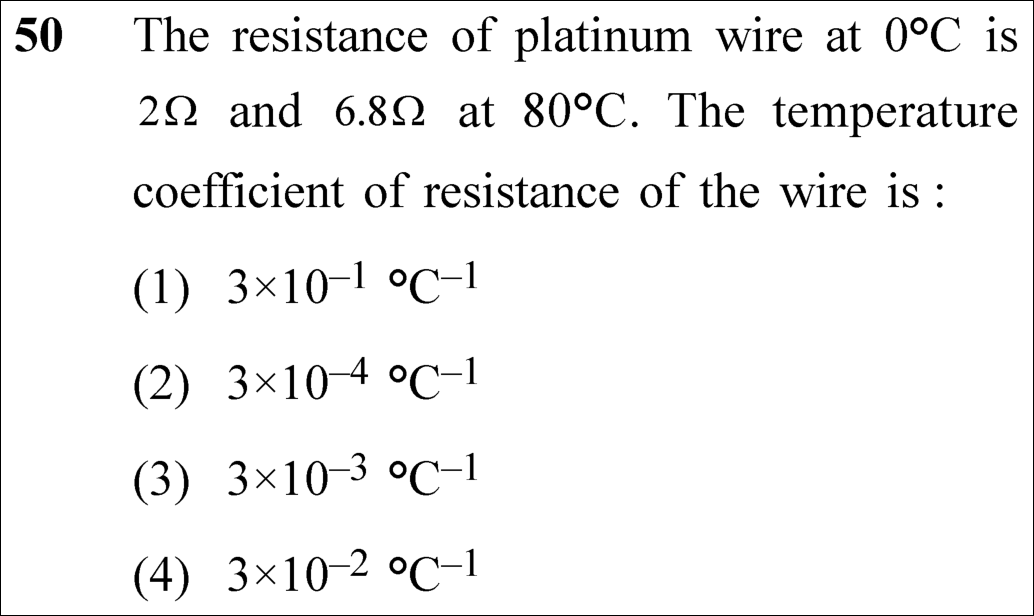
The resistance of platinum wire at 0°C is 2 Ω and 6.8 Ω at 80°C. The temperature coefficient of resistance of the wire is:
Dynamic 180-question full-length simulator mixed dynamically from all 6 years for 2027 & 2026 aspirants.
The resistance of platinum wire at 0°C is 2 Ω and 6.8 Ω at 80°C. The temperature coefficient of resistance of the wire is:
ΔR = 6.8 - 2 = 4.8 Ω. Then α = 4.8 / (2 × 80) = 4.8 / 160 = 48 / 1600 = 3 / 100 = 3 × 10⁻² °C⁻¹ in 10 seconds!
Over moderate temperature intervals, the electrical resistance of a metallic conductor varies linearly with temperature according to the relation:
From the problem statement:
Expanding and isolating the temperature coefficient α:
Substitute the given values into the isolated equation:
Convert 0.03 to scientific notation:
Diagnose every choice: Know exactly why the right option works and why distractors fail.
Off by a factor of 10 (0.3 instead of 0.03).
Underestimates coefficient by a factor of 100.
Typical platinum wire value in textbooks (3.9 × 10⁻³), but does NOT match the exam question’s specific numbers.
Accurate value derived from given data: 4.8 / 160 = 0.03 = 3 × 10⁻² °C⁻¹.
Students who memorize standard physical constants often know that platinum has α ≈ 3.9 × 10⁻³ °C⁻¹ and hastily select Option (3) 3 × 10⁻³. The exam question uses hypothetical numbers (R increases from 2 Ω to 6.8 Ω over only 80°C!), yielding α = 0.03 = 3 × 10⁻² °C⁻¹.
"Temperature coefficient of resistance is α = ΔR / (R₀ ΔT)."
Test your speed and accuracy in the authentic 200-minute timed NTA simulator.
Spotted a mistake in this solution? Report an error ([email protected])
Cover all 1,140 official NEET questions in 285 days at your own pace. Progress is saved on your device. No login needed.