NEET 2020 Physics Question 144 Solution
Question
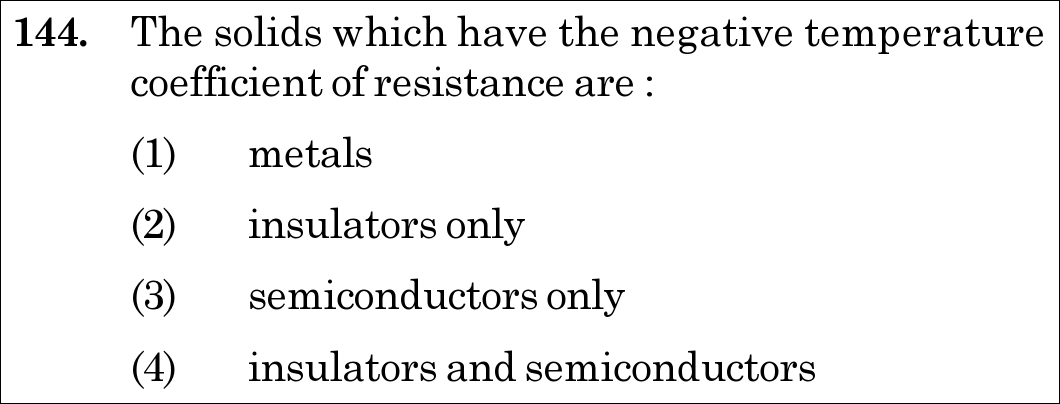
The solids which have the negative temperature coefficient of resistance are:
- (1)metals
- (2)insulators only
- (3)semiconductors only
- (4)insulators and semiconductors
Dynamic 180-question full-length simulator mixed dynamically from all 6 years for 2027 & 2026 aspirants.
The solids which have the negative temperature coefficient of resistance are:
In metallic conductors, heating increases lattice vibrations and collision frequency, so resistance increases (). In semiconductors and insulators, heating breaks covalent bonds, exponentially increasing the charge carrier density (). Because , the massive rise in dominates over the slight drop in , causing resistance to drop sharply with temperature (). Hence, BOTH insulators and semiconductors have negative ! Mark Option (4) in 5 seconds.
According to the Drude-Lorentz free electron model, the electrical resistivity of a solid is given by: where is electron mass, is electron charge, is charge carrier number density, and is the average relaxation time between collisions.
In metals, the carrier concentration is independent of temperature (). As temperature increases, lattice thermal vibrations amplify, reducing relaxation time . Consequently, increases with temperature, yielding a POSITIVE temperature coefficient of resistance ().
In semiconductors and insulators, valence electrons are separated from the conduction band by an energy band gap (). As temperature rises, thermal energy excites electrons across the band gap into the conduction band, causing the carrier density to increase exponentially according to Boltzmann distribution: This immense increase in overwhelmingly compensates for any modest decrease in relaxation time . Consequently, resistivity and resistance decrease exponentially as temperature increases.
Because , both insulators and semiconductors possess a NEGATIVE temperature coefficient of resistance ().
Diagnose every choice: Know exactly why the right option works and why distractors fail.
Incorrect; metals have a POSITIVE temperature coefficient of resistance () because resistance increases with temperature.
Incorrect; incomplete because semiconductors also exhibit a negative temperature coefficient.
Incorrect; incomplete because insulators also exhibit a negative temperature coefficient of resistance.
Factually and physically exact; both insulators and semiconductors experience carrier generation upon heating, resulting in a negative temperature coefficient.
Students often know that semiconductors have negative and hastily click "semiconductors only" (Option 3). But NCERT explicitly states: "for insulators and semiconductors, decreases with temperature. A negative temperature coefficient of resistance is observed for both."
""
Test your speed and accuracy in the authentic 180-minute timed NTA simulator.
Spotted a mistake in this solution? Report an error ([email protected])
Cover all 1,140 official NEET questions in 285 days at your own pace. Progress is saved on your device. No login needed.