MyCompetitiveExams Logo MyCompetitiveExams
Search 1,140+ Questions
Chapters, formulas, speed tricks
→
⚡ Brahmastra NEET 2027
720 MARKS

Dynamic 180-question full-length simulator mixed dynamically from all 6 years for 2027 & 2026 aspirants.

Launch Brahmastra 2027 Test →
Start Practice →
100% Free · No Login Required
Q.16 Physics · Section A ⭐ 360° Option Elimination Active
Vault ↗

NEET 2024 Physics Question 16 Solution

Topic: Wave Optics · Official NTA Booklet Code T1
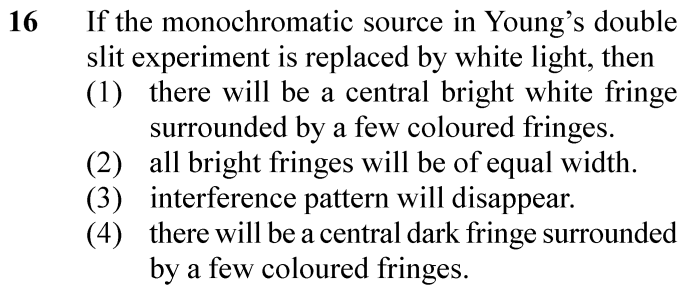
NEET 2024 Physics Question 16: Young’s Double Slit Experiment with White Light

Question

If the monochromatic source in Young's double slit experiment is replaced by white light, then

✓
Verified Against NTA Final Answer Key
Option (1) : there will be a central bright white fringe surrounded by a few coloured fringes.
📚 Wave Optics Easy
📋 Given Parameters & Problem Setup
Light source White light (polychromatic containing continuous spectrum from 400 nm to 700 nm)
Experimental setup Standard Young’s Double Slit Experiment (YDSE)
⚡

The 30-Second Exam Hall Shortcut: ⚡ Zero Path Difference Central Symmetry Hack

⏱️ Save ~40 seconds

At center, path difference Δx = 0 for ALL wavelengths -> All colors constructively interfere simultaneously -> Central WHITE fringe!

1 Central point on screen O has zero path difference: Δx = d sin θ = 0.
2 Zero path difference gives constructive interference for EVERY constituent wavelength of white light.
3 Mixing all colors in phase creates a bright WHITE central fringe.
4 Away from the center, fringe width β = λD/d varies with color: violet fringes form closest (smallest λ), red fringes farthest (largest λ).
5 This produces a few colored fringes near the center, after which overlapping creates uniform white illumination.
6 Matches Option (1) in under 5 seconds!
🛡️
Why You Can 100% Trust This Shortcut: NCERT Physics · Wave Optics (Interference with white light in Young’s double slit experiment).
📐

Step-by-Step Rigorous Workflow & Mathematical Proof

Step 1

Path Difference at the Central Point

In Young’s double slit experiment, the path difference between light waves emerging from slits S1 and S2 arriving at the central point O on the perpendicular bisector is identically zero:

Δx=S2O−S1O=0\Delta x = S_2 O - S_1 O = 0
Step 2

Superposition at the Central Maximum

Since Δx = 0 satisfies the condition for constructive interference (Δx = nλ with n = 0) for every wavelength in the visible spectrum simultaneously, all color components (VIBGYOR) constructively combine with maximum intensity. Their additive combination yields a bright white central fringe.

Phase difference Δϕ=2πλ(0)=0  ⟹  Imax=4I0 for all λ\text{Phase difference } \Delta \phi = \frac{2\pi}{\lambda} (0) = 0 \implies I_{max} = 4 I_0 \text{ for all } \lambda
Step 3

Dispersion Away from the Center

For points away from the center (Δx ≠ 0), the fringe width β depends directly on wavelength:

β=λDd\beta = \frac{\lambda D}{d}
Step 4

Color Fringing and Pattern Overlap

Because λ_violet ≈ 400 nm is smaller than λ_red ≈ 700 nm, the violet bright fringes form closest to the central white fringe, with red forming farther out. After a few colored fringes, the overlapping of different bright and dark bands of different colors produces uniform white illumination.

βviolet<βblue<⋯<βred\beta_{violet} < \beta_{blue} < \dots < \beta_{red}
⭐

360° Option Elimination Engine Key Feature

Diagnose every choice: Know exactly why the right option works and why distractors fail.

4-Option Deep Scan
1 (1)
✓ 100% Correct
Verdict & Scientific Reason:

Standard textbook result: zero path difference ensures central white maximum.

💡
Why this is airtight: None.
2 (2)
✗ Incorrect
Verdict & Scientific Reason:

False; fringe width β = λD/d varies across different colors.

⚠️
Student Fallacy (Why candidates pick this trap): Assuming monochromatic fringe formula applies equally to all wavelengths.
3 (3)
✗ Incorrect
Verdict & Scientific Reason:

False; interference still occurs, clearly visible near the center.

⚠️
Student Fallacy (Why candidates pick this trap): Believing white light is completely incoherent and cannot produce any fringes.
4 (4)
✗ Incorrect
Verdict & Scientific Reason:

Directly contradicts the condition of zero path difference at the center (which is a maximum, not a minimum).

⚠️
Student Fallacy (Why candidates pick this trap): Confusing YDSE with Lloyd’s mirror where a 180° reflection phase shift occurs.
⚠️

NTA Trap Alert: Confusing Central Maximum with Destructive Interference

Students sometimes confuse thin film interference (reflected ray phase reversal) with YDSE and think the central fringe is dark.

🛡️ How to avoid the -1 mark: In standard YDSE with two in-phase slits, Δx = 0 is ALWAYS a bright maximum (white if source is white).
📖

Core NEET Syllabus Standard

Physics Core Wave Optics · Wave Optics Standard Benchmark
Core Scientific Principle Tested:

"When white light is used in YDSE, the central fringe is white because path difference is zero for all wavelengths; fringes on either side are colored with violet closest to center."

Syllabus Focus: Interference of Light Waves and Young’s Experiment
✓ Core NEET UG Syllabus Anchor Syllabus & Academic Standards ↗
Zero path difference blends all light: Central band is pure and WHITE!

Ready to attempt under real exam pressure?

Test your speed and accuracy in the authentic 200-minute timed NTA simulator.

Launch NEET 2024 CBT Test →

Spotted a mistake in this solution? Report an error ([email protected])

⚖️ Legal & Fair Dealing Notice: Sourced from publicly released NEET 2024 question papers and NEET answer keys for private study, research, and non-commercial educational practice under Fair Dealing (Section 52(1)(a) of the Indian Copyright Act, 1957). Not affiliated with or endorsed by NTA or NMC.

Solve 4 NEET Questions a Day — One per Subject

Cover all 1,140 official NEET questions in 285 days at your own pace. Progress is saved on your device. No login needed.