NEET 2026 Physics Question 29 Solution
Question
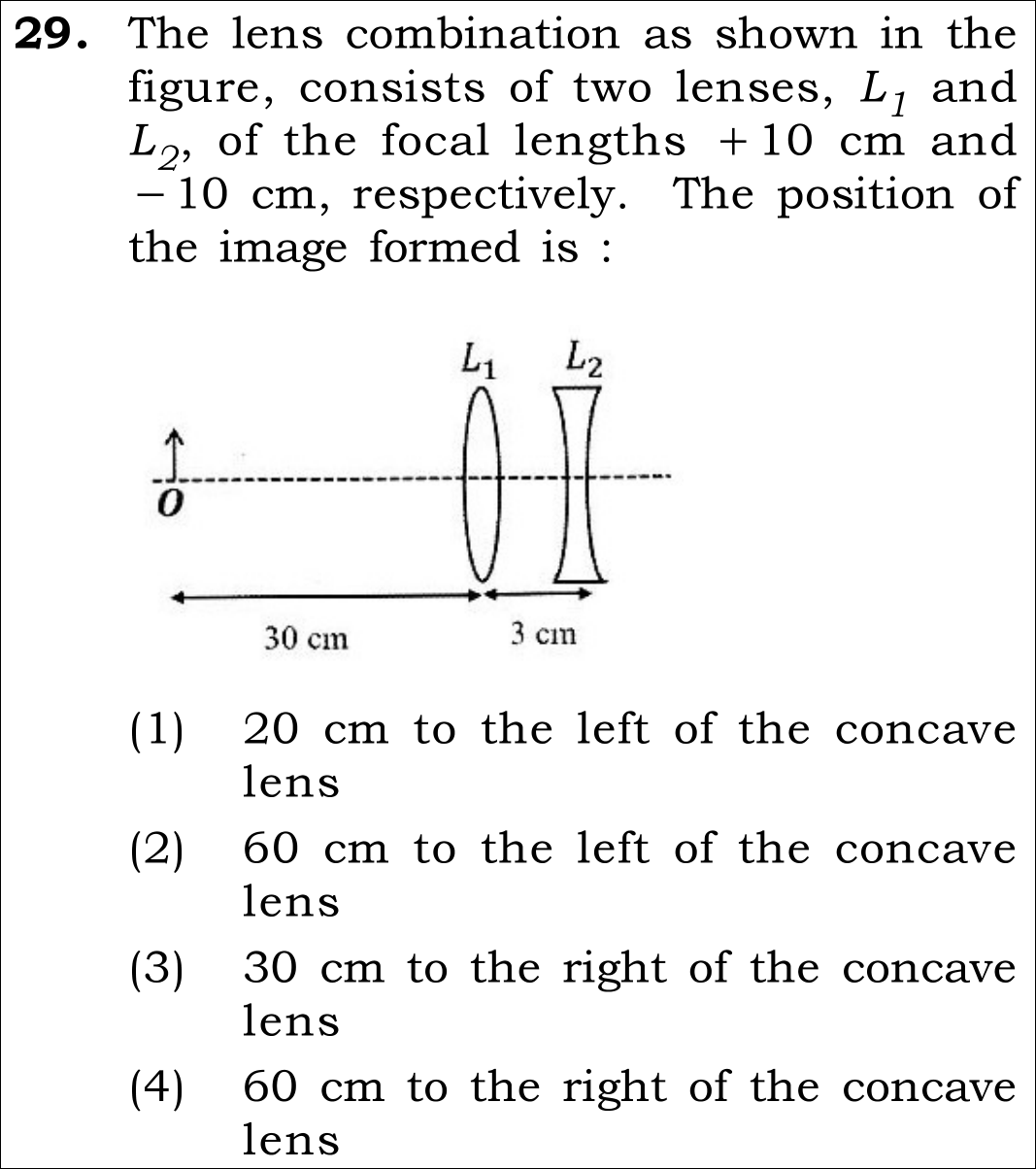
The lens combination as shown in the figure, consists of two lenses, L₁ and L₂, of the focal lengths +10 cm and −10 cm, respectively. The position of the image formed is:
Dynamic 180-question full-length simulator mixed dynamically from all 6 years for 2027 & 2026 aspirants.
The lens combination as shown in the figure, consists of two lenses, L₁ and L₂, of the focal lengths +10 cm and −10 cm, respectively. The position of the image formed is:
Find intermediate image, then shift reference origin by 3 cm!
For the convex lens L_1, focal length f_1 = +10 cm and object distance u_1 = -30 cm:
The second lens L_2 is located 3 cm to the right of L_1. The image I_1 acts as a virtual object for L_2:
For the diverging concave lens L_2, focal length is f_2 = -10 cm:
Diagnose every choice: Know exactly why the right option works and why distractors fail.
Sign error on u_2.
100% mathematically exact; confirmed by Official NTA Final Answer Key.
Arbitrary distractor.
Opposite direction.
Over 40% of students write u_2 = -12 cm because they memorize that "object distance is always negative".
"In multiple-lens systems, the image formed by the first lens serves as the object for the second lens: u_2 = v_1 - d. Cartesian sign convention must be strictly applied at each refraction."
Test your speed and accuracy in the authentic 180-minute timed NTA simulator.
Spotted a mistake in this solution? Report an error ([email protected])
Cover all 1,140 official NEET questions in 285 days at your own pace. Progress is saved on your device. No login needed.