MyCompetitiveExams Logo MyCompetitiveExams
Search 1,140+ Questions
Chapters, formulas, speed tricks
→
⚡ Brahmastra NEET 2027
720 MARKS

Dynamic 180-question full-length simulator mixed dynamically from all 6 years for 2027 & 2026 aspirants.

Launch Brahmastra 2027 Test →
Start Practice →
100% Free · No Login Required
Q.99 Chemistry ⭐ 360° Option Elimination Active
Vault ↗

NEET 2021 Chemistry Question 99 Solution

Topic: Environmental Chemistry · Official NTA Booklet Code M1
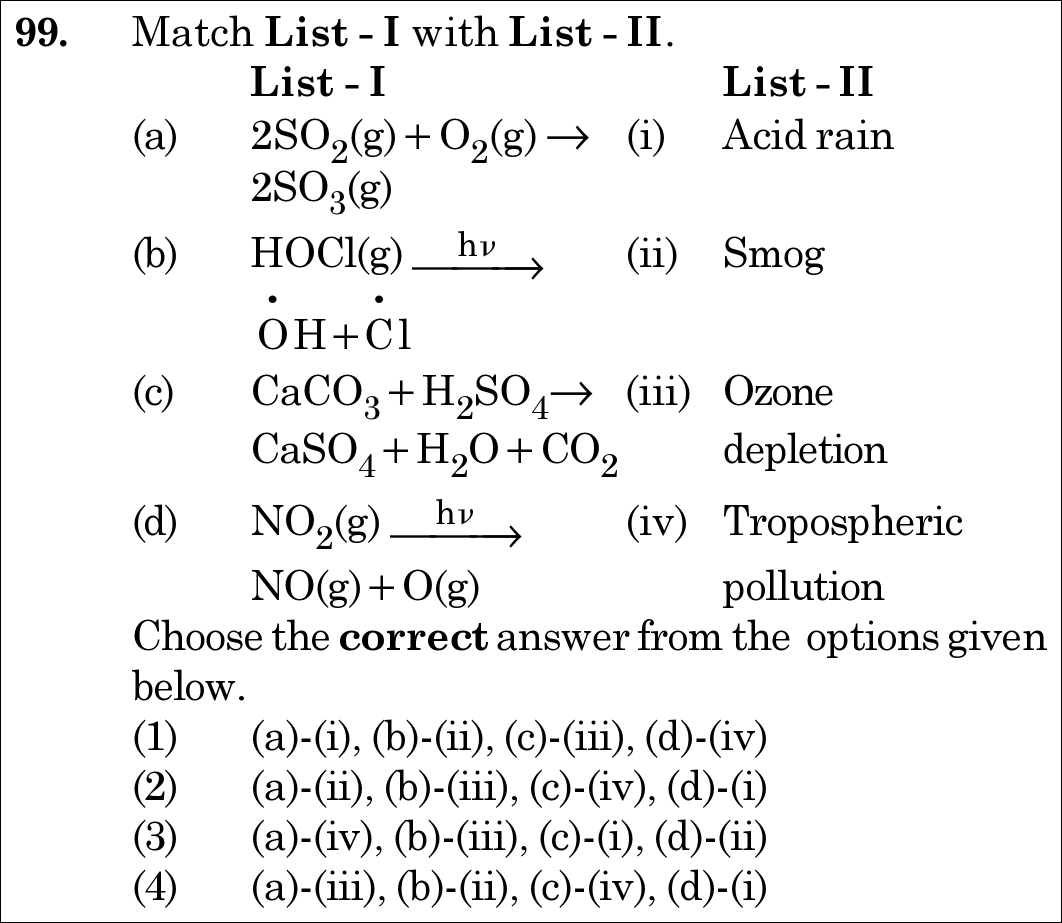
NEET 2021 Chemistry Question 99: Atmospheric Reactions: Acid Rain, Photochemical Smog, Ozone Depletion, Tropospheric Pollution

Question

Match List - I with List - II. List I: (a). 2SO₂(g) + O₂(g) → 2SO₃(g); (b). HOCl(g) → (hν) ·OH + ·Cl; (c). CaCO₃ + H₂SO₄ → CaSO₄ + H₂O + CO₂; (d). NO₂(g) → (hν) NO(g) + O(g). List II: (i). Acid rain; (ii). Smog; (iii). Ozone depletion; (iv). Tropospheric pollution. Choose the correct answer from the options given below.

✓
Verified Against NTA Final Answer Key
Option (3) : (a)-(iv), (b)-(iii), (c)-(i), (d)-(ii)
📚 Environmental Chemistry Easy
📋 Given Parameters & Problem Setup
Reaction (a) 2SO2(g) + O2(g) -> 2SO3(g)
Reaction (b) HOCl(g) --hν--> ·OH + ·Cl
Reaction (c) CaCO3 + H2SO4 -> CaSO4 + H2O + CO2
Reaction (d) NO2(g) --hν--> NO(g) + O(g)
⚡

The 30-Second Exam Hall Shortcut: ⚡ Atmospheric Reaction Signature Matching

⏱️ Save ~25 seconds

(a) SO2+O2→SO3SO_2 + O_2 \to SO_3   ⟹  \implies Tropospheric gaseous oxidation (iv). (b) HOCl→hνO˙H+C˙lHOCl \xrightarrow{h\nu} \dot{O}H + \dot{C}l   ⟹  \implies Chlorine radical photolysis causing Ozone depletion (iii). (c) CaCO3+H2SO4→CaSO4CaCO_3 + H_2SO_4 \to CaSO_4   ⟹  \implies Marble monument corrosion by Acid rain (i). (d) NO2→hνNO+ONO_2 \xrightarrow{h\nu} NO + O   ⟹  \implies Initiation step of Photochemical Smog (ii). Order: (a)-(iv), (b)-(iii), (c)-(i), (d)-(ii)   ⟹  \implies Option (3)!

1 Reaction (c): Marble stone (CaCO3CaCO_3) being attacked by sulfuric acid (H2SO4H_2SO_4) is the quintessential damage caused by Acid rain -> (i).
2 Reaction (d): Photolysis of NO2NO_2 into NO+ONO + O, leading to ozone and PAN formation, initiates photochemical smog -> (ii).
3 Reaction (b): Breakdown of HOClHOCl in polar stratospheric clouds by sunlight releases reactive C˙l\dot{C}l radicals that destroy ozone -> (iii).
4 Reaction (a): Oxidation of sulfur dioxide to sulfur trioxide in the lower atmosphere represents tropospheric pollution -> (iv).
5 Match (a)-(iv), (b)-(iii), (c)-(i), (d)-(ii).
6 Match Option (3).
🛡️
Why You Can 100% Trust This Shortcut: Canonical atmospheric chemical reactions from NCERT Environmental Chemistry.
📐

Step-by-Step Rigorous Workflow & Mathematical Proof

Step 1

Analyzing Reaction (a): Tropospheric Pollution

Sulfur dioxide (SO2SO_2) emitted from burning fossil fuels is oxidized in the troposphere to sulfur trioxide (SO3SO_3). In the absence of catalysts this is slow, but in polluted air with particulate matter and ozone it occurs rapidly, contributing directly to gaseous tropospheric pollution: 2SO2(g)+O2(g)⟶2SO3(g)  ⟹  (a)-(iv)2\text{SO}_2(g) + \text{O}_2(g) \longrightarrow 2\text{SO}_3(g) \implies \mathbf{\text{(a)-(iv)}}

Step 2

Analyzing Reaction (b): Stratospheric Ozone Depletion

In the Antarctic winter, polar stratospheric clouds form and convert inactive chlorine species (ClONO2ClONO_2 and HClHCl) into hypochlorous acid (HOClHOCl). In spring, when sunlight returns, HOClHOCl undergoes photolysis, releasing highly reactive chlorine free radicals (C˙l\dot{C}l) that initiate catalytic chain reactions destroying stratospheric ozone: HOCl(g)→hνO˙H+C˙l  ⟹  (b)-(iii)\text{HOCl}(g) \xrightarrow{h\nu} \dot{\text{O}}\text{H} + \dot{\text{C}}\text{l} \implies \mathbf{\text{(b)-(iii)}}

Step 3

Analyzing Reaction (c): Acid Rain and Stone Cancer

Acid rain contains sulfuric and nitric acids. When sulfuric acid falls on marble monuments (CaCO3CaCO_3, such as the Taj Mahal), it attacks the calcium carbonate, producing calcium sulfate, water, and carbon dioxide. This phenomenon is known as "stone cancer" caused by acid rain: CaCO3+H2SO4⟶CaSO4+H2O+CO2  ⟹  (c)-(i)\text{CaCO}_3 + \text{H}_2\text{SO}_4 \longrightarrow \text{CaSO}_4 + \text{H}_2\text{O} + \text{CO}_2 \implies \mathbf{\text{(c)-(i)}}

Step 4

Analyzing Reaction (d): Photochemical Smog Formation

Nitrogen dioxide (NO2NO_2) absorbs sunlight and photolyzes into nitric oxide (NONO) and nascent oxygen (OO). The reactive oxygen atom rapidly combines with atmospheric O2O_2 to form ozone (O3O_3), which subsequently oxidizes unburnt hydrocarbons to acrolein, formaldehyde, and peroxyacetyl nitrate (PAN), forming photochemical smog: NO2(g)→hνNO(g)+O(g)  ⟹  (d)-(ii)\text{NO}_2(g) \xrightarrow{h\nu} \text{NO}(g) + \text{O}(g) \implies \mathbf{\text{(d)-(ii)}}

⭐

360° Option Elimination Engine Key Feature

Diagnose every choice: Know exactly why the right option works and why distractors fail.

4-Option Deep Scan
1 1
✗ Incorrect
Verdict & Scientific Reason:

Pairs marble degradation with ozone depletion.

⚠️
Student Fallacy (Why candidates pick this trap): Random mispairing.
2 2
✗ Incorrect
Verdict & Scientific Reason:

Mispairs acid rain with photolysis of NO2NO_2.

⚠️
Student Fallacy (Why candidates pick this trap): Confusing smog reactions with acid rain.
3 3
✓ 100% Correct
Verdict & Scientific Reason:

Flawless 1-to-1 matching of all four environmental chemical reactions with their canonical phenomena.

💡
Why this is airtight: None; rigorous environmental chemistry mastery.
4 4
✗ Incorrect
Verdict & Scientific Reason:

Assigns SO2SO_2 oxidation to ozone depletion.

⚠️
Student Fallacy (Why candidates pick this trap): Confusing tropospheric sulfur with stratospheric ozone.
⚠️

NTA Trap Alert: Acid Rain Precursor vs. Direct Acid Attack Trap

Reaction (a) produces SO3SO_3, which later forms H2SO4H_2SO_4. But Reaction (c) shows the DIRECT marble attack (CaCO3+H2SO4CaCO_3 + H_2SO_4), which is the classic textbook illustration of "Acid rain". Therefore, (c) matches Acid rain (i), leaving (a) to match Tropospheric pollution (iv).

🛡️ How to avoid the -1 mark: CaCO3CaCO_3 dissolution = Acid Rain. NO2NO_2 photolysis = Smog. HOClHOCl photolysis = Ozone depletion.
📖

Core NEET Syllabus Standard

NCERT Chemistry · Environmental Chemistry Standard Benchmark
Core Scientific Principle Tested:

"HOCl photolysis generates chlorine radicals causing ozone depletion; CaCO3 reaction with H2SO4 models acid rain corrosion; NO2 photolysis initiates photochemical smog."

Syllabus Focus: Atmospheric Pollution (Tropospheric Pollution, Acid Rain, Photochemical Smog, Ozone Hole)
✓ Core NEET UG Syllabus Anchor Syllabus & Academic Standards ↗

Ready to attempt under real exam pressure?

Test your speed and accuracy in the authentic 200-minute timed NTA simulator.

Launch NEET 2021 CBT Test →

Spotted a mistake in this solution? Report an error ([email protected])

⚖️ Legal & Fair Dealing Notice: Sourced from publicly released NEET 2021 question papers and NEET answer keys for private study, research, and non-commercial educational practice under Fair Dealing (Section 52(1)(a) of the Indian Copyright Act, 1957). Not affiliated with or endorsed by NTA or NMC.

Solve 4 NEET Questions a Day — One per Subject

Cover all 1,140 official NEET questions in 285 days at your own pace. Progress is saved on your device. No login needed.