MyCompetitiveExams Logo MyCompetitiveExams
Search 1,140+ Questions
Chapters, formulas, speed tricks
→
⚡ Brahmastra NEET 2027
720 MARKS

Dynamic 180-question full-length simulator mixed dynamically from all 6 years for 2027 & 2026 aspirants.

Launch Brahmastra 2027 Test →
Start Practice →
100% Free · No Login Required
🧪 Chemistry Moderate Frequency

NEET Environmental Chemistry Previous Year Questions with Solutions

Complete repository of official NTA NEET questions for Environmental Chemistry from 2020 to 2026. Every question includes 30-second elimination tricks, step-by-step NCERT solutions, option-by-option traps, and official answer keys.

3 Questions 3 Exam Years (2023, 2021, 2020) 3 Easy · 0 Medium · 0 Challenging
NEET 2023 · Q100 Easy
Official NEET 2023 Question 100 - Environmental Chemistry
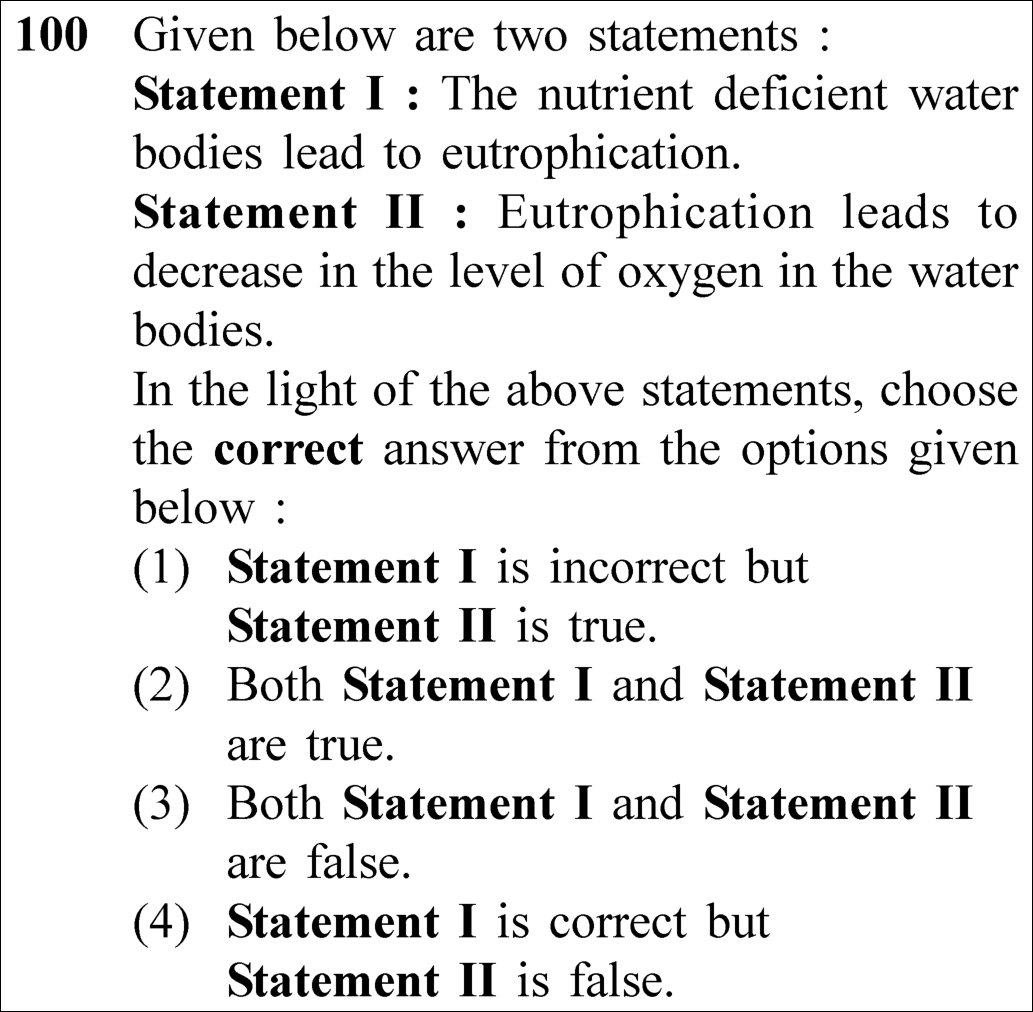
1 Statement I is incorrect but Statement II is true. ✓ Key
2 Both Statement I and Statement II are true.
3 Both Statement I and Statement II are false.
4 Statement I is correct but Statement II is false.
💡 Verified Solution & 30-Second Hack
✓
Verified Against NTA Final Answer Key
Option (1) : Statement I is incorrect but Statement II is true.
📚 Environmental Chemistry Easy
📋 Given Parameters & Problem Setup
Statement I The nutrient deficient water bodies lead to eutrophication.
Statement II Eutrophication leads to decrease in the level of oxygen in the water bodies.
⚡

The 30-Second Exam Hall Shortcut: ⚡ Definition Check: Eutrophication Means Nutrient ENRICHED, Not Deficient!

⏱️ Save ~25 seconds

By canonical definition, eutrophication is the process in which water bodies become nutrient-ENRICHED (excess nitrates and phosphates from runoff), causing massive algal bloom! Hence Statement I is INCORRECT. Algae die and decay aerially, consuming dissolved oxygen and suffocating aquatic life! Hence Statement II is TRUE. Verdict: Statement I is incorrect but Statement II is true (Option 1) in 10 seconds!

1 Check Statement I: "The nutrient deficient water bodies lead to eutrophication." False! Eutrophication is caused by nutrient-rich (nutrient-enriched) water bodies, particularly phosphates and nitrates.
2 Check Statement II: "Eutrophication leads to decrease in the level of oxygen in the water bodies." True! Dense algal bloom prevents sunlight, and microbial decomposition of dead algae depletes dissolved oxygen (BOD surges, DO plummets).
3 Match: Statement I is incorrect but Statement II is true (Option 1).
🛡️
Why You Can 100% Trust This Shortcut: Verbatim NCERT Environmental Chemistry section on Water Pollution & Eutrophication.
📐

Step-by-Step Rigorous Workflow & Mathematical Proof

Step 1

Definition of Eutrophication

Eutrophication is defined as the process in which a water body becomes overly enriched with nutrients (primarily phosphates and nitrates from agricultural runoff, fertilizers, and sewage):

Eutrophication  ⟺  Nutrient enrichment  (NOT nutrient deficiency)\text{Eutrophication} \iff \text{Nutrient \textbf{enrichment}} \; (\text{NOT nutrient deficiency})
Step 2

Evaluate Statement I

Statement I asserts that "nutrient deficient water bodies lead to eutrophication." This directly contradicts the canonical definition, as oligotrophic (nutrient-deficient) waters support low biological productivity and do NOT undergo eutrophication. Statement I is INCORRECT:

Statement I=INCORRECT (requires nutrient-rich waters)\text{Statement I} = \text{INCORRECT (requires nutrient-rich waters)}
Step 3

Mechanism of Dissolved Oxygen Depletion (Statement II)

Nutrient enrichment stimulates explosive growth of algae (algal bloom). When the dense algal mass dies, aerobic bacteria consume enormous quantities of dissolved oxygen to decompose the dead organic matter. Consequently, the concentration of dissolved oxygen (DO) plummets below critical levels, killing fish and other aquatic organisms. Statement II is TRUE:

Algal decay+Aerobic bacteria  ⟹  BOD increases, Dissolved O2 decreases\text{Algal decay} + \text{Aerobic bacteria} \implies \text{BOD increases, Dissolved } \text{O}_2 \text{ decreases}
⭐

360° Option Elimination Engine Key Feature

Diagnose every choice: Know exactly why the right option works and why distractors fail.

4-Option Deep Scan
1 (1)
✓ 100% Correct
Verdict & Scientific Reason:

Accurate: Eutrophication is driven by nutrient enrichment (making I false), which subsequently depletes dissolved oxygen (making II true).

💡
Why this is airtight: None. Candidate read the critical word "deficient" carefully.
2 (2)
✗ Incorrect
Verdict & Scientific Reason:

Statement I is false because nutrient-deficient waters do not cause eutrophication.

⚠️
Student Fallacy (Why candidates pick this trap): Candidate skimmed the statement and assumed "nutrient" implied nutrient-rich.
3 (3)
✗ Incorrect
Verdict & Scientific Reason:

Statement II is factually true; oxygen levels dramatically decrease due to algal decomposition.

⚠️
Student Fallacy (Why candidates pick this trap): Candidate doubted that eutrophication causes dissolved oxygen depletion.
4 (4)
✗ Incorrect
Verdict & Scientific Reason:

Completely inverts the truth values of both statements.

⚠️
Student Fallacy (Why candidates pick this trap): Candidate reversed the concepts of nutrient enrichment and oxygen depletion.
⚠️

NTA Trap Alert: Misreading "Nutrient Deficient" as "Nutrient Enriched"

Under exam pressure, students read the word "nutrient" and quickly assume Statement I says "nutrient rich". Look closely at the word "deficient" — that single opposite word makes Statement I completely false!

🛡️ How to avoid the -1 mark: Read every qualifying word carefully: "deficient" vs "enriched".
📖

Core NEET Syllabus Standard

National Eligibility cum Entrance Test (NEET UG) · Environmental Chemistry Standard Benchmark
Core Scientific Principle Tested:

"Eutrophication is the aging of water bodies due to nutrient enrichment, leading to algal blooms and drastic loss of dissolved oxygen."
Syllabus Focus: Water Pollution – Eutrophication and Biochemical Oxygen Demand (BOD)
Preserved in Rationalized Curriculum Syllabus & Academic Standards ↗
NEET 2021 · Q99 Easy
Official NEET 2021 Question 99 - Environmental Chemistry
1
2
3 ✓ Key
4
💡 Verified Solution & 30-Second Hack
✓
Verified Against NTA Final Answer Key
Option (3) : (a)-(iv), (b)-(iii), (c)-(i), (d)-(ii)
📚 Environmental Chemistry Easy
📋 Given Parameters & Problem Setup
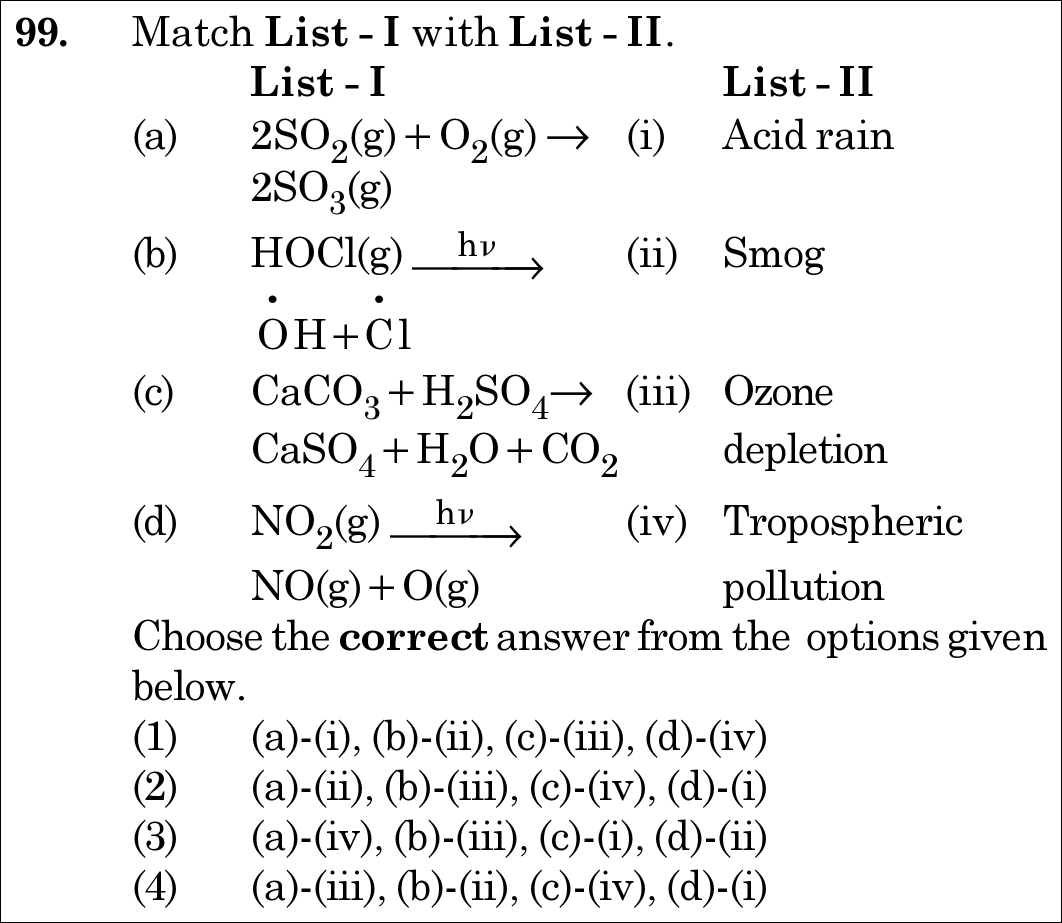
Reaction (a) 2SO2(g) + O2(g) -> 2SO3(g)
Reaction (b) HOCl(g) --hν--> ·OH + ·Cl
Reaction (c) CaCO3 + H2SO4 -> CaSO4 + H2O + CO2
Reaction (d) NO2(g) --hν--> NO(g) + O(g)
⚡

The 30-Second Exam Hall Shortcut: ⚡ Atmospheric Reaction Signature Matching

⏱️ Save ~25 seconds

(a) SO2+O2→SO3SO_2 + O_2 \to SO_3   ⟹  \implies Tropospheric gaseous oxidation (iv). (b) HOCl→hνO˙H+C˙lHOCl \xrightarrow{h\nu} \dot{O}H + \dot{C}l   ⟹  \implies Chlorine radical photolysis causing Ozone depletion (iii). (c) CaCO3+H2SO4→CaSO4CaCO_3 + H_2SO_4 \to CaSO_4   ⟹  \implies Marble monument corrosion by Acid rain (i). (d) NO2→hνNO+ONO_2 \xrightarrow{h\nu} NO + O   ⟹  \implies Initiation step of Photochemical Smog (ii). Order: (a)-(iv), (b)-(iii), (c)-(i), (d)-(ii)   ⟹  \implies Option (3)!

1 Reaction (c): Marble stone (CaCO3CaCO_3) being attacked by sulfuric acid (H2SO4H_2SO_4) is the quintessential damage caused by Acid rain -> (i).
2 Reaction (d): Photolysis of NO2NO_2 into NO+ONO + O, leading to ozone and PAN formation, initiates photochemical smog -> (ii).
3 Reaction (b): Breakdown of HOClHOCl in polar stratospheric clouds by sunlight releases reactive C˙l\dot{C}l radicals that destroy ozone -> (iii).
4 Reaction (a): Oxidation of sulfur dioxide to sulfur trioxide in the lower atmosphere represents tropospheric pollution -> (iv).
5 Match (a)-(iv), (b)-(iii), (c)-(i), (d)-(ii).
6 Match Option (3).
🛡️
Why You Can 100% Trust This Shortcut: Canonical atmospheric chemical reactions from NCERT Environmental Chemistry.
📐

Step-by-Step Rigorous Workflow & Mathematical Proof

Step 1

Analyzing Reaction (a): Tropospheric Pollution

Sulfur dioxide (SO2SO_2) emitted from burning fossil fuels is oxidized in the troposphere to sulfur trioxide (SO3SO_3). In the absence of catalysts this is slow, but in polluted air with particulate matter and ozone it occurs rapidly, contributing directly to gaseous tropospheric pollution: 2SO2(g)+O2(g)⟶2SO3(g)  ⟹  (a)-(iv)2\text{SO}_2(g) + \text{O}_2(g) \longrightarrow 2\text{SO}_3(g) \implies \mathbf{\text{(a)-(iv)}}

Step 2

Analyzing Reaction (b): Stratospheric Ozone Depletion

In the Antarctic winter, polar stratospheric clouds form and convert inactive chlorine species (ClONO2ClONO_2 and HClHCl) into hypochlorous acid (HOClHOCl). In spring, when sunlight returns, HOClHOCl undergoes photolysis, releasing highly reactive chlorine free radicals (C˙l\dot{C}l) that initiate catalytic chain reactions destroying stratospheric ozone: HOCl(g)→hνO˙H+C˙l  ⟹  (b)-(iii)\text{HOCl}(g) \xrightarrow{h\nu} \dot{\text{O}}\text{H} + \dot{\text{C}}\text{l} \implies \mathbf{\text{(b)-(iii)}}

Step 3

Analyzing Reaction (c): Acid Rain and Stone Cancer

Acid rain contains sulfuric and nitric acids. When sulfuric acid falls on marble monuments (CaCO3CaCO_3, such as the Taj Mahal), it attacks the calcium carbonate, producing calcium sulfate, water, and carbon dioxide. This phenomenon is known as "stone cancer" caused by acid rain: CaCO3+H2SO4⟶CaSO4+H2O+CO2  ⟹  (c)-(i)\text{CaCO}_3 + \text{H}_2\text{SO}_4 \longrightarrow \text{CaSO}_4 + \text{H}_2\text{O} + \text{CO}_2 \implies \mathbf{\text{(c)-(i)}}

Step 4

Analyzing Reaction (d): Photochemical Smog Formation

Nitrogen dioxide (NO2NO_2) absorbs sunlight and photolyzes into nitric oxide (NONO) and nascent oxygen (OO). The reactive oxygen atom rapidly combines with atmospheric O2O_2 to form ozone (O3O_3), which subsequently oxidizes unburnt hydrocarbons to acrolein, formaldehyde, and peroxyacetyl nitrate (PAN), forming photochemical smog: NO2(g)→hνNO(g)+O(g)  ⟹  (d)-(ii)\text{NO}_2(g) \xrightarrow{h\nu} \text{NO}(g) + \text{O}(g) \implies \mathbf{\text{(d)-(ii)}}

⭐

360° Option Elimination Engine Key Feature

Diagnose every choice: Know exactly why the right option works and why distractors fail.

4-Option Deep Scan
1 1
✗ Incorrect
Verdict & Scientific Reason:

Pairs marble degradation with ozone depletion.

⚠️
Student Fallacy (Why candidates pick this trap): Random mispairing.
2 2
✗ Incorrect
Verdict & Scientific Reason:

Mispairs acid rain with photolysis of NO2NO_2.

⚠️
Student Fallacy (Why candidates pick this trap): Confusing smog reactions with acid rain.
3 3
✓ 100% Correct
Verdict & Scientific Reason:

Flawless 1-to-1 matching of all four environmental chemical reactions with their canonical phenomena.

💡
Why this is airtight: None; rigorous environmental chemistry mastery.
4 4
✗ Incorrect
Verdict & Scientific Reason:

Assigns SO2SO_2 oxidation to ozone depletion.

⚠️
Student Fallacy (Why candidates pick this trap): Confusing tropospheric sulfur with stratospheric ozone.
⚠️

NTA Trap Alert: Acid Rain Precursor vs. Direct Acid Attack Trap

Reaction (a) produces SO3SO_3, which later forms H2SO4H_2SO_4. But Reaction (c) shows the DIRECT marble attack (CaCO3+H2SO4CaCO_3 + H_2SO_4), which is the classic textbook illustration of "Acid rain". Therefore, (c) matches Acid rain (i), leaving (a) to match Tropospheric pollution (iv).

🛡️ How to avoid the -1 mark: CaCO3CaCO_3 dissolution = Acid Rain. NO2NO_2 photolysis = Smog. HOClHOCl photolysis = Ozone depletion.
📖

Core NEET Syllabus Standard

NCERT Chemistry · Environmental Chemistry Standard Benchmark
Core Scientific Principle Tested:

"HOCl photolysis generates chlorine radicals causing ozone depletion; CaCO3 reaction with H2SO4 models acid rain corrosion; NO2 photolysis initiates photochemical smog."

Syllabus Focus: Atmospheric Pollution (Tropospheric Pollution, Acid Rain, Photochemical Smog, Ozone Hole)
✓ Core NEET UG Syllabus Anchor Syllabus & Academic Standards ↗
NEET 2020 · Q120 Easy
Official NEET 2020 Question 120 - Environmental Chemistry
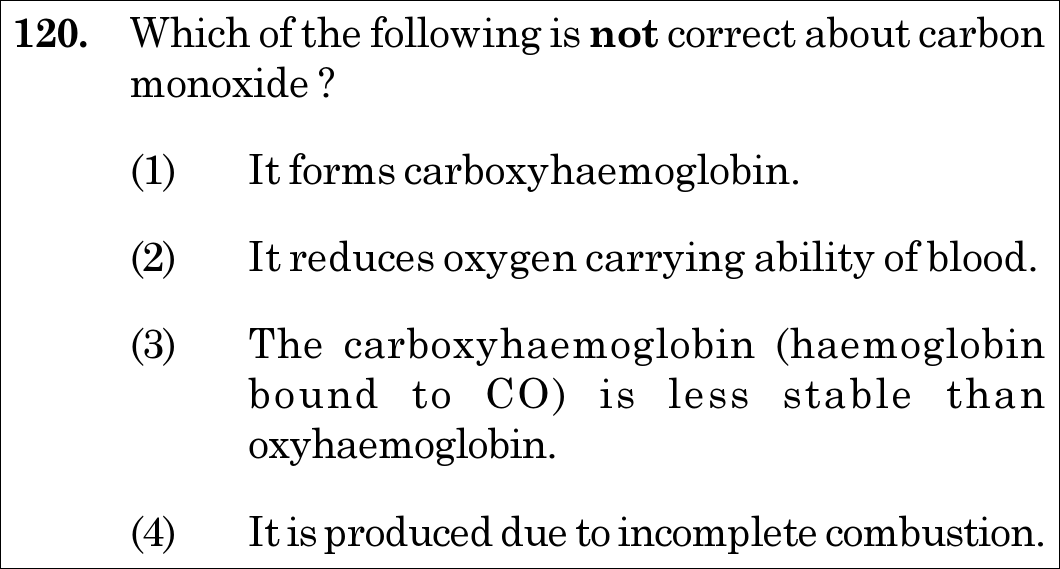
1 It forms carboxyhaemoglobin.
2 It reduces oxygen carrying ability of blood.
3 The carboxyhaemoglobin (haemoglobin bound to CO) is less stable than oxyhaemoglobin. ✓ Key
4 It is produced due to incomplete combustion.
💡 Verified Solution & 30-Second Hack
✓
Verified Against NTA Final Answer Key
Option (3) : The carboxyhaemoglobin (haemoglobin bound to CO) is less stable than oxyhaemoglobin.
📚 Environmental Chemistry Easy
📋 Given Parameters & Problem Setup
Pollutant Gas Carbon monoxide (CO)
Physiological Complex Carboxyhaemoglobin
Question Objective Identify the statement which is NOT CORRECT
⚡

The 30-Second Exam Hall Shortcut: ⚡ "Carboxyhaemoglobin is 300 TIMES MORE STABLE than Oxyhaemoglobin, NOT Less Stable!"

⏱️ 20 seconds

Carbon monoxide binds to haemoglobin about 300 times more strongly than oxygen, forming carboxyhaemoglobin which is FAR MORE STABLE than oxyhaemoglobin. This locks haemoglobin and prevents oxygen delivery, causing hypoxia and asphyxiation. Statement (3) claims carboxyhaemoglobin is "less stable", which is completely false! Mark Option (3) in 5 seconds.

1 Check Statement 1: CO binds haemoglobin to form carboxyhaemoglobin (TRUE).
2 Check Statement 2: Reduces oxygen carrying ability of blood (TRUE).
3 Check Statement 3: Claims carboxyhaemoglobin is LESS stable than oxyhaemoglobin (FALSE! It is ~300 times MORE stable).
4 Check Statement 4: Produced by incomplete combustion of fossil fuels (TRUE).
5 The incorrect statement is (3). Select Option (3).
🛡️
Why You Can 100% Trust This Shortcut: NCERT Chemistry · Environmental Chemistry (Atmospheric Pollution: Gaseous Air Pollutants - Carbon Monoxide)
📐

Step-by-Step Rigorous Workflow & Mathematical Proof

Step 1

Formation of Carboxyhaemoglobin

Carbon monoxide (CO\text{CO}) is a dangerous gaseous air pollutant produced by incomplete combustion of carbonaceous fuels (coal, firewood, petrol). When inhaled, it crosses the alveolar membrane and binds to the ferrous iron (Fe2+\text{Fe}^{2+}) of blood haemoglobin to form carboxyhaemoglobin.

Step 2

Stability of Carboxyhaemoglobin vs Oxyhaemoglobin

NCERT states verbatim in Environmental Chemistry: "Carboxyhaemoglobin is about 300 times more stable than the oxygen-haemoglobin complex." Because CO binds with 300-fold higher affinity, it displaces oxygen and prevents reversible oxygen binding.

Step 3

Physiological Consequences

When concentration of carboxyhaemoglobin reaches 3-4%, the oxygen-carrying capacity of blood is drastically reduced, leading to headache, impaired vision, cardiovascular stress, and fatal asphyxiation.

Step 4

Identify the Erroneous Statement

Statement (3) asserts that carboxyhaemoglobin is "less stable than oxyhaemoglobin." This directly contradicts biochemistry, making Statement (3) the correct answer to the question.

⭐

360° Option Elimination Engine Key Feature

Diagnose every choice: Know exactly why the right option works and why distractors fail.

4-Option Deep Scan
1 A
✗ Incorrect
Verdict & Scientific Reason:

This statement is factually true, hence not the required incorrect answer.

⚠️
Student Fallacy (Why candidates pick this trap): Correctly identifies that CO forms carboxyhaemoglobin.
2 B
✗ Incorrect
Verdict & Scientific Reason:

Factually true; by irreversibly blocking haemoglobin binding sites, it starves body tissues of oxygen.

⚠️
Student Fallacy (Why candidates pick this trap): Standard physiological effect.
3 C
✓ 100% Correct
Verdict & Scientific Reason:

Factually FALSE statement (hence the correct choice); carboxyhaemoglobin is approximately 300 times MORE stable than oxyhaemoglobin.

💡
Why this is airtight: Students who skim over the words "less stable" might miss this explicit factual inversion.
4 D
✗ Incorrect
Verdict & Scientific Reason:

Factually true; incomplete combustion of coal, petrol, and organic matter releases CO.

⚠️
Student Fallacy (Why candidates pick this trap): Well-known environmental chemistry origin.
⚠️

NTA Trap Alert: Affinity Multiplier for Carbon Monoxide

CO affinity for haemoglobin is ~300 times HIGHER than O2. Carboxyhaemoglobin is 300 times MORE STABLE than oxyhaemoglobin.

🛡️ How to avoid the -1 mark: Carboxyhaemoglobin is MORE STABLE, NOT less stable!
📖

Core NEET Syllabus Standard

Chemistry · Environmental Chemistry Standard Benchmark
Core Scientific Principle Tested:

""

Syllabus Focus: Toxicity of Carbon Monoxide: Carboxyhaemoglobin Stability vs Oxyhaemoglobin
✓ Core NEET UG Syllabus Anchor Syllabus & Academic Standards ↗

Solve 4 NEET Questions a Day — One per Subject

Cover all 1,140 official NEET questions in 285 days at your own pace. Progress is saved on your device. No login needed.