MyCompetitiveExams Logo MyCompetitiveExams
Search 1,140+ Questions
Chapters, formulas, speed tricks
→
⚡ Brahmastra NEET 2027
720 MARKS

Dynamic 180-question full-length simulator mixed dynamically from all 6 years for 2027 & 2026 aspirants.

Launch Brahmastra 2027 Test →
Start Practice →
100% Free · No Login Required
🧪 Chemistry ⭐ High Weightage (~2–3 Qs/Year)

NEET Chemical Bonding and Molecular Structure Previous Year Questions with Solutions

Complete repository of official NTA NEET questions for Chemical Bonding and Molecular Structure from 2020 to 2026. Every question includes 30-second elimination tricks, step-by-step NCERT solutions, option-by-option traps, and official answer keys.

14 Questions 6 Exam Years (2026, 2025, 2024, 2023, 2021, 2020) 13 Easy · 1 Medium · 0 Challenging
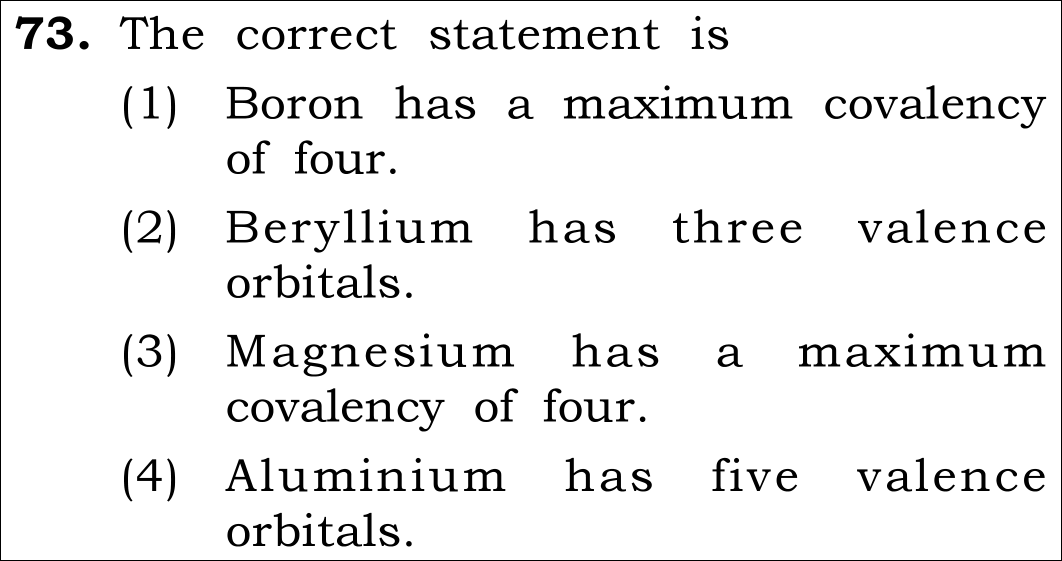
NEET 2026 · Q73 Easy
Official NEET 2026 Question 73 - Chemical Bonding and Molecular Structure
1 Boron has a maximum covalency of four. ✓ Key
2 Beryllium has three valence orbitals.
3 Magnesium has a maximum covalency of four.
4 Aluminium has five valence orbitals.
💡 Verified Solution & 30-Second Hack
✓
Verified Against NTA Final Answer Key
Option (1) : Boron has a maximum covalency of four.
📚 The p-Block Elements & Chemical Bonding Easy
📋 Given Parameters & Problem Setup
Statement 1 Boron has a maximum covalency of four.
Statement 2 Beryllium has three valence orbitals.
Statement 3 Magnesium has a maximum covalency of four.
Statement 4 Aluminium has five valence orbitals.
⚡

The 30-Second Exam Hall Shortcut: ⚡ Second Period Octet Limitation Rule (n = 2)

⏱️ Save ~45 seconds

Second period elements have only one 2s and three 2p orbitals -> Max covalency = 4!

1 Check Statement 1: Boron is in Period 2 (valence shell n = 2). Available orbitals: one 2s + three 2p = 4 orbitals total. With no d-orbitals, its maximum covalency is strictly 4 (e.g., [BF₄]⁻) -> TRUE!
2 Check Statement 2: Beryllium is also in Period 2; it has one 2s + three 2p = 4 valence orbitals, not 3 -> FALSE.
3 Check Statement 3: Magnesium is in Period 3; it has vacant 3d orbitals and can exhibit covalency of 6 (e.g. [Mg(H₂O)₆]²⁺) -> FALSE.
4 Check Statement 4: Aluminium has 3s (1), 3p (3), and 3d (5) = 9 valence orbitals in n=3, not 5 -> FALSE.
5 Statement 1 is the undeniable winner! Pick Option (1) in 10 seconds!
🛡️
Why You Can 100% Trust This Shortcut: NCERT Group 13 Chemistry verbatim: Due to the absence of d-orbitals, the maximum covalency of boron is 4.
📐

Step-by-Step Rigorous Workflow & Mathematical Proof

Step 1

Examine Statement (1): Boron Covalency Limitation

Boron belongs to the second period with electronic configuration 1s² 2s² 2p¹. In the n = 2 principal quantum shell, only s and p subshells exist (one 2s and three 2p orbitals, totaling 4 orbitals). Because there are no vacant d-orbitals in the second energy level, Boron cannot expand its valence shell beyond 8 electrons. Hence, its maximum covalency is strictly limited to four (forming species like BF₄⁻).

Valence orbitals of B (n=2)=2s(1)+2p(3)=4  ⟹  Covalencymax=4\text{Valence orbitals of B } (n=2) = 2s (1) + 2p (3) = 4 \implies \text{Covalency}_{\text{max}} = 4
  • • Statement (1) is completely true.
Step 2

Examine Statement (2): Beryllium Valence Orbitals

Beryllium has atomic number 4 with configuration 1s² 2s². Its valence shell is n = 2, which consists of one 2s orbital and three 2p orbitals, providing a total of 1 + 3 = 4 valence orbitals, not three.

Orbitals of Be (n=2)=1(2s)+3(2p)=4≠3\text{Orbitals of Be } (n=2) = 1(2s) + 3(2p) = 4 \neq 3
  • • Statement (2) is false.
Step 3

Examine Statements (3) and (4): Third Period Elements (Mg, Al)

Magnesium (Z = 12) and Aluminium (Z = 13) belong to the third period (n = 3). The n = 3 shell contains one 3s, three 3p, and five 3d orbitals (total = 1 + 3 + 5 = 9 valence orbitals). Because vacant 3d orbitals are accessible: - Magnesium can expand its coordination number/covalency up to 6 in complexes like [Mg(H₂O)₆]²⁺. - Aluminium has 9 valence orbitals, not 5, and regularly exhibits a covalency of 6 (e.g., [AlF₆]³⁻).

Valence orbitals for n=3:3s(1)+3p(3)+3d(5)=9\text{Valence orbitals for } n=3: 3s (1) + 3p (3) + 3d (5) = 9
  • • Statements (3) and (4) are both false.
⭐

360° Option Elimination Engine Key Feature

Diagnose every choice: Know exactly why the right option works and why distractors fail.

4-Option Deep Scan
1 A
✓ 100% Correct
Verdict & Scientific Reason:

Exact canonical statement from NCERT p-Block Elements: absence of d-orbitals restricts boron to covalency 4.

💡
Why this is airtight: None; fundamental periodic chemistry.
2 B
✗ Incorrect
Verdict & Scientific Reason:

Incorrect. The n = 2 shell has four orbitals (one 2s and three 2p).

⚠️
Student Fallacy (Why candidates pick this trap): Confusing valence electron count with valence orbital count.
3 C
✗ Incorrect
Verdict & Scientific Reason:

Incorrect. Due to available 3d orbitals, magnesium forms hexacoordinated complexes with covalency 6.

⚠️
Student Fallacy (Why candidates pick this trap): Assuming Group 2 elements cannot exceed covalency 4.
4 D
✗ Incorrect
Verdict & Scientific Reason:

Incorrect. The third shell has nine orbitals (1s + 3p + 5d = 9).

⚠️
Student Fallacy (Why candidates pick this trap): Confusing the number of d-orbitals (5) with total valence orbitals.
⚠️

NTA Trap Alert: Confusing Covalency with Oxidation State

Boron exhibits an oxidation state of +3, but its COVALENCY (number of shared electron pairs) can reach 4 by accepting a lone pair into its empty 2p orbital (as in BF₄⁻ or [B(OH)₄]⁻). It cannot exceed 4 because there are no 2d orbitals.

🛡️ How to avoid the -1 mark: Oxidation state = +3; Maximum covalency = 4.
📖

Core NEET Syllabus Standard

NEET Chemistry Core Syllabus · The p-Block Elements Standard Benchmark
Core Scientific Principle Tested:

"Second period elements are restricted to a maximum covalency of 4 due to the unavailability of d-orbitals."
Syllabus Focus: Group 13 elements - Anomalous properties of Boron and covalency limits
✓ Core NEET UG Syllabus Anchor Syllabus & Academic Standards ↗
No d-orbitals in row two: Boron stops at covalency four, through and through!
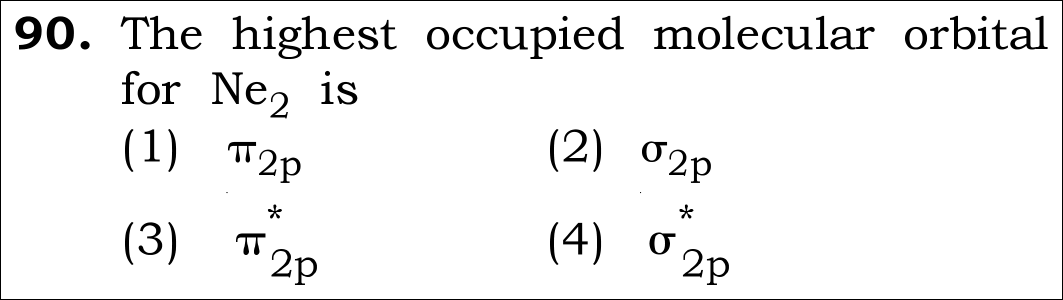
NEET 2026 · Q90 Easy
Official NEET 2026 Question 90 - Chemical Bonding and Molecular Structure
1
2
3
4 ✓ Key
💡 Verified Solution & 30-Second Hack
✓
Verified Against NTA Final Answer Key
Option (4) : σ*_{2p}
📚 Chemical Bonding and Molecular Structure Easy
📋 Given Parameters & Problem Setup
Diatomic Species Ne₂ (Neon dimer)
Total Electron Count 2 × 10 = 20 electrons
Target Highest Occupied Molecular Orbital (HOMO)
⚡

The 30-Second Exam Hall Shortcut: ⚡ Full 20-Electron MOT Sequence

⏱️ Save ~45 seconds

Ne₂ fills all available second-row molecular orbitals up to the very highest antibonding level: σ*_{2p}!

1 Total electrons in Ne₂ = 10 + 10 = 20 electrons.
2 Molecular orbital filling order for elements with Z > 7 (O₂, F₂, Ne₂):
3 σ_{1s}² σ*_{1s}² σ_{2s}² σ*_{2s}² σ_{2p_z}² (π_{2p_x}² = π_{2p_y}²) (π*_{2p_x}² = π*_{2p_y}²) σ*_{2p_z}².
4 All 20 electrons completely fill orbitals up to the final σ*_{2p} level.
5 Therefore, the Highest Occupied Molecular Orbital (HOMO) is σ*_{2p}!
6 Option (4) is undeniably correct in 5 seconds flat!
🛡️
Why You Can 100% Trust This Shortcut: Universal molecular orbital theory: Second-row diatomic molecules with 20 electrons fill all bonding and antibonding molecular orbitals generated from 1s, 2s, and 2p valence atomic orbitals, ending at σ*_{2p} (bond order = (10 - 10)/2 = 0).
📐

Step-by-Step Rigorous Workflow & Mathematical Proof

Step 1

Calculate Total Number of Electrons in Ne₂

Neon has atomic number Z = 10. A hypothetical homonuclear diatomic neon molecule (Ne₂) contains 2 × 10 = 20 electrons.

Ntotal=10+10=20 electronsN_{\text{total}} = 10 + 10 = 20\text{ electrons}
  • • Core electrons from 1s: 4 electrons.
  • • Valence electrons from 2s and 2p: 16 electrons.
Step 2

Construct the Complete Molecular Orbital Configuration

For homonuclear diatomics with Z > 7, no significant 2s-2p mixing occurs. The molecular orbitals are ordered by increasing energy: σ_{1s} < σ*_{1s} < σ_{2s} < σ*_{2s} < σ_{2p_z} < (π_{2p_x} = π_{2p_y}) < (π*_{2p_x} = π*_{2p_y}) < σ*_{2p_z}

σ1s2  σ1s∗2  σ2s2  σ2s∗2  σ2pz2  (π2px2=π2py2)  (π2px∗2=π2py∗2)  σ2pz∗2\sigma_{1s}^2\; \sigma_{1s}^{*2}\; \sigma_{2s}^2\; \sigma_{2s}^{*2}\; \sigma_{2p_z}^2\; (\pi_{2p_x}^2 = \pi_{2p_y}^2)\; (\pi_{2p_x}^{*2} = \pi_{2p_y}^{*2})\; \sigma_{2p_z}^{*2}
  • • Total electrons accommodated = 2 + 2 + 2 + 2 + 2 + 4 + 4 + 2 = 20 electrons.
Step 3

Identify the Highest Occupied Molecular Orbital (HOMO)

The orbital of highest energy that contains electrons in the ground-state electron configuration is defined as the HOMO. In Ne₂, the last two electrons occupy the σ*_{2p_z} (antibonding σ_{2p}) orbital.

HOMO(Ne2)≡σ2p∗\text{HOMO}(\text{Ne}_2) \equiv \sigma^*_{2p}
  • • HOMO is σ*_{2p}.
  • • Matches Option (4).
⭐

360° Option Elimination Engine Key Feature

Diagnose every choice: Know exactly why the right option works and why distractors fail.

4-Option Deep Scan
1 A
✗ Incorrect
Verdict & Scientific Reason:

Incorrect. π_{2p} holds electrons 11 through 14, well below the highest occupied orbital.

⚠️
Student Fallacy (Why candidates pick this trap): Confusing bonding π orbitals with highest occupied level.
2 B
✗ Incorrect
Verdict & Scientific Reason:

Incorrect. σ_{2p} holds electrons 9 and 10, far lower in energy than the antibonding orbitals.

⚠️
Student Fallacy (Why candidates pick this trap): Thinking of bonding orbitals only.
3 C
✗ Incorrect
Verdict & Scientific Reason:

Incorrect. π*_{2p} is the HOMO for O₂ (16 electrons) and F₂ (18 electrons), but Ne₂ has 20 electrons.

⚠️
Student Fallacy (Why candidates pick this trap): Confusing the HOMO of F₂ with the HOMO of Ne₂.
4 D
✓ 100% Correct
Verdict & Scientific Reason:

Exact match: With 20 electrons, the last orbital filled is the antibonding σ*_{2p} orbital.

💡
Why this is airtight: None; flawless mastery of Molecular Orbital Theory.
⚠️

NTA Trap Alert: Assuming F₂ and Ne₂ Share the Same HOMO

Students frequently memorize that F₂ (18 electrons) has HOMO = π*_{2p}. Ne₂ has 20 electrons, adding 2 more electrons that occupy the final higher-energy σ*_{2p} orbital!

🛡️ How to avoid the -1 mark: Count all 20 electrons: F₂ stops at π*_{2p} (18 e⁻); Ne₂ fills the final σ*_{2p} (20 e⁻).
📖

Core NEET Syllabus Standard

NEET Chemistry Core Syllabus · Chemical Bonding and Molecular Structure Standard Benchmark
Core Scientific Principle Tested:

"In diatomic second-row molecules with 20 electrons, all 2p bonding and antibonding orbitals are completely filled."

Syllabus Focus: Molecular Orbital Theory - Energy level diagrams and electronic configurations
✓ Core NEET UG Syllabus Anchor Syllabus & Academic Standards ↗
20 electrons fill the cup right to the top: σ*_{2p} is the final stop!
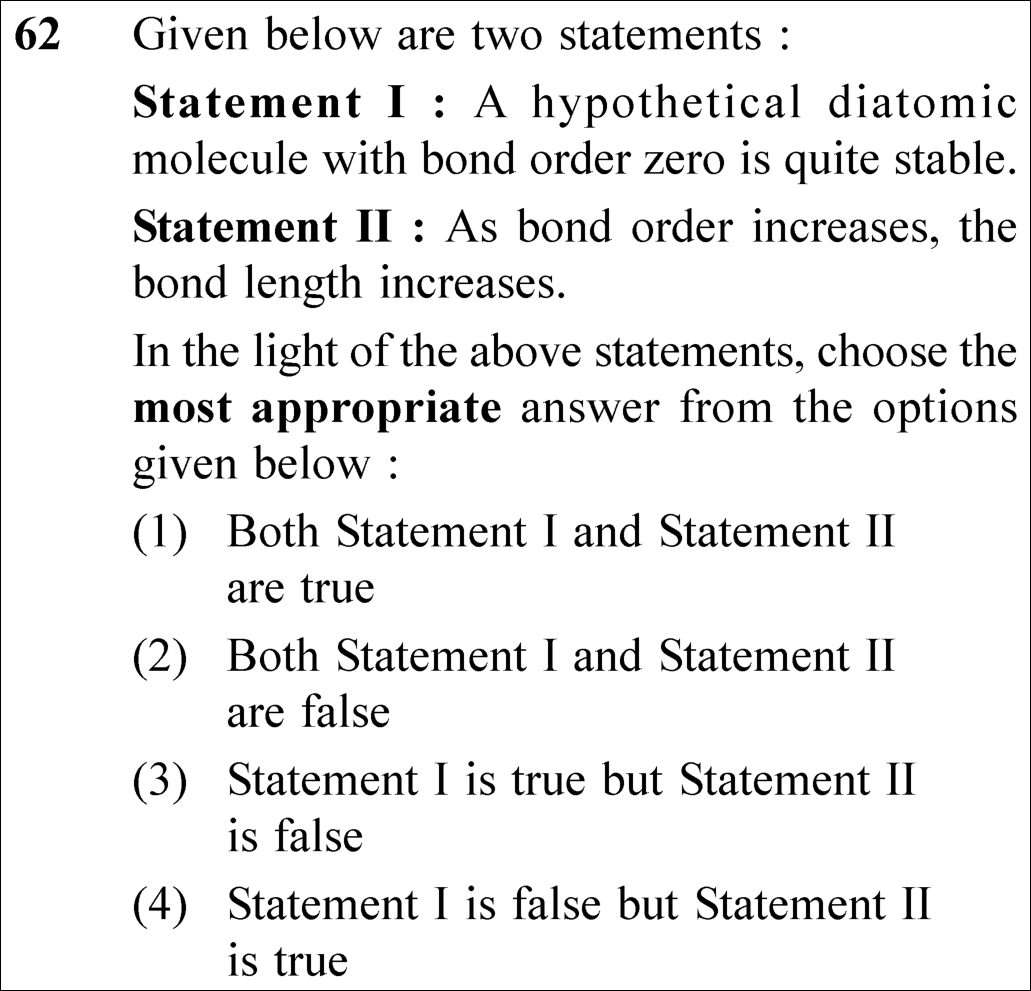
NEET 2025 · Q62 Easy
Official NEET 2025 Question 62 - Chemical Bonding and Molecular Structure
1 Both Statement I and Statement II are true
2 Both Statement I and Statement II are false ✓ Key
3 Statement I is true but Statement II is false
4 Statement I is false but Statement II is true
💡 Verified Solution & 30-Second Hack
✓
Verified Against NTA Final Answer Key
Option (2) : Both Statement I and Statement II are false
📚 Chemical Bonding and Molecular Structure Easy
📋 Given Parameters & Problem Setup
Statement I A hypothetical diatomic molecule with bond order zero is quite stable.
Statement II As bond order increases, the bond length increases.
⚡

The 30-Second Exam Hall Shortcut: ⚡ MOT Fundamental Axioms Check

⏱️ Save ~30 seconds

Bond order zero means NO net bonding forces ⟹ molecule DOES NOT EXIST (unstable)! Bond order increases (single → double → triple) ⟹ atoms pulled CLOSER ⟹ bond length DECREASES! Both statements are completely FALSE!

1 Examine Statement I: Bond Order = (N_b - N_a)/2. A bond order of zero means bonding electrons equal antibonding electrons (net attraction = 0). Such molecules (like He₂ or Be₂) are unstable and do not exist under normal conditions. Statement I claims it is "quite stable" ⟹ FALSE!
2 Examine Statement II: Greater bond order means more electron density shared between nuclei, pulling nuclei closer together (e.g., C-C = 154 pm, C=C = 134 pm, C≡C = 120 pm). Bond length DECREASES as bond order increases. Statement II claims bond length increases ⟹ FALSE!
3 Conclusion: Both Statement I and Statement II are false.
4 Match Option (2) in under 10 seconds!
🛡️
Why You Can 100% Trust This Shortcut: Molecular Orbital Theory & Bond Order Principles (NCERT Chemistry · Chemical Bonding and Molecular Structure: Bond Order = ½(N_b - N_a)).
📐

Step-by-Step Rigorous Workflow & Mathematical Proof

Step 1

Evaluate Statement I (Significance of Bond Order Zero)

In Molecular Orbital Theory, the bond order is defined as half the difference between the number of bonding electrons (N_b) and antibonding electrons (N_a):

Bond Order (B.O.)=Nb−Na2\text{Bond Order (B.O.)} = \frac{N_b - N_a}{2}
  • • A positive bond order (B.O. > 0) indicates a stable molecule.
  • • If B.O. = 0 (N_b = N_a), the antibonding destabilization completely cancels the bonding stabilization.
  • • The molecule cannot hold together and is unstable or non-existent (e.g., He₂, Be₂).
  • • Therefore, Statement I is unequivocally FALSE.
Step 2

Evaluate Statement II (Bond Order vs. Bond Length Relationship)

Bond order reflects the multiplicity of the covalent bond between two atoms:

Bond Length∝1Bond Order\text{Bond Length} \propto \frac{1}{\text{Bond Order}}
  • • For carbon-carbon bonds: C-C (B.O. = 1, length = 154 pm), C=C (B.O. = 2, length = 134 pm), C≡C (B.O. = 3, length = 120 pm).
  • • As bond order increases, bond length DECREASES, and bond dissociation enthalpy increases.
  • • Statement II states that bond length increases, which is completely FALSE.
Step 3

Select Matching Option

Since both statements are false, select Option (2).

Statement I: False,Statement II: False  ⟹  Option (2)\text{Statement I: False}, \quad \text{Statement II: False} \implies \text{Option (2)}
  • • Matches Option (2) with complete scientific accuracy.
⭐

360° Option Elimination Engine Key Feature

Diagnose every choice: Know exactly why the right option works and why distractors fail.

4-Option Deep Scan
1 A
✗ Incorrect
Verdict & Scientific Reason:

Incorrect. Both statements contradict fundamental MOT laws.

⚠️
Student Fallacy (Why candidates pick this trap): Total misconception of bond order.
2 B
✓ 100% Correct
Verdict & Scientific Reason:

100% correct. B.O. = 0 means unstable/non-existent, and higher B.O. shortens bond length.

💡
Why this is airtight: None; solid conceptual grasp of chemical bonding.
3 C
✗ Incorrect
Verdict & Scientific Reason:

Incorrect. Statement I is false.

⚠️
Student Fallacy (Why candidates pick this trap): Believing B.O. = 0 can be stable.
4 D
✗ Incorrect
Verdict & Scientific Reason:

Incorrect. Statement II is false.

⚠️
Student Fallacy (Why candidates pick this trap): Thinking higher bond order increases bond length.
⚠️

NTA Trap Alert: Confusing Bond Energy with Bond Length

As bond order increases, bond STRENGTH and bond ENERGY increase, but bond LENGTH decreases! Candidates who confuse bond length with bond energy mistakenly believe Statement II is true.

🛡️ How to avoid the -1 mark: Triple bond is STRONGER but SHORTER: Bond order up ⟹ Bond length down!
📖

Core NEET Syllabus Standard

NEET Chemistry Core Syllabus · Chemical Bonding and Molecular Structure Standard Benchmark
Core Scientific Principle Tested:

"B.O. = 0 means unstable molecule; Bond length is inversely proportional to bond order."

Syllabus Focus: Molecular Orbital Theory & Bond Parameters
✓ Core NEET UG Syllabus Anchor Syllabus & Academic Standards ↗
B.O. = 0 is unstable, higher B.O. shrinks the bond ⟹ Both statements are FALSE!
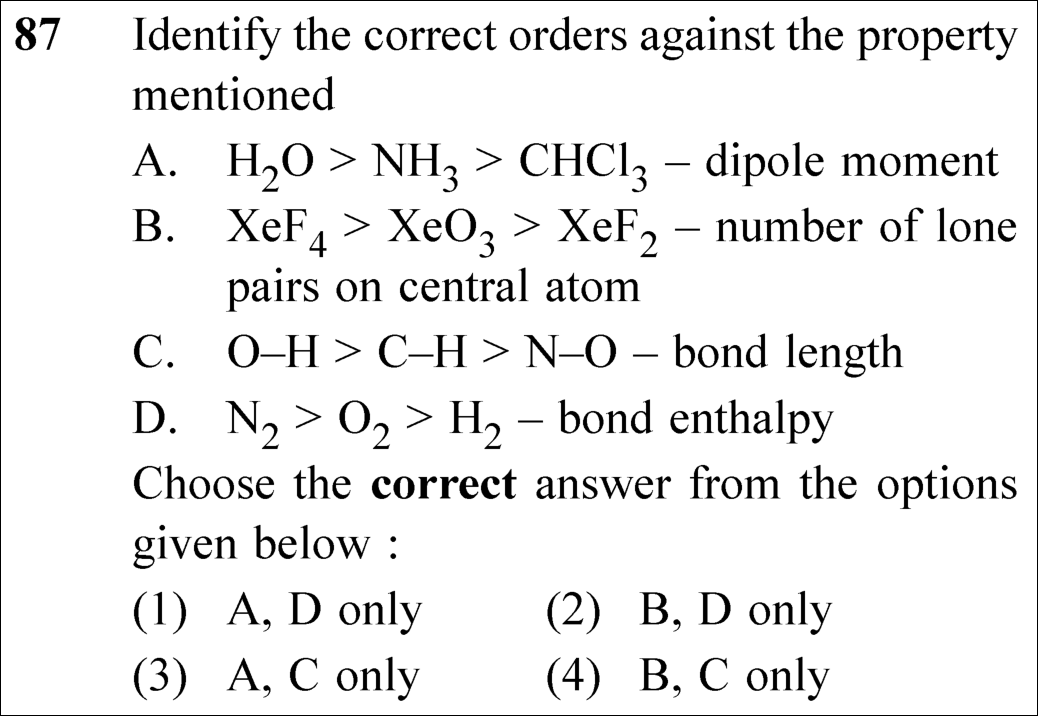
NEET 2025 · Q87 Medium
Official NEET 2025 Question 87 - Chemical Bonding and Molecular Structure
1 ✓ Key
2
3
4
💡 Verified Solution & 30-Second Hack
✓
Verified Against NTA Final Answer Key
Option (1) : A, D only
📚 Chemical Bonding and Molecular Structure Medium
📋 Given Parameters & Problem Setup
Order A (Dipole Moment) H₂O > NH₃ > CHCl₃
Order B (Lone Pairs on Xe) XeF₄ > XeO₃ > XeF₂
Order C (Bond Length) O-H > C-H > N-O
Order D (Bond Enthalpy) N₂ > O₂ > H₂
⚡

The 30-Second Exam Hall Shortcut: ⚡ Canonical Data Cross-Verification

⏱️ Save ~40 seconds

A: Dipole moments: H₂O (1.85 D) > NH₃ (1.47 D) > CHCl₃ (1.04 D) ⟹ TRUE! B: Lone pairs: XeF₂ (3) > XeF₄ (2) > XeO₃ (1), so B is FALSE! C: O-H (96 pm) is SHORTEST, not longest ⟹ FALSE! D: N₂ (946 kJ/mol, triple bond) > O₂ (498, double) > H₂ (436, single) ⟹ TRUE! ⟹ A, D only!

1 Check Order A (Dipole moment): H₂O has μ = 1.85 D; NH₃ has μ = 1.47 D; CHCl₃ has μ = 1.04 D. The order H₂O > NH₃ > CHCl₃ is TRUE.
2 Check Order B (Lone pairs on Xe): Xe has 8 valence electrons. XeF₄ has (8-4)/2 = 2 lone pairs; XeO₃ has (8-6)/2 = 1 lone pair; XeF₂ has (8-2)/2 = 3 lone pairs. The statement claims 2 > 1 > 3, which is mathematically and chemically FALSE.
3 Check Order C (Bond length): O-H bond length is ~96 pm; C-H is ~109 pm; N-O single bond is ~140 pm. The true order is N-O > C-H > O-H. Order C claims O-H is longest ⟹ FALSE.
4 Check Order D (Bond dissociation enthalpy): N₂ has a strong triple bond (946 kJ/mol); O₂ has a double bond (498 kJ/mol); H₂ has a single bond (436 kJ/mol). The order N₂ > O₂ > H₂ is TRUE.
5 Conclusion: Orders A and D only are correct.
6 Select Option (1) in under 15 seconds!
🛡️
Why You Can 100% Trust This Shortcut: Half-Life and Arrhenius Activation Energy (NCERT Chemistry · Chemical Kinetics: t_1/2 = 0.693/k).
📐

Step-by-Step Rigorous Workflow & Mathematical Proof

Step 1

Evaluate Order A (Dipole Moments of H₂O, NH₃, and CHCl₃)

Examine experimental dipole moment values in Debye (D) from NCERT Chapter 4:

μ(H2O)=1.85 D>μ(NH3)=1.47 D>μ(CHCl3)=1.04 D\mu(\text{H}_2\text{O}) = 1.85\text{ D} > \mu(\text{NH}_3) = 1.47\text{ D} > \mu(\text{CHCl}_3) = 1.04\text{ D}
  • • H₂O has two bond dipoles adding vectorially to two lone pairs in a bent geometry.
  • • NH₃ has three bond dipoles reinforcing the single lone pair in a pyramidal geometry.
  • • CHCl₃ has opposing C-H and C-Cl bond dipoles, resulting in a net moment of 1.04 D.
  • • Order A is completely TRUE.
Step 2

Evaluate Orders B and C (Lone Pairs on Xenon & Bond Lengths)

Determine the number of non-bonding electron pairs on xenon and compare covalent radii:

Lone pairs on Xe: XeF2 (3)>XeF4 (2)>XeO3 (1)\text{Lone pairs on Xe: } \text{XeF}_2\,(3) > \text{XeF}_4\,(2) > \text{XeO}_3\,(1)
  • • Order B claims XeF₄ > XeO₃ > XeF₂, which contradicts the true count. Order B is FALSE.
  • • Covalent bond lengths: N-O single bond (140 pm) > C-H bond (109 pm) > O-H bond (96 pm).
  • • Order C claims O-H > C-H > N-O, which is the exact reverse. Order C is FALSE.
Step 3

Evaluate Order D (Bond Dissociation Enthalpies of Diatomic Molecules)

Compare bond dissociation enthalpies from NCERT thermodynamics and chemical bonding data:

ΔbondH∘:  N2 (945.8 kJ/mol)>O2 (498.3 kJ/mol)>H2 (435.8 kJ/mol)\Delta_{bond} H^\circ: \; \text{N}_2\,(945.8\text{ kJ/mol}) > \text{O}_2\,(498.3\text{ kJ/mol}) > \text{H}_2\,(435.8\text{ kJ/mol})
  • • N₂ possesses a triple bond (:N≡N:), O₂ possesses a double bond (O=O), and H₂ has a single bond (H-H).
  • • The order N₂ > O₂ > H₂ is completely TRUE.
  • • Therefore, A and D only are correct, matching Option (1).
⭐

360° Option Elimination Engine Key Feature

Diagnose every choice: Know exactly why the right option works and why distractors fail.

4-Option Deep Scan
1 A
✓ 100% Correct
Verdict & Scientific Reason:

100% correct. Both dipole moment hierarchy (A) and bond enthalpy order (D) are factually exact.

💡
Why this is airtight: None; precise recall of NCERT tables.
2 B
✗ Incorrect
Verdict & Scientific Reason:

Incorrect. Order B is false (XeF₂ has 3 lone pairs, more than XeF₄ and XeO₃).

⚠️
Student Fallacy (Why candidates pick this trap): Miscounting lone pairs on XeF₂.
3 C
✗ Incorrect
Verdict & Scientific Reason:

Incorrect. Order C is false (O-H is ~96 pm, much shorter than N-O ~140 pm).

⚠️
Student Fallacy (Why candidates pick this trap): Believing O-H is the longest bond.
4 D
✗ Incorrect
Verdict & Scientific Reason:

Incorrect. Both B and C are false.

⚠️
Student Fallacy (Why candidates pick this trap): Selecting two invalid statements.
⚠️

NTA Trap Alert: Assuming H₂ Has a Stronger Bond Than O₂

Students often know H₂ has a very strong single bond (436 kJ/mol) and forget that O₂ has a DOUBLE bond (498 kJ/mol)! The double bond of O₂ requires more energy to break than the single bond of H₂, making N₂ (946) > O₂ (498) > H₂ (436) completely true!

🛡️ How to avoid the -1 mark: Bond order check: N₂ (B.O. = 3, ~946) > O₂ (B.O. = 2, ~498) > H₂ (B.O. = 1, ~436).
📖

Core NEET Syllabus Standard

NEET Chemistry Core Syllabus · Chemical Bonding and Molecular Structure Standard Benchmark
Core Scientific Principle Tested:

"H₂O > NH₃ > CHCl₃ (dipole); N₂ > O₂ > H₂ (bond enthalpy)."

Syllabus Focus: Dipole Moments & Bond Enthalpies of Diatomic Molecules
✓ Core NEET UG Syllabus Anchor Syllabus & Academic Standards ↗
Dipole: H₂O > NH₃ > CHCl₃ (A). Bond: Triple (N₂) > Double (O₂) > Single (H₂) (D) ⟹ A & D only!
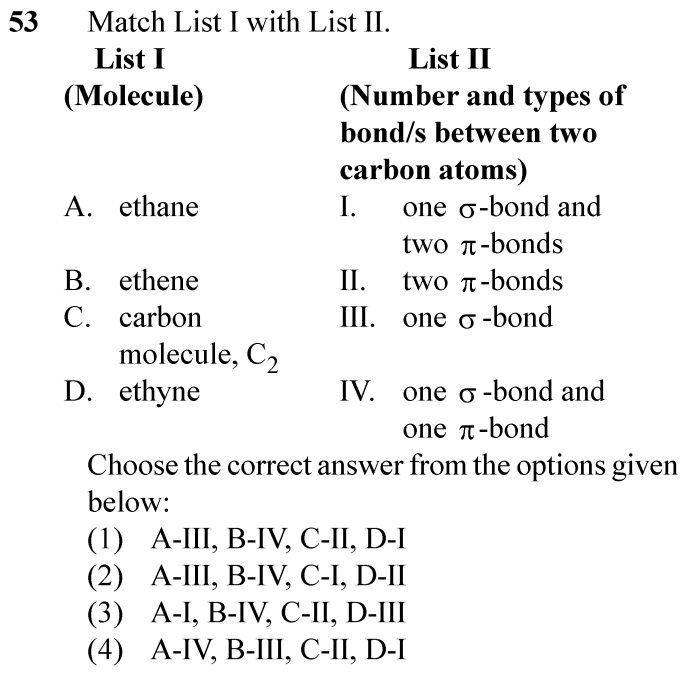
NEET 2024 · Q53 Easy
Official NEET 2024 Question 53 - Chemical Bonding and Molecular Structure
1 ✓ Key
2
3
4
💡 Verified Solution & 30-Second Hack
✓
Verified Against NTA Final Answer Key
Option (1) : A-III, B-IV, C-II, D-I
📚 Chemical Bonding and Molecular Structure Easy
📋 Given Parameters & Problem Setup
Molecule A Ethane (C2H6)
Molecule B Ethene (C2H4)
Molecule C Carbon molecule (C2)
Molecule D Ethyne (C2H2)
⚡

The 30-Second Exam Hall Shortcut: ⚡ The Unique C2 Molecular Orbital Hack

⏱️ Save ~40 seconds

Ethane = 1σ (III), Ethene = 1σ + 1π (IV), Ethyne = 1σ + 2π (I), and C2 has ONLY 2π bonds (II)!

1 Ethane: H3C-CH3 single bond = one σ-bond (A-III).
2 Ethene: H2C=CH2 double bond = one σ-bond and one π-bond (B-IV).
3 Ethyne: HC≡CH triple bond = one σ-bond and two π-bonds (D-I).
4 C2 molecule has 12 electrons: (σ1s)² (σ*1s)² (σ2s)² (σ*2s)² (π2px)² (π2py)². Both bonding pairs reside in degenerate π-orbitals -> Two π-bonds and ZERO σ-bonds (C-II)!
5 Match: A-III, B-IV, C-II, D-I -> Option (1) in 5 seconds!
🛡️
Why You Can 100% Trust This Shortcut: NCERT Chemistry · Chemical Bonding and Molecular Structure (Molecular orbital configuration of C2 and hybridization).
📐

Step-by-Step Rigorous Workflow & Mathematical Proof

Step 1

Bonding in Ethane, Ethene, and Ethyne

In valence bond theory: Ethane involves sp³-sp³ axial overlap forming one σ-bond. Ethene involves sp²-sp² axial overlap (one σ-bond) and sideways 2p-2p overlap (one π-bond). Ethyne involves sp-sp axial overlap (one σ-bond) and two mutually perpendicular sideways 2p-2p overlaps (two π-bonds).

Ethane: 1σ,Ethene: 1σ+1π,Ethyne: 1σ+2π\text{Ethane: } 1\sigma, \quad \text{Ethene: } 1\sigma + 1\pi, \quad \text{Ethyne: } 1\sigma + 2\pi
Step 2

Molecular Orbital Treatment of C2

For homonuclear diatomic molecules with Z ≤ 7, the π2px and π2py molecular orbitals are lower in energy than the σ2pz orbital due to 2s-2p mixing. The 12-electron configuration of C2 is:

σ1s2  σ1s∗2  σ2s2  σ2s∗2  (π2px2=π2py2)\sigma_{1s}^2 \; \sigma_{1s}^{*2} \; \sigma_{2s}^2 \; \sigma_{2s}^{*2} \; (\pi_{2p_x}^2 = \pi_{2p_y}^2)
Step 3

Evaluation of Bond Order and Nature in C2

The bond order is (8 - 4)/2 = 2. The four valence electrons responsible for the double bond reside entirely in the degenerate π2px and π2py bonding orbitals. Consequently, the double bond in C2 consists entirely of two π-bonds with no σ-bond.

Nb=8,  Na=4  ⟹  Bond Order=8−42=2  (both are π-bonds)N_b = 8, \; N_a = 4 \implies \text{Bond Order} = \frac{8 - 4}{2} = 2 \; (\text{both are } \pi\text{-bonds})
⭐

360° Option Elimination Engine Key Feature

Diagnose every choice: Know exactly why the right option works and why distractors fail.

4-Option Deep Scan
1 (1)
✓ 100% Correct
Verdict & Scientific Reason:

Perfect alignment across all four species.

💡
Why this is airtight: None.
2 (2)
✗ Incorrect
Verdict & Scientific Reason:

Inverts C2 and ethyne bond descriptions.

⚠️
Student Fallacy (Why candidates pick this trap): Assuming C2 has a triple bond.
3 (3)
✗ Incorrect
Verdict & Scientific Reason:

Assigns triple bond to ethane.

⚠️
Student Fallacy (Why candidates pick this trap): Confusing ethane with ethyne.
4 (4)
✗ Incorrect
Verdict & Scientific Reason:

Inverts ethane and ethene.

⚠️
Student Fallacy (Why candidates pick this trap): Switching single and double bond counts.
⚠️

NTA Trap Alert: Assuming All Double Bonds Consist of 1σ and 1π

Students routinely assume every double bond must contain one σ and one π bond. In C2, MOT proves both bonds are exclusively π bonds!

🛡️ How to avoid the -1 mark: Remember this classic NCERT line: "In C2, the double bond consists of both pi bonds because of the presence of four electrons in two pi molecular orbitals."
📖

Core NEET Syllabus Standard

Chemistry Core Inorganic/Physical · Chemical Bonding and Molecular Structure Standard Benchmark
Core Scientific Principle Tested:

"In diatomic carbon C2, the 4 outermost valence electrons occupy degenerate π2p bonding orbitals, making the bond order 2 consisting of two π bonds."

Syllabus Focus: Molecular Orbital Theory and Electronic Configuration of Diatomics
✓ Core NEET UG Syllabus Anchor Syllabus & Academic Standards ↗
C2 is the Pi-Pi star: Two pi bonds and no sigma at all!
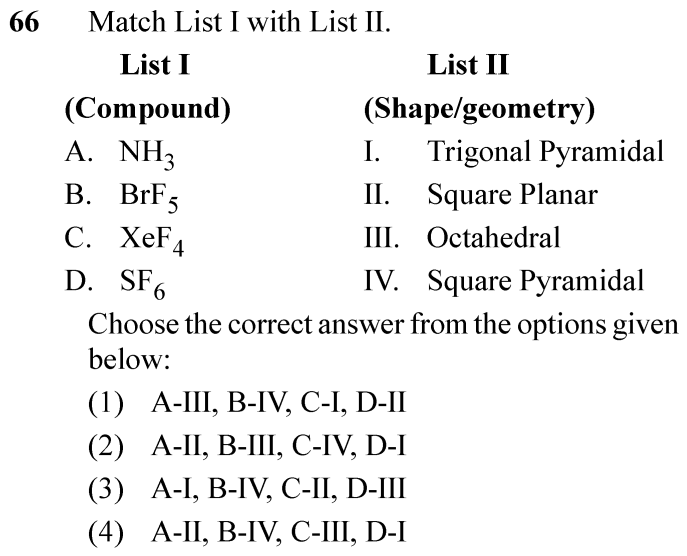
NEET 2024 · Q66 Easy
Official NEET 2024 Question 66 - Chemical Bonding and Molecular Structure
1
2
3 ✓ Key
4
💡 Verified Solution & 30-Second Hack
✓
Verified Against NTA Final Answer Key
Option (3) : A-I, B-IV, C-II, D-III
📚 Chemical Bonding and Molecular Structure Easy
📋 Given Parameters & Problem Setup
Molecule A NH3 (Ammonia)
Molecule B BrF5 (Bromine pentafluoride)
Molecule C XeF4 (Xenon tetrafluoride)
Molecule D SF6 (Sulfur hexafluoride)
⚡

The 30-Second Exam Hall Shortcut: ⚡ Steric Number & Lone Pair Direct Mapping

⏱️ Save ~40 seconds

NH3: 3 bp + 1 lp -> Trigonal Pyramidal (I); BrF5: 5 bp + 1 lp -> Square Pyramidal (IV); XeF4: 4 bp + 2 lp -> Square Planar (II); SF6: 6 bp + 0 lp -> Octahedral (III)!

1 NH3: Steric number = 3 + 1 = 4 (sp³). One lone pair compresses tetrahedral geometry into Trigonal Pyramidal (A-I).
2 BrF5: Br has 7 valence e⁻. 5 bonding pairs + 1 lone pair = steric number 6 (sp³d²). One axial lone pair yields Square Pyramidal (B-IV).
3 XeF4: Xe has 8 valence e⁻. 4 bonding pairs + 2 lone pairs = steric number 6 (sp³d²). Two axial lone pairs yield Square Planar (C-II).
4 SF6: S has 6 valence e⁻. 6 bonding pairs + 0 lone pairs = steric number 6 (sp³d²). Symmetrical Octahedral (D-III).
5 Match: A-I, B-IV, C-II, D-III -> Option (3) in 5 seconds!
🛡️
Why You Can 100% Trust This Shortcut: NCERT Chemistry · Chemical Bonding and Molecular Structure (VSEPR theory and shapes of molecules).
📐

Step-by-Step Rigorous Workflow & Mathematical Proof

Step 1

VSEPR Calculation for Ammonia (NH3)

Central atom Nitrogen has 5 valence electrons. It forms 3 single bonds with hydrogen atoms and retains 1 non-bonding lone pair: Steric Number = 3 + 1 = 4 (sp³ hybridization). The electron-pair geometry is tetrahedral, but the molecular shape (positions of nuclei) is Trigonal Pyramidal.

SN=3  bp+1  lp=4  ⟹  Trigonal Pyramidal\text{SN} = 3\;\text{bp} + 1\;\text{lp} = 4 \implies \text{Trigonal Pyramidal}
Step 2

VSEPR Calculation for Bromine Pentafluoride (BrF5)

Central atom Bromine has 7 valence electrons. Forming 5 Br-F bonds consumes 5 electrons, leaving 2 electrons (1 lone pair): Steric Number = 5 + 1 = 6 (sp³d² hybridization). Octahedral electron geometry with one lone pair gives a Square Pyramidal shape.

SN=5  bp+1  lp=6  ⟹  Square Pyramidal\text{SN} = 5\;\text{bp} + 1\;\text{lp} = 6 \implies \text{Square Pyramidal}
Step 3

VSEPR Calculation for Xenon Tetrafluoride (XeF4)

Central atom Xenon has 8 valence electrons. Forming 4 Xe-F bonds leaves 4 non-bonding electrons (2 lone pairs): Steric Number = 4 + 2 = 6 (sp³d² hybridization). To minimize lone pair-lone pair repulsions, the two lone pairs occupy trans axial positions (180° apart), leaving the 4 fluorines in an equatorial plane: Square Planar shape.

SN=4  bp+2  lp=6  ⟹  Square Planar\text{SN} = 4\;\text{bp} + 2\;\text{lp} = 6 \implies \text{Square Planar}
Step 4

VSEPR Calculation for Sulfur Hexafluoride (SF6)

Central atom Sulfur has 6 valence electrons, all shared in 6 S-F bonds with 0 lone pairs: Steric Number = 6 + 0 = 6 (sp³d² hybridization). Completely symmetrical regular Octahedral shape.

SN=6  bp+0  lp=6  ⟹  Octahedral\text{SN} = 6\;\text{bp} + 0\;\text{lp} = 6 \implies \text{Octahedral}
⭐

360° Option Elimination Engine Key Feature

Diagnose every choice: Know exactly why the right option works and why distractors fail.

4-Option Deep Scan
1 (1)
✗ Incorrect
Verdict & Scientific Reason:

Assigns octahedral shape to NH3.

⚠️
Student Fallacy (Why candidates pick this trap): Gross mismatch of basic geometries.
2 (2)
✗ Incorrect
Verdict & Scientific Reason:

Mismatches all shapes.

⚠️
Student Fallacy (Why candidates pick this trap): Random pairing.
3 (3)
✓ 100% Correct
Verdict & Scientific Reason:

Perfect alignment with VSEPR steric numbers and shapes.

💡
Why this is airtight: None.
4 (4)
✗ Incorrect
Verdict & Scientific Reason:

Assigns square planar to NH3.

⚠️
Student Fallacy (Why candidates pick this trap): Confusing 4-coordinate with 3-coordinate.
⚠️

NTA Trap Alert: Confusing Electron Geometry with Molecular Shape

XeF4 has an octahedral electron-pair arrangement (steric number 6), but its actual observed molecular geometry is Square Planar because lone pairs are invisible in shape determination.

🛡️ How to avoid the -1 mark: Always distinguish electron domain geometry from molecular geometry (shape of atoms).
📖

Core NEET Syllabus Standard

Chemistry Core Chemical Bonding · Chemical Bonding and Molecular Structure Standard Benchmark
Core Scientific Principle Tested:

"Molecular geometry is determined by the spatial arrangement of bonded atoms that minimizes electron-pair repulsions (lone pair-lone pair > lone pair-bond pair > bond pair-bond pair)."

Syllabus Focus: VSEPR Theory: Molecular Geometries of Polyatomic Species
✓ Core NEET UG Syllabus Anchor Syllabus & Academic Standards ↗
Six pairs make Octahedral base: 0 lp is Octahedral, 1 lp is Square Pyramid, 2 lp is Square Flat!
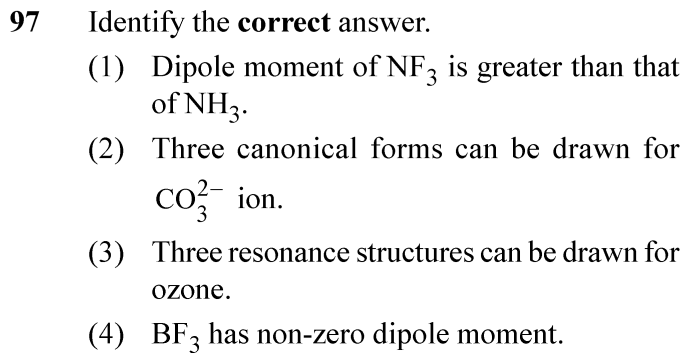
NEET 2024 · Q97 Easy
Official NEET 2024 Question 97 - Chemical Bonding and Molecular Structure
1
2 ✓ Key
3
4
💡 Verified Solution & 30-Second Hack
✓
Verified Against NTA Final Answer Key
Option (2) : Three canonical forms can be drawn for CO3²⁻ ion.
📚 Chemical Bonding and Molecular Structure Easy
📋 Given Parameters & Problem Setup
Option 1 statement Dipole moment of NF3 is greater than that of NH3
Option 2 statement Three canonical forms can be drawn for CO3²⁻ ion
Option 3 statement Three resonance structures can be drawn for ozone
Option 4 statement BF3 has non-zero dipole moment
⚡

The 30-Second Exam Hall Shortcut: ⚡ Carbonate Resonance Canonical Form Rule

⏱️ Save ~35 seconds

Carbonate CO3²⁻ has 3 equivalent oxygen atoms sharing one double bond and two single bonds -> Exactly THREE canonical Lewis forms! Option (2) is TRUE!

1 Check Option (1): In NH3, N-H bond dipoles add to the lone pair dipole (μ = 1.47 D). In NF3, electronegative fluorines pull in the opposite direction to the lone pair, opposing it (μ = 0.24 D). Thus, μ(NH3) > μ(NF3) -> Option (1) is FALSE.
2 Check Option (2): In carbonate ion CO3²⁻, the central carbon is bonded to three oxygens. The C=O double bond can reside with oxygen 1, oxygen 2, or oxygen 3. Exactly 3 equivalent canonical forms -> Option (2) is TRUE!
3 Check Option (3): Ozone (O3) has only 2 main canonical resonance Lewis structures (O=O⁺-O⁻ ↔ ⁻O-O⁺=O) -> Option (3) is FALSE.
4 Check Option (4): BF3 has symmetrical trigonal planar geometry (120° bond angles); the three B-F bond dipoles cancel to yield μ = 0 (zero dipole moment) -> Option (4) is FALSE.
5 Option (2) in 5 seconds!
🛡️
Why You Can 100% Trust This Shortcut: NCERT Chemistry · Chemical Bonding and Molecular Structure (Resonance structures of CO3 2-, ozone, and dipole moments of NH3 vs NF3 and BF3).
📐

Step-by-Step Rigorous Workflow & Mathematical Proof

Step 1

Analysis of Carbonate Resonance Structures (Statement 2)

In the carbonate ion (CO3²⁻), the carbon atom forms one double bond (C=O) and two single bonds (C-O⁻) with formal charges -1 on each single-bonded oxygen. Because all three oxygens are chemically and spatially equivalent, the double bond is delocalized equally among the three oxygen atoms, generating three equivalent canonical Lewis resonance structures:

[:O¨=C(O¨:⊖)2]⟷[⊖:O¨−C(=O¨)−O¨:⊖]⟷[(⊖:O¨−)2C=O¨:](3 canonical forms)[:\ddot{\text{O}}=\text{C}(\ddot{\text{O}}:^\ominus)_2] \longleftrightarrow [^\ominus:\ddot{\text{O}}{-}\text{C}(=\ddot{\text{O}}){-}\ddot{\text{O}}:^\ominus] \longleftrightarrow [(^\ominus:\ddot{\text{O}}{-})_2\text{C}=\ddot{\text{O}}:] \quad (\text{3 canonical forms})
Step 2

Analysis of NH3 versus NF3 Dipole Moments (Statement 1)

Both NH3 and NF3 have trigonal pyramidal geometries with one lone pair. In NH3, nitrogen is more electronegative than hydrogen, so N-H bond dipoles reinforce the lone pair dipole: μ = 1.47 D. In NF3, fluorine is more electronegative than nitrogen, so N-F bond dipoles oppose the lone pair dipole, resulting in a tiny net dipole: μ = 0.24 D. Hence μ(NH3) > μ(NF3). Statement 1 is false.

μ(NH3)=1.47  D  >  μ(NF3)=0.24  D\mu(\text{NH}_3) = 1.47\;\text{D} \;>\; \mu(\text{NF}_3) = 0.24\;\text{D}
Step 3

Analysis of Ozone Resonance (Statement 3)

Ozone (O3) is an angular molecule with a central oxygen atom bonded to two terminal oxygens. It possesses only TWO principal canonical resonance structures:

O¨=O¨⊕−O¨:⊖⟷ :⊖O¨−O¨⊕=O¨(2 resonance structures, not 3)\ddot{\text{O}}=\overset{\oplus}{\ddot{\text{O}}}{-}\ddot{\text{O}}:^\ominus \longleftrightarrow \,:^\ominus\ddot{\text{O}}{-}\overset{\oplus}{\ddot{\text{O}}}=\ddot{\text{O}} \quad (\text{2 resonance structures, not 3})
Step 4

Analysis of BF3 Dipole Moment (Statement 4)

Boron trifluoride (BF3) has sp² hybridization and symmetrical trigonal planar geometry with 120° bond angles. The vector sum of the three identical B-F bond dipole moments is identically zero:

μ⃗net=μ⃗1+μ⃗2+μ⃗3=0  ⟹  Dipole moment of BF3 is ZERO\vec{\mu}_{net} = \vec{\mu}_1 + \vec{\mu}_2 + \vec{\mu}_3 = 0 \implies \text{Dipole moment of BF}_3 \text{ is ZERO}
⭐

360° Option Elimination Engine Key Feature

Diagnose every choice: Know exactly why the right option works and why distractors fail.

4-Option Deep Scan
1 (1)
✗ Incorrect
Verdict & Scientific Reason:

False: μ(NH3) = 1.47 D > μ(NF3) = 0.24 D.

⚠️
Student Fallacy (Why candidates pick this trap): Assuming higher electronegativity difference in N-F automatically gives higher dipole moment.
2 (2)
✓ 100% Correct
Verdict & Scientific Reason:

True: Carbonate has exactly 3 equivalent canonical Lewis resonance structures.

💡
Why this is airtight: None.
3 (3)
✗ Incorrect
Verdict & Scientific Reason:

False: Ozone has only 2 principal canonical forms.

⚠️
Student Fallacy (Why candidates pick this trap): Confusing 3 oxygen atoms with 3 resonance structures.
4 (4)
✗ Incorrect
Verdict & Scientific Reason:

False: Trigonal planar symmetry cancels all bond dipoles to zero.

⚠️
Student Fallacy (Why candidates pick this trap): Forgetting vector cancellation in symmetric planar molecules.
⚠️

NTA Trap Alert: The NF3 vs NH3 Dipole Direction Trap

Even though fluorine is much more electronegative than hydrogen, in NF3 the bond dipoles oppose the lone pair, canceling most of the dipole. In NH3, they add constructively!

🛡️ How to avoid the -1 mark: Draw the dipole vectors: In NH3 arrows point up (constructive); in NF3 bond arrows point down (destructive).
📖

Core NEET Syllabus Standard

Chemistry Core Inorganic/Physical · Chemical Bonding and Molecular Structure Standard Benchmark
Core Scientific Principle Tested:

"Carbonate ion CO3 2- exhibits resonance among three equivalent canonical structures where the double bond is shared across each C-O bond."

Syllabus Focus: Resonance and Dipole Moments: Carbonate, Ozone, and NH3/NF3
✓ Core NEET UG Syllabus Anchor Syllabus & Academic Standards ↗
Three oxygens in carbonate take turns with the pi: Three canonical forms catch the eye!
NEET 2023 · Q52 Easy
Official NEET 2023 Question 52 - Chemical Bonding and Molecular Structure
1
2 ✓ Key
3
4
💡 Verified Solution & 30-Second Hack
✓
Verified Against NTA Final Answer Key
Option (2) : 3
📚 Chemical Bonding and Molecular Structure Easy
📋 Given Parameters & Problem Setup
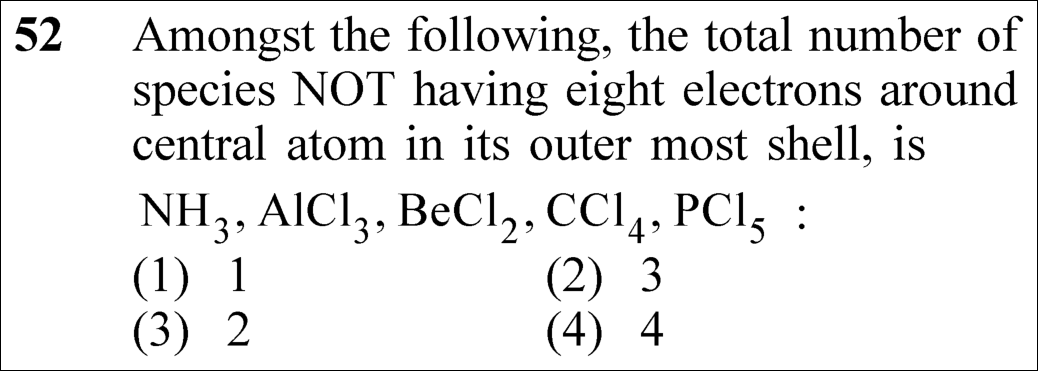
Set of molecules NH₃, AlCl₃, BeCl₂, CCl₄, PCl₅
Target condition Central atom NOT having 8 electrons in outermost shell
⚡

The 30-Second Exam Hall Shortcut: ⚡ Valence Electron Quick Scan: Octet = 8; Non-Octet ≠ 8

⏱️ Save ~30 seconds

NH₃ (8 e⁻, octet) and CCl₄ (8 e⁻, octet) are normal octets. AlCl₃ (6 e⁻, hypo), BeCl₂ (4 e⁻, hypo), and PCl₅ (10 e⁻, hyper) violate octet rule! Total = 3 non-octet species in 10 seconds!

1 Inspect each central atom valence shell:
2 - NH₃: N has 3 single bonds + 1 lone pair = 6 + 2 = 8 electrons (Octet complete).
3 - AlCl₃: Al has 3 valence electrons, forming 3 single bonds = 6 electrons (Incomplete octet / Hypovalent) ⟹ COUNT #1.
4 - BeCl₂: Be has 2 valence electrons, forming 2 single bonds = 4 electrons (Incomplete octet / Hypovalent) ⟹ COUNT #2.
5 - CCl₄: C has 4 valence electrons, forming 4 single bonds = 8 electrons (Octet complete).
6 - PCl₅: P has 5 valence electrons, forming 5 single bonds = 10 electrons (Expanded octet / Hypervalent) ⟹ COUNT #3.
7 Count the non-octet species: AlCl₃, BeCl₂, and PCl₅ = 3 species.
8 Lock Option (2) 3 immediately!
🛡️
Why You Can 100% Trust This Shortcut: Chemical Bonding · Octet Rule Exceptions (Incomplete octets occur in electron-deficient Group 2 and 13 monomer halides; expanded octets occur in Period 3 elements utilizing d-orbitals).
📐

Step-by-Step Rigorous Workflow & Mathematical Proof

Step 1

Definition of Lewis Octet Completeness

According to the Lewis-Kossel octet rule, main-group atoms tend to gain, lose, or share electrons to attain a stable valence configuration of eight electrons (s² p⁶). Species deviating from 8 valence electrons around the central atom are classified as either electron-deficient (incomplete octet, < 8 e⁻) or hypervalent (expanded octet, > 8 e⁻).

Octet Criterion: Valence electrons around central atom =8\text{Octet Criterion: Valence electrons around central atom } = 8
Step 2

Individual Molecule Electron Count

Evaluate the total valence electrons surrounding the central atom in each monomeric Lewis structure:

NH3:3 bond pairs+1 lone pair=6+2=8 e−(Complete octet)AlCl3:3 bond pairs+0 lone pairs=6 e−(Incomplete octet, <8)BeCl2:2 bond pairs+0 lone pairs=4 e−(Incomplete octet, <8)CCl4:4 bond pairs+0 lone pairs=8 e−(Complete octet)PCl5:5 bond pairs+0 lone pairs=10 e−(Expanded octet, >8)\begin{aligned} \text{NH}_3 &: 3\text{ bond pairs} + 1\text{ lone pair} = 6 + 2 = 8\ e^- \quad (\text{Complete octet}) \\[4pt] \text{AlCl}_3 &: 3\text{ bond pairs} + 0\text{ lone pairs} = 6\ e^- \quad (\text{Incomplete octet, } < 8) \\[4pt] \text{BeCl}_2 &: 2\text{ bond pairs} + 0\text{ lone pairs} = 4\ e^- \quad (\text{Incomplete octet, } < 8) \\[4pt] \text{CCl}_4 &: 4\text{ bond pairs} + 0\text{ lone pairs} = 8\ e^- \quad (\text{Complete octet}) \\[4pt] \text{PCl}_5 &: 5\text{ bond pairs} + 0\text{ lone pairs} = 10\ e^- \quad (\text{Expanded octet, } > 8) \end{aligned}
Step 3

Summation of Non-Octet Species

The species not having eight electrons around their central atom are AlCl₃ (6 e⁻), BeCl₂ (4 e⁻), and PCl₅ (10 e⁻). Thus, exactly 3 species violate the octet rule.

Total non-octet species=3(AlCl3,BeCl2,PCl5)\text{Total non-octet species} = 3 \quad (\text{AlCl}_3, \text{BeCl}_2, \text{PCl}_5)
⭐

360° Option Elimination Engine Key Feature

Diagnose every choice: Know exactly why the right option works and why distractors fail.

4-Option Deep Scan
1 (1)
✗ Incorrect
Verdict & Scientific Reason:

Only counts PCl₅ (assuming only expanded octets violate the rule).

⚠️
Student Fallacy (Why candidates pick this trap): Candidate forgot that incomplete octets (< 8 e⁻) are also non-octet species.
2 (2)
✓ 100% Correct
Verdict & Scientific Reason:

Accurate count: AlCl₃ (6 e⁻), BeCl₂ (4 e⁻), and PCl₅ (10 e⁻) all lack exactly 8 electrons.

💡
Why this is airtight: None. Candidate correctly included both hypovalent and hypervalent molecules.
3 (3)
✗ Incorrect
Verdict & Scientific Reason:

Only counts hypovalent species (AlCl₃ and BeCl₂) or misses PCl₅.

⚠️
Student Fallacy (Why candidates pick this trap): Candidate forgot that having 10 electrons in PCl₅ means it does NOT have 8 electrons.
4 (4)
✗ Incorrect
Verdict & Scientific Reason:

Overcounting NH₃ or CCl₄.

⚠️
Student Fallacy (Why candidates pick this trap): Candidate miscounted the lone pair on nitrogen in NH₃.
⚠️

NTA Trap Alert: Forgetting That "NOT 8" Includes BOTH Less Than 8 AND More Than 8

Some students only look for electron-deficient species (< 8, giving AlCl₃ and BeCl₂ = 2 species). Others only look for expanded octets (> 8, giving PCl₅ = 1 species). The prompt asks for species NOT having 8 electrons, which includes ALL deviations from 8: AlCl₃ (6), BeCl₂ (4), and PCl₅ (10)!

🛡️ How to avoid the -1 mark: Read "NOT having 8" literally: Any count ≠ 8 qualifies.
📖

Core NEET Syllabus Standard

National Eligibility cum Entrance Test (NEET UG) · Chemical Bonding and Molecular Structure Standard Benchmark
Core Scientific Principle Tested:

"Exceptions to the octet rule include the incomplete octet of central atom (BeCl₂, AlCl₃) and the expanded octet (PCl₅, SF₆)."

Syllabus Focus: Kossel-Lewis Approach and Limitations of the Octet Rule
Preserved in Rationalized Curriculum Syllabus & Academic Standards ↗
NEET 2023 · Q53 Easy
Official NEET 2023 Question 53 - Chemical Bonding and Molecular Structure
1
2 ✓ Key
3
4
💡 Verified Solution & 30-Second Hack
✓
Verified Against NTA Final Answer Key
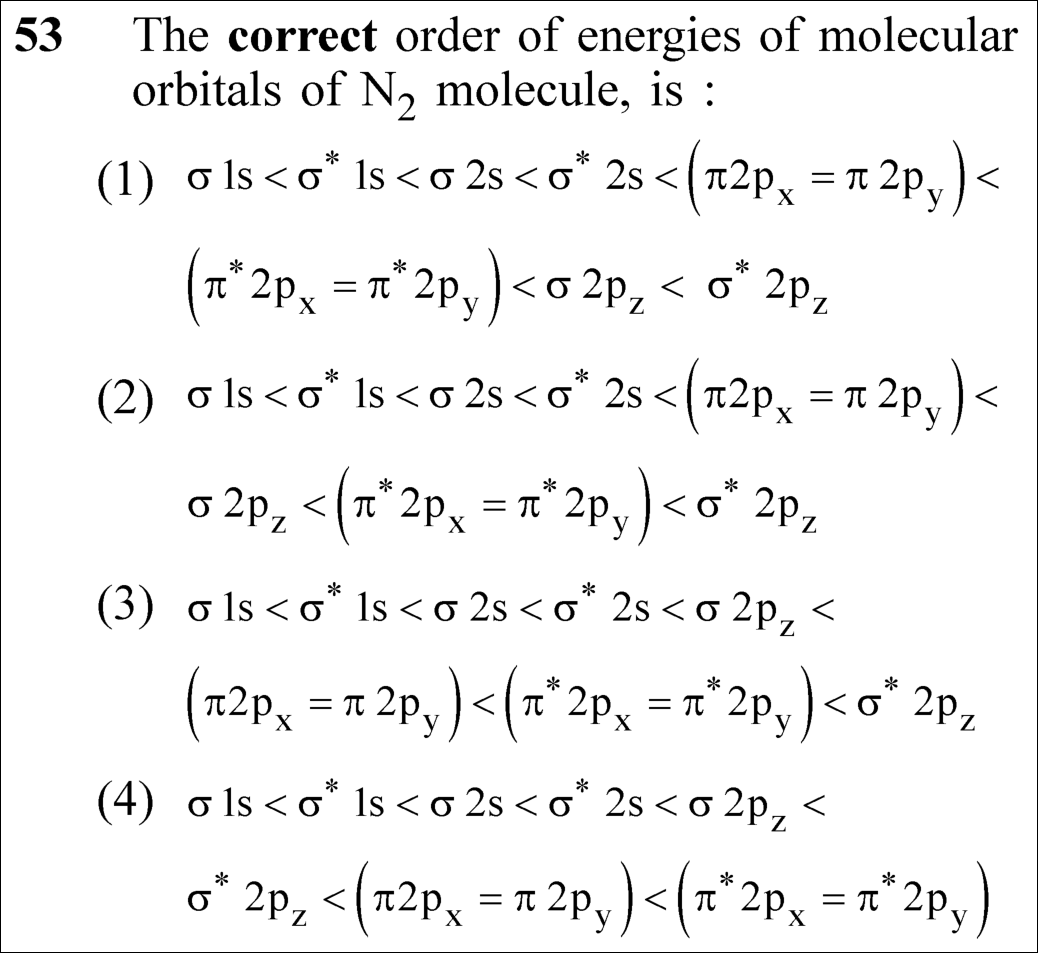
Option (2) : σ 1s < σ* 1s < σ 2s < σ* 2s < (π 2p_x = π 2p_y) < σ 2p_z < (π* 2p_x = π* 2p_y) < σ* 2p_z
📚 Chemical Bonding and Molecular Structure Easy
📋 Given Parameters & Problem Setup
Target molecule N₂ (Dinitrogen)
Total electron count 7 + 7 = 14 electrons
Phenomenon involved 2s-2p orbital mixing (sp-mixing)
⚡

The 30-Second Exam Hall Shortcut: ⚡ 14-Electron "2-1-2-1" MOT Pattern Hack

⏱️ Save ~40 seconds

For ≤ 14 electrons (up to N₂), sp-mixing elevates σ2p_z ABOVE π2p! The filling pattern is π before σ: π(2) – σ(1) – π*(2) – σ*(1). Option (2) in 10 seconds!

1 Total electrons in N₂ = 14 electrons.
2 For diatomic molecules with ≤ 14 electrons (B₂, C₂, N₂), small energy gap between 2s and 2p causes strong 2s-2p mixing.
3 Mixing pushes σ 2s lower, σ* 2s higher, and pushes σ 2p_z HIGHER than the degenerate π 2p_x and π 2p_y orbitals.
4 Thus, (π 2p_x = π 2p_y) orbitals have LOWER energy than σ 2p_z.
5 The correct sequence is: σ 1s < σ* 1s < σ 2s < σ* 2s < (π 2p_x = π 2p_y) < σ 2p_z < (π* 2p_x = π* 2p_y) < σ* 2p_z.
6 Lock Option (2) immediately!
🛡️
Why You Can 100% Trust This Shortcut: Molecular Orbital Theory · Energy Level Diagrams (In homonuclear diatomics with Z ≤ 7, the degenerate π 2p_x and π 2p_y orbitals lie lower in energy than σ 2p_z due to s-p mixing).
📐

Step-by-Step Rigorous Workflow & Mathematical Proof

Step 1

Fundamentals of Molecular Orbital Theory (MOT) Ordering

In homonuclear diatomic molecules, atomic orbitals of comparable energy and appropriate symmetry combine to form bonding (σ, π) and antibonding (σ*, π*) molecular orbitals. The internuclear axis is taken as the z-axis, so head-on overlap forms σ 2p_z, and lateral overlaps form degenerate π 2p_x and π 2p_y.

Internuclear Axis: z  ⟹  σ2pz,π2px=π2py\text{Internuclear Axis: } z \implies \sigma 2p_z, \quad \pi 2p_x = \pi 2p_y
Step 2

Effect of 2s-2p Mixing for Molecules with ≤ 14 Electrons

For elements up to nitrogen (Z ≤ 7, total electrons ≤ 14), the 2s and 2p atomic orbital energy levels lie close enough to undergo significant quantum mixing. This interaction raises the energy of the σ 2p_z orbital above the degenerate π 2p_x and π 2p_y orbitals:

E(π2px)=E(π2py)<E(σ2pz)E(\pi 2p_x) = E(\pi 2p_y) < E(\sigma 2p_z)
Step 3

Construction of the Full Energy Sequence

Arranging all molecular orbitals in order of increasing energy:

σ1s<σ∗1s<σ2s<σ∗2s<(π2px=π2py)<σ2pz<(π∗2px=π∗2py)<σ∗2pz\sigma 1s < \sigma^* 1s < \sigma 2s < \sigma^* 2s < (\pi 2p_x = \pi 2p_y) < \sigma 2p_z < (\pi^* 2p_x = \pi^* 2p_y) < \sigma^* 2p_z
⭐

360° Option Elimination Engine Key Feature

Diagnose every choice: Know exactly why the right option works and why distractors fail.

4-Option Deep Scan
1 (1)
✗ Incorrect
Verdict & Scientific Reason:

Places antibonding π* below bonding σ 2p_z, violating Aufbau principle.

⚠️
Student Fallacy (Why candidates pick this trap): Candidate mixed up bonding and antibonding orbital energies.
2 (2)
✓ 100% Correct
Verdict & Scientific Reason:

Accurate energy sequence for N₂ with 2s-2p mixing.

💡
Why this is airtight: None. Candidate correctly recognized the π < σ order for ≤ 14 electrons.
3 (3)
✗ Incorrect
Verdict & Scientific Reason:

This is the standard order for O₂ and F₂ (> 14 electrons) where NO s-p mixing occurs.

⚠️
Student Fallacy (Why candidates pick this trap): Candidate applied the O₂/F₂ order (1-2-2-1) instead of the N₂ order (2-1-2-1).
4 (4)
✗ Incorrect
Verdict & Scientific Reason:

Unphysical order placing σ* below π.

⚠️
Student Fallacy (Why candidates pick this trap): Severe confusion in orbital energy hierarchy.
⚠️

NTA Trap Alert: Applying the O₂/F₂ Order (σ 2p_z before π 2p) to N₂

In O₂ and F₂ (> 14 electrons), σ 2p_z is lower than π 2p (Option 3). But in N₂ (≤ 14 electrons), sp-mixing pushes σ 2p_z HIGHER than π 2p! Using the O₂ diagram for N₂ is the most common MOT blunder.

🛡️ How to avoid the -1 mark: Mnemonic: For ≤ 14 e⁻ (N₂), "2 comes before 1" (π pair before single σ). For > 14 e⁻ (O₂), "1 comes before 2" (single σ before π pair).
📖

Core NEET Syllabus Standard

National Eligibility cum Entrance Test (NEET UG) · Chemical Bonding and Molecular Structure Standard Benchmark
Core Scientific Principle Tested:

"For homonuclear diatomic molecules of second period elements with ≤ 14 electrons, the energy sequence is σ 1s < σ* 1s < σ 2s < σ* 2s < (π 2p_x = π 2p_y) < σ 2p_z < (π* 2p_x = π* 2p_y) < σ* 2p_z."

Syllabus Focus: Molecular Orbital Theory and Energy Level Diagrams
Preserved in Rationalized Curriculum Syllabus & Academic Standards ↗
NEET 2021 · Q63 Easy
Official NEET 2021 Question 63 - Chemical Bonding and Molecular Structure
1 (a)-(iv), (b)-(iii), (c)-(i), (d)-(ii) ✓ Key
2 (a)-(ii), (b)-(iii), (c)-(iv), (d)-(i)
3 (a)-(iii), (b)-(i), (c)-(iv), (d)-(ii)
4 (a)-(iv), (b)-(iii), (c)-(ii), (d)-(i)
💡 Verified Solution & 30-Second Hack
✓
Verified Against NTA Final Answer Key
Option (1) : (a)-(iv), (b)-(iii), (c)-(i), (d)-(ii)
📚 Chemical Bonding and Molecular Structure Easy
📋 Given Parameters & Problem Setup
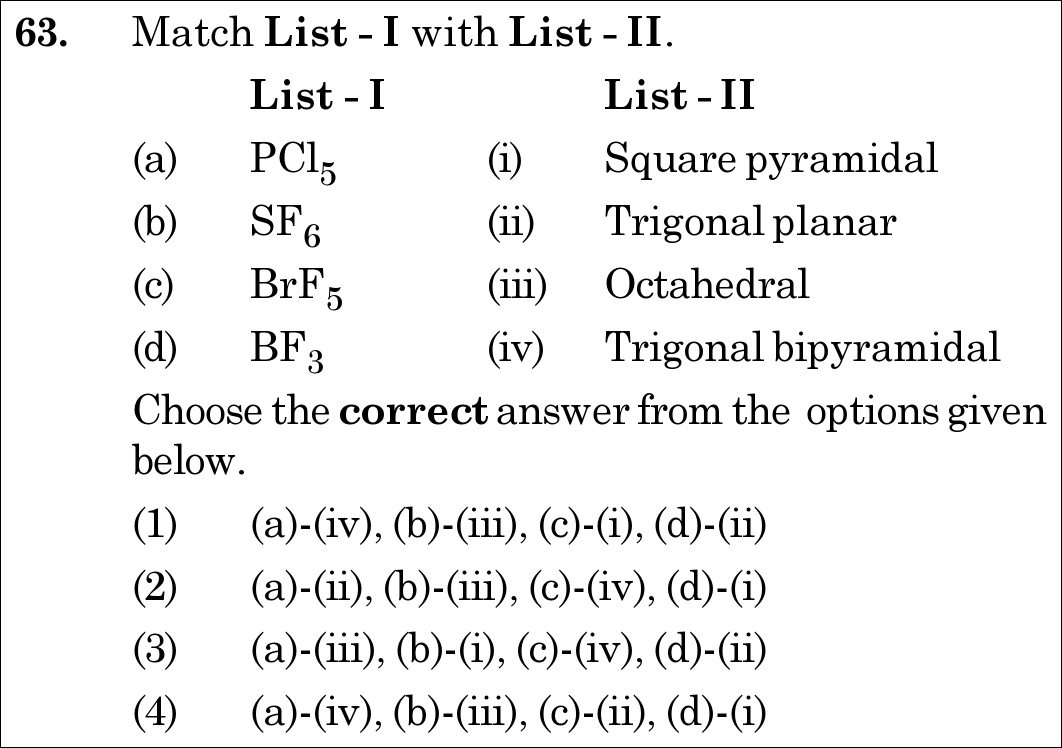
List I Molecules (a) PCl5, (b) SF6, (c) BrF5, (d) BF3
List II Geometries (i) Square pyramidal, (ii) Trigonal planar, (iii) Octahedral, (iv) Trigonal bipyramidal
⚡

The 30-Second Exam Hall Shortcut: ⚡ VSEPR Electron Pair Counting Match

⏱️ Save ~25 seconds

PCl5PCl_5: 5 bp + 0 lp →\to Trigonal bipyramidal (iv); SF6SF_6: 6 bp + 0 lp →\to Octahedral (iii); BrF5BrF_5: 5 bp + 1 lp →\to Square pyramidal (i); BF3BF_3: 3 bp + 0 lp →\to Trigonal planar (ii)! Instant 10-second matching to Option (1)!

1 PCl5PCl_5: Valence electrons =5+5(7)=40= 5 + 5(7) = 40. Steric number =5= 5 (5 bp, 0 lp)   ⟹  sp3d  ⟹  \implies sp^3d \implies Trigonal bipyramidal -> (a)-(iv).
2 SF6SF_6: Steric number =6= 6 (6 bp, 0 lp)   ⟹  sp3d2  ⟹  \implies sp^3d^2 \implies Octahedral -> (b)-(iii).
3 BrF5BrF_5: Steric number =6= 6 (5 bp, 1 lp)   ⟹  sp3d2  ⟹  \implies sp^3d^2 \implies Square pyramidal -> (c)-(i).
4 BF3BF_3: Steric number =3= 3 (3 bp, 0 lp)   ⟹  sp2  ⟹  \implies sp^2 \implies Trigonal planar -> (d)-(ii).
5 Match combination: (a)-(iv), (b)-(iii), (c)-(i), (d)-(ii) -> Option (1).
🛡️
Why You Can 100% Trust This Shortcut: Canonical Gillespie-Nyholm VSEPR theory and hybridization rules.
📐

Step-by-Step Rigorous Workflow & Mathematical Proof

Step 1

Analyzing PCl5 (a)

Phosphorus has 5 valence electrons, all bonded to chlorine atoms forming 5 σ\sigma-bonds with zero lone pairs (sp3dsp^3d hybridization). The ideal geometry is trigonal bipyramidal:

PCl5  ⟹  5 bp+0 lp  ⟹  Trigonal bipyramidal (iv)PCl_5 \implies 5\text{ bp} + 0\text{ lp} \implies \mathbf{\text{Trigonal bipyramidal (iv)}}
Step 2

Analyzing SF6 (b)

Sulfur has 6 valence electrons, all forming 6 σ\sigma-bonds with fluorine atoms with zero lone pairs (sp3d2sp^3d^2 hybridization). The regular symmetrical geometry is octahedral:

SF6  ⟹  6 bp+0 lp  ⟹  Octahedral (iii)SF_6 \implies 6\text{ bp} + 0\text{ lp} \implies \mathbf{\text{Octahedral (iii)}}
Step 3

Analyzing BrF5 (c)

Bromine has 7 valence electrons: 5 form σ\sigma-bonds with fluorine and 2 form 1 lone pair (5 bp+1 lp=65\text{ bp} + 1\text{ lp} = 6 electron pairs, sp3d2sp^3d^2 hybridization). According to VSEPR, the lone pair occupies one axial site, giving a square pyramidal shape:

BrF5  ⟹  5 bp+1 lp  ⟹  Square pyramidal (i)BrF_5 \implies 5\text{ bp} + 1\text{ lp} \implies \mathbf{\text{Square pyramidal (i)}}
Step 4

Analyzing BF3 (d)

Boron has 3 valence electrons, forming 3 σ\sigma-bonds with fluorine atoms with zero lone pairs (sp2sp^2 hybridization). The molecular shape is trigonal planar with bond angles of 120∘120^\circ:

BF3  ⟹  3 bp+0 lp  ⟹  Trigonal planar (ii)BF_3 \implies 3\text{ bp} + 0\text{ lp} \implies \mathbf{\text{Trigonal planar (ii)}}
⭐

360° Option Elimination Engine Key Feature

Diagnose every choice: Know exactly why the right option works and why distractors fail.

4-Option Deep Scan
1 1
✓ 100% Correct
Verdict & Scientific Reason:

Flawless 1-to-1 correspondence with all VSEPR geometries.

💡
Why this is airtight: None; textbook VSEPR matching.
2 2
✗ Incorrect
Verdict & Scientific Reason:

Mismatches PCl5PCl_5 with trigonal planar and BrF5BrF_5 with trigonal bipyramidal.

⚠️
Student Fallacy (Why candidates pick this trap): Confusing steric numbers 5 and 3.
3 3
✗ Incorrect
Verdict & Scientific Reason:

Mismatches PCl5PCl_5 with octahedral.

⚠️
Student Fallacy (Why candidates pick this trap): Assigning 6 coordination to phosphorus.
4 4
✗ Incorrect
Verdict & Scientific Reason:

Swaps geometries of BrF5BrF_5 and BF3BF_3.

⚠️
Student Fallacy (Why candidates pick this trap): Swapping square pyramidal with trigonal planar.
⚠️

NTA Trap Alert: BrF5 Square Pyramidal vs. Trigonal Bipyramidal Trap

Students frequently count 5 fluorine atoms in BrF5BrF_5 and immediately think "5 bonds = trigonal bipyramidal", forgetting the essential LONE PAIR on bromine (5+1=65+1=6 electron pairs   ⟹  \implies square pyramidal).

🛡️ How to avoid the -1 mark: Count total electron pairs: BrF5BrF_5 has 5 bp+1 lp=65\text{ bp} + 1\text{ lp} = 6 pairs   ⟹  \implies Square pyramidal.
📖

Core NEET Syllabus Standard

NCERT Chemistry · Chemical Bonding and Molecular Structure Standard Benchmark
Core Scientific Principle Tested:

"Molecular shape is determined by the total number of bond pairs and lone pairs around the central atom."

Syllabus Focus: VSEPR Theory and Shapes of Simple Molecules
✓ Core NEET UG Syllabus Anchor Syllabus & Academic Standards ↗
NEET 2021 · Q80 Easy
Official NEET 2021 Question 80 - Chemical Bonding and Molecular Structure
1 sp3 and 4
2 sp3 and 6
3 sp2 and 6 ✓ Key
4 sp2 and 8
💡 Verified Solution & 30-Second Hack
✓
Verified Against NTA Final Answer Key
Option (3) : sp^2 and 6
📚 Chemical Bonding and Molecular Structure Easy
📋 Given Parameters & Problem Setup
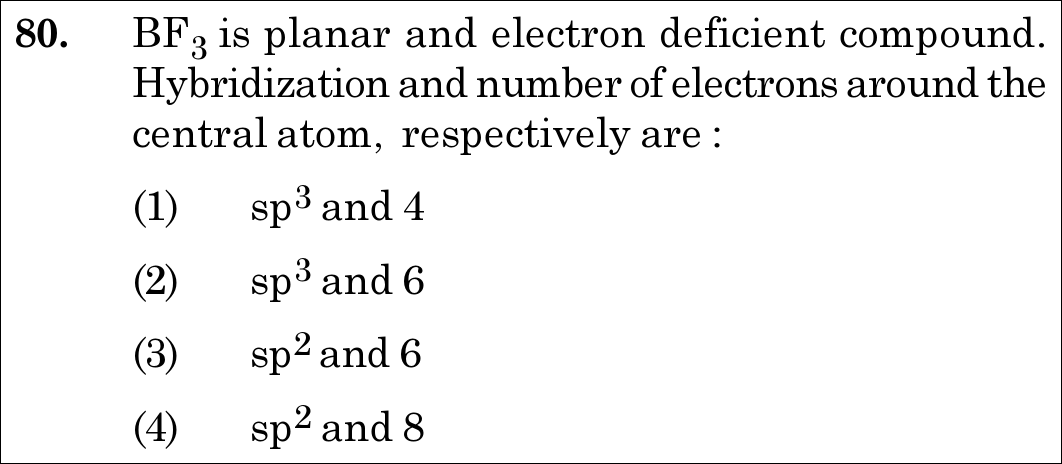
Molecule Boron trifluoride (BF3)
Geometry Planar (trigonal planar)
Electronic Nature Electron deficient
⚡

The 30-Second Exam Hall Shortcut: ⚡ 3 Bonds + 0 Lone Pairs = sp² Hybridized, 3 × 2 = 6 Electrons

⏱️ Save ~15 seconds

Boron in BF3BF_3 forms 3 single σ\sigma-bonds with fluorine and has zero lone pairs: Steric number =3  ⟹  sp2= 3 \implies sp^2 hybridization (trigonal planar). Three shared covalent bond pairs contain 3×2=63 \times 2 = 6 valence electrons around the central boron atom (incomplete octet/sextet)! Match Option (3)!

1 Boron valence electrons =3= 3.
2 Forms 3 single covalent bonds with 3 fluorine atoms: 3 bond pairs, 0 lone pairs.
3 Steric number =3  ⟹  sp2= 3 \implies sp^2 hybridization.
4 Total electrons around central boron atom =3 pairs×2=6= 3\text{ pairs} \times 2 = 6 electrons.
5 Respectively: sp2sp^2 and 66.
6 Match Option (3).
🛡️
Why You Can 100% Trust This Shortcut: Canonical hybridization and valence octet deficit in Group 13 trihalides.
📐

Step-by-Step Rigorous Workflow & Mathematical Proof

Step 1

Electronic Configuration of Central Boron Atom

Boron (Z=5Z = 5) has the ground-state electronic configuration 1s22s22p11s^2 2s^2 2p^1. In the excited state, one 2s2s electron is promoted to an empty 2p2p orbital: 1s22s12px12py12pz01s^2 2s^1 2p_x^1 2p_y^1 2p_z^0.

Step 2

Hybridization of Boron in BF3

The one 2s2s orbital and two 2p2p orbitals mix to form three equivalent sp2sp^2 hybrid orbitals directed towards the corners of an equilateral triangle at bond angles of 120∘120^\circ (trigonal planar geometry). Each hybrid orbital overlaps with a 2p2p orbital of fluorine to form a σ\sigma-bond.

Hybridization=sp2(Trigonal planar)\text{Hybridization} = sp^2 \quad (\text{Trigonal planar})
Step 3

Counting Electrons Around the Central Atom

The central boron atom forms three single σ\sigma-bonds with fluorine and possesses no lone pairs. Each single covalent bond contains 2 shared electrons:

Total electrons around Boron=3×2=6 electrons\text{Total electrons around Boron} = 3 \times 2 = 6\text{ electrons}
Step 4

Conclusion

The hybridization is sp2sp^2 and the number of electrons around the central atom is 6, corresponding to Option (3).

⭐

360° Option Elimination Engine Key Feature

Diagnose every choice: Know exactly why the right option works and why distractors fail.

4-Option Deep Scan
1 1
✗ Incorrect
Verdict & Scientific Reason:

Incorrect tetrahedral hybridization and incorrect electron count.

⚠️
Student Fallacy (Why candidates pick this trap): Assuming 4 electron pairs.
2 2
✗ Incorrect
Verdict & Scientific Reason:

Assigns sp3sp^3 hybridization to a strictly planar molecule.

⚠️
Student Fallacy (Why candidates pick this trap): Assigning sp3sp^3 hybridization to a 3-coordinate planar molecule.
3 3
✓ 100% Correct
Verdict & Scientific Reason:

Exact parameters: sp2sp^2 hybridization with 6 valence electrons (incomplete octet).

💡
Why this is airtight: None; textbook chemical bonding analysis.
4 4
✗ Incorrect
Verdict & Scientific Reason:

Claims boron has a complete octet (8 electrons), directly contradicting that BF3BF_3 is electron-deficient.

⚠️
Student Fallacy (Why candidates pick this trap): Assuming the octet rule is satisfied in BF3BF_3.
⚠️

NTA Trap Alert: Octet Assumption Trap (8 Electrons)

Students who assume every stable molecule must satisfy the octet rule choose Option (4) (sp2sp^2 and 8). The prompt itself explicitly mentions "BF3 is planar and ELECTRON DEFICIENT compound", confirming an incomplete octet with only 6 electrons.

🛡️ How to avoid the -1 mark: Read the prompt: "electron deficient"   ⟹  6\implies 6 electrons, NOT 8!
📖

Core NEET Syllabus Standard

NCERT Chemistry · Chemical Bonding and Molecular Structure Standard Benchmark
Core Scientific Principle Tested:

"In BF3, boron is sp2 hybridized with 3 bond pairs and an unhybridized empty 2p orbital, surrounded by 6 valence electrons."

Syllabus Focus: Hybridization and Incomplete Octet of Central Atom
✓ Core NEET UG Syllabus Anchor Syllabus & Academic Standards ↗
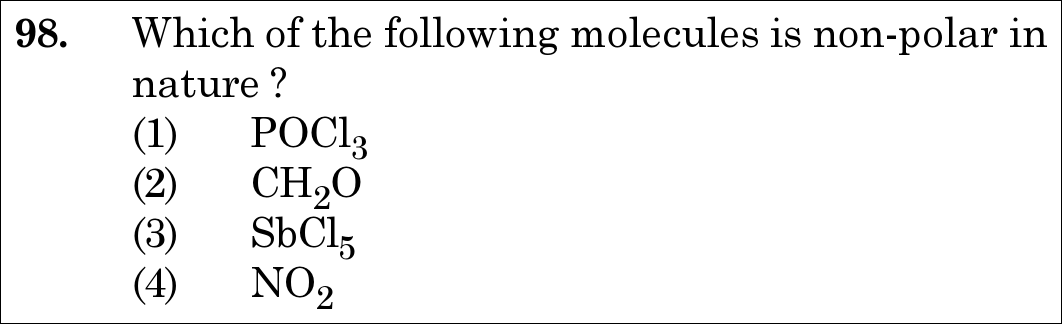
NEET 2021 · Q98 Easy
Official NEET 2021 Question 98 - Chemical Bonding and Molecular Structure
1
2
3 ✓ Key
4
💡 Verified Solution & 30-Second Hack
✓
Verified Against NTA Final Answer Key
Option (3) : SbCl5
📚 Chemical Bonding and Molecular Structure Easy
📋 Given Parameters & Problem Setup
Molecules Evaluated POCl3, CH2O, SbCl5, NO2
Target Property Non-polar molecule (net dipole moment μ = 0)
⚡

The 30-Second Exam Hall Shortcut: ⚡ Symmetrical TBP with Zero Lone Pairs: Net μ = 0 (SbCl5)

⏱️ Save ~20 seconds

Antimony pentachloride (SbCl5SbCl_5) has steric number =5= 5 (5  σ5\;\sigma-bonds, 00 lone pairs) with ideal trigonal bipyramidal (TBP) geometry. The 3 equatorial Sb−ClSb-Cl bond dipoles lie at 120∘120^\circ and cancel completely (∑μ⃗eq=0\sum \vec{\mu}_{\text{eq}} = 0); the 2 axial Sb−ClSb-Cl bond dipoles are collinear at 180∘180^\circ in opposite directions and cancel completely (∑μ⃗ax=0\sum \vec{\mu}_{\text{ax}} = 0). Net dipole moment μ=0\mu = 0   ⟹  \implies NON-POLAR! Match Option (3)!

1 Check POCl3POCl_3: Tetrahedral but unsymmetrical (one P=OP=O, three P−ClP-Cl dipoles)   ⟹  μ≠0\implies \mu \neq 0 (Polar).
2 Check CH2OCH_2O: Trigonal planar but unsymmetrical (C=OC=O dipole ≠C−H\neq C-H dipoles)   ⟹  μ≠0\implies \mu \neq 0 (Polar).
3 Check SbCl5SbCl_5: Trigonal bipyramidal (sp3dsp^3d), zero lone pairs, all 5 surrounding atoms are identical (ClCl). Symmetrical cancellation: ∑μ⃗=0  ⟹  \sum \vec{\mu} = 0 \implies Non-polar.
4 Check NO2NO_2: Bent geometry with odd unpaired electron on nitrogen   ⟹  μ≠0\implies \mu \neq 0 (Polar).
5 Match Option (3) SbCl5.
🛡️
Why You Can 100% Trust This Shortcut: Canonical VSEPR molecular symmetry and vector dipole cancellation.
📐

Step-by-Step Rigorous Workflow & Mathematical Proof

Step 1

Criteria for Molecular Non-Polarity

A molecule is non-polar if the vector sum of all individual bond dipoles and lone-pair moments cancels to zero (μ⃗net=∑μ⃗i=0\vec{\mu}_{\text{net}} = \sum \vec{\mu}_i = 0). This occurs in regular, symmetrical geometries where all ligands attached to the central atom are identical and there are no stereochemically active lone pairs disrupting symmetry.

Step 2

Analyzing Antimony Pentachloride (SbCl5)

Antimony (SbSb) is in Group 15 with 5 valence electrons. In SbCl5SbCl_5, it forms five single covalent bonds with chlorine atoms and possesses zero lone pairs (sp3dsp^3d hybridization). Its molecular geometry is a regular trigonal bipyramidal (TBP): - Equatorial Plane: Three Sb−ClSb-Cl bonds are directed towards the corners of an equilateral triangle at 120∘120^\circ bond angles. The vector sum of three equal planar vectors separated by 120∘120^\circ is identically zero: μ⃗eq1+μ⃗eq2+μ⃗eq3=0\vec{\mu}_{\text{eq1}} + \vec{\mu}_{\text{eq2}} + \vec{\mu}_{\text{eq3}} = 0 - Axial Axis: Two Sb−ClSb-Cl bonds lie along a straight line perpendicular to the equatorial plane at 180∘180^\circ pointing in opposite directions: μ⃗ax1+μ⃗ax2=0\vec{\mu}_{\text{ax1}} + \vec{\mu}_{\text{ax2}} = 0 Consequently, the overall net dipole moment is zero:

μ⃗net(SbCl5)=μ⃗eq+μ⃗ax=0+0=0(Non-Polar)\vec{\mu}_{\text{net}}(SbCl_5) = \vec{\mu}_{\text{eq}} + \vec{\mu}_{\text{ax}} = 0 + 0 = 0 \quad (\mathbf{\text{Non-Polar}})
Step 3

Analyzing Asymmetrical Polar Molecules

- POCl3POCl_3: Distorted tetrahedral geometry where the strong P=OP=O dipole cannot be cancelled by the three P−ClP-Cl bond dipoles (μ=2.4 D≠0\mu = 2.4\text{ D} \neq 0). - CH2OCH_2O: Planar geometry, but the strong polar C=OC=O dipole points in the opposite direction of the two weakly polar C−HC-H bonds (μ=2.3 D≠0\mu = 2.3\text{ D} \neq 0). - NO2NO_2: Angular/bent molecule (bond angle ≈134∘\approx 134^\circ) with an odd electron on nitrogen, giving a permanent dipole moment (μ=0.32 D≠0\mu = 0.32\text{ D} \neq 0).

⭐

360° Option Elimination Engine Key Feature

Diagnose every choice: Know exactly why the right option works and why distractors fail.

4-Option Deep Scan
1 1
✗ Incorrect
Verdict & Scientific Reason:

Polar molecule due to asymmetry between P=OP=O and P−ClP-Cl dipoles.

⚠️
Student Fallacy (Why candidates pick this trap): Assuming all 4-coordinate species are non-polar.
2 2
✗ Incorrect
Verdict & Scientific Reason:

Polar molecule with substantial net dipole moment pointing along C=OC=O.

⚠️
Student Fallacy (Why candidates pick this trap): Assuming trigonal planar geometry always implies non-polarity.
3 3
✓ 100% Correct
Verdict & Scientific Reason:

Symmetrical trigonal bipyramidal molecule with zero lone pairs; all bond dipoles cancel to zero (μ=0\mu = 0).

💡
Why this is airtight: None; rigorous vector symmetry analysis.
4 4
✗ Incorrect
Verdict & Scientific Reason:

Bent angular odd-electron molecule with permanent dipole moment.

⚠️
Student Fallacy (Why candidates pick this trap): Assuming linear structure for nitrogen dioxide.
⚠️

NTA Trap Alert: Planar Geometry vs. Symmetrical Cancellation Trap

Students often think CH2OCH_2O is non-polar because it is "planar". For dipoles to cancel to zero in a planar geometry, all three peripheral atoms must be identical (BF3BF_3). In CH2OCH_2O, one atom is oxygen and two are hydrogen, so the dipoles do not cancel. Only SbCl5SbCl_5 has all identical ligands in a fully symmetrical TBP geometry.

🛡️ How to avoid the -1 mark: Check if all surrounding atoms are identical: In SbCl5SbCl_5, all 5 are ClCl with 0 lone pairs   ⟹  \implies Perfect cancellation   ⟹  μ=0\implies \mu = 0.
📖

Core NEET Syllabus Standard

NCERT Chemistry · Chemical Bonding and Molecular Structure Standard Benchmark
Core Scientific Principle Tested:

"Symmetrical molecules like SbCl5 (trigonal bipyramidal with zero lone pairs) have a net dipole moment of zero and are non-polar."

Syllabus Focus: Dipole Moment and Molecular Symmetry (VSEPR Theory)
✓ Core NEET UG Syllabus Anchor Syllabus & Academic Standards ↗
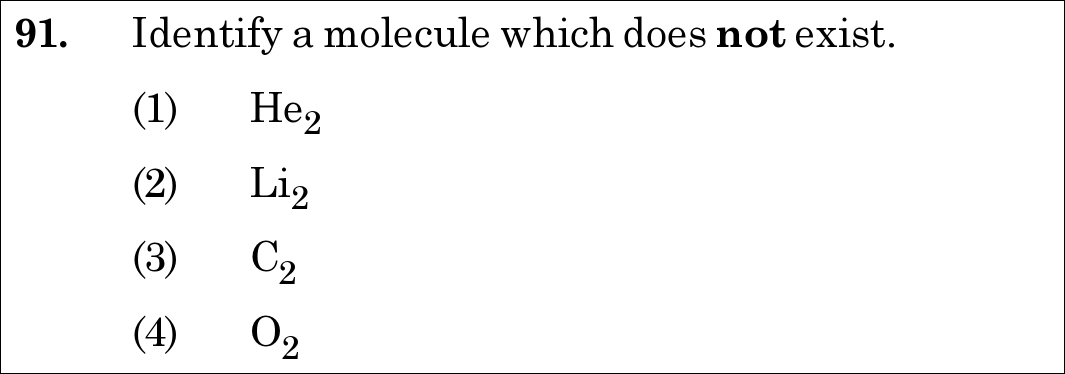
NEET 2020 · Q91 Easy
Official NEET 2020 Question 91 - Chemical Bonding and Molecular Structure
1 ✓ Key
2
3
4
💡 Verified Solution & 30-Second Hack
✓
Verified Against NTA Final Answer Key
Option (1) : He2
📚 Chemical Bonding and Molecular Structure Easy
📋 Given Parameters & Problem Setup
Theoretical Model Molecular Orbital Theory (MOT)
Criterion for Molecular Existence Bond Order (BO) > 0
Candidate Diatomic Species He2, Li2, C2, O2
⚡

The 30-Second Exam Hall Shortcut: ⚡ "Bond Order = 0 Means Molecule Does Not Exist: He2 Has BO = 0!"

⏱️ 20 seconds

According to MOT, Helium has 2 electrons (1s21s^2). In hypothetical He2He_2 (4 electrons), configuration is (σ1s)2(σ∗1s)2(\sigma 1s)^2 (\sigma^* 1s)^2. Bond Order = Nb−Na2=2−22=0\frac{N_b - N_a}{2} = \frac{2 - 2}{2} = 0. A zero bond order means no net chemical bonding forces, so He2He_2 cannot exist! Mark He2 (Option 1) in 5 seconds.

1 Total electrons in He2 = 2 + 2 = 4 electrons.
2 MO configuration: (σ1s)^2 (σ*1s)^2.
3 Bond order = (2 - 2)/2 = 0.
4 Bond order of 0 signifies the molecule does not exist.
5 Select Option (1) He2.
🛡️
Why You Can 100% Trust This Shortcut: NCERT Chemistry · Chemical Bonding and Molecular Structure (Molecular Orbital Theory: Bond Order)
📐

Step-by-Step Rigorous Workflow & Mathematical Proof

Step 1

Molecular Orbital Principle for Stability

According to Molecular Orbital Theory (MOT), a homonuclear diatomic molecule exists as a stable chemical entity only if the number of bonding electrons exceeds antibonding electrons (Nb>NaN_b > N_a), yielding a positive non-zero bond order (BO>0\text{BO} > 0).

Step 2

Calculate Bond Order for He2

Helium (Z=2Z = 2) has configuration 1s21s^2. For hypothetical He2He_2 (4 electrons4\text{ electrons}): MO Configuration=(σ1s)2(σ∗1s)2\text{MO Configuration} = (\sigma 1s)^2 (\sigma^* 1s)^2 Bond Order=Nb−Na2=2−22=0\text{Bond Order} = \frac{N_b - N_a}{2} = \frac{2 - 2}{2} = 0 Because the antibonding electrons completely cancel the stabilization of the bonding electrons, He2He_2 is energetically unstable and does not exist.

Step 3

Verify Other Candidate Molecules

- Li2Li_2 (6 electrons): (σ1s)2(σ∗1s)2(σ2s)2  ⟹  BO=4−22=1(\sigma 1s)^2 (\sigma^* 1s)^2 (\sigma 2s)^2 \implies \text{BO} = \frac{4 - 2}{2} = 1 (exists in vapor phase). - C2C_2 (12 electrons): (σ1s)2(σ∗1s)2(σ2s)2(σ∗2s)2(π2px2=π2py2)  ⟹  BO=8−42=2(\sigma 1s)^2 (\sigma^* 1s)^2 (\sigma 2s)^2 (\sigma^* 2s)^2 (\pi 2p_x^2 = \pi 2p_y^2) \implies \text{BO} = \frac{8 - 4}{2} = 2 (double bond consisting entirely of two pi bonds). - O2O_2 (16 electrons): BO=10−62=2\text{BO} = \frac{10 - 6}{2} = 2 (paramagnetic with 2 unpaired electrons in π∗2p\pi^* 2p).

Step 4

Conclude Option 1

Only He2He_2 has a bond order of zero, confirming that it does not exist.

⭐

360° Option Elimination Engine Key Feature

Diagnose every choice: Know exactly why the right option works and why distractors fail.

4-Option Deep Scan
1 A
✓ 100% Correct
Verdict & Scientific Reason:

Factually and quantum mechanically exact; He2He_2 has Bond Order = 0, so it does not exist.

💡
Why this is airtight: None; quintessential MOT question.
2 B
✗ Incorrect
Verdict & Scientific Reason:

Incorrect; dilithium exists in the gas phase with a single sigma bond (BO=1\text{BO} = 1).

⚠️
Student Fallacy (Why candidates pick this trap): Assuming metals never form diatomic gas molecules.
3 C
✗ Incorrect
Verdict & Scientific Reason:

Incorrect; dicarbon exists in carbon vapor with a bond order of 2, held together by two pi bonds.

⚠️
Student Fallacy (Why candidates pick this trap): Assuming carbon only forms tetravalent networks.
4 D
✗ Incorrect
Verdict & Scientific Reason:

Incorrect; dioxygen is an abundant, highly stable diatomic molecule (BO=2\text{BO} = 2).

⚠️
Student Fallacy (Why candidates pick this trap): Obvious distractor.
⚠️

NTA Trap Alert: Noble Gas Diatomic Instability

Homonuclear noble gas dimers like He2 and Ne2 have equal numbers of bonding and antibonding electrons (Nb=NaN_b = N_a), resulting in a Bond Order of 0.

🛡️ How to avoid the -1 mark: Bond Order = 0 -> Molecule does NOT exist! He2He_2 and Ne2Ne_2 do not exist.
📖

Core NEET Syllabus Standard

Chemistry · Chemical Bonding and Molecular Structure Standard Benchmark
Core Scientific Principle Tested:

""

Syllabus Focus: Bond Order and Existence of Diatomic Molecules: Non-existence of He2
✓ Core NEET UG Syllabus Anchor Syllabus & Academic Standards ↗
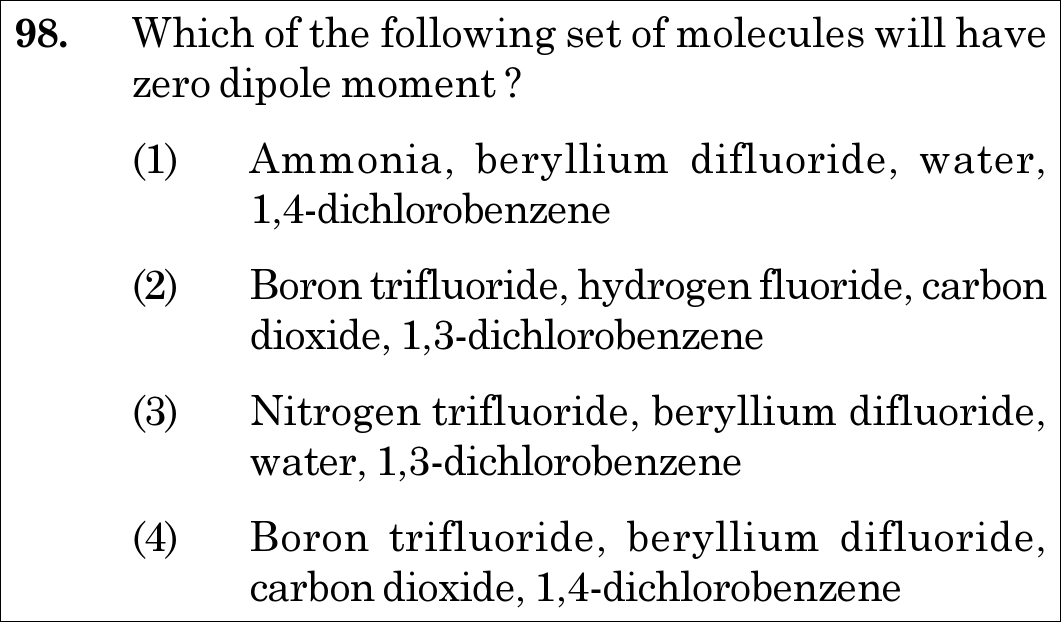
NEET 2020 · Q98 Easy
Official NEET 2020 Question 98 - Chemical Bonding and Molecular Structure
1 Ammonia, beryllium difluoride, water, 1,4-dichlorobenzene
2 Boron trifluoride, hydrogen fluoride, carbon dioxide, 1,3-dichlorobenzene
3 Nitrogen trifluoride, beryllium difluoride, water, 1,3-dichlorobenzene
4 Boron trifluoride, beryllium difluoride, carbon dioxide, 1,4-dichlorobenzene ✓ Key
💡 Verified Solution & 30-Second Hack
✓
Verified Against NTA Final Answer Key
Option (4) : Boron trifluoride, beryllium difluoride, carbon dioxide, 1,4-dichlorobenzene
📚 Chemical Bonding and Molecular Structure Easy
📋 Given Parameters & Problem Setup
Criterion Net dipole moment μ = 0 (completely non-polar molecular set)
Candidate Sets Four sets containing various inorganic and organic compounds
⚡

The 30-Second Exam Hall Shortcut: ⚡ "Symmetric Shapes: BF3 (trigonal planar), BeF2 & CO2 (linear), p-C6H4Cl2 (para-trans) ALL have μ = 0!"

⏱️ 25 seconds

Water (H2OH_2O) is bent and polar (μ≠0\mu \neq 0; eliminate Options 1 and 3). Hydrogen fluoride (HFHF) and 1,3-dichlorobenzene (meta) are polar (μ≠0\mu \neq 0; eliminate Option 2). In Option 4, BF3BF_3 (trigonal planar), BeF2BeF_2 (linear), CO2CO_2 (linear), and 1,4-dichlorobenzene (para-trans symmetric) all have vector cancellation giving μ=0\mu = 0! Mark Option (4) in 5 seconds.

1 Water (H2O) has a bent shape with net dipole moment μ = 1.85 D (rules out Options 1 and 3).
2 HF is diatomic with high electronegativity difference, μ ≠ 0 (rules out Option 2).
3 Check Option 4: - BF3: Trigonal planar, three equal vectors at 120° cancel, μ = 0. - BeF2: Linear (180°), two equal opposite vectors cancel, μ = 0. - CO2: Linear (180°), C=O dipoles cancel, μ = 0. - 1,4-dichlorobenzene: Para-substituted benzene, C-Cl bond dipoles cancel at 180°, μ = 0.
4 Select Option (4).
🛡️
Why You Can 100% Trust This Shortcut: NCERT Chemistry · Chemical Bonding and Molecular Structure (Bond Polarity and Dipole Moment)
📐

Step-by-Step Rigorous Workflow & Mathematical Proof

Step 1

Understand Dipole Moment Vector Summation

Dipole moment is a vector quantity (magnitude μ=q×d\mu = q \times d) pointing from the positive to the negative center of charge. A polyatomic molecule has a net zero dipole moment only when its individual bond dipoles cancel each other symmetrically in space.

Step 2

Evaluate BF3, BeF2, CO2 and 1,4-Dichlorobenzene

- BF3\text{BF}_3: sp2sp^2 hybridized, trigonal planar geometry (120∘120^\circ bond angles). The vector resultant of any two B-F bonds is equal and opposite to the third B-F bond, so μnet=0\mu_{\text{net}} = 0. - BeF2\text{BeF}_2: spsp hybridized, linear (180∘180^\circ). The two Be-F bond dipoles oppose and cancel, so μnet=0\mu_{\text{net}} = 0. - CO2\text{CO}_2: spsp hybridized, linear (180∘180^\circ). The two C=O bond dipoles cancel, so μnet=0\mu_{\text{net}} = 0. - 1,4-dichlorobenzene (pp-dichlorobenzene): The two C-Cl dipole vectors are oriented directly opposite each other at 180∘180^\circ across the aromatic ring, canceling out completely (μnet=0\mu_{\text{net}} = 0).

Step 3

Identify Polar Molecules in Distractors

- H2OH_2O: sp3sp^3 hybridized bent geometry with two lone pairs, μ=1.85 D\mu = 1.85\text{ D}. - NH3NH_3: Trigonal pyramidal with one lone pair, μ=1.47 D\mu = 1.47\text{ D}. - NF3NF_3: Trigonal pyramidal, μ=0.23 D\mu = 0.23\text{ D}. - HFHF: Strongly polar linear diatomic, μ=1.78 D\mu = 1.78\text{ D}. - 1,3-dichlorobenzene (mm-dichlorobenzene): The two C-Cl dipoles meet at a 120∘120^\circ angle, giving a substantial net dipole moment (μ≠0\mu \neq 0).

Step 4

Conclude Option 4

Only the fourth set consists exclusively of non-polar molecules with μ=0\mu = 0.

⭐

360° Option Elimination Engine Key Feature

Diagnose every choice: Know exactly why the right option works and why distractors fail.

4-Option Deep Scan
1 A
✗ Incorrect
Verdict & Scientific Reason:

Incorrect; ammonia (NH3NH_3) and water (H2OH_2O) possess permanent, non-zero dipole moments.

⚠️
Student Fallacy (Why candidates pick this trap): Overlooking the lone pairs on oxygen and nitrogen.
2 B
✗ Incorrect
Verdict & Scientific Reason:

Incorrect; hydrogen fluoride (HFHF) and 1,3-dichlorobenzene (meta isomer) are polar.

⚠️
Student Fallacy (Why candidates pick this trap): Assuming meta-dichlorobenzene has canceling dipoles.
3 C
✗ Incorrect
Verdict & Scientific Reason:

Incorrect; NF3NF_3, H2OH_2O, and 1,3-dichlorobenzene all have non-zero dipole moments.

⚠️
Student Fallacy (Why candidates pick this trap): Believing lone pair cancels N-F dipoles in NF3 completely.
4 D
✓ 100% Correct
Verdict & Scientific Reason:

Factually and geometrically exact; all four molecules possess highly symmetrical geometries with zero net dipole moments.

💡
Why this is airtight: None; rigorous application of VSEPR symmetry.
⚠️

NTA Trap Alert: Meta vs Para Dichlorobenzene Polarity

1,4-dichlorobenzene (para) = SYMMETRIC (μ=0\mu = 0). 1,3-dichlorobenzene (meta) = ASYMMETRIC (μ=1.72 D≠0\mu = 1.72\text{ D} \neq 0).

🛡️ How to avoid the -1 mark: Look for "1,4" (para) for zero dipole, and immediately reject any option containing water!
📖

Core NEET Syllabus Standard

Chemistry · Chemical Bonding and Molecular Structure Standard Benchmark
Core Scientific Principle Tested:

""

Syllabus Focus: Dipole Moment (μ = 0): Symmetric Non-polar Molecules
✓ Core NEET UG Syllabus Anchor Syllabus & Academic Standards ↗

Solve 4 NEET Questions a Day — One per Subject

Cover all 1,140 official NEET questions in 285 days at your own pace. Progress is saved on your device. No login needed.