MyCompetitiveExams Logo MyCompetitiveExams
Search 1,140+ Questions
Chapters, formulas, speed tricks
→
⚡ Brahmastra NEET 2027
720 MARKS

Dynamic 180-question full-length simulator mixed dynamically from all 6 years for 2027 & 2026 aspirants.

Launch Brahmastra 2027 Test →
Start Practice →
100% Free · No Login Required
Q.73 Chemistry ⭐ 360° Option Elimination Active
Vault ↗

NEET 2026 Chemistry Question 73 Solution

Topic: The p-Block Elements & Chemical Bonding · Official NTA Booklet Code 50
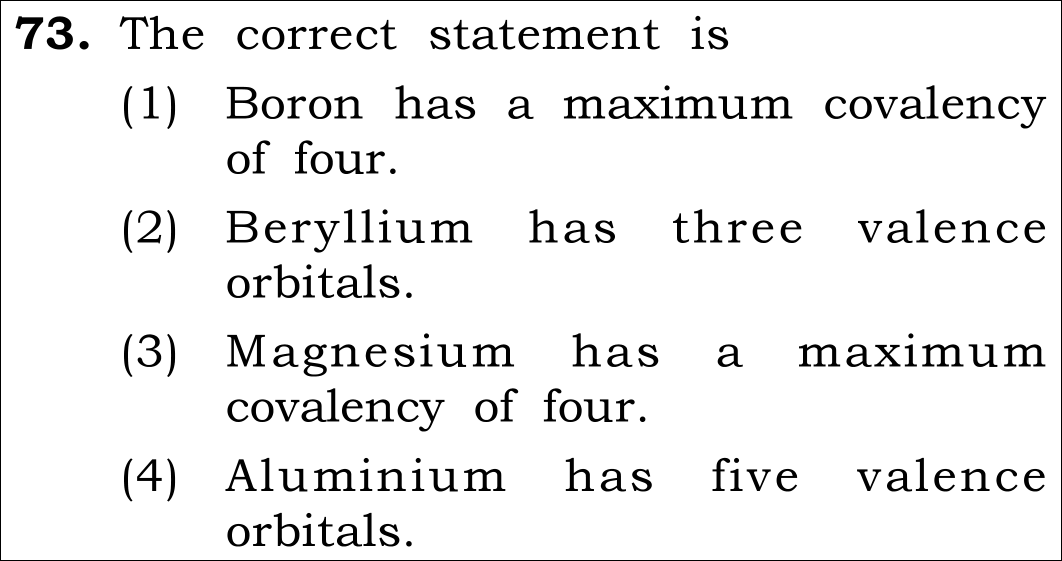
NEET 2026 Chemistry Question 73: Covalency & Valence Orbital Availability in Second Period Elements

Question

The correct statement is

  1. (1)Boron has a maximum covalency of four.
  2. (2)Beryllium has three valence orbitals.
  3. (3)Magnesium has a maximum covalency of four.
  4. (4)Aluminium has five valence orbitals.
✓
Verified Against NTA Final Answer Key
Option (1) : Boron has a maximum covalency of four.
📚 The p-Block Elements & Chemical Bonding Easy
📋 Given Parameters & Problem Setup
Statement 1 Boron has a maximum covalency of four.
Statement 2 Beryllium has three valence orbitals.
Statement 3 Magnesium has a maximum covalency of four.
Statement 4 Aluminium has five valence orbitals.
⚡

The 30-Second Exam Hall Shortcut: ⚡ Second Period Octet Limitation Rule (n = 2)

⏱️ Save ~45 seconds

Second period elements have only one 2s and three 2p orbitals -> Max covalency = 4!

1 Check Statement 1: Boron is in Period 2 (valence shell n = 2). Available orbitals: one 2s + three 2p = 4 orbitals total. With no d-orbitals, its maximum covalency is strictly 4 (e.g., [BF₄]⁻) -> TRUE!
2 Check Statement 2: Beryllium is also in Period 2; it has one 2s + three 2p = 4 valence orbitals, not 3 -> FALSE.
3 Check Statement 3: Magnesium is in Period 3; it has vacant 3d orbitals and can exhibit covalency of 6 (e.g. [Mg(H₂O)₆]²⁺) -> FALSE.
4 Check Statement 4: Aluminium has 3s (1), 3p (3), and 3d (5) = 9 valence orbitals in n=3, not 5 -> FALSE.
5 Statement 1 is the undeniable winner! Pick Option (1) in 10 seconds!
🛡️
Why You Can 100% Trust This Shortcut: NCERT Group 13 Chemistry verbatim: Due to the absence of d-orbitals, the maximum covalency of boron is 4.
📐

Step-by-Step Rigorous Workflow & Mathematical Proof

Step 1

Examine Statement (1): Boron Covalency Limitation

Boron belongs to the second period with electronic configuration 1s² 2s² 2p¹. In the n = 2 principal quantum shell, only s and p subshells exist (one 2s and three 2p orbitals, totaling 4 orbitals). Because there are no vacant d-orbitals in the second energy level, Boron cannot expand its valence shell beyond 8 electrons. Hence, its maximum covalency is strictly limited to four (forming species like BF₄⁻).

Valence orbitals of B (n=2)=2s(1)+2p(3)=4  ⟹  Covalencymax=4\text{Valence orbitals of B } (n=2) = 2s (1) + 2p (3) = 4 \implies \text{Covalency}_{\text{max}} = 4
  • • Statement (1) is completely true.
Step 2

Examine Statement (2): Beryllium Valence Orbitals

Beryllium has atomic number 4 with configuration 1s² 2s². Its valence shell is n = 2, which consists of one 2s orbital and three 2p orbitals, providing a total of 1 + 3 = 4 valence orbitals, not three.

Orbitals of Be (n=2)=1(2s)+3(2p)=4≠3\text{Orbitals of Be } (n=2) = 1(2s) + 3(2p) = 4 \neq 3
  • • Statement (2) is false.
Step 3

Examine Statements (3) and (4): Third Period Elements (Mg, Al)

Magnesium (Z = 12) and Aluminium (Z = 13) belong to the third period (n = 3). The n = 3 shell contains one 3s, three 3p, and five 3d orbitals (total = 1 + 3 + 5 = 9 valence orbitals). Because vacant 3d orbitals are accessible: - Magnesium can expand its coordination number/covalency up to 6 in complexes like [Mg(H₂O)₆]²⁺. - Aluminium has 9 valence orbitals, not 5, and regularly exhibits a covalency of 6 (e.g., [AlF₆]³⁻).

Valence orbitals for n=3:3s(1)+3p(3)+3d(5)=9\text{Valence orbitals for } n=3: 3s (1) + 3p (3) + 3d (5) = 9
  • • Statements (3) and (4) are both false.
⭐

360° Option Elimination Engine Key Feature

Diagnose every choice: Know exactly why the right option works and why distractors fail.

4-Option Deep Scan
1 A
✓ 100% Correct
Verdict & Scientific Reason:

Exact canonical statement from NCERT p-Block Elements: absence of d-orbitals restricts boron to covalency 4.

💡
Why this is airtight: None; fundamental periodic chemistry.
2 B
✗ Incorrect
Verdict & Scientific Reason:

Incorrect. The n = 2 shell has four orbitals (one 2s and three 2p).

⚠️
Student Fallacy (Why candidates pick this trap): Confusing valence electron count with valence orbital count.
3 C
✗ Incorrect
Verdict & Scientific Reason:

Incorrect. Due to available 3d orbitals, magnesium forms hexacoordinated complexes with covalency 6.

⚠️
Student Fallacy (Why candidates pick this trap): Assuming Group 2 elements cannot exceed covalency 4.
4 D
✗ Incorrect
Verdict & Scientific Reason:

Incorrect. The third shell has nine orbitals (1s + 3p + 5d = 9).

⚠️
Student Fallacy (Why candidates pick this trap): Confusing the number of d-orbitals (5) with total valence orbitals.
⚠️

NTA Trap Alert: Confusing Covalency with Oxidation State

Boron exhibits an oxidation state of +3, but its COVALENCY (number of shared electron pairs) can reach 4 by accepting a lone pair into its empty 2p orbital (as in BF₄⁻ or [B(OH)₄]⁻). It cannot exceed 4 because there are no 2d orbitals.

🛡️ How to avoid the -1 mark: Oxidation state = +3; Maximum covalency = 4.
📖

Core NEET Syllabus Standard

NEET Chemistry Core Syllabus · The p-Block Elements Standard Benchmark
Core Scientific Principle Tested:

"Second period elements are restricted to a maximum covalency of 4 due to the unavailability of d-orbitals."

Syllabus Focus: Group 13 elements - Anomalous properties of Boron and covalency limits
✓ Core NEET UG Syllabus Anchor Syllabus & Academic Standards ↗
No d-orbitals in row two: Boron stops at covalency four, through and through!

Ready to attempt under real exam pressure?

Test your speed and accuracy in the authentic 180-minute timed NTA simulator.

Launch NEET 2026 CBT Test →

Spotted a mistake in this solution? Report an error ([email protected])

⚖️ Legal & Fair Dealing Notice: Sourced from publicly released NEET 2026 question papers and NEET answer keys for private study, research, and non-commercial educational practice under Fair Dealing (Section 52(1)(a) of the Indian Copyright Act, 1957). Not affiliated with or endorsed by NTA or NMC.

Solve 4 NEET Questions a Day — One per Subject

Cover all 1,140 official NEET questions in 285 days at your own pace. Progress is saved on your device. No login needed.