MyCompetitiveExams Logo MyCompetitiveExams
Search 1,140+ Questions
Chapters, formulas, speed tricks
→
⚡ Brahmastra NEET 2027
720 MARKS

Dynamic 180-question full-length simulator mixed dynamically from all 6 years for 2027 & 2026 aspirants.

Launch Brahmastra 2027 Test →
Start Practice →
100% Free · No Login Required
Q.62 Chemistry ⭐ 360° Option Elimination Active
Vault ↗

NEET 2025 Chemistry Question 62 Solution

Topic: Chemical Bonding and Molecular Structure · Official NTA Booklet Code 45
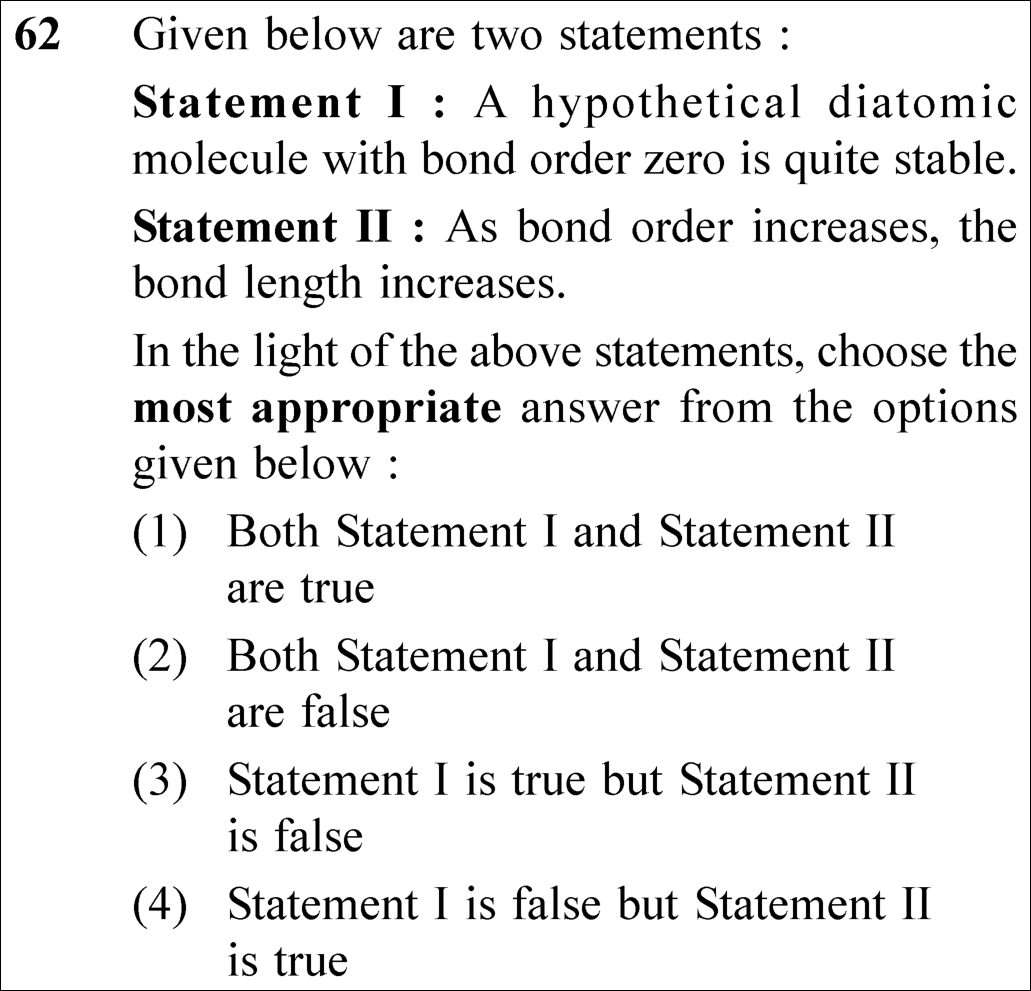
NEET 2025 Chemistry Question 62: Bond Order, Molecular Stability and Bond Length Relationships

Question

Given below are two statements: Statement I: A hypothetical diatomic molecule with bond order zero is quite stable. Statement II: As bond order increases, the bond length increases. In the light of the above statements, choose the most appropriate answer from the options given below:

  1. (1)Both Statement I and Statement II are true
  2. (2)Both Statement I and Statement II are false
  3. (3)Statement I is true but Statement II is false
  4. (4)Statement I is false but Statement II is true
✓
Verified Against NTA Final Answer Key
Option (2) : Both Statement I and Statement II are false
📚 Chemical Bonding and Molecular Structure Easy
📋 Given Parameters & Problem Setup
Statement I A hypothetical diatomic molecule with bond order zero is quite stable.
Statement II As bond order increases, the bond length increases.
⚡

The 30-Second Exam Hall Shortcut: ⚡ MOT Fundamental Axioms Check

⏱️ Save ~30 seconds

Bond order zero means NO net bonding forces ⟹ molecule DOES NOT EXIST (unstable)! Bond order increases (single → double → triple) ⟹ atoms pulled CLOSER ⟹ bond length DECREASES! Both statements are completely FALSE!

1 Examine Statement I: Bond Order = (N_b - N_a)/2. A bond order of zero means bonding electrons equal antibonding electrons (net attraction = 0). Such molecules (like He₂ or Be₂) are unstable and do not exist under normal conditions. Statement I claims it is "quite stable" ⟹ FALSE!
2 Examine Statement II: Greater bond order means more electron density shared between nuclei, pulling nuclei closer together (e.g., C-C = 154 pm, C=C = 134 pm, C≡C = 120 pm). Bond length DECREASES as bond order increases. Statement II claims bond length increases ⟹ FALSE!
3 Conclusion: Both Statement I and Statement II are false.
4 Match Option (2) in under 10 seconds!
🛡️
Why You Can 100% Trust This Shortcut: Molecular Orbital Theory & Bond Order Principles (NCERT Chemistry · Chemical Bonding and Molecular Structure: Bond Order = ½(N_b - N_a)).
📐

Step-by-Step Rigorous Workflow & Mathematical Proof

Step 1

Evaluate Statement I (Significance of Bond Order Zero)

In Molecular Orbital Theory, the bond order is defined as half the difference between the number of bonding electrons (N_b) and antibonding electrons (N_a):

Bond Order (B.O.)=Nb−Na2\text{Bond Order (B.O.)} = \frac{N_b - N_a}{2}
  • • A positive bond order (B.O. > 0) indicates a stable molecule.
  • • If B.O. = 0 (N_b = N_a), the antibonding destabilization completely cancels the bonding stabilization.
  • • The molecule cannot hold together and is unstable or non-existent (e.g., He₂, Be₂).
  • • Therefore, Statement I is unequivocally FALSE.
Step 2

Evaluate Statement II (Bond Order vs. Bond Length Relationship)

Bond order reflects the multiplicity of the covalent bond between two atoms:

Bond Length∝1Bond Order\text{Bond Length} \propto \frac{1}{\text{Bond Order}}
  • • For carbon-carbon bonds: C-C (B.O. = 1, length = 154 pm), C=C (B.O. = 2, length = 134 pm), C≡C (B.O. = 3, length = 120 pm).
  • • As bond order increases, bond length DECREASES, and bond dissociation enthalpy increases.
  • • Statement II states that bond length increases, which is completely FALSE.
Step 3

Select Matching Option

Since both statements are false, select Option (2).

Statement I: False,Statement II: False  ⟹  Option (2)\text{Statement I: False}, \quad \text{Statement II: False} \implies \text{Option (2)}
  • • Matches Option (2) with complete scientific accuracy.
⭐

360° Option Elimination Engine Key Feature

Diagnose every choice: Know exactly why the right option works and why distractors fail.

4-Option Deep Scan
1 A
✗ Incorrect
Verdict & Scientific Reason:

Incorrect. Both statements contradict fundamental MOT laws.

⚠️
Student Fallacy (Why candidates pick this trap): Total misconception of bond order.
2 B
✓ 100% Correct
Verdict & Scientific Reason:

100% correct. B.O. = 0 means unstable/non-existent, and higher B.O. shortens bond length.

💡
Why this is airtight: None; solid conceptual grasp of chemical bonding.
3 C
✗ Incorrect
Verdict & Scientific Reason:

Incorrect. Statement I is false.

⚠️
Student Fallacy (Why candidates pick this trap): Believing B.O. = 0 can be stable.
4 D
✗ Incorrect
Verdict & Scientific Reason:

Incorrect. Statement II is false.

⚠️
Student Fallacy (Why candidates pick this trap): Thinking higher bond order increases bond length.
⚠️

NTA Trap Alert: Confusing Bond Energy with Bond Length

As bond order increases, bond STRENGTH and bond ENERGY increase, but bond LENGTH decreases! Candidates who confuse bond length with bond energy mistakenly believe Statement II is true.

🛡️ How to avoid the -1 mark: Triple bond is STRONGER but SHORTER: Bond order up ⟹ Bond length down!
📖

Core NEET Syllabus Standard

NEET Chemistry Core Syllabus · Chemical Bonding and Molecular Structure Standard Benchmark
Core Scientific Principle Tested:

"B.O. = 0 means unstable molecule; Bond length is inversely proportional to bond order."

Syllabus Focus: Molecular Orbital Theory & Bond Parameters
✓ Core NEET UG Syllabus Anchor Syllabus & Academic Standards ↗
B.O. = 0 is unstable, higher B.O. shrinks the bond ⟹ Both statements are FALSE!

Ready to attempt under real exam pressure?

Test your speed and accuracy in the authentic 180-minute timed NTA simulator.

Launch NEET 2025 CBT Test →

Spotted a mistake in this solution? Report an error ([email protected])

⚖️ Legal & Fair Dealing Notice: Sourced from publicly released NEET 2025 question papers and NEET answer keys for private study, research, and non-commercial educational practice under Fair Dealing (Section 52(1)(a) of the Indian Copyright Act, 1957). Not affiliated with or endorsed by NTA or NMC.

Solve 4 NEET Questions a Day — One per Subject

Cover all 1,140 official NEET questions in 285 days at your own pace. Progress is saved on your device. No login needed.