MyCompetitiveExams Logo MyCompetitiveExams
Search 1,140+ Questions
Chapters, formulas, speed tricks
→
⚡ Brahmastra NEET 2027
720 MARKS

Dynamic 180-question full-length simulator mixed dynamically from all 6 years for 2027 & 2026 aspirants.

Launch Brahmastra 2027 Test →
Start Practice →
100% Free · No Login Required
🧪 Chemistry 🔥 High-Yield Core Topic (~3–4 Qs/Year)

NEET Hydrocarbons Previous Year Questions with Solutions

Complete repository of official NTA NEET questions for Hydrocarbons from 2020 to 2026. Every question includes 30-second elimination tricks, step-by-step NCERT solutions, option-by-option traps, and official answer keys.

17 Questions 6 Exam Years (2026, 2025, 2024, 2023, 2021, 2020) 11 Easy · 5 Medium · 1 Challenging
NEET 2026 · Q72 Medium
Official NEET 2026 Question 72 - Hydrocarbons
1
2
3
4 ✓ Key
💡 Verified Solution & 30-Second Hack
✓
Verified Against NTA Final Answer Key
Option (4) : Cyclohexane (Structure 4)
📚 Organic Chemistry: Haloalkanes, Amines & Hydrocarbons Medium
📋 Given Parameters & Problem Setup
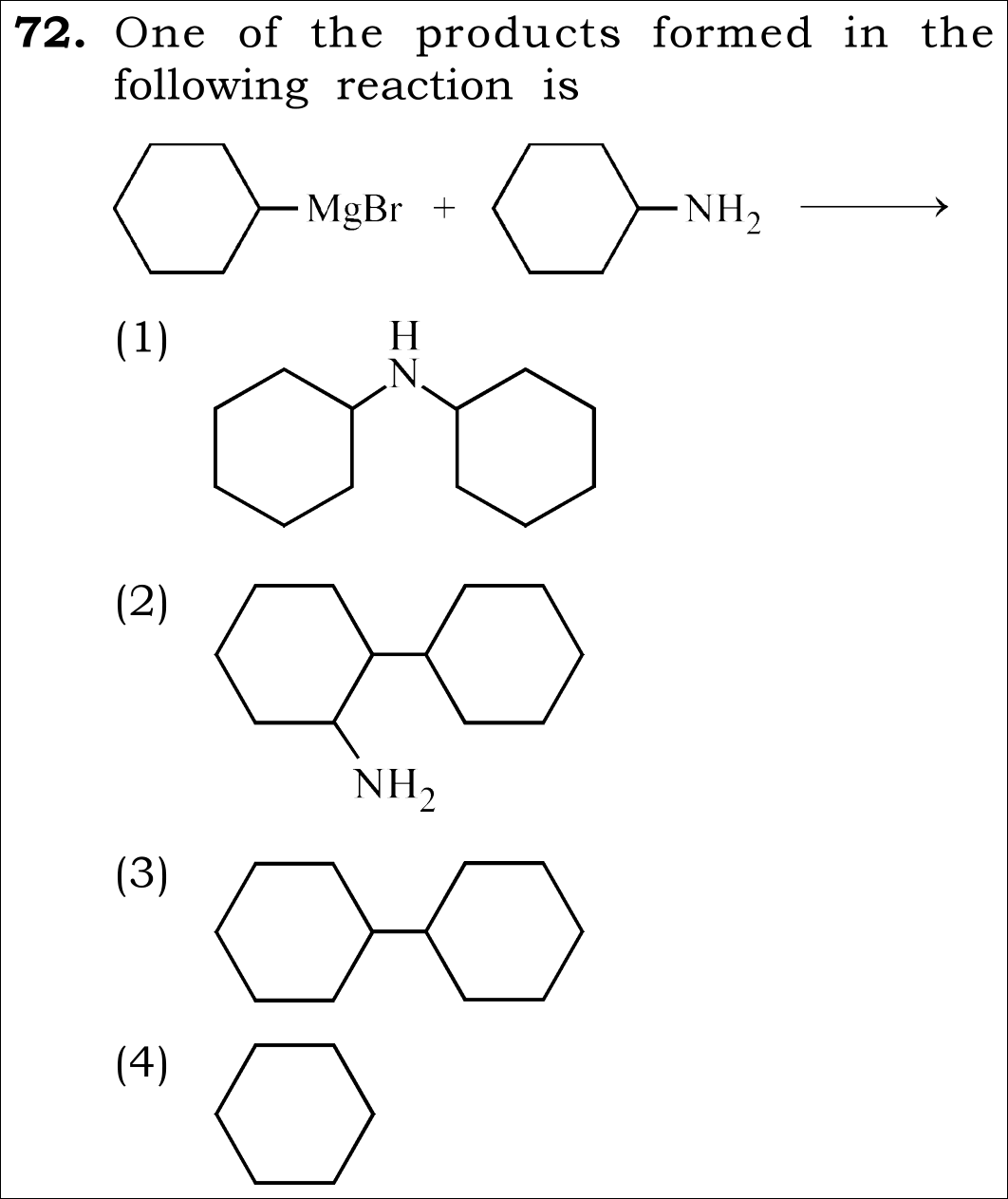
Reactant 1 Cyclohexylmagnesium bromide (C₆H₁₁MgBr, Grignard reagent)
Reactant 2 Cyclohexylamine (C₆H₁₁NH₂, primary aliphatic amine)
Target One of the major organic products formed
⚡

The 30-Second Exam Hall Shortcut: ⚡ Grignard as a Base: Proton Grab!

⏱️ Save ~60 seconds

Grignard reagents are powerful BASES first, nucleophiles second! Active H on -NH₂ = Alkane!

1 Identify reactive species: Cyclohexylmagnesium bromide has a carbanionic carbon: C₆H₁₁⁻ MgBr⁺.
2 Identify partner: Cyclohexylamine has acidic amine protons (-NH₂).
3 Acid-base proton transfer is instantaneous and far faster than any substitution or coupling!
4 C₆H₁₁⁻ grabs H⁺ from C₆H₁₁NH₂ to form CYCLOHEXANE (C₆H₁₂) and C₆H₁₁NHMgBr.
5 Structure (4) is cyclohexane! Pick Option (4) in 10 seconds!
🛡️
Why You Can 100% Trust This Shortcut: Zerevitinov reaction: Grignard reagents react quantitatively with any compound containing active hydrogen (water, alcohols, amines, terminal alkynes) to regenerate the parent alkane.
📐

Step-by-Step Rigorous Workflow & Mathematical Proof

Step 1

Understand the Basicity of Grignard Reagents

The carbon-magnesium bond in a Grignard reagent is highly polarized: C^{δ-} - Mg^{δ+}Br. The alkyl group behaves as a extremely strong Brønsted-Lowry base (conjugate base of an alkane, pKa ≈ 50).

R−MgX+H−Y⟶R−H+Mg(Y)X\text{R}-\text{MgX} + \text{H}-\text{Y} \longrightarrow \text{R}-\text{H} + \text{Mg}(\text{Y})\text{X}
  • • Whenever an active hydrogen donor is present, acid-base proton transfer dominates.
Step 2

Identify the Active Hydrogen in Cyclohexylamine

Primary amines possess two acidic protons bonded to the electronegative nitrogen atom (-NH₂). The cyclohexyl group of the Grignard reagent abstracts a proton from the amino group of cyclohexylamine.

C6H11MgBr+C6H11NH2⟶C6H12(Cyclohexane)+C6H11NHMgBr\text{C}_6\text{H}_{11}\text{MgBr} + \text{C}_6\text{H}_{11}\text{NH}_2 \longrightarrow \text{C}_6\text{H}_{12} (\text{Cyclohexane}) + \text{C}_6\text{H}_{11}\text{NHMgBr}
  • • The carbanion equivalent C₆H₁₁⁻ receives a proton H⁺ to become neutral cyclohexane (C₆H₁₂).
  • • The byproduct is cyclohexylaminomagnesium bromide.
Step 3

Match with Given Structures

Structure (1) is dicyclohexylamine; Structure (2) is 2-cyclohexylcyclohexanamine; Structure (3) is bicyclohexyl; Structure (4) is a plain cyclohexyl ring (cyclohexane).

Structure (4)≡Cyclohexane\text{Structure (4)} \equiv \text{Cyclohexane}
  • • Matches Option (4).
⭐

360° Option Elimination Engine Key Feature

Diagnose every choice: Know exactly why the right option works and why distractors fail.

4-Option Deep Scan
1 A
✗ Incorrect
Verdict & Scientific Reason:

Incorrect. Nucleophilic substitution on amine nitrogen does not occur.

⚠️
Student Fallacy (Why candidates pick this trap): Assuming nucleophilic attack by the carbanion on nitrogen with loss of hydride.
2 B
✗ Incorrect
Verdict & Scientific Reason:

Incorrect. No ring substitution or electrophilic aromatic-style addition can occur on an aliphatic cyclohexane ring.

⚠️
Student Fallacy (Why candidates pick this trap): Inventing an imaginary ring addition reaction.
3 C
✗ Incorrect
Verdict & Scientific Reason:

Incorrect. Bicyclohexyl would be a Wurtz-coupling product, not formed in the presence of an amine.

⚠️
Student Fallacy (Why candidates pick this trap): Confusing Grignard acid-base quenching with a coupling reaction.
4 D
✓ 100% Correct
Verdict & Scientific Reason:

Exact product of the Zerevitinov acid-base reaction between a Grignard reagent and an amine.

💡
Why this is airtight: None; rigorous application of organometallic reaction chemistry.
⚠️

NTA Trap Alert: Looking for Complex Coupling Instead of Simple Acid-Base Reaction

Students see two large cyclohexyl rings and instinctively look for a bonded dimer or secondary amine (Structures 1, 2, or 3). They forget that Grignard reagents are among the STRONGEST BASES known and simply steal a proton to yield an alkane!

🛡️ How to avoid the -1 mark: Whenever Grignard meets -OH, -NH₂, -COOH, or -C≡CH, the product is ALWAYS the simple parent alkane (R-H)!
📖

Core NEET Syllabus Standard

NEET Chemistry Core Syllabus · Haloalkanes & Haloarenes / Amines Standard Benchmark
Core Scientific Principle Tested:

"Grignard reagents react with compounds containing active hydrogen atoms to form hydrocarbons."
Syllabus Focus: Reactivity of Grignard reagents with compounds containing active hydrogen
✓ Core NEET UG Syllabus Anchor Syllabus & Academic Standards ↗
Grignard meets amine: steals a proton, walks away clean as an alkane!
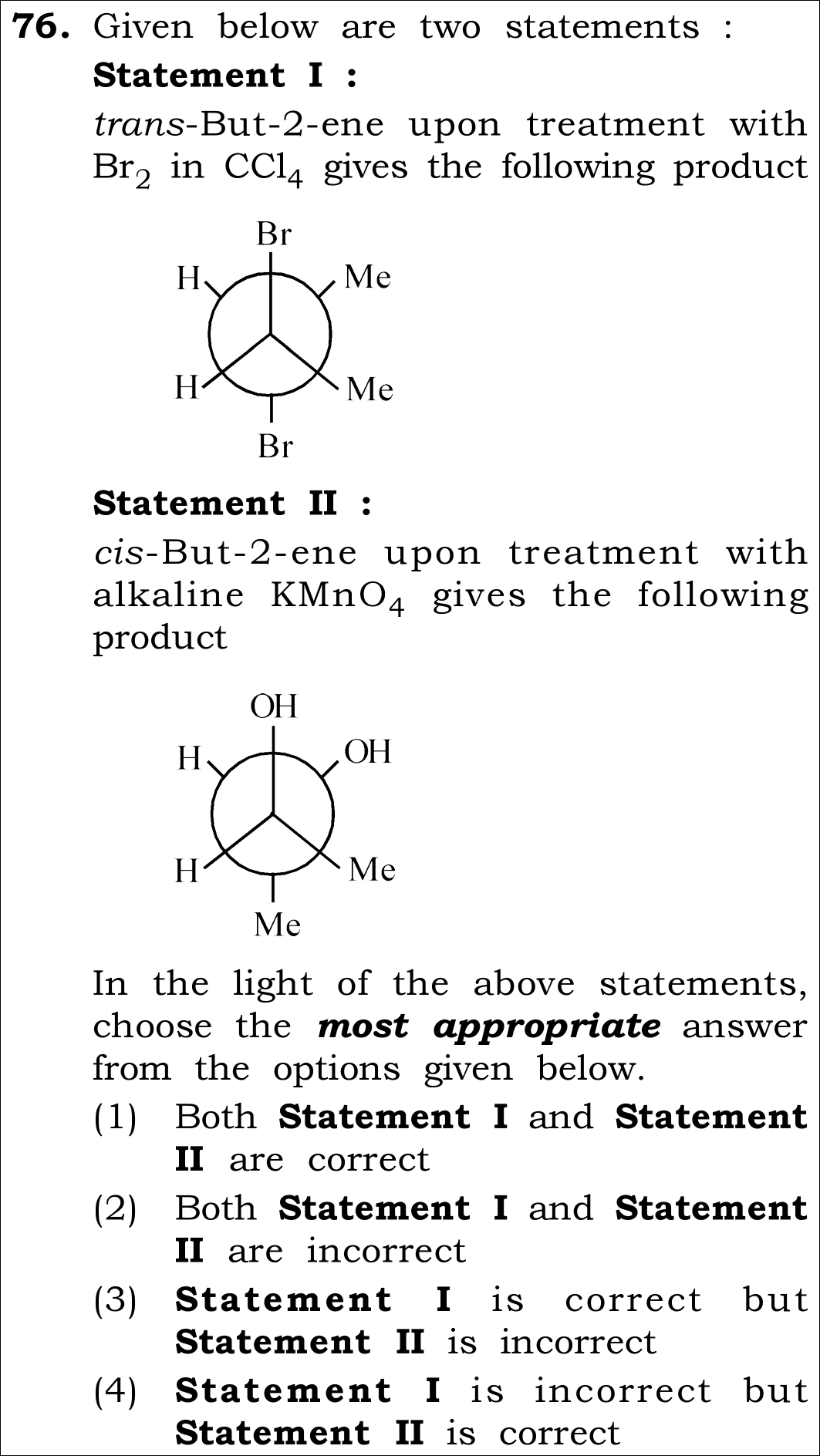
NEET 2026 · Q76 Challenging
Official NEET 2026 Question 76 - Hydrocarbons
1
2
3
4 ✓ Key
💡 Verified Solution & 30-Second Hack
✓
Verified Against NTA Final Answer Key
Option (4) : Statement I is incorrect but Statement II is correct.
📚 Hydrocarbons & Haloalkanes Challenging
📋 Given Parameters & Problem Setup
Statement I trans-But-2-ene upon treatment with Br₂ in CCl₄ gives the depicted Newman projection
Statement II cis-But-2-ene upon treatment with alkaline KMnO₄ gives the depicted Newman projection
⚡

The 30-Second Exam Hall Shortcut: ⚡ Stereospecific Addition Mnemonics (TAM & CSM)

⏱️ Save ~90 seconds

TAM: Trans + Anti = Meso! CSM: Cis + Syn = Meso!

1 Bromination (Br₂/CCl₄) proceeds via cyclic bromonium ion with ANTI addition.
2 Apply TAM: Trans-alkene + Anti addition = MESO compound.
3 In the Newman projection of Statement I, both Me groups are on the right side while Br are opposite; this represents an optically active racemic/threo enantiomer, NOT the meso compound! -> Statement I is FALSE.
4 Alkaline KMnO₄ (Baeyer's reagent) proceeds via cyclic manganate ester with SYN addition.
5 Apply CSM: Cis-alkene + Syn addition = MESO compound.
6 In Statement II, the Newman projection has an internal plane of symmetry eclipsing identical groups (OH with OH, H with H, Me with Me), which IS the meso compound! -> Statement II is TRUE.
7 Statement I is incorrect but Statement II is correct -> Option (4)!
🛡️
Why You Can 100% Trust This Shortcut: Established stereochemical theorems: Anti-addition across trans-alkenes yields meso-2,3-dibromobutane; Syn-dihydroxylation of cis-alkenes yields meso-butane-2,3-diol.
📐

Step-by-Step Rigorous Workflow & Mathematical Proof

Step 1

Analyze Statement I: Bromination of trans-But-2-ene

Addition of Br₂ across an alkene in non-polar CCl₄ proceeds through a cyclic bromonium ion intermediate, resulting in stereospecific ANTI addition. According to the stereochemical addition rule (TAM: Trans + Anti = Meso), bromination of trans-but-2-ene MUST produce MESO-2,3-dibromobutane.

trans-But-2-ene+Br2→Anti Additionmeso-2,3-dibromobutane\text{trans-But-2-ene} + \text{Br}_2 \xrightarrow{\text{Anti Addition}} \text{meso-2,3-dibromobutane}
  • • In meso-2,3-dibromobutane in its anti conformation, there is an inversion center: if front carbon has Br UP and Me DOWN-RIGHT, the back carbon must have Br DOWN and Me UP-LEFT.
  • • In the Newman projection given in Statement I, both Me groups are on the right and both H are on the left. Inverting through the center fails. This depicts the (2R, 3R) or (2S, 3S) chiral enantiomer (threo-pair), NOT the meso isomer!
  • • Statement I is incorrect.
Step 2

Analyze Statement II: Hydroxylation of cis-But-2-ene

Reaction of an alkene with cold, alkaline KMnO₄ (Baeyer's reagent) proceeds via a cyclic permanganate ester intermediate, delivering both hydroxyl groups to the SAME face of the double bond (SYN addition). According to the stereochemical addition rule (CSM: Cis + Syn = Meso), syn-dihydroxylation of cis-but-2-ene produces MESO-butane-2,3-diol.

cis-But-2-ene+alkaline KMnO4→Syn Additionmeso-butane-2,3-diol\text{cis-But-2-ene} + \text{alkaline KMnO}_4 \xrightarrow{\text{Syn Addition}} \text{meso-butane-2,3-diol}
  • • In the Newman projection in Statement II, the groups are in a near-eclipsed conformation where front OH aligns with back OH, front H aligns with back H, and front Me aligns with back Me.
  • • This eclipsed conformation contains an internal plane of symmetry (σ), which is the definitive visual hallmark of the meso isomer.
  • • Statement II is correct.
Step 3

Conclusion

Statement I is incorrect, but Statement II is correct.

Statement I: False,Statement II: True  ⟹  Option (4)\text{Statement I: False}, \quad \text{Statement II: True} \implies \text{Option (4)}
  • • Matches Option (4).
⭐

360° Option Elimination Engine Key Feature

Diagnose every choice: Know exactly why the right option works and why distractors fail.

4-Option Deep Scan
1 A
✗ Incorrect
Verdict & Scientific Reason:

Incorrect. Statement I draws the racemic diastereomer instead of the meso isomer.

⚠️
Student Fallacy (Why candidates pick this trap): Failing to inspect the spatial configuration of the Newman projection in Statement I.
2 B
✗ Incorrect
Verdict & Scientific Reason:

Incorrect. Statement II correctly depicts the meso diol formed by syn dihydroxylation.

⚠️
Student Fallacy (Why candidates pick this trap): Thinking KMnO₄ performs anti dihydroxylation.
3 C
✗ Incorrect
Verdict & Scientific Reason:

Incorrect. Exactly backwards.

⚠️
Student Fallacy (Why candidates pick this trap): Confusing anti addition stereochemistry with syn addition stereochemistry.
4 D
✓ 100% Correct
Verdict & Scientific Reason:

Scientifically exact: Statement I fails because the depicted Newman structure is chiral threo, whereas Statement II correctly depicts the symmetric meso diol.

💡
Why this is airtight: None; mastery of stereochemical addition mechanisms.
⚠️

NTA Trap Alert: Looking Only at the Reaction Names Without Checking the Newman Projections

Students memorize "trans + Br₂ gives product, cis + KMnO₄ gives product" and assume both statements must be true (Option 1). They fail to check the actual Newman drawing, which deliberately depicts the WRONG stereoisomer for Statement I!

🛡️ How to avoid the -1 mark: Always test symmetry of Newman projections: For meso in anti-staggered conformation, identical groups must be diagonally opposite (center of inversion).
📖

Core NEET Syllabus Standard

NEET Chemistry Core Syllabus · Hydrocarbons Standard Benchmark
Core Scientific Principle Tested:

"Anti addition on trans-alkene yields meso; Syn addition on cis-alkene yields meso."

Syllabus Focus: Stereospecific addition reactions of alkenes - Bromination and Baeyer's oxidation
✓ Core NEET UG Syllabus Anchor Syllabus & Academic Standards ↗
TAM: Trans + Anti = Meso! CSM: Cis + Syn = Meso!
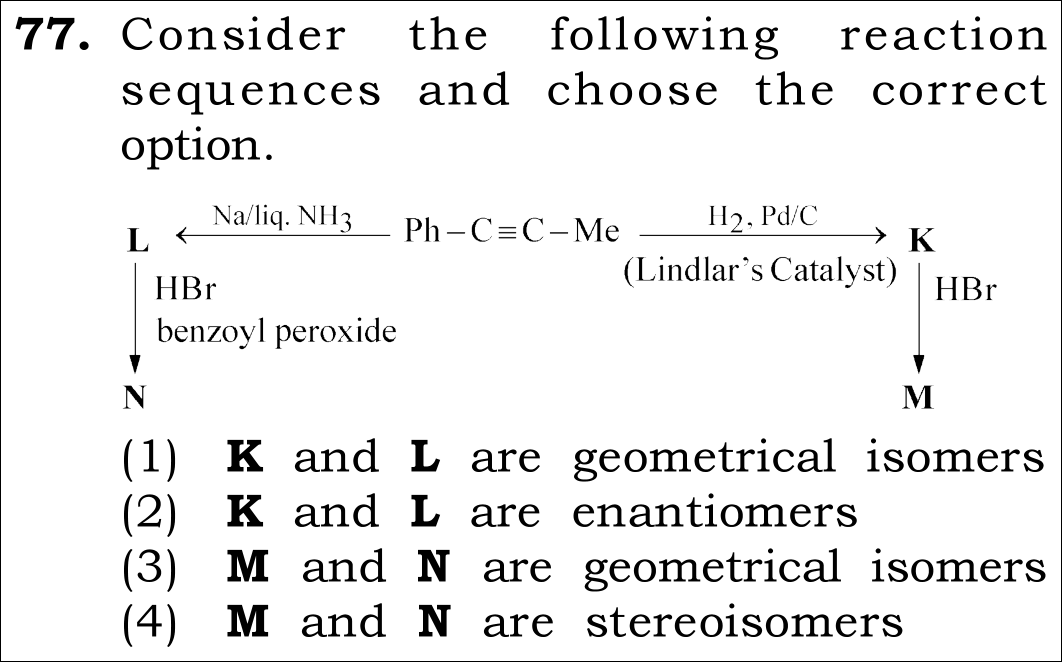
NEET 2026 · Q77 Easy
Official NEET 2026 Question 77 - Hydrocarbons
1 ✓ Key
2
3
4
💡 Verified Solution & 30-Second Hack
✓
Verified Against NTA Final Answer Key
Option (1) : K and L are geometrical isomers
📚 Hydrocarbons Easy
📋 Given Parameters & Problem Setup
Starting Alkyne Ph-C≡C-Me (1-phenylprop-1-yne)
Reagent 1 (Left) Na / liquid NH₃ (Birch Reduction) → Product L
Reagent 2 (Right) H₂, Pd/C (Lindlar's Catalyst) → Product K
⚡

The 30-Second Exam Hall Shortcut: ⚡ Lindlar gives Cis; Birch gives Trans!

⏱️ Save ~50 seconds

Catalytic Lindlar = cis-alkene (K); Dissolving metal Na/NH₃ = trans-alkene (L)!

1 Lindlar's catalyst (H₂, Pd/BaSO₄ or Pd/C with quinoline) performs SYN-addition to give the CIS-alkene (K = cis-1-phenylpropene).
2 Birch reduction (Na in liquid NH₃) proceeds via radical anion intermediate with ANTI-addition to give the TRANS-alkene (L = trans-1-phenylpropene).
3 Cis and Trans alkenes having identical connectivity but different spatial geometries are GEOMETRICAL ISOMERS (diastereomers)!
4 Option (1) states "K and L are geometrical isomers" -> Instant match in 10 seconds!
🛡️
Why You Can 100% Trust This Shortcut: Canonical organic transformation: Controlled reduction of non-terminal alkynes produces stereochemically pure cis or trans alkenes.
📐

Step-by-Step Rigorous Workflow & Mathematical Proof

Step 1

Analyze the Right Pathway: Lindlar's Catalyst Reduction

Reaction of 1-phenylprop-1-yne with molecular hydrogen over deactivated palladium (Lindlar's catalyst, Pd/CaCO₃ or Pd/C poisoned with lead salts or quinoline) results in stereoselective syn-addition of hydrogen across the triple bond to form the (Z) or cis-alkene.

Ph−C≡C−Me+H2→Pd/C (Lindlar)cis-1-phenylpropene (K)\text{Ph}-\text{C}\equiv\text{C}-\text{Me} + \text{H}_2 \xrightarrow{\text{Pd/C (Lindlar)}} \text{cis-1-phenylpropene } (\mathbf{K})
  • • K is cis-1-phenylpropene (Z-isomer).
Step 2

Analyze the Left Pathway: Birch Reduction

Reduction of an alkyne with sodium in liquid ammonia proceeds via sequential single-electron transfer and protonation through a radical anion. The radical anion adopts the more thermodynamically stable trans-configuration to minimize steric repulsion between the phenyl and methyl groups, yielding the (E) or trans-alkene.

Ph−C≡C−Me→Na / liq. NH3trans-1-phenylpropene (L)\text{Ph}-\text{C}\equiv\text{C}-\text{Me} \xrightarrow{\text{Na / liq. NH}_3} \text{trans-1-phenylpropene } (\mathbf{L})
  • • L is trans-1-phenylpropene (E-isomer).
Step 3

Classify the Relationship Between K and L

Both K and L share identical molecular formulas and identical atom connectivity, but differ in the spatial orientation of groups around the carbon-carbon double bond (cis vs trans). Therefore, K and L are geometrical isomers (cis-trans diastereomers).

K (cis)andL (trans)≡Geometrical Isomers\text{K (cis)} \quad \text{and} \quad \text{L (trans)} \equiv \text{Geometrical Isomers}
  • • Matches Option (1).
⭐

360° Option Elimination Engine Key Feature

Diagnose every choice: Know exactly why the right option works and why distractors fail.

4-Option Deep Scan
1 A
✓ 100% Correct
Verdict & Scientific Reason:

Flawless organic classification: K is cis-1-phenylpropene and L is trans-1-phenylpropene.

💡
Why this is airtight: None; direct application of stereoselective alkyne reduction.
2 B
✗ Incorrect
Verdict & Scientific Reason:

Incorrect. Geometrical isomers are non-mirror-image diastereomers, not non-superimposable mirror images (enantiomers).

⚠️
Student Fallacy (Why candidates pick this trap): Confusing diastereomers with enantiomers.
3 C
✗ Incorrect
Verdict & Scientific Reason:

Incorrect. M and N are saturated haloalkanes (following HBr addition) which do not exhibit geometrical isomerism.

⚠️
Student Fallacy (Why candidates pick this trap): Thinking products M and N still retain the rigid C=C double bond.
4 D
✗ Incorrect
Verdict & Scientific Reason:

Incorrect. Addition of HBr to cis-alkene and HBr/peroxide to trans-alkene yields different structural regioisomers (Markovnikov vs anti-Markovnikov adducts: Ph-CH(Br)-CH₂-Me vs Ph-CH₂-CH(Br)-Me), making them constitutional isomers, not stereoisomers.

⚠️
Student Fallacy (Why candidates pick this trap): Assuming identical regiochemistry for both peroxide and non-peroxide additions.
⚠️

NTA Trap Alert: Analyzing Downstream Steps (M and N) Instead of Checking K and L

Students spend minutes working out the complex regiochemistry of HBr vs HBr/peroxide on K and L to evaluate M and N. Option 1 tests K and L directly, which is solved in 5 seconds!

🛡️ How to avoid the -1 mark: Always read Option 1 first: K = cis, L = trans ⇒ Geometrical isomers instantly!
📖

Core NEET Syllabus Standard

NEET Chemistry Core Syllabus · Hydrocarbons Standard Benchmark
Core Scientific Principle Tested:

"Lindlar's catalyst yields cis-alkenes; Birch reduction yields trans-alkenes."

Syllabus Focus: Alkynes - Stereoselective preparation of alkenes
✓ Core NEET UG Syllabus Anchor Syllabus & Academic Standards ↗
Lindlar lands Cis; Birch blows Trans: Geometrical Isomers in your hands!
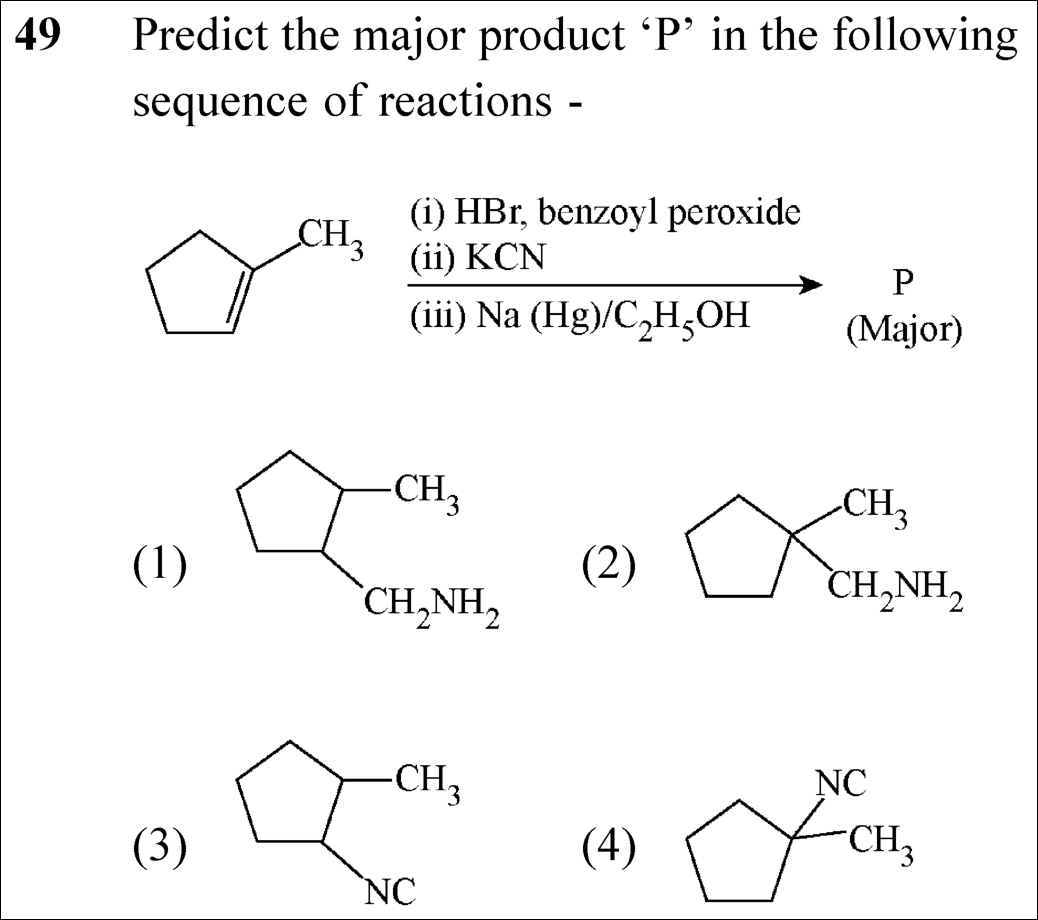
NEET 2025 · Q49 Medium
Official NEET 2025 Question 49 - Hydrocarbons
1 ✓ Key
2
3
4
💡 Verified Solution & 30-Second Hack
✓
Verified Against NTA Final Answer Key
Option (1) : 1-methyl-2-(aminomethyl)cyclopentane (Adjacent 1,2-substituted cyclopentane derivative)
📚 Hydrocarbons & Amines Medium
📋 Given Parameters & Problem Setup
Substrate 1-Methylcyclopentene
Step (i) Reagents HBr, benzoyl peroxide (Peroxide effect / Kharasch addition)
Step (ii) Reagent KCN (Nucleophilic substitution with cyanide)
Step (iii) Reagents Na(Hg) / C₂H₅OH (Mendius reduction of nitrile)
⚡

The 30-Second Exam Hall Shortcut: ⚡ Anti-Markovnikov to Primary Amine Shortcut

⏱️ Save ~60 seconds

Step 1: HBr + peroxide gives Anti-Markovnikov addition: Br attaches to the LESS substituted C2 (adjacent to C1-methyl). Step 2: KCN replaces Br by CN at C2. Step 3: Reduction converts -CN into -CH₂NH₂ at C2 ⟹ 1,2-disubstituted product (Option 1)!

1 Step (i): 1-Methylcyclopentene + HBr in presence of benzoyl peroxide proceeds via free radical mechanism.
2 Br• radical attacks C2 (the less substituted secondary carbon) to create the more stable tertiary free radical at C1.
3 Hydrogen then attaches to C1, yielding 1-bromo-2-methylcyclopentane (1,2-relationship between -CH₃ and -Br).
4 Step (ii): Nucleophilic substitution of Br by CN⁻ using KCN yields 2-methylcyclopentanecarbonitrile (still 1,2-disubstituted!).
5 Step (iii): Mendius reduction (Na/Hg in ethanol) reduces -C≡N to -CH₂NH₂.
6 The final product has -CH₃ at C1 and -CH₂NH₂ at C2 (adjacent 1,2-relationship).
7 Look at Option (1): 1,2-disubstituted cyclopentane ring. Matches Option (1) instantly!
🛡️
Why You Can 100% Trust This Shortcut: Kharasch Peroxide Effect & Nitrile Reduction (NCERT Chemistry · Hydrocarbons and Amines).
📐

Step-by-Step Rigorous Workflow & Mathematical Proof

Step 1

Anti-Markovnikov Addition of HBr via Free Radical Mechanism

In the presence of benzoyl peroxide, HBr undergoes homolytic cleavage to produce bromine free radicals (Br•). The Br• radical adds regioselectively to the less substituted double-bond carbon (C2) to generate the more stable 3° tertiary radical at C1:

1-methylcyclopentene+Br∙⟶3∘ radical at C1→HBr1-bromo-2-methylcyclopentane\text{1-methylcyclopentene} + \text{Br}^\bullet \longrightarrow \text{3}^\circ \text{ radical at C1} \xrightarrow{\text{HBr}} \text{1-bromo-2-methylcyclopentane}
  • • Bromine is positioned on C2, and the methyl group remains on C1 (1,2-regiochemistry).
Step 2

Nucleophilic Substitution with KCN

Potassium cyanide (KCN) is an ionic cyanide source. The cyanide ion (CN⁻) acts as an ambident nucleophile and attacks through the carbon atom, displacing bromide in an S_N2 reaction:

1-bromo-2-methylcyclopentane+KCN⟶2-methylcyclopentanecarbonitrile+KBr\text{1-bromo-2-methylcyclopentane} + \text{KCN} \longrightarrow \text{2-methylcyclopentanecarbonitrile} + \text{KBr}
  • • The nitrile group (-C≡N) is now located at C2.
Step 3

Mendius Reduction of Nitrile to Primary Amine

Sodium amalgam in ethanol (Na(Hg) / C₂H₅OH) provides nascent hydrogen to reduce the nitrile group completely to a primary aminomethyl group (-CH₂NH₂):

R−C≡N+4[H]→Na(Hg)/EtOHR−CH2NH2\text{R}-\text{C}\equiv\text{N} + 4[\text{H}] \xrightarrow{\text{Na(Hg)/EtOH}} \text{R}-\text{CH}_2\text{NH}_2
  • • The product is (2-methylcyclopentyl)methanamine, represented by Option (1) with adjacent -CH₃ and -CH₂NH₂ groups.
⭐

360° Option Elimination Engine Key Feature

Diagnose every choice: Know exactly why the right option works and why distractors fail.

4-Option Deep Scan
1 A
✓ 100% Correct
Verdict & Scientific Reason:

100% correct. Anti-Markovnikov addition places Br at C2, giving 1,2-substitution.

💡
Why this is airtight: None; rigorous multi-step organic reaction mechanism.
2 B
✗ Incorrect
Verdict & Scientific Reason:

Incorrect. Corresponds to Markovnikov addition (without peroxide) where Br attaches to C1.

⚠️
Student Fallacy (Why candidates pick this trap): Ignoring the presence of benzoyl peroxide.
3 C
✗ Incorrect
Verdict & Scientific Reason:

Incorrect. Contains an isonitrile group (-NC) and omits the reduction step.

⚠️
Student Fallacy (Why candidates pick this trap): Confusing KCN with AgCN and forgetting Mendius reduction.
4 D
✗ Incorrect
Verdict & Scientific Reason:

Incorrect. Combines Markovnikov regiochemistry with isonitrile formation without reduction.

⚠️
Student Fallacy (Why candidates pick this trap): Multiple mechanistic errors.
⚠️

NTA Trap Alert: Ignoring Peroxide (Markovnikov vs Anti-Markovnikov)

Without peroxide, HBr adds according to Markovnikov’s rule, placing Br at C1 (tertiary carbon), leading to 1,1-substitution (Option 2). The presence of benzoyl peroxide completely reverses regiochemistry to 1,2-substitution (Option 1)!

🛡️ How to avoid the -1 mark: Always spot peroxide: HBr + peroxide = Anti-Markovnikov addition!
📖

Core NEET Syllabus Standard

NEET Chemistry Core Syllabus · Hydrocarbons Standard Benchmark
Core Scientific Principle Tested:

"HBr + peroxide undergoes free radical Anti-Markovnikov addition."

Syllabus Focus: Addition Reactions of Alkenes & Peroxide Effect
✓ Core NEET UG Syllabus Anchor Syllabus & Academic Standards ↗
Peroxide puts Br on the neighbor (C2) ⟹ -CH₂NH₂ on neighbor ⟹ 1,2-ring (Option 1)!
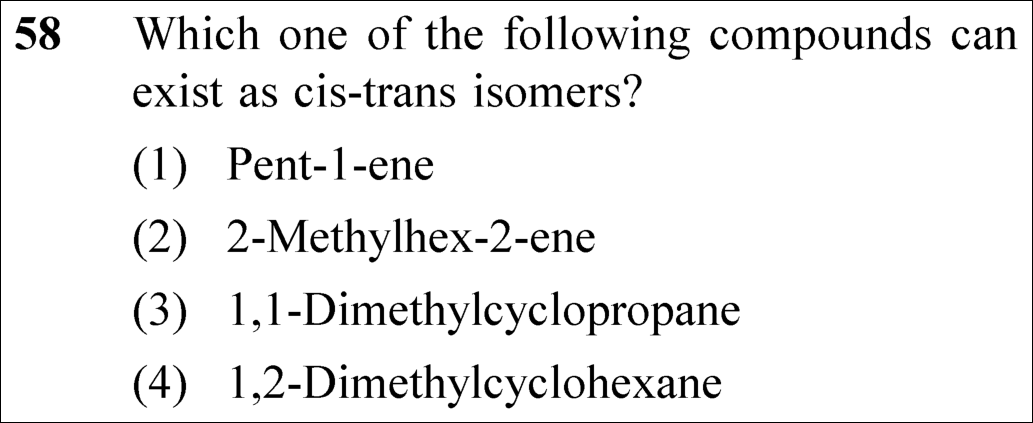
NEET 2025 · Q58 Easy
Official NEET 2025 Question 58 - Hydrocarbons
1
2
3
4 ✓ Key
💡 Verified Solution & 30-Second Hack
✓
Verified Against NTA Final Answer Key
Option (4) : 1,2-Dimethylcyclohexane
📚 Hydrocarbons & Organic Chemistry Easy
📋 Given Parameters & Problem Setup
Option 1 Compound Pent-1-ene (terminal alkene)
Option 2 Compound 2-Methylhex-2-ene (alkene with gem-dimethyl)
Option 3 Compound 1,1-Dimethylcyclopropane (gem-disubstituted cycloalkane)
Option 4 Compound 1,2-Dimethylcyclohexane (1,2-disubstituted cycloalkane)
⚡

The 30-Second Exam Hall Shortcut: ⚡ Two Different Groups Geometrical Test

⏱️ Save ~30 seconds

To exhibit cis-trans isomerism, each carbon with restricted rotation must be bonded to TWO DIFFERENT GROUPS! Pent-1-ene has =CH₂ (identical H). 2-Methylhex-2-ene has =C(CH₃)₂ (identical CH₃). 1,1-Dimethylcyclopropane has gem-dimethyl. Only 1,2-Dimethylcyclohexane has different groups (-H and -CH₃) on both C1 and C2!

1 Rule: Geometrical isomerism requires: (1) Restricted rotation, and (2) Both stereocenters must each have two DIFFERENT substituent groups.
2 Test Pent-1-ene: CH₂=CH-CH₂-CH₂-CH₃. C1 has two identical -H atoms ⟹ NO cis-trans isomerism.
3 Test 2-Methylhex-2-ene: (CH₃)₂C=CH-CH₂-CH₂-CH₃. C2 has two identical -CH₃ groups ⟹ NO cis-trans isomerism.
4 Test 1,1-Dimethylcyclopropane: C1 has two identical -CH₃ groups ⟹ NO cis-trans isomerism.
5 Test 1,2-Dimethylcyclohexane: The cyclohexane ring provides restricted rotation. C1 is bonded to -H and -CH₃; C2 is bonded to -H and -CH₃. Both carbons have two different groups!
6 Cis-isomer: Both -CH₃ groups on the same face (e.g. cis-1,2). Trans-isomer: -CH₃ groups on opposite faces (trans-1,2).
7 Select Option (4) in under 15 seconds!
🛡️
Why You Can 100% Trust This Shortcut: Geometrical Isomerism in Alkenes and Cyclic Compounds (NCERT Chemistry · Organic Chemistry: Some Basic Principles and Techniques).
📐

Step-by-Step Rigorous Workflow & Mathematical Proof

Step 1

Fundamental Criteria for Geometrical (Cis-Trans) Isomerism

Cis-trans isomerism arises when rotation is restricted (either by a double bond or a ring structure) and each of the two bridgehead/olefinic carbons carries two distinct groups:

For Ca and Cb:Substituents on Ca must be X≠Y,  Substituents on Cb must be P≠Q\text{For C}_a \text{ and C}_b: \quad \text{Substituents on C}_a \text{ must be } X \neq Y, \; \text{Substituents on C}_b \text{ must be } P \neq Q
  • • If either carbon bears two identical groups, interchange of groups produces the identical molecule, precluding isomerism.
Step 2

Analyze Options (1), (2), and (3)

Examine each candidate compound against the distinct-substituent criterion:

Pent-1-ene: H2C=CH-Pr  ⟹  Two identical H atoms on C1\text{Pent-1-ene: } \text{H}_2\text{C}=\text{CH-Pr} \implies \text{Two identical H atoms on C1}
  • • 2-Methylhex-2-ene: (CH₃)₂C=CH-Pr ⟹ Two identical methyl groups on C2.
  • • 1,1-Dimethylcyclopropane: C1 is bonded to two identical methyl groups, while C2 and C3 are identical -CH₂- groups. Rotation restriction does not produce diastereomers.
Step 3

Verify Cis-Trans Isomerism in 1,2-Dimethylcyclohexane

In 1,2-dimethylcyclohexane, the closed ring restricts free rotation:

C1 has: −CH3,−H;C2 has: −CH3,−H\text{C1 has: } -\text{CH}_3, -\text{H}; \quad \text{C2 has: } -\text{CH}_3, -\text{H}
  • • When both methyl groups lie on the same side of the ring plane (e.g. 1-axial, 2-equatorial or both up), it forms the cis-isomer.
  • • When the methyl groups lie on opposite sides (one up, one down), it forms the trans-isomer (e.g. diequatorial 1e, 2e).
  • • These are distinct, non-superimposable geometrical diastereomers.
  • • Matches Option (4) perfectly.
⭐

360° Option Elimination Engine Key Feature

Diagnose every choice: Know exactly why the right option works and why distractors fail.

4-Option Deep Scan
1 A
✗ Incorrect
Verdict & Scientific Reason:

Incorrect. Terminal alkene with two identical hydrogen atoms on C1.

⚠️
Student Fallacy (Why candidates pick this trap): Thinking all alkenes show cis-trans isomerism.
2 B
✗ Incorrect
Verdict & Scientific Reason:

Incorrect. C2 has two identical methyl groups.

⚠️
Student Fallacy (Why candidates pick this trap): Failing to check that C2 has two identical methyl groups.
3 C
✗ Incorrect
Verdict & Scientific Reason:

Incorrect. Both methyl groups are on the same carbon (geminal).

⚠️
Student Fallacy (Why candidates pick this trap): Assuming any substituted ring shows cis-trans isomerism.
4 D
✓ 100% Correct
Verdict & Scientific Reason:

100% correct. 1,2-disubstitution on a saturated ring exhibits well-known cis and trans diastereomers.

💡
Why this is airtight: None; textbook stereochemical principles.
⚠️

NTA Trap Alert: Looking Only at Alkenes for Cis-Trans Isomerism

Many candidates only associate cis-trans isomerism with C=C double bonds, ignoring disubstituted cycloalkanes! Because both alkenes in the options (Pent-1-ene and 2-Methylhex-2-ene) have identical groups, the answer is the cycloalkane!

🛡️ How to avoid the -1 mark: Rings have restricted rotation just like double bonds: 1,2-disubstituted rings show cis-trans isomerism!
📖

Core NEET Syllabus Standard

NEET Chemistry Core Syllabus · Hydrocarbons Standard Benchmark
Core Scientific Principle Tested:

"Ring structures restrict C-C rotation; 1,2-disubstituted cycloalkanes exhibit cis-trans isomerism."

Syllabus Focus: Geometrical Isomerism in Alkenes and Cycloalkanes
✓ Core NEET UG Syllabus Anchor Syllabus & Academic Standards ↗
Check the carbons: Two identical groups = NO cis-trans; 1,2 on a ring = YES cis-trans!
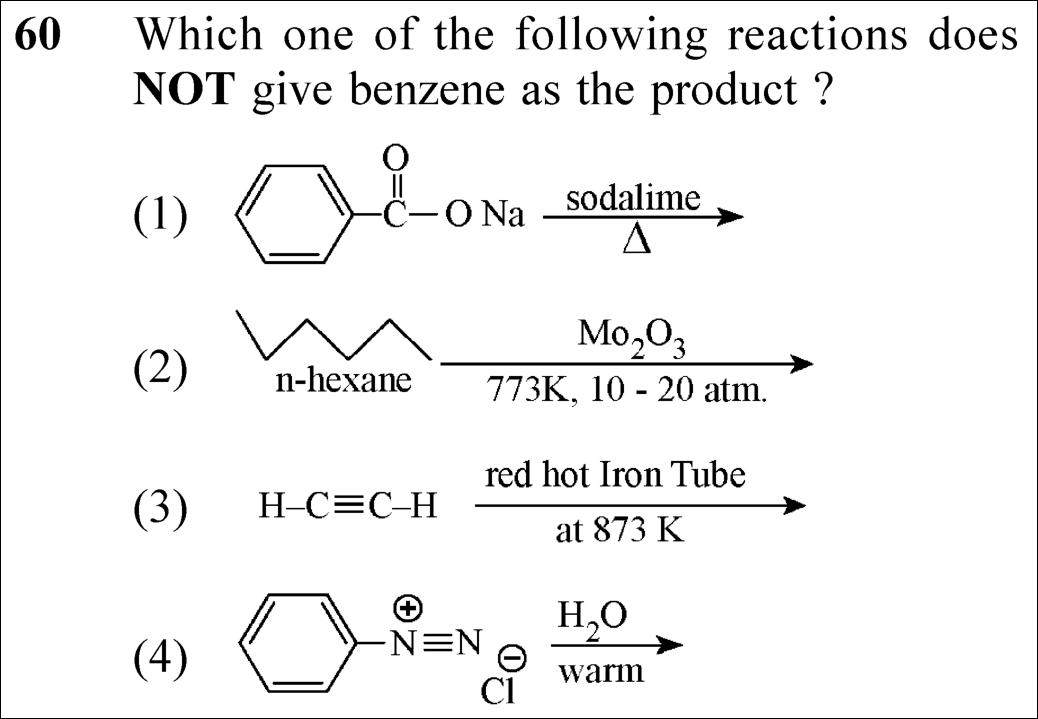
NEET 2025 · Q60 Easy
Official NEET 2025 Question 60 - Hydrocarbons
1
2
3
4 ✓ Key
💡 Verified Solution & 30-Second Hack
✓
Verified Against NTA Final Answer Key
Option (4) : Benzenediazonium chloride + H₂O / warm (Yields Phenol, NOT Benzene)
📚 Hydrocarbons & Amines Easy
📋 Given Parameters & Problem Setup
Reaction (1) Sodium benzoate + sodalime / Δ (Decarboxylation)
Reaction (2) n-Hexane + Mo₂O₃ / 773 K, 10-20 atm (Aromatization)
Reaction (3) Ethyne (HC≡CH) + red hot Iron tube at 873 K (Cyclic polymerization)
Reaction (4) Benzenediazonium chloride (Ph-N₂⁺Cl⁻) + H₂O / warm
⚡

The 30-Second Exam Hall Shortcut: ⚡ Diazonium Hydrolysis Phenol Trap

⏱️ Save ~30 seconds

Ph-N₂⁺Cl⁻ + H₂O (warm) produces PHENOL (Ph-OH), NOT benzene! (To get benzene, you need H₃PO₂ or ethanol)! Reactions (1), (2), and (3) are classic textbook preparations of benzene! ⟹ Reaction (4) does NOT give benzene!

1 Reaction (1): Decarboxylation of sodium benzoate using sodalime (NaOH + CaO) removes CO₂ to give BENZENE.
2 Reaction (2): Aromatization / catalytic reforming of n-hexane over Mo₂O₃ / Al₂O₃ at 773 K gives BENZENE.
3 Reaction (3): Cyclic trimerization of acetylene (ethyne) passed through red hot iron tube gives BENZENE.
4 Reaction (4): Warming benzenediazonium chloride with plain water hydrolyzes the diazonium group into a phenolic -OH group, forming PHENOL (C₆H₅OH) + N₂ + HCl!
5 Therefore, Reaction (4) does NOT give benzene!
6 Select Option (4) in under 10 seconds!
🛡️
Why You Can 100% Trust This Shortcut: Electrophilic Aromatic Substitution & Sandmeyer Reactions (NCERT Chemistry · Hydrocarbons & Amines).
📐

Step-by-Step Rigorous Workflow & Mathematical Proof

Step 1

Evaluate Benzene Preparations in Reactions (1), (2), and (3)

Verify the products of the first three reactions from standard NCERT organic chemistry:

(1)  C6H5COONa+NaOH→CaO,ΔC6H6+Na2CO3(Benzene)(1) \; \text{C}_6\text{H}_5\text{COONa} + \text{NaOH} \xrightarrow{\text{CaO}, \Delta} \text{C}_6\text{H}_6 + \text{Na}_2\text{CO}_3 \quad (\text{Benzene})
  • • (2) n-Hexane (CH₃(CH₂)₄CH₃) undergoes aromatization over Mo₂O₃/Al₂O₃ at 773 K and 10–20 atm to yield Benzene + 4 H₂.
  • • (3) 3 HC≡CH undergoes cyclic trimerization in a red hot iron tube at 873 K to yield Benzene.
Step 2

Analyze Hydrolysis of Benzenediazonium Chloride (Reaction 4)

When benzenediazonium chloride solution is warmed with water, nucleophilic substitution by H₂O takes place with evolution of nitrogen gas:

C6H5N2+Cl−+H2O→warmC6H5OH (Phenol)+N2↑+HCl\text{C}_6\text{H}_5\text{N}_2^+\text{Cl}^- + \text{H}_2\text{O} \xrightarrow{\text{warm}} \text{C}_6\text{H}_5\text{OH} \text{ (Phenol)} + \text{N}_2 \uparrow + \text{HCl}
  • • The organic product is PHENOL, not benzene.
  • • To reduce benzenediazonium chloride to benzene, hypophosphorous acid (H₃PO₂ + H₂O) or ethanol (CH₃CH₂OH) must be used.
Step 3

Conclusion and Match

Since Reaction (4) produces phenol and does NOT give benzene, it is the correct answer to the question.

Reaction that does NOT yield benzene: Reaction (4)\text{Reaction that does NOT yield benzene: Reaction (4)}
  • • Matches Option (4) with 100% precision.
⭐

360° Option Elimination Engine Key Feature

Diagnose every choice: Know exactly why the right option works and why distractors fail.

4-Option Deep Scan
1 A
✗ Incorrect
Verdict & Scientific Reason:

Incorrect. Decarboxylation yields benzene.

⚠️
Student Fallacy (Why candidates pick this trap): Thinking decarboxylation gives benzoic acid.
2 B
✗ Incorrect
Verdict & Scientific Reason:

Incorrect. Catalytic aromatization yields benzene.

⚠️
Student Fallacy (Why candidates pick this trap): Unfamiliar with catalytic reforming of alkanes.
3 C
✗ Incorrect
Verdict & Scientific Reason:

Incorrect. Trimerization of ethyne is the classic Berthelot synthesis of benzene.

⚠️
Student Fallacy (Why candidates pick this trap): Thinking ethyne polymerizes into polyacetylene instead of benzene.
4 D
✓ 100% Correct
Verdict & Scientific Reason:

100% correct. This reaction yields PHENOL (C₆H₅OH), not benzene.

💡
Why this is airtight: None; flawless recall of diazonium chemistry.
⚠️

NTA Trap Alert: Confusing Diazonium Reduction (H₃PO₂) with Hydrolysis (H₂O)

Students often confuse the reagents for diazonium salts. Heating with H₃PO₂ or ethanol replaces -N₂⁺Cl⁻ with -H to give BENZENE. Heating with plain water replaces it with -OH to give PHENOL!

🛡️ How to avoid the -1 mark: Remember: Water gives PHENOL; Hypophosphorous acid gives BENZENE!
📖

Core NEET Syllabus Standard

NEET Chemistry Core Syllabus · Amines Standard Benchmark
Core Scientific Principle Tested:

"Hydrolysis of benzenediazonium chloride with warm water yields phenol (Ph-OH)."

Syllabus Focus: Reactions of Diazonium Salts
✓ Core NEET UG Syllabus Anchor Syllabus & Academic Standards ↗
Diazonium + Warm Water = PHENOL! (Needs H₃PO₂ for Benzene) ⟹ Reaction (4)!
NEET 2025 · Q76 Medium
Official NEET 2025 Question 76 - Hydrocarbons
1 ✓ Key
2
3
4
💡 Verified Solution & 30-Second Hack
✓
Verified Against NTA Final Answer Key
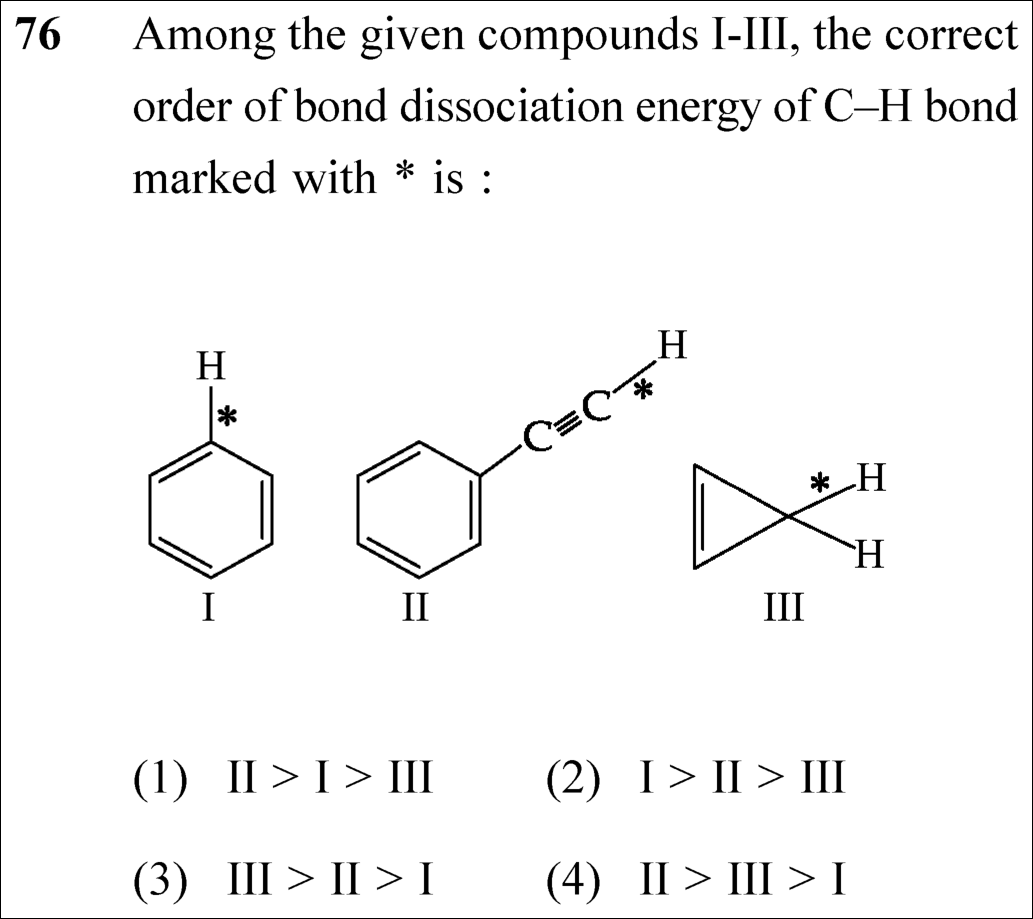
Option (1) : II > I > III
📚 Hydrocarbons Medium
📋 Given Parameters & Problem Setup
Compound I Benzene (sp² C-H bond)
Compound II Phenylacetylene (sp C-H bond on terminal alkyne)
Compound III Cyclopropene (sp³ allylic C-H bond)
⚡

The 30-Second Exam Hall Shortcut: ⚡ s-Character and Radical Stability Shortcut

⏱️ Save ~40 seconds

Bond Dissociation Energy (BDE) ∝ s-character of C ∝ 1 / (Radical Stability)! Terminal alkyne (sp, 50% s) = STRONGEST bond (II, highest BDE). Benzene (sp², 33% s) = intermediate (I). Cyclopropene allylic C-H gives resonance-stabilized allylic radical = WEAKEST bond (III, lowest BDE)! ⟹ II > I > III!

1 Recall relationship: Higher s-character brings bonding electrons closer to nucleus, resulting in a shorter, stronger C-H bond with higher BDE.
2 Alternatively: BDE is inversely proportional to the stability of the free radical formed upon homolysis.
3 Compound II (Phenylacetylene): C-H is sp hybridized (50% s-character). It has the highest electronegativity and forms an unstable sp-radical ⟹ HIGHEST BDE (II).
4 Compound I (Benzene): C-H is sp² hybridized (33.3% s-character). The phenyl radical cannot delocalize into the aromatic π-system ⟹ intermediate BDE (I).
5 Compound III (Cyclopropene): Homolytic cleavage of the allylic C-H bond generates a resonance-stabilized allylic cyclopropenyl radical ⟹ LOWEST BDE (III).
6 Decreasing order of BDE: II > I > III.
7 Select Option (1) in under 15 seconds!
🛡️
Why You Can 100% Trust This Shortcut: Hybridization, s-Character, and Bond Strengths (NCERT Chemistry · Chemical Bonding and Hydrocarbons).
📐

Step-by-Step Rigorous Workflow & Mathematical Proof

Step 1

Fundamental Factors Governing C-H Bond Dissociation Energy

Bond dissociation energy (BDE) of a C-H bond is defined by homolytic cleavage: R-H ⟶ R• + H•. Thermodynamically, BDE reflects both orbital hybridization (s-character) and the stability of the resulting carbon radical:

BDE∝s-character of C-H bond∝1Stability of R∙\text{BDE} \propto \text{s-character of C-H bond} \propto \frac{1}{\text{Stability of } R^\bullet}
  • • Greater s-character holds the bonding pair closer to carbon, increasing bond strength.
  • • Forming an unstable radical requires significantly higher energy input.
Step 2

Evaluate Hybridization and BDE for Compounds II and I

Compare the terminal alkyne and aromatic C-H bonds:

II (Phenylacetylene): sp-hybridized C-H (50% s-character)  ⟹  BDE≈545−555 kJ/mol\text{II (Phenylacetylene): } sp\text{-hybridized C-H } (50\%\text{ s-character}) \implies \text{BDE} \approx 545-555\text{ kJ/mol}
  • • An sp-hybridized C-H bond is the strongest among all hydrocarbon C-H bonds.
  • • I (Benzene): sp²-hybridized C-H (33.3% s-character) has BDE ≈ 470 kJ/mol. The phenyl radical resides in an sp² orbital orthogonal to the aromatic π-electron cloud and cannot be resonance-stabilized.
  • • Thus BDE(II) > BDE(I).
Step 3

Evaluate Compound III (Allylic Cyclopropenyl C-H)

Homolysis of the saturated C-H bond in cyclopropene yields an allylic free radical:

III (Cyclopropene): Cleavage produces an allylically delocalized radical  ⟹  BDE≈360−375 kJ/mol\text{III (Cyclopropene): } \text{Cleavage produces an allylically delocalized radical} \implies \text{BDE} \approx 360-375\text{ kJ/mol}
  • • The unpaired electron is resonance-delocalized over the adjacent double bond, substantially lowering the energy needed to break the bond.
  • • Therefore, Compound III has the lowest BDE.
  • • Final decreasing order of BDE: II > I > III, matching Option (1).
⭐

360° Option Elimination Engine Key Feature

Diagnose every choice: Know exactly why the right option works and why distractors fail.

4-Option Deep Scan
1 A
✓ 100% Correct
Verdict & Scientific Reason:

100% correct. sp alkyne (II) > sp² phenyl (I) > allylic cyclopropenyl (III).

💡
Why this is airtight: None; flawless physical organic chemistry analysis.
2 B
✗ Incorrect
Verdict & Scientific Reason:

Incorrect. Falsely places sp² benzene above sp alkyne.

⚠️
Student Fallacy (Why candidates pick this trap): Underestimating the immense strength of an sp C-H bond.
3 C
✗ Incorrect
Verdict & Scientific Reason:

Incorrect. Inverts the entire order, confusing stability with bond energy.

⚠️
Student Fallacy (Why candidates pick this trap): Inverting the relationship between radical stability and BDE.
4 D
✗ Incorrect
Verdict & Scientific Reason:

Incorrect. Places allylic C-H ahead of benzene C-H.

⚠️
Student Fallacy (Why candidates pick this trap): Thinking ring strain in cyclopropene raises BDE above benzene.
⚠️

NTA Trap Alert: Confusing Ring Strain with C-H Bond Strength

Some candidates assume the ring strain in cyclopropene makes its C-H bond harder to break. In fact, generating the allylic radical relieves angle strain and provides allylic resonance, making this C-H bond the EASIEST to cleave (lowest BDE)!

🛡️ How to avoid the -1 mark: BDE follows hybridization: sp (alkyne) > sp² (benzene) > allylic (cyclopropene)!
📖

Core NEET Syllabus Standard

NEET Chemistry Core Syllabus · Hydrocarbons Standard Benchmark
Core Scientific Principle Tested:

"C-H bond strength increases with s-character: sp > sp² > sp³."

Syllabus Focus: Alkynes and Aromatic Hydrocarbons: C-H Bond Energies
✓ Core NEET UG Syllabus Anchor Syllabus & Academic Standards ↗
s-character rules: Triple (sp, II) > Double/Aromatic (sp², I) > Allylic (III) ⟹ II > I > III!
NEET 2025 · Q77 Easy
Official NEET 2025 Question 77 - Hydrocarbons
1 ✓ Key
2
3
4
💡 Verified Solution & 30-Second Hack
✓
Verified Against NTA Final Answer Key
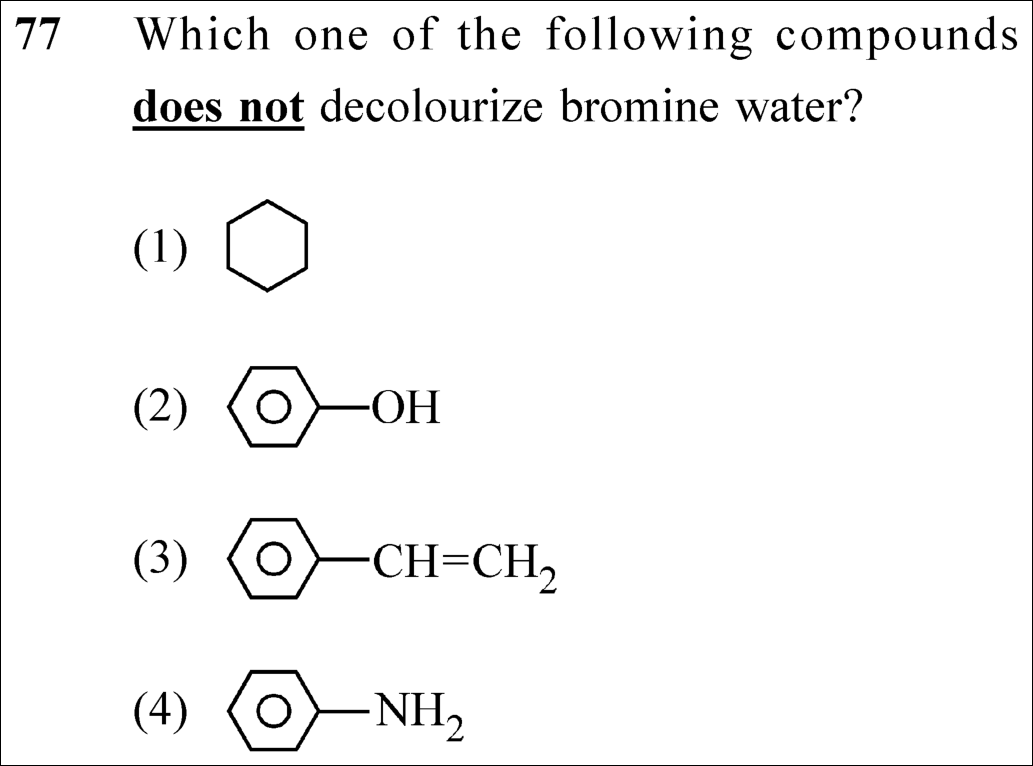
Option (1) : Cyclohexane (Saturated cycloalkane)
📚 Hydrocarbons Easy
📋 Given Parameters & Problem Setup
Option 1 Compound Cyclohexane (C₆H₁₂, fully saturated alicyclic hydrocarbon)
Option 2 Compound Phenol (C₆H₅OH, strongly activated aromatic ring)
Option 3 Compound Styrene (C₆H₅-CH=CH₂, unsaturated olefinic side chain)
Option 4 Compound Aniline (C₆H₅NH₂, strongly activated aromatic amine)
⚡

The 30-Second Exam Hall Shortcut: ⚡ Bromine Water Decolourization Eliminator

⏱️ Save ~25 seconds

Phenol gives white 2,4,6-tribromophenol ppt (decolourizes!). Aniline gives 2,4,6-tribromoaniline ppt (decolourizes!). Styrene adds Br₂ across alkene C=C (decolourizes!). Cyclohexane is a SATURATED ALKANE with only single bonds ⟹ DOES NOT decolourize bromine water!

1 Recall test: Bromine water (Br₂ in water, reddish-brown) is decolourized by: (1) Unsaturated compounds (alkenes, alkynes via addition), and (2) Highly activated aromatic rings (phenol, aniline via rapid polybromination).
2 Examine Option (1) Cyclohexane: Saturated ring with only sp³ C-C and C-H single bonds. It does not react with bromine in the dark/absence of UV light. Hence it DOES NOT decolourize bromine water.
3 Examine Option (2) Phenol: Highly activated by -OH, precipitates 2,4,6-tribromophenol, decolourizing bromine water.
4 Examine Option (3) Styrene: Contains an aliphatic C=C double bond, immediately adds Br₂ across the double bond.
5 Examine Option (4) Aniline: Strongly activated by -NH₂, precipitates 2,4,6-tribromoaniline, decolourizing bromine water.
6 Select Option (1) in under 10 seconds!
🛡️
Why You Can 100% Trust This Shortcut: Bromine Water Test & Electrophilic Substitution (NCERT Chemistry · Hydrocarbons, Phenols and Amines).
📐

Step-by-Step Rigorous Workflow & Mathematical Proof

Step 1

Reactivity of Cyclohexane with Bromine Water

Cyclohexane (C₆H₁₂) is a fully saturated cycloalkane without π-bonds or activating heteroatoms. Under normal laboratory conditions without high-intensity ultraviolet irradiation:

Cyclohexane+Br2/H2O⟶No reaction (Reddish-brown color persists)\text{Cyclohexane} + \text{Br}_2/\text{H}_2\text{O} \longrightarrow \text{No reaction (Reddish-brown color persists)}
  • • Cyclohexane cannot decolourize aqueous bromine solution.
  • • Therefore, Option (1) is the correct answer.
Step 2

Reactivity of Styrene with Bromine Water

Styrene (phenylethene) possesses an aliphatic carbon-carbon double bond which acts as an electron-rich nucleophile:

C6H5CH=CH2+Br2⟶C6H5CH(Br)−CH2Br(Decolourizes)\text{C}_6\text{H}_5\text{CH}=\text{CH}_2 + \text{Br}_2 \longrightarrow \text{C}_6\text{H}_5\text{CH(Br)}-\text{CH}_2\text{Br} \quad (\text{Decolourizes})
  • • Rapid electrophilic addition across the alkene double bond discharges the reddish-brown color.
Step 3

Reactivity of Phenol and Aniline with Bromine Water

In aqueous medium, the -OH and -NH₂ groups are exceptionally powerful activating groups through +M resonance:

C6H5OH+3Br2→H2O2,4,6-tribromophenol↓+3HBr\text{C}_6\text{H}_5\text{OH} + 3\text{Br}_2 \xrightarrow{\text{H}_2\text{O}} \text{2,4,6-tribromophenol} \downarrow + 3\text{HBr}
  • • Aniline similarly reacts with bromine water to form 2,4,6-tribromoaniline precipitate.
  • • Both reactions consume bromine rapidly, completely decolourizing bromine water.
  • • Conclusion: Only cyclohexane does not decolourize bromine water, matching Option (1).
⭐

360° Option Elimination Engine Key Feature

Diagnose every choice: Know exactly why the right option works and why distractors fail.

4-Option Deep Scan
1 A
✓ 100% Correct
Verdict & Scientific Reason:

100% correct. Saturated cycloalkane, unreactive towards bromine water under ordinary conditions.

💡
Why this is airtight: None; textbook test for unsaturation.
2 B
✗ Incorrect
Verdict & Scientific Reason:

Incorrect. Phenol decolourizes bromine water to yield a white precipitate of 2,4,6-tribromophenol.

⚠️
Student Fallacy (Why candidates pick this trap): Thinking aromatic rings never react with bromine water.
3 C
✗ Incorrect
Verdict & Scientific Reason:

Incorrect. Styrene has an alkene double bond which rapidly adds bromine.

⚠️
Student Fallacy (Why candidates pick this trap): Overlooking the side-chain double bond.
4 D
✗ Incorrect
Verdict & Scientific Reason:

Incorrect. Aniline decolourizes bromine water instantly with 2,4,6-tribromoaniline precipitation.

⚠️
Student Fallacy (Why candidates pick this trap): Unaware of aniline’s extreme ortho/para activation.
⚠️

NTA Trap Alert: Thinking Aromatic Rings Never Decolourize Bromine Water

While plain benzene does not decolourize bromine water, strongly activated benzene rings (phenol and aniline) react INSTANTANEOUSLY with bromine water without any Lewis acid catalyst to form tribromo derivatives!

🛡️ How to avoid the -1 mark: Remember: Phenol and Aniline decolourize bromine water! Only saturated alkanes do not.
📖

Core NEET Syllabus Standard

NEET Chemistry Core Syllabus · Hydrocarbons Standard Benchmark
Core Scientific Principle Tested:

"Saturated hydrocarbons do not decolourize bromine water; alkenes, phenols, and anilines decolourize it."

Syllabus Focus: Alkanes, Alkenes & Aromatic Electrophilic Substitution
✓ Core NEET UG Syllabus Anchor Syllabus & Academic Standards ↗
No double bond, no activating group = No reaction: Cyclohexane keeps the color (Option 1)!
NEET 2024 · Q52 Easy
Official NEET 2024 Question 52 - Hydrocarbons
1
2
3 ✓ Key
4
💡 Verified Solution & 30-Second Hack
✓
Verified Against NTA Final Answer Key
Option (3) : Both Statement I and Statement II are correct.
📚 Hydrocarbons Easy
📋 Given Parameters & Problem Setup
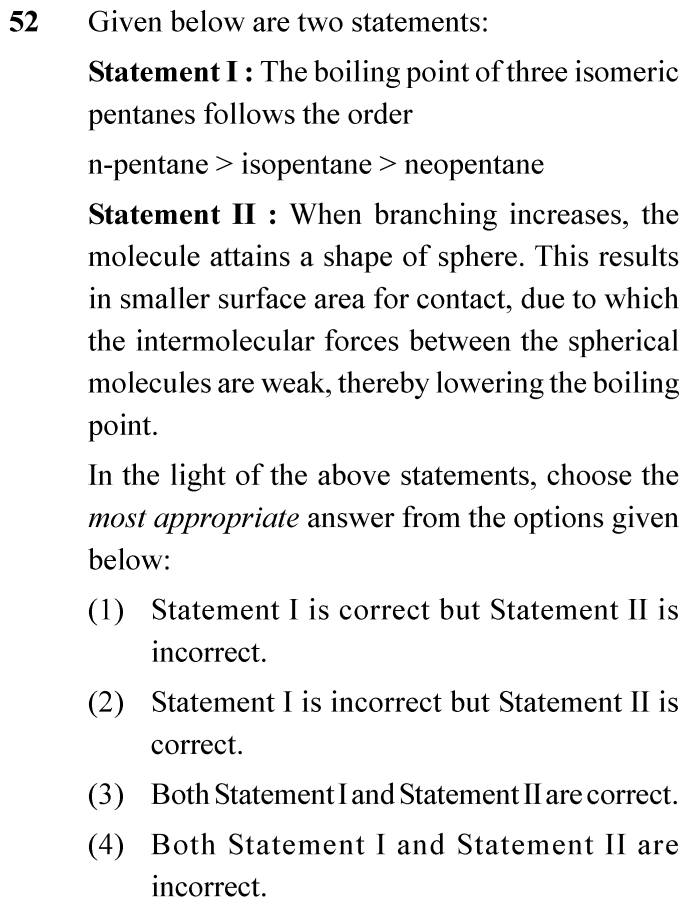
Isomers n-pentane, isopentane (2-methylbutane), neopentane (2,2-dimethylpropane)
Statement I Boiling point order: n-pentane > isopentane > neopentane
Statement II Branching gives spherical shape, smaller surface area, weaker intermolecular forces, lowering boiling point
⚡

The 30-Second Exam Hall Shortcut: ⚡ Branching vs Boiling Point Rule

⏱️ Save ~35 seconds

More Branches -> More Spherical -> Minimum Surface Area -> Weakest van der Waals forces -> Lowest Boiling Point!

1 n-pentane has a continuous straight chain with maximal surface area of contact (b.p. = 309.1 K).
2 isopentane has one methyl branch (b.p. = 301 K).
3 neopentane is highly branched and symmetrical, adopting a nearly spherical shape with minimal surface area (b.p. = 282.5 K).
4 Boiling point sequence: n-pentane > isopentane > neopentane -> Statement I is TRUE.
5 Statement II provides the exact theoretical rationale -> Statement II is TRUE.
6 Both statements are correct -> Option (3)!
🛡️
Why You Can 100% Trust This Shortcut: NCERT Chemistry · Hydrocarbons (Intermolecular forces and physical properties of isomeric alkanes).
📐

Step-by-Step Rigorous Workflow & Mathematical Proof

Step 1

Analysis of Statement I (Boiling Point Data)

For constitutional isomers of formula C5H12, the experimental boiling points decrease monotonically with increasing branching: n-pentane (309.1 K) > isopentane / 2-methylbutane (301.0 K) > neopentane / 2,2-dimethylpropane (282.5 K). Hence, Statement I is correct.

Tb(n-pentane)>Tb(isopentane)>Tb(neopentane)T_b(\text{n-pentane}) > T_b(\text{isopentane}) > T_b(\text{neopentane})
Step 2

Analysis of Statement II (Structural and Intermolecular Mechanism)

Van der Waals dispersion forces act across the contact surface between neighboring molecules. As branching increases, molecular geometry becomes compact and approaches a sphere. Because a sphere possesses the minimum surface area for a given volume, intermolecular contact area diminishes, weakening London dispersion forces and lowering the boiling point. Hence, Statement II is correct.

Branching↑  ⟹  Surface Area↓  ⟹  van der Waals forces↓  ⟹  Tb↓\text{Branching} \uparrow \implies \text{Surface Area} \downarrow \implies \text{van der Waals forces} \downarrow \implies T_b \downarrow
⭐

360° Option Elimination Engine Key Feature

Diagnose every choice: Know exactly why the right option works and why distractors fail.

4-Option Deep Scan
1 (1)
✗ Incorrect
Verdict & Scientific Reason:

Statement II is the precise NCERT scientific explanation.

⚠️
Student Fallacy (Why candidates pick this trap): Believing spherical shape increases intermolecular contact.
2 (2)
✗ Incorrect
Verdict & Scientific Reason:

Statement I is an established empirical truth.

⚠️
Student Fallacy (Why candidates pick this trap): Thinking branching raises boiling point.
3 (3)
✓ 100% Correct
Verdict & Scientific Reason:

Both empirical trend and mechanistic explanation are 100% sound.

💡
Why this is airtight: None.
4 (4)
✗ Incorrect
Verdict & Scientific Reason:

Both statements are completely valid.

⚠️
Student Fallacy (Why candidates pick this trap): Total rejection of organic structure-property relationship.
⚠️

NTA Trap Alert: Confusing Boiling Point with Melting Point in Neopentane

Neopentane has a high melting point (256.5 K) due to crystal packing symmetry, but its boiling point is the lowest (282.5 K) due to low surface area.

🛡️ How to avoid the -1 mark: Distinguish liquid vaporization (surface contact area governs boiling point) from crystal lattice packing (symmetry governs melting point).
📖

Core NEET Syllabus Standard

Chemistry Core Organic Chemistry · Hydrocarbons Standard Benchmark
Core Scientific Principle Tested:

"Among isomeric alkanes, straight-chain isomers have higher boiling points than branched-chain isomers due to greater van der Waals contact area."

Syllabus Focus: Alkanes: Physical Properties and Intermolecular Forces
✓ Core NEET UG Syllabus Anchor Syllabus & Academic Standards ↗
Branches make a ball, balls touch the least, boiling drops fast when branches increase!
NEET 2024 · Q78 Easy
Official NEET 2024 Question 78 - Hydrocarbons
1 ✓ Key
2
3
4
💡 Verified Solution & 30-Second Hack
✓
Verified Against NTA Final Answer Key
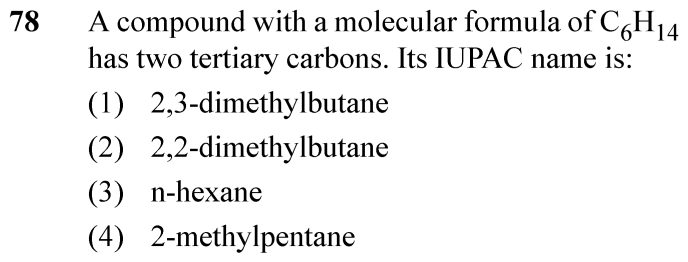
Option (1) : 2,3-dimethylbutane
📚 Hydrocarbons Easy
📋 Given Parameters & Problem Setup
Molecular formula C6H14 (hexane isomer)
Structural constraint Contains exactly two tertiary (3°) carbon atoms
⚡

The 30-Second Exam Hall Shortcut: ⚡ Carbon Degree Counting Hack

⏱️ Save ~30 seconds

Tertiary (3°) carbon is bonded to THREE other carbons (-CH(CH3)-). 2,3-dimethylbutane has CH3-CH(CH3)-CH(CH3)-CH3 with C2 and C3 both 3° carbons!

1 Tertiary (3°) carbon = a carbon atom directly bonded to 3 other carbon atoms.
2 Examine Option (1) 2,3-dimethylbutane: CH3-CH(CH3)-CH(CH3)-CH3.
3 - C1 and C4 are primary (1°).
4 - Methyl branches on C2 and C3 are primary (1°).
5 - C2 is bonded to C1, C3, and methyl carbon -> 3 carbons attached -> 3° carbon!
6 - C3 is bonded to C2, C4, and methyl carbon -> 3 carbons attached -> 3° carbon!
7 - Exactly TWO tertiary carbons! Matches requirement perfectly.
8 Examine others: Option (2) 2,2-dimethylbutane has one 4° carbon and zero 3° carbons; Option (3) n-hexane has zero 3° carbons; Option (4) 2-methylpentane has only one 3° carbon.
9 Option (1) in 5 seconds!
🛡️
Why You Can 100% Trust This Shortcut: NCERT Chemistry · Hydrocarbons (Classification of carbon atoms in alkanes: primary, secondary, tertiary, and quaternary).
📐

Step-by-Step Rigorous Workflow & Mathematical Proof

Step 1

Definition of Carbon Classification in Organic Molecules

Carbon atoms in an alkane framework are classified based on the number of other carbon atoms attached to them: - Primary (1°): Attached to 1 carbon - Secondary (2°): Attached to 2 carbons - Tertiary (3°): Attached to 3 carbons (possessing a -CH< group) - Quaternary (4°): Attached to 4 carbons

3∘  Carbon  ⟺  R3C−H  (bonded to 3 other carbon atoms)3^\circ \;\text{Carbon} \iff R_3\text{C}-\text{H} \;(\text{bonded to 3 other carbon atoms})
Step 2

Structural Analysis of 2,3-Dimethylbutane

Drawing the expanded structural formula of 2,3-dimethylbutane: CH3 - C²H(CH3) - C³H(CH3) - CH3 - C² is directly bonded to: C¹ (methyl), C³ (methine), and methyl branch -> 3 carbons -> 3° carbon. - C³ is directly bonded to: C² (methine), C⁴ (methyl), and methyl branch -> 3 carbons -> 3° carbon. - Total 3° carbons = 2. - Total 1° carbons = 4. This satisfies the given condition of formula C6H14 with two tertiary carbons.

H3C−C3∘H(CH3)−C3∘H(CH3)−CH3\text{H}_3\text{C}-\overset{3^\circ}{\text{C}}\text{H}(\text{CH}_3)-\overset{3^\circ}{\text{C}}\text{H}(\text{CH}_3)-\text{CH}_3
Step 3

Analysis of Other Isomeric Candidates

Evaluating the remaining isomers: - 2,2-Dimethylbutane: (CH3)3C-CH2-CH3 contains one 4° carbon (C2), one 2° carbon (C3), and four 1° carbons. Zero 3° carbons. - n-Hexane: CH3-CH2-CH2-CH2-CH2-CH3 contains four 2° carbons and two 1° carbons. Zero 3° carbons. - 2-Methylpentane: (CH3)2CH-CH2-CH2-CH3 contains one 3° carbon (C2), two 2° carbons (C3, C4), and three 1° carbons. Only ONE 3° carbon.

Count of 3∘ carbons: 2,3-DMB(2)>2-MP(1)>2,2-DMB(0)=n-hexane(0)\text{Count of } 3^\circ \text{ carbons: } \text{2,3-DMB} (2) > \text{2-MP} (1) > \text{2,2-DMB} (0) = n\text{-hexane} (0)
⭐

360° Option Elimination Engine Key Feature

Diagnose every choice: Know exactly why the right option works and why distractors fail.

4-Option Deep Scan
1 (1)
✓ 100% Correct
Verdict & Scientific Reason:

Has exactly two tertiary carbons (C2 and C3) with formula C6H14.

💡
Why this is airtight: None.
2 (2)
✗ Incorrect
Verdict & Scientific Reason:

Contains one quaternary (4°) carbon and zero tertiary carbons.

⚠️
Student Fallacy (Why candidates pick this trap): Confusing quaternary carbon with tertiary carbon.
3 (3)
✗ Incorrect
Verdict & Scientific Reason:

Contains only primary and secondary carbons.

⚠️
Student Fallacy (Why candidates pick this trap): Assuming straight chain has tertiary carbons.
4 (4)
✗ Incorrect
Verdict & Scientific Reason:

Contains only one tertiary carbon (C2).

⚠️
Student Fallacy (Why candidates pick this trap): Failing to notice it only has a single branch.
⚠️

NTA Trap Alert: Confusing Quaternary with Tertiary in 2,2-Dimethylbutane

Students often see two methyl branches in 2,2-dimethylbutane and assume it has two tertiary carbons, but both branches are on the same carbon, making it quaternary!

🛡️ How to avoid the -1 mark: Two branches on different carbons (2,3) = two 3° carbons. Two branches on same carbon (2,2) = one 4° carbon.
📖

Core NEET Syllabus Standard

Chemistry Core Organic Chemistry · Hydrocarbons Standard Benchmark
Core Scientific Principle Tested:

"A tertiary carbon is attached to three other carbon atoms; 2,3-dimethylbutane contains two methine (3°) carbons at positions 2 and 3."

Syllabus Focus: Alkanes: Structural Isomerism and Carbon Classification
✓ Core NEET UG Syllabus Anchor Syllabus & Academic Standards ↗
Branches on two and three: two tertiary carbons for you and me!
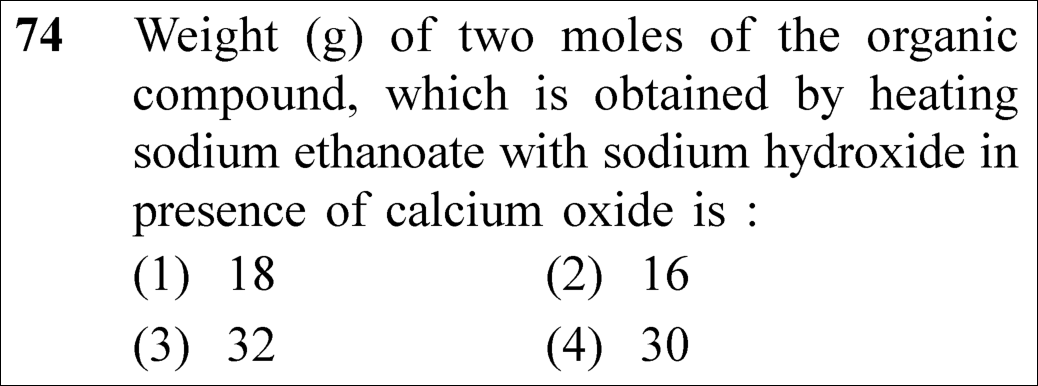
NEET 2023 · Q74 Easy
Official NEET 2023 Question 74 - Hydrocarbons
1 18
2 16
3 32 ✓ Key
4 30
💡 Verified Solution & 30-Second Hack
✓
Verified Against NTA Final Answer Key
Option (3) : 32
📚 Hydrocarbons Easy
📋 Given Parameters & Problem Setup
Reactant Sodium ethanoate (CH₃COONa)
Reagent Soda-lime (NaOH + CaO in 3:1 ratio, Δ)
Target quantity Weight (in grams) of TWO MOLES of the organic product
⚡

The 30-Second Exam Hall Shortcut: ⚡ Decarboxylation Product & 2-Mole Mass Hack

⏱️ Save ~30 seconds

CH₃COONa + NaOH ⟶ CH₄ + Na₂CO₃. The organic compound is methane (CH₄, molar mass = 16 g/mol). Two moles weigh 2 × 16 = 32 g in 10 seconds! (Option 3)

1 Identify the reaction: Heating sodium ethanoate with soda-lime (NaOH + CaO) is the classic decarboxylation reaction.
2 The carboxyl group is cleaved as Na₂CO₃: CH₃COONa + NaOH ⟶ CH₄ + Na₂CO₃.
3 The organic compound formed is methane (CH₄).
4 Calculate the molar mass of methane: M(CH₄) = 12 + 4(1) = 16 g mol⁻¹.
5 The question specifically asks for the weight of TWO MOLES of the compound:
6 Mass = 2 mol × 16 g mol⁻¹ = 32 g.
7 Lock Option (3) 32 immediately!
🛡️
Why You Can 100% Trust This Shortcut: Organic Syntheses · Decarboxylation of Carboxylic Acids (Sodium salts of carboxylic acids heated with soda-lime lose carbon dioxide to form alkanes containing one carbon less than the carboxylic acid).
📐

Step-by-Step Rigorous Workflow & Mathematical Proof

Step 1

Equation for Soda-Lime Decarboxylation

When sodium ethanoate is heated with soda-lime (a dry mixture of sodium hydroxide and calcium oxide in an approximate 3:1 mass ratio), it undergoes decarboxylation to produce an alkane with one less carbon atom than the parent carboxylate salt:

CH3COONa+NaOH→CaO, ΔCH4(g)+Na2CO3(s)\text{CH}_3\text{COONa} + \text{NaOH} \xrightarrow{\text{CaO, } \Delta} \text{CH}_4(g) + \text{Na}_2\text{CO}_3(s)
Step 2

Identification of the Organic Product

Of the two products formed, Na₂CO₃ is an inorganic salt, so the organic compound obtained is methane (CH₄).

Organic Product=Methane (CH4)\text{Organic Product} = \text{Methane } (\text{CH}_4)
Step 3

Molar Mass Calculation of Methane

Calculate the molecular weight of methane from standard atomic masses (C = 12 u, H = 1 u):

M(CH4)=12+4(1)=16 g mol−1M(\text{CH}_4) = 12 + 4(1) = 16\text{ g mol}^{-1}
Step 4

Evaluation of the Mass of Two Moles

The problem explicitly asks for the weight in grams of TWO MOLES of this organic compound:

Mass=n×M=2 mol×16 g mol−1=32 g\text{Mass} = n \times M = 2\text{ mol} \times 16\text{ g mol}^{-1} = 32\text{ g}
⭐

360° Option Elimination Engine Key Feature

Diagnose every choice: Know exactly why the right option works and why distractors fail.

4-Option Deep Scan
1 (1)
✗ Incorrect
Verdict & Scientific Reason:

Molar mass of water (H₂O), completely irrelevant to methane.

⚠️
Student Fallacy (Why candidates pick this trap): Candidate confused the product with water.
2 (2)
✗ Incorrect
Verdict & Scientific Reason:

Mass of ONE mole of methane (CH₄), forgetting that the question asks for TWO moles.

⚠️
Student Fallacy (Why candidates pick this trap): Candidate solved for 1 mole of CH₄ (16 g) and forgot to multiply by 2.
3 (3)
✓ 100% Correct
Verdict & Scientific Reason:

Accurate weight of 2 moles of methane: 2 × 16 g = 32 g.

💡
Why this is airtight: None. Candidate accounted for the "two moles" multiplier.
4 (4)
✗ Incorrect
Verdict & Scientific Reason:

Molar mass of ethane (C₂H₆), which would form in Kolbe’s electrolysis, not soda-lime decarboxylation.

⚠️
Student Fallacy (Why candidates pick this trap): Candidate confused soda-lime decarboxylation with Kolbe’s electrolytic coupling.
⚠️

NTA Trap Alert: Reporting the Molar Mass (16 g) Instead of Two Moles (32 g)

The most frequent mistake on this question is correctly identifying methane (CH₄, 16 g/mol) and immediately circling 16 (Option 2). The question prompt explicitly starts with "Weight (g) of TWO MOLES..."!

🛡️ How to avoid the -1 mark: Always reread the question stem: "two moles" means 2 × 16 = 32 g.
📖

Core NEET Syllabus Standard

National Eligibility cum Entrance Test (NEET UG) · Hydrocarbons Standard Benchmark
Core Scientific Principle Tested:

"Decarboxylation of sodium ethanoate yields methane: CH₃COONa + NaOH ⟶ CH₄ + Na₂CO₃. 2 moles of CH₄ weigh 32 g."

Syllabus Focus: Alkanes – Preparation from Carboxylic Acids (Decarboxylation)
Preserved in Rationalized Curriculum Syllabus & Academic Standards ↗
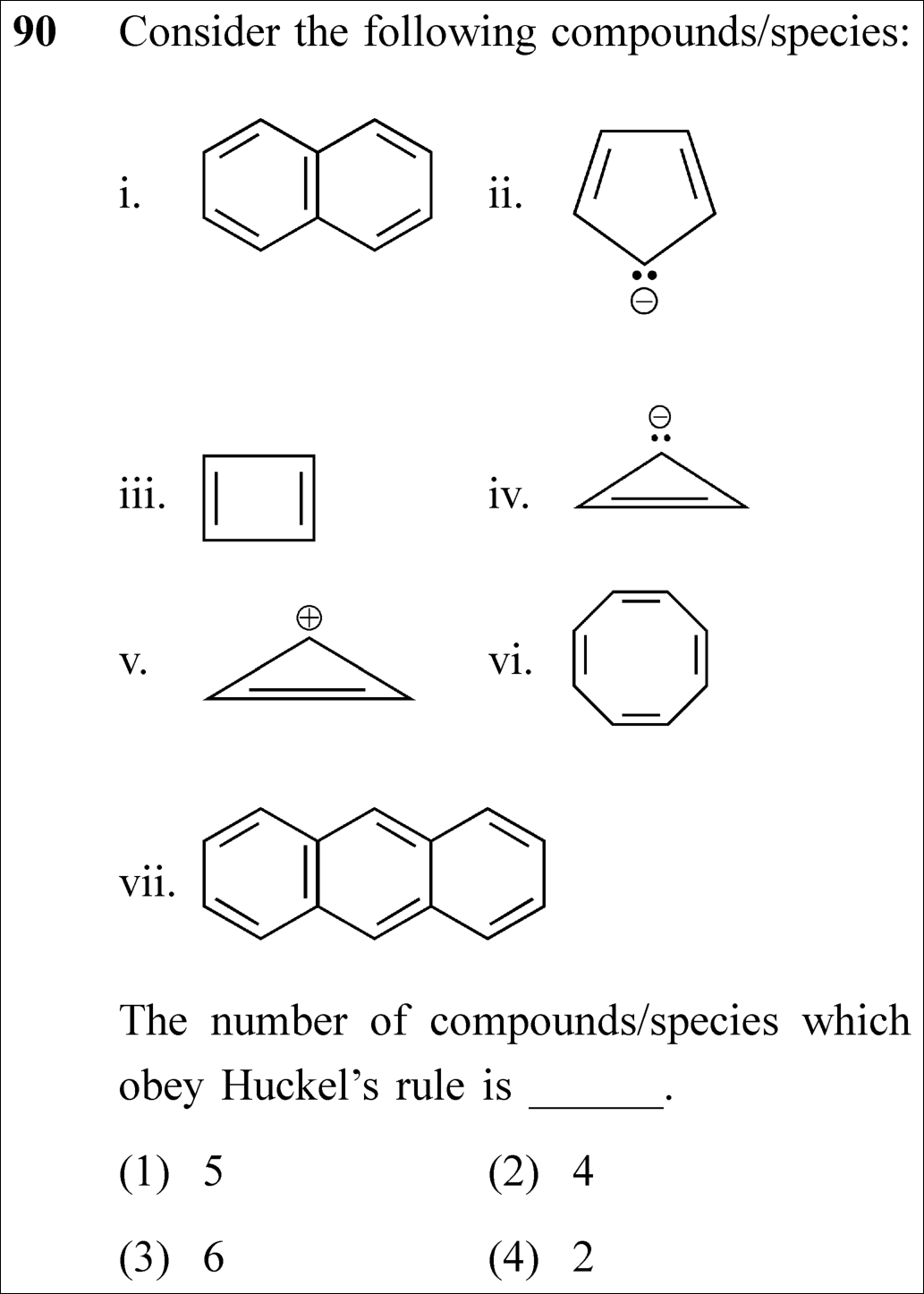
NEET 2023 · Q90 Medium
Official NEET 2023 Question 90 - Hydrocarbons
1
2 ✓ Key
3
4
💡 Verified Solution & 30-Second Hack
✓
Verified Against NTA Final Answer Key
Option (2) : 4
📚 Hydrocarbons Medium
📋 Given Parameters & Problem Setup
Species evaluated i. Naphthalene, ii. Cyclopentadienyl anion, iii. Cyclobutadiene, iv. Cyclopropenyl anion, v. Cyclopropenyl cation, vi. Cyclooctatetraene, vii. Anthracene
Rule to test Hückel’s Rule ((4n + 2) π electrons, cyclic, planar, fully conjugated)
⚡

The 30-Second Exam Hall Shortcut: ⚡ Hückel’s Magic Numbers: 2, 6, 10, 14 π Electrons in Planar Conjugated Cycles

⏱️ Save ~40 seconds

Hückel’s rule requires (4n + 2) delocalized π electrons in a planar conjugated ring. Count π electrons for each: i (10, n=2) ✓; ii (6, n=1) ✓; iii (4, 4n anti-aromatic) ✗; iv (4, 4n anti-aromatic) ✗; v (2, n=0) ✓; vi (8, non-planar tub) ✗; vii (14, n=3) ✓. Exactly 4 species obey Hückel’s rule in 15 seconds!

1 Check i (Naphthalene): 10 π electrons (4n+2 with n=2) ⟶ Aromatic (Obey).
2 Check ii (Cyclopentadienyl anion): 4 from double bonds + 2 from lone pair = 6 π electrons (n=1) ⟶ Aromatic (Obey).
3 Check iii (Cyclobutadiene): 4 π electrons (4n system) ⟶ Anti-aromatic (Does NOT obey).
4 Check iv (Cyclopropenyl anion): 2 from double bond + 2 from lone pair = 4 π electrons (4n system) ⟶ Anti-aromatic (Does NOT obey).
5 Check v (Cyclopropenyl cation): 2 π electrons (4n+2 with n=0) ⟶ Aromatic (Obey).
6 Check vi (Cyclooctatetraene): 8 π electrons, adopts non-planar tub conformation ⟶ Non-aromatic (Does NOT obey).
7 Check vii (Anthracene): 14 π electrons (4n+2 with n=3) ⟶ Aromatic (Obey).
8 Total qualifying species = 4 (Option 2).
🛡️
Why You Can 100% Trust This Shortcut: Classical Hückel’s Rule criteria for aromaticity in NCERT Organic Chemistry.
📐

Step-by-Step Rigorous Workflow & Mathematical Proof

Step 1

Criteria for Obeying Hückel’s Rule

For a compound to obey Hückel’s rule of aromaticity, it must satisfy three structural criteria: (a) cyclic and planar ring system, (b) complete delocalization of π electrons across the ring, and (c) contain (4n + 2) π electrons where n = 0, 1, 2, 3...

Hu¨ckel’s Formula: Nπ=4n+2(n=0,1,2,3,… )\text{Hückel's Formula: } N_\pi = 4n + 2 \quad (n = 0, 1, 2, 3, \dots)
Step 2

Evaluation of Benzenoid Fused Arenes

Naphthalene (i) has 5 conjugated double bonds = 10 π electrons (4n+2 with n=2). Anthracene (vii) has 7 conjugated double bonds = 14 π electrons (4n+2 with n=3). Both are planar, fully conjugated, and aromatic:

Naphthalene (i): 10π (n=2),Anthracene (vii): 14π (n=3)  ⟹  Both Obey\text{Naphthalene (i): } 10\pi\ (n=2), \quad \text{Anthracene (vii): } 14\pi\ (n=3) \implies \text{Both Obey}
Step 3

Evaluation of Charged Carbocycles

Cyclopentadienyl anion (ii) has two double bonds (4 e⁻) and one localized lone pair in a p-orbital (2 e⁻) = 6 π electrons (n=1, aromatic). Cyclopropenyl cation (v) has one double bond (2 e⁻) and a vacant p-orbital = 2 π electrons (n=0, aromatic):

Cyclopentadienyl anion (ii): 6π (n=1),Cyclopropenyl cation (v): 2π (n=0)  ⟹  Both Obey\text{Cyclopentadienyl anion (ii): } 6\pi\ (n=1), \quad \text{Cyclopropenyl cation (v): } 2\pi\ (n=0) \implies \text{Both Obey}
Step 4

Disqualification of Non-Aromatic and Anti-Aromatic Species

Cyclobutadiene (iii) has 4 π electrons (4n, anti-aromatic). Cyclopropenyl anion (iv) has 4 π electrons (4n, anti-aromatic). Cyclooctatetraene (vi) has 8 π electrons and adopts a non-planar tub conformation (non-aromatic). None of these three obey Hückel’s rule:

Species iii, iv, vi: Do not obey Hu¨ckel’s rule  ⟹  Total Obeying=4\text{Species iii, iv, vi: Do not obey Hückel's rule} \implies \text{Total Obeying} = 4
⭐

360° Option Elimination Engine Key Feature

Diagnose every choice: Know exactly why the right option works and why distractors fail.

4-Option Deep Scan
1 (1)
✗ Incorrect
Verdict & Scientific Reason:

Overcounts by including cyclooctatetraene or an anti-aromatic ring.

⚠️
Student Fallacy (Why candidates pick this trap): Candidate incorrectly counted COT (8π) as aromatic.
2 (2)
✓ 100% Correct
Verdict & Scientific Reason:

Accurate: Exactly 4 species obey Hückel’s rule (i: 10π, ii: 6π, v: 2π, vii: 14π).

💡
Why this is airtight: None. Candidate correctly applied (4n + 2) and planarity requirements.
3 (3)
✗ Incorrect
Verdict & Scientific Reason:

Includes anti-aromatic 4n systems (cyclobutadiene and cyclopropenyl anion).

⚠️
Student Fallacy (Why candidates pick this trap): Candidate counted 4n π electron systems as obeying Hückel’s rule.
4 (4)
✗ Incorrect
Verdict & Scientific Reason:

Counted only fused benzenoids and missed charged aromatic ions.

⚠️
Student Fallacy (Why candidates pick this trap): Candidate did not recognize charged species (cyclopentadienyl anion, cyclopropenyl cation) as aromatic.
⚠️

NTA Trap Alert: Counting π-Electrons in Carbanions and Carbocations

In cyclopropenyl anion, the lone pair adds 2 electrons to the double bond, giving 4π electrons (4n, anti-aromatic). In cyclopropenyl cation, the vacant p-orbital has 0 electrons, giving 2π electrons (4n+2 with n=0, aromatic). Don’t confuse anion and cation!

🛡️ How to avoid the -1 mark: Carbanion carbon in conjugated ring contributes 2 π electrons; carbocation carbon with vacant p-orbital contributes 0.
📖

Core NEET Syllabus Standard

National Eligibility cum Entrance Test (NEET UG) · Hydrocarbons Standard Benchmark
Core Scientific Principle Tested:

"A planar, cyclic, fully conjugated system possessing (4n + 2) π electrons exhibits exceptional aromatic stability."

Syllabus Focus: Aromaticity – Hückel’s Rule
Preserved in Rationalized Curriculum Syllabus & Academic Standards ↗
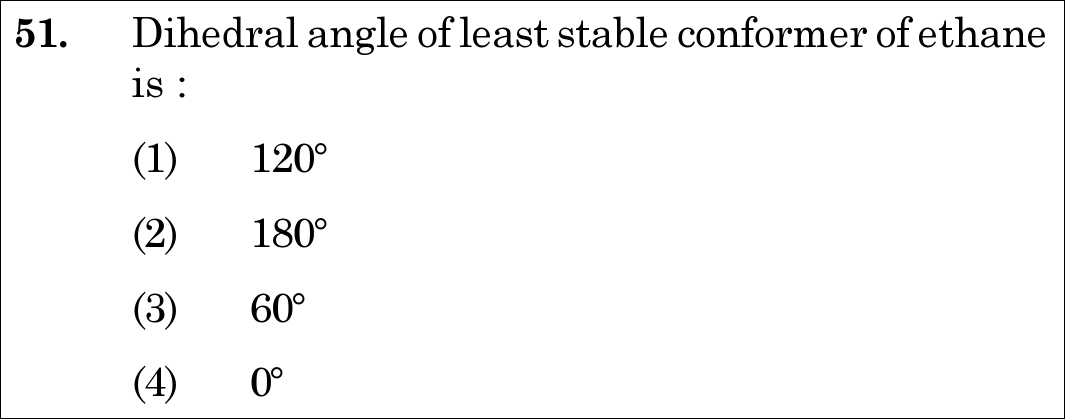
NEET 2021 · Q51 Easy
Official NEET 2021 Question 51 - Hydrocarbons
1
2
3
4 ✓ Key
💡 Verified Solution & 30-Second Hack
✓
Verified Against NTA Final Answer Key
Option (4) : 0°
📚 Hydrocarbons Easy
📋 Given Parameters & Problem Setup
Molecule Ethane (C2H6)
Target Conformer Least stable conformer (Eclipsed conformer)
⚡

The 30-Second Exam Hall Shortcut: ⚡ Eclipsed = 0° Dihedral Angle

⏱️ Save ~20 seconds

The least stable conformer of ethane is the eclipsed conformer due to maximum torsional strain between adjacent C-H bonding pairs. In the eclipsed form, hydrogen atoms directly shadow each other with a dihedral angle of θ=0∘\theta = 0^\circ! The most stable staggered form has θ=60∘\theta = 60^\circ. Match Option (4)!

1 Recall ethane conformers: Staggered conformer (most stable) and Eclipsed conformer (least stable).
2 Torsional strain is maximal in the eclipsed conformer because electron clouds of adjacent C-H bonds are at minimum distance.
3 Looking down the C-C bond (Newman projection), the dihedral angle between front and back C-H bonds in eclipsed form is θ=0∘\theta = 0^\circ.
4 Match Option (4).
🛡️
Why You Can 100% Trust This Shortcut: Canonical NCERT Hydrocarbons section on Conformations of Ethane.
📐

Step-by-Step Rigorous Workflow & Mathematical Proof

Step 1

Definition of Dihedral (Torsional) Angle

The dihedral angle (also called torsional angle θ\theta) in ethane (CH3−CH3CH_3-CH_3) is the angle between the two intersecting planes formed by the H−C−CH-C-C bonds of the adjacent carbon atoms when viewed along the carbon-carbon single bond axis.

Step 2

Identifying the Least Stable Conformation of Ethane

Ethane exhibits infinite conformations resulting from free rotation about the C−CC-C σ\sigma-bond. The two extreme conformations are: - Staggered Conformation: Hydrogen atoms are as far apart as possible (dihedral angle θ=60∘\theta = 60^\circ). Torsional strain is minimized, rendering it the most stable conformer. - Eclipsed Conformation: Hydrogen atoms on adjacent carbons are closest to each other, resulting in maximum repulsive interaction between adjacent bonding electron pairs (torsional strain of ≈12.5 kJ/mol\approx 12.5\text{ kJ/mol}). Consequently, it is the least stable conformer.

θeclipsed=0∘,θstaggered=60∘\theta_{\text{eclipsed}} = 0^\circ, \quad \theta_{\text{staggered}} = 60^\circ
Step 3

Conclusion

The dihedral angle of the least stable (eclipsed) conformer is identically 0∘0^\circ, corresponding to Option (4).

⭐

360° Option Elimination Engine Key Feature

Diagnose every choice: Know exactly why the right option works and why distractors fail.

4-Option Deep Scan
1 1
✗ Incorrect
Verdict & Scientific Reason:

At heta=120circheta = 120^circ, another eclipsed conformation is achieved, but the fundamental dihedral angle defining eclipse is 0circ0^circ.

⚠️
Student Fallacy (Why candidates pick this trap): Confusing tetrahedral or planar bond angles (120circ120^circ) with the primary dihedral angle.
2 2
✗ Incorrect
Verdict & Scientific Reason:

At heta=180circheta = 180^circ, the conformer is staggered (anti-periplanar equivalent in butane, highly stable).

⚠️
Student Fallacy (Why candidates pick this trap): Confusing anti-conformation with eclipsed conformation.
3 3
✗ Incorrect
Verdict & Scientific Reason:

This is the dihedral angle of the MOST stable (staggered) conformer of ethane.

⚠️
Student Fallacy (Why candidates pick this trap): Misreading "least stable" as "most stable".
4 4
✓ 100% Correct
Verdict & Scientific Reason:

Exact dihedral angle of the eclipsed conformer where electron-cloud repulsion (torsional strain) is maximal.

💡
Why this is airtight: None; textbook conformation knowledge.
⚠️

NTA Trap Alert: Most Stable vs. Least Stable Reading Trap

Students frequently read "conformer of ethane" and instinctively select 60∘60^\circ (Option 3), forgetting that 60∘60^\circ corresponds to the MOST stable staggered form, whereas the prompt explicitly asks for the LEAST stable (eclipsed, 0∘0^\circ) form.

🛡️ How to avoid the -1 mark: Highlight the keyword: "LEAST stable"   ⟹  \implies Eclipsed   ⟹  0∘\implies 0^\circ. "MOST stable"   ⟹  \implies Staggered   ⟹  60∘\implies 60^\circ.
📖

Core NEET Syllabus Standard

NCERT Chemistry · Hydrocarbons Standard Benchmark
Core Scientific Principle Tested:

"In the eclipsed conformation of ethane, adjacent C-H bonds have a dihedral angle of 0∘0^\circ and experience maximum torsional strain."

Syllabus Focus: Conformations of Alkanes (Ethane)
✓ Core NEET UG Syllabus Anchor Syllabus & Academic Standards ↗
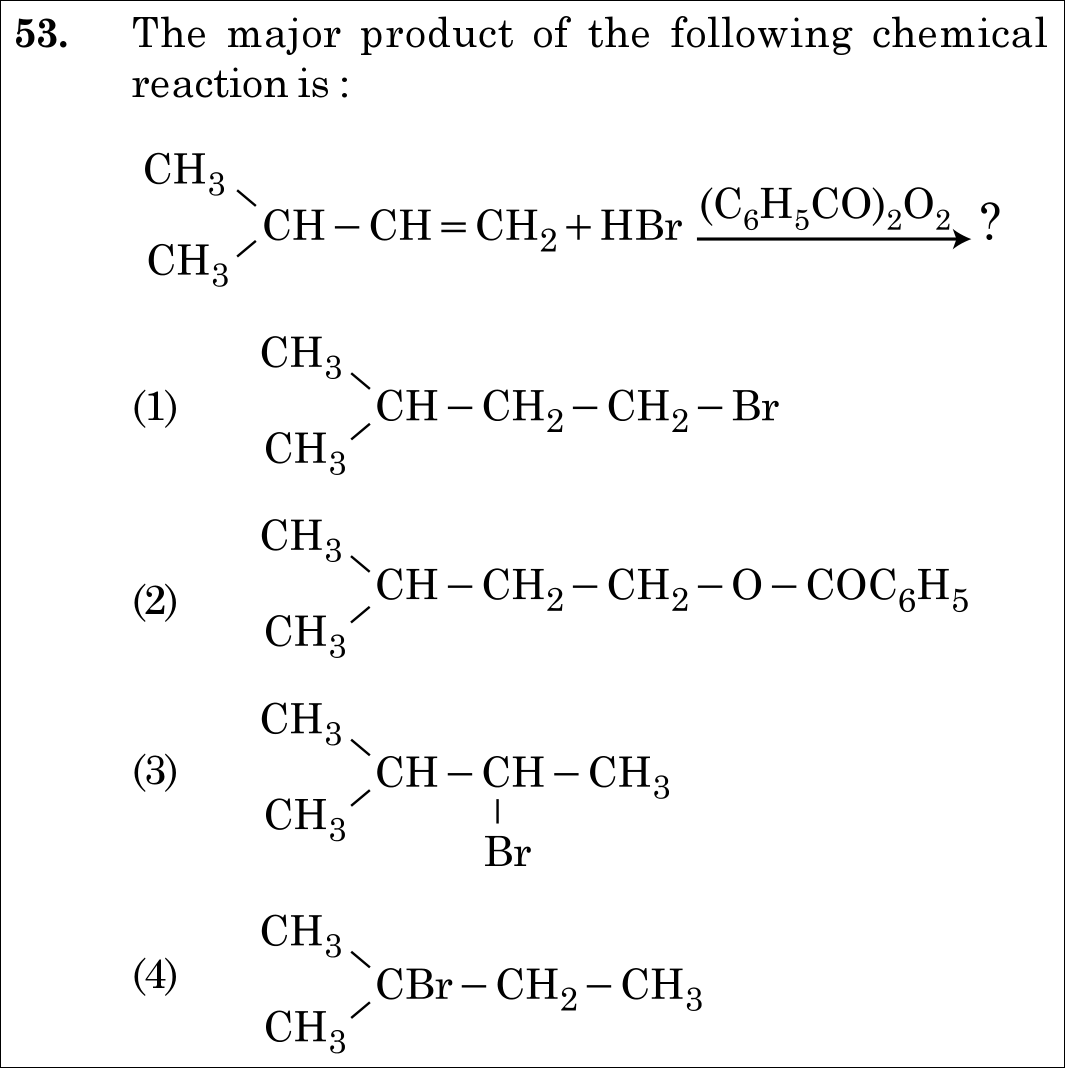
NEET 2021 · Q53 Easy
Official NEET 2021 Question 53 - Hydrocarbons
1 ✓ Key
2
3
4
💡 Verified Solution & 30-Second Hack
✓
Verified Against NTA Final Answer Key
Option (1) : (CH3)2CH - CH2 - CH2 - Br
📚 Hydrocarbons Easy
📋 Given Parameters & Problem Setup
Reactant Alkene 3-methylbut-1-ene ((CH3)2CH - CH = CH2)
Reagent HBr in presence of benzoyl peroxide ((C6H5CO)2O2)
⚡

The 30-Second Exam Hall Shortcut: ⚡ Peroxide Effect on HBr = Anti-Markovnikov Product!

⏱️ Save ~25 seconds

Addition of HBrHBr in the presence of organic peroxides exclusively follows the free radical Anti-Markovnikov pathway (Kharasch effect). The bromine radical (Br˙\dot{\text{Br}}) attacks the less substituted terminal carbon (C1C_1) to form the more stable 2∘2^\circ free radical, yielding 1-bromo-3-methylbutane: (CH3)2CH−CH2−CH2−Br(CH_3)_2CH-CH_2-CH_2-Br! Match Option (1)!

1 Reagent is HBr+peroxide  ⟹  HBr + \text{peroxide} \implies Peroxide effect (Anti-Markovnikov addition).
2 In free-radical addition, Br˙\dot{\text{Br}} attacks first at the terminal carbon (CH2CH_2) to generate the more stable secondary free radical: (CH3)2CH−C˙H−CH2Br(CH_3)_2CH - \dot{C}H - CH_2Br.
3 Subsequent reaction with HBrHBr abstracts a hydrogen atom to yield the 11-bromo alkane.
4 Result: (CH3)2CH−CH2−CH2−Br(CH_3)_2CH - CH_2 - CH_2 - Br (1-bromo-3-methylbutane).
5 Match Option (1).
🛡️
Why You Can 100% Trust This Shortcut: Canonical Kharasch peroxide effect mechanism in NCERT Hydrocarbons.
📐

Step-by-Step Rigorous Workflow & Mathematical Proof

Step 1

Initiation Step: Generation of Bromine Free Radical

Benzoyl peroxide undergoes homolytic cleavage upon heating or exposure to light to yield benzoyloxy radicals, which decarboxylate into phenyl radicals and abstract hydrogen from HBrHBr to generate bromine radicals:

(C6H5CO)2O2⟶2C6H5C˙O⟶2C˙6H5+2CO2,C˙6H5+HBr⟶C6H6+Br˙(C_6H_5CO)_2O_2 \longrightarrow 2 C_6H_5\dot{C}O \longrightarrow 2 \dot{C}_6H_5 + 2 CO_2, \quad \dot{C}_6H_5 + HBr \longrightarrow C_6H_6 + \dot{\text{Br}}
Step 2

Propagation Step 1: Regioselective Addition of Bromine Radical

The electrophilic bromine radical attacks the unsymmetrical double bond of 3-methylbut-1-ene. Addition at the less hindered terminal CH2CH_2 carbon generates a stable secondary (2∘2^\circ) free radical rather than an unstable primary (1∘1^\circ) radical:

(CH3)2CH−CH=CH2+Br˙⟶(CH3)2CH−C˙H−CH2−Br(more stable 2∘ radical)(CH_3)_2CH - CH = CH_2 + \dot{\text{Br}} \longrightarrow (CH_3)_2CH - \dot{C}H - CH_2 - Br \quad (\text{more stable } 2^\circ \text{ radical})
Step 3

Propagation Step 2: Hydrogen Abstraction to Form Final Product

The secondary radical abstracts a hydrogen atom from another HBrHBr molecule to produce 1-bromo-3-methylbutane and regenerates a bromine radical:

(CH3)2CH−C˙H−CH2−Br+HBr⟶(CH3)2CH−CH2−CH2−Br+Br˙(CH_3)_2CH - \dot{C}H - CH_2 - Br + HBr \longrightarrow (CH_3)_2CH - CH_2 - CH_2 - Br + \dot{\text{Br}}
⭐

360° Option Elimination Engine Key Feature

Diagnose every choice: Know exactly why the right option works and why distractors fail.

4-Option Deep Scan
1 1
✓ 100% Correct
Verdict & Scientific Reason:

Exact Anti-Markovnikov major product obtained via free-radical peroxide mechanism.

💡
Why this is airtight: None; rigorous organic mechanism execution.
2 2
✗ Incorrect
Verdict & Scientific Reason:

Erroneously incorporates the peroxide catalyst into the organic skeleton.

⚠️
Student Fallacy (Why candidates pick this trap): Believing the peroxide acts as a nucleophile rather than a radical initiator.
3 3
✗ Incorrect
Verdict & Scientific Reason:

This is the un-rearranged Markovnikov addition product formed in the ABSENCE of peroxides.

⚠️
Student Fallacy (Why candidates pick this trap): Ignoring the presence of benzoyl peroxide and applying standard Markovnikov rule.
4 4
✗ Incorrect
Verdict & Scientific Reason:

This is the rearranged tertiary carbocation product formed during carbocationic Markovnikov addition (in absence of peroxides).

⚠️
Student Fallacy (Why candidates pick this trap): Assuming carbocation intermediate with hydride shift occurs under free radical conditions.
⚠️

NTA Trap Alert: Markovnikov vs. Peroxide Effect Trap

Without peroxide, HBrHBr addition proceeds via carbocations, undergoing a 1,2-hydride shift to yield 2-bromo-2-methylbutane (Option 4). In the PRESENCE of peroxide, free radicals are formed, which DO NOT undergo hydride rearrangements and strictly yield the Anti-Markovnikov terminal bromide (Option 1).

🛡️ How to avoid the -1 mark: Identify (C6H5CO)2O2(C_6H_5CO)_2O_2! Peroxide + HBr  ⟹  HBr \implies Anti-Markovnikov (terminal Br).
📖

Core NEET Syllabus Standard

NCERT Chemistry · Hydrocarbons Standard Benchmark
Core Scientific Principle Tested:

"In the presence of peroxide, addition of HBr to unsymmetrical alkenes takes place contrary to Markovnikov's rule via a free-radical mechanism."

Syllabus Focus: Chemical Reactions of Alkenes (Peroxide Effect / Kharasch Effect)
✓ Core NEET UG Syllabus Anchor Syllabus & Academic Standards ↗
NEET 2021 · Q73 Medium
Official NEET 2021 Question 73 - Hydrocarbons
1 ✓ Key
2
3
4
💡 Verified Solution & 30-Second Hack
✓
Verified Against NTA Final Answer Key
Option (1) : Structure (1)
📚 Hydrocarbons Medium
📋 Given Parameters & Problem Setup
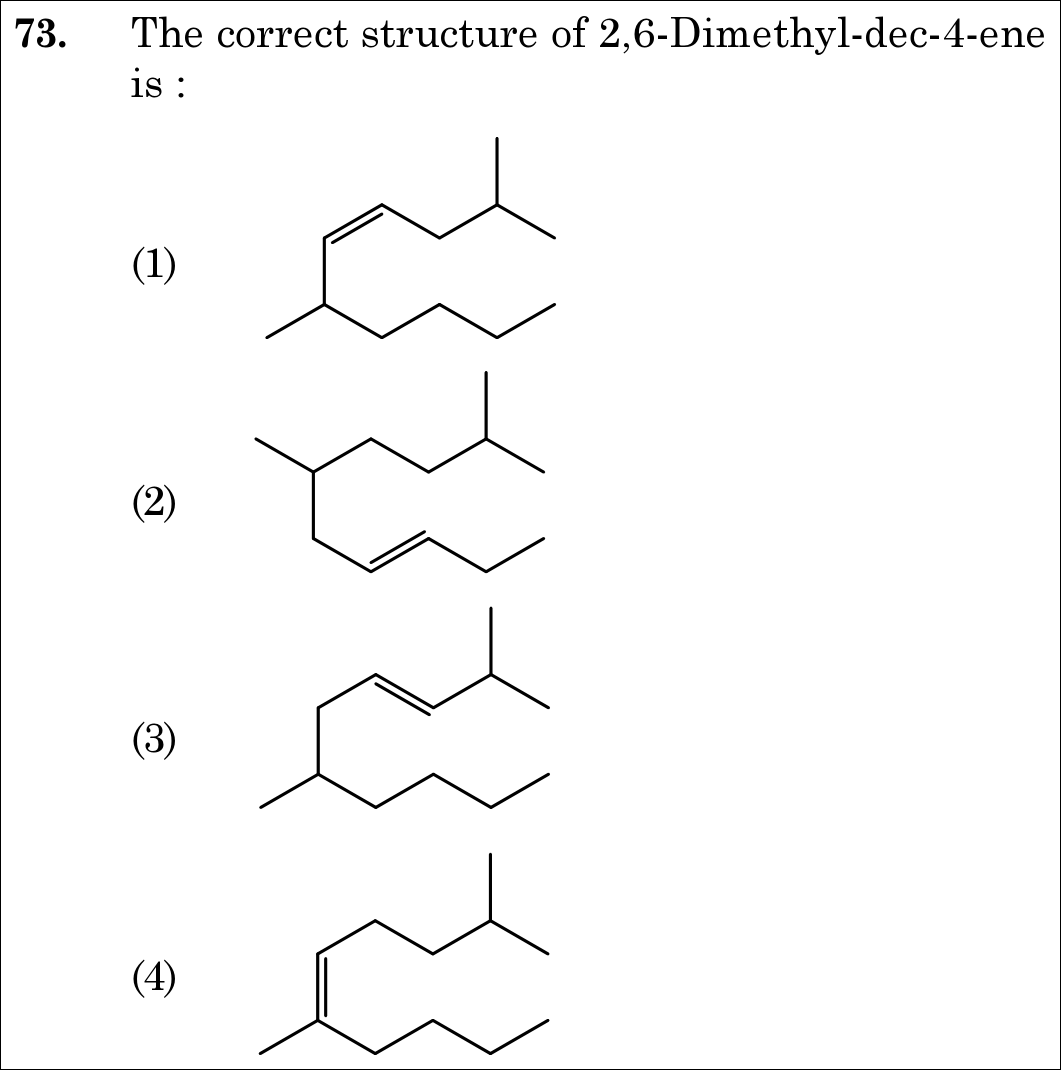
Target Compound 2,6-Dimethyl-dec-4-ene
Main Chain 10 carbon atoms (dec-)
Principal Unsaturation Double bond at C-4 (dec-4-ene)
Substituents Two methyl groups at C-2 and C-6
⚡

The 30-Second Exam Hall Shortcut: ⚡ IUPAC Locant Verification: 2-Methyl + C4=C5 + 6-Methyl

⏱️ Save ~25 seconds

Number from the end that gives lowest locant to the double bond: Top right is isopropyl (C1−C2(CH3)−C_1-C_2(CH_3)-). Then C3(CH2)C_3(CH_2), then double bond starts at C4C_4 (C4=C5C_4=C_5). Carbon C6C_6 carries the second methyl group, followed by a 4-carbon butyl chain (C7−C8−C9−C10C_7-C_8-C_9-C_{10}). Total chain = 10 carbons (dec-4-ene) with methyls at 2 and 6. This is uniquely Structure (1)! Match Option (1)!

1 Target IUPAC: 2,6-Dimethyldec-4-ene.
2 Check main chain length: 10 carbons.
3 Double bond must be at position 4 (between C4 and C5).
4 In Structure (1): - C1: terminal methyl - C2: CH with methyl branch - C3: CH2 - C4=C5: double bond - C6: CH with methyl branch - C7 to C10: butyl chain (-CH2-CH2-CH2-CH3). All locants match perfectly (2,6-dimethyldec-4-ene).
5 In Structure (3), the double bond is between C3 and C4 (dec-3-ene).
6 Match Option (1).
🛡️
Why You Can 100% Trust This Shortcut: Canonical IUPAC rules for naming branched alkenes.
📐

Step-by-Step Rigorous Workflow & Mathematical Proof

Step 1

Decoding the IUPAC Name 2,6-Dimethyl-dec-4-ene

Break down the IUPAC components: - Root word: dec   ⟹  \implies longest continuous carbon chain containing the double bond has 10 carbon atoms. - Suffix: -4-ene   ⟹  \implies double bond is between carbon-4 and carbon-5. - Substituents: 2,6-dimethyl   ⟹  \implies methyl groups (−CH3-CH_3) are located at carbon-2 and carbon-6.

Step 2

Verifying Structure (1)

Trace the carbon skeleton of Structure (1) starting from the right-hand isopropyl terminus: - C1C_1: terminal methyl group - C2C_2: carbon with vertical methyl branch - C3C_3: −CH2−-CH_2- methylene carbon - C4=C5C_4=C_5: internal double bond (dec-4-ene) - C6C_6: carbon with methyl branch - C7−C8−C9−C10C_7-C_8-C_9-C_{10}: linear butyl tail (−CH2−CH2−CH2−CH3-CH_2-CH_2-CH_2-CH_3) Total carbon chain length =10= 10. The double bond is at position 4, and substituents are at 2 and 6. Thus, Structure (1) is identically 2,6-dimethyldec-4-ene.

Step 3

Eliminating Alternative Structures

- Structure (2): Double bond is located towards the bottom at position 5 or 6. - Structure (3): The double bond connects directly to the carbon adjacent to C2, placing the double bond at position 3 (dec-3-ene). - Structure (4): The double bond is located between the branch carbon and the next carbon, giving an incorrect substituent position.

⭐

360° Option Elimination Engine Key Feature

Diagnose every choice: Know exactly why the right option works and why distractors fail.

4-Option Deep Scan
1 1
✓ 100% Correct
Verdict & Scientific Reason:

Flawless structure of 2,6-dimethyldec-4-ene with 10 carbons in parent chain and correct locants.

💡
Why this is airtight: None; rigorous IUPAC skeleton verification.
2 2
✗ Incorrect
Verdict & Scientific Reason:

Double bond is located at position 5/6, not position 4.

⚠️
Student Fallacy (Why candidates pick this trap): Incorrect locant numbering.
3 3
✗ Incorrect
Verdict & Scientific Reason:

Double bond is at position 3 (2,6-dimethyldec-3-ene).

⚠️
Student Fallacy (Why candidates pick this trap): Missing the methylene spacer between C2 and double bond.
4 4
✗ Incorrect
Verdict & Scientific Reason:

Double bond is at position 2, directly at the branch point.

⚠️
Student Fallacy (Why candidates pick this trap): Misplacing double bond at branch carbon.
⚠️

NTA Trap Alert: Counting Vertices in Skeletal Bond-Line Formulas Trap

In bond-line structures, candidates frequently mistake Structure (3) for the answer by miscounting the single bond between the isopropyl group and the double bond. In Structure (3), only 1 carbon separates C2 and the alkene, making it dec-3-ene. In Structure (1), a full methylene (−CH2−-CH_2-) group exists at C3, making it dec-4-ene.

🛡️ How to avoid the -1 mark: Count vertices sequentially from C1: C1→C2(methyl)→C3→C4=C5C_1 \to C_2(\text{methyl}) \to C_3 \to C_4=C_5. Only Structure (1) has the double bond at C4.
📖

Core NEET Syllabus Standard

NCERT Chemistry · Hydrocarbons Standard Benchmark
Core Scientific Principle Tested:

"IUPAC rules dictate selecting the longest chain containing the double bond and numbering from the end that gives the double bond the lowest locant."

Syllabus Focus: Nomenclature of Alkenes
✓ Core NEET UG Syllabus Anchor Syllabus & Academic Standards ↗
NEET 2020 · Q133 Easy
Official NEET 2020 Question 133 - Hydrocarbons
1
2
3 ✓ Key
4
💡 Verified Solution & 30-Second Hack
✓
Verified Against NTA Final Answer Key
Option (3) : Methylenecyclohexane (exocyclic =CH2 alkene)
📚 Hydrocarbons Easy
📋 Given Parameters & Problem Setup
Reaction Reductive ozonolysis (1. O3, 2. Zn / H2O)
Diagnostic Product Methanal (Formaldehyde, HCHO)
Structural Requirement Terminal alkene containing =CH2 group
⚡

The 30-Second Exam Hall Shortcut: ⚡ "Methanal (HCHO) Means the Alkene MUST Have a Terminal =CH2 Group!"

⏱️ 20 seconds

Ozonolysis cleaves the double bond: R1R2C=CH2→O3,Zn/H2OR1R2C=O+HCHO\text{R}_1\text{R}_2\text{C}=\text{CH}_2 \xrightarrow{\text{O}_3, \text{Zn/H}_2\text{O}} \text{R}_1\text{R}_2\text{C}=\text{O} + \text{HCHO}. For methanal (HCHOHCHO) to be formed, one of the doubly bonded carbons must be attached to TWO hydrogens (i.e. a terminal =CH2=CH_2 group). Option (3) is methylenecyclohexane containing an exocyclic =CH2=CH_2 double bond, which cleanly yields cyclohexanone and methanal! Mark Option (3) in 5 seconds.

1 Cleavage rule: Cut the C=C bond and cap both ends with =O.
2 Product required: Methanal (H-CHO).
3 Backtrack: To yield H2C=O, the original alkene must contain =CH2.
4 Option (1), (2), and (4) have endocyclic or internal double bonds (-CH=CH- or -CH=C(CH3)-).
5 Option (3) has an exocyclic =CH2 double bond on the ring.
6 Select Option (3).
🛡️
Why You Can 100% Trust This Shortcut: NCERT Chemistry · Hydrocarbons (Alkenes: Chemical Properties - Ozonolysis)
📐

Step-by-Step Rigorous Workflow & Mathematical Proof

Step 1

Mechanism of Reductive Ozonolysis

Ozonolysis of alkenes involves the addition of an ozone molecule to the carbon-carbon double bond to form an ozonide intermediate. Subsequent cleavage of the ozonide with zinc dust and water (Zn+H2O\text{Zn} + \text{H}_2\text{O}) cleaves the double bond completely, converting each doubly bonded carbon into a carbonyl (C=O\text{C}=\text{O}) group: R1R2C=CR3R4→1. O3, 2. Zn/H2OR1R2C=O+O=CR3R4\text{R}_1\text{R}_2\text{C}=\text{CR}_3\text{R}_4 \xrightarrow{\text{1. O}_3, \text{ 2. Zn/H}_2\text{O}} \text{R}_1\text{R}_2\text{C}=\text{O} + \text{O}=\text{CR}_3\text{R}_4

Step 2

Structural Requirement for Methanal Formation

Methanal (formaldehyde, HCHO\text{HCHO}) has the structure H2C=O\text{H}_2\text{C}=\text{O}. Therefore, for methanal to be produced, one end of the alkene double bond must have been an unsubstituted methylene carbon (=CH2=\text{CH}_2), which only occurs in terminal alkenes.

Step 3

Evaluate the Candidate Structures in Options

- Structure (1): 1-methylcyclohexene. The double bond is inside the ring (endocyclic). Ozonolysis breaks the ring to yield 6-oxoheptanal (a single dicarbonyl compound), with no formaldehyde. - Structure (2): Cyclohexene with internal methyl substituent, gives a dicarbonyl upon ring opening. - Structure (3): Methylenecyclohexane (cyclohexane ring with an exocyclic =CH2=\text{CH}_2 group). Ozonolysis cleaves the exocyclic double bond, yielding Cyclohexanone and Methanal (HCHO\text{HCHO}). - Structure (4): Internal endocyclic double bond.

Step 4

Conclude Structure 3

Option (3) is uniquely capable of generating methanal upon ozonolysis.

⭐

360° Option Elimination Engine Key Feature

Diagnose every choice: Know exactly why the right option works and why distractors fail.

4-Option Deep Scan
1 A
✗ Incorrect
Verdict & Scientific Reason:

Incorrect; endocyclic double bond cleaves to form a single ketoaldehyde (6-oxoheptanal), producing zero methanal.

⚠️
Student Fallacy (Why candidates pick this trap): Thinking a methyl group on the double bond produces methanal.
2 B
✗ Incorrect
Verdict & Scientific Reason:

Incorrect; ring-opening ozonolysis yields dialdehydes or ketoaldehydes, not isolated methanal.

⚠️
Student Fallacy (Why candidates pick this trap): Assuming ring cleavage yields simple aldehydes.
3 C
✓ 100% Correct
Verdict & Scientific Reason:

Factually and chemically exact; the exocyclic =CH2 group cleanly yields methanal (HCHO) alongside cyclohexanone.

💡
Why this is airtight: None; textbook structural determination.
4 D
✗ Incorrect
Verdict & Scientific Reason:

Incorrect; lacks a terminal =CH2 group.

⚠️
Student Fallacy (Why candidates pick this trap): Overlooking the requirement for a terminal =CH2 carbon.
⚠️

NTA Trap Alert: Ozonolysis Product Diagnostic Rule

- Terminal =CH2=\text{CH}_2 gives Methanal (HCHO). - Terminal −CH=CH−CH3-\text{CH}=\text{CH}-\text{CH}_3 gives Ethanal (CH3CHOCH_3CHO). - Disubstituted =C(CH3)2=\text{C(CH}_3)_2 gives Acetone. - Endocyclic ring double bond opens up into a single dicarbonyl chain!

🛡️ How to avoid the -1 mark: Look for the exocyclic =CH2=\text{CH}_2 group to get methanal!
📖

Core NEET Syllabus Standard

Chemistry · Hydrocarbons Standard Benchmark
Core Scientific Principle Tested:

""

Syllabus Focus: Ozonolysis of Alkenes: Formation of Methanal (HCHO) Requires Terminal =CH2 Group
✓ Core NEET UG Syllabus Anchor Syllabus & Academic Standards ↗
NEET 2020 · Q134 Easy
Official NEET 2020 Question 134 - Hydrocarbons
1 n-Hexane
2 2,3-Dimethylbutane
3 n-Heptane ✓ Key
4 n-Butane
💡 Verified Solution & 30-Second Hack
✓
Verified Against NTA Final Answer Key
Option (3) : n-Heptane
📚 Hydrocarbons Easy
📋 Given Parameters & Problem Setup
Synthetic Reaction Wurtz reaction (2 R-X + 2 Na / dry ether -> R-R + 2 NaX)
Criterion CANNOT be prepared in good yield
Candidate Alkanes n-Hexane (6C), 2,3-Dimethylbutane (6C), n-Heptane (7C), n-Butane (4C)
⚡

The 30-Second Exam Hall Shortcut: ⚡ "Wurtz Reaction Gives SYMMETRICAL Alkanes with EVEN Carbons! n-Heptane has 7 (ODD) Carbons!"

⏱️ 20 seconds

The Wurtz reaction (2R−X+2Na→R−R2R-X + 2Na \to R-R) couples identical alkyl radicals to form symmetrical alkanes containing an EVEN number of carbon atoms. Attempting to prepare an alkane with an ODD number of carbons like n-heptane (7 carbons) requires mixing two different alkyl halides (e.g. propyl halide + butyl halide), which yields an inseparable mixture of THREE alkanes (hexane + heptane + octane) in poor yield! Mark n-Heptane (Option 3) in 5 seconds.

1 Wurtz reaction principle: Couples two alkyl groups R-R.
2 Excellent yield for symmetrical alkanes with even number of carbon atoms.
3 Check carbon counts: - n-Hexane: 6 carbons (Even, symmetrical from 1-chloropropane) -> Good yield. - 2,3-Dimethylbutane: 6 carbons (Even, symmetrical from 2-chloropropane) -> Good yield. - n-Butane: 4 carbons (Even, symmetrical from chloroethane) -> Good yield. - n-Heptane: 7 carbons (ODD number of carbons) -> POOR yield. 4. Select Option (3) n-Heptane.
🛡️
Why You Can 100% Trust This Shortcut: NCERT Chemistry · Hydrocarbons (Alkanes: Preparation - Wurtz Reaction Limitations)
📐

Step-by-Step Rigorous Workflow & Mathematical Proof

Step 1

Mechanism of the Wurtz Reaction

Alkyl halides on treatment with sodium metal in dry ethereal solution give higher alkanes containing twice the number of carbon atoms: 2R−X+2Na→dry etherR−R+2NaX2\text{R}-\text{X} + 2\text{Na} \xrightarrow{\text{dry ether}} \text{R}-\text{R} + 2\text{NaX} Because two identical alkyl groups are coupled, the product is always a symmetrical alkane with an even number of carbon atoms.

Step 2

Evaluate Synthesis of Symmetrical Even-Carbon Alkanes

- nn-Hexane (6 C6\text{ C}): Formed by coupling two 1-propyl groups (2 C3H7Br+2Na→C6H142\text{ C}_3\text{H}_7\text{Br} + 2\text{Na} \to \text{C}_6\text{H}_{14}) in good yield. - 2,3-Dimethylbutane (6 C6\text{ C}): Symmetrical alkane formed by coupling two isopropyl groups (2(CH3)2CH-Br+2Na→(CH3)2CH−CH(CH3)22 (\text{CH}_3)_2\text{CH-Br} + 2\text{Na} \to (\text{CH}_3)_2\text{CH}-\text{CH}(\text{CH}_3)_2) in good yield. - nn-Butane (4 C4\text{ C}): Formed by coupling two ethyl groups (2 C2H5Br+2Na→C4H102\text{ C}_2\text{H}_5\text{Br} + 2\text{Na} \to \text{C}_4\text{H}_{10}) in good yield.

Step 3

Why n-Heptane Cannot be Made in Good Yield

nn-Heptane contains 7 carbon atoms (an odd number). To synthesize it, two different alkyl halides must be used: 1-halopropane (3 C3\text{ C}) and 1-halobutane (4 C4\text{ C}). Three different radical coupling reactions occur simultaneously: 1. C3H7⋅+C3H7⋅→Hexane (6 C)\text{C}_3\text{H}_7\cdot + \text{C}_3\text{H}_7\cdot \to \text{Hexane (6 C)} 2. C3H7⋅+C4H9⋅→Heptane (7 C)\text{C}_3\text{H}_7\cdot + \text{C}_4\text{H}_9\cdot \to \text{Heptane (7 C)} 3. C4H9⋅+C4H9⋅→Octane (8 C)\text{C}_4\text{H}_9\cdot + \text{C}_4\text{H}_9\cdot \to \text{Octane (8 C)} This generates a complex mixture of three alkanes whose boiling points are very close, making separation extremely difficult and the yield of heptane very poor.

Step 4

Conclude n-Heptane

NCERT explicitly states that the Wurtz reaction cannot be used for the preparation of unsymmetrical alkanes having an odd number of carbon atoms. Thus, nn-heptane is the correct answer.

⭐

360° Option Elimination Engine Key Feature

Diagnose every choice: Know exactly why the right option works and why distractors fail.

4-Option Deep Scan
1 A
✗ Incorrect
Verdict & Scientific Reason:

Incorrect; n-hexane has 6 carbons (even and symmetrical) and is cleanly prepared from 1-bromopropane in high yield.

⚠️
Student Fallacy (Why candidates pick this trap): Assuming straight-chain alkanes give poor yields.
2 B
✗ Incorrect
Verdict & Scientific Reason:

Incorrect; highly symmetrical even alkane prepared from 2-bromopropane in good yield.

⚠️
Student Fallacy (Why candidates pick this trap): Assuming branched alkanes cannot be made by Wurtz.
3 C
✓ 100% Correct
Verdict & Scientific Reason:

Factually and synthetically exact; as an odd-carbon alkane (7 carbons), it cannot be prepared in good yield by Wurtz reaction.

💡
Why this is airtight: None; famous classic limitation of Wurtz synthesis.
4 D
✗ Incorrect
Verdict & Scientific Reason:

Incorrect; n-butane has 4 carbons (even and symmetrical) and is easily prepared from bromoethane in excellent yield.

⚠️
Student Fallacy (Why candidates pick this trap): Overlooking that butane has an even number of carbons.
⚠️

NTA Trap Alert: Even vs Odd Carbon Count in Wurtz Synthesis

Wurtz reaction gives good yields ONLY for SYMMETRICAL ALKANES WITH EVEN CARBONS (2, 4, 6, 8...). Any alkane with an ODD number of carbons (1, 3, 5, 7...) gives poor yield!

🛡️ How to avoid the -1 mark: Count carbons: Heptane = 7 (ODD) -> CANNOT be made in good yield!
📖

Core NEET Syllabus Standard

Chemistry · Hydrocarbons Standard Benchmark
Core Scientific Principle Tested:

""

Syllabus Focus: Wurtz Reaction Limitations: Inability to Synthesize Odd-Carbon Alkanes in Good Yield
✓ Core NEET UG Syllabus Anchor Syllabus & Academic Standards ↗

Solve 4 NEET Questions a Day — One per Subject

Cover all 1,140 official NEET questions in 285 days at your own pace. Progress is saved on your device. No login needed.