MyCompetitiveExams Logo MyCompetitiveExams
Search 1,140+ Questions
Chapters, formulas, speed tricks
→
⚡ Brahmastra NEET 2027
720 MARKS

Dynamic 180-question full-length simulator mixed dynamically from all 6 years for 2027 & 2026 aspirants.

Launch Brahmastra 2027 Test →
Start Practice →
100% Free · No Login Required
Q.90 Chemistry ⭐ 360° Option Elimination Active
Vault ↗

NEET 2023 Chemistry Question 90 Solution

Topic: Hydrocarbons · Official NTA Booklet Code G5
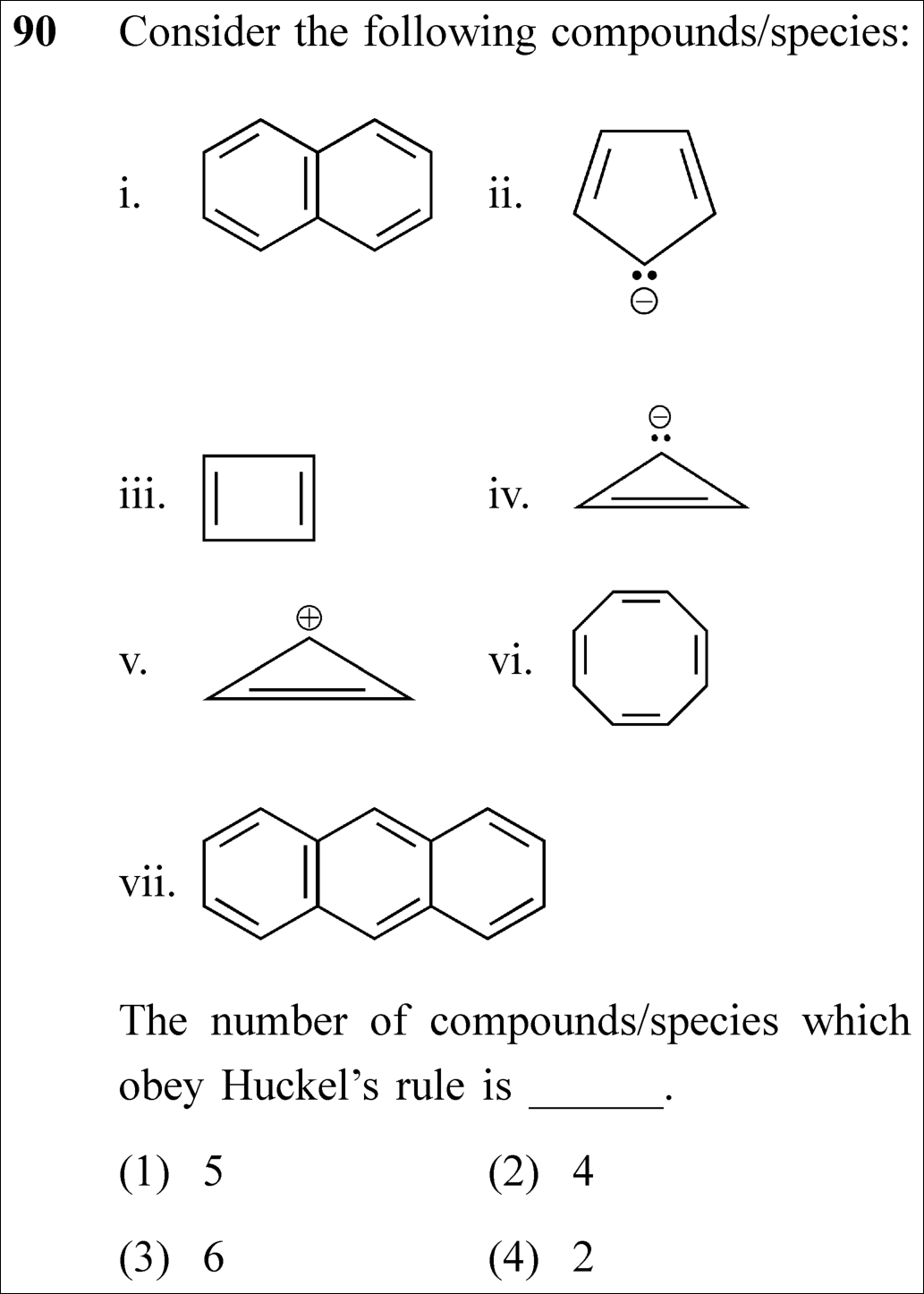
NEET 2023 Chemistry Question 90: Hückel’s (4n + 2) π-Electron Rule for Aromaticity

Question

Consider the following compounds/species: i. naphthalene ii. cyclopentadienyl anion iii. cyclobutadiene iv. cyclopropenyl anion v. cyclopropenyl cation vi. cyclooctatetraene vii. anthracene. The number of compounds/species which obey Huckel's rule is ___.

✓
Verified Against NTA Final Answer Key
Option (2) : 4
📚 Hydrocarbons Medium
📋 Given Parameters & Problem Setup
Species evaluated i. Naphthalene, ii. Cyclopentadienyl anion, iii. Cyclobutadiene, iv. Cyclopropenyl anion, v. Cyclopropenyl cation, vi. Cyclooctatetraene, vii. Anthracene
Rule to test Hückel’s Rule ((4n + 2) π electrons, cyclic, planar, fully conjugated)
⚡

The 30-Second Exam Hall Shortcut: ⚡ Hückel’s Magic Numbers: 2, 6, 10, 14 π Electrons in Planar Conjugated Cycles

⏱️ Save ~40 seconds

Hückel’s rule requires (4n + 2) delocalized π electrons in a planar conjugated ring. Count π electrons for each: i (10, n=2) ✓; ii (6, n=1) ✓; iii (4, 4n anti-aromatic) ✗; iv (4, 4n anti-aromatic) ✗; v (2, n=0) ✓; vi (8, non-planar tub) ✗; vii (14, n=3) ✓. Exactly 4 species obey Hückel’s rule in 15 seconds!

1 Check i (Naphthalene): 10 π electrons (4n+2 with n=2) ⟶ Aromatic (Obey).
2 Check ii (Cyclopentadienyl anion): 4 from double bonds + 2 from lone pair = 6 π electrons (n=1) ⟶ Aromatic (Obey).
3 Check iii (Cyclobutadiene): 4 π electrons (4n system) ⟶ Anti-aromatic (Does NOT obey).
4 Check iv (Cyclopropenyl anion): 2 from double bond + 2 from lone pair = 4 π electrons (4n system) ⟶ Anti-aromatic (Does NOT obey).
5 Check v (Cyclopropenyl cation): 2 π electrons (4n+2 with n=0) ⟶ Aromatic (Obey).
6 Check vi (Cyclooctatetraene): 8 π electrons, adopts non-planar tub conformation ⟶ Non-aromatic (Does NOT obey).
7 Check vii (Anthracene): 14 π electrons (4n+2 with n=3) ⟶ Aromatic (Obey).
8 Total qualifying species = 4 (Option 2).
🛡️
Why You Can 100% Trust This Shortcut: Classical Hückel’s Rule criteria for aromaticity in NCERT Organic Chemistry.
📐

Step-by-Step Rigorous Workflow & Mathematical Proof

Step 1

Criteria for Obeying Hückel’s Rule

For a compound to obey Hückel’s rule of aromaticity, it must satisfy three structural criteria: (a) cyclic and planar ring system, (b) complete delocalization of π electrons across the ring, and (c) contain (4n + 2) π electrons where n = 0, 1, 2, 3...

Hu¨ckel’s Formula: Nπ=4n+2(n=0,1,2,3,… )\text{Hückel's Formula: } N_\pi = 4n + 2 \quad (n = 0, 1, 2, 3, \dots)
Step 2

Evaluation of Benzenoid Fused Arenes

Naphthalene (i) has 5 conjugated double bonds = 10 π electrons (4n+2 with n=2). Anthracene (vii) has 7 conjugated double bonds = 14 π electrons (4n+2 with n=3). Both are planar, fully conjugated, and aromatic:

Naphthalene (i): 10π (n=2),Anthracene (vii): 14π (n=3)  ⟹  Both Obey\text{Naphthalene (i): } 10\pi\ (n=2), \quad \text{Anthracene (vii): } 14\pi\ (n=3) \implies \text{Both Obey}
Step 3

Evaluation of Charged Carbocycles

Cyclopentadienyl anion (ii) has two double bonds (4 e⁻) and one localized lone pair in a p-orbital (2 e⁻) = 6 π electrons (n=1, aromatic). Cyclopropenyl cation (v) has one double bond (2 e⁻) and a vacant p-orbital = 2 π electrons (n=0, aromatic):

Cyclopentadienyl anion (ii): 6π (n=1),Cyclopropenyl cation (v): 2π (n=0)  ⟹  Both Obey\text{Cyclopentadienyl anion (ii): } 6\pi\ (n=1), \quad \text{Cyclopropenyl cation (v): } 2\pi\ (n=0) \implies \text{Both Obey}
Step 4

Disqualification of Non-Aromatic and Anti-Aromatic Species

Cyclobutadiene (iii) has 4 π electrons (4n, anti-aromatic). Cyclopropenyl anion (iv) has 4 π electrons (4n, anti-aromatic). Cyclooctatetraene (vi) has 8 π electrons and adopts a non-planar tub conformation (non-aromatic). None of these three obey Hückel’s rule:

Species iii, iv, vi: Do not obey Hu¨ckel’s rule  ⟹  Total Obeying=4\text{Species iii, iv, vi: Do not obey Hückel's rule} \implies \text{Total Obeying} = 4
⭐

360° Option Elimination Engine Key Feature

Diagnose every choice: Know exactly why the right option works and why distractors fail.

4-Option Deep Scan
1 (1)
✗ Incorrect
Verdict & Scientific Reason:

Overcounts by including cyclooctatetraene or an anti-aromatic ring.

⚠️
Student Fallacy (Why candidates pick this trap): Candidate incorrectly counted COT (8π) as aromatic.
2 (2)
✓ 100% Correct
Verdict & Scientific Reason:

Accurate: Exactly 4 species obey Hückel’s rule (i: 10π, ii: 6π, v: 2π, vii: 14π).

💡
Why this is airtight: None. Candidate correctly applied (4n + 2) and planarity requirements.
3 (3)
✗ Incorrect
Verdict & Scientific Reason:

Includes anti-aromatic 4n systems (cyclobutadiene and cyclopropenyl anion).

⚠️
Student Fallacy (Why candidates pick this trap): Candidate counted 4n π electron systems as obeying Hückel’s rule.
4 (4)
✗ Incorrect
Verdict & Scientific Reason:

Counted only fused benzenoids and missed charged aromatic ions.

⚠️
Student Fallacy (Why candidates pick this trap): Candidate did not recognize charged species (cyclopentadienyl anion, cyclopropenyl cation) as aromatic.
⚠️

NTA Trap Alert: Counting π-Electrons in Carbanions and Carbocations

In cyclopropenyl anion, the lone pair adds 2 electrons to the double bond, giving 4π electrons (4n, anti-aromatic). In cyclopropenyl cation, the vacant p-orbital has 0 electrons, giving 2π electrons (4n+2 with n=0, aromatic). Don’t confuse anion and cation!

🛡️ How to avoid the -1 mark: Carbanion carbon in conjugated ring contributes 2 π electrons; carbocation carbon with vacant p-orbital contributes 0.
📖

Core NEET Syllabus Standard

National Eligibility cum Entrance Test (NEET UG) · Hydrocarbons Standard Benchmark
Core Scientific Principle Tested:

"A planar, cyclic, fully conjugated system possessing (4n + 2) π electrons exhibits exceptional aromatic stability."

Syllabus Focus: Aromaticity – Hückel’s Rule
Preserved in Rationalized Curriculum Syllabus & Academic Standards ↗

Ready to attempt under real exam pressure?

Test your speed and accuracy in the authentic 200-minute timed NTA simulator.

Launch NEET 2023 CBT Test →

Spotted a mistake in this solution? Report an error ([email protected])

⚖️ Legal & Fair Dealing Notice: Sourced from publicly released NEET 2023 question papers and NEET answer keys for private study, research, and non-commercial educational practice under Fair Dealing (Section 52(1)(a) of the Indian Copyright Act, 1957). Not affiliated with or endorsed by NTA or NMC.

Solve 4 NEET Questions a Day — One per Subject

Cover all 1,140 official NEET questions in 285 days at your own pace. Progress is saved on your device. No login needed.