MyCompetitiveExams Logo MyCompetitiveExams
Search 1,140+ Questions
Chapters, formulas, speed tricks
→
⚡ Brahmastra NEET 2027
720 MARKS

Dynamic 180-question full-length simulator mixed dynamically from all 6 years for 2027 & 2026 aspirants.

Launch Brahmastra 2027 Test →
Start Practice →
100% Free · No Login Required
Q.77 Chemistry ⭐ 360° Option Elimination Active
Vault ↗

NEET 2026 Chemistry Question 77 Solution

Topic: Hydrocarbons · Official NTA Booklet Code 50
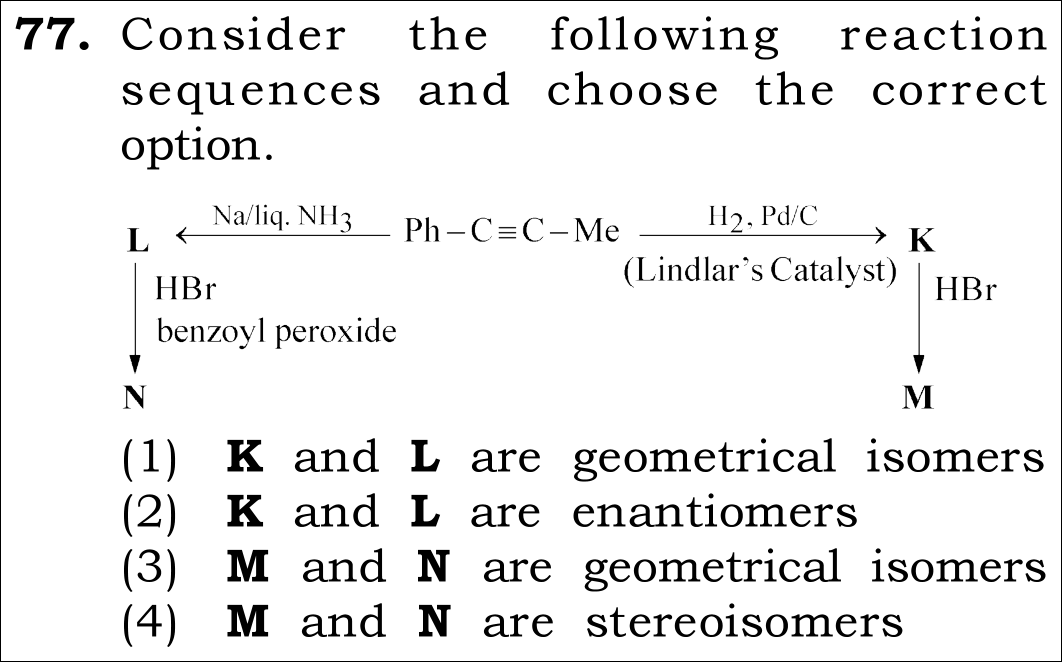
NEET 2026 Chemistry Question 77: Stereoselective Hydrogenation of Alkynes (Lindlar vs Birch Reduction)

Question

Consider the following reaction sequences and choose the correct option. Ph−C≡C−Me → (Na/liq. NH₃) L → (HBr, benzoyl peroxide) N; Ph−C≡C−Me → (H₂, Pd/C, Lindlar's Catalyst) K → (HBr) M

✓
Verified Against NTA Final Answer Key
Option (1) : K and L are geometrical isomers
📚 Hydrocarbons Easy
📋 Given Parameters & Problem Setup
Starting Alkyne Ph-C≡C-Me (1-phenylprop-1-yne)
Reagent 1 (Left) Na / liquid NH₃ (Birch Reduction) → Product L
Reagent 2 (Right) H₂, Pd/C (Lindlar's Catalyst) → Product K
⚡

The 30-Second Exam Hall Shortcut: ⚡ Lindlar gives Cis; Birch gives Trans!

⏱️ Save ~50 seconds

Catalytic Lindlar = cis-alkene (K); Dissolving metal Na/NH₃ = trans-alkene (L)!

1 Lindlar's catalyst (H₂, Pd/BaSO₄ or Pd/C with quinoline) performs SYN-addition to give the CIS-alkene (K = cis-1-phenylpropene).
2 Birch reduction (Na in liquid NH₃) proceeds via radical anion intermediate with ANTI-addition to give the TRANS-alkene (L = trans-1-phenylpropene).
3 Cis and Trans alkenes having identical connectivity but different spatial geometries are GEOMETRICAL ISOMERS (diastereomers)!
4 Option (1) states "K and L are geometrical isomers" -> Instant match in 10 seconds!
🛡️
Why You Can 100% Trust This Shortcut: Canonical organic transformation: Controlled reduction of non-terminal alkynes produces stereochemically pure cis or trans alkenes.
📐

Step-by-Step Rigorous Workflow & Mathematical Proof

Step 1

Analyze the Right Pathway: Lindlar's Catalyst Reduction

Reaction of 1-phenylprop-1-yne with molecular hydrogen over deactivated palladium (Lindlar's catalyst, Pd/CaCO₃ or Pd/C poisoned with lead salts or quinoline) results in stereoselective syn-addition of hydrogen across the triple bond to form the (Z) or cis-alkene.

Ph−C≡C−Me+H2→Pd/C (Lindlar)cis-1-phenylpropene (K)\text{Ph}-\text{C}\equiv\text{C}-\text{Me} + \text{H}_2 \xrightarrow{\text{Pd/C (Lindlar)}} \text{cis-1-phenylpropene } (\mathbf{K})
  • • K is cis-1-phenylpropene (Z-isomer).
Step 2

Analyze the Left Pathway: Birch Reduction

Reduction of an alkyne with sodium in liquid ammonia proceeds via sequential single-electron transfer and protonation through a radical anion. The radical anion adopts the more thermodynamically stable trans-configuration to minimize steric repulsion between the phenyl and methyl groups, yielding the (E) or trans-alkene.

Ph−C≡C−Me→Na / liq. NH3trans-1-phenylpropene (L)\text{Ph}-\text{C}\equiv\text{C}-\text{Me} \xrightarrow{\text{Na / liq. NH}_3} \text{trans-1-phenylpropene } (\mathbf{L})
  • • L is trans-1-phenylpropene (E-isomer).
Step 3

Classify the Relationship Between K and L

Both K and L share identical molecular formulas and identical atom connectivity, but differ in the spatial orientation of groups around the carbon-carbon double bond (cis vs trans). Therefore, K and L are geometrical isomers (cis-trans diastereomers).

K (cis)andL (trans)≡Geometrical Isomers\text{K (cis)} \quad \text{and} \quad \text{L (trans)} \equiv \text{Geometrical Isomers}
  • • Matches Option (1).
⭐

360° Option Elimination Engine Key Feature

Diagnose every choice: Know exactly why the right option works and why distractors fail.

4-Option Deep Scan
1 A
✓ 100% Correct
Verdict & Scientific Reason:

Flawless organic classification: K is cis-1-phenylpropene and L is trans-1-phenylpropene.

💡
Why this is airtight: None; direct application of stereoselective alkyne reduction.
2 B
✗ Incorrect
Verdict & Scientific Reason:

Incorrect. Geometrical isomers are non-mirror-image diastereomers, not non-superimposable mirror images (enantiomers).

⚠️
Student Fallacy (Why candidates pick this trap): Confusing diastereomers with enantiomers.
3 C
✗ Incorrect
Verdict & Scientific Reason:

Incorrect. M and N are saturated haloalkanes (following HBr addition) which do not exhibit geometrical isomerism.

⚠️
Student Fallacy (Why candidates pick this trap): Thinking products M and N still retain the rigid C=C double bond.
4 D
✗ Incorrect
Verdict & Scientific Reason:

Incorrect. Addition of HBr to cis-alkene and HBr/peroxide to trans-alkene yields different structural regioisomers (Markovnikov vs anti-Markovnikov adducts: Ph-CH(Br)-CH₂-Me vs Ph-CH₂-CH(Br)-Me), making them constitutional isomers, not stereoisomers.

⚠️
Student Fallacy (Why candidates pick this trap): Assuming identical regiochemistry for both peroxide and non-peroxide additions.
⚠️

NTA Trap Alert: Analyzing Downstream Steps (M and N) Instead of Checking K and L

Students spend minutes working out the complex regiochemistry of HBr vs HBr/peroxide on K and L to evaluate M and N. Option 1 tests K and L directly, which is solved in 5 seconds!

🛡️ How to avoid the -1 mark: Always read Option 1 first: K = cis, L = trans ⇒ Geometrical isomers instantly!
📖

Core NEET Syllabus Standard

NEET Chemistry Core Syllabus · Hydrocarbons Standard Benchmark
Core Scientific Principle Tested:

"Lindlar's catalyst yields cis-alkenes; Birch reduction yields trans-alkenes."

Syllabus Focus: Alkynes - Stereoselective preparation of alkenes
✓ Core NEET UG Syllabus Anchor Syllabus & Academic Standards ↗
Lindlar lands Cis; Birch blows Trans: Geometrical Isomers in your hands!

Ready to attempt under real exam pressure?

Test your speed and accuracy in the authentic 180-minute timed NTA simulator.

Launch NEET 2026 CBT Test →

Spotted a mistake in this solution? Report an error ([email protected])

⚖️ Legal & Fair Dealing Notice: Sourced from publicly released NEET 2026 question papers and NEET answer keys for private study, research, and non-commercial educational practice under Fair Dealing (Section 52(1)(a) of the Indian Copyright Act, 1957). Not affiliated with or endorsed by NTA or NMC.

Solve 4 NEET Questions a Day — One per Subject

Cover all 1,140 official NEET questions in 285 days at your own pace. Progress is saved on your device. No login needed.