NEET 2025 Chemistry Question 58 Solution
Question
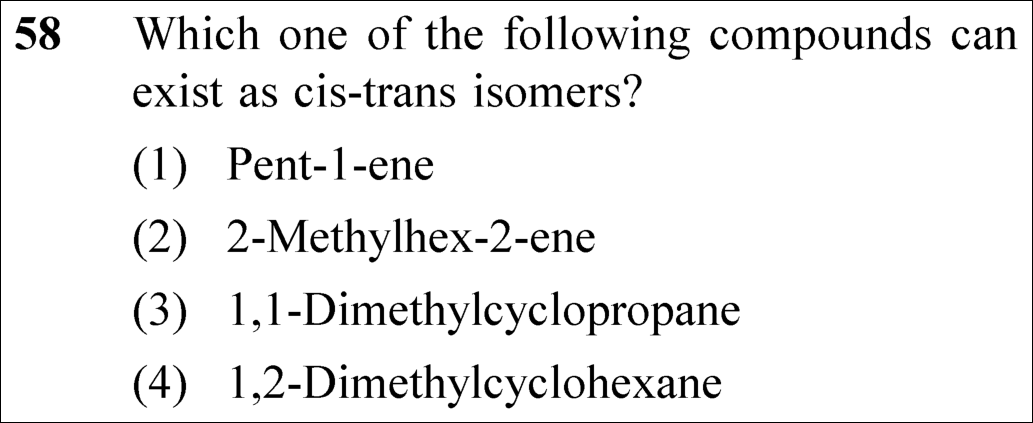
Which one of the following compounds can exist as cis-trans isomers?
Dynamic 180-question full-length simulator mixed dynamically from all 6 years for 2027 & 2026 aspirants.
Which one of the following compounds can exist as cis-trans isomers?
To exhibit cis-trans isomerism, each carbon with restricted rotation must be bonded to TWO DIFFERENT GROUPS! Pent-1-ene has =CH₂ (identical H). 2-Methylhex-2-ene has =C(CH₃)₂ (identical CH₃). 1,1-Dimethylcyclopropane has gem-dimethyl. Only 1,2-Dimethylcyclohexane has different groups (-H and -CH₃) on both C1 and C2!
Cis-trans isomerism arises when rotation is restricted (either by a double bond or a ring structure) and each of the two bridgehead/olefinic carbons carries two distinct groups:
Examine each candidate compound against the distinct-substituent criterion:
In 1,2-dimethylcyclohexane, the closed ring restricts free rotation:
Diagnose every choice: Know exactly why the right option works and why distractors fail.
Incorrect. Terminal alkene with two identical hydrogen atoms on C1.
Incorrect. C2 has two identical methyl groups.
Incorrect. Both methyl groups are on the same carbon (geminal).
100% correct. 1,2-disubstitution on a saturated ring exhibits well-known cis and trans diastereomers.
Many candidates only associate cis-trans isomerism with C=C double bonds, ignoring disubstituted cycloalkanes! Because both alkenes in the options (Pent-1-ene and 2-Methylhex-2-ene) have identical groups, the answer is the cycloalkane!
"Ring structures restrict C-C rotation; 1,2-disubstituted cycloalkanes exhibit cis-trans isomerism."
Test your speed and accuracy in the authentic 180-minute timed NTA simulator.
Spotted a mistake in this solution? Report an error ([email protected])
Cover all 1,140 official NEET questions in 285 days at your own pace. Progress is saved on your device. No login needed.