MyCompetitiveExams Logo MyCompetitiveExams
Search 1,140+ Questions
Chapters, formulas, speed tricks
→
⚡ Brahmastra NEET 2027
720 MARKS

Dynamic 180-question full-length simulator mixed dynamically from all 6 years for 2027 & 2026 aspirants.

Launch Brahmastra 2027 Test →
Start Practice →
100% Free · No Login Required
Q.57 Chemistry ⭐ 360° Option Elimination Active
Vault ↗

NEET 2025 Chemistry Question 57 Solution

Topic: Coordination Compounds · Official NTA Booklet Code 45
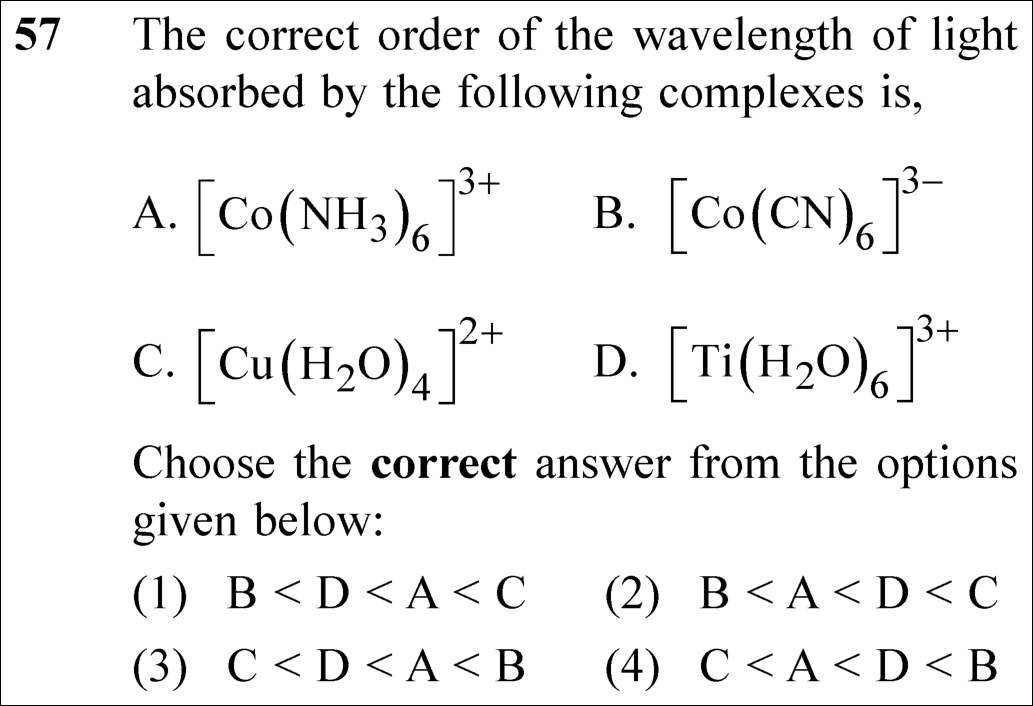
NEET 2025 Chemistry Question 57: Correct Order of Wavelength of Light Absorbed by Coordination Complexes

Question

The correct order of the wavelength of light absorbed by the following complexes is, A. [Co(NH₃)₆]³⁺ B. [Co(CN)₆]³⁻ C. [Cu(H₂O)₄]²⁺ D. [Ti(H₂O)₆]³⁺ Choose the correct answer from the options given below:

✓
Verified Against NTA Final Answer Key
Option (2) : B < A < D < C
📚 Coordination Compounds Medium
📋 Given Parameters & Problem Setup
Complex A [Co(NH₃)₆]³⁺
Complex B [Co(CN)₆]³⁻
Complex C [Cu(H₂O)₄]²⁺
Complex D [Ti(H₂O)₆]³⁺
⚡

The 30-Second Exam Hall Shortcut: ⚡ Inverse Wavelength Δ_o Spectrochemical Rule

⏱️ Save ~45 seconds

Energy absorbed Δ_o = hc / λ ⟹ Wavelength λ ∝ 1 / Δ_o! Strongest ligand gives largest Δ_o ⟹ SHORTEST wavelength! CN⁻ (strongest) ⟹ B has smallest λ! Next is NH₃ (A). Weak ligand H₂O with Ti³⁺ (D). Weakest + lowest charge Cu²⁺ (C) has largest λ! ⟹ B < A < D < C!

1 Relate splitting energy to wavelength: Δ_o = h c / λ_abs ⟹ λ_abs is INVERSELY proportional to crystal field splitting Δ_o.
2 Order of ligand field strength in spectrochemical series: CN⁻ >> NH₃ > H₂O.
3 Compare metal charges: Co³⁺ and Ti³⁺ (+3 charge) have much larger splitting than Cu²⁺ (+2 charge).
4 Order of Δ_o: [Co(CN)₆]³⁻ (B, largest Δ_o) > [Co(NH₃)₆]³⁺ (A) > [Ti(H₂O)₆]³⁺ (D) > [Cu(H₂O)₄]²⁺ (C, smallest Δ_o).
5 Inverting for absorbed wavelength (λ ∝ 1/Δ): B < A < D < C.
6 Match Option (2) in under 20 seconds!
🛡️
Why You Can 100% Trust This Shortcut: Spectrochemical Series & d-d Transitions (NCERT Chemistry · Coordination Compounds).
📐

Step-by-Step Rigorous Workflow & Mathematical Proof

Step 1

Relationship Between Crystal Field Splitting and Wavelength Absorbed

When a coordination entity absorbs a photon, an electron is promoted across the crystal field splitting gap (d-d transition):

Δo=hν=hcλabsorbed  ⟹  λabsorbed∝1Δo\Delta_o = h \nu = \frac{h c}{\lambda_{absorbed}} \implies \lambda_{absorbed} \propto \frac{1}{\Delta_o}
  • • A larger crystal field splitting energy corresponds to a shorter absorbed wavelength.
Step 2

Evaluate Crystal Field Splitting for the Complexes

Analyze central metal oxidation states and ligand field strengths from the spectrochemical series:

Ligand field strength: CN−>NH3>H2O\text{Ligand field strength: } \text{CN}^- > \text{NH}_3 > \text{H}_2\text{O}
  • • Complex B [Co(CN)₆]³⁻: Co³⁺ with the extremely strong field ligand CN⁻ produces the highest splitting (absorbs UV/violet, λ ≈ 310 nm).
  • • Complex A [Co(NH₃)₆]³⁺: Co³⁺ with strong field ligand NH₃ has large Δ_o (absorbs blue-green, λ ≈ 475 nm).
  • • Complex D [Ti(H₂O)₆]³⁺: Ti³⁺ (+3 state) with H₂O has Δ_o = 20,300 cm⁻¹ (absorbs yellow-green, λ ≈ 498 nm).
  • • Complex C [Cu(H₂O)₄]²⁺: Cu²⁺ (+2 state) with H₂O has much lower splitting (absorbs red/near-IR, λ ≈ 600–800 nm, transmitting blue).
Step 3

Establish the Final Wavelength Order

Since absorbed wavelength is inversely proportional to splitting energy:

Δo(B)>Δo(A)>Δo(D)>Δo(C)  ⟹  λ(B)<λ(A)<λ(D)<λ(C)\Delta_o(B) > \Delta_o(A) > \Delta_o(D) > \Delta_o(C) \implies \lambda(B) < \lambda(A) < \lambda(D) < \lambda(C)
  • • Thus the correct order of absorbed wavelength is B < A < D < C, matching Option (2).
⭐

360° Option Elimination Engine Key Feature

Diagnose every choice: Know exactly why the right option works and why distractors fail.

4-Option Deep Scan
1 A
✗ Incorrect
Verdict & Scientific Reason:

Incorrect. Places Ti(H₂O)₆³⁺ before Co(NH₃)₆³⁺, forgetting that NH₃ is a much stronger ligand than H₂O.

⚠️
Student Fallacy (Why candidates pick this trap): Thinking water creates greater crystal field splitting than ammonia.
2 B
✓ 100% Correct
Verdict & Scientific Reason:

100% correct. Direct consequence of λ ∝ 1/Δ_o and spectrochemical series.

💡
Why this is airtight: None; rigorous coordination chemistry deduction.
3 C
✗ Incorrect
Verdict & Scientific Reason:

Incorrect. This is the order of splitting energy Δ_o, completely forgetting to invert for wavelength!

⚠️
Student Fallacy (Why candidates pick this trap): Confusing splitting energy order with wavelength order.
4 D
✗ Incorrect
Verdict & Scientific Reason:

Incorrect. Partially inverted order.

⚠️
Student Fallacy (Why candidates pick this trap): Multiple errors in ligand ranking.
⚠️

NTA Trap Alert: Energy Order vs Wavelength Order Inversion

Option 3 (C < D < A < B) represents the direct order of ENERGY (Δ). Because energy and wavelength are inversely related (E = hc/λ), candidates who forget to flip the inequality fall straight into Option 3!

🛡️ How to avoid the -1 mark: Always remember: HIGH energy = SHORT wavelength!
📖

Core NEET Syllabus Standard

NEET Chemistry Core Syllabus · Coordination Compounds Standard Benchmark
Core Scientific Principle Tested:

"λ_abs = hc / Δ; ligand field order CN⁻ > NH₃ > H₂O dictates Δ and inverted λ."

Syllabus Focus: Crystal Field Theory & Spectrochemical Series
✓ Core NEET UG Syllabus Anchor Syllabus & Academic Standards ↗
Stronger Ligand ⟹ Bigger Δ ⟹ Shorter λ: CN⁻ shortest (B), Cu-water longest (C) ⟹ B < A < D < C!

Ready to attempt under real exam pressure?

Test your speed and accuracy in the authentic 180-minute timed NTA simulator.

Launch NEET 2025 CBT Test →

Spotted a mistake in this solution? Report an error ([email protected])

⚖️ Legal & Fair Dealing Notice: Sourced from publicly released NEET 2025 question papers and NEET answer keys for private study, research, and non-commercial educational practice under Fair Dealing (Section 52(1)(a) of the Indian Copyright Act, 1957). Not affiliated with or endorsed by NTA or NMC.

Solve 4 NEET Questions a Day — One per Subject

Cover all 1,140 official NEET questions in 285 days at your own pace. Progress is saved on your device. No login needed.