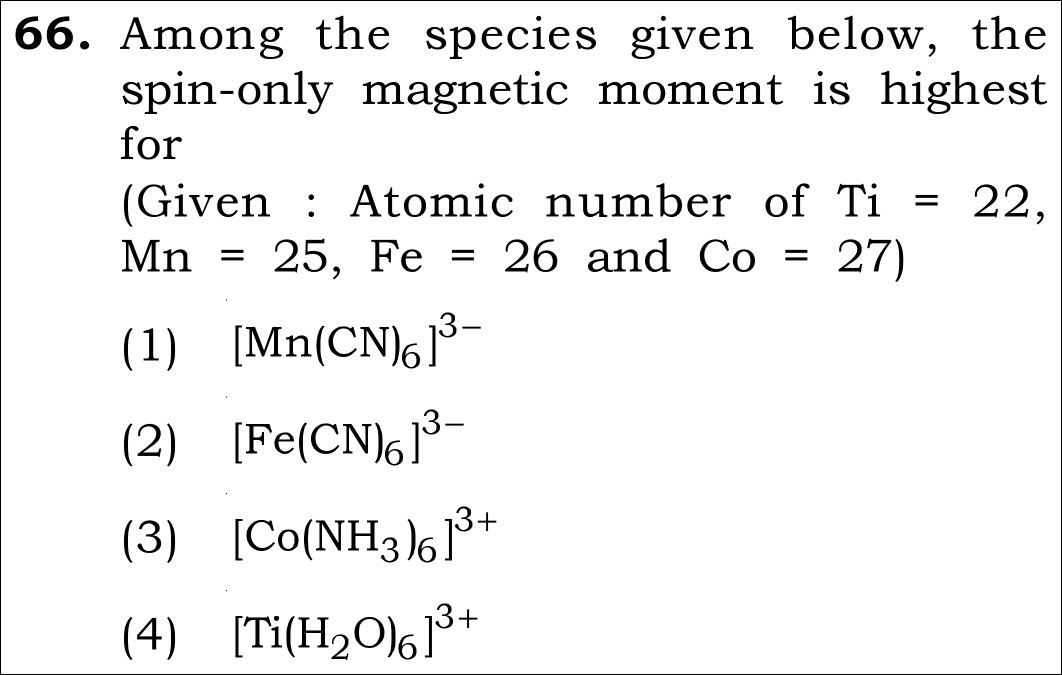
📋 Given Parameters & Problem Setup
Atomic Numbers Ti = 22, Mn = 25, Fe = 26, Co = 27
Target Species with highest spin-only magnetic moment (μ_s = √[n(n+2)] BM)
Highest magnetic moment = greatest number of unpaired electrons (n)!
1 [Mn(CN)₆]³⁻: Mn³⁺ is d⁴. CN⁻ is strong field -> t_{2g}⁴ e_g⁰ -> 2 unpaired electrons (n = 2).
2 [Fe(CN)₆]³⁻: Fe³⁺ is d⁵. CN⁻ is strong field -> t_{2g}⁵ e_g⁰ -> 1 unpaired electron (n = 1).
3 [Co(NH₃)₆]³⁺: Co³⁺ is d⁶. NH₃ with Co³⁺ is strong field -> t_{2g}⁶ e_g⁰ -> 0 unpaired electrons (diamagnetic, n = 0).
4 [Ti(H₂O)₆]³⁺: Ti³⁺ is d¹ -> t_{2g}¹ e_g⁰ -> 1 unpaired electron (n = 1).
5 Highest n is n = 2 in [Mn(CN)₆]³⁻! Option (1) wins in 20 seconds!
🛡️ Why You Can 100% Trust This Shortcut: Spin-only magnetic moment formula μ = √[n(n+2)] BM is strictly monotonically increasing with the number of unpaired electrons n.
⚠️
Students habitually think d⁵ (Fe³⁺) is always the most paramagnetic. With strong field CN⁻, pairing collapses d⁵ into t_{2g}⁵ (only ONE unpaired electron), whereas d⁴ has t_{2g}⁴ (TWO unpaired electrons)!
🛡️ How to avoid the -1 mark: Fill the three t_{2g} orbitals: 4 electrons leave 2 half-filled orbitals; 5 electrons leave only 1 half-filled orbital.
📖
NEET Chemistry Core Syllabus · Coordination Compounds Standard Benchmark
Core Scientific Principle Tested:
"In strong field octahedral environments (low spin), d⁴ has n=2 while d⁵ has n=1."
Syllabus Focus: Crystal field theory, electronic configurations of d-orbitals, magnetic properties
In strong field cage: d⁴ has two lonely souls, but d⁵ has only one!