MyCompetitiveExams Logo MyCompetitiveExams
Search 1,140+ Questions
Chapters, formulas, speed tricks
→
⚡ Brahmastra NEET 2027
720 MARKS

Dynamic 180-question full-length simulator mixed dynamically from all 6 years for 2027 & 2026 aspirants.

Launch Brahmastra 2027 Test →
Start Practice →
100% Free · No Login Required
🧪 Chemistry 🔥 High-Yield Core Topic (~3–4 Qs/Year)

NEET Coordination Compounds Previous Year Questions with Solutions

Complete repository of official NTA NEET questions for Coordination Compounds from 2020 to 2026. Every question includes 30-second elimination tricks, step-by-step NCERT solutions, option-by-option traps, and official answer keys.

21 Questions 6 Exam Years (2026, 2025, 2024, 2023, 2021, 2020) 15 Easy · 6 Medium · 0 Challenging
NEET 2026 · Q47 Medium
Official NEET 2026 Question 47 - Coordination Compounds
1
2
3 ✓ Key
4
💡 Verified Solution & 30-Second Hack
✓
Verified Against NTA Final Answer Key
Option (3) : Coordination isomerism, and IUPAC name is hexaamminechromium(III) hexacyanidocobaltate(III)
📚 Coordination Compounds Medium
📋 Given Parameters & Problem Setup
Pair of Complexes [Cr(NH₃)₆][Co(CN)₆] and [Co(NH₃)₆][Cr(CN)₆]
Cationic Complex [Cr(NH₃)₆]³⁺
Anionic Complex [Co(CN)₆]³⁻
⚡

The 30-Second Exam Hall Shortcut: ⚡ Ligand Swap = Coordination Isomerism

⏱️ Save ~60 seconds

Swap ligands between two complex centers -> Coordination Isomerism immediately!

1 Notice both cation and anion are coordination entities.
2 Ammines swapped from Cr to Co, and cyanides swapped from Co to Cr. By definition, interchange of ligands between cationic and anionic entities is Coordination Isomerism.
3 Naming: Cation first (hexaamminechromium(III)), then anion with "-ate" ending (hexacyanidocobaltate(III)).
4 Look for Option (3): Coordination isomerism + hexaamminechromium(III) hexacyanidocobaltate(III).
🛡️
Why You Can 100% Trust This Shortcut: Universal IUPAC coordination rule: Anionic complex metal always takes the suffix "-ate". Both Cr and Co are in the +3 oxidation state.
📐

Step-by-Step Rigorous Workflow & Mathematical Proof

Step 1

Determining Oxidation States of Metal Centers

Both ammonia (NH₃) is a neutral ligand (charge = 0) and cyanide (CN⁻) is a uninegative ligand (charge = -1). For [Cr(NH₃)₆][Co(CN)₆], since both metals commonly exhibit +3 states and the overall complex is neutral: Cr³⁺ + 6(0) = +3 for the cation, and Co³⁺ + 6(-1) = -3 for the anion.

Cation: [Cr3+(NH3)6]3+,Anion: [Co3+(CN)6]3−\text{Cation: }[\text{Cr}^{3+}(\text{NH}_3)_6]^{3+}, \quad \text{Anion: }[\text{Co}^{3+}(\text{CN})_6]^{3-}
  • • Oxidation state of Cr = +3.
  • • Oxidation state of Co = +3.
Step 2

Classification of Structural Isomerism

Coordination isomerism occurs when both cationic and anionic entities are coordination complexes, and an interchange of ligands occurs between the two different metal centers.

[Cr(NH3)6][Co(CN)6]⇌ligand swap[Co(NH3)6][Cr(CN)6][\text{Cr}(\text{NH}_3)_6][\text{Co}(\text{CN})_6] \xrightleftharpoons{\text{ligand swap}} [\text{Co}(\text{NH}_3)_6][\text{Cr}(\text{CN})_6]
  • • Type of isomerism: Coordination isomerism.
Step 3

Applying IUPAC Nomenclature Rules

1. Name the cation first: hexaamminechromium(III). 2. Name the anion second: hexacyanidocobaltate(III). The anionic metal requires the Latin suffix "-ate". Combined IUPAC name: hexaamminechromium(III) hexacyanidocobaltate(III).

hexaamminechromium(III) hexacyanidocobaltate(III)\text{hexaamminechromium(III) hexacyanidocobaltate(III)}
  • • Cationic entity: hexaamminechromium(III).
  • • Anionic entity: hexacyanidocobaltate(III).
⭐

360° Option Elimination Engine Key Feature

Diagnose every choice: Know exactly why the right option works and why distractors fail.

4-Option Deep Scan
1 A
✗ Incorrect
Verdict & Scientific Reason:

Incorrect. Ionisation isomerism involves exchange with counter-ions in the outer sphere, not between two complex spheres.

⚠️
Student Fallacy (Why candidates pick this trap): Confusing coordination isomerism with ionisation isomerism.
2 B
✗ Incorrect
Verdict & Scientific Reason:

Incorrect. Linkage isomerism requires ambidentate ligands (like NO₂⁻ or SCN⁻) binding through different atoms. Also, naming puts the anion first, which violates IUPAC rules.

⚠️
Student Fallacy (Why candidates pick this trap): Assuming CN⁻ binds through N without seeing the swap of metal centers.
3 C
✓ 100% Correct
Verdict & Scientific Reason:

Exact match with IUPAC rules and coordination isomerism definition.

💡
Why this is airtight: None; rigorous and precise.
4 D
✗ Incorrect
Verdict & Scientific Reason:

Incorrect order: IUPAC mandates that the cation MUST be named before the anion.

⚠️
Student Fallacy (Why candidates pick this trap): Naming the anion before the cation.
⚠️

NTA Trap Alert: Naming the Anion First or Dropping the "-ate" Suffix

Students frequently forget that even in bimetallic coordination salts, the positive complex is ALWAYS named first, followed by the negative complex with the "-ate" suffix on the metal.

🛡️ How to avoid the -1 mark: Cation first, Anion second. Anionic complex metal ends in "-ate".
📖

Core NEET Syllabus Standard

NEET Chemistry Core Syllabus · Coordination Compounds Standard Benchmark
Core Scientific Principle Tested:

"Ligand interchange between complex cation and complex anion constitutes coordination isomerism."
Syllabus Focus: Isomerism and IUPAC nomenclature of coordination compounds
✓ Core NEET UG Syllabus Anchor Syllabus & Academic Standards ↗
Cation First, Anion Last with "-ate"; Two Complex Centers = Coordination Isomer state!
NEET 2026 · Q49 Easy
Official NEET 2026 Question 49 - Coordination Compounds
1 ✓ Key
2
3
4
💡 Verified Solution & 30-Second Hack
✓
Verified Against NTA Final Answer Key
Option (1) : 1:2
📚 Coordination Compounds & Equilibrium Easy
📋 Given Parameters & Problem Setup
Substance Potash Alum [K₂SO₄·Al₂(SO₄)₃·24H₂O]
Target Ions Ratio of K⁺ to SO₄²⁻ ions
⚡

The 30-Second Exam Hall Shortcut: ⚡ Formula Inspection Shortcut

⏱️ Save ~45 seconds

Potash alum has formula KAl(SO₄)₂·12H₂O -> Exactly 1 K⁺ for every 2 SO₄²⁻!

1 Write the empirical double-salt formula: KAl(SO₄)₂·12H₂O.
2 Count ions: 1 K⁺ ion and 2 SO₄²⁻ ions.
3 Ratio of K⁺ : SO₄²⁻ = 1 : 2 immediately!
4 Even in the dual-formula K₂SO₄·Al₂(SO₄)₃·24H₂O: 2 K⁺ and (1 + 3) = 4 SO₄²⁻ -> 2 : 4 = 1 : 2.
🛡️
Why You Can 100% Trust This Shortcut: Standard definition of double salts: In aqueous solution, potash alum completely dissociates into simple hydrated ions retaining stoichiometric molar proportions.
📐

Step-by-Step Rigorous Workflow & Mathematical Proof

Step 1

Chemical Formula of Potash Alum

Potash alum is a classic double salt containing potassium sulfate and aluminium sulfate crystallized with 24 molecules of water of hydration.

K2SO4⋅Al2(SO4)3⋅24H2OorKAl(SO4)2⋅12H2O\text{K}_2\text{SO}_4 \cdot \text{Al}_2(\text{SO}_4)_3 \cdot 24\text{H}_2\text{O} \quad \text{or} \quad \text{KAl}(\text{SO}_4)_2 \cdot 12\text{H}_2\text{O}
  • • Full crystalline unit: K₂SO₄·Al₂(SO₄)₃·24H₂O.
  • • Empirical unit: KAl(SO₄)₂·12H₂O.
Step 2

Complete Aqueous Dissociation

Unlike coordination complexes where inner-sphere ligands do not dissociate, double salts dissociate completely into their constituent simple ions in aqueous solution.

K2SO4⋅Al2(SO4)3⋅24H2O(s)→excess H2O2K++2Al3++4SO42−+24H2O\text{K}_2\text{SO}_4 \cdot \text{Al}_2(\text{SO}_4)_3 \cdot 24\text{H}_2\text{O} (s) \xrightarrow{\text{excess H}_2\text{O}} 2\text{K}^+ + 2\text{Al}^{3+} + 4\text{SO}_4^{2-} + 24\text{H}_2\text{O}
  • • Total K⁺ ions per formula unit = 2.
  • • Total Al³⁺ ions per formula unit = 2.
  • • Total SO₄²⁻ ions per formula unit = 1 (from K₂SO₄) + 3 (from Al₂(SO₄)₃) = 4.
Step 3

Compute the Molar Ratio of K⁺ to SO₄²⁻

Divide the stoichiometric coefficient of potassium ions by that of sulfate ions.

n(K+)n(SO42−)=24=12=1:2\frac{n(\text{K}^+)}{n(\text{SO}_4^{2-})} = \frac{2}{4} = \frac{1}{2} = 1:2
  • • Ratio = 1:2.
  • • Corresponds to Option (1).
⭐

360° Option Elimination Engine Key Feature

Diagnose every choice: Know exactly why the right option works and why distractors fail.

4-Option Deep Scan
1 A
✓ 100% Correct
Verdict & Scientific Reason:

Completely correct. There are two K⁺ ions for every four SO₄²⁻ ions, yielding a 1:2 ratio.

💡
Why this is airtight: None; mathematically exact.
2 B
✗ Incorrect
Verdict & Scientific Reason:

Inverted ratio. 2:1 is the ratio of SO₄²⁻ to K⁺, not K⁺ to SO₄²⁻.

⚠️
Student Fallacy (Why candidates pick this trap): Reading the question order in reverse.
3 C
✗ Incorrect
Verdict & Scientific Reason:

Incorrect. This represents the ratio of K⁺ to sulfate ions from Al₂(SO₄)₃ alone, neglecting the sulfate from K₂SO₄.

⚠️
Student Fallacy (Why candidates pick this trap): Omitting the sulfate ion originating from the potassium sulfate component.
4 D
✗ Incorrect
Verdict & Scientific Reason:

Incorrect. Does not represent any valid stoichiometric ion ratio in potash alum.

⚠️
Student Fallacy (Why candidates pick this trap): Confusing valency of aluminium (+3) with potassium ion counts.
⚠️

NTA Trap Alert: Counting Only Sulfates in Al₂(SO₄)₃

A common slip is counting only the 3 sulfates in aluminium sulfate and concluding the ratio is 2:3, forgetting that K₂SO₄ provides the 4th sulfate ion.

🛡️ How to avoid the -1 mark: Always tally all ions: 1 sulfate from K₂SO₄ plus 3 sulfates from Al₂(SO₄)₃ equals 4 sulfates total.
📖

Core NEET Syllabus Standard

NEET Chemistry Core Syllabus · Coordination Compounds Standard Benchmark
Core Scientific Principle Tested:

"Double salts lose their identity in aqueous solution and dissociate into all constituent ions."

Syllabus Focus: Double salts vs Coordination complexes
✓ Core NEET UG Syllabus Anchor Syllabus & Academic Standards ↗
Potash Alum: 1 K⁺ and 1 Al³⁺ balanced by 2 Sulfates (1:2 ratio)!
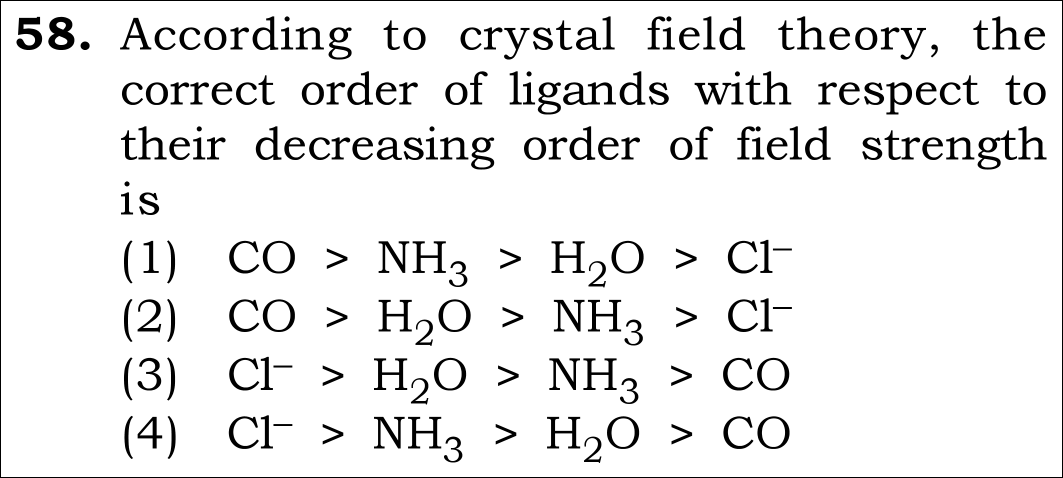
NEET 2026 · Q58 Easy
Official NEET 2026 Question 58 - Coordination Compounds
1 ✓ Key
2
3
4
💡 Verified Solution & 30-Second Hack
✓
Verified Against NTA Final Answer Key
Option (1) : CO > NH₃ > H₂O > Cl⁻
📚 Coordination Compounds Easy
📋 Given Parameters & Problem Setup
Theory Crystal Field Theory (CFT)
Ligands CO, NH₃, H₂O, Cl⁻
Required Order Decreasing order of crystal field strength (Δ_o)
⚡

The 30-Second Exam Hall Shortcut: ⚡ Donor Atom Hierarchy Rule: C > N > O > Halogen

⏱️ Save ~45 seconds

Carbon donors are strongest; Halogens are weakest! Order: C > N > O > Halogen!

1 Recall ligand donor atoms: CO (Carbon donor), NH₃ (Nitrogen donor), H₂O (Oxygen donor), Cl⁻ (Halogen donor).
2 Spectrochemical field strength follows donor electronegativity and π-effects: C-donors > N-donors > O-donors > Halide ions.
3 Therefore: CO > NH₃ > H₂O > Cl⁻.
4 Option (1) is instantly recognized in 5 seconds!
🛡️
Why You Can 100% Trust This Shortcut: Spectrochemical series experimentally established via UV-vis crystal field splitting parameter Δ_o in octahedral complexes.
📐

Step-by-Step Rigorous Workflow & Mathematical Proof

Step 1

Understand Crystal Field Splitting (Δ_o)

Crystal Field Theory (CFT) treats the interaction between metal d-orbitals and ligands as electrostatic and covalent π-interactions. Ligands that produce large splitting of the d-orbitals are called strong-field ligands, while those that produce small splitting are weak-field ligands.

Δo(strong field)>Δo(weak field)\Delta_o(\text{strong field}) > \Delta_o(\text{weak field})
  • • Strong field: Low spin complexes (pairing occurs).
  • • Weak field: High spin complexes.
Step 2

Examine the Spectrochemical Series

The experimentally determined spectrochemical series arranges ligands in order of increasing field strength: I⁻ < Br⁻ < S²⁻ < SCN⁻ < Cl⁻ < N₃⁻ < F⁻ < OH⁻ < C₂O₄²⁻ < H₂O < NCS⁻ < edta⁴⁻ < NH₃ < en < CN⁻ < CO

Cl−<H2O<NH3<CO\text{Cl}^- < \text{H}_2\text{O} < \text{NH}_3 < \text{CO}
  • • CO (Carbonyl): Strongest known ligand due to synergistic π-backbonding.
  • • NH₃: Nitrogen-donor ligand, stronger than oxygen-donors.
  • • H₂O: Oxygen-donor ligand, intermediate field strength.
  • • Cl⁻: Weak field halide donor due to repulsive π-donor interactions.
Step 3

Arrange in Decreasing Order of Strength

Inverting to decreasing order gives: CO > NH₃ > H₂O > Cl⁻

CO>NH3>H2O>Cl−\text{CO} > \text{NH}_3 > \text{H}_2\text{O} > \text{Cl}^-
  • • Matches Option (1).
⭐

360° Option Elimination Engine Key Feature

Diagnose every choice: Know exactly why the right option works and why distractors fail.

4-Option Deep Scan
1 A
✓ 100% Correct
Verdict & Scientific Reason:

Perfect match with the standard IUPAC/NCERT spectrochemical series.

💡
Why this is airtight: None; canonical inorganic knowledge.
2 B
✗ Incorrect
Verdict & Scientific Reason:

Incorrect. Places H₂O ahead of NH₃, but NH₃ (N-donor) has a higher field strength than H₂O (O-donor).

⚠️
Student Fallacy (Why candidates pick this trap): Swapping NH₃ and H₂O in the spectrochemical series.
3 C
✗ Incorrect
Verdict & Scientific Reason:

Incorrect. Completely inverted order (increasing instead of decreasing).

⚠️
Student Fallacy (Why candidates pick this trap): Reading the question decreasing vs increasing prompt backwards.
4 D
✗ Incorrect
Verdict & Scientific Reason:

Incorrect. Claims chloride is the strongest field ligand and CO is the weakest.

⚠️
Student Fallacy (Why candidates pick this trap): Gross misunderstanding of crystal field splitting.
⚠️

NTA Trap Alert: Confusing NH₃ and H₂O Placement

The most common point of confusion is whether NH₃ or H₂O is stronger. N-donors are less electronegative than O-donors and donate their lone pairs more readily, making NH₃ stronger than H₂O.

🛡️ How to avoid the -1 mark: Remember C > N > O > Halogen: Carbonyl > Ammine > Aqua > Halo.
📖

Core NEET Syllabus Standard

NEET Chemistry Core Syllabus · Coordination Compounds Standard Benchmark
Core Scientific Principle Tested:

"Ligand field strength increases from halide donors to oxygen, nitrogen, and carbon donors."

Syllabus Focus: Crystal Field Theory - Spectrochemical Series
✓ Core NEET UG Syllabus Anchor Syllabus & Academic Standards ↗
Can Not Overcome Chlorine: C (CO) > N (NH₃) > O (H₂O) > Cl (Cl⁻)!
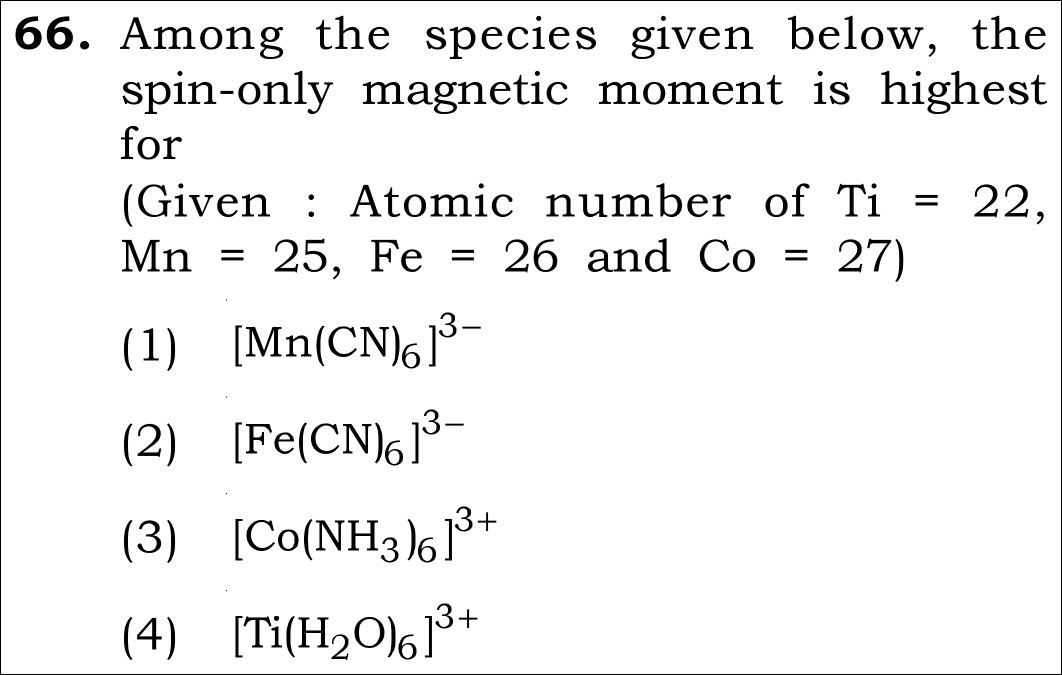
NEET 2026 · Q66 Medium
Official NEET 2026 Question 66 - Coordination Compounds
1 ✓ Key
2
3
4
💡 Verified Solution & 30-Second Hack
✓
Verified Against NTA Final Answer Key
Option (1) : [Mn(CN)₆]³⁻
📚 Coordination Compounds Medium
📋 Given Parameters & Problem Setup
Atomic Numbers Ti = 22, Mn = 25, Fe = 26, Co = 27
Target Species with highest spin-only magnetic moment (μ_s = √[n(n+2)] BM)
⚡

The 30-Second Exam Hall Shortcut: ⚡ Count Unpaired Electrons (n)

⏱️ Save ~60 seconds

Highest magnetic moment = greatest number of unpaired electrons (n)!

1 [Mn(CN)₆]³⁻: Mn³⁺ is d⁴. CN⁻ is strong field -> t_{2g}⁴ e_g⁰ -> 2 unpaired electrons (n = 2).
2 [Fe(CN)₆]³⁻: Fe³⁺ is d⁵. CN⁻ is strong field -> t_{2g}⁵ e_g⁰ -> 1 unpaired electron (n = 1).
3 [Co(NH₃)₆]³⁺: Co³⁺ is d⁶. NH₃ with Co³⁺ is strong field -> t_{2g}⁶ e_g⁰ -> 0 unpaired electrons (diamagnetic, n = 0).
4 [Ti(H₂O)₆]³⁺: Ti³⁺ is d¹ -> t_{2g}¹ e_g⁰ -> 1 unpaired electron (n = 1).
5 Highest n is n = 2 in [Mn(CN)₆]³⁻! Option (1) wins in 20 seconds!
🛡️
Why You Can 100% Trust This Shortcut: Spin-only magnetic moment formula μ = √[n(n+2)] BM is strictly monotonically increasing with the number of unpaired electrons n.
📐

Step-by-Step Rigorous Workflow & Mathematical Proof

Step 1

Determine Oxidation State and d-Electron Count for Each Complex

Find the d-electron configuration of the central metal ion: 1. [Mn(CN)₆]³⁻: Mn + 6(-1) = -3 ⇒ Mn³⁺. Mn atom is [Ar] 3d⁵ 4s² ⇒ Mn³⁺ is 3d⁴. 2. [Fe(CN)₆]³⁻: Fe + 6(-1) = -3 ⇒ Fe³⁺. Fe atom is [Ar] 3d⁶ 4s² ⇒ Fe³⁺ is 3d⁵. 3. [Co(NH₃)₆]³⁺: Co + 6(0) = +3 ⇒ Co³⁺. Co atom is [Ar] 3d⁷ 4s² ⇒ Co³⁺ is 3d⁶. 4. [Ti(H₂O)₆]³⁺: Ti + 6(0) = +3 ⇒ Ti³⁺. Ti atom is [Ar] 3d² 4s² ⇒ Ti³⁺ is 3d¹.

Mn3+:3d4,Fe3+:3d5,Co3+:3d6,Ti3+:3d1\text{Mn}^{3+}: 3d^4, \quad \text{Fe}^{3+}: 3d^5, \quad \text{Co}^{3+}: 3d^6, \quad \text{Ti}^{3+}: 3d^1
  • • All four complexes possess octahedral geometry.
Step 2

Apply Crystal Field Theory (Ligand Field Splitting)

Examine ligand field strengths: - CN⁻ is a strong field ligand (Δ_o > P), causing electron pairing in t_{2g}. - For Mn³⁺ (d⁴): 4 electrons enter t_{2g} giving configuration t_{2g}⁴ e_g⁰. Number of unpaired electrons n = 2. - For Fe³⁺ (d⁵): 5 electrons enter t_{2g} giving configuration t_{2g}⁵ e_g⁰. Number of unpaired electrons n = 1. - For Co³⁺ (d⁶): NH₃ acts as a strong field ligand with Co³⁺ (high charge density), giving low-spin t_{2g}⁶ e_g⁰. Number of unpaired electrons n = 0 (diamagnetic). - For Ti³⁺ (d¹): configuration is t_{2g}¹ e_g⁰. Number of unpaired electrons n = 1.

n([Mn(CN)6]3−)=2,n([Fe(CN)6]3−)=1,n([Co(NH3)6]3+)=0,n([Ti(H2O)6]3+)=1n([\text{Mn}(\text{CN})_6]^{3-}) = 2, \quad n([\text{Fe}(\text{CN})_6]^{3-}) = 1, \quad n([\text{Co}(\text{NH}_3)_6]^{3+}) = 0, \quad n([\text{Ti}(\text{H}_2\text{O})_6]^{3+}) = 1
  • • Maximum unpaired electrons n = 2.
Step 3

Calculate Spin-Only Magnetic Moments

Using the spin-only formula μ = √[n(n+2)] BM: 1. [Mn(CN)₆]³⁻: μ = √[2(4)] = √8 ≈ 2.83 BM. 2. [Fe(CN)₆]³⁻: μ = √[1(3)] = √3 ≈ 1.73 BM. 3. [Co(NH₃)₆]³⁺: μ = 0 BM. 4. [Ti(H₂O)₆]³⁺: μ = √[1(3)] = √3 ≈ 1.73 BM.

μ([Mn(CN)6]3−)=2.83 BM(Highest)\mu([\text{Mn}(\text{CN})_6]^{3-}) = 2.83\text{ BM} \quad (\text{Highest})
  • • Matches Option (1).
⭐

360° Option Elimination Engine Key Feature

Diagnose every choice: Know exactly why the right option works and why distractors fail.

4-Option Deep Scan
1 A
✓ 100% Correct
Verdict & Scientific Reason:

Highest magnetic moment with n = 2 unpaired electrons (μ = 2.83 BM).

💡
Why this is airtight: None; accurate application of low-spin t_{2g} filling.
2 B
✗ Incorrect
Verdict & Scientific Reason:

Incorrect. Fe³⁺ (d⁵) low-spin has t_{2g}⁵, which leaves only 1 unpaired electron (μ = 1.73 BM).

⚠️
Student Fallacy (Why candidates pick this trap): Assuming d⁵ always has 5 unpaired electrons, forgetting CN⁻ forces pairing.
3 C
✗ Incorrect
Verdict & Scientific Reason:

Incorrect. Co³⁺ with NH₃ forms a diamagnetic low-spin complex with n = 0 unpaired electrons (μ = 0).

⚠️
Student Fallacy (Why candidates pick this trap): Treating NH₃ as a weak-field ligand for Co³⁺.
4 D
✗ Incorrect
Verdict & Scientific Reason:

Incorrect. Ti³⁺ (d¹) has only 1 unpaired electron (μ = 1.73 BM).

⚠️
Student Fallacy (Why candidates pick this trap): Thinking Ti³⁺ has more d-electrons.
⚠️

NTA Trap Alert: Assuming d⁵ Fe³⁺ Always Has the Highest Magnetic Moment

Students habitually think d⁵ (Fe³⁺) is always the most paramagnetic. With strong field CN⁻, pairing collapses d⁵ into t_{2g}⁵ (only ONE unpaired electron), whereas d⁴ has t_{2g}⁴ (TWO unpaired electrons)!

🛡️ How to avoid the -1 mark: Fill the three t_{2g} orbitals: 4 electrons leave 2 half-filled orbitals; 5 electrons leave only 1 half-filled orbital.
📖

Core NEET Syllabus Standard

NEET Chemistry Core Syllabus · Coordination Compounds Standard Benchmark
Core Scientific Principle Tested:

"In strong field octahedral environments (low spin), d⁴ has n=2 while d⁵ has n=1."

Syllabus Focus: Crystal field theory, electronic configurations of d-orbitals, magnetic properties
✓ Core NEET UG Syllabus Anchor Syllabus & Academic Standards ↗
In strong field cage: d⁴ has two lonely souls, but d⁵ has only one!
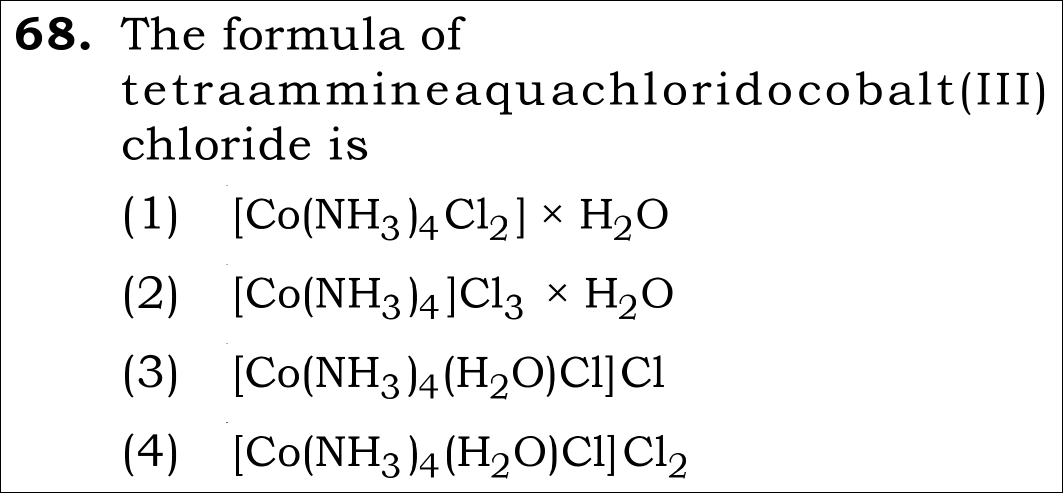
NEET 2026 · Q68 Easy
Official NEET 2026 Question 68 - Coordination Compounds
1
2
3
4 ✓ Key
💡 Verified Solution & 30-Second Hack
✓
Verified Against NTA Final Answer Key
Option (4) : [Co(NH₃)₄(H₂O)Cl]Cl₂
📚 Coordination Compounds Easy
📋 Given Parameters & Problem Setup
IUPAC Name tetraammineaquachloridocobalt(III) chloride
Central Metal Cobalt in +3 oxidation state [Co³⁺]
⚡

The 30-Second Exam Hall Shortcut: ⚡ Charge Balancing in Coordination Formulas

⏱️ Save ~45 seconds

Sum the charges inside the bracket to find the required counter-ions outside!

1 Central atom: Co³⁺ (+3).
2 Ligands inside bracket: 4 NH₃ (neutral = 0) + 1 H₂O (neutral = 0) + 1 Cl⁻ (-1).
3 Net charge of complex cation = +3 + 0 + 0 - 1 = +2.
4 To balance the +2 cation, we need TWO Cl⁻ ions outside: Cl₂!
5 Chemical formula MUST be [Co(NH₃)₄(H₂O)Cl]Cl₂.
6 Option (4) is identified in 10 seconds!
🛡️
Why You Can 100% Trust This Shortcut: Electroneutrality of ionic coordination compounds: Total cationic charge + Total anionic charge = 0.
📐

Step-by-Step Rigorous Workflow & Mathematical Proof

Step 1

Identify Central Metal and Ligands from IUPAC Name

Break down the name "tetraammineaquachloridocobalt(III) chloride": 1. Central metal: Cobalt, oxidation state = +3. 2. tetraammine = 4 NH₃ ligands (neutral). 3. aqua = 1 H₂O ligand (neutral). 4. chlorido = 1 Cl⁻ ligand (charge -1). 5. Counter-ion: chloride (Cl⁻).

Metal: Co3+,Ligands: 4(NH3),1(H2O),1(Cl−)\text{Metal: }\text{Co}^{3+}, \quad \text{Ligands: } 4(\text{NH}_3), 1(\text{H}_2\text{O}), 1(\text{Cl}^-)
  • • Coordination number = 4 + 1 + 1 = 6 (octahedral complex).
Step 2

Calculate the Net Charge of the Coordination Entity

Sum the oxidation state of the metal and the formal charges of all coordinated ligands.

qcomplex=(+3)+4(0)+1(0)+1(−1)=+2q_{\text{complex}} = (+3) + 4(0) + 1(0) + 1(-1) = +2
  • • The complex ion is [Co(NH₃)₄(H₂O)Cl]²⁺.
Step 3

Balance with Outer-Sphere Counter-Ions

To neutralize the +2 charge of the complex cation, two chloride ions (Cl⁻, each -1) are required outside the coordination sphere.

[Co(NH3)4(H2O)Cl]2++2Cl−⟶[Co(NH3)4(H2O)Cl]Cl2[\text{Co}(\text{NH}_3)_4(\text{H}_2\text{O})\text{Cl}]^{2+} + 2\text{Cl}^- \longrightarrow [\text{Co}(\text{NH}_3)_4(\text{H}_2\text{O})\text{Cl}]\text{Cl}_2
  • • Final formula: [Co(NH₃)₄(H₂O)Cl]Cl₂.
  • • Matches Option (4).
⭐

360° Option Elimination Engine Key Feature

Diagnose every choice: Know exactly why the right option works and why distractors fail.

4-Option Deep Scan
1 A
✗ Incorrect
Verdict & Scientific Reason:

Incorrect. Contains two chlorido ligands inside and water of crystallization outside (hydrate isomer).

⚠️
Student Fallacy (Why candidates pick this trap): Placing aqua outside as water of crystallization.
2 B
✗ Incorrect
Verdict & Scientific Reason:

Incorrect. Missing chlorido ligand inside the coordination sphere.

⚠️
Student Fallacy (Why candidates pick this trap): Placing all chloride ions outside the brackets.
3 C
✗ Incorrect
Verdict & Scientific Reason:

Incorrect. Only one chloride outside, which implies Co is in the +2 oxidation state instead of +3.

⚠️
Student Fallacy (Why candidates pick this trap): Failing to balance charges for Cobalt(III).
4 D
✓ 100% Correct
Verdict & Scientific Reason:

Exact formula matching the IUPAC name with Cobalt(III) oxidation state.

💡
Why this is airtight: None; perfect nomenclature translation.
⚠️

NTA Trap Alert: Confusing Ligand Aqua with Water of Hydration

Students often see "aqua" and mistakenly write "· H₂O" outside the bracket (Option 1). In IUPAC nomenclature, "aqua" inside the prefix name refers to a coordinated ligand inside the bracket [ ... (H₂O) ... ].

🛡️ How to avoid the -1 mark: Prefixes in the complex name (aqua, ammine) belong INSIDE the square bracket.
📖

Core NEET Syllabus Standard

NEET Chemistry Core Syllabus · Coordination Compounds Standard Benchmark
Core Scientific Principle Tested:

"The coordination entity is enclosed in square brackets; charge is balanced by counter-ions outside."

Syllabus Focus: Nomenclature and formulation of coordination compounds
✓ Core NEET UG Syllabus Anchor Syllabus & Academic Standards ↗
Inside the bracket: 4 ammines, 1 aqua, 1 chloro leaves +2; needs 2 chlorides outside to make it true!
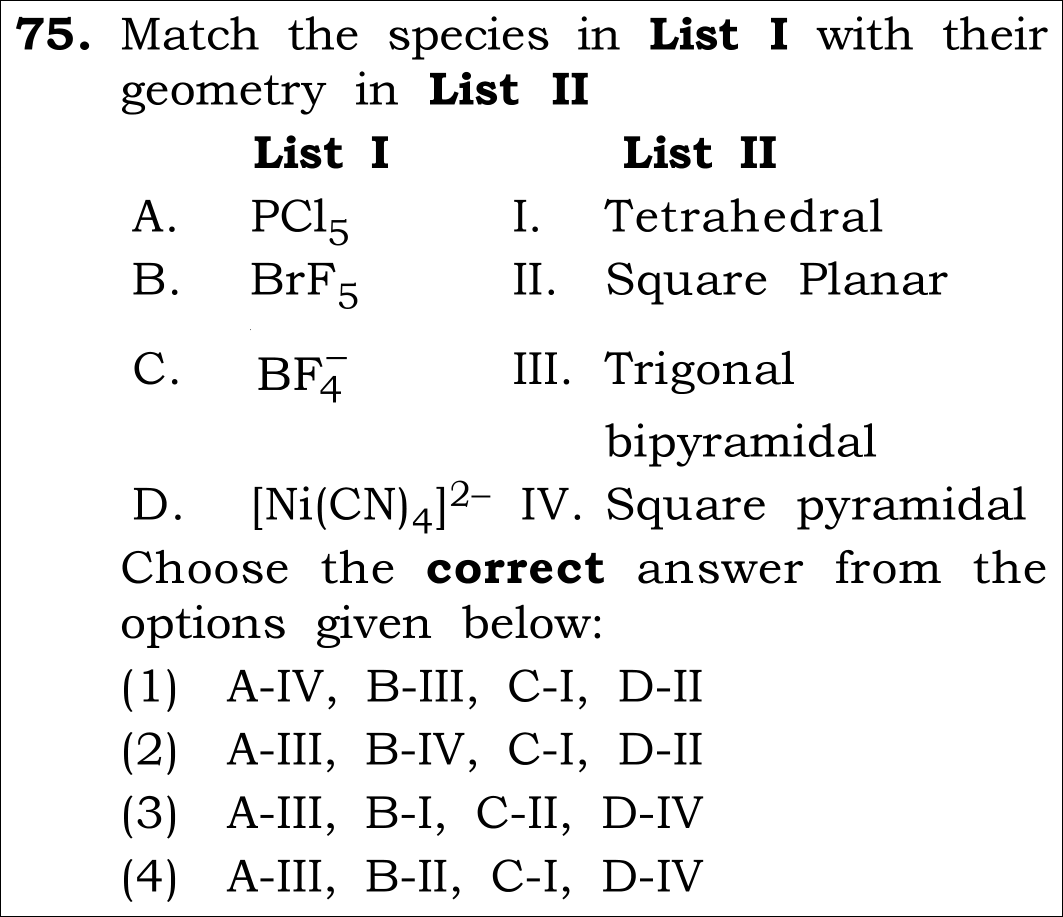
NEET 2026 · Q75 Easy
Official NEET 2026 Question 75 - Coordination Compounds
1
2 ✓ Key
3
4
💡 Verified Solution & 30-Second Hack
✓
Verified Against NTA Final Answer Key
Option (2) : A-III, B-IV, C-I, D-II
📚 Chemical Bonding and Molecular Structure & Coordination Compounds Easy
📋 Given Parameters & Problem Setup
Species A PCl₅
Species B BrF₅
Species C BF₄⁻
Species D [Ni(CN)₄]²⁻
Geometries I. Tetrahedral, II. Square Planar, III. Trigonal bipyramidal, IV. Square pyramidal
⚡

The 30-Second Exam Hall Shortcut: ⚡ Steric Number & Electron Pair Fingerprint

⏱️ Save ~50 seconds

Match PCl₅ (5 bp = TBP) and [Ni(CN)₄]²⁻ (d⁸ strong field = Square Planar) to finish in 10 seconds!

1 A. PCl₅: 5 bond pairs, 0 lone pairs -> Steric Number 5 -> Trigonal bipyramidal (III) -> A-III.
2 This immediately eliminates Option (1)!
3 D. [Ni(CN)₄]²⁻: Ni²⁺ (3d⁸) with strong field CN⁻ forces pairing -> dsp² hybridization -> Square Planar (II) -> D-II.
4 This eliminates Option (3) and Option (4)!
5 Confirm B and C: BrF₅ (5 bp + 1 lp = Square pyramidal, IV); BF₄⁻ (4 bp + 0 lp = Tetrahedral, I).
6 Option (2) is rock-solid: A-III, B-IV, C-I, D-II!
🛡️
Why You Can 100% Trust This Shortcut: Direct application of VSEPR theory for main group species and Crystal Field / Valence Bond Theory for coordination complexes.
📐

Step-by-Step Rigorous Workflow & Mathematical Proof

Step 1

Determine Geometry of PCl₅ (Species A)

Phosphorus has 5 valence electrons, all forming single σ bonds with five chlorine atoms. Steric number = 5 (5 bond pairs + 0 lone pairs). Hybridization = sp³d.

Steric Number=5+0=5  ⟹  Trigonal bipyramidal (III)\text{Steric Number} = 5 + 0 = 5 \implies \text{Trigonal bipyramidal (III)}
  • • Match: A -> III.
Step 2

Determine Geometry of BrF₅ (Species B)

Bromine has 7 valence electrons: 5 form single bonds with fluorine, leaving 1 lone pair. Steric number = 5 bond pairs + 1 lone pair = 6. Hybridization = sp³d² with octahedral electron geometry and square pyramidal molecular shape.

Steric Number=5+1=6  ⟹  Square pyramidal (IV)\text{Steric Number} = 5 + 1 = 6 \implies \text{Square pyramidal (IV)}
  • • Match: B -> IV.
Step 3

Determine Geometry of BF₄⁻ (Species C)

Boron has 3 valence electrons + 1 negative charge = 4 electrons, forming four σ bonds with four fluorine atoms. Steric number = 4 bond pairs + 0 lone pairs = 4. Hybridization = sp³.

Steric Number=4+0=4  ⟹  Tetrahedral (I)\text{Steric Number} = 4 + 0 = 4 \implies \text{Tetrahedral (I)}
  • • Match: C -> I.
Step 4

Determine Geometry of [Ni(CN)₄]²⁻ (Species D)

Nickel is in the +2 oxidation state (3d⁸). Cyanide (CN⁻) is a strong field ligand that forces the 3d electrons to pair up, leaving one vacant 3d orbital. Hybridization is dsp² with a square planar geometry.

Ni2+(3d8)+4CN−→pairingdsp2  ⟹  Square Planar (II)\text{Ni}^{2+} (3d^8) + 4\text{CN}^- \xrightarrow{\text{pairing}} dsp^2 \implies \text{Square Planar (II)}
  • • Match: D -> II.
  • • Full Match: A-III, B-IV, C-I, D-II (Option 2).
⭐

360° Option Elimination Engine Key Feature

Diagnose every choice: Know exactly why the right option works and why distractors fail.

4-Option Deep Scan
1 A
✗ Incorrect
Verdict & Scientific Reason:

Incorrect. Swaps geometries of PCl₅ and BrF₅.

⚠️
Student Fallacy (Why candidates pick this trap): Confusing 5 bond pairs with 5 bond pairs + 1 lone pair.
2 B
✓ 100% Correct
Verdict & Scientific Reason:

Exact match: PCl₅ is TBP (III), BrF₅ is square pyramidal (IV), BF₄⁻ is tetrahedral (I), and [Ni(CN)₄]²⁻ is square planar (II).

💡
Why this is airtight: None; flawless VSEPR and CFT alignment.
3 C
✗ Incorrect
Verdict & Scientific Reason:

Incorrect. Assigns tetrahedral to BrF₅ and square pyramidal to [Ni(CN)₄]²⁻.

⚠️
Student Fallacy (Why candidates pick this trap): Miscounting electron pairs.
4 D
✗ Incorrect
Verdict & Scientific Reason:

Incorrect. Assigns square planar to BrF₅.

⚠️
Student Fallacy (Why candidates pick this trap): Confusing square planar (AX₄E₂) with square pyramidal (AX₅E).
⚠️

NTA Trap Alert: Confusing BrF₅ (Square Pyramidal) with PCl₅ (TBP)

Both PCl₅ and BrF₅ have five peripheral halogen atoms, but PCl₅ has NO lone pairs (Trigonal bipyramidal), while BrF₅ has ONE lone pair on bromine (Square pyramidal).

🛡️ How to avoid the -1 mark: Count total valence electrons: PCl₅ has 5 pairs (TBP); BrF₅ has 6 pairs (Square pyramidal).
📖

Core NEET Syllabus Standard

NEET Chemistry Core Syllabus · Chemical Bonding and Coordination Compounds Standard Benchmark
Core Scientific Principle Tested:

"Shape is dictated by steric number and lone pairs: 5+0 = TBP, 5+1 = square pyramidal, 4+0 = tetrahedral, dsp² = square planar."

Syllabus Focus: VSEPR Theory shapes and dsp² square planar coordination geometries
✓ Core NEET UG Syllabus Anchor Syllabus & Academic Standards ↗
PCl₅ = TBP; BrF₅ = Square Pyramid; BF₄⁻ = Tetrahedral; [Ni(CN)₄]²⁻ = Square Planar!
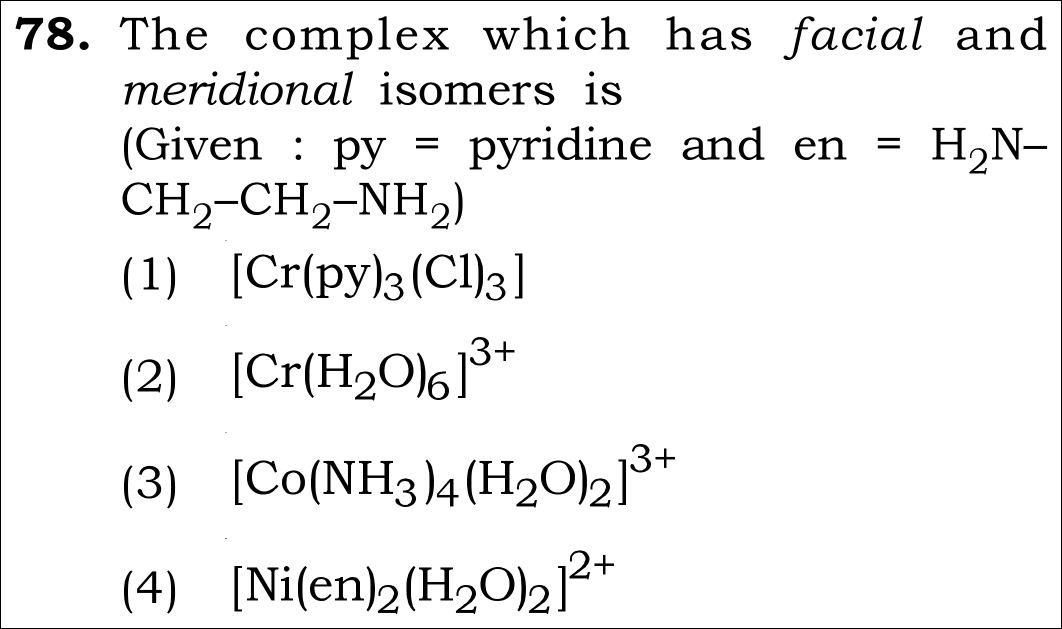
NEET 2026 · Q78 Easy
Official NEET 2026 Question 78 - Coordination Compounds
1 ✓ Key
2
3
4
💡 Verified Solution & 30-Second Hack
✓
Verified Against NTA Final Answer Key
Option (1) : [Cr(py)₃(Cl)₃]
📚 Coordination Compounds Easy
📋 Given Parameters & Problem Setup
Topic Facial (fac) and meridional (mer) isomerism
Formula Type Required Octahedral complex of type [M a₃ b₃]
⚡

The 30-Second Exam Hall Shortcut: ⚡ The [M a₃ b₃] Fingerprint

⏱️ Save ~45 seconds

Fac-mer isomerism ONLY occurs in octahedral complexes of the stoichiometry [M a₃ b₃]!

1 Scan formulas for an octahedral complex with three of one monodentate ligand and three of another (3:3 ratio).
2 Option (1): [Cr(py)₃(Cl)₃] -> exactly [M a₃ b₃] where a = py, b = Cl⁻!
3 Option (2): [Cr(H₂O)₆]³⁺ is [M a₆] (no geometrical isomers).
4 Option (3): [Co(NH₃)₄(H₂O)₂]³⁺ is [M a₄ b₂] (exhibits cis-trans, NOT fac-mer).
5 Option (4): [Ni(en)₂(H₂O)₂]²⁺ is [M (AA)₂ b₂] (exhibits cis-trans).
6 Only Option (1) has the [M a₃ b₃] formula -> Selected in 5 seconds!
🛡️
Why You Can 100% Trust This Shortcut: NCERT Coordination Compounds verbatim: Another type of geometrical isomerism occurs in octahedral coordination entities of the type [Ma₃b₃] like [Co(NH₃)₃(NO₂)₃].
📐

Step-by-Step Rigorous Workflow & Mathematical Proof

Step 1

Define Facial (fac) and Meridional (mer) Isomerism

In an octahedral complex of type [M a₃ b₃] containing two sets of three unidentate ligands: 1. Facial (fac) isomer: Three donor atoms of the same ligand occupy adjacent positions at the three corners of an octahedral triangular face. 2. Meridional (mer) isomer: Three donor atoms of the same ligand occupy positions around the meridian of the octahedron (two are trans to each other and one is cis).

[M a3b3]⇌Isomerismfac-isomer+mer-isomer[\text{M a}_3 \text{b}_3] \xrightleftharpoons{\text{Isomerism}} \text{fac-isomer} + \text{mer-isomer}
  • • Fac-mer isomerism is unique to the [M a₃ b₃] stoichiometry.
Step 2

Evaluate the Given Complex [Cr(py)₃(Cl)₃]

Pyridine (py) is a neutral monodentate ligand (a). Chloride (Cl⁻) is a uninegative monodentate ligand (b). The complex has the general formula [M a₃ b₃] with chromium in the +3 oxidation state and coordination number 6.

[Cr(py)3(Cl)3]≡[M a3b3][\text{Cr}(\text{py})_3(\text{Cl})_3] \equiv [\text{M a}_3 \text{b}_3]
  • • It exists as fac-[Cr(py)₃(Cl)₃] and mer-[Cr(py)₃(Cl)₃].
Step 3

Analyze Other Options

1. [Cr(H₂O)₆]³⁺: Homoleptic [M a₆], no geometrical isomerism. 2. [Co(NH₃)₄(H₂O)₂]³⁺: [M a₄ b₂], exhibits cis-trans isomerism only. 3. [Ni(en)₂(H₂O)₂]²⁺: [M (AA)₂ b₂], exhibits cis-trans isomerism only.

Only [Cr(py)3(Cl)3] matches [M a3b3]\text{Only } [\text{Cr}(\text{py})_3(\text{Cl})_3] \text{ matches } [\text{M a}_3 \text{b}_3]
  • • Matches Option (1).
⭐

360° Option Elimination Engine Key Feature

Diagnose every choice: Know exactly why the right option works and why distractors fail.

4-Option Deep Scan
1 A
✓ 100% Correct
Verdict & Scientific Reason:

Exact [M a₃ b₃] formulation displaying both fac and mer geometrical isomers.

💡
Why this is airtight: None; textbook precision.
2 B
✗ Incorrect
Verdict & Scientific Reason:

Incorrect. Homoleptic complex with 6 identical ligands; has zero geometrical isomers.

⚠️
Student Fallacy (Why candidates pick this trap): Assuming any octahedral complex shows geometrical isomerism.
3 C
✗ Incorrect
Verdict & Scientific Reason:

Incorrect. [M a₄ b₂] complex exhibits cis-trans isomerism, not fac-mer.

⚠️
Student Fallacy (Why candidates pick this trap): Confusing cis-trans isomerism of [M a₄ b₂] with fac-mer of [M a₃ b₃].
4 D
✗ Incorrect
Verdict & Scientific Reason:

Incorrect. Bidentate complex [M (AA)₂ b₂] exhibits cis-trans and optical isomerism, not fac-mer.

⚠️
Student Fallacy (Why candidates pick this trap): Mistaking bidentate en coordination for a 3:3 ligand set.
⚠️

NTA Trap Alert: Confusing [M a₄ b₂] (cis-trans) with [M a₃ b₃] (fac-mer)

Students frequently remember that octahedral complexes have isomers, but mix up the numbers: 4:2 is cis-trans, whereas 3:3 is fac-mer.

🛡️ How to avoid the -1 mark: 3 and 3 makes FAC and MER! [M a₃ b₃] = facial and meridional.
📖

Core NEET Syllabus Standard

NEET Chemistry Core Syllabus · Coordination Compounds Standard Benchmark
Core Scientific Principle Tested:

"Octahedral coordination entities of the type [M a₃ b₃] exhibit facial and meridional isomerism."

Syllabus Focus: Geometrical isomerism in octahedral complexes - fac-mer isomerism
✓ Core NEET UG Syllabus Anchor Syllabus & Academic Standards ↗
Three of each on the octahedral chair: Fac on the face, Mer around the square!
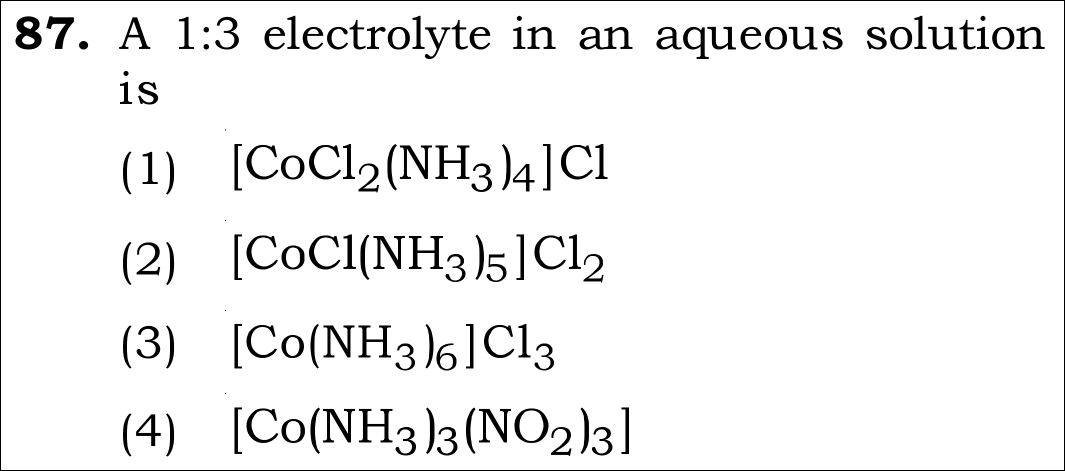
NEET 2026 · Q87 Easy
Official NEET 2026 Question 87 - Coordination Compounds
1
2
3 ✓ Key
4
💡 Verified Solution & 30-Second Hack
✓
Verified Against NTA Final Answer Key
Option (3) : [Co(NH₃)₆]Cl₃
📚 Coordination Compounds & Solutions Easy
📋 Given Parameters & Problem Setup
Requirement A 1:3 electrolyte in an aqueous solution
Options [CoCl₂(NH₃)₄]Cl, [CoCl(NH₃)₅]Cl₂, [Co(NH₃)₆]Cl₃, [Co(NH₃)₃(NO₂)₃]
⚡

The 30-Second Exam Hall Shortcut: ⚡ Count Cation vs Anion Ion Ratio

⏱️ Save ~40 seconds

A 1:3 electrolyte produces 1 complex cation and 3 simple anions!

1 [CoCl₂(NH₃)₄]Cl → [CoCl₂(NH₃)₄]⁺ + 1 Cl⁻ (1:1 electrolyte).
2 [CoCl(NH₃)₅]Cl₂ → [CoCl(NH₃)₅]²⁺ + 2 Cl⁻ (1:2 electrolyte).
3 [Co(NH₃)₆]Cl₃ → [Co(NH₃)₆]³⁺ + 3 Cl⁻ (1:3 ELECTROLYTE!).
4 [Co(NH₃)₃(NO₂)₃] → Neutral complex, does not ionize (non-electrolyte).
5 Option (3) is instantly spotted in 5 seconds!
🛡️
Why You Can 100% Trust This Shortcut: Werner's coordination theory: Ionizable counter-ions exist outside the square bracket, while non-ionizable ligands reside inside.
📐

Step-by-Step Rigorous Workflow & Mathematical Proof

Step 1

Define 1:3 Electrolyte

An electrolyte of type 1:3 (or A B₃) dissociates in aqueous solution to yield one cation and three anions (total of 4 ions per formula unit).

A B3(s)→H2OA3+(aq)+3B−(aq)\text{A B}_3(s) \xrightarrow{\text{H}_2\text{O}} \text{A}^{3+}(aq) + 3\text{B}^-(aq)
  • • Produces 1 cation and 3 anions.
Step 2

Examine the Dissociation of Each Option

1. [CoCl₂(NH₃)₄]Cl: [CoCl₂(NH₃)₄]Cl → [CoCl₂(NH₃)₄]⁺ + Cl⁻ (1 cation + 1 anion = 1:1 electrolyte, total 2 ions). 2. [CoCl(NH₃)₅]Cl₂: [CoCl(NH₃)₅]Cl₂ → [CoCl(NH₃)₅]²⁺ + 2 Cl⁻ (1 cation + 2 anions = 1:2 electrolyte, total 3 ions). 3. [Co(NH₃)₆]Cl₃: [Co(NH₃)₆]Cl₃ → [Co(NH₃)₆]³⁺ + 3 Cl⁻ (1 cation + 3 anions = 1:3 electrolyte, total 4 ions). 4. [Co(NH₃)₃(NO₂)₃]: Neutral coordination compound, does not dissociate (non-electrolyte, 0 ions).

[Co(NH3)6]Cl3⟶[Co(NH3)6]3++3Cl−(1:3 electrolyte)[\text{Co}(\text{NH}_3)_6]\text{Cl}_3 \longrightarrow [\text{Co}(\text{NH}_3)_6]^{3+} + 3\text{Cl}^- \quad (1:3\text{ electrolyte})
  • • Option (3) is a 1:3 electrolyte.
Step 3

Conclusion

[Co(NH₃)₆]Cl₃ is a 1:3 electrolyte.

Matches Option (3)\text{Matches Option (3)}
  • • Matches Option (3).
⭐

360° Option Elimination Engine Key Feature

Diagnose every choice: Know exactly why the right option works and why distractors fail.

4-Option Deep Scan
1 A
✗ Incorrect
Verdict & Scientific Reason:

Incorrect. Produces only one Cl⁻ ion in solution, making it a 1:1 electrolyte.

⚠️
Student Fallacy (Why candidates pick this trap): Counting the two chlorido ligands inside the coordination sphere.
2 B
✗ Incorrect
Verdict & Scientific Reason:

Incorrect. Produces two Cl⁻ counter-ions, making it a 1:2 electrolyte.

⚠️
Student Fallacy (Why candidates pick this trap): Miscounting the outer chloride subscript.
3 C
✓ 100% Correct
Verdict & Scientific Reason:

Exact: Dissociates into one [Co(NH₃)₆]³⁺ cation and three Cl⁻ anions (1:3 electrolyte).

💡
Why this is airtight: None; standard Werner coordination dissociation.
4 D
✗ Incorrect
Verdict & Scientific Reason:

Incorrect. Non-ionic coordination entity with zero ionizable counter-ions.

⚠️
Student Fallacy (Why candidates pick this trap): Assuming coordination compounds always dissociate into ions.
⚠️

NTA Trap Alert: Counting Chlorido Ligands Inside the Square Bracket

Ligands inside the square bracket [ ... ] are covalently/coordinatively bonded to the transition metal and do NOT ionize in water. Only ions OUTSIDE the bracket dissociate!

🛡️ How to avoid the -1 mark: Only look at what is outside the bracket: Cl₃ outside means 3 chloride ions are formed.
📖

Core NEET Syllabus Standard

NEET Chemistry Core Syllabus · Coordination Compounds Standard Benchmark
Core Scientific Principle Tested:

"Primary valencies (outside the sphere) ionize; secondary valencies (inside the sphere) do not."

Syllabus Focus: Werner's theory of coordination compounds and electrical conductance
✓ Core NEET UG Syllabus Anchor Syllabus & Academic Standards ↗
Three chlorides outside the gate: 1:3 electrolyte is its fate!
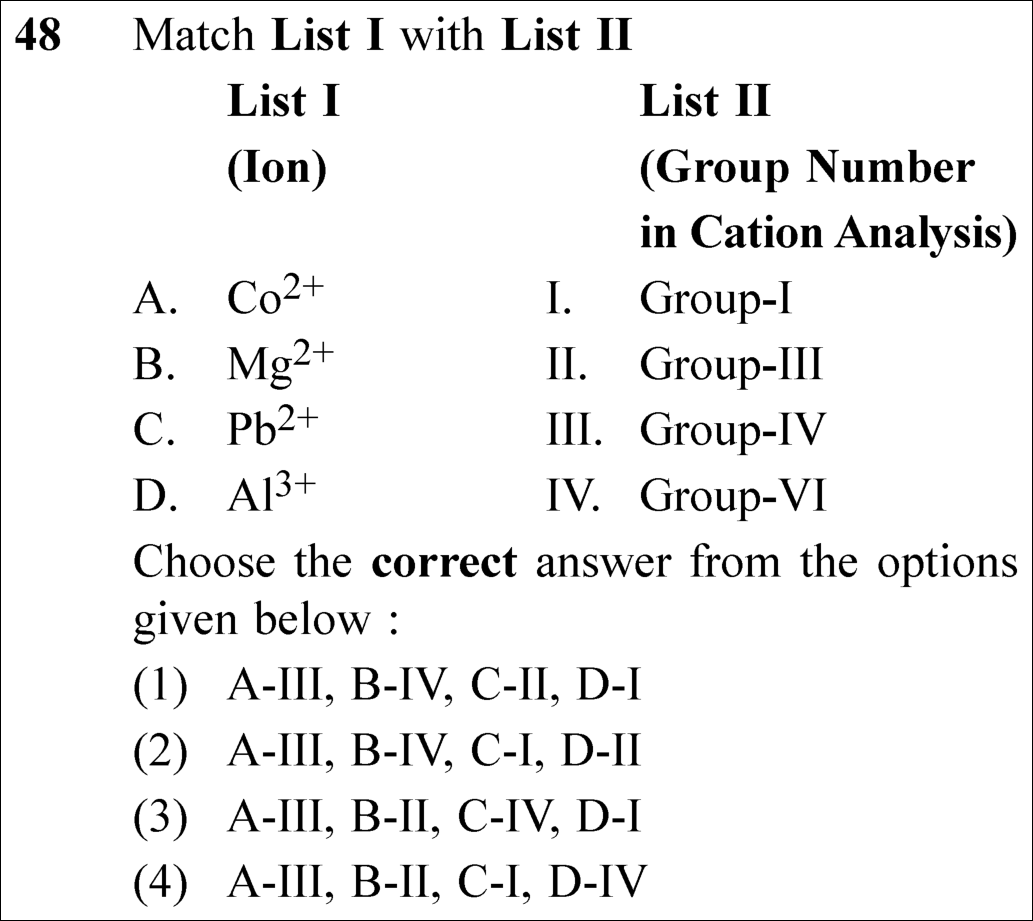
NEET 2025 · Q48 Easy
Official NEET 2025 Question 48 - Coordination Compounds
1
2 ✓ Key
3
4
💡 Verified Solution & 30-Second Hack
✓
Verified Against NTA Final Answer Key
Option (2) : A-III, B-IV, C-I, D-II
📚 Practical Chemistry & Coordination Compounds Easy
📋 Given Parameters & Problem Setup
List I (Ions) A. Co²⁺, B. Mg²⁺, C. Pb²⁺, D. Al³⁺
List II (Analytical Groups) I. Group-I, II. Group-III, III. Group-IV, IV. Group-VI
⚡

The 30-Second Exam Hall Shortcut: ⚡ Cation Group Reagent Fingerprint

⏱️ Save ~45 seconds

Pb²⁺ precipitated by dil HCl = Group-I (C-I). Al³⁺ precipitated by NH₄OH = Group-III (D-II). Co²⁺ precipitated by H₂S in NH₄OH = Group-IV (A-III). Mg²⁺ = Group-VI (B-IV)!

1 Identify Group-I cation: Pb²⁺ precipitates as white PbCl₂ with dilute HCl ⟹ C matches I.
2 Look at options: Only Option (2) has C-I and D-II!
3 Verify Al³⁺: Group-III cation, precipitated as gelatinous white Al(OH)₃ with NH₄OH in presence of NH₄Cl ⟹ D matches II.
4 Verify Co²⁺: Group-IV cation, precipitated as black CoS with H₂S in alkaline medium ⟹ A matches III.
5 Verify Mg²⁺: Group-VI cation, precipitated as Mg(NH₄)PO₄ with (NH₄)₂HPO₄ ⟹ B matches IV.
6 Matches Option (2) uniquely in under 10 seconds!
🛡️
Why You Can 100% Trust This Shortcut: Systematic Qualitative Cation Analysis (NCERT Chemistry Laboratory Manual).
📐

Step-by-Step Rigorous Workflow & Mathematical Proof

Step 1

Classification of Lead (Pb²⁺) in Group-I

Cations of analytical Group-I form insoluble chlorides upon the addition of dilute hydrochloric acid (dil. HCl). Lead (Pb²⁺), along with Ag⁺ and Hg₂²⁺, belongs to Group-I:

Pb2++2Cl−⟶PbCl2↓ (White precipitate)\text{Pb}^{2+} + 2\text{Cl}^- \longrightarrow \text{PbCl}_2 \downarrow \text{ (White precipitate)}
  • • Thus C matches I (C-I).
Step 2

Classification of Aluminium (Al³⁺) in Group-III

Cations of Group-III are precipitated as their hydroxides by ammonium hydroxide (NH₄OH) in the presence of ammonium chloride (NH₄Cl). Aluminium (Al³⁺), Fe³⁺, and Cr³⁺ belong to Group-III:

Al3++3OH−⟶Al(OH)3↓ (Gelatinous white)\text{Al}^{3+} + 3\text{OH}^- \longrightarrow \text{Al(OH)}_3 \downarrow \text{ (Gelatinous white)}
  • • Thus D matches II (D-II).
Step 3

Classification of Cobalt (Co²⁺) and Magnesium (Mg²⁺)

Group-IV cations (Co²⁺, Ni²⁺, Mn²⁺, Zn²⁺) precipitate as sulphides in basic medium (H₂S + NH₄OH + NH₄Cl). Magnesium (Mg²⁺) does not precipitate in Groups I–V and belongs to Group-VI:

Co2++S2−⟶CoS↓,Mg2++NH4++PO43−⟶Mg(NH4)PO4↓\text{Co}^{2+} + \text{S}^{2-} \longrightarrow \text{CoS} \downarrow, \quad \text{Mg}^{2+} + \text{NH}_4^+ + \text{PO}_4^{3-} \longrightarrow \text{Mg(NH}_4\text{)PO}_4 \downarrow
  • • Co²⁺ is in Group-IV ⟹ A matches III (A-III).
  • • Mg²⁺ is in Group-VI ⟹ B matches IV (B-IV).
  • • Complete match: A-III, B-IV, C-I, D-II, corresponding to Option (2).
⭐

360° Option Elimination Engine Key Feature

Diagnose every choice: Know exactly why the right option works and why distractors fail.

4-Option Deep Scan
1 A
✗ Incorrect
Verdict & Scientific Reason:

Incorrect. Swaps Pb²⁺ into Group-III and Al³⁺ into Group-I.

⚠️
Student Fallacy (Why candidates pick this trap): Confusing Al³⁺ chloride insolubility with PbCl₂.
2 B
✓ 100% Correct
Verdict & Scientific Reason:

100% correct. Co²⁺ (Group-IV), Mg²⁺ (Group-VI), Pb²⁺ (Group-I), Al³⁺ (Group-III).

💡
Why this is airtight: None; standard qualitative analysis sequence.
3 C
✗ Incorrect
Verdict & Scientific Reason:

Incorrect. Places Mg²⁺ in Group-III and Pb²⁺ in Group-VI.

⚠️
Student Fallacy (Why candidates pick this trap): Completely scrambling group reagents.
4 D
✗ Incorrect
Verdict & Scientific Reason:

Incorrect. Places Al³⁺ in Group-VI.

⚠️
Student Fallacy (Why candidates pick this trap): Confusing Al³⁺ with zero group or group VI.
⚠️

NTA Trap Alert: Lead (Pb²⁺) Dual Appearance Trap

Pb²⁺ is slightly soluble in cold water, so it precipitates in Group-I as PbCl₂ and the remaining traces also precipitate in Group-II as PbS. However, in canonical classification, Pb²⁺ is primarily listed in Group-I!

🛡️ How to avoid the -1 mark: Pb is Group-I (chloride); Al is Group-III (hydroxide); Co is Group-IV (sulphide in base); Mg is Group-VI.
📖

Core NEET Syllabus Standard

NEET Chemistry Core Syllabus · Practical Chemistry Standard Benchmark
Core Scientific Principle Tested:

"Systematic cation precipitation: Gr-I (Cl⁻), Gr-III (OH⁻), Gr-IV (S²⁻ in base), Gr-VI (HPO₄²⁻)."

Syllabus Focus: Qualitative Analysis of Cations
✓ Core NEET UG Syllabus Anchor Syllabus & Academic Standards ↗
Pb is 1st (Cl⁻), Al is 3rd (OH⁻), Co is 4th (S²⁻), Mg is 6th (last)!
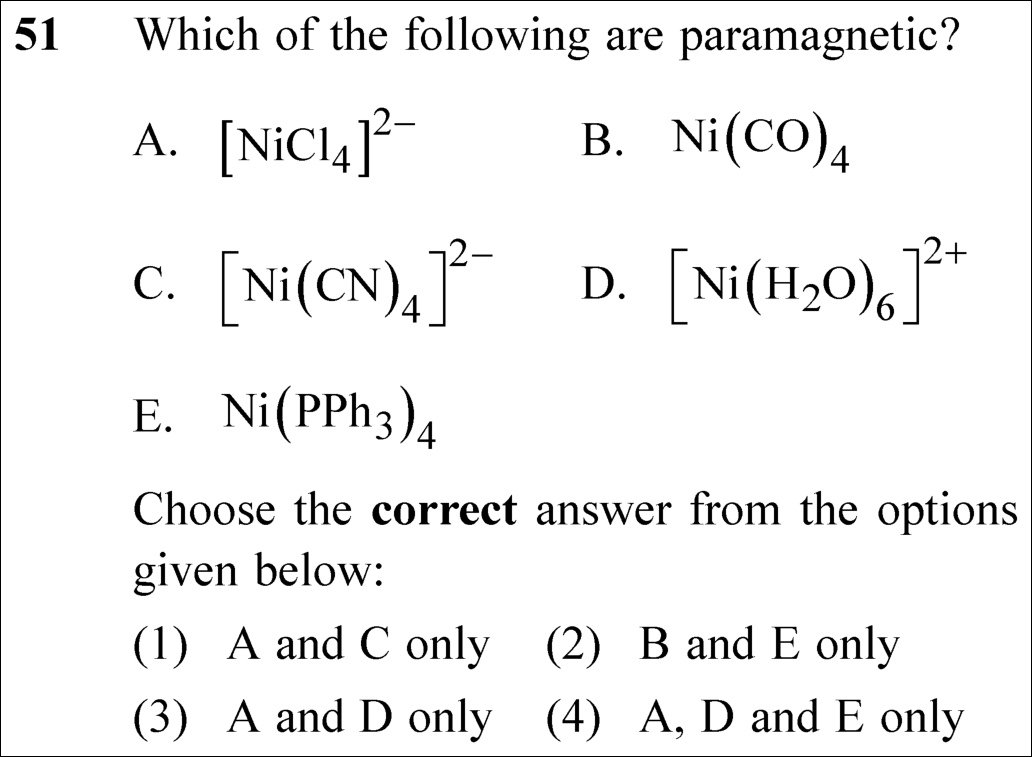
NEET 2025 · Q51 Medium
Official NEET 2025 Question 51 - Coordination Compounds
1
2
3 ✓ Key
4
💡 Verified Solution & 30-Second Hack
✓
Verified Against NTA Final Answer Key
Option (3) : A and D only
📚 Coordination Compounds Medium
📋 Given Parameters & Problem Setup
Complex A [NiCl₄]²⁻ (Tetrachloridonickelate(II))
Complex B Ni(CO)₄ (Tetracarbonylnickel(0))
Complex C [Ni(CN)₄]²⁻ (Tetracyanidonickelate(II))
Complex D [Ni(H₂O)₆]²⁺ (Hexaaquanickel(II))
Complex E Ni(PPh₃)₄ (Tetrakis(triphenylphosphine)nickel(0))
⚡

The 30-Second Exam Hall Shortcut: ⚡ Nickel Coordination Electron Pairing Rule

⏱️ Save ~50 seconds

[NiCl₄]²⁻ has weak ligand Cl⁻ (sp³ tetrahedral, 2 unpaired e⁻). [Ni(H₂O)₆]²⁺ has d⁸ octahedral (t₂g⁶ eg², 2 unpaired e⁻). Both are PARAMAGNETIC! Ni(CO)₄ and Ni(PPh₃)₄ are d¹⁰ (diamagnetic). [Ni(CN)₄]²⁻ is dsp² square planar (diamagnetic)!

1 Complex A [NiCl₄]²⁻: Ni²⁺ (3d⁸), Cl⁻ is weak field ligand. Tetrahedral geometry (sp³), configuration is e⁴ t₂⁴ with 2 unpaired electrons ⟹ PARAMAGNETIC.
2 Complex B Ni(CO)₄: Ni⁰ (3d⁸ 4s²). CO is a very strong field ligand, forcing pairing into 3d¹⁰. Zero unpaired electrons ⟹ DIAMAGNETIC.
3 Complex C [Ni(CN)₄]²⁻: Ni²⁺ (3d⁸). CN⁻ is strong field, forces pairing in 3d into dsp² square planar. Zero unpaired electrons ⟹ DIAMAGNETIC.
4 Complex D [Ni(H₂O)₆]²⁺: Ni²⁺ (3d⁸) in octahedral crystal field. Configuration is always t₂g⁶ eg² with 2 unpaired electrons in eg ⟹ PARAMAGNETIC.
5 Complex E Ni(PPh₃)₄: Ni⁰ (3d⁸ 4s²), PPh₃ forces pairing into 3d¹⁰. Zero unpaired electrons ⟹ DIAMAGNETIC.
6 Paramagnetic complexes are A and D only!
7 Select Option (3) with complete certainty!
🛡️
Why You Can 100% Trust This Shortcut: Crystal Field Theory & Spin-Only Magnetic Moment (NCERT Chemistry · Coordination Compounds: μ = √(n(n+2)) BM).
📐

Step-by-Step Rigorous Workflow & Mathematical Proof

Step 1

Electronic Configuration and Splitting of [NiCl₄]²⁻

In [NiCl₄]²⁻, nickel is in +2 oxidation state with electronic configuration [Ar] 3d⁸. Chloride (Cl⁻) is a weak field ligand, so the crystal field splitting Δ_t is less than the pairing energy P:

Geometry: Tetrahedral (sp3),Configuration: e4t24\text{Geometry: Tetrahedral } (sp^3), \quad \text{Configuration: } e^4 t_2^4
  • • There are 2 unpaired electrons (n = 2).
  • • Magnetic moment μ = √(2(2+2)) = √8 ≈ 2.83 BM.
  • • Therefore, [NiCl₄]²⁻ is PARAMAGNETIC.
Step 2

Electronic Configuration of Ni(CO)₄, [Ni(CN)₄]²⁻ and Ni(PPh₃)₄

Examine the low-spin and zero-valent complexes with strong π-acceptor ligands:

Ni(CO)4 and Ni(PPh3)4:  Ni0(3d84s2)→pairing3d104s0  ⟹  n=0 (Diamagnetic)\text{Ni(CO)}_4 \text{ and Ni(PPh}_3)_4: \; \text{Ni}^0 (3d^8 4s^2) \xrightarrow{\text{pairing}} 3d^{10} 4s^0 \implies n = 0 \text{ (Diamagnetic)}
  • • [Ni(CN)₄]²⁻: Ni²⁺ (3d⁸). CN⁻ causes pairing into four d-orbitals, leaving one d-orbital empty for dsp² square planar hybridization (n = 0, Diamagnetic).
Step 3

Electronic Configuration and Splitting of [Ni(H₂O)₆]²⁺

In the octahedral complex [Ni(H₂O)₆]²⁺, nickel is in +2 oxidation state (3d⁸). In octahedral symmetry, the d⁸ configuration is uniquely determined regardless of ligand field strength:

Configuration: t2g6eg2  ⟹  n=2 unpaired electrons\text{Configuration: } t_{2g}^6 e_g^2 \implies n = 2 \text{ unpaired electrons}
  • • Two unpaired electrons reside in the eg orbitals (dx²-y² and dz²).
  • • Therefore, [Ni(H₂O)₆]²⁺ is PARAMAGNETIC (μ ≈ 2.83 BM).
  • • Conclusion: A and D only are paramagnetic, matching Option (3).
⭐

360° Option Elimination Engine Key Feature

Diagnose every choice: Know exactly why the right option works and why distractors fail.

4-Option Deep Scan
1 A
✗ Incorrect
Verdict & Scientific Reason:

Incorrect. [Ni(CN)₄]²⁻ is square planar and diamagnetic (zero unpaired electrons).

⚠️
Student Fallacy (Why candidates pick this trap): Thinking all 4-coordinate Ni²⁺ complexes are tetrahedral and paramagnetic.
2 B
✗ Incorrect
Verdict & Scientific Reason:

Incorrect. Both Ni(CO)₄ and Ni(PPh₃)₄ are 3d¹⁰ diamagnetic complexes.

⚠️
Student Fallacy (Why candidates pick this trap): Assuming Ni(0) has unpaired electrons from 3d⁸.
3 C
✓ 100% Correct
Verdict & Scientific Reason:

100% correct. Both [NiCl₄]²⁻ (tetrahedral d⁸) and [Ni(H₂O)₆]²⁺ (octahedral d⁸) possess 2 unpaired electrons.

💡
Why this is airtight: None; perfect mastery of CFT.
4 D
✗ Incorrect
Verdict & Scientific Reason:

Incorrect. Complex E is diamagnetic.

⚠️
Student Fallacy (Why candidates pick this trap): Treating PPh₃ as a weak ligand.
⚠️

NTA Trap Alert: Square Planar [Ni(CN)₄]²⁻ vs Tetrahedral [NiCl₄]²⁻

Candidates often confuse [Ni(CN)₄]²⁻ with [NiCl₄]²⁻. Because CN⁻ is strong field, it pairs up all electrons in 3d⁸ to make a square planar diamagnetic complex, whereas Cl⁻ is weak field, yielding a tetrahedral paramagnetic complex!

🛡️ How to avoid the -1 mark: Remember: Ni²⁺ with CN⁻ is square planar & DIAMAGNETIC; with Cl⁻ it is tetrahedral & PARAMAGNETIC.
📖

Core NEET Syllabus Standard

NEET Chemistry Core Syllabus · Coordination Compounds Standard Benchmark
Core Scientific Principle Tested:

"d⁸ tetrahedral with weak ligands has 2 unpaired e⁻; d⁸ octahedral always has 2 unpaired e⁻ (t₂g⁶ eg²)."

Syllabus Focus: Magnetic Properties & Hybridization of Coordination Complexes
✓ Core NEET UG Syllabus Anchor Syllabus & Academic Standards ↗
Cl⁻ leaves d⁸ unpaired (A), water in octahedron has 2 unpaired in eg (D) ⟹ A & D only!
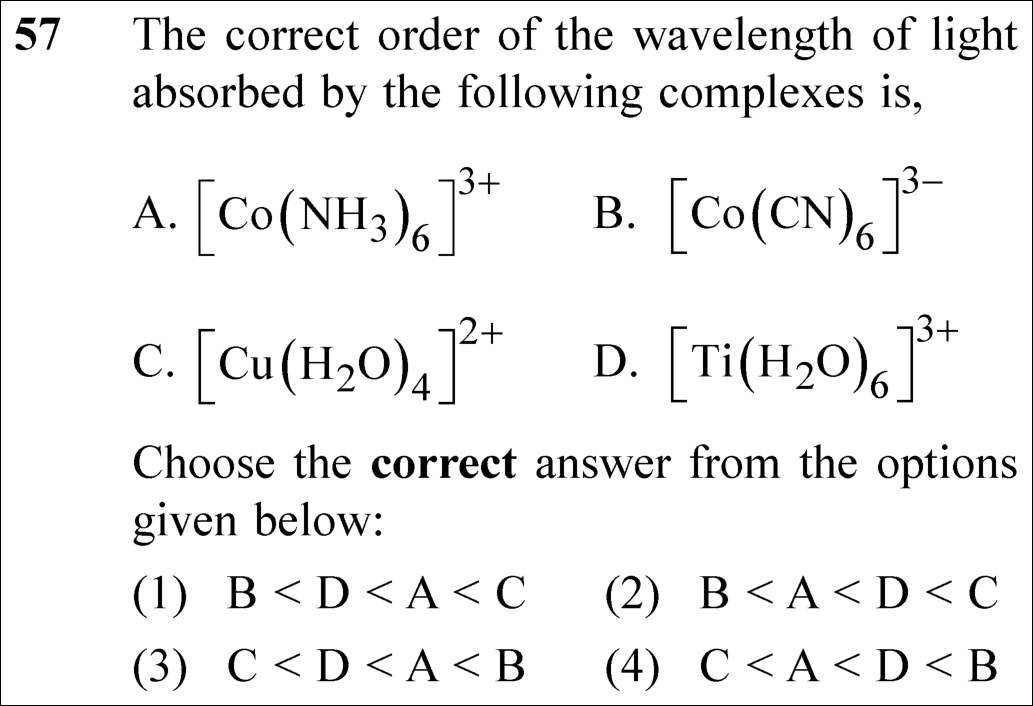
NEET 2025 · Q57 Medium
Official NEET 2025 Question 57 - Coordination Compounds
1
2 ✓ Key
3
4
💡 Verified Solution & 30-Second Hack
✓
Verified Against NTA Final Answer Key
Option (2) : B < A < D < C
📚 Coordination Compounds Medium
📋 Given Parameters & Problem Setup
Complex A [Co(NH₃)₆]³⁺
Complex B [Co(CN)₆]³⁻
Complex C [Cu(H₂O)₄]²⁺
Complex D [Ti(H₂O)₆]³⁺
⚡

The 30-Second Exam Hall Shortcut: ⚡ Inverse Wavelength Δ_o Spectrochemical Rule

⏱️ Save ~45 seconds

Energy absorbed Δ_o = hc / λ ⟹ Wavelength λ ∝ 1 / Δ_o! Strongest ligand gives largest Δ_o ⟹ SHORTEST wavelength! CN⁻ (strongest) ⟹ B has smallest λ! Next is NH₃ (A). Weak ligand H₂O with Ti³⁺ (D). Weakest + lowest charge Cu²⁺ (C) has largest λ! ⟹ B < A < D < C!

1 Relate splitting energy to wavelength: Δ_o = h c / λ_abs ⟹ λ_abs is INVERSELY proportional to crystal field splitting Δ_o.
2 Order of ligand field strength in spectrochemical series: CN⁻ >> NH₃ > H₂O.
3 Compare metal charges: Co³⁺ and Ti³⁺ (+3 charge) have much larger splitting than Cu²⁺ (+2 charge).
4 Order of Δ_o: [Co(CN)₆]³⁻ (B, largest Δ_o) > [Co(NH₃)₆]³⁺ (A) > [Ti(H₂O)₆]³⁺ (D) > [Cu(H₂O)₄]²⁺ (C, smallest Δ_o).
5 Inverting for absorbed wavelength (λ ∝ 1/Δ): B < A < D < C.
6 Match Option (2) in under 20 seconds!
🛡️
Why You Can 100% Trust This Shortcut: Spectrochemical Series & d-d Transitions (NCERT Chemistry · Coordination Compounds).
📐

Step-by-Step Rigorous Workflow & Mathematical Proof

Step 1

Relationship Between Crystal Field Splitting and Wavelength Absorbed

When a coordination entity absorbs a photon, an electron is promoted across the crystal field splitting gap (d-d transition):

Δo=hν=hcλabsorbed  ⟹  λabsorbed∝1Δo\Delta_o = h \nu = \frac{h c}{\lambda_{absorbed}} \implies \lambda_{absorbed} \propto \frac{1}{\Delta_o}
  • • A larger crystal field splitting energy corresponds to a shorter absorbed wavelength.
Step 2

Evaluate Crystal Field Splitting for the Complexes

Analyze central metal oxidation states and ligand field strengths from the spectrochemical series:

Ligand field strength: CN−>NH3>H2O\text{Ligand field strength: } \text{CN}^- > \text{NH}_3 > \text{H}_2\text{O}
  • • Complex B [Co(CN)₆]³⁻: Co³⁺ with the extremely strong field ligand CN⁻ produces the highest splitting (absorbs UV/violet, λ ≈ 310 nm).
  • • Complex A [Co(NH₃)₆]³⁺: Co³⁺ with strong field ligand NH₃ has large Δ_o (absorbs blue-green, λ ≈ 475 nm).
  • • Complex D [Ti(H₂O)₆]³⁺: Ti³⁺ (+3 state) with H₂O has Δ_o = 20,300 cm⁻¹ (absorbs yellow-green, λ ≈ 498 nm).
  • • Complex C [Cu(H₂O)₄]²⁺: Cu²⁺ (+2 state) with H₂O has much lower splitting (absorbs red/near-IR, λ ≈ 600–800 nm, transmitting blue).
Step 3

Establish the Final Wavelength Order

Since absorbed wavelength is inversely proportional to splitting energy:

Δo(B)>Δo(A)>Δo(D)>Δo(C)  ⟹  λ(B)<λ(A)<λ(D)<λ(C)\Delta_o(B) > \Delta_o(A) > \Delta_o(D) > \Delta_o(C) \implies \lambda(B) < \lambda(A) < \lambda(D) < \lambda(C)
  • • Thus the correct order of absorbed wavelength is B < A < D < C, matching Option (2).
⭐

360° Option Elimination Engine Key Feature

Diagnose every choice: Know exactly why the right option works and why distractors fail.

4-Option Deep Scan
1 A
✗ Incorrect
Verdict & Scientific Reason:

Incorrect. Places Ti(H₂O)₆³⁺ before Co(NH₃)₆³⁺, forgetting that NH₃ is a much stronger ligand than H₂O.

⚠️
Student Fallacy (Why candidates pick this trap): Thinking water creates greater crystal field splitting than ammonia.
2 B
✓ 100% Correct
Verdict & Scientific Reason:

100% correct. Direct consequence of λ ∝ 1/Δ_o and spectrochemical series.

💡
Why this is airtight: None; rigorous coordination chemistry deduction.
3 C
✗ Incorrect
Verdict & Scientific Reason:

Incorrect. This is the order of splitting energy Δ_o, completely forgetting to invert for wavelength!

⚠️
Student Fallacy (Why candidates pick this trap): Confusing splitting energy order with wavelength order.
4 D
✗ Incorrect
Verdict & Scientific Reason:

Incorrect. Partially inverted order.

⚠️
Student Fallacy (Why candidates pick this trap): Multiple errors in ligand ranking.
⚠️

NTA Trap Alert: Energy Order vs Wavelength Order Inversion

Option 3 (C < D < A < B) represents the direct order of ENERGY (Δ). Because energy and wavelength are inversely related (E = hc/λ), candidates who forget to flip the inequality fall straight into Option 3!

🛡️ How to avoid the -1 mark: Always remember: HIGH energy = SHORT wavelength!
📖

Core NEET Syllabus Standard

NEET Chemistry Core Syllabus · Coordination Compounds Standard Benchmark
Core Scientific Principle Tested:

"λ_abs = hc / Δ; ligand field order CN⁻ > NH₃ > H₂O dictates Δ and inverted λ."

Syllabus Focus: Crystal Field Theory & Spectrochemical Series
✓ Core NEET UG Syllabus Anchor Syllabus & Academic Standards ↗
Stronger Ligand ⟹ Bigger Δ ⟹ Shorter λ: CN⁻ shortest (B), Cu-water longest (C) ⟹ B < A < D < C!
NEET 2025 · Q63 Medium
Official NEET 2025 Question 63 - Coordination Compounds
1 ✓ Key
2
3
4
💡 Verified Solution & 30-Second Hack
✓
Verified Against NTA Final Answer Key
Option (1) : [Co(NH₃)₃Cl₃] (OR [Co(NH₃)₄Cl₂]; both (1) and (2) awarded by NTA due to non-electrolyte formulation)
📚 Coordination Compounds Medium
📋 Given Parameters & Problem Setup
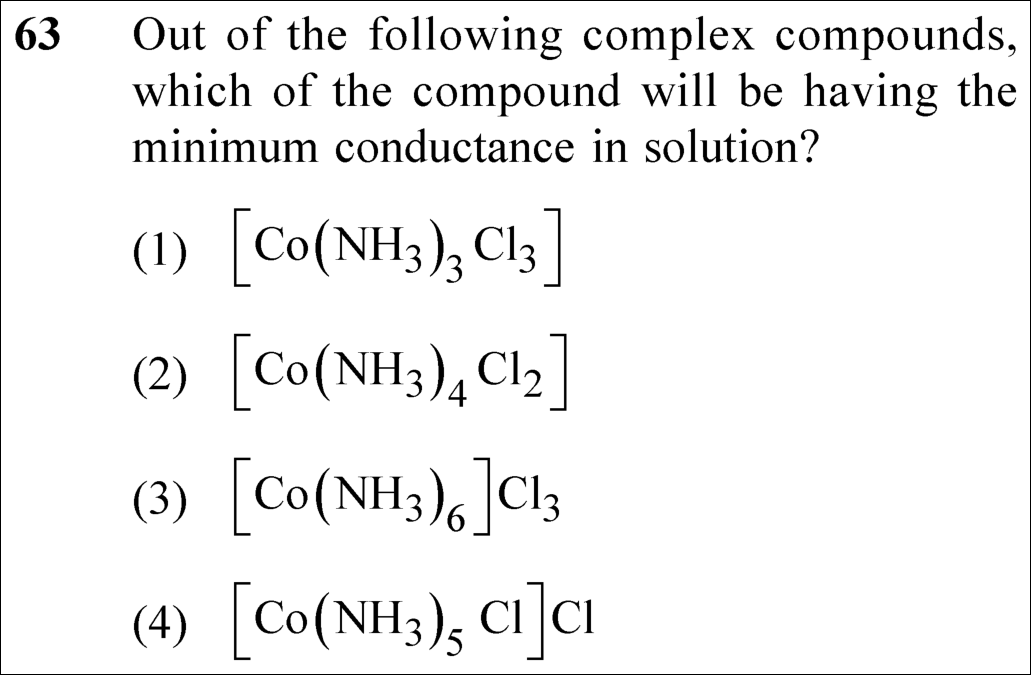
Option 1 Complex [Co(NH₃)₃Cl₃] (Neutral coordination sphere, 0 counter ions)
Option 2 Complex [Co(NH₃)₄Cl₂] (Printed as neutral coordination sphere, 0 counter ions)
Option 3 Complex [Co(NH₃)₆]Cl₃ (1:3 electrolyte, yields 4 ions)
Option 4 Complex [Co(NH₃)₅Cl]Cl (Printed as 1:1 electrolyte, yields 2 ions)
⚡

The 30-Second Exam Hall Shortcut: ⚡ Werner Ion Count and NTA Dual-Key Discovery

⏱️ Save ~40 seconds

Electrical conductance depends on the number of ions produced in solution! [Co(NH₃)₃Cl₃] is a non-electrolyte (0 ions ⟹ zero/minimum conductance). Option (2) was printed as [Co(NH₃)₄Cl₂] without counter-ion (also 0 ions)! NTA officially awarded full marks to BOTH (1) and (2)!

1 Werner’s theory: Only ions outside the coordination bracket [ ] ionize in aqueous solution.
2 Evaluate Option (1): [Co(NH₃)₃Cl₃] has all ligands inside the coordination sphere. It does not ionize in water (number of ions = 0) ⟹ NON-ELECTROLYTE with MINIMUM (zero) conductance!
3 Evaluate Option (2): Printed as [Co(NH₃)₄Cl₂]. Because there is no counter-ion outside the bracket, as written it also yields 0 ions in solution!
4 Evaluate Option (3): [Co(NH₃)₆]Cl₃ ionizes into [Co(NH₃)₆]³⁺ + 3 Cl⁻ (4 ions) ⟹ highest conductance.
5 Evaluate Option (4): [Co(NH₃)₅Cl]Cl ionizes into 2 ions.
6 Because both Option (1) and Option (2) yield zero ions based on printed formulas, NTA officially accepted both (1) and (2) (Key: A,B)!
🛡️
Why You Can 100% Trust This Shortcut: Werner’s Coordination Theory & Electrolytic Conductance (NCERT Chemistry · Coordination Compounds) & NTA Official Key.
📐

Step-by-Step Rigorous Workflow & Mathematical Proof

Step 1

Principle of Electrical Conductance in Coordination Compounds

The molar conductance of an aqueous solution of a coordination compound is directly proportional to the number of free ions produced per formula unit upon dissolution:

Conductance∝Total number of ions per formula unit\text{Conductance} \propto \text{Total number of ions per formula unit}
  • • Ligands inside the coordination sphere [ ] are covalently/coordinatively bonded and do not dissociate in water.
Step 2

Analyze Ionization of Each Complex

Examine the ionization behavior of each given option:

[Co(NH3)3Cl3]→H2ONo ionization  ⟹  0 ions (Non-electrolyte)[\text{Co(NH}_3)_3\text{Cl}_3] \xrightarrow{\text{H}_2\text{O}} \text{No ionization} \implies 0\text{ ions (Non-electrolyte)}
  • • Option (1): [Co(NH₃)₃Cl₃] is a neutral coordination complex with zero counter ions, giving essentially zero electrical conductance (minimum).
  • • Option (2): Printed as [Co(NH₃)₄Cl₂]. Without an external counter-ion, it represents a neutral entity yielding 0 ions in solution.
  • • Option (3): [Co(NH₃)₆]Cl₃ ⟶ [Co(NH₃)₆]³⁺ + 3 Cl⁻ (Total 4 ions) ⟹ Maximum conductance.
  • • Option (4): [Co(NH₃)₅Cl]Cl ⟶ [Co(NH₃)₅Cl]⁺ + Cl⁻ (Total 2 ions).
Step 3

NTA Official Multi-Key Verdict (A, B)

Standard textbook problems list [Co(NH₃)₄Cl₂]Cl (which yields 2 ions). However, the examination paper printed [Co(NH₃)₄Cl₂] with no external chlorine atom, making both (1) and (2) neutral non-electrolytes:

Both [Co(NH3)3Cl3] and [Co(NH3)4Cl2] produce 0 ions  ⟹  Key: A,B\text{Both [Co(NH}_3)_3\text{Cl}_3] \text{ and [Co(NH}_3)_4\text{Cl}_2] \text{ produce 0 ions} \implies \text{Key: A,B}
  • • NTA recognized this printing discrepancy and awarded full marks to candidates selecting either Option (1) or Option (2).
⭐

360° Option Elimination Engine Key Feature

Diagnose every choice: Know exactly why the right option works and why distractors fail.

4-Option Deep Scan
1 A
✓ 100% Correct
Verdict & Scientific Reason:

Officially accepted by NTA (A,B). Canonical neutral non-electrolyte producing 0 ions.

💡
Why this is airtight: None; awarded full marks.
2 B
✓ 100% Correct
Verdict & Scientific Reason:

Officially accepted by NTA (A,B). Printed as a neutral entity without counter-ion, yielding 0 ions.

💡
Why this is airtight: None; awarded full marks.
3 C
✗ Incorrect
Verdict & Scientific Reason:

Incorrect. Produces 4 ions in solution, exhibiting the MAXIMUM conductance.

⚠️
Student Fallacy (Why candidates pick this trap): Selecting maximum conductance instead of minimum conductance.
4 D
✗ Incorrect
Verdict & Scientific Reason:

Incorrect. Ionizes to give 2 ions, having significant conductance.

⚠️
Student Fallacy (Why candidates pick this trap): Thinking one counter-ion gives zero conductance.
⚠️

NTA Trap Alert: Maximum vs Minimum Conductance

Students frequently read "minimum conductance" and impulsively pick [Co(NH₃)₆]Cl₃ because it has the most chlorine atoms (3 Cl). But those 3 chlorines are outside the bracket and fully ionize to give MAXIMUM conductance!

🛡️ How to avoid the -1 mark: Remember: Inside bracket = NO ions = ZERO conductance (minimum)!
📖

Core NEET Syllabus Standard

NEET Chemistry Core Syllabus · Coordination Compounds Standard Benchmark
Core Scientific Principle Tested:

"Only primary valencies outside coordination sphere ionize; neutral complexes are non-electrolytes."

Syllabus Focus: Werner’s Theory & Electrolytic Behavior of Complexes
✓ Core NEET UG Syllabus Anchor Syllabus & Academic Standards ↗
No outside ions = Non-electrolyte = Zero conductance (Key: A,B)!
NEET 2025 · Q80 Easy
Official NEET 2025 Question 80 - Coordination Compounds
1
2
3 ✓ Key
4
💡 Verified Solution & 30-Second Hack
✓
Verified Against NTA Final Answer Key
Option (3) : A-I, B-II, C-III, D-IV
📚 The d- and f-Block Elements & Coordination Compounds Easy
📋 Given Parameters & Problem Setup
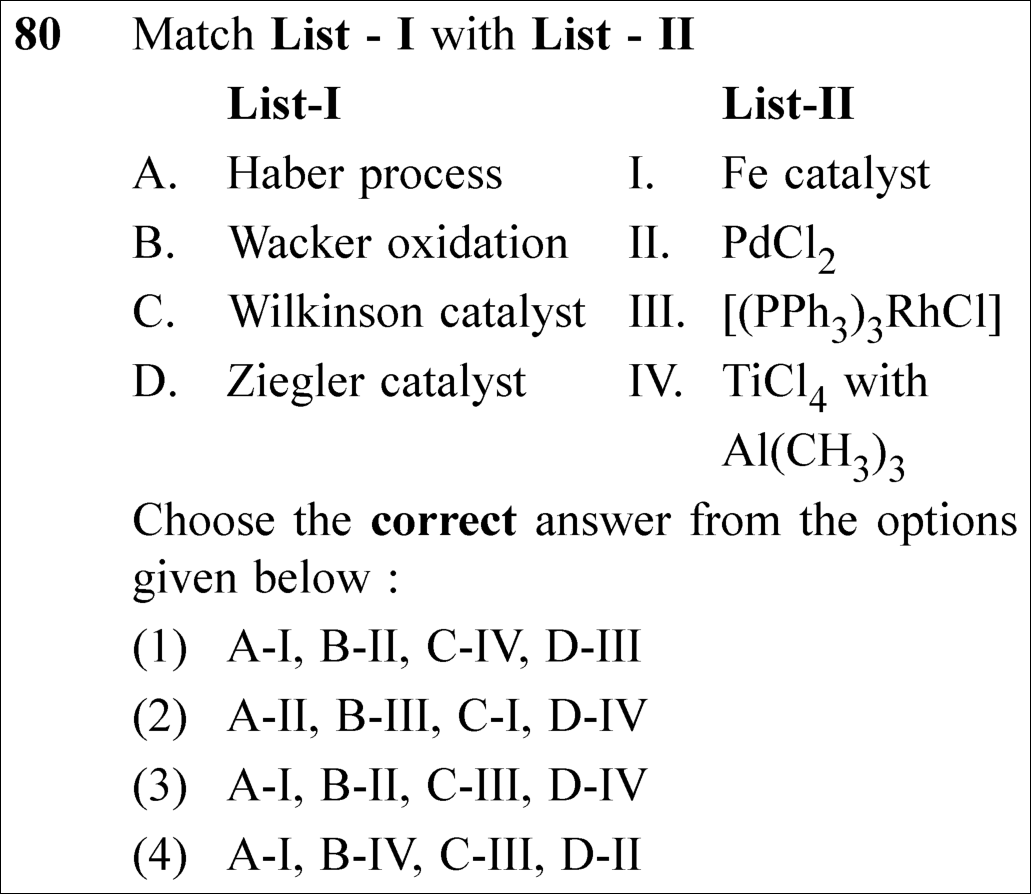
List I (Processes/Catalysts) A. Haber process, B. Wacker oxidation, C. Wilkinson catalyst, D. Ziegler catalyst
List II (Catalyst Formulations) I. Fe catalyst, II. PdCl₂, III. [(PPh₃)₃RhCl], IV. TiCl₄ with Al(CH₃)₃
⚡

The 30-Second Exam Hall Shortcut: ⚡ Named Catalysts 1-to-1 Sequence Match

⏱️ Save ~30 seconds

Haber = Fe (A-I). Wacker oxidation = PdCl₂ (B-II). Wilkinson = Rh complex [(PPh₃)₃RhCl] (C-III). Ziegler-Natta = TiCl₄ + AlR₃ (D-IV)! Perfect sequential match: A-I, B-II, C-III, D-IV!

1 A. Haber process: Industrial synthesis of ammonia (N₂ + 3H₂ ⇌ 2NH₃) uses Iron (Fe) catalyst with K₂O/Al₂O₃ promoter ⟹ A matches I.
2 B. Wacker process: Oxidation of ethene to ethanal (acetaldehyde) uses Palladium chloride (PdCl₂) with CuCl₂ ⟹ B matches II.
3 C. Wilkinson’s catalyst: Homogeneous hydrogenation of alkenes uses chloridotris(triphenylphosphine)rhodium(I), [(PPh₃)₃RhCl] ⟹ C matches III.
4 D. Ziegler-Natta catalyst: Coordination polymerization of alkenes uses Titanium tetrachloride (TiCl₄) with trialkylaluminium (Al(CH₃)₃ or Al(C₂H₅)₃) ⟹ D matches IV.
5 Sequential match: A-I, B-II, C-III, D-IV.
6 Select Option (3) in under 10 seconds!
🛡️
Why You Can 100% Trust This Shortcut: Variable Oxidation States & Catalytic Mechanisms of Transition Elements (NCERT Chemistry · d- and f-Block Elements).
📐

Step-by-Step Rigorous Workflow & Mathematical Proof

Step 1

Match Haber Process and Wacker Oxidation

Examine transition metal catalysts in major industrial processes from NCERT Chapter 8:

Haber Process: N2+3H2→Fe catalyst,Mo/K2O2NH3  ⟹  A matches I\text{Haber Process: } \text{N}_2 + 3\text{H}_2 \xrightarrow{\text{Fe catalyst}, \text{Mo/K}_2\text{O}} 2\text{NH}_3 \implies \text{A matches I}
  • • A matches I (A-I).
  • • Wacker Oxidation: Conversion of ethene into ethanal using aqueous PdCl₂ catalyst in the presence of CuCl₂ and air:
  • • \text{C}_2\text{H}_4 + \text{PdCl}_2 + \text{H}_2\text{O} \longrightarrow \text{CH}_3\text{CHO} + \text{Pd} + 2\text{HCl} \implies \text{B matches II (B-II)}.
Step 2

Match Wilkinson and Ziegler Catalysts

Examine organometallic and coordination complexes used in homogeneous and heterogeneous polymerizations:

Wilkinson Catalyst: [(PPh3)3RhCl]  ⟹  C matches III\text{Wilkinson Catalyst: } [(\text{PPh}_3)_3\text{RhCl}] \implies \text{C matches III}
  • • Wilkinson’s catalyst is a square planar rhodium(I) complex used for selective homogeneous hydrogenation of double bonds.
  • • Ziegler-Natta Catalyst: A mixture of titanium tetrachloride and trialkylaluminium (TiCl₄ + Al(CH₃)₃ or Al(C₂H₅)₃), used for stereospecific polymerization of ethene into high-density polyethylene (HDPE): D matches IV (D-IV).
Step 3

Synthesize the Complete Match

Combine all four matches into the final answer:

A-I, B-II, C-III, D-IV  ⟹  Option (3)\text{A-I, B-II, C-III, D-IV} \implies \text{Option (3)}
  • • Matches Option (3) perfectly.
⭐

360° Option Elimination Engine Key Feature

Diagnose every choice: Know exactly why the right option works and why distractors fail.

4-Option Deep Scan
1 A
✗ Incorrect
Verdict & Scientific Reason:

Incorrect. Swaps Wilkinson catalyst and Ziegler catalyst.

⚠️
Student Fallacy (Why candidates pick this trap): Confusing Rhodium with Titanium catalyst.
2 B
✗ Incorrect
Verdict & Scientific Reason:

Incorrect. Assigns PdCl₂ to Haber process.

⚠️
Student Fallacy (Why candidates pick this trap): Completely scrambled matches.
3 C
✓ 100% Correct
Verdict & Scientific Reason:

100% correct. Direct sequential match of all canonical NCERT catalysts.

💡
Why this is airtight: None; textbook mastery of transition metal catalysis.
4 D
✗ Incorrect
Verdict & Scientific Reason:

Incorrect. Swaps Wacker oxidation and Ziegler catalyst.

⚠️
Student Fallacy (Why candidates pick this trap): Assigning TiCl₄ to Wacker process.
⚠️

NTA Trap Alert: Swapping Wilkinson and Ziegler Catalysts

Option 1 swaps Wilkinson (Rh) and Ziegler (Ti). Remembering that Wilkinson’s catalyst is the famous Rhodium complex [(PPh₃)₃RhCl] easily prevents this confusion.

🛡️ How to avoid the -1 mark: Remember: Wilkinson = Rhodium (Rh); Ziegler-Natta = Titanium (Ti) + Aluminium (Al)!
📖

Core NEET Syllabus Standard

NEET Chemistry Core Syllabus · The d- and f-Block Elements Standard Benchmark
Core Scientific Principle Tested:

"Haber = Fe, Wacker = PdCl₂, Wilkinson = [(PPh₃)₃RhCl], Ziegler = TiCl₄ + AlR₃."

Syllabus Focus: Catalytic Properties of Transition Metals and Coordination Complexes
✓ Core NEET UG Syllabus Anchor Syllabus & Academic Standards ↗
Haber-Fe, Wacker-Pd, Wilkinson-Rh, Ziegler-Ti ⟹ 1, 2, 3, 4 straight down (Option 3)!
NEET 2024 · Q67 Easy
Official NEET 2024 Question 67 - Coordination Compounds
1
2
3 ✓ Key
4
💡 Verified Solution & 30-Second Hack
✓
Verified Against NTA Final Answer Key
Option (3) : A-II, B-III, C-IV, D-I
📚 Coordination Compounds Easy
📋 Given Parameters & Problem Setup
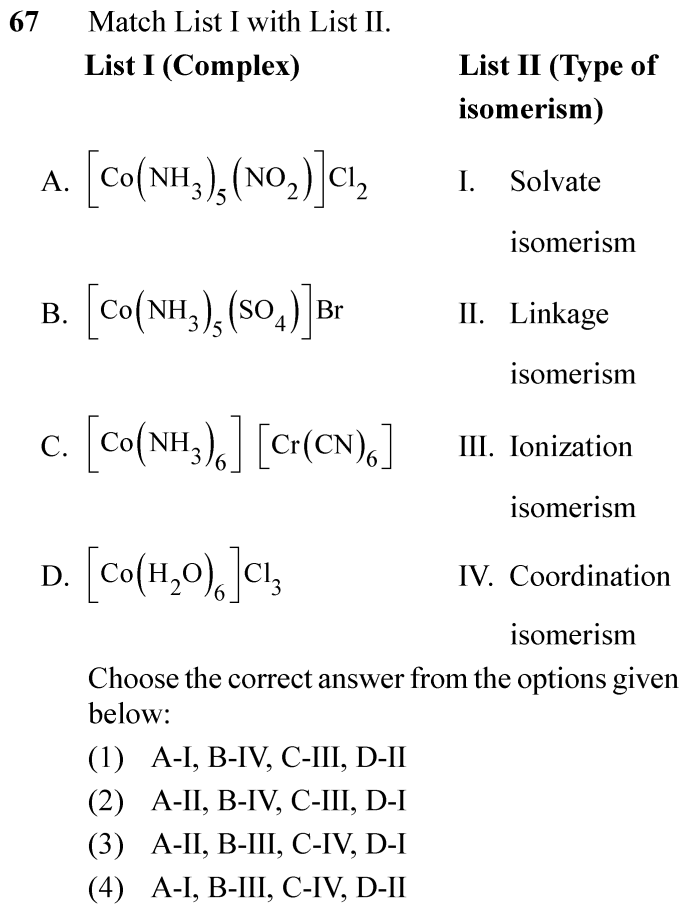
Complex A [Co(NH3)5(NO2)]Cl2
Complex B [Co(NH3)5(SO4)]Br
Complex C [Co(NH3)6][Cr(CN)6]
Complex D [Co(H2O)6]Cl3
⚡

The 30-Second Exam Hall Shortcut: ⚡ Ligand Fingerprint Isomerism Hack

⏱️ Save ~35 seconds

NO2⁻ is ambidentate -> Linkage (II); SO4²⁻/Br⁻ exchange outside sphere -> Ionization (III); Two complex ions swapping ligands -> Coordination (IV); H2O ligand/hydrate -> Solvate (I)!

1 Complex A contains NO2⁻ (nitro / nitrito), an ambidentate ligand that can coordinate through N or O -> Linkage isomerism (A-II).
2 Complex B has SO4²⁻ inside and Br⁻ outside, which can interchange to form [Co(NH3)5Br]SO4 -> Ionization isomerism (B-III).
3 Complex C contains both cationic [Co(NH3)6]³⁺ and anionic [Cr(CN)6]³⁻ coordination spheres capable of interchanging ligands -> Coordination isomerism (C-IV).
4 Complex D contains coordinated water molecules that can interchange with counterions (hydrate/solvate) -> Solvate isomerism (D-I).
5 Match: A-II, B-III, C-IV, D-I -> Option (3) in 5 seconds!
🛡️
Why You Can 100% Trust This Shortcut: NCERT Chemistry · Coordination Compounds (Structural isomerism: linkage, coordination, ionization, and solvate isomerism).
📐

Step-by-Step Rigorous Workflow & Mathematical Proof

Step 1

Linkage Isomerism in [Co(NH3)5(NO2)]Cl2

Linkage isomerism arises in coordination compounds containing ambidentate ligands (ligands possessing two distinct donor atoms). In [Co(NH3)5(NO2)]Cl2, the ligand can bind via nitrogen (nitro, yellow) or oxygen (nitrito, -ONO, red):

[Co(NH3)5(NO2)]2+  vs  [Co(NH3)5(ONO)]2+  ⟹  Linkage Isomerism[\text{Co}(\text{NH}_3)_5(\text{NO}_2)]^{2+} \;\text{vs}\; [\text{Co}(\text{NH}_3)_5(\text{ONO})]^{2+} \implies \text{Linkage Isomerism}
Step 2

Ionization Isomerism in [Co(NH3)5(SO4)]Br

Ionization isomerism occurs when the counterion in a complex salt is itself a potential ligand and can displace a ligand from the coordination sphere, producing different ions upon dissolution:

[Co(NH3)5(SO4)]Br→aqBr⊖vs[Co(NH3)5Br]SO4→aqSO42−  ⟹  Ionization[\text{Co}(\text{NH}_3)_5(\text{SO}_4)]\text{Br} \xrightarrow{\text{aq}} \text{Br}^\ominus \quad \text{vs} \quad [\text{Co}(\text{NH}_3)_5\text{Br}]\text{SO}_4 \xrightarrow{\text{aq}} \text{SO}_4^{2-} \implies \text{Ionization}
Step 3

Coordination Isomerism in [Co(NH3)6][Cr(CN)6]

This type of isomerism occurs in compounds where both the cation and anion are complex ions, and ligands interchange between the two different metal centers:

[Co(NH3)6][Cr(CN)6]and[Cr(NH3)6][Co(CN)6]  ⟹  Coordination Isomerism[\text{Co}(\text{NH}_3)_6][\text{Cr}(\text{CN})_6] \quad \text{and} \quad [\text{Cr}(\text{NH}_3)_6][\text{Co}(\text{CN})_6] \implies \text{Coordination Isomerism}
Step 4

Solvate (Hydrate) Isomerism in [Co(H2O)6]Cl3

Solvate isomerism (hydrate isomerism when water is involved) differs based on whether a solvent molecule is directly bonded to the metal ion as a ligand or merely present as crystal lattice water:

[Co(H2O)6]Cl3  vs  [Co(H2O)5Cl]Cl2⋅H2O  ⟹  Solvate Isomerism[\text{Co}(\text{H}_2\text{O})_6]\text{Cl}_3 \;\text{vs}\; [\text{Co}(\text{H}_2\text{O})_5\text{Cl}]\text{Cl}_2 \cdot \text{H}_2\text{O} \implies \text{Solvate Isomerism}
⭐

360° Option Elimination Engine Key Feature

Diagnose every choice: Know exactly why the right option works and why distractors fail.

4-Option Deep Scan
1 (1)
✗ Incorrect
Verdict & Scientific Reason:

Mismatches linkage with solvate.

⚠️
Student Fallacy (Why candidates pick this trap): Arbitrary guessing.
2 (2)
✗ Incorrect
Verdict & Scientific Reason:

Swaps ionization and coordination isomerism.

⚠️
Student Fallacy (Why candidates pick this trap): Confusing single coordination sphere with dual coordination sphere.
3 (3)
✓ 100% Correct
Verdict & Scientific Reason:

Exact correspondence to canonical NCERT definitions.

💡
Why this is airtight: None.
4 (4)
✗ Incorrect
Verdict & Scientific Reason:

Mismatches complex A.

⚠️
Student Fallacy (Why candidates pick this trap): Failure to recognize ambidentate NO2.
⚠️

NTA Trap Alert: Confusing Ionization with Coordination Isomerism

Ionization involves exchange between inner sphere ligand and outer sphere simple counterion. Coordination isomerism requires TWO complex coordination spheres exchanging ligands.

🛡️ How to avoid the -1 mark: Two brackets [ ][ ] = Coordination isomerism; One bracket with outer ion [ ]X = Ionization isomerism.
📖

Core NEET Syllabus Standard

Chemistry Core Inorganic Chemistry · Coordination Compounds Standard Benchmark
Core Scientific Principle Tested:

"Ambidentate ligand -> Linkage; Counterion exchange -> Ionization; Dual complex ion interchange -> Coordination; Water participation -> Solvate."

Syllabus Focus: Isomerism in Coordination Compounds: Structural Types
✓ Core NEET UG Syllabus Anchor Syllabus & Academic Standards ↗
Ambidentate links, ions trade free, two cages coordinate, water solvates thee!
NEET 2024 · Q81 Easy
Official NEET 2024 Question 81 - Coordination Compounds
1
2
3 ✓ Key
4
💡 Verified Solution & 30-Second Hack
✓
Verified Against NTA Final Answer Key
Option (3) : Both Statement I and Statement II are true.
📚 Coordination Compounds Easy
📋 Given Parameters & Problem Setup
Complex 1 [Co(NH3)6]³⁺ (hexaamminecobalt(III) ion)
Complex 2 [CoF6]³⁻ (hexafluoridocobaltate(III) ion)
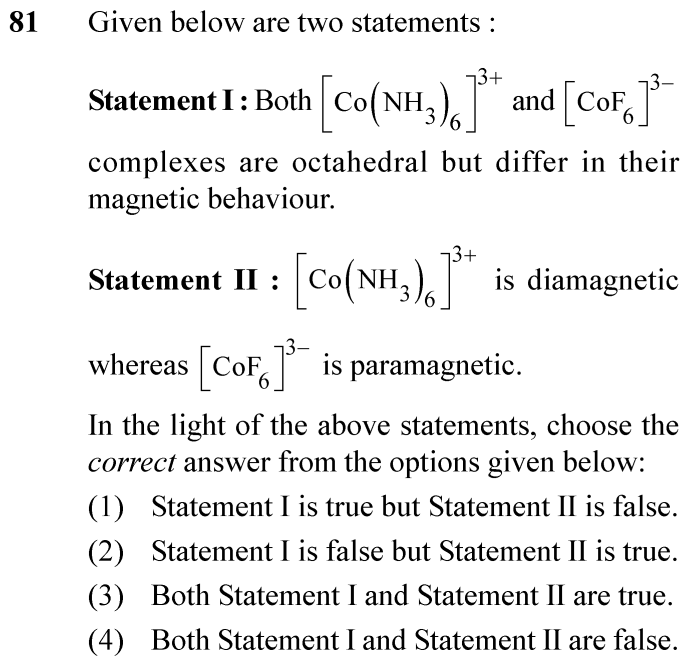
Statement I Both complexes are octahedral but differ in their magnetic behaviour
Statement II [Co(NH3)6]³⁺ is diamagnetic whereas [CoF6]³⁻ is paramagnetic
⚡

The 30-Second Exam Hall Shortcut: ⚡ Strong Field vs Weak Field Spectrochemical Hack

⏱️ Save ~40 seconds

Co³⁺ is d⁶. NH3 is a strong field ligand -> Δ_o > P -> pairing -> t_2g⁶ e_g⁰ (n=0, diamagnetic)! F⁻ is a weak field ligand -> Δ_o < P -> t_2g⁴ e_g² (n=4, paramagnetic)!

1 Both complexes have coordination number 6 -> Both are Octahedral geometry -> Statement I part 1 is TRUE.
2 Oxidation state of Co is +3 in both: Co³⁺ = [Ar] 3d⁶.
3 In [Co(NH3)6]³⁺, NH3 is a strong field ligand. Crystal field splitting Δ_o exceeds pairing energy P (Δ_o > P), causing complete pairing into t_2g⁶ e_g⁰ -> n = 0 unpaired electrons -> DIAMAGNETIC.
4 In [CoF6]³⁻, F⁻ is a weak field ligand (Δ_o < P), leading to high-spin configuration t_2g⁴ e_g² -> n = 4 unpaired electrons -> PARAMAGNETIC.
5 Therefore, both are octahedral, differ in magnetic behavior (Statement I is TRUE), and [Co(NH3)6]³⁺ is diamagnetic while [CoF6]³⁻ is paramagnetic (Statement II is TRUE).
6 Both statements are true -> Option (3) in 5 seconds!
🛡️
Why You Can 100% Trust This Shortcut: NCERT Chemistry · Coordination Compounds (Crystal field theory in octahedral complexes: [Co(NH3)6]3+ diamagnetic low-spin vs [CoF6]3- paramagnetic high-spin).
📐

Step-by-Step Rigorous Workflow & Mathematical Proof

Step 1

Coordination Number and Geometry

Both [Co(NH3)6]³⁺ and [CoF6]³⁻ possess a central cobalt ion surrounded by six monodentate ligands (coordination number = 6). Coordination number 6 uniquely dictates an Octahedral coordination polyhedral geometry for both complexes:

CN=6  ⟹  Octahedral Geometry for both complexes\text{CN} = 6 \implies \text{Octahedral Geometry for both complexes}
Step 2

Crystal Field Analysis of [Co(NH3)6]³⁺

Cobalt(III) has a 3d⁶ valence electron configuration. NH3 occupies a high position in the spectrochemical series and behaves as a strong field ligand with Co³⁺. Because Δo > P (pairing energy), electrons fully pair in the lower energy t2g orbitals:

Configuration: t2g6 eg0,n=0  ⟹  Diamagnetic (Low-spin / inner orbital complex)\text{Configuration: } t_{2g}^6\,e_g^0, \quad n = 0 \implies \text{Diamagnetic (Low-spin / inner orbital complex)}
Step 3

Crystal Field Analysis of [CoF6]³⁻

Fluoride ion (F⁻) lies at the weak field end of the spectrochemical series. The crystal field splitting is smaller than the pairing energy (Δo < P), so electrons follow Hund’s rule of maximum multiplicity across both t2g and eg sets:

Configuration: t2g4 eg2,n=4  ⟹  μ=4(6)=4.90  B.M.  (Paramagnetic / high-spin)\text{Configuration: } t_{2g}^4\,e_g^2, \quad n = 4 \implies \mu = \sqrt{4(6)} = 4.90\;\text{B.M.} \; (\text{Paramagnetic / high-spin})
Step 4

Evaluating Statements

Statement I correctly asserts that both are octahedral but differ in magnetic behavior. Statement II correctly specifies that [Co(NH3)6]³⁺ is diamagnetic and [CoF6]³⁻ is paramagnetic. Both statements are factually and theoretically correct.

Both Statement I and Statement II are true (Option 3)\text{Both Statement I and Statement II are true (Option 3)}
⭐

360° Option Elimination Engine Key Feature

Diagnose every choice: Know exactly why the right option works and why distractors fail.

4-Option Deep Scan
1 (1)
✗ Incorrect
Verdict & Scientific Reason:

Statement II is the precise textbook statement of their magnetic properties.

⚠️
Student Fallacy (Why candidates pick this trap): Thinking [CoF6]3- is diamagnetic.
2 (2)
✗ Incorrect
Verdict & Scientific Reason:

Statement I is true: both complexes are octahedral.

⚠️
Student Fallacy (Why candidates pick this trap): Thinking they have different geometries.
3 (3)
✓ 100% Correct
Verdict & Scientific Reason:

Both statements reflect canonical crystal field theory and empirical magnetic measurements.

💡
Why this is airtight: None.
4 (4)
✗ Incorrect
Verdict & Scientific Reason:

Both statements are completely verified truths.

⚠️
Student Fallacy (Why candidates pick this trap): Total rejection of CFT.
⚠️

NTA Trap Alert: Assuming All Co(III) Complexes Have Identical Magnetism

Students frequently remember Co³⁺ as diamagnetic from [Co(NH3)6]³⁺, forgetting that weak field ligands like F⁻ produce high-spin paramagnetic complexes (n = 4).

🛡️ How to avoid the -1 mark: Always check ligand strength: NH3 = strong (diamagnetic); F⁻ = weak (paramagnetic).
📖

Core NEET Syllabus Standard

Chemistry Core Inorganic Chemistry · Coordination Compounds Standard Benchmark
Core Scientific Principle Tested:

"In octahedral field, d6 forms diamagnetic t2g⁶ eg⁰ with strong field ligands (NH3) and paramagnetic t2g⁴ eg² with weak field ligands (F⁻)."

Syllabus Focus: Crystal Field Theory: Electronic Configurations of d6 Ions
✓ Core NEET UG Syllabus Anchor Syllabus & Academic Standards ↗
Ammonia pairs them all (diamagnetic zero); Fluoride spreads them wide (paramagnetic hero)!
NEET 2024 · Q99 Easy
Official NEET 2024 Question 99 - Coordination Compounds
1
2
3 ✓ Key
4
💡 Verified Solution & 30-Second Hack
✓
Verified Against NTA Final Answer Key
Option (3) : Both Statement I and Statement II are true.
📚 Coordination Compounds Easy
📋 Given Parameters & Problem Setup
Complex 1 [Co(NH3)6]³⁺
Complex 2 [Co(NH3)4Cl2]⁺
Statement I [Co(NH3)6]³⁺ is a homoleptic complex whereas [Co(NH3)4Cl2]⁺ is a heteroleptic complex.
Statement II Complex [Co(NH3)6]³⁺ has only one kind of ligands but [Co(NH3)4Cl2]⁺ has more than one kind of ligands.
⚡

The 30-Second Exam Hall Shortcut: ⚡ Homo vs Hetero Direct Definition

⏱️ Save ~30 seconds

Homo = Same (only one kind of ligand -> [Co(NH3)6]³⁺); Hetero = Different (more than one kind of ligand -> [Co(NH3)4Cl2]⁺)! Both statements are completely TRUE!

1 Homoleptic complex: Complex in which the metal atom or ion is bound to only one kind of donor groups/ligands.
2 [Co(NH3)6]³⁺ has only NH3 ligands -> Homoleptic complex.
3 Heteroleptic complex: Complex in which the metal atom or ion is bound to more than one kind of donor groups/ligands.
4 [Co(NH3)4Cl2]⁺ has two kinds of ligands (four NH3 and two Cl⁻) -> Heteroleptic complex.
5 Statement I accurately classifies both complexes -> TRUE.
6 Statement II gives the exact NCERT textbook definition -> TRUE.
7 Both Statement I and Statement II are true -> Option (3) in 3 seconds!
🛡️
Why You Can 100% Trust This Shortcut: NCERT Chemistry · Coordination Compounds (Definitions of coordination entity: homoleptic and heteroleptic complexes).
📐

Step-by-Step Rigorous Workflow & Mathematical Proof

Step 1

Definition of Homoleptic Complexes

Homoleptic complexes are coordination entities in which a central metal ion is coordinated to only one chemical type of donor atom or ligand. In [Co(NH3)6]³⁺, all six coordination sites are occupied exclusively by neutral ammonia (ammine) molecules:

[Co(NH3)6]3+  ⟹  Single ligand type (all NH3)  ⟹  Homoleptic Complex[\text{Co}(\text{NH}_3)_6]^{3+} \implies \text{Single ligand type (all } \text{NH}_3) \implies \text{Homoleptic Complex}
Step 2

Definition of Heteroleptic Complexes

Heteroleptic complexes are coordination entities in which the central metal ion is bound to two or more distinct types of ligands. In [Co(NH3)4Cl2]⁺, cobalt is coordinated simultaneously to two different ligand species: four neutral ammine ligands and two anionic chlorido ligands:

[Co(NH3)4Cl2]+  ⟹  Two distinct ligand types (4 NH3+2  Cl⊖)  ⟹  Heteroleptic Complex[\text{Co}(\text{NH}_3)_4\text{Cl}_2]^+ \implies \text{Two distinct ligand types (4 } \text{NH}_3 + 2\;\text{Cl}^\ominus) \implies \text{Heteroleptic Complex}
Step 3

Evaluating Statements

Statement I correctly identifies [Co(NH3)6]³⁺ as homoleptic and [Co(NH3)4Cl2]⁺ as heteroleptic. Statement II accurately provides the foundational definition: [Co(NH3)6]³⁺ has only one kind of ligand while [Co(NH3)4Cl2]⁺ has more than one kind. Both statements are true.

Both Statement I and Statement II are true (Option 3)\text{Both Statement I and Statement II are true (Option 3)}
⭐

360° Option Elimination Engine Key Feature

Diagnose every choice: Know exactly why the right option works and why distractors fail.

4-Option Deep Scan
1 (1)
✗ Incorrect
Verdict & Scientific Reason:

Statement II is the verbatim definition of homoleptic/heteroleptic.

⚠️
Student Fallacy (Why candidates pick this trap): Believing Statement II has a flaw.
2 (2)
✗ Incorrect
Verdict & Scientific Reason:

Statement I is completely true.

⚠️
Student Fallacy (Why candidates pick this trap): Inverting homoleptic and heteroleptic.
3 (3)
✓ 100% Correct
Verdict & Scientific Reason:

Both statements are indisputable textbook definitions.

💡
Why this is airtight: None.
4 (4)
✗ Incorrect
Verdict & Scientific Reason:

Both statements are 100% verified truths.

⚠️
Student Fallacy (Why candidates pick this trap): Rejecting basic terminology.
⚠️

NTA Trap Alert: Second-Guessing Obvious Textbook Definitions

Students sometimes think there must be a trick in Statement II and guess Option (1). Statement II is literally the verbatim definition of homoleptic and heteroleptic.

🛡️ How to avoid the -1 mark: Trust foundational definitions: homo = one kind, hetero = mixed kinds.
📖

Core NEET Syllabus Standard

Chemistry Core Inorganic Chemistry · Coordination Compounds Standard Benchmark
Core Scientific Principle Tested:

"Homoleptic complexes contain only one type of ligand; heteroleptic complexes contain more than one type of ligand."

Syllabus Focus: Basic Terminology: Homoleptic and Heteroleptic Complexes
✓ Core NEET UG Syllabus Anchor Syllabus & Academic Standards ↗
Homo is one kind alone; Hetero has mixed ligands shown!
NEET 2023 · Q61 Easy
Official NEET 2023 Question 61 - Coordination Compounds
1
2 ✓ Key
3
4
💡 Verified Solution & 30-Second Hack
✓
Verified Against NTA Final Answer Key
Option (2) : Potassium trioxalatoaluminate (III)
📚 Coordination Compounds Easy
📋 Given Parameters & Problem Setup
Target classification Homoleptic complex
Definition Central metal atom/ion bound to only ONE type of donor group/ligand
⚡

The 30-Second Exam Hall Shortcut: ⚡ Prefix & Ligand Variety Scan: Homo = ONE Ligand Type

⏱️ Save ~30 seconds

Potassium trioxalatoaluminate (III) is K₃[Al(C₂O₄)₃], containing ONLY oxalate ligands! All other options contain two or three different ligand types (heteroleptic). Option (2) in 5 seconds!

1 Homoleptic complex: A coordination entity where the metal is bound to only ONE kind of ligand.
2 Heteroleptic complex: A coordination entity where the metal is bound to more than one kind of ligand.
3 Option (1): Triamminetriaquachromium (III) chloride contains NH₃ AND H₂O (two ligand kinds ⟹ Heteroleptic).
4 Option (2): Potassium trioxalatoaluminate (III) contains ONLY oxalate (ox²⁻) ligands ⟹ HOMOLEPTIC.
5 Option (3): Diamminechloridonitrito-N-platinum (II) contains NH₃, Cl⁻, and NO₂⁻ (three ligand kinds ⟹ Heteroleptic).
6 Option (4): Pentaamminecarbonatocobalt (III) chloride contains NH₃ AND CO₃²⁻ (two ligand kinds ⟹ Heteroleptic).
7 Select Option (2) directly!
🛡️
Why You Can 100% Trust This Shortcut: Coordination Chemistry · IUPAC Terminology (Complexes in which a metal is bound to only one kind of donor groups are homoleptic, e.g., [Al(C₂O₄)₃]³⁻).
📐

Step-by-Step Rigorous Workflow & Mathematical Proof

Step 1

Definition of Homoleptic Coordination Entities

According to IUPAC coordination chemistry conventions, complexes are classified based on the diversity of their coordinating donor ligands: (i) Homoleptic complexes: complexes in which the central metal atom or ion is coordinated to only ONE type of ligand species; (ii) Heteroleptic complexes: complexes in which the metal ion is coordinated to two or more chemically distinct types of ligands.

Homoleptic: [M(L)n]m±,Heteroleptic: [M(L1)a(L2)b]m±\text{Homoleptic: } [\text{M}(\text{L})_n]^{m\pm}, \qquad \text{Heteroleptic: } [\text{M}(\text{L}_1)_a(\text{L}_2)_b]^{m\pm}
Step 2

Chemical Formula of Option 2

Potassium trioxalatoaluminate (III) has the chemical formula K₃[Al(C₂O₄)₃]. In this complex, the central aluminum(III) ion is coordinated exclusively to three bidentate oxalate ligands (C₂O₄²⁻):

K3[Al(C2O4)3]  ⟹  Coordination sphere contains only oxalate ligands (Homoleptic)\text{K}_3[\text{Al}(\text{C}_2\text{O}_4)_3] \implies \text{Coordination sphere contains only oxalate ligands } (\text{Homoleptic})
Step 3

Formulas and Analysis of Heteroleptic Distractors

Writing the coordination formulas for the remaining choices reveals multiple distinct ligand types:

Option 1: [Cr(NH3)3(H2O)3]Cl3(Ligands: NH3,H2O  ⟹  Heteroleptic)Option 3: [Pt(NH3)2Cl(NO2)](Ligands: NH3,Cl−,NO2−  ⟹  Heteroleptic)Option 4: [Co(NH3)5(CO3)]Cl(Ligands: NH3,CO32−  ⟹  Heteroleptic)\begin{aligned} \text{Option 1: } &[\text{Cr}(\text{NH}_3)_3(\text{H}_2\text{O})_3]\text{Cl}_3 \quad (\text{Ligands: } \text{NH}_3, \text{H}_2\text{O} \implies \text{Heteroleptic}) \\[4pt] \text{Option 3: } &[\text{Pt}(\text{NH}_3)_2\text{Cl}(\text{NO}_2)] \quad (\text{Ligands: } \text{NH}_3, \text{Cl}^-, \text{NO}_2^- \implies \text{Heteroleptic}) \\[4pt] \text{Option 4: } &[\text{Co}(\text{NH}_3)_5(\text{CO}_3)]\text{Cl} \quad (\text{Ligands: } \text{NH}_3, \text{CO}_3^{2-} \implies \text{Heteroleptic}) \end{aligned}
⭐

360° Option Elimination Engine Key Feature

Diagnose every choice: Know exactly why the right option works and why distractors fail.

4-Option Deep Scan
1 (1)
✗ Incorrect
Verdict & Scientific Reason:

Heteroleptic: contains both ammine (NH₃) and aqua (H₂O) ligands.

⚠️
Student Fallacy (Why candidates pick this trap): Candidate saw identical stoichiometric counts (3 and 3) and guessed homoleptic.
2 (2)
✓ 100% Correct
Verdict & Scientific Reason:

Accurate homoleptic complex: contains exclusively oxalate ligands [Al(C₂O₄)₃]³⁻.

💡
Why this is airtight: None. Candidate correctly verified single ligand type.
3 (3)
✗ Incorrect
Verdict & Scientific Reason:

Heteroleptic: contains three distinct ligand types (ammine, chlorido, nitrito-N).

⚠️
Student Fallacy (Why candidates pick this trap): Candidate overlooked the presence of multiple ligands.
4 (4)
✗ Incorrect
Verdict & Scientific Reason:

Heteroleptic: contains ammine and carbonato ligands.

⚠️
Student Fallacy (Why candidates pick this trap): Candidate saw pentaammine (5 ammines) and ignored the carbonato ligand.
⚠️

NTA Trap Alert: Confusing Counter Ions with Coordination Ligands

Potassium (K⁺) in K₃[Al(C₂O₄)₃] is an ion outside the coordination bracket. Only the species INSIDE the coordination square brackets define homoleptic vs heteroleptic character.

🛡️ How to avoid the -1 mark: Focus strictly inside the brackets: If there is only ONE type of ligand inside [ ], it is homoleptic.
📖

Core NEET Syllabus Standard

National Eligibility cum Entrance Test (NEET UG) · Coordination Compounds Standard Benchmark
Core Scientific Principle Tested:

"Homoleptic complexes have central metal bound to only one kind of donor groups; heteroleptic complexes have more than one kind."

Syllabus Focus: Definitions of Some Important Terms Pertaining to Coordination Compounds
Preserved in Rationalized Curriculum Syllabus & Academic Standards ↗
NEET 2023 · Q88 Easy
Official NEET 2023 Question 88 - Coordination Compounds
1
2
3
4 ✓ Key
💡 Verified Solution & 30-Second Hack
✓
Verified Against NTA Final Answer Key
Option (4) : [CoCl₂(en)₂]NO₃
📚 Coordination Compounds Easy
📋 Given Parameters & Problem Setup
Complex 1 [Co(NH₃)₆]₂(SO₄)₃
Complex 2 [Co(NH₃)₄(H₂O)Br](NO₃)₂
Complex 3 [Co(NH₃)₃(NO₃)₃]
Complex 4 [CoCl₂(en)₂]NO₃
⚡

The 30-Second Exam Hall Shortcut: ⚡ Chelate Effect Dominance: Chelating Ligand (en) Imparts Highest Stability

⏱️ Save ~25 seconds

Chelate complexes containing multidentate ring-forming ligands are far more stable than non-chelated complexes containing only monodentate ligands. Ethylenediamine (en) is a bidentate chelating ligand forming stable 5-membered rings. Among all four choices, ONLY Option (4) contains chelating ligands!

1 Scan ligand types in all four complexes:
2 - Complex (1): NH₃ is unidentate (monodentate).
3 - Complex (2): NH₃, H₂O, Br⁻ are all unidentate.
4 - Complex (3): NH₃, NO₃⁻ are unidentate.
5 - Complex (4): "en" (ethylenediamine) is a bidentate chelating ligand.
6 Chelate rings provide huge positive entropy gain (chelate effect), maximizing formation constant β.
7 Select Option (4) [CoCl₂(en)₂]NO₃ instantly!
🛡️
Why You Can 100% Trust This Shortcut: Classical Coordination Chemistry Chelate Effect in NCERT.
📐

Step-by-Step Rigorous Workflow & Mathematical Proof

Step 1

Define the Chelate Effect in Coordination Chemistry

When a multidentate (polydentate) ligand binds to a central metal ion to form a ring structure, the resulting complex possesses significantly higher thermodynamic stability than an analogous complex containing only unidentate ligands. This phenomenon is known as the chelate effect:

[M(H2O)6]n++2en⇌[M(en)2]n++6H2O(ΔS∘>0)[\text{M}(\text{H}_2\text{O})_6]^{n+} + 2\text{en} \rightleftharpoons [\text{M}(\text{en})_2]^{n+} + 6\text{H}_2\text{O} \quad (\Delta S^\circ > 0)
Step 2

Analyze Ligand Denticity in Given Complexes

Examine each coordination sphere: [Co(NH₃)₆]³⁺, [Co(NH₃)₄(H₂O)Br]²⁺, and [Co(NH₃)₃(NO₃)₃] contain only unidentate ligands. [CoCl₂(en)₂]⁺ contains two bidentate chelating ethylenediamine ligands:

Ethylenediamine (en): H2N−CH2−CH2−NH2(Bidentate, forms stable 5-membered rings)\text{Ethylenediamine (en): } \text{H}_2\text{N}-\text{CH}_2-\text{CH}_2-\text{NH}_2 \quad (\text{Bidentate, forms stable 5-membered rings})
Step 3

Thermodynamic Driving Force for Chelation

Chelate formation is thermodynamically favored primarily due to a positive entropy change (ΔS° > 0). Displacement of multiple monodentate solvent molecules by a chelating ligand increases disorder:

ΔG∘=ΔH∘−TΔS∘  ⟹  ΔG∘≪0  (Enhanced Stability Constant β)\Delta G^\circ = \Delta H^\circ - T\Delta S^\circ \implies \Delta G^\circ \ll 0 \; (\text{Enhanced Stability Constant } \beta)
⭐

360° Option Elimination Engine Key Feature

Diagnose every choice: Know exactly why the right option works and why distractors fail.

4-Option Deep Scan
1 (1)
✗ Incorrect
Verdict & Scientific Reason:

Contains only monodentate NH₃ ligands with no chelate rings.

⚠️
Student Fallacy (Why candidates pick this trap): Candidate incorrectly thought a higher number of ammine ligands implies higher stability.
2 (2)
✗ Incorrect
Verdict & Scientific Reason:

Contains weak and monodentate ligands (H₂O, Br⁻) with no chelation.

⚠️
Student Fallacy (Why candidates pick this trap): Candidate confused mixed-ligand sphere with thermodynamic stability.
3 (3)
✗ Incorrect
Verdict & Scientific Reason:

Neutral complex without chelate rings, possessing significantly lower formation constant.

⚠️
Student Fallacy (Why candidates pick this trap): Candidate thought zero charge on the complex sphere provides greater stability.
4 (4)
✓ 100% Correct
Verdict & Scientific Reason:

Accurate: Contains two bidentate chelating ethylenediamine ligands forming stable 5-membered rings.

💡
Why this is airtight: None. Candidate recognized that chelation dominates complex stability.
⚠️

NTA Trap Alert: Overlooking the Chelate Effect in Favor of Ligand Field Strength

Students often try to compare ligand field strengths in the spectrochemical series (e.g., NH₃ vs Cl⁻). However, thermodynamic stability of a coordination complex is overwhelmingly governed by the chelate effect: a complex with chelate rings is vastly more stable than non-chelated complexes even if individual donor atoms are comparable.

🛡️ How to avoid the -1 mark: Whenever asked for "most stable complex", immediately look for multidentate/chelating ligands (en, ox, EDTA).
📖

Core NEET Syllabus Standard

National Eligibility cum Entrance Test (NEET UG) · Coordination Compounds Standard Benchmark
Core Scientific Principle Tested:

"Polydentate ligands form stable ring structures with metal ions, dramatically enhancing the formation constant (chelate effect)."

Syllabus Focus: Stability of Coordination Compounds – Chelate Effect
Preserved in Rationalized Curriculum Syllabus & Academic Standards ↗
NEET 2021 · Q71 Easy
Official NEET 2021 Question 71 - Coordination Compounds
1 Hexadentate ligand with four "O" and two "N" donor atoms ✓ Key
2 Unidentate ligand
3 Bidentate ligand with two "N" donor atoms
4 Tridentate ligand with three "N" donor atoms
💡 Verified Solution & 30-Second Hack
✓
Verified Against NTA Final Answer Key
Option (1) : Hexadentate ligand with four "O" and two "N" donor atoms
📚 Coordination Compounds Easy
📋 Given Parameters & Problem Setup
Ligand Ethylenediaminetetraacetate ion (EDTA^4-)
⚡

The 30-Second Exam Hall Shortcut: ⚡ EDTA = 2 Amines + 4 Acetates = Hexadentate (2 N + 4 O)

⏱️ Save ~15 seconds

The chemical formula of EDTA4−EDTA^{4-} is [(−OOC−CH2)2N−CH2−CH2−N(CH2−COO−)2][(^-OOC-CH_2)_2N-CH_2-CH_2-N(CH_2-COO^-)_2]. It possesses 2 tertiary nitrogen atoms with lone pairs (2 N2\text{ N}) and 4 negatively charged carboxylate oxygen atoms (4 O4\text{ O}). Total donor atoms =2+4=6= 2 + 4 = 6, making it a HEXADENTATE ligand! Match Option (1)!

1 Write the structural components of EDTA: Ethylene backbone (−CH2−CH2−-CH_2-CH_2-) + 2 Diamino nitrogens (−N−-N-) + 4 Acetate groups (−CH2COO−-CH_2COO^-).
2 Count nitrogen donor atoms: 2 tertiary amine nitrogens, each donating 1 lone pair (2 N2\text{ N}).
3 Count oxygen donor atoms: 4 carboxylate groups, each donating through 1 oxygen atom (4 O4\text{ O}).
4 Total donor atoms =6  ⟹  = 6 \implies Hexadentate ligand with 4 "O" and 2 "N" donor atoms.
5 Match Option (1).
🛡️
Why You Can 100% Trust This Shortcut: Canonical NCERT Coordination Compounds section on Types of Ligands.
📐

Step-by-Step Rigorous Workflow & Mathematical Proof

Step 1

Chemical Structure of EDTA4-

Ethylenediaminetetraacetate ion (EDTA4−EDTA^{4-}) is an important polychelating agent derived from ethylenediaminetetraacetic acid by loss of four carboxylate protons. Its molecular structure is:

(O−OC−CH2)2N¨−CH2−CH2−N¨(CH2−COO−)2(\text{O}^-\text{OC}-\text{CH}_2)_2\ddot{\text{N}}-\text{CH}_2-\text{CH}_2-\ddot{\text{N}}(\text{CH}_2-\text{COO}^-)_2
Step 2

Identifying the Coordinating Donor Atoms

When EDTA4−EDTA^{4-} binds to a central metal cation (Mn+M^{n+}) to form an octahedral complex, it wraps around the metal using six donor atoms: - Two Nitrogen Atoms: The two tertiary nitrogen atoms of the ethylenediamine core, each containing an unshared pair of electrons (2 N2\text{ N}). - Four Oxygen Atoms: One oxygen atom from each of the four deprotonated carboxylate groups (−COO−-COO^-) (4 O4\text{ O}).

Step 3

Classification by Denticity

Because it coordinates simultaneously through six donor sites, it is classified as a hexadentate ligand with four "O" and two "N" donor atoms.

Denticity=2 (N donors)+4 (O donors)=6  (Hexadentate)\text{Denticity} = 2\text{ (N donors)} + 4\text{ (O donors)} = 6\;(\text{Hexadentate})
⭐

360° Option Elimination Engine Key Feature

Diagnose every choice: Know exactly why the right option works and why distractors fail.

4-Option Deep Scan
1 1
✓ 100% Correct
Verdict & Scientific Reason:

Verbatim NCERT definition of EDTA4−EDTA^{4-} coordination behavior.

💡
Why this is airtight: None; textbook ligand denticity knowledge.
2 2
✗ Incorrect
Verdict & Scientific Reason:

Unidentate ligands bind through only one donor atom (e.g., Cl−,H2O,NH3Cl^-, H_2O, NH_3).

⚠️
Student Fallacy (Why candidates pick this trap): Confusing multidentate chelate with unidentate ligand.
3 3
✗ Incorrect
Verdict & Scientific Reason:

This describes ethylenediamine (enen, H2NCH2CH2NH2H_2NCH_2CH_2NH_2), not EDTA.

⚠️
Student Fallacy (Why candidates pick this trap): Confusing ethylenediamine with ethylenediaminetetraacetate.
4 4
✗ Incorrect
Verdict & Scientific Reason:

Describes diethylenetriamine (diendien), not EDTA.

⚠️
Student Fallacy (Why candidates pick this trap): Misremembering the number of nitrogen donors.
⚠️

NTA Trap Alert: EDTA vs. Ethylene Diamine (en) Trap

Students who focus only on "ethylene diamine" in the name often think of enen and choose bidentate with two N donors (Option 3). The suffix "tetraacetate" adds four oxygen donors, making it a hexadentate ligand (4 O+2 N4\text{ O} + 2\text{ N}).

🛡️ How to avoid the -1 mark: EDTA = Ethylene Diamine (2 N) + Tetra Acetate (4 O) = Hexadentate (6 donors).
📖

Core NEET Syllabus Standard

NCERT Chemistry · Coordination Compounds Standard Benchmark
Core Scientific Principle Tested:

"Ethylenediaminetetraacetate ion (EDTA4-) is an important hexadentate ligand that coordinates via two nitrogen and four oxygen donor atoms."

Syllabus Focus: Definitions of Some Important Terms (Ligands and Denticity)
✓ Core NEET UG Syllabus Anchor Syllabus & Academic Standards ↗
NEET 2021 · Q86 Medium
Official NEET 2021 Question 86 - Coordination Compounds
1
2
3
4 ✓ Key
💡 Verified Solution & 30-Second Hack
✓
Verified Against NTA Final Answer Key
Option (4) : (a)-(iv), (b)-(i), (c)-(ii), (d)-(iii)
📚 Coordination Compounds Medium
📋 Given Parameters & Problem Setup
List I Complexes (a) [Fe(CN)6]^3-, (b) [Fe(H2O)6]^3+, (c) [Fe(CN)6]^4-, (d) [Fe(H2O)6]^2+
List II Magnetic Moments (i) 5.92 BM, (ii) 0 BM, (iii) 4.90 BM, (iv) 1.73 BM
⚡

The 30-Second Exam Hall Shortcut: ⚡ Unpaired Electrons to BM: n=1 →\to 1.73, n=5 →\to 5.92, n=0 →\to 0, n=4 →\to 4.90

⏱️ Save ~30 seconds

[Fe(CN)6]3−[Fe(CN)_6]^{3-}: Fe3+(3d5)+strong CN−  ⟹  t2g5  ⟹  n=1  ⟹  1.73 BMFe^{3+} (3d^5) + \text{strong } CN^- \implies t_{2g}^5 \implies n=1 \implies 1.73\text{ BM} (iv). [Fe(H2O)6]3+[Fe(H_2O)_6]^{3+}: Fe3+(3d5)+weak H2O  ⟹  t2g3eg2  ⟹  n=5  ⟹  5.92 BMFe^{3+} (3d^5) + \text{weak } H_2O \implies t_{2g}^3 e_g^2 \implies n=5 \implies 5.92\text{ BM} (i). [Fe(CN)6]4−[Fe(CN)_6]^{4-}: Fe2+(3d6)+strong CN−  ⟹  t2g6  ⟹  n=0  ⟹  0 BMFe^{2+} (3d^6) + \text{strong } CN^- \implies t_{2g}^6 \implies n=0 \implies 0\text{ BM} (ii). [Fe(H2O)6]2+[Fe(H_2O)_6]^{2+}: Fe2+(3d6)+weak H2O  ⟹  t2g4eg2  ⟹  n=4  ⟹  4.90 BMFe^{2+} (3d^6) + \text{weak } H_2O \implies t_{2g}^4 e_g^2 \implies n=4 \implies 4.90\text{ BM} (iii). Match (a)-(iv), (b)-(i), (c)-(ii), (d)-(iii)   ⟹  \implies Option (4)!

1 Recall spin-only formula: μs=n(n+2) BM\mu_s = \sqrt{n(n+2)}\text{ BM}.
2 Identify ligand strength: CN−CN^- is strong field (pairs electrons); H2OH_2O is weak field (high spin).
3 Complex (a) [Fe(CN)6]3−[Fe(CN)_6]^{3-}: Fe3+(d5)Fe^{3+} (d^5), low spin   ⟹  t2g5  ⟹  n=1  ⟹  μ=3=1.73 BM\implies t_{2g}^5 \implies n = 1 \implies \mu = \sqrt{3} = 1.73\text{ BM} -> (iv).
4 Complex (b) [Fe(H2O)6]3−[Fe(H_2O)_6]^{3-}: Fe3+(d5)Fe^{3+} (d^5), high spin   ⟹  t2g3eg2  ⟹  n=5  ⟹  μ=35=5.92 BM\implies t_{2g}^3 e_g^2 \implies n = 5 \implies \mu = \sqrt{35} = 5.92\text{ BM} -> (i).
5 Complex (c) [Fe(CN)6]4−[Fe(CN)_6]^{4-}: Fe2+(d6)Fe^{2+} (d^6), low spin   ⟹  t2g6  ⟹  n=0  ⟹  μ=0 BM\implies t_{2g}^6 \implies n = 0 \implies \mu = 0\text{ BM} -> (ii).
6 Complex (d) [Fe(H2O)6]2−[Fe(H_2O)_6]^{2-}: Fe2+(d6)Fe^{2+} (d^6), high spin   ⟹  t2g4eg2  ⟹  n=4  ⟹  μ=24=4.90 BM\implies t_{2g}^4 e_g^2 \implies n = 4 \implies \mu = \sqrt{24} = 4.90\text{ BM} -> (iii).
7 Match Option (4).
🛡️
Why You Can 100% Trust This Shortcut: Canonical Crystal Field Theory (CFT) electronic configurations and Gouy balance magnetic moments.
📐

Step-by-Step Rigorous Workflow & Mathematical Proof

Step 1

Crystal Field Theory Principles for Octahedral Complexes

Under an octahedral ligand field, the five degenerate dd-orbitals split into lower t2gt_{2g} (triply degenerate) and higher ege_g (doubly degenerate) sets separated by crystal field splitting energy Δo\Delta_o. Strong field ligands (CN−CN^-) induce high Δo>P\Delta_o > P (pairing energy), producing low-spin paired configurations. Weak field ligands (H2OH_2O) have Δo<P\Delta_o < P, producing high-spin configurations obeying Hund's rule.

Step 2

Evaluating Complex (a): [Fe(CN)6]3-

Iron is in the +3+3 oxidation state (Fe3+:[Ar]3d5Fe^{3+}: [Ar]3d^5). With strong-field cyanide ligands (CN−CN^-), pairing occurs: t2g5eg0t_{2g}^5 e_g^0. Number of unpaired electrons n=1n = 1: μ=1(1+2)=3≈1.73 BM  ⟹  (a)-(iv)\mu = \sqrt{1(1+2)} = \sqrt{3} \approx 1.73\text{ BM} \implies \mathbf{\text{(a)-(iv)}}

Step 3

Evaluating Complex (b): [Fe(H2O)6]3+

Iron is in the +3+3 oxidation state (Fe3+:[Ar]3d5Fe^{3+}: [Ar]3d^5). With weak-field aqua ligands (H2OH_2O), electrons occupy orbitals singly: t2g3eg2t_{2g}^3 e_g^2. Number of unpaired electrons n=5n = 5: μ=5(5+2)=35≈5.92 BM  ⟹  (b)-(i)\mu = \sqrt{5(5+2)} = \sqrt{35} \approx 5.92\text{ BM} \implies \mathbf{\text{(b)-(i)}}

Step 4

Evaluating Complex (c): [Fe(CN)6]4-

Iron is in the +2+2 oxidation state (Fe2+:[Ar]3d6Fe^{2+}: [Ar]3d^6). With strong-field cyanide ligands (CN−CN^-), all 6 electrons completely pair in t2gt_{2g}: t2g6eg0t_{2g}^6 e_g^0. Number of unpaired electrons n=0n = 0 (diamagnetic): μ=0 BM  ⟹  (c)-(ii)\mu = 0\text{ BM} \implies \mathbf{\text{(c)-(ii)}}

Step 5

Evaluating Complex (d): [Fe(H2O)6]2+

Iron is in the +2+2 oxidation state (Fe2+:[Ar]3d6Fe^{2+}: [Ar]3d^6). With weak-field aqua ligands (H2OH_2O), the configuration is t2g4eg2t_{2g}^4 e_g^2. Number of unpaired electrons n=4n = 4: μ=4(4+2)=24≈4.90 BM  ⟹  (d)-(iii)\mu = \sqrt{4(4+2)} = \sqrt{24} \approx 4.90\text{ BM} \implies \mathbf{\text{(d)-(iii)}}

⭐

360° Option Elimination Engine Key Feature

Diagnose every choice: Know exactly why the right option works and why distractors fail.

4-Option Deep Scan
1 1
✗ Incorrect
Verdict & Scientific Reason:

Mismatches (b) with 0 BM and (c) with 5.92 BM.

⚠️
Student Fallacy (Why candidates pick this trap): Swapping high spin Fe(III) with low spin Fe(II).
2 2
✗ Incorrect
Verdict & Scientific Reason:

Assigns 0 BM to complex (a), which has an odd number of electrons (3d53d^5) and cannot be diamagnetic.

⚠️
Student Fallacy (Why candidates pick this trap): Assuming complete pairing is possible with 5 electrons.
3 3
✗ Incorrect
Verdict & Scientific Reason:

Treats cyanide as a weak-field ligand and water as strong-field.

⚠️
Student Fallacy (Why candidates pick this trap): Inverting spectrochemical series.
4 4
✓ 100% Correct
Verdict & Scientific Reason:

Flawless 1-to-1 match of all four coordination complexes with their exact CFT magnetic moments.

💡
Why this is airtight: None; rigorous crystal field theory execution.
⚠️

NTA Trap Alert: Odd vs. Even Electron Diamagnetism Trap

Students frequently mix up [Fe(CN)6]3−[Fe(CN)_6]^{3-} (Fe3+,3d5Fe^{3+}, 3d^5) and [Fe(CN)6]4−[Fe(CN)_6]^{4-} (Fe2+,3d6Fe^{2+}, 3d^6). An odd-electron species (d5d^5) can NEVER be diamagnetic (0 BM0\text{ BM})! Only d6d^6 in a strong field can pair all 6 electrons to give μ=0 BM\mu = 0\text{ BM}.

🛡️ How to avoid the -1 mark: Check electron count: Fe2+(d6)+CN−  ⟹  0 BMFe^{2+} (d^6) + CN^- \implies 0\text{ BM}. Fe3+(d5)+CN−  ⟹  1 unpaired e−  ⟹  1.73 BMFe^{3+} (d^5) + CN^- \implies 1\text{ unpaired } e^- \implies 1.73\text{ BM}.
📖

Core NEET Syllabus Standard

NCERT Chemistry · Coordination Compounds Standard Benchmark
Core Scientific Principle Tested:

"Spin-only magnetic moment μ=n(n+2) BM\mu = \sqrt{n(n+2)}\text{ BM} is determined by the number of unpaired electrons governed by ligand field strength."

Syllabus Focus: Crystal Field Theory (Magnetic Properties of Complexes)
✓ Core NEET UG Syllabus Anchor Syllabus & Academic Standards ↗
NEET 2020 · Q116 Easy
Official NEET 2020 Question 116 - Coordination Compounds
1 ✓ Key
2
3
4
💡 Verified Solution & 30-Second Hack
✓
Verified Against NTA Final Answer Key
Option (1) : SCN- < F- < C2O4^2- < CN-
📚 Coordination Compounds Easy
📋 Given Parameters & Problem Setup
Theoretical Framework Spectrochemical Series (Crystal Field Splitting Power Δ_o)
Ligands to Arrange SCN-, F-, C2O4^2- (oxalate), CN-
Question Objective Identify the correct order of increasing ligand field strength
⚡

The 30-Second Exam Hall Shortcut: ⚡ "Spectrochemical Series: Halides < O-donors < N-donors < C-donors! SCN- < F- < C2O4^2- < CN-!"

⏱️ 20 seconds

Ligand field strength increases from weak-field halide/sulfur donors to intermediate oxygen/nitrogen donors to strong-field carbon donors: SCN−<F−<C2O42−<CN−SCN^- < F^- < C_2O_4^{2-} < CN^-. Cyanide (CN−CN^-) is a powerful carbon-donor strong field ligand at the top of the series! Option (1) has the exact textbook sequence. Mark Option (1) in 5 seconds.

1 Recall general donor atom strength: I- < Br- < SCN- < Cl- < S2- < F- < OH- < C2O4^2- < H2O < NCS- < edta^4- < NH3 < en < CN- < CO.
2 Arrange given ligands in increasing order: SCN- < F- < C2O4^2- < CN-.
3 Verify: SCN- (sulfur donor) is weaker than F- (halide); F- is weaker than C2O4^2- (oxygen donor chelator); CN- (carbon donor) is strongest.
4 Matches Option (1).
🛡️
Why You Can 100% Trust This Shortcut: NCERT Chemistry · Coordination Compounds (Crystal Field Theory: Spectrochemical Series)
📐

Step-by-Step Rigorous Workflow & Mathematical Proof

Step 1

Define the Spectrochemical Series

The crystal field splitting parameter (Δo\Delta_o) depends on the field produced by the ligand. An experimentally determined series of ligands arranged in the order of increasing field strength (ability to split dd-orbitals) is called the spectrochemical series.

Step 2

Recall the Full Spectrochemical Series from NCERT

I−<Br−<SCN−<Cl−<S2−<F−<OH−<C2O42−<H2O<NCS−<edta4−<NH3<en<CN−<CO\text{I}^- < \text{Br}^- < \text{SCN}^- < \text{Cl}^- < \text{S}^{2-} < \text{F}^- < \text{OH}^- < \text{C}_2\text{O}_4^{2-} < \text{H}_2\text{O} < \text{NCS}^- < \text{edta}^{4-} < \text{NH}_3 < \text{en} < \text{CN}^- < \text{CO}

Step 3

Locate the Four Specific Ligands

Extracting the four ligands in the question: 1. SCN−\text{SCN}^- (thiocyanate, S-donor): Appears early, weak field. 2. F−\text{F}^- (fluoride): Weak field halide, stronger than &#x27; in math mode at position 13: \text{SCN}^-̲. 3." style="color:#cc0000">\text{SCN}^-$. 3.\text{C}_2\text{O}_4^{2-}(oxalate,O−donorbidentate):Strongerthanfluoride.4.(oxalate, O-donor bidentate): Stronger than fluoride. 4.\text{CN}^-$$ (cyanide, C-donor pseudohalide): Very strong field ligand near the end of the series.

Step 4

Assemble the Increasing Sequence

SCN−<F−<C2O42−<CN−\text{SCN}^- < \text{F}^- < \text{C}_2\text{O}_4^{2-} < \text{CN}^-

⭐

360° Option Elimination Engine Key Feature

Diagnose every choice: Know exactly why the right option works and why distractors fail.

4-Option Deep Scan
1 A
✓ 100% Correct
Verdict & Scientific Reason:

Factually exact; conforms precisely to the IUPAC/NCERT spectrochemical series.

💡
Why this is airtight: None; standard spectrochemical series ordering.
2 B
✗ Incorrect
Verdict & Scientific Reason:

Incorrect; places oxalate as a stronger field ligand than cyanide (CN−CN^- is far stronger than oxalate).

⚠️
Student Fallacy (Why candidates pick this trap): Underestimating the extreme field strength of cyanide.
3 C
✗ Incorrect
Verdict & Scientific Reason:

Incorrect; places fluoride weaker than thiocyanate (SCN−<F−\text{SCN}^- < \text{F}^- in spectrochemical series).

⚠️
Student Fallacy (Why candidates pick this trap): Flipping SCN- and F-.
4 D
✗ Incorrect
Verdict & Scientific Reason:

Incorrect; completely reversed order, placing strong-field CN- as the weakest.

⚠️
Student Fallacy (Why candidates pick this trap): Confusing increasing order with decreasing order.
⚠️

NTA Trap Alert: Donor Atom Trend Shortcut

Order of donor atoms: Halides / S-donors < O-donors < N-donors < C-donors. Here: S-donor (SCN-) < Halide (F-) < O-donor (oxalate) < C-donor (CN-).

🛡️ How to avoid the -1 mark: Remember: C-donors (CN-, CO) are ALWAYS the strongest!
📖

Core NEET Syllabus Standard

Chemistry · Coordination Compounds Standard Benchmark
Core Scientific Principle Tested:

""

Syllabus Focus: Spectrochemical Series: Order of Increasing Field Strength of Ligands
✓ Core NEET UG Syllabus Anchor Syllabus & Academic Standards ↗

Solve 4 NEET Questions a Day — One per Subject

Cover all 1,140 official NEET questions in 285 days at your own pace. Progress is saved on your device. No login needed.