MyCompetitiveExams Logo MyCompetitiveExams
Search 1,140+ Questions
Chapters, formulas, speed tricks
→
⚡ Brahmastra NEET 2027
720 MARKS

Dynamic 180-question full-length simulator mixed dynamically from all 6 years for 2027 & 2026 aspirants.

Launch Brahmastra 2027 Test →
Start Practice →
100% Free · No Login Required
Q.116 Chemistry ⭐ 360° Option Elimination Active
Vault ↗

NEET 2020 Chemistry Question 116 Solution

Topic: Coordination Compounds · Official NTA Booklet Code E1
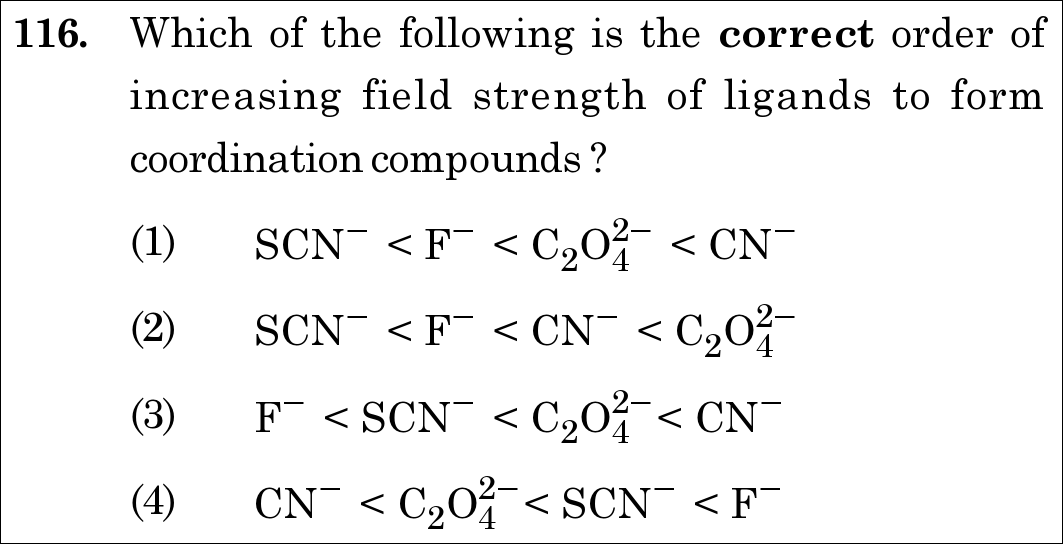
NEET 2020 Chemistry Question 116: Spectrochemical Series: Order of Increasing Field Strength of Ligands

Question

Which of the following is the correct order of increasing field strength of ligands to form coordination compounds?

✓
Verified Against NTA Final Answer Key
Option (1) : SCN- < F- < C2O4^2- < CN-
📚 Coordination Compounds Easy
📋 Given Parameters & Problem Setup
Theoretical Framework Spectrochemical Series (Crystal Field Splitting Power Δ_o)
Ligands to Arrange SCN-, F-, C2O4^2- (oxalate), CN-
Question Objective Identify the correct order of increasing ligand field strength
⚡

The 30-Second Exam Hall Shortcut: ⚡ "Spectrochemical Series: Halides < O-donors < N-donors < C-donors! SCN- < F- < C2O4^2- < CN-!"

⏱️ 20 seconds

Ligand field strength increases from weak-field halide/sulfur donors to intermediate oxygen/nitrogen donors to strong-field carbon donors: SCN−<F−<C2O42−<CN−SCN^- < F^- < C_2O_4^{2-} < CN^-. Cyanide (CN−CN^-) is a powerful carbon-donor strong field ligand at the top of the series! Option (1) has the exact textbook sequence. Mark Option (1) in 5 seconds.

1 Recall general donor atom strength: I- < Br- < SCN- < Cl- < S2- < F- < OH- < C2O4^2- < H2O < NCS- < edta^4- < NH3 < en < CN- < CO.
2 Arrange given ligands in increasing order: SCN- < F- < C2O4^2- < CN-.
3 Verify: SCN- (sulfur donor) is weaker than F- (halide); F- is weaker than C2O4^2- (oxygen donor chelator); CN- (carbon donor) is strongest.
4 Matches Option (1).
🛡️
Why You Can 100% Trust This Shortcut: NCERT Chemistry · Coordination Compounds (Crystal Field Theory: Spectrochemical Series)
📐

Step-by-Step Rigorous Workflow & Mathematical Proof

Step 1

Define the Spectrochemical Series

The crystal field splitting parameter (Δo\Delta_o) depends on the field produced by the ligand. An experimentally determined series of ligands arranged in the order of increasing field strength (ability to split dd-orbitals) is called the spectrochemical series.

Step 2

Recall the Full Spectrochemical Series from NCERT

I−<Br−<SCN−<Cl−<S2−<F−<OH−<C2O42−<H2O<NCS−<edta4−<NH3<en<CN−<CO\text{I}^- < \text{Br}^- < \text{SCN}^- < \text{Cl}^- < \text{S}^{2-} < \text{F}^- < \text{OH}^- < \text{C}_2\text{O}_4^{2-} < \text{H}_2\text{O} < \text{NCS}^- < \text{edta}^{4-} < \text{NH}_3 < \text{en} < \text{CN}^- < \text{CO}

Step 3

Locate the Four Specific Ligands

Extracting the four ligands in the question: 1. SCN−\text{SCN}^- (thiocyanate, S-donor): Appears early, weak field. 2. F−\text{F}^- (fluoride): Weak field halide, stronger than &#x27; in math mode at position 13: \text{SCN}^-̲. 3." style="color:#cc0000">\text{SCN}^-$. 3.\text{C}_2\text{O}_4^{2-}(oxalate,O−donorbidentate):Strongerthanfluoride.4.(oxalate, O-donor bidentate): Stronger than fluoride. 4.\text{CN}^-$$ (cyanide, C-donor pseudohalide): Very strong field ligand near the end of the series.

Step 4

Assemble the Increasing Sequence

SCN−<F−<C2O42−<CN−\text{SCN}^- < \text{F}^- < \text{C}_2\text{O}_4^{2-} < \text{CN}^-

⭐

360° Option Elimination Engine Key Feature

Diagnose every choice: Know exactly why the right option works and why distractors fail.

4-Option Deep Scan
1 A
✓ 100% Correct
Verdict & Scientific Reason:

Factually exact; conforms precisely to the IUPAC/NCERT spectrochemical series.

💡
Why this is airtight: None; standard spectrochemical series ordering.
2 B
✗ Incorrect
Verdict & Scientific Reason:

Incorrect; places oxalate as a stronger field ligand than cyanide (CN−CN^- is far stronger than oxalate).

⚠️
Student Fallacy (Why candidates pick this trap): Underestimating the extreme field strength of cyanide.
3 C
✗ Incorrect
Verdict & Scientific Reason:

Incorrect; places fluoride weaker than thiocyanate (SCN−<F−\text{SCN}^- < \text{F}^- in spectrochemical series).

⚠️
Student Fallacy (Why candidates pick this trap): Flipping SCN- and F-.
4 D
✗ Incorrect
Verdict & Scientific Reason:

Incorrect; completely reversed order, placing strong-field CN- as the weakest.

⚠️
Student Fallacy (Why candidates pick this trap): Confusing increasing order with decreasing order.
⚠️

NTA Trap Alert: Donor Atom Trend Shortcut

Order of donor atoms: Halides / S-donors < O-donors < N-donors < C-donors. Here: S-donor (SCN-) < Halide (F-) < O-donor (oxalate) < C-donor (CN-).

🛡️ How to avoid the -1 mark: Remember: C-donors (CN-, CO) are ALWAYS the strongest!
📖

Core NEET Syllabus Standard

Chemistry · Coordination Compounds Standard Benchmark
Core Scientific Principle Tested:

""

Syllabus Focus: Spectrochemical Series: Order of Increasing Field Strength of Ligands
✓ Core NEET UG Syllabus Anchor Syllabus & Academic Standards ↗

Ready to attempt under real exam pressure?

Test your speed and accuracy in the authentic 180-minute timed NTA simulator.

Launch NEET 2020 CBT Test →

Spotted a mistake in this solution? Report an error ([email protected])

⚖️ Legal & Fair Dealing Notice: Sourced from publicly released NEET 2020 question papers and NEET answer keys for private study, research, and non-commercial educational practice under Fair Dealing (Section 52(1)(a) of the Indian Copyright Act, 1957). Not affiliated with or endorsed by NTA or NMC.

Solve 4 NEET Questions a Day — One per Subject

Cover all 1,140 official NEET questions in 285 days at your own pace. Progress is saved on your device. No login needed.