MyCompetitiveExams Logo MyCompetitiveExams
Search 1,140+ Questions
Chapters, formulas, speed tricks
→
⚡ Brahmastra NEET 2027
720 MARKS

Dynamic 180-question full-length simulator mixed dynamically from all 6 years for 2027 & 2026 aspirants.

Launch Brahmastra 2027 Test →
Start Practice →
100% Free · No Login Required
Q.47 Chemistry ⭐ 360° Option Elimination Active
Vault ↗

NEET 2026 Chemistry Question 47 Solution

Topic: Coordination Compounds · Official NTA Booklet Code 50
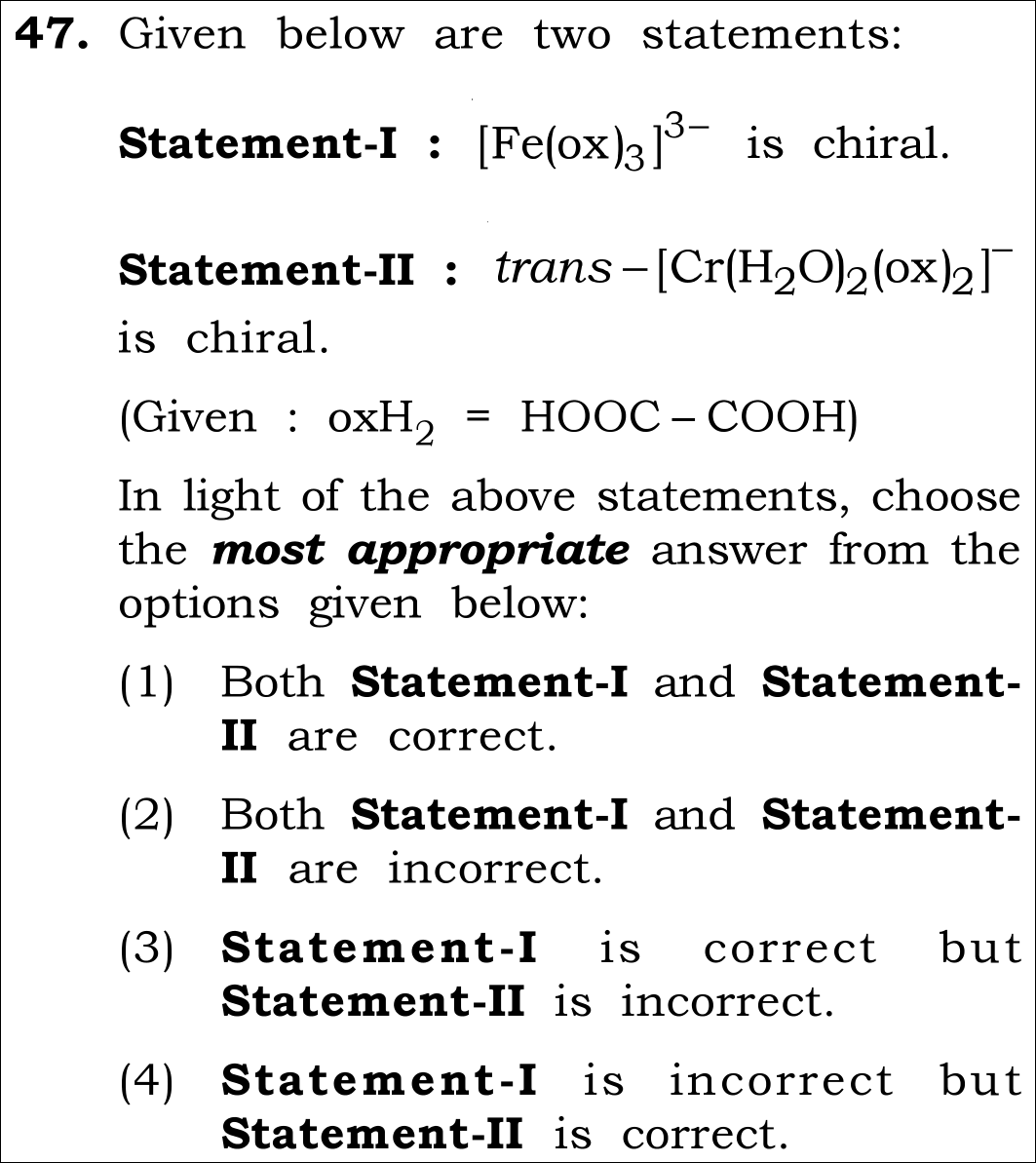
NEET 2026 Chemistry Question 47: Coordination Isomerism & IUPAC Nomenclature of Bimetallic Complexes

Question

Given below are two statements: Statement-I: [Fe(ox)₃]³⁻ is chiral. Statement-II: trans-[Cr(H₂O)₂(ox)₂]⁻ is chiral. (Given: oxH₂ = HOOC−COOH) In light of the above statements, choose the most appropriate answer from the options given below:

✓
Verified Against NTA Final Answer Key
Option (3) : Coordination isomerism, and IUPAC name is hexaamminechromium(III) hexacyanidocobaltate(III)
📚 Coordination Compounds Medium
📋 Given Parameters & Problem Setup
Pair of Complexes [Cr(NH₃)₆][Co(CN)₆] and [Co(NH₃)₆][Cr(CN)₆]
Cationic Complex [Cr(NH₃)₆]³⁺
Anionic Complex [Co(CN)₆]³⁻
⚡

The 30-Second Exam Hall Shortcut: ⚡ Ligand Swap = Coordination Isomerism

⏱️ Save ~60 seconds

Swap ligands between two complex centers -> Coordination Isomerism immediately!

1 Notice both cation and anion are coordination entities.
2 Ammines swapped from Cr to Co, and cyanides swapped from Co to Cr. By definition, interchange of ligands between cationic and anionic entities is Coordination Isomerism.
3 Naming: Cation first (hexaamminechromium(III)), then anion with "-ate" ending (hexacyanidocobaltate(III)).
4 Look for Option (3): Coordination isomerism + hexaamminechromium(III) hexacyanidocobaltate(III).
🛡️
Why You Can 100% Trust This Shortcut: Universal IUPAC coordination rule: Anionic complex metal always takes the suffix "-ate". Both Cr and Co are in the +3 oxidation state.
📐

Step-by-Step Rigorous Workflow & Mathematical Proof

Step 1

Determining Oxidation States of Metal Centers

Both ammonia (NH₃) is a neutral ligand (charge = 0) and cyanide (CN⁻) is a uninegative ligand (charge = -1). For [Cr(NH₃)₆][Co(CN)₆], since both metals commonly exhibit +3 states and the overall complex is neutral: Cr³⁺ + 6(0) = +3 for the cation, and Co³⁺ + 6(-1) = -3 for the anion.

Cation: [Cr3+(NH3)6]3+,Anion: [Co3+(CN)6]3−\text{Cation: }[\text{Cr}^{3+}(\text{NH}_3)_6]^{3+}, \quad \text{Anion: }[\text{Co}^{3+}(\text{CN})_6]^{3-}
  • • Oxidation state of Cr = +3.
  • • Oxidation state of Co = +3.
Step 2

Classification of Structural Isomerism

Coordination isomerism occurs when both cationic and anionic entities are coordination complexes, and an interchange of ligands occurs between the two different metal centers.

[Cr(NH3)6][Co(CN)6]⇌ligand swap[Co(NH3)6][Cr(CN)6][\text{Cr}(\text{NH}_3)_6][\text{Co}(\text{CN})_6] \xrightleftharpoons{\text{ligand swap}} [\text{Co}(\text{NH}_3)_6][\text{Cr}(\text{CN})_6]
  • • Type of isomerism: Coordination isomerism.
Step 3

Applying IUPAC Nomenclature Rules

1. Name the cation first: hexaamminechromium(III). 2. Name the anion second: hexacyanidocobaltate(III). The anionic metal requires the Latin suffix "-ate". Combined IUPAC name: hexaamminechromium(III) hexacyanidocobaltate(III).

hexaamminechromium(III) hexacyanidocobaltate(III)\text{hexaamminechromium(III) hexacyanidocobaltate(III)}
  • • Cationic entity: hexaamminechromium(III).
  • • Anionic entity: hexacyanidocobaltate(III).
⭐

360° Option Elimination Engine Key Feature

Diagnose every choice: Know exactly why the right option works and why distractors fail.

4-Option Deep Scan
1 A
✗ Incorrect
Verdict & Scientific Reason:

Incorrect. Ionisation isomerism involves exchange with counter-ions in the outer sphere, not between two complex spheres.

⚠️
Student Fallacy (Why candidates pick this trap): Confusing coordination isomerism with ionisation isomerism.
2 B
✗ Incorrect
Verdict & Scientific Reason:

Incorrect. Linkage isomerism requires ambidentate ligands (like NO₂⁻ or SCN⁻) binding through different atoms. Also, naming puts the anion first, which violates IUPAC rules.

⚠️
Student Fallacy (Why candidates pick this trap): Assuming CN⁻ binds through N without seeing the swap of metal centers.
3 C
✓ 100% Correct
Verdict & Scientific Reason:

Exact match with IUPAC rules and coordination isomerism definition.

💡
Why this is airtight: None; rigorous and precise.
4 D
✗ Incorrect
Verdict & Scientific Reason:

Incorrect order: IUPAC mandates that the cation MUST be named before the anion.

⚠️
Student Fallacy (Why candidates pick this trap): Naming the anion before the cation.
⚠️

NTA Trap Alert: Naming the Anion First or Dropping the "-ate" Suffix

Students frequently forget that even in bimetallic coordination salts, the positive complex is ALWAYS named first, followed by the negative complex with the "-ate" suffix on the metal.

🛡️ How to avoid the -1 mark: Cation first, Anion second. Anionic complex metal ends in "-ate".
📖

Core NEET Syllabus Standard

NEET Chemistry Core Syllabus · Coordination Compounds Standard Benchmark
Core Scientific Principle Tested:

"Ligand interchange between complex cation and complex anion constitutes coordination isomerism."

Syllabus Focus: Isomerism and IUPAC nomenclature of coordination compounds
✓ Core NEET UG Syllabus Anchor Syllabus & Academic Standards ↗
Cation First, Anion Last with "-ate"; Two Complex Centers = Coordination Isomer state!

Ready to attempt under real exam pressure?

Test your speed and accuracy in the authentic 180-minute timed NTA simulator.

Launch NEET 2026 CBT Test →

Spotted a mistake in this solution? Report an error ([email protected])

⚖️ Legal & Fair Dealing Notice: Sourced from publicly released NEET 2026 question papers and NEET answer keys for private study, research, and non-commercial educational practice under Fair Dealing (Section 52(1)(a) of the Indian Copyright Act, 1957). Not affiliated with or endorsed by NTA or NMC.

Solve 4 NEET Questions a Day — One per Subject

Cover all 1,140 official NEET questions in 285 days at your own pace. Progress is saved on your device. No login needed.