NEET 2020 Chemistry Question 115 Solution
Question
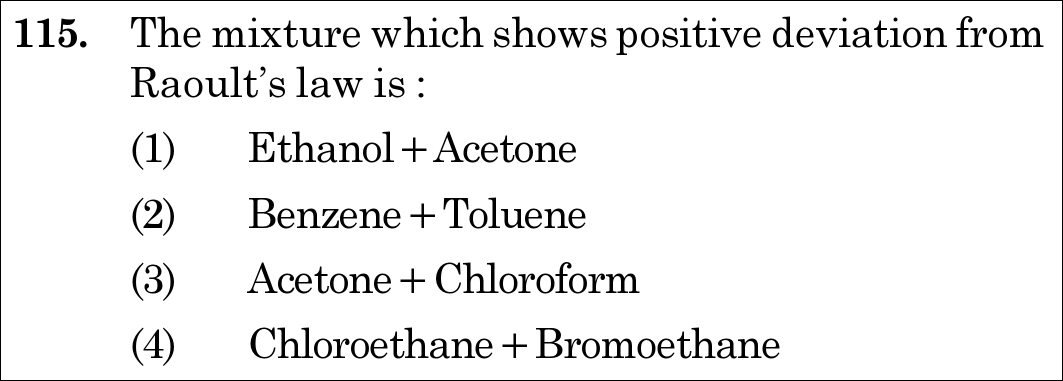
The mixture which shows positive deviation from Raoult's law is:
- (1)Ethanol+Acetone
- (2)Benzene+Toluene
- (3)Acetone+Chloroform
- (4)Chloroethane+Bromoethane
Dynamic 180-question full-length simulator mixed dynamically from all 6 years for 2027 & 2026 aspirants.
The mixture which shows positive deviation from Raoult's law is:
Pure ethanol molecules are held together by strong intermolecular hydrogen bonds. When acetone is added, acetone molecules get between ethanol molecules and break some of the hydrogen bonds, weakening overall intermolecular attractions (). This increases escaping tendency and vapor pressure (Positive Deviation)! Acetone + Chloroform shows Negative deviation; Benzene + Toluene is Ideal. Mark Option (1) in 5 seconds.
In solutions exhibiting positive deviation from Raoult's law, the intermolecular attractive forces between solute and solvent molecules () are weaker than those between like molecules ( and ). As a result, molecules escape more easily into the vapor phase, leading to higher vapor pressures (, ), endothermic mixing (), and volume expansion ().
In pure ethanol, molecules are strongly associated via intermolecular hydrogen bonding. When acetone is mixed with ethanol, its molecules slip in between host ethanol molecules and disrupt their hydrogen-bonded network. Because the new ethanol-acetone dipole-dipole attractions are weaker than the original ethanol-ethanol hydrogen bonds, the escaping tendency of both components increases, displaying positive deviation.
- Benzene + Toluene: Both are non-polar hydrocarbons of similar size and structure, forming an nearly IDEAL solution (). - Chloroethane + Bromoethane: Ideal solution of homologous haloalkanes. - Acetone + Chloroform: Chloroform forms a new, strong intermolecular hydrogen bond with the carbonyl oxygen of acetone, displaying NEGATIVE deviation.
Ethanol + Acetone uniquely exhibits positive deviation from Raoult's law.
Diagnose every choice: Know exactly why the right option works and why distractors fail.
Factually exact; disruption of ethanol hydrogen bonding by acetone causes positive deviation from Raoult's law.
Incorrect; forms an ideal solution obeying Raoult's law over the entire range of concentrations.
Incorrect; exhibits NEGATIVE deviation from Raoult's law due to new intermolecular hydrogen bonding between chloroform's C-H and acetone's C=O.
Incorrect; classic textbook example of an ideal solution.
- Acetone + Ethanol = POSITIVE deviation (breaks existing H-bonds). - Acetone + Chloroform = NEGATIVE deviation (creates NEW H-bonds).
""
Test your speed and accuracy in the authentic 180-minute timed NTA simulator.
Spotted a mistake in this solution? Report an error ([email protected])
Cover all 1,140 official NEET questions in 285 days at your own pace. Progress is saved on your device. No login needed.