MyCompetitiveExams Logo MyCompetitiveExams
Search 1,140+ Questions
Chapters, formulas, speed tricks
→
⚡ Brahmastra NEET 2027
720 MARKS

Dynamic 180-question full-length simulator mixed dynamically from all 6 years for 2027 & 2026 aspirants.

Launch Brahmastra 2027 Test →
Start Practice →
100% Free · No Login Required
🧪 Chemistry ⭐ High Weightage (~2–3 Qs/Year)

NEET The d- and f-Block Elements Previous Year Questions with Solutions

Complete repository of official NTA NEET questions for The d- and f-Block Elements from 2020 to 2026. Every question includes 30-second elimination tricks, step-by-step NCERT solutions, option-by-option traps, and official answer keys.

13 Questions 6 Exam Years (2026, 2025, 2024, 2023, 2021, 2020) 9 Easy · 4 Medium · 0 Challenging
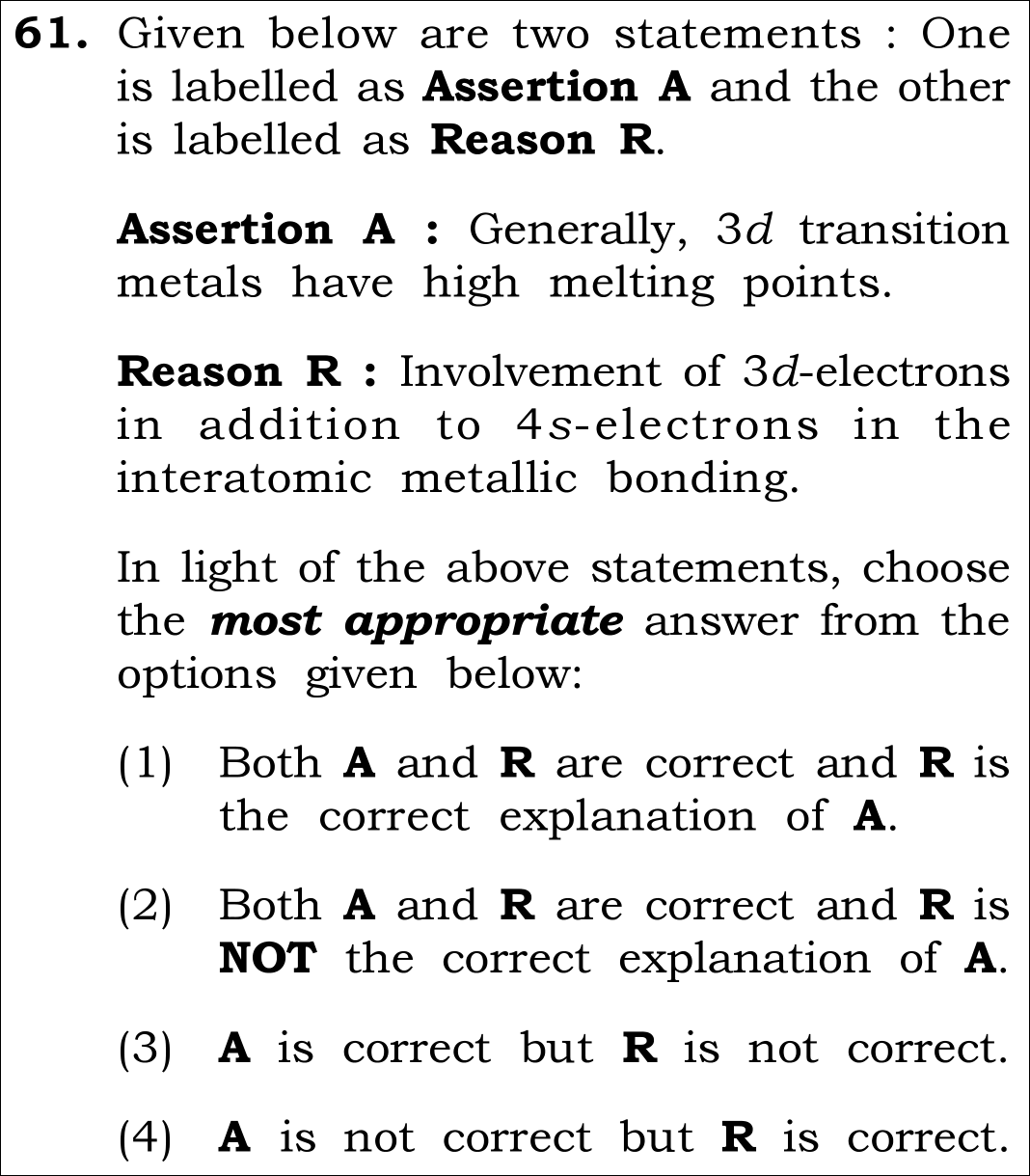
NEET 2026 · Q61 Easy
Official NEET 2026 Question 61 - The d- and f-Block Elements
1 Both A and R are correct and R is the correct explanation of A. ✓ Key
2 Both A and R are correct and R is NOT the correct explanation of A.
3 A is correct but R is not correct.
4 A is not correct but R is correct.
💡 Verified Solution & 30-Second Hack
✓
Verified Against NTA Final Answer Key
Option (1) : Both A and R are correct and R is the correct explanation of A.
📚 The d- and f-Block Elements Easy
📋 Given Parameters & Problem Setup
Assertion (A) Generally, 3d transition metals have high melting points.
Reason (R) Involvement of 3d-electrons in addition to 4s-electrons in the interatomic metallic bonding.
⚡

The 30-Second Exam Hall Shortcut: ⚡ Transition Metal Binding Rule

⏱️ Save ~45 seconds

More unpaired d-electrons + s-electrons = ultra-strong metallic lattice -> High melting point!

1 Recall Assertion A: Transition metals (like Ti, V, Cr, Fe) are well known for high melting points (above 1000 °C - 1900 °C) -> TRUE.
2 Recall Reason R: In main group s-block metals, only ns electrons participate. In transition metals, both (n-1)d and ns electrons participate in metallic bonding, vastly multiplying bond density -> TRUE.
3 Does R explain A? Yes, the greater number of valence bonding electrons directly causes the high lattice cohesive energy and high melting points!
4 Select Option (1) in 10 seconds!
🛡️
Why You Can 100% Trust This Shortcut: Verbatim NCERT d-block text: The high melting points of transition metals are attributed to the involvement of a greater number of electrons from (n-1)d in addition to the ns electrons in interatomic metallic bonding.
📐

Step-by-Step Rigorous Workflow & Mathematical Proof

Step 1

Evaluate Assertion A (Melting Points of 3d Metals)

Transition elements have exceptionally high melting and boiling points compared to s-block elements in the same period. For example, Vanadium melts at 1910 °C and Chromium at 1907 °C.

Tm(Transition Metals)≫Tm(s-block metals)T_m(\text{Transition Metals}) \gg T_m(\text{s-block metals})
  • • Assertion A is factually correct.
Step 2

Evaluate Reason R (Role of 3d and 4s Electrons in Metallic Bonding)

Metallic bonding strength is directly proportional to the number of valence electrons per atom available for delocalization throughout the crystal lattice. In 3d transition metals, the energies of 3d and 4s subshells are very close, allowing both 4s and (n-1)d electrons (especially unpaired d-electrons) to participate in covalent interatomic bonding and metallic lattice cohesion.

Cohesive Energy∝nbonding electrons=n(4s)+n(3dunpaired)\text{Cohesive Energy} \propto n_{\text{bonding electrons}} = n(4s) + n(3d_{\text{unpaired}})
  • • Reason R is factually correct.
Step 3

Determine Explanation Validity

Because the interatomic bonding is reinforced by the dual participation of (n-1)d and ns electrons, immense thermal energy is required to break the lattice bonds. Thus, Reason R is the precise, direct scientific explanation of Assertion A.

Both A and R are correct and R is the correct explanation of A (Option 1)\text{Both A and R are correct and R is the correct explanation of A (Option 1)}
  • • Matches Option (1).
⭐

360° Option Elimination Engine Key Feature

Diagnose every choice: Know exactly why the right option works and why distractors fail.

4-Option Deep Scan
1 A
✓ 100% Correct
Verdict & Scientific Reason:

Scientifically flawless and aligns verbatim with NCERT d- and f-Block Chemistry.

💡
Why this is airtight: None; fundamental concept of transition metal cohesion.
2 B
✗ Incorrect
Verdict & Scientific Reason:

Incorrect. R directly explains why the melting points are high.

⚠️
Student Fallacy (Why candidates pick this trap): Believing that d-electron participation is an unrelated property rather than the direct causal mechanism.
3 C
✗ Incorrect
Verdict & Scientific Reason:

Incorrect. Reason R is an established physical principle of transition metal chemistry.

⚠️
Student Fallacy (Why candidates pick this trap): Assuming only outer 4s electrons can participate in metallic bonding.
4 D
✗ Incorrect
Verdict & Scientific Reason:

Incorrect. 3d transition metals clearly possess high melting points.

⚠️
Student Fallacy (Why candidates pick this trap): Confusing 3d metals with low-melting zinc group (Zn, Cd, Hg).
⚠️

NTA Trap Alert: Confusing Transition Metals Generally with Group 12 (Zn, Cd, Hg)

Students sometimes think of Zinc or Mercury (which have low melting points due to fully filled d¹⁰ configurations with no unpaired d-electrons) and doubt Assertion A. The assertion states "Generally", which is true for the 3d series.

🛡️ How to avoid the -1 mark: Remember that Zn, Cd, Hg are pseudo-transition metals with full d¹⁰ subshells; all true transition metals (Sc to Cu) have high melting points.
📖

Core NEET Syllabus Standard

NEET Chemistry Core Syllabus · The d- and f-Block Elements Standard Benchmark
Core Scientific Principle Tested:

"Participation of both (n-1)d and ns electrons maximizes metallic bond enthalpy and melting temperature."
Syllabus Focus: General properties of transition elements - Melting points and metallic bonding
✓ Core NEET UG Syllabus Anchor Syllabus & Academic Standards ↗
Both 3d and 4s join hands: melting points soar across the lands!
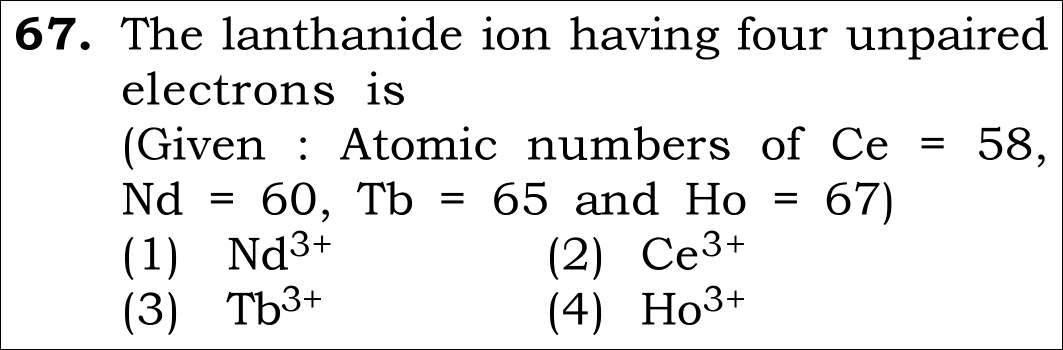
NEET 2026 · Q67 Medium
Official NEET 2026 Question 67 - The d- and f-Block Elements
1
2
3
4 ✓ Key
💡 Verified Solution & 30-Second Hack
✓
Verified Against NTA Final Answer Key
Option (4) : Ho³⁺
📚 The d- and f-Block Elements Medium
📋 Given Parameters & Problem Setup
Atomic Numbers Ce = 58, Nd = 60, Tb = 65, Ho = 67
Target The lanthanide ion having exactly four unpaired electrons
⚡

The 30-Second Exam Hall Shortcut: ⚡ The 4f Subshell Occupancy Rule

⏱️ Save ~60 seconds

4f subshell has 7 orbitals. 4 unpaired electrons requires 4f⁴ (7-3) or 4f¹⁰ (7-3 pairs)!

1 Recall general Ln³⁺ configuration: [Xe] 4f^n where n = Z - 57.
2 Ce³⁺ (Z = 58): 4f¹ -> 1 unpaired electron.
3 Nd³⁺ (Z = 60): 4f³ -> 3 unpaired electrons.
4 Tb³⁺ (Z = 65): 4f⁸ -> (8 - 7) = 1 pair + 6 unpaired -> 6 unpaired electrons.
5 Ho³⁺ (Z = 67): 4f¹⁰ -> (10 - 7) = 3 pairs + 4 unpaired -> exactly 4 UNPAIRED ELECTRONS!
6 Pick Ho³⁺ (Option 4) in 15 seconds!
🛡️
Why You Can 100% Trust This Shortcut: Universal Hund's rule of maximum multiplicity applied to the 7 degenerate 4f orbitals.
📐

Step-by-Step Rigorous Workflow & Mathematical Proof

Step 1

Determine Electronic Configurations of Neutral Lanthanoids

Xenon (Xe) has 54 electrons. The ground-state configurations of the neutral atoms are: - Ce (58): [Xe] 4f¹ 5d¹ 6s² - Nd (60): [Xe] 4f⁴ 6s² - Tb (65): [Xe] 4f⁹ 6s² - Ho (67): [Xe] 4f¹¹ 6s²

[Xe]=54 electrons[\text{Xe}] = 54\text{ electrons}
  • • Trivalent ionization removes outer 6s and 5d electrons first, then 4f.
Step 2

Determine 4f Configurations of Trivalent (Ln³⁺) Ions

For all lanthanoids, forming the stable Ln³⁺ cation removes 3 valence electrons (the two 6s electrons and one 5d or 4f electron): - Ce³⁺: 58 - 3 - 54 = 1 electron in 4f ⇒ [Xe] 4f¹ - Nd³⁺: 60 - 3 - 54 = 3 electrons in 4f ⇒ [Xe] 4f³ - Tb³⁺: 65 - 3 - 54 = 8 electrons in 4f ⇒ [Xe] 4f⁸ - Ho³⁺: 67 - 3 - 54 = 10 electrons in 4f ⇒ [Xe] 4f¹⁰

Ce3+:4f1,Nd3+:4f3,Tb3+:4f8,Ho3+:4f10\text{Ce}^{3+}: 4f^1, \quad \text{Nd}^{3+}: 4f^3, \quad \text{Tb}^{3+}: 4f^8, \quad \text{Ho}^{3+}: 4f^{10}
  • • Total electrons in 4f subshell established.
Step 3

Count Unpaired Electrons via Hund's Rule

The 4f subshell has 7 spatial orbitals (maximum 14 electrons): 1. Ce³⁺ (4f¹): 1 unpaired electron. 2. Nd³⁺ (4f³): 3 unpaired electrons. 3. Tb³⁺ (4f⁸): 7 single + 1 paired = 6 unpaired electrons. 4. Ho³⁺ (4f¹⁰): 7 orbitals with 10 electrons means 3 orbitals are doubly occupied and 4 orbitals are singly occupied. Number of unpaired electrons = 7 - 3 = 4.

n(Ho3+)=14−10=4 unpaired electronsn(\text{Ho}^{3+}) = 14 - 10 = 4\text{ unpaired electrons}
  • • Ho³⁺ has exactly 4 unpaired electrons.
  • • Matches Option (4).
⭐

360° Option Elimination Engine Key Feature

Diagnose every choice: Know exactly why the right option works and why distractors fail.

4-Option Deep Scan
1 A
✗ Incorrect
Verdict & Scientific Reason:

Incorrect. Nd³⁺ has configuration 4f³ with 3 unpaired electrons.

⚠️
Student Fallacy (Why candidates pick this trap): Confusing Nd³⁺ (4f³) with Pm³⁺ (4f⁴).
2 B
✗ Incorrect
Verdict & Scientific Reason:

Incorrect. Ce³⁺ has configuration 4f¹ with only 1 unpaired electron.

⚠️
Student Fallacy (Why candidates pick this trap): Assuming Ce³⁺ has 4 valence electrons remaining.
3 C
✗ Incorrect
Verdict & Scientific Reason:

Incorrect. Tb³⁺ has configuration 4f⁸ with 6 unpaired electrons.

⚠️
Student Fallacy (Why candidates pick this trap): Subtracting 8 - 4 instead of applying orbital pairing (7 - 1 = 6).
4 D
✓ 100% Correct
Verdict & Scientific Reason:

Exact match. Ho³⁺ is 4f¹⁰, which leaves exactly 4 singly occupied orbitals (4 unpaired electrons).

💡
Why this is airtight: None; perfect understanding of 4f orbital filling.
⚠️

NTA Trap Alert: Subtracting from 7 Instead of 14 for Unpaired Electrons

When an orbital holds more than half its capacity (like 4f¹⁰), the number of unpaired electrons is (14 - 10) = 4, NOT (10 - 7) = 3 (which is the number of pairs).

🛡️ How to avoid the -1 mark: For any subshell with more than half electrons: Unpaired electrons = (Capacity - Number of electrons) = 14 - 10 = 4.
📖

Core NEET Syllabus Standard

NEET Chemistry Core Syllabus · The d- and f-Block Elements Standard Benchmark
Core Scientific Principle Tested:

"In the 4f subshell, number of unpaired electrons for 4f^n (n > 7) is (14 - n)."

Syllabus Focus: Electronic configurations and magnetic properties of Lanthanoids
✓ Core NEET UG Syllabus Anchor Syllabus & Academic Standards ↗
14 minus 10 is 4: Holmium (Ho³⁺) holds 4 unpaired electrons in store!
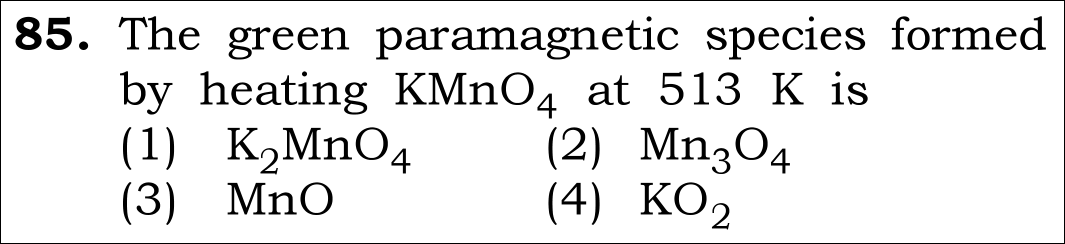
NEET 2026 · Q85 Easy
Official NEET 2026 Question 85 - The d- and f-Block Elements
1 ✓ Key
2
3
4
💡 Verified Solution & 30-Second Hack
✓
Verified Against NTA Final Answer Key
Option (1) : K₂MnO₄
📚 The d- and f-Block Elements Easy
📋 Given Parameters & Problem Setup
Reactant KMnO₄ (Potassium permanganate, dark purple, diamagnetic Mn⁺⁷)
Reaction Condition Heating at 513 K (240 °C)
Characteristics Green, paramagnetic species formed
⚡

The 30-Second Exam Hall Shortcut: ⚡ The Green Manganate Fingerprint

⏱️ Save ~45 seconds

KMnO₄ heated at 513 K decomposes to GREEN Potassium Manganate (K₂MnO₄)!

1 Recall thermal decomposition of KMnO₄: 2 KMnO₄ → K₂MnO₄ + MnO₂ + O₂.
2 K₂MnO₄ (potassium manganate) contains the manganate ion [MnO₄]²⁻.
3 Manganese is in the +6 oxidation state (d¹ configuration), which has ONE unpaired electron (paramagnetic) and exhibits a characteristic dark GREEN color!
4 Option (1) is K₂MnO₄ -> Instant selection in 5 seconds!
🛡️
Why You Can 100% Trust This Shortcut: NCERT d- and f-Block Elements verbatim: Potassium permanganate on heating decomposes at 513 K to give potassium manganate (K₂MnO₄), manganese dioxide, and oxygen.
📐

Step-by-Step Rigorous Workflow & Mathematical Proof

Step 1

State the Chemical Reaction for Thermal Decomposition of KMnO₄

Potassium permanganate decomposes upon heating above 513 K (240 °C) in a solid-state disproportionation/decomposition reaction:

2KMnO4(s)→513 KK2MnO4(s)+MnO2(s)+O2(g)2\text{KMnO}_4(s) \xrightarrow{513\text{ K}} \text{K}_2\text{MnO}_4(s) + \text{MnO}_2(s) + \text{O}_2(g)
  • • Products are potassium manganate (K₂MnO₄), black manganese dioxide (MnO₂), and oxygen gas (O₂).
Step 2

Analyze the Color and Magnetism of Potassium Manganate (K₂MnO₄)

1. Oxidation state: In K₂MnO₄, potassium is +1 and oxygen is -2. 2(+1) + x + 4(-2) = 0 ⇒ x = +6. 2. Electronic configuration: Mn (Z = 25) is [Ar] 3d⁵ 4s². Mn(VI) is [Ar] 3d¹. 3. Magnetism: The single unpaired electron in the 3d orbital makes the manganate ion [MnO₄]²⁻ PARAMAGNETIC (μ ≈ 1.73 BM). 4. Color: The tetraoxo anion [MnO₄]²⁻ absorbs light via ligand-to-metal charge transfer (LMCT) and d-d transitions, appearing intensely DARK GREEN.

Mn6+:[Ar]3d1(n=1  ⟹  Paramagnetic, Green)\text{Mn}^{6+}: [\text{Ar}] 3d^1 \quad (n = 1 \implies \text{Paramagnetic, Green})
  • • Color: Green.
  • • Magnetism: Paramagnetic.
  • • Formula: K₂MnO₄.
Step 3

Contrast with KMnO₄ Precursor

In contrast, KMnO₄ has manganese in the +7 oxidation state (3d⁰), which has no unpaired d-electrons and is diamagnetic (dark purple due to LMCT).

KMnO4(Purple, d0)→513 KK2MnO4(Green, d1)\text{KMnO}_4 (\text{Purple, } d^0) \xrightarrow{513\text{ K}} \text{K}_2\text{MnO}_4 (\text{Green, } d^1)
  • • Matches Option (1).
⭐

360° Option Elimination Engine Key Feature

Diagnose every choice: Know exactly why the right option works and why distractors fail.

4-Option Deep Scan
1 A
✓ 100% Correct
Verdict & Scientific Reason:

Exact match with textbook thermal decomposition: K₂MnO₄ is green and paramagnetic (3d¹).

💡
Why this is airtight: None; direct factual recall.
2 B
✗ Incorrect
Verdict & Scientific Reason:

Incorrect. Hausmannite (Mn₃O₄) is formed by heating MnO₂ at much higher temperatures (> 1000 °C), not by heating KMnO₄ at 513 K.

⚠️
Student Fallacy (Why candidates pick this trap): Confusing high-temperature oxide conversions.
3 C
✗ Incorrect
Verdict & Scientific Reason:

Incorrect. Manganous oxide (MnO) is a green-gray basic oxide formed by reducing MnO₂ with H₂, not thermal decomposition of KMnO₄.

⚠️
Student Fallacy (Why candidates pick this trap): Associating the color green with MnO instead of the manganate salt.
4 D
✗ Incorrect
Verdict & Scientific Reason:

Incorrect. Potassium superoxide (KO₂) is an orange solid formed by burning potassium in excess oxygen, not a product of KMnO₄ decomposition.

⚠️
Student Fallacy (Why candidates pick this trap): Random alkali metal superoxide guess.
⚠️

NTA Trap Alert: Confusing Manganate (Green, K₂MnO₄) with Permanganate (Purple, KMnO₄)

Students frequently confuse potassium manganate (K₂MnO₄, Mn⁺⁶, green) with potassium permanganate (KMnO₄, Mn⁺⁷, purple). Heating KMnO₄ gives K₂MnO₄!

🛡️ How to avoid the -1 mark: Permanganate = Purple (Mn⁺⁷); Manganate = Green (Mn⁺⁶).
📖

Core NEET Syllabus Standard

NEET Chemistry Core Syllabus · The d- and f-Block Elements Standard Benchmark
Core Scientific Principle Tested:

"2 KMnO₄ decomposes thermally at 513 K into green paramagnetic K₂MnO₄, MnO₂, and O₂."

Syllabus Focus: Compounds of manganese - Potassium permanganate and potassium manganate
✓ Core NEET UG Syllabus Anchor Syllabus & Academic Standards ↗
Purple Permanganate heated to 513 K turns Green Manganate all the way!
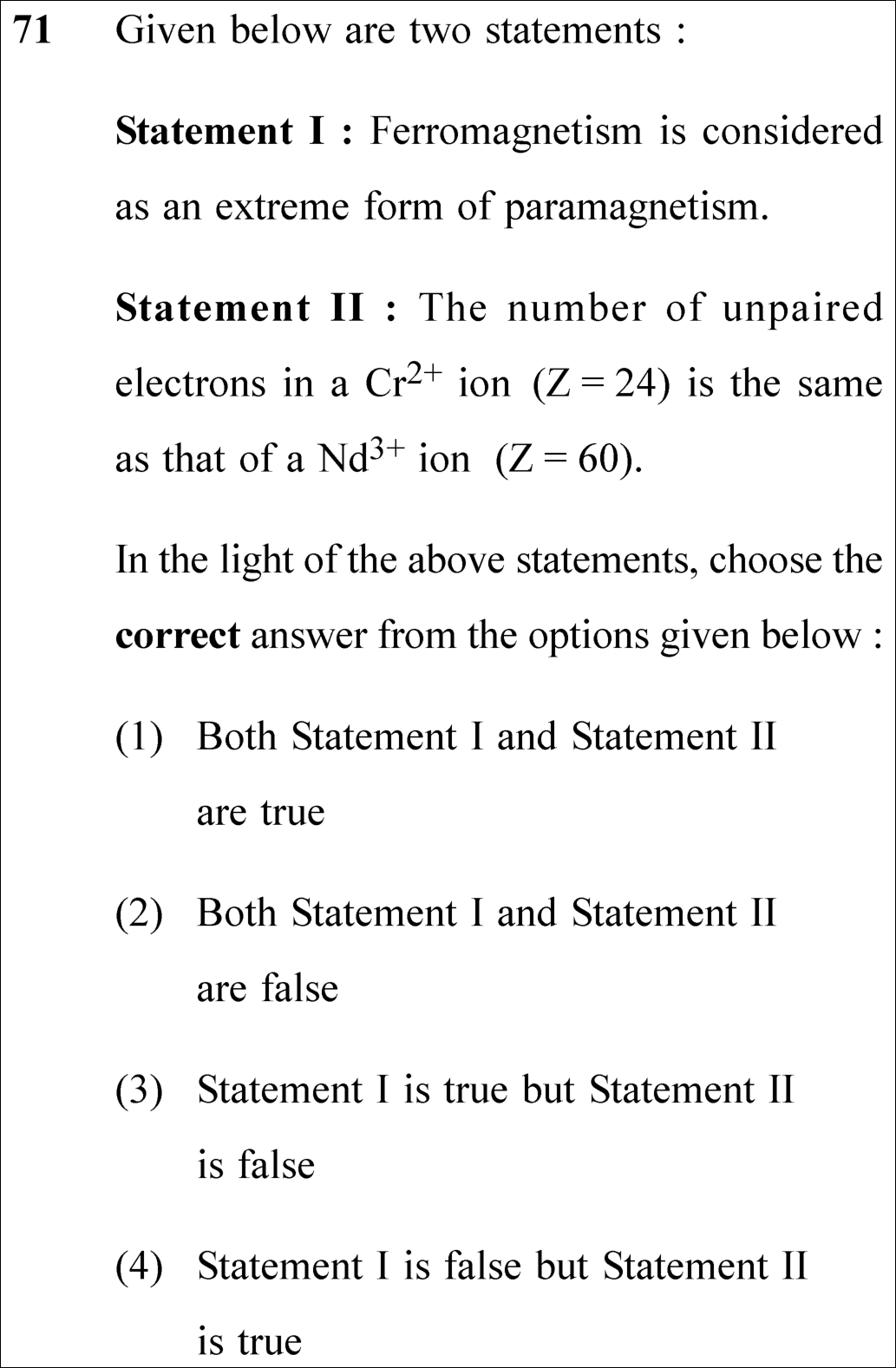
NEET 2025 · Q71 Medium
Official NEET 2025 Question 71 - The d- and f-Block Elements
1
2
3 ✓ Key
4
💡 Verified Solution & 30-Second Hack
✓
Verified Against NTA Final Answer Key
Option (3) : Statement I is true but Statement II is false
📚 The d- and f-Block Elements Medium
📋 Given Parameters & Problem Setup
Statement I Ferromagnetism is considered as an extreme form of paramagnetism.
Statement II The number of unpaired electrons in a Cr²⁺ ion (Z = 24) is the same as that of a Nd³⁺ ion (Z = 60).
⚡

The 30-Second Exam Hall Shortcut: ⚡ NCERT Magnetism Text & Unpaired Electron Count

⏱️ Save ~40 seconds

Statement I is an NCERT verbatim quote: "Ferromagnetism is considered as an extreme form of paramagnetism" (TRUE)! Cr²⁺ (3d⁴) has 4 unpaired electrons. Nd³⁺ (4f³) has 3 unpaired electrons. 4 ≠ 3 ⟹ Statement II is FALSE!

1 Check Statement I: NCERT Chapter 8 Section 8.3.8 states verbatim: "Ferromagnetism is an extreme form of paramagnetism." In ferromagnetic materials, domains spontaneously align parallel, creating permanent magnetization. Statement I is TRUE.
2 Check Statement II: Chromium (Z = 24) has configuration [Ar] 3d⁵ 4s¹. Removing 2 electrons gives Cr²⁺: [Ar] 3d⁴ (n = 4 unpaired electrons).
3 Neodymium (Z = 60) is a lanthanoid with configuration [Xe] 4f⁴ 6s². Removing 3 electrons gives Nd³⁺: [Xe] 4f³ (n = 3 unpaired electrons).
4 Cr²⁺ has 4 unpaired electrons, while Nd³⁺ has 3 unpaired electrons. They are NOT the same! Statement II is FALSE.
5 Conclusion: Statement I is true but Statement II is false.
6 Select Option (3) in under 15 seconds!
🛡️
Why You Can 100% Trust This Shortcut: Oxidation States and Standard Electrode Potentials of 3d Metals (NCERT Chemistry · d- and f-Block Elements).
📐

Step-by-Step Rigorous Workflow & Mathematical Proof

Step 1

Evaluate Statement I (Nature of Ferromagnetism)

Analyze the physical and chemical definition of ferromagnetism from the NCERT text:

Ferromagnetism=Extreme form of paramagnetism with permanent domain alignment\text{Ferromagnetism} = \text{Extreme form of paramagnetism with permanent domain alignment}
  • • Paramagnetic substances are weakly attracted by a magnetic field due to unpaired electrons.
  • • When exchange coupling forces magnetic dipoles of adjacent atoms to align spontaneously in large macroscopic domains, the substance exhibits ferromagnetism (e.g., Fe, Co, Ni).
  • • NCERT d- and f-Block Elements explicitly states: "Ferromagnetism is an extreme form of paramagnetism."
  • • Statement I is unequivocally TRUE.
Step 2

Calculate Unpaired Electrons in Cr²⁺ (Z = 24)

Write the electronic configuration of chromium and its divalent cation:

Cr (Z = 24): [Ar]3d54s1→−2e−Cr2+:[Ar]3d4\text{Cr (Z = 24): } [\text{Ar}] 3d^5 4s^1 \xrightarrow{-2e^-} \text{Cr}^{2+}: [\text{Ar}] 3d^4
  • • According to Hund’s rule of maximum multiplicity, the 4 electrons occupy 4 degenerate d-orbitals singly.
  • • Number of unpaired electrons in Cr²⁺: n = 4.
Step 3

Calculate Unpaired Electrons in Nd³⁺ (Z = 60) and Compare

Write the electronic configuration of neodymium and its trivalent lanthanoid cation:

Nd (Z = 60): [Xe]4f46s2→−3e−Nd3+:[Xe]4f3\text{Nd (Z = 60): } [\text{Xe}] 4f^4 6s^2 \xrightarrow{-3e^-} \text{Nd}^{3+}: [\text{Xe}] 4f^3
  • • The 3 electrons occupy 3 of the seven degenerate 4f-orbitals singly.
  • • Number of unpaired electrons in Nd³⁺: n = 3.
  • • Since 4 ≠ 3, Statement II is FALSE.
  • • Statement I is true but Statement II is false, matching Option (3).
⭐

360° Option Elimination Engine Key Feature

Diagnose every choice: Know exactly why the right option works and why distractors fail.

4-Option Deep Scan
1 A
✗ Incorrect
Verdict & Scientific Reason:

Incorrect. Statement II is false (Cr²⁺ has 4, Nd³⁺ has 3 unpaired electrons).

⚠️
Student Fallacy (Why candidates pick this trap): Miscounting f-electrons in Nd³⁺ as 4.
2 B
✗ Incorrect
Verdict & Scientific Reason:

Incorrect. Statement I is true.

⚠️
Student Fallacy (Why candidates pick this trap): Doubting whether ferromagnetism is related to paramagnetism.
3 C
✓ 100% Correct
Verdict & Scientific Reason:

100% correct. Ferromagnetism is an extreme form of paramagnetism, and Cr²⁺ (4) ≠ Nd³⁺ (3).

💡
Why this is airtight: None; rigorous electronic configuration analysis.
4 D
✗ Incorrect
Verdict & Scientific Reason:

Incorrect. Inverts truth values of both statements.

⚠️
Student Fallacy (Why candidates pick this trap): Multiple errors.
⚠️

NTA Trap Alert: Forgetting to Remove an Electron from 4f in Nd³⁺

Nd has 4f⁴ 6s². When forming the trivalent ion Nd³⁺, it loses TWO 6s electrons AND ONE 4f electron, leaving 4f³ (3 unpaired electrons)! Students who only remove the two 6s electrons mistakenly get 4f⁴ (4 unpaired electrons) and falsely mark Statement II as true!

🛡️ How to avoid the -1 mark: For M³⁺ lanthanoids, always remove two 6s electrons and one 4f electron: Nd³⁺ is 4f³!
📖

Core NEET Syllabus Standard

NEET Chemistry Core Syllabus · The d- and f-Block Elements Standard Benchmark
Core Scientific Principle Tested:

"Ferromagnetism is extreme paramagnetism; Cr²⁺ is 3d⁴ (4 unpaired e⁻); Nd³⁺ is 4f³ (3 unpaired e⁻)."

Syllabus Focus: Magnetic Properties & Lanthanoid Electronic Configurations
✓ Core NEET UG Syllabus Anchor Syllabus & Academic Standards ↗
Cr²⁺ has 4 (3d⁴), Nd³⁺ has 3 (4f³) ⟹ Not equal! Statement I true, II false (Option 3)!
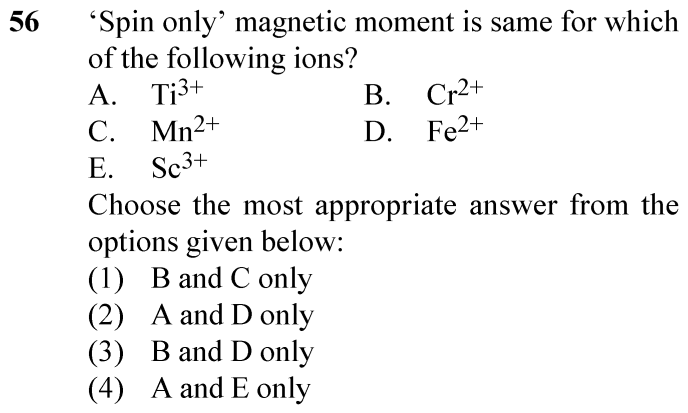
NEET 2024 · Q56 Easy
Official NEET 2024 Question 56 - The d- and f-Block Elements
1
2
3 ✓ Key
4
💡 Verified Solution & 30-Second Hack
✓
Verified Against NTA Final Answer Key
Option (3) : B and D only (Cr2+ and Fe2+)
📚 The d- and f-Block Elements Easy
📋 Given Parameters & Problem Setup
Ion A Ti3+ (Z = 22)
Ion B Cr2+ (Z = 24)
Ion C Mn2+ (Z = 25)
Ion D Fe2+ (Z = 26)
Ion E Sc3+ (Z = 21)
⚡

The 30-Second Exam Hall Shortcut: ⚡ Unpaired Electrons Counting Shortcut

⏱️ Save ~40 seconds

Same spin-only magnetic moment requires IDENTICAL number of unpaired electrons (n)! Cr2+ (3d4 -> 4) and Fe2+ (3d6 -> 4) both have n = 4!

1 Formula: μ_s = √[n(n + 2)] BM. Equal μ requires equal n.
2 Ti3+ (Z=22, [Ar]3d1): n = 1 unpaired electron.
3 Cr2+ (Z=24, [Ar]3d4): n = 4 unpaired electrons.
4 Mn2+ (Z=25, [Ar]3d5): n = 5 unpaired electrons.
5 Fe2+ (Z=26, [Ar]3d6): 6 electrons in five d-orbitals = 1 paired + 4 unpaired -> n = 4 unpaired electrons.
6 Sc3+ (Z=21, [Ar]3d0): n = 0 unpaired electrons.
7 Ions with n = 4 are Cr2+ (B) and Fe2+ (D) -> Option (3) in 10 seconds!
🛡️
Why You Can 100% Trust This Shortcut: NCERT Chemistry · The d- and f-Block Elements (Electronic configurations and magnetic properties of first row transition metal ions).
📐

Step-by-Step Rigorous Workflow & Mathematical Proof

Step 1

Formula for Spin-Only Magnetic Moment

For transition metal ions of the first series, orbital angular momentum is largely quenched by the crystal/ligand field. The magnetic moment depends exclusively on the number of unpaired electrons n:

μs=n(n+2)  B.M.(Bohr Magnetons)\mu_s = \sqrt{n(n + 2)} \; \text{B.M.} \quad (\text{Bohr Magnetons})
Step 2

Determination of d-Electron Count and Unpaired Electrons

Determining the electronic configurations of the 3d transition metal cations: - Ti3+ (Z = 22): [Ar] 3d1 -> n = 1 unpaired electron (μ = √3 = 1.73 BM) - Cr2+ (Z = 24): [Ar] 3d4 -> n = 4 unpaired electrons (μ = √24 = 4.90 BM) - Mn2+ (Z = 25): [Ar] 3d5 -> n = 5 unpaired electrons (μ = √35 = 5.92 BM) - Fe2+ (Z = 26): [Ar] 3d6 -> 5 + 1 paired -> n = 4 unpaired electrons (μ = √24 = 4.90 BM) - Sc3+ (Z = 21): [Ar] 3d0 -> n = 0 unpaired electrons (μ = 0 BM, diamagnetic)

n(Cr2+)=4,n(Fe2+)=4  ⟹  μs=4(4+2)=24≈4.90  B.M.n(\text{Cr}^{2+}) = 4, \quad n(\text{Fe}^{2+}) = 4 \implies \mu_s = \sqrt{4(4 + 2)} = \sqrt{24} \approx 4.90\;\text{B.M.}
⭐

360° Option Elimination Engine Key Feature

Diagnose every choice: Know exactly why the right option works and why distractors fail.

4-Option Deep Scan
1 (1)
✗ Incorrect
Verdict & Scientific Reason:

Cr2+ has n = 4 whereas Mn2+ has n = 5.

⚠️
Student Fallacy (Why candidates pick this trap): Assuming adjacent elements in the periodic table have identical magnetic moments.
2 (2)
✗ Incorrect
Verdict & Scientific Reason:

Ti3+ has n = 1 whereas Fe2+ has n = 4.

⚠️
Student Fallacy (Why candidates pick this trap): Failing to pair electrons in the d6 subshell.
3 (3)
✓ 100% Correct
Verdict & Scientific Reason:

Both ions possess precisely 4 unpaired electrons, yielding identical spin-only moments of 4.90 BM.

💡
Why this is airtight: None.
4 (4)
✗ Incorrect
Verdict & Scientific Reason:

Ti3+ is paramagnetic (n=1) while Sc3+ is diamagnetic (n=0).

⚠️
Student Fallacy (Why candidates pick this trap): Confusing 3d0 with 3d1.
⚠️

NTA Trap Alert: Counting All 6 d-Electrons in Fe2+ as Unpaired

Students who forget Hund’s rule occasionally write n = 6 for Fe2+, forgetting that the 5 d-orbitals can hold at most 5 parallel spins before pairing begins (n = 10 - 6 = 4).

🛡️ How to avoid the -1 mark: For dn configurations with n > 5: Number of unpaired electrons = 10 - n.
📖

Core NEET Syllabus Standard

Chemistry Core Inorganic Chemistry · The d- and f-Block Elements Standard Benchmark
Core Scientific Principle Tested:

"The spin-only magnetic moment μ = √[n(n+2)] BM is identical for any pair of ions that possess the same number of unpaired d-electrons."

Syllabus Focus: Magnetic Properties of Transition Metal Compounds
✓ Core NEET UG Syllabus Anchor Syllabus & Academic Standards ↗
d4 and d6 mirror around half-filled d5: both share 4 unpaired spins alive!
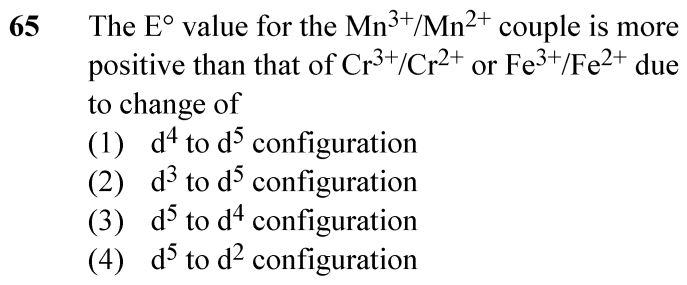
NEET 2024 · Q65 Easy
Official NEET 2024 Question 65 - The d- and f-Block Elements
1 ✓ Key
2
3
4
💡 Verified Solution & 30-Second Hack
✓
Verified Against NTA Final Answer Key
Option (1) : d4 to d5 configuration
📚 The d- and f-Block Elements Easy
📋 Given Parameters & Problem Setup
Electrode couples Mn3+/Mn2+ (E° = +1.57 V) vs Cr3+/Cr2+ (E° = -0.41 V) and Fe3+/Fe2+ (E° = +0.77 V)
Core question Reason for the unusually high positive E° value of Mn3+/Mn2+
⚡

The 30-Second Exam Hall Shortcut: ⚡ Half-Filled d5 Stability Hack

⏱️ Save ~35 seconds

Mn3+ is 3d4; when reduced to Mn2+ it gains an electron to form 3d5, an extraordinarily stable HALF-FILLED subshell -> Huge driving force -> Highly positive E°!

1 Write reduction half-reaction: Mn3+ + e- -> Mn2+.
2 Electronic configuration: Mn3+ is [Ar] 3d4.
3 Product Mn2+ is [Ar] 3d5, possessing a symmetrically half-filled subshell with high exchange energy.
4 Transition from less stable d4 to exceptionally stable d5 imparts a massive thermodynamic driving force (ΔG° < 0).
5 Consequently, E°(Mn3+/Mn2+) is highly positive (+1.57 V), far more positive than Cr3+/Cr2+ or Fe3+/Fe2+.
6 Direct match: "d4 to d5 configuration" -> Option (1) in 3 seconds!
🛡️
Why You Can 100% Trust This Shortcut: NCERT Chemistry · The d- and f-Block Elements (Trends in the M3+/M2+ standard electrode potentials and stability of d5 configuration).
📐

Step-by-Step Rigorous Workflow & Mathematical Proof

Step 1

Electronic Configurations of the Redox Couple

Manganese has atomic number Z = 25 with neutral ground-state configuration [Ar] 3d5 4s2. Removing valence electrons gives: - Mn3+: [Ar] 3d4 (partially filled, relatively less stable) - Mn2+: [Ar] 3d5 (symmetrically half-filled, possessing maximal exchange energy and high stabilization)

Mn3+(3d4)+e⊖⟶Mn2+(3d5)\text{Mn}^{3+} (3d^4) + e^\ominus \longrightarrow \text{Mn}^{2+} (3d^5)
Step 2

Thermodynamic Driving Force and Electrode Potential

Standard reduction potential E° is related to the standard Gibbs free energy change by ΔG° = -nFE°. Because the conversion of d4 into the half-filled d5 configuration is energetically extremely favorable, ΔG° is large and negative, rendering E° unusually high and positive (+1.57 V):

E∘(Mn3+/Mn2+)=+1.57  V(highly favorable reduction due to stable 3d5)E^\circ(\text{Mn}^{3+}/\text{Mn}^{2+}) = +1.57\;\text{V} \quad (\text{highly favorable reduction due to stable } 3d^5)
Step 3

Comparison with Chromium and Iron Couples

For chromium: Cr3+ is [Ar] 3d3 (stable half-filled t2g³ level in octahedral fields), so reducing it to Cr2+ (3d4) is unfavorable (E° = -0.41 V). For iron: Fe3+ is already 3d5, so reducing it to Fe2+ (3d6) loses the d5 stability (E° = +0.77 V). Only in the manganese couple does reduction produce the stable d5 configuration from d4.

Cr3+(3d3)→Cr2+(3d4)  [E∘=−0.41V];Fe3+(3d5)→Fe2+(3d6)  [E∘=+0.77V]\text{Cr}^{3+} (3d^3) \rightarrow \text{Cr}^{2+} (3d^4) \; [E^\circ = -0.41\text{V}]; \quad \text{Fe}^{3+} (3d^5) \rightarrow \text{Fe}^{2+} (3d^6) \; [E^\circ = +0.77\text{V}]
⭐

360° Option Elimination Engine Key Feature

Diagnose every choice: Know exactly why the right option works and why distractors fail.

4-Option Deep Scan
1 (1)
✓ 100% Correct
Verdict & Scientific Reason:

Verbatim NCERT rationale: reduction converts 3d4 (Mn3+) into extra-stable half-filled 3d5 (Mn2+).

💡
Why this is airtight: None.
2 (2)
✗ Incorrect
Verdict & Scientific Reason:

A single-electron reduction cannot change the d-count by 2.

⚠️
Student Fallacy (Why candidates pick this trap): Assuming reduction involves a 2-electron transfer.
3 (3)
✗ Incorrect
Verdict & Scientific Reason:

Represents oxidation (Mn2+ -> Mn3+), not reduction.

⚠️
Student Fallacy (Why candidates pick this trap): Inverting oxidation and reduction.
4 (4)
✗ Incorrect
Verdict & Scientific Reason:

Irrelevant configuration change.

⚠️
Student Fallacy (Why candidates pick this trap): Arbitrary guess.
⚠️

NTA Trap Alert: Confusing Reduction with Oxidation

Option (3) states "d5 to d4 configuration", which describes the reverse process (oxidation of Mn2+ to Mn3+). The E° value refers strictly to REDUCTION (Mn3+ -> Mn2+), which is d4 to d5.

🛡️ How to avoid the -1 mark: E° is always defined for reduction: Mn3+ (d4) + e- -> Mn2+ (d5).
📖

Core NEET Syllabus Standard

Chemistry Core Inorganic Chemistry · The d- and f-Block Elements Standard Benchmark
Core Scientific Principle Tested:

"The standard electrode potential E° for the Mn3+/Mn2+ couple is exceptionally high (+1.57 V) because reduction transforms the d4 ion into the extra stable half-filled d5 configuration."

Syllabus Focus: Trends in Standard Reduction Potentials: Stability of d5 Half-Filled Shell
✓ Core NEET UG Syllabus Anchor Syllabus & Academic Standards ↗
d4 gains an electron to reach d5: half-filled stability keeps positive E° alive!
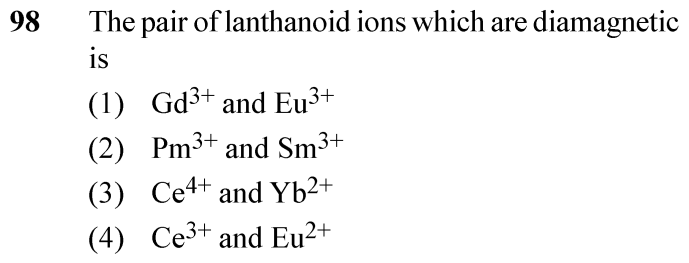
NEET 2024 · Q98 Easy
Official NEET 2024 Question 98 - The d- and f-Block Elements
1
2
3 ✓ Key
4
💡 Verified Solution & 30-Second Hack
✓
Verified Against NTA Final Answer Key
Option (3) : Ce4+ and Yb2+
📚 The d- and f-Block Elements Easy
📋 Given Parameters & Problem Setup
Target property Diamagnetic lanthanoid ions (unpaired electrons n = 0)
Elements involved Cerium (Ce, Z=58), Ytterbium (Yb, Z=70), Gadolinium (Gd, Z=64), Europium (Eu, Z=63)
⚡

The 30-Second Exam Hall Shortcut: ⚡ Empty 4f0 and Filled 4f14 Diamagnetism Hack

⏱️ Save ~35 seconds

Lanthanoid ions are diamagnetic ONLY when 4f is completely EMPTY (4f⁰, e.g. Ce⁴⁺, La³⁺) or completely FILLED (4f¹⁴, e.g. Yb²⁺, Lu³⁺)! Ce⁴⁺ and Yb²⁺ is the only diamagnetic pair!

1 Diamagnetic requires zero unpaired electrons: n = 0.
2 In lanthanoids, this occurs exclusively with 4f⁰ (noble gas [Xe] core) or 4f¹⁴ (completely filled f-subshell).
3 Check Ce⁴⁺: Ce is [Xe] 4f¹ 5d¹ 6s². Losing 4 electrons leaves [Xe] 4f⁰ -> n = 0 (DIAMAGNETIC).
4 Check Yb²⁺: Yb is [Xe] 4f¹⁴ 6s². Losing 2 valence 6s electrons leaves [Xe] 4f¹⁴ -> n = 0 (DIAMAGNETIC).
5 Both Ce⁴⁺ and Yb²⁺ have zero unpaired f-electrons and are diamagnetic.
6 Other ions have unpaired f-electrons (e.g. Gd³⁺ has 4f⁷, Eu²⁺ has 4f⁷, Eu³⁺ has 4f⁶).
7 Option (3) in 5 seconds!
🛡️
Why You Can 100% Trust This Shortcut: NCERT Chemistry · The d- and f-Block Elements (Lanthanoids: electronic configurations, oxidation states, and magnetic properties: Ce4+ [4f0] and Yb2+ [4f14] are diamagnetic).
📐

Step-by-Step Rigorous Workflow & Mathematical Proof

Step 1

Electronic Configurations of Lanthanoids

Lanthanoids have valence electrons filling the 4f subshell, with neutral ground states: - Cerium (Ce, Z = 58): [Xe] 4f¹ 5d¹ 6s² - Ytterbium (Yb, Z = 70): [Xe] 4f¹⁴ 6s² - Europium (Eu, Z = 63): [Xe] 4f⁷ 6s² - Gadolinium (Gd, Z = 64): [Xe] 4f⁷ 5d¹ 6s²

Ce: [Xe] 4f15d16s2;Yb: [Xe] 4f146s2\text{Ce: } [\text{Xe}]\,4f^1 5d^1 6s^2; \quad \text{Yb: } [\text{Xe}]\,4f^{14} 6s^2
Step 2

Determining Configurations and Unpaired Electrons of Cations

Removing electrons from the outermost orbitals: 1. Ce⁴⁺: Loses 6s², 5d¹, and 4f¹ ⟹ [Xe] 4f⁰. Possesses an empty 4f subshell (n = 0 unpaired electrons) ⟹ Diamagnetic. 2. Yb²⁺: Loses 6s² ⟹ [Xe] 4f¹⁴. Possesses a completely filled 4f subshell (n = 0 unpaired electrons) ⟹ Diamagnetic. 3. Gd³⁺: Loses 6s² and 5d¹ ⟹ [Xe] 4f⁷ (n = 7 unpaired electrons) ⟹ Strongly paramagnetic. 4. Eu³⁺: Loses 6s² and one 4f ⟹ [Xe] 4f⁶ (n = 6 unpaired electrons) ⟹ Paramagnetic. 5. Eu²⁺: Loses 6s² ⟹ [Xe] 4f⁷ (n = 7 unpaired electrons) ⟹ Paramagnetic.

Ce4+  ([Xe] 4f0)  ⟹  n=0;Yb2+  ([Xe] 4f14)  ⟹  n=0\text{Ce}^{4+} \;([\text{Xe}]\,4f^0) \implies n = 0; \quad \text{Yb}^{2+} \;([\text{Xe}]\,4f^{14}) \implies n = 0
Step 3

Conclusion

Ce⁴⁺ (4f⁰) and Yb²⁺ (4f¹⁴) both possess zero unpaired f-electrons. Consequently, both are diamagnetic, matching Option (3).

Diamagnetic pair: Ce4+  and  Yb2+  (Option 3)\text{Diamagnetic pair: } \text{Ce}^{4+} \;\text{and}\; \text{Yb}^{2+} \; (\text{Option 3})
⭐

360° Option Elimination Engine Key Feature

Diagnose every choice: Know exactly why the right option works and why distractors fail.

4-Option Deep Scan
1 (1)
✗ Incorrect
Verdict & Scientific Reason:

Gd3+ has 7 unpaired electrons (4f7); Eu3+ has 6 unpaired electrons (4f6). Both are paramagnetic.

⚠️
Student Fallacy (Why candidates pick this trap): Confusing half-filled stability with diamagnetism.
2 (2)
✗ Incorrect
Verdict & Scientific Reason:

Pm3+ is 4f4 (n=4) and Sm3+ is 4f5 (n=5). Both are paramagnetic.

⚠️
Student Fallacy (Why candidates pick this trap): Random selection.
3 (3)
✓ 100% Correct
Verdict & Scientific Reason:

Ce4+ is 4f0 and Yb2+ is 4f14; both have zero unpaired electrons and are diamagnetic.

💡
Why this is airtight: None.
4 (4)
✗ Incorrect
Verdict & Scientific Reason:

Ce3+ is 4f1 (n=1) and Eu2+ is 4f7 (n=7). Both are paramagnetic.

⚠️
Student Fallacy (Why candidates pick this trap): Confusing Ce3+ with Ce4+.
⚠️

NTA Trap Alert: Confusing Half-Filled 4f7 (Gd3+) with Diamagnetism

Students frequently associate "extra stability" of half-filled 4f7 with diamagnetism. 4f7 has SEVEN unpaired electrons, making it the MOST paramagnetic ion, not diamagnetic!

🛡️ How to avoid the -1 mark: Diamagnetic means NO unpaired electrons: only 4f⁰ or 4f¹⁴.
📖

Core NEET Syllabus Standard

Chemistry Core Inorganic Chemistry · The d- and f-Block Elements Standard Benchmark
Core Scientific Principle Tested:

"Lanthanoid ions are diamagnetic only when they possess empty (4f0, e.g. Ce4+, La3+) or completely filled (4f14, e.g. Yb2+, Lu3+) f-orbitals."

Syllabus Focus: Lanthanoids: Electronic Configurations, Oxidation States, and Magnetic Properties
✓ Core NEET UG Syllabus Anchor Syllabus & Academic Standards ↗
Empty zero (Ce4+) and full fourteen (Yb2+): the only diamagnetic lanthanoids seen!
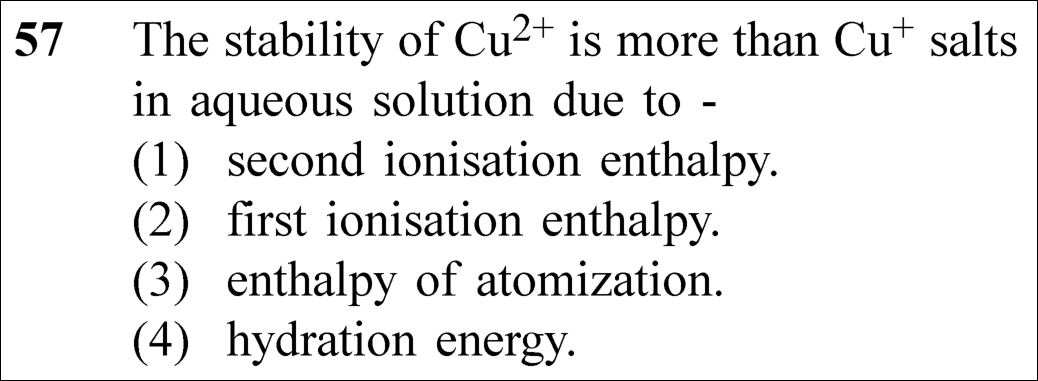
NEET 2023 · Q57 Easy
Official NEET 2023 Question 57 - The d- and f-Block Elements
1
2
3
4 ✓ Key
💡 Verified Solution & 30-Second Hack
✓
Verified Against NTA Final Answer Key
Option (4) : hydration energy
📚 The d- and f-Block Elements Easy
📋 Given Parameters & Problem Setup
Transition metal ion pair Cu²⁺(aq) vs Cu⁺(aq)
Medium Aqueous solution
Observed phenomenon Cu²⁺ is much more stable than Cu⁺; Cu⁺ disproportionates
⚡

The 30-Second Exam Hall Shortcut: ⚡ Hydration Enthalpy Dominance Rule: Δ_hyd H(Cu²⁺) Compensates IE₂

⏱️ Save ~30 seconds

Cu⁺ has d¹⁰ configuration, but Cu²⁺ has double the charge density! High negative hydration enthalpy of Cu²⁺ (-2121 kJ/mol) overcomes its 2nd ionization enthalpy, making Cu²⁺ stable in aqueous solution in 5 seconds!

1 In the gas phase, Cu⁺ (3d¹⁰) is more stable than Cu²⁺ (3d⁹) due to a fully filled d-subshell.
2 In aqueous solution, however, Cu⁺ spontaneously disproportionates: 2 Cu⁺(aq) ⟶ Cu²⁺(aq) + Cu(s).
3 Why is Cu²⁺ favored in water? Because Cu²⁺ has a smaller ionic radius and a +2 charge.
4 This high charge density produces an enormous negative hydration enthalpy for Cu²⁺.
5 The high hydration energy more than compensates for the high second ionization enthalpy (IE₂) of copper.
6 Lock Option (4) hydration energy immediately!
🛡️
Why You Can 100% Trust This Shortcut: d-Block Chemistry · Standard Reduction Potentials (The stability of Cu²⁺(aq) rather than Cu⁺(aq) is due to the much more negative hydration enthalpy of Cu²⁺(aq) than Cu⁺(aq)).
📐

Step-by-Step Rigorous Workflow & Mathematical Proof

Step 1

Electronic Configurations and Gas Phase Stability

In the isolated gaseous state, copper exhibits the following configurations:

Cu+:[Ar] 3d10,Cu2+:[Ar] 3d9\text{Cu}^+ : [\text{Ar}]\, 3d^{10}, \qquad \text{Cu}^{2+} : [\text{Ar}]\, 3d^9
Step 2

Thermodynamic Cycle in Aqueous Medium

The stability of an oxidation state in aqueous solution is dictated by the total standard electrode potential (E°), which is governed by the Born-Haber energy cycle involving sublimation enthalpy, ionization enthalpy, and hydration enthalpy:

ΔHtotal=ΔsubH+IE1+IE2+ΔhydH\Delta H_{\text{total}} = \Delta_{\text{sub}}H + \text{IE}_1 + \text{IE}_2 + \Delta_{\text{hyd}}H
Step 3

The Compensation Role of Hydration Enthalpy

Although removing a second electron from copper requires a very large amount of energy (high second ionization enthalpy IE₂ = 1958 kJ mol⁻¹ to break the stable 3d¹⁰ shell), the much smaller ionic radius and higher charge of Cu²⁺ gives it a massive negative hydration enthalpy (-2121 kJ mol⁻¹ compared to only -593 kJ mol⁻¹ for Cu⁺):

∣ΔhydH(Cu2+)−ΔhydH(Cu+)∣>IE2|\Delta_{\text{hyd}}H(\text{Cu}^{2+}) - \Delta_{\text{hyd}}H(\text{Cu}^+)| > \text{IE}_2
Step 4

Disproportionation of Cu⁺ in Water

Because the hydration enthalpy heavily tilts the free energy balance toward Cu²⁺, Cu⁺ ions are unstable in water and undergo rapid disproportionation:

2Cu+(aq)⟶Cu2+(aq)+Cu(s),E∘=+0.37 V2\text{Cu}^+(aq) \longrightarrow \text{Cu}^{2+}(aq) + \text{Cu}(s), \quad E^\circ = +0.37\text{ V}
⭐

360° Option Elimination Engine Key Feature

Diagnose every choice: Know exactly why the right option works and why distractors fail.

4-Option Deep Scan
1 (1)
✗ Incorrect
Verdict & Scientific Reason:

Second ionization enthalpy is unfavorable (endothermic, opposes Cu²⁺ formation).

⚠️
Student Fallacy (Why candidates pick this trap): Candidate confused the factor that opposes formation with the factor that favors it.
2 (2)
✗ Incorrect
Verdict & Scientific Reason:

First ionization enthalpy is identical for forming Cu⁺.

⚠️
Student Fallacy (Why candidates pick this trap): Irrelevant to the difference between Cu⁺ and Cu²⁺.
3 (3)
✗ Incorrect
Verdict & Scientific Reason:

Sublimation/atomization enthalpy is the same for both oxidation states starting from metallic copper.

⚠️
Student Fallacy (Why candidates pick this trap): Candidate selected a generic thermodynamic parameter.
4 (4)
✓ 100% Correct
Verdict & Scientific Reason:

Direct canonical textbook reason: huge negative hydration enthalpy of Cu²⁺ compensates for IE₂.

💡
Why this is airtight: None. Candidate correctly cited the hydration energy compensation effect.
⚠️

NTA Trap Alert: Thinking d¹⁰ Makes Cu⁺ More Stable in Solution

Students frequently remember that Cu⁺ has a fully filled 3d¹⁰ configuration and assume it must be more stable than 3d⁹ Cu²⁺. In aqueous solution, lattice/hydration energetics completely override subshell symmetry!

🛡️ How to avoid the -1 mark: Golden Rule: In gas phase, 3d¹⁰ Cu⁺ is more stable; in AQUEOUS SOLUTION, 3d⁹ Cu²⁺ is far more stable due to hydration enthalpy.
📖

Core NEET Syllabus Standard

National Eligibility cum Entrance Test (NEET UG) · The d- and f-Block Elements Standard Benchmark
Core Scientific Principle Tested:

"The stability of Cu²⁺(aq) rather than Cu⁺(aq) is due to the much more negative hydration enthalpy of Cu²⁺(aq) which more than compensates for second ionization enthalpy."

Syllabus Focus: Trends in the M²⁺/M Standard Electrode Potentials
Preserved in Rationalized Curriculum Syllabus & Academic Standards ↗
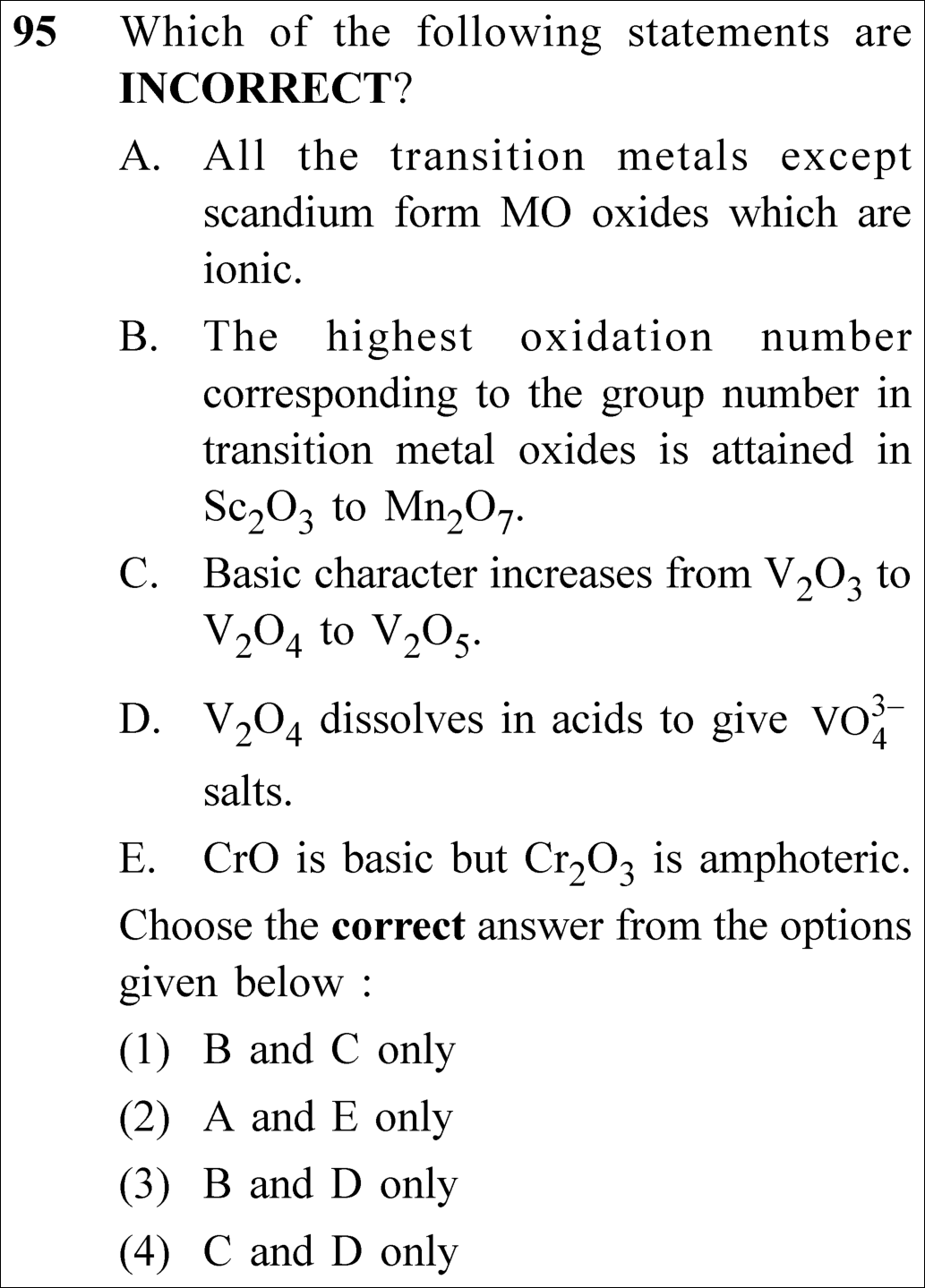
NEET 2023 · Q95 Medium
Official NEET 2023 Question 95 - The d- and f-Block Elements
1
2
3
4 ✓ Key
💡 Verified Solution & 30-Second Hack
✓
Verified Against NTA Final Answer Key
Option (4) : C and D only
📚 The d- and f-Block Elements Medium
📋 Given Parameters & Problem Setup
Topic evaluated Properties of transition metal oxides (Sc, V, Cr, Mn)
Statements A, B, C, D, E
Question requirement Identify INCORRECT statements
⚡

The 30-Second Exam Hall Shortcut: ⚡ Oxide Oxidation State Trend: Higher Oxidation State = Higher Acidity!

⏱️ Save ~40 seconds

As oxidation number of vanadium increases (+3 in V₂O₃, +4 in V₂O₄, +5 in V₂O₅), basic character DECREASES and acidic character increases (V₂O₃ basic, V₂O₄ amphoteric, V₂O₅ amphoteric/acidic). Hence Statement C is FALSE! Also, V₂O₄ dissolves in acids to give VO²⁺ (vanadyl ion, +4 state), NOT VO₄³⁻ (+5 state). Hence Statement D is FALSE! Statements C and D are INCORRECT ⟹ Option (4)!

1 Check Statement A: All transition metals except Sc form MO oxides which are ionic (Verbatim NCERT, TRUE).
2 Check Statement B: Highest oxidation number in oxides matches group number for Sc₂O₃ (+3) to Mn₂O₇ (+7) (Verbatim NCERT, TRUE).
3 Check Statement C: "Basic character increases from V₂O₃ to V₂O₄ to V₂O₅." False! As oxidation state rises, electronegativity rises, so basic character decreases and acidic character increases (INCORRECT).
4 Check Statement D: "V₂O₄ dissolves in acids to give VO₄³⁻ salts." False! V₂O₄ has vanadium in +4 state and gives VO²⁺ salts; VO₄³⁻ is orthovanadate (+5) (INCORRECT).
5 Check Statement E: CrO is basic, Cr₂O₃ is amphoteric, CrO₃ is acidic (Verbatim NCERT, TRUE).
6 Incorrect statements are C and D only (Option 4).
🛡️
Why You Can 100% Trust This Shortcut: Verbatim NCERT d- and f-Block Elements section on Oxides and Oxoanions of Metals.
📐

Step-by-Step Rigorous Workflow & Mathematical Proof

Step 1

Evaluate Statements A and B

Statement A: Transition metals (except scandium, which only forms Sc₂O₃) form ionic MO oxides (TiO to NiO) — verbatim NCERT (TRUE). Statement B: Highest oxidation states matching group number occur from Group 3 (Sc₂O₃, +3) to Group 7 (Mn₂O₇, +7) — verbatim NCERT (TRUE):

Statements A and B  ⟺  Factually True\text{Statements A and B} \iff \text{Factually True}
Step 2

Evaluate Statement C: Vanadium Oxide Acid-Base Trend

As the oxidation state of a transition metal increases, covalent character increases and basic character decreases: V₂O₃ (+3) is basic, V₂O₄ (+4) is amphoteric, and V₂O₅ (+5) is amphoteric/acidic. Statement C claims basic character increases, which is directly FALSE:

Basic character: V2O3(+3)>V2O4(+4)>V2O5(+5)  ⟹  Statement C is INCORRECT\text{Basic character: } \text{V}_2\text{O}_3 (+3) > \text{V}_2\text{O}_4 (+4) > \text{V}_2\text{O}_5 (+5) \implies \text{Statement C is INCORRECT}
Step 3

Evaluate Statement D: Dissolution Chemistry of V₂O₄

V₂O₄ has vanadium in oxidation state +4. It dissolves in non-oxidizing acids to give vanadyl salts containing VO²⁺ (+4). VO₄³⁻ contains vanadium in oxidation state +5 (orthovanadate). Statement D is FALSE:

V2O4+2H+⟶2VO2++H2O(VO2+ salts, NOT VO43−)  ⟹  Statement D is INCORRECT\text{V}_2\text{O}_4 + 2\text{H}^+ \longrightarrow 2\text{VO}^{2+} + \text{H}_2\text{O} \quad (\text{VO}^{2+} \text{ salts, NOT } \text{VO}_4^{3-}) \implies \text{Statement D is INCORRECT}
Step 4

Evaluate Statement E: Chromium Oxides

CrO (Cr²⁺) is basic, Cr₂O₃ (Cr³⁺) is amphoteric, and CrO₃ (Cr⁶⁺) is acidic. Statement E correctly identifies CrO as basic and Cr₂O₃ as amphoteric (TRUE):

CrO (basic),Cr2O3 (amphoteric)  ⟹  Statement E is True\text{CrO (basic)}, \quad \text{Cr}_2\text{O}_3 \text{ (amphoteric)} \implies \text{Statement E is True}
⭐

360° Option Elimination Engine Key Feature

Diagnose every choice: Know exactly why the right option works and why distractors fail.

4-Option Deep Scan
1 (1)
✗ Incorrect
Verdict & Scientific Reason:

Statement B is factually true, so it cannot be part of the incorrect set.

⚠️
Student Fallacy (Why candidates pick this trap): Candidate incorrectly thought highest oxidation states do not reach Mn₂O₇.
2 (2)
✗ Incorrect
Verdict & Scientific Reason:

Both Statements A and E are correct NCERT principles.

⚠️
Student Fallacy (Why candidates pick this trap): Candidate confused correct statements with incorrect statements.
3 (3)
✗ Incorrect
Verdict & Scientific Reason:

Statement B is correct.

⚠️
Student Fallacy (Why candidates pick this trap): Candidate failed to verify statement B.
4 (4)
✓ 100% Correct
Verdict & Scientific Reason:

Accurate: Statements C and D are both false statements regarding vanadium oxides.

💡
Why this is airtight: None. Candidate correctly identified the two incorrect statements.
⚠️

NTA Trap Alert: Overlooking Oxidation State Conservation in Acid Dissolution

In V₂O₄, vanadium has oxidation state +4. Dissolution in acid does not oxidize it; it forms the vanadyl cation VO²⁺ (+4). VO₄³⁻ has vanadium in oxidation state +5 (formed by dissolution of V₂O₅ in alkali)!

🛡️ How to avoid the -1 mark: Check oxidation states: V in V₂O₄ is +4 ⟶ forms VO²⁺ (+4). It cannot form VO₄³⁻ (+5) without an oxidizing agent.
📖

Core NEET Syllabus Standard

National Eligibility cum Entrance Test (NEET UG) · The d- and f-Block Elements Standard Benchmark
Core Scientific Principle Tested:

"Basic character decreases as oxidation state increases; V₂O₄ dissolves in acid to yield VO²⁺ salts."

Syllabus Focus: Transition Metal Oxides and Oxoanions – Acid-Base Trends
Preserved in Rationalized Curriculum Syllabus & Academic Standards ↗
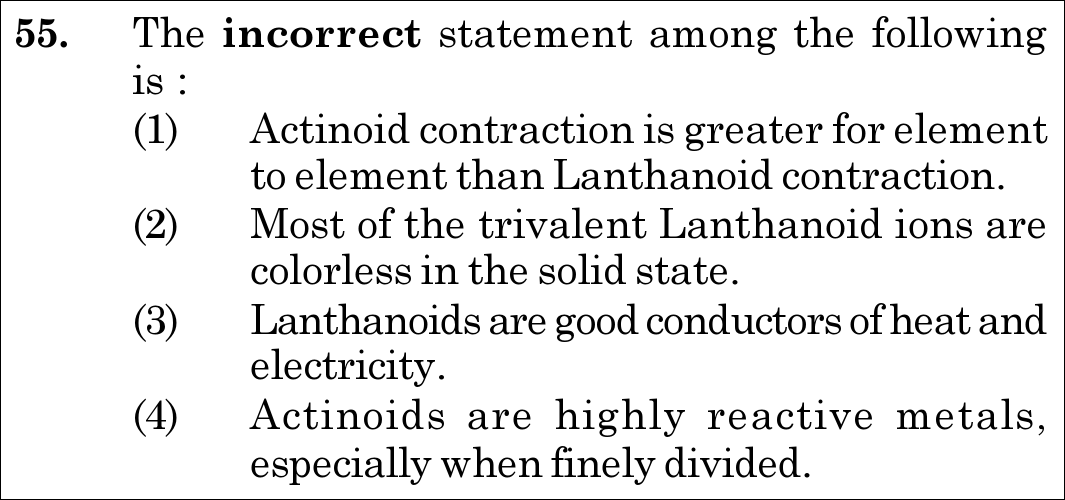
NEET 2021 · Q55 Medium
Official NEET 2021 Question 55 - The d- and f-Block Elements
1 Actinoid contraction is greater for element to element than Lanthanoid contraction.
2 Most of the trivalent Lanthanoid ions are colorless in the solid state. ✓ Key
3 Lanthanoids are good conductors of heat and electricity.
4 Actinoids are highly reactive metals, especially when finely divided.
💡 Verified Solution & 30-Second Hack
✓
Verified Against NTA Final Answer Key
Option (2) : Most of the trivalent Lanthanoid ions are colorless in the solid state.
📚 The d- and f-Block Elements Medium
📋 Given Parameters & Problem Setup
Topic Area f-Block Elements (Lanthanoids and Actinoids)
Target Identify the INCORRECT statement
⚡

The 30-Second Exam Hall Shortcut: ⚡ f-f Transitions Impart Color to Most Ln³⁺ Ions!

⏱️ Save ~25 seconds

Verbatim NCERT d- and f-Block Elements: "Many trivalent lanthanoid ions are coloured both in solid state and in aqueous solutions. Colour of these ions may be attributed to the presence of f electrons (f-f transitions)." Only La3+(4f0)La^{3+} (4f^0) and Lu3+(4f14)Lu^{3+} (4f^{14}) are colorless! Statement (2) claiming most are colorless is factually FALSE! Match Option (2)!

1 Check Statement (1): Actinoid contraction is greater than lanthanoid contraction due to poorer shielding by 5f5f compared to 4f4f orbitals -> True.
2 Check Statement (2): Claims "most trivalent lanthanoid ions are colorless". In reality, partially filled 4fn4f^n shells exhibit characteristic absorption spectra (ff-ff transitions), making MOST trivalent ions COLOURED -> False (Incorrect statement).
3 Check Statement (3): Lanthanoids are typical metallic conductors of heat and electricity -> True.
4 Check Statement (4): Actinoids are electropositive and highly reactive, particularly when finely divided -> True.
5 Match Option (2).
🛡️
Why You Can 100% Trust This Shortcut: Canonical NCERT d- and f-Block Elements physical properties of lanthanoids.
📐

Step-by-Step Rigorous Workflow & Mathematical Proof

Step 1

Analyzing Statement (1): Actinoid vs. Lanthanoid Contraction

The steady decrease in atomic and ionic radii along the actinoid series (actinoid contraction) is larger from element to element than lanthanoid contraction. This arises because 5f5f electrons have more diffuse radial wavefunctions and exert even poorer electrostatic shielding of nuclear charge than 4f4f electrons. Statement (1) is scientifically correct.

Step 2

Analyzing Statement (2): Color of Trivalent Lanthanoid Ions

According to NCERT Chapter on d- and f-Block Elements: *"Many trivalent lanthanoid ions are coloured both in the solid state and in aqueous solutions. Colour of these ions may be attributed to the presence of partially filled f electrons (ff-ff transitions)."* Only ions with an empty subshell (La3+:4f0La^{3+}: 4f^0) or a completely filled subshell (Lu3+:4f14Lu^{3+}: 4f^{14}) are colorless. The vast majority (Pr3+,Nd3+,Sm3+,Eu3+,Gd3+,Tb3+,Dy3+,Ho3+,Er3+,Tm3+Pr^{3+}, Nd^{3+}, Sm^{3+}, Eu^{3+}, Gd^{3+}, Tb^{3+}, Dy^{3+}, Ho^{3+}, Er^{3+}, Tm^{3+}) possess characteristic vivid colors (e.g., Nd3+Nd^{3+} is pink, Pr3+Pr^{3+} is green). Therefore, Statement (2) is demonstrably incorrect.

Step 3

Analyzing Statements (3) and (4)

- Statement 3: Lanthanoids are silvery-white metals and good conductors of heat and electricity (NCERT fact, correct). - Statement 4: Actinoids are highly electropositive and reactive metals, readily attacked by boiling water and oxygen, especially when in finely divided state (NCERT fact, correct).

⭐

360° Option Elimination Engine Key Feature

Diagnose every choice: Know exactly why the right option works and why distractors fail.

4-Option Deep Scan
1 1
✗ Incorrect
Verdict & Scientific Reason:

This statement is scientifically true (poorer shielding by 5f electrons).

⚠️
Student Fallacy (Why candidates pick this trap): Assuming 4f shields more poorly than 5f.
2 2
✓ 100% Correct
Verdict & Scientific Reason:

This is the INCORRECT statement: most trivalent lanthanoid ions are coloured due to f-f absorption transitions.

💡
Why this is airtight: None; textbook verbatim recall.
3 3
✗ Incorrect
Verdict & Scientific Reason:

This statement is scientifically true (all lanthanoids possess metallic conductivity).

⚠️
Student Fallacy (Why candidates pick this trap): Doubting the metallic nature of lanthanoids.
4 4
✗ Incorrect
Verdict & Scientific Reason:

This statement is scientifically true (pyrophoric finely divided actinoid metals).

⚠️
Student Fallacy (Why candidates pick this trap): Assuming radioactivity suppresses chemical reactivity.
⚠️

NTA Trap Alert: Lanthanoid Color Trap

Students mistakenly remember that La3+La^{3+} and Lu3+Lu^{3+} are colorless, and generalize that "lanthanoids are generally colorless". In reality, La3+La^{3+} (4f04f^0) and Lu3+Lu^{3+} (4f144f^{14}) are the only exceptions; almost all other Ln3+Ln^{3+} ions are distinctly colored.

🛡️ How to avoid the -1 mark: Remember: 4f1−134f^{1-13} ions undergo ff-ff transitions and are COLOURED. Only 4f04f^0 and 4f144f^{14} are colorless.
📖

Core NEET Syllabus Standard

NCERT Chemistry · The d- and f-Block Elements Standard Benchmark
Core Scientific Principle Tested:

"Many trivalent lanthanoid ions are coloured both in solid state and in aqueous solutions due to f-f transitions."

Syllabus Focus: General Characteristics of Lanthanoids (Colour and Spectra)
✓ Core NEET UG Syllabus Anchor Syllabus & Academic Standards ↗
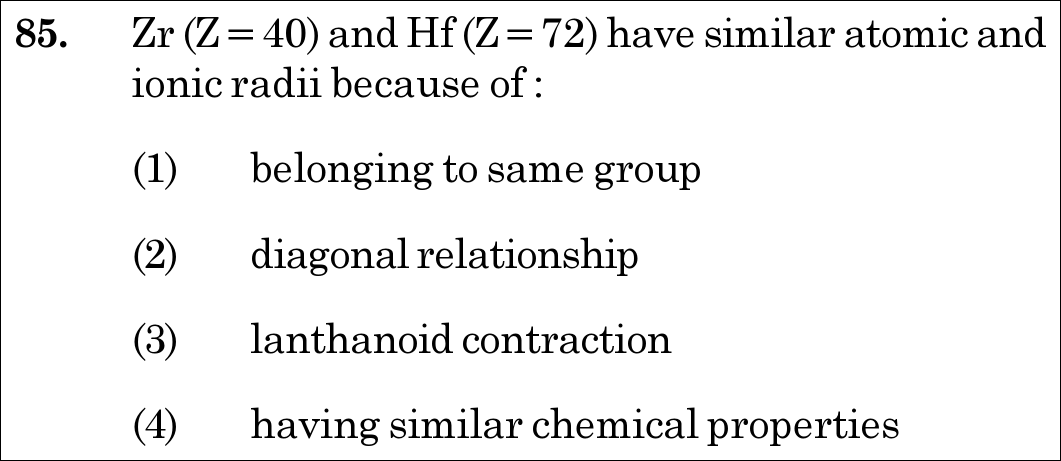
NEET 2021 · Q85 Easy
Official NEET 2021 Question 85 - The d- and f-Block Elements
1
2
3 ✓ Key
4
💡 Verified Solution & 30-Second Hack
✓
Verified Against NTA Final Answer Key
Option (3) : lanthanoid contraction
📚 The d- and f-Block Elements Easy
📋 Given Parameters & Problem Setup
Elements Zirconium (Zr, Z = 40) and Hafnium (Hf, Z = 72)
Phenomenon Virtually identical atomic radii (Zr: 160 pm, Hf: 159 pm)
⚡

The 30-Second Exam Hall Shortcut: ⚡ Zr and Hf Identical Radii = Lanthanoid Contraction!

⏱️ Save ~15 seconds

Zirconium belongs to the 4d4d transition series, while Hafnium belongs to the 5d5d transition series. Between them lie the 14 lanthanoid elements (58Ce_{58}\text{Ce} to 71Lu_{71}\text{Lu}). Due to the poor shielding of the nuclear charge by the intervening 4f144f^{14} electrons, the expected size increase from 4d→5d4d \to 5d is completely compensated by lanthanoid contraction (Zr:160 pm,Hf:159 pmZr: 160\text{ pm}, Hf: 159\text{ pm}). Match Option (3)!

1 ZrZr (Z=40Z = 40, period 5, group 4) and HfHf (Z=72Z = 72, period 6, group 4) belong to the same vertical transition group.
2 Normally, descending a group increases atomic size due to addition of a quantum shell.
3 However, before HfHf, the 14 lanthanoid elements involve progressive filling of the 4f4f subshell.
4 The 4f4f orbitals have diffuse radial distribution and shield the increasing nuclear charge (+14+14) very poorly.
5 This results in lanthanoid contraction, making the atomic and ionic radii of ZrZr and HfHf virtually identical.
6 Match Option (3).
🛡️
Why You Can 100% Trust This Shortcut: Canonical NCERT d- and f-Block Elements hallmark consequence of lanthanoid contraction.
📐

Step-by-Step Rigorous Workflow & Mathematical Proof

Step 1

Periodic Context of Zirconium and Hafnium

Zirconium (ZrZr, atomic number 40) is a member of the second (4d4d) transition series in Group 4. Hafnium (HfHf, atomic number 72) is located directly beneath ZrZr in the third (5d5d) transition series. In moving from ZrZr to HfHf, 32 protons are added to the nucleus, including the 14 elements of the lanthanoid series (58Ce_{58}\text{Ce} to 71Lu_{71}\text{Lu}).

Step 2

Mechanism of Lanthanoid Contraction

In the lanthanoids, electrons enter the inner (n−2)f=4f(n-2)f = 4f orbitals. Because ff-orbitals have highly diffuse angular shapes, they exert exceptionally poor screening (shielding) of the nuclear charge on the outer 5d5d and 6s6s electrons. Consequently, as the nuclear charge increases by 14 units, the effective nuclear charge (ZeffZ_{\text{eff}}) experienced by outer electrons increases steadily, pulling the electron clouds inwards.

Step 3

Consequence on Radii of 4d and 5d Conjoined Pairs

This contraction in size (lanthanoid contraction) almost exactly cancels the expected expansion due to the addition of an extra quantum shell (n=5→n=6n=5 \to n=6): - Atomic radii: Zr=160 pm,Hf=159 pmZr = 160\text{ pm}, \quad Hf = 159\text{ pm} - Ionic radii (M4+M^{4+}): Zr4+=79 pm,Hf4+=78 pmZr^{4+} = 79\text{ pm}, \quad Hf^{4+} = 78\text{ pm} Hence, ZrZr and HfHf possess almost identical physical and chemical properties and occur together in nature.

r(Zr)≈r(Hf)  ⟸  Lanthanoid Contractionr(Zr) \approx r(Hf) \impliedby \mathbf{\text{Lanthanoid Contraction}}
⭐

360° Option Elimination Engine Key Feature

Diagnose every choice: Know exactly why the right option works and why distractors fail.

4-Option Deep Scan
1 1
✗ Incorrect
Verdict & Scientific Reason:

Belonging to the same group usually causes an INCREASE in radius down the group (Ti<ZrTi < Zr); it does not explain identical radii without lanthanoid contraction.

⚠️
Student Fallacy (Why candidates pick this trap): Assuming elements in the same group naturally have identical radii.
2 2
✗ Incorrect
Verdict & Scientific Reason:

Diagonal relationship operates across adjacent periods and groups in the ss- and pp-blocks (e.g., Li−Mg,Be−Al,B−SiLi-Mg, Be-Al, B-Si), not between vertical dd-block group members.

⚠️
Student Fallacy (Why candidates pick this trap): Confusing vertical lanthanoid consequence with diagonal relationship.
3 3
✓ 100% Correct
Verdict & Scientific Reason:

Verbatim NCERT explanation: lanthanoid contraction compensates for the normal group size increase.

💡
Why this is airtight: None; textbook transition metal chemistry hallmark.
4 4
✗ Incorrect
Verdict & Scientific Reason:

Similar chemical properties are a CONSEQUENCE of similar radii, not the cause.

⚠️
Student Fallacy (Why candidates pick this trap): Confusing cause and effect.
⚠️

NTA Trap Alert: Cause vs. Consequence Trap (Option 3 vs. Option 4)

Option (4) states "having similar chemical properties". Similar chemical properties are the RESULT of having nearly identical radii. The fundamental physical CAUSE of their identical radii is the LANTHANOID CONTRACTION.

🛡️ How to avoid the -1 mark: Identify CAUSE vs. EFFECT: Lanthanoid contraction is the physical cause; identical chemical behavior is the resulting effect.
📖

Core NEET Syllabus Standard

NCERT Chemistry · The d- and f-Block Elements Standard Benchmark
Core Scientific Principle Tested:

"The almost identical radii of a pair of elements of 4d and 5d series (e.g., Zr and Hf) is a direct consequence of the lanthanoid contraction."

Syllabus Focus: Electronic Configurations and Radii of Transition Elements (Lanthanoid Contraction)
✓ Core NEET UG Syllabus Anchor Syllabus & Academic Standards ↗
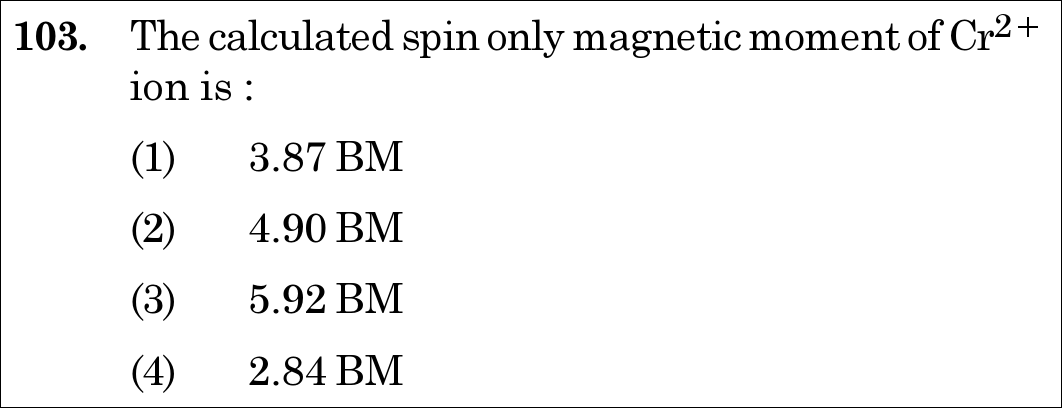
NEET 2020 · Q103 Easy
Official NEET 2020 Question 103 - The d- and f-Block Elements
1 3.87 BM
2 4.90 BM ✓ Key
3 5.92 BM
4 2.84 BM
💡 Verified Solution & 30-Second Hack
✓
Verified Against NTA Final Answer Key
Option (2) : 4.90 BM
📚 The d- and f-Block Elements Easy
📋 Given Parameters & Problem Setup
Transition Metal Cation Cr2+ (Chromium Z = 24)
Formula μ_s = √[n(n + 2)] Bohr Magnetons (BM)
Question Objective Calculate the spin-only magnetic moment
⚡

The 30-Second Exam Hall Shortcut: ⚡ "Cr2+ is 3d4 -> 4 Unpaired Electrons -> μ = √[4(6)] = √24 = 4.90 BM!"

⏱️ 20 seconds

Chromium (Z=24Z = 24) ground state is [Ar]3d54s1[Ar] 3d^5 4s^1. Loss of 2 electrons gives Cr2+=[Ar]3d4Cr^{2+} = [Ar] 3d^4, possessing n=4n = 4 unpaired electrons. Shortcut: for nn unpaired electrons, μ\mu is always "n.n.something" -> for n=4n = 4, μ=24=4.899≈4.90 BM\mu = \sqrt{24} = 4.899 \approx 4.90\text{ BM}. Mark Option (2) in 5 seconds!

1 Ground state Cr: [Ar] 3d^5 4s^1.
2 Cr2+ configuration: [Ar] 3d^4 (1 electron lost from 4s, 1 from 3d).
3 Number of unpaired d-electrons (n) = 4.
4 Spin-only magnetic moment: μ = √[n(n+2)] = √[4(6)] = √24 BM.
5 Since √25 = 5.0, √24 ≈ 4.90 BM.
6 Select Option (2) 4.90 BM.
🛡️
Why You Can 100% Trust This Shortcut: NCERT Chemistry · The d- and f-Block Elements (Magnetic Properties of Transition Metals)
📐

Step-by-Step Rigorous Workflow & Mathematical Proof

Step 1

Determine Ground State Configuration of Chromium

Chromium has atomic number Z=24Z = 24. Its exceptional, half-filled stable ground state electronic configuration is: Cr=[Ar]3d54s1\text{Cr} = [\text{Ar}] 3d^5 4s^1

Step 2

Determine Electronic Configuration of Cr2+

During ionization to form Cr2+Cr^{2+}, electrons are removed first from the outermost 4s4s subshell, followed by the 3d3d subshell: Cr2+=[Ar]3d44s0\text{Cr}^{2+} = [\text{Ar}] 3d^4 4s^0 In the five degenerate 3d3d orbitals, according to Hund's rule of maximum multiplicity, all 4 electrons occupy separate orbitals with parallel spins: ↑,↑,↑,↑,_\uparrow, \uparrow, \uparrow, \uparrow, \_. Therefore, the number of unpaired electrons is n=4n = 4.

Step 3

Apply Spin-Only Formula

The spin-only magnetic moment (μs\mu_s) is calculated using the formula: μs=n(n+2) BM\mu_s = \sqrt{n(n + 2)} \text{ BM} Substituting n=4n = 4: μs=4(4+2)=4×6=24 BM\mu_s = \sqrt{4(4 + 2)} = \sqrt{4 \times 6} = \sqrt{24} \text{ BM} 24=4.8989...≈4.90 BM\sqrt{24} = 4.8989... \approx 4.90 \text{ BM}

Step 4

Evaluate Other Magnetic Moments in Options

- n=3  ⟹  μ=15=3.87 BMn = 3 \implies \mu = \sqrt{15} = 3.87\text{ BM} (e.g. Cr3+Cr^{3+}) - n=5  ⟹  μ=35=5.92 BMn = 5 \implies \mu = \sqrt{35} = 5.92\text{ BM} (e.g. Fe3+,Mn2+Fe^{3+}, Mn^{2+}) - n=2  ⟹  μ=8=2.84 BMn = 2 \implies \mu = \sqrt{8} = 2.84\text{ BM} (e.g. Ni2+Ni^{2+}).

⭐

360° Option Elimination Engine Key Feature

Diagnose every choice: Know exactly why the right option works and why distractors fail.

4-Option Deep Scan
1 A
✗ Incorrect
Verdict & Scientific Reason:

Incorrect; corresponds to n=3n = 3 unpaired electrons (15=3.87 BM\sqrt{15} = 3.87\text{ BM}, characteristic of Cr3+Cr^{3+} or V2+V^{2+}).

⚠️
Student Fallacy (Why candidates pick this trap): Confusing Cr2+ (3d4) with Cr3+ (3d3).
2 B
✓ 100% Correct
Verdict & Scientific Reason:

Factually and mathematically exact; n=4n = 4 unpaired electrons gives μ=24≈4.90 BM\mu = \sqrt{24} \approx 4.90\text{ BM}.

💡
Why this is airtight: None; standard spin-only calculation.
3 C
✗ Incorrect
Verdict & Scientific Reason:

Incorrect; corresponds to n=5n = 5 unpaired electrons (35=5.92 BM\sqrt{35} = 5.92\text{ BM}, seen in Mn2+Mn^{2+} or Fe3+Fe^{3+}).

⚠️
Student Fallacy (Why candidates pick this trap): Assuming neutral Cr configuration retains 5 unpaired electrons.
4 D
✗ Incorrect
Verdict & Scientific Reason:

Incorrect; corresponds to n=2n = 2 unpaired electrons (8=2.84 BM\sqrt{8} = 2.84\text{ BM}).

⚠️
Student Fallacy (Why candidates pick this trap): Subtracting 2 from 4 electrons.
⚠️

NTA Trap Alert: Cr2+ vs Cr3+ Oxidation State Trap

Don't confuse Cr2+Cr^{2+} with the more common Cr3+Cr^{3+}! Cr3+Cr^{3+} has 3 unpaired electrons (μ=3.87 BM\mu = 3.87\text{ BM}), whereas Cr2+Cr^{2+} has 4 unpaired electrons (μ=4.90 BM\mu = 4.90\text{ BM}).

🛡️ How to avoid the -1 mark: Remember: Cr2+Cr^{2+} loses 1 from 4s and 1 from 3d -> 3d43d^4 (n=4n = 4 -> 4.90 BM)!
📖

Core NEET Syllabus Standard

Chemistry · The d- and f-Block Elements Standard Benchmark
Core Scientific Principle Tested:

""

Syllabus Focus: Spin-Only Magnetic Moment Calculation: Cr2+ Ion
✓ Core NEET UG Syllabus Anchor Syllabus & Academic Standards ↗
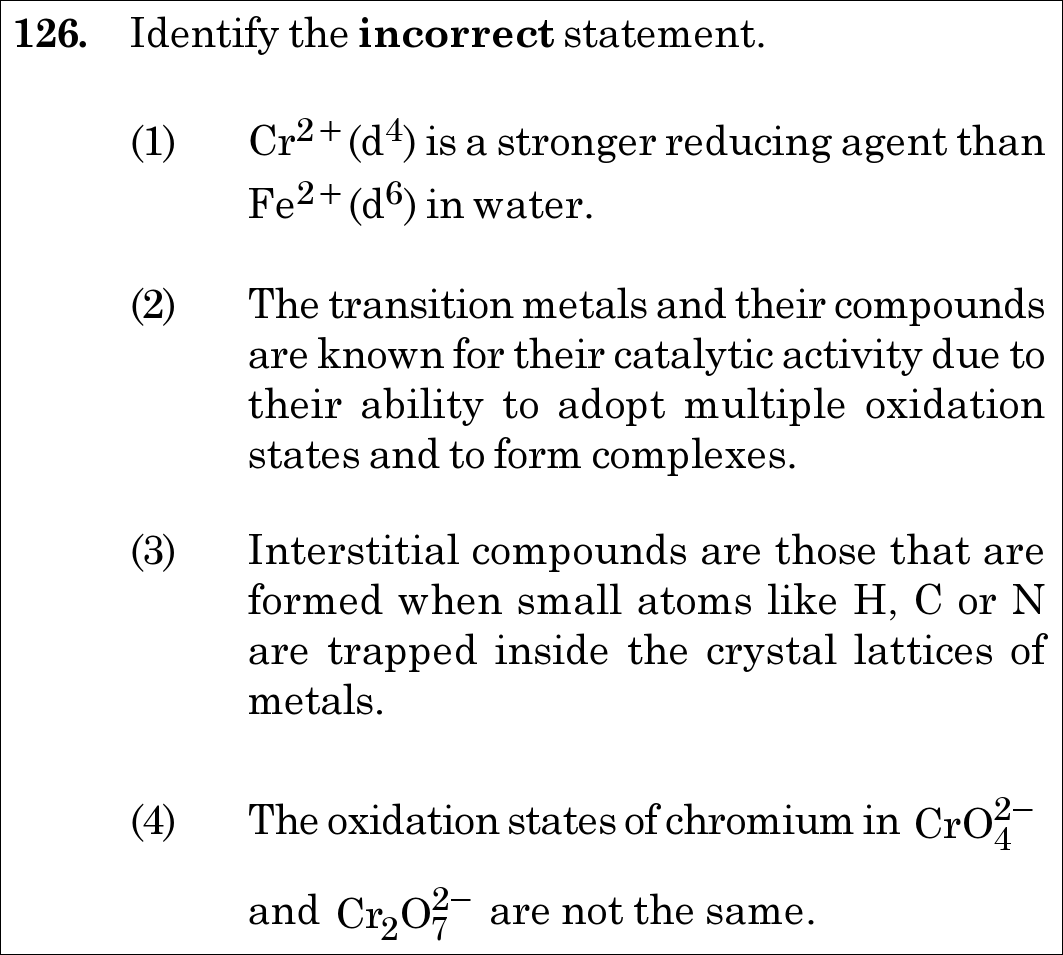
NEET 2020 · Q126 Easy
Official NEET 2020 Question 126 - The d- and f-Block Elements
1
2
3
4 ✓ Key
💡 Verified Solution & 30-Second Hack
✓
Verified Against NTA Final Answer Key
Option (4) : The oxidation states of chromium in CrO4^2- and Cr2O7^2- are not the same.
📚 The d- and f-Block Elements Easy
📋 Given Parameters & Problem Setup
Oxoanion 1 Chromate ion (CrO4^2-)
Oxoanion 2 Dichromate ion (Cr2O7^2-)
Question Objective Identify the INCORRECT statement among the choices
⚡

The 30-Second Exam Hall Shortcut: ⚡ "Cr in CrO4^2- is +6; Cr in Cr2O7^2- is +6: BOTH HAVE THE SAME +6 OXIDATION STATE!"

⏱️ 20 seconds

Calculate oxidation state: In CrO42−CrO_4^{2-}, x+4(−2)=−2  ⟹  x=+6x + 4(-2) = -2 \implies x = +6. In Cr2O72−Cr_2O_7^{2-}, 2x+7(−2)=−2  ⟹  2x=+12  ⟹  x=+62x + 7(-2) = -2 \implies 2x = +12 \implies x = +6. Both chromate and dichromate possess chromium in the exact same +6 oxidation state! Statement (4) claims they are "not the same", which is completely false! Mark Option (4) in 5 seconds.

1 Check Statement 4: Claims oxidation states of Cr in CrO4^2- and Cr2O7^2- are not the same.
2 In CrO4^2-: Cr + 4(-2) = -2 -> Cr = +6.
3 In Cr2O7^2-: 2Cr + 7(-2) = -2 -> 2Cr = +12 -> Cr = +6.
4 Both have Cr in +6 oxidation state (they interconvert with pH: 2CrO4^2- + 2H+ <=> Cr2O7^2- + H2O without any redox change).
5 Statement 4 is INCORRECT. Select Option (4).
🛡️
Why You Can 100% Trust This Shortcut: NCERT Chemistry · The d- and f-Block Elements (Potassium Dichromate & Chromate Interconversion)
📐

Step-by-Step Rigorous Workflow & Mathematical Proof

Step 1

Calculate Oxidation State of Cr in Chromate Ion

In the yellow chromate ion (CrO42−\text{CrO}_4^{2-}), oxygen has an oxidation state of −2-2: x+4(−2)=−2x + 4(-2) = -2 x−8=−2  ⟹  x=+6x - 8 = -2 \implies x = +6 Thus, chromium has an oxidation state of +6+6.

Step 2

Calculate Oxidation State of Cr in Dichromate Ion

In the orange dichromate ion (Cr2O72−\text{Cr}_2\text{O}_7^{2-}), oxygen has an oxidation state of −2-2: 2x+7(−2)=−22x + 7(-2) = -2 2x−14=−2  ⟹  2x=+12  ⟹  x=+62x - 14 = -2 \implies 2x = +12 \implies x = +6 Thus, chromium also has an oxidation state of +6+6.

Step 3

Chemical Significance of Chromate-Dichromate Equilibrium

Chromate and dichromate ions interconvert depending upon pH without any change in oxidation state: 2CrO42−(yellow)+2H+⇌Cr2O72−(orange)+H2O2\text{CrO}_4^{2-} \text{(yellow)} + 2\text{H}^+ \rightleftharpoons \text{Cr}_2\text{O}_7^{2-} \text{(orange)} + \text{H}_2\text{O} Because chromium remains in the +6+6 oxidation state in both species, Statement (4) is undeniably false.

Step 4

Verify Statements 1, 2, and 3

- Statement (1): Cr2+Cr^{2+} (d4d^4) is reducing because d4→d3d^4 \to d^3 (t2g3t_{2g}^3, half-filled stable configuration in aqueous medium), whereas Fe2+Fe^{2+} (d6→d5d^6 \to d^5) has a positive standard potential (ECr3+/Cr2+∘=−0.41 VE^\circ_{\text{Cr}^{3+}/\text{Cr}^{2+}} = -0.41\text{ V}, EFe3+/Fe2+∘=+0.77 VE^\circ_{\text{Fe}^{3+}/\text{Fe}^{2+}} = +0.77\text{ V}). True. - Statement (2): Transition metals are catalysts due to multiple oxidation states and complex formation. True. - Statement (3): Interstitial compounds form when small non-metal atoms (H, C, N) occupy interstitial voids. True.

⭐

360° Option Elimination Engine Key Feature

Diagnose every choice: Know exactly why the right option works and why distractors fail.

4-Option Deep Scan
1 A
✗ Incorrect
Verdict & Scientific Reason:

This statement is factually true in water because Cr3+ achieves a stable half-filled t2g^3 electronic configuration.

⚠️
Student Fallacy (Why candidates pick this trap): Failing to realize that Cr3+ stability makes Cr2+ strongly reducing.
2 B
✗ Incorrect
Verdict & Scientific Reason:

Factually true; standard textbook explanation for transition metal catalysis.

⚠️
Student Fallacy (Why candidates pick this trap): Correctly identifying known catalytic behavior.
3 C
✗ Incorrect
Verdict & Scientific Reason:

Factually true; verbatim NCERT definition of interstitial compounds.

⚠️
Student Fallacy (Why candidates pick this trap): Standard metallurgical definition.
4 D
✓ 100% Correct
Verdict & Scientific Reason:

Factually INCORRECT statement (hence the correct answer); chromium has the identical oxidation state of +6 in both oxoanions.

💡
Why this is airtight: None; clean algebraic verification of oxidation numbers.
⚠️

NTA Trap Alert: Chromate vs Dichromate Color vs Oxidation State

Although chromate is YELLOW and dichromate is ORANGE, their oxidation states are IDENTICAL (+6 in both). The color change is due to pH-dependent condensation, NOT a redox reaction!

🛡️ How to avoid the -1 mark: Both CrO42−CrO_4^{2-} and Cr2O72−Cr_2O_7^{2-} have Chromium in the +6 state!
📖

Core NEET Syllabus Standard

Chemistry · The d- and f-Block Elements Standard Benchmark
Core Scientific Principle Tested:

""

Syllabus Focus: Oxidation States of Chromium in Chromate (CrO4^2-) and Dichromate (Cr2O7^2-)
✓ Core NEET UG Syllabus Anchor Syllabus & Academic Standards ↗

Solve 4 NEET Questions a Day — One per Subject

Cover all 1,140 official NEET questions in 285 days at your own pace. Progress is saved on your device. No login needed.