NEET 2021 Chemistry Question 85 Solution
Question
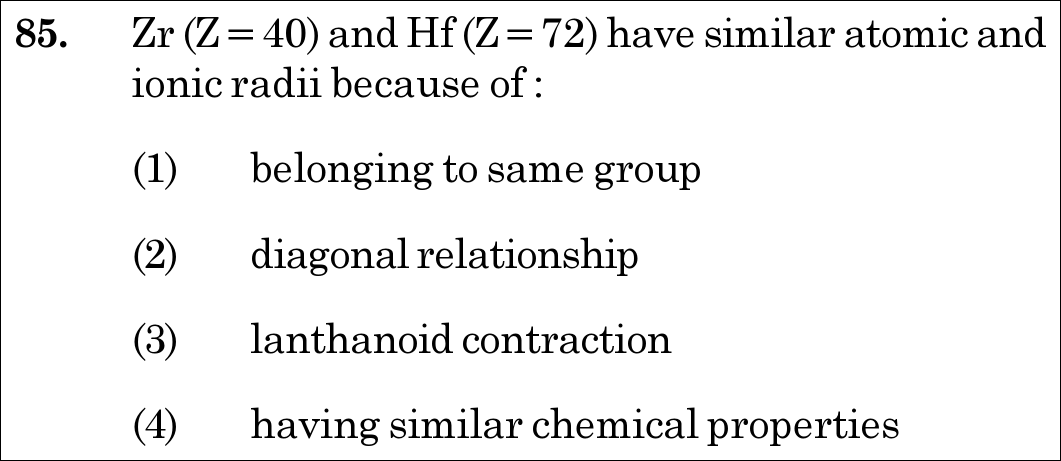
Zr (Z = 40) and Hf (Z = 72) have similar atomic and ionic radii because of:
Dynamic 180-question full-length simulator mixed dynamically from all 6 years for 2027 & 2026 aspirants.
Zr (Z = 40) and Hf (Z = 72) have similar atomic and ionic radii because of:
Zirconium belongs to the transition series, while Hafnium belongs to the transition series. Between them lie the 14 lanthanoid elements ( to ). Due to the poor shielding of the nuclear charge by the intervening electrons, the expected size increase from is completely compensated by lanthanoid contraction (). Match Option (3)!
Zirconium (, atomic number 40) is a member of the second () transition series in Group 4. Hafnium (, atomic number 72) is located directly beneath in the third () transition series. In moving from to , 32 protons are added to the nucleus, including the 14 elements of the lanthanoid series ( to ).
In the lanthanoids, electrons enter the inner orbitals. Because -orbitals have highly diffuse angular shapes, they exert exceptionally poor screening (shielding) of the nuclear charge on the outer and electrons. Consequently, as the nuclear charge increases by 14 units, the effective nuclear charge () experienced by outer electrons increases steadily, pulling the electron clouds inwards.
This contraction in size (lanthanoid contraction) almost exactly cancels the expected expansion due to the addition of an extra quantum shell (): - Atomic radii: - Ionic radii (): Hence, and possess almost identical physical and chemical properties and occur together in nature.
Diagnose every choice: Know exactly why the right option works and why distractors fail.
Belonging to the same group usually causes an INCREASE in radius down the group (); it does not explain identical radii without lanthanoid contraction.
Diagonal relationship operates across adjacent periods and groups in the - and -blocks (e.g., ), not between vertical -block group members.
Verbatim NCERT explanation: lanthanoid contraction compensates for the normal group size increase.
Similar chemical properties are a CONSEQUENCE of similar radii, not the cause.
Option (4) states "having similar chemical properties". Similar chemical properties are the RESULT of having nearly identical radii. The fundamental physical CAUSE of their identical radii is the LANTHANOID CONTRACTION.
"The almost identical radii of a pair of elements of 4d and 5d series (e.g., Zr and Hf) is a direct consequence of the lanthanoid contraction."
Test your speed and accuracy in the authentic 200-minute timed NTA simulator.
Spotted a mistake in this solution? Report an error ([email protected])
Cover all 1,140 official NEET questions in 285 days at your own pace. Progress is saved on your device. No login needed.