MyCompetitiveExams Logo MyCompetitiveExams
Search 1,140+ Questions
Chapters, formulas, speed tricks
→
⚡ Brahmastra NEET 2027
720 MARKS

Dynamic 180-question full-length simulator mixed dynamically from all 6 years for 2027 & 2026 aspirants.

Launch Brahmastra 2027 Test →
Start Practice →
100% Free · No Login Required
Q.67 Chemistry ⭐ 360° Option Elimination Active
Vault ↗

NEET 2026 Chemistry Question 67 Solution

Topic: The d- and f-Block Elements · Official NTA Booklet Code 50
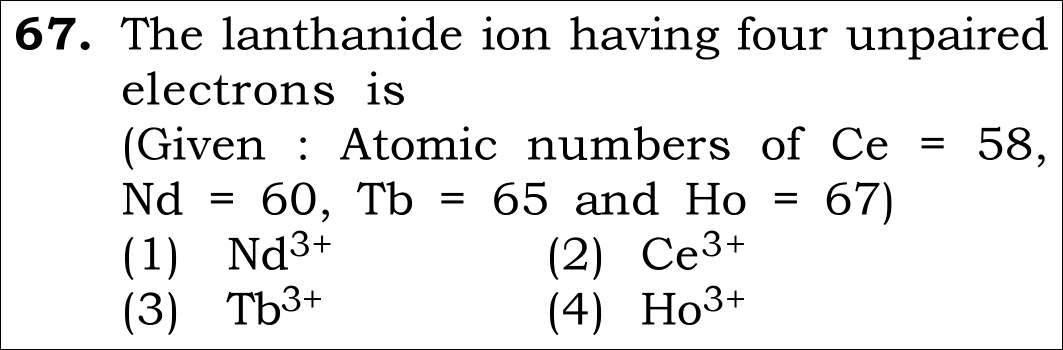
NEET 2026 Chemistry Question 67: Unpaired 4f Electrons in Trivalent Lanthanoid Cations

Question

The lanthanide ion having four unpaired electrons is (Given: Atomic numbers of Ce = 58, Nd = 60, Tb = 65 and Ho = 67)

✓
Verified Against NTA Final Answer Key
Option (4) : Ho³⁺
📚 The d- and f-Block Elements Medium
📋 Given Parameters & Problem Setup
Atomic Numbers Ce = 58, Nd = 60, Tb = 65, Ho = 67
Target The lanthanide ion having exactly four unpaired electrons
⚡

The 30-Second Exam Hall Shortcut: ⚡ The 4f Subshell Occupancy Rule

⏱️ Save ~60 seconds

4f subshell has 7 orbitals. 4 unpaired electrons requires 4f⁴ (7-3) or 4f¹⁰ (7-3 pairs)!

1 Recall general Ln³⁺ configuration: [Xe] 4f^n where n = Z - 57.
2 Ce³⁺ (Z = 58): 4f¹ -> 1 unpaired electron.
3 Nd³⁺ (Z = 60): 4f³ -> 3 unpaired electrons.
4 Tb³⁺ (Z = 65): 4f⁸ -> (8 - 7) = 1 pair + 6 unpaired -> 6 unpaired electrons.
5 Ho³⁺ (Z = 67): 4f¹⁰ -> (10 - 7) = 3 pairs + 4 unpaired -> exactly 4 UNPAIRED ELECTRONS!
6 Pick Ho³⁺ (Option 4) in 15 seconds!
🛡️
Why You Can 100% Trust This Shortcut: Universal Hund's rule of maximum multiplicity applied to the 7 degenerate 4f orbitals.
📐

Step-by-Step Rigorous Workflow & Mathematical Proof

Step 1

Determine Electronic Configurations of Neutral Lanthanoids

Xenon (Xe) has 54 electrons. The ground-state configurations of the neutral atoms are: - Ce (58): [Xe] 4f¹ 5d¹ 6s² - Nd (60): [Xe] 4f⁴ 6s² - Tb (65): [Xe] 4f⁹ 6s² - Ho (67): [Xe] 4f¹¹ 6s²

[Xe]=54 electrons[\text{Xe}] = 54\text{ electrons}
  • • Trivalent ionization removes outer 6s and 5d electrons first, then 4f.
Step 2

Determine 4f Configurations of Trivalent (Ln³⁺) Ions

For all lanthanoids, forming the stable Ln³⁺ cation removes 3 valence electrons (the two 6s electrons and one 5d or 4f electron): - Ce³⁺: 58 - 3 - 54 = 1 electron in 4f ⇒ [Xe] 4f¹ - Nd³⁺: 60 - 3 - 54 = 3 electrons in 4f ⇒ [Xe] 4f³ - Tb³⁺: 65 - 3 - 54 = 8 electrons in 4f ⇒ [Xe] 4f⁸ - Ho³⁺: 67 - 3 - 54 = 10 electrons in 4f ⇒ [Xe] 4f¹⁰

Ce3+:4f1,Nd3+:4f3,Tb3+:4f8,Ho3+:4f10\text{Ce}^{3+}: 4f^1, \quad \text{Nd}^{3+}: 4f^3, \quad \text{Tb}^{3+}: 4f^8, \quad \text{Ho}^{3+}: 4f^{10}
  • • Total electrons in 4f subshell established.
Step 3

Count Unpaired Electrons via Hund's Rule

The 4f subshell has 7 spatial orbitals (maximum 14 electrons): 1. Ce³⁺ (4f¹): 1 unpaired electron. 2. Nd³⁺ (4f³): 3 unpaired electrons. 3. Tb³⁺ (4f⁸): 7 single + 1 paired = 6 unpaired electrons. 4. Ho³⁺ (4f¹⁰): 7 orbitals with 10 electrons means 3 orbitals are doubly occupied and 4 orbitals are singly occupied. Number of unpaired electrons = 7 - 3 = 4.

n(Ho3+)=14−10=4 unpaired electronsn(\text{Ho}^{3+}) = 14 - 10 = 4\text{ unpaired electrons}
  • • Ho³⁺ has exactly 4 unpaired electrons.
  • • Matches Option (4).
⭐

360° Option Elimination Engine Key Feature

Diagnose every choice: Know exactly why the right option works and why distractors fail.

4-Option Deep Scan
1 A
✗ Incorrect
Verdict & Scientific Reason:

Incorrect. Nd³⁺ has configuration 4f³ with 3 unpaired electrons.

⚠️
Student Fallacy (Why candidates pick this trap): Confusing Nd³⁺ (4f³) with Pm³⁺ (4f⁴).
2 B
✗ Incorrect
Verdict & Scientific Reason:

Incorrect. Ce³⁺ has configuration 4f¹ with only 1 unpaired electron.

⚠️
Student Fallacy (Why candidates pick this trap): Assuming Ce³⁺ has 4 valence electrons remaining.
3 C
✗ Incorrect
Verdict & Scientific Reason:

Incorrect. Tb³⁺ has configuration 4f⁸ with 6 unpaired electrons.

⚠️
Student Fallacy (Why candidates pick this trap): Subtracting 8 - 4 instead of applying orbital pairing (7 - 1 = 6).
4 D
✓ 100% Correct
Verdict & Scientific Reason:

Exact match. Ho³⁺ is 4f¹⁰, which leaves exactly 4 singly occupied orbitals (4 unpaired electrons).

💡
Why this is airtight: None; perfect understanding of 4f orbital filling.
⚠️

NTA Trap Alert: Subtracting from 7 Instead of 14 for Unpaired Electrons

When an orbital holds more than half its capacity (like 4f¹⁰), the number of unpaired electrons is (14 - 10) = 4, NOT (10 - 7) = 3 (which is the number of pairs).

🛡️ How to avoid the -1 mark: For any subshell with more than half electrons: Unpaired electrons = (Capacity - Number of electrons) = 14 - 10 = 4.
📖

Core NEET Syllabus Standard

NEET Chemistry Core Syllabus · The d- and f-Block Elements Standard Benchmark
Core Scientific Principle Tested:

"In the 4f subshell, number of unpaired electrons for 4f^n (n > 7) is (14 - n)."

Syllabus Focus: Electronic configurations and magnetic properties of Lanthanoids
✓ Core NEET UG Syllabus Anchor Syllabus & Academic Standards ↗
14 minus 10 is 4: Holmium (Ho³⁺) holds 4 unpaired electrons in store!

Ready to attempt under real exam pressure?

Test your speed and accuracy in the authentic 180-minute timed NTA simulator.

Launch NEET 2026 CBT Test →

Spotted a mistake in this solution? Report an error ([email protected])

⚖️ Legal & Fair Dealing Notice: Sourced from publicly released NEET 2026 question papers and NEET answer keys for private study, research, and non-commercial educational practice under Fair Dealing (Section 52(1)(a) of the Indian Copyright Act, 1957). Not affiliated with or endorsed by NTA or NMC.

Solve 4 NEET Questions a Day — One per Subject

Cover all 1,140 official NEET questions in 285 days at your own pace. Progress is saved on your device. No login needed.