📋 Given Parameters & Problem Setup
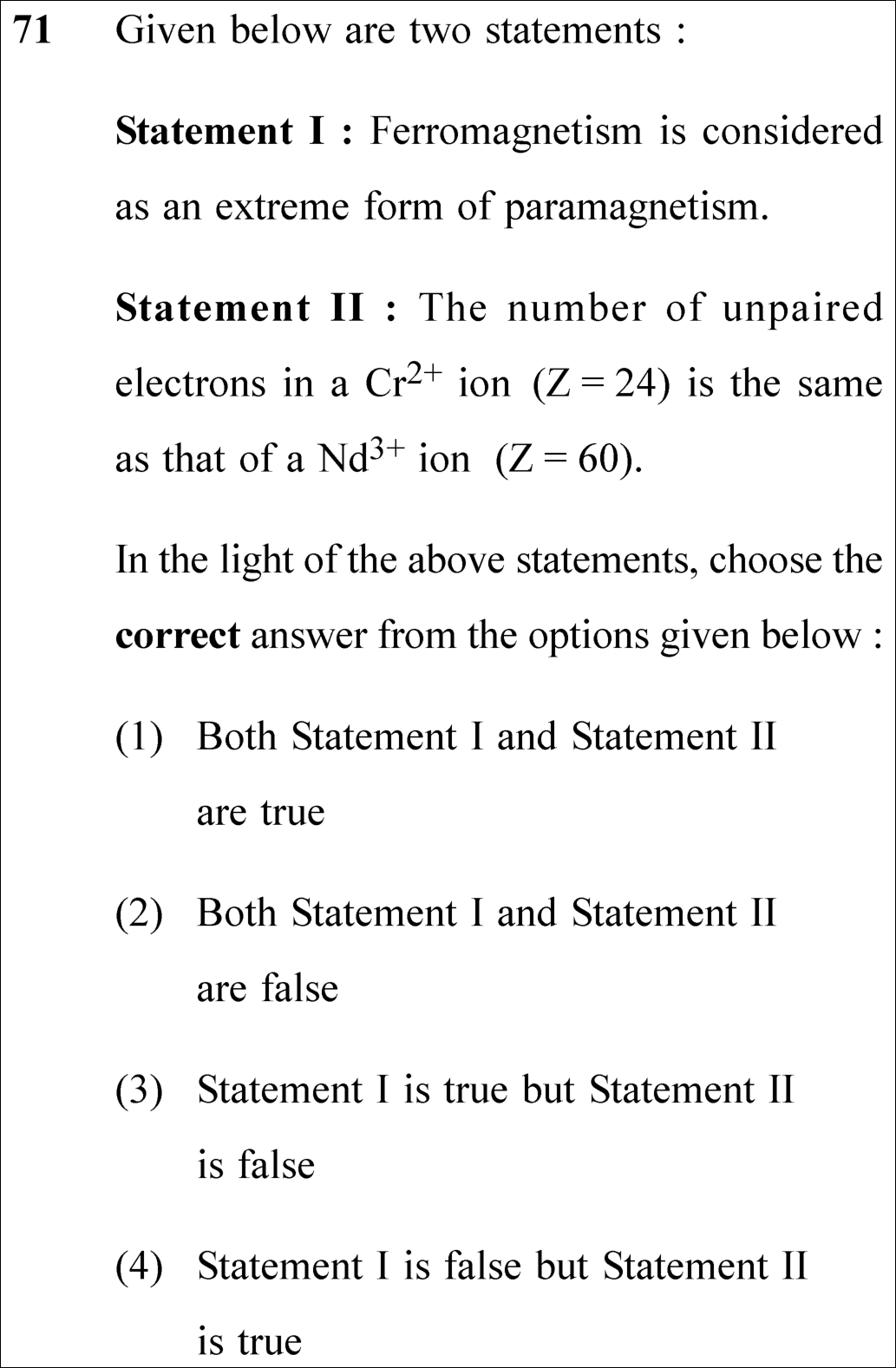
Statement I Ferromagnetism is considered as an extreme form of paramagnetism.
Statement II The number of unpaired electrons in a Cr²⁺ ion (Z = 24) is the same as that of a Nd³⁺ ion (Z = 60).
Statement I is an NCERT verbatim quote: "Ferromagnetism is considered as an extreme form of paramagnetism" (TRUE)! Cr²⁺ (3d⁴) has 4 unpaired electrons. Nd³⁺ (4f³) has 3 unpaired electrons. 4 ≠ 3 ⟹ Statement II is FALSE!
1 Check Statement I: NCERT Chapter 8 Section 8.3.8 states verbatim: "Ferromagnetism is an extreme form of paramagnetism." In ferromagnetic materials, domains spontaneously align parallel, creating permanent magnetization. Statement I is TRUE.
2 Check Statement II: Chromium (Z = 24) has configuration [Ar] 3d⁵ 4s¹. Removing 2 electrons gives Cr²⁺: [Ar] 3d⁴ (n = 4 unpaired electrons).
3 Neodymium (Z = 60) is a lanthanoid with configuration [Xe] 4f⁴ 6s². Removing 3 electrons gives Nd³⁺: [Xe] 4f³ (n = 3 unpaired electrons).
4 Cr²⁺ has 4 unpaired electrons, while Nd³⁺ has 3 unpaired electrons. They are NOT the same! Statement II is FALSE.
5 Conclusion: Statement I is true but Statement II is false.
6 Select Option (3) in under 15 seconds!
🛡️ Why You Can 100% Trust This Shortcut: Oxidation States and Standard Electrode Potentials of 3d Metals (NCERT Chemistry · d- and f-Block Elements).
⚠️
Nd has 4f⁴ 6s². When forming the trivalent ion Nd³⁺, it loses TWO 6s electrons AND ONE 4f electron, leaving 4f³ (3 unpaired electrons)! Students who only remove the two 6s electrons mistakenly get 4f⁴ (4 unpaired electrons) and falsely mark Statement II as true!
🛡️ How to avoid the -1 mark: For M³⁺ lanthanoids, always remove two 6s electrons and one 4f electron: Nd³⁺ is 4f³!
📖
NEET Chemistry Core Syllabus · The d- and f-Block Elements Standard Benchmark
Core Scientific Principle Tested:
"Ferromagnetism is extreme paramagnetism; Cr²⁺ is 3d⁴ (4 unpaired e⁻); Nd³⁺ is 4f³ (3 unpaired e⁻)."
Syllabus Focus: Magnetic Properties & Lanthanoid Electronic Configurations
Cr²⁺ has 4 (3d⁴), Nd³⁺ has 3 (4f³) ⟹ Not equal! Statement I true, II false (Option 3)!